


Krzysztof Penderecki

Encyclopedia
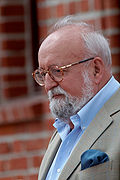
Debica
Dębica is a town in southeastern Poland with 46,693 inhabitants, as of 2 June 2009. It is the capital of Dębica County. Since 1999 it has been situated in the Subcarpathian Voivodeship; it had previously been in the Tarnów Voivodeship .-Area:...
) is a Polish
Poland
Poland , officially the Republic of Poland , is a country in Central Europe bordered by Germany to the west; the Czech Republic and Slovakia to the south; Ukraine, Belarus and Lithuania to the east; and the Baltic Sea and Kaliningrad Oblast, a Russian exclave, to the north...
composer and conductor
Conducting
Conducting is the art of directing a musical performance by way of visible gestures. The primary duties of the conductor are to unify performers, set the tempo, execute clear preparations and beats, and to listen critically and shape the sound of the ensemble...
. His 1960 avant-garde Threnody to the Victims of Hiroshima
Threnody to the Victims of Hiroshima
Threnody to the Victims of Hiroshima is a musical composition for 52 string instruments, composed in 1960 by Krzysztof Penderecki , which took third prize at the Grzegorz Fitelberg Composers' Competition in Katowice in 1960...
for string orchestra brought him to international attention, and this success was followed by acclaim for his choral St. Luke Passion
St. Luke Passion (Penderecki)
The St. Luke Passion is a work for chorus and orchestra written in 1966 by Polish composer Krzysztof Penderecki...
. Both these works exhibit novel compositional techniques. Since the 1970s Penderecki's style has changed to encompass a post-Romantic idiom.
He has won prestigious awards including Grammy Award
Grammy Award
A Grammy Award — or Grammy — is an accolade by the National Academy of Recording Arts and Sciences of the United States to recognize outstanding achievement in the music industry...
s in 1987 and 1998 and 2001, and the Grawemeyer Award for Music Composition
Grawemeyer Award (Music Composition)
The Grawemeyer Award for Music Composition is an annual prize instituted by H. Charles Grawemeyer, industrialist and entrepreneur, at the University of Louisville in 1984. The award was first given in 1985...
in 1992.
As well as the works already mentioned, his compositions include four operas, eight symphonies and other orchestral pieces, a variety of instrumental concertos, choral settings of mainly religious texts, as well as chamber and instrumental works.
Early years
After taking private composition lessons with Franciszek Skolyszewski, Penderecki studied music at Jagiellonian UniversityJagiellonian University
The Jagiellonian University was established in 1364 by Casimir III the Great in Kazimierz . It is the oldest university in Poland, the second oldest university in Central Europe and one of the oldest universities in the world....
and the Academy of Music in Kraków
Academy of Music in Kraków
The Academy of Music in Kraków is a conservatory located in downtown Kraków, Poland.-History:The Academy, until 1945 as a conservatory under the name Cracow Conservatory or Conservatory of the Music Society, was founded in 1888 by the eminent Polish composer Władysław Żeleński thanks to artistic...
under Artur Malawski and Stanislaw Wiechowicz. Having graduated in 1958, he took up a teaching post at the Academy. Penderecki's early works show the influence of Anton Webern
Anton Webern
Anton Webern was an Austrian composer and conductor. He was a member of the Second Viennese School. As a student and significant follower of Arnold Schoenberg, he became one of the best-known exponents of the twelve-tone technique; in addition, his innovations regarding schematic organization of...
and Pierre Boulez
Pierre Boulez
Pierre Boulez is a French composer of contemporary classical music, a pianist, and a conductor.-Early years:Boulez was born in Montbrison, Loire, France. As a child he began piano lessons and demonstrated aptitude in both music and mathematics...
(he has also been influenced by Igor Stravinsky
Igor Stravinsky
Igor Fyodorovich Stravinsky ; 6 April 1971) was a Russian, later naturalized French, and then naturalized American composer, pianist, and conductor....
). Penderecki's international recognition began in 1959 at the Warsaw Autumn
Warsaw Autumn
Warsaw Autumn is the largest international Polish festival of contemporary music. Indeed, for many years, it was the only festival of its type in Central and Eastern Europe. It was founded in 1956 by two composers, Tadeusz Baird and Kazimierz Serocki, and officially established by the Head Board...
with the premieres of the works Strophen, Psalms of David, and Emanations, but the piece that truly brought him to international attention was Threnody to the Victims of Hiroshima
Threnody to the Victims of Hiroshima
Threnody to the Victims of Hiroshima is a musical composition for 52 string instruments, composed in 1960 by Krzysztof Penderecki , which took third prize at the Grzegorz Fitelberg Composers' Competition in Katowice in 1960...
(see threnody
Threnody
A threnody is a song, hymn or poem of mourning composed or performed as a memorial to a dead person. The term originates from the Greek word threnoidia, from threnos + oide ; ultimately, from the Proto-Indo-European root wed- that is also the precursor of such words as "ode", "tragedy", "comedy",...
and atomic bombing of Hiroshima
Atomic bombings of Hiroshima and Nagasaki
During the final stages of World War II in 1945, the United States conducted two atomic bombings against the cities of Hiroshima and Nagasaki in Japan, the first on August 6, 1945, and the second on August 9, 1945. These two events are the only use of nuclear weapons in war to date.For six months...
), written for 52 string instrument
String instrument
A string instrument is a musical instrument that produces sound by means of vibrating strings. In the Hornbostel-Sachs scheme of musical instrument classification, used in organology, they are called chordophones...
s. In it, Penderecki makes use of extended instrumental techniques (for example, playing on the "wrong" side of the bridge, bowing on the tailpiece). There are many novel textures in the work, which makes great use of tone cluster
Tone cluster
A tone cluster is a musical chord comprising at least three consecutive tones in a scale. Prototypical tone clusters are based on the chromatic scale, and are separated by semitones. For instance, three adjacent piano keys struck simultaneously produce a tone cluster...
s. He originally titled the work 8' 37", but decided to dedicate it to the victims of Hiroshima.
Fluorescences followed a year later; it increases the orchestral density with more wind and brass, and an enormous percussion section of 32 instruments for six players including a Mexican güiro, typewriters, gongs and other unusual instruments. The piece was composed for the Donaueschingen Festival
Donaueschingen Festival
The Donaueschingen Festival is a festival for new music that takes place every October in the small town of Donaueschingen...
of contemporary music of 1962, and its performance was regarded as provocative and controversial. Penderecki's intentions at this stage were quite Cagean: 'All I'm interested in is liberating sound beyond all tradition'. This preoccupation with sound culminated in De Natura Sonoris I, which frequently calls upon the orchestra to use non-standard playing techniques to produce original sounds and colours. A sequel, De Natura Sonoris II, was composed in 1971: with its more limited orchestra, it incorporates more elements of post-Romanticism
Romanticism
Romanticism was an artistic, literary and intellectual movement that originated in the second half of the 18th century in Europe, and gained strength in reaction to the Industrial Revolution...
than its predecessor. This foreshadowed Penderecki's renunciation of the avant-garde in the mid-1970s, although both pieces feature dramatic glissandos, dense clusters, and a use of harmonics, and unusual instruments (the musical saw
Musical saw
A musical saw, also called a singing saw, is the application of a hand saw as a musical instrument. The sound creates an ethereal tone, very similar to the theremin...
features in the second piece).
In 1968 he received State Prize 1st class. Due to the jubilee of People's Republic of Poland
People's Republic of Poland
The People's Republic of Poland was the official name of Poland from 1952 to 1990. Although the Soviet Union took control of the country immediately after the liberation from Nazi Germany in 1944, the name of the state was not changed until eight years later...
he received Commander's Cross (1974)and Knight's Cross of Order of Polonia Restituta (1964).
The St. Luke Passion
| Year | Song title | Work | Instrumentation |
|---|---|---|---|
| 1968 1968 in music -Events:*January 4 – Guitarist Jimi Hendrix is jailed by Stockholm police, after trashing a hotel room during a drunken fist fight with bassist Noel Redding.*January 6 – Gibson Guitar Corporation patents its Gibson Flying V electric guitar design.... : |
"Miserere mei, Deus" |
Saint Luke Passion | Chorus |
The large-scale St. Luke Passion
St. Luke Passion (Penderecki)
The St. Luke Passion is a work for chorus and orchestra written in 1966 by Polish composer Krzysztof Penderecki...
(1963–66) brought Penderecki further popular acclaim, not least because it was devoutly religious, yet written in an avant-garde musical language, composed within Communist Eastern Europe. Western audiences saw it as a snub to the Soviet authorities. Various different musical styles can be seen in the piece. The experimental textures, such as were seen in the Threnody, are balanced by the work's Baroque
Baroque music
Baroque music describes a style of Western Classical music approximately extending from 1600 to 1760. This era follows the Renaissance and was followed in turn by the Classical era...
form and the occasional use of more traditional harmonic
Harmony
In music, harmony is the use of simultaneous pitches , or chords. The study of harmony involves chords and their construction and chord progressions and the principles of connection that govern them. Harmony is often said to refer to the "vertical" aspect of music, as distinguished from melodic...
and melodic
Melody
A melody , also tune, voice, or line, is a linear succession of musical tones which is perceived as a single entity...
writing. Penderecki makes use of serialism
Serialism
In music, serialism is a method or technique of composition that uses a series of values to manipulate different musical elements. Serialism began primarily with Arnold Schoenberg's twelve-tone technique, though his contemporaries were also working to establish serialism as one example of...
in this piece, and one of the tone rows he uses includes the BACH motif
BACH motif
In music, the BACH motif is the motif, a succession of notes important or characteristic to a piece, B flat, A, C, B natural. In German musical nomenclature, in which the note B natural is written as H and the B flat as B, it forms Johann Sebastian Bach's family name...
, which acts as a bridge between the conventional and more experimental elements. The Stabat Mater section towards the end of the piece concludes on a simple major chord
Chord (music)
A chord in music is any harmonic set of two–three or more notes that is heard as if sounding simultaneously. These need not actually be played together: arpeggios and broken chords may for many practical and theoretical purposes be understood as chords...
of D major, and this gesture is repeated at the very end of the work, which finishes on a triumphant E major chord. These are the only tonal harmonies in the work, and both come as a surprise to the listener; Penderecki's use of tonal triads such as these remains a controversial aspect of the work.
Penderecki continued to write pieces that explored the sacred in music. In the early 1970s he wrote a Dies Irae
Dies Irae
Dies Irae is a thirteenth century Latin hymn thought to be written by Thomas of Celano . It is a medieval Latin poem characterized by its accentual stress and its rhymed lines. The metre is trochaic...
, a version of the Magnificat, and Canticum Canticorum, a song of songs for chorus and orchestra.
1970s-present
Around the mid-1970s, while he was a professor at the Yale School of MusicYale School of Music
The Yale School of Music is one of the twelve professional schools at Yale University and one of the premier music conservatories in the world....
, Penderecki's style began to change. The Violin Concerto
Violin concerto
A violin concerto is a concerto for solo violin and instrumental ensemble, customarily orchestra. Such works have been written since the Baroque period, when the solo concerto form was first developed, up through the present day...
No. 1 largely leaves behind the dense tone clusters with which he had been associated, and instead focuses on two melodic
Melody
A melody , also tune, voice, or line, is a linear succession of musical tones which is perceived as a single entity...
intervals: the semitone
Semitone
A semitone, also called a half step or a half tone, is the smallest musical interval commonly used in Western tonal music, and it is considered the most dissonant when sounded harmonically....
and the tritone
Tritone
In classical music from Western culture, the tritone |tone]]) is traditionally defined as a musical interval composed of three whole tones. In a chromatic scale, each whole tone can be further divided into two semitones...
. Some commentators compared this new direction to Anton Bruckner
Anton Bruckner
Anton Bruckner was an Austrian composer known for his symphonies, masses, and motets. The first are considered emblematic of the final stage of Austro-German Romanticism because of their rich harmonic language, complex polyphony, and considerable length...
. This direction continued with the Symphony No. 2, Christmas (1980), which is harmonically and melodically quite straightforward. It makes frequent use of the tune of the Christmas carol
Christmas carol
A Christmas carol is a carol whose lyrics are on the theme of Christmas or the winter season in general and which are traditionally sung in the period before Christmas.-History:...
Silent Night.
Penderecki explained this shift by stating that he had come to feel that the experimentation of the avant-garde had gone too far from the expressive, non-formal qualities of Western music: 'The avant-garde gave one an illusion of universalism. The musical world of Stockhausen, Nono
Luigi Nono
Luigi Nono was an Italian avant-garde composer of classical music and remains one of the most prominent composers of the 20th century.- Early years :Born in Venice, he was a member of a wealthy artistic family, and his grandfather was a notable painter...
, Boulez and Cage was for us, the young - hemmed in by the aesthetics of socialist realism, then the official canon in our country - a liberation...I was quick to realise however, that this novelty, this experimentation and formal speculation, is more destructive than constructive; I realised the Utopian quality of its Promethean tone'. Penderecki concluded that he was 'saved from the avant-garde snare of formalism by a return to tradition'.
In 1980, Penderecki was commissioned by Solidarity to compose a piece to accompany the unveiling of a statue at the Gdańsk
Gdansk
Gdańsk is a Polish city on the Baltic coast, at the centre of the country's fourth-largest metropolitan area.The city lies on the southern edge of Gdańsk Bay , in a conurbation with the city of Gdynia, spa town of Sopot, and suburban communities, which together form a metropolitan area called the...
shipyards to commemorate those killed in anti-government riots there in 1970. Penderecki responded with Lacrimosa, which he later expanded into one of the best known works of his later period, the Polish Requiem
Polish Requiem
Polish Requiem is a large scale Requiem Mass for soloists, mixed choir and orchestra by Krzysztof Penderecki, originally composed between 1980 and 1984, revised and expanded in 1993, and expanded again in 2005 with the additional movement, Ciaccona...
(1980–84, 1993, 2005). Again the harmonies are rich, although there are moments which recall his work in the 1960s. In recent years, he has tended towards more traditionally conceived tonal constructs, as heard in works like the Cello Concerto No. 2 and the Credo. He conducted Credo on the occasion of the 70th birthday of Helmuth Rilling
Helmuth Rilling
Helmuth Rilling is an internationally known German choral conductor, founder of the Gächinger Kantorei , the Bach-Collegium Stuttgart , the Oregon Bach Festival , the Internationale Bachakademie Stuttgart and other Bach Academies worldwide, and the "Festival Ensemble Stuttgart"...
, 29 May 2003.
In celebration of his 75th birthday he conducted three of his works at the Rheingau Musik Festival
Rheingau Musik Festival
The Rheingau Musik Festival is an international summer music festival in Germany, founded in 1987. It is mostly for classical music, but includes other genres...
in 2008, among them Ciaccona from the Polish Requiem.
In 2001, Penderecki's Credo received the Grammy Award
Grammy Award
A Grammy Award — or Grammy — is an accolade by the National Academy of Recording Arts and Sciences of the United States to recognize outstanding achievement in the music industry...
for best choral performance for the world-premiere recording made by the Oregon Bach Festival
Oregon Bach Festival
The Oregon Bach Festival is an annual celebration of the works of Johann Sebastian Bach and his musical legacy, held in Eugene, Oregon, United States, in late June and early July. The artistic director is German organist and conductor Helmuth Rilling and the Executive Director is John Evans,...
, which commissioned the piece. The same year, Penderecki was awarded with the Prince of Asturias Prize in Spain, one of the highest honours given in Spain to individuals, entities, organizations or others from around the world who make notable achievements in the sciences, arts, humanities, or public affairs. Invited by Walter Fink
Walter Fink
Walter Fink is a German retired executive and a patron of Contemporary music. He is mostly known for being a founding member, Executive Committee member and sponsor of the Rheingau Musik Festival.- Biography :...
, he was the eleventh composer featured in the annual Komponistenporträt of the Rheingau Musik Festival in 2001. Penderecki received an honorary doctorate from the Seoul National University
Seoul National University
Seoul National University , colloquially known in Korean as Seoul-dae , is a national research university in Seoul, Korea, ranked 24th in the world in publications in an analysis of data from the Science Citation Index, 7th in Asia and 42nd in the world by the 2011 QS World University Rankings...
, Korea in 2005, as well as from the University of Münster
University of Münster
The University of Münster is a public university located in the city of Münster, North Rhine-Westphalia in Germany. The WWU is part of the Deutsche Forschungsgemeinschaft, a society of Germany's leading research universities...
, Germany in 2006. His notable students include Chester Biscardi
Chester Biscardi
Chester Biscardi is an Italian American composer and educator.He received a B.A. degree in English literature from the University of Wisconsin–Madison ; he studied during 1969-1970 at the University of Bologna and the Conservatorio di Musica "G. B. Martini"; he received an M.A...
and Walter Mays.
Penderecki has three children, a daughter from his first marriage, and a son and daughter with his current wife, Elżbieta Solecka, whom he married in 1965.He lives in the Kraków suburb of Wola Justowska
Wola Justowska
Wola Justowska is an area belonging to Zwierzyniec District Nº. VII of Kraków, Poland. It was previously a village known as Wola Chełmska until the 16th century. It became part of metropolitan Kraków in 1941....
. He is working on an opera based on Phèdre
Phèdre
Phèdre is a dramatic tragedy in five acts written in alexandrine verse by Jean Racine, first performed in 1677.-Composition and premiere:...
by Racine for 2014 and wishes to write a 9th symphony.
Work
Penderecki's compositions include operas, symphonies, choral works, as well as chamber and instrumental music.Use
Some of Penderecki's music has been adapted for film soundtracks. The ShiningThe Shining (film)
The Shining is a 1980 psychological horror film produced and directed by Stanley Kubrick, co-written with novelist Diane Johnson, and starring Jack Nicholson, Shelley Duvall, and Danny Lloyd. The film is based on the novel of the same name by Stephen King. A writer, Jack Torrance, takes a job as an...
(1980) features six pieces of Penderecki's music: Utrenja II: Ewangelia, Utrenja II: Kanon Paschy, The Awakening of Jacob, De Natura Sonoris No. 1, De Natura Sonoris No. 2 and Polymorphia
Polymorphia
Polymorphia is a musical composition for 48 string instruments composed by the Polish composer Krzysztof Penderecki in 1961. The piece was commissioned by the North German Radio Hamburg. It premiered on April 16, 1962 by the radio orchestra and was conducted by Andrzej Markowski...
. The Exorcist
The Exorcist (film)
The Exorcist is a 1973 American horror film directed by William Friedkin, adapted from the 1971 novel of the same name by William Peter Blatty and based on the exorcism case of Robbie Mannheim, dealing with the demonic possession of a young girl and her mother’s desperate attempts to win back her...
(1973) features Polymorphia
Polymorphia
Polymorphia is a musical composition for 48 string instruments composed by the Polish composer Krzysztof Penderecki in 1961. The piece was commissioned by the North German Radio Hamburg. It premiered on April 16, 1962 by the radio orchestra and was conducted by Andrzej Markowski...
as well as his String Quartet and Kanon For Orchestra and Tape; fragments of the Cello Concerto and The Devils of Loudun
The Devils of Loudun (opera)
The Devils of Loudun is an opera in three acts written in between 1968-69 by Polish composer Krzysztof Penderecki. The work was commissioned by the Hamburg State Opera, which consequently gave the premiere on June 20, 1969...
are also used in the film. Writing about The Exorcist, the film critic for The New Republic wrote "even the music is faultless, most of it by Krzysztof Penderecki, who at last is where he belongs." David Lynch
David Lynch
David Keith Lynch is an American filmmaker, television director, visual artist, musician and occasional actor. Known for his surrealist films, he has developed his own unique cinematic style, which has been dubbed "Lynchian", and which is characterized by its dream imagery and meticulous sound...
has used Penderecki's music in the soundtracks of the movies Wild at Heart
Wild at Heart (film)
Wild at Heart is a 1990 American film written and directed by David Lynch, and based on Barry Gifford's 1989 novel Wild at Heart: The Story of Sailor and Lula. Both the book and the film revolve around Sailor Ripley and Lula Pace Fortune , a young couple from Cape Fear, North Carolina who go on...
(1990) and Inland Empire
Inland Empire (film)
Inland Empire, sometimes styled as INLAND EMPIRE, is a 2006 mystery film written and directed by David Lynch. It was his first feature-length film since 2001's Mulholland Drive, and shares many similarities with that film. It premiered in Italy at the Venice Film Festival on September 6, 2006...
(2006). In the film Fearless
Fearless (1993 film)
Fearless is a 1993 film directed by Peter Weir and written by Rafael Yglesias from his novel of the same name. It was shot entirely in California....
by Peter Weir
Peter Weir
Peter Lindsay Weir, AM is an Australian film director. After playing a leading role in the Australian New Wave cinema with his films such as Picnic at Hanging Rock, The Last Wave and Gallipoli, Weir directed a diverse group of American and international films—many of them major box office...
, the piece Polymorphia
Polymorphia
Polymorphia is a musical composition for 48 string instruments composed by the Polish composer Krzysztof Penderecki in 1961. The piece was commissioned by the North German Radio Hamburg. It premiered on April 16, 1962 by the radio orchestra and was conducted by Andrzej Markowski...
was once again used for an intense plane crash scene seen from the point of view of the passenger played by Jeff Bridges
Jeff Bridges
Jeffrey Leon "Jeff" Bridges is an American actor and musician. He won the Academy Award for Best Actor for his role as Otis "Bad" Blake in the 2009 film Crazy Heart....
. Penderecki's piece, Threnody for the Victims of Hiroshima, was also used during one of the final sequences in the film Children of Men
Children of Men
Children of Men is a 2006 science fiction film loosely adapted from P. D. James's 1992 novel The Children of Men, directed by Alfonso Cuarón. In 2027, two decades of human infertility have left society on the brink of collapse. Illegal immigrants seek sanctuary in England, where the last...
. Penderecki composed music for Andrzej Wajda
Andrzej Wajda
Andrzej Wajda is a Polish film director. Recipient of an honorary Oscar, he is possibly the most prominent member of the unofficial "Polish Film School"...
's 2007 film Katyń
Katyn (film)
Katyń is a 2007 Polish film about the 1940 Katyn massacre, directed by Academy Honorary Award winner Andrzej Wajda. It is based on the book Post Mortem: The Story of Katyn by Andrzej Mularczyk...
, while Martin Scorsese
Martin Scorsese
Martin Charles Scorsese is an American film director, screenwriter, producer, actor, and film historian. In 1990 he founded The Film Foundation, a nonprofit organization dedicated to film preservation, and in 2007 he founded the World Cinema Foundation...
's Shutter Island featured his Symphony No. 3
Symphony No. 3 (Penderecki)
Symphony No. 3 is a symphony for orchestra in five movements composed between 1988 and 1995 by Krzysztof Penderecki. It was commissioned and completed for the 100 year celebration of the Munich Philharmonic...
and Fluorescences.
Sources
- Penderecki, Krzysztof by Adrian Thomas, in 'The New Grove Dictionary of OperaNew Grove Dictionary of OperaThe New Grove Dictionary of Opera is an encyclopedia of opera, considered to be one of the best general reference sources on the subject. It is the largest work on opera in English, and in its printed form, amounts to 5,448 pages in four volumes....
', ed. Stanley Sadie (London, 1992) ISBN 0-333-73432-7
External links
- Penderecki's official home page (in Polish)
- Penderecki page at the Polish Music Center (last updated 2001)
- Penderecki homepage maintained by Schott MusicSchott MusicSchott Music is one of the oldest German music publishers. It is also one of the largest music publishing houses in Europe and is currently the second oldest music publishing house. The company headquarters of Schott Music was founded by Bernhard Schott in Mainz, Germany in 1770.Established in...
publishers (German/English) - Krzysztof Penderecki interview by Bruce Duffie (March 2000)
- Interview with Krzysztof Penderecki by Galina Zhukova (2011), Журнал «reMusik», Saint-Petersburg Contemporary Music Center.
- Sheet Music - 3 Miniatures For Clarinet with Piano (1956). Krzysztof Penderecki