

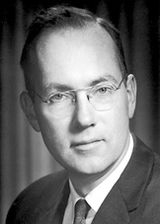
Charles Hard Townes

Encyclopedia
Charles Hard Townes is an American
Nobel Prize-winning
physicist
and educator. Townes is known for his work on the theory and application of the maser
, on which he got the fundamental patent, and other work in quantum electronics connected with both maser and laser
devices. He shared the Nobel Prize in Physics
in 1964 with Nikolay Basov
and Alexander Prokhorov. The Japanese FM Towns
computer and game console is named in his honour.
on July 28, 1915, the son of Henry Keith Townes, an attorney, and Ellen (Hard) Townes. He attended the Greenville public schools and then Furman University
in Greenville, where he completed the requirements for the Bachelor of Science degree in Physics and the Bachelor of Arts degree in Modern Languages, graduating summa cum laude in 1935, at the age of 19. Physics had fascinated him since his first course in the subject during his sophomore year in college because of its "beautifully logical structure". He was also interested in natural history while at Furman, serving as curator of the museum, and working during the summers as collector for Furman's biology camp. In addition, he was busy with other activities, including the swimming team, the college newspaper and the football band.
Townes completed work for the Master of Arts degree in Physics at Duke University
in 1936, and then entered graduate school at the California Institute of Technology
, where he received the Ph.D. degree in 1939 with a thesis on isotope separation
and nuclear spins.
A member of the technical staff of Bell Telephone Laboratories from 1933 to 1947, Townes worked extensively during World War II
in designing radar bombing systems and has a number of patents in related technology. From this he turned his attention to applying the microwave
technique of wartime radar research to spectroscopy
, which he foresaw as providing a powerful new tool for the study of the structure of atoms and molecules and as a potential new basis for controlling electromagnetic waves.
At Columbia University
, where he was appointed to the faculty in 1948, he continued research in microwave physics, particularly studying the interactions between microwaves and molecules, and using microwave spectra for the study of the structure of molecules, atoms, and nuclei. In 1951, Townes conceived the idea of the maser, and a few months later he and his associates began working on a device using ammonia
gas as the active medium. In early 1954, the first amplification and generation of electromagnetic waves by stimulated emission were obtained. Townes and his students coined the word "maser
" for this device, which is an acronym for microwave amplification by stimulated emission of radiation. In 1958, Townes and his brother-in-law, Dr. Arthur Leonard Schawlow
, for some time a professor at Stanford University
but now deceased, showed theoretically that masers could be made to operate in the optical and infrared region and proposed how this could be accomplished in particular systems. This work resulted in their joint paper on optical and infrared
masers, or lasers (light amplification by stimulated emission of radiation). Other research has been in the fields of nonlinear optics, radio astronomy, and infrared astronomy. He and his assistants detected the first complex molecules in the interstellar medium
and first measured the mass of the black hole
in the center of our galaxy
.
Having joined the faculty at Columbia University
as Associate Professor of Physics in 1948, Townes was appointed Professor in 1950. He served as Executive Director of the Columbia Radiation Laboratory from 1950 to 1952 and was Chairman of the Physics Department from 1952 to 1955.
From 1959 to 1961, he was on leave of absence from Columbia University to serve as Vice President and Director of Research of the Institute for Defense Analyses
in Washington, D.C., a nonprofit organization which advised the U.S. government and was operated by eleven universities.
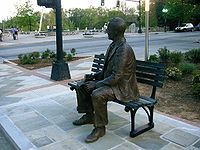 In 1961, Townes was appointed Provost
and Professor of Physics at the Massachusetts Institute of Technology
(M.I.T). As Provost he shared with the President responsibility for general supervision of the educational and research programs of the Institute. In 1966, he became Institute Professor at M.I.T., and later in the same year resigned from the position of Provost in order to return to more intensive research, particularly in the fields of quantum electronics and astronomy
. He was appointed University Professor at the University of California
in 1967. In this position Townes is participating in teaching, research, and other activities on several campuses of the University, although he is located at the Berkeley
campus.
During 1955 and 1956, Townes was a Guggenheim Fellow and a Fulbright Lecturer, first at the University of Paris
and then at the University of Tokyo. He was National Lecturer for Sigma Xi and also taught during summer sessions at the University of Michigan
and at the Enrico Fermi International School of Physics in Italy, serving as Director for a session in 1963 on coherent light. In the fall of 1963, he was Scott Lecture at the University of Toronto
. More recently (2002–2003) he has been the Karl Schwarzschild Lecturer in Germany and the Birla Lecturer and Schroedinger Lecturer in India
.
In addition to the Nobel Prize
, Townes has received the Templeton Prize
, for contributions to the understanding of religion, and a number of other prizes as well as 27 honorary degrees from various universities.
Townes has served on a number of scientific committees advising governmental agencies and has been active in professional societies. This includes being a member, and vice chairman, of the Science Advisory Committee to the President of the U.S., Chairman of the Advisory Committee for the first human landing on the moon, and chairman of the Defense Department’s Committee on the MX missile. He also served on the boards of General Motors and of the Perkin Elmer Corporation.
Townes and his wife (the former Frances H. Brown; they married in 1941) live in Berkeley, California. They have four daughters: Linda Rosenwein, Ellen Anderson, Carla Kessler, and Holly Townes.
, the first astronomical interferometer to operate in the mid-infrared. He continues researching into astrophysics
and astronomy
at the University of California, Berkeley
. With Arthur Leonard Schawlow
, he wrote the book Microwave Spectroscopy, published in 1955.
During his time at Bell Labs
Townes was asked to help with the development of a new radar
system for aircraft in World War II. He never served in the military, but felt he was helping his country from within the lab. Townes and his team were successful in creating more accurate and precise radar systems, but none of them were ever mass produced by the military. Some of the new systems developed were used as prototypes in early B-52 bombers
. After the war, Townes continued to work at Bell Labs, creating new radar by experimenting with different radio wavelengths.
Moving from Bell Labs in 1948, to the physics department of Columbia University
allowed Townes to return to experimental physics and away from the applications of physics. At Columbia, his research was still partially funded by the US Navy’s desire for even smaller radar. At Bell Labs Townes helped develop a radar system with a 1.25 centimeter wavelength. After moving to Columbia, the military wanted radar systems with wavelengths only a few millimeters. The shortening of the wavelength led Townes and his colleagues to focus on microwave research. In 1951, the idea of the maser
was proposed to Townes' superiors. After three years and many experiments, Townes and Jim Gordon created a working maser.
, Townes considers that "science and religion [are] quite parallel, much more similar than most people think and that in the long run, they must converge". In 2005, he was awarded the Templeton Prize
for "Progress Toward Research or Discoveries about Spiritual Realities."
United States
The United States of America is a federal constitutional republic comprising fifty states and a federal district...
Nobel Prize-winning
Nobel Prize
The Nobel Prizes are annual international awards bestowed by Scandinavian committees in recognition of cultural and scientific advances. The will of the Swedish chemist Alfred Nobel, the inventor of dynamite, established the prizes in 1895...
physicist
Physicist
A physicist is a scientist who studies or practices physics. Physicists study a wide range of physical phenomena in many branches of physics spanning all length scales: from sub-atomic particles of which all ordinary matter is made to the behavior of the material Universe as a whole...
and educator. Townes is known for his work on the theory and application of the maser
Maser
A maser is a device that produces coherent electromagnetic waves through amplification by stimulated emission. Historically, “maser” derives from the original, upper-case acronym MASER, which stands for "Microwave Amplification by Stimulated Emission of Radiation"...
, on which he got the fundamental patent, and other work in quantum electronics connected with both maser and laser
Laser
A laser is a device that emits light through a process of optical amplification based on the stimulated emission of photons. The term "laser" originated as an acronym for Light Amplification by Stimulated Emission of Radiation...
devices. He shared the Nobel Prize in Physics
Nobel Prize in Physics
The Nobel Prize in Physics is awarded once a year by the Royal Swedish Academy of Sciences. It is one of the five Nobel Prizes established by the will of Alfred Nobel in 1895 and awarded since 1901; the others are the Nobel Prize in Chemistry, Nobel Prize in Literature, Nobel Peace Prize, and...
in 1964 with Nikolay Basov
Nikolay Basov
Nikolay Gennadiyevich Basov was a Soviet physicist and educator. For his fundamental work in the field of quantum electronics that led to the development of laser and maser, Basov shared the 1964 Nobel Prize in Physics with Alexander Prokhorov and Charles Hard Townes.-Early life:Basov was born in...
and Alexander Prokhorov. The Japanese FM Towns
FM Towns
The FM Towns system is a Japanese PC variant, built by Fujitsu from February 1989 to the summer of 1997. It started as a proprietary PC variant intended for multimedia applications and PC games, but later became more compatible with regular PCs...
computer and game console is named in his honour.
Biography
Townes was born in Greenville, South CarolinaGreenville, South Carolina
-Law and government:The city of Greenville adopted the Council-Manager form of municipal government in 1976.-History:The area was part of the Cherokee Nation's protected grounds after the Treaty of 1763, which ended the French and Indian War. No White man was allowed to enter, though some families...
on July 28, 1915, the son of Henry Keith Townes, an attorney, and Ellen (Hard) Townes. He attended the Greenville public schools and then Furman University
Furman University
Furman University is a selective, private, coeducational, liberal arts college in Greenville, South Carolina, United States. Furman is one of the oldest, and more selective private institutions in South Carolina...
in Greenville, where he completed the requirements for the Bachelor of Science degree in Physics and the Bachelor of Arts degree in Modern Languages, graduating summa cum laude in 1935, at the age of 19. Physics had fascinated him since his first course in the subject during his sophomore year in college because of its "beautifully logical structure". He was also interested in natural history while at Furman, serving as curator of the museum, and working during the summers as collector for Furman's biology camp. In addition, he was busy with other activities, including the swimming team, the college newspaper and the football band.
Townes completed work for the Master of Arts degree in Physics at Duke University
Duke University
Duke University is a private research university located in Durham, North Carolina, United States. Founded by Methodists and Quakers in the present day town of Trinity in 1838, the school moved to Durham in 1892. In 1924, tobacco industrialist James B...
in 1936, and then entered graduate school at the California Institute of Technology
California Institute of Technology
The California Institute of Technology is a private research university located in Pasadena, California, United States. Caltech has six academic divisions with strong emphases on science and engineering...
, where he received the Ph.D. degree in 1939 with a thesis on isotope separation
Isotope separation
Isotope separation is the process of concentrating specific isotopes of a chemical element by removing other isotopes, for example separating natural uranium into enriched uranium and depleted uranium. This is a crucial process in the manufacture of uranium fuel for nuclear power stations, and is...
and nuclear spins.
A member of the technical staff of Bell Telephone Laboratories from 1933 to 1947, Townes worked extensively during World War II
World War II
World War II, or the Second World War , was a global conflict lasting from 1939 to 1945, involving most of the world's nations—including all of the great powers—eventually forming two opposing military alliances: the Allies and the Axis...
in designing radar bombing systems and has a number of patents in related technology. From this he turned his attention to applying the microwave
Microwave
Microwaves, a subset of radio waves, have wavelengths ranging from as long as one meter to as short as one millimeter, or equivalently, with frequencies between 300 MHz and 300 GHz. This broad definition includes both UHF and EHF , and various sources use different boundaries...
technique of wartime radar research to spectroscopy
Spectroscopy
Spectroscopy is the study of the interaction between matter and radiated energy. Historically, spectroscopy originated through the study of visible light dispersed according to its wavelength, e.g., by a prism. Later the concept was expanded greatly to comprise any interaction with radiative...
, which he foresaw as providing a powerful new tool for the study of the structure of atoms and molecules and as a potential new basis for controlling electromagnetic waves.
At Columbia University
Columbia University
Columbia University in the City of New York is a private, Ivy League university in Manhattan, New York City. Columbia is the oldest institution of higher learning in the state of New York, the fifth oldest in the United States, and one of the country's nine Colonial Colleges founded before the...
, where he was appointed to the faculty in 1948, he continued research in microwave physics, particularly studying the interactions between microwaves and molecules, and using microwave spectra for the study of the structure of molecules, atoms, and nuclei. In 1951, Townes conceived the idea of the maser, and a few months later he and his associates began working on a device using ammonia
Ammonia
Ammonia is a compound of nitrogen and hydrogen with the formula . It is a colourless gas with a characteristic pungent odour. Ammonia contributes significantly to the nutritional needs of terrestrial organisms by serving as a precursor to food and fertilizers. Ammonia, either directly or...
gas as the active medium. In early 1954, the first amplification and generation of electromagnetic waves by stimulated emission were obtained. Townes and his students coined the word "maser
Maser
A maser is a device that produces coherent electromagnetic waves through amplification by stimulated emission. Historically, “maser” derives from the original, upper-case acronym MASER, which stands for "Microwave Amplification by Stimulated Emission of Radiation"...
" for this device, which is an acronym for microwave amplification by stimulated emission of radiation. In 1958, Townes and his brother-in-law, Dr. Arthur Leonard Schawlow
Arthur Leonard Schawlow
Arthur Leonard Schawlow was an American physicist. He is best remembered for his work on lasers, for which he shared the 1981 Nobel Prize in Physics with Nicolaas Bloembergen and Kai Siegbahn.-Biography:...
, for some time a professor at Stanford University
Stanford University
The Leland Stanford Junior University, commonly referred to as Stanford University or Stanford, is a private research university on an campus located near Palo Alto, California. It is situated in the northwestern Santa Clara Valley on the San Francisco Peninsula, approximately northwest of San...
but now deceased, showed theoretically that masers could be made to operate in the optical and infrared region and proposed how this could be accomplished in particular systems. This work resulted in their joint paper on optical and infrared
Infrared
Infrared light is electromagnetic radiation with a wavelength longer than that of visible light, measured from the nominal edge of visible red light at 0.74 micrometres , and extending conventionally to 300 µm...
masers, or lasers (light amplification by stimulated emission of radiation). Other research has been in the fields of nonlinear optics, radio astronomy, and infrared astronomy. He and his assistants detected the first complex molecules in the interstellar medium
Interstellar medium
In astronomy, the interstellar medium is the matter that exists in the space between the star systems in a galaxy. This matter includes gas in ionic, atomic, and molecular form, dust, and cosmic rays. It fills interstellar space and blends smoothly into the surrounding intergalactic space...
and first measured the mass of the black hole
Black hole
A black hole is a region of spacetime from which nothing, not even light, can escape. The theory of general relativity predicts that a sufficiently compact mass will deform spacetime to form a black hole. Around a black hole there is a mathematically defined surface called an event horizon that...
in the center of our galaxy
Galaxy
A galaxy is a massive, gravitationally bound system that consists of stars and stellar remnants, an interstellar medium of gas and dust, and an important but poorly understood component tentatively dubbed dark matter. The word galaxy is derived from the Greek galaxias , literally "milky", a...
.
Having joined the faculty at Columbia University
Columbia University
Columbia University in the City of New York is a private, Ivy League university in Manhattan, New York City. Columbia is the oldest institution of higher learning in the state of New York, the fifth oldest in the United States, and one of the country's nine Colonial Colleges founded before the...
as Associate Professor of Physics in 1948, Townes was appointed Professor in 1950. He served as Executive Director of the Columbia Radiation Laboratory from 1950 to 1952 and was Chairman of the Physics Department from 1952 to 1955.
From 1959 to 1961, he was on leave of absence from Columbia University to serve as Vice President and Director of Research of the Institute for Defense Analyses
Institute for Defense Analyses
The Institute for Defense Analyses is a non-profit corporation that administers three federally funded research and development centers to assist the United States government in addressing important national security issues, particularly those requiring scientific and technical expertise...
in Washington, D.C., a nonprofit organization which advised the U.S. government and was operated by eleven universities.
Provost (education)
A provost is the senior academic administrator at many institutions of higher education in the United States, Canada and Australia, the equivalent of a pro-vice-chancellor at some institutions in the United Kingdom and Ireland....
and Professor of Physics at the Massachusetts Institute of Technology
Massachusetts Institute of Technology
The Massachusetts Institute of Technology is a private research university located in Cambridge, Massachusetts. MIT has five schools and one college, containing a total of 32 academic departments, with a strong emphasis on scientific and technological education and research.Founded in 1861 in...
(M.I.T). As Provost he shared with the President responsibility for general supervision of the educational and research programs of the Institute. In 1966, he became Institute Professor at M.I.T., and later in the same year resigned from the position of Provost in order to return to more intensive research, particularly in the fields of quantum electronics and astronomy
Astronomy
Astronomy is a natural science that deals with the study of celestial objects and phenomena that originate outside the atmosphere of Earth...
. He was appointed University Professor at the University of California
University of California
The University of California is a public university system in the U.S. state of California. Under the California Master Plan for Higher Education, the University of California is a part of the state's three-tier public higher education system, which also includes the California State University...
in 1967. In this position Townes is participating in teaching, research, and other activities on several campuses of the University, although he is located at the Berkeley
University of California, Berkeley
The University of California, Berkeley , is a teaching and research university established in 1868 and located in Berkeley, California, USA...
campus.
During 1955 and 1956, Townes was a Guggenheim Fellow and a Fulbright Lecturer, first at the University of Paris
University of Paris
The University of Paris was a university located in Paris, France and one of the earliest to be established in Europe. It was founded in the mid 12th century, and officially recognized as a university probably between 1160 and 1250...
and then at the University of Tokyo. He was National Lecturer for Sigma Xi and also taught during summer sessions at the University of Michigan
University of Michigan
The University of Michigan is a public research university located in Ann Arbor, Michigan in the United States. It is the state's oldest university and the flagship campus of the University of Michigan...
and at the Enrico Fermi International School of Physics in Italy, serving as Director for a session in 1963 on coherent light. In the fall of 1963, he was Scott Lecture at the University of Toronto
University of Toronto
The University of Toronto is a public research university in Toronto, Ontario, Canada, situated on the grounds that surround Queen's Park. It was founded by royal charter in 1827 as King's College, the first institution of higher learning in Upper Canada...
. More recently (2002–2003) he has been the Karl Schwarzschild Lecturer in Germany and the Birla Lecturer and Schroedinger Lecturer in India
India
India , officially the Republic of India , is a country in South Asia. It is the seventh-largest country by geographical area, the second-most populous country with over 1.2 billion people, and the most populous democracy in the world...
.
In addition to the Nobel Prize
Nobel Prize
The Nobel Prizes are annual international awards bestowed by Scandinavian committees in recognition of cultural and scientific advances. The will of the Swedish chemist Alfred Nobel, the inventor of dynamite, established the prizes in 1895...
, Townes has received the Templeton Prize
Templeton Prize
The Templeton Prize is an annual award presented by the Templeton Foundation. Established in 1972, it is awarded to a living person who, in the estimation of the judges, "has made an exceptional contribution to affirming life's spiritual dimension, whether through insight, discovery, or practical...
, for contributions to the understanding of religion, and a number of other prizes as well as 27 honorary degrees from various universities.
Townes has served on a number of scientific committees advising governmental agencies and has been active in professional societies. This includes being a member, and vice chairman, of the Science Advisory Committee to the President of the U.S., Chairman of the Advisory Committee for the first human landing on the moon, and chairman of the Defense Department’s Committee on the MX missile. He also served on the boards of General Motors and of the Perkin Elmer Corporation.
Townes and his wife (the former Frances H. Brown; they married in 1941) live in Berkeley, California. They have four daughters: Linda Rosenwein, Ellen Anderson, Carla Kessler, and Holly Townes.
Research
Charlie Townes was the lead researcher in the construction of the Infrared Spatial InterferometerInfrared Spatial Interferometer
The Infrared Spatial Interferometer is an astronomical interferometer array of three 65 inch telescopes operating in the mid-infrared. The telescopes are fully mobile and their current site on Mount Wilson allows for placements as far as 70 m apart, giving the resolution of a telescope of that...
, the first astronomical interferometer to operate in the mid-infrared. He continues researching into astrophysics
Astrophysics
Astrophysics is the branch of astronomy that deals with the physics of the universe, including the physical properties of celestial objects, as well as their interactions and behavior...
and astronomy
Astronomy
Astronomy is a natural science that deals with the study of celestial objects and phenomena that originate outside the atmosphere of Earth...
at the University of California, Berkeley
University of California, Berkeley
The University of California, Berkeley , is a teaching and research university established in 1868 and located in Berkeley, California, USA...
. With Arthur Leonard Schawlow
Arthur Leonard Schawlow
Arthur Leonard Schawlow was an American physicist. He is best remembered for his work on lasers, for which he shared the 1981 Nobel Prize in Physics with Nicolaas Bloembergen and Kai Siegbahn.-Biography:...
, he wrote the book Microwave Spectroscopy, published in 1955.
During his time at Bell Labs
Bell Labs
Bell Laboratories is the research and development subsidiary of the French-owned Alcatel-Lucent and previously of the American Telephone & Telegraph Company , half-owned through its Western Electric manufacturing subsidiary.Bell Laboratories operates its...
Townes was asked to help with the development of a new radar
Radar
Radar is an object-detection system which uses radio waves to determine the range, altitude, direction, or speed of objects. It can be used to detect aircraft, ships, spacecraft, guided missiles, motor vehicles, weather formations, and terrain. The radar dish or antenna transmits pulses of radio...
system for aircraft in World War II. He never served in the military, but felt he was helping his country from within the lab. Townes and his team were successful in creating more accurate and precise radar systems, but none of them were ever mass produced by the military. Some of the new systems developed were used as prototypes in early B-52 bombers
B-52 Stratofortress
The Boeing B-52 Stratofortress is a long-range, subsonic, jet-powered strategic bomber operated by the United States Air Force since the 1950s. The B-52 was designed and built by Boeing, who have continued to provide maintainence and upgrades to the aircraft in service...
. After the war, Townes continued to work at Bell Labs, creating new radar by experimenting with different radio wavelengths.
Moving from Bell Labs in 1948, to the physics department of Columbia University
Columbia University
Columbia University in the City of New York is a private, Ivy League university in Manhattan, New York City. Columbia is the oldest institution of higher learning in the state of New York, the fifth oldest in the United States, and one of the country's nine Colonial Colleges founded before the...
allowed Townes to return to experimental physics and away from the applications of physics. At Columbia, his research was still partially funded by the US Navy’s desire for even smaller radar. At Bell Labs Townes helped develop a radar system with a 1.25 centimeter wavelength. After moving to Columbia, the military wanted radar systems with wavelengths only a few millimeters. The shortening of the wavelength led Townes and his colleagues to focus on microwave research. In 1951, the idea of the maser
Maser
A maser is a device that produces coherent electromagnetic waves through amplification by stimulated emission. Historically, “maser” derives from the original, upper-case acronym MASER, which stands for "Microwave Amplification by Stimulated Emission of Radiation"...
was proposed to Townes' superiors. After three years and many experiments, Townes and Jim Gordon created a working maser.
Science and religion
A member of the United Church of ChristUnited Church of Christ
The United Church of Christ is a mainline Protestant Christian denomination primarily in the Reformed tradition but also historically influenced by Lutheranism. The Evangelical and Reformed Church and the Congregational Christian Churches united in 1957 to form the UCC...
, Townes considers that "science and religion [are] quite parallel, much more similar than most people think and that in the long run, they must converge". In 2005, he was awarded the Templeton Prize
Templeton Prize
The Templeton Prize is an annual award presented by the Templeton Foundation. Established in 1972, it is awarded to a living person who, in the estimation of the judges, "has made an exceptional contribution to affirming life's spiritual dimension, whether through insight, discovery, or practical...
for "Progress Toward Research or Discoveries about Spiritual Realities."
Awards
Townes has been widely recognized for his scientific work and leadership.- 1956 - elected Full Member of the National Academy of SciencesUnited States National Academy of SciencesThe National Academy of Sciences is a corporation in the United States whose members serve pro bono as "advisers to the nation on science, engineering, and medicine." As a national academy, new members of the organization are elected annually by current members, based on their distinguished and...
. - 1957 - elected Fellow of the American Academy of Arts and SciencesAmerican Academy of Arts and SciencesThe American Academy of Arts and Sciences is an independent policy research center that conducts multidisciplinary studies of complex and emerging problems. The Academy’s elected members are leaders in the academic disciplines, the arts, business, and public affairs.James Bowdoin, John Adams, and...
. - 1958 - awarded the Comstock Prize in PhysicsComstock Prize in PhysicsThe Comstock Prize in Physics is awarded by the U.S. National Academy of Sciences "for recent innovative discovery or investigation in electricity, magnetism, or radiant energy, broadly interpreted."...
from the National Academy of Science. - 1961 - awarded the David SarnoffDavid SarnoffDavid Sarnoff was an American businessman and pioneer of American commercial radio and television. He founded the National Broadcasting Company and throughout most of his career he led the Radio Corporation of America in various capacities from shortly after its founding in 1919 until his...
Electronics Award given by the Institute of Electrical and Electronics EngineersInstitute of Electrical and Electronics EngineersThe Institute of Electrical and Electronics Engineers is a non-profit professional association headquartered in New York City that is dedicated to advancing technological innovation and excellence...
, and the Rumford MedalRumford MedalThe Rumford Medal is awarded by the Royal Society every alternating year for "an outstandingly important recent discovery in the field of thermal or optical properties of matter made by a scientist working in Europe". First awarded in 1800, it was created after a 1796 donation of $5000 by the...
awarded by the American Academy of Arts and SciencesAmerican Academy of Arts and SciencesThe American Academy of Arts and Sciences is an independent policy research center that conducts multidisciplinary studies of complex and emerging problems. The Academy’s elected members are leaders in the academic disciplines, the arts, business, and public affairs.James Bowdoin, John Adams, and...
. - 1962 - The John J. Carty Award for the Advancement of Science given by the National Academy of Science.
- 1962 - The Stuart Ballantine Medal given by The Franklin Institute.
- 1963 - Young Medal and PrizeYoung Medal and PrizeThe Young Medal and Prize is a prize awarded on odd numbered years by the Institute of Physics in the memory of Thomas Young for distinguished research in the field of optics, including physics outside the visible region.- Young Medalists:...
, for distinguished research in the field of opticsOpticsOptics is the branch of physics which involves the behavior and properties of light, including its interactions with matter and the construction of instruments that use or detect it. Optics usually describes the behavior of visible, ultraviolet, and infrared light...
presented by the Institute of physicsInstitute of PhysicsThe Institute of Physics is a scientific charity devoted to increasing the practice, understanding and application of physics. It has a worldwide membership of around 40,000....
. - 1964 - Nobel Prize in PhysicsNobel Prize in PhysicsThe Nobel Prize in Physics is awarded once a year by the Royal Swedish Academy of Sciences. It is one of the five Nobel Prizes established by the will of Alfred Nobel in 1895 and awarded since 1901; the others are the Nobel Prize in Chemistry, Nobel Prize in Literature, Nobel Peace Prize, and...
with N. G. Basov and Aleksandr ProkhorovAleksandr Mikhailovich ProkhorovAlexander Mikhaylovich Prokhorov was a Russian physicist known for his pioneering research on lasers and masers for which he shared the Nobel Prize in Physics in 1964 with Charles Hard Townes and Nikolay Basov....
for contributions to fundamental work in quantum electronics leading to the development of the maser and laser. - 1979 - He was awarded the Niels BohrNiels BohrNiels Henrik David Bohr was a Danish physicist who made foundational contributions to understanding atomic structure and quantum mechanics, for which he received the Nobel Prize in Physics in 1922. Bohr mentored and collaborated with many of the top physicists of the century at his institute in...
international medal awarded for contributions to the peaceful use of atomic energy. - 1980 - Townes was inducted by his home state into the South CarolinaSouth CarolinaSouth Carolina is a state in the Deep South of the United States that borders Georgia to the south, North Carolina to the north, and the Atlantic Ocean to the east. Originally part of the Province of Carolina, the Province of South Carolina was one of the 13 colonies that declared independence...
Hall of Science and Technology, and has also been awarded a South Carolina Hall of Science and Technology Citation. - 1982 - He received the National Medal of ScienceNational Medal of ScienceThe National Medal of Science is an honor bestowed by the President of the United States to individuals in science and engineering who have made important contributions to the advancement of knowledge in the fields of behavioral and social sciences, biology, chemistry, engineering, mathematics and...
, presented by President Ronald ReaganRonald ReaganRonald Wilson Reagan was the 40th President of the United States , the 33rd Governor of California and, prior to that, a radio, film and television actor....
. - 1994 - elected Foreign Member of the Russian Academy of SciencesRussian Academy of SciencesThe Russian Academy of Sciences consists of the national academy of Russia and a network of scientific research institutes from across the Russian Federation as well as auxiliary scientific and social units like libraries, publishers and hospitals....
. - 1996 - awarded the Frederic Ives Medal by the OSAOptical Society of AmericaThe Optical Society is a scientific society dedicated to advancing the study of light—optics and photonics—in theory and application, by means of publishing, organizing conferences and exhibitions, partnership with industry, and education. The organization has members in more than 100 countries...
- 1998 - awarded the Henry Norris Russell LectureshipHenry Norris Russell LectureshipThe Henry Norris Russell Lectureship is awarded each year by the American Astronomical Society in recognition of a lifetime of excellence in astronomical research.-Previous lecturers:This list of lecturers is from the American Astronomical Society's website....
by the American Astronomical SocietyAmerican Astronomical SocietyThe American Astronomical Society is an American society of professional astronomers and other interested individuals, headquartered in Washington, DC...
. - 2000 - awarded the Lomonosov Medal by the Russian Academy of SciencesRussian Academy of SciencesThe Russian Academy of Sciences consists of the national academy of Russia and a network of scientific research institutes from across the Russian Federation as well as auxiliary scientific and social units like libraries, publishers and hospitals....
. - 2003 - awarded the Telluride Tech Festival Award of Technology in Telluride, Colorado.
- 2005 - awarded the Templeton PrizeTempleton PrizeThe Templeton Prize is an annual award presented by the Templeton Foundation. Established in 1972, it is awarded to a living person who, in the estimation of the judges, "has made an exceptional contribution to affirming life's spiritual dimension, whether through insight, discovery, or practical...
for "Progress Toward Research or Discoveries about Spiritual Realities."- He has also been awarded the LeConte Medallion.
- 2006 - Along with associate Raj ReddyRaj ReddyDabbala Rajagopal "Raj" Reddy , a Turing Award winner, is one of the early pioneers in Computer Science and Artificial Intelligence and has served on the faculty of Stanford and Carnegie Mellon University for over 40 years. He was the founding Director of the Robotics Institute at CMU...
, Townes was awarded the Vannevar Bush AwardVannevar Bush AwardThe National Science Board established the Vannevar Bush Award in 1980 to honor Dr. Vannevar Bush's unique contributions to public service. His name is pronounced ....
for Lifetime Contributions and Statesmanship to Science - 2008 - On May 24 Townes received an Honorary Doctorate of Humane Letters from the University of RedlandsUniversity of RedlandsThe University of Redlands is a private liberal arts and sciences university located in Redlands, California. The university's campus sits on near downtown Redlands. The university was founded in 1907 and was associated with the American Baptist Church. The land for the university was donated by...
. - 2010 - SPIE Gold MedalSPIE Gold MedalSPIE Gold Medal, or Gold Medal Award of SPIE, is the highest honor of SPIE , and is considered as one of the highest award in the fields of photonic and optical engineering and related instrumental sciences. The Gold Medal started awarding annually since 1977, and the award includes a medal and...
Representation
- Between 1966 and 1970 he was chairman of the NASANASAThe National Aeronautics and Space Administration is the agency of the United States government that is responsible for the nation's civilian space program and for aeronautics and aerospace research...
Science Advisory Committee for the ApolloProject ApolloThe Apollo program was the spaceflight effort carried out by the United States' National Aeronautics and Space Administration , that landed the first humans on Earth's Moon. Conceived during the Presidency of Dwight D. Eisenhower, Apollo began in earnest after President John F...
lunar landing program.
External links
- http://news.harvard.edu/gazette/2005/06.16/05-laser.html
- Charles Hard Townes
- Amazing Light: Visions of Discovery (Symposium in honor of Charles Townes)
- Bright Idea: The First Lasers (history with interview clips)
- Infrared Spatial Interferometer Array
- Research page
- Oral History interview transcript with Charles H. Townes 20 and 21 May 1987, American Institute of Physics, Niels Bohr Library and Archives
- Dedication Program for the Charles H. Townes Center for Science, Furman University, November 1, 2008