

Institute of Physics

Encyclopedia
The Institute of Physics (IOP) is a scientific charity devoted to increasing the practice, understanding and application of physics. It has a worldwide membership of around 40,000.
It is the main professional body for physicists in the United Kingdom
and the Republic of Ireland
, and grants the professional qualification of Chartered Physicist
(CPhys), as well as Chartered Engineer
(CEng) as a nominated body of the Engineering Council. In addition to this, the IOP provides services to its members including careers advice and professional development. As a part of its mission, the IOP works to engage the public with physics and runs the physics.org website, an online guide to physics, and a blog. The IOP is prominent in its work in policy and advocacy, lobbying for stronger support for physics in education, research and industry in the UK.
The IOP's publishing company, IOP Publishing, publishes more than 60 academic titles.
The current chief executive of the IOP is Robert Kirby-Harris
, and its current president is Sir Peter Knight
.
 The present day Institute of Physics was formed in 1960 from the merger of the Physical Society of London
, founded in 1874, and the Institute of Physics, founded in 1920.
as its first president. From its beginning, the society held open meetings and demonstrations and published Proceedings of the Physical Society
. Its membership was broadly based, including eminent academics, schoolteachers and amateur scientists.
" emerged, partly as a result of the increased demand for scientists during World War I
. In 1917, the Council of the Physical Society, along with the Faraday Society
, the Optical Society, and the Roentgen Society, started to explore ways of improving the professional status of physicists. To this end, in 1920, the Institute of Physics was created under special licence from the Board of Trade
. Sir Richard Glazebrook
was elected first President of the Institute. As with the Physical Society, dissemination of knowledge was fundamental to the Institute, which began publication of the Journal of Scientific Instruments in 1922. The annual Reports on Progress in Physics began in 1934 and is still published today.
In 1952, in line with its role in creating and promoting the profession of physicist, the Institute began the "Graduateship" course and examination, which ran until 1984 when the expansion of access to universities removed demand.
tradition of the Physical Society with the professional body tradition of the Institute of Physics. Upon being granted a royal charter
in 1970, the organization renamed itself to Institute of Physics.
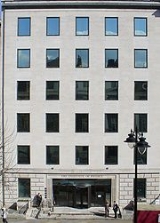
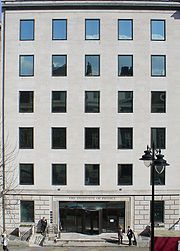
The modern Institute of Physics is based at 76 Portland Place
in London
, while its publishing company has its headquarters in Bristol
. In addition to its traditional roles of publishing and disseminating knowledge, the Institute is prominent in its work in policy and advocacy, lobbying for stronger support for physics in education, research and industry in the UK.
, lined in violet and faced on the cowl with crimson silk.
' A-level course, in conjunction with the OCR examining board, which is accredited by the Qualifications and Curriculum Authority
. Advancing Physics was sold to Oxford University Press in January 2011. The IOP also developed the Integrated Sciences degree, which is run at four universities in England.
of Chartered Physicist
(CPhys) as well as Chartered Engineer (CEng) as a nominated body of the Engineering Council
. Until 1998 CPhys was granted automatically with MInstP, however since then it has become a separate qualification that is equal in stature to Chartered Engineer. In order to gain the CPhys qualification, a physicist must be appropriately qualified (an MSci or MPhys undergraduate master's degree
is standard, although experience leading to an equivalent level can be counted), have had a minimum of two years of structured training and a minimum of two years responsible work experience, have demonstrated a commitment to continuing professional development, and have gained a number of competencies.
and the Republic of Ireland
. The subsidiary IOP Publishing has offices in the USA, China, Japan and Russia.
. The history of the Institute, from its founding as the Physical Society of London through to today's Institute has meant that the name of the post held has varied.
, Philadelphia, Tokyo
, Beijing
and Washington DC. It won the Queen's Award for Export Achievement in 1990, 1995 and 2000 and publishes a large number of journals, websites and magazines, including:
IOP Publishing also operates specialist 'community websites':
relating to the study
and application of physics
. The most significant content
of the magazine is news
, employment
, and upcoming-events-related information. Several of these services were originally part of a web site called The Internet Pilot to Physics
or 'TIPTOP'.
It is the main professional body for physicists in the United Kingdom
United Kingdom
The United Kingdom of Great Britain and Northern IrelandIn the United Kingdom and Dependencies, other languages have been officially recognised as legitimate autochthonous languages under the European Charter for Regional or Minority Languages...
and the Republic of Ireland
Republic of Ireland
Ireland , described as the Republic of Ireland , is a sovereign state in Europe occupying approximately five-sixths of the island of the same name. Its capital is Dublin. Ireland, which had a population of 4.58 million in 2011, is a constitutional republic governed as a parliamentary democracy,...
, and grants the professional qualification of Chartered Physicist
Chartered Physicist
Chartered Physicist is a chartered status and a professional qualification awarded by the Institute of Physics.Achieving chartered status in any profession denotes to the wider community a high level of specialised subject knowledge and professional competence...
(CPhys), as well as Chartered Engineer
Chartered Engineer (UK)
In the United Kingdom, a Chartered Engineer is an engineer registered with Engineering Council UK . Contemporary Chartered Engineers are master's degree-qualified and have gained professional competencies through training and experience...
(CEng) as a nominated body of the Engineering Council. In addition to this, the IOP provides services to its members including careers advice and professional development. As a part of its mission, the IOP works to engage the public with physics and runs the physics.org website, an online guide to physics, and a blog. The IOP is prominent in its work in policy and advocacy, lobbying for stronger support for physics in education, research and industry in the UK.
The IOP's publishing company, IOP Publishing, publishes more than 60 academic titles.
The current chief executive of the IOP is Robert Kirby-Harris
Robert Kirby-Harris
Bob Kirby-Harris has been the Chief Executive of the Institute of Physics since 2005.-Early life:He went to Ashford Grammar School . He gained a 1st Class BSc in Theoretical Physics in 1973 from the University of Kent. From Clare College, Cambridge, he gained an MA in Applied Maths and Theoretical...
, and its current president is Sir Peter Knight
Peter Knight (scientist)
Sir Peter Knight, FRS is a British physicist, Professor of Quantum Optics and Senior Research Investigator Imperial College London, and Principal of the Kavli Royal Society International Centre. He was knighted in the Queen's Birthday Honours List of 2005. He was president of the Optical Society of...
.
History
Physical Society of London
The Physical Society of London, England, existed from 1874 to 1921. It was a scientific society and produced the Proceedings of the Physical Society of London...
, founded in 1874, and the Institute of Physics, founded in 1920.
The Physical Society of London
The Physical Society was founded to provide a forum for the promotion and discussion of physical research. The Society was officially formed on 14 February 1874 with John Hall GladstoneJohn Hall Gladstone
John Hall Gladstone FRS was a British chemist. He served as President of the Physical Society between 1874 and 1876 and during 1877–1879 was President of the Chemical Society...
as its first president. From its beginning, the society held open meetings and demonstrations and published Proceedings of the Physical Society
Proceedings of the Physical Society
The Proceedings of the Physical Society is a journal on the subject of physics, originally associated with the Physical Society of London, England. - Journal history :* 1874–1925: Proceedings of the Physical Society of London...
. Its membership was broadly based, including eminent academics, schoolteachers and amateur scientists.
The Institute of Physics and the Physical Society
In the early part of the 20th century, the profession of "physicistPhysicist
A physicist is a scientist who studies or practices physics. Physicists study a wide range of physical phenomena in many branches of physics spanning all length scales: from sub-atomic particles of which all ordinary matter is made to the behavior of the material Universe as a whole...
" emerged, partly as a result of the increased demand for scientists during World War I
World War I
World War I , which was predominantly called the World War or the Great War from its occurrence until 1939, and the First World War or World War I thereafter, was a major war centred in Europe that began on 28 July 1914 and lasted until 11 November 1918...
. In 1917, the Council of the Physical Society, along with the Faraday Society
Faraday Society
The Faraday Society was a British society for the study of physical chemistry, founded in 1903 and named in honour of Michael Faraday. It merged with several similar organisations in 1980 to form the Royal Society of Chemistry...
, the Optical Society, and the Roentgen Society, started to explore ways of improving the professional status of physicists. To this end, in 1920, the Institute of Physics was created under special licence from the Board of Trade
Board of Trade
The Board of Trade is a committee of the Privy Council of the United Kingdom, originating as a committee of inquiry in the 17th century and evolving gradually into a government department with a diverse range of functions...
. Sir Richard Glazebrook
Richard Glazebrook
Sir Richard Tetley Glazebrook KCB KCVO FRS was an English physicist.-Education and early career:Glazebrook was born in West Derby, Liverpool, the son of a surgeon...
was elected first President of the Institute. As with the Physical Society, dissemination of knowledge was fundamental to the Institute, which began publication of the Journal of Scientific Instruments in 1922. The annual Reports on Progress in Physics began in 1934 and is still published today.
In 1952, in line with its role in creating and promoting the profession of physicist, the Institute began the "Graduateship" course and examination, which ran until 1984 when the expansion of access to universities removed demand.
Merger
In 1960, the Physical Society and the Institute of Physics merged to create a single organisation, the Institute of Physics and the Physical Society, which combined the learned societyLearned society
A learned society is an organization that exists to promote an academic discipline/profession, as well a group of disciplines. Membership may be open to all, may require possession of some qualification, or may be an honor conferred by election, as is the case with the oldest learned societies,...
tradition of the Physical Society with the professional body tradition of the Institute of Physics. Upon being granted a royal charter
Royal Charter
A royal charter is a formal document issued by a monarch as letters patent, granting a right or power to an individual or a body corporate. They were, and are still, used to establish significant organizations such as cities or universities. Charters should be distinguished from warrants and...
in 1970, the organization renamed itself to Institute of Physics.
The modern Institute of Physics is based at 76 Portland Place
Portland Place
Portland Place is a street in the Marylebone district of central London, England.-History and topography:The street was laid out by the brothers Robert and James Adam for the Duke of Portland in the late 18th century and originally ran north from the gardens of a detached mansion called Foley House...
in London
London
London is the capital city of :England and the :United Kingdom, the largest metropolitan area in the United Kingdom, and the largest urban zone in the European Union by most measures. Located on the River Thames, London has been a major settlement for two millennia, its history going back to its...
, while its publishing company has its headquarters in Bristol
Bristol
Bristol is a city, unitary authority area and ceremonial county in South West England, with an estimated population of 433,100 for the unitary authority in 2009, and a surrounding Larger Urban Zone with an estimated 1,070,000 residents in 2007...
. In addition to its traditional roles of publishing and disseminating knowledge, the Institute is prominent in its work in policy and advocacy, lobbying for stronger support for physics in education, research and industry in the UK.
Membership
There are three grades of membership: Associate Member (AMInstP), Member (MInstP) and Fellow (FInstP). Qualification for AMInstP is normally by completion of an undergraduate degree accredited by the Institute – this covers almost all UK physics degrees. An AMInstP can become an MInstP by gaining professional experience as a physicist and an FInstP by making "an outstanding contribution to the profession". MInstP and FInstP are the two corporate grades of membership, granting the right to vote in Institute elections. There are also student and affiliate grades of membership for those currently studying physics degrees and those who do not have accredited degrees (or equivalent experience). The Institute grants academic dress to the various grades of membership. Those who have passed the Institute's graduateeship examination are entitled to a violet damask Oxford burgon-shaped hood. Corporate members are entitled to wear a hood of Toronto shape in violet damaskDamask
Damask is a reversible figured fabric of silk, wool, linen, cotton, or synthetic fibers, with a pattern formed by weaving. Damasks are woven with one warp yarn and one weft yarn, usually with the pattern in warp-faced satin weave and the ground in weft-faced or sateen weave...
, lined in violet and faced on the cowl with crimson silk.
Qualifications
The IOP accredits undergraduate degrees (BSc/BA and MSci/MPhys) in Physics in British and Irish universities. At post-16 level, the IOP developed the 'Advancing PhysicsAdvancing Physics
Advancing Physics is an A-level physics course examined by OCR which was developed in association with the Institute of Physics with assessment through written examinations and teacher-assessed coursework. It may also be referred to Physics 'B' to distinguish it from the OCR's other Physics...
' A-level course, in conjunction with the OCR examining board, which is accredited by the Qualifications and Curriculum Authority
Qualifications and Curriculum Authority
The Qualifications and Curriculum Development Agency is an exempt charity, and an executive non-departmental public body of the Department for Children, Schools and Families...
. Advancing Physics was sold to Oxford University Press in January 2011. The IOP also developed the Integrated Sciences degree, which is run at four universities in England.
Chartered Status
The Institute grants the professional titleBritish professional qualifications
Professional qualifications in the United Kingdom are generally awarded by professional bodies in line with their charters. These qualifications are subject to the European directives on professional qualifications...
of Chartered Physicist
Chartered Physicist
Chartered Physicist is a chartered status and a professional qualification awarded by the Institute of Physics.Achieving chartered status in any profession denotes to the wider community a high level of specialised subject knowledge and professional competence...
(CPhys) as well as Chartered Engineer (CEng) as a nominated body of the Engineering Council
Engineering Council UK
The Engineering Council is Britain's regulatory authority for registration of Chartered and Incorporated engineers and technicians, holding a register of these and providing advice to students, engineers, employers and academic institutions on the standards for registration and procedures for...
. Until 1998 CPhys was granted automatically with MInstP, however since then it has become a separate qualification that is equal in stature to Chartered Engineer. In order to gain the CPhys qualification, a physicist must be appropriately qualified (an MSci or MPhys undergraduate master's degree
Master's degree
A master's is an academic degree granted to individuals who have undergone study demonstrating a mastery or high-order overview of a specific field of study or area of professional practice...
is standard, although experience leading to an equivalent level can be counted), have had a minimum of two years of structured training and a minimum of two years responsible work experience, have demonstrated a commitment to continuing professional development, and have gained a number of competencies.
National and regional branches
The IOP operates 13 national and regional branches in the United KingdomUnited Kingdom
The United Kingdom of Great Britain and Northern IrelandIn the United Kingdom and Dependencies, other languages have been officially recognised as legitimate autochthonous languages under the European Charter for Regional or Minority Languages...
and the Republic of Ireland
Republic of Ireland
Ireland , described as the Republic of Ireland , is a sovereign state in Europe occupying approximately five-sixths of the island of the same name. Its capital is Dublin. Ireland, which had a population of 4.58 million in 2011, is a constitutional republic governed as a parliamentary democracy,...
. The subsidiary IOP Publishing has offices in the USA, China, Japan and Russia.
Governance
An elected Council governs and controls the affairs of the Institute. The Council meets four times a year and has up to 25 members of whom 16 are elected by members of the Institute.Presidents of the Institute of Physics
The President of the Institute is the head of the Council of the Institute. The President is now elected by the membership of the Institute and serves a term of two years. The current President is Sir Peter KnightPeter Knight (scientist)
Sir Peter Knight, FRS is a British physicist, Professor of Quantum Optics and Senior Research Investigator Imperial College London, and Principal of the Kavli Royal Society International Centre. He was knighted in the Queen's Birthday Honours List of 2005. He was president of the Optical Society of...
. The history of the Institute, from its founding as the Physical Society of London through to today's Institute has meant that the name of the post held has varied.
Presidents of the Physical Society of London
- 1874-1876 John H GladstoneJohn Hall GladstoneJohn Hall Gladstone FRS was a British chemist. He served as President of the Physical Society between 1874 and 1876 and during 1877–1879 was President of the Chemical Society...
- 1876-1878 George C Foster
- 1878-1880 William G AdamsWilliam Grylls AdamsWilliam Grylls Adams FRS was professor of Natural Philosophy at King's College, London.William Grylls Adams was a younger brother of John Couch Adams . He graduated from St...
- 1880-1882 The Lord Kelvin of LargsWilliam Thomson, 1st Baron KelvinWilliam Thomson, 1st Baron Kelvin OM, GCVO, PC, PRS, PRSE, was a mathematical physicist and engineer. At the University of Glasgow he did important work in the mathematical analysis of electricity and formulation of the first and second laws of thermodynamics, and did much to unify the emerging...
- 1882-1884 Robert B Clifton
- 1884-1886 Frederick GuthrieFrederick GuthrieFrederick Guthrie was a British scientific writer and professor. He helped found the Physical Society of London in 1874 and was president of the society from 1884-1886. He believed that science should be based on experimentation rather than discussion...
- 1886-1888 Balfour StewartBalfour StewartBalfour Stewart was a Scottish physicist. His studies in the field of radiant heat led to him receiving the Rumford Medal of the Royal Society in 1868. In 1859 he was appointed director of Kew Observatory...
- 1888-1890 Arnold W Reinold
- 1890-1892 William E AyrtonWilliam Edward Ayrton-See also:*Henry Dyer*John Milne*Anglo-Japanese relations...
- 1892-1893 George F Fitzgerald
- 1893-1895 Arthur W RuckerArthur William RuckerSir Arthur William Rucker , KB, FRS was a British physicist. He gained his BA at Brasenose College, Oxford, in 1871, and was a Fellow there from 1871 to 1876...
- 1895-1897 William de W AbneyWilliam de Wiveleslie AbneyWilliam de Wiveleslie Abney FRS was an English astronomer, chemist, and photographer.-Biography:Abney was born in Derby, England, the son of Edward Abney vicar of St Alkmund's Derby, and owner of the Firs Estate...
- 1897-1899 Shelford BidwellShelford BidwellShelford Bidwell was an English physicist and inventor. He is best known for his work with "telephotography", a precursor to the modern fax machine.-Private Life:...
- 1899-1901 Oliver J Lodge
- 1901-1903 Silvanus P Thompson
- 1903-1905 Richard T GlazebrookRichard GlazebrookSir Richard Tetley Glazebrook KCB KCVO FRS was an English physicist.-Education and early career:Glazebrook was born in West Derby, Liverpool, the son of a surgeon...
- 1905-1906 John H PoyntingJohn Henry PoyntingJohn Henry Poynting was an English physicist. He was a professor of physics at Mason Science College from 1880 until his death....
- 1906-1908 John PerryJohn Perry (engineer)John Perry was a pioneering engineer and mathematician from Ireland. He was born on February 14, 1850 at Garvagh, County Londonderry, the second son of Samuel Perry and a Scottish-born wife....
- 1908-1910 Charles ChreeCharles ChreeCharles Chree was a British physicist.He was born in Lintrathen, Forfarshire, Scotland and educated at the Grammar School, Old Aberdeen, the University of Aberdeen where he graduated MA in 1879 and the University of Cambridge...
- 1910-1912 Hugh Longbourne CallendarHugh Longbourne CallendarHugh Longbourne Callendar FRS was a British physicist. He was born at Hatherop as the eldest son of the Reverend Hugh Callendar, a local Anglican rector...
- 1912-1914 Arthur SchusterArthur SchusterSir Franz Arthur Friedrich Schuster FRS was a German-born British physicist known for his work in spectroscopy, electrochemistry, optics, X-radiography and the application of harmonic analysis to physics...
- 1914-1916 Sir Joseph Thompson
- 1916-1918 Charles V Boys
- 1918-1920 Charles Herbert Lees
Presidents of the Physical Society
- 1920-1922 Sir William BraggWilliam Henry BraggSir William Henry Bragg OM, KBE, PRS was a British physicist, chemist, mathematician and active sportsman who uniquely shared a Nobel Prize with his son William Lawrence Bragg - the 1915 Nobel Prize in Physics...
- 1922-1924 A Russell
- 1924-1926 F E SmithFrank Edward SmithSir Frank Edward Smith, GCB, GBE, FRS was a British physicist.He was elected a Fellow of the Royal Society in 1918. His candidacy citation read: "Principal Assistant in the National Physical Laboratory . Author of a number of papers dealing with electrical units which have appeared in the...
- 1926-1928 O W Richardson
- 1928-1930 W H EcclesWilliam EcclesWilliam Henry Eccles was a British physicist and a pioneer in the development of radio communication.He was born in Barrow-in-Furness, Lancashire, England. Following graduation from the Royal College of Science, London, in 1898, he became an assistant to Guglielmo Marconi, the Italian radio...
- 1930-1932 Sir Arthur Eddington
- 1932-1934 A O Rankine
- 1934-1936 Lord Rayleigh
- 1936-1938 T Smith
- 1938-1941 Sir Allan Ferguson
- 1941-1943 Sir Charles DarwinCharles Galton DarwinSir Charles Galton Darwin, KBE, MC, FRS was an English physicist, the grandson of Charles Darwin. He served as director of the National Physical Laboratory during the Second World War.-Early life:...
- 1943-1945 E N de Costa AndradeEdward AndradeEdward Neville da Costa Andrade FRS was an English physicist, writer, and poet.-Background:Andrade was a Sephardi Jew and is a descendant Moses da Costa Andrade...
- 1945-1947 D BruntDavid BruntSir David Brunt KBE was a Welsh meteorologist.-Early life:He was born in Staylittle, Montgomeryshire, Wales, the youngest of the nine children of farmworker John Brunt. His father moved the family to the mining district on Monmouthshire to work as a coal miner. David attended the local Abertillery...
- 1947-1949 G I Finch
- 1949-1950 S Chapman
- 1950-1952 L F Bates
- 1952-1954 R Whiddington
- 1954-1956 H S W MasseyHarrie MasseySir Harrie Stewart Wilson Massey FRS was an influential Australian mathematical physicist. He worked primarily in the fields of atomic and atmospheric physics.- Life and career :...
- 1956-1958 N F Mott
- 1958-1960 J A RatcliffeJ. A. RatcliffeJohn Ashworth Ratcliffe, FRS , "JAR or Jack", was an influential British radio physicist....
Presidents of the Institute of Physics
- 1920 - 1921 Sir Richard T GlazebrookRichard GlazebrookSir Richard Tetley Glazebrook KCB KCVO FRS was an English physicist.-Education and early career:Glazebrook was born in West Derby, Liverpool, the son of a surgeon...
- 1921 - 1923 Sir Joseph Thomson
- 1923 - 1925 Sir Charles Parsons
- 1925 - 1927 Sir William BraggWilliam Henry BraggSir William Henry Bragg OM, KBE, PRS was a British physicist, chemist, mathematician and active sportsman who uniquely shared a Nobel Prize with his son William Lawrence Bragg - the 1915 Nobel Prize in Physics...
- 1927 - 1929 Sir Frank DysonFrank Watson DysonSir Frank Watson Dyson, KBE, FRS was an English astronomer and Astronomer Royal who is remembered today largely for introducing time signals from Greenwich, England, and for the role he played in testing Einstein's theory of general relativity.- Biography :Dyson was born in Measham, near...
- 1929 - 1931 William H EcclesWilliam EcclesWilliam Henry Eccles was a British physicist and a pioneer in the development of radio communication.He was born in Barrow-in-Furness, Lancashire, England. Following graduation from the Royal College of Science, London, in 1898, he became an assistant to Guglielmo Marconi, the Italian radio...
- 1931 - 1933 The Lord Rutherford of Nelson
- 1933 - 1935 Sir Henry LyonsHenry George LyonsColonel Sir Henry George Lyons FRS was a geologist and director of the Science Museum in London.Henry Lyons was born in London, the son of General T.C. Lyons, CB....
- 1935 - 1937 Alfred FowlerAlfred FowlerAlfred Fowler, FRS was an English astronomer. Not to be confused with American astrophysicist William Alfred Fowler....
- 1937 - 1939 Clifford C Paterson
- 1939 - 1943 Sir Lawrence Bragg
- 1943 - 1946 Sir Frank SmithFrank Edward SmithSir Frank Edward Smith, GCB, GBE, FRS was a British physicist.He was elected a Fellow of the Royal Society in 1918. His candidacy citation read: "Principal Assistant in the National Physical Laboratory . Author of a number of papers dealing with electrical units which have appeared in the...
- 1946 - 1948 Arthur M Tyndall
- 1948 - 1950 Francis C Toy
- 1950 - 1952 William E Curtis
- 1952 - 1954 Charles Sykes
- 1954 - 1956 Sir John CockroftJohn CockcroftSir John Douglas Cockcroft OM KCB CBE FRS was a British physicist. He shared the Nobel Prize in Physics for splitting the atomic nucleus with Ernest Walton, and was instrumental in the development of nuclear power....
- 1956 - 1958 Oliver W Humphreys
- 1958 - 1960 Sir George ThompsonGeorge Paget ThomsonSir George Paget Thomson, FRS was an English physicist and Nobel laureate in physics recognised for his discovery with Clinton Davisson of the wave properties of the electron by electron diffraction.-Biography:...
Presidents of the Institute of Physics and the Physical Society
- 1960 - 1962 Sir John CockroftJohn CockcroftSir John Douglas Cockcroft OM KCB CBE FRS was a British physicist. He shared the Nobel Prize in Physics for splitting the atomic nucleus with Ernest Walton, and was instrumental in the development of nuclear power....
- 1962 - 1964 Sir Alan Wilson
- 1964 - 1966 Sir Gordon SutherlandGordon SutherlandSir Gordon Brims Black McIvor Sutherland FRS was a Scottish physicist. In 1964 he became Master of Emmanuel College, Cambridge.-External links:* http://www.archiveshub.ac.uk/news/03041101.html...
- 1966 - 1968 Sir James Taylor
- 1968 - 1970 Malcolm R Gavin
Presidents of the Institute of Physics
- 1970 - 1972 James W Menter
- 1972 - 1974 Sir Brian Flowers
- 1974 - 1976 Sir Brian PippardBrian PippardSir Alfred Brian Pippard, ScD, FRS , was a British physicist. He was Cavendish Professor of Physics from 1971 until 1984 and an Honorary Fellow of Clare Hall, University of Cambridge, of which he was the first President...
- 1976 - 1978 Basil J MasonBasil John MasonSir John Mason, CB, FRCP, FRCPEd, FRFPS, FRS is an expert on cloud physics and former Director of the UK Meteorological Office.His work includes the Mason Equation, giving the growth or evaporation of small water droplets...
- 1978 - 1980 Rendel S PeaseBas PeaseRendel Sebastian "Bas" Pease FRS was a British physicist.Pease's father was the geneticist Michael Pease, son of Edward Reynolds Pease. His mother was Helen Bowen Wedgwood, daughter of Josiah Wedgwood IV...
- 1980 - 1982 Sir Denys WilkinsonDenys WilkinsonSir Denys Haigh Wilkinson FRS is a British nuclear physicist. He was educated at Loughborough Grammar School and Jesus College, Cambridge. He holds the higher degree of ScD, an HonFilDr degree and an HonLLD degree...
- 1982 - 1984 Sir Robert Clayton
- 1984 - 1986 Sir Alec MerrisonAlec MerrisonSir Alexander Walter Merrison FRS, was a British physicist born in Wood Green, London on 20 March 1924. He was a professor in Experimental Physics at Liverpool University and the first Director of the new Daresbury Nuclear Physics Laboratory...
- 1986 - 1988 Godfrey H StaffordGodfrey StaffordDr Godfrey Harry Stafford CBE, MA FInstP, FRS is a British physicist and directed the Rutherford Appleton Laboratories from 1969 to 1981. He went on to be a master at St Cross College, in Oxford and president of the Institute of Physics. In 1950 Dr. Stafford married Helen Goldthorp Clark, an...
- 1988 - 1990 Cyril HilsumCyril HilsumCyril Hilsum CBE FRS FREng HonFInstP is a British physicist and academic.-Life:He entered Raine's Foundation School in 1936 as the middle of three brothers, leaving in 1943 after being accepted into University College London, where he did his Bsc. In 1945 he joined the Royal Naval Scientific...
- 1990 - 1992 Roger Blin-Stoyle
- 1992 - 1994 Clive A P Foxell
- 1994 - 1996 Sir Arnold WolfendaleArnold WolfendaleSir Arnold Whittaker Wolfendale FRS is a British astronomer who served as Astronomer Royal from 1991 to 1995.-Early life:...
- 1996 - 1998 Brian W Manley
- 1998 - 2000 Sir Gareth Roberts
- 2000 - 2002 Sir Peter WilliamsPeter Williams (physicist)Sir Peter Michael Williams, CBE, FREng, FRS is a British physicist.Williams completed his first degree and PhD at the University of Cambridge, and began an academic career at Selwyn College. He then moved to industry and worked first at VG Instruments and later Oxford Instruments...
- 2002 - 2004 Sir David WallaceDavid Wallace (physicist)Professor Sir David James Wallace, CBE, FRS, DL is the Director of the Isaac Newton Institute for Mathematical Sciences in Cambridge and master of Churchill College, Cambridge....
- 2004 - 2006 Sir John Enderby
- 2006 - 2008 Peter Saraga
- 2008 - 2010 Dame Jocelyn Bell BurnellJocelyn Bell BurnellSusan Jocelyn Bell Burnell, DBE, FRS, FRAS , is a British astrophysicist. As a postgraduate student she discovered the first radio pulsars with her thesis supervisor Antony Hewish. She was president of the Institute of Physics from October 2008 until October 2010, and was interim president...
- 2010 - 2011 Marshall StonehamMarshall StonehamArthur Marshall Stoneham, FRS , known as Marshall Stoneham, was a British physicist who worked for the United Kingdom Atomic Energy Authority, and from 1995 was Massey professor of physics at University College London...
- 2011 - 2011 Dame Jocelyn Bell BurnellJocelyn Bell BurnellSusan Jocelyn Bell Burnell, DBE, FRS, FRAS , is a British astrophysicist. As a postgraduate student she discovered the first radio pulsars with her thesis supervisor Antony Hewish. She was president of the Institute of Physics from October 2008 until October 2010, and was interim president...
(Interim) - 2011 - present Sir Peter KnightPeter Knight (scientist)Sir Peter Knight, FRS is a British physicist, Professor of Quantum Optics and Senior Research Investigator Imperial College London, and Principal of the Kavli Royal Society International Centre. He was knighted in the Queen's Birthday Honours List of 2005. He was president of the Optical Society of...
Awards
The Institute of Physics bestows several awards to recognise and reward outstanding achievements in physics, in research, teaching, outreach work and industry. The awards are presented at a high-profile ceremony held annually in central London. The awards include:- The Isaac Newton MedalIsaac Newton MedalThe Isaac Newton Medal is a prize awarded annually by the Institute of Physics and is valued at £1000. The award is given to a physicist, regardless of subject area, background or nationality, for outstanding contributions to physics...
, an international prize, awarded for outstanding contributions to physics. - Moseley Medal and Prize (formerly the Boys Medal and Prize), for distinguished research in experimental physicsExperimental physicsWithin the field of physics, experimental physics is the category of disciplines and sub-disciplines concerned with the observation of physical phenomena in order to gather data about the universe...
, which recognises physicists early in their careers. - Bragg Medal and Prize, for significant contributions to physics education.
- Appleton Medal and PrizeAppleton Medal and PrizeThe Appleton medal and prize is awarded for distinguished research in environmental, earth or atmospheric physics. It was originally called the "Chree medal and prize" after Dr. Charles Chree but was renamed in 2008 by the Institute of Physics...
(formerly the Chree Medal and Prize), for distinguished research in environmental, earth or atmospheric physics. - Gabor Medal and Prize (formerly the Duddell Medal and PrizeDuddell Medal and PrizeThe Duddell Medal and Prize was a prize awarded annually by the Institute of Physics in the memory of William du Bois Duddell, the inventor of the electromagnetic oscillograph. The medal was instituted by the Council of The Physical Society in 1923. Between 1961 and 1973 the prize was awarded in...
), for distinguished work in the application of physics in an industrial, commercial or business context, including work that has enhanced the economic or social well being of the UK or Ireland. - Dirac Medal and Prize, for outstanding contributions to theoretical physicsTheoretical physicsTheoretical physics is a branch of physics which employs mathematical models and abstractions of physics to rationalize, explain and predict natural phenomena...
. - Faraday Medal and Prize (formerly the Guthrie Medal and PrizeGuthrie Medal and PrizeThe Faraday Medal and Prize is a prize awarded annually by the Institute of Physics. The prize is awarded for "outstanding contributions to experimental physics, to a physicist of international reputation in any sector."...
), for an internationally outstanding body of work in experimental physics. - Glazebrook Medal and Prize, for outstanding contributions to physics organizations or the application of physics.
- Kelvin Medal and Prize, for contributions to the public understanding of science.
- Maxwell Medal and PrizeMaxwell Medal and PrizeThe Maxwell Medal and Prize is one of the principal awards made annually by the Institute of Physics. The award is made for outstanding contributions to theoretical physics and is intended to recognize theoretical physicists early in their careers....
, for outstanding contributions to theoretical physics, mathematical or computational physics which recognises physicists early in their careers. - Mott Medal and PrizeMott PrizeThe Mott medal and prize is awarded by the Institute of Physics. It was first established in 1997 thanks to a donation of Sir Nevill Mott's family. Sir Nevill Mott was the outstanding British condensed matter theorists and won a Nobel prize in Physics in 1977. He died in 1996...
, for distinguished research in condensed matter physicsCondensed matter physicsCondensed matter physics deals with the physical properties of condensed phases of matter. These properties appear when a number of atoms at the supramolecular and macromolecular scale interact strongly and adhere to each other or are otherwise highly concentrated in a system. The most familiar...
or material physicsMaterial physicsMaterial physics is the use of physics to describe materials in many different ways such as force, heat, light and mechanics. It is a synthesis of physical sciences such as chemistry, solid mechanics and solid state physics....
. - Paterson Medal and Prize, for outstanding contributions by a physicist early in their career to the application of physics and its commercial exploitation.
- Rutherford Medal and PrizeRutherford Medal and PrizeThe Rutherford Medal and Prize is awarded once every two years by the Institute of Physics for "distinguished research in nuclear physics or nuclear technology."- History :...
, for distinguished research in nuclear physics or nuclear technology. - Young Medal and PrizeYoung Medal and PrizeThe Young Medal and Prize is a prize awarded on odd numbered years by the Institute of Physics in the memory of Thomas Young for distinguished research in the field of optics, including physics outside the visible region.- Young Medalists:...
, for distinguished research in the field of opticsOpticsOptics is the branch of physics which involves the behavior and properties of light, including its interactions with matter and the construction of instruments that use or detect it. Optics usually describes the behavior of visible, ultraviolet, and infrared light...
, including work related to physics outside the visible region. - Business and Innovation Medal and Prize, for outstanding contributions to the organisation or application of physics in an industrial or commercial context.
- Chadwick Medal and Prize, for distinguished research in particle physics.
- Hoyle Medal and Prize, for distinguished research in astrophysics, gravitational physics or cosmology
- Franklin Medal and Prize, for distinguished research in physics applied to the life sciences.
- Joule Medal and Prize, for distinguished research in applied physics.
- Payne-Gaposchkin Medal and Prize, for distinguished research in plasma, solar or space physics.
- Rayleigh Medal and Prize, for distinguished research in theoretical, mathematical or computational physics.
- Tabor Medal and Prize, for distinguished research in surface or nanoscale physics.
- Thomson Medal and Prize, for distinguished research in atomic or molecular physics.
IOP Publishing
IOP Publishing is a wholly owned subsidiary of the IOP with offices in BristolBristol
Bristol is a city, unitary authority area and ceremonial county in South West England, with an estimated population of 433,100 for the unitary authority in 2009, and a surrounding Larger Urban Zone with an estimated 1,070,000 residents in 2007...
, Philadelphia, Tokyo
Tokyo
, ; officially , is one of the 47 prefectures of Japan. Tokyo is the capital of Japan, the center of the Greater Tokyo Area, and the largest metropolitan area of Japan. It is the seat of the Japanese government and the Imperial Palace, and the home of the Japanese Imperial Family...
, Beijing
Beijing
Beijing , also known as Peking , is the capital of the People's Republic of China and one of the most populous cities in the world, with a population of 19,612,368 as of 2010. The city is the country's political, cultural, and educational center, and home to the headquarters for most of China's...
and Washington DC. It won the Queen's Award for Export Achievement in 1990, 1995 and 2000 and publishes a large number of journals, websites and magazines, including:
- Bioinspiration & BiomimeticsBioinspiration & BiomimeticsBioinspiration & Biomimetics is a peer-reviewed journal that publishes research involving the study and distillation of principles and functions found in biological systems that have been developed through evolution....
- Classical and Quantum GravityClassical and Quantum GravityClassical and Quantum Gravity is a peer-reviewed journal that covers all aspects of gravitational physics and the theory of spacetime.Its scope includes*Classical general relativity*Applications of relativity*Experimental gravitation...
- Computational Science & DiscoveryComputational Science & DiscoveryComputational Science & Discovery is an international, multidisciplinary, peer-reviewed journal focused on scientific advances and discovery through computational science in physics, chemistry, biology and applied science...
- Environmental Research LettersEnvironmental Research LettersEnvironmental Research Letters is an open-access electronic-only peer-reviewed scientific journal covering research in all aspects of environmental science. Numerical modelling or simulation, as well as theoretical and experimental approaches to environmental science form the core content...
- European Journal of PhysicsEuropean Journal of PhysicsThe European Journal of Physics is an international peer-reviewed, scientific journal dedicated to maintaining and improving the standard of physics education in higher education...
- Inverse ProblemsInverse ProblemsInverse Problems is a peer-reviewed, broad-based interdisciplinary journal for pure and applied mathematicians and physicists. It combines theoretical, experimental and mathematical papers on inverse problems with numerical and practical approaches to their solution...
- Journal of Geophysics and EngineeringJournal of Geophysics and EngineeringThe Journal of Geophysics and Engineering is a peer-reviewed scientific journal covering research and developments in geophysics and related areas of engineering. Although the journal has a predominantly applied science and engineering focus, it also publishes contributions in all Earth-physics...
- Journal of Micromechanics and MicroengineeringJournal of Micromechanics and MicroengineeringJournal of Micromechanics and Microengineering covers all aspects of microelectromechanical systems, devices and structures, as well as micromechanics, microengineering and microfabrication. The journal highlights the link between fabrication technologies and their capacity to create novel...
- Journal of Optics
- Journal of PhysicsJournal of PhysicsJournal of Physics may refer to:* Journal of Physics A: Mathematical and Theoretical* Journal of Physics B: Atomic, Molecular and Optical Physics* Journal of Physics C: Solid State Physics...
- Journal of Physics AJournal of Physics AThe Journal of Physics A: Mathematical and Theoretical is a peer-reviewed scientific journal published by IOP Publishing. It is part of the Journal of Physics series and covers theoretical physics focusing on sophisticated mathematical and computational techniques.The journal is divided into six...
- Journal of Physics BJournal of Physics B-External links:*...
- Journal of Physics D
- Journal of Physics G
- Journal of Physics: Condensed MatterJournal of Physics: Condensed MatterJournal of Physics: Condensed Matter is a monthly, peer reviewed, scientific journal, established in 1989, and published by the Institute of Physics. This journal reports on all areas of condensed matter physics including soft matter and nanostructures. This journal publishes papers that contain...
- Journal of Physics: Conference SeriesJournal of Physics: Conference SeriesJournal of Physics: Conference Series is a peer-reviewed, open-access journal providing readers with the latest developments in physics presented at international conferences....
- Journal of Physics A
- Journal of Cosmology and Astroparticle Physics
- Journal of Radiological ProtectionJournal of Radiological ProtectionJournal of Radiological Protection is the official journal of the Society for Radiological Protection. It publishes articles in English on all aspects of radiological protection, including non-ionizing as well as ionizing radiations...
- Measurement Science and TechnologyMeasurement Science and TechnologyMeasurement Science and Technology is a journal published by Institute of Physics Publishing. It is an international journal publishing articles in the areas of measurement, instrumentation and sensor technology in physics, chemistry, biology, engineering and the environmental life sciences, from...
- MetrologiaMetrologiaMetrologia is an international journal dealing with the scientific aspects of metrology. It has been running since 1965 and has been published by the Bureau International des Poids et Mesures since 1991. Since 2003 the journal has been published by Institute of Physics Publishing on behalf of the...
- Modelling and Simulation in Materials Science and EngineeringModelling and Simulation in Materials Science and EngineeringModelling and Simulation in Materials Science and Engineering is a peer-reviewed scientific journal published by the IOP Publishing eight times per year....
- New Journal of Physics
- NonlinearityNonlinearity (journal)Nonlinearity is a peer-reviewed scientific journal of the Institute of Physics and the London Mathematical Society. The journal’s coverage ranges from proofs of important theorems to papers presenting ideas, conjectures and numerical or physical experiments of physical and mathematical interest...
- Physical BiologyPhysical BiologyPhysical Biology publishes articles in the interdisciplinary field bridging biology and the physical sciences. This journal focuses on research in which physics-based approaches lead to new insights into biological systems at all scales of space and time, and all levels of complexity.The...
- Physics EducationPhysics EducationPhysics Education is an international journal that covers the teaching of physics at the secondary school and introductory undergraduate level...
- Physics in Medicine and BiologyPhysics in Medicine and BiologyPhysics in Medicine and Biology is a peer reviewed journal concerned with the application of theoretical and practical physics to medicine, physiology and biology. The first issue was published in July 1956....
- Plasma Sources Science and TechnologyPlasma Sources Science and TechnologyPlasma Sources Science and Technology is an international journal dedicated solely to non-fusion aspects of plasma science.The Journal was founded in 1992 by Professor Noah Hershkowitz of the University of Wisconsin–Madison who also served as Editor-in-Chief until 2007. The current Editor-in-Chief...
- Proceedings of the Physical SocietyProceedings of the Physical SocietyThe Proceedings of the Physical Society is a journal on the subject of physics, originally associated with the Physical Society of London, England. - Journal history :* 1874–1925: Proceedings of the Physical Society of London...
- Reports on Progress in Physics
- Science and Technology of Advanced MaterialsScience and Technology of Advanced MaterialsScience and Technology of Advanced Materials is a bimonthly peer-reviewed scientific journal in materials science that was established in 2000. In 2008 it became an open access journal through the sponsorship by the National Institute for Materials Science . The journal is international, with its...
- Semiconductor Science and TechnologySemiconductor science and technologySemiconductor Science and Technology is a peer-reviewed scientific journal covering all applied or explicitly applicable experimental and theoretical studies of the properties of semiconductors and their interfaces, devices, and packaging. The journal publishes different article types including...
- Smart Materials and StructuresSmart Materials and StructuresSmart Materials and Structures covers both basic and applied research in physics, engineering and materials science, and industrial applications.Its scope includes:• Materials science• Sensing and actuation• Optics and electromagnetics• Structures...
IOP Publishing also operates specialist 'community websites':
- medicalphysicsweb.org - A website for the medical physics community.
- eprintweb.org - An e-print front end to the arXiv.org service.
- compoundsemiconductor.net - Contains news, articles from Compound Semiconductors and a Buyer's Guide. A resource for the compound semiconductor community.
- nanotechweb.org - Provides news, resources and events listings for nanotechnology community.
- cerncourier.com - Computer Newsletter section, Buyer’s Guide and the Jobs Watch directory.
- fibers.org - news, analysis, buyers guide and recruitment service for optical networking community.
- environmentalresearchweb.org - A source of information on issues from global warming to waste management and renewable energy sources.
PhysicsWorld
Physics World is the membership magazine of the Institute of Physics. It was launched in 1988 by IOP Publishing Ltd and has established itself as one of the world's leading physics magazines. It, and its associated website, PhysicsWorld.com (formerly PhysicsWeb.org), provides news and informationInformation
Information in its most restricted technical sense is a message or collection of messages that consists of an ordered sequence of symbols, or it is the meaning that can be interpreted from such a message or collection of messages. Information can be recorded or transmitted. It can be recorded as...
relating to the study
Education
Education in its broadest, general sense is the means through which the aims and habits of a group of people lives on from one generation to the next. Generally, it occurs through any experience that has a formative effect on the way one thinks, feels, or acts...
and application of physics
Physics
Physics is a natural science that involves the study of matter and its motion through spacetime, along with related concepts such as energy and force. More broadly, it is the general analysis of nature, conducted in order to understand how the universe behaves.Physics is one of the oldest academic...
. The most significant content
Content (media and publishing)
In media production and publishing, content is information and experiences that may provide value for an end-user/audience in specific contexts. Content may be delivered via any medium such as the internet, television, and audio CDs, as well as live events such as conferences and stage performances...
of the magazine is news
News
News is the communication of selected information on current events which is presented by print, broadcast, Internet, or word of mouth to a third party or mass audience.- Etymology :...
, employment
Employment
Employment is a contract between two parties, one being the employer and the other being the employee. An employee may be defined as:- Employee :...
, and upcoming-events-related information. Several of these services were originally part of a web site called The Internet Pilot to Physics
The Internet Pilot to Physics
TIPTOP was a web site operated in collaboration between Kenneth Bodin-Holmlund at Umeå University, Mikko Karttunen at McGill University and Guenther Nowotny at the Technical University of Vienna during 1994-1998, and it was originally derived from Physics Around the World that was initiated by...
or 'TIPTOP'.
External links
- iop.org - The Institute of Physics
- iopscience.iop.org - IOPScience website, which host all articles from IOP Journals.
- physicsworld.com - Physicsworld.com
- physics.org - An online guide to physics produced by the IOP.