


Canals of the United Kingdom

Encyclopedia
The canals of the United Kingdom are a major part of the network of inland waterways in the United Kingdom
. They have a colourful history
, from use for irrigation and transport, through becoming the focus of the Industrial Revolution
, to today's role for recreational boating. Despite a period of abandonment, today the canal
system in the United Kingdom is again in increasing use, with abandoned and derelict canals being reopened, and the construction of some new routes.
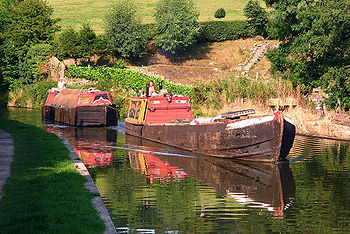 Canals first saw use during the Roman occupation of the south of Great Britain, and were used mainly for irrigation. The Romans also created several navigable canals, such as Foss Dyke
, to link rivers, enabling increased transport inland by water.
The United Kingdom's navigable water network grew as the demand for industrial transport increased. The canals were key to the pace of the Industrial Revolution: roads at the time were unsuitable for large volumes of traffic. A system of very large pack horse trains had developed, but few roads were suitable for wheeled vehicles able to transport large amounts of materials (especially fragile manufactured goods such as pottery) quickly. Canal boats were very much quicker, could carry large volumes, and were much safer for fragile items. Following the success of the Bridgewater Canal
, other canals were constructed between industrial centres, cities and ports, and were soon transporting raw materials (esp coal and lumber) and manufactured goods. There were immediate benefits to households, as well as to commerce: in Manchester
, the cost of coal fell by 75% when the Bridgewater Canal arrived.
As the Industrial Revolution
took hold in the end of the 18th and beginning of the 19th century, the technology allowed canals to be improved. The early canals contoured round hills and valleys, later ones went straighter. Locks took canals up and down hills, and they strode across valleys on taller and longer aqueducts and through hills in longer and deeper tunnels.
From the mid 19th century, railways began to replace canals, especially those built with the standard narrow (7 ft) bridges and locks. As trains, and later road vehicles, became more advanced, they became cheaper than the narrow canal system, being faster, and able to carry much larger cargoes. The canal network declined, and many canals were bought by railway companies – in some cases to enable them to penetrate rival companies' areas transhipping to/from canal boats. Some narrow canals became unusable, filled with weeds, silt and rubbish, or converted to railways.
 There was a late burst of wide-waterway building (e.g. the Caledonian Canal
, and the Manchester Ship Canal
), and of invention and innovation by people such as Bartholomew of the Aire and Calder company, who conceived the trains of nineteen coal-filled "Tom Pudding" compartment boats that were pulled along the Aire and Calder Navigation
from the Yorkshire coalfields, and lifted bodily to upturn their contents directly into seagoing colliers at Goole
Docks (their descendants, Hargreaves' tugs pushing three coal-pans trains to be upended into hoppers at the Aire power stations lasted as late as 2004). However, the last new canal before the end of the 20th century was the New Junction Canal
in Yorkshire (now South Yorkshire) in 1905. As competition intensified, horse-drawn single narrowboats were replaced by steam and later diesel powered boats towing an unpowered butty, and many of the boatmen's families abandoned their shore homes for a life afloat, to help with boat handling and to reduce accommodation costs – the birth of the legendary "boatman's cabin" with bright white lace, gleaming brass and gaily-painted metalware.
Constant lowering of tolls meant that the carriage of some bulky, non-perishable, and non-vital goods by water was still feasible on some inland waterways – but the death knell for commercial carrying on the narrow canals was sounded in the winter of 1962–1963, when a long hard frost kept goods icebound on the canals for three months. A few of the remaining customers turned to road and rail haulage to ensure reliability of supply and never returned, though both rail and road had been severely disrupted by the frost and snow too. Other narrow boat traffic gradually ceased with the change from coal to oil, the closure of canalside factories, and run down of British heavy industry. The last long distance narrow boat traffics, coal from the midlands to Dickinson's paper mills at Croxley and the Kearley & Tongue Jam Factory at Southall both ceased in 1970 – the Croxley mills had changed to oil and the Jam Factory closed for re-location. Regular narrow boat traffics continued; lime juice from Brentford to Boxmoor (until 1981) while aggregates were carried on the River Soar until 1988. Some individual waterways (especially the Manchester Ship Canal, the Aire & Calder Navigation and the other large waterways) remain viable, carrying many millions of tonnes per year and there are still hopes for development, but containerisation of ports and lorries has mostly passed the waterways by. The last major investment development of the inland waterways was the enlargement of the Sheffield and South Yorkshire Navigation
in the early 1980s to cope with barges of standard European dimensions that (in the depression of the 80s) never came. The scale of the futile hopes of those days can be appreciated by the occupants of a holiday narrowboat nearly lost in a lock built for the barges that were going to sail down the Rhine, across the North Sea
aboard a ship, and up to Doncaster
. Today there have been a number of successful initiatives to get more traffic on to the larger inland waterways, though even the Manchester Ship Canal does not convey cargo ships to the docks in Salford, which have become little more than a 'water feature' for the apartments, offices and cultural institutions of 'Salford Quays' that have replaced the wharves and warehouses.
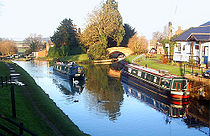 In the latter half of the 20th century, while the use of canals for transporting goods was dying out, there was a rise in interest in their history and potential use for leisure. A large amount of credit for this is usually given to L. T. C. Rolt
, whose book "Narrow Boat" about a journey made in nb Cressy was published in 1944. A key development was the foundation of the Inland Waterways Association
, and the establishment of fledgling weekly boat-hire companies, following the example of such companies on the Norfolk Broads, which had long been used for leisure boating. The authority responsible for the canals, British Waterways Board, encouraged this process from the late 1950s by operating a fleet of holiday hire boats, initially converted from cut down working boats.
Holidaymakers began renting 'narrowboat
s' and roaming the canals, visiting towns and villages they passed. Other people bought boats to use for weekend breaks and the occasional longer trip. The concept of a canal holiday became even more familiar when the large agencies that dealt with Broads holidays began to include canal boatyards in their brochures. Canal-based holidays became popular due to their relaxing nature, self-catering levels of cost, and variety of scenery available; from inner London to the Scottish Highlands. This growth in interest came just in time to give local canal societies the ammunition they needed to combat government proposals in the 1960s to close commercially unviable canals, and to resist pressure from local authorities and newspapers to "Fill In this eyesore" or even to "Close the Killer Canal" (when someone fell in one). It was not long before enthusiastic volunteers were repairing unnavigable but officially open canals and moving on to restore officially closed ones and demonstrating their renewed viability to the authorities.
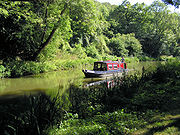 Local authorities began to see how a cleaned-up and well-used waterway was bringing visitors to other towns and waterside pubs (not just boaters, but people who just like being near water and watching boats (see gongoozler
). They began to clean up their own watersides, and to campaign for "their" canal to be restored. As a result of this growing revival of interest, for the first time in a century some new routes have been constructed (the Ribble Link
and the Liverpool Canal Link
), another is under construction (the Fens Waterways Link
). Large projects such as the restoration of the spectacular Anderton Boat Lift
, or the building of the startling Falkirk Wheel
attracted development funding from the European Union and from the Millennium Fund. The Rochdale Canal
, the Huddersfield Narrow Canal
and the Droitwich Canals have all been restored to navigation since 2000.
, Thames
, Mersey
, River Severn
, and River Ribble
. This network is navigable in its entirety by a narrowboat (a boat 7 ft wide) no longer than about 56 feet. There are also several through-routes not connected to the main network, notably those in Scotland, e.g. Glasgow
to Edinburgh
via the Falkirk Wheel
, and Inverness to Fort William
via Loch Ness
.
The aim of campaigning bodies such as the Inland Waterways Association is to persuade British Waterways
(which owns about half of Britain's inland waterway network) to fully reopen all disused canals. In May 2005 The Times
reported that British Waterways was hoping to quadruple the amount of cargo carried on Britain's canal network to six million tonnes by 2010 by transporting large amounts of waste to disposal facilities.
The speed limit for the majority of inland waterways in the United Kingdom managed by British Waterways is four miles per hour. All speed measurements on BW waterways are expressed in terms of speed over the ground, rather than speed through the water.
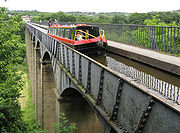 Canal aqueducts are structures that carry the canal across a valley, road or railway. Dundas Aqueduct
is built of stone in a classical style. Pontcysyllte Aqueduct
is an iron trough on tall stone piers. Barton Swing Aqueduct
opens to let ships pass underneath on the Manchester Ship Canal.
Where a large height difference has to be overcome, locks are built close together in a flight such as at Caen Hill Locks
. Where the gradient is very steep, a set of staircase locks are sometimes used, like Bingley Five Rise Locks
. At the other extreme stop locks have little or no change in level but were built to conserve water where one canal joined another. An interesting example is King's Norton Stop Lock
which was built with guillotine gates.
See also List of canal locks in the United Kingdom.
Waterways in the United Kingdom
Waterways in the United Kingdom is a link page for any waterway, river, canal, firth or estuary in the United Kingdom.-Related topics:*Waterway, water power, navigable, navigable aqueduct, navigable river, navigable waters, navigability, Waterway society, List of waterway societies in the United...
. They have a colourful history
History of the British canal system
The British canal system of water transport played a vital role in the United Kingdom's Industrial Revolution at a time when roads were only just emerging from the medieval mud and long trains of pack horses were the only means of "mass" transit by road of raw materials and finished products The...
, from use for irrigation and transport, through becoming the focus of the Industrial Revolution
Industrial Revolution
The Industrial Revolution was a period from the 18th to the 19th century where major changes in agriculture, manufacturing, mining, transportation, and technology had a profound effect on the social, economic and cultural conditions of the times...
, to today's role for recreational boating. Despite a period of abandonment, today the canal
Canal
Canals are man-made channels for water. There are two types of canal:#Waterways: navigable transportation canals used for carrying ships and boats shipping goods and conveying people, further subdivided into two kinds:...
system in the United Kingdom is again in increasing use, with abandoned and derelict canals being reopened, and the construction of some new routes.
History of commercial carrying
Foss Dyke
The Foss Dyke, or Fossdyke, connects the River Trent at Torksey to Lincoln, the county town of Lincolnshire, and may be the oldest canal in England that is still in use. It is usually thought to have been built around 120 AD by the Romans, but there is no consensus among authors...
, to link rivers, enabling increased transport inland by water.
The United Kingdom's navigable water network grew as the demand for industrial transport increased. The canals were key to the pace of the Industrial Revolution: roads at the time were unsuitable for large volumes of traffic. A system of very large pack horse trains had developed, but few roads were suitable for wheeled vehicles able to transport large amounts of materials (especially fragile manufactured goods such as pottery) quickly. Canal boats were very much quicker, could carry large volumes, and were much safer for fragile items. Following the success of the Bridgewater Canal
Bridgewater Canal
The Bridgewater Canal connects Runcorn, Manchester and Leigh, in North West England. It was commissioned by Francis Egerton, 3rd Duke of Bridgewater, to transport coal from his mines in Worsley to Manchester...
, other canals were constructed between industrial centres, cities and ports, and were soon transporting raw materials (esp coal and lumber) and manufactured goods. There were immediate benefits to households, as well as to commerce: in Manchester
Manchester
Manchester is a city and metropolitan borough in Greater Manchester, England. According to the Office for National Statistics, the 2010 mid-year population estimate for Manchester was 498,800. Manchester lies within one of the UK's largest metropolitan areas, the metropolitan county of Greater...
, the cost of coal fell by 75% when the Bridgewater Canal arrived.
As the Industrial Revolution
Industrial Revolution
The Industrial Revolution was a period from the 18th to the 19th century where major changes in agriculture, manufacturing, mining, transportation, and technology had a profound effect on the social, economic and cultural conditions of the times...
took hold in the end of the 18th and beginning of the 19th century, the technology allowed canals to be improved. The early canals contoured round hills and valleys, later ones went straighter. Locks took canals up and down hills, and they strode across valleys on taller and longer aqueducts and through hills in longer and deeper tunnels.
From the mid 19th century, railways began to replace canals, especially those built with the standard narrow (7 ft) bridges and locks. As trains, and later road vehicles, became more advanced, they became cheaper than the narrow canal system, being faster, and able to carry much larger cargoes. The canal network declined, and many canals were bought by railway companies – in some cases to enable them to penetrate rival companies' areas transhipping to/from canal boats. Some narrow canals became unusable, filled with weeds, silt and rubbish, or converted to railways.
Caledonian Canal
The Caledonian Canal is a canal in Scotland that connects the Scottish east coast at Inverness with the west coast at Corpach near Fort William. It was constructed in the early nineteenth century by engineer Thomas Telford, and is a sister canal of the Göta Canal in Sweden, also constructed by...
, and the Manchester Ship Canal
Manchester Ship Canal
The Manchester Ship Canal is a river navigation 36 miles long in the North West of England. Starting at the Mersey Estuary near Liverpool, it generally follows the original routes of the rivers Mersey and Irwell through the historic counties of Cheshire and Lancashire. Several sets of locks lift...
), and of invention and innovation by people such as Bartholomew of the Aire and Calder company, who conceived the trains of nineteen coal-filled "Tom Pudding" compartment boats that were pulled along the Aire and Calder Navigation
Aire and Calder Navigation
The Aire and Calder Navigation is a river and canal system of the River Aire and the River Calder in the metropolitan county of West Yorkshire, England. The first improvements to the rivers above Knottingley were completed in 1704 when the Aire was made navigable to Leeds and the Calder to...
from the Yorkshire coalfields, and lifted bodily to upturn their contents directly into seagoing colliers at Goole
Goole
Goole is a town, civil parish and port located approximately inland on the confluence of the rivers Don and Ouse in the East Riding of Yorkshire, England...
Docks (their descendants, Hargreaves' tugs pushing three coal-pans trains to be upended into hoppers at the Aire power stations lasted as late as 2004). However, the last new canal before the end of the 20th century was the New Junction Canal
New Junction Canal
The New Junction Canal is a canal in South Yorkshire, England. It is part of the Sheffield and South Yorkshire Navigation , although it was jointly funded by the Aire and Calder Navigation, and was opened in 1905. It links the River Don Navigation and the Stainforth and Keadby Canal with the Aire...
in Yorkshire (now South Yorkshire) in 1905. As competition intensified, horse-drawn single narrowboats were replaced by steam and later diesel powered boats towing an unpowered butty, and many of the boatmen's families abandoned their shore homes for a life afloat, to help with boat handling and to reduce accommodation costs – the birth of the legendary "boatman's cabin" with bright white lace, gleaming brass and gaily-painted metalware.
Constant lowering of tolls meant that the carriage of some bulky, non-perishable, and non-vital goods by water was still feasible on some inland waterways – but the death knell for commercial carrying on the narrow canals was sounded in the winter of 1962–1963, when a long hard frost kept goods icebound on the canals for three months. A few of the remaining customers turned to road and rail haulage to ensure reliability of supply and never returned, though both rail and road had been severely disrupted by the frost and snow too. Other narrow boat traffic gradually ceased with the change from coal to oil, the closure of canalside factories, and run down of British heavy industry. The last long distance narrow boat traffics, coal from the midlands to Dickinson's paper mills at Croxley and the Kearley & Tongue Jam Factory at Southall both ceased in 1970 – the Croxley mills had changed to oil and the Jam Factory closed for re-location. Regular narrow boat traffics continued; lime juice from Brentford to Boxmoor (until 1981) while aggregates were carried on the River Soar until 1988. Some individual waterways (especially the Manchester Ship Canal, the Aire & Calder Navigation and the other large waterways) remain viable, carrying many millions of tonnes per year and there are still hopes for development, but containerisation of ports and lorries has mostly passed the waterways by. The last major investment development of the inland waterways was the enlargement of the Sheffield and South Yorkshire Navigation
Sheffield and South Yorkshire Navigation
The Sheffield and South Yorkshire Navigation is a system of navigable inland waterways in South Yorkshire and Lincolnshire, England....
in the early 1980s to cope with barges of standard European dimensions that (in the depression of the 80s) never came. The scale of the futile hopes of those days can be appreciated by the occupants of a holiday narrowboat nearly lost in a lock built for the barges that were going to sail down the Rhine, across the North Sea
North Sea
In the southwest, beyond the Straits of Dover, the North Sea becomes the English Channel connecting to the Atlantic Ocean. In the east, it connects to the Baltic Sea via the Skagerrak and Kattegat, narrow straits that separate Denmark from Norway and Sweden respectively...
aboard a ship, and up to Doncaster
Doncaster
Doncaster is a town in South Yorkshire, England, and the principal settlement of the Metropolitan Borough of Doncaster. The town is about from Sheffield and is popularly referred to as "Donny"...
. Today there have been a number of successful initiatives to get more traffic on to the larger inland waterways, though even the Manchester Ship Canal does not convey cargo ships to the docks in Salford, which have become little more than a 'water feature' for the apartments, offices and cultural institutions of 'Salford Quays' that have replaced the wharves and warehouses.
Growth of leisure use
L. T. C. Rolt
Lionel Thomas Caswall Rolt was a prolific English writer and the biographer of major civil engineering figures including Isambard Kingdom Brunel and Thomas Telford...
, whose book "Narrow Boat" about a journey made in nb Cressy was published in 1944. A key development was the foundation of the Inland Waterways Association
Inland Waterways Association
The Inland Waterways Association was formed in 1946 as a registered charity in the United Kingdom to campaign for the conservation, use, maintenance, restoration and sensitive development of British Canals and river navigations....
, and the establishment of fledgling weekly boat-hire companies, following the example of such companies on the Norfolk Broads, which had long been used for leisure boating. The authority responsible for the canals, British Waterways Board, encouraged this process from the late 1950s by operating a fleet of holiday hire boats, initially converted from cut down working boats.
Holidaymakers began renting 'narrowboat
Narrowboat
A narrowboat or narrow boat is a boat of a distinctive design, made to fit the narrow canals of Great Britain.In the context of British Inland Waterways, "narrow boat" refers to the original working boats built in the 18th, 19th, and 20th centuries for carrying goods on the narrow canals...
s' and roaming the canals, visiting towns and villages they passed. Other people bought boats to use for weekend breaks and the occasional longer trip. The concept of a canal holiday became even more familiar when the large agencies that dealt with Broads holidays began to include canal boatyards in their brochures. Canal-based holidays became popular due to their relaxing nature, self-catering levels of cost, and variety of scenery available; from inner London to the Scottish Highlands. This growth in interest came just in time to give local canal societies the ammunition they needed to combat government proposals in the 1960s to close commercially unviable canals, and to resist pressure from local authorities and newspapers to "Fill In this eyesore" or even to "Close the Killer Canal" (when someone fell in one). It was not long before enthusiastic volunteers were repairing unnavigable but officially open canals and moving on to restore officially closed ones and demonstrating their renewed viability to the authorities.
Gongoozler
A gongoozler is a person who enjoys watching activity on the canals in the United Kingdom. The term is also often used in a more general way to describe those who have an interest in canals and the canal life, but do not actively participate.-Etymology:...
). They began to clean up their own watersides, and to campaign for "their" canal to be restored. As a result of this growing revival of interest, for the first time in a century some new routes have been constructed (the Ribble Link
Ribble Link
The Millennium Ribble Link is a Linear Water Park and new navigation which links the once-isolated Lancaster Canal in Lancashire, England to the River Ribble...
and the Liverpool Canal Link
Liverpool Canal Link
The Liverpool Canal Link is a £22m waterway link that connects the Leeds and Liverpool Canal, at Liverpool, to the South Docks. The new link adds of navigable waterway to the canal system.-History:...
), another is under construction (the Fens Waterways Link
Fens Waterways Link
The Fens Waterways Link is a project to improve recreational boating opportunities in the counties of Cambridgeshire and Lincolnshire, England. By a combination of improvements to existing waterways and the construction of new links a circular route between Lincoln, Peterborough, Ely and Boston is...
). Large projects such as the restoration of the spectacular Anderton Boat Lift
Anderton Boat Lift
The Anderton Boat Lift near the village of Anderton, Cheshire, in north-west England provides a vertical link between two navigable waterways: the River Weaver and the Trent and Mersey Canal....
, or the building of the startling Falkirk Wheel
Falkirk Wheel
The Falkirk Wheel is a rotating boat lift located in Scotland, UK,connecting the Forth and Clyde Canal with the Union Canal, opened in 2002. It is named after the nearby town of Falkirk which is in central Scotland...
attracted development funding from the European Union and from the Millennium Fund. The Rochdale Canal
Rochdale Canal
The Rochdale Canal is a navigable "broad" canal in northern England, part of the connected system of the canals of Great Britain. The "Rochdale" in its name refers to the town of Rochdale, Greater Manchester, through which the canal passes....
, the Huddersfield Narrow Canal
Huddersfield Narrow Canal
The Huddersfield Narrow Canal is an inland waterway in northern England. It runs just under from Lock 1E at the rear of the University of Huddersfield campus, near Aspley Basin at Huddersfield to the junction with the Ashton Canal at Whitelands Basin in Ashton-under-Lyne...
and the Droitwich Canals have all been restored to navigation since 2000.
Present status
There are now thousands of miles of navigable canals and rivers throughout the United Kingdom. Most of them are linked into a single English and Welsh network from Bristol to London, Liverpool to Goole, and Lancaster to Ripon, and connecting the Irish Sea, the North Sea, the estuaries of the HumberHumber
The Humber is a large tidal estuary on the east coast of Northern England. It is formed at Trent Falls, Faxfleet, by the confluence of the tidal River Ouse and the tidal River Trent. From here to the North Sea, it forms part of the boundary between the East Riding of Yorkshire on the north bank...
, Thames
River Thames
The River Thames flows through southern England. It is the longest river entirely in England and the second longest in the United Kingdom. While it is best known because its lower reaches flow through central London, the river flows alongside several other towns and cities, including Oxford,...
, Mersey
River Mersey
The River Mersey is a river in North West England. It is around long, stretching from Stockport, Greater Manchester, and ending at Liverpool Bay, Merseyside. For centuries, it formed part of the ancient county divide between Lancashire and Cheshire....
, River Severn
River Severn
The River Severn is the longest river in Great Britain, at about , but the second longest on the British Isles, behind the River Shannon. It rises at an altitude of on Plynlimon, Ceredigion near Llanidloes, Powys, in the Cambrian Mountains of mid Wales...
, and River Ribble
River Ribble
The River Ribble is a river that runs through North Yorkshire and Lancashire, in northern England. The river's drainage basin also includes parts of Greater Manchester around Wigan.-Geography:...
. This network is navigable in its entirety by a narrowboat (a boat 7 ft wide) no longer than about 56 feet. There are also several through-routes not connected to the main network, notably those in Scotland, e.g. Glasgow
Glasgow
Glasgow is the largest city in Scotland and third most populous in the United Kingdom. The city is situated on the River Clyde in the country's west central lowlands...
to Edinburgh
Edinburgh
Edinburgh is the capital city of Scotland, the second largest city in Scotland, and the eighth most populous in the United Kingdom. The City of Edinburgh Council governs one of Scotland's 32 local government council areas. The council area includes urban Edinburgh and a rural area...
via the Falkirk Wheel
Falkirk Wheel
The Falkirk Wheel is a rotating boat lift located in Scotland, UK,connecting the Forth and Clyde Canal with the Union Canal, opened in 2002. It is named after the nearby town of Falkirk which is in central Scotland...
, and Inverness to Fort William
Fort William, Scotland
Fort William is the second largest settlement in the highlands of Scotland and the largest town: only the city of Inverness is larger.Fort William is a major tourist centre with Glen Coe just to the south, Aonach Mòr to the north and Glenfinnan to the west, on the Road to the Isles...
via Loch Ness
Loch Ness
Loch Ness is a large, deep, freshwater loch in the Scottish Highlands extending for approximately southwest of Inverness. Its surface is above sea level. Loch Ness is best known for the alleged sightings of the cryptozoological Loch Ness Monster, also known affectionately as "Nessie"...
.
The aim of campaigning bodies such as the Inland Waterways Association is to persuade British Waterways
British Waterways
British Waterways is a statutory corporation wholly owned by the government of the United Kingdom, serving as the navigation authority in England, Scotland and Wales for the vast majority of the canals as well as a number of rivers and docks...
(which owns about half of Britain's inland waterway network) to fully reopen all disused canals. In May 2005 The Times
The Times
The Times is a British daily national newspaper, first published in London in 1785 under the title The Daily Universal Register . The Times and its sister paper The Sunday Times are published by Times Newspapers Limited, a subsidiary since 1981 of News International...
reported that British Waterways was hoping to quadruple the amount of cargo carried on Britain's canal network to six million tonnes by 2010 by transporting large amounts of waste to disposal facilities.
The speed limit for the majority of inland waterways in the United Kingdom managed by British Waterways is four miles per hour. All speed measurements on BW waterways are expressed in terms of speed over the ground, rather than speed through the water.
Aqueducts
Dundas Aqueduct
Dundas Aqueduct carries the Kennet and Avon Canal over the River Avon and the Wessex Main Line railway from Bath to Westbury, near Limpley Stoke in Wiltshire, England....
is built of stone in a classical style. Pontcysyllte Aqueduct
Pontcysyllte Aqueduct
The Pontcysyllte Aqueduct is a navigable aqueduct that carries the Llangollen Canal over the valley of the River Dee in Wrexham in north east Wales....
is an iron trough on tall stone piers. Barton Swing Aqueduct
Barton Swing Aqueduct
The Barton Swing Aqueduct is a moveable navigable aqueduct in Barton upon Irwell in Greater Manchester, England. It carries the Bridgewater Canal across the Manchester Ship Canal. The swinging action allows large vessels using the Manchester Ship Canal to pass underneath and smaller narrowboats to...
opens to let ships pass underneath on the Manchester Ship Canal.
Inclined planes
- Hay Inclined PlaneHay Inclined PlaneThe Hay Inclined Plane is a canal inclined plane in the Ironbridge Gorge in Shropshire, with a height of 207 feet . It was located on a short stretch of the Shropshire Canal that linked the industrial area of Blists Hill with the River Severn. The inclined plane was in operation from 1792 to 1894...
- Foxton Inclined Plane
- Worsley Underground Incline
Locks
Locks are the most common means of raising or lowering a boat from one water level to another. The distinguishing feature of a lock is a fixed chamber whose water-level can be changed.Where a large height difference has to be overcome, locks are built close together in a flight such as at Caen Hill Locks
Caen Hill Locks
Caen Hill Locks are a flight of locks on the Kennet and Avon Canal, between Rowde and Devizes in Wiltshire England.The 29 locks have a rise of 237 feet in 2 miles or a 1 in 44 gradient. The locks come in three groups. The lower seven locks, Foxhangers Wharf Lock to Foxhangers Bridge Lock, are...
. Where the gradient is very steep, a set of staircase locks are sometimes used, like Bingley Five Rise Locks
Bingley Five Rise Locks
Bingley Five Rise Locks is a staircase lock on the Leeds and Liverpool Canal at Bingley . As the name implies, a boat going up the lock is lifted in five stages.-Description:...
. At the other extreme stop locks have little or no change in level but were built to conserve water where one canal joined another. An interesting example is King's Norton Stop Lock
King's Norton Stop Lock
Kings Norton Stop Lock is a Grade II* listed building at Kings Norton Junction on the Stratford-upon-Avon Canal near its junction with the Worcester and Birmingham Canal...
which was built with guillotine gates.
See also List of canal locks in the United Kingdom.
Canal boats
- Bastard boats or Statters (12' / 3.65 m beam; wide boats on Manchester, Bolton & Bury)
- Broad-beam boats (called "wide boats" on the Grand Union canalGrand Union CanalThe Grand Union Canal in England is part of the British canal system. Its main line connects London and Birmingham, stretching for 137 miles with 166 locks...
, 2.2 m to 4.3 m beam) - Cabin CruiserCabin cruiserA cabin cruiser is a type of power boat that provides accommodation for its crew and passengers inside the structure of the craft.A cabin cruiser usually ranges in size from in length, with larger pleasure craft usually considered yachts. Many cabin cruisers can be recovered and towed with a...
s - Fly boats (long and short; on the Aire and Calder NavigationAire and Calder NavigationThe Aire and Calder Navigation is a river and canal system of the River Aire and the River Calder in the metropolitan county of West Yorkshire, England. The first improvements to the rivers above Knottingley were completed in 1704 when the Aire was made navigable to Leeds and the Calder to...
) - Keels (on Aire and Calder NavigationAire and Calder NavigationThe Aire and Calder Navigation is a river and canal system of the River Aire and the River Calder in the metropolitan county of West Yorkshire, England. The first improvements to the rivers above Knottingley were completed in 1704 when the Aire was made navigable to Leeds and the Calder to...
) - Long boats (narrow boats used on the River SevernRiver SevernThe River Severn is the longest river in Great Britain, at about , but the second longest on the British Isles, behind the River Shannon. It rises at an altitude of on Plynlimon, Ceredigion near Llanidloes, Powys, in the Cambrian Mountains of mid Wales...
) - Mersey FlatMersey FlatA Mersey flat is a type of doubled-ended barge with rounded bilges, carvel build and fully decked. Traditionally, the hull was built of oak and the deck was pitch pine. Some had a single mast, with a fore and aft rig, while some had an additional mizzen mast. Despite having a flat bottom and curved...
, a doubled-ended, fully decked carvel-builtCarvel (boat building)In boat building, carvel built or carvel planking is a method of constructing wooden boats and tall ships by fixing planks to a frame so that the planks butt up against each other, edge to edge, gaining support from the frame and forming a smooth hull...
barge that worked canals in NW England. - NarrowboatNarrowboatA narrowboat or narrow boat is a boat of a distinctive design, made to fit the narrow canals of Great Britain.In the context of British Inland Waterways, "narrow boat" refers to the original working boats built in the 18th, 19th, and 20th centuries for carrying goods on the narrow canals...
s or Narrow Boats (nominally 6 in 10 in (2.08 m) beam); originally working boats on Midlands canals; now mostly pleasure boats) - Severners (used on the River SevernRiver SevernThe River Severn is the longest river in Great Britain, at about , but the second longest on the British Isles, behind the River Shannon. It rises at an altitude of on Plynlimon, Ceredigion near Llanidloes, Powys, in the Cambrian Mountains of mid Wales...
) - Short boats (on Northern canals such as Leeds & Liverpool, Calder & Hebble, Aire and Calder NavigationAire and Calder NavigationThe Aire and Calder Navigation is a river and canal system of the River Aire and the River Calder in the metropolitan county of West Yorkshire, England. The first improvements to the rivers above Knottingley were completed in 1704 when the Aire was made navigable to Leeds and the Calder to...
) - Stort boats – used on the Stort NavigationStort NavigationThe Stort Navigation is the canalised section of the River Stort running from the town of Bishop's Stortford, Hertfordshire downstream to its confluence with the River Lee Navigation at Feildes Weir near Rye House, Hoddesdon, Hertfordshire.-History:...
, with a 13 in 3 in (4.04 m) beam - Sloops (on Aire and Calder NavigationAire and Calder NavigationThe Aire and Calder Navigation is a river and canal system of the River Aire and the River Calder in the metropolitan county of West Yorkshire, England. The first improvements to the rivers above Knottingley were completed in 1704 when the Aire was made navigable to Leeds and the Calder to...
) - Starvationers used in the Worsley Navigable LevelsWorsley Navigable LevelsThe Worsley Navigable Levels are an extensive series of coal mines in Worsley in the City of Salford in Greater Manchester, England. They were worked largely by the use of underground canals and boats called starvationers....
and the Bridgewater CanalBridgewater CanalThe Bridgewater Canal connects Runcorn, Manchester and Leigh, in North West England. It was commissioned by Francis Egerton, 3rd Duke of Bridgewater, to transport coal from his mines in Worsley to Manchester...
. - Trench boats (for 6' / 1.83 m locks on the Trench, TelfordTrench, TelfordTrench is a suburb of the new town of Telford in the borough of Telford and Wrekin and ceremonial county of Shropshire, England, on the north side of the town, north of Oakengates.-Canal Inclined Plane:...
Arm of the Shrewsbury CanalShrewsbury CanalThe Shrewsbury Canal was a canal in Shropshire, England. Authorised in 1793, the main line from Trench to Shrewsbury was fully open by 1797, but it remained isolated from the rest of the canal network until 1835, when the Birmingham and Liverpool Junction Canal built the Newport Branch from...
) - Tub boatTub boatA tub boat was a type of unpowered cargo boat used on a number of the early English and German canals. The English boats were typically long and wide and generally carried to of cargo, though some extra deep ones could carry up to . They are also called compartment boats or container boats.The...
s (used on various canals including the Bude CanalBude CanalThe Bude Canal was a canal built to serve the hilly hinterland in the Devon and Cornwall border territory in the United Kingdom, chiefly to bring lime-bearing sand for agricultural fertiliser. The Bude Canal system was one of the most unusual in Britain....
and the Grand Western CanalGrand Western CanalThe Grand Western Canal ran between Taunton in Somerset and Tiverton in Devon in the United Kingdom. The canal had its origins in various plans, going back to 1796, to link the Bristol Channel and the English Channel by a canal, bypassing Lands End...
) - White boats (on Aire and Calder NavigationAire and Calder NavigationThe Aire and Calder Navigation is a river and canal system of the River Aire and the River Calder in the metropolitan county of West Yorkshire, England. The first improvements to the rivers above Knottingley were completed in 1704 when the Aire was made navigable to Leeds and the Calder to...
; with white side decks for working at night) - Wide-beam narrowboats (more than 4.3 m beam)
Canal museums
- National Waterways MuseumNational Waterways MuseumThe National Waterways Museum holds the inland waterways collection at three museum sites in England: Gloucester, Ellesmere Port, and Stoke Bruerne....
, Gloucester - London Canal MuseumLondon Canal MuseumLondon Canal Museum in the King's Cross area of London, England, is a regional museum that displays information about the history of London's canals.- History :...
- Stoke Bruerne Canal MuseumStoke Bruerne Canal MuseumStoke Bruerne Canal Museum, part of England's National Waterways Museum, is a canal museum located next to the Grand Union Canal just south of the Blisworth Tunnel, near the village of Stoke Bruerne in Northamptonshire...
, Northamptonshire - Ellesmere Port Boat Museum
Canal engineers
- James BrindleyJames BrindleyJames Brindley was an English engineer. He was born in Tunstead, Derbyshire, and lived much of his life in Leek, Staffordshire, becoming one of the most notable engineers of the 18th century.-Early life:...
- James DadfordJames DadfordJames Dadford was an English canal engineer, as were his father Thomas Dadford and brothers Thomas Dadford Junior and John Dadford.He was engineer of the Gloucester and Berkeley Canal from 1795 to 1800.-See also:*Canals of the United Kingdom...
- John DadfordJohn DadfordJohn Dadford was an English canal engineer, as were his father Thomas Dadford and brothers Thomas Dadford Junior and James Dadford.From 1794 – 1797, he was Engineer of the Montgomeryshire Canal. The Vyrnwy Aqueduct and Berriew Aqueduct both had difficulties, and Dadford resigned...
- Thomas DadfordThomas DadfordThomas Dadford, Senior was an English canal engineer, as were his sons, Thomas Dadford Junior, John Dadford and James Dadford.He probably originated from Stewponey or Stourton near Stourbridge. He started as one of James Brindley's many pupil-assistants, in which capacity he worked on the...
- Thomas Dadford, Jr.Thomas Dadford, Jr.Thomas Dadford was an English canal engineer, who came from a family of canal engineers. He worked with his father and later independently, contributing to a number of canal schemes before dying at the relatively young age of 40....
- James GreenJames Green (engineer)James Green was a noted civil engineer and canal engineer, who was particularly active in the South West of England, where he pioneered the building of tub boat canals, and inventive solutions for coping with hilly terrain, which included tub boat lifts and inclined planes...
- Sir Edward Leader Williams
- Thomas TelfordThomas TelfordThomas Telford FRS, FRSE was a Scottish civil engineer, architect and stonemason, and a noted road, bridge and canal builder.-Early career:...
- John Rennie the Elder
See also
- Stamford CanalStamford Canal-New plans:The river Welland is not currently navigable above Crowland but plans for the Fens Waterways Link include a new link upstream of here to above the Dog in a doublet sluice on the River Nene. There are currently no plans to restore navigation to Stamford....
(predates Bridgewater by a century) - Canals of IrelandCanals of Ireland*Boyne Navigation*Broharris Canal*Coalisland Canal *Dukart's Canal*Grand Canal*Lacy's Canal*Lagan Canal*Lecarrow Canal*Newry Canal*Royal Canal*Shannon-Erne Waterway*Strabane Canal*Ulster Canal...
- Geography of the United KingdomGeography of the United KingdomThe United Kingdom of Great Britain and Northern Ireland, or UK, is a sovereign state located off the northwestern coast of continental Europe. With a total area of approximately , the UK occupies the major part of the British Isles archipelago and includes the island of Great Britain, the...
- Waterways in the United KingdomWaterways in the United KingdomWaterways in the United Kingdom is a link page for any waterway, river, canal, firth or estuary in the United Kingdom.-Related topics:*Waterway, water power, navigable, navigable aqueduct, navigable river, navigable waters, navigability, Waterway society, List of waterway societies in the United...
- Waterway restorationWaterway restorationWaterway restoration is the activity of restoring a canal or river, including special features such as warehouse buildings, locks, boat lifts, and boats. In the United Kingdom, Canada and the United States, the focus of waterway restoration is on improving navigability, while in Australia the term...
- List of navigation authorities in the United Kingdom
- List of waterway societies in the United Kingdom
- World Canals ConferenceWorld Canals ConferenceThe World Canals Conference is an annual conference about canals and other waterways worldwide. The first conference took place in 1988, and the 2008 conference will be the twenty-first...
- Canal ringCanal ringA canal ring is the name given to a series of canals that make a complete loop.-Origin of the Term:Whilst there have been canals which formed a ring for centuries, the ring terminology was unknown before the 1960s, when it was coined by the Inland Waterways Association as part of its campaign to...
- WaterscapeWaterscapeWaterscape was set up in the summer of 2003 and is British Waterways leisure website, supported by the Environment Agency and the Broads Authority as an official information and leisure resource for inland waterways within the UK....
- Canal reservoirs in England
- List of canal aqueducts in the United Kingdom