

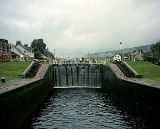
Caledonian Canal

Encyclopedia
The Caledonian Canal is a canal
in Scotland
that connects the Scottish east coast at Inverness
with the west coast at Corpach
near Fort William
. It was constructed in the early nineteenth century by engineer Thomas Telford
, and is a sister canal of the Göta Canal
in Sweden
, also constructed by Telford.
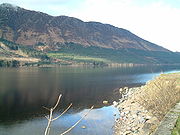
, Loch Oich
, and Loch Lochy
. These lochs are part of the Great Glen
, a geological fault in the Earth
's crust
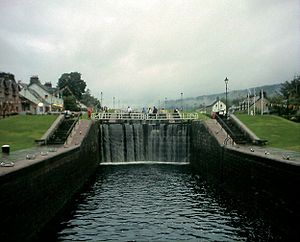
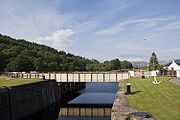
. There are 29 locks
(including eight at Neptune's Staircase
, Banavie
), four aqueduct
s and 10 bridges in the course of the canal.
 The canal was conceived as a way of providing much-needed employment to the Highland region. The area was depressed as a result of the Highland Clearances
, which had deprived many of their homes and jobs, and faced with laws which sought to eradicate their culture, including the right to wear tartan, to play bagpipes, and to speak Gaelic, many were emigrating to Canada or to the Scottish lowlands. The canal would also provide a safer passage for wooden sailing ships from the north east of Scotland to the south west, avoiding the route around the north coast via Cape Wrath and the Pentland Firth.
The first survey for a canal was carried out by James Watt
in 1773, but it was the Caledonian Canal Commission that paved the way for the actual construction. On 27 July 1803, an Act of Parliament
was passed to authorise the project, and the canal engineer Thomas Telford
was asked to survey, design and build the waterway. Telford worked with William Jessop
on the survey, and the two men oversaw the construction until Jessop died in 1814. The design was expected to take seven years to complete, and to cost £474,000, to be funded by the Government, but both estimates were inadequate.
Because of the remoteness of the location, construction was started at both ends, so that completed sections could be used to bring in the materials for the middle sections. At Corpach, near Fort William, the entrance lock was built on rock, but at the other end, there was 56 feet (17.1 m) of mud below the proposed site of the sea lock. Rock was tipped on top of the mud and was allowed to settle for six months before construction could begin. The ground through which the canal was cut was variable, and further difficulties were experienced with the construction of the locks, the largest ever built at the time. There were also problems with the labour force, with high levels of absence, particularly during and after the potato harvest and the peat cutting season. This led to Telford bringing in Irish navvies, to manage the shortfall, which led to further criticism, since one of the main aims of the project was to reduce unemployment in the Highlands. The canal finally opened in 1822, having taken an extra 12 years to complete, and cost £910,000. Over 3,000 local people had been employed in its construction, but the draught had been reduced from 20 feet (6.1 m) to 15 feet (4.6 m), in an effort to save costs. In the meantime, shipbuilding had advanced, with the introduction of steam-powered iron-hulled ships, many of which were now too big to use the canal. The navy did not need to use the canal either, as Napoleon had been defeated at Waterloo in 1815, and the perceived threat to shipping when the canal was started was now gone.
 Before long, defects in some of the materials used became apparent, and part of Corpach double lock collapsed in 1843. This led to a decision to close the canal, to allow repairs to be carried out, and the depth was increased to 18 feet (5.5 m) at the same time. The work was designed by Telford's associate, James Walker
and completed by 1847, but not all of the traffic expected to return to using the canal did so. Commercially, the venture was not a success, but the dramatic scenery through which it passes led to it becoming a tourist attraction. Queen Victoria took a trip along it in 1873, and the publicity surrounding the trip resulted in a large increase in people visiting the region and wanting to travel on the canal. Even the arrival of the railways at Fort William, Fort Augustus
and Inverness
did little to harm the canal, as trains were scheduled to connect with steamboat services.
There was an upsurge in commercial traffic during the First World War when components for the construction of mines were shipped through the canal on their way to Inverness from America, and fishing boats used it to avoid the route around the north of Scotland. Ownership passed to the Ministry of Transport in 1920, and then to British Waterways
in 1962. Improvements were made, with the locks being mechanised between 1964 and 1969. By 1990, the canal was in obvious need of restoration, with lock walls bulging, and it was estimated that repairs would cost £60 million. With no prospect of the Government funding this, British Waterways devised a repair plan, and between 1995 and 2005, sections of the canal were drained each winter. Stainless steel
rods were used to tie the double-skinned lock walls together, and over 25,000 tonnes of grout were injected into the lock structures. All of the lock gates were replaced, and the result was a canal where the structures are probably in a better condition than they have ever been.
The canal is now a Scheduled Ancient Monument, and attracts over half a million visitors each year. British Waterways, who work with the Highland Council and the Scottish Forestry Commission
through the Great Glen Ways Initiative, are hoping to increase this number to over 1 million by 2012. There are many ways for tourists to enjoy the canal, whether it is taking part in the Great Glen
Rally, cycling along the tow-paths, or cruising on Hotel Barges
.
) and a literal translation "Sligh'-Uisge na h-Alba".
Canal
Canals are man-made channels for water. There are two types of canal:#Waterways: navigable transportation canals used for carrying ships and boats shipping goods and conveying people, further subdivided into two kinds:...
in Scotland
Scotland
Scotland is a country that is part of the United Kingdom. Occupying the northern third of the island of Great Britain, it shares a border with England to the south and is bounded by the North Sea to the east, the Atlantic Ocean to the north and west, and the North Channel and Irish Sea to the...
that connects the Scottish east coast at Inverness
Inverness
Inverness is a city in the Scottish Highlands. It is the administrative centre for the Highland council area, and is regarded as the capital of the Highlands of Scotland...
with the west coast at Corpach
Corpach
Corpach is a large village north of Fort William, in the Scottish Highlands. The canal lock at Corpach Basin on Loch Linnhe, east of the narrows leading to Loch Eil, is the western sea entrance of the Caledonian Canal...
near Fort William
Fort William, Scotland
Fort William is the second largest settlement in the highlands of Scotland and the largest town: only the city of Inverness is larger.Fort William is a major tourist centre with Glen Coe just to the south, Aonach Mòr to the north and Glenfinnan to the west, on the Road to the Isles...
. It was constructed in the early nineteenth century by engineer Thomas Telford
Thomas Telford
Thomas Telford FRS, FRSE was a Scottish civil engineer, architect and stonemason, and a noted road, bridge and canal builder.-Early career:...
, and is a sister canal of the Göta Canal
Göta Canal
The Göta Canal is a Swedish canal constructed in the early 19th century. It formed the backbone of a waterway stretching some 382 miles , linking a number of lakes and rivers to provide a route from Gothenburg on the west coast to Söderköping on the Baltic Sea via the river Göta älv and the...
in Sweden
Sweden
Sweden , officially the Kingdom of Sweden , is a Nordic country on the Scandinavian Peninsula in Northern Europe. Sweden borders with Norway and Finland and is connected to Denmark by a bridge-tunnel across the Öresund....
, also constructed by Telford.
Route
The canal runs some 62 miles (99.8 km) from northeast to southwest. Only one third of the entire length is man-made, the rest being formed by Loch Dochfour, Loch NessLoch Ness
Loch Ness is a large, deep, freshwater loch in the Scottish Highlands extending for approximately southwest of Inverness. Its surface is above sea level. Loch Ness is best known for the alleged sightings of the cryptozoological Loch Ness Monster, also known affectionately as "Nessie"...
, Loch Oich
Loch Oich
Loch Oich is a freshwater loch in the Highlands of Scotland which forms part of the Caledonian Canal, of which it is the highest point. This narrow loch lies between Loch Ness and Loch Lochy in the Great Glen...
, and Loch Lochy
Loch Lochy
Loch Lochy is a large freshwater loch in Lochaber, Highland, Scotland. With a mean depth of , it is the third deepest loch of Scotland.-Geography:...
. These lochs are part of the Great Glen
Great Glen
The Great Glen , also known as Glen Albyn or Glen More is a series of glens in Scotland running 100 kilometres from Inverness on the Moray Firth, to Fort William at the head of Loch Linnhe.The Great Glen follows a large geological fault known as the Great Glen Fault...
, a geological fault in the Earth
Earth
Earth is the third planet from the Sun, and the densest and fifth-largest of the eight planets in the Solar System. It is also the largest of the Solar System's four terrestrial planets...
's crust
Crust (geology)
In geology, the crust is the outermost solid shell of a rocky planet or natural satellite, which is chemically distinct from the underlying mantle...
. There are 29 locks
Lock (water transport)
A lock is a device for raising and lowering boats between stretches of water of different levels on river and canal waterways. The distinguishing feature of a lock is a fixed chamber in which the water level can be varied; whereas in a caisson lock, a boat lift, or on a canal inclined plane, it is...
(including eight at Neptune's Staircase
Neptune's Staircase
Neptune's Staircase is a staircase lock comprising eight locks on the Caledonian Canal. It is the longest staircase lock in the United Kingdom, and lifts boats 64 feet...
, Banavie
Banavie
Banavie is a small settlement near Fort William in the Highland Council Area of Scotland. One of the closest villages to Ben Nevis, it is about 4 km north east of Fort William town centre, next to Caol and Corpach.It has been suggested that Banavie is one of the possible birth places of Saint...
), four aqueduct
Aqueduct
An aqueduct is a water supply or navigable channel constructed to convey water. In modern engineering, the term is used for any system of pipes, ditches, canals, tunnels, and other structures used for this purpose....
s and 10 bridges in the course of the canal.
History
Highland Clearances
The Highland Clearances were forced displacements of the population of the Scottish Highlands during the 18th and 19th centuries. They led to mass emigration to the sea coast, the Scottish Lowlands, and the North American colonies...
, which had deprived many of their homes and jobs, and faced with laws which sought to eradicate their culture, including the right to wear tartan, to play bagpipes, and to speak Gaelic, many were emigrating to Canada or to the Scottish lowlands. The canal would also provide a safer passage for wooden sailing ships from the north east of Scotland to the south west, avoiding the route around the north coast via Cape Wrath and the Pentland Firth.
The first survey for a canal was carried out by James Watt
James Watt
James Watt, FRS, FRSE was a Scottish inventor and mechanical engineer whose improvements to the Newcomen steam engine were fundamental to the changes brought by the Industrial Revolution in both his native Great Britain and the rest of the world.While working as an instrument maker at the...
in 1773, but it was the Caledonian Canal Commission that paved the way for the actual construction. On 27 July 1803, an Act of Parliament
Act of Parliament
An Act of Parliament is a statute enacted as primary legislation by a national or sub-national parliament. In the Republic of Ireland the term Act of the Oireachtas is used, and in the United States the term Act of Congress is used.In Commonwealth countries, the term is used both in a narrow...
was passed to authorise the project, and the canal engineer Thomas Telford
Thomas Telford
Thomas Telford FRS, FRSE was a Scottish civil engineer, architect and stonemason, and a noted road, bridge and canal builder.-Early career:...
was asked to survey, design and build the waterway. Telford worked with William Jessop
William Jessop
William Jessop was an English civil engineer, best known for his work on canals, harbours and early railways in the late 18th and early 19th centuries.-Early life:...
on the survey, and the two men oversaw the construction until Jessop died in 1814. The design was expected to take seven years to complete, and to cost £474,000, to be funded by the Government, but both estimates were inadequate.
Because of the remoteness of the location, construction was started at both ends, so that completed sections could be used to bring in the materials for the middle sections. At Corpach, near Fort William, the entrance lock was built on rock, but at the other end, there was 56 feet (17.1 m) of mud below the proposed site of the sea lock. Rock was tipped on top of the mud and was allowed to settle for six months before construction could begin. The ground through which the canal was cut was variable, and further difficulties were experienced with the construction of the locks, the largest ever built at the time. There were also problems with the labour force, with high levels of absence, particularly during and after the potato harvest and the peat cutting season. This led to Telford bringing in Irish navvies, to manage the shortfall, which led to further criticism, since one of the main aims of the project was to reduce unemployment in the Highlands. The canal finally opened in 1822, having taken an extra 12 years to complete, and cost £910,000. Over 3,000 local people had been employed in its construction, but the draught had been reduced from 20 feet (6.1 m) to 15 feet (4.6 m), in an effort to save costs. In the meantime, shipbuilding had advanced, with the introduction of steam-powered iron-hulled ships, many of which were now too big to use the canal. The navy did not need to use the canal either, as Napoleon had been defeated at Waterloo in 1815, and the perceived threat to shipping when the canal was started was now gone.
Operation
James Walker (engineer)
James Walker, FRS, was an influential Scottish civil engineer of the first half of the 19th century.Walker was born in Falkirk and was apprenticed to his uncle Ralph Walker in approximately 1800, with whom he gained experience working on the design and construction of the West India and East India...
and completed by 1847, but not all of the traffic expected to return to using the canal did so. Commercially, the venture was not a success, but the dramatic scenery through which it passes led to it becoming a tourist attraction. Queen Victoria took a trip along it in 1873, and the publicity surrounding the trip resulted in a large increase in people visiting the region and wanting to travel on the canal. Even the arrival of the railways at Fort William, Fort Augustus
Invergarry and Fort Augustus Railway
The Invergarry and Fort Augustus Railway was a branch-line railway built in Scotland, and served by the Highland Railway, the North British Railway and later the London & North Eastern Railway- Beginnings :...
and Inverness
Inverness
Inverness is a city in the Scottish Highlands. It is the administrative centre for the Highland council area, and is regarded as the capital of the Highlands of Scotland...
did little to harm the canal, as trains were scheduled to connect with steamboat services.
There was an upsurge in commercial traffic during the First World War when components for the construction of mines were shipped through the canal on their way to Inverness from America, and fishing boats used it to avoid the route around the north of Scotland. Ownership passed to the Ministry of Transport in 1920, and then to British Waterways
British Waterways
British Waterways is a statutory corporation wholly owned by the government of the United Kingdom, serving as the navigation authority in England, Scotland and Wales for the vast majority of the canals as well as a number of rivers and docks...
in 1962. Improvements were made, with the locks being mechanised between 1964 and 1969. By 1990, the canal was in obvious need of restoration, with lock walls bulging, and it was estimated that repairs would cost £60 million. With no prospect of the Government funding this, British Waterways devised a repair plan, and between 1995 and 2005, sections of the canal were drained each winter. Stainless steel
Stainless steel
In metallurgy, stainless steel, also known as inox steel or inox from French "inoxydable", is defined as a steel alloy with a minimum of 10.5 or 11% chromium content by mass....
rods were used to tie the double-skinned lock walls together, and over 25,000 tonnes of grout were injected into the lock structures. All of the lock gates were replaced, and the result was a canal where the structures are probably in a better condition than they have ever been.
The canal is now a Scheduled Ancient Monument, and attracts over half a million visitors each year. British Waterways, who work with the Highland Council and the Scottish Forestry Commission
Forestry Commission
The Forestry Commission is a non-ministerial government department responsible for forestry in Great Britain. Its mission is to protect and expand Britain's forests and woodlands and increase their value to society and the environment....
through the Great Glen Ways Initiative, are hoping to increase this number to over 1 million by 2012. There are many ways for tourists to enjoy the canal, whether it is taking part in the Great Glen
Great Glen
The Great Glen , also known as Glen Albyn or Glen More is a series of glens in Scotland running 100 kilometres from Inverness on the Moray Firth, to Fort William at the head of Loch Linnhe.The Great Glen follows a large geological fault known as the Great Glen Fault...
Rally, cycling along the tow-paths, or cruising on Hotel Barges
Hotel barge
The Hotel Barge came into being following the decline in commercial and freight carriage on the canals of Europe. Many working barges have been converted into floating hotels of varying degrees of luxury...
.
Names
The canal has several names in Scottish Gaelic including, "Amar-Uisge/Seòlaid a' Ghlinne Mhòir" (Waterway of the Great GlenGreat Glen
The Great Glen , also known as Glen Albyn or Glen More is a series of glens in Scotland running 100 kilometres from Inverness on the Moray Firth, to Fort William at the head of Loch Linnhe.The Great Glen follows a large geological fault known as the Great Glen Fault...
) and a literal translation "Sligh'-Uisge na h-Alba".