

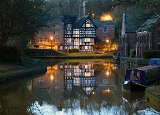
Bridgewater Canal

Encyclopedia
The Bridgewater Canal connects Runcorn
, Manchester
and Leigh
, in North West England
. It was commissioned by Francis Egerton, 3rd Duke of Bridgewater
, to transport coal from his mines in Worsley
to Manchester. It was opened in 1761 from Worsley to Manchester, and later extended from Manchester to Runcorn, and then from Worsley to Leigh.
The canal
is connected to the Manchester Ship Canal
via a lock at Cornbrook, the Rochdale Canal
in Manchester, the Trent and Mersey Canal
at Preston Brook
, southeast of Runcorn, and to the Leeds and Liverpool Canal
at Leigh. It once connected with the River Mersey
at Runcorn but has since been cut off by a slip road to the Silver Jubilee Bridge.
Often considered to be the first "true" canal, it required the construction of an aqueduct
to cross the River Irwell
, one of the first of its kind. Its success helped inspire a period of intense canal building, known as "canal mania". It later faced intense competition from the Liverpool and Manchester Railway
and the Macclesfield Canal
. Navigable throughout its history, it is one of the few canals in Britain not to have been nationalised, and remains privately owned. Pleasure craft now use the canal which forms part of the Cheshire Ring
network of canals.
, owned some of the coal mines dug to supply north west England
with fuel for the steam engine
s instrumental in powering England's industrial revolution
. The Duke transported his coal along the Mersey and Irwell Navigation and also by packhorse
, but each method was inefficient and expensive; river transport was subject to the vagaries of river navigation, and the amount of coal packhorses could carry was limited by its relative weight. The Duke's underground mines also suffered from persistent flooding, caused by the geology
of the Middle Coal Measures
, where the coal seam lies beneath a layer of permeable sandstone
.
Having visited the Canal du Midi
in France and watched the construction of the Sankey Canal
in England, the Duke's solution to these problems was to build an underground canal at Worsley, connected to a surface canal between Worsley
and Salford. In addition to easing overland transport difficulties and providing drainage for his mines, an underground canal would provide a reliable source of water for the surface canal, and also eliminate the need to lift the coal to the surface (an expensive and difficult proposition). The canal boats would carry 30 LT at a time, pulled by only one horse–more than ten times the amount of cargo per horse that was possible with a cart. The Duke and his estate manager John Gilbert
produced a plan of the canal, and in 1759 obtained an Act of Parliament
enabling its construction.
James Brindley
was brought in for his technical expertise (having previously installed a pumping system at the nearby Wet Earth Colliery
), and after a six-day visit suggested varying the route of the proposed canal away from Salford, instead taking it across the River Irwell
to Stretford
and thereon into Manchester. This route would make connecting to any future canals much easier, and would also increase competition with the Mersey and Irwell Navigation company. Brindley moved into Worsley Old Hall
and spent 46 days surveying the proposed route, which to cross the Irwell would require the construction of an aqueduct at Barton-upon-Irwell
. At the Duke's behest, in January 1760 Brindley also travelled to London to give evidence before a parliamentary committee. The Duke therefore gained a second Act of Parliament, which superseded the original.
Brindley's planned route began at Worsley and passed southeast through Eccles
, before turning south to cross the River Irwell. From there it continued southeast along the edge of Trafford Park
, and then east into Manchester. Although a connection with the Mersey and Irwell Navigation was included in the new Act, at Hulme Locks in Castlefield
(on land previously occupied by Hulme Hall), this was not completed until 1838. The terminus would be at Castlefield Basin, where the nearby River Medlock
was to help supply the canal with water. Boats would unload their cargoes inside the Duke's purpose-built warehouse. There were no locks in Brindley's design, demonstrating his ability as a competent engineer. His aqueduct
was built relatively quickly for the time; work commenced in September 1760 and the first boat crossed on 17 July 1761.

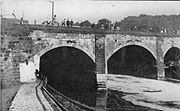 The Duke invested a large sum of money in the scheme. From Worsley to Manchester its construction cost £168,000 (£ as of ), but its advantages over land and river transport meant that within a year of its opening in 1761, the price of coal in Manchester fell by about half. This success helped inspire a period of intense canal building, known as Canal Mania
. Along with its stone aqueduct at Barton-upon-Irwell, the Bridgewater Canal was considered a major engineering achievement. One commentator wrote that when finished, "[the canal] will be the most extraordinary thing in the Kingdom, if not in Europe. The boats in some places are to go underground, and in other places over a navigable river, without communicating with its waters ..."
In addition to the Duke's warehouse at Manchester, more buildings were built by Brindley and extended to Alport Street (now called Deansgate
). The warehouses were of timber frame design, with load-bearing hand-made brick walls, supported on cast iron posts. The Duke's warehouse was badly damaged by fire in 1789 but was rebuilt.

. He assisted in obtaining Parliamentary approval for the Bridgewater Canal Extension Act of 1762 which allowed the construction of an extension to the canal, from Manchester, to the River Mersey at Runcorn
. Despite objections from the Mersey and Irwell Navigation Company, Royal assent
was given on 24 March 1762. A junction, Waters Meeting, was created in Trafford Park
, at which the new extension branched south through Stretford
, Sale
, Altrincham
, Lymm
and finally to Runcorn
.
In December 1761 Brindley undertook a survey of the route at Runcorn. His initial plan was to make the terminus at Hempstones, east of Runcorn Gap, but following a study of the tides and depth of water there, he decided instead to build the terminus west of Runcorn Gap. This change was designed to accommodate Mersey flats
, although the low fixed bridges required that traffic on the canal be able to lower or unship their masts. Runcorn basin was almost 90 feet (27 m) above the Mersey, so a flight of ten locks, described as "the wonder of their time", was built to connect the two. Nine locks had a fall of 2 metres (7 ft), with a fall at the river lock of more than 6 metres (20 ft) at low water. It allowed vessels to enter and leave the canal on any tide
. The connection to the Mersey was made on 1 January 1773. The river's tidal action tended to deposit silt
around the lower entrance to the locks, so to counteract this a channel, equipped with gates at each end and known as the Duke's Gut, was cut through the marshes upriver from the locks. At high tide the gates were closed, and with the ebb of the tide were opened to release water, which scoured the silt from the entrance to the locks. The cut created an island, known as Runcorn Island, crossed by Castle Bridge.
 The connection to Manchester was delayed by Sir Richard Brooke
of Norton Priory
. Concerned that boatmen might poach his game and wild fowl, Brooke did not want the canal to pass through his land. The Act included several stipulations; the canal should not come within 325 metres (1,066 ft) of his house; the towpath should be on the south side of the canal, furthest away from Brooke's house; there should be no quays, buildings, hedges or fences to obstruct the view; no vessels were to be moored within 1000 metres (3,281 ft) of the house, other than during construction. Eventually though, a compromise was reached. This included the construction of a link to the Trent and Mersey Canal
at Preston Brook
(permitted by the Trent and Mersey Canal Act of 1766), and the building of the canal's terminus to the west of Runcorn Gap. The Trent and Mersey link gave the Duke access to the Midlands, and forestalled the Weaver Trustees from making their own junction with the canal. The new extension also met with opposition from the Mersey and Irwell Navigation, until the Duke purchased a controlling interest in the company. The first part of the new extension was opened in 1767, and completed in full by March 1776, but Brindley did not live to see its completion; it was continued by his brother-in-law, Hugh Henshall
.
The total cost of the canal, from Worsley to Manchester and from Longford Bridge to the Mersey at Runcorn, was £220,000. Alongside the Mersey, the Duke built Runcorn Dock
, several warehouses, and Bridgewater House
, a temporary home from which he could supervise operations at the Runcorn end. Two locks up from the tideway was a small dry dock
.
and Stockport
which was to follow the valley of the Mersey. The Act was applied for to counter a proposed canal that would give the towns of Stockport
and Macclesfield
access to the Mersey, via the River Weaver
. The work was not done, the Act lapsed and this section of canal was never built.
Over two decades later, the nearby Manchester Bolton & Bury Canal had sought a connection to other waterways, and it appears that the Duke had planned to limit the activities of the new company. On 15 December 1792 the Duke purchased a portion of the Ringspiggot estate in Salford which blocked the MB&BC's plans to build a riverside basin and wharfs there.
, Astley Green
and Bedford
to Leigh. The new extension enabled the supply to Manchester of coal from Leigh and the surrounding districts. On 21 June 1819 an Act of Parliament was enacted to create a link between this extension and the Wigan
branch of the Leeds and Liverpool Canal
.
Access to the canal brought about a rapid development in coal mining on the Manchester Coalfield
west of Worsley. Chaddock pits in the east of Tyldesley were connected to a level from Worsley. In 1820 they were connected to the canal at Boothstown by the Chaddock Level which ran in a north west direction from Boothstown Basin which would have eased congestion at the Delph. Sometime after 1840 Samuel Jackson built a narrow gauge tramroad worked by horses from his Gin Pit Colliery
to Marsland Green where he had cranes and tipplers to load barges at a wharf on the canal. The tramroad was later worked by locomotives. In the 1940s and 50s coal was sent to Barton Power Station
and Runcorn Gas Works. In 1867 the Fletchers
built a private railway line and Bedford Basin with facilities for loading coal from Howe Bridge
onto barges. Astley Green Colliery
began winding coal on the north bank of the canal in 1912.
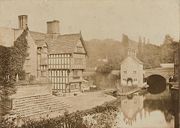
 Upon completion of the Rochdale Canal
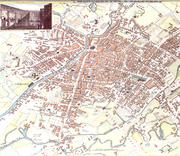
in 1804, the two canals were joined at Castlefield. This connection may have been a factor in the failure of the Manchester Bolton & Bury Canal Company's rival scheme to build a canal between Bury and Sladen. The River Medlock, a major source of water for the canal and which was almost as badly polluted as the nearby Irwell, was diverted through a tunnel under the canal at Castlefield by Charles Edward Cawley
, a civil engineer for the Salford Corporation
and later MP for Salford. The canal was from that point supplied by the much purer water of the Rochdale Canal.
quarry
near Worsley Brook, was the entrance to the Navigable Levels. It is now a Scheduled Monument. Two entrances, built years apart, allow access to the specially built M-boats (also known as Starvationers), the largest of which could carry 12 LT of coal. Inside the mines 46 miles (74 km) of underground canal on four levels, linked by inclined planes, were constructed. The mines ceased production in 1887. As the canal passes through Worsley, iron oxide
from the mines has, for many years, stained the water bright orange. The removal of this colouration is currently the subject of a £2.5 million remedial scheme.
was also transported from Cheshire
. Sales of coal were £19,455, and nearly £30,000 was earned from other cargoes. Passenger traffic in 1791 brought in receipts of £3,781.
The canal also carried passengers and was in keen competition with the Mersey and Irwell Navigation Company (M&IN). The journey down river by the latter route took eight hours (nine hours in the up direction) while the journey on the Bridgewater canal took nine hours each way. Fares were similar but the Bridgewater route was said to be "more picturesque". Boating
men also used the canal. They lifted their small lightweight boats out of the M&IN at Runcorn, and carried them a short distance up the steep streets onto the Bridgewater Canal.
Barges on the canal continued to be towed by horses until the middle of the 19th century, when they were replaced by steam-powered boats after a fatal epidemic spread through the horse population. The "dense smoke" produced by the steam barges and their "harsh unnecessary whistling" proved unpopular with some local residents, who also began to suffer from a condition known as canal throat, "no doubt caused by the foul emanations given off by its [the Bridgewater Canal's] horribly filthy water".
The canal carried commercial freight traffic until 1975; the last regular cargo was grain from Liverpool to Manchester for BOCM. It is now used mainly by pleasure craft and hosts two rowing
clubs – Trafford Rowing Club and Manchester University Boat Club.
, the Marquess of Stafford (later the 1st Duke of Sutherland). On his death it was to go to Stafford's second son Francis
, provided he changed his name to Egerton; and then to his heirs and successors. The management of the company was placed in the hands of three trustees. These were Sir Archibald Macdonald
, who was Lord Chief Baron of the Exchequer
, Edward Venables-Vernon-Harcourt, at the time the Bishop of Carlisle
and later the Archbishop of York
, and, as Superintendent, Robert Haldane Bradshaw
, the Duke's agent. Bradshaw managed the estate, for which he received a salary of £2,000 a year and the use of the Duke's mansions at Worsley and Runcorn. The other two trustees had each married nieces of the Duke and were "dummy trustees".
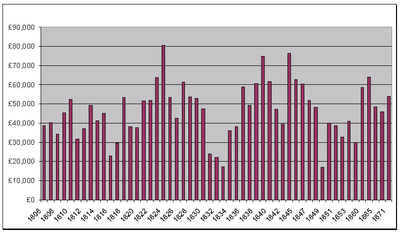 During the time the canal was administered by the Bridgewater Trustees, it made a profit every year. Until his retirement in 1834, the administration was carried out entirely by Bradshaw. It has been calculated that the average annual profit between 1806 and 1826 was of the order of 13%, and in 1824, the best year, it was 23%. Bradshaw found it difficult to delegate, and complained of being over-worked, but he was also regarded as being a "formidable bargainer". In 1805 he was approached by the proprietors of the nearby Manchester Bolton & Bury Canal to resolve a dispute with a Salford landowner, but his response was delayed. In 1810 there was a general agreement with the Mersey and Irwell Navigation Company (M&IN) to simultaneously raise freight charges. However any cooperation between the two companies was short-lived and by 1812 the Mersey and Irwell had reduced their charges. Further competition was to come from other carriers who used the canal; in 1824 the traffic carried by private companies exceeded that carried by the Trustees for the first time. However, in time more profit came from "tonnage traffic" (that carried by private companies) than from the Bridgewater's own carriage of freight. Bradshaw's administration saw increased deterioration of the fabric of the canal, the locks, docks and warehouses. The undertakings were starved of capital largely due to inadequate provision for it in the Duke's will. There were also problems caused by silting around the entrance to the Mersey and by the changing channels of the river itself.
During the 1820s there was increased dissatisfaction with the canals. They did not cope well with increasing volumes of cargo, and they were perceived as monopolistic, and the preserve of the landed gentry class. There was increased interest in the possibility of railway construction. The possible construction of a railway between Liverpool and Manchester was vigorously opposed by Bradshaw, who refused railway surveyors access to land owned by the Trustees. When the first bill
was presented to parliament in 1825, the Trustees opposed and it was overthrown. However later in the year Lord Stafford, possibly persuaded to do so by William Huskisson
, invested £100,000 (one-fifth of the required capital), in the Liverpool and Manchester Railway
. Following this the Trustees withdrew their opposition to the construction of the railway; they did not petition against the second bill, which was passed in 1826. At the same time as he made his investment in the railway, Lord Stafford advanced £40,000 for improvements to the canal. This was spent mainly on a second line of locks at Runcorn, which were completed in 1828, plus new warehouses at Manchester and Liverpool. The additional line of locks cost £35,000 and was used for traffic heading to Manchester, while the old line was used for traffic passing down to the Mersey.
In 1830 the new railway opened and by the end of the year was carrying freight. Bradshaw immediately went into competition by lowering the rates of carriage on the canal and by offering improved terms to the private carriers. By so doing he managed to maintain the volume of traffic carried by the canal, both freight and passengers, at a time when the country was suffering a trade depression
. However Bradshaw's tactics led to a sharp decline in profits. At the same time costs were rising, partly due to the use of steamboats on the Mersey. Further competition came with the opening of the Macclesfield Canal
in 1831 which gave separate access to Manchester from the Midlands. In November 1831 Bradshaw suffered a stroke
, as a result of which he lost the use of his left arm and leg, and there is evidence that it also impaired his judgement.
Matters came to a head in 1833, the year in which the canal made its lowest profit since the death of the Duke. On 19 July the Marquess of Stafford (now the 1st Duke of Sutherland) died and the profits from the canal passed to Francis Egerton. On 25 September Bradshaw's son, Captain James Bradshaw, who had been acting as a deputy superintendent to the Trustees, and who had been expected to succeed his father as Superintendent, committed suicide. The agent for both Francis Egerton and his older brother, who was now the 2nd Duke of Sutherland
, was James Loch
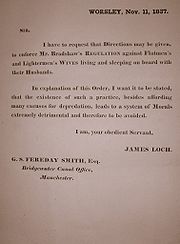
. The events that followed were "stage-managed by Loch". He reported to Francis Egerton that Bradshaw was no longer fit to be Superintendent, and then persuaded Bradshaw to retire on his full salary. It had been expected that he would appoint his other son, William Rigby Bradshaw, as his successor, but Loch persuaded him to appoint James Sothern in the position; Sothern had been the principal agent of the Trust since December 1832. He took over the position of Superintendent on 3 February 1834. The appointment of Sothern was not a success. Charges were made against him of dishonesty and of nepotism. He entered into disputes and disagreements with Loch, with Francis Egerton, and with the other two trustees. (Sir Archibald Macdonald had died in 1826; by this time his place had been taken by the 10th Earl of Devon). To avoid a costly lawsuit, at the end of 1836 Sothern agreed to retire on various conditions which included receipt of £45,000. On 1 March 1837, he was succeeded as Superintendent by James Loch.
Loch was extremely busy and did not have time to deal with the detailed administration of the Trust. He therefore looked for a deputy to take on these duties. His first choice was Richard Smith who was the mine agent to the Trustees of the 1st Earl of Dudley. However this was perceived as poaching and it led to such controversy that Smith declined the offer and recommended his son, George Samuel Fereday Smith
for the post. Fereday Smith was appointed as Deputy Superintendent in March 1837 on a salary of £600 a year, half of the salary which had been offered to his father. Loch immediately undertook a reorganisation of the administration and efficiency of the business, restored the agreement with the Old Quay Company to raise freight charges, and improved the facilities for passengers, including the introduction of "swift boats". By 1837, the Trustees employed around 3,000 people (including those working in the colliery and in Worsley Yard), making it one of the largest employers in the country at the time. Since the death of the Duke the amount of freight carried by the canal had almost trebled; in 1803 it carried 334495 LT of goods and in 1836 968795 LT.
In 1843 a new dock, the Francis Dock, was opened at Runcorn. The late 1830s and early 1840s had seen increased competition between the Bridgewater Canal on the one hand, and other canal companies and the railways on the other. The most dangerous of the rivals was the Mersey and Irwell Navigation Company who started to reduce their rates again in 1840. This led to a price war between the two canal companies and the Liverpool and Manchester Railway, who had previously cooperated on rates. Eventually, in desperation, the Bridgewater Trustees bought the Mersey and Irwell and took over its ownership on 1 January 1844. During the same year competition with other canals was further reduced by agreements made with the Ellesmere and Chester Canal
Company and with the Anderton Carrying Company. In 1844 the canal made a profit of £76,410, the second highest during the time it was administered by the Trustees.
Having seen off competition from other canal companies, the next major threat was to come from the railways. This was the period in the mid-1840s known as the Railway Mania
. The railways competed with the canals in three ways; by building, or threatening to build, new lines which would be in direct competition with the canals; by amalgamation into giant companies (such as the Midland
and the London and North Western
companies), which gave them more political power; and by taking over ownership of canal companies. On 13 April 1844 The Times
newspaper reported that the canal was to be emptied of water, and converted into a railway, although nothing came of this scheme. In 1845, in return for concessions, the Trustees supported the Grand Junction Railway
in its campaign to build a more direct line to Liverpool, which crossed the Mersey over a bridge at Runcorn Gap. However the bill was overthrown in the House of Lords. Competition from the railways and other canals led to a decline in the trading and the profits between 1845 and 1848, but there was no "disastrous collapse". During this time the Trustees and their representatives were engaged in vigorous campaigns in Parliament to protect their interests.
By October 1844 a bonding warehouse had been built in Manchester and the first cargo to arrive was announced in a letter to the Manchester Guardian, later printed in The Times
:
However, this venture was less successful than expected, as is evidenced by a letter to The Observer
later that year, also printed in The Times:
Between 1849 and 1851 the competition between the Trustees and the railway companies intensified. Agreements and alliances were made and broken. Their major opponents were the London and North Western Railway and the Lancashire and Yorkshire Railway
who reduced tariffs and took business away from the canals. For the first time the railways carried more trade between Liverpool and the towns of central Lancashire than the canals. The value of the traffic carried by the Bridgewater Canal in 1851 was the lowest in the time it was administered by the Trustees. In 1851 the Earl of Ellesmere hosted a visit to Manchester
by Queen Victoria and Prince Albert. They stayed at Worsley Hall, with a view of the canal, and were given a trip between Patricroft railway station
and Worsley Hall, on state barges. Large crowds had gathered to cheer the royal party, which apparently frightened the horses drawing the barge so much that they fell into the canal.
The Trustees spent much time between 1851 and 1855 in negotiations to ease the competition, especially that from the London and North Western Railway. The most likely allies seemed to be other railway companies, including the Shrewsbury and Birmingham
and the Shrewsbury and Chester
railway companies, and the Great Western Railway. Of these, the most likely seemed to be the Great Western Railway who, in their concern to expand northwards were willing to help the Trustees with the carriage of their traffic to the south. However years of negotiations came to no agreement and, in the end, the Trustees' railway deal was done with the London and North Western Railway, who agreed to cooperate with the onward passage of the Trustees' traffic.
On 28 June 1855 James Loch, the Superintendent, died and was succeeded by Hon. Algernon Fulke Egerton
, Lord Ellesmere's third son. He was then aged 29, and had been educated at Harrow
and Christ Church, Oxford
; he had been destined for a political life and had no experience of managing coal mines or canals. Since James Loch had been appointed, he had been mainly in control of the management of the Trustees, assisted by his son George Loch
. During this time the role of Fereday Smith had been diminished; initially appointed as Deputy Superintendent, his position was reduced to that of Principal Agent in 1845. With the arrival of the inexperienced Algernon Egerton, Fereday Smith had a much greater say in the management. During the previous four years the Lochs had been reluctant to invest in improvements to the canal or Runcorn Dock, despite the increasing demand for the passage of goods through the dock, and the profits made during these years became stagnant. Fereday Smith had been keen on expansion and now his opportunity came. He first reduced the top-heavy administration of the Trust, and then took on the planning of the expansion of the business. The steamers
owned by the Trustees had been neglected and were in a poor state; these were repaired or sold.
George Loch, who had been opposed to using the Trustees' investments for improvements to the canals or docks, died in 1857. Between 1857 and 1872 the Trustees provided more capital for improvements from their own resources than at any previous time. The Runcorn and Weston Canal
was built in 1858–59, providing a connection between Runcorn Docks and the Weaver Navigation
. A new half tide dock
, the Alfred Dock was opened at Runcorn in 1860. Electric telegraph was installed in 1861–62.
In 1862 the 2nd Earl of Ellesmere died and his son and heir, the 3rd Earl
was a minor
, aged 15. This gave Algernon Egerton even more power to invest the profits of the company in developments. Negotiations were made to increase sea-borne trade, both British and foreign, through the canal. Building started on a new dock at Runcorn in 1867. Work was carried out in the Mersey estuary around the docks to improve access for vessels. Some of this was carried out in conjunction with the London and North Western Railway who were building a bridge
across Runcorn Gap to take their line from Weaver Junction to Liverpool; the railway paid half the cost of the improvements, amounting to about £20,000 (£ today). Improvements were made to the Trustees' facilities at Liverpool, to the Mersey and Irwell Navigation and to the Bridgewater Canal itself. Agreements were made with the railway companies to cooperate on the transit of goods and the rates of carriage and "the Trustees' fortunes entered a calmer phase".
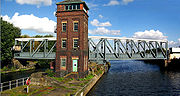 In 1872 the Bridgewater Navigation Company Ltd was formed, and on Monday 9 September the canal was purchased in the names of Sir Edward William Watkin
and William Philip Price, respectively chairmen of the Manchester, Sheffield and Lincolnshire Railway
and the Midland Railway
for £1,120,000. The canal was sold again in 1885, when the Manchester Ship Canal
Company paid the Bridgewater Navigation Company £1,710,000 for all their property. The construction of the Ship Canal forced the removal of Barton Aqueduct and the construction of Barton Swing Aqueduct
, as the former was too low for the vessels which would use the new canal. In 1923 Bridgewater Estates Ltd was formed to acquire the Ellesmere family
estate in Worsley.
In 1984 Bridgewater Estates Ltd was purchased by a subsidiary of Peel Holdings
. In 1987 Highams Ltd acquired a majority shareholding of the Manchester Ship Canal Company (subsequently the shares held by Highams were transferred to Peel Holdings). In 1994 the Manchester Ship Canal Company became a wholly owned subsidiary of the Peel Holdings group. In 2004 ownership of the Manchester Ship Canal Company was transferred to the Peel Ports group.
 The Bridgewater is often considered to be the first true canal in Britain, as it relied upon existing watercourses as sources of water rather than as navigable routes. It now terminates in Runcorn basin, just before the disused flight of 10 locks which (before the approach road to the Silver Jubilee Bridge was built) used to lower the canal to the Runcorn Docks on the River Mersey and later, to the Manchester Ship Canal. The old line of locks in Runcorn fell into disuse in the late 1930s, and they were closed under the Ship Canal Act of 1949 and filled in. The Ship Canal Act of 1966 allowed the closure and filling in of the newer line of locks. The gates from this flight of locks were removed and installed at Devizes on the Kennett & Avon Canal. The Duke's warehouse in Manchester was demolished in 1960.
The canal has suffered three breaches; one soon after opening, another in 1971 near the River Bollin
aqueduct, and another in the summer of 2005 when a sluice gate failed in Manchester. Cranes
are located at intervals along the canal's length to allow boards to be dropped into slots in the banks. These allow sections of the canal to be isolated in the event of a leak.
The canal now forms an integral part of the Cheshire Ring
network of canals. Pleasure craft have been allowed on the canal since 1952.
The proposed new road crossing of the Mersey may allow a realignment of the Bridge approach road and the complete restoration of the original flight of locks – thus re-opening the link to Runcorn Docks, the Runcorn and Weston Canal, the River Mersey, the Manchester Ship Canal, and the River Weaver. This would create a new ring route for leisure boats involving the Trent and Mersey Canal, the Anderton Boat Lift
and the River Weaver.
The Hulme Locks Branch Canal
in Manchester is now disused, and on 26 May 1995 was replaced by the nearby Pomona Lock.
Runcorn
Runcorn is an industrial town and cargo port within the borough of Halton in the ceremonial county of Cheshire, England. In 2009, its population was estimated to be 61,500. The town is on the southern bank of the River Mersey where the estuary narrows to form Runcorn Gap. Directly to the north...
, Manchester
Manchester
Manchester is a city and metropolitan borough in Greater Manchester, England. According to the Office for National Statistics, the 2010 mid-year population estimate for Manchester was 498,800. Manchester lies within one of the UK's largest metropolitan areas, the metropolitan county of Greater...
and Leigh
Leigh, Greater Manchester
Leigh is a town within the Metropolitan Borough of Wigan, in Greater Manchester, England. It is southeast of Wigan, and west of Manchester. Leigh is situated on low lying land to the north west of Chat Moss....
, in North West England
North West England
North West England, informally known as The North West, is one of the nine official regions of England.North West England had a 2006 estimated population of 6,853,201 the third most populated region after London and the South East...
. It was commissioned by Francis Egerton, 3rd Duke of Bridgewater
Francis Egerton, 3rd Duke of Bridgewater
Francis Egerton, 3rd Duke of Bridgewater , known as Lord Francis Egerton until 1748, was a British nobleman, the younger son of the 1st Duke...
, to transport coal from his mines in Worsley
Worsley
Worsley is a town in the metropolitan borough of the City of Salford, in Greater Manchester, England. It lies along the course of Worsley Brook, west of Manchester. The M60 motorway bisects the area....
to Manchester. It was opened in 1761 from Worsley to Manchester, and later extended from Manchester to Runcorn, and then from Worsley to Leigh.
The canal
Canal
Canals are man-made channels for water. There are two types of canal:#Waterways: navigable transportation canals used for carrying ships and boats shipping goods and conveying people, further subdivided into two kinds:...
is connected to the Manchester Ship Canal
Manchester Ship Canal
The Manchester Ship Canal is a river navigation 36 miles long in the North West of England. Starting at the Mersey Estuary near Liverpool, it generally follows the original routes of the rivers Mersey and Irwell through the historic counties of Cheshire and Lancashire. Several sets of locks lift...
via a lock at Cornbrook, the Rochdale Canal
Rochdale Canal
The Rochdale Canal is a navigable "broad" canal in northern England, part of the connected system of the canals of Great Britain. The "Rochdale" in its name refers to the town of Rochdale, Greater Manchester, through which the canal passes....
in Manchester, the Trent and Mersey Canal
Trent and Mersey Canal
The Trent and Mersey Canal is a in the East Midlands, West Midlands, and North West of England. It is a "narrow canal" for the vast majority of its length, but at the extremities—east of Burton upon Trent and west of Middlewich—it is a wide canal....
at Preston Brook
Preston Brook
Preston Brook is a civil parish in the borough of Halton, a unitary authority in the ceremonial county of Cheshire, England. It is located to the south-east of Runcorn and is adjacent to the M56 motorway. It contains the villages of Preston Brook and Preston on the Hill.In the 2001 Census, the...
, southeast of Runcorn, and to the Leeds and Liverpool Canal
Leeds and Liverpool Canal
The Leeds and Liverpool Canal is a canal in Northern England, linking the cities of Leeds and Liverpool. Over a distance of , it crosses the Pennines, and includes 91 locks on the main line...
at Leigh. It once connected with the River Mersey
River Mersey
The River Mersey is a river in North West England. It is around long, stretching from Stockport, Greater Manchester, and ending at Liverpool Bay, Merseyside. For centuries, it formed part of the ancient county divide between Lancashire and Cheshire....
at Runcorn but has since been cut off by a slip road to the Silver Jubilee Bridge.
Often considered to be the first "true" canal, it required the construction of an aqueduct
Aqueduct
An aqueduct is a water supply or navigable channel constructed to convey water. In modern engineering, the term is used for any system of pipes, ditches, canals, tunnels, and other structures used for this purpose....
to cross the River Irwell
River Irwell
The River Irwell is a long river which flows through the Irwell Valley in the counties of Lancashire and Greater Manchester in North West England. The river's source is at Irwell Springs on Deerplay Moor, approximately north of Bacup, in the parish of Cliviger, Lancashire...
, one of the first of its kind. Its success helped inspire a period of intense canal building, known as "canal mania". It later faced intense competition from the Liverpool and Manchester Railway
Liverpool and Manchester Railway
The Liverpool and Manchester Railway was the world's first inter-city passenger railway in which all the trains were timetabled and were hauled for most of the distance solely by steam locomotives. The line opened on 15 September 1830 and ran between the cities of Liverpool and Manchester in North...
and the Macclesfield Canal
Macclesfield Canal
The Macclesfield Canal is a canal in east Cheshire, England, one of the six that make up the Cheshire Ring.-Route:The canal runs from Marple Junction at Marple, where it joins the Upper Peak Forest Canal, , southwards , before arriving at Bosley.Having descended the 12 Bosley Locks over the course...
. Navigable throughout its history, it is one of the few canals in Britain not to have been nationalised, and remains privately owned. Pleasure craft now use the canal which forms part of the Cheshire Ring
Cheshire Ring
The Cheshire Ring is a popular canal cruising circuit, or canal ring which includes six of the canals in and around Cheshire, England.Because it takes approximately a week to complete, it is suited to narrowboat holidays which start and return to the same location. The route has 92 locks and is long...
network of canals.
Design and construction
Francis Egerton, 3rd Duke of BridgewaterFrancis Egerton, 3rd Duke of Bridgewater
Francis Egerton, 3rd Duke of Bridgewater , known as Lord Francis Egerton until 1748, was a British nobleman, the younger son of the 1st Duke...
, owned some of the coal mines dug to supply north west England
North West England
North West England, informally known as The North West, is one of the nine official regions of England.North West England had a 2006 estimated population of 6,853,201 the third most populated region after London and the South East...
with fuel for the steam engine
Steam engine
A steam engine is a heat engine that performs mechanical work using steam as its working fluid.Steam engines are external combustion engines, where the working fluid is separate from the combustion products. Non-combustion heat sources such as solar power, nuclear power or geothermal energy may be...
s instrumental in powering England's industrial revolution
Industrial Revolution
The Industrial Revolution was a period from the 18th to the 19th century where major changes in agriculture, manufacturing, mining, transportation, and technology had a profound effect on the social, economic and cultural conditions of the times...
. The Duke transported his coal along the Mersey and Irwell Navigation and also by packhorse
Packhorse
.A packhorse or pack horse refers generally to an equid such as a horse, mule, donkey or pony used for carrying goods on their backs, usually carried in sidebags or panniers. Typically packhorses are used to cross difficult terrain, where the absence of roads prevents the use of wheeled vehicles. ...
, but each method was inefficient and expensive; river transport was subject to the vagaries of river navigation, and the amount of coal packhorses could carry was limited by its relative weight. The Duke's underground mines also suffered from persistent flooding, caused by the geology
Geology
Geology is the science comprising the study of solid Earth, the rocks of which it is composed, and the processes by which it evolves. Geology gives insight into the history of the Earth, as it provides the primary evidence for plate tectonics, the evolutionary history of life, and past climates...
of the Middle Coal Measures
Coal Measures
The Coal Measures is a lithostratigraphical term for the coal-bearing part of the Upper Carboniferous System. It represents the remains of fluvio-deltaic sediment, and consists mainly of clastic rocks interstratified with the beds of coal...
, where the coal seam lies beneath a layer of permeable sandstone
Sandstone
Sandstone is a sedimentary rock composed mainly of sand-sized minerals or rock grains.Most sandstone is composed of quartz and/or feldspar because these are the most common minerals in the Earth's crust. Like sand, sandstone may be any colour, but the most common colours are tan, brown, yellow,...
.
Having visited the Canal du Midi
Canal du Midi
The is a long canal in Southern France . The canal connects the Garonne River to the on the Mediterranean and along with the Canal de Garonne forms the Canal des Deux Mers joining the Atlantic to the Mediterranean. The canal runs from the city of Toulouse down to the Étang de Thau...
in France and watched the construction of the Sankey Canal
Sankey Canal
The Sankey Canal, which is also known as the Sankey Brook Navigation and the St Helens Canal, is a canal in Cheshire, extending into Merseyside, in the northwest of England, connecting St Helens with the River Mersey...
in England, the Duke's solution to these problems was to build an underground canal at Worsley, connected to a surface canal between Worsley
Worsley
Worsley is a town in the metropolitan borough of the City of Salford, in Greater Manchester, England. It lies along the course of Worsley Brook, west of Manchester. The M60 motorway bisects the area....
and Salford. In addition to easing overland transport difficulties and providing drainage for his mines, an underground canal would provide a reliable source of water for the surface canal, and also eliminate the need to lift the coal to the surface (an expensive and difficult proposition). The canal boats would carry 30 LT at a time, pulled by only one horse–more than ten times the amount of cargo per horse that was possible with a cart. The Duke and his estate manager John Gilbert
John Gilbert (agent)
John Gilbert was land agent and engineer to the third Duke of Bridgewater and is credited with the idea which led to the building of the Bridgewater Canal....
produced a plan of the canal, and in 1759 obtained an Act of Parliament
Acts of Parliament in the United Kingdom
An Act of Parliament in the United Kingdom is a type of legislation called primary legislation. These Acts are passed by the Parliament of the United Kingdom at Westminster, or by the Scottish Parliament at Edinburgh....
enabling its construction.
James Brindley
James Brindley
James Brindley was an English engineer. He was born in Tunstead, Derbyshire, and lived much of his life in Leek, Staffordshire, becoming one of the most notable engineers of the 18th century.-Early life:...
was brought in for his technical expertise (having previously installed a pumping system at the nearby Wet Earth Colliery
Wet Earth Colliery
The Wet Earth Colliery has a unique place in British coal mining history, apart from being one of the earliest pits in the country; it is the place where the engineer James Brindley made water run uphill...
), and after a six-day visit suggested varying the route of the proposed canal away from Salford, instead taking it across the River Irwell
River Irwell
The River Irwell is a long river which flows through the Irwell Valley in the counties of Lancashire and Greater Manchester in North West England. The river's source is at Irwell Springs on Deerplay Moor, approximately north of Bacup, in the parish of Cliviger, Lancashire...
to Stretford
Stretford
Stretford is a town within the Metropolitan Borough of Trafford, in Greater Manchester, England. Lying on flat ground between the River Mersey and the Manchester Ship Canal, it is to the southwest of Manchester city centre, south-southwest of Salford and northeast of Altrincham...
and thereon into Manchester. This route would make connecting to any future canals much easier, and would also increase competition with the Mersey and Irwell Navigation company. Brindley moved into Worsley Old Hall
Worsley Old Hall
Worsley Old Hall is a former house, now a public house and restaurant, off Walkden Road , Worsley, Greater Manchester, England. Historically situated within Lancashire, it has been designated by English Heritage as a Grade II listed building...
and spent 46 days surveying the proposed route, which to cross the Irwell would require the construction of an aqueduct at Barton-upon-Irwell
Barton-upon-Irwell
Barton-upon-Irwell is a suburban area of Eccles, Greater Manchester, England.-History:...
. At the Duke's behest, in January 1760 Brindley also travelled to London to give evidence before a parliamentary committee. The Duke therefore gained a second Act of Parliament, which superseded the original.
Brindley's planned route began at Worsley and passed southeast through Eccles
Eccles, Greater Manchester
Eccles is a town in the City of Salford, a metropolitan borough of Greater Manchester in North West England, west of Salford and west of Manchester city centre...
, before turning south to cross the River Irwell. From there it continued southeast along the edge of Trafford Park
Trafford Park
Trafford Park is an area of the Metropolitan Borough of Trafford, in Greater Manchester, England. Located opposite Salford Quays, on the southern side of the Manchester Ship Canal, it is west-southwest of Manchester city centre, and north of Stretford. Until the late 19th century it was the...
, and then east into Manchester. Although a connection with the Mersey and Irwell Navigation was included in the new Act, at Hulme Locks in Castlefield
Castlefield
Castlefield is an inner city area of Manchester, in North West England. The conservation area which bears its name is bounded by the River Irwell, Quay Street, Deansgate and the Chester Road. It was the site of the Roman era fort of Mamucium or Mancunium which gave its name to Manchester...
(on land previously occupied by Hulme Hall), this was not completed until 1838. The terminus would be at Castlefield Basin, where the nearby River Medlock
River Medlock
The River Medlock is a river of Greater Manchester in North West England. It rises near Oldham and flows, south and west, for ten miles to join the River Irwell in the extreme southwest of Manchester city centre.-Source:...
was to help supply the canal with water. Boats would unload their cargoes inside the Duke's purpose-built warehouse. There were no locks in Brindley's design, demonstrating his ability as a competent engineer. His aqueduct
Aqueduct
An aqueduct is a water supply or navigable channel constructed to convey water. In modern engineering, the term is used for any system of pipes, ditches, canals, tunnels, and other structures used for this purpose....
was built relatively quickly for the time; work commenced in September 1760 and the first boat crossed on 17 July 1761.
Canal Mania
Canal Mania is a term used to describe an intense period of canal building in England and Wales between the 1790s and 1810s, and the speculative frenzy that accompanied it in the early 1790s.-Background:...
. Along with its stone aqueduct at Barton-upon-Irwell, the Bridgewater Canal was considered a major engineering achievement. One commentator wrote that when finished, "[the canal] will be the most extraordinary thing in the Kingdom, if not in Europe. The boats in some places are to go underground, and in other places over a navigable river, without communicating with its waters ..."
In addition to the Duke's warehouse at Manchester, more buildings were built by Brindley and extended to Alport Street (now called Deansgate
Deansgate
Deansgate is a main road through the city centre of Manchester, England. It runs roughly north–south in a near straight route through the western part of the city centre and is the longest road in the city centre at over one mile long....
). The warehouses were of timber frame design, with load-bearing hand-made brick walls, supported on cast iron posts. The Duke's warehouse was badly damaged by fire in 1789 but was rebuilt.
Manchester to Runcorn extension
In September 1761, with his assistant Hugh Oldham, Brindley surveyed an extension from Longford Bridge to Hempstones, near Halton, CheshireHalton, Cheshire
Halton, formerly a separate village, is now part of the town of Runcorn, Cheshire, England. The name Halton has been assumed by the Borough of Halton, which includes Runcorn, Widnes and some outlying parishes.-Geography:...
. He assisted in obtaining Parliamentary approval for the Bridgewater Canal Extension Act of 1762 which allowed the construction of an extension to the canal, from Manchester, to the River Mersey at Runcorn
Runcorn
Runcorn is an industrial town and cargo port within the borough of Halton in the ceremonial county of Cheshire, England. In 2009, its population was estimated to be 61,500. The town is on the southern bank of the River Mersey where the estuary narrows to form Runcorn Gap. Directly to the north...
. Despite objections from the Mersey and Irwell Navigation Company, Royal assent
Royal Assent
The granting of royal assent refers to the method by which any constitutional monarch formally approves and promulgates an act of his or her nation's parliament, thus making it a law...
was given on 24 March 1762. A junction, Waters Meeting, was created in Trafford Park
Trafford Park
Trafford Park is an area of the Metropolitan Borough of Trafford, in Greater Manchester, England. Located opposite Salford Quays, on the southern side of the Manchester Ship Canal, it is west-southwest of Manchester city centre, and north of Stretford. Until the late 19th century it was the...
, at which the new extension branched south through Stretford
Stretford
Stretford is a town within the Metropolitan Borough of Trafford, in Greater Manchester, England. Lying on flat ground between the River Mersey and the Manchester Ship Canal, it is to the southwest of Manchester city centre, south-southwest of Salford and northeast of Altrincham...
, Sale
Sale, Greater Manchester
Sale is a town within the Metropolitan Borough of Trafford, in Greater Manchester, England. Historically part of Cheshire, the town lies on flat ground on the south bank of the River Mersey, south of Stretford, northeast of Altrincham, and southwest of the city of Manchester...
, Altrincham
Altrincham
Altrincham is a market town within the Metropolitan Borough of Trafford, in Greater Manchester, England. It lies on flat ground south of the River Mersey about southwest of Manchester city centre, south-southwest of Sale and east of Warrington...
, Lymm
Lymm
Lymm is a large village and civil parish within the Warrington borough of Cheshire, in North West England. Lymm was an urban district of Cheshire from 1894 to 1974. The civil parish of Lymm incorporates the hamlets of Booths Hill, Broomedge, Church Green, Deansgreen, Heatley, Heatley Heath, Little...
and finally to Runcorn
Runcorn
Runcorn is an industrial town and cargo port within the borough of Halton in the ceremonial county of Cheshire, England. In 2009, its population was estimated to be 61,500. The town is on the southern bank of the River Mersey where the estuary narrows to form Runcorn Gap. Directly to the north...
.
In December 1761 Brindley undertook a survey of the route at Runcorn. His initial plan was to make the terminus at Hempstones, east of Runcorn Gap, but following a study of the tides and depth of water there, he decided instead to build the terminus west of Runcorn Gap. This change was designed to accommodate Mersey flats
Mersey Flat
A Mersey flat is a type of doubled-ended barge with rounded bilges, carvel build and fully decked. Traditionally, the hull was built of oak and the deck was pitch pine. Some had a single mast, with a fore and aft rig, while some had an additional mizzen mast. Despite having a flat bottom and curved...
, although the low fixed bridges required that traffic on the canal be able to lower or unship their masts. Runcorn basin was almost 90 feet (27 m) above the Mersey, so a flight of ten locks, described as "the wonder of their time", was built to connect the two. Nine locks had a fall of 2 metres (7 ft), with a fall at the river lock of more than 6 metres (20 ft) at low water. It allowed vessels to enter and leave the canal on any tide
Tide
Tides are the rise and fall of sea levels caused by the combined effects of the gravitational forces exerted by the moon and the sun and the rotation of the Earth....
. The connection to the Mersey was made on 1 January 1773. The river's tidal action tended to deposit silt
Silt
Silt is granular material of a size somewhere between sand and clay whose mineral origin is quartz and feldspar. Silt may occur as a soil or as suspended sediment in a surface water body...
around the lower entrance to the locks, so to counteract this a channel, equipped with gates at each end and known as the Duke's Gut, was cut through the marshes upriver from the locks. At high tide the gates were closed, and with the ebb of the tide were opened to release water, which scoured the silt from the entrance to the locks. The cut created an island, known as Runcorn Island, crossed by Castle Bridge.
Brooke Baronets
There have been six Baronetcies created for persons with the surname Brooke, one in the Baronetage of England, one in the Baronetage of Ireland and four in the Baronetage of the United Kingdom...
of Norton Priory
Norton Priory
Norton Priory is a historic site in Norton, Runcorn, Cheshire, England, comprising the remains of an abbey complex dating from the 12th to 16th centuries, and an 18th-century country house; it is now a museum. The remains are a scheduled ancient monument and have been designated by English...
. Concerned that boatmen might poach his game and wild fowl, Brooke did not want the canal to pass through his land. The Act included several stipulations; the canal should not come within 325 metres (1,066 ft) of his house; the towpath should be on the south side of the canal, furthest away from Brooke's house; there should be no quays, buildings, hedges or fences to obstruct the view; no vessels were to be moored within 1000 metres (3,281 ft) of the house, other than during construction. Eventually though, a compromise was reached. This included the construction of a link to the Trent and Mersey Canal
Trent and Mersey Canal
The Trent and Mersey Canal is a in the East Midlands, West Midlands, and North West of England. It is a "narrow canal" for the vast majority of its length, but at the extremities—east of Burton upon Trent and west of Middlewich—it is a wide canal....
at Preston Brook
Preston Brook
Preston Brook is a civil parish in the borough of Halton, a unitary authority in the ceremonial county of Cheshire, England. It is located to the south-east of Runcorn and is adjacent to the M56 motorway. It contains the villages of Preston Brook and Preston on the Hill.In the 2001 Census, the...
(permitted by the Trent and Mersey Canal Act of 1766), and the building of the canal's terminus to the west of Runcorn Gap. The Trent and Mersey link gave the Duke access to the Midlands, and forestalled the Weaver Trustees from making their own junction with the canal. The new extension also met with opposition from the Mersey and Irwell Navigation, until the Duke purchased a controlling interest in the company. The first part of the new extension was opened in 1767, and completed in full by March 1776, but Brindley did not live to see its completion; it was continued by his brother-in-law, Hugh Henshall
Hugh Henshall
Hugh Henshall was an English civil engineer, noted for his work on canals. He was born in North Staffordshire and was a student of the canal engineer James Brindley, who was also his brother-in-law.-Early life:...
.
The total cost of the canal, from Worsley to Manchester and from Longford Bridge to the Mersey at Runcorn, was £220,000. Alongside the Mersey, the Duke built Runcorn Dock
Port of Runcorn
The Port of Runcorn is in the town of Runcorn, Cheshire, England. It is situated to the west of a point where the River Mersey narrows, known as Runcorn Gap. Originally opening directly into the Mersey, with the building of the Manchester Ship Canal, it now links with this canal.-Early...
, several warehouses, and Bridgewater House
Bridgewater House, Runcorn
Bridgewater House, Runcorn is in the Old Coach Road, Runcorn, Cheshire, England. It has been designated by English Heritage as a Grade II listed building...
, a temporary home from which he could supervise operations at the Runcorn end. Two locks up from the tideway was a small dry dock
Dry dock
A drydock is a narrow basin or vessel that can be flooded to allow a load to be floated in, then drained to allow that load to come to rest on a dry platform...
.
Sale to Stockport branch
In 1766 the Duke gained a fourth act of parliament for a branch canal between Sale MoorSale, Greater Manchester
Sale is a town within the Metropolitan Borough of Trafford, in Greater Manchester, England. Historically part of Cheshire, the town lies on flat ground on the south bank of the River Mersey, south of Stretford, northeast of Altrincham, and southwest of the city of Manchester...
and Stockport
Stockport
Stockport is a town in Greater Manchester, England. It lies on elevated ground southeast of Manchester city centre, at the point where the rivers Goyt and Tame join and create the River Mersey. Stockport is the largest settlement in the metropolitan borough of the same name...
which was to follow the valley of the Mersey. The Act was applied for to counter a proposed canal that would give the towns of Stockport
Stockport
Stockport is a town in Greater Manchester, England. It lies on elevated ground southeast of Manchester city centre, at the point where the rivers Goyt and Tame join and create the River Mersey. Stockport is the largest settlement in the metropolitan borough of the same name...
and Macclesfield
Macclesfield
Macclesfield is a market town within the unitary authority of Cheshire East, the county palatine of Chester, also known as the ceremonial county of Cheshire, England. The population of the Macclesfield urban sub-area at the time of the 2001 census was 50,688...
access to the Mersey, via the River Weaver
River Weaver
The River Weaver is a river, navigable in its lower reaches, running in a curving route anti-clockwise across west Cheshire, northern England. Improvements to the river to make it navigable were authorised in 1720 and the work, which included eleven locks, was completed in 1732...
. The work was not done, the Act lapsed and this section of canal was never built.
Over two decades later, the nearby Manchester Bolton & Bury Canal had sought a connection to other waterways, and it appears that the Duke had planned to limit the activities of the new company. On 15 December 1792 the Duke purchased a portion of the Ringspiggot estate in Salford which blocked the MB&BC's plans to build a riverside basin and wharfs there.
Worsley to Leigh extension
In 1795 the Duke secured a fifth Act which enabled him to extend the canal a further 5 miles (8 km) from Worsley via BoothstownBoothstown
Boothstown is a residential village straddling the City of Salford and Metropolitan Borough of Wigan, in Greater Manchester, England. It is situated to the west of the City of Salford, bordered to the north by the East Lancashire Road A580 and to the south by the Bridgewater Canal...
, Astley Green
Astley, Greater Manchester
Astley is a settlement within the Metropolitan Borough of Wigan in Greater Manchester, England, variously described as a suburb or a village. Astley lies on flat land to the northwest of the city of Manchester, and is crossed by the Bridgewater Canal and the A580 "East Lancashire Road"...
and Bedford
Bedford, Greater Manchester
Bedford, a suburb of Leigh, Greater Manchester is one of three ancient townships, Bedford, Pennington and Westleigh, that merged in 1875 to form the town of Leigh.-Toponymy:...
to Leigh. The new extension enabled the supply to Manchester of coal from Leigh and the surrounding districts. On 21 June 1819 an Act of Parliament was enacted to create a link between this extension and the Wigan
Wigan
Wigan is a town in Greater Manchester, England. It stands on the River Douglas, south-west of Bolton, north of Warrington and west-northwest of Manchester. Wigan is the largest settlement in the Metropolitan Borough of Wigan and is its administrative centre. The town of Wigan had a total...
branch of the Leeds and Liverpool Canal
Leeds and Liverpool Canal
The Leeds and Liverpool Canal is a canal in Northern England, linking the cities of Leeds and Liverpool. Over a distance of , it crosses the Pennines, and includes 91 locks on the main line...
.
Access to the canal brought about a rapid development in coal mining on the Manchester Coalfield
Manchester Coalfield
The Manchester Coalfield is part of the South East Lancashire Coalfield. Its coal seams were laid down in the Carboniferous period and some easily accessible seams were worked on a small scale from the Middle Ages and extensively from the beginning of the Industrial Revolution in the early 19th...
west of Worsley. Chaddock pits in the east of Tyldesley were connected to a level from Worsley. In 1820 they were connected to the canal at Boothstown by the Chaddock Level which ran in a north west direction from Boothstown Basin which would have eased congestion at the Delph. Sometime after 1840 Samuel Jackson built a narrow gauge tramroad worked by horses from his Gin Pit Colliery
Astley and Tyldesley Collieries
The Astley and Tyldesley Collieries Company formed in 1900 owned coal mines on the Lancashire Coalfield south of the railway in Astley and Tyldesley, then in the historic county of Lancashire, England...
to Marsland Green where he had cranes and tipplers to load barges at a wharf on the canal. The tramroad was later worked by locomotives. In the 1940s and 50s coal was sent to Barton Power Station
Barton Power Station
Barton Power Station was a coal-fired power station in Trafford Park on the Bridgewater Canal, near Eccles in Greater Manchester, England.-History:The construction of the station began in 1920 and operation began in 1923...
and Runcorn Gas Works. In 1867 the Fletchers
Fletcher, Burrows and Company
Fletcher, Burrows and Company was a coal mining company that owned collieries in Atherton, Greater Manchester, England. Gibfield, Howe Bridge and Chanters collieries exploited the coal mines of the middle coal measures in the Manchester Coalfield...
built a private railway line and Bedford Basin with facilities for loading coal from Howe Bridge
Howe Bridge
Howe Bridge is a suburb of Atherton in the Metropolitan Borough of Wigan, Greater Manchester, England. It is situated to the south west of Atherton town centre on the B5215, the old turnpike road from Bolton to Leigh...
onto barges. Astley Green Colliery
Astley Green Colliery
Astley Green Colliery was a coal mine in Astley, Greater Manchester, then in the historic county of Lancashire, England. Sinking commenced in 1908 by the Pilkington Colliery Company, a subsidiary of the Clifton and Kersley Coal Company, at the southern edge of the Manchester Coalfield, working the...
began winding coal on the north bank of the canal in 1912.
Connection to Rochdale Canal
Rochdale Canal
The Rochdale Canal is a navigable "broad" canal in northern England, part of the connected system of the canals of Great Britain. The "Rochdale" in its name refers to the town of Rochdale, Greater Manchester, through which the canal passes....
in 1804, the two canals were joined at Castlefield. This connection may have been a factor in the failure of the Manchester Bolton & Bury Canal Company's rival scheme to build a canal between Bury and Sladen. The River Medlock, a major source of water for the canal and which was almost as badly polluted as the nearby Irwell, was diverted through a tunnel under the canal at Castlefield by Charles Edward Cawley
Charles Edward Cawley
Charles Edward Cawley was a British civil engineer and Conservative Party politician.He was the only son of Samuel Cawley of Goodden House, Middleton, Lancashire and his wife Mary Jones of Packington, Warwickshire. He became involved in Conservative politics and was for many years was an alderman...
, a civil engineer for the Salford Corporation
County Borough of Salford
Salford was, from 1844 to 1974, a local government district in the northwest of England, coterminate with Salford. It was granted city status in 1926.-Free Borough and Police Commissioners:...
and later MP for Salford. The canal was from that point supplied by the much purer water of the Rochdale Canal.
Mines
Worsley Delph, in Worsley, originally a centuries-old SandstoneSandstone
Sandstone is a sedimentary rock composed mainly of sand-sized minerals or rock grains.Most sandstone is composed of quartz and/or feldspar because these are the most common minerals in the Earth's crust. Like sand, sandstone may be any colour, but the most common colours are tan, brown, yellow,...
quarry
Quarry
A quarry is a type of open-pit mine from which rock or minerals are extracted. Quarries are generally used for extracting building materials, such as dimension stone, construction aggregate, riprap, sand, and gravel. They are often collocated with concrete and asphalt plants due to the requirement...
near Worsley Brook, was the entrance to the Navigable Levels. It is now a Scheduled Monument. Two entrances, built years apart, allow access to the specially built M-boats (also known as Starvationers), the largest of which could carry 12 LT of coal. Inside the mines 46 miles (74 km) of underground canal on four levels, linked by inclined planes, were constructed. The mines ceased production in 1887. As the canal passes through Worsley, iron oxide
Iron oxide
Iron oxides are chemical compounds composed of iron and oxygen. All together, there are sixteen known iron oxides and oxyhydroxides.Iron oxides and oxide-hydroxides are widespread in nature, play an important role in many geological and biological processes, and are widely utilized by humans, e.g.,...
from the mines has, for many years, stained the water bright orange. The removal of this colouration is currently the subject of a £2.5 million remedial scheme.
Traffic
In 1791 the mines at Worsley produced 100282 LT of coal, 60461 LT of which were "sold down the navigation"; 12000 LT of rocksaltHalite
Halite , commonly known as rock salt, is the mineral form of sodium chloride . Halite forms isometric crystals. The mineral is typically colorless or white, but may also be light blue, dark blue, purple, pink, red, orange, yellow or gray depending on the amount and type of impurities...
was also transported from Cheshire
Cheshire
Cheshire is a ceremonial county in North West England. Cheshire's county town is the city of Chester, although its largest town is Warrington. Other major towns include Widnes, Congleton, Crewe, Ellesmere Port, Runcorn, Macclesfield, Winsford, Northwich, and Wilmslow...
. Sales of coal were £19,455, and nearly £30,000 was earned from other cargoes. Passenger traffic in 1791 brought in receipts of £3,781.
The canal also carried passengers and was in keen competition with the Mersey and Irwell Navigation Company (M&IN). The journey down river by the latter route took eight hours (nine hours in the up direction) while the journey on the Bridgewater canal took nine hours each way. Fares were similar but the Bridgewater route was said to be "more picturesque". Boating
Boating
Boating is the leisurely activity of travelling by boat, or the recreational use of a boat whether powerboats, sailboats, or man-powered vessels , focused on the travel itself, as well as sports activities, such as fishing or water skiing...
men also used the canal. They lifted their small lightweight boats out of the M&IN at Runcorn, and carried them a short distance up the steep streets onto the Bridgewater Canal.
Barges on the canal continued to be towed by horses until the middle of the 19th century, when they were replaced by steam-powered boats after a fatal epidemic spread through the horse population. The "dense smoke" produced by the steam barges and their "harsh unnecessary whistling" proved unpopular with some local residents, who also began to suffer from a condition known as canal throat, "no doubt caused by the foul emanations given off by its [the Bridgewater Canal's] horribly filthy water".
The canal carried commercial freight traffic until 1975; the last regular cargo was grain from Liverpool to Manchester for BOCM. It is now used mainly by pleasure craft and hosts two rowing
Sport rowing
Rowing is a sport in which athletes race against each other on rivers, on lakes or on the ocean, depending upon the type of race and the discipline. The boats are propelled by the reaction forces on the oar blades as they are pushed against the water...
clubs – Trafford Rowing Club and Manchester University Boat Club.
Bridgewater Trustees
The Duke of Bridgewater died on 8 March 1803. By his will the income from the canal was to be paid to his nephew George Leveson-GowerGeorge Leveson-Gower, 1st Duke of Sutherland
George Granville Leveson-Gower, 1st Duke of Sutherland KG, PC , known as Viscount Trentham from 1758 to 1786, as Earl Gower from 1786 to 1803 and as The Marquess of Stafford from 1803 to 1833, was a British politician, diplomat, landowner and patron of the arts. He is estimated to have been the...
, the Marquess of Stafford (later the 1st Duke of Sutherland). On his death it was to go to Stafford's second son Francis
Francis Egerton, 1st Earl of Ellesmere
Francis Egerton, 1st Earl of Ellesmere KG, PC , known as Lord Francis Leveson-Gower until 1833, was a British politician, writer, traveller and patron of the arts...
, provided he changed his name to Egerton; and then to his heirs and successors. The management of the company was placed in the hands of three trustees. These were Sir Archibald Macdonald
Archibald Macdonald
Sir Archibald Macdonald, 1st Baronet was a British lawyer and politician.-Family:Archibald Macdonald was the posthumous son of Sir Alexander Macdonald, 7th Baronet, and younger brother of the 8th baronet , but was bought to England in the aftermath of Culloden to complete his education at...
, who was Lord Chief Baron of the Exchequer
Lord Chief Baron of the Exchequer
The Chief Baron of the Exchequer was the first "baron" of the English Exchequer of pleas. "In the absence of both the Treasurer of the Exchequer or First Lord of the Treasury, and the Chancellor of the Exchequer, it was he who presided in the equity court and answered the bar i.e...
, Edward Venables-Vernon-Harcourt, at the time the Bishop of Carlisle
Bishop of Carlisle
The Bishop of Carlisle is the Ordinary of the Church of England Diocese of Carlisle in the Province of York.The diocese covers the County of Cumbria except for Alston Moor and the former Sedbergh Rural District...
and later the Archbishop of York
Archbishop of York
The Archbishop of York is a high-ranking cleric in the Church of England, second only to the Archbishop of Canterbury. He is the diocesan bishop of the Diocese of York and metropolitan of the Province of York, which covers the northern portion of England as well as the Isle of Man...
, and, as Superintendent, Robert Haldane Bradshaw
Robert Haldane Bradshaw
Robert Haldane Bradshaw was agent to Francis Egerton, 3rd Duke of Bridgewater and, after the Duke's death, was the first Superintendent of the Bridgewater Trustees. The Trustees administered the Duke's estate, which included coal mines at Worsley and the Bridgewater Canal.Robert Haldane Bradshaw...
, the Duke's agent. Bradshaw managed the estate, for which he received a salary of £2,000 a year and the use of the Duke's mansions at Worsley and Runcorn. The other two trustees had each married nieces of the Duke and were "dummy trustees".
During the 1820s there was increased dissatisfaction with the canals. They did not cope well with increasing volumes of cargo, and they were perceived as monopolistic, and the preserve of the landed gentry class. There was increased interest in the possibility of railway construction. The possible construction of a railway between Liverpool and Manchester was vigorously opposed by Bradshaw, who refused railway surveyors access to land owned by the Trustees. When the first bill
Bill (proposed law)
A bill is a proposed law under consideration by a legislature. A bill does not become law until it is passed by the legislature and, in most cases, approved by the executive. Once a bill has been enacted into law, it is called an act or a statute....
was presented to parliament in 1825, the Trustees opposed and it was overthrown. However later in the year Lord Stafford, possibly persuaded to do so by William Huskisson
William Huskisson
William Huskisson PC was a British statesman, financier, and Member of Parliament for several constituencies, including Liverpool...
, invested £100,000 (one-fifth of the required capital), in the Liverpool and Manchester Railway
Liverpool and Manchester Railway
The Liverpool and Manchester Railway was the world's first inter-city passenger railway in which all the trains were timetabled and were hauled for most of the distance solely by steam locomotives. The line opened on 15 September 1830 and ran between the cities of Liverpool and Manchester in North...
. Following this the Trustees withdrew their opposition to the construction of the railway; they did not petition against the second bill, which was passed in 1826. At the same time as he made his investment in the railway, Lord Stafford advanced £40,000 for improvements to the canal. This was spent mainly on a second line of locks at Runcorn, which were completed in 1828, plus new warehouses at Manchester and Liverpool. The additional line of locks cost £35,000 and was used for traffic heading to Manchester, while the old line was used for traffic passing down to the Mersey.
In 1830 the new railway opened and by the end of the year was carrying freight. Bradshaw immediately went into competition by lowering the rates of carriage on the canal and by offering improved terms to the private carriers. By so doing he managed to maintain the volume of traffic carried by the canal, both freight and passengers, at a time when the country was suffering a trade depression
Depression (economics)
In economics, a depression is a sustained, long-term downturn in economic activity in one or more economies. It is a more severe downturn than a recession, which is seen by some economists as part of the modern business cycle....
. However Bradshaw's tactics led to a sharp decline in profits. At the same time costs were rising, partly due to the use of steamboats on the Mersey. Further competition came with the opening of the Macclesfield Canal
Macclesfield Canal
The Macclesfield Canal is a canal in east Cheshire, England, one of the six that make up the Cheshire Ring.-Route:The canal runs from Marple Junction at Marple, where it joins the Upper Peak Forest Canal, , southwards , before arriving at Bosley.Having descended the 12 Bosley Locks over the course...
in 1831 which gave separate access to Manchester from the Midlands. In November 1831 Bradshaw suffered a stroke
Stroke
A stroke, previously known medically as a cerebrovascular accident , is the rapidly developing loss of brain function due to disturbance in the blood supply to the brain. This can be due to ischemia caused by blockage , or a hemorrhage...
, as a result of which he lost the use of his left arm and leg, and there is evidence that it also impaired his judgement.
Matters came to a head in 1833, the year in which the canal made its lowest profit since the death of the Duke. On 19 July the Marquess of Stafford (now the 1st Duke of Sutherland) died and the profits from the canal passed to Francis Egerton. On 25 September Bradshaw's son, Captain James Bradshaw, who had been acting as a deputy superintendent to the Trustees, and who had been expected to succeed his father as Superintendent, committed suicide. The agent for both Francis Egerton and his older brother, who was now the 2nd Duke of Sutherland
George Sutherland-Leveson-Gower, 2nd Duke of Sutherland
George Granville Sutherland-Leveson-Gower, 2nd Duke of Sutherland KG , styled Viscount Trentham until 1803, Earl Gower between 1803 and 1833 and Marquess of Stafford in 1833, was a British peer....
, was James Loch
James Loch
James Loch was a Scottish estate commissioner and later a Member of Parliament.-Early life:Loch was born near Edinburgh in 1780. After his father's death in 1788, he lived on the Blair Adam estate with his uncle....
. The events that followed were "stage-managed by Loch". He reported to Francis Egerton that Bradshaw was no longer fit to be Superintendent, and then persuaded Bradshaw to retire on his full salary. It had been expected that he would appoint his other son, William Rigby Bradshaw, as his successor, but Loch persuaded him to appoint James Sothern in the position; Sothern had been the principal agent of the Trust since December 1832. He took over the position of Superintendent on 3 February 1834. The appointment of Sothern was not a success. Charges were made against him of dishonesty and of nepotism. He entered into disputes and disagreements with Loch, with Francis Egerton, and with the other two trustees. (Sir Archibald Macdonald had died in 1826; by this time his place had been taken by the 10th Earl of Devon). To avoid a costly lawsuit, at the end of 1836 Sothern agreed to retire on various conditions which included receipt of £45,000. On 1 March 1837, he was succeeded as Superintendent by James Loch.
Loch was extremely busy and did not have time to deal with the detailed administration of the Trust. He therefore looked for a deputy to take on these duties. His first choice was Richard Smith who was the mine agent to the Trustees of the 1st Earl of Dudley. However this was perceived as poaching and it led to such controversy that Smith declined the offer and recommended his son, George Samuel Fereday Smith
George Samuel Fereday Smith
George Samuel Fereday Smith was an English industrialist and canal manager who from 1837 to 1887 was the Deputy Superintendent of the Bridgewater Trustees and their successors, whose major source of income came from the Bridgewater Canal.-Early life and education:Fereday Smith was born in 1812 at...
for the post. Fereday Smith was appointed as Deputy Superintendent in March 1837 on a salary of £600 a year, half of the salary which had been offered to his father. Loch immediately undertook a reorganisation of the administration and efficiency of the business, restored the agreement with the Old Quay Company to raise freight charges, and improved the facilities for passengers, including the introduction of "swift boats". By 1837, the Trustees employed around 3,000 people (including those working in the colliery and in Worsley Yard), making it one of the largest employers in the country at the time. Since the death of the Duke the amount of freight carried by the canal had almost trebled; in 1803 it carried 334495 LT of goods and in 1836 968795 LT.
In 1843 a new dock, the Francis Dock, was opened at Runcorn. The late 1830s and early 1840s had seen increased competition between the Bridgewater Canal on the one hand, and other canal companies and the railways on the other. The most dangerous of the rivals was the Mersey and Irwell Navigation Company who started to reduce their rates again in 1840. This led to a price war between the two canal companies and the Liverpool and Manchester Railway, who had previously cooperated on rates. Eventually, in desperation, the Bridgewater Trustees bought the Mersey and Irwell and took over its ownership on 1 January 1844. During the same year competition with other canals was further reduced by agreements made with the Ellesmere and Chester Canal
Ellesmere Canal
The Ellesmere Canal was a canal in England and Wales, originally planned to link the Rivers Mersey, Dee, and Severn, by running from Netherpool to Shrewsbury. The canal that was eventually constructed was very different from what was originally envisioned...
Company and with the Anderton Carrying Company. In 1844 the canal made a profit of £76,410, the second highest during the time it was administered by the Trustees.
Having seen off competition from other canal companies, the next major threat was to come from the railways. This was the period in the mid-1840s known as the Railway Mania
Railway Mania
The Railway Mania was an instance of speculative frenzy in Britain in the 1840s. It followed a common pattern: as the price of railway shares increased, more and more money was poured in by speculators, until the inevitable collapse...
. The railways competed with the canals in three ways; by building, or threatening to build, new lines which would be in direct competition with the canals; by amalgamation into giant companies (such as the Midland
Midland Railway
The Midland Railway was a railway company in the United Kingdom from 1844 to 1922, when it became part of the London, Midland and Scottish Railway....
and the London and North Western
London and North Western Railway
The London and North Western Railway was a British railway company between 1846 and 1922. It was created by the merger of three companies – the Grand Junction Railway, the London and Birmingham Railway and the Manchester and Birmingham Railway...
companies), which gave them more political power; and by taking over ownership of canal companies. On 13 April 1844 The Times
The Times
The Times is a British daily national newspaper, first published in London in 1785 under the title The Daily Universal Register . The Times and its sister paper The Sunday Times are published by Times Newspapers Limited, a subsidiary since 1981 of News International...
newspaper reported that the canal was to be emptied of water, and converted into a railway, although nothing came of this scheme. In 1845, in return for concessions, the Trustees supported the Grand Junction Railway
Grand Junction Railway
The Grand Junction Railway was an early railway company in the United Kingdom, which existed between 1833 and 1846 when it was merged into the London and North Western Railway...
in its campaign to build a more direct line to Liverpool, which crossed the Mersey over a bridge at Runcorn Gap. However the bill was overthrown in the House of Lords. Competition from the railways and other canals led to a decline in the trading and the profits between 1845 and 1848, but there was no "disastrous collapse". During this time the Trustees and their representatives were engaged in vigorous campaigns in Parliament to protect their interests.
By October 1844 a bonding warehouse had been built in Manchester and the first cargo to arrive was announced in a letter to the Manchester Guardian, later printed in The Times
The Times
The Times is a British daily national newspaper, first published in London in 1785 under the title The Daily Universal Register . The Times and its sister paper The Sunday Times are published by Times Newspapers Limited, a subsidiary since 1981 of News International...
:
However, this venture was less successful than expected, as is evidenced by a letter to The Observer
The Observer
The Observer is a British newspaper, published on Sundays. In the same place on the political spectrum as its daily sister paper The Guardian, which acquired it in 1993, it takes a liberal or social democratic line on most issues. It is the world's oldest Sunday newspaper.-Origins:The first issue,...
later that year, also printed in The Times:
Between 1849 and 1851 the competition between the Trustees and the railway companies intensified. Agreements and alliances were made and broken. Their major opponents were the London and North Western Railway and the Lancashire and Yorkshire Railway
Lancashire and Yorkshire Railway
The Lancashire and Yorkshire Railway was a major British railway company before the 1923 Grouping. It was incorporated in 1847 from an amalgamation of several existing railways...
who reduced tariffs and took business away from the canals. For the first time the railways carried more trade between Liverpool and the towns of central Lancashire than the canals. The value of the traffic carried by the Bridgewater Canal in 1851 was the lowest in the time it was administered by the Trustees. In 1851 the Earl of Ellesmere hosted a visit to Manchester
Royal Visits to Manchester and Salford During the Reign of Queen Victoria
Royal visits to Manchester and the surrounding areas in the nineteenth century signify important achievements in the city’s history and offer an insight into the development of the area during this period...
by Queen Victoria and Prince Albert. They stayed at Worsley Hall, with a view of the canal, and were given a trip between Patricroft railway station
Patricroft railway station
Patricroft railway station serves the Patricroft district of Eccles, England. The station is located on Green Lane, Patricroft just north of the junction with Cromwell Road...
and Worsley Hall, on state barges. Large crowds had gathered to cheer the royal party, which apparently frightened the horses drawing the barge so much that they fell into the canal.
The Trustees spent much time between 1851 and 1855 in negotiations to ease the competition, especially that from the London and North Western Railway. The most likely allies seemed to be other railway companies, including the Shrewsbury and Birmingham
Shrewsbury and Birmingham Railway
The Shrewsbury and Birmingham Railway opened on 12 November 1849. It merged with the Great Western Railway on 1 September 1854.The company formed originally as the Shrewsbury & Wolverhampton, Dudley & Birmingham Railway in 1844, it became Shrewsbury & Birmingham Railway in 1847.When the section...
and the Shrewsbury and Chester
Shrewsbury to Chester Line
The Shrewsbury to Chester Line, also known as the Severn–Dee Line , was built in 1846 as the Shrewsbury and Chester Railway...
railway companies, and the Great Western Railway. Of these, the most likely seemed to be the Great Western Railway who, in their concern to expand northwards were willing to help the Trustees with the carriage of their traffic to the south. However years of negotiations came to no agreement and, in the end, the Trustees' railway deal was done with the London and North Western Railway, who agreed to cooperate with the onward passage of the Trustees' traffic.
On 28 June 1855 James Loch, the Superintendent, died and was succeeded by Hon. Algernon Fulke Egerton
Algernon Egerton
The Honourable Algernon Fulke Egerton , known as Algernon Leveson-Gower until 1833, was a British Conservative politician.-Background:...
, Lord Ellesmere's third son. He was then aged 29, and had been educated at Harrow
Harrow School
Harrow School, commonly known simply as "Harrow", is an English independent school for boys situated in the town of Harrow, in north-west London.. The school is of worldwide renown. There is some evidence that there has been a school on the site since 1243 but the Harrow School we know today was...
and Christ Church, Oxford
Christ Church, Oxford
Christ Church or house of Christ, and thus sometimes known as The House), is one of the largest constituent colleges of the University of Oxford in England...
; he had been destined for a political life and had no experience of managing coal mines or canals. Since James Loch had been appointed, he had been mainly in control of the management of the Trustees, assisted by his son George Loch
George Loch
George Loch was a Scottish Liberal Party politician. He was elected as the Member of Parliament for Wick at the 1868 general election, but resigned his seat on 6 February 1872 by becoming Steward of the Manor of Northstead....
. During this time the role of Fereday Smith had been diminished; initially appointed as Deputy Superintendent, his position was reduced to that of Principal Agent in 1845. With the arrival of the inexperienced Algernon Egerton, Fereday Smith had a much greater say in the management. During the previous four years the Lochs had been reluctant to invest in improvements to the canal or Runcorn Dock, despite the increasing demand for the passage of goods through the dock, and the profits made during these years became stagnant. Fereday Smith had been keen on expansion and now his opportunity came. He first reduced the top-heavy administration of the Trust, and then took on the planning of the expansion of the business. The steamers
Steamboat
A steamboat or steamship, sometimes called a steamer, is a ship in which the primary method of propulsion is steam power, typically driving propellers or paddlewheels...
owned by the Trustees had been neglected and were in a poor state; these were repaired or sold.
George Loch, who had been opposed to using the Trustees' investments for improvements to the canals or docks, died in 1857. Between 1857 and 1872 the Trustees provided more capital for improvements from their own resources than at any previous time. The Runcorn and Weston Canal
Runcorn and Weston Canal
The Runcorn and Weston Canal was a short canal near Runcorn in Cheshire, England, constructed to link the Weston Canal, which is part of the River Weaver Navigation, to the Bridgewater Canal and Runcorn Docks. It was completed in 1859, but was little used. Around half of it became the Arnold Dock...
was built in 1858–59, providing a connection between Runcorn Docks and the Weaver Navigation
River Weaver
The River Weaver is a river, navigable in its lower reaches, running in a curving route anti-clockwise across west Cheshire, northern England. Improvements to the river to make it navigable were authorised in 1720 and the work, which included eleven locks, was completed in 1732...
. A new half tide dock
Half Tide Dock
A half tide dock is a partially tidal dock. Typically the dock is entered at high tide. As the tide ebbs a sill or weir prevents the level dropping below a certain point, meaning that the ships in the dock remain afloat. Half tide docks are particularly useful in areas with a large tidal range....
, the Alfred Dock was opened at Runcorn in 1860. Electric telegraph was installed in 1861–62.
In 1862 the 2nd Earl of Ellesmere died and his son and heir, the 3rd Earl
Francis Egerton, 3rd Earl of Ellesmere
Francis Charles Granville Egerton, 3rd Earl of Ellesmere VD, DL, JP , styled Viscount Brackley between 1857 and 1862, was a British peer, soldier and author...
was a minor
Minor (law)
In law, a minor is a person under a certain age — the age of majority — which legally demarcates childhood from adulthood; the age depends upon jurisdiction and application, but is typically 18...
, aged 15. This gave Algernon Egerton even more power to invest the profits of the company in developments. Negotiations were made to increase sea-borne trade, both British and foreign, through the canal. Building started on a new dock at Runcorn in 1867. Work was carried out in the Mersey estuary around the docks to improve access for vessels. Some of this was carried out in conjunction with the London and North Western Railway who were building a bridge
Runcorn Railway Bridge
The Runcorn Railway Bridge, which is also known as the Ethelfleda Bridge or the Britannia Bridge, crosses the River Mersey at Runcorn Gap from Runcorn to Widnes in Cheshire, England. It was built for the London and North Western Railway to a design by William Baker, chief engineer of the railway...
across Runcorn Gap to take their line from Weaver Junction to Liverpool; the railway paid half the cost of the improvements, amounting to about £20,000 (£ today). Improvements were made to the Trustees' facilities at Liverpool, to the Mersey and Irwell Navigation and to the Bridgewater Canal itself. Agreements were made with the railway companies to cooperate on the transit of goods and the rates of carriage and "the Trustees' fortunes entered a calmer phase".
Subsequent owners
Edward Watkin
Sir Edward William Watkin, 1st Baronet was an English railway chairman and politician.- Biography :Watkin was born in Salford, Lancashire, the son of a wealthy cotton merchant, Absalom Watkin who was noted for his involvement in the Anti-corn Law League.After a private education, he returned to...
and William Philip Price, respectively chairmen of the Manchester, Sheffield and Lincolnshire Railway
Manchester, Sheffield and Lincolnshire Railway
The Manchester, Sheffield and Lincolnshire Railway was formed by amalgamation in 1847. The MS&LR changed its name to the Great Central Railway in 1897 in anticipation of the opening in 1899 of its London Extension.-Origin:...
and the Midland Railway
Midland Railway
The Midland Railway was a railway company in the United Kingdom from 1844 to 1922, when it became part of the London, Midland and Scottish Railway....
for £1,120,000. The canal was sold again in 1885, when the Manchester Ship Canal
Manchester Ship Canal
The Manchester Ship Canal is a river navigation 36 miles long in the North West of England. Starting at the Mersey Estuary near Liverpool, it generally follows the original routes of the rivers Mersey and Irwell through the historic counties of Cheshire and Lancashire. Several sets of locks lift...
Company paid the Bridgewater Navigation Company £1,710,000 for all their property. The construction of the Ship Canal forced the removal of Barton Aqueduct and the construction of Barton Swing Aqueduct
Barton Swing Aqueduct
The Barton Swing Aqueduct is a moveable navigable aqueduct in Barton upon Irwell in Greater Manchester, England. It carries the Bridgewater Canal across the Manchester Ship Canal. The swinging action allows large vessels using the Manchester Ship Canal to pass underneath and smaller narrowboats to...
, as the former was too low for the vessels which would use the new canal. In 1923 Bridgewater Estates Ltd was formed to acquire the Ellesmere family
Earl of Ellesmere
Earl of Ellesmere, of Ellesmere in the County of Shropshire , is a title in the Peerage of the United Kingdom. It was created in 1846 for the Conservative politician Lord Francis Egerton. He was granted the courtesy title of Viscount Brackley, of Brackley in the County of Northampton, at the same...
estate in Worsley.
In 1984 Bridgewater Estates Ltd was purchased by a subsidiary of Peel Holdings
Peel Group
The Peel Group is a diversified real estate, transport and infrastructure investment company in the United Kingdom. It has assets owned and under management approaching £6 billion...
. In 1987 Highams Ltd acquired a majority shareholding of the Manchester Ship Canal Company (subsequently the shares held by Highams were transferred to Peel Holdings). In 1994 the Manchester Ship Canal Company became a wholly owned subsidiary of the Peel Holdings group. In 2004 ownership of the Manchester Ship Canal Company was transferred to the Peel Ports group.
Current status
The canal has suffered three breaches; one soon after opening, another in 1971 near the River Bollin
River Bollin
The River Bollin is a major tributary of the River Mersey in the north-west of England.It rises in Macclesfield Forest at the western end of the Peak District, and can be seen in spring form, from the Buxton to Macclesfield road. The stream then descends the through Macclesfield and Wilmslow where...
aqueduct, and another in the summer of 2005 when a sluice gate failed in Manchester. Cranes
Crane (machine)
A crane is a type of machine, generally equipped with a hoist, wire ropes or chains, and sheaves, that can be used both to lift and lower materials and to move them horizontally. It uses one or more simple machines to create mechanical advantage and thus move loads beyond the normal capability of...
are located at intervals along the canal's length to allow boards to be dropped into slots in the banks. These allow sections of the canal to be isolated in the event of a leak.
The canal now forms an integral part of the Cheshire Ring
Cheshire Ring
The Cheshire Ring is a popular canal cruising circuit, or canal ring which includes six of the canals in and around Cheshire, England.Because it takes approximately a week to complete, it is suited to narrowboat holidays which start and return to the same location. The route has 92 locks and is long...
network of canals. Pleasure craft have been allowed on the canal since 1952.
The proposed new road crossing of the Mersey may allow a realignment of the Bridge approach road and the complete restoration of the original flight of locks – thus re-opening the link to Runcorn Docks, the Runcorn and Weston Canal, the River Mersey, the Manchester Ship Canal, and the River Weaver. This would create a new ring route for leisure boats involving the Trent and Mersey Canal, the Anderton Boat Lift
Anderton Boat Lift
The Anderton Boat Lift near the village of Anderton, Cheshire, in north-west England provides a vertical link between two navigable waterways: the River Weaver and the Trent and Mersey Canal....
and the River Weaver.
The Hulme Locks Branch Canal
Hulme Locks Branch Canal
The Hulme Locks Branch Canal was a canal in the city of Manchester. It was 200m in length and was built to provide a direct waterway between the Mersey and Irwell Navigation and the Bridgewater Canal...
in Manchester is now disused, and on 26 May 1995 was replaced by the nearby Pomona Lock.
Bridgewater Way
The Bridgewater Way is a scheme to redevelop the canal and make it more accessible to users, particularly cyclists. The 40-mile development, which includes a new towpath, will form part of the National Cycle and Footpath Network as Regional Route number 82.See also
- Canals of the United KingdomCanals of the United KingdomThe canals of the United Kingdom are a major part of the network of inland waterways in the United Kingdom. They have a colourful history, from use for irrigation and transport, through becoming the focus of the Industrial Revolution, to today's role for recreational boating...
- History of the British canal systemHistory of the British canal systemThe British canal system of water transport played a vital role in the United Kingdom's Industrial Revolution at a time when roads were only just emerging from the medieval mud and long trains of pack horses were the only means of "mass" transit by road of raw materials and finished products The...