

Byzantine-Seljuk wars

Encyclopedia
The Byzantine–Seljuq Wars were a series of decisive battles that shifted the balance of power in Asia Minor
and Syria
from the Byzantine Empire
to the Seljuq Turks
. Riding from the steppe
s of Central Asia
, the Seljuq Turks replicated tactics practiced by the Huns
hundreds of years earlier against a similar Roman opponent but now combining it with new-found Islamic zeal; in many ways, the Seljuq Turks resumed the conquests of the Muslims in the Byzantine-Arab Wars
initiated by the Rashidun
, Umayyad
and Abassid Caliphate in the Levant
, North Africa
and Asia Minor.
Today, the Battle of Manzikert
is widely seen as the moment when the Byzantines lost the war against the Turks; however the Byzantine military was of questionable quality before 1071 with regular Turkish incursions overrunning the failing theme system
. Even after Manzikert, Byzantine rule over Asia Minor did not end immediately, nor were any heavy concessions levied by the Turks on their opponents — it took another 20 years before the Turks were in control of the entire Anatolian peninsula and not for long either.
During the course of the war, the Seljuq Turks and their allies attacked the Fatimid Caliphate of Egypt, capturing Jerusalem and catalyzing the call for the First Crusade
. Crusader assistance to the Byzantine Empire was mixed with treachery and looting, although substantial gains were made in the First Crusade
. Within a hundred years of Manzikert, the Byzantines had (with Crusader assistance) successfully driven back the Turks from the coasts of Asia Minor and extended their influence right down to Palestine and even Egypt. Later, the Byzantines were unable to extract any more assistance, and the Fourth Crusade
even led to the sack of Constantinople
. Before the conflict petered out, the Seljuqs managed to take more territory from the weakened Empire of Nicaea
until the Sultanate itself was taken over by the Mongols
, leading to the rise of the ghazis
and the conclusive Byzantine-Ottoman wars
.
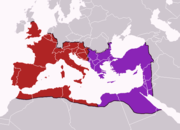
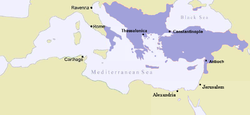 The wars' distant origins lay in the formation of the Byzantine Empire from the collapsing Roman Empire in the 4th century AD. Prior to the formation of the Byzantine realm in the 3rd century AD, the Roman Empire
faced a severe military and political crisis; political assassinations and dangerous campaigning led to 32 Emperors seizing and losing power within 50 years of Roman history. Matters were made worse with an economic and demographic problem.The population of the Roman Empire began to fall in the 4th century AD due to a lack of conquest leading to a lack of slaves, a vital and significant group of people in the Empire. Reforms by Emperors like Constantine I
and Theodosius I
prolonged the Roman Empire but nonetheless the Empire split into Eastern and Western Halves in 395 AD. The Western Half (Western Roman Empire
) was plagued by barbarian invasions, collapsing in 476 AD whilst the Eastern Half survived and began to undergo Hellenization
transforming into what historians label today as the Byzantine Empire. Unlike the Western Half of the Roman Empire, the Eastern Half experienced fewer barbarian invasions although encounters with the Huns
and Persians kept the Byzantines busy enough from making any serious recovery attempts in the West.
In the 7th and 8th centuries, the Byzantines experienced several co-ordinated Arab invasions
losing several vital provinces, such as Egypt and the Levant
. A Byzantine resurgence under the Macedonian Dynasty allowed the Byzantines to reconquer parts of Syria and Mesopotamia; in particular were the efforts of Basil II
who from the late 10th century to early 11th century transformed the Empire into the most powerful state in the Medieval World.
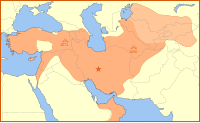 Despite this, the Byzantines were far from safe. With the death of Basil II came a series of Emperors who failed to secure the Empire against external threats. The biggest threat to the Empire since the Arab invasions were the Turks. The Turks were much like the Byzantines former enemies, the Huns
. Combining their excellent riding skills with Islamic zeal, the Turks who converted to Islam in the 7th and later 8th centuries were to become a formidable enemy to a Christian state in decline.
As the Byzantines were making headway against the Arabs in the 10th century, Persia was being ruled by the Ghaznevids, another Turkic people. The migration of Seljuq Turks into Persia in the 10th century led to the Ghaznevids being overthrown. There they settled and adopted Persian language and customs.
The Seljuqs established a powerful domain and captured Baghdad in 1055 from the Abassid Caliphate
. The Abassid Caliphate henceforth became a mere figurehead in the Islamic World. The Seljuq Turks, spurred on by their previous success, now launched an attack on the Levant and against Fatimid Egypt, which lost Jerusalem in 1071.
Encounters between the Seljuq Turks and the Byzantines did not occur until after the reign of Basil II. However, the outcome of another war, the Byzantine-Georgian wars
was in some ways influenced by the incursions of the Seljuk Turks into Georgia, so it is unlikely that they were unheard of.
When the Seljuq Turks did encounter the Byzantines, they had chosen a good time to attack; Byzantium was faced with weak rule, Norman
conquests and the schism
whilst the Abassid Caliphate had recently been seriously weakened with its wars against the Fatimid
dynasty.
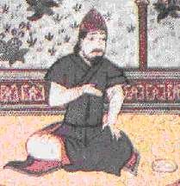 Ever since the early 11th century, the Seljuq Turks from central Asia had been expanding westward, defeating various Arab factions and occupying the Abassid caliphate's power base in Baghdad. At the same time, the Byzantine empire was making a few gains in Edessa
and Syria. In 1067 the Seljuq Turks invaded Asia Minor attacking Caesarea
and in 1069 Iconium. A Byzantine counter attack in 1069 drove the Seljuq Turks back from these lands. Further offensives by the Byzantine army drove the Turks back across the Euphrates
.
Despite this, the Seljuq Turks continued their incursions into Asia Minor, capturing Manzikert. The Byzantine Emperor Romanus Diogenes led an army in an attempt to score a decisive blow against the Seljuqs and add some military justification to his rule (which had seen the loss of southern Italy to Norman conquests). During the march, Alp Arslan
, the leader of the Seljuq Turks withdrew from Manzikert. His tactical withdrawal allowed his army to ambush the Byzantines, reclaiming Manzikert shortly after. The victory itself led to few gains at the time for the Seljuq Turks, but the civil chaos that resulted in the Byzantine Empire allowed the Seljuq's and various other Turkic allies to swarm into Asia Minor.
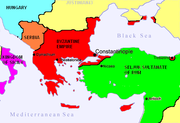 After Manzikert, the Seljuq Turks concentrated on their eastern territorial gains which were threatened by the Fatimid dynasty in Egypt although Alp Arslan encouraged other allied Turks and vassals to establish Beyliks in Asia Minor. Many Byzantines at the time did not see the victory as a total disaster and when the Turks began occupying the countryside in Anatolia they began to garrison the Byzantine cities as well, not as foreign conquerors but as mercenaries requested by various Byzantine factions — one Byzantine Emperor even gave the city of Nicaea's defense to the invading Turks in 1078.
The result of the civil war meant that pretenders to the Byzantine throne sought Turkic aid by conceding Byzantine territory. The loss of these cities such as Nicaea and another defeat in Anatolia led to a prolongation of the war. The civil conflict finally ended when Alexius I Comnenus, who had been leading Imperial armies to defeat revolts in Asia Minor became a rebel himself and seized the Byzantine throne in 1081. Despite emergency reforms implemented by Alexius I
, Antioch
and Smyrna
were lost by 1084. However, between 1078 and 1084 the city had been in the hands of Philaretos Brachamios
, an Armenian renegade. By 1091, the few remaining Byzantine towns in Asia Minor inherited by Alexius were lost as well. However, all was not to end in defeat for Byzantium; in 1091, a combined Seljuq/Pecheneg invasion and siege of Constantinople was thoroughly defeated whilst the Norman invasions had been held back as well allowing the Empire to focus her energies against the Turks. The Byzantines were thus able to recover the Aegean islands from Tzachas and destroy his fleet, and even regain the southern littoral of the Marmara Sea in 1094.
In 1094, Alexius Comnenus sent a message to Pope Urban II asking for weapons, supplies and skilled troops. At the Council of Clermont in 1095, the Pope preached a Crusade to be undertaken in order to capture Jerusalem and, in the process, assist the Byzantine Empire which could no longer guard Christendom in the East from Islamic aggression. Though the Crusades would assist the Byzantine Empire in reconquering many vital Anatolian towns, it also led to the dissolution of the Empire in 1204 during which time the Byzantines struggled to hold on to their territories.
, Battle of Dorylaeum
, Siege of Antioch
The first Crusaders arrived in 1096 following Alexius' appeal to the West. The agreement between the Byzantines and the Crusaders was that any Byzantine cities re-captured from the Turks would be handed over to the Empire.
This was beneficial for the Crusaders as it meant that they did not have to garrison captured towns and lose troop strength whilst maintaining their supply lines. The Byzantines, in return, would supply the Crusaders with food in a hostile territory and Alexius' troops would act as a reserve to reinforce them in any dangerous situations. The Crusaders first set about attacking Nicaea
on May 6, 1097. Kilij Arslan I
was unable to assist the Turks there due to the immense size of the Crusader armies; another small defeat on May 16 convinced Kilij Arslan to withdraw and abandon the city, which surrendered to the Byzantines on the June 19. After this, a decisive victory at Dorylaeum
gave the Crusaders an Asia Minor that was open to attack; Sozopolis
, Philomelium, Iconium, Antioch in Pisidia, Heraclea
and Caesarea
all fell to the Crusaders and they even reached as far as Cilicia where they liberated the Armenians from Turkic rule, establishing a supply base.
Unfortunately for Alexius Comnenus, the Byzantines were unable to fully capitalize on these conquests with Caesarea returning to the Seljuqs as a part of the Sultanate of Rum
along with several other cities such as Iconium, the future capital of the Seljuq Turks.
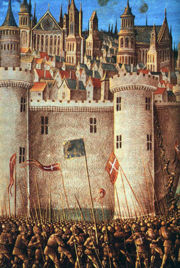 Following these victories, the Crusaders went on to lay siege to Antioch
a city under Seljuq occupation. The siege marked the end of Crusader assistance to the Byzantines due to the simulations of Stephen of Blois
. Kerbogah, a vassal of the Seljuq Turks, had a huge army of 75,000 troops sent to relieve Antioch; his unsuccessful siege of Edessa (a city that had recently fallen to the Crusaders) allowed the Crusaders time to capture Antioch on the June 3, 1098, a day before Kerbogah's arrival. Despite this, Kerbogah's troops were able to breach the citadel where vicious and desperate fighting allowed the Crusaders to repulse his offensive. At this point, one of the Crusaders present, Stephen of Blois deserted and reaching Alexius Comnenus warned him that the Crusaders were destroyed and the Byzantine Emperor was forced to turn back.
As a result of this apparent desertion of Alexius I, the Crusaders refused to hand back Antioch when they managed to defeat Kerbogah's scattered army. With this resentment, the Crusaders largely abandoned assisting the Byzantines against the Seljuqs and their allies. A further Crusade in 1101 to follow up the successes of the First ended in total defeat and the consolidation of Seljuq power in Asia Minor with Iconium (modern day Konya) being established as the capital of the Sultanate of Rum.
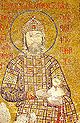
. John Comnenus was able to use this to his advantage as he undertook a series of campaigns aimed at recapturing Anatolia. Under his rule, the front line was pushed far into Anatolia, reaching dangerously close to his enemies' capital at Iconium. Despite this, the Turks in Anatolia continued to fight each other but a fatal hunting accident to the emperor John robbed the Byzantines of the opportunity to inflict a decisive victory.
, resulted in the Byzantine campaign of conquest being abandoned.
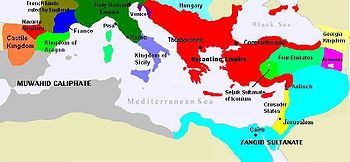 The battle was tactically indecisive with both leaders keen to seek peace. Following this Manuel's army continued to skirmish with the Turks in Anatolia, defeating them in a smaller but indecisive battle in the Meander Valley. Regardless of this small respite, Myriokephalon had far more decisive implications than the casualties would suggest — there was no more reconquest of Asia Minor under Manuel Comnenus after 1176 like that which occurred under his father's reign. For the Seljuqs, the acquisition of Danishmend territory gave them a victory though once again the Seljuqs had to contend with neighbouring disputes leading to the peace treaty as requested by both leaders. By the terms of the treaty, Manuel was obliged to remove the armies and fortifications posted at Dorylaeum and Sublaeum.
However, Manuel Comnenus refused and when Kilij Arslan tried to enforce this treaty, John Vatatzes, who was sent by the Emperor to repel the Turkish invasion scored a victory over the Turks at the Battle of Hyelion and Leimocheir
in the Meander valley; a sign that the Byzantine army remained strong and that the defensive program of western Asia Minor
was still successful. After the victory on the Meander, Manuel himself advanced with a small army to drive the Turks from Panasium and Lacerium, south of Cotyaeum. However, in 1178 a Byzantine army retreated after encountering a Turkish force at Charax
, allowing the Turks to capture many livestock. The city of Claudiopolis
in Bithynia
was besieged by the Turks in 1179, forcing Manuel to lead a small cavalry force to save the city and then, even as late as 1180, the Byzantines succeeded in scoring a victory over the Turks.
However, the continuous warfare did have a serious effect upon Manuel's vitality; he declined in health and in 1180 succumbed to a slow fever. Furthermore, like Manzikert, the balance between the two powers began to gradually shift – Manuel never again attacked the Turks and, after his death, they began to move further and further west, deeper into Byzantine territory.
 Following this turmoil, the Byzantine Empire was ruled by a series of corrupt and/or incapable emperors between 1185 and 1204, who failed to guard the frontier. The weak Imperial Byzantine rule led to the Armenian Kingdom of Cilicia and Antioch freeing themselves from Byzantine vassal status, the latter doing so in 1180 and the former establishing Prince Leo II on the throne in 1187.
Meanwhile, the Crusader states in Palestine began to fall to Saladin
resulting in the Third Crusade. This ended in a wasted opportunity for the Holy Roman Empire and the Byzantine Empire to make substantial gains in the Middle East. The Byzantine Emperor Isacc II
further demonstrated his incompetent rule by promising Saladin to keep the Third Crusade from crossing Anatolia (he had little military power to back up this agreement) and when he did allow the Third Crusade to pass due to Frederick I
's threat, he failed to capitalize on the Crusader sacking of Iconium which had the potential to reverse the defeat at Myriokephalon.
For an empire that was surrounded by enemies the downfall of Byzantium became a greater probability and in 1204 the city of Constantinople was sacked by soldiers of the Fourth Crusade
bringing the Empire into another era of chaos. The Seljuqs of Rum under a new Sultan Kaykhusraw exploited this event and attacked the port of Antalya
in 1207 capturing it from the weakened splinter Empire of Nicaea
. The tide turned however in 1210 when the Sultan himself was killed in single combat by the Emperor of Nicaea at the Battle of Antioch on the Meander and from then on the eastern frontier was more or less stabilized. In 1243, the Mongol
invasion broke Seljuq power in Anatolia
. Three years later, the early death of Kaykhusraw II
placed his three young sons on the throne. Civil disputes arose once again in the Sultanate of Rum
allowing the Empire of Nicaea to recapture Constantinople from the Latins in 1261. In 1283, the Sultanate of Rum took its share of Civil warfare and in 1308 was disbanded; Iconium was taken some time afterward by the Karamanids, another Turkic people. The end of the Sultanate did not end the confrontations between the Turks and the Byzantines; the rising power of one of the nobles of the Sultanate, Osman
(Uc Beg) gave rise to the Ottoman Beylik and the Byzantine-Ottoman wars
, a continuation of confrontations between the Turks and the Byzantines ultimately leading to the demise of the Byzantine Empire and Islamic domination in Anatolia.
Throughout the 10th and 11th centuries, the Byzantine Army was utilized in an increasingly aggressive manner, with new conquests made in the East and the West. As a result, the Theme system which was designed as a defensive military solution to wear down invasions of Asia Minor slowly began to break down. Troops were needed that would maintain a full-time presence on the field, something that the Thematic militia armies drawn from peasant farmers could not do. As a result, the use of Tagmata, full-time professional soldiers became increasingly necessary to wage the offensive warfare that had propelled Byzantium to Great Power status in the 11th century. The Tagamata were also drawn from mercenaries, such as Franks, Normans and no doubt Saxons, Rus and Vikings. The use of Tagamata troops did not directly undermine Byzantine military strength — Romanus Diogenes campaigns into Seljuq controlled Mesopotamia was composed of Tagmata as well as Theme troops. Nonetheless, the Theme troops began to seriously decline in quality. Michael Attaleiates commented at the time of the Manzikert Campaign that the troops of the Theme system were poorly supplied, poorly provisioned and unfit for warfare. Consequently, when the Tagmata army was routed at Manzikert, the Theme system could not stop the relentless advance of the Seljuq Turks and their Turkic allies as they swarmed over Asia Minor, over-running the last Byzantine settlements in 1091. The Tagmata army was not the cause of the failure at Manzikert; however, the reliance on the Tagmata troops was one of the causes that led to the disintegration of the Theme System. As the Turks took Asia Minor, any organized resistance (as demonstrated by Alexius I's pre-Imperial career) had to make-do with an army in a poor condition.
Furthermore, the frontline had moved much closer to Constantinople. Throughout the 12th century, Constantinople held the initiative against Konya, especially so under Manuel's early and middle rule, thanks in part due to his aggressive policies and that of his Father, but when the balance of power shifted to the Turks, losses steadily mounted; soon Western Asia Minor became infiltrated by Turkish ghazis.
saw Byzantium make substantial gains in territory although this may have been achieved by the Byzantines themselves; there were plenty of civil conflicts in Asia Minor and amongst the Turks for Alexius to exploit. Furthermore, every other Crusade after the First had a detrimental effect on the Empire with Crusader armies unable to resist raiding towns which were supposed to be their allies but in Byzantine territory there were quarrels over supplies and a few incidents of fighting. Once again, the westerners had created an unfavorable impression of themselves, and once again the Greeks had made themselves seem untrustworthy. At Constantinople, there were further incidents, even to the point that Conrad threatened to return from the crusade and take the city by force. The Second Crusade saw increased unity amongst the Islamic World, with Zhengi able to bring Damascus into the fold and soon after much of Syria became a united front against the Crusades and a threat to Byzantine interests there. The Holy Roman Emperor Frederick I
even threatened an assault on Constantinople in the Third Crusade
and the Fourth Crusade
saw the sack of Constantinople and substantial loss of territory by the Byzantines to the Frankish Crusaders and the Seljuq Turks.
Long term consequences of the Crusade also includes increased Islamic fanaticism and no more clearly is this seen then in the numerous Beyliks set up in Western Anatolia after 1204, particularly the Beylik of the Ottomans, Osman I
's domain. Later, the Crusades of Nicopolis in 1396 and Varna in 1444 designed to aid the Byzantines made Constantinople appear as a magnet for Frankish Knights to launch their zealous attacks — this did not help the Byzantines in the long run.
On the other hand, the Crusades allowed Byzantium a chance to regain power in the Mediterranean. Additionally, under Manuel Comnenus, the Byzantine
and Catholic Churches experienced far better relations than in the previous few decades and even coming close to healing the Schism
. The alliance with the Pope was also crucial. Together, the Byzantines and Catholics were able to put on hold the incursions of the Normans in southern Italy who were ravaging Byzantine territory in the Balkans, becoming almost as dangerous a threat as the Seljuq Turks.
It must also be said that long before Manzikert, the Turkic incursions into Asia Minor had begun and Norman Knights were attacking Byzantine cities in southern Italy and the Balkans
. The First Crusade in some aspects gave the Byzantines the tools they needed to utilize the Normans and other Franks as mercenaries, some of whom joined the Varangian guard
. Without the Crusades, the Normans and Turks may have continued their advance even after the defeat of the Pechenegs and the Normans
in the Balkans.
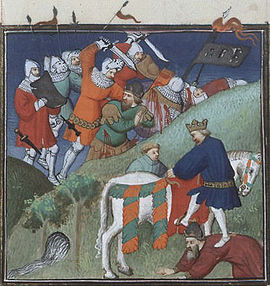 The war's outcome was determined as much by the weakness of the Byzantines as the strengths of the Seljuqs. Nonetheless, the latter, just like the Arabs many years earlier, failed to destroy the Byzantine Empire. The Seljuq Turks, having originated from the steppes, possessed many advantages. At the Battle of Manzikert, the Byzantine heavy cavalry was defeated using simple hit and run tactics, with the faster light cavalry of the Turks out-flanking and out-maneuvering the exhausted cavalry.
Asia Minor was not completely overrun by the Turks after Manzikert but the resulting chaos that followed was easily exploited — Turkic soldiers had been used as Mamluks by the Arabs before seizing power themselves — the same occurred in Asia Minor, with Byzantine factions inviting Turkic mercenaries to garrison towns. As Imperial rule was re-imposed in Byzantium, these factions, which were secured by Turkic soldiers, became part of the Seljuq Turk domains. Some Greeks fled conquered areas, others stayed to become second-class citizens in an Islamic world (though under Islamic rule were protected provided they paid the jizya
tax). More importantly, others converted and were assimilated into the settling population of Turks. Orthodox churches were replaced with Mosques and the crippling Imperial taxes levied by the government and the accompanying Church were lowered.
to re-conquer. The result was that even when the Byzantine empire was not riddled with civil disputes, it could not defeat the Seljuq Turks, who rarely allowed the Byzantines to engage them, hence the slow campaigning of John Komnenus.
Whenever the Seljuqs did show up in great strength, poor strategy on the part of the Byzantines coupled with good strategy on behalf of the Seljuq ruler resulted in two decisive defeats at Manzikert and Myriokephalon.
The old Roman state was in a constant state of war due to the numerous enemies on its borders; Muslims to the South and East, Slavs to the North and Franks to the West. The Byzantine Empire had to face Normans, Pechenegs and Turks
within a few decades of each other at a time when the army was torn in civil conflict.
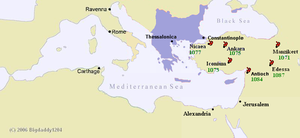 The war had great consequences. The Middle East was dominated by the power of the Fatimid Caliphate and the Byzantine Empire; by the end of the 13th century, neither of the two were in a position to project power; the Fatimids having been toppled by the Kurdish influenced Ayyubids, whilst the Byzantines severely weakened by the Seljuqs. Power shifted to the Mamelukes by the 14th century and then back to the Turks in the late 15th and early 16th centuries. Never again would a Christian Kingdom yield so much military and political power in the Middle East. As the Turks steadily gained ground in Anatolia, the local population converted to Islam, further reducing any chances of a successful reconquest.
The War also gave Western Christendom the opportunity to launch expeditions/pilgrimages to visit/liberate the Holy Land from Muslim Rule. In time, these Crusaders would establish their own fiefs in the Holy Land, ruling with interests coinciding, but more often in conflict with, the Byzantine Empire, ultimately leading to a weakening of both the Crusader states and the Byzantine Empire.
For the Turks, it was the beginning of a new era of power. Despite further invasions and attacks by Crusaders from the west and Mongols/Turkic tribes from the east, the Turks slowly emerged as a superpower under the Ottomans. The rise of the Ottomans was parallel to the fall of the Sultanate of Rum and the carving up of the Byzantine Empire. The power vacuum left in Anatolia was easily exploited by one of the Sultanate's nobles, Osman I. Matters were made worse for the Byzantine Empire due to the Latin presence in the Peloponnese
and the rising power of the Bulgarians whom continued to press hard against the borders of Byzantium. In time, the Byzantines would be forced to call on the aid of the Ottomans to head to the European mainland and fight the Bulgarians, giving the Ottoman Turks a firm grip on Europe. The close proximity of Osman's Beylik ensured that confrontation between the Byzantines and the Ottomans would be inevitable. The Byzantines were a match for the Ottomans but events west of Constantinople coupled with civil war and incompetent leadership left the Byzantines reeling from one siege after another
until Constantinople fell in 1453
.
Asia Minor
Asia Minor is a geographical location at the westernmost protrusion of Asia, also called Anatolia, and corresponds to the western two thirds of the Asian part of Turkey...
and Syria
Syria
Syria , officially the Syrian Arab Republic , is a country in Western Asia, bordering Lebanon and the Mediterranean Sea to the West, Turkey to the north, Iraq to the east, Jordan to the south, and Israel to the southwest....
from the Byzantine Empire
Byzantine Empire
The Byzantine Empire was the Eastern Roman Empire during the periods of Late Antiquity and the Middle Ages, centred on the capital of Constantinople. Known simply as the Roman Empire or Romania to its inhabitants and neighbours, the Empire was the direct continuation of the Ancient Roman State...
to the Seljuq Turks
Seljuq dynasty
The Seljuq ; were a Turco-Persian Sunni Muslim dynasty that ruled parts of Central Asia and the Middle East from the 11th to 14th centuries...
. Riding from the steppe
Steppe
In physical geography, steppe is an ecoregion, in the montane grasslands and shrublands and temperate grasslands, savannas, and shrublands biomes, characterized by grassland plains without trees apart from those near rivers and lakes...
s of Central Asia
Central Asia
Central Asia is a core region of the Asian continent from the Caspian Sea in the west, China in the east, Afghanistan in the south, and Russia in the north...
, the Seljuq Turks replicated tactics practiced by the Huns
Huns
The Huns were a group of nomadic people who, appearing from east of the Volga River, migrated into Europe c. AD 370 and established the vast Hunnic Empire there. Since de Guignes linked them with the Xiongnu, who had been northern neighbours of China 300 years prior to the emergence of the Huns,...
hundreds of years earlier against a similar Roman opponent but now combining it with new-found Islamic zeal; in many ways, the Seljuq Turks resumed the conquests of the Muslims in the Byzantine-Arab Wars
Byzantine-Arab Wars
The Byzantine–Arab Wars were a series of wars between the Arab Caliphates and the East Roman or Byzantine Empire between the 7th and 12th centuries AD. These started during the initial Muslim conquests under the expansionist Rashidun and Umayyad caliphs and continued in the form of an enduring...
initiated by the Rashidun
Rashidun
The Rightly Guided Caliphs or The Righteous Caliphs is a term used in Sunni Islam to refer to the first four Caliphs who established the Rashidun Caliphate. The concept of "Rightly Guided Caliphs" originated with the Abbasid Dynasty...
, Umayyad
Umayyad
The Umayyad Caliphate was the second of the four major Arab caliphates established after the death of Muhammad. It was ruled by the Umayyad dynasty, whose name derives from Umayya ibn Abd Shams, the great-grandfather of the first Umayyad caliph. Although the Umayyad family originally came from the...
and Abassid Caliphate in the Levant
Levant
The Levant or ) is the geographic region and culture zone of the "eastern Mediterranean littoral between Anatolia and Egypt" . The Levant includes most of modern Lebanon, Syria, Jordan, Israel, the Palestinian territories, and sometimes parts of Turkey and Iraq, and corresponds roughly to the...
, North Africa
North Africa
North Africa or Northern Africa is the northernmost region of the African continent, linked by the Sahara to Sub-Saharan Africa. Geopolitically, the United Nations definition of Northern Africa includes eight countries or territories; Algeria, Egypt, Libya, Morocco, South Sudan, Sudan, Tunisia, and...
and Asia Minor.
Today, the Battle of Manzikert
Battle of Manzikert
The Battle of Manzikert , was fought between the Byzantine Empire and Seljuq Turks led by Alp Arslan on August 26, 1071 near Manzikert...
is widely seen as the moment when the Byzantines lost the war against the Turks; however the Byzantine military was of questionable quality before 1071 with regular Turkish incursions overrunning the failing theme system
Theme (Byzantine administrative unit)
The themes or themata were the main administrative divisions of the middle Byzantine Empire. They were established in the mid-seventh century in the aftermath of the Muslim conquests of Byzantine territory and replaced the earlier provincial system established by emperors Diocletian and...
. Even after Manzikert, Byzantine rule over Asia Minor did not end immediately, nor were any heavy concessions levied by the Turks on their opponents — it took another 20 years before the Turks were in control of the entire Anatolian peninsula and not for long either.
During the course of the war, the Seljuq Turks and their allies attacked the Fatimid Caliphate of Egypt, capturing Jerusalem and catalyzing the call for the First Crusade
First Crusade
The First Crusade was a military expedition by Western Christianity to regain the Holy Lands taken in the Muslim conquest of the Levant, ultimately resulting in the recapture of Jerusalem...
. Crusader assistance to the Byzantine Empire was mixed with treachery and looting, although substantial gains were made in the First Crusade
First Crusade
The First Crusade was a military expedition by Western Christianity to regain the Holy Lands taken in the Muslim conquest of the Levant, ultimately resulting in the recapture of Jerusalem...
. Within a hundred years of Manzikert, the Byzantines had (with Crusader assistance) successfully driven back the Turks from the coasts of Asia Minor and extended their influence right down to Palestine and even Egypt. Later, the Byzantines were unable to extract any more assistance, and the Fourth Crusade
Fourth Crusade
The Fourth Crusade was originally intended to conquer Muslim-controlled Jerusalem by means of an invasion through Egypt. Instead, in April 1204, the Crusaders of Western Europe invaded and conquered the Christian city of Constantinople, capital of the Eastern Roman Empire...
even led to the sack of Constantinople
Constantinople
Constantinople was the capital of the Roman, Eastern Roman, Byzantine, Latin, and Ottoman Empires. Throughout most of the Middle Ages, Constantinople was Europe's largest and wealthiest city.-Names:...
. Before the conflict petered out, the Seljuqs managed to take more territory from the weakened Empire of Nicaea
Empire of Nicaea
The Empire of Nicaea was the largest of the three Byzantine Greek successor states founded by the aristocracy of the Byzantine Empire that fled after Constantinople was occupied by Western European and Venetian forces during the Fourth Crusade...
until the Sultanate itself was taken over by the Mongols
Mongol Empire
The Mongol Empire , initially named as Greater Mongol State was a great empire during the 13th and 14th centuries...
, leading to the rise of the ghazis
Ghazw
Ghazi or ghazah is an Arabic term that means "to raid/foray." From it evolved the word "Ghazwa" which specifically refers to a battle led by the Islamic prophet Muhammad.In English language literature the word often appears as razzia, deriving from French, although it probably...
and the conclusive Byzantine-Ottoman wars
Byzantine-Ottoman wars
The Byzantine–Ottoman Wars were a series of decisive conflicts between the Ottoman Turks and the Byzantine that led to the final destruction of the Byzantine Empire and the rise of the Ottoman Empire....
.
Origins
Roman Empire
The Roman Empire was the post-Republican period of the ancient Roman civilization, characterised by an autocratic form of government and large territorial holdings in Europe and around the Mediterranean....
faced a severe military and political crisis; political assassinations and dangerous campaigning led to 32 Emperors seizing and losing power within 50 years of Roman history. Matters were made worse with an economic and demographic problem.The population of the Roman Empire began to fall in the 4th century AD due to a lack of conquest leading to a lack of slaves, a vital and significant group of people in the Empire. Reforms by Emperors like Constantine I
Constantine I
Constantine the Great , also known as Constantine I or Saint Constantine, was Roman Emperor from 306 to 337. Well known for being the first Roman emperor to convert to Christianity, Constantine and co-Emperor Licinius issued the Edict of Milan in 313, which proclaimed religious tolerance of all...
and Theodosius I
Theodosius I
Theodosius I , also known as Theodosius the Great, was Roman Emperor from 379 to 395. Theodosius was the last emperor to rule over both the eastern and the western halves of the Roman Empire. During his reign, the Goths secured control of Illyricum after the Gothic War, establishing their homeland...
prolonged the Roman Empire but nonetheless the Empire split into Eastern and Western Halves in 395 AD. The Western Half (Western Roman Empire
Western Roman Empire
The Western Roman Empire was the western half of the Roman Empire after its division by Diocletian in 285; the other half of the Roman Empire was the Eastern Roman Empire, commonly referred to today as the Byzantine Empire....
) was plagued by barbarian invasions, collapsing in 476 AD whilst the Eastern Half survived and began to undergo Hellenization
Hellenization
Hellenization is a term used to describe the spread of ancient Greek culture, and, to a lesser extent, language. It is mainly used to describe the spread of Hellenistic civilization during the Hellenistic period following the campaigns of Alexander the Great of Macedon...
transforming into what historians label today as the Byzantine Empire. Unlike the Western Half of the Roman Empire, the Eastern Half experienced fewer barbarian invasions although encounters with the Huns
Huns
The Huns were a group of nomadic people who, appearing from east of the Volga River, migrated into Europe c. AD 370 and established the vast Hunnic Empire there. Since de Guignes linked them with the Xiongnu, who had been northern neighbours of China 300 years prior to the emergence of the Huns,...
and Persians kept the Byzantines busy enough from making any serious recovery attempts in the West.
In the 7th and 8th centuries, the Byzantines experienced several co-ordinated Arab invasions
Byzantine-Arab Wars
The Byzantine–Arab Wars were a series of wars between the Arab Caliphates and the East Roman or Byzantine Empire between the 7th and 12th centuries AD. These started during the initial Muslim conquests under the expansionist Rashidun and Umayyad caliphs and continued in the form of an enduring...
losing several vital provinces, such as Egypt and the Levant
Levant
The Levant or ) is the geographic region and culture zone of the "eastern Mediterranean littoral between Anatolia and Egypt" . The Levant includes most of modern Lebanon, Syria, Jordan, Israel, the Palestinian territories, and sometimes parts of Turkey and Iraq, and corresponds roughly to the...
. A Byzantine resurgence under the Macedonian Dynasty allowed the Byzantines to reconquer parts of Syria and Mesopotamia; in particular were the efforts of Basil II
Basil II
Basil II , known in his time as Basil the Porphyrogenitus and Basil the Young to distinguish him from his ancestor Basil I the Macedonian, was a Byzantine emperor from the Macedonian dynasty who reigned from 10 January 976 to 15 December 1025.The first part of his long reign was dominated...
who from the late 10th century to early 11th century transformed the Empire into the most powerful state in the Medieval World.
Huns
The Huns were a group of nomadic people who, appearing from east of the Volga River, migrated into Europe c. AD 370 and established the vast Hunnic Empire there. Since de Guignes linked them with the Xiongnu, who had been northern neighbours of China 300 years prior to the emergence of the Huns,...
. Combining their excellent riding skills with Islamic zeal, the Turks who converted to Islam in the 7th and later 8th centuries were to become a formidable enemy to a Christian state in decline.
As the Byzantines were making headway against the Arabs in the 10th century, Persia was being ruled by the Ghaznevids, another Turkic people. The migration of Seljuq Turks into Persia in the 10th century led to the Ghaznevids being overthrown. There they settled and adopted Persian language and customs.
The Seljuqs established a powerful domain and captured Baghdad in 1055 from the Abassid Caliphate
Abbasid
The Abbasid Caliphate or, more simply, the Abbasids , was the third of the Islamic caliphates. It was ruled by the Abbasid dynasty of caliphs, who built their capital in Baghdad after overthrowing the Umayyad caliphate from all but the al-Andalus region....
. The Abassid Caliphate henceforth became a mere figurehead in the Islamic World. The Seljuq Turks, spurred on by their previous success, now launched an attack on the Levant and against Fatimid Egypt, which lost Jerusalem in 1071.
Encounters between the Seljuq Turks and the Byzantines did not occur until after the reign of Basil II. However, the outcome of another war, the Byzantine-Georgian wars
Byzantine-Georgian wars
The Byzantine–Georgian wars were a series conflicts fought during the 11th century and were mainly focused on several strategic districts in the Byzantine-Georgian-Armenian marchlands. Most of these lands were granted by Emperor Basil II to the Georgian courapalates David III of Tao in reward for...
was in some ways influenced by the incursions of the Seljuk Turks into Georgia, so it is unlikely that they were unheard of.
When the Seljuq Turks did encounter the Byzantines, they had chosen a good time to attack; Byzantium was faced with weak rule, Norman
Normans
The Normans were the people who gave their name to Normandy, a region in northern France. They were descended from Norse Viking conquerors of the territory and the native population of Frankish and Gallo-Roman stock...
conquests and the schism
Schism (religion)
A schism , from Greek σχίσμα, skhísma , is a division between people, usually belonging to an organization or movement religious denomination. The word is most frequently applied to a break of communion between two sections of Christianity that were previously a single body, or to a division within...
whilst the Abassid Caliphate had recently been seriously weakened with its wars against the Fatimid
Fatimid
The Fatimid Islamic Caliphate or al-Fāṭimiyyūn was a Berber Shia Muslim caliphate first centered in Tunisia and later in Egypt that ruled over varying areas of the Maghreb, Sudan, Sicily, the Levant, and Hijaz from 5 January 909 to 1171.The caliphate was ruled by the Fatimids, who established the...
dynasty.
Initial Conflicts: 1064-1071
Edessa, Mesopotamia
Edessa is the Greek name of an Aramaic town in northern Mesopotamia, as refounded by Seleucus I Nicator. For the modern history of the city, see Şanlıurfa.-Names:...
and Syria. In 1067 the Seljuq Turks invaded Asia Minor attacking Caesarea
Antioch, Pisidia
Antioch in Pisidia – alternatively Antiochia in Pisidia or Pisidian Antioch and in Roman Empire, Latin: Antiochia Caesareia or Antiochia Caesaria – is a city in the Turkish Lakes Region, which is at the crossroads of the Mediterranean, Aegean and Central Anatolian regions, and formerly...
and in 1069 Iconium. A Byzantine counter attack in 1069 drove the Seljuq Turks back from these lands. Further offensives by the Byzantine army drove the Turks back across the Euphrates
Euphrates
The Euphrates is the longest and one of the most historically important rivers of Western Asia. Together with the Tigris, it is one of the two defining rivers of Mesopotamia...
.
Despite this, the Seljuq Turks continued their incursions into Asia Minor, capturing Manzikert. The Byzantine Emperor Romanus Diogenes led an army in an attempt to score a decisive blow against the Seljuqs and add some military justification to his rule (which had seen the loss of southern Italy to Norman conquests). During the march, Alp Arslan
Alp Arslan
Alp Arslan was the third sultan of the Seljuq dynasty and great-grandson of Seljuk, the eponymous founder of the dynasty...
, the leader of the Seljuq Turks withdrew from Manzikert. His tactical withdrawal allowed his army to ambush the Byzantines, reclaiming Manzikert shortly after. The victory itself led to few gains at the time for the Seljuq Turks, but the civil chaos that resulted in the Byzantine Empire allowed the Seljuq's and various other Turkic allies to swarm into Asia Minor.
Turkic Conquests: 1071-1096
The result of the civil war meant that pretenders to the Byzantine throne sought Turkic aid by conceding Byzantine territory. The loss of these cities such as Nicaea and another defeat in Anatolia led to a prolongation of the war. The civil conflict finally ended when Alexius I Comnenus, who had been leading Imperial armies to defeat revolts in Asia Minor became a rebel himself and seized the Byzantine throne in 1081. Despite emergency reforms implemented by Alexius I
Alexius I
Alexius I may refer to:*Alexios I Komnenos , Byzantine Emperor *Alexios I of Trebizond , great-great-grandson of the above, Emperor of Trapezunt...
, Antioch
Antioch
Antioch on the Orontes was an ancient city on the eastern side of the Orontes River. It is near the modern city of Antakya, Turkey.Founded near the end of the 4th century BC by Seleucus I Nicator, one of Alexander the Great's generals, Antioch eventually rivaled Alexandria as the chief city of the...
and Smyrna
Izmir
Izmir is a large metropolis in the western extremity of Anatolia. The metropolitan area in the entire Izmir Province had a population of 3.35 million as of 2010, making the city third most populous in Turkey...
were lost by 1084. However, between 1078 and 1084 the city had been in the hands of Philaretos Brachamios
Philaretos Brachamios
Philaretos Brachamios was a distinguished Byzantine general and warlord of Armenian heritage, and for a time was a usurper against emperor Michael VII...
, an Armenian renegade. By 1091, the few remaining Byzantine towns in Asia Minor inherited by Alexius were lost as well. However, all was not to end in defeat for Byzantium; in 1091, a combined Seljuq/Pecheneg invasion and siege of Constantinople was thoroughly defeated whilst the Norman invasions had been held back as well allowing the Empire to focus her energies against the Turks. The Byzantines were thus able to recover the Aegean islands from Tzachas and destroy his fleet, and even regain the southern littoral of the Marmara Sea in 1094.
In 1094, Alexius Comnenus sent a message to Pope Urban II asking for weapons, supplies and skilled troops. At the Council of Clermont in 1095, the Pope preached a Crusade to be undertaken in order to capture Jerusalem and, in the process, assist the Byzantine Empire which could no longer guard Christendom in the East from Islamic aggression. Though the Crusades would assist the Byzantine Empire in reconquering many vital Anatolian towns, it also led to the dissolution of the Empire in 1204 during which time the Byzantines struggled to hold on to their territories.
Byzantium Survives: 1096-1118
See also: Siege of NicaeaSiege of Nicaea
The Siege of Nicaea took place from May 14 to June 19, 1097, during the First Crusade.-Background:Nicaea , located on the eastern shore of Lake İznik, had been captured from the Byzantine Empire by the Seljuk Turks in 1081, and formed the capital of the Sultanate of Rüm...
, Battle of Dorylaeum
Battle of Dorylaeum
The Battle of Dorylaeum took place during the First Crusade on July 1, 1097, between the crusaders and the Seljuk Turks, near the city of Dorylaeum in Anatolia.-Background:...
, Siege of Antioch
Siege of Antioch
The Siege of Antioch took place during the First Crusade in 1097 and 1098. The first siege, by the crusaders against the Muslim city, lasted from October 21, 1097, to June 2, 1098. The second siege, against the crusaders who had occupied it, lasted from June 7 to June 28, 1098.-Background:Antioch...
The first Crusaders arrived in 1096 following Alexius' appeal to the West. The agreement between the Byzantines and the Crusaders was that any Byzantine cities re-captured from the Turks would be handed over to the Empire.
This was beneficial for the Crusaders as it meant that they did not have to garrison captured towns and lose troop strength whilst maintaining their supply lines. The Byzantines, in return, would supply the Crusaders with food in a hostile territory and Alexius' troops would act as a reserve to reinforce them in any dangerous situations. The Crusaders first set about attacking Nicaea
Siege of Nicaea
The Siege of Nicaea took place from May 14 to June 19, 1097, during the First Crusade.-Background:Nicaea , located on the eastern shore of Lake İznik, had been captured from the Byzantine Empire by the Seljuk Turks in 1081, and formed the capital of the Sultanate of Rüm...
on May 6, 1097. Kilij Arslan I
Kilij Arslan I
Kilij Arslan was the Seljuq Sultan of Rûm from 1092 until his death in 1107. He ruled the Sultanate during the time of the First Crusade and thus faced the brunt of the entire attack...
was unable to assist the Turks there due to the immense size of the Crusader armies; another small defeat on May 16 convinced Kilij Arslan to withdraw and abandon the city, which surrendered to the Byzantines on the June 19. After this, a decisive victory at Dorylaeum
Battle of Dorylaeum
The Battle of Dorylaeum took place during the First Crusade on July 1, 1097, between the crusaders and the Seljuk Turks, near the city of Dorylaeum in Anatolia.-Background:...
gave the Crusaders an Asia Minor that was open to attack; Sozopolis
Sozopolis, Pisidia
Sozopolis in Pisidia, called Apollonia during Seleucid times, was an ancient town in the region of Pisidia, now in the Asian part of Turkey. It is not to be confused with the Thracian Sozopolis in present-day Bulgaria....
, Philomelium, Iconium, Antioch in Pisidia, Heraclea
Konya Province
Konya Province is a province of Turkey located in central Anatolia. The provincial capital is the city of Konya. It is the largest province by area of Turkey.-Districts:...
and Caesarea
Kayseri
Kayseri is a large and industrialized city in Central Anatolia, Turkey. It is the seat of Kayseri Province. The city of Kayseri, as defined by the boundaries of Kayseri Metropolitan Municipality, is structurally composed of five metropolitan districts, the two core districts of Kocasinan and...
all fell to the Crusaders and they even reached as far as Cilicia where they liberated the Armenians from Turkic rule, establishing a supply base.
Unfortunately for Alexius Comnenus, the Byzantines were unable to fully capitalize on these conquests with Caesarea returning to the Seljuqs as a part of the Sultanate of Rum
Sultanate of Rûm
The Sultanate of Rum , also known as the Anatolian Seljuk State , was a Turkic state centered in in Anatolia, with capitals first at İznik and then at Konya. Since the court of the sultanate was highly mobile, cities like Kayseri and Sivas also functioned at times as capitals...
along with several other cities such as Iconium, the future capital of the Seljuq Turks.
Siege of Antioch
The Siege of Antioch took place during the First Crusade in 1097 and 1098. The first siege, by the crusaders against the Muslim city, lasted from October 21, 1097, to June 2, 1098. The second siege, against the crusaders who had occupied it, lasted from June 7 to June 28, 1098.-Background:Antioch...
a city under Seljuq occupation. The siege marked the end of Crusader assistance to the Byzantines due to the simulations of Stephen of Blois
Stephen II, Count of Blois
Stephen II Henry , Count of Blois and Count of Chartres, was the son of Theobald III, count of Blois, and Garsinde du Maine. He married Adela of Normandy, a daughter of William the Conqueror around 1080 in Chartres...
. Kerbogah, a vassal of the Seljuq Turks, had a huge army of 75,000 troops sent to relieve Antioch; his unsuccessful siege of Edessa (a city that had recently fallen to the Crusaders) allowed the Crusaders time to capture Antioch on the June 3, 1098, a day before Kerbogah's arrival. Despite this, Kerbogah's troops were able to breach the citadel where vicious and desperate fighting allowed the Crusaders to repulse his offensive. At this point, one of the Crusaders present, Stephen of Blois deserted and reaching Alexius Comnenus warned him that the Crusaders were destroyed and the Byzantine Emperor was forced to turn back.
As a result of this apparent desertion of Alexius I, the Crusaders refused to hand back Antioch when they managed to defeat Kerbogah's scattered army. With this resentment, the Crusaders largely abandoned assisting the Byzantines against the Seljuqs and their allies. A further Crusade in 1101 to follow up the successes of the First ended in total defeat and the consolidation of Seljuq power in Asia Minor with Iconium (modern day Konya) being established as the capital of the Sultanate of Rum.
Byzantine Counter-Attack: 1118-1176
See also: Battle of MyriokephalonBattle of Myriokephalon
The Battle of Myriokephalon, also known as the ', or in Turkish, was a battle between the Byzantine Empire and the Seljuk Turks in Phrygia on September 17, 1176. The battle was a strategic reverse for the Byzantine forces, who were ambushed when moving through a mountain pass...
John II Comnenus
The death of Alexius I brought John II Comnenus to power. By now, the Seljuq Turks had fractured and became loosely allied to each other. During this time the Sultanate of Rum was busy fighting off their former allies, the DanishmendsDanishmends
The Danishmend dynasty was a Turcoman dynasty that ruled in north-central and eastern Anatolia in the 11th and 12th centuries. The centered originally around Sivas, Tokat, and Niksar in central-northeastern Anatolia, they extended as far west as Ankara and Kastamonu for a time, and as far south as...
. John Comnenus was able to use this to his advantage as he undertook a series of campaigns aimed at recapturing Anatolia. Under his rule, the front line was pushed far into Anatolia, reaching dangerously close to his enemies' capital at Iconium. Despite this, the Turks in Anatolia continued to fight each other but a fatal hunting accident to the emperor John robbed the Byzantines of the opportunity to inflict a decisive victory.
Manuel Comnenus
John II died in 1143 while the Byzantine empire was very powerful. The new emperor, Manuel Comnenus, was unable to extend the front line past his father's achievements. The Seljuq Turks were able to subdue their enemies, the Danishmends under Kilij Arslan II. During this time, the Byzantines were also fighting the Danishmends as nominal allies of the Seljuqs. Part of the agreement meant that captured Danishmend territory would go to the Byzantines. When Kilij Arslan refused, Manuel Comnenus, in 1176, led an impressively large army into Seljuq territory with the intent of taking its capital Iconium. However, the Byzantine force was ambushed in a mountain pass with consequent heavy losses to both sides. This battle, the Battle of MyriokephalonBattle of Myriokephalon
The Battle of Myriokephalon, also known as the ', or in Turkish, was a battle between the Byzantine Empire and the Seljuk Turks in Phrygia on September 17, 1176. The battle was a strategic reverse for the Byzantine forces, who were ambushed when moving through a mountain pass...
, resulted in the Byzantine campaign of conquest being abandoned.
However, Manuel Comnenus refused and when Kilij Arslan tried to enforce this treaty, John Vatatzes, who was sent by the Emperor to repel the Turkish invasion scored a victory over the Turks at the Battle of Hyelion and Leimocheir
Battle of Hyelion and Leimocheir
The Battle of Hyelion and Leimocheir saw the destruction, in an ambush at a river crossing, of a raiding Seljuq Turk army by the Byzantines.-Background:...
in the Meander valley; a sign that the Byzantine army remained strong and that the defensive program of western Asia Minor
Asia Minor
Asia Minor is a geographical location at the westernmost protrusion of Asia, also called Anatolia, and corresponds to the western two thirds of the Asian part of Turkey...
was still successful. After the victory on the Meander, Manuel himself advanced with a small army to drive the Turks from Panasium and Lacerium, south of Cotyaeum. However, in 1178 a Byzantine army retreated after encountering a Turkish force at Charax
Hereke
Hereke is a town in Turkey, located near Istanbul. It is known for Hereke carpets. It was bounded to Gebze district until transferring to Körfez one in 1987 and had municipality until 2009. It consists from 17 Ağustos , Agah Ateş, Cumhuriyet, Haci Akif, Kışladüzü , Şirinyalı and Yukarı Hereke...
, allowing the Turks to capture many livestock. The city of Claudiopolis
Claudiopolis
Claudiopolis is the name of a number of ancient cities named after Roman emperor Claudius, or another person bearing that name , notably:...
in Bithynia
Bithynia
Bithynia was an ancient region, kingdom and Roman province in the northwest of Asia Minor, adjoining the Propontis, the Thracian Bosporus and the Euxine .-Description:...
was besieged by the Turks in 1179, forcing Manuel to lead a small cavalry force to save the city and then, even as late as 1180, the Byzantines succeeded in scoring a victory over the Turks.
However, the continuous warfare did have a serious effect upon Manuel's vitality; he declined in health and in 1180 succumbed to a slow fever. Furthermore, like Manzikert, the balance between the two powers began to gradually shift – Manuel never again attacked the Turks and, after his death, they began to move further and further west, deeper into Byzantine territory.
Byzantine Collapse 1180–1308
The death of Manuel I Comnenus in 1180 did not end the Komnenoi dynasty, but Manuel's son proved to be incapable of holding together an empire burdened with heavy expenditure thanks to his father's extensive campaigning. In 1183, Alexius II Comnenus was deposed and replaced by Andronikus II Comnenus. His attempts to continue the militarization of the empire led to his torture, blinding, 3 days of public humiliation and finally death in 1185. Even the Komnenoi proved fallible - Sozopolis, Ankara and Heraclea all fell to Kılıç Arslan II, reaping the benefits of Myriokephalon at long last.Meanwhile, the Crusader states in Palestine began to fall to Saladin
Siege of Jerusalem (1187)
On July 4, 1187 the Kingdom's army was defeated at the Battle of Hattin by Saladin and only Balian of Ibelin commanding a small number of soldiers remained in Jerusalem. The Siege of Jerusalem lasted from September 20 to October 2, 1187. On October 2, 1187 Balian of Ibelin surrendered Jerusalem to...
resulting in the Third Crusade. This ended in a wasted opportunity for the Holy Roman Empire and the Byzantine Empire to make substantial gains in the Middle East. The Byzantine Emperor Isacc II
Isaac II Angelos
Isaac II Angelos was Byzantine emperor from 1185 to 1195, and again from 1203 to 1204....
further demonstrated his incompetent rule by promising Saladin to keep the Third Crusade from crossing Anatolia (he had little military power to back up this agreement) and when he did allow the Third Crusade to pass due to Frederick I
Frederick I, Holy Roman Emperor
Frederick I Barbarossa was a German Holy Roman Emperor. He was elected King of Germany at Frankfurt on 4 March 1152 and crowned in Aachen on 9 March, crowned King of Italy in Pavia in 1155, and finally crowned Roman Emperor by Pope Adrian IV, on 18 June 1155, and two years later in 1157 the term...
's threat, he failed to capitalize on the Crusader sacking of Iconium which had the potential to reverse the defeat at Myriokephalon.
For an empire that was surrounded by enemies the downfall of Byzantium became a greater probability and in 1204 the city of Constantinople was sacked by soldiers of the Fourth Crusade
Fourth Crusade
The Fourth Crusade was originally intended to conquer Muslim-controlled Jerusalem by means of an invasion through Egypt. Instead, in April 1204, the Crusaders of Western Europe invaded and conquered the Christian city of Constantinople, capital of the Eastern Roman Empire...
bringing the Empire into another era of chaos. The Seljuqs of Rum under a new Sultan Kaykhusraw exploited this event and attacked the port of Antalya
Antalya
Antalya is a city on the Mediterranean coast of southwestern Turkey. With a population 1,001,318 as of 2010. It is the eighth most populous city in Turkey and country's biggest international sea resort.- History :...
in 1207 capturing it from the weakened splinter Empire of Nicaea
Empire of Nicaea
The Empire of Nicaea was the largest of the three Byzantine Greek successor states founded by the aristocracy of the Byzantine Empire that fled after Constantinople was occupied by Western European and Venetian forces during the Fourth Crusade...
. The tide turned however in 1210 when the Sultan himself was killed in single combat by the Emperor of Nicaea at the Battle of Antioch on the Meander and from then on the eastern frontier was more or less stabilized. In 1243, the Mongol
Mongol Empire
The Mongol Empire , initially named as Greater Mongol State was a great empire during the 13th and 14th centuries...
invasion broke Seljuq power in Anatolia
Anatolia
Anatolia is a geographic and historical term denoting the westernmost protrusion of Asia, comprising the majority of the Republic of Turkey...
. Three years later, the early death of Kaykhusraw II
Kaykhusraw II
Ghiyath al-Din Kaykhusraw II was the sultan of the Seljuqs of Rûm from 1237 until his death in 1246. He ruled at the time of the Babai uprising and the Mongol invasion of Anatolia. He led the Seljuq army with its Christian allies at the Battle of Köse Dağ in 1243...
placed his three young sons on the throne. Civil disputes arose once again in the Sultanate of Rum
Sultanate of Rûm
The Sultanate of Rum , also known as the Anatolian Seljuk State , was a Turkic state centered in in Anatolia, with capitals first at İznik and then at Konya. Since the court of the sultanate was highly mobile, cities like Kayseri and Sivas also functioned at times as capitals...
allowing the Empire of Nicaea to recapture Constantinople from the Latins in 1261. In 1283, the Sultanate of Rum took its share of Civil warfare and in 1308 was disbanded; Iconium was taken some time afterward by the Karamanids, another Turkic people. The end of the Sultanate did not end the confrontations between the Turks and the Byzantines; the rising power of one of the nobles of the Sultanate, Osman
Osman I
Osman I or Othman I or El-Gazi Sultan Osman Ghazi, or Osman Bey or I. Osman, Osman Gazi Han), nicknamed "Kara" for his courage, was the leader of the Ottoman Turks, and the founder of the dynasty that established and ruled the Ottoman Empire...
(Uc Beg) gave rise to the Ottoman Beylik and the Byzantine-Ottoman wars
Byzantine-Ottoman wars
The Byzantine–Ottoman Wars were a series of decisive conflicts between the Ottoman Turks and the Byzantine that led to the final destruction of the Byzantine Empire and the rise of the Ottoman Empire....
, a continuation of confrontations between the Turks and the Byzantines ultimately leading to the demise of the Byzantine Empire and Islamic domination in Anatolia.
Analysis
Byzantine Army
As the below table demonstrates, the population of Byzantium did not fall as a result of Seljuq acquisitions; manpower was still as readily available in 1143 as in 1025. In fact, Western Asia Minor and Greece experienced a population growth on an unprecedented scale, thanks in part due to the trade of the Italian city states of Venice and Genoa and also due to the influx of Greek refugees fleeing the Seljuq Turks. Manuel Komnenos' first expedition to Konya saw the entire Greek population of Philomelion evacuated and settled west. However, the efficiency and resources needed to raise large armies had dwindled somewhat, as can be seen by John and Manuel's failure to create a national army.Throughout the 10th and 11th centuries, the Byzantine Army was utilized in an increasingly aggressive manner, with new conquests made in the East and the West. As a result, the Theme system which was designed as a defensive military solution to wear down invasions of Asia Minor slowly began to break down. Troops were needed that would maintain a full-time presence on the field, something that the Thematic militia armies drawn from peasant farmers could not do. As a result, the use of Tagmata, full-time professional soldiers became increasingly necessary to wage the offensive warfare that had propelled Byzantium to Great Power status in the 11th century. The Tagamata were also drawn from mercenaries, such as Franks, Normans and no doubt Saxons, Rus and Vikings. The use of Tagamata troops did not directly undermine Byzantine military strength — Romanus Diogenes campaigns into Seljuq controlled Mesopotamia was composed of Tagmata as well as Theme troops. Nonetheless, the Theme troops began to seriously decline in quality. Michael Attaleiates commented at the time of the Manzikert Campaign that the troops of the Theme system were poorly supplied, poorly provisioned and unfit for warfare. Consequently, when the Tagmata army was routed at Manzikert, the Theme system could not stop the relentless advance of the Seljuq Turks and their Turkic allies as they swarmed over Asia Minor, over-running the last Byzantine settlements in 1091. The Tagmata army was not the cause of the failure at Manzikert; however, the reliance on the Tagmata troops was one of the causes that led to the disintegration of the Theme System. As the Turks took Asia Minor, any organized resistance (as demonstrated by Alexius I's pre-Imperial career) had to make-do with an army in a poor condition.
Furthermore, the frontline had moved much closer to Constantinople. Throughout the 12th century, Constantinople held the initiative against Konya, especially so under Manuel's early and middle rule, thanks in part due to his aggressive policies and that of his Father, but when the balance of power shifted to the Turks, losses steadily mounted; soon Western Asia Minor became infiltrated by Turkish ghazis.
Crusades
Historians continue to debate the effect of the Crusaders on Byzantium. The First CrusadeFirst Crusade
The First Crusade was a military expedition by Western Christianity to regain the Holy Lands taken in the Muslim conquest of the Levant, ultimately resulting in the recapture of Jerusalem...
saw Byzantium make substantial gains in territory although this may have been achieved by the Byzantines themselves; there were plenty of civil conflicts in Asia Minor and amongst the Turks for Alexius to exploit. Furthermore, every other Crusade after the First had a detrimental effect on the Empire with Crusader armies unable to resist raiding towns which were supposed to be their allies but in Byzantine territory there were quarrels over supplies and a few incidents of fighting. Once again, the westerners had created an unfavorable impression of themselves, and once again the Greeks had made themselves seem untrustworthy. At Constantinople, there were further incidents, even to the point that Conrad threatened to return from the crusade and take the city by force. The Second Crusade saw increased unity amongst the Islamic World, with Zhengi able to bring Damascus into the fold and soon after much of Syria became a united front against the Crusades and a threat to Byzantine interests there. The Holy Roman Emperor Frederick I
Frederick I, Holy Roman Emperor
Frederick I Barbarossa was a German Holy Roman Emperor. He was elected King of Germany at Frankfurt on 4 March 1152 and crowned in Aachen on 9 March, crowned King of Italy in Pavia in 1155, and finally crowned Roman Emperor by Pope Adrian IV, on 18 June 1155, and two years later in 1157 the term...
even threatened an assault on Constantinople in the Third Crusade
Third Crusade
The Third Crusade , also known as the Kings' Crusade, was an attempt by European leaders to reconquer the Holy Land from Saladin...
and the Fourth Crusade
Fourth Crusade
The Fourth Crusade was originally intended to conquer Muslim-controlled Jerusalem by means of an invasion through Egypt. Instead, in April 1204, the Crusaders of Western Europe invaded and conquered the Christian city of Constantinople, capital of the Eastern Roman Empire...
saw the sack of Constantinople and substantial loss of territory by the Byzantines to the Frankish Crusaders and the Seljuq Turks.
Long term consequences of the Crusade also includes increased Islamic fanaticism and no more clearly is this seen then in the numerous Beyliks set up in Western Anatolia after 1204, particularly the Beylik of the Ottomans, Osman I
Osman I
Osman I or Othman I or El-Gazi Sultan Osman Ghazi, or Osman Bey or I. Osman, Osman Gazi Han), nicknamed "Kara" for his courage, was the leader of the Ottoman Turks, and the founder of the dynasty that established and ruled the Ottoman Empire...
's domain. Later, the Crusades of Nicopolis in 1396 and Varna in 1444 designed to aid the Byzantines made Constantinople appear as a magnet for Frankish Knights to launch their zealous attacks — this did not help the Byzantines in the long run.
On the other hand, the Crusades allowed Byzantium a chance to regain power in the Mediterranean. Additionally, under Manuel Comnenus, the Byzantine
Greek Orthodox Church
The Greek Orthodox Church is the body of several churches within the larger communion of Eastern Orthodox Christianity sharing a common cultural tradition whose liturgy is also traditionally conducted in Koine Greek, the original language of the New Testament...
and Catholic Churches experienced far better relations than in the previous few decades and even coming close to healing the Schism
Schism (religion)
A schism , from Greek σχίσμα, skhísma , is a division between people, usually belonging to an organization or movement religious denomination. The word is most frequently applied to a break of communion between two sections of Christianity that were previously a single body, or to a division within...
. The alliance with the Pope was also crucial. Together, the Byzantines and Catholics were able to put on hold the incursions of the Normans in southern Italy who were ravaging Byzantine territory in the Balkans, becoming almost as dangerous a threat as the Seljuq Turks.
It must also be said that long before Manzikert, the Turkic incursions into Asia Minor had begun and Norman Knights were attacking Byzantine cities in southern Italy and the Balkans
Balkans
The Balkans is a geopolitical and cultural region of southeastern Europe...
. The First Crusade in some aspects gave the Byzantines the tools they needed to utilize the Normans and other Franks as mercenaries, some of whom joined the Varangian guard
Varangian Guard
The Varangian Guard was an elite unit of the Byzantine Army in 10th to the 14th centuries, whose members served as personal bodyguards of the Byzantine Emperors....
. Without the Crusades, the Normans and Turks may have continued their advance even after the defeat of the Pechenegs and the Normans
Normans
The Normans were the people who gave their name to Normandy, a region in northern France. They were descended from Norse Viking conquerors of the territory and the native population of Frankish and Gallo-Roman stock...
in the Balkans.
Seljuq Turks
Asia Minor was not completely overrun by the Turks after Manzikert but the resulting chaos that followed was easily exploited — Turkic soldiers had been used as Mamluks by the Arabs before seizing power themselves — the same occurred in Asia Minor, with Byzantine factions inviting Turkic mercenaries to garrison towns. As Imperial rule was re-imposed in Byzantium, these factions, which were secured by Turkic soldiers, became part of the Seljuq Turk domains. Some Greeks fled conquered areas, others stayed to become second-class citizens in an Islamic world (though under Islamic rule were protected provided they paid the jizya
Jizya
Under Islamic law, jizya or jizyah is a per capita tax levied on a section of an Islamic state's non-Muslim citizens, who meet certain criteria...
tax). More importantly, others converted and were assimilated into the settling population of Turks. Orthodox churches were replaced with Mosques and the crippling Imperial taxes levied by the government and the accompanying Church were lowered.
Conclusion
Despite being under Roman rule for almost 1000 years, the Seljuqs rapidly consolidated their holdings over Anatolia. This allowed them to hold on to their lands and made it all the more difficult for the Byzantines during the Komnenian restorationKomnenian restoration
The Komnenian restoration is the term used by historians to describe the military, financial and territorial recovery of the Byzantine Empire under the Komnenian dynasty, from the accession of Alexios I Komnenos in 1081, to the death of Manuel I Komnenos in 1180. The Komnenian restoration is also...
to re-conquer. The result was that even when the Byzantine empire was not riddled with civil disputes, it could not defeat the Seljuq Turks, who rarely allowed the Byzantines to engage them, hence the slow campaigning of John Komnenus.
Whenever the Seljuqs did show up in great strength, poor strategy on the part of the Byzantines coupled with good strategy on behalf of the Seljuq ruler resulted in two decisive defeats at Manzikert and Myriokephalon.
The old Roman state was in a constant state of war due to the numerous enemies on its borders; Muslims to the South and East, Slavs to the North and Franks to the West. The Byzantine Empire had to face Normans, Pechenegs and Turks
Turkish people
Turkish people, also known as the "Turks" , are an ethnic group primarily living in Turkey and in the former lands of the Ottoman Empire where Turkish minorities had been established in Bulgaria, Cyprus, Bosnia and Herzegovina, Georgia, Greece, Kosovo, Macedonia, and Romania...
within a few decades of each other at a time when the army was torn in civil conflict.
Consequences
The War also gave Western Christendom the opportunity to launch expeditions/pilgrimages to visit/liberate the Holy Land from Muslim Rule. In time, these Crusaders would establish their own fiefs in the Holy Land, ruling with interests coinciding, but more often in conflict with, the Byzantine Empire, ultimately leading to a weakening of both the Crusader states and the Byzantine Empire.
For the Turks, it was the beginning of a new era of power. Despite further invasions and attacks by Crusaders from the west and Mongols/Turkic tribes from the east, the Turks slowly emerged as a superpower under the Ottomans. The rise of the Ottomans was parallel to the fall of the Sultanate of Rum and the carving up of the Byzantine Empire. The power vacuum left in Anatolia was easily exploited by one of the Sultanate's nobles, Osman I. Matters were made worse for the Byzantine Empire due to the Latin presence in the Peloponnese
Peloponnese
The Peloponnese, Peloponnesos or Peloponnesus , is a large peninsula , located in a region of southern Greece, forming the part of the country south of the Gulf of Corinth...
and the rising power of the Bulgarians whom continued to press hard against the borders of Byzantium. In time, the Byzantines would be forced to call on the aid of the Ottomans to head to the European mainland and fight the Bulgarians, giving the Ottoman Turks a firm grip on Europe. The close proximity of Osman's Beylik ensured that confrontation between the Byzantines and the Ottomans would be inevitable. The Byzantines were a match for the Ottomans but events west of Constantinople coupled with civil war and incompetent leadership left the Byzantines reeling from one siege after another
Byzantine-Ottoman wars
The Byzantine–Ottoman Wars were a series of decisive conflicts between the Ottoman Turks and the Byzantine that led to the final destruction of the Byzantine Empire and the rise of the Ottoman Empire....
until Constantinople fell in 1453
Fall of Constantinople
The Fall of Constantinople was the capture of the capital of the Byzantine Empire, which occurred after a siege by the Ottoman Empire, under the command of Ottoman Sultan Mehmed II, against the defending army commanded by Byzantine Emperor Constantine XI...
.
See also
- Seljuq TurksSeljuq dynastyThe Seljuq ; were a Turco-Persian Sunni Muslim dynasty that ruled parts of Central Asia and the Middle East from the 11th to 14th centuries...
- Komnenian armyKomnenian armyThe Komnenian Byzantine army or Komnenian army was the force established by Byzantine emperor Alexios I Komnenos during the late 11th/early 12th century, and perfected by his successors John II Komnenos and Manuel I Komnenos during the 12th century. Alexios constructed a new army from the ground...
- Byzantine military
- Decline of the Byzantine EmpireDecline of the Byzantine EmpireThe decline of the Byzantine Empire was a process similar to the decline of the Western Roman Empire, in that it lasted many centuries. There is no clear consensus on when this process began; but many dates and time lines have been proposed by historians....
- Rise of the Ottoman EmpireRise of the Ottoman EmpireThe Foundation and Rise of the Ottoman Empire refers to the period which started with the weakening of the Seljuq Sultanate of Rûm in the very early 14th century and ended with the Byzantine Empire decline and the Fall of Constantinople on May 29, 1453.The rise of the Ottomans correlates with the...
- Second CrusadeSecond CrusadeThe Second Crusade was the second major crusade launched from Europe. The Second Crusade was started in response to the fall of the County of Edessa the previous year to the forces of Zengi. The county had been founded during the First Crusade by Baldwin of Boulogne in 1098...
- Third CrusadeThird CrusadeThe Third Crusade , also known as the Kings' Crusade, was an attempt by European leaders to reconquer the Holy Land from Saladin...