
All Topics  
Osman I


   Email Print
   Bookmark   Link


Osman I


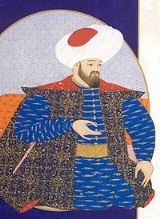
Osman IOsman Gazi or Othman I El-Gazi (1258, Sögüt
Sögüt

S?g?t is a town and district of Bilecik Province in the Marmara Region, Turkey region of Turkey. S?g?t has an area of and borders Bilecik to the west, G?lpazari to the north, Inhisar to the northeast, Eskisehir to the southeast, and Boz?y?k to the southwest....
, Anatolia
Anatolia

Anatolia or Asia Minor is a region of Western Asia, comprising most of the modern Republic of Turkey. It is a geographic region bounded by the Black Sea to the north, the Caucasus to the northeast, the Aegean Sea to the west, the Mediterranean Sea to the south, and the Iranian plateau to the east and southeast....
, Turkey
Turkey

Turkey , known officially as the Republic of Turkey , is a Eurasian country that stretches across the Anatolian peninsula in southwest Asia and Thrace in the Balkans region of Southern Europe....
 – February 1326, Sögüt
Sögüt

S?g?t is a town and district of Bilecik Province in the Marmara Region, Turkey region of Turkey. S?g?t has an area of and borders Bilecik to the west, G?lpazari to the north, Inhisar to the northeast, Eskisehir to the southeast, and Boz?y?k to the southwest....
) Ottoman
Ottoman Turkish language

Ottoman Turkish is the variety of the Turkish language that was used as the administrative and literary language of the Ottoman Empire. It contains extensive borrowings from Arabic language and Persian language languages and was written in a variant of the Arabic script....
: ????? ?? ??????, or Osman Bey or I.Osman or Osman Sayed II) was the leader of the Ottoman Turks
Ottoman Turks

The Ottoman Turks were the subdivision of the Ottoman Muslim Millet that dominated the ruling class of the Ottoman Empire. Reliable information about the early history of the Ottomans is scarce....
, and the founder of the dynasty
Ottoman Dynasty

File:Barber cape.jpgThe Ottoman Dynasty ruled the Ottoman Empire from 1299 to 1922, beginning with Osman I , though the dynasty was not proclaimed until Orhan Bey declared himself sultan....
 that established and ruled the Ottoman Empire
Ottoman Empire

The Ottoman Empire , also known by its contemporaries as the Turkish Empire or Turkey , was an empire that lasted from 1299?1923. It was Treaty of Lausanne by the Republic of Turkey, which was officially proclaimed on October 29, 1923....
. The Empire, named after him, would prevail as a worldpower for over six centuries. He was Sultan
Sultan

Sultan is an Islamic honorifics, with several historical meanings. Originally it was an Arabic language abstract noun meaning "strength", "authority", or "rulership", derived from the verbal noun ???? sulah, meaning "authority" or "power"....
 of Iconium from 1299 to 1317 and then Sultan
Sultan

Sultan is an Islamic honorifics, with several historical meanings. Originally it was an Arabic language abstract noun meaning "strength", "authority", or "rulership", derived from the verbal noun ???? sulah, meaning "authority" or "power"....
 of Rûm
Rûm

R?m, also Roum or Rhum , is a very indefinite term used at different times in the Muslim world to refer to the Balkans and Anatolia generally, and for the Byzantine Empire in particular, for the Seljuk Sultanate of R?m in Asia Minor, and for Greeks inhabiting Ottoman Empire or modern Turkey territory as well as for Greek Cypriots....
 or Anatolia
Anatolia

Anatolia or Asia Minor is a region of Western Asia, comprising most of the modern Republic of Turkey. It is a geographic region bounded by the Black Sea to the north, the Caucasus to the northeast, the Aegean Sea to the west, the Mediterranean Sea to the south, and the Iranian plateau to the east and southeast....
 from 1317 to 1326.

Osman declared the independence of his own small kingdom from the Seljuk Turks in 1299.


Discussion
Ask a question about 'Osman I'
Start a new discussion about 'Osman I'
Answer questions from other users
Full Discussion Forum


Encyclopedia


Osman IOsman Gazi or Othman I El-Gazi (1258, Sögüt
Sögüt

S?g?t is a town and district of Bilecik Province in the Marmara Region, Turkey region of Turkey. S?g?t has an area of and borders Bilecik to the west, G?lpazari to the north, Inhisar to the northeast, Eskisehir to the southeast, and Boz?y?k to the southwest....
, Anatolia
Anatolia

Anatolia or Asia Minor is a region of Western Asia, comprising most of the modern Republic of Turkey. It is a geographic region bounded by the Black Sea to the north, the Caucasus to the northeast, the Aegean Sea to the west, the Mediterranean Sea to the south, and the Iranian plateau to the east and southeast....
, Turkey
Turkey

Turkey , known officially as the Republic of Turkey , is a Eurasian country that stretches across the Anatolian peninsula in southwest Asia and Thrace in the Balkans region of Southern Europe....
 – February 1326, Sögüt
Sögüt

S?g?t is a town and district of Bilecik Province in the Marmara Region, Turkey region of Turkey. S?g?t has an area of and borders Bilecik to the west, G?lpazari to the north, Inhisar to the northeast, Eskisehir to the southeast, and Boz?y?k to the southwest....
) Ottoman
Ottoman Turkish language

Ottoman Turkish is the variety of the Turkish language that was used as the administrative and literary language of the Ottoman Empire. It contains extensive borrowings from Arabic language and Persian language languages and was written in a variant of the Arabic script....
: ????? ?? ??????, or Osman Bey or I.Osman or Osman Sayed II) was the leader of the Ottoman Turks
Ottoman Turks

The Ottoman Turks were the subdivision of the Ottoman Muslim Millet that dominated the ruling class of the Ottoman Empire. Reliable information about the early history of the Ottomans is scarce....
, and the founder of the dynasty
Ottoman Dynasty

File:Barber cape.jpgThe Ottoman Dynasty ruled the Ottoman Empire from 1299 to 1922, beginning with Osman I , though the dynasty was not proclaimed until Orhan Bey declared himself sultan....
 that established and ruled the Ottoman Empire
Ottoman Empire

The Ottoman Empire , also known by its contemporaries as the Turkish Empire or Turkey , was an empire that lasted from 1299?1923. It was Treaty of Lausanne by the Republic of Turkey, which was officially proclaimed on October 29, 1923....
. The Empire, named after him, would prevail as a worldpower for over six centuries. He was Sultan
Sultan

Sultan is an Islamic honorifics, with several historical meanings. Originally it was an Arabic language abstract noun meaning "strength", "authority", or "rulership", derived from the verbal noun ???? sulah, meaning "authority" or "power"....
 of Iconium from 1299 to 1317 and then Sultan
Sultan

Sultan is an Islamic honorifics, with several historical meanings. Originally it was an Arabic language abstract noun meaning "strength", "authority", or "rulership", derived from the verbal noun ???? sulah, meaning "authority" or "power"....
 of Rûm
Rûm

R?m, also Roum or Rhum , is a very indefinite term used at different times in the Muslim world to refer to the Balkans and Anatolia generally, and for the Byzantine Empire in particular, for the Seljuk Sultanate of R?m in Asia Minor, and for Greeks inhabiting Ottoman Empire or modern Turkey territory as well as for Greek Cypriots....
 or Anatolia
Anatolia

Anatolia or Asia Minor is a region of Western Asia, comprising most of the modern Republic of Turkey. It is a geographic region bounded by the Black Sea to the north, the Caucasus to the northeast, the Aegean Sea to the west, the Mediterranean Sea to the south, and the Iranian plateau to the east and southeast....
 from 1317 to 1326.

Osman declared the independence of his own small kingdom from the Seljuk Turks in 1299. The westward drive of the Mongol invasions
Mongol invasions

The Mongol invasions progressed throughout the 13th century, resulting in the vast Mongol Empire covering much of Asia by 1300.The Mongol Empire emerged in the course of the 13th century by a series of conquests and invasions throughout Central Asia and Western Asia, reaching Eastern Europe by the 1240s....
 had pushed scores of Muslims toward Osman's Anatolia
Anatolia

Anatolia or Asia Minor is a region of Western Asia, comprising most of the modern Republic of Turkey. It is a geographic region bounded by the Black Sea to the north, the Caucasus to the northeast, the Aegean Sea to the west, the Mediterranean Sea to the south, and the Iranian plateau to the east and southeast....
n principality, a power base that Osman was quick to consolidate. As the Byzantine Empire
Byzantine Empire

Byzantine Empire and Eastern Roman Empire are conventional names used to describe the Roman Empire during the Middle Ages, centered on its capital of Constantinople....
 declined, the Ottoman Empire rose to take its place.

Origins of empire

However, be aware that this entry contains material from legendary accounts of the beginning of the life of Osman 1, so it is a mixture of fact and fiction. Ertugrul
Ertugrul

This article is about the Ottoman leader Ertugrul. For the Ottoman frigate, see Ertugrul .Ertugrul, called Virile Falcon , also Ertogrul , was the father of Osman I, the founder of the Ottoman Empire....
, Osman's father, led the Turkic Kayi tribe west into Anatolia
Anatolia

Anatolia or Asia Minor is a region of Western Asia, comprising most of the modern Republic of Turkey. It is a geographic region bounded by the Black Sea to the north, the Caucasus to the northeast, the Aegean Sea to the west, the Mediterranean Sea to the south, and the Iranian plateau to the east and southeast....
, fleeing the Mongol onslaught. His mother was named Khaima. He pledged allegiance to Sultan
Sultan

Sultan is an Islamic honorifics, with several historical meanings. Originally it was an Arabic language abstract noun meaning "strength", "authority", or "rulership", derived from the verbal noun ???? sulah, meaning "authority" or "power"....
 Alaeddin Keykubat of the Seljuk principality of Rum, who gave him permission to establish an emirate
Emirate

An emirate is a political territory that is ruled by a dynastic Arab Monarch styled emir....
 and expand it if he could, at the expense of the neighboring Byzantine
Byzantine

The word Byzantine may refer to:Topics directly related to the Byzantine Empire* A citizen of Byzantine Empire, or native Greeks during the Middle Ages ....
 provinces. This location was auspicious, as the wealthy Byzantine Empire was weakening to his West, while in the east, Muslim forces under the Seljuk Turks were splintered and distracted in the face of relentless Mongol aggression and internal bickering. Baghdad had been sacked by Hulagu Khan
Hulagu Khan

Hulagu Khan, also known as Hulagu, H?leg? or Hulegu , was a Mongols ruler who conquered much of Southwest Asia. Son of Tolui and the Kerait princess Sorghaghtani Beki, he was a grandson of Genghis Khan, and the brother of Arik Boke, M?ngke Khan and Kublai Khan....
 in 1258, the very year Osman I was born. Accordingly, Ertugrul founded a town known as Sogut, which became the initial capital of his territory.

Osman became chief, or Bey
Bey

Bey is a Turkish language title for "chieftain," traditionally applied to the leaders of small tribal groups. In historical accounts, many Turkey, other Turkic peoples and Iran leaders are titled Baig....
, upon his father’s death in 1281. By this time, mercenaries were streaming into his realm from all over the Islamic world to fight against and hopefully plunder the weakening Orthodox empire. In addition, the Turkic population of Osman's emirate were constantly reinforced by a flood of refugees, fleeing from the Mongols. Of these, many were Ghazi warriors, or fighters for Islam, border fighters who believed they were fighting for the expansion or defense of Islam. Under the strong and able leadership of Osman, these forces quickly proved a formidable force, and the foundations of the Empire were quickly laid.

24 years of age at his accession, Osman had already proven his skill as a leader and warrior. His early fortunes and exploits are favorite subjects of Oriental writers, especially in love stories of his wooing and winning the fair Mal Hatun
Mal Hatun

Mal Hatun was the wife of Osman I, Valide Sultan, and probably daughter of Sheik Edebali....
. These legends have been romanticized by the poetical pens which recorded them in later years. The Ottoman writers attached great importance to this legendary, dreamlike conception of the founder of their empire.

Ottoman historians often dwell on the prophetic significance of his name, which means "bone-breaker", signifying the powerful energy with which he and his followers appeared to show in the following centuries of conquest. "Osman" also refers to a large species
Lammergeier

File:Lammergeier with boy, Kabul, 1973.JPGThe Lammergeier or Bearded Vulture, Gypaetus barbatus , is an Old World vulture, the only member of the genus Gypaetus....
 of vulture
Vulture

Vultures are scavenger birds, feeding mostly on the carcasses of dead animals. Vultures are found on every continent except Antarctica and Oceania....
, commonly called the royal vulture, which is considered the emblem of sovereignty and warlike power in the East, comparable to the eagle in the nations of the West. On the other hand, the name Osman is the Turkish variation of the Muslim name Othman, or Uthman
Uthman

?Uthman ibn ?Affan was one of the sahaba . An early convert to Islam, he played a major role in early Muslim history, most notably as the third Caliph of the Rashidun Empire and in the compilation of the Qur'an....
.

After the last prince of the family of Alaeddin, to whom Osman's empire was indebted for its foundation in Asia Minor, died, there was no one to compete with Osman for the headship of the Turkish people of the region and dominion over the whole peninsula, save the Emir of Karamanogullari
Karamanoglu

Beylik of Karaman or of Karamanoglu , also called the Karamanid Dynasty or the Karamanids, was an Anatolian Turkish Beylik state centered in south-central Anatolia, around the present-day Karaman Province....
. A long and fierce struggle between the descendants of Osman and Karamanogullari princes for ascendancy commenced in Osman’s lifetime, extending through the reigns of many of his successors. Osman himself had gained some advantages over his Karamanli rival; but the weak and wealthy possessions of the Byzantine Emperor in northwest Asia Minor were more tempting marks for his ambition than the Karamanoglu plains, and it was over the cities and armies of the ailing Byzantine Empire that the triumphs of the last 26 years of Osman’s life were achieved.

Osman I left his mark on the history of the region. He is remembered as the founder of a powerful empire and one of the symbols of the Ghazi
Ghazw

Ghazw or ghazah was originally an Arabic term referring to the battles in which the Islamic prophet Muhammad personally participated....
 tradition. A considerable portion of the Turkish people
Turkish people

The Turkish people , also known as "Turks" are defined mainly as citizens of the Republic of Turkey. An early history text provided the definition of being a Turk as "any individual within the Republic of Turkey, whatever his faith who speaks Turkish, grows up with Turkish culture and adopts the Turkish ideal is a Turk." This ideal...
 called themselves Osmanli (Ottoman) until the dissolution of the Ottoman Empire
Dissolution of the Ottoman Empire

The dissolution of the Ottoman Empire began with the watershed event of Young Turk Revolution and ended with the partitioning of the Ottoman Empire by the victorious sides of the World War I in the early part of the 20th century....
.

Military victories

In 1302, after soundly defeating a Byzantine force
Battle of Bapheus

The Battle of Bapheus occurred in July 27, 1302 between an Ottoman army under Osman I and a Byzantine army. The Byzantines, who had suffered a number of raids by the Ottomans, possessed an army of far lesser quality and strategy than that of the Komnenos dynasty, and were defeated outside of Nicomedia....
 near Nicaea
Nicaea

Nicaea or Nikaia may be:*The ancient name of several places, including:**Empire of Nicaea**Nicaea , capital of the Empire of Nicaea and known today as Iznik, Turkey...
, Osman began settling his forces closer to Byzantine
Byzantine

The word Byzantine may refer to:Topics directly related to the Byzantine Empire* A citizen of Byzantine Empire, or native Greeks during the Middle Ages ....
 controlled areas. Large numbers of Ghazi warriors, Islamic scholars and dervishes began settling in Osman-controlled areas, and migrants composed the bulk of his army. The influx of Ghazi warriors and adventurers of differing backgrounds into these lands spurred subsequent Ottoman rulers to title themselves "Sultan
Sultan

Sultan is an Islamic honorifics, with several historical meanings. Originally it was an Arabic language abstract noun meaning "strength", "authority", or "rulership", derived from the verbal noun ???? sulah, meaning "authority" or "power"....
 of Ghazi
Ghazi

The term Ghazi may refer to:...
s"..

Alarmed by Osman's growing influence, the Byzantines gradually fled the Anatolian
Anatolian

Anatolian means of or pertaining to Anatolia , or a person from Anatolia, including:Biology* Anatolian Black, a breed of cattle.* Anatolian buffalo, a domestic animal of Anatolia....
 countryside and dedicated their resources to the Navy instead. Byzantine leadership was determined to prevent Osman from crossing into Europe
Europe

Europe is, conventionally, one of the world's seven continents. Comprising the westernmost peninsula of Eurasia, Europe is generally divided from Asia to its east by the water divide of the Ural Mountains, the Ural , the Caspian Sea, and by the Caucasus Mountains to the southeast....
 and attempted to contain Ottoman expansion westward. Osman however continued to press westward and captured the Byzantine city of Ephesus
Ephesus

Ephesus was an ancient Greek city on the west coast of Anatolia, in the region known as Ionia during the period known as Classical Greece. It was one of the twelve cities of the Ionian League....
 near the Aegean Sea
Aegean Sea

The Aegean Sea is an elongated embayment of the Mediterranean Sea located between the southern Balkans and Anatolian peninsulas, i.e., between the mainlands of Greece and Turkey respectively....
. Further strengthened by the influx of migrants into his territory, Osman also moved eastward and seized Byzantine domains in the Black Sea
Black Sea

The Black Sea is an inland sea sea bounded by southeastern Europe, the Caucasus and the Anatolia and is ultimately connected to the Atlantic Ocean via the Mediterranean Sea and Aegean Seas and various straits....
 region of Anatolia.

Osman's last campaign, before dying of old age, was against the Byzantines in the city of Bursa. Although Osman did not physically participate in the battle, the victory at Bursa proved to be extremely vital for the Ottomans as the city served as a staging ground against the Byzantines in Constantinople
Constantinople

Constantinople was the empire capital of the Roman Empire , the Byzantine Empire , the Latin Empire , and the Ottoman Empire . Strategically located between the Golden Horn and the Sea of Marmara at the point where Europe meets Asia, Byzantine Constantinople had been the capital of a Christendom empire, successor to ancient ancient Greece...
, and as a newly adorned capital for Osman's son, Orhan.

A sleepless night

There is a well known story about a sleepless night Osman spent before taking the throne. One day, when he was 19-years old, Ertugrul
Ertugrul

This article is about the Ottoman leader Ertugrul. For the Ottoman frigate, see Ertugrul .Ertugrul, called Virile Falcon , also Ertogrul , was the father of Osman I, the founder of the Ottoman Empire....
 went to visit a distant friend with his family, where he would remain overnight. The host of the house shows Osman his room and everyone retires for the night. Just after he prepares to go to sleep Osman notices the Quran hanging on the wall. His respect for the holy book of Islam
Islam

Islam is a Monotheism, Abrahamic religion originating with the teachings of the Prophets of Islam Muhammad, a 7th century Arab religious and political figure....
 keeps him from laying down, and as he is a visitor, he cannot take the Quran out of the room. He decides not to sleep until morning and sits beside the sofa. He cannot bear to stay awake and falls asleep for a short time just before dawn.

As he sleeps, he dreams he sees a crescent coming out of the chest of his mentor, Sheik Edebali
Sheik Edebali

Sheikh Edebali was a highly influential and respected religious leader, who helped shape and develop the policies of the growing Ottoman Empire....
, and going into his body. Afterwards an enormous plane tree emerges from his chest and covers all the sky, shading the earth, the people enjoying and benefiting from his shade. He then wakes. When he and his family get back to their village he recounts this dream to his mentor, Sheik Edebali, who smiles after hearing the dream and tells Osman that Allah
Allah

Allah is the standard Arabic language word for God. While the term is best known in the Western world for its use by Muslims as a reference to God, it is used by Arabic-speakers of all Abrahamic faiths, including Christians and Jews, in reference to "God"....
 would grant him and his descendants an enormous empire and he will see the hand of Sheikh Edebali's daughter in marriage. Because of his loyalty to Islam
Islam

Islam is a Monotheism, Abrahamic religion originating with the teachings of the Prophets of Islam Muhammad, a 7th century Arab religious and political figure....
, his sharpness, his courage and generosity, he was nominated to be the ruler of the Kayi Clan.

Last testament


In directing his son to continue the administrative policies set forth by Sheik Edebali
Sheik Edebali

Sheikh Edebali was a highly influential and respected religious leader, who helped shape and develop the policies of the growing Ottoman Empire....
, Osman stated:

Literature about Osman Ghazi

Osman has been celebrated by Oriental writers for his physical beauty, and for “his wondrous length and strength of arm.” Like Artaxerxes Longimanus
Artaxerxes I of Persia

Artaxerxes I was king of the Persian Empire from 465 BC to 424 BC, although other historians would place the beginning of his reign at 475 BC....
 of the old dynasty of Persian kings, Liu Bei
Liu Bei

Liu Bei , Chinese style name Xu?nd? , was a general, warlord, and later the founding emperor of Shu Han during the Three Kingdoms era of China....
 in the Romance of the Three Kingdoms
Romance of the Three Kingdoms

Romance of the Three Kingdoms , written by Luo Guanzhong in the 14th century, is a Chinese historical novel based upon events in the turbulent years near the end of the Han Dynasty and the Three Kingdoms era of China, starting in 169 and ending with the reunification of the land in 280....
, Gautama the Buddha
Gautama Buddha

Siddhartha Gautama was a Spirituality teacher in the northern region of the Indian subcontinent who founded Buddhism. He is generally seen by Buddhists as the Supreme Buddhahood of our age....
, and the Highland chieftain of whom William Wordsworth
William Wordsworth

William Wordsworth was a major England Romantic poetry poet who, with Samuel Taylor Coleridge, helped to launch the Romanticism in English literature with the 1798 joint publication Lyrical Ballads....
 sang, Osman is said to have been able to touch his knees with his hands when standing upright.

He was often depicted as unsurpassed in skill and grace as a horseman; and the jet black color of his hair, his beard, and eyebrows, gained him in youth the title of “Kara” (“Black”) Osman. The epithet “Kara,” a frequent occurrence in Turkish
Turkish people

The Turkish people , also known as "Turks" are defined mainly as citizens of the Republic of Turkey. An early history text provided the definition of being a Turk as "any individual within the Republic of Turkey, whatever his faith who speaks Turkish, grows up with Turkish culture and adopts the Turkish ideal is a Turk." This ideal...
 lore, implies the highest degree of manly beauty, when applied to a person. He dressed simply, in the tradition of the first warriors of Islam
Islam

Islam is a Monotheism, Abrahamic religion originating with the teachings of the Prophets of Islam Muhammad, a 7th century Arab religious and political figure....
, and like them he wore a turban
Turban

The turban is a headgear consisting of a long scarf-like single piece of cloth wound around either the head itself or an inner hat. The word "turban" is a common umbrella term, loosely used in English to refer to several sorts of head wrap....
 of white linen, wreathed round a red center. His loose flowing kaftan was of one color and had long open sleeves.

Marriages and Children

He married in 1280 Valide Sultan
Valide Sultan

Valide Sultan was the title held by the mother of a ruling Sultan in the Ottoman Empire. The Turkish phonology pronunciation of the word Valide, rendered in Help:IPA, is ....
 (1324) Kamariya Sultana Mal, daughter of Abdulaziz Bey. He also married a daughter of Sheikh Edebali.

  • Ala ed-din or Alaeddin, died in 1333
  • Orhan I
    Orhan I

    Orhan I , was the second Bey, or chief, of the nascent Ottoman Empire from 1326 to 1359. He was the son of Osman I, and his mother was Kamariya Sultana Mal, daughter of Abdulaziz Bey....
     - son of Kamariya Sultana Mal
  • Kashif
  • Tchioban
  • Melik
  • Hamid
  • Pazarlu


See also

  • Ghazan
  • Andronicus II Palaeologus
  • Catalan Company
    Catalan Company

    The Catalan Company of the East , officially the Company of the Army of the Franks#Crusaders and other Western Europeans as "Franks" in Byzantine empire, sometimes called the Grand Company and widely known as the Catalan Company, was a free company of mercenary founded by Roger de Flor in the early 14th-century....
  • Modun
  • Bumin
  • Seljuk
    Seljuk

    Seljuk was the eponymous hero of the Seljuks. He was the son of a certain Dukak Timuryaligh surnamed Timuryaligh -of the iron bow- and either the chief or an eminent member from the Kinik tribe of the Oghuz Turks....


External links