


Treaty of the Pyrenees

Encyclopedia
France
The French Republic , The French Republic , The French Republic , (commonly known as France , is a unitary semi-presidential republic in Western Europe with several overseas territories and islands located on other continents and in the Indian, Pacific, and Atlantic oceans. Metropolitan France...
and Spain
Spain
Spain , officially the Kingdom of Spain languages]] under the European Charter for Regional or Minority Languages. In each of these, Spain's official name is as follows:;;;;;;), is a country and member state of the European Union located in southwestern Europe on the Iberian Peninsula...
, a war that was initially a part of the wider Thirty Years' War
Thirty Years' War
The Thirty Years' War was fought primarily in what is now Germany, and at various points involved most countries in Europe. It was one of the most destructive conflicts in European history....
. It was signed on Pheasant Island
Pheasant Island
Pheasant Island is a river island located in the Bidasoa river. The island is a condominium , under joint sovereignty of Spain and France, and so administered by Irun and Hendaye , which are in charge of the island during alternating periods of six months...
, a river island on the border between the two countries. The kings Louis XIV of France
Louis XIV of France
Louis XIV , known as Louis the Great or the Sun King , was a Bourbon monarch who ruled as King of France and Navarre. His reign, from 1643 to his death in 1715, began at the age of four and lasted seventy-two years, three months, and eighteen days...
and Philip IV of Spain
Philip IV of Spain
Philip IV was King of Spain between 1621 and 1665, sovereign of the Spanish Netherlands, and King of Portugal until 1640...
were represented by their chief ministers, Cardinal Mazarin and Don Luis de Haro
Luis de Haro
Luis Méndez de Haro, 6th Marquis of Carpio, Grandee of Spain, , , was a Spanish nobleman, political figure and general....
, respectively.
Context
France entered the Thirty Years' War after the Spanish Habsburg victories in the Dutch RevoltDutch Revolt
The Dutch Revolt or the Revolt of the Netherlands This article adopts 1568 as the starting date of the war, as this was the year of the first battles between armies. However, since there is a long period of Protestant vs...
in the 1620s and at the Battle of Nördlingen
Battle of Nördlingen (1634)
The Battle of Nördlingen was fought on 27 August or 6 September , 1634 during the Thirty Years' War. The Roman Catholic Imperial army, bolstered by 18,000 Spanish and Italian soldiers, won a crushing victory over the combined Protestant armies of Sweden and their German-Protestant allies .After...
against Sweden
Sweden
Sweden , officially the Kingdom of Sweden , is a Nordic country on the Scandinavian Peninsula in Northern Europe. Sweden borders with Norway and Finland and is connected to Denmark by a bridge-tunnel across the Öresund....
in 1634. By 1640 France began to interfere in Spanish politics, aiding the revolt in Catalonia
Catalan Revolt
The Catalan Revolt affected a large part of the Catalan Principality of Catalonia between the years of 1640 and 1659. It had an enduring effect in the Treaty of the Pyrenees , which ceded the county of Roussillon and the northern half of the county of Cerdanya to France , thereby splitting the...
, while Spain in response aided the Fronde
Fronde
The Fronde was a civil war in France, occurring in the midst of the Franco-Spanish War, which had begun in 1635. The word fronde means sling, which Parisian mobs used to smash the windows of supporters of Cardinal Mazarin....
revolt in France in 1648. During the negotiations for the Peace of Westphalia
Peace of Westphalia
The Peace of Westphalia was a series of peace treaties signed between May and October of 1648 in Osnabrück and Münster. These treaties ended the Thirty Years' War in the Holy Roman Empire, and the Eighty Years' War between Spain and the Dutch Republic, with Spain formally recognizing the...
in 1648, France gained Alsace
Alsace
Alsace is the fifth-smallest of the 27 regions of France in land area , and the smallest in metropolitan France. It is also the seventh-most densely populated region in France and third most densely populated region in metropolitan France, with ca. 220 inhabitants per km²...
and Lorraine
Lorraine (province)
The Duchy of Upper Lorraine was an historical duchy roughly corresponding with the present-day northeastern Lorraine region of France, including parts of modern Luxembourg and Germany. The main cities were Metz, Verdun, and the historic capital Nancy....
and cut off Spanish access to the Netherlands
Netherlands
The Netherlands is a constituent country of the Kingdom of the Netherlands, located mainly in North-West Europe and with several islands in the Caribbean. Mainland Netherlands borders the North Sea to the north and west, Belgium to the south, and Germany to the east, and shares maritime borders...
from Austria
Austria
Austria , officially the Republic of Austria , is a landlocked country of roughly 8.4 million people in Central Europe. It is bordered by the Czech Republic and Germany to the north, Slovakia and Hungary to the east, Slovenia and Italy to the south, and Switzerland and Liechtenstein to the...
, leading to open warfare between the French and Spanish.
After over ten years of war, an Anglo-French alliance was victorious at the Battle of the Dunes
Battle of the Dunes (1658)
The Battle of the Dunes, fought on 14 June , 1658, is also known as the Battle of Dunkirk. It was a victory of the French army, under Turenne, against the Spanish army, led by John of Austria the Younger and Louis II de Condé...
in 1658 and peace was settled by means of this treaty in 1659.
Content
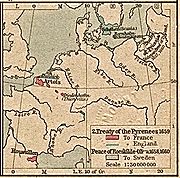
France gained RoussillonRoussillon
Roussillon is one of the historical counties of the former Principality of Catalonia, corresponding roughly to the present-day southern French département of Pyrénées-Orientales...
and Perpignan
Perpignan
-Sport:Perpignan is a rugby stronghold: their rugby union side, USA Perpignan, is a regular competitor in the Heineken Cup and seven times champion of the Top 14 , while their rugby league side plays in the engage Super League under the name Catalans Dragons.-Culture:Since 2004, every year in the...
, Montmédy
Montmédy
Montmédy is a commune in the Meuse department in Lorraine in north-eastern France.-Citadel of Montmédy:In 1221 the first castle of Montmédy was built on top of a hill by the Count of Chiny. Montmédy became soon the capital of his territory - later it belonged to Luxembourg, Burgundy, Austria and...
and other parts of Luxembourg
Luxembourg
Luxembourg , officially the Grand Duchy of Luxembourg , is a landlocked country in western Europe, bordered by Belgium, France, and Germany. It has two principal regions: the Oesling in the North as part of the Ardennes massif, and the Gutland in the south...
, Artois
Artois
Artois is a former province of northern France. Its territory has an area of around 4000 km² and a population of about one million. Its principal cities are Arras , Saint-Omer, Lens and Béthune.-Location:...
and other towns in Flanders
Flanders
Flanders is the community of the Flemings but also one of the institutions in Belgium, and a geographical region located in parts of present-day Belgium, France and the Netherlands. "Flanders" can also refer to the northern part of Belgium that contains Brussels, Bruges, Ghent and Antwerp...
, including Arras, Béthune
Béthune
Béthune is a city in northern France, sub-prefecture of the Pas-de-Calais department.-Geography:Béthune is located in the former province of Artois. It is situated South-East of Calais, West of Lille, and North of Paris.-Landmarks:...
, Gravelines
Gravelines
Gravelines is a commune in the Nord department in northern France.It lies at the mouth of the river Aa 15 miles southwest of Dunkirk. There is a market in the town square on Saturdays. The "Arsenal" approached from the town square is home to an extensive and carefully displayed art collection....
and Thionville
Thionville
Thionville , is a commune in the Moselle department in Lorraine in north-eastern France. The city is located on the left bank of the river Moselle, opposite its suburb Yutz.-Demographics:...
, and a new border with Spain was fixed at the Pyrenees. However, the treaty stipulated only that all villages north of the Pyrenees should become part of France. For that reason there is an exclave of Spain in this part of France, the town of Llívia
Llívia
Llívia is a town of Cerdanya, province of Girona, Catalonia, Spain. It is a Spanish exclave within the French département of Pyrénées-Orientales...
, considered a town and not a village, which remains under Spanish control and is part of the comarca
Comarca
A comarca is a traditional region or local administrative division found in parts of Spain, Portugal, Panama, Nicaragua, and Brazil. The term is derived from the term marca, meaning a "march, mark", plus the prefix co- meaning "together, jointly".The comarca is known in Aragonese as redolada and...
of Baixa Cerdanya, the Spanish province of Girona
Girona (province)
Girona is a province of north-eastern Spain, in the northern part of the autonomous community of Catalonia. It is bordered by the provinces of Barcelona and Lleida, and by France and the Mediterranean Sea....
. This border was not properly settled until the Treaty of Bayonne was signed in 1856.
Spain was forced to recognise and confirm all of the French gains at the Peace of Westphalia.
In exchange for the Spanish territorial losses, the French king pledged to quit his support for Portugal
Portugal
Portugal , officially the Portuguese Republic is a country situated in southwestern Europe on the Iberian Peninsula. Portugal is the westernmost country of Europe, and is bordered by the Atlantic Ocean to the West and South and by Spain to the North and East. The Atlantic archipelagos of the...
and renounced to his claim to the county of Barcelona, which the French crown was claiming ever since the Catalan Revolt
Catalan Revolt
The Catalan Revolt affected a large part of the Catalan Principality of Catalonia between the years of 1640 and 1659. It had an enduring effect in the Treaty of the Pyrenees , which ceded the county of Roussillon and the northern half of the county of Cerdanya to France , thereby splitting the...
(also known as Reapers' War). The Portuguese revolt in 1640, led by the Duke of Braganza was supported monetarily by Cardinal Richelieu of France. After the Catalonian Revolt France had controlled Catalonia from January 1641, when a combined Catalan and French force defeated the Spanish army at Montjuich
Battle of Montjuïc (1641)
Battle of Montjuïc took place on 26 January 1641 during the Catalan Revolt. A Spanish force under Pedro Fajardo launched an attack on a Catalan rebel force, made up mainly of Miquelet militias led by Francesc de Tamarit, and their French allies....
, until 1652.
The treaty also arranged for a marriage between Louis XIV of France
Louis XIV of France
Louis XIV , known as Louis the Great or the Sun King , was a Bourbon monarch who ruled as King of France and Navarre. His reign, from 1643 to his death in 1715, began at the age of four and lasted seventy-two years, three months, and eighteen days...
and Maria Theresa of Spain
Maria Theresa of Spain
Maria Theresa of Austria was the daughter of Philip IV, King of Spain and Elizabeth of France. Maria Theresa was Queen of France as wife of King Louis XIV and mother of the Grand Dauphin, an ancestor of the last four Bourbon kings of France.-Early life:Born as Infanta María Teresa of Spain at the...
, the daughter of Philip IV of Spain
Philip IV of Spain
Philip IV was King of Spain between 1621 and 1665, sovereign of the Spanish Netherlands, and King of Portugal until 1640...
. Maria Theresa was forced to renounce her claim to the Spanish throne, in return for a monetary settlement as part of her dowry
Dowry
A dowry is the money, goods, or estate that a woman brings forth to the marriage. It contrasts with bride price, which is paid to the bride's parents, and dower, which is property settled on the bride herself by the groom at the time of marriage. The same culture may simultaneously practice both...
. This settlement was never paid, a factor that eventually led to the War of Devolution
War of Devolution
The War of Devolution saw Louis XIV's French armies overrun the Habsburg-controlled Spanish Netherlands and the Franche-Comté, but forced to give most of it back by a Triple Alliance of England, Sweden, and the Dutch Republic in the Treaty of Aix-la-Chapelle.-Background:Louis's claims to the...
in 1668.
In addition, the English received Dunkirk.
Consequences
The Treaty of the Pyrenees is the last major diplomatic achievement by Cardinal Mazarin. Combined with the Peace of WestphaliaPeace of Westphalia
The Peace of Westphalia was a series of peace treaties signed between May and October of 1648 in Osnabrück and Münster. These treaties ended the Thirty Years' War in the Holy Roman Empire, and the Eighty Years' War between Spain and the Dutch Republic, with Spain formally recognizing the...
, it allowed Louis XIV remarkable stability and diplomatic advantage by means of a weakened Louis II de Bourbon, Prince de Condé
Louis II de Bourbon, Prince de Condé
Louis de Bourbon, Prince of Condé was a French general and the most famous representative of the Condé branch of the House of Bourbon. Prior to his father's death in 1646, he was styled the Duc d'Enghien...
and a weakened Spanish Crown, along the agreed dowry, which was an important element in the French king's strategy:
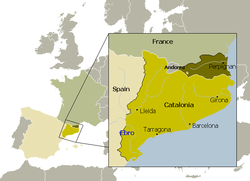
French annexations
In the context of the territorial changes involved in the Treaty, France got some territorial gains, on both its northern and southern borders.- In the north, France gained French FlandersFrench FlandersFrench Flanders is a part of the historical County of Flanders in present-day France. The region today lies in the modern-day region of Nord-Pas de Calais, the department of Nord, and roughly corresponds to the arrondissements of Lille, Douai and Dunkirk on the Belgian border.-Geography:French...
.
- In the south, the northern part of Historical CataloniaPrincipality of CataloniaThe Principality of Catalonia , is a historic territory in the northeastern Iberian Peninsula, mostly in Spain and with an adjoining portion in southern France....
, including RoussillonRoussillonRoussillon is one of the historical counties of the former Principality of Catalonia, corresponding roughly to the present-day southern French département of Pyrénées-Orientales...
, ConflentConflentConflent is a historical Catalan comarca of Northern Catalonia, now part of the French Département of Pyrénées-Orientales. In the Middle Ages it comprised the County of Conflent....
, VallespirVallespirVallespir is a historical Catalan comarca of Northern Catalonia, part of the French Département of Pyrénées-Orientales. The capital of the comarca is Ceret, and it borders Conflent, Rosselló, Alt Empordà, Garrotxa and Ripollès...
, CapcirCapcirCapcir is a historical Catalan comarca of Northern Catalonia, now part of the French Département of Pyrénées-Orientales. The capital of the comarca was Formiguera, and it borders the historical comarques of Conflent and Alta Cerdanya...
and French CerdagneFrench CerdagneFrench Cerdagne is the northern half of Cerdanya, which came under French control as a result of the Treaty of the Pyrenees in 1659, while the southern half remained in Spain . Catalonians often refer to French Cerdagne as Upper Cerdanya...
were transferred to France. The Albera Range, an eastern prolongation of the PyreneesPyreneesThe Pyrenees is a range of mountains in southwest Europe that forms a natural border between France and Spain...
became the border between France and Spain. Every year on 7 November, Catalanists from this region, known nowadays in Catalonia as "Northern CataloniaNorthern CataloniaNorthern Catalonia is a term that is sometimes used, particularly in Catalan writings, to refer to the territory ceded to France by Spain through the signing of the Treaty of the Pyrenees in 1659...
", remember this event and demonstrate in PerpignanPerpignan-Sport:Perpignan is a rugby stronghold: their rugby union side, USA Perpignan, is a regular competitor in the Heineken Cup and seven times champion of the Top 14 , while their rugby league side plays in the engage Super League under the name Catalans Dragons.-Culture:Since 2004, every year in the...
. In 2009 the demonstrations marked the 350 anniversary of the Treaty of the Pyrenees.