

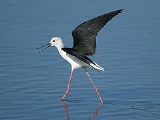
Black-winged Stilt

Encyclopedia
The Black-winged Stilt or Common Stilt (Himantopus himantopus) is a widely distributed very long-legged wader
in the avocet
and stilt
family
(Recurvirostridae
). Opinions differ as to whether the birds treated under the scientific name H. himantopus ought to be treated as a single species
and if not, how many species to recognize. Most sources today accept 2–4 species.
Immature birds are grey instead of black and have a markedly sandy hue on the wings, with light feather fringes appearing as a whitish line in flight.
of this bird is still somewhat contentious. Some believe that there are as many as five distinct species
; others consider some or all of these to be subspecies
. In addition, two dubious subspecies are also sometimes listed, but not as independent species.
In the most extensive circumscription, with one species and 5-7 subspecies, this bird is often called Common Stilt. The name Black-winged Stilt on the other hand can specifically refer to the Old World
nominate subspecies. The commonly accepted taxa are:
of all these stilts is marsh
es, shallow lake
s and pond
s. Some populations are migratory
and move to the ocean coasts in winter; those in warmer regions are generally resident or short-range vagrants. In Europe
, the Black-winged Stilt is a regular spring overshoot vagrants north of its normal range, occasionally remaining to breed in northern European countries, for example in Britain in 1987.
These birds pick up their food from sand or water. They mainly eat insects and crustaceans.
The nest site is a bare spot on the ground near water. These birds often nest in small groups, sometimes with Avocet
s.
The Hawaiian population is endangered due to habitat loss and probably also introduced predators. The IUCN recognizes 3 species at present, merging the Hawaiian and South American birds with the Black-necked Stilt; consequently, none of the three is listed as threatened species
. The Black-winged Stilt is one of the species to which the Agreement on the Conservation of African-Eurasian Migratory Waterbirds applies.
Wader
Waders, called shorebirds in North America , are members of the order Charadriiformes, excluding the more marine web-footed seabird groups. The latter are the skuas , gulls , terns , skimmers , and auks...
in the avocet
Avocet
The four species of Avocets are a genus, Recurvirostra, of waders in the same avian family as the stilts.Avocets have long legs and long, thin, upcurved bills which they sweep from side to side when feeding in the brackish or saline wetlands they prefer...
and stilt
Stilt
Stilt is a common name for several species of birds in the family Recurvirostridae, which also includes those known as avocets. They are found in brackish or saline wetlands in warm or hot climates....
family
Family (biology)
In biological classification, family is* a taxonomic rank. Other well-known ranks are life, domain, kingdom, phylum, class, order, genus, and species, with family fitting between order and genus. As for the other well-known ranks, there is the option of an immediately lower rank, indicated by the...
(Recurvirostridae
Recurvirostridae
Recurvirostridae is a family of birds in the wader suborder Charadrii. It contains two distinct groups of birds, the avocets and the stilts .-Description and diet:...
). Opinions differ as to whether the birds treated under the scientific name H. himantopus ought to be treated as a single species
Species
In biology, a species is one of the basic units of biological classification and a taxonomic rank. A species is often defined as a group of organisms capable of interbreeding and producing fertile offspring. While in many cases this definition is adequate, more precise or differing measures are...
and if not, how many species to recognize. Most sources today accept 2–4 species.
Description
Adults are 33–36 cm long. They have long pink legs, a long thin black bill and are blackish above and white below, with a white head and neck with a varying amount of black. Males have a black back, often with greenish gloss. Females' backs have a brown hue, contrasting with the black remiges. In the populations that have the top of the head normally white at least in winter, females tend to have less black on head and neck all year round, while males often have much black, particularly in summer. This difference is not clear-cut, however, and males usually get all-white heads in winter.Immature birds are grey instead of black and have a markedly sandy hue on the wings, with light feather fringes appearing as a whitish line in flight.
Taxonomy and systematics
The taxonomyTaxonomy
Taxonomy is the science of identifying and naming species, and arranging them into a classification. The field of taxonomy, sometimes referred to as "biological taxonomy", revolves around the description and use of taxonomic units, known as taxa...
of this bird is still somewhat contentious. Some believe that there are as many as five distinct species
Species
In biology, a species is one of the basic units of biological classification and a taxonomic rank. A species is often defined as a group of organisms capable of interbreeding and producing fertile offspring. While in many cases this definition is adequate, more precise or differing measures are...
; others consider some or all of these to be subspecies
Subspecies
Subspecies in biological classification, is either a taxonomic rank subordinate to species, ora taxonomic unit in that rank . A subspecies cannot be recognized in isolation: a species will either be recognized as having no subspecies at all or two or more, never just one...
. In addition, two dubious subspecies are also sometimes listed, but not as independent species.
In the most extensive circumscription, with one species and 5-7 subspecies, this bird is often called Common Stilt. The name Black-winged Stilt on the other hand can specifically refer to the Old World
Old World
The Old World consists of those parts of the world known to classical antiquity and the European Middle Ages. It is used in the context of, and contrast with, the "New World" ....
nominate subspecies. The commonly accepted taxa are:
- Black-winged Stilt proper, Himantopus himantopus himantopus or H. himantopus (Linnaeus, 1758) – including proposed subspecies meridionalis (S AfricaAfricaAfrica is the world's second largest and second most populous continent, after Asia. At about 30.2 million km² including adjacent islands, it covers 6% of the Earth's total surface area and 20.4% of the total land area...
) and ceylonensis (Sri LankaSri LankaSri Lanka, officially the Democratic Socialist Republic of Sri Lanka is a country off the southern coast of the Indian subcontinent. Known until 1972 as Ceylon , Sri Lanka is an island surrounded by the Indian Ocean, the Gulf of Mannar and the Palk Strait, and lies in the vicinity of India and the...
)
- W EuropeEuropeEurope is, by convention, one of the world's seven continents. Comprising the westernmost peninsula of Eurasia, Europe is generally 'divided' from Asia to its east by the watershed divides of the Ural and Caucasus Mountains, the Ural River, the Caspian and Black Seas, and the waterways connecting...
and Mediterranean region to Central AsiaCentral AsiaCentral Asia is a core region of the Asian continent from the Caspian Sea in the west, China in the east, Afghanistan in the south, and Russia in the north...
, sub-Saharan AfricaSub-Saharan AfricaSub-Saharan Africa as a geographical term refers to the area of the African continent which lies south of the Sahara. A political definition of Sub-Saharan Africa, instead, covers all African countries which are fully or partially located south of the Sahara...
and MadagascarMadagascarThe Republic of Madagascar is an island country located in the Indian Ocean off the southeastern coast of Africa...
, SouthSouth AsiaSouth Asia, also known as Southern Asia, is the southern region of the Asian continent, which comprises the sub-Himalayan countries and, for some authorities , also includes the adjoining countries to the west and the east...
and Southeast AsiaSoutheast AsiaSoutheast Asia, South-East Asia, South East Asia or Southeastern Asia is a subregion of Asia, consisting of the countries that are geographically south of China, east of India, west of New Guinea and north of Australia. The region lies on the intersection of geological plates, with heavy seismic...
; localized breeder in East AsiaEast AsiaEast Asia or Eastern Asia is a subregion of Asia that can be defined in either geographical or cultural terms...
(e.g. TaiwanTaiwanTaiwan , also known, especially in the past, as Formosa , is the largest island of the same-named island group of East Asia in the western Pacific Ocean and located off the southeastern coast of mainland China. The island forms over 99% of the current territory of the Republic of China following...
) but more widespread during winter; has become a regular migrant to the Marianas and SaipanSaipanSaipan is the largest island of the United States Commonwealth of the Northern Mariana Islands , a chain of 15 tropical islands belonging to the Marianas archipelago in the western Pacific Ocean with a total area of . The 2000 census population was 62,392...
and sometimes is seen on other islands in western MicronesiaMicronesiaMicronesia is a subregion of Oceania, comprising thousands of small islands in the western Pacific Ocean. It is distinct from Melanesia to the south, and Polynesia to the east. The Philippines lie to the west, and Indonesia to the southwest....
(e.g. KororKororKoror is the state comprising the main commercial centre of the Republic of Palau. It consists of several islands, the most prominent being Koror Island ....
, Ngeriungs Islet and PeleliuPeleliuPeleliu is an island in the island nation of Palau. Peleliu forms, along with two small islands to its northeast, one of the sixteen states of Palau. It is located northeast of Angaur and southwest of Koror....
of PalauPalauPalau , officially the Republic of Palau , is an island nation in the Pacific Ocean, east of the Philippines and south of Tokyo. In 1978, after three decades as being part of the United Nations trusteeship, Palau chose independence instead of becoming part of the Federated States of Micronesia, a...
) since the late 20th-century. NW populations migrate south to Africa in winter.
- Head and neck vary from all-white to white with all-black cap and hindneck, usually with white band across upper back. Sometimes vestigial open black chest band.
- Black-necked StiltBlack-necked StiltThe Black-necked Stilt is a locally abundant shorebird of American wetlands and coastlines. It is found from the coastal areas of California through much of the interior western United States and along the Gulf of Mexico as far east as Florida, then south through Central America and the Caribbean...
, Himantopus himantopus mexicanus, Himantopus mexicanus mexicanus or H. mexicanus (P.L.S.MüllerPhilipp Ludwig Statius MüllerPhilipp Ludwig Statius Muller was a German zoologist.Statius Muller was born in Esens, and was Professor of Natural Science at Erlangen. Between 1773 and 1776, he published a German translation of Linnaeus's Natursystem...
, 1776)
- Black-necked Stilt
- Southern North AmericaNorth AmericaNorth America is a continent wholly within the Northern Hemisphere and almost wholly within the Western Hemisphere. It is also considered a northern subcontinent of the Americas...
through Central AmericaCentral AmericaCentral America is the central geographic region of the Americas. It is the southernmost, isthmian portion of the North American continent, which connects with South America on the southeast. When considered part of the unified continental model, it is considered a subcontinent...
and CaribbeanCaribbeanThe Caribbean is a crescent-shaped group of islands more than 2,000 miles long separating the Gulf of Mexico and the Caribbean Sea, to the west and south, from the Atlantic Ocean, to the east and north...
to N PeruPeruPeru , officially the Republic of Peru , is a country in western South America. It is bordered on the north by Ecuador and Colombia, on the east by Brazil, on the southeast by Bolivia, on the south by Chile, and on the west by the Pacific Ocean....
and NE BrazilBrazilBrazil , officially the Federative Republic of Brazil , is the largest country in South America. It is the world's fifth largest country, both by geographical area and by population with over 192 million people...
. Northernmost populations migrate south in winter. Intergrades with White-backed Stilt in C Brazil. - Head and neck always white with black cap down to the eyeline, white spot above eye, black hindneck. Usually no white band across upper back. Often vestigial open black chest band.
- White-backed Stilt, Himantopus himantopus melanurus, Himantopus mexicanus melanurus or H. melanurus (VieillotLouis Jean Pierre VieillotLouis Jean Pierre Vieillot was a French ornithologist.Vieillot described a large number of birds for the first time, especially those he encountered during the time he spent in the West Indies and North America, and 26 genera established by him are still in use...
, 1817)
- White-backed Stilt, Himantopus himantopus melanurus, Himantopus mexicanus melanurus or H. melanurus (Vieillot
- South AmericaSouth AmericaSouth America is a continent situated in the Western Hemisphere, mostly in the Southern Hemisphere, with a relatively small portion in the Northern Hemisphere. The continent is also considered a subcontinent of the Americas. It is bordered on the west by the Pacific Ocean and on the north and east...
from C Peru and N ChileChileChile ,officially the Republic of Chile , is a country in South America occupying a long, narrow coastal strip between the Andes mountains to the east and the Pacific Ocean to the west. It borders Peru to the north, Bolivia to the northeast, Argentina to the east, and the Drake Passage in the far...
to SE Brazil and south to SC ArgentinaArgentinaArgentina , officially the Argentine Republic , is the second largest country in South America by land area, after Brazil. It is constituted as a federation of 23 provinces and an autonomous city, Buenos Aires...
. Intergrades with Black-necked Stilt in C Brazil. - Head and neck usually white with black hindneck and a black line from the nape to the eye. Usually has open black chest band and a white band across upper back.
- Pied Stilt, White-headed Stilt or (New ZealandNew ZealandNew Zealand is an island country in the south-western Pacific Ocean comprising two main landmasses and numerous smaller islands. The country is situated some east of Australia across the Tasman Sea, and roughly south of the Pacific island nations of New Caledonia, Fiji, and Tonga...
) poaka, Himantopus himantopus leucocephalus or H. leucocephalus (GouldJohn GouldJohn Gould was an English ornithologist and bird artist. The Gould League in Australia was named after him. His identification of the birds now nicknamed "Darwin's finches" played a role in the inception of Darwin's theory of evolution by natural selection...
, 1837)
- Pied Stilt, White-headed Stilt or (New Zealand
- JavaJavaJava is an island of Indonesia. With a population of 135 million , it is the world's most populous island, and one of the most densely populated regions in the world. It is home to 60% of Indonesia's population. The Indonesian capital city, Jakarta, is in west Java...
to New GuineaNew GuineaNew Guinea is the world's second largest island, after Greenland, covering a land area of 786,000 km2. Located in the southwest Pacific Ocean, it lies geographically to the east of the Malay Archipelago, with which it is sometimes included as part of a greater Indo-Australian Archipelago...
, AustraliaAustraliaAustralia , officially the Commonwealth of Australia, is a country in the Southern Hemisphere comprising the mainland of the Australian continent, the island of Tasmania, and numerous smaller islands in the Indian and Pacific Oceans. It is the world's sixth-largest country by total area...
and New Zealand. Southern population winter in the PhilippinesPhilippinesThe Philippines , officially known as the Republic of the Philippines , is a country in Southeast Asia in the western Pacific Ocean. To its north across the Luzon Strait lies Taiwan. West across the South China Sea sits Vietnam...
region. - Head usually all-white, neck white, black behind and with open black chest band. Usually a white band across upper back.
- Hawaiian Stilt or āeo, Himantopus himantopus knudseni, Himantopus mexicanus knudseni or H. knudseni (StejnegerLeonhard Hess StejnegerLeonhard Hess Stejneger was a Norwegian-born American ornithologist, herpetologist and zoologist. Stejneger specialized in vertebrate natural history studies. He gained his greatest reputation with reptiles and amphibians....
, 1887)
- Hawaiian Stilt or āeo, Himantopus himantopus knudseni, Himantopus mexicanus knudseni or H. knudseni (Stejneger
- Hawaiian IslandsHawaiian IslandsThe Hawaiian Islands are an archipelago of eight major islands, several atolls, numerous smaller islets, and undersea seamounts in the North Pacific Ocean, extending some 1,500 miles from the island of Hawaii in the south to northernmost Kure Atoll...
, where it is the only breeding shorebird - Generally similar to Black-necked Stilt, but black on head and neck more extensive, usually extending below the eye.
Ecology and status
The breeding habitatHabitat
* Habitat , a place where a species lives and grows*Human habitat, a place where humans live, work or play** Space habitat, a space station intended as a permanent settlement...
of all these stilts is marsh
Marsh
In geography, a marsh, or morass, is a type of wetland that is subject to frequent or continuous flood. Typically the water is shallow and features grasses, rushes, reeds, typhas, sedges, other herbaceous plants, and moss....
es, shallow lake
Lake
A lake is a body of relatively still fresh or salt water of considerable size, localized in a basin, that is surrounded by land. Lakes are inland and not part of the ocean and therefore are distinct from lagoons, and are larger and deeper than ponds. Lakes can be contrasted with rivers or streams,...
s and pond
Pond
A pond is a body of standing water, either natural or man-made, that is usually smaller than a lake. A wide variety of man-made bodies of water are classified as ponds, including water gardens, water features and koi ponds; all designed for aesthetic ornamentation as landscape or architectural...
s. Some populations are migratory
Bird migration
Bird migration is the regular seasonal journey undertaken by many species of birds. Bird movements include those made in response to changes in food availability, habitat or weather. Sometimes, journeys are not termed "true migration" because they are irregular or in only one direction...
and move to the ocean coasts in winter; those in warmer regions are generally resident or short-range vagrants. In Europe
Europe
Europe is, by convention, one of the world's seven continents. Comprising the westernmost peninsula of Eurasia, Europe is generally 'divided' from Asia to its east by the watershed divides of the Ural and Caucasus Mountains, the Ural River, the Caspian and Black Seas, and the waterways connecting...
, the Black-winged Stilt is a regular spring overshoot vagrants north of its normal range, occasionally remaining to breed in northern European countries, for example in Britain in 1987.
These birds pick up their food from sand or water. They mainly eat insects and crustaceans.
The nest site is a bare spot on the ground near water. These birds often nest in small groups, sometimes with Avocet
Avocet
The four species of Avocets are a genus, Recurvirostra, of waders in the same avian family as the stilts.Avocets have long legs and long, thin, upcurved bills which they sweep from side to side when feeding in the brackish or saline wetlands they prefer...
s.
The Hawaiian population is endangered due to habitat loss and probably also introduced predators. The IUCN recognizes 3 species at present, merging the Hawaiian and South American birds with the Black-necked Stilt; consequently, none of the three is listed as threatened species
Threatened species
Threatened species are any speciesg animals, plants, fungi, etc.) which are vulnerable to endangerment in the near future.The World Conservation Union is the foremost authority on threatened species, and treats threatened species not as a single category, but as a group of three categories,...
. The Black-winged Stilt is one of the species to which the Agreement on the Conservation of African-Eurasian Migratory Waterbirds applies.
Further reading
- Hayman, Peter; Marchant, John & Prater, Tony (1986): Shorebirds: an identification guide to the waders of the world. Houghton Mifflin, Boston. ISBN 0-395-60237-8
External links
- Black-winged Stilt videos, photos & sounds on the Internet Bird Collection
- Identification guide (PDF) by Javier Blasco-Zumeta