

Recurvirostridae

Encyclopedia
Recurvirostridae is a family of bird
s in the wader
suborder Charadrii. It contains two distinct groups of birds, the avocet
s (one genus) and the stilt
s (two genera).
, which swim more. The majority of species' plumage
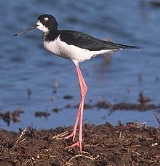
has contrasting areas of black and white, with some species having patches of buff or brown on the head or chest. The sexes are similar.
Their vocalizations are usually yelps of one or two syllables.
These species feed on small aquatic animals such as mollusks, brine shrimp
and other crustacean
s, larval insect
s, segmented worms, tadpole
s, and small fish
.
family, being distributed on all the world's continents except Antarctica, and occurring on several oceanic islands. There are several wide-ranging species and a few locally distributed species.
One species, the Black Stilt
of New Zealand
, is critically endangered
due to habitat loss, introduced predators
and hybridisation with the Pied Stilt.
. They defend nesting territories vigorously with aggressive displays and mob intruders and possible predators with a great deal of noise. They are monogamous
, although the pair bonds are not maintained from season to season. Their eggs are light-coloured with dark markings, weighing 22 to 44 g (0.776027166312463 to 1.6 oz). Three to four are laid in simple nests
, and both parents share the incubation
duties, which last 22 to 28 days. The Banded Stilt may breed only every couple of years, as it breeds on temporary lakes caused by rains in the deserts of Australia. The chicks are downy
and precocial
, leaving the nest within a day of hatching; they fledge in 28 to 35 days. In all species except the Banded Stilt, the chicks are cared for several months by the parents, which may move them to new areas and defend territories there; Banded Stilts deviate from this by collecting their chicks in massive crèches
numbering several hundred.
FAMILY: RECURVIROSTRIDAE
Bird
Birds are feathered, winged, bipedal, endothermic , egg-laying, vertebrate animals. Around 10,000 living species and 188 families makes them the most speciose class of tetrapod vertebrates. They inhabit ecosystems across the globe, from the Arctic to the Antarctic. Extant birds range in size from...
s in the wader
Wader
Waders, called shorebirds in North America , are members of the order Charadriiformes, excluding the more marine web-footed seabird groups. The latter are the skuas , gulls , terns , skimmers , and auks...
suborder Charadrii. It contains two distinct groups of birds, the avocet
Avocet
The four species of Avocets are a genus, Recurvirostra, of waders in the same avian family as the stilts.Avocets have long legs and long, thin, upcurved bills which they sweep from side to side when feeding in the brackish or saline wetlands they prefer...
s (one genus) and the stilt
Stilt
Stilt is a common name for several species of birds in the family Recurvirostridae, which also includes those known as avocets. They are found in brackish or saline wetlands in warm or hot climates....
s (two genera).
Description and diet
Avocets and stilts range in length from 30 to 46 cm (11.8 to 18.1 in) and in weight from 140 to 435 g (4.9 to 15.3 oz); males are usually slightly bigger than females. All possess long, thin legs, necks, and bills. The bills of avocets are curved upwards, and are swept from side to side when the bird is feeding in the brackish or saline wetlands they prefer. The bills of stilts, in contrast, are straight. The front toes are webbed, partially in most stilts, fully in avocets and the Banded StiltBanded Stilt
The Banded Stilt is a nomadic stilt from Australia. It belongs to the monotypical genus Cladorhynchus. It gets its name from the red-brown breast band found on breeding adults, but this is mottled or entirely absent in non-breeding adults and juveniles. Its remaining plumage is pied and the eyes...
, which swim more. The majority of species' plumage
Plumage
Plumage refers both to the layer of feathers that cover a bird and the pattern, colour, and arrangement of those feathers. The pattern and colours of plumage vary between species and subspecies and can also vary between different age classes, sexes, and season. Within species there can also be a...
has contrasting areas of black and white, with some species having patches of buff or brown on the head or chest. The sexes are similar.
Their vocalizations are usually yelps of one or two syllables.
These species feed on small aquatic animals such as mollusks, brine shrimp
Brine shrimp
Artemia is a genus of aquatic crustaceans known as brine shrimp. Artemia, the only genus in the family Artemiidae, has changed little externally since the Triassic period...
and other crustacean
Crustacean
Crustaceans form a very large group of arthropods, usually treated as a subphylum, which includes such familiar animals as crabs, lobsters, crayfish, shrimp, krill and barnacles. The 50,000 described species range in size from Stygotantulus stocki at , to the Japanese spider crab with a leg span...
s, larval insect
Insect
Insects are a class of living creatures within the arthropods that have a chitinous exoskeleton, a three-part body , three pairs of jointed legs, compound eyes, and two antennae...
s, segmented worms, tadpole
Tadpole
A tadpole or polliwog is the wholly aquatic larval stage in the life cycle of an amphibian, particularly that of a frog or toad.- Appellation :...
s, and small fish
Fish
Fish are a paraphyletic group of organisms that consist of all gill-bearing aquatic vertebrate animals that lack limbs with digits. Included in this definition are the living hagfish, lampreys, and cartilaginous and bony fish, as well as various extinct related groups...
.
Distribution
Avocets and stilts are a cosmopolitanCosmopolitan distribution
In biogeography, a taxon is said to have a cosmopolitan distribution if its range extends across all or most of the world in appropriate habitats. For instance, the killer whale has a cosmopolitan distribution, extending over most of the world's oceans. Other examples include humans, the lichen...
family, being distributed on all the world's continents except Antarctica, and occurring on several oceanic islands. There are several wide-ranging species and a few locally distributed species.
One species, the Black Stilt
Black Stilt
The Black Stilt or Kakī , Himantopus novaezelandiae, is a large wader in the avocet and stilt family Recurvirostridae. The species is endemic to New Zealand. Adults are 40 cm long. They have very long red legs, a long thin black bill and black plumage...
of New Zealand
New Zealand
New Zealand is an island country in the south-western Pacific Ocean comprising two main landmasses and numerous smaller islands. The country is situated some east of Australia across the Tasman Sea, and roughly south of the Pacific island nations of New Caledonia, Fiji, and Tonga...
, is critically endangered
Critically endangered
Version 2010.3 of the IUCN Red List of Threatened Species identified 3744 Critically Endangered species, subspecies and varieties, stocks and subpopulations.Critically Endangered by kingdom:*1993 Animalia*2 Fungi*1745 Plantae*4 Protista-References:...
due to habitat loss, introduced predators
Introduced species
An introduced species — or neozoon, alien, exotic, non-indigenous, or non-native species, or simply an introduction, is a species living outside its indigenous or native distributional range, and has arrived in an ecosystem or plant community by human activity, either deliberate or accidental...
and hybridisation with the Pied Stilt.
Reproduction
Stilts and avocets breed on open ground near water, often in loose coloniesBird colony
A bird colony is a large congregation of individuals of one or more species of bird that nest or roost in close proximity at a particular location. Many kinds of birds are known to congregate in groups of varying size; a congregation of nesting birds is called a breeding colony...
. They defend nesting territories vigorously with aggressive displays and mob intruders and possible predators with a great deal of noise. They are monogamous
Monogamy
Monogamy /Gr. μονός+γάμος - one+marriage/ a form of marriage in which an individual has only one spouse at any one time. In current usage monogamy often refers to having one sexual partner irrespective of marriage or reproduction...
, although the pair bonds are not maintained from season to season. Their eggs are light-coloured with dark markings, weighing 22 to 44 g (0.776027166312463 to 1.6 oz). Three to four are laid in simple nests
Bird nest
A bird nest is the spot in which a bird lays and incubates its eggs and raises its young. Although the term popularly refers to a specific structure made by the bird itself—such as the grassy cup nest of the American Robin or Eurasian Blackbird, or the elaborately woven hanging nest of the...
, and both parents share the incubation
Avian incubation
Incubation refers to the process by which certain oviparous animals hatch their eggs, and to the development of the embryo within the egg. The most vital factor of incubation is the constant temperature required for its development over a specific period. Especially in domestic fowl, the act of...
duties, which last 22 to 28 days. The Banded Stilt may breed only every couple of years, as it breeds on temporary lakes caused by rains in the deserts of Australia. The chicks are downy
Down feathers
The down of birds is a layer of fine feathers found under the tougher exterior feathers. Very young birds are clad only in down. Powder down is a specialized type of down found only in a few groups of birds. Down is a fine thermal insulator and padding, used in goods such as jackets, bedding,...
and precocial
Precocial
In biology, the term precocial refers to species in which the young are relatively mature and mobile from the moment of birth or hatching. The opposite developmental strategy is called "altricial," where the young are born or hatched helpless. Extremely precocial species may be called...
, leaving the nest within a day of hatching; they fledge in 28 to 35 days. In all species except the Banded Stilt, the chicks are cared for several months by the parents, which may move them to new areas and defend territories there; Banded Stilts deviate from this by collecting their chicks in massive crèches
Crèche (zoology)
The Crèche in zoology refers to care of another's offspring, for instance in a colony. This term is used in the study of bird colonies...
numbering several hundred.
Species
The taxonomy of the stilts is particularly debated, with the genus Himantopus considered to have two to six species.FAMILY: RECURVIROSTRIDAE
- Genus: Recurvirostra - Avocets
- Pied AvocetPied AvocetThe Pied Avocet, Recurvirostra avosetta, is a large black and white wader in the avocet and stilt family, Recurvirostridae. They breed in temperate Europe and western and Central Asia. It is a migratory species and most winter in Africa or southern Asia...
, Recurvirostra avosetta - American AvocetAmerican AvocetThe American Avocet is a large wader in the avocet and stilt family, Recurvirostridae.This avocet has long, thin, gray legs, giving it its colloquial name, "blue shanks". The plumage is black and white on the back with white on the underbelly. The neck and head are cinnamon colored in the summer...
, Recurvirostra americana - Red-necked AvocetRed-necked AvocetThe Red-necked Avocet is a water bird found throughout Australia, except for the northern parts of the Northern Territory....
, Recurvirostra novaehollandiae - Andean AvocetAndean AvocetThe Andean Avocet is a large wader in the avocet and stilt bird family, Recurvirostridae. It is resident in the Andes, breeding above 3500 m in northwestern Argentina, western Bolivia, northern Chile and southern Peru.-Description:...
, Recurvirostra andina
- Pied Avocet
- Genus: Himantopus
- Black-winged StiltBlack-winged StiltThe Black-winged Stilt or Common Stilt is a widely distributed very long-legged wader in the avocet and stilt family . Opinions differ as to whether the birds treated under the scientific name H. himantopus ought to be treated as a single species and if not, how many species to recognize...
, Himantopus himantopus- Pied Stilt, Himantopus (himantopus) leucocephalus
- Hawaiian Stilt or aeʻo, Himantopus (himantopus/mexicanus) knudseni
- White-backed Stilt, Himantopus (himantopus/mexicanus) melanurus
- Black-necked StiltBlack-necked StiltThe Black-necked Stilt is a locally abundant shorebird of American wetlands and coastlines. It is found from the coastal areas of California through much of the interior western United States and along the Gulf of Mexico as far east as Florida, then south through Central America and the Caribbean...
, Himantopus (himantopus/mexicanus) mexicanus
- Black StiltBlack StiltThe Black Stilt or Kakī , Himantopus novaezelandiae, is a large wader in the avocet and stilt family Recurvirostridae. The species is endemic to New Zealand. Adults are 40 cm long. They have very long red legs, a long thin black bill and black plumage...
, Himantopus novaezelandiae
- Black-winged Stilt
- Genus: Cladorhynchus
- Banded StiltBanded StiltThe Banded Stilt is a nomadic stilt from Australia. It belongs to the monotypical genus Cladorhynchus. It gets its name from the red-brown breast band found on breeding adults, but this is mottled or entirely absent in non-breeding adults and juveniles. Its remaining plumage is pied and the eyes...
, Cladorhynchus leucocephalus
- Banded Stilt