

Music of Japan

Encyclopedia
The music of Japan includes a wide array of performers in distinct styles both traditional and modern. The word for music in Japanese
is 音楽 (ongaku), combining the kanji 音 ("on" sound) with the kanji 楽 ("gaku" fun, comfort). Japan
is the second largest music market in the world, behind the United States
, and most of the market is dominated by Japanese artists.
Local music often appears at karaoke
venues, which is on lease from the record labels. Traditional Japanese music has no specific beat, and is calm. In 1873, a British traveler claimed that Japanese music, "exasperate[s] beyond all endurance the European breast."
(声明 or you could use 聲明), Buddhist chanting, and gagaku
(雅楽), orchestral court music, both of which date to the Nara
and Heian periods
.
Gagaku
is a type of classical music that has been performed at the Imperial court since the Heian period. Kagurauta (神楽歌), Azumaasobi(東遊) and Yamatouta (大和歌) are relatively indigenous repertories. Tōgaku
(唐楽) and komagaku
originated from the Chinese Tang dynasty
via the Korean peninsula
. In addition, gagaku is divided into kangen (管弦) (instrumental music) and bugaku
(舞楽) (dance accompanied by gagaku).
Originating as early as the 13th century are honkyoku
(本曲 "original pieces"). These are single (solo) shakuhachi
(尺八) pieces played by mendicant
Fuke sect priest
s of Zen buddhism. These priests, called komusō
("emptiness monk"), played honkyoku for alms
and enlightenment
. The Fuke sect ceased to exist in the 19th century, but a verbal and written lineage of many honkyoku continues yesterday, though this music is now often practiced in a concert or performance setting.
The samurai
often listened to and performed in these music activities, in their practices of enriching their lives and understanding.
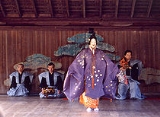
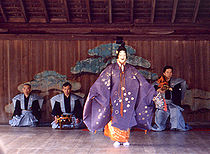 Musical theater also developed in Japan from an early age. Noh
(能) or nō arose out of various more popular traditions and by the 14th century had developed into a highly refined art. It was brought to its peak by Kan'ami (1333–1384) and Zeami (1363?-1443). In particular Zeami provided the core of the Noh repertory and authored many treatises on the secrets of the Noh tradition (until the modern era these were not widely read).
Another form of Japanese theater is the puppet theater, often known as bunraku
(文楽). This traditional puppet theater also has roots in popular traditions and flourished especially during Chonin in the Edo period
(1600–1868). It is usually accompanied by recitation (various styles of jōruri
) (浄瑠璃) accompanied by shamisen
(三味線) music.
During the Edo period actors (after 1652 only male adults) performed the lively and popular kabuki
(歌舞伎) theater. Kabuki, which could feature anything from historical plays to dance plays, was often accompanied by nagauta
(長唄) style of singing and shamisen performance.
(琵琶), a form of short-necked lute
, was played by a group of itinerant performers (biwa hōshi
) (琵琶法師) who used it to accompany stories. The most famous of these stories is The Tale of the Heike
, a 12th century history of the triumph of the Minamoto clan over the Taira. Biwa hōshi began organizing themselves into a guild-like association (tōdō
) for visually impaired men as early as the thirteenth century. This guild eventually controlled a large portion of the musical culture of Japan.
In addition, numerous smaller groups of itinerant blind musicians were formed especially in the Kyushu area. These musicians, known as mōsō
(盲僧 blind monk) toured their local areas and performed a variety of religious and semi-religious texts to purify households and bring about good health and good luck. They also maintained a repertory of secular genres. The biwa that they played was considerably smaller than the Heike biwa (平家琵琶) played by the biwa hōshi.
Lafcadio Hearn
related in his book Kwaidan: Stories and Studies of Strange Things
"Mimi-nashi Hoichi" (Hoichi the Earless), a Japanese ghost story about a blind biwa hōshi who performs "The Tale of the Heike
"
Blind women, known as goze
(瞽女), also toured the land since the medieval era, singing songs and playing accompanying music on a lap drum. From the seventeenth century they often played the koto
or the shamisen
. Goze organizations sprung up throughout the land, and existed until recently in what is today Niigata prefecture.
 The taiko
is a Japanese drum that comes in various sizes and is used to play a variety of musical genres. It has become particularly popular in recent years as the central instrument of percussion ensembles whose repertory is based on a variety of folk and festival music of the past. Such taiko music is played by large drum ensembles called kumi-daiko. Its origins are uncertain, but can be stretched out as far back as the 7th centuries, when a clay figure of a drummer indicates its existence. China
influences followed, but the instrument and its music remained uniquely Japanese. Taiko drums during this period were used during battle to intimidate the enemy and to communicate commands. Taiko continue to be used in the religious music of Buddhism
and Shintō
. In the past players were holy men, who played only at special occasions and in small groups, but in time secular men (rarely women) also played the taiko in semi-religious festivals such as the bon dance.
Modern ensemble taiko is said to have been invented by Daihachi Oguchi
in 1951. A jazz
drummer, Oguchi incorporated his musical background into large ensembles, which he had also designed. His energetic style made his group popular throughout Japan, and made the Hokuriku region
a center for taiko music. Musicians to arise from this wave of popularity included Sukeroku Daiko and his bandmate Seido Kobayashi. 1969 saw a group called Za Ondekoza
founded by Tagayasu Den; Za Ondekoza gathered together young performers who innovated a new roots revival
version of taiko, which was used as a way of life in communal lifestyles. During the 1970s, the Japanese government allocated funds to preserve Japanese culture, and many community taiko groups were formed. Later in the century, taiko groups spread across the world, especially to the United States
. The video game Taiko Drum Master is based around taiko. One example of a modern Taiko band is Gocoo
.
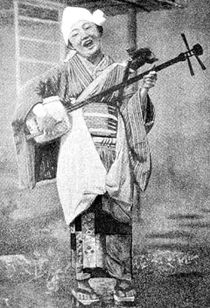
Japanese folk songs (min'yō) can be grouped and classified in many ways but it is often convenient to think of four main categories: work song
s, religious songs (such as sato kagura
, a form of Shintoist music), songs used for gatherings such as weddings, funerals, and festivals (matsuri, especially Obon
), and children's songs (warabe uta
).
In min'yō
, singers are typically accompanied by the three-stringed lute
known as the shamisen
, taiko
drums, and a bamboo flute called shakuhachi
. Other instruments that could accompany are a transverse flute known as the shinobue
, a bell known as kane
, a hand drum called the tsuzumi
, and/or a 13-stringed zither known as the koto
. In Okinawa, the main instrument is the sanshin
. These are traditional Japanese instruments, but modern instrumentation, such as electric guitars
and synthesizer
s, is also used in this day and age, when enka
singers cover traditional min'yō
songs (Enka
being a Japanese music genre all its own).
Terms often heard when speaking about min'yō
are ondo, bushi, bon uta, and komori uta. An ondo generally describes any folk song with a distinctive swing that may be heard as 2/4 time rhythm
(though performers usually do not group beats). The typical folk song heard at Obon
festival dances will most likely be an ondo. A fushi is a song with a distinctive melody. Its very name, which is pronounced "bushi" in compounds, means "melody" or "rhythm." The word is rarely used on its own, but is usually prefixed by a term referring to occupation, location, personal name or the like. Bon uta, as the name describes, are songs for Obon
, the lantern festival of the dead. Komori uta are children's lullabies. The names of min'yo songs often include descriptive term, usually at the end. For example: Tokyo Ondo, Kushimoto Bushi, Hokkai Bon Uta, and Itsuki no Komoriuta.
Many of these songs include extra stress on certain syllables as well as pitched shouts (kakegoe
). Kakegoe are generally shouts of cheer but in min'yō
, they are often included as parts of choruses. There are many kakegoe
, though they vary from region to region. In Okinawa Min'yō, for example, one will hear the common "ha iya sasa!" In mainland Japan, however, one will be more likely to hear "a yoisho!," "sate!," or "a sore!" Others are "a donto koi!," and "dokoisho!"
Recently a guild
-based system known as the iemoto
system has been applied to some forms of min'yō; it is called. This system was originally developed for transmitting classical genres such as nagauta, shakuhachi, or koto music, but since it proved profitable to teachers and was supported by students who wished to obtain certificates of proficiency and artist's names continues to spread to genres such as min'yō, Tsugaru-jamisen
and other forms of music that were traditionally transmitted more informally. Today some min'yō are passed on in such pseudo-family organizations and long apprenticeships are common.
See also Ainu music
of north Japan.
, dance songs, and, especially kachāshī
, lively celebratory music, were all popular.
Okinawan folk music varies from mainland Japanese folk music in several ways.
First, Okinawan folk music is often accompanied by the sanshin
whereas in mainland Japan, the shamisen
accompanies instead. Other Okinawan instruments include the sanba
(which produce a clicking sound similar to that of castanets), taiko
and a sharp finger whistling
called .
Second, tonality. A pentatonic scale
, which coincides with the major pentatonic scale of Western musical disciplines, is often heard in min'yō
from the main islands of Japan, see minyō scale. In this pentatonic scale the subdominant
and leading tone (scale degrees 4 and 7 of the Western major scale
) are omitted, resulting in a musical scale with no half-steps between each note. (Do, Re, Mi, So, La in solfeggio, or scale degrees 1, 2, 3, 5, and 6) Okinawan min'yō, however, is characterized by scales that include the half-steps omitted in the aforementioned pentatonic scale, when analyzed in the Western discipline of music. In fact, the most common scale used in Okinawan min'yō includes scale degrees 1, 2, 3, 4, 5, 6, 7,
introduced Western musical instruction, a bureaucrat named Izawa Shuji compiled songs like "Auld Lang Syne
" and commissioned songs using a pentatonic melody. Western music, especially military marches, soon became popular in Japan. Two major forms of music that developed during this period were shoka, which was composed to bring western music to schools, and gunka
, which are military marches with some Japanese elements..
As Japan moved towards representative democracy
in the late 19th century, leaders hired singers to sell copies of songs that aired their messages, since the leaders themselves were usually prohibited from speaking in public. The street performers were called enka-shi. Also at the end of the 19th century, an Osaka
n form of streetcorner singing became popular; this was called rōkyoku
. This included the first two Japanese stars, Yoshida Naramaru and Tochuken Kumoemon
..
Westernized pop music
is called kayōkyoku
, which is said to have and first appeared in a dramatization of Resurrection
by Tolstoy
. The song "Kachūsha no Uta", composed by Shinpei Nakayama
, was sung by Sumako Matsui
in 1914. The song became a hit among enka-shi, and was one of the first major best-selling records in Japan. . Ryūkōka
, which adopted Western classical music, made waves across the country in the prewar period.. Ichiro Fujiyama
became popular in the prewar period, but war songs later became popular when the World War II
occurred..
Kayōkyoku became a major industry, especially after the arrival of superstar Misora Hibari. In the 1950s, tango
and other kinds of Latin music, especially Cuban music, became very popular in Japan. A distinctively Japanese form of tango called dodompa also developed. Kayōkyoku became associated entirely with traditional Japanese structures, while more Western-style music was called Japanese pop. Enka
music, adopting Japanese traditional structures, became quite popular in the postwar period, though its popularity has waned since the 1970s and enjoys little favour with contemporary youth. Famous enka singers include Hibari Misora
, Saburo Kitajima
, Ikuzo Yoshi
and Kiyoshi Hikawa
.
(famous as well for his avant-garde works and movie scoring) being the best known. Also famous is the conductor
Seiji Ozawa
. Since 1999 the pianist Fujiko Hemming, who plays Liszt
and Chopin
, has been famous and her CDs have sold millions of copies. Japan is also home to the world's leading wind band. , the Tokyo Kosei Wind Orchestra
, and the largest music competition of any kind, the All-Japan Band Association
national contest. Western classical music does not represent Japan's original culture. Japanese were first exposed to it in the second half of the 19th century, after more than 200 hundred years of national isolation during the Edo Period. But after that, Japanese studied classical music earnestly to make it a part of their own artistic culture.
Orchestras
Composers
, when it was repressed as music of the enemy) jazz has had a strong presence in Japan. The country is an important market for the music, and it is common that recordings unavailable in the United States
or Europe are available there. A number of Japanese jazz musicians have achieved popularity abroad as well as at home. Musicians such as June (born in Japan) and Dan (third generation American born, of Hiroshima
fame), and Sadao Watanabe have a large fan base outside their native country.
Lately, club jazz or nu-jazz has become popular with a growing number of young Japanese. Native DJs such as Ryota Nozaki (Jazztronik
), the two brothers Okino Shuya and Okino Yoshihiro of Kyoto Jazz Massive
, Toshio Matsuura (former member of the United Future Organization) and DJ Shundai Matsuo creator of the popular monthly DJ event, Creole in Beppu, Japan
as well as nu-jazz artists, Sleepwalker, GrooveLine, and Soil & "Pimp" Sessions have brought great change to the traditional notions of jazz in Japan.
Today, some of the newer and very interesting bands include Ego-Wrappin'
and Sakerock.
ese pop, is a loosely-defined musical genre that entered the musical mainstream of Japan in the 1990s. Modern J-pop has its roots in 1960s music such as The Beatles
, and replaced kayōkyoku
("Lyric Singing Music", a term for Japanese pop music from the 1920s to the 1980s) in the Japanese music scene. The term was coined by the Japanese media to distinguish Japanese music from foreign music, and now refers to most Japanese popular music.
, Bob Dylan
and the Rolling Stones, along with other Appalachian folk music, psychedelic rock
, mod and similar genres; this was called Group Sounds
(G.S.). John Lennon
of The Beatles later became one of most popular Western musicians in Japan. Group Sounds
is a genre of Japanese rock music that was popular in the mid to late 1960s. After the boom of Group Sounds, there were several influential singer-songwriters. Nobuyasu Okabayashi
was the first who became widely recognized. Wataru Takada, inspired by Woody Guthrie
, also became popular.. They both were influenced by American folk music
but wrote Japanese lyrics. Takada used modern Japanese poetry
as lyrics, while Kazuki Tomokawa
made an album using Chuya Nakahara's poems. Tomobe Masato, inspired by Bob Dylan
, wrote critically acclaimed lyrics. The Tigers was the most popular Group Sounds band in the era. Later, some of the members of The Tigers, The Tempters
and The Spiders formed the first Japanese supergroup
Pyg
.
Homegrown Japanese folk rock had developed by the late 1960s. Artists like Happy End are considered to have virtually developed the genre. During the 1970s, it grew more popular. The Okinawan band Champloose
, along with Carol (led by Eikichi Yazawa
), RC Succession
and Shinji Harada
were especially famous and helped define the genre's sound. Sometimes also beginning in the late sixties, but mostly active in the seventies, are musicians mixing rock music with American-style folk and pop elements, usually labelled "folk" by the Japanese because of their regular use of the acoustic guitar. This includes bands like Off Course
, Tulip, Alice (led by Shinji Tanimura
), Kaguyahime
, Banban, and Garo
. Solo artists of the same movement include Yosui Inoue
, Yuming, and Iruka
. Later groups, like Kai Band (led by Yoshihiro Kai) and early Southern All Stars
, are often attached to the same movement.
Several Japanese musicians began experimenting with electronic rock in the early 1970s. The most notable was the internationally renowned Isao Tomita
, whose 1972 album Electric Samurai: Switched on Rock featured electronic synthesizer
renditions of contemporary rock and pop songs
. Other early examples of electronic rock records include Inoue Yousui's folk rock
and pop rock
album Ice World (1973) and Osamu Kitajima's progressive
psychadelic rock album Benzaiten
(1974), both of which involved contributions from Haruomi Hosono, who later started the electronic music group "Yellow Magic Band" (later known as Yellow Magic Orchestra) in 1977. Most influentially, the 1970s spawned the electronic music
band Yellow Magic Orchestra
, led by Haruomi Hosono
.
In the 1980s, Boøwy
inspired alternative rock
bands like Shonen Knife
, Boredoms, The Pillows
and Tama & Little Creatures as well as more mainstream bands as Glay
. In 1980, Huruoma and Ry Cooder
, an American musician, collaborated on a rock album with Shoukichi Kina
, driving force behind the aforementioned Okinawan band Champloose. They were followed by Sandii & the Sunsetz
, who further mixed Japanese and Okinawan influences. Also during the 80s, Japanese metal and rock bands gave birth to the movement known as visual kei
, represented during its history by bands like X Japan
, Buck-Tick
, Luna Sea
, Malice Mizer
and many others, some of which experienced national, and international success in the latest years.
In the 1990s, Japanese rock musicians such as B'z
, Mr. Children
, Glay
, Southern All Stars
, L'Arc-en-Ciel, Tube
, Spitz
, Wands
, T-Bolan
, Judy and Mary
, Asian Kung–Fu Generation, Field of View
, Deen, Ulfuls
, Lindberg
, Sharam Q, The Yellow Monkey
, The Brilliant Green
and Dragon Ash
achieved great commercial success. B'z is the #1 best selling act in Japanese music since Oricon
started to count., followed by Mr. Children. In the '90s, pop songs were often used in film
s, anime
, television advertisement
and dramatic programming
, becoming some of the best-selling forms of music in Japan. The rise of disposable pop has been linked with the popularity of karaoke
, leading to criticism that it is consumerist
: Kazufumi Miyazawa of The Boom
said "I hate that buy, listen, and throw away and sing at a karaoke bar mentality." Of the visual kei bands Luna Sea
, whose members toned down their on-stage attire with on-going success, was either very successful, while Malice Mizer
, La'cryma Christi
, Shazna
, Janne Da Arc
, and Fanatic Crisis
also achieved commercial success in the late '90s.
The first Fuji Rock Festival
opened in 1997. Rising Sun Rock Festival
opened in 1999. Summer Sonic Festival
and Rock in Japan Festival
opened in 2000. Though the rock scene in the 2000s is not as strong, newer bands such as Bump of Chicken
, Sambomaster
, Flow
, Orange Range
, Remioromen
, Uverworld
, Radwimps
and Aqua Timez
, which are considered rock bands, have achieved success. Orange Range also adopts hip hop. Established bands as B'z, Mr. Children, Glay, and L'Arc-en-Ciel also continue to top charts, though B'z and Mr. Children are the only bands to maintain a high standards of their sales along the years.
Japanese rock has a vibrant underground rock scene, best known internationally for noise rock
bands such as Boredoms and Melt Banana, as well as stoner rock
bands such as Boris
and alternative acts such as Shonen Knife
(who were championed in the West by Kurt Cobain
), Pizzicato Five
and The Pillows
(who gained international attention in 1999 for the FLCL
soundtrack). More conventional indie rock
artists such as Eastern Youth
, The Band Apart and Number Girl
have found some success in Japan , but little recognition outside of their home country. Other notable international touring indie rock acts are Mono and Nisennenmondai
.
, The Stalin
, INU, Gaseneta, Bomb Factory
, Lizard (who were produced by the Stranglers
) and Friction
(whose guitarist Reck had previously played with Teenage Jesus and the Jerks before returning to Tokyo) and The Blue Hearts
. The early punk scene was immortalised on film by Sogo Ishii
, who directed the 1982 film Burst City featuring a cast of punk bands/musicians and also filmed videos for The Stalin. In the 80s, hardcore bands such as GISM
, Gauze
, Confuse, Lip Cream and Systematic Death began appearing, some incorporating crossover
elements. The independent scene also included a diverse number of alternative/post-punk/new wave artists such as Aburadako
, P-Model
, Uchoten
, Auto-Mod, Buck-Tick
, Guernica
and Yapoos (both of which featured Jun Togawa), G-Schmitt, Totsuzen Danball and Jagatara
, along with noise/industrial bands such as Hijokaidan
and Hanatarashi.
Ska-punk bands of the late nineties extending in the years 2000 include Shakalabbits and 175R
.
's Unleashed in the East
, Iron Maiden
's Maiden Japan
, Deep Purple
's Made in Japan
and Dream Theater
's Live at Budokan
. From the international bands, such as Angra
, Sonata Arctica
and Skylark
have had major success in Japan.
First Japanese heavy metal bands started emerging in the late 1970s, pioneered by bands like Bow Wow, formed in 1975 by guitarist Kyoji Yamamoto
, and Loudness
, formed in 1981 by guitarist Akira Takasaki
. Although there existed other contemporary bands, like Earthshaker
, Anthem
and 44 Magnum
, their debut albums were released only around the mid eighties when metal bands started getting an major exposure. First oversease live performances were by Bow Wow in 1978 in Hong Kong
and at the Montreux Jazz Festival
in Switzerland
, as well played at the Reading Festival
in England
in 1982. In 1983 Loudness toured United States and Europe, and started focusing more on an international career. In 1985 was a first Japanese metal act signed to a major label in the United States. Their albums Thunder in the East and Lightning Strikes
released in 1985 and 1986 peaked at number 74 (while number 4 in homeland Oricon
chart), and number 64 in the Billboard 200
charts respectively. Till the end of the eightes only two other bands, Ezo
and Dead End
, got their albums released in the United States. In the eighties few bands had a female members, like all-female band Show Ya
fronted by Keiko Terada
, and Terra Rosa
with Kazue Akao on vocals. In September 1989, Show Yas album Outerlimits
was released, it reached number 3 in the Oricon album chart. Heavy metal bands reached their peak in the late '80s and many disbanded until the mid 1990s.
In 1982 were formed some of the first Japanese glam metal
bands, like Seikima-II
with Kabuki
-inspired makeup, and X Japan
who pioneered the Japanese movement known as visual kei
, and became the best-selling metal band. In 1985, Seikima-IIs album Seikima-II - Akuma ga Kitarite Heavy Metal was released and although reached number 48 on the Oricon album chart exceeded 100,000 in sales, first time for any Japanese metal band. Their albums charted regularly in the top ten until mid '90s. In April 1989, X Japans second album Blue Blood was released and went to number 6, and after 108 weeks on charts sold 712,000 copies. In July 1991 was released their third and best-selling album Jelaousy, it topped the charts and sold 1.11 million copies. There were released more two number one studio albums, Art of Life
and Dahlia
, a singles compilation X Singles
, all selling more than half a million, and since the formation had thirteenth top five singles, disbanding in 1996.
heavy metal bands formed in the wake of American and European wave, but didn’t get any bigger exposure until the ‘90s, and like overseas the genre is usually treated as an underground form of music in Japan. First thrash metal
bands formed in the early '80s, like United
, whose music also incorporates death metal
elements, and Outrage
. United's first international performance took place in Los Angeles at the metal festival “Foundations Forum” in September 1995 and had few albums released in North America. Formed in the mid ‘80s, Doom
played a gig in the United States in October 1988 at CBGB, and was active until 2000 when disbanded.
The first bands to play black metal
music were Sabbat
, who is still active, and Bellzlleb
, who was active until early ‘90s. Another notable act is Sigh
.
Doom metal
has also gained an audience in Japan. The two best-known Japanese doom metal acts are Church of Misery
and Boris
, both of whom have gained considerable popularity outside the country.
and solo albums of Ryuichi Sakamoto
and Haruomi Hosono
in 1978 before hitting popularity in 79/80. Influenced by disco, impressionistic and 20th century classical composition, jazz/fusion pop, new wave and technopop artists such as Kraftwerk
and Telex
, these artists were commercial yet uncompromising. Ryuichi Sakamoto claims that "to me, making pop music is not a compromise because I enjoy doing it". The artists that fall under the banner of technopop in Japan are as loose as those that do so in the West, thus new wave bands such as P-Model
and The Plastics fall under the category alongside the symphonic techno arrangements of Yellow Magic Orchestra
. The popularity of this music meant that many popular artists of the 70s that previously were known for acoustic music turned to techno production,. such as Taeko Onuki and Akiko Yano
, and idol producers began employing electronic arrangements for new singers in the 80s. Today, newer artists such as Polysics
pay explicit homage to this era of Japanese popular (and in some cases underground or difficult to obtain) music..
's album Thriller
became the first album by a Western artist to sell over one million copies in Japanese Oricon
charts history. His style is cited as one of the models for Japanese dance music
, leading the popularity of Avex Group and Johnny & Associates
.
In 1990, Avex Trax
began to release the Super Eurobeat
series in Japan. Eurobeat
in Japan led the popularity of group dance
form Para Para
. While Avex's artists such as Every Little Thing and Ayumi Hamasaki
became popular in 1990s, new names in the late 90s included Hikaru Utada and Morning Musume
. Hikaru Utada's debut album, First Love, went on to be the highest-selling album in Japan with over 7 million copies sold, whereas Ayumi Hamasaki
became Japan's top selling female and solo artist, and Morning Musume remains one of the most well-known girl groups in the Japanese pop music industry.
notes, "viewing a music scene in terms of a pyramid provides a more nuanced understanding of how to interpret the significance of different levels and kinds of success." The levels are as follows (from lowest to highest): fans and potential artists, performing artists, recording artists (indies), major label artists, and mega-hit stars. These different levels can be clearly seen at a genba, or nightclub. Different "families" of rappers perform on stage. A family is essentially a collection of rap groups that are usually headed by one of the more famous Tokyo acts, which also include a number of proteges. They are important because they are "the key to understanding stylistic differences between groups." Hip-hop fans in the audience are the ones in control of the night club. They are the judges who determine the winners in rap battles on stage. An example of this can be seen with the battle between rap artists Dabo
(a major label artist) and Kan
(an indie artist). Kan challenged Dabo to a battle on stage while Dabo was mid-performance. Another important part of night clubs was displayed at this time. It showed "the openness of the scene and the fluidity of boundaries in clubs."
like Shang Shang Typhoon
and The Boom
became popular. Okinawan roots bands like Nenes
and Kina were also commercially and critically successful. This led to the second wave of Okinawan music, led by the sudden success of Rinkenband. A new wave of bands followed, including the comebacks of Champluse and Kina, as led by Kikusuimaru Kawachiya; very similar to kawachi ondo
is Tadamaru Sakuragawa's goshu ondo
.
, Jamaica
and elsewhere were assimilated. African soukous
and Latin music, like Orquesta de la Luz (オルケスタ・デ・ラ・ルス)
, was popular as was Jamaican reggae
and ska
, exemplified by Mice Teeth, Mute Beat
, La-ppisch, Home Grown and Ska Flames, Determinations, and Tokyo Ska Paradise Orchestra
.
is noise music
. The noise from this country is called Japanoise
. Its most prominent representative is Masami Akita with his project Merzbow
.
composed for films, anime
, Tokusatsu
, and Japanese television drama
s are considered a separate music genre. Several prominent musical artists and groups have spent most of their musical careers performing theme songs and composing soundtrack
s for visual media. Such artists include Masato Shimon
(current holder of the world record for most successful single in Japan for "Oyoge! Taiyaki-kun
"), Ichirou Mizuki
, all of the members of JAM Project
, Akira Kushida
, Isao Sasaki
, and Mitsuko Horie
. Notable composers of Japanese theme music include Joe Hisaishi
, Michiru Oshima
, Yoko Kanno
, Toshihiko Sahashi
, Yuki Kajiura
, Kōtarō Nakagawa
and Hayashi Yuuki.
, also noteworthy for its deeply (at that time) constructed stories. Though many games have had beautiful music to accompany their gameplay, one of the most important games in the history of the video game music is Dragon Quest
. Koichi Sugiyama
, a composer who was known for his music for various anime and TV shows, including Cyborg 009
and a feature film of Godzilla vs. Biollante
, got involved in the project out of the pure curiosity and proved that games can have serious soundtracks. Until his involvement, music and sounds were often neglected in the development of video games and programmers with little musical knowledge were forced to write the soundtracks as well. Undaunted by technological limits, Sugiyama worked with only 8 part polyphony to create a soundtrack that would not tire the player despite hours and hours of gameplay.
Another well-known author of video game music is Nobuo Uematsu
. Even Uematsu's earlier compositions for the game series, Final Fantasy
, on Famicom
(Nintendo Entertainment System in America) are being arranged for full orchestral score. In 2003, he even took his rock-based tunes from their original MIDI format and created The Black Mages
.
Yasunori Mitsuda
is a highly known composer of such games as Xenogears
, Xenosaga Episode I, Chrono Cross
, and Chrono Trigger
.
Koji Kondo
, the main composer for Nintendo
, is also prominent on the Japanese game music scene. He is best known for the Zelda
and Mario
themes.
Motoi Sakuraba
is also another well-known video game composer. He is known for composing the Tales Series, Star Ocean
, Valkyrie Profile
, Golden Sun
, and the Baten Kaitos games, as well as numerous Mario Sports games.
The techno
/trance
music production group I've Sound
has made a name for themselves first by making themes for eroge
computer games, and then by breaking into the anime
scene by composing themes for them. Unlike others, this group was able to find fans in other parts of the world through their eroge and anime themes.
Today, game soundtracks are sold on CD. Famous singers like Hikaru Utada, Ayumi Hamasaki
and Gackt
sometimes sing songs for games as well, and this is also seen as a way for singers to make a names for themselves.
Japanese language
is a language spoken by over 130 million people in Japan and in Japanese emigrant communities. It is a member of the Japonic language family, which has a number of proposed relationships with other languages, none of which has gained wide acceptance among historical linguists .Japanese is an...
is 音楽 (ongaku), combining the kanji 音 ("on" sound) with the kanji 楽 ("gaku" fun, comfort). Japan
Japan
Japan is an island nation in East Asia. Located in the Pacific Ocean, it lies to the east of the Sea of Japan, China, North Korea, South Korea and Russia, stretching from the Sea of Okhotsk in the north to the East China Sea and Taiwan in the south...
is the second largest music market in the world, behind the United States
Music of the United States
The music of the United States reflects the country's multi-ethnic population through a diverse array of styles. Among the country's most internationally-renowned genres are hip hop, blues, country, rhythm and blues, jazz, barbershop, pop, techno, and rock and roll. The United States has the...
, and most of the market is dominated by Japanese artists.
Local music often appears at karaoke
Karaoke
is a form of interactive entertainment or video game in which amateur singers sing along with recorded music using a microphone and public address system. The music is typically a well-known pop song minus the lead vocal. Lyrics are usually displayed on a video screen, along with a moving symbol,...
venues, which is on lease from the record labels. Traditional Japanese music has no specific beat, and is calm. In 1873, a British traveler claimed that Japanese music, "exasperate[s] beyond all endurance the European breast."
Traditional and folk music
The oldest forms of traditional Japanese music are shōmyōShomyo
Shōmyō is a style of Japanese Buddhist chant, used mainly in the Tendai and Shingon sects. There are two styles: ryokyoku and rikkyoku, described as difficult and easy to remember, respectively....
(声明 or you could use 聲明), Buddhist chanting, and gagaku
Gagaku
Gagaku is a type of Japanese classical music that has been performed at the Imperial Court in Kyoto for several centuries. It consists of three primary repertoires:#Native Shinto religious music and folk songs and dance, called kuniburi no utamai...
(雅楽), orchestral court music, both of which date to the Nara
Nara period
The of the history of Japan covers the years from AD 710 to 794. Empress Gemmei established the capital of Heijō-kyō . Except for 5 years , when the capital was briefly moved again, it remained the capital of Japanese civilization until Emperor Kammu established a new capital, Nagaoka-kyō, in 784...
and Heian periods
Heian period
The is the last division of classical Japanese history, running from 794 to 1185. The period is named after the capital city of Heian-kyō, or modern Kyōto. It is the period in Japanese history when Buddhism, Taoism and other Chinese influences were at their height...
.
Gagaku
Gagaku
Gagaku is a type of Japanese classical music that has been performed at the Imperial Court in Kyoto for several centuries. It consists of three primary repertoires:#Native Shinto religious music and folk songs and dance, called kuniburi no utamai...
is a type of classical music that has been performed at the Imperial court since the Heian period. Kagurauta (神楽歌), Azumaasobi(東遊) and Yamatouta (大和歌) are relatively indigenous repertories. Tōgaku
Togaku
Tōgaku is the Japanese pronunciation of an early style of music and dance from the Tang Dynasty in China...
(唐楽) and komagaku
Komagaku
Komagaku is a form of Gagaku, or court music, that appeared in Japan around the beginning of the Nara period . It originated in Korea and is often played as a dance accompaniment....
originated from the Chinese Tang dynasty
Tang Dynasty
The Tang Dynasty was an imperial dynasty of China preceded by the Sui Dynasty and followed by the Five Dynasties and Ten Kingdoms Period. It was founded by the Li family, who seized power during the decline and collapse of the Sui Empire...
via the Korean peninsula
Korean Peninsula
The Korean Peninsula is a peninsula in East Asia. It extends southwards for about 684 miles from continental Asia into the Pacific Ocean and is surrounded by the Sea of Japan to the south, and the Yellow Sea to the west, the Korea Strait connecting the first two bodies of water.Until the end of...
. In addition, gagaku is divided into kangen (管弦) (instrumental music) and bugaku
Bugaku
Bugaku dance is the traditional Japanese dance that has been performed to select elites mostly in Japanese imperial courts for over twelve hundred years. In this way it has been an upper class secret, although after World War II the dance was opened to the public and has even toured around the...
(舞楽) (dance accompanied by gagaku).
Originating as early as the 13th century are honkyoku
Honkyoku
Honkyoku are the pieces of shakuhachi or hocchiku music played by mendicant Japanese Zen monks called komusō. Komusō played honkyoku for enlightenment and alms as early as the 13th century. Honkyoku is the practice of suizen...
(本曲 "original pieces"). These are single (solo) shakuhachi
Shakuhachi
The is a Japanese end-blown flute. It is traditionally made of bamboo, but versions now exist in ABS and hardwoods. It was used by the monks of the Fuke school of Zen Buddhism in the practice of...
(尺八) pieces played by mendicant
Mendicant
The term mendicant refers to begging or relying on charitable donations, and is most widely used for religious followers or ascetics who rely exclusively on charity to survive....
Fuke sect priest
Priest
A priest is a person authorized to perform the sacred rites of a religion, especially as a mediatory agent between humans and deities. They also have the authority or power to administer religious rites; in particular, rites of sacrifice to, and propitiation of, a deity or deities...
s of Zen buddhism. These priests, called komusō
Komuso
A was a Japanese mendicant monk of the Fuke school of Zen Buddhism, during the Edo period of 1600-1868. Komusō were characterised by the straw basket worn on the head, manifesting the absence of specific ego. They are also known for playing solo pieces on the shakuhachi...
("emptiness monk"), played honkyoku for alms
Alms
Alms or almsgiving is a religious rite which, in general, involves giving materially to another as an act of religious virtue.It exists in a number of religions. In Philippine Regions, alms are given as charity to benefit the poor. In Buddhism, alms are given by lay people to monks and nuns to...
and enlightenment
Satori
is a Japanese Buddhist term for enlightenment that literally means "understanding". In the Zen Buddhist tradition, satori refers to a flash of sudden awareness, or individual enlightenment, and is considered a "first step" or embarkation toward nirvana....
. The Fuke sect ceased to exist in the 19th century, but a verbal and written lineage of many honkyoku continues yesterday, though this music is now often practiced in a concert or performance setting.
The samurai
Samurai
is the term for the military nobility of pre-industrial Japan. According to translator William Scott Wilson: "In Chinese, the character 侍 was originally a verb meaning to wait upon or accompany a person in the upper ranks of society, and this is also true of the original term in Japanese, saburau...
often listened to and performed in these music activities, in their practices of enriching their lives and understanding.
Noh
, or - derived from the Sino-Japanese word for "skill" or "talent" - is a major form of classical Japanese musical drama that has been performed since the 14th century. Many characters are masked, with men playing male and female roles. Traditionally, a Noh "performance day" lasts all day and...
(能) or nō arose out of various more popular traditions and by the 14th century had developed into a highly refined art. It was brought to its peak by Kan'ami (1333–1384) and Zeami (1363?-1443). In particular Zeami provided the core of the Noh repertory and authored many treatises on the secrets of the Noh tradition (until the modern era these were not widely read).
Another form of Japanese theater is the puppet theater, often known as bunraku
Bunraku
, also known as Ningyō jōruri , is a form of traditional Japanese puppet theater, founded in Osaka in 1684.Three kinds of performers take part in a bunraku performance:* Ningyōtsukai or Ningyōzukai—puppeteers* Tayū—the chanters* Shamisen players...
(文楽). This traditional puppet theater also has roots in popular traditions and flourished especially during Chonin in the Edo period
Edo period
The , or , is a division of Japanese history which was ruled by the shoguns of the Tokugawa family, running from 1603 to 1868. The political entity of this period was the Tokugawa shogunate....
(1600–1868). It is usually accompanied by recitation (various styles of jōruri
Jōruri (music)
is a form of traditional Japanese narrative music in which a sings to the accompaniment of a shamisen. As a form of storytelling, the emphasis is on the lyrics and narration rather than the music itself....
) (浄瑠璃) accompanied by shamisen
Shamisen
The , also called is a three-stringed, Japanese musical instrument played with a plectrum called a bachi. The Japanese pronunciation is usually "shamisen" but sometimes "jamisen" when used as a suffix . -Construction:The shamisen is a plucked stringed instrument...
(三味線) music.
During the Edo period actors (after 1652 only male adults) performed the lively and popular kabuki
Kabuki
is classical Japanese dance-drama. Kabuki theatre is known for the stylization of its drama and for the elaborate make-up worn by some of its performers.The individual kanji characters, from left to right, mean sing , dance , and skill...
(歌舞伎) theater. Kabuki, which could feature anything from historical plays to dance plays, was often accompanied by nagauta
Nagauta
, literally "long song", is a kind of traditional Japanese music which accompanies the kabuki theater. They were developed around 1740. Influences included the vocal yōkyoku style used in noh theater, and instruments including the shamisen and various kinds of drums.The shamisen, a plucked lute...
(長唄) style of singing and shamisen performance.
Biwa hōshi, Heike biwa, mōsō, and goze
The biwaBiwa
The is a Japanese short-necked fretted lute, often used in narrative storytelling. The biwa is the chosen instrument of Benten, goddess of music, eloquence, poetry, and education in Japanese Shinto....
(琵琶), a form of short-necked lute
Lute
Lute can refer generally to any plucked string instrument with a neck and a deep round back, or more specifically to an instrument from the family of European lutes....
, was played by a group of itinerant performers (biwa hōshi
Biwa hoshi
Biwa hōshi , also known as "lute priests" were travelling performers in the era of Japanese history preceding the Meiji period. They earned their income by reciting vocal literature to the accompaniment of biwa music. Often blind, they adopted the shaved heads and robes common to Buddhist monks...
) (琵琶法師) who used it to accompany stories. The most famous of these stories is The Tale of the Heike
The Tale of the Heike
is an epic account of the struggle between the Taira and Minamoto clans for control of Japan at the end of the 12th century in the Genpei War...
, a 12th century history of the triumph of the Minamoto clan over the Taira. Biwa hōshi began organizing themselves into a guild-like association (tōdō
Todo
Todo may refer to:* Todo , a Mexican humor magazine.* Todo Bichig, Kalmyk ‘Clear Script’* Time management, or to-do list* TODO, a computer programming comment tagTōdō may refer to:...
) for visually impaired men as early as the thirteenth century. This guild eventually controlled a large portion of the musical culture of Japan.
In addition, numerous smaller groups of itinerant blind musicians were formed especially in the Kyushu area. These musicians, known as mōsō
Moso
Moso can refer to:* MoSo, an abbreviiation for Missouri Southern State University* Moso , a species of bamboo* Moso, Eritrea* Moso , an island in Vanuatu* Mosuo, an ethnic minority in the People's Republic of China...
(盲僧 blind monk) toured their local areas and performed a variety of religious and semi-religious texts to purify households and bring about good health and good luck. They also maintained a repertory of secular genres. The biwa that they played was considerably smaller than the Heike biwa (平家琵琶) played by the biwa hōshi.
Lafcadio Hearn
Lafcadio Hearn
Patrick Lafcadio Hearn , known also by the Japanese name , was an international writer, known best for his books about Japan, especially his collections of Japanese legends and ghost stories, such as Kwaidan: Stories and Studies of Strange Things...
related in his book Kwaidan: Stories and Studies of Strange Things
Kwaidan: Stories and Studies of Strange Things
, often shortened to Kwaidan, is a book by Lafcadio Hearn that features several Japanese ghost stories and a brief non-fiction study on insects...
"Mimi-nashi Hoichi" (Hoichi the Earless), a Japanese ghost story about a blind biwa hōshi who performs "The Tale of the Heike
The Tale of the Heike
is an epic account of the struggle between the Taira and Minamoto clans for control of Japan at the end of the 12th century in the Genpei War...
"
Blind women, known as goze
Goze
is a Japanese historic term referring to visually impaired Japanese women, of whom most worked as musicians.- Etymology :The ideographs for mean "blind" and "woman." The ideographs are, however, read in this manner because the word already existed. In fact, it probably derived from the term ,...
(瞽女), also toured the land since the medieval era, singing songs and playing accompanying music on a lap drum. From the seventeenth century they often played the koto
Koto (musical instrument)
The koto is a traditional Japanese stringed musical instrument, similar to the Chinese guzheng, the Mongolian yatga, the Korean gayageum and the Vietnamese đàn tranh. The koto is the national instrument of Japan. Koto are about length, and made from kiri wood...
or the shamisen
Shamisen
The , also called is a three-stringed, Japanese musical instrument played with a plectrum called a bachi. The Japanese pronunciation is usually "shamisen" but sometimes "jamisen" when used as a suffix . -Construction:The shamisen is a plucked stringed instrument...
. Goze organizations sprung up throughout the land, and existed until recently in what is today Niigata prefecture.
Taiko
Taiko
means "drum" in Japanese . Outside Japan, the word is often used to refer to any of the various Japanese drums and to the relatively recent art-form of ensemble taiko drumming...
is a Japanese drum that comes in various sizes and is used to play a variety of musical genres. It has become particularly popular in recent years as the central instrument of percussion ensembles whose repertory is based on a variety of folk and festival music of the past. Such taiko music is played by large drum ensembles called kumi-daiko. Its origins are uncertain, but can be stretched out as far back as the 7th centuries, when a clay figure of a drummer indicates its existence. China
China
Chinese civilization may refer to:* China for more general discussion of the country.* Chinese culture* Greater China, the transnational community of ethnic Chinese.* History of China* Sinosphere, the area historically affected by Chinese culture...
influences followed, but the instrument and its music remained uniquely Japanese. Taiko drums during this period were used during battle to intimidate the enemy and to communicate commands. Taiko continue to be used in the religious music of Buddhism
Buddhism
Buddhism is a religion and philosophy encompassing a variety of traditions, beliefs and practices, largely based on teachings attributed to Siddhartha Gautama, commonly known as the Buddha . The Buddha lived and taught in the northeastern Indian subcontinent some time between the 6th and 4th...
and Shintō
Shinto
or Shintoism, also kami-no-michi, is the indigenous spirituality of Japan and the Japanese people. It is a set of practices, to be carried out diligently, to establish a connection between present day Japan and its ancient past. Shinto practices were first recorded and codified in the written...
. In the past players were holy men, who played only at special occasions and in small groups, but in time secular men (rarely women) also played the taiko in semi-religious festivals such as the bon dance.
Modern ensemble taiko is said to have been invented by Daihachi Oguchi
Daihachi Oguchi
was a Japanese drummer best known for popularizing taiko.Master Japanese drummer Daihachi Oguchi is credited with inventing kumi-daiko, the taiko ensemble, in 1951...
in 1951. A jazz
Jazz
Jazz is a musical style that originated at the beginning of the 20th century in African American communities in the Southern United States. It was born out of a mix of African and European music traditions. From its early development until the present, jazz has incorporated music from 19th and 20th...
drummer, Oguchi incorporated his musical background into large ensembles, which he had also designed. His energetic style made his group popular throughout Japan, and made the Hokuriku region
Hokuriku region
The is located in the northwestern part of Honshū, the main island of Japan. It lies along the Sea of Japan within the Chūbu region. It is almost equivalent to Koshi Province and Hokurikudō area in pre-modern Japan....
a center for taiko music. Musicians to arise from this wave of popularity included Sukeroku Daiko and his bandmate Seido Kobayashi. 1969 saw a group called Za Ondekoza
Ondekoza
, sometimes referred to as "Za Ondekoza", is a Japanese troupe specializing in taiko drumming.Founded in 1969 by Den Tagayasu, in Sado island, Japan. Ondekoza was influential in the rise of the kumi-daiko style of taiko...
founded by Tagayasu Den; Za Ondekoza gathered together young performers who innovated a new roots revival
Roots revival
A roots revival is a trend which includes young performers popularizing the traditional musical styles of their ancestors. Often, roots revivals include an addition of newly-composed songs with socially and politically aware lyrics, as well as a general modernization of the folk sound.After an...
version of taiko, which was used as a way of life in communal lifestyles. During the 1970s, the Japanese government allocated funds to preserve Japanese culture, and many community taiko groups were formed. Later in the century, taiko groups spread across the world, especially to the United States
United States
The United States of America is a federal constitutional republic comprising fifty states and a federal district...
. The video game Taiko Drum Master is based around taiko. One example of a modern Taiko band is Gocoo
GOCOO
Gocoo, or GOCOO are seven female and four male Taiko drummers from Tokyo . Gocoo performed at major Blues & Roots, Rock & Pop and alternative Rock festivals, in live clubs, classic theatres and concert halls or at techno events. Lead drummer, Kaoly Asano , attracts much attention as a female Taiko...
.
Min'yō folk music
Japanese folk songs (min'yō) can be grouped and classified in many ways but it is often convenient to think of four main categories: work song
Work song
A work song is a piece of music closely connected to a specific form of work, either sung while conducting a task or a song linked to a task or trade which might be a connected narrative, description, or protest song....
s, religious songs (such as sato kagura
Sato kagura
Sato kagura, or village kagura, is a popular form of kagura that presents ritualized dance-dramas reenacting mythological themes, including the primal restoration of sunlight to the world...
, a form of Shintoist music), songs used for gatherings such as weddings, funerals, and festivals (matsuri, especially Obon
Obón
Obón is a municipality located in the province of Teruel, Aragon, Spain. According to the 2004 census , the municipality has a population of 75 inhabitants....
), and children's songs (warabe uta
Warabe uta
are traditional Japanese songs, similar to nursery rhymes. They are often sung as part of traditional children's games. They are described as a form of min'yo: traditional Japanese songs, usually sung without accompanying instruments....
).
In min'yō
Min'yo
is a genre of traditional Japanese music. The term is a translation of the German word "Volkslied" and has only been in use during the twentieth century...
, singers are typically accompanied by the three-stringed lute
Lute
Lute can refer generally to any plucked string instrument with a neck and a deep round back, or more specifically to an instrument from the family of European lutes....
known as the shamisen
Shamisen
The , also called is a three-stringed, Japanese musical instrument played with a plectrum called a bachi. The Japanese pronunciation is usually "shamisen" but sometimes "jamisen" when used as a suffix . -Construction:The shamisen is a plucked stringed instrument...
, taiko
Taiko
means "drum" in Japanese . Outside Japan, the word is often used to refer to any of the various Japanese drums and to the relatively recent art-form of ensemble taiko drumming...
drums, and a bamboo flute called shakuhachi
Shakuhachi
The is a Japanese end-blown flute. It is traditionally made of bamboo, but versions now exist in ABS and hardwoods. It was used by the monks of the Fuke school of Zen Buddhism in the practice of...
. Other instruments that could accompany are a transverse flute known as the shinobue
Shinobue
The shinobue is a Japanese transverse flute or fue that has a high-pitched sound. It is found in hayashi and nagauta ensembles, and plays important roles in noh and kabuki theatre music. It is heard in Shinto music such as kagura-den and in traditional Japanese folk songs...
, a bell known as kane
Kane (musical instrument)
The is a type of bell from Japan.Often accompanying Japanese folk music, or Min'yō, is a dish-shaped bell called a . It is often hung on a bar, and the player holds the bell in place with one hand, and beats the Kane with a specialized mallet with the other...
, a hand drum called the tsuzumi
Tsuzumi
The is a Japanese drum of Chinese/Indian origin. It consists of a wooden body shaped like an hourglass, and it is taut, with two drum heads with cords that can be squeezed or released to increase or decrease the tension of the heads respectively...
, and/or a 13-stringed zither known as the koto
Koto (musical instrument)
The koto is a traditional Japanese stringed musical instrument, similar to the Chinese guzheng, the Mongolian yatga, the Korean gayageum and the Vietnamese đàn tranh. The koto is the national instrument of Japan. Koto are about length, and made from kiri wood...
. In Okinawa, the main instrument is the sanshin
Sanshin
The sanshin is an Okinawan musical instrument and precursor of the Japanese shamisen. Often likened to a banjo, it consists of a snakeskin-covered body, neck and three strings....
. These are traditional Japanese instruments, but modern instrumentation, such as electric guitars
Electric Guitars
Electric Guitars were formed early in 1980 by Neil Davenport and Richard Hall who were both studying English at Bristol University. The band soon increased to a five-man line-up, with Andy Saunders , Matt Salt and Dick Truscott , they also later added two backing singers: Sara and Wendy...
and synthesizer
Synthesizer
A synthesizer is an electronic instrument capable of producing sounds by generating electrical signals of different frequencies. These electrical signals are played through a loudspeaker or set of headphones...
s, is also used in this day and age, when enka
Enka
is a popular Japanese music genre considered to resemble traditional Japanese music stylistically. Modern enka, however, is a relatively recent musical form which arose in the context of such postwar expressions of modern Japanese nonmaterial nationalism as nihonjinron, while adopting a more...
singers cover traditional min'yō
Minyo
Minyo is Korean and Japanese for folk song.* Min'yō , a style of Japanese accompanied folk singing* Minyo , a style of Korean accompanied folk singing. See: Music of Korea...
songs (Enka
Enka
is a popular Japanese music genre considered to resemble traditional Japanese music stylistically. Modern enka, however, is a relatively recent musical form which arose in the context of such postwar expressions of modern Japanese nonmaterial nationalism as nihonjinron, while adopting a more...
being a Japanese music genre all its own).
Terms often heard when speaking about min'yō
Min'yo
is a genre of traditional Japanese music. The term is a translation of the German word "Volkslied" and has only been in use during the twentieth century...
are ondo, bushi, bon uta, and komori uta. An ondo generally describes any folk song with a distinctive swing that may be heard as 2/4 time rhythm
Rhythm
Rhythm may be generally defined as a "movement marked by the regulated succession of strong and weak elements, or of opposite or different conditions." This general meaning of regular recurrence or pattern in time may be applied to a wide variety of cyclical natural phenomena having a periodicity or...
(though performers usually do not group beats). The typical folk song heard at Obon
Obón
Obón is a municipality located in the province of Teruel, Aragon, Spain. According to the 2004 census , the municipality has a population of 75 inhabitants....
festival dances will most likely be an ondo. A fushi is a song with a distinctive melody. Its very name, which is pronounced "bushi" in compounds, means "melody" or "rhythm." The word is rarely used on its own, but is usually prefixed by a term referring to occupation, location, personal name or the like. Bon uta, as the name describes, are songs for Obon
Obón
Obón is a municipality located in the province of Teruel, Aragon, Spain. According to the 2004 census , the municipality has a population of 75 inhabitants....
, the lantern festival of the dead. Komori uta are children's lullabies. The names of min'yo songs often include descriptive term, usually at the end. For example: Tokyo Ondo, Kushimoto Bushi, Hokkai Bon Uta, and Itsuki no Komoriuta.
Many of these songs include extra stress on certain syllables as well as pitched shouts (kakegoe
Kakegoe
Kakegoe can be literally translated as "hung voice" or "a voice you hang." The "hanging" part is probably meant to be taken in an abstract sense to mean "ornament" or "decoration," as it is the same Japanese verb used when talk about kakemono. Kakegoe, therefore, refers to an auxiliary pitched or...
). Kakegoe are generally shouts of cheer but in min'yō
Min'yo
is a genre of traditional Japanese music. The term is a translation of the German word "Volkslied" and has only been in use during the twentieth century...
, they are often included as parts of choruses. There are many kakegoe
Kakegoe
Kakegoe can be literally translated as "hung voice" or "a voice you hang." The "hanging" part is probably meant to be taken in an abstract sense to mean "ornament" or "decoration," as it is the same Japanese verb used when talk about kakemono. Kakegoe, therefore, refers to an auxiliary pitched or...
, though they vary from region to region. In Okinawa Min'yō, for example, one will hear the common "ha iya sasa!" In mainland Japan, however, one will be more likely to hear "a yoisho!," "sate!," or "a sore!" Others are "a donto koi!," and "dokoisho!"
Recently a guild
Guild
A guild is an association of craftsmen in a particular trade. The earliest types of guild were formed as confraternities of workers. They were organized in a manner something between a trade union, a cartel, and a secret society...
-based system known as the iemoto
Iemoto
Iemoto is a Japanese term used to refer to the founder or current head master of a certain school of traditional Japanese art...
system has been applied to some forms of min'yō; it is called. This system was originally developed for transmitting classical genres such as nagauta, shakuhachi, or koto music, but since it proved profitable to teachers and was supported by students who wished to obtain certificates of proficiency and artist's names continues to spread to genres such as min'yō, Tsugaru-jamisen
Tsugaru-jamisen
Tsugaru-Shamisen is a genre of shamisen music originating in Aomori prefecture in the northernmost area of the Japanese island of Honshū. It is today performed throughout Japan, though associations with the Tsugaru area of Aomori remain strong....
and other forms of music that were traditionally transmitted more informally. Today some min'yō are passed on in such pseudo-family organizations and long apprenticeships are common.
See also Ainu music
Ainu music
Ainu music refers to the musical traditions of the Ainu people of northern Japan.Genres include the oldest, yukar , which is a form of epic poetry, and upopo, in which "the second contrapuntal voice had to imitate the musical formula in the first contrapuntal voice , at an interval much shorter...
of north Japan.
Okinawan folk music
Umui, religious songs, shima utaShima uta
is a 1992 song by the Japanese band The Boom. It was written by the lead singer, Kazufumi Miyazawa, based on his impressions from visiting Okinawa for a photo shoot. It is the band's best selling song, well-known throughout Japan and Argentina, and one of the most widely known songs associated with...
, dance songs, and, especially kachāshī
Kachāshī
, sometimes romanized as katcharsee, is a form of festive Ryukyuan folk dance. In Okinawa, it is often a feature of celebrations such as weddings and victory festivities after Okinawan sumo matches and public elections...
, lively celebratory music, were all popular.
Okinawan folk music varies from mainland Japanese folk music in several ways.
First, Okinawan folk music is often accompanied by the sanshin
Sanshin
The sanshin is an Okinawan musical instrument and precursor of the Japanese shamisen. Often likened to a banjo, it consists of a snakeskin-covered body, neck and three strings....
whereas in mainland Japan, the shamisen
Shamisen
The , also called is a three-stringed, Japanese musical instrument played with a plectrum called a bachi. The Japanese pronunciation is usually "shamisen" but sometimes "jamisen" when used as a suffix . -Construction:The shamisen is a plucked stringed instrument...
accompanies instead. Other Okinawan instruments include the sanba
Sanba (musical instrument)
is a percussion musical instrument from the Ryukyu Islands. The name itself means "three slabs" or "three boards/planks," and it consists of three shards ebony or other woods that are bound together by twine. It produces a variety of clicking sounds similar to that of castanets...
(which produce a clicking sound similar to that of castanets), taiko
Taiko
means "drum" in Japanese . Outside Japan, the word is often used to refer to any of the various Japanese drums and to the relatively recent art-form of ensemble taiko drumming...
and a sharp finger whistling
Wolf-whistling
Wolf-whistling or finger whistling is a type of whistling in which fingers are inserted in the mouth to produce a louder and more penetrating tone....
called .
Second, tonality. A pentatonic scale
Pentatonic scale
A pentatonic scale is a musical scale with five notes per octave in contrast to a heptatonic scale such as the major scale and minor scale...
, which coincides with the major pentatonic scale of Western musical disciplines, is often heard in min'yō
Min'yo
is a genre of traditional Japanese music. The term is a translation of the German word "Volkslied" and has only been in use during the twentieth century...
from the main islands of Japan, see minyō scale. In this pentatonic scale the subdominant
Subdominant
In music, the subdominant is the technical name for the fourth tonal degree of the diatonic scale. It is so called because it is the same distance "below" the tonic as the dominant is above the tonic - in other words, the tonic is the dominant of the subdominant. It is also the note immediately...
and leading tone (scale degrees 4 and 7 of the Western major scale
Major scale
In music theory, the major scale or Ionian scale is one of the diatonic scales. It is made up of seven distinct notes, plus an eighth which duplicates the first an octave higher. In solfege these notes correspond to the syllables "Do, Re, Mi, Fa, Sol, La, Ti/Si, ", the "Do" in the parenthesis at...
) are omitted, resulting in a musical scale with no half-steps between each note. (Do, Re, Mi, So, La in solfeggio, or scale degrees 1, 2, 3, 5, and 6) Okinawan min'yō, however, is characterized by scales that include the half-steps omitted in the aforementioned pentatonic scale, when analyzed in the Western discipline of music. In fact, the most common scale used in Okinawan min'yō includes scale degrees 1, 2, 3, 4, 5, 6, 7,
Traditional instruments
- BiwaBiwaThe is a Japanese short-necked fretted lute, often used in narrative storytelling. The biwa is the chosen instrument of Benten, goddess of music, eloquence, poetry, and education in Japanese Shinto....
(琵琶) - FueFueFue is the Japanese word for flute, and refers to a class of flutes native to Japan.Fue or FUE may also refer to:*The French University in Egypt*The Future University in Egypt*Follicular unit extraction, a technique of harvesting hair...
(笛) - HichirikiHichirikiThe is a double reed Japanese fue used as one of two main melodic instruments in Japanese gagaku music, the other being the ryūteki. The hichiriki is difficult to play, due in part to its double reed configuration. Although a double reed instrument like the oboe, the hichiriki has a cylindrical...
(篳篥) - HocchikuHocchiku, sometimes romanized as hocchiku or hochiku, is a Japanese end-blown flute , crafted from root sections of bamboo. After cleaning and sanding, the heavy root end of the bamboo stalk reveals many small circular knots where the roots formerly joined the stalk...
(法竹) - HyōshigiHyoshigiThe is a simple Japanese musical instrument, consisting of two pieces of hardwood or bamboo that are connected by a thin ornamental rope. Hyoshigi are used in traditional theaters in Japan to announce the beginning of a performance. The clappers are played together or on the floor to create a...
(拍子木) - KaneKane (musical instrument)The is a type of bell from Japan.Often accompanying Japanese folk music, or Min'yō, is a dish-shaped bell called a . It is often hung on a bar, and the player holds the bell in place with one hand, and beats the Kane with a specialized mallet with the other...
(鐘) - KakkoKakkoThe is a Japanese double-headed drum. One way in which the kakko differs from the regular taiko drum is in the way in which it is made taut. Like the Shime-Daiko and tsuzumi, the skin of the heads are first stretched over metal hoops before they are placed on the body, tying them to each other and...
(鞨鼓) - KokyūKokyuThe is a traditional Japanese string instrument, the only one played with a bow. Although it was introduced to Japan from China along with the shamisen, its material, shape, and sound are unique to Japan...
(胡弓) - KotoKoto (musical instrument)The koto is a traditional Japanese stringed musical instrument, similar to the Chinese guzheng, the Mongolian yatga, the Korean gayageum and the Vietnamese đàn tranh. The koto is the national instrument of Japan. Koto are about length, and made from kiri wood...
(琴) - NikoErhuThe erhu is a two-stringed bowed musical instrument, more specifically a spike fiddle, which may also be called a "southern fiddle", and sometimes known in the Western world as the "Chinese violin" or a "Chinese two-stringed fiddle". It is used as a solo instrument as well as in small ensembles...
(二胡) - Okawa (AKA ŌtsuzumiOtsuzumiThe , also known as the ōkawa, is an hourglass-shaped Japanese drum. It is a larger version of the tsuzumi, or kotsuzumi and is used in traditional Japanese theater and folk music. Its appearance and the sound it produces are slightly different than that of the tsuzumi...
) (大鼓) - RyūtekiRyutekiThe is a Japanese transverse fue made of bamboo. It is used in gagaku, the Shinto classical music associated with Japan's imperial court. The sound of the ryūteki is said to represent the dragons which ascend the skies between the heavenly lights and the people of the earth...
(竜笛) - SanshinSanshinThe sanshin is an Okinawan musical instrument and precursor of the Japanese shamisen. Often likened to a banjo, it consists of a snakeskin-covered body, neck and three strings....
(三線) - ShakuhachiShakuhachiThe is a Japanese end-blown flute. It is traditionally made of bamboo, but versions now exist in ABS and hardwoods. It was used by the monks of the Fuke school of Zen Buddhism in the practice of...
(bamboo flute) (尺八) - ShamisenShamisenThe , also called is a three-stringed, Japanese musical instrument played with a plectrum called a bachi. The Japanese pronunciation is usually "shamisen" but sometimes "jamisen" when used as a suffix . -Construction:The shamisen is a plucked stringed instrument...
(三味線) - Shime-DaikoShime-Daiko]The shime-daiko is a small Japanese drum. The word "shime-daiko" comes from a larger word "tsukeshime-daiko" often shortened to simply, "shime-daiko" or "shime." It has a short but wide body with animal skin drumheads on both its upper and bottom sides. The hide is first stretched on metal...
(締太鼓) - ShinobueShinobueThe shinobue is a Japanese transverse flute or fue that has a high-pitched sound. It is found in hayashi and nagauta ensembles, and plays important roles in noh and kabuki theatre music. It is heard in Shinto music such as kagura-den and in traditional Japanese folk songs...
(篠笛) - Shō (笙)
- SuikinkutsuSuikinkutsuA is a type of Japanese garden ornament and music device. It consists of an upside down buried pot with a hole at the top. Water drips through the hole at the top onto a small pool of water inside of the pot, creating a pleasant splashing sound that rings inside of the pot similar to a bell or a...
(water zither) (水琴窟) - TaikoTaikomeans "drum" in Japanese . Outside Japan, the word is often used to refer to any of the various Japanese drums and to the relatively recent art-form of ensemble taiko drumming...
(i.e. Wadaiko)太鼓~和太鼓 - TsuzumiTsuzumiThe is a Japanese drum of Chinese/Indian origin. It consists of a wooden body shaped like an hourglass, and it is taut, with two drum heads with cords that can be squeezed or released to increase or decrease the tension of the heads respectively...
(鼓) (AKA Kotsuzumi)
Traditional pop music
After the Meiji RestorationMeiji Restoration
The , also known as the Meiji Ishin, Revolution, Reform or Renewal, was a chain of events that restored imperial rule to Japan in 1868...
introduced Western musical instruction, a bureaucrat named Izawa Shuji compiled songs like "Auld Lang Syne
Auld Lang Syne
"Auld Lang Syne" is a Scots poem written by Robert Burns in 1788 and set to the tune of a traditional folk song . It is well known in many countries, especially in the English-speaking world; its traditional use being to celebrate the start of the New Year at the stroke of midnight...
" and commissioned songs using a pentatonic melody. Western music, especially military marches, soon became popular in Japan. Two major forms of music that developed during this period were shoka, which was composed to bring western music to schools, and gunka
Gunka
is the Japanese term for military music. While in standard use in Japan it applies both to Japanese songs and foreign songs such as Battle Hymn of the Republic, as an English language category it refers to songs produced by the Empire of Japan in between roughly 1885 and 1943.Japanese gunka were...
, which are military marches with some Japanese elements..
As Japan moved towards representative democracy
Democracy
Democracy is generally defined as a form of government in which all adult citizens have an equal say in the decisions that affect their lives. Ideally, this includes equal participation in the proposal, development and passage of legislation into law...
in the late 19th century, leaders hired singers to sell copies of songs that aired their messages, since the leaders themselves were usually prohibited from speaking in public. The street performers were called enka-shi. Also at the end of the 19th century, an Osaka
Osaka
is a city in the Kansai region of Japan's main island of Honshu, a designated city under the Local Autonomy Law, the capital city of Osaka Prefecture and also the biggest part of Keihanshin area, which is represented by three major cities of Japan, Kyoto, Osaka and Kobe...
n form of streetcorner singing became popular; this was called rōkyoku
Rokyoku
Rōkyoku is a genre of traditional Japanese narrative singing. Generally accompanied by a shamisen, rōkyoku became very popular in Japan during the first half of the 20th century.-Notable performers:...
. This included the first two Japanese stars, Yoshida Naramaru and Tochuken Kumoemon
Tochuken Kumoemon
was a popular rōkyoku recitalist in Meiji Japan. His immense popularity helped rōkyoku break into the mainstream. At his height, he performed tales of the Forty-seven ronin to sell-out crowds at some of the biggest theatres in Tokyo and Osaka...
..
Westernized pop music
Pop music
Pop music is usually understood to be commercially recorded music, often oriented toward a youth market, usually consisting of relatively short, simple songs utilizing technological innovations to produce new variations on existing themes.- Definitions :David Hatch and Stephen Millward define pop...
is called kayōkyoku
Kayokyoku
is a Japanese pop music genre, which became a base of modern J-pop. The Japan Times describes kayōkyoku as "standard Japanese pop" or "Showa era pop".Kayōkyoku is Western-style-inspired music of Japan. Music in this genre is extremely varied as a result...
, which is said to have and first appeared in a dramatization of Resurrection
Resurrection (novel)
Resurrection , first published in 1899, was the last novel written by Leo Tolstoy. The book is the last of his major long fiction works published in his lifetime . Tolstoy intended the novel as an exposition of injustice of man-made laws and the hypocrisy of institutionalized church...
by Tolstoy
Tolstoy
Tolstoy, or Tolstoi is a prominent family of Russian nobility, descending from Andrey Kharitonovich Tolstoy who served under Vasily II of Moscow...
. The song "Kachūsha no Uta", composed by Shinpei Nakayama
Shinpei Nakayama
was a Japanese songwriter, famous for his many children's songs and popular songs that have become deeply embedded in Japanese popular culture....
, was sung by Sumako Matsui
Sumako Matsui
was a Japanese actress and singer. Born as Masako Kobayashi in Matsushiro, Nagano, Nagano Prefecture as the fifth daughter and last of nine children of Tohta Kobayashi, she was adopted by the Hasegawa family in Ueda at the age of six and in 1900 graduated Ueda school...
in 1914. The song became a hit among enka-shi, and was one of the first major best-selling records in Japan. . Ryūkōka
Ryukoka
- 1914–1927: Origin :In 1914, Sumako Matsui's song "Katyusha's song", composed by Shinpei Nakayama, was used as a theme of the rendition Resurrection in Japan. The record of the song sold 20,000 copies...
, which adopted Western classical music, made waves across the country in the prewar period.. Ichiro Fujiyama
Ichiro Fujiyama
, born as , was a popular Japanese singer and composer, known for his contribution to Japanese popular music called ryūkōka by his Western classical music skills. He was born in Chūō, Tokyo, and graduated from the Tokyo Music School. Although he was regarded as a tenor singer in Japanese popular...
became popular in the prewar period, but war songs later became popular when the World War II
World War II
World War II, or the Second World War , was a global conflict lasting from 1939 to 1945, involving most of the world's nations—including all of the great powers—eventually forming two opposing military alliances: the Allies and the Axis...
occurred..
Kayōkyoku became a major industry, especially after the arrival of superstar Misora Hibari. In the 1950s, tango
Tango music
Tango is a style of ballroom dance music in 2/4 or 4/4 time that originated among European immigrant populations of Argentina and Uruguay . It is traditionally played by a sextet, known as the orquesta típica, which includes two violins, piano, double bass, and two bandoneons...
and other kinds of Latin music, especially Cuban music, became very popular in Japan. A distinctively Japanese form of tango called dodompa also developed. Kayōkyoku became associated entirely with traditional Japanese structures, while more Western-style music was called Japanese pop. Enka
Enka
is a popular Japanese music genre considered to resemble traditional Japanese music stylistically. Modern enka, however, is a relatively recent musical form which arose in the context of such postwar expressions of modern Japanese nonmaterial nationalism as nihonjinron, while adopting a more...
music, adopting Japanese traditional structures, became quite popular in the postwar period, though its popularity has waned since the 1970s and enjoys little favour with contemporary youth. Famous enka singers include Hibari Misora
Hibari Misora
was an award-winning Japanese enka singer and actress. and was the first woman in Japan to receive the People's Honour Award, which was awarded posthumously for her notable contributions to the music industry. Misora recorded 1,200 songs, and sold 68 million records. After she died, consumer demand...
, Saburo Kitajima
Saburo Kitajima
is a well-known Japanese enka singer, lyricist and composer.He was born Minoru Ōno , in a little town in Hokkaidō to a fisherman. He was very poor because of the effects of World War II, and he was forced to work while he studied....
, Ikuzo Yoshi
Ikuzo Yoshi
is the stage name of ', a Japanese famous Enka singer-songwriter.Enka is a popular genre akin to Japanese folk music or blues music in the Western world. He has released several popular albums. Amongst his most famous hits are "Sake-yo", "Suika", and "Yuki Guni".He also claimed that he became the...
and Kiyoshi Hikawa
Kiyoshi Hikawa
is a Japanese enka singer who was born on September 6, 1977 in Minami-ku, Fukuoka, Fukuoka Prefecture, Japan. His real name is and he is known as "The Prince of Enka" due to his young age and popularity...
.
Western classical music
Western classical music has a strong presence in Japan and the country is one of the most important markets for this music tradition., with Toru TakemitsuToru Takemitsu
was a Japanese composer and writer on aesthetics and music theory. Largely self-taught, Takemitsu possessed consummate skill in the subtle manipulation of instrumental and orchestral timbre...
(famous as well for his avant-garde works and movie scoring) being the best known. Also famous is the conductor
Conducting
Conducting is the art of directing a musical performance by way of visible gestures. The primary duties of the conductor are to unify performers, set the tempo, execute clear preparations and beats, and to listen critically and shape the sound of the ensemble...
Seiji Ozawa
Seiji Ozawa
is a Japanese conductor, particularly noted for his interpretations of large-scale late Romantic works. He is most known for his work as music director of the Boston Symphony Orchestra and principal conductor of the Vienna State Opera.-Early years:...
. Since 1999 the pianist Fujiko Hemming, who plays Liszt
Franz Liszt
Franz Liszt ; ), was a 19th-century Hungarian composer, pianist, conductor, and teacher.Liszt became renowned in Europe during the nineteenth century for his virtuosic skill as a pianist. He was said by his contemporaries to have been the most technically advanced pianist of his age...
and Chopin
Frédéric Chopin
Frédéric François Chopin was a Polish composer and virtuoso pianist. He is considered one of the great masters of Romantic music and has been called "the poet of the piano"....
, has been famous and her CDs have sold millions of copies. Japan is also home to the world's leading wind band. , the Tokyo Kosei Wind Orchestra
Tokyo Kosei Wind Orchestra
The is a professional concert band that has long been regarded as one of the world's finest, perhaps rivaled only in recent years by the Dallas Wind Symphony ....
, and the largest music competition of any kind, the All-Japan Band Association
All-Japan Band Association
The All Japan Band Association is an organization that exists solely for the purpose of facilitating an enormous annual music competition among Japanese wind bands...
national contest. Western classical music does not represent Japan's original culture. Japanese were first exposed to it in the second half of the 19th century, after more than 200 hundred years of national isolation during the Edo Period. But after that, Japanese studied classical music earnestly to make it a part of their own artistic culture.
Orchestras
- Gunma Symphony Orchestra
- Hiroshima Symphony OrchestraHiroshima Symphony OrchestraThe is an orchestra based in Hiroshima, Japan, founded in 1963. It is the only professional orchestra in Japan's Chūgoku region.-Music Directors, Conductors and Concertmasters:*Akeo Watanabe *Ken Takaseki...
- Hyogo Performing Arts Center OrchestraHyogo Performing Arts Center OrchestraThe ' is a professional orchestra in the city of Nishinomiya, Hyōgo Prefecture, Japan. Founded concurrently with the Hyogo Performing Arts Center in 2005, the Hyogo Performing Arts Center Orchestra is under the leaership of Yutaka Sado....
- Japan Philharmonic OrchestraJapan Philharmonic OrchestraThe , is an orchestra based in Tokyo, Japan.-History:The Japan Philharmonic Orchestra was founded on June 22, 1956, as the exclusive subsidiary orchestra under the Nippon Cultural Broadcasting. Akeo Watanabe served the first Chief conductor of the orchestra...
- Kanagawa Philharmonic OrchestraKanagawa Philharmonic OrchestraThe is a classical orchestra based in Yokohama, Kanagawa Prefecture, Japan. Founded in 1970.- Music directors :*Hanns-Martin Schneidt *Yuzo Toyama *Kazuo Yamada...
- Kyoto Symphony Orchestra
- Kyushu Symphony Orchestra
- Nagoya Philharmonic OrchestraNagoya Philharmonic OrchestraThe is a symphony orchestra based in Nagoya, Japan, founded in 1966. The orchestra gives concerts primarily at the Aichi Prefectural Arts Theater Concert Hall and the Chukyo University Center for Culture & Arts Aurora Hall.- History :...
- New Japan PhilharmonicNew Japan PhilharmonicThe is a symphony orchestra based in Tokyo, Japan. It was founded in 1972 with Seiji Ozawa as honorary conductor laureate. The Philharmonic's primary concert venue is the Sumida Triphony Hall. Since 2003, its music director is Christian Arming....
- NHK Symphony OrchestraNHK Symphony OrchestraThe in Tokyo, Japan began as the New Symphony Orchestra on October 5, 1926 and was the country's first professional symphony orchestra. Later, it changed its name to Japan Symphony Orchestra and in 1951, after receiving financial support from NHK, it took its current name...
- Orchestra Ensemble KanazawaOrchestra Ensemble KanazawaThe is a professional chamber orchestra, founded in 1988, based in Kanazawa, Ishikawa, Japan, and is a full member of Association of Japanese Symphony Orchestras. The Orchestra's home is Ishikawa Ongakudo . Since 2007, its music director is Michiyoshi Inoue.-Activities:The orchestra performs more...
- Osaka Philharmonic OrchestraOsaka Philharmonic OrchestraThe is a classical orchestra based in Osaka, Japan. Founded in 1947 as the Kansai Symphony Orchestra, it took its current name in 1960. Founder Takashi Asahina conducted the orchestra for 55 years from its creation until 2001....
- Sapporo Symphony OrchestraSapporo Symphony OrchestraThe Sapporo Symphony Orchestra is a professional orchestra based in Sapporo, Japan. The Orchestra has its nickname “Sakkyo” and is a full member of “Association of Japanese Symphony Orchestras.”-Outline:...
- Tokyo Metropolitan Symphony OrchestraTokyo Metropolitan Symphony OrchestraThe , also known as Tokyō , is one of the representative symphony orchestras of Japan. The Orchestra was founded in 1965 by the Tokyo Metropolitan Government, to commemorate the Tokyo Olympics ....
- Tokyo Philharmonic OrchestraTokyo Philharmonic OrchestraThe claims to be the oldest classical orchestra in Japan, having been founded in Nagoya in 1911. It moved to Tokyo in 1938 and has some 166 members as of 2005....
- Tokyo City Philharmonic Orchestra
- Tokyo Symphony OrchestraTokyo Symphony OrchestraThe , or TSO, was established in 1946 as the Toho Symphony Orchestra . It assumed its present name in 1951.Based in Kawasaki, the TSO performs in numerous concert halls and serves as the pit ensemble for some productions at New National Theatre, Tokyo, the city's leading opera house...
- Yamagata Symphony Orchestra
- Yomiuri Nippon Symphony OrchestraYomiuri Nippon Symphony OrchestraThe is a Japanese symphony orchestra administratively based in Tokyo. The orchestra primarily performs concerts in Tokyo at the Suntory Hall, but also gives concerts at the Tokyo Opera City Concert Hall...
Composers
- Rentarō Taki (1879-1903)
- Kosaku YamadaKosaku Yamadawas a Japanese composer and conductor.In many Western reference books his name is given as Kósçak Yamada. During his music study in the Imperial German capital of Berlin from 1910-13 he hated the times when people laughed at him because his "normal" transliteration of his first name "Kosaku"...
(1886-1965) - Yasuji KiyoseYasuji KiyoseYasuji Kiyose was a Japanese composer. He studied composition privately with Kōsaku Yamada and Kōsuke Komatsu and in 1930, took an active part in organizing the Shinkō Sakkyokuka Renmei, .In 1948, Kiyose took on Hiroyoshi Suzuki and Tōru Takemitsu for a brief period as...
(1900-1981) - Masao Ohki (1901-1971)
- Saburo Moroi (1903-1977)
- Kunihiko HashimotoKunihiko Hashimotowas a Japanese composer, violinist, conductor, and musical educator. He was born in the Hongo district of Tokyo. In 1923, he entered the Tokyo Music School where he studied violin and conducting. In composition, he was largely self-taught, but later he would study that subject as a graduate...
(1904-1949) - Tomojirō IkenouchiTomojiro Ikenouchiwas a Japanese composer of contemporary classical music and professor born in Tokyo, Japan. The son of a haiku poet, Ikenouchi traveled to Paris in 1927, where he studied composition with Henri Büsser and piano with Lazare Levy. His music is influenced by French Impressionist music...
(1906-1991) - Yoritsune MatsudairaYoritsune Matsudairawas a Japanese composer of contemporary classical music.Matsudaira was descended, on his father's side of the family, from the Matsudaira clan, related to the Tokugawa clan who ruled Japan as shogun during the Edo Period , and on his mother's side of the family from the Fujiwara family, who were...
(1907-2001) - Hisato OhzawaHisato ohzawawas a Japanese composer. His relative neglect today contrasts with the fact that he was one of the pre-eminent Japanese composers of his day.- Biography :He grew up in Kobe, studying piano, organ and choral singing...
(1907-1953) - Shiro Fukai (1907-1959)
- Hisatada Otaka (1911-1951)
- Akira IfukubeAkira Ifukubewas a Japanese composer of classical music and film scores, perhaps best known for his work on the soundtracks of the Godzilla movies by Toho.-Biography:...
(1914-2006) - Fumio HayasakaFumio HayasakaFumio Hayasaka was a Japanese composer of classical music and film scores.- Early life :...
(1914-1955) - Sadao BekkuSadao Bekku, is a Japanese classical composer. His works include five symphonies, film scores, a flute sonata, a piano concerto, choral work and art songs, and the opera, Prince Arima.His work takes strong influence from jazz....
(1922-) - Ikuma DanIkuma Danwas a Japanese composer.- Biography :Dan was born in Tokyo, the descendant of a prominent family, his grandfather Baron Dan Takuma having been President of Mitsui before being assassinated in 1932. He graduated from Tokyo National University of Fine Arts and Music in 1946...
(1924-) - Yasushi AkutagawaYasushi Akutagawawas a Japanese composer and conductor. He was born and raised in Tabata, Tokyo. His father was Ryūnosuke Akutagawa.Akutagawa was taught composition by Kunihiko Hashimoto and Akira Ifukube at the Tokyo Conservatory of Music...
(1925-1989) - Roh OguraRoh OguraRoh Ogura, 小倉 朗, was a Japanese composer and writer.He was born in Kitakyushu and lived in Tokyo and Kamakura. First he learned French Modern Music under Shiro Fukai and Tomojiro Ikenouchi...
(1926-1990) - Joji YuasaJoji Yuasais a Japanese composer of contemporary classical music.-Biography:Born in Kōriyama, Fukushima, he is self-taught as a composer.In 1951 or 1952, together with the composer Tōru Takemitsu and other contemporary artists and musicians, he founded Jikken Kobo , an organization dedicated to the...
(1929-) - Toshiro MayuzumiToshiro MayuzumiToshiro Mayuzumi was a Japanese composer.-Biography:...
(1929-) - Akio YashiroAkio Yashirowas a Japanese composer, born in Tokyo. Yashiro entered the Tokyo Music Academy in 1945, where he studied composition under Kunihiko Hashimoto, Yujiro Ikeuchi, Akira Ifukube, and Tomojiro Ikenouchi, and piano under Noboru Toyomasu, Leonid Kreutzer, and Kiyo Kawakami...
(1929-1976) - Teizo MatsumuraTeizo MatsumuraTeizo Matsumura was a Japanese composer and poet.Orphaned and suffering from tuberculosis, during his recovery in the early 1950s he began to write both haiku and music. He studied with Tomojiro Ikenouchi. He was influenced by Ravel and Stravinsky, but also Asian traditions...
(1929-2007) - Toru TakemitsuToru Takemitsuwas a Japanese composer and writer on aesthetics and music theory. Largely self-taught, Takemitsu possessed consummate skill in the subtle manipulation of instrumental and orchestral timbre...
(1930-1996) - Hikaru HayashiHikaru Hayashiis a contemporary Japanese composer, pianist and conductor. He is the cousin of flautist Ririko Hayashi.Hayashi entered Tokyo University of the Arts as a composition student but did not complete his studies. Studying under Hisatada Otaka, he produced many compositions including orchestral works...
(1931-) - Yuzo ToyamaYuzo Toyamais a Japanese composer and conductor. A native of Tokyo, he was a pupil of Kan'ichi Shimofusa; he studied conducting with Kurt Wöss and Wilhelm Loibner, and like them later became a conductor of the NHK Symphony Orchestra. As a conductor he has served with numerous orchestras throughout Japan; as...
(1931-) - Akira MiyoshiAkira MiyoshiAkira Miyoshi is a Japanese composer.Miyoshi was a child prodigy on piano, studying with Kozaburo Hirai and Tomojiro Ikenouchi. He studied French literature at the University of Tokyo, and then at the Paris Conservatory with Henri Challan and Raymond Gallois-Montbrun from 1955 to 1957. He was...
(1933-) - Toshi IchiyanagiToshi Ichiyanagiis a Japanese composer of avant-garde music. He studied with Tomojiro Ikenouchi and John Cage.One of his most notable works is the 1960 composition, Kaiki, which combined Japanese instruments, shō and koto, and western instruments, harmonica and saxophone. Another work Distance requires the...
(1933-) - Maki IshiiMaki Ishiiwas a Japanese composer of contemporary classical music, and brother of composer Kan Ishii.-Biography:Born in Tokyo, Ishii studied composition privately and conducting with Watanabe from 1952 to 1958 in Tokyo, then moved to Berlin, where he continued his studies under Boris Blacher and Josef Rufer...
(1936-2003) - Shigeaki Saegusa (1942-)
- Shin-ichiro IkebeShin-ichiro Ikebeis a Japanese composer of contemporary classical music. He has written the scores for many films by Akira Kurosawa and other Japanese film directors, including Kagemusha , MacArthur's Children , Kurosawa's Dreams , Rhapsody in August , Madadayo , and Warm Water Under a Red Bridge .He studied...
(1943-) - Michio Kitazume (1948-)
- Takashi YoshimatsuTakashi Yoshimatsuis a contemporary Japanese composer of classical music. He is well known for composing the 2003 remake of Astro Boy.Takashi Yoshimatsu was born in Tokyo, Japan, and like Toru Takemitsu, the composer generally considered to be Japan's greatest in the western classical style, did not receive formal...
(1953-) - Akira NishimuraAkira Nishimurais a Japanese composer.Nishimura studied composition and musical theory on a graduate course at Tokyo National University of Fine Arts and Music. He also studied Asiatic traditional music, religion, aesthetics, cosmology and the heterophonic concepts, all of which had a lasting influence on his...
(1953-) - Toshio HosokawaToshio Hosokawais a Japanese composer of contemporary classical music.-Biography:Hosokawa studied with Yun Isang at the Berlin University of the Arts. Since 1998, Hosokawa has served as Composer-in-Residence at the Tokyo Symphony Orchestra. In 2004, Hosokawa became a guest professor at Tokyo College of Music...
(1955-)
Jazz
From the 1930s on (except during World War IIWorld War II
World War II, or the Second World War , was a global conflict lasting from 1939 to 1945, involving most of the world's nations—including all of the great powers—eventually forming two opposing military alliances: the Allies and the Axis...
, when it was repressed as music of the enemy) jazz has had a strong presence in Japan. The country is an important market for the music, and it is common that recordings unavailable in the United States
United States
The United States of America is a federal constitutional republic comprising fifty states and a federal district...
or Europe are available there. A number of Japanese jazz musicians have achieved popularity abroad as well as at home. Musicians such as June (born in Japan) and Dan (third generation American born, of Hiroshima
Hiroshima (band)
Hiroshima is an American jazz fusion/smooth jazz band formed in 1974 by Sansei Japanese American Dan Kuramoto , Peter Hata , June Kuramoto , Johnny Mori , Dave Iwataki and Danny Yamamoto...
fame), and Sadao Watanabe have a large fan base outside their native country.
Lately, club jazz or nu-jazz has become popular with a growing number of young Japanese. Native DJs such as Ryota Nozaki (Jazztronik
Jazztronik
Jazztronik is the Japanese Tokyo-based DJ/producer Ryota Nozaki.As one of Japan's leading DJs, Ryota Nozaki is known not only in Japan, but also in Europe, New Zealand and the United States...
), the two brothers Okino Shuya and Okino Yoshihiro of Kyoto Jazz Massive
Kyoto Jazz Massive
Kyoto Jazz Massive is a musical project specialising in broken beat and electronic styles, consisting of the two brothers Okino Shuya and Okino Yoshihiro. The group has also included Hajime Yoshizawa, the pianist producer, on a number of works and albums...
, Toshio Matsuura (former member of the United Future Organization) and DJ Shundai Matsuo creator of the popular monthly DJ event, Creole in Beppu, Japan
Japan
Japan is an island nation in East Asia. Located in the Pacific Ocean, it lies to the east of the Sea of Japan, China, North Korea, South Korea and Russia, stretching from the Sea of Okhotsk in the north to the East China Sea and Taiwan in the south...
as well as nu-jazz artists, Sleepwalker, GrooveLine, and Soil & "Pimp" Sessions have brought great change to the traditional notions of jazz in Japan.
Today, some of the newer and very interesting bands include Ego-Wrappin'
Ego-Wrappin'
EGO-WRAPPIN’ is a Japanese jazz band which formed in Osaka, Japan in 1996. They were first signed to RD Records in 1999, but transferred to Universal Music Japan two years later. The band primarily consists of two main members, Yoshie Nakano as the vocalist/songwriter and Masaki Mori as the...
and Sakerock.
Popular music
J-pop, an abbreviation for JapanJapan
Japan is an island nation in East Asia. Located in the Pacific Ocean, it lies to the east of the Sea of Japan, China, North Korea, South Korea and Russia, stretching from the Sea of Okhotsk in the north to the East China Sea and Taiwan in the south...
ese pop, is a loosely-defined musical genre that entered the musical mainstream of Japan in the 1990s. Modern J-pop has its roots in 1960s music such as The Beatles
The Beatles
The Beatles were an English rock band, active throughout the 1960s and one of the most commercially successful and critically acclaimed acts in the history of popular music. Formed in Liverpool, by 1962 the group consisted of John Lennon , Paul McCartney , George Harrison and Ringo Starr...
, and replaced kayōkyoku
Kayokyoku
is a Japanese pop music genre, which became a base of modern J-pop. The Japan Times describes kayōkyoku as "standard Japanese pop" or "Showa era pop".Kayōkyoku is Western-style-inspired music of Japan. Music in this genre is extremely varied as a result...
("Lyric Singing Music", a term for Japanese pop music from the 1920s to the 1980s) in the Japanese music scene. The term was coined by the Japanese media to distinguish Japanese music from foreign music, and now refers to most Japanese popular music.
Rock music
In the 1960s, Japanese bands imitated The BeatlesThe Beatles
The Beatles were an English rock band, active throughout the 1960s and one of the most commercially successful and critically acclaimed acts in the history of popular music. Formed in Liverpool, by 1962 the group consisted of John Lennon , Paul McCartney , George Harrison and Ringo Starr...
, Bob Dylan
Bob Dylan
Bob Dylan is an American singer-songwriter, musician, poet, film director and painter. He has been a major and profoundly influential figure in popular music and culture for five decades. Much of his most celebrated work dates from the 1960s when he was an informal chronicler and a seemingly...
and the Rolling Stones, along with other Appalachian folk music, psychedelic rock
Psychedelic rock
Psychedelic rock is a style of rock music that is inspired or influenced by psychedelic culture and attempts to replicate and enhance the mind-altering experiences of psychedelic drugs. It emerged during the mid 1960s among folk rock and blues rock bands in United States and the United Kingdom...
, mod and similar genres; this was called Group Sounds
Group Sounds
Group Sounds is a genre of Japanese rock music. Inspired by The Beatles, Group Sounds became popular in the mid to late 1960s. Group Sounds initiated fusion of Japanese kayōkyoku music and rock music...
(G.S.). John Lennon
John Lennon
John Winston Lennon, MBE was an English musician and singer-songwriter who rose to worldwide fame as one of the founding members of The Beatles, one of the most commercially successful and critically acclaimed acts in the history of popular music...
of The Beatles later became one of most popular Western musicians in Japan. Group Sounds
Group Sounds
Group Sounds is a genre of Japanese rock music. Inspired by The Beatles, Group Sounds became popular in the mid to late 1960s. Group Sounds initiated fusion of Japanese kayōkyoku music and rock music...
is a genre of Japanese rock music that was popular in the mid to late 1960s. After the boom of Group Sounds, there were several influential singer-songwriters. Nobuyasu Okabayashi
Nobuyasu Okabayashi
is a folk singer born in Omihachiman City, Shiga Prefecture, Japan. He is known to his fans as the 'god of Folk' and as 'Japan's Bob Dylan'....
was the first who became widely recognized. Wataru Takada, inspired by Woody Guthrie
Woody Guthrie
Woodrow Wilson "Woody" Guthrie is best known as an American singer-songwriter and folk musician, whose musical legacy includes hundreds of political, traditional and children's songs, ballads and improvised works. He frequently performed with the slogan This Machine Kills Fascists displayed on his...
, also became popular.. They both were influenced by American folk music
American folk music
American folk music is a musical term that encompasses numerous genres, many of which are known as traditional music or roots music. Roots music is a broad category of music including bluegrass, country music, gospel, old time music, jug bands, Appalachian folk, blues, Cajun and Native American...
but wrote Japanese lyrics. Takada used modern Japanese poetry
Japanese poetry
Japanese poets first encountered Chinese poetry during the Tang Dynasty. It took them several hundred years to digest the foreign impact, make it a part of their culture and merge it with their literary tradition in their mother tongue, and begin to develop the diversity of their native poetry. For...
as lyrics, while Kazuki Tomokawa
Kazuki Tomokawa
Tenji Nozoki , best known by the stage name Kazuki Tomokawa , is a prolific Japanese musician, active in the Japanese music scene since the early seventies. He is often described as a "screaming philosopher" due to his idiosyncratic singing style...
made an album using Chuya Nakahara's poems. Tomobe Masato, inspired by Bob Dylan
Bob Dylan
Bob Dylan is an American singer-songwriter, musician, poet, film director and painter. He has been a major and profoundly influential figure in popular music and culture for five decades. Much of his most celebrated work dates from the 1960s when he was an informal chronicler and a seemingly...
, wrote critically acclaimed lyrics. The Tigers was the most popular Group Sounds band in the era. Later, some of the members of The Tigers, The Tempters
The Tempters
The Tempters were part of Japan's Group Sounds pop music era in the 1960s.Featuring lead vocalist Kenichi Hagiwara, who was also known by the nickname of Shoken, they rivaled The Tigers for the top spot in the Japan rock scene hierarchy...
and The Spiders formed the first Japanese supergroup
Supergroup (music)
In the late 1960s, the term supergroup was coined to describe "a rock music group whose performers are already famous from having performed individually or in other groups"....
Pyg
Pyg
PYG was a super-group from Japan, made up of members of the most famous bands of the Group Sounds era, The Tempters, The Spiders and The Tigers....
.
Homegrown Japanese folk rock had developed by the late 1960s. Artists like Happy End are considered to have virtually developed the genre. During the 1970s, it grew more popular. The Okinawan band Champloose
Champloose
is a Japanese band from Okinawa blending traditional Okinawan music with a strong Western rock influence. Their name is apparently derived from the word for a traditional Okinawan stir-fry, chanpuru. Singer and lead songwriter Shoukichi Kina's electric sanshin was a particularly distinctive part of...
, along with Carol (led by Eikichi Yazawa
Eikichi Yazawa
is an influential Japanese singer-songwriter, and important figure in Japanese popular music.Yoko Yazawa of The Generous is his daughter.-Biography:...
), RC Succession
RC Succession
RC Succession was an influential Japanese rock band fronted by singer-songwriter Kiyoshiro Imawano.- History :In 1966, Kiyoshiro formed a band named the Clover with Kenchi Haren. This band broke up the following year, however, the remaining members added some new members and called it the...
and Shinji Harada
Shinji Harada
Shinji Harada is a famous pop music artist in Japan, born in Hiroshima, on December 5, 1958.After three years of practicing guitar, at the age of fifteen he was ready to play guitar with the band Yamaha....
were especially famous and helped define the genre's sound. Sometimes also beginning in the late sixties, but mostly active in the seventies, are musicians mixing rock music with American-style folk and pop elements, usually labelled "folk" by the Japanese because of their regular use of the acoustic guitar. This includes bands like Off Course
Off Course
Off Course was one of Japan's most influential Folk rock bands. It was formed in early 1969 by Kazumasa Oda and Yasuhiro Suzuki(鈴木康博). They broke up in 1989 after their February 26 farewell performance at Tokyo Dome....
, Tulip, Alice (led by Shinji Tanimura
Shinji Tanimura
is a Japanese singer and songwriter.- Biography :In 1971, Tanimura set up the musical group, Alice, along with Takao Horiuchi, and in 1972 produced his first extended play musical album. Two years later, they produced their first album from the musical group...
), Kaguyahime
Kaguyahime
is a science fiction manga series by Reiko Shimizu. This 27-volume series was serialized in Lala from 1994 to 2005. The story is based on the Japanese legend of Kaguyahime ....
, Banban, and Garo
Garo (Japanese rock group)
GARO, was a '70s threepiece acoustic Japanese Rock group. The band was composed of Mark Horiuchi , Tommy Hidaka and Masumi "Vocal" Ohno . They recorded with Columbia and had a few chart hits, including no. 1 "Gakuseigai-no-Kissaten" in 1973...
. Solo artists of the same movement include Yosui Inoue
Yosui Inoue
is a Japanese singer, lyricist, composer, guitarist and record producer, who is an important figure in Japanese music. He is renowned for his unique tone, eccentric lyrics, and dark sunglasses which he always wears....
, Yuming, and Iruka
Iruka
Iruka may refer to:*Makasete Iruka!, an independent original video animation made by Akitaro Daichi*Lake Iruka, a reservoir located near the Meiji Mura- People :*Soga no Iruka , statesman and son of Soga no Emishi...
. Later groups, like Kai Band (led by Yoshihiro Kai) and early Southern All Stars
Southern All Stars
, also known by the abbreviations or SAS, is a Japanese pop/rock band that formed in the mid 1970s.The band is composed of Keisuke Kuwata , Yuko Hara , Kazuyuki Sekiguchi , Hiroshi Matsuda and Hideyuki "Kegani" Nozawa...
, are often attached to the same movement.
Several Japanese musicians began experimenting with electronic rock in the early 1970s. The most notable was the internationally renowned Isao Tomita
Isao Tomita
, often known simply as Tomita, is a Japanese music composer, regarded as one of the pioneers of electronic music and space music, and as one of the most famous producers of analog synthesizer arrangements...
, whose 1972 album Electric Samurai: Switched on Rock featured electronic synthesizer
Synthesizer
A synthesizer is an electronic instrument capable of producing sounds by generating electrical signals of different frequencies. These electrical signals are played through a loudspeaker or set of headphones...
renditions of contemporary rock and pop songs
Pop music
Pop music is usually understood to be commercially recorded music, often oriented toward a youth market, usually consisting of relatively short, simple songs utilizing technological innovations to produce new variations on existing themes.- Definitions :David Hatch and Stephen Millward define pop...
. Other early examples of electronic rock records include Inoue Yousui's folk rock
Folk rock
Folk rock is a musical genre combining elements of folk music and rock music. In its earliest and narrowest sense, the term referred to a genre that arose in the United States and the UK around the mid-1960s...
and pop rock
Pop rock
Pop rock is a music genre which mixes a catchy pop style and light lyrics in its guitar-based rock songs. There are varying definitions of the term, ranging from a slower and mellower form of rock music to a subgenre of pop music...
album Ice World (1973) and Osamu Kitajima's progressive
Progressive rock
Progressive rock is a subgenre of rock music that developed in the late 1960s and early 1970s as part of a "mostly British attempt to elevate rock music to new levels of artistic credibility." John Covach, in Contemporary Music Review, says that many thought it would not just "succeed the pop of...
psychadelic rock album Benzaiten
Benzaiten
Benzaiten is the Japanese name for the Hindu goddess Saraswati. Worship of Benzaiten arrived in Japan during the 6th through 8th centuries, mainly via the Chinese translations of the Sutra of Golden Light, which has a section devoted to her...
(1974), both of which involved contributions from Haruomi Hosono, who later started the electronic music group "Yellow Magic Band" (later known as Yellow Magic Orchestra) in 1977. Most influentially, the 1970s spawned the electronic music
Electronic music
Electronic music is music that employs electronic musical instruments and electronic music technology in its production. In general a distinction can be made between sound produced using electromechanical means and that produced using electronic technology. Examples of electromechanical sound...
band Yellow Magic Orchestra
Yellow Magic Orchestra
Sakamoto first worked with Hosono as a member of his live band in 1976, while Takahashi recruited Sakamoto to produce his debut solo recording in 1977 following the split of the Sadistic Mika Band...
, led by Haruomi Hosono
Haruomi Hosono
, also known as Harry Hosono, is a Japanese popular musician, best known internationally as a key member of the rock band Happy End and the pioneering electronic music band Yellow Magic Orchestra.-Biography:...
.
In the 1980s, Boøwy
Boøwy
Boøwy was a Japanese rock group consisting of Kyosuke Himuro , Tomoyasu Hotei , Tsunematsu Matsui and Makoto Takahashi . They were a rock band that reached legendary status in Japan during the 1980s...
inspired alternative rock
Alternative rock
Alternative rock is a genre of rock music and a term used to describe a diverse musical movement that emerged from the independent music underground of the 1980s and became widely popular by the 1990s...
bands like Shonen Knife
Shonen Knife
Shonen Knife, written in Japanese characters as 少年ナイフ, which transliterates as Shōnen Naifu, literally "Boy Knife," is an all-female Japanese pop-punk band formed in Osaka, Japan, in 1981...
, Boredoms, The Pillows
The Pillows
The Pillows are a Japanese rock band. The group has released more than a dozen original studio albums, along with several EPs, singles and compilations...
and Tama & Little Creatures as well as more mainstream bands as Glay
Glay
Glay is a rock/pop band from Hakodate, Hokkaidō, Japan formed by guitarist Takuro and vocalist Teru in high school in 1988. Glay primarily composes songs in the rock and pop genres, but they have also composed songs using elements of different styles such as reggae and gospel...
. In 1980, Huruoma and Ry Cooder
Ry Cooder
Ryland Peter "Ry" Cooder is an American guitarist, singer and composer. He is known for his slide guitar work, his interest in roots music from the United States, and, more recently, his collaborations with traditional musicians from many countries.His solo work has been eclectic, encompassing...
, an American musician, collaborated on a rock album with Shoukichi Kina
Shoukichi Kina
, born June 10, 1948 in Koza , Okinawa, is an Okinawan rock musician who, along with his band Champloose, played a large role in the Japanese home-grown "folk rock" scene in the 70s and 80s. His first big hit was "Haisai Ojisan" in 1972, which he wrote when he was in high school...
, driving force behind the aforementioned Okinawan band Champloose. They were followed by Sandii & the Sunsetz
Sandii & the Sunsetz
Sandii & the Sunsetz were a Japanese technopop band that collaborated from 1979 until the 1990s. The Sunsetz, led by Makoto Kubota, and Sandii started as separate artists, and each have a separate discography...
, who further mixed Japanese and Okinawan influences. Also during the 80s, Japanese metal and rock bands gave birth to the movement known as visual kei
Visual Kei
is a movement among Japanese musicians, that is characterized by the use of make-up, elaborate hair styles and flamboyant costumes, often, but not always, coupled with androgynous aesthetics. Some sources state that visual kei refers to a music genre, or to a sub-genre of Japanese rock, with its...
, represented during its history by bands like X Japan
X Japan
is a Japanese heavy metal band founded in 1982 by Yoshiki and Toshi. Originally named X , the group achieved their breakthrough success in 1989 with the release of their second album Blue Blood...
, Buck-Tick
Buck-Tick
Buck-Tick is a rock band formed in 1983 in Fujioka, Japan. The band has consisted of Atsushi Sakurai , Hisashi Imai , Hidehiko Hoshino , Yutaka Higuchi and Toll Yagami for the majority of its existence...
, Luna Sea
Luna Sea
Luna Sea is a rock band from Kanagawa, Japan, formed in 1989. The band was initially founded by bassist J and rhythm guitarist Inoran, when they were in high school. They soon recruited lead guitarist and violinist Sugizo, drummer Shinya and vocalist Ryuichi, a lineup that has remained the same...
, Malice Mizer
Malice Mizer
Malice Mizer was a visual kei rock band from Japan. They were active from August 1992 to December 2001. Formed by Mana and Közi, the band's name stands for "malice and misery", extracted from "nothing but a being of malice and misery" — their reply to the question "what is human?"...
and many others, some of which experienced national, and international success in the latest years.
In the 1990s, Japanese rock musicians such as B'z
B'z
is a Japanese hard rock duo, composed of and .B'z has released 45 consecutive #1 singles, 24 #1 albums, and sold more than 79 million records in Japan alone...
, Mr. Children
Mr. Children
, commonly called , is a Japanese rock band formed in 1988 by Kazutoshi Sakurai, Kenichi Tahara, Keisuke Nakagawa, and Hideya Suzuki. As a group, they are one of the most successful Japanese rock artists, having sold over 50 million records and creating the in the mid 1990s in Japan...
, Glay
Glay
Glay is a rock/pop band from Hakodate, Hokkaidō, Japan formed by guitarist Takuro and vocalist Teru in high school in 1988. Glay primarily composes songs in the rock and pop genres, but they have also composed songs using elements of different styles such as reggae and gospel...
, Southern All Stars
Southern All Stars
, also known by the abbreviations or SAS, is a Japanese pop/rock band that formed in the mid 1970s.The band is composed of Keisuke Kuwata , Yuko Hara , Kazuyuki Sekiguchi , Hiroshi Matsuda and Hideyuki "Kegani" Nozawa...
, L'Arc-en-Ciel, Tube
Tube (band)
TUBE is a Japanese pop/rock band. This group released most of its songs in April to July earning the phrase, "Summer comes with TUBE". There is an urban legend that Fuyumi Sakamoto who releases her songs only in winter, has never met TUBE or that she makes songs for TUBE and vice versa...
, Spitz
Spitz (band)
is a Japanese rock band formed in 1987. They gained remarkable commercial success in the mid and late 1990s, and are known for their abstract and eccentric songs penned by primary singer-songwriter and guitarist Masamune Kusano....
, Wands
Wands (band)
was a Japanese rock band formed in 1991 as a three-member group. The band, throughout nine years of activity, had two vocalists, guitarists and keyboardists. Show Wesugi , Hiroshi Shibasaki , Kousuke Oshima are the original member of the band. Shinya Kimura joined them after Oshima separate early...
, T-Bolan
T-BOLAN
T-Bolan was a Japanese rock band which debuted in 1991. Its members were vocal Arashi Moritomo, drummer Kazuyoshi Aoki, guitarist Takeshi Gomi, and bassist Hirofumi Ueno. The name of this band was inspired by T. Rex and its vocalist Marc Bolan.The band was formed in 1990. Their 1991 song...
, Judy and Mary
Judy and Mary
Judy and Mary was a Japanese multi-genre band formed in 1991 in Hakodate, Hokkaido by bassist and vocalist , with drummer and guitarist completing the lineup in 1992. Guitarist replaced Taiji the following year...
, Asian Kung–Fu Generation, Field of View
Field of View
Field of View was a popular Japanese rock band formed in 1994 by vocalist U-ya Asaoka, guitarist Takashi Oda, keyboardist Jun Abe and drummer Takuto Kohashi, with Jun Abe leaving and Kenji Niitsu joining the following year...
, Deen, Ulfuls
Ulfuls
is a Japanese rock band from Osaka. The band name Ulfuls is derived from a misreading of the word "soulful," found on the cover of one of the band members' favorite records...
, Lindberg
Lindberg (band)
Lindberg is a Japanese pop/rock band that was active from 1989 to 2002 and again in 2009. It is now defunct.-History:Lindberg typically appealed to the junior high to early high school crowd, and was unique in that in the time of its inception in 1989, few Japanese "rock" bands had female members,...
, Sharam Q, The Yellow Monkey
The Yellow Monkey
The Yellow Monkey , often abbreviated as Yemon , was a Japanese rock band active from 1989 to 2001. They officially disbanded on July 7, 2004....
, The Brilliant Green
The brilliant green
The Brilliant Green is a Japanese pop rock band formed in 1997 who were signed to Sony Music Entertainment Japan. On December 1, 2009, The Brilliant Green announced that they had signed with Warner Music Group Japan.-Overview:...
and Dragon Ash
Dragon Ash
are a Japanese Rap metal group founded in 1996 by Furuya "Kj" Kenji and Sakurai Makoto. They are an icon in Japan and were one of the first groups to popularize hip hop in Japan. They brought a western flavor to Japanese music and helped to turn rap music mainstream, with a mixture of reggae, rap,...
achieved great commercial success. B'z is the #1 best selling act in Japanese music since Oricon
Oricon
, established in 1999, is the holding company at the head of a Japanese corporate group that supplies statistics and information on music and the music industry in Japan. It started as , which was founded by Sōkō Koike in November 1967 and became known for its music charts. Oricon Inc...
started to count., followed by Mr. Children. In the '90s, pop songs were often used in film
Film
A film, also called a movie or motion picture, is a series of still or moving images. It is produced by recording photographic images with cameras, or by creating images using animation techniques or visual effects...
s, anime
Anime
is the Japanese abbreviated pronunciation of "animation". The definition sometimes changes depending on the context. In English-speaking countries, the term most commonly refers to Japanese animated cartoons....
, television advertisement
Television advertisement
A television advertisement or television commercial, often just commercial, advert, ad, or ad-film – is a span of television programming produced and paid for by an organization that conveys a message, typically one intended to market a product...
and dramatic programming
Dramatic programming
Dramatic programming in the UK, or television drama and television drama series in the US, is television program content that is scripted and fictional along the lines of √a traditional drama. This excludes, for example, sports television, television news, reality show and game shows, stand-up...
, becoming some of the best-selling forms of music in Japan. The rise of disposable pop has been linked with the popularity of karaoke
Karaoke
is a form of interactive entertainment or video game in which amateur singers sing along with recorded music using a microphone and public address system. The music is typically a well-known pop song minus the lead vocal. Lyrics are usually displayed on a video screen, along with a moving symbol,...
, leading to criticism that it is consumerist
Consumerism
Consumerism is a social and economic order that is based on the systematic creation and fostering of a desire to purchase goods and services in ever greater amounts. The term is often associated with criticisms of consumption starting with Thorstein Veblen...
: Kazufumi Miyazawa of The Boom
The Boom
The Boom is a Japanese rock band. Its members are Kazufumi Miyazawa , Kobayashi Takashi , Yamakawa Hiromasa , and Tochigi Takao .-History:...
said "I hate that buy, listen, and throw away and sing at a karaoke bar mentality." Of the visual kei bands Luna Sea
Luna Sea
Luna Sea is a rock band from Kanagawa, Japan, formed in 1989. The band was initially founded by bassist J and rhythm guitarist Inoran, when they were in high school. They soon recruited lead guitarist and violinist Sugizo, drummer Shinya and vocalist Ryuichi, a lineup that has remained the same...
, whose members toned down their on-stage attire with on-going success, was either very successful, while Malice Mizer
Malice Mizer
Malice Mizer was a visual kei rock band from Japan. They were active from August 1992 to December 2001. Formed by Mana and Közi, the band's name stands for "malice and misery", extracted from "nothing but a being of malice and misery" — their reply to the question "what is human?"...
, La'cryma Christi
La'cryma Christi
La'cryma Christi was a Japanese visual kei rock band, which formed in 1993 and disbanded in January 2007. They reunited for a concert in 2009 at the "V-Rock Festival", and for their short reunion tour in 2010.- History :...
, Shazna
Shazna
Shazna was a Japanese visual kei rock band originally active from 1993 to 2000. The band started on the relatively harder side of rock, but upon signing to a major label switched to a softer more pop sound. They became one of the most popular visual kei bands of the 1990s, together with Malice...
, Janne Da Arc
Janne Da Arc
is a Japanese rock band from Hirakata, Osaka. The band's name is often seen shortened to either "Janne" or "JDA".- Career :The band is currently signed to the Motorod record label, which is owned by Avex Group...
, and Fanatic Crisis
Fanatic Crisis
Fanatic Crisis was a Japanese Nagoya kei rock band active from 1992–2005.-History:Formed by guitarist Kazuya and bassist Ryuji in 1992, they came into the Nagoya kei scene, with other bands such as Kuroyume, Laputa and Rouage, among others. In December 1993, Shun joined on guitar...
also achieved commercial success in the late '90s.
The first Fuji Rock Festival
Fuji Rock Festival
Fuji Rock Festival is an annual rock festival held in Naeba Ski Resort, in Niigata Prefecture, Japan. The 3 day event, organized by Smash Japan, features more than 200 Japanese and international musicians, making it the largest outdoor music event in Japan...
opened in 1997. Rising Sun Rock Festival
Rising Sun Rock Festival
Rising Sun Rock Festival is an annual rock festival held in Ishikari, Hokkaido, Japan. The two-day event is organized by WESS. The festival sells itself as "A True Rock Festival", referring to the fact that only Japanese artists perform at this event...
opened in 1999. Summer Sonic Festival
Summer Sonic Festival
The Summer Sonic Festival is an annual two or three-days rock festival held at the same time in Osaka and Chiba. The majority of the bands playing in Osaka the first day go to Chiba the following day and vice versa....
and Rock in Japan Festival
Rock in Japan Festival
The Rock in Japan Festival is an annual three-day rock festival held during early August in Hitachinaka, Ibaraki Prefecture, Japan, organized by Rockin'on. At this festival appear many J-pop artists. Rock in Japan Festival is the biggest rock festival in Japan....
opened in 2000. Though the rock scene in the 2000s is not as strong, newer bands such as Bump of Chicken
Bump of Chicken
Bump of Chicken is a rock group from Sakura, Chiba, Japan. Their members are Fujiwara Motoo, Hiroaki Masukawa, Yoshifumi Naoi and Hideo Masu. Since their inception in 1994, they have released fourteen singles and five albums...
, Sambomaster
Sambomaster
is a Japanese rock band signed by Sony Music Japan. The band's name, Sambomaster, refers to the Russian martial art called Sambo.-History:Lead vocalist and guitarist Takashi Yamaguchi first met drummer Yasufumi Kiuchi a few years back, at a university music club they were both members of...
, Flow
Flow (band)
Flow is a Japanese rock band, that formed in 1998 and signed on to Sony Music Japan's Ki/oon Records label. Flow is a five-piece band made up of two vocalists, a drummer, a bassist and a guitarist...
, Orange Range
Orange Range
is a 5-member Okinawan alternative rock band, based in Okinawa, Japan. Formed in 2001, the band began with Spice Music and later signed with Sony Music Japan's gr8! records division in 2003. The group left gr8! records in 2010 to start their own label, Super Echo....
, Remioromen
Remioromen
is a Japanese rock band, formed by Ryota Fujimaki, Keisuke Maeda and Osamu Jinguji in 2000.-History:Remioromen was formed in December 2000 with their current three person line up. They say that the name of the band has no real significance and was instead the result of wordplay. On November 25 of...
, Uverworld
Uverworld
Uverworld is a Japanese rock band consisting of five members originating from Kusatsu, Shiga, Japan. Releasing six studio albums and several singles, which went on to achieve massive success, they went on to become one of the most influential rock bands in Japan to this day.-2000–2005: Beginnings...
, Radwimps
Radwimps
is a Japanese rock band, who debuted independently in 2003 and later on major label Toshiba EMI in 2005. The band achieved great commercial success in 2006 album their album Radwimps 4: Okazu no Gohan, and are best known for their later singles "Order Made" and "Dada" , both of which hit number...
and Aqua Timez
Aqua Timez
is a Japanese pop rock band signed to Epic Records.-Overview:Futoshi and OKP-Star met on with9.com in 2000 and attempted to start a band together. Unable to agree on the band's future, the two disbanded. In 2003, the current band members gathered and formed Aqua Timez. Their first independent music...
, which are considered rock bands, have achieved success. Orange Range also adopts hip hop. Established bands as B'z, Mr. Children, Glay, and L'Arc-en-Ciel also continue to top charts, though B'z and Mr. Children are the only bands to maintain a high standards of their sales along the years.
Japanese rock has a vibrant underground rock scene, best known internationally for noise rock
Noise rock
Noise rock describes a style of post-punk rock music that became prominent in the 1980s. Noise rock makes use of the traditional instrumentation and iconography of rock, but incorporates atonality and especially dissonance, and also frequently discards usual songwriting conventions.-Style:Noise...
bands such as Boredoms and Melt Banana, as well as stoner rock
Stoner rock
Stoner rock or stoner metal is a subgenre of heavy metal, combining elements of psychedelic rock, blues rock, traditional heavy metal and doom metal. Stoner rock is typically slow-to-mid tempo and features a bass-heavy sound, melodic vocals, and 'retro' production...
bands such as Boris
Boris (band)
is a Japanese experimental rock band, known for often combining and switching between different music genres including drone metal, sludge metal, noise rock, psychedelic rock, ambient and pop...
and alternative acts such as Shonen Knife
Shonen Knife
Shonen Knife, written in Japanese characters as 少年ナイフ, which transliterates as Shōnen Naifu, literally "Boy Knife," is an all-female Japanese pop-punk band formed in Osaka, Japan, in 1981...
(who were championed in the West by Kurt Cobain
Kurt Cobain
Kurt Donald Cobain was an American singer-songwriter, musician and artist, best known as the lead singer and guitarist of the grunge band Nirvana...
), Pizzicato Five
Pizzicato Five
Pizzicato Five was a Japanese pop group best known to audiences in the West in their later incarnation as a duo of Maki Nomiya and Yasuharu Konishi...
and The Pillows
The Pillows
The Pillows are a Japanese rock band. The group has released more than a dozen original studio albums, along with several EPs, singles and compilations...
(who gained international attention in 1999 for the FLCL
FLCL
is an original video animation series written by Yōji Enokido, directed by Kazuya Tsurumaki and produced by the FLCL Production Committee, which included Gainax, Production I.G, and Starchild Records....
soundtrack). More conventional indie rock
Indie rock
Indie rock is a genre of alternative rock that originated in the United Kingdom and the United States in the 1980s. Indie rock is extremely diverse, with sub-genres that include lo-fi, post-rock, math rock, indie pop, dream pop, noise rock, space rock, sadcore, riot grrrl and emo, among others...
artists such as Eastern Youth
Eastern Youth
Eastern Youth is a Japanese indie rock trio. Despite being primarily punk rock-influenced, their sound blends many different styles, and is especially complex for a three-piece band. Their lyrics express the helplessness of Japanese youths...
, The Band Apart and Number Girl
Number Girl
was a rock band formed in Fukuoka, Japan in August, 1995 by guitarist and vocalist Mukai Shutoku. They disbanded in 2002 following bassist Nakao Kentarou's departure from the band....
have found some success in Japan , but little recognition outside of their home country. Other notable international touring indie rock acts are Mono and Nisennenmondai
Nisennenmondai
Nisennenmondai are a Tokyo-based instrumental trio who make music that's both raw and danceable in equal measure. They formed in 1999 and took their name from the Japanese translation of the then-current phrase "Y2K bug."-Formation:...
.
Punk rock / alternative
Early examples of punk rock/no wave in Japan include The SS, The Star ClubThe Star Club
is a Japanese punk rock band that was formed in Nagoya in 1977 and has been based in Tokyo since 1987. The band has had a long career with numerous lineup changes centred on original vocalist HIKAGE. The band is considered representative of Japanese punk....
, The Stalin
The Stalin
were an influential Japanese punk rock band formed in June 1980, by leader and vocalist Michiro Endo. After numerous member changes, he disbanded the group in February 1985. In May 1987 Michiro formed a group called Video Stalin, which mostly made videos instead of albums, they disbanded in 1988...
, INU, Gaseneta, Bomb Factory
Bomb Factory (band)
Bomb Factory is a musical group from Tokyo, Japan with styles influenced by 70's and 80's hardcore punk, hard rock, and heavy metal music. Although their mother tongue is Japanese, almost all the music they have produced since 1997 has English song titles and lyrics.-History:Brothers Jun-ya and...
, Lizard (who were produced by the Stranglers
The Stranglers
The Stranglers are an English punk/rock music group.Scoring some 23 UK top 40 singles and 17 UK top 40 albums to date in a career spanning five decades, the Stranglers are the longest-surviving and most "continuously successful" band to have originated in the UK punk scene of the mid to late 1970s...
) and Friction
Friction (band)
Friction is an influential rock band from Japan, formed in 1978. They originally began in 1971 under the name Circle Triangle Square, and are considered to be one of the pioneers of Japan's alternative rock scene.-History:...
(whose guitarist Reck had previously played with Teenage Jesus and the Jerks before returning to Tokyo) and The Blue Hearts
The Blue Hearts
was a popular Japanese punk rock band that performed from the mid-1980s to the early-1990s. In 2003, they were ranked by HMV Japan as number 19 on their list of 100 most important Japanese pop acts...
. The early punk scene was immortalised on film by Sogo Ishii
Sogo Ishii
', formerly is a Japanese filmmaker known for his striking visuals and sometimes outlandish subject matter.Ishii was born in Fukuoka City, Fukuoka Prefecture, and is a graduate of Fukuoka Prefectural Fukuoka High School and Nihon University College of Art....
, who directed the 1982 film Burst City featuring a cast of punk bands/musicians and also filmed videos for The Stalin. In the 80s, hardcore bands such as GISM
GISM
was a Japanese hardcore punk band formed in Tokyo, Japan in 1980. Even though the guitar style resembled heavy metal style riffs and solos, GISM were one of the first Japanese hardcore bands, while at the same time drawing influence from the early industrial/avant-garde music scene; something...
, Gauze
Gauze (band)
Gauze is a hardcore–punk band from Japan. Since their formation in 1981, Gauze has been a major influence in both the Japanese hardcore scene, and the underground hardcore scene around the world...
, Confuse, Lip Cream and Systematic Death began appearing, some incorporating crossover
Crossover thrash
__FORCETOC__Crossover thrash, often abbreviated to crossover, is a form of thrash metal that contains more hardcore punk elements than standard thrash. The genre lies on a continuum between heavy metal and punk rock...
elements. The independent scene also included a diverse number of alternative/post-punk/new wave artists such as Aburadako
Aburadako
is a Japanese punk group. Their name means "Greasy Octopus". A notable oddity is that none of Aburadako's albums have titles and are only distinguished by their packages.-Singles:...
, P-Model
P-Model
P-Model was a Japanese New Wave synth-rock & techno-pop band started in 1979 by frontman Susumu Hirasawa. The band has included many lineup revisions over the years but Hirasawa was always at the helm of operations...
, Uchoten
Uchoten
Uchoten were a Japanese new wave band, active in the 1980s and early 1990s. They formed in 1982 and disbanded in 1991, after releasing eight studio albums and two live albums.-History:...
, Auto-Mod, Buck-Tick
Buck-Tick
Buck-Tick is a rock band formed in 1983 in Fujioka, Japan. The band has consisted of Atsushi Sakurai , Hisashi Imai , Hidehiko Hoshino , Yutaka Higuchi and Toll Yagami for the majority of its existence...
, Guernica
Guernica (band)
Presumably named after the famous painting Guernica by Pablo Picasso, this Japanese trio from the 1980s specializes in avant-garde music in a retro 1920's and 30's cabaret style...
and Yapoos (both of which featured Jun Togawa), G-Schmitt, Totsuzen Danball and Jagatara
JAGATARA
Jagatara was a Japanese band centered around Edo Akemi. They are renowned for their unique sound, which has been described as a mixture of rock, especially punk, funk and reggae....
, along with noise/industrial bands such as Hijokaidan
Hijokaidan
Hijokaidan is a Japanese noise and free improvisation group with a revolving lineup that has ranged from two members to as many as fourteen in its early days. The group is the project of guitarist Yoshiyuki "Jojo" Hiroshige its one constant member, who is head & owner of the Osaka-based Alchemy...
and Hanatarashi.
Ska-punk bands of the late nineties extending in the years 2000 include Shakalabbits and 175R
175R
is a Japanese ska punk band from Kitakyūshū, Fukuoka Prefecture.Debuting in 2001, 175R has released seven singles, seven albums and four DVDs. The band's members include Shogo on Vocals, Kazya on guitar, Isakick on bass and Yoshiaki on drums. The band shared their second single with the band Shaka...
.
Heavy metal
Japan is known for being a successful area for metal bands touring around the world and many live albums are recorded in Japan. Notable examples are Judas PriestJudas Priest
Judas Priest are an English heavy metal band from Birmingham, England, formed in 1969. The current line-up consists of lead vocalist Rob Halford, guitarists Glenn Tipton and Richie Faulkner, bassist Ian Hill, and drummer Scott Travis. The band has gone through several drummers over the years,...
's Unleashed in the East
Unleashed in the East
Unleashed in the East is Judas Priest's first live album, recorded live in Tokyo, Japan during the Hell Bent for Leather Tour in 1979...
, Iron Maiden
Iron Maiden
Iron Maiden are an English heavy metal band from Leyton in east London, formed in 1975 by bassist and primary songwriter Steve Harris. Since their inception, the band's discography has grown to include a total of thirty-six albums: fifteen studio albums; eleven live albums; four EPs; and six...
's Maiden Japan
Maiden Japan
Maiden Japan, also known as Heavy Metal Army, is a live EP by the British heavy metal band Iron Maiden. The title is a pun of Deep Purple's live album Made in Japan....
, Deep Purple
Deep Purple
Deep Purple are an English rock band formed in Hertford in 1968. Along with Led Zeppelin and Black Sabbath, they are considered to be among the pioneers of heavy metal and modern hard rock, although some band members believe that their music cannot be categorised as belonging to any one genre...
's Made in Japan
Made in Japan (album)
Made in Japan is a double live album by English rock band Deep Purple, recorded during their first tour of Japan in August 1972. It was originally released in December 1972, with a U.S...
and Dream Theater
Dream Theater
Dream Theater is an American progressive metal band formed in 1985 under the name Majesty by John Petrucci, John Myung, and Mike Portnoy while they attended Berklee College of Music in Massachusetts. They subsequently dropped out of their studies to further concentrate on the band that would...
's Live at Budokan
Live at Budokan (Dream Theater album)
Live at Budokan is a live recording released by progressive metal band Dream Theater on October 5, 2004, available on either 3 CDs, 2 DVDs, or 1 Blu-ray Disc...
. From the international bands, such as Angra
Angra (band)
Angra is a Brazilian metal band from São Paulo, Brazil known for its symphonic interludes, highly technical instrumental playing and Brazilian regional elements.- Biography :...
, Sonata Arctica
Sonata Arctica
Sonata Arctica are a Finnish power metal band from the town of Kemi, originally assembled in 1995. Their later works contain several elements typical of progressive metal.....
and Skylark
Skylark (Italian band)
Skylark is an Italian power metal band founded in 1994 by Eddy Antonini and is still active today.-History:Skylark was founded by Eddy Antonini in 1994 with the intent of exploring several musical styles in one project. After adding four members, the group recorded the 1995 album The Horizon and...
have had major success in Japan.
First Japanese heavy metal bands started emerging in the late 1970s, pioneered by bands like Bow Wow, formed in 1975 by guitarist Kyoji Yamamoto
Kyoji Yamamoto
is a Japanese musician, singer-songwriter and record producer who is the leader of the hard rock/metal bands Bow Wow and Wild Flag...
, and Loudness
Loudness (band)
is a Japan-based heavy metal band formed in 1981 by guitarist Akira Takasaki and drummer Munetaka Higuchi. They were the first Japanese heavy metal act signed to a major label in the United States, releasing twenty-three studio albums...
, formed in 1981 by guitarist Akira Takasaki
Akira Takasaki
is the lead guitarist and founding member of the Japanese heavy metal band, Loudness.-Career:He started his career as a guitarist, winning a TV contest for young music talents at the age of 14. He was rapidly put under contract to be part of the pop-rock band Lazy, of which drummer Munetaka Higuchi...
. Although there existed other contemporary bands, like Earthshaker
Earthshaker (band)
is a Japanese heavy metal band that was formed in 1978 in Osaka. Their earlier music was very similar in style to countrymen Loudness and Anthem, but the band steered toward a poppier sound on later albums and dropped from worldwide view, preferring to record and tour in their home country...
, Anthem
Anthem (band)
is a Japanese heavy metal band that was formed during the early 1980s in Tokyo. They are among the handful of heavy metal bands founded in Japan during that time and are considered to be one of the most successful and influential, alongside Loudness and Earthshaker.-Early years :Anthem was founded...
and 44 Magnum
44 Magnum (band)
44 Magnum is a heavy metal/hard rock band from Japan, originally formed in 1977. After the band disbanded in 1989, they had a thirteen-year hiatus before reuniting and releasing their seventh album, Ignition, in 2002...
, their debut albums were released only around the mid eighties when metal bands started getting an major exposure. First oversease live performances were by Bow Wow in 1978 in Hong Kong
Hong Kong
Hong Kong is one of two Special Administrative Regions of the People's Republic of China , the other being Macau. A city-state situated on China's south coast and enclosed by the Pearl River Delta and South China Sea, it is renowned for its expansive skyline and deep natural harbour...
and at the Montreux Jazz Festival
Montreux Jazz Festival
The Montreux Jazz Festival is the best-known music festival in Switzerland and one of the most prestigious in Europe; it is held annually in early July in Montreux on the shores of Lake Geneva...
in Switzerland
Switzerland
Switzerland name of one of the Swiss cantons. ; ; ; or ), in its full name the Swiss Confederation , is a federal republic consisting of 26 cantons, with Bern as the seat of the federal authorities. The country is situated in Western Europe,Or Central Europe depending on the definition....
, as well played at the Reading Festival
Reading and Leeds Festivals
The Reading and Leeds Festivals are a pair of annual music festivals that take place in Reading and Leeds in England. The events take place simultaneously on the Friday, Saturday and Sunday of the August bank holiday weekend, sharing the same bill. The Reading Festival is held at Little John's Farm...
in England
England
England is a country that is part of the United Kingdom. It shares land borders with Scotland to the north and Wales to the west; the Irish Sea is to the north west, the Celtic Sea to the south west, with the North Sea to the east and the English Channel to the south separating it from continental...
in 1982. In 1983 Loudness toured United States and Europe, and started focusing more on an international career. In 1985 was a first Japanese metal act signed to a major label in the United States. Their albums Thunder in the East and Lightning Strikes
Lightning Strikes (Loudness album)
Lightning Strikes is the sixth studio album by the Japanese heavy metal band Loudness. The album, which was released on July 25, 1986, remained 15 weeks in the U.S. charts, peaking at #64 . The album was produced by Max Norman...
released in 1985 and 1986 peaked at number 74 (while number 4 in homeland Oricon
Oricon
, established in 1999, is the holding company at the head of a Japanese corporate group that supplies statistics and information on music and the music industry in Japan. It started as , which was founded by Sōkō Koike in November 1967 and became known for its music charts. Oricon Inc...
chart), and number 64 in the Billboard 200
Billboard 200
The Billboard 200 is a ranking of the 200 highest-selling music albums and EPs in the United States, published weekly by Billboard magazine. It is frequently used to convey the popularity of an artist or groups of artists...
charts respectively. Till the end of the eightes only two other bands, Ezo
Ezo (band)
was a Japanese heavy metal band originally formed as FRATVACKER in the spring of 1982 in Sapporo, Japan out of the remnants of two high school bands, POWER-STATION and SCRAP...
and Dead End
Dead End (band)
is an influential Japanese metal/rock band formed in Tokyo in 1984. They were one of few Japanese metal bands who had international exposure in the United States during the eighties...
, got their albums released in the United States. In the eighties few bands had a female members, like all-female band Show Ya
Show Ya
is a female heavy metal/hard rock band from Japan, founded in 1982. The band disbanded in 1998, years after original singer Keiko Terada had left, and reformed in 2005 for the 20th anniversary of their first release...
fronted by Keiko Terada
Keiko Terada
is a Japanese rock singer. She was the lead singer of the Japanese female heavy metal band Show-Ya from 1982 to 1991, before going solo.Terada's trademark was a fake rose tattoo she wore above her right breast...
, and Terra Rosa
Terra Rosa (band)
was a Japanese hard rock band formed by keyboardist Masashi Okagaki and female vocalist Kazue Akao in Osaka in 1982. Their musical style was notably under the influence of Rainbow. They released three original albums and a live album before they disbanded in 1992....
with Kazue Akao on vocals. In September 1989, Show Yas album Outerlimits
Outerlimits
Outerlimits is the seventh album of the Japanese female hard rock group Show-Ya. The album was released on 6 September 1989, in Japan. The album was mixed at the famous Cherokee Studios in California and was arranged by Masanori Sasaji and Show-Ya. Lyricist Yoshihiko Andō wrote most of the lyrics...
was released, it reached number 3 in the Oricon album chart. Heavy metal bands reached their peak in the late '80s and many disbanded until the mid 1990s.
In 1982 were formed some of the first Japanese glam metal
Glam metal
Glam metal is a subgenre of hard rock and heavy metal that arose in the late 1970s and early 1980s in the United States, particularly on the Los Angeles Sunset Strip music scene...
bands, like Seikima-II
SEIKIMA-II
is a Japanese heavy metal band formed by guitarist Damian Hamada in 1982.According to the mythology created by the band, Seikima-II is a group of "Akuma" , from the futuristic hyper-evolved dimension "Makai", that are preaching a religion, in order to propagate Satan through the use of heavy metal...
with Kabuki
Kabuki
is classical Japanese dance-drama. Kabuki theatre is known for the stylization of its drama and for the elaborate make-up worn by some of its performers.The individual kanji characters, from left to right, mean sing , dance , and skill...
-inspired makeup, and X Japan
X Japan
is a Japanese heavy metal band founded in 1982 by Yoshiki and Toshi. Originally named X , the group achieved their breakthrough success in 1989 with the release of their second album Blue Blood...
who pioneered the Japanese movement known as visual kei
Visual Kei
is a movement among Japanese musicians, that is characterized by the use of make-up, elaborate hair styles and flamboyant costumes, often, but not always, coupled with androgynous aesthetics. Some sources state that visual kei refers to a music genre, or to a sub-genre of Japanese rock, with its...
, and became the best-selling metal band. In 1985, Seikima-IIs album Seikima-II - Akuma ga Kitarite Heavy Metal was released and although reached number 48 on the Oricon album chart exceeded 100,000 in sales, first time for any Japanese metal band. Their albums charted regularly in the top ten until mid '90s. In April 1989, X Japans second album Blue Blood was released and went to number 6, and after 108 weeks on charts sold 712,000 copies. In July 1991 was released their third and best-selling album Jelaousy, it topped the charts and sold 1.11 million copies. There were released more two number one studio albums, Art of Life
Art of Life
Art of Life is a mini album released by X Japan on August 25, 1993. It consists solely of the 29 minute long title track, which was written and composed by Yoshiki, entirely in English. The album is also the first where the band is called "X Japan", after they changed their name from "X"...
and Dahlia
Dahlia (album)
Dahlia is an album released by X Japan on November 4, 1996. It is the band's fifth studio album and is composed largely of ballads, with only a few tracks retaining the band's heavier musical traits seen on previous releases...
, a singles compilation X Singles
X Singles
X Singles is a compilation album released by X Japan on November 21, 1993. It collects all the singles the band released while it was still named "X" and under contract with CBS/Sony...
, all selling more than half a million, and since the formation had thirteenth top five singles, disbanding in 1996.
Extreme metal
Japanese extremeExtreme metal
Extreme metal is a loosely defined umbrella term for a number of related heavy metal music subgenres that have developed since the early 1980s. The term usually refers to a more abrasive, harsher, underground, non-commercialized style or sound nearly always associated with genres like black metal,...
heavy metal bands formed in the wake of American and European wave, but didn’t get any bigger exposure until the ‘90s, and like overseas the genre is usually treated as an underground form of music in Japan. First thrash metal
Thrash metal
Thrash metal is a subgenre of heavy metal that is characterized usually by its fast tempo and aggression. Songs of the genre typically use fast percussive and low-register guitar riffs, overlaid with shredding-style lead work...
bands formed in the early '80s, like United
United (band)
United is a thrash metal band from Japan formed in 1981. They took their name from the song of the same name, off of Judas Priest's British Steel. Originally a Judas Priest and Black Sabbath cover band, they began to write their own material in 1983 when bassist Yoko joined...
, whose music also incorporates death metal
Death metal
Death metal is an extreme subgenre of heavy metal. It typically employs heavily distorted guitars, tremolo picking, deep growling vocals, blast beat drumming, minor keys or atonality, and complex song structures with multiple tempo changes....
elements, and Outrage
Outrage (band)
Outrage is a thrash metal band formed in Nagoya, Japan in 1982. The band was named after Motörhead's song "Sex & Outrage" from Iron Fist. They were influenced by NWOBHM bands in their early years. Outrage released their debut album in 1988. In 1999 singer Naoki left the band, they continued as a...
. United's first international performance took place in Los Angeles at the metal festival “Foundations Forum” in September 1995 and had few albums released in North America. Formed in the mid ‘80s, Doom
Doom (Japanese band)
Doom was a Japanese thrash metal band by former Zadkiel members Takashi and Koh. Formed in Tokyo in 1985, the first line up included Takashi "Taka" Fujita , Koh "Pirarucu" Morota and Jouichi "Joe" Hirokawa . The group released their first EP Go Mad Yourself! in 1986, and the debut album No More...
played a gig in the United States in October 1988 at CBGB, and was active until 2000 when disbanded.
The first bands to play black metal
Black metal
Black metal is an extreme subgenre of heavy metal music. Common traits include fast tempos, shrieked vocals, highly distorted guitars played with tremolo picking, blast beat drumming, raw recording, and unconventional song structure....
music were Sabbat
Sabbat (Japanese band)
is a Japanese black metal band, formed in the early 1980s. On some releases, they showcase a more thrash influenced sound.-History:Sabbat started in 1983 when a band called Evil consisting of bassist Gezol, guitarists Ozny and Elizaveat, drummer Valvin and vocalist Toshiya was formed...
, who is still active, and Bellzlleb
BELLZLLEB
Bellzlleb is a Japanese heavy metal band, formed in Chiba, Japan in 1985 by Tetsu and Yuji. Their sound mixed elements from heavy metal, black metal and hardcore with influences from Aleister Crowley, the occult, horror, satanism and the dark, heavy sound of Black Sabbath...
, who was active until early ‘90s. Another notable act is Sigh
Sigh (band)
is a Japanese extreme metal band from Tokyo, formed in 1990. They are credited as being one of the first Japanese black metal bands, when the majority of black metal in early 1990s came from Scandinavia. They gradually shifted from a more traditional black/thrash metal sound, to a more...
.
Doom metal
Doom metal
Doom metal is an extreme form of heavy metal music that typically uses slower tempos, low-tuned guitars and a much "thicker" or "heavier" sound than other metal genres...
has also gained an audience in Japan. The two best-known Japanese doom metal acts are Church of Misery
Church of Misery
is a doom metal band from Tokyo, Japan. Church of Misery's style melds early-era Black Sabbath style doom with psychedelic rock.-History:Most songs by Church of Misery are about serial killers and mass murderers...
and Boris
Boris (band)
is a Japanese experimental rock band, known for often combining and switching between different music genres including drone metal, sludge metal, noise rock, psychedelic rock, ambient and pop...
, both of whom have gained considerable popularity outside the country.
Electropop and club music
Electronic pop music in Japan became a successful commodity with the "Technopop" craze of the late 70s and 80s., beginning with Yellow Magic OrchestraYellow Magic Orchestra
Sakamoto first worked with Hosono as a member of his live band in 1976, while Takahashi recruited Sakamoto to produce his debut solo recording in 1977 following the split of the Sadistic Mika Band...
and solo albums of Ryuichi Sakamoto
Ryuichi Sakamoto
After working as a session musician with Haruomi Hosono and Yukihiro Takahashi in 1977, the trio formed the internationally successful electronic music band Yellow Magic Orchestra in 1978. Known for their seminal influence on electronic music, the group helped pioneer electronic genres such as...
and Haruomi Hosono
Haruomi Hosono
, also known as Harry Hosono, is a Japanese popular musician, best known internationally as a key member of the rock band Happy End and the pioneering electronic music band Yellow Magic Orchestra.-Biography:...
in 1978 before hitting popularity in 79/80. Influenced by disco, impressionistic and 20th century classical composition, jazz/fusion pop, new wave and technopop artists such as Kraftwerk
Kraftwerk
Kraftwerk is an influential electronic music band from Düsseldorf, Germany. The group was formed by Ralf Hütter and Florian Schneider in 1970, and was fronted by them until Schneider's departure in 2008...
and Telex
Telex (band)
The Belgian synth-pop group Telex was formed in 1978 by Marc Moulin, Dan Lacksman, and Michel Moers, with the intention of "Making something really European, different from rock, without guitar — and the idea was electronic music." Mixing the aesthetics of disco, punk and experimental electronic...
, these artists were commercial yet uncompromising. Ryuichi Sakamoto claims that "to me, making pop music is not a compromise because I enjoy doing it". The artists that fall under the banner of technopop in Japan are as loose as those that do so in the West, thus new wave bands such as P-Model
P-Model
P-Model was a Japanese New Wave synth-rock & techno-pop band started in 1979 by frontman Susumu Hirasawa. The band has included many lineup revisions over the years but Hirasawa was always at the helm of operations...
and The Plastics fall under the category alongside the symphonic techno arrangements of Yellow Magic Orchestra
Yellow Magic Orchestra
Sakamoto first worked with Hosono as a member of his live band in 1976, while Takahashi recruited Sakamoto to produce his debut solo recording in 1977 following the split of the Sadistic Mika Band...
. The popularity of this music meant that many popular artists of the 70s that previously were known for acoustic music turned to techno production,. such as Taeko Onuki and Akiko Yano
Akiko Yano
is a Japanese pop and jazz musician and singer. She was born as Akiko Suzuki in Tokyo and raised in Aomori, Aomori, and later began her singing career in the mid-1970s...
, and idol producers began employing electronic arrangements for new singers in the 80s. Today, newer artists such as Polysics
Polysics
is a Japanese new wave and rock band from Tokyo, who dubs its unique style as "technicolor pogo punk". It was named after a brand of synthesizer, the Korg Polysix. The band started in 1997, but got their big break in 1998 at a concert in Tokyo...
pay explicit homage to this era of Japanese popular (and in some cases underground or difficult to obtain) music..
Dance and disco music
In 1984, American musician Michael JacksonMichael Jackson
Michael Joseph Jackson was an American recording artist, entertainer, and businessman. Referred to as the King of Pop, or by his initials MJ, Jackson is recognized as the most successful entertainer of all time by Guinness World Records...
's album Thriller
Thriller (album)
Thriller is the sixth studio album by American recording artist Michael Jackson. It was released on November 30, 1982, by Epic Records as the follow-up to Jackson's critically and commercially successful 1979 album Off the Wall...
became the first album by a Western artist to sell over one million copies in Japanese Oricon
Oricon
, established in 1999, is the holding company at the head of a Japanese corporate group that supplies statistics and information on music and the music industry in Japan. It started as , which was founded by Sōkō Koike in November 1967 and became known for its music charts. Oricon Inc...
charts history. His style is cited as one of the models for Japanese dance music
Dance music
Dance music is music composed specifically to facilitate or accompany dancing. It can be either a whole musical piece or part of a larger musical arrangement...
, leading the popularity of Avex Group and Johnny & Associates
Johnny & Associates
is a talent agency formed by Johnny Kitagawa in 1962. Johnny & Associates trains and promotes groups of male idols, collectively known as , in Japan.-1962–1989:...
.
In 1990, Avex Trax
Avex Trax
, listed in the Tokyo Stock Exchange as 7860 and abbreviated as AGHD, is the holding company for a group of entertainment-related subsidiaries based in Japan...
began to release the Super Eurobeat
Super Eurobeat
Super Eurobeat is a CD compilation series of Eurobeat music in Japan. The series itself is one of the longest running in the entire world. It has been running for over twenty years and consists of 214 volumes as of May 2011...
series in Japan. Eurobeat
Eurobeat
Eurobeat is a form of italo-disco/hi-NRG music that developed in the late 1980s.In the United States, Eurobeat was sometimes marketed as Hi-NRG and for a short while shared this term with the very early freestyle music hits....
in Japan led the popularity of group dance
Group dance
Group dances are danced by groups of people simultaneously, as opposed to individuals dancing alone or individually, and as opposed to couples dancing together but independently of others dancing at the same time, if any....
form Para Para
Para Para
is a synchronized group dance that originated in Japan. Unlike most club dancing and rave dancing there are specific synchronized movements for each song much like line dancing...
. While Avex's artists such as Every Little Thing and Ayumi Hamasaki
Ayumi Hamasaki
is a Japanese singer-songwriter, record producer, model, lyricist, and actress. Also called "Ayu" by her fans, Hamasaki has been dubbed the "Empress of Pop" because of her popularity and widespread influence in Japan and throughout Asia. Born and raised in Fukuoka, she moved to Tokyo at fourteen to...
became popular in 1990s, new names in the late 90s included Hikaru Utada and Morning Musume
Morning Musume
, sometimes referred to as is a Japanese idol girl group, whose act generally revolves around singing and dancing to upbeat melodies. They are the lead group of Hello! Project, which is managed and produced by Tsunku, who composes nearly all the lyrics and melodies of their songs...
. Hikaru Utada's debut album, First Love, went on to be the highest-selling album in Japan with over 7 million copies sold, whereas Ayumi Hamasaki
Ayumi Hamasaki
is a Japanese singer-songwriter, record producer, model, lyricist, and actress. Also called "Ayu" by her fans, Hamasaki has been dubbed the "Empress of Pop" because of her popularity and widespread influence in Japan and throughout Asia. Born and raised in Fukuoka, she moved to Tokyo at fourteen to...
became Japan's top selling female and solo artist, and Morning Musume remains one of the most well-known girl groups in the Japanese pop music industry.
Hip-Hop
Hip-hop is a newer form of music on the Japanese music scene. Many felt it was a trend that would immediately pass. However, the genre has lasted for many years and is still thriving. In fact, rappers in Japan did not achieve the success of hip-hop artists in other countries until the late 1980s. This was mainly due to the music world's belief that "Japanese sentences were not capable of forming the rhyming effect that was contained in American rappers' songs." There is a certain, well-defined structure to the music industry called "The Pyramid Structure of a Music Scene". As Ian CondryIan Condry
Ian Condry is a cultural anthropologist and author. He graduated from Harvard University in 1987 with a B.A. in Government and received his Ph.D. in Anthropology from Yale University in 1999...
notes, "viewing a music scene in terms of a pyramid provides a more nuanced understanding of how to interpret the significance of different levels and kinds of success." The levels are as follows (from lowest to highest): fans and potential artists, performing artists, recording artists (indies), major label artists, and mega-hit stars. These different levels can be clearly seen at a genba, or nightclub. Different "families" of rappers perform on stage. A family is essentially a collection of rap groups that are usually headed by one of the more famous Tokyo acts, which also include a number of proteges. They are important because they are "the key to understanding stylistic differences between groups." Hip-hop fans in the audience are the ones in control of the night club. They are the judges who determine the winners in rap battles on stage. An example of this can be seen with the battle between rap artists Dabo
Dabo
Dabo is a Japanese rapper. He first appeared on the Japanese hip-hop scene in the 1990s, collaborating in a Shakkazombie song, "Tomo ni ikkou". Since 2002, he has released three albums: Hitman , Diamond , and The Force...
(a major label artist) and Kan
Kan
Kan may refer to:* Kan River in Russia* Kan District of Iran* Kan * One of the Bacabs of Mayan mythology* Gan, the Wade-Giles spelling of the Pinyin word* Kan variation of the Sicilian Defence, a chess opening-In music:...
(an indie artist). Kan challenged Dabo to a battle on stage while Dabo was mid-performance. Another important part of night clubs was displayed at this time. It showed "the openness of the scene and the fluidity of boundaries in clubs."
Roots music
In the late 1980s, roots bandsTraditional music
Traditional music is the term increasingly used for folk music that is not contemporary folk music. More on this is at the terminology section of the World music article...
like Shang Shang Typhoon
Shang Shang Typhoon
is a Japanese band of the 1980s and 1990s. Led by Kōryū, the band also features female singers Satoko Nishikawa and Emi Shirasaki. The SST sound is a blend of Okinawan music, min'yo singing and other Japanese elements, with some rock, pop and reggae thrown in...
and The Boom
The Boom
The Boom is a Japanese rock band. Its members are Kazufumi Miyazawa , Kobayashi Takashi , Yamakawa Hiromasa , and Tochigi Takao .-History:...
became popular. Okinawan roots bands like Nenes
Nenes
Nēnēs is an Okinawan folk music group formed in 1990 by China Sadao . The group name means "sisters" in Okinawan. Nēnēs is composed of four female singers who perform traditional Okinawan shima uta songs in traditional costume with sanshin accompaniment; they have also performed with a backing...
and Kina were also commercially and critically successful. This led to the second wave of Okinawan music, led by the sudden success of Rinkenband. A new wave of bands followed, including the comebacks of Champluse and Kina, as led by Kikusuimaru Kawachiya; very similar to kawachi ondo
Kawachi ondo
Kawachi Ondo is a kind of Japanese folk song that originates from Yao City in the old Kawachi region of Japan, now part of modern-day Osaka Prefecture. This song's style and melody are said to have evolved from another folk song called Gōshū Ondo from Shiga Prefecture, known as Goshu in earlier days...
is Tadamaru Sakuragawa's goshu ondo
Goshu ondo
The is a type of ondo , a traditional Japanese dance song. It originated in Shiga Prefecture which was formerly known as Gōshū. It is believed to have been perfected around the Meiji Era.- Form :...
.
Latin, reggae and ska music
Other forms of music from IndonesiaIndonesia
Indonesia , officially the Republic of Indonesia , is a country in Southeast Asia and Oceania. Indonesia is an archipelago comprising approximately 13,000 islands. It has 33 provinces with over 238 million people, and is the world's fourth most populous country. Indonesia is a republic, with an...
, Jamaica
Jamaica
Jamaica is an island nation of the Greater Antilles, in length, up to in width and 10,990 square kilometres in area. It is situated in the Caribbean Sea, about south of Cuba, and west of Hispaniola, the island harbouring the nation-states Haiti and the Dominican Republic...
and elsewhere were assimilated. African soukous
Soukous
Soukous is a dance music genre that originated in the two neighbouring countries of Belgian Congo and French Congo during the 1930s and early 1940s, and which has gained popularity throughout Africa...
and Latin music, like Orquesta de la Luz (オルケスタ・デ・ラ・ルス)
Orquesta de la Luz
is a Japanese salsa band that began performing and recording in 1990. The band sings in Spanish, and is led by vocalist Nora, who returned to traditional salsa after the band broke up in the mid-1990s...
, was popular as was Jamaican reggae
Reggae
Reggae is a music genre first developed in Jamaica in the late 1960s. While sometimes used in a broader sense to refer to most types of Jamaican music, the term reggae more properly denotes a particular music style that originated following on the development of ska and rocksteady.Reggae is based...
and ska
Ska
Ska |Jamaican]] ) is a music genre that originated in Jamaica in the late 1950s, and was the precursor to rocksteady and reggae. Ska combined elements of Caribbean mento and calypso with American jazz and rhythm and blues...
, exemplified by Mice Teeth, Mute Beat
Mute Beat
Mute Beat was an influential dub reggae band from Japan. Their first release was a self-titled cassette on New York's Roir label. - Members :* Kazufumi "Echo" Kodama - trumpet* Akihotp Masui - trombone* Hiroyuki Asamoto - keyboards...
, La-ppisch, Home Grown and Ska Flames, Determinations, and Tokyo Ska Paradise Orchestra
Tokyo Ska Paradise Orchestra
, commonly abbreviated by fans as Skapara or TSPO, is a Japanese ska and jazz band officially formed in 1988 by the percussionist Asa-Chang, and initially composed of over 10 veterans of Tokyo's underground scene...
.
Noise music
Another recognized music form, from JapanJapan
Japan is an island nation in East Asia. Located in the Pacific Ocean, it lies to the east of the Sea of Japan, China, North Korea, South Korea and Russia, stretching from the Sea of Okhotsk in the north to the East China Sea and Taiwan in the south...
is noise music
Noise music
Noise music is a term used to describe varieties of avant-garde music and sound art that may use elements such as cacophony, dissonance, atonality, noise, indeterminacy, and repetition in their realization. Noise music can feature distortion, various types of acoustically or electronically...
. The noise from this country is called Japanoise
Japanoise
is a portmanteau of the words "Japanese" and "noise": a term applied to the diverse, prolific, and influential noise music scene of Japan. Primarily popular and active in the 1980s and 1990s but still alive today, the Japanoise scene is defined by a remarkable sense of musical freedom...
. Its most prominent representative is Masami Akita with his project Merzbow
Merzbow
is the main recording name of the Japanese noise musician , born in 1956. Since 1979 he has released in excess of 350 recordings.The name "Merzbow" comes from German artist Kurt Schwitters' artwork, "Merzbau”. This was chosen to reflect Akita's dada influence and junk art aesthetic...
.
Theme music
Theme musicTheme music
Theme music is a piece that is often written specifically for a radio program, television program, video game or movie, and usually played during the title sequence and/or end credits...
composed for films, anime
Anime
is the Japanese abbreviated pronunciation of "animation". The definition sometimes changes depending on the context. In English-speaking countries, the term most commonly refers to Japanese animated cartoons....
, Tokusatsu
Tokusatsu
is a Japanese term that applies to any live-action film or television drama that usually features superheroes and makes considerable use of special effects ....
, and Japanese television drama
Japanese television drama
, also called , are a staple of Japanese television and are broadcast daily. All major TV networks in Japan produce a variety of drama series including murder romance, comedy, detective stories, horror, and many others...
s are considered a separate music genre. Several prominent musical artists and groups have spent most of their musical careers performing theme songs and composing soundtrack
Soundtrack
A soundtrack can be recorded music accompanying and synchronized to the images of a motion picture, book, television program or video game; a commercially released soundtrack album of music as featured in the soundtrack of a film or TV show; or the physical area of a film that contains the...
s for visual media. Such artists include Masato Shimon
Masato Shimon
is a retired Japanese vocalist from Meguro, Tokyo. He is most known for his contributions to the theme songs of various anime and tokusatsu series. In his career, he has sung under the names and . "Masato Shimon" is also his recording name, as he was born with the name...
(current holder of the world record for most successful single in Japan for "Oyoge! Taiyaki-kun
Oyoge! Taiyaki-kun
is a song by Japanese singer Masato Shimon, released by Canyon Records on December 25, 1975. The B-side "Ippon Demo Ninjin" was sung by Japanese folk singer Kenichi Nagira. However, the label claimed that the song was a children's song because the song was used in Japanese child television program...
"), Ichirou Mizuki
Ichirou Mizuki
, better known by his stage name , is a Japanese vocalist, lyrist, composer, voice actor and actor best known for his work on theme songs for anime and tokusatsu. For over 40 years, he has recorded over 1200 songs for Japanese film, television, video and video games. He is referred to by fans and...
, all of the members of JAM Project
JAM Project
JAM Project is an anime music genre "supergroup" based in Japan, originally founded on July 19, 2000 by famous 1970s theme song artist Ichirou Mizuki...
, Akira Kushida
Akira Kushida
, is a Japanese vocalist who is well known for his work in the soundtracks for anime and tokusatsu productions, most notably Taiyou Sentai Sun Vulcan, Kinnikuman, and Uchuu Keiji Gavan. His nickname from his fans is...
, Isao Sasaki
Isao Sasaki
is a Japanese seiyū, actor, and vocalist. He has had voice roles in anime such as Legend of the Galactic Heroes, Space Battleship Yamato, and Gatchaman. He has also performed the opening themes for anime such as Yamato, Star of the Giants, Getter Robo, Casshan, Grendizer, Gaiking and tokusatsu...
, and Mitsuko Horie
Mitsuko Horie
is a Japanese seiyū and singer. She was born on March 8, 1957 in Yamato, Kanagawa, Japan. She has voiced several characters throughout her career, such as Sailor Galaxia in Sailor Moon: Sailor Stars and Remi in the Nippon Animation World Masterpiece Theater series Remi, Nobody's Girl...
. Notable composers of Japanese theme music include Joe Hisaishi
Joe Hisaishi
, known professionally as , is a composer and director known for over 100 film scores and solo albums dating back to 1981.While possessing a stylistically distinct sound, Hisaishi's music has been known to explore and incorporate different genres, including minimalist, experimental electronic,...
, Michiru Oshima
Michiru Oshima
, is a Japanese composer who has worked on several video game, movie, and television titles. Her works include composition for the video games Genghis Khan II: Clan of the Gray Wolf for Super Nintendo, Ico for PlayStation 2, Legend of Legaia for the PlayStation , is a Japanese composer who has...
, Yoko Kanno
Yoko Kanno
is a composer, arranger and musician best known for her work on the soundtracks for many games, anime films, TV series, live-action movies, and advertisements...
, Toshihiko Sahashi
Toshihiko Sahashi
is an accomplished Japanese composer. He graduated from Tokyo National University of Fine Arts and Music in 1986. Sahashi has composed music for various anime series , video games, movies, dramas, and musicals...
, Yuki Kajiura
Yuki Kajiura
, born August 6, 1965 in Tokyo, Japan, is a Japanese composer and music producer. She has provided the music for several popular anime series, such as one of the Kimagure Orange Road movies, Noir, .hack//SIGN, Aquarian Age, Madlax, My-HiME, My-Otome, .hack//Roots, Pandora Hearts, Puella Magi...
, Kōtarō Nakagawa
Kotaro Nakagawa
is a Japanese composer and arranger. He is a graduate of the Tokyo National University of Fine Arts and Music's school of music.He is the son of trumpet player Yoshihiro Nakagawa, the elder brother of trombone player Eijirō Nakagawa and the nephew of clarinet player Takeshi Nakagawa and trombone...
and Hayashi Yuuki.
Game music
When the first electronic games were sold, they only had rudimentary sound chips with which to produce music. As the technology advanced, the quality of sound and music these game machines could produce increased dramatically. The first game to take credit for its music was XeviousXevious
is a vertical scrolling shooter arcade game by Namco, released in 1982. It was designed by Masanobu Endō. In the U.S., the game was manufactured and distributed by Atari. Xevious runs on Namco Galaga hardware. In Brazil the arcade cabinet was printed with the name 'COLUMBIA' for the game, while the...
, also noteworthy for its deeply (at that time) constructed stories. Though many games have had beautiful music to accompany their gameplay, one of the most important games in the history of the video game music is Dragon Quest
Dragon Quest
, published as Dragon Warrior in North America until 2005,Due to the inconsistent usage by sources since Square Enix obtained the naming rights to Dragon Quest in North America. Dragon Quest has been used by sources to refer to games released solely under the Dragon Warrior titles...
. Koichi Sugiyama
Koichi Sugiyama
is a Japanese music composer, council member of JASRAC , and honorary chairman of the Japanese Backgammon Society...
, a composer who was known for his music for various anime and TV shows, including Cyborg 009
Cyborg 009
is a manga created by Shotaro Ishinomori. It was serialized in many different magazines, including Monthly Shōnen King, Weekly Shōnen Magazine, Shōnen Big Comic, COM, Shōjo Comic, Weekly Shōnen Sunday, Monthly Shōnen Jump and Monthly Comic Nora in Japan...
and a feature film of Godzilla vs. Biollante
Godzilla vs. Biollante
is a 1989 science fiction kaiju film written and directed by Kazuki Ōmori. It was the seventeenth film to be released in the Godzilla franchise and the second in terms of the franchise's Heisei period...
, got involved in the project out of the pure curiosity and proved that games can have serious soundtracks. Until his involvement, music and sounds were often neglected in the development of video games and programmers with little musical knowledge were forced to write the soundtracks as well. Undaunted by technological limits, Sugiyama worked with only 8 part polyphony to create a soundtrack that would not tire the player despite hours and hours of gameplay.
Another well-known author of video game music is Nobuo Uematsu
Nobuo Uematsu
is a Japanese video game composer, best known for scoring the majority of titles in the Final Fantasy series. He is considered as one of the most famous and respected composers in the video game community...
. Even Uematsu's earlier compositions for the game series, Final Fantasy
Final Fantasy
is a media franchise created by Hironobu Sakaguchi, and is developed and owned by Square Enix . The franchise centers on a series of fantasy and science-fantasy role-playing video games , but includes motion pictures, anime, printed media, and other merchandise...
, on Famicom
Nintendo Entertainment System
The Nintendo Entertainment System is an 8-bit video game console that was released by Nintendo in North America during 1985, in Europe during 1986 and Australia in 1987...
(Nintendo Entertainment System in America) are being arranged for full orchestral score. In 2003, he even took his rock-based tunes from their original MIDI format and created The Black Mages
The Black Mages
The Black Mages were a Japanese instrumental rock band formed in 2002 by Nobuo Uematsu, Kenichiro Fukui and Tsuyoshi Sekito - three composers for Square Enix. The band arranged Uematsu's Final Fantasy video game series-based compositions in a rock style often similar to progressive metal, achieved...
.
Yasunori Mitsuda
Yasunori Mitsuda
is a Japanese video game composer, sound programmer, and musician. He has composed music for or worked on over 35 games, and has contributed to over 15 other albums...
is a highly known composer of such games as Xenogears
Xenogears
is a science-fiction console role-playing game developed and published by Square for Sony's PlayStation. It was released on February 11, 1998 in Japan and on October 20, 1998 in North America. The game was never released in PAL territories...
, Xenosaga Episode I, Chrono Cross
Chrono Cross
is a role-playing video game developed and published by Square for the PlayStation video game console. It is the sequel to Chrono Trigger, which was released in 1995 for the Super Nintendo Entertainment System...
, and Chrono Trigger
Chrono Trigger
is a role-playing video game developed and published by Square for the Super Nintendo Entertainment System in 1995. Chrono Triggers development team included three designers that Square dubbed the "Dream Team": Hironobu Sakaguchi, the creator of Square's Final Fantasy series; Yuji Horii, a...
.
Koji Kondo
Koji Kondo
is a Japanese video game composer and sound director who has been employed at Nintendo since 1984. He is best known for scoring numerous titles in the Mario and The Legend of Zelda series.-Early life:...
, the main composer for Nintendo
Nintendo
is a multinational corporation located in Kyoto, Japan. Founded on September 23, 1889 by Fusajiro Yamauchi, it produced handmade hanafuda cards. By 1963, the company had tried several small niche businesses, such as a cab company and a love hotel....
, is also prominent on the Japanese game music scene. He is best known for the Zelda
The Legend of Zelda series
, occasionally called Legend of Zelda or simply Zelda, is a high fantasy action-adventure video game series created by Japanese game designers Shigeru Miyamoto and Takashi Tezuka. It is developed and published by Nintendo, with some portable installments outsourced to Flagship/Capcom, Vanpool, and...
and Mario
Mario
is a fictional character in his video game series, created by Japanese video game designer Shigeru Miyamoto. Serving as Nintendo's mascot and the main protagonist of the series, Mario has appeared in over 200 video games since his creation...
themes.
Motoi Sakuraba
Motoi Sakuraba
is a Japanese composer of video games, anime series, and television dramas as well as independent progressive rock albums.-Biography:Motoi Sakuraba was born in Akita Prefecture, Japan...
is also another well-known video game composer. He is known for composing the Tales Series, Star Ocean
Star Ocean
is a franchise of action role-playing video games developed by tri-Ace and published and owned by Square Enix .-Creation and influence:...
, Valkyrie Profile
Valkyrie Profile
Valkyrie Profile is a video game series developed by tri-Ace and published by Enix . It comprises three titles:* Valkyrie Profile, a 1999 PlayStation game**Valkyrie Profile: Lenneth, the 2006 PlayStation Portable port...
, Golden Sun
Golden Sun
Golden Sun, released in Japan as , is the first installment in a series of fantasy role-playing video games developed by Camelot Software Planning and published by Nintendo. It was released in November 2001 for Nintendo's Game Boy Advance and was followed by a sequel, Golden Sun: The Lost Age, in...
, and the Baten Kaitos games, as well as numerous Mario Sports games.
The techno
Techno
Techno is a form of electronic dance music that emerged in Detroit, Michigan in the United States during the mid to late 1980s. The first recorded use of the word techno, in reference to a genre of music, was in 1988...
/trance
Trance music
Trance is a genre of electronic dance music that developed in the 1990s.:251 It is generally characterized by a tempo of between 125 and 150 bpm,:252 repeating melodic synthesizer phrases, and a musical form that builds up and breaks down throughout a track...
music production group I've Sound
I've Sound
I've Sound, or simply called , is a Japanese techno/trance music production group based in Sapporo, Hokkaidō, Japan. Led by Kazuya Takase, it features the talents of seasoned "sound creators" and many different female vocalists, known as to their fans....
has made a name for themselves first by making themes for eroge
Eroge
An or Ero-ga is a Japanese video or computer game that features erotic content, usually in the form of anime-style artwork. Eroge originated from galge, but unlike galge, they feature erotic/pornographic content.-History:...
computer games, and then by breaking into the anime
Anime
is the Japanese abbreviated pronunciation of "animation". The definition sometimes changes depending on the context. In English-speaking countries, the term most commonly refers to Japanese animated cartoons....
scene by composing themes for them. Unlike others, this group was able to find fans in other parts of the world through their eroge and anime themes.
Today, game soundtracks are sold on CD. Famous singers like Hikaru Utada, Ayumi Hamasaki
Ayumi Hamasaki
is a Japanese singer-songwriter, record producer, model, lyricist, and actress. Also called "Ayu" by her fans, Hamasaki has been dubbed the "Empress of Pop" because of her popularity and widespread influence in Japan and throughout Asia. Born and raised in Fukuoka, she moved to Tokyo at fourteen to...
and Gackt
Gackt
is a Japanese singer-songwriter, actor, voice actor and author. Usually referred to by his mononymous stage name, he is known for his career as a solo artist and as the former vocalist for the defunct visual kei rock band Malice Mizer....
sometimes sing songs for games as well, and this is also seen as a way for singers to make a names for themselves.
See also
- 2010 in Japanese music2010 in Japanese musicThe following is a list of notable events and releases that occurred in 2010 in Japanese music.-January:* January 10 – RIAJ certifies pop/dance group Exile's album Aisubeki Mirai e as a million selling album...
- All-Japan Band AssociationAll-Japan Band AssociationThe All Japan Band Association is an organization that exists solely for the purpose of facilitating an enormous annual music competition among Japanese wind bands...
- Buddhist musicBuddhist musicBuddhist music is music created for or inspired by Buddhism and part of Buddhist art.-Honkyoku:Honkyoku are the pieces of shakuhachi or hocchiku music played by wandering Japanese Zen monks called Komuso. Komuso played honkyoku for enlightenment and alms as early as the 13th century...
- ChindonyaChindonyaChindon'ya , also called Japanese marching band, and in the old times also called tōzaiya or hiromeya are a type of elaborately costumed street musicians in Japan that advertise for shops and other establishments. The performers advertised the opening of new stores and other venues, or promoted...
- EnkaEnkais a popular Japanese music genre considered to resemble traditional Japanese music stylistically. Modern enka, however, is a relatively recent musical form which arose in the context of such postwar expressions of modern Japanese nonmaterial nationalism as nihonjinron, while adopting a more...
- Group SoundsGroup SoundsGroup Sounds is a genre of Japanese rock music. Inspired by The Beatles, Group Sounds became popular in the mid to late 1960s. Group Sounds initiated fusion of Japanese kayōkyoku music and rock music...
- Japanese hardcoreJapanese hardcoreJapanese hardcore punk refers to the fast-paced Japanese punk/hardcore genre. The original intent of Japanese hardcore was to protest the social and economic changes sweeping Japan in the 1980s. The band SS is regarded as the first, forming in 1977. Bands, such as G.I.S.M. and The Stalin, soon...
- Japanese hip hopJapanese hip hopJapanese hip hop is said to have begun when Hiroshi Fujiwara returned to Japan and started playing hip hop records in the early 1980s. Japanese hip hop generally tends to be most directly influenced by old school hip hop, taking from the era's catchy beats, dance culture, and overall fun and...
- JapanoiseJapanoiseis a portmanteau of the words "Japanese" and "noise": a term applied to the diverse, prolific, and influential noise music scene of Japan. Primarily popular and active in the 1980s and 1990s but still alive today, the Japanoise scene is defined by a remarkable sense of musical freedom...
- J-popJ-pop, an abbreviation for Japanese pop, is a musical genre that entered the musical mainstream of Japan in the 1990s. Modern J-pop has its roots in 1960s music, such as The Beatles, and replaced kayōkyoku in the Japanese music scene...
- J-skaJ-skaJapanese ska or J-ska is ska or ska punk music made in Japan by Japanese artists with lyrics in the Japanese language or in English...
- OriconOricon, established in 1999, is the holding company at the head of a Japanese corporate group that supplies statistics and information on music and the music industry in Japan. It started as , which was founded by Sōkō Koike in November 1967 and became known for its music charts. Oricon Inc...
- RyūkōkaRyukoka- 1914–1927: Origin :In 1914, Sumako Matsui's song "Katyusha's song", composed by Shinpei Nakayama, was used as a theme of the rendition Resurrection in Japan. The record of the song sold 20,000 copies...
- Seiyū
- Shibuya-keiShibuya-keiis a sub-genre of Japanese pop music which originated in the Shibuya district of Tokyo. It is best described as a mix between jazz, pop, and electropop.- Overview :...
- Shintō musicShinto musicShinto music is the ceremonial and festive music of , the native religion of Japan. Its origin myth is the erotic dance of Ame-no-Uzume-no-Mikoto which lured Amaterasu from her cave.-Kagura:...
- Visual keiVisual Keiis a movement among Japanese musicians, that is characterized by the use of make-up, elaborate hair styles and flamboyant costumes, often, but not always, coupled with androgynous aesthetics. Some sources state that visual kei refers to a music genre, or to a sub-genre of Japanese rock, with its...
- Tokyo Kosei Wind OrchestraTokyo Kosei Wind OrchestraThe is a professional concert band that has long been regarded as one of the world's finest, perhaps rivaled only in recent years by the Dallas Wind Symphony ....
- List of Japanese rock bands
- List of Japanese hip hop musicians
- List of J-pop artists
- In scaleIn scaleThe in scale, which contains semitones, according to a traditional theory is one of two pentatonic scales used in much Japanese music, excluding gagaku and Buddhist chanting...
External links
Audio clips: Traditional music of Japan. Musée d'Ethnographie de Genève. Accessed November 25, 2010.- BBC Radio 3 Audio (60 minutes): Minyo singers and Taiko drumming. Accessed November 25, 2010.
- BBC Radio 3 Audio (60 minutes): Sadao China, Yoreko Genako, The Rinken Band. Accessed November 25, 2010.
- columbia.jp – Japanese Traditional Music