

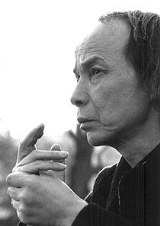
Toru Takemitsu

Encyclopedia
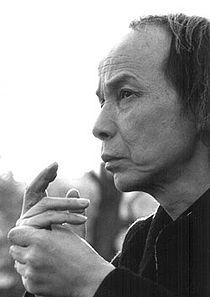
Composer
A composer is a person who creates music, either by musical notation or oral tradition, for interpretation and performance, or through direct manipulation of sonic material through electronic media...
and writer on aesthetics
Aesthetics
Aesthetics is a branch of philosophy dealing with the nature of beauty, art, and taste, and with the creation and appreciation of beauty. It is more scientifically defined as the study of sensory or sensori-emotional values, sometimes called judgments of sentiment and taste...
and music theory
Music theory
Music theory is the study of how music works. It examines the language and notation of music. It seeks to identify patterns and structures in composers' techniques across or within genres, styles, or historical periods...
. Largely self-taught, Takemitsu possessed consummate skill in the subtle manipulation of instrumental and orchestral timbre. He drew from a wide range of influences, including jazz, popular music, avant-garde procedures and traditional Japanese music
Traditional Japanese music
Traditional Japanese music is the term used to describe historical Japanese folk music, or traditional music.-Rhythm:One of the characteristics of traditional Japanese music is a sparse rhythm. It also doesn't have regular chords. In Japanese music, one cannot beat time with one's hands because...
, in a harmonic idiom largely derived from the music of Claude Debussy
Claude Debussy
Claude-Achille Debussy was a French composer. Along with Maurice Ravel, he was one of the most prominent figures working within the field of impressionist music, though he himself intensely disliked the term when applied to his compositions...
and Olivier Messiaen
Olivier Messiaen
Olivier Messiaen was a French composer, organist and ornithologist, one of the major composers of the 20th century. His music is rhythmically complex ; harmonically and melodically it is based on modes of limited transposition, which he abstracted from his early compositions and improvisations...
.
In 1958, his Requiem for strings (1957) gained international attention, led to several commissions from across the world and settled his reputation as one of the leading Japanese composers of the 20th century. He was the recipient of numerous awards, commissions and honours; he composed over 100 film scores and about 130 concert works for ensembles of various sizes and combinations. He also found time to write a detective novel and appeared frequently on Japanese television as a celebrity chef
Celebrity chef
A celebrity chef is a kitchen chef who has become famous and well known. Today celebrity chefs often become celebrities by presenting cookery advice and demonstrations via mass media, especially television. Historically, celebrity chefs have included Antoine Carême and Martino da Como.-External...
.
In the foreword to a selection of Takemitsu's writings in English, conductor Seiji Ozawa
Seiji Ozawa
is a Japanese conductor, particularly noted for his interpretations of large-scale late Romantic works. He is most known for his work as music director of the Boston Symphony Orchestra and principal conductor of the Vienna State Opera.-Early years:...
writes: "I am very proud of my friend Toru Takemitsu. He is the first Japanese composer to write for a world audience and achieve international recognition."
Youth
Takemitsu was born in TokyoTokyo
, ; officially , is one of the 47 prefectures of Japan. Tokyo is the capital of Japan, the center of the Greater Tokyo Area, and the largest metropolitan area of Japan. It is the seat of the Japanese government and the Imperial Palace, and the home of the Japanese Imperial Family...
on October 8, 1930; a month later his family moved to Dalian
Dalian
Dalian is a major city and seaport in the south of Liaoning province, Northeast China. It faces Shandong to the south, the Yellow Sea to the east and the Bohai Sea to the west and south. Holding sub-provincial administrative status, Dalian is the southernmost city of Northeast China and China's...
in the Chinese province then known as Manchuria
Manchuria
Manchuria is a historical name given to a large geographic region in northeast Asia. Depending on the definition of its extent, Manchuria usually falls entirely within the People's Republic of China, or is sometimes divided between China and Russia. The region is commonly referred to as Northeast...
. He returned to Japan to attend elementary school, but his education was cut short by military conscription in 1944. Takemitsu described his experience of military service at such a young age, under the Japanese Nationalist government, as "... extremely bitter". Takemitsu first became really conscious of Western classical music
Classical music
Classical music is the art music produced in, or rooted in, the traditions of Western liturgical and secular music, encompassing a broad period from roughly the 11th century to present times...
(which was banned in Japan during the war) during his term of military service, in the form of a popular French Song ("Parlez-moi d'amour
Parlez-moi d'amour (song)
"Parlez-moi d'amour" is a song written by Jean Lenoir in 1930. An English translation was written by Bruce Sievier and is known as "Speak to Me of Love" or "Tell Me About Love"...
") which he listened to with colleagues in secret, played on a gramophone with a makeshift needle fashioned from bamboo.
During the post-war U.S. occupation of Japan, Takemitsu worked for the U.S. Armed Forces, but was ill for a long period. Hospitalised and bed-ridden, he took the opportunity to listen to as much Western music as he could on the U.S. Armed Forces network. While deeply affected by these experiences of Western music, he simultaneously felt a need to distance himself from the traditional music of his native Japan. He explained much later, in a lecture at the New York International Festival of the Arts, that for him Japanese traditional music "always recalled the bitter memories of war".
Despite his almost complete lack of musical training, and taking inspiration from what little Western music he had heard, Takemitsu began to compose in earnest at the age of 16: "... I began [writing] music attracted to music itself as one human being. Being in music I found my raison d'être as a man. After the war, music was the only thing. Choosing to be in music clarified my identity." Though he studied briefly with Yasuji Kiyose
Yasuji Kiyose
Yasuji Kiyose was a Japanese composer. He studied composition privately with Kōsaku Yamada and Kōsuke Komatsu and in 1930, took an active part in organizing the Shinkō Sakkyokuka Renmei, .In 1948, Kiyose took on Hiroyoshi Suzuki and Tōru Takemitsu for a brief period as...
beginning in 1948, Takemitsu remained largely self-taught throughout his musical career.
Early development and Jikken Kōbō
In 1948, Takemitsu conceived the idea of electronic musicElectronic music
Electronic music is music that employs electronic musical instruments and electronic music technology in its production. In general a distinction can be made between sound produced using electromechanical means and that produced using electronic technology. Examples of electromechanical sound...
technology
Music technology
Music technology is a term that refers to all forms of technology involved with the musical arts, particularly the use of electronic devices and computer software to facilitate playback, recording, composition, storage and performance. This subject is taught at many different educational levels,...
, or in his own words, to "bring noise into tempered musical tones inside a busy small tube." During the 1950s, Takemitsu had learned that in 1948 "a French [engineer] Pierre Schaeffer
Pierre Schaeffer
Pierre Henri Marie Schaeffer was a French composer, writer, broadcaster, engineer, musicologist and acoustician of the 20th century. His innovative work in both the sciences —particularly communications and acoustics— and the various arts of music, literature and radio presentation after the end...
invented the method(s) of musique concrète
Musique concrète
Musique concrète is a form of electroacoustic music that utilises acousmatic sound as a compositional resource. The compositional material is not restricted to the inclusion of sounds derived from musical instruments or voices, nor to elements traditionally thought of as "musical"...
based on the same idea as mine. I was pleased with this coincidence."
In 1951, Takemitsu was a founding member of the anti-academic : an artistic group established for multidisciplinary collaboration on mixed-media projects, who sought to avoid Japanese artistic tradition. The performances and works undertaken by the group introduced several contemporary Western composers to Japanese audiences. During this period he wrote Saegirarenai Kyūsoku I ("Uninterrupted Rest I", 1952: a piano work, without a regular rhythmic pulse or barlines); and by 1955 Takemitsu had begun to use electronic tape-recording
Tape recorder
An audio tape recorder, tape deck, reel-to-reel tape deck, cassette deck or tape machine is an audio storage device that records and plays back sounds, including articulated voices, usually using magnetic tape, either wound on a reel or in a cassette, for storage...
techniques in such works as Relief Statique (1955) and Vocalism A·I (1956). Takemitsu also studied in the early 1950s with the composer Fumio Hayasaka
Fumio Hayasaka
Fumio Hayasaka was a Japanese composer of classical music and film scores.- Early life :...
, perhaps best known for the scores he wrote for films by Kenji Mizoguchi
Kenji Mizoguchi
Kenji Mizoguchi was a Japanese film director and screenwriter. His film Ugetsu won the Silver Lion at the Venice Film Festival, and appeared in the Sight & Sound Critics' Top Ten Poll in 1962 and 1972. Mizoguchi is renowned for his mastery of the long take and mise-en-scène...
and Akira Kurosawa
Akira Kurosawa
was a Japanese film director, producer, screenwriter and editor. Regarded as one of the most important and influential filmmakers in the history of cinema, Kurosawa directed 30 filmsIn 1946, Kurosawa co-directed, with Hideo Sekigawa and Kajiro Yamamoto, the feature Those Who Make Tomorrow ;...
, the latter of whom Takemitsu would collaborate with decades later.
In the late 1950s chance brought Takemitsu international attention: his Requiem for string orchestra (1957 ), written as an homage to Hayasaka, was heard by Igor Stravinsky
Igor Stravinsky
Igor Fyodorovich Stravinsky ; 6 April 1971) was a Russian, later naturalized French, and then naturalized American composer, pianist, and conductor....
in 1958 during his visit to Japan. (The NHK
NHK
NHK is Japan's national public broadcasting organization. NHK, which has always identified itself to its audiences by the English pronunciation of its initials, is a publicly owned corporation funded by viewers' payments of a television license fee....
had organised opportunities for Stravinsky to listen to some of the latest Japanese music; when Takemitsu's work was put on by mistake, Stravinsky insisted on hearing it to the end.) At a press conference later, Stravinsky expressed his admiration for the work, praising its "sincerity" and "passionate" writing. Stravinsky subsequently invited Takemitsu to lunch; and for Takemitsu this was an "unforgettable" experience. After Stravinsky returned to the U.S., Takemitsu soon received a commission for a new work from the Koussevitsky Foundation which, he assumed, had come as a suggestion from Stravinsky to Aaron Copland
Aaron Copland
Aaron Copland was an American composer, composition teacher, writer, and later in his career a conductor of his own and other American music. He was instrumental in forging a distinctly American style of composition, and is often referred to as "the Dean of American Composers"...
. For this he composed Dorian Horizon, (1966), which was premièred by the San Francisco Symphony Orchestra, conducted by Copland.
Influence of Cage; interest in traditional Japanese music
During his time with Jikken Kōbō, Takemitsu came into contact with the experimental work of John CageJohn Cage
John Milton Cage Jr. was an American composer, music theorist, writer, philosopher and artist. A pioneer of indeterminacy in music, electroacoustic music, and non-standard use of musical instruments, Cage was one of the leading figures of the post-war avant-garde...
; but when the composer Toshi Ichiyanagi
Toshi Ichiyanagi
is a Japanese composer of avant-garde music. He studied with Tomojiro Ikenouchi and John Cage.One of his most notable works is the 1960 composition, Kaiki, which combined Japanese instruments, shō and koto, and western instruments, harmonica and saxophone. Another work Distance requires the...
returned from his studies in America in 1961, he gave the first Japanese performance of Cage's Concert for Piano and Orchestra. This left a "deep impression" on Takemitsu: he recalled the impact of hearing the work when writing an obituary for Cage, 31 years later. This encouraged Takemitsu in his use of indeterminate procedures and graphic-score notation, for example in the graphic scores of Ring (1961), Corona for pianist(s) and Corona II for string(s) (both 1962). In these works each performer is presented with cards printed with coloured circular patterns which are freely arranged by the performer to create "the score".
Although the immediate influence of Cage's procedures did not last in Takemitsu's music—Coral Island, for example for soprano and orchestra (1962) shows significant departures from indeterminate procedures partly as a result of Takemitsu's renewed interest in the music of Anton Webern
Anton Webern
Anton Webern was an Austrian composer and conductor. He was a member of the Second Viennese School. As a student and significant follower of Arnold Schoenberg, he became one of the best-known exponents of the twelve-tone technique; in addition, his innovations regarding schematic organization of...
—certain similarities between Cage's philosophies and Takemitsu's thought remained. For example, Cage's emphasis on timbres within individual sound-events, and his notion of silence "as plenum rather than vacuum", can be aligned with Takemitsu's interest in ma. Furthermore, Cage's interest in Zen practice (through his contact with Zen Master Daisetz Teitaro Suzuki
Daisetz Teitaro Suzuki
Daisetsu Teitaro Suzuki was a Japanese author of books and essays on Buddhism, Zen and Shin that were instrumental in spreading interest in both Zen and Shin to the West. Suzuki was also a prolific translator of Chinese, Japanese, and Sanskrit literature...
) seems to have resulted in a renewed interest in the East in general, and ultimately alerted Takemitsu to the potential for incorporating elements drawn from Japanese traditional music into his composition:
I must express my deep and sincere gratitude to John Cage. The reason for this is that in my own life, in my own development, for a long period I struggled to avoid being "Japanese", to avoid "Japanese" qualities. It was largely through my contact with John Cage that I came to recognize the value of my own tradition.
For Takemitsu, as he explained later in a lecture in 1988, one performance of Japanese traditional music stood out:
One day I chanced to see a performance of the Bunraku puppet theater and was very surprised by it. It was in the tone quality, the timbre, of the futazao shamisen, the wide-necked shamisen used in Bunraku, that I first recognized the splendor of traditional Japanese music. I was very moved by it and I wondered why my attention had never been captured before by this Japanese music.
Thereafter, he resolved to study all types of traditional Japanese music, paying special attention to the differences between the two very different musical traditions; in a diligent attempt to "bring forth the sensibilities of Japanese music that had always been within [him]...". This was no easy task, since in the years following the war traditional music was largely overlooked and ignored: only one or two "masters" continued to keep their art alive, often meeting with public indifference. In conservatoria across the country, even students of traditional instruments were always required to learn the piano.
From the early 1960s, Takemitsu began to make use of traditional Japanese instruments
Traditional Japanese musical instruments
Traditional Japanese musical instruments comprise a wide range of string, wind, and percussion instruments.-Plucked:*Biwa - pear-shaped lute*Ichigenkin - one-string zither*Koto - long zither*Junanagen - 17-stringed zither...
in his music, and even took up playing the biwa
Biwa
The is a Japanese short-necked fretted lute, often used in narrative storytelling. The biwa is the chosen instrument of Benten, goddess of music, eloquence, poetry, and education in Japanese Shinto....
—an instrument he used in his score for the film Seppuku (1962). In 1967, Takemitsu received a commission from the New York Philharmonic Orchestra, to commemorate the orchestra's 125th anniversary, for which he wrote November Steps
November Steps
is a musical composition by the Japanese composer Tōru Takemitsu, for the traditional Japanese musical instruments, shakuhachi and biwa, and western orchestra...
for biwa, shakuhachi
Shakuhachi
The is a Japanese end-blown flute. It is traditionally made of bamboo, but versions now exist in ABS and hardwoods. It was used by the monks of the Fuke school of Zen Buddhism in the practice of...
, and orchestra. Initially, Takemitsu had great difficulty in uniting these instruments from such different musical cultures in one work. Eclipse for biwa and shakuhachi (1966) illustrates Takemitsu's attempts to find a viable notational system for these instruments, which in normal circumstances neither sound together nor are used in works notated in any system of Western staff notation
Staff (music)
In standard Western musical notation, the staff, or stave, is a set of five horizontal lines and four spaces that each represent a different musical pitch—or, in the case of a percussion staff, different percussion instruments. Appropriate music symbols, depending upon the intended effect,...
.
The first performance of November Steps was given in 1967, under Seiji Ozawa
Seiji Ozawa
is a Japanese conductor, particularly noted for his interpretations of large-scale late Romantic works. He is most known for his work as music director of the Boston Symphony Orchestra and principal conductor of the Vienna State Opera.-Early years:...
. Despite the trials of writing such an ambitious work, Takemitsu maintained "that making the attempt was very worthwhile because what resulted somehow liberated music from a certain stagnation and brought to music something distinctly new and different". The work was distributed widely in the West when it was coupled as the fourth side of an LP release of Messiaen's Turangalîla Symphony.
In 1972, Takemitsu, accompanied by Iannis Xenakis
Iannis Xenakis
Iannis Xenakis was a Romanian-born Greek ethnic, naturalized French composer, music theorist, and architect-engineer. He is commonly recognized as one of the most important post-war avant-garde composers...
, Betsy Jolas
Betsy Jolas
Betsy Jolas is a French composer.Betsy Jolas was born in Paris. Resident in the United States from 1940 until 1946, she studied composition with Paul Boepple and piano with Helen Schnabel. On her return to France she continued her studies with Simone Plé-Caussade, Darius Milhaud and Olivier...
, and others, heard Bali
Bali
Bali is an Indonesian island located in the westernmost end of the Lesser Sunda Islands, lying between Java to the west and Lombok to the east...
nese gamelan
Gamelan
A gamelan is a musical ensemble from Indonesia, typically from the islands of Bali or Java, featuring a variety of instruments such as metallophones, xylophones, drums and gongs; bamboo flutes, bowed and plucked strings. Vocalists may also be included....
music in Bali. The experience influenced the composer on a largely philosophical and theological level. For those accompanying Takemitsu on the expedition (most of whom were French musicians), who "... could not keep their composure as I did before this music: it was too foreign for them to be able to assess the resulting discrepancies with their logic", the experience was without precedent. For Takemitsu, however, by now quite familiar with his own native musical tradition, there was a relationship between "the sounds of the gamelan, the tone of the kapachi, the unique scales and rhythms by which they are formed, and Japanese traditional music which had shaped such a large part of my sensitivity". In his solo piano work For Away (written for Roger Woodward
Roger Woodward
Roger Woodward AC OBE is an Australian classical concert pianist.-Biography:Roger Woodward was born in 1942 in Chatswood, a suburb of Sydney, the youngest of four children to Gladys and Frank Woodward...
in 1973), a single, complex line is distributed between the pianist's hands, which reflects the interlocking patterns between the metallophone
Metallophone
A metallophone is any musical instrument consisting of tuned metal bars which are struck to make sound, usually with a mallet.Metallophones have been used in music for hundreds of years. There are several different types used in Balinese and Javanese gamelan ensembles, including the gendér, gangsa...
s of a gamelan orchestra.
A year later, Takemitsu returned to the instrumental combination of shakuhachi, biwa, and orchestra, in the less well known work Autumn (1973). The significance of this work is revealed in its far greater integration of the traditional Japanese instruments into the orchestral discourse; whereas in November Steps, the two contrasting instrumental ensembles perform largely in alternation, with only a few moments of contact. Takemitsu expressed this change in attitude:
But now my attitude is getting to be a little different, I think. Now my concern is mostly to find out what there is in common ... Autumn was written after November Steps. I really wanted to do something which I hadn't done in November Steps, not to blend the instruments, but to integrate them.
International status and the gradual shift in style
By 1970, Takemitsu's reputation as a leading member of avant-garde community was well established, and during his involvement with Expo '70 in OsakaOsaka
is a city in the Kansai region of Japan's main island of Honshu, a designated city under the Local Autonomy Law, the capital city of Osaka Prefecture and also the biggest part of Keihanshin area, which is represented by three major cities of Japan, Kyoto, Osaka and Kobe...
, he was at last able to meet more of his Western colleagues, including Karlheinz Stockhausen
Karlheinz Stockhausen
Karlheinz Stockhausen was a German composer, widely acknowledged by critics as one of the most important but also controversial composers of the 20th and early 21st centuries. Another critic calls him "one of the great visionaries of 20th-century music"...
. Also, during a contemporary music festival in April 1970, produced by the Japanese composer himself ("Iron and Steel Pavilion"), Takemitsu met among the participants Lukas Foss
Lukas Foss
Lukas Foss was a German-born American composer, conductor, and pianist.-Music career:He was born Lukas Fuchs in Berlin, Germany in 1922. His father was the philosopher and scholar Martin Fuchs...
, Peter Sculthorpe
Peter Sculthorpe
Peter Joshua Sculthorpe AO OBE is an Australian composer. Much of his music has resulted from an interest in the music of Australia's neighbours as well as from the impulse to bring together aspects of native Australian music with that of the heritage of the West...
, and Vinko Globokar
Vinko Globokar
Vinko Globokar is a French avant-garde composer and trombonist of Slovene descent.His work is noted for its use of unconventional and extended techniques, closely allying him to contemporaries Salvatore Sciarrino and Helmut Lachenmann...
. Later that year, as part of a commission from Paul Sacher
Paul Sacher
Paul Sacher was a Swiss conductor, patron and impresario.-Biography:He studied under Felix Weingartner, among others. In 1926 he founded the Basel Chamber Orchestra to play works written before the classical period and modern works...
and the Zurich Collegium Musicum
Collegium Musicum
The Collegium Musicum was one of several types of musical societies that arose in German and German-Swiss cities and towns during the Reformation and thrived into the mid-18th century...
, Takemitsu incorporated into his Eucalyptus I parts for international performers: flautist Aurèle Nicolet
Aurèle Nicolet
Aurèle Nicolet is a Swiss flautist. He is considered as one of the world's best flute players of the late twentieth century. He has performed in various international concerts. A number of composers wrote music especially for him, such composers include Toru Takemitsu, György Ligeti, Krzysztof...
, oboist Heinz Holliger
Heinz Holliger
Heinz Holliger Heinz Holliger Heinz Holliger (born 21 May 1939 is a Swiss oboist, composer and conductor.-Biography:He was born in Langenthal, Switzerland, and began his musical education at the conservatories of Bern and Basel. He studied composition with Sándor Veress and Pierre Boulez...
, and harpist Ursula Holliger.
Critical examination of the complex instrumental works written during this period for the new generation of "contemporary soloists" reveals the level of his high-profile engagement with the Western avant-garde, in works such as Voice for solo flute (1971), Waves for clarinet, horn, two trombones and bass drum (1976), Quatrain for clarinet, violin, cello, piano and orchestra (1977). Experiments and works that incorporated traditional Japanese musical ideas and language continued to appear in his output, and an increased interest in the traditional Japanese garden began to reflect itself in works such as In an Autumn Garden for gagaku orchestra (1973), and A Flock Descends into the Pentagonal Garden for orchestra (1977).
Throughout this apogee of avant-garde work, Takemitsu's musical style seems to have undergone a series of stylistic changes. Comparison of Green (for orchestra, 1967) and A Flock Descends into the Pentagonal Garden (1977) quickly reveals the seeds of this change. The latter was composed according a pre-compositional scheme, in which pentatonic modes were superimposed over one central pentatonic scale (the so-called "black-key pentatonic") around a central sustained central pitch (F-sharp), and an approach that is highly indicative of the sort of "pantonal" and modal pitch material seen gradually emerging in his works throughout the 1970s. The former, Green (or November Steps II) written 10 years earlier, is heavily influenced by Debussy, and is, in spite of its very dissonant language (including momentary quarter-tone clusters), largely constructed through a complex web of modal forms. These modal forms are largely audible, particularly in the momentary repose toward the end of the work. Thus in these works, it is possible to see both a continuity of approach, and the emergence of a simpler harmonic language that was to characterise the work of his later period.
His friend and colleague Jō Kondō
Jo Kondo
Jō Kondō is a Japanese composer of contemporary classical music.Kondo studied composition from 1968 to 1972 with Yoshio Hasegawa and Hiroaki Minami at the Tokyo National University of Fine Arts and Music. He won the third prize and made his debut in Japan-Germany Contemporary Music Festival in 1969...
said, "If his later works sound different from earlier pieces, it is due to his gradual refining of his basic style rather than any real alteration of it."
Later works: the sea of tonality
In a Tokyo lecture given in 1984, Takemitsu identified a melodic motiveMotif (music)
In music, a motif or motive is a short musical idea, a salient recurring figure, musical fragment or succession of notes that has some special importance in or is characteristic of a composition....
in his Far Calls. Coming Far! (for violin and orchestra, 1980) that would recur throughout his later works:
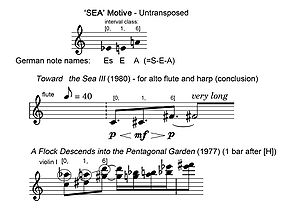
I wanted to plan a tonal "sea". Here the "sea" is E-flat [Es in German nomenclature]-E-A, a three-note ascending motive consisting of a half step and perfect fourth. [... In Far Calls] this is extended upward from A with two major thirds and one minor third ... Using these patterns I set the "sea of tonality" from which many pantonal chords flow.
Takemitsu's words here highlight his changing stylistic trends from the late 1970s into the 1980s, which have been described as "an increased use of diatonic material [... with] references to tertian harmony and jazz voicing", which do not, however, project a sense of "large-scale tonality". Many of the works from this period have titles that include a reference to water: Toward the Sea (1981), Rain Tree and Rain Coming (1982), riverrun and I Hear the Water Dreaming (1987). Takemitsu wrote in his notes for the score of Rain Coming that "... the complete collection [is] entitled "Waterscape" ... it was the composer's intention to create a series of works, which like their subject, pass through various metamorphoses, culminating in a sea of tonality." Throughout these works, the S-E-A motive (discussed further below) features prominently, and points to an increased emphasis on the melodic element in Takemitsu's music that began during this later period.
Pedal notes played an increasingly prominent role in Takemitsu's music during this period, as in A Flock Descends into the Pentagonal Garden. In Dream/Window, (orchestra, 1985) a pedal D serves as anchor point, holding together statements of a striking four-note motivic gesture which recurs in various instrumental and rhythmic guises throughout. Very occasionally, fully fledged references to diatonic tonality can be found, often in harmonic allusions to early- and pre-20th century composers—for example, Folios for guitar (1974), which quotes
Musical quotation
Musical quotation is the practice of directly quoting another work in a new composition. The quotation may be from the same composer's work , or from a different composer's work ....
from J. S. Bach's
Bạch
Bạch is a Vietnamese surname. The name is transliterated as Bai in Chinese and Baek, in Korean.Bach is the anglicized variation of the surname Bạch.-Notable people with the surname Bạch:* Bạch Liêu...
St Matthew Passion, and Family Tree for narrator and orchestra (1984), which invokes the musical language of Ravel and American popular song.
By this time, Takemitsu's incorporation of traditional Japanese (and other Eastern) musical traditions with his Western style had become much more integrated. Takemitsu commented, "There is no doubt ... the various countries and cultures of the world have begun a journey toward the geographic and historic unity of all peoples ... The old and new exist within me with equal weight."
Toward the end of his life, Takemitsu had planned to complete an opera, a collaboration with the novelist Barry Gifford
Barry Gifford
Barry Gifford is an American author, poet, and screenwriter known for his distinctive mix of American landscapes and film noir- and Beat Generation-influenced literary madness....
and the director Daniel Schmid, commissioned by the Opéra National de Lyon
Opéra National de Lyon
Opéra National de Lyon is an opera company in Lyon, France which performs in the Nouvel Opéra, a modernized version in 1993 of the original 1831 opera house.The inaugural performance of François-Adrien Boïeldieu's La Dame blanche was given on 1 July 1831...
in France. He was in the process of publishing a plan of its musical and dramatic structure with Kenzaburō Ōe
Kenzaburo Oe
is a Japanese author and a major figure in contemporary Japanese literature. His works, strongly influenced by French and American literature and literary theory, deal with political, social and philosophical issues including nuclear weapons, social non-conformism and existentialism.Ōe was awarded...
, but he was prevented from completing it by his death at 65. He died of pneumonia while undergoing treatment for bladder cancer
Bladder cancer
Bladder cancer is any of several types of malignant growths of the urinary bladder. It is a disease in which abnormal cells multiply without control in the bladder. The bladder is a hollow, muscular organ that stores urine; it is located in the pelvis...
on February 20, 1996.
Legacy
In a memorial issue of Contemporary Music Review, Jō Kondō wrote, "Needless to say, Takemitsu is among the most important composers in Japanese music history. He was also the first Japanese composer fully recognized in the west, and remained the guiding light for the younger generations of Japanese composers."Composer Peter Lieberson
Peter Lieberson
Peter Lieberson was an American composer. He was ballerina and choreographer Vera Zorina and Goddard Lieberson, president of Columbia Records....
shared the following in his program note to the Ocean that has no East and West, written in memory of Takemitsu: "I spent the most time with Toru in Tokyo when I was invited to be a guest composer at his Music Today Festival in 1987. Peter Serkin
Peter Serkin
-Biography:He was born in New York City and is the son of pianist Rudolf Serkin, and grandson of the influential violinist Adolf Busch, whose daughter Irene had married Rudolf Serkin...
and composer Oliver Knussen were also there, as was cellist Fred Sherry
Fred Sherry
Fred Sherry is an American cello virtuoso who is particularly admired for his work as a chamber musician and concert soloist. He studied with Leonard Rose at the Juilliard School before winning the Young Concert Artists International Auditions in 1968. In 1971 he co-founded the Speculum Musicae...
. Though he was the senior of our group by many years, Toru stayed up with us every night and literally drank us under the table. I was confirmed in my impression of Toru as a person who lived his life like a traditional Zen poet."
Music
Composers whom Takemitsu cited as influential in his early work include Claude DebussyClaude Debussy
Claude-Achille Debussy was a French composer. Along with Maurice Ravel, he was one of the most prominent figures working within the field of impressionist music, though he himself intensely disliked the term when applied to his compositions...
, Anton Webern
Anton Webern
Anton Webern was an Austrian composer and conductor. He was a member of the Second Viennese School. As a student and significant follower of Arnold Schoenberg, he became one of the best-known exponents of the twelve-tone technique; in addition, his innovations regarding schematic organization of...
, Edgard Varèse
Edgard Varèse
Edgard Victor Achille Charles Varèse, , whose name was also spelled Edgar Varèse , was an innovative French-born composer who spent the greater part of his career in the United States....
, Arnold Schoenberg
Arnold Schoenberg
Arnold Schoenberg was an Austrian composer, associated with the expressionist movement in German poetry and art, and leader of the Second Viennese School...
, and Olivier Messiaen
Olivier Messiaen
Olivier Messiaen was a French composer, organist and ornithologist, one of the major composers of the 20th century. His music is rhythmically complex ; harmonically and melodically it is based on modes of limited transposition, which he abstracted from his early compositions and improvisations...
. (Messiaen was introduced to him by fellow composer Toshi Ichiyanagi
Toshi Ichiyanagi
is a Japanese composer of avant-garde music. He studied with Tomojiro Ikenouchi and John Cage.One of his most notable works is the 1960 composition, Kaiki, which combined Japanese instruments, shō and koto, and western instruments, harmonica and saxophone. Another work Distance requires the...
, and remained a lifelong influence). Although Takemitsu was reluctant at first to develop an interest in traditional Japanese music
Traditional Japanese music
Traditional Japanese music is the term used to describe historical Japanese folk music, or traditional music.-Rhythm:One of the characteristics of traditional Japanese music is a sparse rhythm. It also doesn't have regular chords. In Japanese music, one cannot beat time with one's hands because...
after his wartime experiences of nationalism, Takemitsu showed an early interest in "... the Japanese Garden in color spacing and form ...". The formal garden of the kaiyu-shiki interested him in particular.
He expressed his unusual stance toward compositional theory early on, his lack of respect for the "trite rules of music, rules that are ... stifled by formulas and calculations"; for Takemitsu it was of far greater importance that "sounds have the freedom to breathe. ... Just as one cannot plan his life, neither can he plan music".
Takemitsu's sensitivity to instrumental and orchestral timbre can be heard throughout his work, and is often made apparent by the unusual instrumental combinations he specified. This is evident in works such as November Steps, that combine traditional Japanese instruments, shakuhachi
Shakuhachi
The is a Japanese end-blown flute. It is traditionally made of bamboo, but versions now exist in ABS and hardwoods. It was used by the monks of the Fuke school of Zen Buddhism in the practice of...
and biwa
Biwa
The is a Japanese short-necked fretted lute, often used in narrative storytelling. The biwa is the chosen instrument of Benten, goddess of music, eloquence, poetry, and education in Japanese Shinto....
, with a conventional Western orchestra. It may also be discerned in his works for ensembles that make no use of traditional instruments, for example Quotation of Dream (1991), Archipelago S., for 21 players (1993), and Arc I & II (1963–66/1976). In these works, the more conventional orchestral forces are divided into unconventional "groups". Even where these instrumental combinations were determined by the particular ensemble commissioning the work, "Takemitsu's genius for instrumentation (and genius it was, in my view) ...", in the words of Oliver Knussen
Oliver Knussen
Oliver Knussen CBE is a British composer and conductor.-Biography:Oliver Knussen was born in Glasgow, Scotland. His father, Stuart Knussen, was principal double bass of the London Symphony Orchestra. Oliver Knussen studied composition with John Lambert, between 1963 and 1969 and also received...
, "... creates the illusion that the instrumental restrictions are self-imposed".
Influence of traditional Japanese music
His dislike for the music traditions of his own country in particular were intensified by his experiences of the war, during which Japanese music became associated with militaristic and nationalistic cultural ideals.
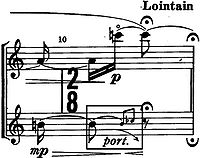
Nevertheless, Takemitsu incorporated some idiomatic elements of Japanese music in his very earliest works, perhaps unconsciously. One unpublished set of pieces, Kakehi ("Conduit"), written at the age of 17, incorporates the ryō, ritsu and insen scales throughout. When Takemitsu discovered that these "nationalist" elements had somehow found their way into his music, he was so alarmed that he later destroyed the works. Further examples can be seen for example in the quarter-tone glissandi of Masques I (for two flutes, 1959), which mirror the characteristic pitch bends of the shakuhachi, and for which he devised his own unique notation: a held note is tied to an enharmonic
Enharmonic
In modern musical notation and tuning, an enharmonic equivalent is a note , interval , or key signature which is equivalent to some other note, interval, or key signature, but "spelled", or named, differently...
spelling of the same pitch class, with a portamento
Portamento
Portamento is a musical term originated from the Italian expression "portamento della voce" , denoting from the beginning of the 17th century a vocal slide between two pitches and its emulation by members of the violin family and certain wind instruments, and is sometimes used...
direction across the tie.
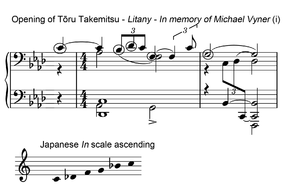
Michael Vyner
Michael Vyner was an English arts administrator.Formerly employed by the music publishers Schott Music, he became Musical Director of the London Sinfonietta in 1972...
(first movement), a reconstruction from memory by Takemitsu of Lento in Due Movimenti (1950; the original score was lost), pentatonicism is clearly visible in the upper voice, which opens the work on an unaccompanied anacrusis
Anacrusis
In poetry, an anacrusis is the lead-in syllables, collectively, that precede the first full measure.In music, it is the note or sequence of notes which precedes the first downbeat in a bar. In the latter sense an anacrusis is often called a pickup, pickup note, or pickup measure, referring to the...
. The pitches of the opening melody combine to form the constituent notes of the ascending form of the Japanese in scale.
When, from the early 1960s, Takemitsu began to "consciously apprehend" the sounds of traditional Japanese music, he found that his creative process, "the logic of my compositional thought[,] was torn apart", and nevertheless, "hogaku [traditional Japanese music ...] seized my heart and refuses to release it". In particular, Takemitsu perceived that, for example, the sound of a single stroke of the biwa or single pitch breathed through the shakuhachi, could "so transport our reason because they are of extreme complexity ... already complete in themselves". This fascination with the sounds produced in traditional Japanese music brought Takemitsu to his idea of ma (usually translated as the space between two objects), which ultimately informed his understanding of the intense quality of traditional Japanese music as a whole:
Just one sound can be complete in itself, for its complexity lies in the formulation of ma, an unquantifiable metaphysical space (duration) of dynamically tensed absence of sound. For example, in the performance of nō, the ma of sound and silence does not have an organic relation for the purpose of artistic expression. Rather, these two elements contrast sharply with one another in an immaterial balance.
In 1970, Takemitsu received a commission from the National Theatre of Japan
National Theatre of Japan
The is a complex consisting of three halls in two buildings in Hayabusa-chō, a neighborhood in Chiyoda, Tokyo, Japan. The Japan Arts Council, an Independent Administrative Institution of the Ministry of Education, Culture, Sports, Science and Technology, operates the National Theatre...
to write a work for the gagaku
Gagaku
Gagaku is a type of Japanese classical music that has been performed at the Imperial Court in Kyoto for several centuries. It consists of three primary repertoires:#Native Shinto religious music and folk songs and dance, called kuniburi no utamai...
ensemble of the Imperial Household; this was fulfilled in 1973, when he completed Shuteiga ("In an Autumn Garden", although he later incorporated the work, as the fourth movement, into his 50 minute long "In an Autumn Garden—Complete Version"). As well as being "... the furthest removed from the West of any work he had written", While it introduces certain Western musical ideas to the Japanese court ensemble, the work represents the deepest of Takemitsu's investigations into Japanese musical tradition, the lasting effects of which are clearly reflected in his works for conventional Western ensemble formats that followed.
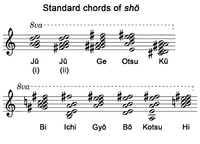
Hichiriki
The is a double reed Japanese fue used as one of two main melodic instruments in Japanese gagaku music, the other being the ryūteki. The hichiriki is difficult to play, due in part to its double reed configuration. Although a double reed instrument like the oboe, the hichiriki has a cylindrical...
in gagaku ensembles.
Influence of Messiaen
Olivier Messiaen
Olivier Messiaen was a French composer, organist and ornithologist, one of the major composers of the 20th century. His music is rhythmically complex ; harmonically and melodically it is based on modes of limited transposition, which he abstracted from his early compositions and improvisations...
on Takemitsu was already apparent in some of Takemitsu's earliest published works. By the time he composed Lento in Due Movimenti, (1950), Takemitsu had already come into possession of a copy of Messiaen's 8 Préludes (through Toshi Ichiyanagi
Toshi Ichiyanagi
is a Japanese composer of avant-garde music. He studied with Tomojiro Ikenouchi and John Cage.One of his most notable works is the 1960 composition, Kaiki, which combined Japanese instruments, shō and koto, and western instruments, harmonica and saxophone. Another work Distance requires the...
), and the influence of Messiaen is clearly visible in the work, in the use of modes, the suspension of regular metre, and sensitivity to timbre. Throughout his career Takemitsu often made use of modes from which he derived his musical material, both melodic and harmonic among which Messiaen's modes of limited transposition
Modes of limited transposition
Modes of limited transposition are musical modes or scales that fulfill specific criteria relating to their symmetry and the repetition of their interval groups...
to appear with some frequency. In particular, the use of the octatonic, (mode II, or the 8-28 collection), and mode VI (8-25) is particularly common. However, Takemitsu pointed out that he had used the octatonic collection in his music before ever coming across it in Messiaen's music.
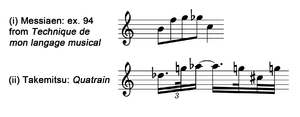
In 1977, Takemitsu met Messiaen in New York, and during "what was to be a one-hour 'lesson' [but which] lasted three hours ... Messiaen played his Quartet for the End of Time for Takemitsu at the piano", which, Takemitsu recalled, was like listening to an orchestral performance. Takemitsu responded to this with his homage to the French composer, Quatrain, for which he asked Messiaen's permission to use the same instrumental combination for the main quartet, cello, violin, clarinet and piano (which is accompanied by orchestra). As well as the obvious similarity of instrumentation, Takemitsu employs several melodic figures that appear to "mimic" certain musical examples given by Messiaen in his Technique de mon langage musical, (see ex. 4).
On hearing of Messiaen's death in 1992, Takemitsu was interviewed by telephone, and still in shock, "blurted out, 'His death leaves a crisis in contemporary music!' " Then later, in an obituary written for the French composer in the same year, Takemitsu further expressed his sense of loss at Messiaen's death: "Truly, he was my spiritual mentor ... Among the many things I learned from his music, the concept and experience of color and the form of time will be unforgettable." The composition Rain Tree Sketch II, which was to be Takemitsu's final piano piece, was also written that year and subtitled "In Memoriam Olivier Messiaen".
Influence of Debussy
Takemitsu frequently expressed his indebtedness to Claude DebussyClaude Debussy
Claude-Achille Debussy was a French composer. Along with Maurice Ravel, he was one of the most prominent figures working within the field of impressionist music, though he himself intensely disliked the term when applied to his compositions...
, referring to the French composer as his "great mentor". As Arnold Whitall puts it:
Given the enthusiasm for the exotic and the Orient in these [Debussy and Messiaen] and other French composers, it is understandable that Takemitsu should have been attracted to the expressive and formal qualities of music in which flexibility of rhythm and richness of harmony count for so much.
For Takemitsu, Debussy's "greatest contribution was his unique orchestration which emphasizes colour, light and shadow ... the orchestration of Debussy has many musical focuses." He was fully aware of Debussy's own interest in Japanese art, (the cover of the first edition of La Mer
La Mer (Debussy)
La mer, trois esquisses symphoniques pour orchestre , or simply La mer , is an orchestral composition by the French composer Claude Debussy. It was started in 1903 in France and completed in 1905 on the English Channel coast in Eastbourne...
, for example, was famously adorned by Hokusai
Hokusai
was a Japanese artist, ukiyo-e painter and printmaker of the Edo period. He was influenced by such painters as Sesshu, and other styles of Chinese painting...
's The Great Wave off Kanagawa
The Great Wave off Kanagawa
, also known as The Great Wave or simply The Wave, is a woodblock print by the Japanese artist Hokusai. An example of ukiyo-e art, it was published sometime between 1830 and 1833 as the first in Hokusai's series Thirty-six Views of Mount Fuji , and is his most famous work...
). For Takemitsu, this interest in Japanese culture, combined with his unique personality, and perhaps most importantly, his lineage as a composer of the French musical tradition running from Rameau and Lully
Jean-Baptiste Lully
Jean-Baptiste de Lully was an Italian-born French composer who spent most of his life working in the court of Louis XIV of France. He is considered the chief master of the French Baroque style. Lully disavowed any Italian influence in French music of the period. He became a French subject in...
through Berlioz in which colour is given special attention, gave Debussy his unique style and sense of orchestration.
During the composition of Green (November Steps II, for orchestra, 1967: "steeped in the sound-color world of the orchestral music of Claude Debussy") Takemitsu said he had taken the scores of Debussy's Prélude à l'Après-midi d'un Faune
Prélude à l'après-midi d'un faune
Prélude à l'après-midi d'un faune , commonly known by its English title Prelude to the Afternoon of a Faun, is a symphonic poem for orchestra by Claude Debussy, approximately 10 minutes in duration...
and Jeux to the mountain villa where both this work and November Steps I were composed. For Oliver Knussen
Oliver Knussen
Oliver Knussen CBE is a British composer and conductor.-Biography:Oliver Knussen was born in Glasgow, Scotland. His father, Stuart Knussen, was principal double bass of the London Symphony Orchestra. Oliver Knussen studied composition with John Lambert, between 1963 and 1969 and also received...
, "the final appearance of the main theme irresistibly prompts the thought that Takemitsu may, quite unconsciously, have been attempting a latterday Japanese Après-midi d'un Faune". Details of orchestration in Green, such as the prominent use of antique cymbals, and tremolandi harmonies in the strings, clearly point to the influence of Takemitsu's compositional mentor, and of these works in particular.
In Quotation of Dream (1991), direct quotations
Musical quotation
Musical quotation is the practice of directly quoting another work in a new composition. The quotation may be from the same composer's work , or from a different composer's work ....
from Debussy's La Mer and Takemitsu's earlier works relating to the sea are incorporated into the musical flow ("stylistic jolts were not intended"), depicting the landscape outside the Japanese garden of his own music.
Motives
Several recurring musical motives can be heard in Takemitsu's works. In particular the pitch motive E♭-E-A can be heard in many of his later works, whose titles refer to water in some form (Toward the SeaToward the Sea
is a work by the Japanese composer Tōru Takemitsu, commissioned by Greenpeace for the Save the Whales campaign.-Form:Towards the Sea exists in three separate versions:* The first, composed in 1981 for alto flute and guitar...
, 1981; Rain Tree Sketch, 1982; I Hear the Water Dreaming, 1987).
Musique Concrète
During Takemitsu's years as a member of the Jikken Kōbō, he experimented with compositions of musique concrèteMusique concrète
Musique concrète is a form of electroacoustic music that utilises acousmatic sound as a compositional resource. The compositional material is not restricted to the inclusion of sounds derived from musical instruments or voices, nor to elements traditionally thought of as "musical"...
(and a very limited amount of electronic music
Electronic music
Electronic music is music that employs electronic musical instruments and electronic music technology in its production. In general a distinction can be made between sound produced using electromechanical means and that produced using electronic technology. Examples of electromechanical sound...
, the most notable example being Stanza II for harp and tape written later in 1972). In Water Music (1960 ), Takemitsu's source material consisted entirely of sounds produced by droplets of water. His manipulation of these sounds, through the use of highly percussive envelopes, often results in a resemblance to traditional Japanese instruments, such as the tsuzumi
Tsuzumi
The is a Japanese drum of Chinese/Indian origin. It consists of a wooden body shaped like an hourglass, and it is taut, with two drum heads with cords that can be squeezed or released to increase or decrease the tension of the heads respectively...
and nō
NO
NO, N.O., No, or No. may refer to:* One of a pair of English words, yes and no, which signal confirmation or a negative response respectively.- Geographical locations :* Norway, ISO 3166-1 country code* Lake No, Sudan...
ensembles.
Aleatory techniques
One aspect of John CageJohn Cage
John Milton Cage Jr. was an American composer, music theorist, writer, philosopher and artist. A pioneer of indeterminacy in music, electroacoustic music, and non-standard use of musical instruments, Cage was one of the leading figures of the post-war avant-garde...
's compositional procedure that Takemitsu continued to use throughout his career, was the use of indeterminacy
Aleatory
Aleatoricism is the incorporation of chance into the process of creation, especially the creation of art or media. The word derives from the Latin word alea, the rolling of dice...
, in which performers are given a degree of choice in what to perform. As mentioned previously, this was particularly used in works such as November Steps, in which musicians playing traditional Japanese instruments were able to play in an orchestral setting with a certain degree of improvisational freedom. However, he also employed a technique that is sometimes called "aleatory counterpoint" in his well-known orchestral work A Flock Descends Into the Pentagonal Garden (1977, at [J] in the score ), and in the score of Arc II: i Textures (1964) for piano and orchestra, in which sections of the orchestra are divided into groups, and required to repeat short passages of music at will. In these passages the overall sequence of events is, however, controlled by the conductor, who is instructed about the approximate durations for each section, and who indicates to the orchestra when to move from one section to next. The technique is commonly found in the work of Witold Lutosławski, who pioneered it in his Jeux vénitiens.
Film music
Takemitsu's contribution to film music was considerable; in under 40 years he composed music for over 100 films, some of which were written for purely financial reasons (such as those written for Noboru Nakamura). However, as the composer attained financial independence, he grew more selective, often reading whole scripts before agreeing to compose the music, and later surveying the action on set, "breathing the atmosphere" whilst conceiving his musical ideas. One notable consideration in Takemitsu's composition for film was his careful use of silence (also important in many of his concert works), which often immediately intensifies the events on screen, and prevents any monotony through a continuous musical accompaniment. For the first battle scene of Akira KurosawaAkira Kurosawa
was a Japanese film director, producer, screenwriter and editor. Regarded as one of the most important and influential filmmakers in the history of cinema, Kurosawa directed 30 filmsIn 1946, Kurosawa co-directed, with Hideo Sekigawa and Kajiro Yamamoto, the feature Those Who Make Tomorrow ;...
's Ran
Ran (film)
is a 1985 Japanese-French jidaigeki film written and directed by Akira Kurosawa. The film starred Tatsuya Nakadai as Hidetora Ichimonji, an aging Sengoku-era warlord who decides to abdicate as ruler in favor of his three sons. It also stars Mieko Harada as the wife of Ichimonji's eldest son...
, Takemitsu provided an extended passage of intense elegiac quality that halts at the sound of a single gunshot, leaving the audience with the pure "sounds of battle: cries screams and neighing horses".
Takemitsu attached the greatest importance to the director's conception of the film; in an interview with Max Tessier, he explained that, "everything depends on the film itself ... I try to concentrate as much as possible on the subject, so that I can express what the director feels himself. I try to extend his feelings with my music."
Awards
Takemitsu won awards for composition, both in Japan and abroad, including the Prix Italia for his orchestral work Tableau noir in 1958, the Otaka Prize in 1976 and 1981, the Los Angeles Film Critics Award in 1987 (for the film score Ran) and the Grawemeyer AwardGrawemeyer Award
The Grawemeyer Awards are five awards given annually by the University of Louisville in the state of Kentucky, United States. The prizes are presented to individuals in the fields of education, ideas improving world order, music composition, religion, and psychology...
in 1994 (for Fantasma/Cantos). In Japan, he received the Film Awards of the Japanese Academy for outstanding achievement in music, for soundtracks to the following films:
- 1979
- 1986
- 1990
- 1996
He was also invited to attend numerous international festivals throughout his career, and presented lectures and talks at academic institutions across the world. He was made an honorary member of the Akademie der Künste of the DDR in 1979, and the American Institute of Arts and Letters in 1985. He was admitted to the French Ordre des Arts et des Lettres in 1985, and the Académie des Beaux-Arts in 1986. He is the recipient of the 22nd Suntory Music Award
Suntory Music Award
The , previously known as the , designed to promote Western music in Japan, has been given by the Suntory Music Foundation since their establishment in 1969. The award is presented annually to individuals or groups for the greatest achievement in the development of Western or contemporary music in...
(1990).
Takemitsu was posthumously awarded the fourth Glenn Gould Prize
Glenn Gould Prize
The Glenn Gould Prize is an international award bestowed by the Glenn Gould Foundation in memory of noted Canadian pianist Glenn Gould. It is awarded every third year to a living individual in recognition of his/her contributions to music and communication....
in Autumn, 1996.
Notable compositions
Orchestral Works- Requiem for String Orchestra (1957)
- Music of Tree (1961)
- The Dorian Horizon (1966)
- Green (1967)
- Winter (1971)
- A Flock Descends into the Pentagonal Garden (1977)
- A Way A Lone II for string orchestra (version of A Way a Lone for string quartet)
- Rain Coming for chamber orchestra (1982)
- Dream/Window (1985)
- Twill by Twilight—In Memory of Morton Feldman (1988)
- Tree Line for chamber orchestra (1988)
- Visions (1990)
- I Mystère
- II Les yeux clos
- How slow the Wind (1991)
- Archipelago S. for 21 players (1993)
Works for soloists and orchestra
- Arc Part I for piano and orchestra (1963–1966/1976)
- I Pile (1963)
- II Solitude (1966)
- III Your love and the crossing (1963)
- Arc Part II for piano and orchestra (1964–1966/1976)
- I Textures (1964)
- II Reflection (1966)
- III Coda ... Shall begin from the end (1966)
- November Steps for biwa, shakuhachi and orchestra (1967)
- Asterism for piano and orchestra (1967)
- Eucalyptus I for flute, oboe, harp and string orchestra (1970)
- Autumn for biwa, shakuhachi and orchestra (1973)
- Quatrain for clarinet, violin, cello, piano and orchestra (1975)
- Far calls. Coming, far! for violin and orchestra (1980)
- Toward the Sea II for alto flute, harp and string orchestra (version of Toward the Sea for alto flute and guitar (1981))
- To the Edge of Dream for guitar and orchestra (1983)
- Orion and Pleiades for cello and orchestra (1984)
- riverrun for piano and orchestra (1984)
- I Hear the Water Dreaming for flute and orchestra (1987)
- Nostalghia—In Memory of Andrei Tarkovsky for violin and string orchestra (1987)
- A String Around Autumn for viola and orchestra (1989)
- From Me Flows What You Call Time for five percussionists and orchestra (1990)
- Fantasma/Cantos for clarinet and orchestra (1991), winner of the Grawemeyer AwardGrawemeyer AwardThe Grawemeyer Awards are five awards given annually by the University of Louisville in the state of Kentucky, United States. The prizes are presented to individuals in the fields of education, ideas improving world order, music composition, religion, and psychology...
for Music Composition. - Quotation of Dream for two pianos and orchestra (1991)
Electronic and Tape Music
- Static Relief, magnetic tape (1955)
- Vocalism A・I, magnetic tape (1956)
- Water Music (1960)
- Kaidan (1964)
Chamber works
- Le Son Calligraphé I–III for four violins, two violas and two cellos (1958–1960)
- Ring for flute, terz guitar and lute (1961)
- Corona II for string(s) graphic work in collaboration with Kōhei Sugiura (1962)
- Arc for Strings graphic work (1963)
- Valeria for violin, cello, guitar, electric organ and two piccolos (1965)
- Eucalyptus II for flute, oboe and harp (1971)
- In an Autumn Garden for gagaku orchestra (1973/1979)
- Garden Rain for brass ensemble (1974)
- Waves for clarinet, horn, two trombones and bass drum (1976)
- Quatrain II for clarinet, violin, cello and piano (1977)
- A Way a Lone for string quartet (1981)
- Rocking Mirror Daybreak for Violin Duo (1983)
- Signals from Heaven—two antiphonal fanfares for two brass groups (1987)
- I Day Signal
- II Night Signal
- And then I knew 'twas Wind for flute, viola and harp (1992)
Piano works
- Romance (1949)
- Lento in Due Movimenti (1950, unpublished/original lost—rewritten as Litany, 1989)
- Piano Distance (1961)
- Corona for pianist(s) graphic score (in collaboration with Kōhei Sugiura, 1962)
- Crossing graphic score (in collaboration with Kōhei Sugiura, 1962)
- For Away (1973)
- Les yeux clos (1979)
- Rain Tree Sketch (1982)
- Litany—In Memory of Michael VynerMichael VynerMichael Vyner was an English arts administrator.Formerly employed by the music publishers Schott Music, he became Musical Director of the London Sinfonietta in 1972...
recomposition of Lento in Due Movimenti (1950/1989) - Rain Tree Sketch II—In Memoriam Olivier Messiaen (1992)
Guitar
- Folios (1974)
- 12 Songs for Guitar (1974, 1977)
- The Last Waltz (1983)
- A Boy Named HIROSHIMA (1987)
- All in Twilight - Four pieces for guitar - written for Julian BreamJulian BreamJulian Bream, CBE is an English classical guitarist and lutenist and is one of the most distinguished classical guitarists of the 20th century. He has also been successful in renewing popular interest in the Renaissance lute....
(1987) - Bad Boy (1961, 1992)
- A Pieces for guitar - For the 60th birthday of Sylvano Bussotti - (1991)
- Equinox (1993)
- In the Woods - Three pieces for guitar - (1995)
Film scores
- Pitfall (Otoshiana), dir. Hiroshi Teshigahara (1962)
- Harakiri, dir. Masaki Kobayashi (1962)
- Woman in the DunesWoman in the Dunesis a film directed by Hiroshi Teshigahara and based on the novel of the same name by Kōbō Abe. The novel was published in 1962, and the film was released in 1964. Kōbō Abe also wrote the screenplay for the film version....
, dir. Hiroshi Teshigahara (1964) - KaidanKwaidan (film)is a 1964 Japanese portmanteau film directed by Masaki Kobayashi; the title means 'ghost story'. It is based on stories from Lafcadio Hearn's collections of Japanese folk tales. The film consists of four separate and unrelated stories. Kwaidan is the archaic transliteration of Kaidan, meaning...
, dir. Masaki Kobayashi (1964) - Assassination, dir. Masahiro ShinodaMasahiro Shinodais a Japanese film director, originally associated with the Shochiku Studio, who came to prominence as part of the Japanese New Wave in the 1960s.-Career:...
(1964) - The Face of Another, dir. Hiroshi Teshigahara (1966)
- Samurai RebellionSamurai RebellionSamurai Rebellion is a 1967 Japanese film directed by Masaki Kobayashi. Its original Japanese title is Jōi-uchi: Hairyō tsuma shimatsu , which translates approximately as "Rebellion: Result of the Wife Bestowed" or "Rebellion: Receive the Wife".-Plot:In the Edo period of Japan, Isaburo Sasahara is...
, dir. Masaki Kobayashi (1967) - Double SuicideDouble Suicideis a 1969 film directed by Masahiro Shinoda. It is based on the 1721 play The Love Suicides at Amijima by Monzaemon Chikamatsu. This play is often performed in the bunraku style...
, dir. Masahiro ShinodaMasahiro Shinodais a Japanese film director, originally associated with the Shochiku Studio, who came to prominence as part of the Japanese New Wave in the 1960s.-Career:...
(1969) - DodesukadenDodesukadenis a 1970 Japanese film directed by Akira Kurosawa based on Shūgorō Yamamoto's [pen name of Satomu Shimizu] book Kisetsu no nai machi .-Plot:...
, dir. Akira KurosawaAkira Kurosawawas a Japanese film director, producer, screenwriter and editor. Regarded as one of the most important and influential filmmakers in the history of cinema, Kurosawa directed 30 filmsIn 1946, Kurosawa co-directed, with Hideo Sekigawa and Kajiro Yamamoto, the feature Those Who Make Tomorrow ;...
(1970) - Empire of PassionEmpire of Passionis a 1978 Japanese film directed by Nagisa Ōshima. It was Japan's submission to the 51st Academy Awards for the Academy Award for Best Foreign Language Film, but was not accepted as a nominee...
, dir. Nagisa OshimaNagisa Oshimais a Japanese film director and screenwriter. After graduating from Kyoto University he was hired by Shochiku Ltd. and quickly progressed to directing his own movies, making his debut feature A Town of Love and Hope in 1959....
(1978) - RanRan (film)is a 1985 Japanese-French jidaigeki film written and directed by Akira Kurosawa. The film starred Tatsuya Nakadai as Hidetora Ichimonji, an aging Sengoku-era warlord who decides to abdicate as ruler in favor of his three sons. It also stars Mieko Harada as the wife of Ichimonji's eldest son...
, dir. Akira KurosawaAkira Kurosawawas a Japanese film director, producer, screenwriter and editor. Regarded as one of the most important and influential filmmakers in the history of cinema, Kurosawa directed 30 filmsIn 1946, Kurosawa co-directed, with Hideo Sekigawa and Kajiro Yamamoto, the feature Those Who Make Tomorrow ;...
(1985) - Black RainBlack Rain (Japanese film)is a 1989 Japanese film by director Shohei Imamura and based on the novel of the same name by Ibuse Masuji. The events are centered on the aftermath of the atomic bombing of Hiroshima.-Plot:...
, dir. Shohei ImamuraShohei Imamurawas a Japanese film director. Imamura was the first Japanese director to win two Palme d'Or awards.His eldest son Daisuke Tengan is also a script writer and film director, and worked on the screenplays to Imamura's filmsThe Eel , Dr...
(1989) - Rising SunRising Sun (film)Rising Sun is a [1993 film directed by Philip Kaufman, starring Sean Connery , Wesley Snipes, Harvey Keitel, and Cary-Hiroyuki Tagawa...
, dir. Philip KaufmanPhilip KaufmanPhilip Kaufman is an American film director and screenwriter. His movies have adapted novels of widely different types – from Milan Kundera’s The Unbearable Lightness of Being to Michael Crichton’s Rising Sun; from Tom Wolfe’s heroic epic The Right Stuff to the erotic writings of Anaïs Nin’s...
(1993)
Other instrumental
- Masque, for two flutes (1959, 1960)
- Eclipse, for biwa and shakuhachi (1966)
- Voice, (1971)
- Itinerant—In Memory of Isamu Noguchi, (1989)
- Paths, for solo trumpet (1994)
- Air (1995, last published work)
Literary works
- Takemitsu, Toru, with Cronin, Tania and Tann, Hilary, "Afterword", Perspectives of New Music, vol. 27, no. 2 (Summer, 1989), 205–214, accessible at JSTORJSTORJSTOR is an online system for archiving academic journals, founded in 1995. It provides its member institutions full-text searches of digitized back issues of several hundred well-known journals, dating back to 1665 in the case of the Philosophical Transactions of the Royal Society...
, (subscription access) http://links.jstor.org/sici?sici=0031-6016%28198922%2927%3A2%3C205%3AA%3E2.0.CO%3B2-5 - Takemitsu, Tōru, (trans. Adachi, Sumi with Reynolds, Roger), "Mirrors", Perspectives of New Music, vol. 30 no. 1 (Winter, 1992), 36–80 accessible at JSTORJSTORJSTOR is an online system for archiving academic journals, founded in 1995. It provides its member institutions full-text searches of digitized back issues of several hundred well-known journals, dating back to 1665 in the case of the Philosophical Transactions of the Royal Society...
, (subscription access) http://links.jstor.org/sici?sici=0031-6016(199224)30%3A1%3C36%3AM%3E2.0.CO%3B2-P - Takemitsu, Toru, (trans. Hugh de Ferranti) "One Sound", Contemporary Music Review, vol. 8, part 2, (Harwood, 1994), 3–4, accessible at informaworld (subscription access) http://dx.dol.org/10.1080/07494469400640021
- Takemitsu, Tōru, "Contemporary Music in Japan", Perspectives of New Music, vol. 27 no. 2 (Summer, 1989), 198–204 accessible at JSTORJSTORJSTOR is an online system for archiving academic journals, founded in 1995. It provides its member institutions full-text searches of digitized back issues of several hundred well-known journals, dating back to 1665 in the case of the Philosophical Transactions of the Royal Society...
, (subscription access) http://links.jstor.org/sici?sici=0031-6016%28198922%2927%3A2%3C198%3ACMIJ%3E2.0.CO%3B2-H
Listening
- Toru Takemitsu : Air, John McMurtery, flute
- Toru Takemitsu : Voice, John McMurtery, flute
- Toru Takemitsu : Guitar, Shin-Ichi FukudaShin-Ichi Fukudais a Japanese classical guitarist. He has released more than 60 albums, including in Memoriam: Takemitsu: Guitar Works, his interpretation of works by the Japanese composer Toru Takemitsu.-External links:* *...
, guitar
Further reading
General referenceOther references
- Koozin, Timothy, "Traversing distances: pitch organization, gesture and imagery in the late works of Tōru Takemitsu", Contemporary Music Review, vol. 21, no.4, (Taylor & Francis, 2002), 17–34 accessible at informaworld (subscription access) http://dx.doi.org/10.1080/07494460216671
- Nuss, Steven, "Hearing 'Japanese', hearing Takemitsu", Contemporary Music Review, vol. 21, no.4, (Taylor & Francis, 2002), 35–71 accessible at informaworld (subscription access) http://dx.doi.org/10.1080/07494460216667
- Robinson, Elizabeth A. Voice, itinerant, and air: a performance and analytical guide to the solo flute works of Toru Takemitsu. 2011.