


Benzaiten

Encyclopedia

Japanese language
is a language spoken by over 130 million people in Japan and in Japanese emigrant communities. It is a member of the Japonic language family, which has a number of proposed relationships with other languages, none of which has gained wide acceptance among historical linguists .Japanese is an...
name for the Hindu
Hindu
Hindu refers to an identity associated with the philosophical, religious and cultural systems that are indigenous to the Indian subcontinent. As used in the Constitution of India, the word "Hindu" is also attributed to all persons professing any Indian religion...
goddess Saraswati
Saraswati
In Hinduism Saraswati , is the goddess of knowledge, music, arts, science and technology. She is the consort of Brahma, also revered as His Shakti....
. Worship of Benzaiten arrived in Japan during the 6th through 8th centuries, mainly via the Chinese
Chinese language
The Chinese language is a language or language family consisting of varieties which are mutually intelligible to varying degrees. Originally the indigenous languages spoken by the Han Chinese in China, it forms one of the branches of Sino-Tibetan family of languages...
translations of the Sutra of Golden Light, which has a section devoted to her. She is also mentioned in the Lotus Sutra
Lotus Sutra
The Lotus Sūtra is one of the most popular and influential Mahāyāna sūtras, and the basis on which the Tiantai and Nichiren sects of Buddhism were established.-Title:...
and often depicted holding a biwa
Biwa
The is a Japanese short-necked fretted lute, often used in narrative storytelling. The biwa is the chosen instrument of Benten, goddess of music, eloquence, poetry, and education in Japanese Shinto....
, a traditional Japanese lute in contrast to Saraswati who holds a stringed instrument known as a veena
Veena
Veena may refer to one of several Indian plucked instruments:With frets*Rudra veena, plucked string instrument used in Hindustani music*Saraswati veena, plucked string instrument used in Carnatic musicFretless...
. She is a goddess also to Shinto, with the name .
Transfer from India to Japan
Sanskrit
Sanskrit , is a historical Indo-Aryan language and the primary liturgical language of Hinduism, Jainism and Buddhism.Buddhism: besides Pali, see Buddhist Hybrid Sanskrit Today, it is listed as one of the 22 scheduled languages of India and is an official language of the state of Uttarakhand...
(meaning "Goddess Saraswati"), Benzaiten is the goddess of everything that flows: water, words, speech, eloquence, music and by extension knowledge. The original characters used to write her name read "Biancaitian" in Chinese and "Bensaiten" in Japanese (辯才天) and reflect her role as the goddess of eloquence. Because the Sutra of Golden Light promised protection of the state, in Japan she became a protector-deity, at first of the state and then of people. Lastly, she became one of the Seven Gods of Fortune when the Sino-Japanese characters used to write her name changed to 弁財天 (Benzaiten), emphasizing her role in bestowing monetary fortune. Sometimes she is called Benten although this name also refers to the goddess Lakshmi
Lakshmi
Lakshmi or Lakumi is the Hindu goddess of wealth, prosperity , light, wisdom, fortune, fertility, generosity and courage; and the embodiment of beauty, grace and charm. Representations of Lakshmi are also found in Jain monuments...
.
In the Rig-Veda (6.61.7) Sarasvati is credited with killing the three-headed Vritra
Vritra
In the early Vedic religion, Vritra , is an Asura and also a serpent or dragon, the personification of drought and enemy of Indra. Vritra was also known in the Vedas as Ahi...
also known as Ahi ("snake"). This is probably one of the sources of Sarasvati/Benzaiten's close association with snakes and dragons in Japan
Japan
Japan is an island nation in East Asia. Located in the Pacific Ocean, it lies to the east of the Sea of Japan, China, North Korea, South Korea and Russia, stretching from the Sea of Okhotsk in the north to the East China Sea and Taiwan in the south...
. She is enshrined on numerous locations throughout Japan; for example, the Enoshima
Enoshima
is a small island, about 4 km in circumference, at the mouth of the Katase River, which flows into Sagami Bay in Japan. Part of the city of Fujisawa, it is linked to the Katase section of the same city on the mainland by a 600 meter-long bridge...
Island in Sagami Bay
Sagami Bay
Sagami Bay , also known as the Sagami Gulf or Sagami Sea, lies south of Kanagawa Prefecture in Honshū, central Japan, contained within the scope of the Miura Peninsula, in Kanagawa, to the east, the Izu Peninsula, in Shizuoka Prefecture, to the west, and the Shōnan coastline to the north, while the...
, the Chikubu Island
Chikubu Island
is an island in Lake Biwa in Japan. The national government has designated it a special historic site.The island's geographic coordinates are 35°25′24″ N, 136°8′37″ E. Its area is 0.14 km² and its coastline measures 2 km. The highest point has an elevation of 197 m...
in Lake Biwa
Lake Biwa
is the largest freshwater lake in Japan, located in Shiga Prefecture , northeast of the former capital city of Kyoto. Because of its proximity to the ancient capital, references to Lake Biwa appear frequently in Japanese literature, particularly in poetry and in historical accounts of battles.-...
and the Itsukushima
Itsukushima
is an island in the western part of the Inland Sea of Japan, located in the northwest of Hiroshima Bay. It is popularly known as , the Shrine Island. The island is one of . Itsukushima is part of the city of Hatsukaichi in Hiroshima Prefecture...
Island in Seto Inland Sea (Japan's Three Great Benzaiten Shrines); and she and a five-headed dragon
Chinese dragon
Chinese dragons are legendary creatures in Chinese mythology and folklore, with mythic counterparts among Japanese, Korean, Vietnamese, Bhutanese, Western and Turkic dragons. In Chinese art, dragons are typically portrayed as long, scaled, serpentine creatures with four legs...
are the central figures of the Enoshima Engi
Enoshima Engi
The Enoshima Engi is a history of the temples and shrines on Enoshima Island in Sagami Bay. It was written in Chinese, the scholarly language of the time, by the Japanese Buddhist monk Kōkei in 1047 AD....
, a history of the shrines on Enoshima written by the Japanese Buddhist monk Kōkei (皇慶) in AD 1047. According to Kōkei, Benzaiten is the third daughter of the dragon-king of Munetsuchi (無熱池; literally "lake without heat"), known in Sanskrit as Anavatapta
Anavatapta
Anavatapta is the lake lying at the center of the world, according to an ancient Buddhist cosmological view. The name Anavatapta means "heat-free"; the waters of the lake were thought to be able to soothe the fires that torment beings...
, the lake lying at the center of the world according to an ancient Buddhist cosmological view.
Benzaiten has been syncretized
Syncretism
Syncretism is the combining of different beliefs, often while melding practices of various schools of thought. The term means "combining", but see below for the origin of the word...
with some Shinto
Shinto
or Shintoism, also kami-no-michi, is the indigenous spirituality of Japan and the Japanese people. It is a set of practices, to be carried out diligently, to establish a connection between present day Japan and its ancient past. Shinto practices were first recorded and codified in the written...
goddesses and for this reason she is sometimes portrayed with a torii
Torii
A is a traditional Japanese gate most commonly found at the entrance of or within a Shinto shrine, where it symbolically marks the transition from the profane to the sacred...
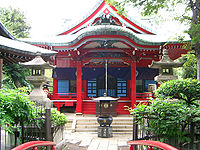
on her head (see photo above). Pavilions or entire shrines are often dedicated to her, as in the case of Kamakura's Zeniarai Benzaiten Ugafuku Shrine.
External links
Sources
- Japan and Indian Asia by Hajime Nakamura. Publisher: Firma KLM, 1961. Publication Date: 1961
- India and Japan: A Study in interaction during 5th cent - 14th century - By Upendra Thakur .