
In
musicMusic is an art form whose medium is sound and silence. Its common elements are pitch , rhythm , dynamics, and the sonic qualities of timbre and texture...
,
timbre (icon or ˈ; tɛ̃bʁ) is the quality of a musical note or sound or tone that distinguishes different types of sound production, such as voices and
musical instrumentA musical instrument is a device created or adapted for the purpose of making musical sounds. In principle, any object that produces sound can serve as a musical instrument—it is through purpose that the object becomes a musical instrument. The history of musical instruments dates back to the...
s, such as string instruments, wind instruments, and percussion instruments. The physical characteristics of sound that determine the perception of timbre include spectrum and envelope. In
psychoacousticsPsychoacoustics is the scientific study of sound perception. More specifically, it is the branch of science studying the psychological and physiological responses associated with sound...
, timbre is also called
tone quality and
tone color.
In simple terms, timbre is what makes a particular musical sound different from another, even when they have the same pitch and loudness. For instance, it is the difference between a guitar and a piano playing the same note at the same loudness. Learned musicians are able to distinguish between different instruments based on their
variedIn music, variation is a formal technique where material is repeated in an altered form. The changes may involve harmony, melody, counterpoint, rhythm, timbre, orchestration or any combination of these.-Variation form:...
timbres, even if those instruments are playing notes at the same
pitchPitch is an auditory perceptual property that allows the ordering of sounds on a frequency-related scale.Pitches are compared as "higher" and "lower" in the sense associated with musical melodies,...
and
loudnessLoudness is the quality of a sound that is primarily a psychological correlate of physical strength . More formally, it is defined as "that attribute of auditory sensation in terms of which sounds can be ordered on a scale extending from quiet to loud."Loudness, a subjective measure, is often...
.
Timbre has been called a "wastebasket" attribute (Dixon Ward, 1965)) or category (Tobias 1970, 409), or "the psychoacoustician's multidimensional wastebasket category for everything that cannot be qualified as pitch or loudness" (McAdams and Bregman, 1979).
Synonyms
Tone quality and
color are synonyms for
timbre, as well as the "
texture attributed to a single instrument". Helmholtz used the German
Klangfarbe (
tone color), and
TyndallTyndall is the name of an English family taken from the land they held as tenants in chief of the Kings of England and Scotland in the 11th, 12th and 13th centuries: Tynedale, or the valley of the Tyne, in Northumberland...
proposed an English translation,
clangtint. But both terms were disapproved of by
Alexander EllisAlexander John Ellis FRS was an English mathematician and philologist. He changed his name from his father's name Sharpe to his mother's maiden name Ellis in 1825, based on a condition for receiving significant financial support from a relative on his mother's side.- Biography :He was born...
, who also discredits
register and
color for their pre-existing English meanings (Erickson 1975, 7).
The sound of a
musical instrumentA musical instrument is a device created or adapted for the purpose of making musical sounds. In principle, any object that produces sound can serve as a musical instrument—it is through purpose that the object becomes a musical instrument. The history of musical instruments dates back to the...
may be described with such words as
bright,
dark,
warm,
harsh, and other terms. There are also
colors of noiseWhile noise is by definition derived from a random signal, it can have different characteristic statistical properties corresponding to different mappings from a source of randomness to the concrete noise. Spectral density is such a property, which can be used to distinguish different types of noise...
, such as
pinkPink noise or 1/ƒ noise is a signal or process with a frequency spectrum such that the power spectral density is inversely proportional to the frequency. In pink noise, each octave carries an equal amount of noise power...
and
whiteWhite noise is a random signal with a flat power spectral density. In other words, the signal contains equal power within a fixed bandwidth at any center frequency...
.
In visual representations of sound, timbre corresponds to the shape of the image (Abbado 1988, 3).
American Standards Association definition
The American Standards Association definition 12.9 of timbre describes it as "that attribute of sensation in terms of which a listener can judge that two sounds having the same
loudnessLoudness is the quality of a sound that is primarily a psychological correlate of physical strength . More formally, it is defined as "that attribute of auditory sensation in terms of which sounds can be ordered on a scale extending from quiet to loud."Loudness, a subjective measure, is often...
and
pitchPitch is an auditory perceptual property that allows the ordering of sounds on a frequency-related scale.Pitches are compared as "higher" and "lower" in the sense associated with musical melodies,...
are dissimilar", and a note to this definition adds that "timbre depends primarily upon the spectrum of the stimulus, but it also depends upon the waveform, the sound pressure, the frequency location of the spectrum, and the temporal characteristics of the stimulus" (American Standards Association 1960, 45).
Attributes
Many commentators have attempted to decompose timbre into component attributes. For example, J. F. Schouten (1968, p. 42) describes the "elusive attributes of timbre" as "determined by at least five major acoustic parameters", which
Robert EricksonRobert Erickson was an American composer.He studied with Ernst Krenek from 1936-1947: "I had already studied—and abandoned—the twelve tone system before most other Americans had taken it up." He influenced notable students Morton Subotnick, Pauline Oliveros, Terry Riley, and Paul Dresher...
(1975) finds "scaled to the concerns of much contemporary music":
- The range between tonal
Tonality is a system of music in which specific hierarchical pitch relationships are based on a key "center", or tonic. The term tonalité originated with Alexandre-Étienne Choron and was borrowed by François-Joseph Fétis in 1840...
and noiseIn common use, the word noise means any unwanted sound. In both analog and digital electronics, noise is random unwanted perturbation to a wanted signal; it is called noise as a generalisation of the acoustic noise heard when listening to a weak radio transmission with significant electrical noise...
like character.
- The spectral envelope
A spectral envelope is a curve in the frequency-amplitude plane, derived from a Fourier magnitude spectrum. It describes one point in time ....
.
- The time envelope in terms of rise, duration, and decay (ADSR—attack, decay, sustain, release).
- The changes both of spectral envelope
A spectral envelope is a curve in the frequency-amplitude plane, derived from a Fourier magnitude spectrum. It describes one point in time ....
(formant-glide) and fundamental frequencyThe fundamental frequency, often referred to simply as the fundamental and abbreviated f0, is defined as the lowest frequency of a periodic waveform. In terms of a superposition of sinusoids The fundamental frequency, often referred to simply as the fundamental and abbreviated f0, is defined as the...
(micro-intonationMicrotonal music is music using microtones—intervals of less than an equally spaced semitone. Microtonal music can also refer to music which uses intervals not found in the Western system of 12 equal intervals to the octave.-Terminology:...
).
- The prefix, an onset of a sound quite dissimilar to the ensuing lasting vibration.
(Erickson 1975, 6) gives a table of subjective experiences and related physical phenomena based on Schouten's five attributes:
| Subjective |
Objective |
| Tonal character, usually pitched |
Periodic sound |
| Noisy, with or without some tonal character, including rustle noise Rustle noise is noise consisting of aperiodic pulses characterized by the average time between those pulses , known as rustle time...
|
Noise, including random pulses characterized by the rustle time (the mean interval between pulses) |
| Coloration |
Spectral envelope |
| Beginning/ending |
Physical rise and decay time |
| Coloration glide or formant glide |
Change of spectral envelope |
| Microintonation |
Small change (one up and down) in frequency |
| Vibrato |
Frequency modulation |
| Tremolo |
Amplitude modulation |
| Attack |
Prefix |
| Final sound |
Suffix |
See also "Psychoacoustic evidence" below.
Harmonics
The richness of a sound or note produced by a musical instrument is sometimes described in terms of a sum of a number of distinct
frequenciesFrequency is the number of occurrences of a repeating event per unit time. It is also referred to as temporal frequency.The period is the duration of one cycle in a repeating event, so the period is the reciprocal of the frequency...
. The lowest frequency is called the
fundamental frequencyThe fundamental frequency, often referred to simply as the fundamental and abbreviated f0, is defined as the lowest frequency of a periodic waveform. In terms of a superposition of sinusoids The fundamental frequency, often referred to simply as the fundamental and abbreviated f0, is defined as the...
and the
pitchPitch is an auditory perceptual property that allows the ordering of sounds on a frequency-related scale.Pitches are compared as "higher" and "lower" in the sense associated with musical melodies,...
it produces is used to name the note, but the fundamental frequency is not always the dominant frequency. The dominant frequency is the frequency that is most heard, and it is always a multiple of the fundamental frequency. For example, the dominant frequency for the transverse flute is double the fundamental frequency. Other significant frequencies are called
overtoneAn overtone is any frequency higher than the fundamental frequency of a sound. The fundamental and the overtones together are called partials. Harmonics are partials whose frequencies are whole number multiples of the fundamental These overlapping terms are variously used when discussing the...
s of the fundamental frequency, which may include
harmonicA harmonic of a wave is a component frequency of the signal that is an integer multiple of the fundamental frequency, i.e. if the fundamental frequency is f, the harmonics have frequencies 2f, 3f, 4f, . . . etc. The harmonics have the property that they are all periodic at the fundamental...
s and
partialPartial may refer to:*partial derivative, in mathematics** ∂, the partial derivative symbol, often read as "partial"*partial function, in mathematics*partial algorithm, in computer science*part score, in contract bridge...
s. Harmonics are
whole numberWhole number is a term with inconsistent definitions by different authors. All distinguish whole numbers from fractions and numbers with fractional parts.Whole numbers may refer to:*natural numbers in sense — the positive integers...
multiples of the fundamental frequency, such as ×2, ×3, ×4, etc. Partials are other overtones. Sometimes there are also
subharmonicSubharmonic frequencies are frequencies below the fundamental frequency of an oscillator in a ratio of 1/n, with n a positive integer number. For example, if the fundamental frequency of an oscillator is 440 Hz, sub-harmonics include 220 Hz and 110 Hz...
s at whole number *divisions* of the fundamental frequency. Most western instruments produce harmonic sounds, but many instruments produce partials and inharmonic tones, such as cymbals and other indefinite-pitched instruments.
When the orchestral tuning note is played, the sound is a combination of 440 Hz, 880 Hz, 1320 Hz, 1760 Hz and so on. Each instrument in the orchestra will produce a different combination of these frequencies, as well as harmonics and overtones. The sound waves of the different frequencies will overlap and combine, and it is the balance of these amplitudes that is a major factor in the characteristic sound of each instrument.
William SetharesWilliam A. Sethares is an American music theorist and professor of Electrical engineering and who is known primarily for his contributions to music theory, including dynamic tonality and a formalization of the source of consonance....
wrote that
just intonationIn music, just intonation is any musical tuning in which the frequencies of notes are related by ratios of small whole numbers. Any interval tuned in this way is called a just interval. The two notes in any just interval are members of the same harmonic series...
and the western
equal temperedAn equal temperament is a musical temperament, or a system of tuning, in which every pair of adjacent notes has an identical frequency ratio. As pitch is perceived roughly as the logarithm of frequency, this means that the perceived "distance" from every note to its nearest neighbor is the same for...
scale are related to the harmonic
spectraA spectrum is a condition that is not limited to a specific set of values but can vary infinitely within a continuum. The word saw its first scientific use within the field of optics to describe the rainbow of colors in visible light when separated using a prism; it has since been applied by...
/timbre of many western instruments in an analogous way that the inharmonic timbre of the
ThaiThe music of Thailand reflects its geographic position at the intersection of China and India, and reflects trade routes that have historically included Persia, Africa, Greece and Rome...
renat (a xylophone-like instrument) is related to the seven-tone near-equal tempered
pelogPelog is one of the two essential scales of gamelan music native to Bali and Java, in Indonesia. The other scale commonly used is called slendro. Pelog has seven notes, but many gamelan ensembles only have keys for five of the pitches...
scale in which they are tuned. Similarly, the inharmonic spectra of
BaliBali is an Indonesian island located in the westernmost end of the Lesser Sunda Islands, lying between Java to the west and Lombok to the east...
nese metallophones combined with harmonic instruments such as the stringed
rebabThe rebab , also rebap, rabab, rebeb, rababah, or al-rababa) is a type of string instrument so named no later than the 8th century and spread via Islamic trading routes over much of North Africa, the Middle East, parts of Europe, and the Far East...
or the voice, are related to the five-note near-equal tempered
slendroSlendro is a pentatonic scale, one of the two most common scales used in Indonesian gamelan music, the other being pélog.-Tuning:...
scale commonly found in Indonesian
gamelanA gamelan is a musical ensemble from Indonesia, typically from the islands of Bali or Java, featuring a variety of instruments such as metallophones, xylophones, drums and gongs; bamboo flutes, bowed and plucked strings. Vocalists may also be included....
music (Sethares 1998, 6, 211, 318).
Envelope
The timbre of a sound is also greatly affected by the following aspects of its
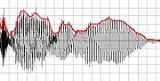
envelope: attack time and characteristics, decay, sustain, release (ADSR envelope) and transients. Thus these are all common controls on synthesizers. For instance, if one takes away the attack from the sound of a piano or trumpet, it becomes more difficult to identify the sound correctly, since the sound of the hammer hitting the strings or the first blat of the player's lips are highly characteristic of those instruments. The envelope is the overall amplitude structure of a sound, so called because the sound just "fits" inside its envelope: what this means should be clear from a time-domain display of almost any interesting sound, zoomed out enough that the entire waveform is visible.
Timbre in music history
The music of Debussy, composed during the last decades of the nineteenth and the first decades of the twentieth centuries, has been credited with elevating the role of timbre in music: "To a marked degree the music of Debussy elevates timbre to an unprecedented structural status; already in
Prélude à l'après-midi d'un faunePrélude à l'après-midi d'un faune , commonly known by its English title Prelude to the Afternoon of a Faun, is a symphonic poem for orchestra by Claude Debussy, approximately 10 minutes in duration...
the
color of
fluteThe flute is a musical instrument of the woodwind family. Unlike woodwind instruments with reeds, a flute is an aerophone or reedless wind instrument that produces its sound from the flow of air across an opening...
and
harpThe harp is a multi-stringed instrument which has the plane of its strings positioned perpendicularly to the soundboard. Organologically, it is in the general category of chordophones and has its own sub category . All harps have a neck, resonator and strings...
functions referentially" (Samson 1977).
Psychoacoustic evidence
Often listeners are able to identify the kind of instrument even across "conditions of changing pitch and loudness, in different environments and with different players". In the case of the
clarinetThe clarinet is a musical instrument of woodwind type. The name derives from adding the suffix -et to the Italian word clarino , as the first clarinets had a strident tone similar to that of a trumpet. The instrument has an approximately cylindrical bore, and uses a single reed...
, an acoustic analysis of the waveforms shows they are irregular enough to suggest three instruments rather than one. David Luce (1963, 16) suggests that this implies "certain strong regularities in the acoustic waveform of the above instruments must exist which are invariant with respect to the above variables". However, Robert Erickson argues that there are few regularities and they do not explain our "powers of recognition and identification". He suggests the borrowing from studies of vision and
visual perceptionVisual perception is the ability to interpret information and surroundings from the effects of visible light reaching the eye. The resulting perception is also known as eyesight, sight, or vision...
the concept of
subjective constancySubjective constancy or perceptual constancy is the perception of an object or quality as constant under changing conditions.-Vision:There are several types of perceptual constancies in Visual perception:-* Shape constancy* Size constancy...
(Erickson 1975, 11).
Psychoacoustic experiments from the 1960s onwards tried to elucidate the nature of timbre. One method involves playing pairs of sounds to listeners and then using a
multidimensional scalingMultidimensional scaling is a set of related statistical techniques often used in information visualization for exploring similarities or dissimilarities in data. MDS is a special case of ordination. An MDS algorithm starts with a matrix of item–item similarities, then assigns a location to each...
algorithm to aggregate their dissimilarity judgements into a timbre space; the most consistent outcomes from such experiments are that brightness or spectral energy distribution (Grey 1977), and the "bite", or rate and synchronicity (Wessel 1979) and rise time (Lakatos 2000), of the attack are important factors.