

Paionia

Encyclopedia
In ancient geography, Paeonia or Paionia was the land of the Paeonians (Ancient Greek
Παίονες). The exact original boundaries of Paeonia, like the early history of its inhabitants, are very obscure, but it is believed that they lay in the region of Thrace
. In the time of Classical Greece
, Paeonia might have later included the whole Vardar
River valley and the surrounding areas, in what is now a small strip along the northern part of the Greek
region of Macedonia
, most of the present-day Republic of Macedonia
, and a small part of southwestern Bulgaria
.
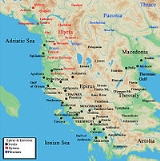
It was located immediately north of ancient Macedonia (which roughly corresponds to the modern Greek
region of Macedonia
) and to the south-east of Dardania (roughly corresponding to modern-day Kosovo
). In the east were Thracians
and in the west the Illyrians
. From Dardania, Paeonia was separated by the mountains through which the Axius passes from the field of Scupi
to the valley of Bylazora
(Veles)
, or of mixed Thraco-Illyrian
origins. They were later hellenised. Linguistically the Paeonian language has been variously connected to its neighboring languages - Illyrian
and Thracian
; (and every possible Thraco-Illyrian
mix in between). Several eastern Paeonian tribes including the Agrianes
, clearly fell within the Thracian sphere of influence. Yet according to the national legend (Herodotus v. 13), they were Teucrian colonists from Troy
. Homer
(Iliad
, book II, line 848) speaks of Paeonians from the Axios
fighting on the side of the Troja
ns, but the Iliad does not mention whether the Paeonians were kin to the Trojans. Homer
gives the Paeonian leader as a certain Pyraechmes
(parentage unknown); but later on in the Iliad (Book 21)Homer mentions a second leader, named Asteropaeus, son of Pelagon
.
Before the reign of Darius Hystaspes, they had made their way as far east as Perinthus in Thrace
on the Propontis. At one time all Mygdonia
, together with Crestonia
, was subject to them. When Xerxes
crossed Chalcidice
on his way to Therma
(later renamed Thessalonica) he is said to have marched through Paeonian territory. They occupied the entire valley of the Axios (Vardar
) as far inland as Stobi
, the valleys to the east of it as far as the Strymon and the country round Astibus and the river of the same name, with the water of which they anointed their kings. Emathia, roughly the district between the Haliacmon
and Axios, was once called Paeonia; and Pieria and Pelagonia
were inhabited by Paeonians. In consequence of the growth of Macedonian power, and under pressure from their Thracian neighbors, their territory was considerably diminished, and in historical times was limited to the north of Macedonia from Illyria to the Strymon.
In Greek mythology
the Paeonians were said to have derived their name from Paeon
the son of Endymion
.
(now Veles
in the Republic of Macedonia
) on the Axios; later the seat of the kings was moved to Stobi
(now Pusto Gradsko). At some point thereafter, the Paeonian princedoms coalesced into a kingdom centered in the central and upper reaches of the Vardar
and Struma
rivers. They joined with the Illyrians to infiltrated the northern most populated areas of the Hellenic state of Macedonia. The Illyrians, who had a culture of piracy, would have been cut off from some trade routes if movement through this land had been blocked. They attacked the northern defenses of Macedonian territory unsuccessfully in an attempt to occupy the region. In 360-359 BC, southern Paeonian tribes were launching raids into Macedon
, (Diodorus XVI. 2.5) in support of an Illyrian invasion.
The Macedonian Royal House was thrown into a state of uncertainty by the death of Perdiccas III
, but his brother Philip II
assumed the throne, reformed the army (providing phalanxes), and proceeded to stop both the Illyrian invasion and the Paeonian raids through the boundary of the "Macedonian Frontier" which was the northern perimeter which he intended to defend as an area of his domain. He followed Perdiccas's success in 358 BC with a campaign deep into the north, into Paeonia itself. This reduced the Paeonian kingdom (then ruled by Agis
) to a semi-autonomous, subordinate status, which led to a process of gradual and formal Hellenization
of the Paeonians,who began during the reign of Philip II to issue coins with Greek legends like the Macedonian ones. This also united Hellenic peoples and clans that had not belonged to another Hellenic state within that region. A Paeonian contingent was attached to Alexander the Great's army.
At the time of the Persian invasion, the Paeonians on the lower Strymon had lost, while those in the north maintained, their territorial determination. The daughter of Audoleon
, one of these kings, was the wife of Pyrrhus
, king of Epirus
, and Alexander the Great wished to bestow the hand of his sister Cynane
upon Langarus
, who had shown himself loyal to Philip II. Alexander the Great's mother was from the Hellenic state of Epirus
and was an Epirot by blood. A genial dynasty also continued through the reigns of Paeonian kings.
, known amongst them as Dyalus or Dryalus, and Herodotus mentions that the Thracian
and Paeonian women offered sacrifice to Queen Artemis
(probably Bendis
). They worshipped the sun in the form of a small round disk fixed on the top of a pole. A passage in Athenaeus
seems to indicate the affinity of their language with Mysian
. They drank barley beer
and various decoctions made from plants and herbs. The country was rich in gold
and a bituminous kind of wood (or stone, which burst into a blaze when in contact with water) called tanrivoc (or tsarivos).
The scanty remains of the Paeonian language do not allow firm judgement to be made. On one side are Wilhelm Tomaschek and Paul Kretschmer, who claim it belonged to the Illyrian family, and on the other side is Dimitar Dečev, who claims affinities with Thracian. On the other hand, the Paeonian kings issued coins from the time of Philip II of Macedon onwards, bearing their names written in Greek. All the names of the Paeonian Kings that have come down to us are in fact explainable with and clearly related to Greek (Agis, Ariston, Audoleon, Lycceios, etc), a fact which according to Irwin L. Merker which puts into question the theories of Illyrian and Thracian connections.
The women were famous for their industry. In this connection Herodotus (v. 12) tells the story that Darius
, having seen at Sardis
a beautiful Paeonian woman carrying a pitcher on her head, leading a horse to drink, and spinning flax
, all at the same time, inquired who she was. Having been informed that she was a Paeonian, he sent instructions to Megabazus
, commander in Thrace, to deport two tribes of the nation without delay to Asia. An inscription, discovered in 1877 at Olympia
on the base of a statue, states that it was set up by the community of the Paeonians in honor of their king and founder Dropion
. Another king, whose name appears as Lyppeius on a fragment of an inscription found at Athens
relating to a treaty of alliance is no doubt identical with the Lycceius or Lycpeius of Paeonian coins (see B. V. Head, Historia numorum, 1887, p. 207).
invaders under Brennus ravaged the land of the Paeonians, who, being further hard pressed by the Dardani
, had no alternative but to join the Macedonians. Despite their combined efforts, however, the Paeonians and Macedonians were defeated. Paeonia consolidated again but in 217 BC the Macedonian king Philip V of Macedon
(220-179 BC), the son of Demetrius II, succeeded in uniting and incorporating into his empire
the separate regions of Dassaretia and Paeonia. A mere 70 years later (in 168 BC), Roman legions conquered Macedon in turn. Paeonia around the Axios formed the second and third districts respectively of the newly constituted Roman province of Macedonia (Livy xiv. 29). Centuries later under Diocletian
, Paeonia and Pelagonia
formed a province called Macedonia Secunda or Macedonia Salutaris, belonging to the Praetorian prefecture of Illyricum
. However, by 400 AD the Paeonians, had lost their identity, and the term Paeonia had become a mere geographic identifier.
Ancient Greek
Ancient Greek is the stage of the Greek language in the periods spanning the times c. 9th–6th centuries BC, , c. 5th–4th centuries BC , and the c. 3rd century BC – 6th century AD of ancient Greece and the ancient world; being predated in the 2nd millennium BC by Mycenaean Greek...
Παίονες). The exact original boundaries of Paeonia, like the early history of its inhabitants, are very obscure, but it is believed that they lay in the region of Thrace
Thrace
Thrace is a historical and geographic area in southeast Europe. As a geographical concept, Thrace designates a region bounded by the Balkan Mountains on the north, Rhodope Mountains and the Aegean Sea on the south, and by the Black Sea and the Sea of Marmara on the east...
. In the time of Classical Greece
Classical Greece
Classical Greece was a 200 year period in Greek culture lasting from the 5th through 4th centuries BC. This classical period had a powerful influence on the Roman Empire and greatly influenced the foundation of Western civilizations. Much of modern Western politics, artistic thought, such as...
, Paeonia might have later included the whole Vardar
Vardar
The Vardar or Axios is the longest and major river in the Republic of Macedonia and also a major river of Greece. It is long, and drains an area of around . The maximum depth of river is ....
River valley and the surrounding areas, in what is now a small strip along the northern part of the Greek
Greece
Greece , officially the Hellenic Republic , and historically Hellas or the Republic of Greece in English, is a country in southeastern Europe....
region of Macedonia
Macedonia (Greece)
Macedonia is a geographical and historical region of Greece in Southern Europe. Macedonia is the largest and second most populous Greek region...
, most of the present-day Republic of Macedonia
Republic of Macedonia
Macedonia , officially the Republic of Macedonia , is a country located in the central Balkan peninsula in Southeast Europe. It is one of the successor states of the former Yugoslavia, from which it declared independence in 1991...
, and a small part of southwestern Bulgaria
Bulgaria
Bulgaria , officially the Republic of Bulgaria , is a parliamentary democracy within a unitary constitutional republic in Southeast Europe. The country borders Romania to the north, Serbia and Macedonia to the west, Greece and Turkey to the south, as well as the Black Sea to the east...
.
It was located immediately north of ancient Macedonia (which roughly corresponds to the modern Greek
Greece
Greece , officially the Hellenic Republic , and historically Hellas or the Republic of Greece in English, is a country in southeastern Europe....
region of Macedonia
Macedonia (Greece)
Macedonia is a geographical and historical region of Greece in Southern Europe. Macedonia is the largest and second most populous Greek region...
) and to the south-east of Dardania (roughly corresponding to modern-day Kosovo
Kosovo
Kosovo is a region in southeastern Europe. Part of the Ottoman Empire for more than five centuries, later the Autonomous Province of Kosovo and Metohija within Serbia...
). In the east were Thracians
Thracians
The ancient Thracians were a group of Indo-European tribes inhabiting areas including Thrace in Southeastern Europe. They spoke the Thracian language – a scarcely attested branch of the Indo-European language family...
and in the west the Illyrians
Illyrians
The Illyrians were a group of tribes who inhabited part of the western Balkans in antiquity and the south-eastern coasts of the Italian peninsula...
. From Dardania, Paeonia was separated by the mountains through which the Axius passes from the field of Scupi
Scupi
Scupi is an archaeological site located between Zajčev Rid and the Vardar River, several kilometers from the center of Skopje, in the Republic of Macedonia. A Roman military camp was founded here in the second decade BC on the site of an older Dardanian settlement...
to the valley of Bylazora
Bylazora
Bylazora or Vilazora is a Paeonian city that was located on the Axius River at Veles in the Republic of Macedonia. Polybius tells us that "King Philip V captured Bylazora, the largest town of Paeonia, and very favourably situated for commanding the pass from Dardania to Macedonia: so that by this...
(Veles)
Tribes
The Paeonian tribes were:- AgrianesAgrianesThe Agrianians a Paeonian-Thracian tribe, who chiefly inhabited the area of present-day Northeastern statistical region of Republic Of Macedonia and Pčinja District of southern Serbia, north of the Thracian Maedi tribe, who were situated in what is now the Greek region of Macedonia and Western...
(also, Agriani and Agrii) - AlmopiansAlmopiansAlmopians or Almopioi were an ancient Paeonian tribe in Thrace....
(also Almopioi) - LaeaeansLaeaeansThe Laeaeans were a Paeonian tribe who in the 4th century BC lived adjacent to the Agrianes, another Paeonian tribe, along the upper course of the Strymon river, at the western edge of Thrace. They were not incorporated into the Odrysian state or the Paeonian state, remaining an independent tribe...
(also Laeaei and Laiai) - DerronesDerronesThe Derrones were a Paionian tribe. Our knowledge of them comes from coins bearing variations of the legend of DERRONIKON - DERR . The letters used in the coins seem to be Greek...
(also Derroni) - Odomantes (also Odomanti)
- PaeoplaePaeoplaePaeoplae were an ancient Paeonian tribe in Thrace....
- Doberes
- SiropaionesSiropaionesSiropaiones were an ancient Paeonian tribe in Thrace....
Origin
Some modern scholars consider the Paionians to have been of either ThracianThracians
The ancient Thracians were a group of Indo-European tribes inhabiting areas including Thrace in Southeastern Europe. They spoke the Thracian language – a scarcely attested branch of the Indo-European language family...
, or of mixed Thraco-Illyrian
Thraco-Illyrian
Thraco-Illyrian refers to a hypothesis that the Thraco-Dacian and Illyrian languages comprise a distinct branch of Indo-European. Thraco-Illyrian is also used as a term merely implying a Thracian-Illyrian interference, mixture or sprachbund, or as a shorthand way of saying that it is not...
origins. They were later hellenised. Linguistically the Paeonian language has been variously connected to its neighboring languages - Illyrian
Illyrian languages
The Illyrian languages are a group of Indo-European languages that were spoken in the western part of the Balkans in former times by groups identified as Illyrians: Ardiaei, Delmatae, Pannonii, Autariates, Taulanti...
and Thracian
Thracian language
The Thracian language was the Indo-European language spoken in ancient times in Southeastern Europe by the Thracians, the northern neighbors of the Ancient Greeks. The Thracian language exhibits satemization: it either belonged to the Satem group of Indo-European languages or it was strongly...
; (and every possible Thraco-Illyrian
Thraco-Illyrian
Thraco-Illyrian refers to a hypothesis that the Thraco-Dacian and Illyrian languages comprise a distinct branch of Indo-European. Thraco-Illyrian is also used as a term merely implying a Thracian-Illyrian interference, mixture or sprachbund, or as a shorthand way of saying that it is not...
mix in between). Several eastern Paeonian tribes including the Agrianes
Agrianes
The Agrianians a Paeonian-Thracian tribe, who chiefly inhabited the area of present-day Northeastern statistical region of Republic Of Macedonia and Pčinja District of southern Serbia, north of the Thracian Maedi tribe, who were situated in what is now the Greek region of Macedonia and Western...
, clearly fell within the Thracian sphere of influence. Yet according to the national legend (Herodotus v. 13), they were Teucrian colonists from Troy
Troy
Troy was a city, both factual and legendary, located in northwest Anatolia in what is now Turkey, southeast of the Dardanelles and beside Mount Ida...
. Homer
Homer
In the Western classical tradition Homer , is the author of the Iliad and the Odyssey, and is revered as the greatest ancient Greek epic poet. These epics lie at the beginning of the Western canon of literature, and have had an enormous influence on the history of literature.When he lived is...
(Iliad
Iliad
The Iliad is an epic poem in dactylic hexameters, traditionally attributed to Homer. Set during the Trojan War, the ten-year siege of the city of Troy by a coalition of Greek states, it tells of the battles and events during the weeks of a quarrel between King Agamemnon and the warrior Achilles...
, book II, line 848) speaks of Paeonians from the Axios
Vardar
The Vardar or Axios is the longest and major river in the Republic of Macedonia and also a major river of Greece. It is long, and drains an area of around . The maximum depth of river is ....
fighting on the side of the Troja
Troja
Troja can refer to several different places:*Troy, in Asia Minor*Troia , a town and commune in the province of Foggia, in southern Italy*Troja , a Heavy Metal band from Kosovo*Troja, Kosovo, a hamlet in Kosovo near Gjakova...
ns, but the Iliad does not mention whether the Paeonians were kin to the Trojans. Homer
Homer
In the Western classical tradition Homer , is the author of the Iliad and the Odyssey, and is revered as the greatest ancient Greek epic poet. These epics lie at the beginning of the Western canon of literature, and have had an enormous influence on the history of literature.When he lived is...
gives the Paeonian leader as a certain Pyraechmes
Pyraechmes
Pyraechmes was, along with Asteropaeus, a leader of the Paeonians in the Trojan War. He came from the city of Amydon. Although Homer mentions Pyraechmes as the leader of the Paeonians early on in the Iliad, in the Trojan Catalogue, Pyraechmes plays a minor role compared to the more illustrious...
(parentage unknown); but later on in the Iliad (Book 21)Homer mentions a second leader, named Asteropaeus, son of Pelagon
Pelagon
There are several figures named Pelagon in Greek mythology.# Pelagon, the King of Phocis who gives Cadmus the cow that will guide him to Boeotia....
.
Before the reign of Darius Hystaspes, they had made their way as far east as Perinthus in Thrace
Thrace
Thrace is a historical and geographic area in southeast Europe. As a geographical concept, Thrace designates a region bounded by the Balkan Mountains on the north, Rhodope Mountains and the Aegean Sea on the south, and by the Black Sea and the Sea of Marmara on the east...
on the Propontis. At one time all Mygdonia
Mygdonia (Europe)
Mygdonia was an ancient territory, part of Ancient Thrace, later conquered by Macedon, which comprised the plains around Therma together with the valleys of Klisali and Besikia, including the area of the Axios river mouth and extending as far east as Lake Bolbe. To the north it was joined by...
, together with Crestonia
Crestonia
Crestonia was an ancient region immediately north of Mygdonia. The Echeidorus river, which flowed through Mygdonia into the Thermaic Gulf, had its source in Crestonia...
, was subject to them. When Xerxes
Xerxes I of Persia
Xerxes I of Persia , Ḫšayāršā, ), also known as Xerxes the Great, was the fifth king of kings of the Achaemenid Empire.-Youth and rise to power:...
crossed Chalcidice
Chalcidice
Chalkidiki, also Halkidiki, Chalcidice or Chalkidike , is a peninsula in northern Greece, and one of the regional units of Greece. It is part of the region of Central Macedonia. The autonomous Mount Athos region is part of the peninsula, but not of the regional unit...
on his way to Therma
Therma
Therma or Thermē was a Greek city founded by Eretrians or Corinthians in late 7th century BC in ancient Mygdonia , situated at the northeastern extremity of a great gulf of the Aegean Sea, the Thermaic Gulf. The city was built amidst mosquito-infested swampland, and its name derives from the...
(later renamed Thessalonica) he is said to have marched through Paeonian territory. They occupied the entire valley of the Axios (Vardar
Vardar
The Vardar or Axios is the longest and major river in the Republic of Macedonia and also a major river of Greece. It is long, and drains an area of around . The maximum depth of river is ....
) as far inland as Stobi
Stobi
Stobi was an ancient town of Paeonia, later conquered by Macedon, and later turned into the capital of the Roman province of Macedonia Salutaris . It is located on the main road that leads from the Danube to the Aegean Sea and is considered by many to be the most famous archaeological site in the...
, the valleys to the east of it as far as the Strymon and the country round Astibus and the river of the same name, with the water of which they anointed their kings. Emathia, roughly the district between the Haliacmon
Haliacmon
The Haliacmon is the longest river in Greece, with a total length of . Haliacmon is the traditional English name for the river, but many sources cite the formerly official Katharevousa version of the name, Aliákmon...
and Axios, was once called Paeonia; and Pieria and Pelagonia
Pelagonia
This is about the geographical plain between Greece and the Republic of Macedonia. For the political unit in Macedonia, go to Pelagonia Statistical Region....
were inhabited by Paeonians. In consequence of the growth of Macedonian power, and under pressure from their Thracian neighbors, their territory was considerably diminished, and in historical times was limited to the north of Macedonia from Illyria to the Strymon.
In Greek mythology
Greek mythology
Greek mythology is the body of myths and legends belonging to the ancient Greeks, concerning their gods and heroes, the nature of the world, and the origins and significance of their own cult and ritual practices. They were a part of religion in ancient Greece...
the Paeonians were said to have derived their name from Paeon
Paeon (son of Endymion)
Paeon in Greek mythology was a son of Endymion, king of Elis, and brother of Epeius, Aetolus, and Eurycyda; from whom the district of Paeonia, on the Axius river in Macedonia, was believed to have derived its name.-References:...
the son of Endymion
Endymion (mythology)
In Greek mythology, Endymion , was variously a handsome Aeolian shepherd or hunter or a king who ruled and was said to reside at Olympia in Elis, but he was also said to reside and was venerated on Mount Latmus in Caria, on the west coast of Asia Minor....
.
Paeonian kingdom
In early times, the chief town and seat of the Paionian kings was BylazoraBylazora
Bylazora or Vilazora is a Paeonian city that was located on the Axius River at Veles in the Republic of Macedonia. Polybius tells us that "King Philip V captured Bylazora, the largest town of Paeonia, and very favourably situated for commanding the pass from Dardania to Macedonia: so that by this...
(now Veles
Veles (city)
Veles is a city in the center of the Republic of Macedonia on the Vardar river. The city of Veles is the seat of Veles Municipality.-Name:The city's name was Vylosa in Ancient Greek and before the Balkan Wars, it was a township with the name Köprülü in the Üsküp sandjak, Ottoman empire for 600...
in the Republic of Macedonia
Republic of Macedonia
Macedonia , officially the Republic of Macedonia , is a country located in the central Balkan peninsula in Southeast Europe. It is one of the successor states of the former Yugoslavia, from which it declared independence in 1991...
) on the Axios; later the seat of the kings was moved to Stobi
Stobi
Stobi was an ancient town of Paeonia, later conquered by Macedon, and later turned into the capital of the Roman province of Macedonia Salutaris . It is located on the main road that leads from the Danube to the Aegean Sea and is considered by many to be the most famous archaeological site in the...
(now Pusto Gradsko). At some point thereafter, the Paeonian princedoms coalesced into a kingdom centered in the central and upper reaches of the Vardar
Vardar
The Vardar or Axios is the longest and major river in the Republic of Macedonia and also a major river of Greece. It is long, and drains an area of around . The maximum depth of river is ....
and Struma
Struma
The Struma was a ship chartered to carry Jewish refugees from Axis-allied Romania to British-controlled Palestine during World War II. On February 23, 1942, with its engine inoperable and its refugee passengers aboard, Turkish authorities towed the ship from Istanbul harbor through the Bosphorus...
rivers. They joined with the Illyrians to infiltrated the northern most populated areas of the Hellenic state of Macedonia. The Illyrians, who had a culture of piracy, would have been cut off from some trade routes if movement through this land had been blocked. They attacked the northern defenses of Macedonian territory unsuccessfully in an attempt to occupy the region. In 360-359 BC, southern Paeonian tribes were launching raids into Macedon
Macedon
Macedonia or Macedon was an ancient kingdom, centered in the northeastern part of the Greek peninsula, bordered by Epirus to the west, Paeonia to the north, the region of Thrace to the east and Thessaly to the south....
, (Diodorus XVI. 2.5) in support of an Illyrian invasion.
The Macedonian Royal House was thrown into a state of uncertainty by the death of Perdiccas III
Perdiccas III of Macedon
Perdiccas III was king of Macedonia from 368 to 359 BC, succeeding his brother Alexander II.Son of Amyntas III and Eurydice, he was underage when Alexander II was killed by Ptolemy of Aloros, who then ruled as regent. In 365, Perdiccas killed Ptolemy and assumed government.Of the reign of...
, but his brother Philip II
Philip II of Macedon
Philip II of Macedon "friend" + ἵππος "horse" — transliterated ; 382 – 336 BC), was a king of Macedon from 359 BC until his assassination in 336 BC. He was the father of Alexander the Great and Philip III.-Biography:...
assumed the throne, reformed the army (providing phalanxes), and proceeded to stop both the Illyrian invasion and the Paeonian raids through the boundary of the "Macedonian Frontier" which was the northern perimeter which he intended to defend as an area of his domain. He followed Perdiccas's success in 358 BC with a campaign deep into the north, into Paeonia itself. This reduced the Paeonian kingdom (then ruled by Agis
Agis (Paeonian)
Agis was an ancient Paeonian king....
) to a semi-autonomous, subordinate status, which led to a process of gradual and formal Hellenization
Hellenization
Hellenization is a term used to describe the spread of ancient Greek culture, and, to a lesser extent, language. It is mainly used to describe the spread of Hellenistic civilization during the Hellenistic period following the campaigns of Alexander the Great of Macedon...
of the Paeonians,who began during the reign of Philip II to issue coins with Greek legends like the Macedonian ones. This also united Hellenic peoples and clans that had not belonged to another Hellenic state within that region. A Paeonian contingent was attached to Alexander the Great's army.
At the time of the Persian invasion, the Paeonians on the lower Strymon had lost, while those in the north maintained, their territorial determination. The daughter of Audoleon
Audoleon
Audoleon was an ancient Paeonian king son of Patraus or Agis. He was a contemporary of Alexander the Great, and was the father of Ariston, who distinguished himself at the battle of Gaugamela, and of a daughter who married Pyrrhus of Epirus...
, one of these kings, was the wife of Pyrrhus
Pyrrhus of Epirus
Pyrrhus or Pyrrhos was a Greek general and statesman of the Hellenistic era. He was king of the Greek tribe of Molossians, of the royal Aeacid house , and later he became king of Epirus and Macedon . He was one of the strongest opponents of early Rome...
, king of Epirus
Epirus
The name Epirus, from the Greek "Ήπειρος" meaning continent may refer to:-Geographical:* Epirus - a historical and geographical region of the southwestern Balkans, straddling modern Greece and Albania...
, and Alexander the Great wished to bestow the hand of his sister Cynane
Cynane
Cynane was half-sister to Alexander the Great, and daughter of Philip II by Audata, an Illyrian princess....
upon Langarus
Langarus
Langarus , king of the Agrianians, was a contemporary of Alexander the Great , with whom he ingratiated himself even before the death of Philip II, previous king of Macedon. He rendered Alexander important services shortly after his accession, in his expedition against the Illyrians and...
, who had shown himself loyal to Philip II. Alexander the Great's mother was from the Hellenic state of Epirus
Epirus
The name Epirus, from the Greek "Ήπειρος" meaning continent may refer to:-Geographical:* Epirus - a historical and geographical region of the southwestern Balkans, straddling modern Greece and Albania...
and was an Epirot by blood. A genial dynasty also continued through the reigns of Paeonian kings.
Culture
The Paeonians included several independent tribes, all later united under the rule of a single king. Little is known of their manners and customs. They adopted the cult of DionysusDionysus
Dionysus was the god of the grape harvest, winemaking and wine, of ritual madness and ecstasy in Greek mythology. His name in Linear B tablets shows he was worshipped from c. 1500—1100 BC by Mycenean Greeks: other traces of Dionysian-type cult have been found in ancient Minoan Crete...
, known amongst them as Dyalus or Dryalus, and Herodotus mentions that the Thracian
Thracians
The ancient Thracians were a group of Indo-European tribes inhabiting areas including Thrace in Southeastern Europe. They spoke the Thracian language – a scarcely attested branch of the Indo-European language family...
and Paeonian women offered sacrifice to Queen Artemis
Artemis
Artemis was one of the most widely venerated of the Ancient Greek deities. Her Roman equivalent is Diana. Some scholars believe that the name and indeed the goddess herself was originally pre-Greek. Homer refers to her as Artemis Agrotera, Potnia Theron: "Artemis of the wildland, Mistress of Animals"...
(probably Bendis
Bendis
Bendis was a Thracian goddess of the moon and the hunt whom the Greeks identified with Artemis. She was a huntress, like Artemis, but was accompanied by dancing satyrs and maenads on a fifth century red-figure stemless cup ....
). They worshipped the sun in the form of a small round disk fixed on the top of a pole. A passage in Athenaeus
Athenaeus
Athenaeus , of Naucratis in Egypt, Greek rhetorician and grammarian, flourished about the end of the 2nd and beginning of the 3rd century AD...
seems to indicate the affinity of their language with Mysian
Mysian language
Mysian language was the languages spoken by Mysians inhabiting Mysia in north-west Anatolia.Little is known about the Mysian language. Strabo noted that their language was, in a way, a mixture of the Lydian and Phrygian languages. As such, the Mysian language could be a language of the Anatolian...
. They drank barley beer
Beer
Beer is the world's most widely consumed andprobably oldest alcoholic beverage; it is the third most popular drink overall, after water and tea. It is produced by the brewing and fermentation of sugars, mainly derived from malted cereal grains, most commonly malted barley and malted wheat...
and various decoctions made from plants and herbs. The country was rich in gold
Gold
Gold is a chemical element with the symbol Au and an atomic number of 79. Gold is a dense, soft, shiny, malleable and ductile metal. Pure gold has a bright yellow color and luster traditionally considered attractive, which it maintains without oxidizing in air or water. Chemically, gold is a...
and a bituminous kind of wood (or stone, which burst into a blaze when in contact with water) called tanrivoc (or tsarivos).
The scanty remains of the Paeonian language do not allow firm judgement to be made. On one side are Wilhelm Tomaschek and Paul Kretschmer, who claim it belonged to the Illyrian family, and on the other side is Dimitar Dečev, who claims affinities with Thracian. On the other hand, the Paeonian kings issued coins from the time of Philip II of Macedon onwards, bearing their names written in Greek. All the names of the Paeonian Kings that have come down to us are in fact explainable with and clearly related to Greek (Agis, Ariston, Audoleon, Lycceios, etc), a fact which according to Irwin L. Merker which puts into question the theories of Illyrian and Thracian connections.
The women were famous for their industry. In this connection Herodotus (v. 12) tells the story that Darius
Darius I of Persia
Darius I , also known as Darius the Great, was the third king of kings of the Achaemenid Empire...
, having seen at Sardis
Sardis
Sardis or Sardes was an ancient city at the location of modern Sart in Turkey's Manisa Province...
a beautiful Paeonian woman carrying a pitcher on her head, leading a horse to drink, and spinning flax
Flax
Flax is a member of the genus Linum in the family Linaceae. It is native to the region extending from the eastern Mediterranean to India and was probably first domesticated in the Fertile Crescent...
, all at the same time, inquired who she was. Having been informed that she was a Paeonian, he sent instructions to Megabazus
Megabazus
Megabazus was a highly regarded Persian general under Darius. Most information about him comes from The Histories by Herodotus. Troops left behind in Europe after a failed attempt to conquer the Scythians were put under the command of Megabazus. He was given a mission to conquer Thrace, in...
, commander in Thrace, to deport two tribes of the nation without delay to Asia. An inscription, discovered in 1877 at Olympia
Olympia, Greece
Olympia , a sanctuary of ancient Greece in Elis, is known for having been the site of the Olympic Games in classical times, comparable in importance to the Pythian Games held in Delphi. Both games were held every Olympiad , the Olympic Games dating back possibly further than 776 BC...
on the base of a statue, states that it was set up by the community of the Paeonians in honor of their king and founder Dropion
Dropion
Dropion , was an ancient Paeonian king, son of Leon of Paionia....
. Another king, whose name appears as Lyppeius on a fragment of an inscription found at Athens
Athens
Athens , is the capital and largest city of Greece. Athens dominates the Attica region and is one of the world's oldest cities, as its recorded history spans around 3,400 years. Classical Athens was a powerful city-state...
relating to a treaty of alliance is no doubt identical with the Lycceius or Lycpeius of Paeonian coins (see B. V. Head, Historia numorum, 1887, p. 207).
Decline
In 280 BC the GallicGauls
The Gauls were a Celtic people living in Gaul, the region roughly corresponding to what is now France, Belgium, Switzerland and Northern Italy, from the Iron Age through the Roman period. They mostly spoke the Continental Celtic language called Gaulish....
invaders under Brennus ravaged the land of the Paeonians, who, being further hard pressed by the Dardani
Dardani
Dardania was the region of the Dardani .Located at the Thraco-Illyrian contact zone, their identification as either an Illyrian or Thracian tribe is uncertain. Their territory itself was not considered part of Illyria by Strabo. The term used for their territory was , while for other tribes had...
, had no alternative but to join the Macedonians. Despite their combined efforts, however, the Paeonians and Macedonians were defeated. Paeonia consolidated again but in 217 BC the Macedonian king Philip V of Macedon
Philip V of Macedon
Philip V was King of Macedon from 221 BC to 179 BC. Philip's reign was principally marked by an unsuccessful struggle with the emerging power of Rome. Philip was attractive and charismatic as a young man...
(220-179 BC), the son of Demetrius II, succeeded in uniting and incorporating into his empire
Ancient Macedonians
The Macedonians originated from inhabitants of the northeastern part of the Greek peninsula, in the alluvial plain around the rivers Haliacmon and lower Axios...
the separate regions of Dassaretia and Paeonia. A mere 70 years later (in 168 BC), Roman legions conquered Macedon in turn. Paeonia around the Axios formed the second and third districts respectively of the newly constituted Roman province of Macedonia (Livy xiv. 29). Centuries later under Diocletian
Diocletian
Diocletian |latinized]] upon his accession to Diocletian . c. 22 December 244 – 3 December 311), was a Roman Emperor from 284 to 305....
, Paeonia and Pelagonia
Pelagonia
This is about the geographical plain between Greece and the Republic of Macedonia. For the political unit in Macedonia, go to Pelagonia Statistical Region....
formed a province called Macedonia Secunda or Macedonia Salutaris, belonging to the Praetorian prefecture of Illyricum
Praetorian prefecture of Illyricum
The praetorian prefecture of Illyricum was one of four praetorian prefectures into which the Late Roman Empire was divided.The administrative centre of the prefecture was Sirmium , and, after 379, Thessalonica...
. However, by 400 AD the Paeonians, had lost their identity, and the term Paeonia had become a mere geographic identifier.
See also
- List of Paeonian kings
- BylazoraBylazoraBylazora or Vilazora is a Paeonian city that was located on the Axius River at Veles in the Republic of Macedonia. Polybius tells us that "King Philip V captured Bylazora, the largest town of Paeonia, and very favourably situated for commanding the pass from Dardania to Macedonia: so that by this...
- StobiStobiStobi was an ancient town of Paeonia, later conquered by Macedon, and later turned into the capital of the Roman province of Macedonia Salutaris . It is located on the main road that leads from the Danube to the Aegean Sea and is considered by many to be the most famous archaeological site in the...
- AgrianesAgrianesThe Agrianians a Paeonian-Thracian tribe, who chiefly inhabited the area of present-day Northeastern statistical region of Republic Of Macedonia and Pčinja District of southern Serbia, north of the Thracian Maedi tribe, who were situated in what is now the Greek region of Macedonia and Western...
- LaeaeansLaeaeansThe Laeaeans were a Paeonian tribe who in the 4th century BC lived adjacent to the Agrianes, another Paeonian tribe, along the upper course of the Strymon river, at the western edge of Thrace. They were not incorporated into the Odrysian state or the Paeonian state, remaining an independent tribe...
- PyraechmesPyraechmesPyraechmes was, along with Asteropaeus, a leader of the Paeonians in the Trojan War. He came from the city of Amydon. Although Homer mentions Pyraechmes as the leader of the Paeonians early on in the Iliad, in the Trojan Catalogue, Pyraechmes plays a minor role compared to the more illustrious...
- Asteropaeus
- DeuriopusDeuriopusDeuriopus was a subdivision of Paionia, in what is today the Republic of Macedonia. Its exact limits are unclear, but it is known that it contained lands around the river Crna...
- Paeonian language