


Bangladesh Awami League

Encyclopedia
The Bangladesh Awami League (BAL) ' onMouseout='HidePop("8300")' href="/topics/Urdu">Urdu
: Bangladesh People's League), commonly known as the Awami League, is the mainstream center-left, secular political party in Bangladesh
. It is also currently the governing party after winning the 2008 Parliamentary elections in Bangladesh.
The Awami League was founded in Dhaka
, the former capital of the Pakistani province of East Bengal
, in 1949 by Bengali nationalists Maulana Abdul Hamid Khan Bhashani
, Shamsul Huq
, and later Huseyn Shaheed Suhrawardy
. The Awami League was established as the Bengali alternative to the domination of the Muslim League
in Pakistan. The party quickly gained massive popular support in East Bengal
, later named East Pakistan
, and eventually led the forces of Bengali nationalism
in the struggle against West Pakistan
's military and political establishment. The party under the leadership of Sheikh Mujibur Rahman
, the founding father of Bangladesh, would lead the struggle for independence, first through massive populist and civil disobedience movements, such as the Six Point Movement
and 1971 Non-Cooperation Movement, and then during the Bangladesh Liberation War
. After the emergence of independent Bangladesh, the Awami League would win the first general elections in 1973 but was overthrown in 1975 after the assassination of Sheikh Mujibur Rahman
.The party was forced by subsequent military regimes into political wilderness and many of its senior leaders and actvists were executed and jailed. After the restoration of democracy in 1990, the Awami League emerged as one of the principal players of Bangladeshi politics.
Amongst the leaders of the Awami League, five have become the President of Bangladesh
, four have become the Prime Minister of Bangladesh
and one became the Prime Minister of Pakistan
. Since the independence of Bangladesh, the party has been under the control of the family of Sheikh Mujibur Rahman. His daughter and also the incumbent Prime Minister of Bangladesh, Sheikh Hasina
, has been heading the party since 1981.
in 1971. The party constitution states, and in two cases defines the reason for, four fundamental principles in guiding its philosophy and policies. They include-
The four principles are similar to those of the original Four State Principles in Bangladesh's constitution which included nationalism
, secularity
, democracy
and socialism
.
Prior to the 2008 general elections in Bangladesh, the Awami League announced in its manifesto, its "Vision 2021" and "Digital Bangladesh" action plans to transform Bangladesh into a fast developing Middle Income Country by 2021. The party also uses the term "Sonar Bangla", or golden Bengal, to describe its vision for Bangladesh to become a modern developed nation. The term is reminiscent of Bangladesh's national anthem and a utopian vision in Bengali nationalism.
saw the establishment of the Muslim
state of Pakistan
on the basis of the Two-Nation Theory
. The new country compromised of two wings, separated by 1000 miles of Indian territory, in the Indian Subcontinent. The western wing consisted of the provinces of Punjab
, Sindh
, North West Frontier Province and Balochistan
, while the province of East Bengal
constituted the eastern wing. From the onset of independence, Pakistan was led by its founder Muhammad Ali Jinnah
and his Muslim League
party.
In 1948, there was rising agitation in East Bengal against the omission of Bengali script
from coins, stamps and government exams. Thousands of students, mainly from the University of Dhaka, protested in Dhaka and clashed with security forces. Prominent student leaders including Shamsul Huq
, Shawkat Ali
, Kazi Golam Mahboob
, Oli Ahad
, Sheikh Mujibur Rahman
and Abdul Wahed were arrested and the police were accused of excessive brutality while charging protesters. In March, senior Bengali political leaders were attacked whilst leading protests demanding that Bengali
be declared an official language in Pakistan. The leaders included the A. K. Fazlul Huq
, the former Prime Minister of undivided Bengal.
Amidst the rising discontent in East Bengal, Jinnah visited Dhaka and announced that Urdu would be sole state language of Pakistan given its significance to Islamic nationalism in South Asia. The announcement caused uproar in East Bengal, where the native Bengali population resented Jinnah for his attempts to impose a language they hardly understood. The resentment was further fueled by rising discrimination against Bengalis in government, industry, bureaucracy and the armed forces and the dominance of the Muslim League. The Bengalis argued that they constituted the ethnic majority of Pakistan's population and Urdu was remote to the land of Bengal, located in the eastern Indian Subcontinent. Moreover, the rich literary heritage of the Bengali language and the deep rooted secular culture of Bengali society led to a strong sense of linguistic and cultural nationalism amongst the people of East Bengal. Against this backdrop, Bengali nationalism began to take root within the Muslim League and the party's Bengali members began to rebel.
and Shamsul Huq
were elected the first President and General Secretary of the party respectively, while Sheikh Mujibur Rahman
, Khondaker Mostaq Ahmad
and A. K. Rafiqul Hussain were elected the party's first Joint Secretaries. The party was formed to champion the rights of masses in Pakistan against the powerful feudal establishment led by the Muslim League. However, due to its strength stemming from the discriminated Bengali population of Pakistan's eastern wing, the party eventually became associated and identified with East Bengal.
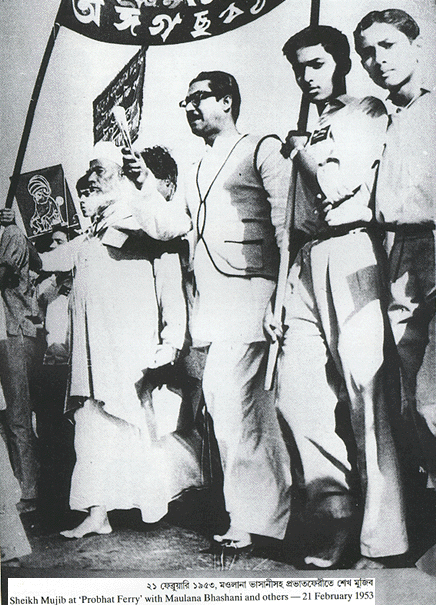
In 1952, the Awami Muslim League and its student wing played an instrumental role in the Bengali Language Movement, during which Pakistani security forces fired upon thousands of protesting students demanding Bengali be declared an official language of Pakistan and famously killing a number of students including Abdus Salam
, Rafiq Uddin Ahmed
, Abul Barkat
and Abdul Jabbar. The events of 1952 is widely seen by historians today as a turning point in the history of Pakistan and the Bengali people, as it was the starting point of the Bengali nationalist struggle that eventually culminated in the creation of Bangladesh in 1971.
In 1953, the party's council meeting voted to drop the word "Muslim" from its name in order to give it a more secular outlook, owing to need of including the province's large Hindu
population in Pakistani politics.
, Nizam-e-Islam and Ganatantri Dal. The alliance was termed the Jukta Front or United Front and formulated the Ekush Dafa, or 21-point Charter, to fight the Muslim League
. The party also took the historic decision to adopt the traditional Bengali boat, which signified the attachment to rural Bengal, as its election symbol.
The election swept the United Front coalition into power in East Bengal with a massive mandate of 223 seats out of 237 seats. The Awami League itself bagged 143 seats while the Muslim League won only 9 seats. A. K. Fazlul Huq
assumed the office of Chief Minister of East Bengal and drew up a cabinet containing many of the prominent student activists that were leading movements against the Pakistani state. They included Sheikh Mujibur Rahman
from the Awami League, who served as commerce minister.
Leaders of the new provincial government demanded greater provincial autonomy for East Bengal and eventually succeeded in pressuring Prime Minister Muhammad Ali Bogra
, himself a Bengali
, to endorse the proposed constitutional recognition of Bengali as an official language of Pakistan. The United Front also passed a landmark order for the establishment of the Bangla Academy
in Dhaka.
As tensions with the western wing grew due to the demands for greater provincial autonomy in East Bengal, Governor-General
Ghulam Muhammad
dismissed the United Front government on 29 May 1954 under Article 92/A of the provisional constitution of Pakistan.
to secure a majority in the new National Assembly of Pakistan
and took over the central government. Awami League President Huseyn Shaheed Suhrawardy
became the Prime Minister of Pakistan
. Suhrawardy pursued a reform agenda to reduce the long standing economic disparity between East and West Pakistan, greater representation of Bengalis in the Pakistani civil and armed services and he unsuccessfully attempted to alleviate the food shortage in the country.
The Awami League also began deepening relations with the United States. The government moved to join the Southeast Asia Treaty Organisation (SEATO) and Central Treaty Organisation (CENTO), the two strategic defense alliances in Asia inspired by the North Atlantic Treaty Organization (NATO). Maulana Bhashani, one of the party's founders, condemned the decision of the Suhrawardy government and called a conference in February, 1957 at Kagmari in East Bengal. He protested the move and the support lent by the Awami League leadership to the government. Bhashani broke away from the Awami League and then formed the leftist National Awami Party (NAP).
The controversy over One Unit (the division of Pakistan into only two provinces, east
and west
) and the appropriate electoral system for Pakistan, whether joint or separate, also revived as soon as Suhrawardy became Prime Minister. In West Pakistan, there was strong opposition to the joint electorate by the Muslim League and the religious parties. The Awami League however, strongly supported the joint electorate. These differences over One Unit and the appropriate electorate caused problems for the government.
By early 1957, the movement for the dismemberment of the One Unit had started. Suhrawardy was at the mercy of central bureaucracy fighting to save the One Unit. Many in the business elite in Karachi were lobbying against Suhrawardy's decision to distribute millions of dollars of American aid to East Pakistan and to set up a national shipping corporation. Supported by these lobbyists, President Iskander Mirza demanded the Prime Minister's resignation. Suhrawardy requested to seek a vote of confidence in the National Assembly, but this request was turned down. Suhrawardy resigned under threat of dismissal on October 10, 1957.
. Ayub Khan eventually deposed Mirza in a bloodless coup. By promulgating the Political Parties Elected Bodies Disqualified Ordinance, Ayub banned all major political parties in Pakistan. Senior politicians, including the entire top leadership of the Awami League, were arrested and most were kept under detention till 1963.
In 1962, Ayub Khan drafted a new constitution, modeled on indirect election, through an electoral college, and termed it 'Basic Democracy'. Huseyn Shaheed Suhrawardy joined Nurul Amin
, Khwaja Nazimuddin, Maulvi Farid Ahmed and Hamidul Haq Chowdhury in forming National Democratic Front against Ayub Khan's military-backed rule and to restore elective democracy. However the alliance failed to obtain any concessions. Instead the electoral colleges appointed a new parliament and the President exercised executive authority.
Widespread discrimination prevailed in Pakistan against Bengalis during the regime of Ayub Khan. Harsh restrictions were imposed on major Bengali cultural symbols, including a ban on the airing of Rabindra Sangeet
in public. The University of Dhaka
became a hotbed for student activism advocating greater rights for Bengalis and the restoration of democracy in Pakistan.
On 5 December 1963, Huseyn Shaheed Suhrawardy was found dead in his hotel room in Beirut
, Lebanon
. His sudden death under mysterious circumstances gave rise to speculation within the Awami League and the general population in East Pakistan that he had been poisoned.
 The 6-point demands
, proposed by Mujib, were widely accepted by the East Pakistani populace, as they proposed greater autonomy for the provinces of Pakistan. After the so-called Agartala Conspiracy Case, and subsequent end of the Ayub Khan regime in Pakistan, the Awami League and its leader Sheikh Mujib reached the peak of their popularity among the East Pakistani Bengali population. In the elections of 1970, the Awami League won 167 of 169 East Pakistan seats in the National Assembly but none of West Pakistan
's 138 seats. It also won 288 of the 300 provincial assembly seats in East Pakistan. This win gave the Awami League a healthy majority in the 313-seat National Assembly and placed it in a position to establish a national government without a coalition partner. This was not acceptable to the political leaders of West Pakistan and led directly to the events of the Bangladesh Liberation War
. The BAL leaders, taking refuge in India, successfully led the war against the Pakistani Army throughout 1971.Leader Sheikh Mujib Surrender to the Pakistan army in March 25, 1971, But Bangladeshi People fight to free themselves
to Egypt, violating US economic sanctions, the Nixon
government barred grain imports that Bangladesh had already paid for from reaching the country. As a result, causing the famine of 1974 was inevitable. 28,000 people died, and support for Mujib declined but the people of Bengal still saw him as there leader.
In January 1975, facing violent leftist insurgents Mujib declared a state of emergency and later assumed the presidency, after the Awami League dominated parliament decided to switch from parliamentary to a presidential form of government. Sheikh Mujib renamed the League the "Bangladesh Farmers and Workers Awami League (Bangladesh Krishok Sramik Awami League, BAKSAL), and banned all other parties. BAKSAL became the strong arm of what had turned into a Presidential government, with Sheikh Mujib becoming the lifetime president. Many opposition political workers, mostly revolutionary communist were killed (Notably Siraj Sikder
) or arrested after three Members of Parliament were killed by the communist insurgency. The crackdown on opposition was aided by the elite paramilitary force Rakkhi Bahini.
, led by Major Faruk Rahman and Major Rashid, murdered Sheikh Mujibur Rahman and all his family members. Including his wife and minor son. Within months, on November 3, 1975, four more of its top leaders, Syed Nazrul Islam
, Tajuddin Ahmed, Captain Muhammad Mansur Ali
and A. H. M. Qamaruzzaman
were killed inside the Dhaka Central Jail
on the orders of the majors. Only Sheikh Hasina
and Sheikh Rehana
, two daughters of Mujib, survived the massacre as they were in West Germany as a part of a cultural exchange program. They later claimed political asylum in the United Kingdom. Sheikh Rehana, the younger sister, chose to remain in the UK permanently, while Sheikh Hasina moved to India
and lived in self imposed exile. Her stays abroad helped her gain important political friends in the West and in India that proved to be a valuable asset for the party in the future.
After 1975, the party remained split into several rival factions, and fared poorly in the 1979 parliamentary elections held under a military government. In 1981 Sheikh Hasina returned after the largest party faction, the "Bangladesh Awami League", elected her its president, and she proceeded to take over the party leadership and unite the factions. As she was under age at the time she could not take part in the 1981 presidential elections that followed the assassination of then President Ziaur Rahman
. Throughout the following nine years of military rule by General Ershad
the AL participated in some polls but boycotted most, nearly all of them rigged to favor the military.
The Awami League emerged as the largest opposition party in parliament in the elections in 1991, following the uprising against Ershad. It made major electoral gains in 1994 as its candidates won mayoral elections in the two largest cities of the country: the capital Dhaka and the commercial capital Chittagong
. Demanding electoral reforms the party resigned from the parliament in 1995, boycotted the February 1996 parliamentary polls, and subsequently won 146 out of 300 seats in June 1996 parliamentary polls. Supported by a few smaller parties, the Awami League formed a "Government of National Unity," and elected a non-partisan head of state, retired Chief Justice Shahabuddin Ahmed
.
(also known as Padma
) in late 1996, and signed a peace treaty with tribal rebels in 1997. In 1998, Bangladesh faced one of the worst floods ever, and the government handled the crisis satisfactorily. It also had significant achievements in containing inflation, and peacefully neutralising a long-running leftist insurgency in south-western districts dating back to the first AL government's time. However, rampant corruption allegations against party office bearers and ministers as well as a deteriorating law and order situation troubled the government. Its pro poor policies achieved wide microeconomic development but that left the country's wealthy business class dissatisfied. The AL's last months in office were marred by sporadic bombing by alleged Islamist militants. Hasina herself escaped several attempts on her life, in one of which two anti-tank mine
s were planted under her helipad in Gopalganj district
. In July 2001, the second AL government stepped down, becoming the first elected government in Bangladesh to serve a full term in office.
The party won only 62 out of 300 parliamentary seats in the elections held in October 2001, despite bagging 40% of the votes, up from 36% in 1996 and 33% in 1991. The BNP and its allies won a two thirds majority in parliament with 46% of the votes cast, with BNP alone winning 41% up from 33% in 1996 and 30% in 1991.
of several key members. Popular young leader Ahsanullah Master, a Member of Parliament from Gazipur, was killed in 2004. This was followed by a grenade attack on Hasina
during a public meeting on August 21, 2004, resulting in the death of 22 party supporters, including party women's secretary Ivy Rahman
, though Hasina lived. Finally, the party's electoral secretary, ex finance minister, and veteran diplomat Shah M S Kibria
, a Member of Parliament from Habiganj, was killed in a grenade
attack in Sylhet
later that year.
In June 2005, the Awami League won an important victory when the AL nominated incumbent mayor A.B.M. Mohiuddin Chowdhury won the important mayor
al election in Chittagong, by a huge margin, against BNP nominee State Minister of Aviation Mir Mohammad Nasiruddin. This election was seen as a showdown between the Awami League and the BNP. However, the killing of party leaders continued. In December 2005, the AL supported Mayor of Sylhet narrowly escaped the third attempt on his life as a grenade thrown at him failed to explode.
In September 2006, several of the party's top leaders, including Saber Hossain Choudhury MP and Asaduzzaman Nur MP, were hospitalized after being critically injured by police beatings while they demonstrated in support of electoral-law reforms. Starting in late October 2006, the Awami League led alliance carried out a series of nationwide demonstrations and blockades centering around the selection of the leader of the interim caretaker administration to oversee the 2007 elections. Although an election was scheduled to take place on January 22, 2007 that the Awami League decided to boycott, the country's military intervened on January 11, 2007 and installed an interim government composed of retired bureaucrats and military officers.
Throughout 2007 and 2008, the military backed government tried to root out corruption and get rid of the two dynastic leaders of the AL and BNP. While these efforts largely failed, they succeeded in producing a credible voter list that was used in the December 29, 2008 national election.
as well as some leftist parties. According to the Official Results, Bangladesh Awami League won 230 out of 299 constituencies, and together with its allies, had a total of 262 parliamentary seats. The Awami League and its allies received 57% of the total votes cast. The AL alone got 48%, compared to 36% of the other major alliance led by the BNP which by itself got 33% of the votes. Sheikh Hasina
, as party head, is the new Prime Minister. Her term of office began in January, 2009. The current cabinet has several new faces, including three women in prominent positions: Dr Dipu Moni
(Foreign Minister), Matia Chowdhury (Agriculture Minister) and Sahara Khatun
(Home Minister). Younger MPs with a link to assassinated members of the 1972-1975 AL government are Syed Ashraful Islam, son of Syed Nazrul Islam
, Sheikh Taposh, son of Sheikh Fazlul Huq Moni, and Sohel Taj, son of Tajuddin Ahmad
.
Since 2009, the Awami League in government faced several major political challenges, including BDR (border security force) mutiny, power crisis, unrest in garments industry and stock market fluctuations. Judicial achievements for the party included restoring 1972 constitution (set by the first Awami League government), beginning of war crimes trials, and guilty vedict in 1975 assassination trial. According to the Nielsen 2 year survey, 50% felt the country was moving in the right direction, and 36% gave the government a favorable rating.
Urdu
Urdu is a register of the Hindustani language that is identified with Muslims in South Asia. It belongs to the Indo-European family. Urdu is the national language and lingua franca of Pakistan. It is also widely spoken in some regions of India, where it is one of the 22 scheduled languages and an...
: Bangladesh People's League), commonly known as the Awami League, is the mainstream center-left, secular political party in Bangladesh
Bangladesh
Bangladesh , officially the People's Republic of Bangladesh is a sovereign state located in South Asia. It is bordered by India on all sides except for a small border with Burma to the far southeast and by the Bay of Bengal to the south...
. It is also currently the governing party after winning the 2008 Parliamentary elections in Bangladesh.
The Awami League was founded in Dhaka
Dhaka
Dhaka is the capital of Bangladesh and the principal city of Dhaka Division. Dhaka is a megacity and one of the major cities of South Asia. Located on the banks of the Buriganga River, Dhaka, along with its metropolitan area, had a population of over 15 million in 2010, making it the largest city...
, the former capital of the Pakistani province of East Bengal
East Bengal
East Bengal was the name used during two periods in the 20th century for a territory that roughly corresponded to the modern state of Bangladesh. Both instances involved a violent partition of Bengal....
, in 1949 by Bengali nationalists Maulana Abdul Hamid Khan Bhashani
Maulana Abdul Hamid Khan Bhashani
Abdul Hamid Khan Bhashani was a popular political leader in Pakistan and Bangladesh, a rural based self-educated person.Abdu Hamid Khan Bhashani, born in 1880 in Dhangara, Bangladesh), was the son of Haji Sharafat Ali Khan. He gained immense popularity among peasants...
, Shamsul Huq
Shamsul Huq
Shamsul Huq was a Bengali politician who led a parliamentary committee in the Constituent Assembly of Pakistan to advocate for the recognition of the Bengali language during the Language movement of the 1950s...
, and later Huseyn Shaheed Suhrawardy
Huseyn Shaheed Suhrawardy
Huseyn Shaheed Suhrawardy was a Pakistani-Bengali politician and statesman who served as 5th Prime Minister of Pakistan from 1956 till 1957, and a close associate of Mohammad Ali Jinnah and Liaquat Ali Khan, first Prime minister of Pakistan...
. The Awami League was established as the Bengali alternative to the domination of the Muslim League
Muslim League (Pakistan)
Muslim League was the original successor of All India Muslim League that led the Pakistan Movement achieving an independent nation. After formation of Pakistan, the party was renamed to Muslim League which came to an end soon after Qaid-e-Azam's death on the first marshal law in 1958.-History:On...
in Pakistan. The party quickly gained massive popular support in East Bengal
East Bengal
East Bengal was the name used during two periods in the 20th century for a territory that roughly corresponded to the modern state of Bangladesh. Both instances involved a violent partition of Bengal....
, later named East Pakistan
East Pakistan
East Pakistan was a provincial state of Pakistan established in 14 August 1947. The provincial state existed until its declaration of independence on 26 March 1971 as the independent nation of Bangladesh. Pakistan recognized the new nation on 16 December 1971. East Pakistan was created from Bengal...
, and eventually led the forces of Bengali nationalism
Bengali nationalism
Bengali nationalism is the political expression of ethno-national consciousness of the Bengali people, who inhabit the ethno-linguistic region of Bengal. The region's territory is divided between Bangladesh and the Indian state of West Bengal...
in the struggle against West Pakistan
West Pakistan
West Pakistan , common name West-Pakistan , in the period between its establishment on 22 November 1955 to disintegration on December 16, 1971. This period, during which, Pakistan was divided, ended when East-Pakistan was disintegrated and succeeded to become which is now what is known as Bangladesh...
's military and political establishment. The party under the leadership of Sheikh Mujibur Rahman
Sheikh Mujibur Rahman
Sheikh Mujibur Rahman was a Bengali nationalist politician and the founder of Bangladesh. He headed the Awami League, served as the first President of Bangladesh and later became its Prime Minister. He headed the Awami League, served as the first President of Bangladesh and later became its...
, the founding father of Bangladesh, would lead the struggle for independence, first through massive populist and civil disobedience movements, such as the Six Point Movement
Six point movement
The 6 Point Movement was a Bengali nationalist movement in East Pakistan spearheaded by Sheikh Mujibur Rahman, which eventually led to the liberation of Bangladesh. The movement's main agenda was to realize the six demands put forward by a coalition of Bengali nationalist political parties in 1966,...
and 1971 Non-Cooperation Movement, and then during the Bangladesh Liberation War
Bangladesh Liberation War
The Bangladesh Liberation War was an armed conflict pitting East Pakistan and India against West Pakistan. The war resulted in the secession of East Pakistan, which became the independent nation of Bangladesh....
. After the emergence of independent Bangladesh, the Awami League would win the first general elections in 1973 but was overthrown in 1975 after the assassination of Sheikh Mujibur Rahman
Assassination of Sheikh Mujibur Rahman
The assassination of Sheikh Mujibur Rahman took place in the early hours of August 15, 1975, when a group of junior Bangladesh Army officers invaded Sheikh Mujibur Rahman's residence with tanks...
.The party was forced by subsequent military regimes into political wilderness and many of its senior leaders and actvists were executed and jailed. After the restoration of democracy in 1990, the Awami League emerged as one of the principal players of Bangladeshi politics.
Amongst the leaders of the Awami League, five have become the President of Bangladesh
President of Bangladesh
Since 1991, the President of Bangladesh is the head of state, a largely ceremonial post elected by the parliament. Since 1996, the President's role becomes more important after the term of the government has finished, when his executive authority is enhanced as laid down in the constitution of the...
, four have become the Prime Minister of Bangladesh
Prime Minister of Bangladesh
The Prime Minister of the People's Republic of Bangladesh is the Head of the Government of Bangladesh. The Prime Minister and the Cabinet are collectively accountable for their policies and actions to the Jatiya Sangsad Parliament, to their political party and ultimately to the electorate...
and one became the Prime Minister of Pakistan
Prime Minister of Pakistan
The Prime Minister of Pakistan , is the Head of Government of Pakistan who is designated to exercise as the country's Chief Executive. By the Constitution of Pakistan, Pakistan has the parliamentary democratic system of government...
. Since the independence of Bangladesh, the party has been under the control of the family of Sheikh Mujibur Rahman. His daughter and also the incumbent Prime Minister of Bangladesh, Sheikh Hasina
Sheikh Hasina
Sheikh Hasina is a Bangladeshi politician and current Prime Minister of Bangladesh. She has been the President of the Awami League, a major political party, since 1981. She is the eldest of five children of Sheikh Mujibur Rahman, the founding father of Bangladesh and widow of a reputed nuclear...
, has been heading the party since 1981.
Ideology
The Bangladesh Awami League styles itself as the leader of the "pro-liberation" forces in Bangladesh, promoting secular and social democratic sections of the political establishment in the country which played the leading role during the Bangladesh Liberation WarBangladesh Liberation War
The Bangladesh Liberation War was an armed conflict pitting East Pakistan and India against West Pakistan. The war resulted in the secession of East Pakistan, which became the independent nation of Bangladesh....
in 1971. The party constitution states, and in two cases defines the reason for, four fundamental principles in guiding its philosophy and policies. They include-
- Bengali nationalismBengali nationalismBengali nationalism is the political expression of ethno-national consciousness of the Bengali people, who inhabit the ethno-linguistic region of Bengal. The region's territory is divided between Bangladesh and the Indian state of West Bengal...
- DemocracyDemocracyDemocracy is generally defined as a form of government in which all adult citizens have an equal say in the decisions that affect their lives. Ideally, this includes equal participation in the proposal, development and passage of legislation into law...
- SecularismSecularismSecularism is the principle of separation between government institutions and the persons mandated to represent the State from religious institutions and religious dignitaries...
, that is to ensure freedom of religion and non-communal politics - SocialismSocialismSocialism is an economic system characterized by social ownership of the means of production and cooperative management of the economy; or a political philosophy advocating such a system. "Social ownership" may refer to any one of, or a combination of, the following: cooperative enterprises,...
, that is to establish an exploitation-free society and social justice
The four principles are similar to those of the original Four State Principles in Bangladesh's constitution which included nationalism
Nationalism
Nationalism is a political ideology that involves a strong identification of a group of individuals with a political entity defined in national terms, i.e. a nation. In the 'modernist' image of the nation, it is nationalism that creates national identity. There are various definitions for what...
, secularity
Secularity
Secularity is the state of being separate from religion.For instance, eating and bathing may be regarded as examples of secular activities, because there may not be anything inherently religious about them...
, democracy
Democracy
Democracy is generally defined as a form of government in which all adult citizens have an equal say in the decisions that affect their lives. Ideally, this includes equal participation in the proposal, development and passage of legislation into law...
and socialism
Socialism
Socialism is an economic system characterized by social ownership of the means of production and cooperative management of the economy; or a political philosophy advocating such a system. "Social ownership" may refer to any one of, or a combination of, the following: cooperative enterprises,...
.
Prior to the 2008 general elections in Bangladesh, the Awami League announced in its manifesto, its "Vision 2021" and "Digital Bangladesh" action plans to transform Bangladesh into a fast developing Middle Income Country by 2021. The party also uses the term "Sonar Bangla", or golden Bengal, to describe its vision for Bangladesh to become a modern developed nation. The term is reminiscent of Bangladesh's national anthem and a utopian vision in Bengali nationalism.
History
The history of the Bangladesh Awami League falls into three distinct eras:- The Early Pakistan Era, when the party championed the rights of the Bengali people in Pakistan;
- The Movement for Independence, when the party led the forces of Bengali nationalism in establishing the sovereign state of Bangladesh;
- The Post Independence Era, when the party is a major player in Bangladeshi politics and often suffered volatile experiences.
Early Pakistan Era
On 14 August 1947, the partition of British IndiaPartition of India
The Partition of India was the partition of British India on the basis of religious demographics that led to the creation of the sovereign states of the Dominion of Pakistan and the Union of India on 14 and 15...
saw the establishment of the Muslim
Muslim
A Muslim, also spelled Moslem, is an adherent of Islam, a monotheistic, Abrahamic religion based on the Quran, which Muslims consider the verbatim word of God as revealed to prophet Muhammad. "Muslim" is the Arabic term for "submitter" .Muslims believe that God is one and incomparable...
state of Pakistan
Pakistan
Pakistan , officially the Islamic Republic of Pakistan is a sovereign state in South Asia. It has a coastline along the Arabian Sea and the Gulf of Oman in the south and is bordered by Afghanistan and Iran in the west, India in the east and China in the far northeast. In the north, Tajikistan...
on the basis of the Two-Nation Theory
Two-Nation Theory
The Two-Nation Theory proposed by Allama Iqbal is the ideology that the primary identity of Muslims in the Indian subcontinent is their religion, rather than their language or ethnicity, and therefore Indian Hindus and Muslims are two distinct nationalities, regardless of ethnic or other...
. The new country compromised of two wings, separated by 1000 miles of Indian territory, in the Indian Subcontinent. The western wing consisted of the provinces of Punjab
Punjab (Pakistan)
Punjab is the most populous province of Pakistan, with approximately 45% of the country's total population. Forming most of the Punjab region, the province is bordered by Kashmir to the north-east, the Indian states of Punjab and Rajasthan to the east, the Pakistani province of Sindh to the...
, Sindh
Sindh
Sindh historically referred to as Ba'ab-ul-Islam , is one of the four provinces of Pakistan and historically is home to the Sindhi people. It is also locally known as the "Mehran". Though Muslims form the largest religious group in Sindh, a good number of Christians, Zoroastrians and Hindus can...
, North West Frontier Province and Balochistan
Balochistan (Pakistan)
Balochistan is one of the four provinces or federating units of Pakistan. With an area of 134,051 mi2 or , it is the largest province of Pakistan, constituting approximately 44% of the total land mass of Pakistan. According to the 1998 population census, Balochistan had a population of...
, while the province of East Bengal
East Bengal
East Bengal was the name used during two periods in the 20th century for a territory that roughly corresponded to the modern state of Bangladesh. Both instances involved a violent partition of Bengal....
constituted the eastern wing. From the onset of independence, Pakistan was led by its founder Muhammad Ali Jinnah
Muhammad Ali Jinnah
Muhammad Ali Jinnah was a Muslim lawyer, politician, statesman and the founder of Pakistan. He is popularly and officially known in Pakistan as Quaid-e-Azam and Baba-e-Qaum ....
and his Muslim League
Muslim League (Pakistan)
Muslim League was the original successor of All India Muslim League that led the Pakistan Movement achieving an independent nation. After formation of Pakistan, the party was renamed to Muslim League which came to an end soon after Qaid-e-Azam's death on the first marshal law in 1958.-History:On...
party.
In 1948, there was rising agitation in East Bengal against the omission of Bengali script
Bengali script
The Bengali alphabet is the writing system for the Bengali language. The script with variations is used for Assamese and is basis for Meitei, Bishnupriya Manipuri, Kokborok, Garo and Mundari alphabets. All these languages are spoken in the eastern region of South Asia. Historically, the script has...
from coins, stamps and government exams. Thousands of students, mainly from the University of Dhaka, protested in Dhaka and clashed with security forces. Prominent student leaders including Shamsul Huq
Shamsul Huq
Shamsul Huq was a Bengali politician who led a parliamentary committee in the Constituent Assembly of Pakistan to advocate for the recognition of the Bengali language during the Language movement of the 1950s...
, Shawkat Ali
Shawkat Ali
Shawkat Ali , , politician and a leader of the Bengali Language Movement. He was one of the founders of Awami Muslim League - which later became Awami League and is now the Bangladesh Awami League. He was a member of all three Rastrabhasa Sangram Parishad. He was also the Chief Organizer of Dhaka...
, Kazi Golam Mahboob
Kazi Golam Mahboob
Kazi Golam Mahboob is an activist of the Language Movement that took place in the erstwhile East Pakistan . He was also an active politician and worked in both of the major political parties of Bangladesh....
, Oli Ahad
Oli Ahad
-Early life:Ahad was born at the Islampur village of Brahmanbaria. In 1944 he passed matriculation from Daudkandi Government Aided High School. During the election for referendum of Pakistan, Ahad got involved with politics and campaigned in various places like Tripura, Bogra and was arrested...
, Sheikh Mujibur Rahman
Sheikh Mujibur Rahman
Sheikh Mujibur Rahman was a Bengali nationalist politician and the founder of Bangladesh. He headed the Awami League, served as the first President of Bangladesh and later became its Prime Minister. He headed the Awami League, served as the first President of Bangladesh and later became its...
and Abdul Wahed were arrested and the police were accused of excessive brutality while charging protesters. In March, senior Bengali political leaders were attacked whilst leading protests demanding that Bengali
Bengali language
Bengali or Bangla is an eastern Indo-Aryan language. It is native to the region of eastern South Asia known as Bengal, which comprises present day Bangladesh, the Indian state of West Bengal, and parts of the Indian states of Tripura and Assam. It is written with the Bengali script...
be declared an official language in Pakistan. The leaders included the A. K. Fazlul Huq
A. K. Fazlul Huq
Not to be confused with the cricket ground in Dhaka Sher-e-Bangla Cricket Stadium Sher-e-Bangla Abul Kashem Fazlul Huq was a well-known Bengali statesman in the first half of the 20th century...
, the former Prime Minister of undivided Bengal.
Amidst the rising discontent in East Bengal, Jinnah visited Dhaka and announced that Urdu would be sole state language of Pakistan given its significance to Islamic nationalism in South Asia. The announcement caused uproar in East Bengal, where the native Bengali population resented Jinnah for his attempts to impose a language they hardly understood. The resentment was further fueled by rising discrimination against Bengalis in government, industry, bureaucracy and the armed forces and the dominance of the Muslim League. The Bengalis argued that they constituted the ethnic majority of Pakistan's population and Urdu was remote to the land of Bengal, located in the eastern Indian Subcontinent. Moreover, the rich literary heritage of the Bengali language and the deep rooted secular culture of Bengali society led to a strong sense of linguistic and cultural nationalism amongst the people of East Bengal. Against this backdrop, Bengali nationalism began to take root within the Muslim League and the party's Bengali members began to rebel.
All Pakistan Awami Muslim League
On 23 June 1949, Bengali nationalists from East Bengal broke away from the Muslim League, Pakistan's dominant political party, and established the All Pakistan Awami Muslim League. The party was founded at the Rose Garden mansion in the old part of Dhaka. Maulana Abdul Hamid Khan BhashaniMaulana Abdul Hamid Khan Bhashani
Abdul Hamid Khan Bhashani was a popular political leader in Pakistan and Bangladesh, a rural based self-educated person.Abdu Hamid Khan Bhashani, born in 1880 in Dhangara, Bangladesh), was the son of Haji Sharafat Ali Khan. He gained immense popularity among peasants...
and Shamsul Huq
Shamsul Huq
Shamsul Huq was a Bengali politician who led a parliamentary committee in the Constituent Assembly of Pakistan to advocate for the recognition of the Bengali language during the Language movement of the 1950s...
were elected the first President and General Secretary of the party respectively, while Sheikh Mujibur Rahman
Sheikh Mujibur Rahman
Sheikh Mujibur Rahman was a Bengali nationalist politician and the founder of Bangladesh. He headed the Awami League, served as the first President of Bangladesh and later became its Prime Minister. He headed the Awami League, served as the first President of Bangladesh and later became its...
, Khondaker Mostaq Ahmad
Khondaker Mostaq Ahmad
Khondaker Moshtaq Ahmad was a Bangladeshi politician who served as the President of Bangladesh from 15 August to 6 November 1975 after the assassination of Sheikh Mujibur Rahman, the founding leader of Bangladesh...
and A. K. Rafiqul Hussain were elected the party's first Joint Secretaries. The party was formed to champion the rights of masses in Pakistan against the powerful feudal establishment led by the Muslim League. However, due to its strength stemming from the discriminated Bengali population of Pakistan's eastern wing, the party eventually became associated and identified with East Bengal.
In 1952, the Awami Muslim League and its student wing played an instrumental role in the Bengali Language Movement, during which Pakistani security forces fired upon thousands of protesting students demanding Bengali be declared an official language of Pakistan and famously killing a number of students including Abdus Salam
Abdus Salam
Mohammad Abdus Salam, NI, SPk Mohammad Abdus Salam, NI, SPk Mohammad Abdus Salam, NI, SPk (Urdu: محمد عبد السلام, pronounced , (January 29, 1926– November 21, 1996) was a Pakistani theoretical physicist and Nobel laureate in Physics for his work on the electroweak unification of the...
, Rafiq Uddin Ahmed
Rafiq Uddin Ahmed
Rafiq Uddin Ahmed was a demonstrator killed during the Bengali Language Movement demonstrations that took place in East Pakistan in 1952....
, Abul Barkat
Abul Barkat
Abul Barkat was a demonstrator killed during the Bengali Language Movement protests which took place in the erstwhile East Pakistan , in 1952....
and Abdul Jabbar. The events of 1952 is widely seen by historians today as a turning point in the history of Pakistan and the Bengali people, as it was the starting point of the Bengali nationalist struggle that eventually culminated in the creation of Bangladesh in 1971.
In 1953, the party's council meeting voted to drop the word "Muslim" from its name in order to give it a more secular outlook, owing to need of including the province's large Hindu
Hindu
Hindu refers to an identity associated with the philosophical, religious and cultural systems that are indigenous to the Indian subcontinent. As used in the Constitution of India, the word "Hindu" is also attributed to all persons professing any Indian religion...
population in Pakistani politics.
United Front
In the run up to the East Bengal Legislative Assembly Elections in 1954, the Awami League took the lead in negotiations in forming a pan-Bengali political alliance including the Krishak Praja PartyKrishak Praja Party
Krishak Praja Party , originally known as "Proja-Shamiti" , was a political party in British India. It struggled for the abolition of zamindari .In the late 1930s, A. K...
, Nizam-e-Islam and Ganatantri Dal. The alliance was termed the Jukta Front or United Front and formulated the Ekush Dafa, or 21-point Charter, to fight the Muslim League
Muslim League (Pakistan)
Muslim League was the original successor of All India Muslim League that led the Pakistan Movement achieving an independent nation. After formation of Pakistan, the party was renamed to Muslim League which came to an end soon after Qaid-e-Azam's death on the first marshal law in 1958.-History:On...
. The party also took the historic decision to adopt the traditional Bengali boat, which signified the attachment to rural Bengal, as its election symbol.
The election swept the United Front coalition into power in East Bengal with a massive mandate of 223 seats out of 237 seats. The Awami League itself bagged 143 seats while the Muslim League won only 9 seats. A. K. Fazlul Huq
A. K. Fazlul Huq
Not to be confused with the cricket ground in Dhaka Sher-e-Bangla Cricket Stadium Sher-e-Bangla Abul Kashem Fazlul Huq was a well-known Bengali statesman in the first half of the 20th century...
assumed the office of Chief Minister of East Bengal and drew up a cabinet containing many of the prominent student activists that were leading movements against the Pakistani state. They included Sheikh Mujibur Rahman
Sheikh Mujibur Rahman
Sheikh Mujibur Rahman was a Bengali nationalist politician and the founder of Bangladesh. He headed the Awami League, served as the first President of Bangladesh and later became its Prime Minister. He headed the Awami League, served as the first President of Bangladesh and later became its...
from the Awami League, who served as commerce minister.
Leaders of the new provincial government demanded greater provincial autonomy for East Bengal and eventually succeeded in pressuring Prime Minister Muhammad Ali Bogra
Muhammad Ali Bogra
Nawabzada Mohammed Ali Bogra was a Pakistani statesman of Bengali origin, who served as the third Prime Minister of Pakistan from 1953 until 1955.-Early life:...
, himself a Bengali
Bengali people
The Bengali people are an ethnic community native to the historic region of Bengal in South Asia. They speak Bengali , which is an Indo-Aryan language of the eastern Indian subcontinent, evolved from the Magadhi Prakrit and Sanskrit languages. In their native language, they are referred to as বাঙালী...
, to endorse the proposed constitutional recognition of Bengali as an official language of Pakistan. The United Front also passed a landmark order for the establishment of the Bangla Academy
Bangla Academy
Bangla Academy , established on 3 December 1955, is the national academy for promoting Bangla language in Bangladesh. The main office of the organization is located at the Burdwan House, once a part of the campus of the University of Dhaka, beside Suhrawardy Udyan.-History:The importance of...
in Dhaka.
As tensions with the western wing grew due to the demands for greater provincial autonomy in East Bengal, Governor-General
Governor-General of Pakistan
The Governor-General of Pakistan was the representative in Pakistan of the Crown from the country's independence in 1947. When Pakistan was proclaimed a republic in 1956 the connection with the British monarchy ended, and the office of Governor-General was abolished.-History:Pakistan gained...
Ghulam Muhammad
Ghulam Muhammad
Malik Ghulam Muhammad served as the third Governor-General of Pakistan from 1951 until 1955, shortly before his death in 1956.-Early life:...
dismissed the United Front government on 29 May 1954 under Article 92/A of the provisional constitution of Pakistan.
Tenure in Central Government
In September 1956, the Awami League formed a coalition with the Republican PartyRepublican Party (Pakistan)
The Pakistani Republican Party was formed in October 1955, by a break away faction of the Muslim League and other politicians supporting the creation of the West Pakistan province, on the instigation of key leaders in the military and civil service....
to secure a majority in the new National Assembly of Pakistan
National Assembly of Pakistan
The National Assembly of Pakistan is the lower house of the bicameral Majlis-e-Shura, which also compromises the President of Pakistan and Senate . The National Assembly and the Senate both convene at Parliament House in Islamabad...
and took over the central government. Awami League President Huseyn Shaheed Suhrawardy
Huseyn Shaheed Suhrawardy
Huseyn Shaheed Suhrawardy was a Pakistani-Bengali politician and statesman who served as 5th Prime Minister of Pakistan from 1956 till 1957, and a close associate of Mohammad Ali Jinnah and Liaquat Ali Khan, first Prime minister of Pakistan...
became the Prime Minister of Pakistan
Prime Minister of Pakistan
The Prime Minister of Pakistan , is the Head of Government of Pakistan who is designated to exercise as the country's Chief Executive. By the Constitution of Pakistan, Pakistan has the parliamentary democratic system of government...
. Suhrawardy pursued a reform agenda to reduce the long standing economic disparity between East and West Pakistan, greater representation of Bengalis in the Pakistani civil and armed services and he unsuccessfully attempted to alleviate the food shortage in the country.
The Awami League also began deepening relations with the United States. The government moved to join the Southeast Asia Treaty Organisation (SEATO) and Central Treaty Organisation (CENTO), the two strategic defense alliances in Asia inspired by the North Atlantic Treaty Organization (NATO). Maulana Bhashani, one of the party's founders, condemned the decision of the Suhrawardy government and called a conference in February, 1957 at Kagmari in East Bengal. He protested the move and the support lent by the Awami League leadership to the government. Bhashani broke away from the Awami League and then formed the leftist National Awami Party (NAP).
The controversy over One Unit (the division of Pakistan into only two provinces, east
East Pakistan
East Pakistan was a provincial state of Pakistan established in 14 August 1947. The provincial state existed until its declaration of independence on 26 March 1971 as the independent nation of Bangladesh. Pakistan recognized the new nation on 16 December 1971. East Pakistan was created from Bengal...
and west
West Pakistan
West Pakistan , common name West-Pakistan , in the period between its establishment on 22 November 1955 to disintegration on December 16, 1971. This period, during which, Pakistan was divided, ended when East-Pakistan was disintegrated and succeeded to become which is now what is known as Bangladesh...
) and the appropriate electoral system for Pakistan, whether joint or separate, also revived as soon as Suhrawardy became Prime Minister. In West Pakistan, there was strong opposition to the joint electorate by the Muslim League and the religious parties. The Awami League however, strongly supported the joint electorate. These differences over One Unit and the appropriate electorate caused problems for the government.
By early 1957, the movement for the dismemberment of the One Unit had started. Suhrawardy was at the mercy of central bureaucracy fighting to save the One Unit. Many in the business elite in Karachi were lobbying against Suhrawardy's decision to distribute millions of dollars of American aid to East Pakistan and to set up a national shipping corporation. Supported by these lobbyists, President Iskander Mirza demanded the Prime Minister's resignation. Suhrawardy requested to seek a vote of confidence in the National Assembly, but this request was turned down. Suhrawardy resigned under threat of dismissal on October 10, 1957.
Ayub Khan coup and martial law
On 7 October 1958, President Iskander Mirza declared martial law and appointed army chief General Ayub Khan as Chief Martial Law AdministratorChief Martial Law Administrator
The office of the Chief Martial Law Administrator was a senior government post created in countries such as Pakistan, Bangladesh and Indonesia that gave considerable executive authority and powers to the holder of the post to enforce martial law in the country. This office has been used mostly by...
. Ayub Khan eventually deposed Mirza in a bloodless coup. By promulgating the Political Parties Elected Bodies Disqualified Ordinance, Ayub banned all major political parties in Pakistan. Senior politicians, including the entire top leadership of the Awami League, were arrested and most were kept under detention till 1963.
In 1962, Ayub Khan drafted a new constitution, modeled on indirect election, through an electoral college, and termed it 'Basic Democracy'. Huseyn Shaheed Suhrawardy joined Nurul Amin
Nurul Amin
Nurul Amin , was a prominent Bengali leader of Pakistan's Muslim League who served as the 8th Prime Minister of Pakistan, and the only first and the last Vice President of Pakistan from 1970 till 1971...
, Khwaja Nazimuddin, Maulvi Farid Ahmed and Hamidul Haq Chowdhury in forming National Democratic Front against Ayub Khan's military-backed rule and to restore elective democracy. However the alliance failed to obtain any concessions. Instead the electoral colleges appointed a new parliament and the President exercised executive authority.
Widespread discrimination prevailed in Pakistan against Bengalis during the regime of Ayub Khan. Harsh restrictions were imposed on major Bengali cultural symbols, including a ban on the airing of Rabindra Sangeet
Rabindra Sangeet
Rabindra Sangeet , also known as Tagore Songs in English, is a form of music composed by Rabindranath Tagore who added a new dimension to the musical concept of India in general and Bengal in specific....
in public. The University of Dhaka
University of Dhaka
The University of Dhaka is the oldest university in Bangladesh. It is a multi-disciplinary research university and is among the top universities in the region. Established on July 21, 1921, as per the Government of India Act, 1920, it was modelled on the Universities in England and soon gained...
became a hotbed for student activism advocating greater rights for Bengalis and the restoration of democracy in Pakistan.
On 5 December 1963, Huseyn Shaheed Suhrawardy was found dead in his hotel room in Beirut
Beirut
Beirut is the capital and largest city of Lebanon, with a population ranging from 1 million to more than 2 million . Located on a peninsula at the midpoint of Lebanon's Mediterranean coastline, it serves as the country's largest and main seaport, and also forms the Beirut Metropolitan...
, Lebanon
Lebanon
Lebanon , officially the Republic of LebanonRepublic of Lebanon is the most common term used by Lebanese government agencies. The term Lebanese Republic, a literal translation of the official Arabic and French names that is not used in today's world. Arabic is the most common language spoken among...
. His sudden death under mysterious circumstances gave rise to speculation within the Awami League and the general population in East Pakistan that he had been poisoned.
1966 to 1971
Six point movement
The 6 Point Movement was a Bengali nationalist movement in East Pakistan spearheaded by Sheikh Mujibur Rahman, which eventually led to the liberation of Bangladesh. The movement's main agenda was to realize the six demands put forward by a coalition of Bengali nationalist political parties in 1966,...
, proposed by Mujib, were widely accepted by the East Pakistani populace, as they proposed greater autonomy for the provinces of Pakistan. After the so-called Agartala Conspiracy Case, and subsequent end of the Ayub Khan regime in Pakistan, the Awami League and its leader Sheikh Mujib reached the peak of their popularity among the East Pakistani Bengali population. In the elections of 1970, the Awami League won 167 of 169 East Pakistan seats in the National Assembly but none of West Pakistan
West Pakistan
West Pakistan , common name West-Pakistan , in the period between its establishment on 22 November 1955 to disintegration on December 16, 1971. This period, during which, Pakistan was divided, ended when East-Pakistan was disintegrated and succeeded to become which is now what is known as Bangladesh...
's 138 seats. It also won 288 of the 300 provincial assembly seats in East Pakistan. This win gave the Awami League a healthy majority in the 313-seat National Assembly and placed it in a position to establish a national government without a coalition partner. This was not acceptable to the political leaders of West Pakistan and led directly to the events of the Bangladesh Liberation War
Bangladesh Liberation War
The Bangladesh Liberation War was an armed conflict pitting East Pakistan and India against West Pakistan. The war resulted in the secession of East Pakistan, which became the independent nation of Bangladesh....
. The BAL leaders, taking refuge in India, successfully led the war against the Pakistani Army throughout 1971.Leader Sheikh Mujib Surrender to the Pakistan army in March 25, 1971, But Bangladeshi People fight to free themselves
Post independence history
1972 to 1975
After independence on 16 December 1971, the party formed the national government of Bangladesh.The In 1972, under Sheikh Mujib, the party name was changed to "Awami League". The new government faced many challenges they successfully rebuilt the country, carried out mine clearing operations.food shortages were a major concern war had prevented the farming of all form of farming. The party aligned itself with NAM and the soviet bloc. The party was accused of corruption by supporters of Pakistan. As Bangladesh continued exporting juteJute
Jute is a long, soft, shiny vegetable fibre that can be spun into coarse, strong threads. It is produced from plants in the genus Corchorus, which has been classified in the family Tiliaceae, or more recently in Malvaceae....
to Egypt, violating US economic sanctions, the Nixon
Richard Nixon
Richard Milhous Nixon was the 37th President of the United States, serving from 1969 to 1974. The only president to resign the office, Nixon had previously served as a US representative and senator from California and as the 36th Vice President of the United States from 1953 to 1961 under...
government barred grain imports that Bangladesh had already paid for from reaching the country. As a result, causing the famine of 1974 was inevitable. 28,000 people died, and support for Mujib declined but the people of Bengal still saw him as there leader.
In January 1975, facing violent leftist insurgents Mujib declared a state of emergency and later assumed the presidency, after the Awami League dominated parliament decided to switch from parliamentary to a presidential form of government. Sheikh Mujib renamed the League the "Bangladesh Farmers and Workers Awami League (Bangladesh Krishok Sramik Awami League, BAKSAL), and banned all other parties. BAKSAL became the strong arm of what had turned into a Presidential government, with Sheikh Mujib becoming the lifetime president. Many opposition political workers, mostly revolutionary communist were killed (Notably Siraj Sikder
Siraj Sikder
-Early life:Siraj Sikder was born on 27 October 1944 at Bhedarganj in Shariatpur District. After passing the matriculation examination from Barisal Zilla School in 1959, he was admitted into Barisal Braja Mohan College in 1961 for I.Sc...
) or arrested after three Members of Parliament were killed by the communist insurgency. The crackdown on opposition was aided by the elite paramilitary force Rakkhi Bahini.
1975 to 1996
The move towards a secular form of government caused widespread dissatisfaction among the Army most of whom received training from the fanatic Pakistan army. On 15 August 1975 some junior members of the armed forces in DhakaDhaka
Dhaka is the capital of Bangladesh and the principal city of Dhaka Division. Dhaka is a megacity and one of the major cities of South Asia. Located on the banks of the Buriganga River, Dhaka, along with its metropolitan area, had a population of over 15 million in 2010, making it the largest city...
, led by Major Faruk Rahman and Major Rashid, murdered Sheikh Mujibur Rahman and all his family members. Including his wife and minor son. Within months, on November 3, 1975, four more of its top leaders, Syed Nazrul Islam
Syed Nazrul Islam
Syed Nazrul Islam was a Bangladeshi politician and a senior leader of the Awami League. During the Bangladesh Liberation War, he served as the acting President of Bangladesh in the absence of Sheikh Mujibur Rahman.-Early life:...
, Tajuddin Ahmed, Captain Muhammad Mansur Ali
Muhammad Mansur Ali
Muhammad Mansur Ali was a Bangladeshi politician who was a close confidante of Sheikh Mujibur Rahman, the founding leader of Bangladesh...
and A. H. M. Qamaruzzaman
A. H. M. Qamaruzzaman
Abul Hasnat Muhammad Qamaruzzaman was a Bangladeshi politician, senior government minister and a leading member of the Awami League...
were killed inside the Dhaka Central Jail
Dhaka Central Jail
Dhaka Central Jail is the largest jail in Bangladesh, located in the old section of Dhaka, the country's capital. The jail has been used to house criminals as well as political prisoners, especially during the Language Movement of 1952, the 6 Point Movement, and the Bangladesh Liberation War....
on the orders of the majors. Only Sheikh Hasina
Sheikh Hasina
Sheikh Hasina is a Bangladeshi politician and current Prime Minister of Bangladesh. She has been the President of the Awami League, a major political party, since 1981. She is the eldest of five children of Sheikh Mujibur Rahman, the founding father of Bangladesh and widow of a reputed nuclear...
and Sheikh Rehana
Sheikh Rehana
Sheikh Rehana from Bangladesh is the youngest daughter of the late President of Bangladesh Bangabandhu Sheikh Mujibur Rahman....
, two daughters of Mujib, survived the massacre as they were in West Germany as a part of a cultural exchange program. They later claimed political asylum in the United Kingdom. Sheikh Rehana, the younger sister, chose to remain in the UK permanently, while Sheikh Hasina moved to India
India
India , officially the Republic of India , is a country in South Asia. It is the seventh-largest country by geographical area, the second-most populous country with over 1.2 billion people, and the most populous democracy in the world...
and lived in self imposed exile. Her stays abroad helped her gain important political friends in the West and in India that proved to be a valuable asset for the party in the future.
After 1975, the party remained split into several rival factions, and fared poorly in the 1979 parliamentary elections held under a military government. In 1981 Sheikh Hasina returned after the largest party faction, the "Bangladesh Awami League", elected her its president, and she proceeded to take over the party leadership and unite the factions. As she was under age at the time she could not take part in the 1981 presidential elections that followed the assassination of then President Ziaur Rahman
Ziaur Rahman
President Ziaur Rahman, Bir Uttam, was a Bangladeshi politician and general, who read the declaration of Independence of Bangladesh on March 26, 1971 on behalf of Sheikh Mujibur Rahman. He later became the seventh President of Bangladesh from 1977 until 1981...
. Throughout the following nine years of military rule by General Ershad
Hossain Mohammad Ershad
Lieutenant General Hussain Muhammad Ershad is a Bangladeshi politician who was President of Bangladesh from 1983 to 1990. Previously, he was Chief of Staff of the Bangladesh Army and then Chief Martial Law Administrator in 1982....
the AL participated in some polls but boycotted most, nearly all of them rigged to favor the military.
The Awami League emerged as the largest opposition party in parliament in the elections in 1991, following the uprising against Ershad. It made major electoral gains in 1994 as its candidates won mayoral elections in the two largest cities of the country: the capital Dhaka and the commercial capital Chittagong
Chittagong
Chittagong ) is a city in southeastern Bangladesh and the capital of an eponymous district and division. Built on the banks of the Karnaphuli River, the city is home to Bangladesh's busiest seaport and has a population of over 4.5 million, making it the second largest city in the country.A trading...
. Demanding electoral reforms the party resigned from the parliament in 1995, boycotted the February 1996 parliamentary polls, and subsequently won 146 out of 300 seats in June 1996 parliamentary polls. Supported by a few smaller parties, the Awami League formed a "Government of National Unity," and elected a non-partisan head of state, retired Chief Justice Shahabuddin Ahmed
Shahabuddin Ahmed
Shahabuddin Ahmed is a former president and Chief Justice of Bangladesh. Justice Shahabuddin Ahmed took over the office of President after a popular uprising against President Hossain Mohammad Ershad in 1991. After the resumption of democracy, he returned to his duties as the Chief Justice...
.
1996 to 2001
AL's second term in office had mixed achievements. Apart from sustaining economic stability during the Asian economic crisis, the government successfully settled Bangladesh's long standing dispute with India over sharing the water of the river GangesGanges River
The Ganges or Ganga, , is a trans-boundary river of India and Bangladesh. The river rises in the western Himalayas in the Indian state of Uttarakhand, and flows south and east through the Gangetic Plain of North India into Bangladesh, where it empties into the Bay of Bengal. By discharge it...
(also known as Padma
Padma River
The Padma is a major trans-boundary river in Bangladesh. It is the main distributary of the Ganges , which originates in the Himalayas. The Padma enters Bangladesh from India near Chapai Nababganj...
) in late 1996, and signed a peace treaty with tribal rebels in 1997. In 1998, Bangladesh faced one of the worst floods ever, and the government handled the crisis satisfactorily. It also had significant achievements in containing inflation, and peacefully neutralising a long-running leftist insurgency in south-western districts dating back to the first AL government's time. However, rampant corruption allegations against party office bearers and ministers as well as a deteriorating law and order situation troubled the government. Its pro poor policies achieved wide microeconomic development but that left the country's wealthy business class dissatisfied. The AL's last months in office were marred by sporadic bombing by alleged Islamist militants. Hasina herself escaped several attempts on her life, in one of which two anti-tank mine
Anti-tank mine
An anti-tank mine, , is a type of land mine designed to damage or destroy vehicles including tanks and armored fighting vehicles....
s were planted under her helipad in Gopalganj district
Gopalganj District (Bangladesh)
The district of Gopalganj consists 356 mosques, 359 temples, six churches and four tombs.-Places of interest:* Ulpur has a former Zamindar palace which is currently used a Tafsil Office and many other Zamindar mansions. It was the home of the Basu Roy Chowdhury family. Arpara has a zamindar palace...
. In July 2001, the second AL government stepped down, becoming the first elected government in Bangladesh to serve a full term in office.
The party won only 62 out of 300 parliamentary seats in the elections held in October 2001, despite bagging 40% of the votes, up from 36% in 1996 and 33% in 1991. The BNP and its allies won a two thirds majority in parliament with 46% of the votes cast, with BNP alone winning 41% up from 33% in 1996 and 30% in 1991.
2001 to 2008
In its second term in opposition since 1991, the party suffered the assassinationAssassination
To carry out an assassination is "to murder by a sudden and/or secret attack, often for political reasons." Alternatively, assassination may be defined as "the act of deliberately killing someone, especially a public figure, usually for hire or for political reasons."An assassination may be...
of several key members. Popular young leader Ahsanullah Master, a Member of Parliament from Gazipur, was killed in 2004. This was followed by a grenade attack on Hasina
2004 Dhaka grenade attack
The 2004 Dhaka grenade attack was an attempt to kill Sheikh Hasina, the then-former Prime Minister of Bangladesh, on August 21, 2004. The attack left at least 23 dead and injured many others, including Hasina....
during a public meeting on August 21, 2004, resulting in the death of 22 party supporters, including party women's secretary Ivy Rahman
Ivy Rahman
Ivy Rahman was a Bangladeshi politician. She was the Women's Affairs secretary of Awami League. She was killed in the 2004 Dhaka Grenade Attacks launched by Islamist terrorists....
, though Hasina lived. Finally, the party's electoral secretary, ex finance minister, and veteran diplomat Shah M S Kibria
Shah M S Kibria
Shah Abu Muhammad Shamsul Kibria , commonly known as SAMS Kibria or Shams Kibria , was an economist, diplomat and politician from Bangladesh....
, a Member of Parliament from Habiganj, was killed in a grenade
Grenade
A grenade is a small explosive device that is projected a safe distance away by its user. Soldiers called grenadiers specialize in the use of grenades. The term hand grenade refers any grenade designed to be hand thrown. Grenade Launchers are firearms designed to fire explosive projectile grenades...
attack in Sylhet
Sylhet
Sylhet , is a major city in north-eastern Bangladesh. It is the main city of Sylhet Division and Sylhet District, and was granted metropolitan city status in March 2009. Sylhet is located on the banks of the Surma Valley and is surrounded by the Jaintia, Khasi and Tripura hills...
later that year.
In June 2005, the Awami League won an important victory when the AL nominated incumbent mayor A.B.M. Mohiuddin Chowdhury won the important mayor
Mayor
In many countries, a Mayor is the highest ranking officer in the municipal government of a town or a large urban city....
al election in Chittagong, by a huge margin, against BNP nominee State Minister of Aviation Mir Mohammad Nasiruddin. This election was seen as a showdown between the Awami League and the BNP. However, the killing of party leaders continued. In December 2005, the AL supported Mayor of Sylhet narrowly escaped the third attempt on his life as a grenade thrown at him failed to explode.
In September 2006, several of the party's top leaders, including Saber Hossain Choudhury MP and Asaduzzaman Nur MP, were hospitalized after being critically injured by police beatings while they demonstrated in support of electoral-law reforms. Starting in late October 2006, the Awami League led alliance carried out a series of nationwide demonstrations and blockades centering around the selection of the leader of the interim caretaker administration to oversee the 2007 elections. Although an election was scheduled to take place on January 22, 2007 that the Awami League decided to boycott, the country's military intervened on January 11, 2007 and installed an interim government composed of retired bureaucrats and military officers.
Throughout 2007 and 2008, the military backed government tried to root out corruption and get rid of the two dynastic leaders of the AL and BNP. While these efforts largely failed, they succeeded in producing a credible voter list that was used in the December 29, 2008 national election.
2008 to 2011
The Awami league won national election on December 29, 2008 as part of a larger electoral alliance that also included the Jatiya Party led by former military ruler General ErshadErshad
Ershad is the transliteration of an Arabic given name meaning "universal guidance". Ershad also means "recite" in Urdu language.Popular people named Ershad include:*Hussain Muhammad Ershad is a former Army General, and a former president of Bangladesh...
as well as some leftist parties. According to the Official Results, Bangladesh Awami League won 230 out of 299 constituencies, and together with its allies, had a total of 262 parliamentary seats. The Awami League and its allies received 57% of the total votes cast. The AL alone got 48%, compared to 36% of the other major alliance led by the BNP which by itself got 33% of the votes. Sheikh Hasina
Sheikh Hasina
Sheikh Hasina is a Bangladeshi politician and current Prime Minister of Bangladesh. She has been the President of the Awami League, a major political party, since 1981. She is the eldest of five children of Sheikh Mujibur Rahman, the founding father of Bangladesh and widow of a reputed nuclear...
, as party head, is the new Prime Minister. Her term of office began in January, 2009. The current cabinet has several new faces, including three women in prominent positions: Dr Dipu Moni
Dipu Moni
Dipu Moni is a Bangladeshi politician and diplomat and the current Minister of Foreign Affairs since 2009.-Early Political Career:Until now the principal focus of her work has been women's rights and entitlements, health legislation, health policy and management, health financing, strategic...
(Foreign Minister), Matia Chowdhury (Agriculture Minister) and Sahara Khatun
Sahara Khatun
Advocate Sahara Khatun MP is a Bangladeshi politician and the current Home Minister in the Government of Bangladesh, and the first woman to hold this position. Khatun is a member of Parliament, and the former law secretary of the Awami League.-Early life:Sahara Khatun was born in Kurmitola in...
(Home Minister). Younger MPs with a link to assassinated members of the 1972-1975 AL government are Syed Ashraful Islam, son of Syed Nazrul Islam
Syed Nazrul Islam
Syed Nazrul Islam was a Bangladeshi politician and a senior leader of the Awami League. During the Bangladesh Liberation War, he served as the acting President of Bangladesh in the absence of Sheikh Mujibur Rahman.-Early life:...
, Sheikh Taposh, son of Sheikh Fazlul Huq Moni, and Sohel Taj, son of Tajuddin Ahmad
Tajuddin Ahmad
Tajuddin Ahmad was a Bangladeshi politician and statesman who served as the first Prime Minister of Bangladesh...
.
Since 2009, the Awami League in government faced several major political challenges, including BDR (border security force) mutiny, power crisis, unrest in garments industry and stock market fluctuations. Judicial achievements for the party included restoring 1972 constitution (set by the first Awami League government), beginning of war crimes trials, and guilty vedict in 1975 assassination trial. According to the Nielsen 2 year survey, 50% felt the country was moving in the right direction, and 36% gave the government a favorable rating.
Wings of Bangladesh Awami League
- Bangladesh Awami Jubo League
- Bangladesh Students LeagueBangladesh Chhatra LeagueBangladesh Chhatra League is the largest, oldest and drastic student political party in Bangladesh. It is the student wing of the Bangladesh Awami League. Its motto is "Education | Peace | Prosperity" and its slogan is "Joy Bangla - Joy Bangabandhu"...
- Bangladesh Krishak League
- Bangladesh Sromik League
- Bangladesh Swechchasebak League
- Bangladesh Awami Olama league
See also
- Politics of BangladeshPolitics of BangladeshPolitics of Bangladesh takes place in a framework of a parliamentary representative democratic republic, whereby the Prime Minister of Bangladesh is the head of government, and of a multi-party system. Executive power is exercised by the government. Legislative power is vested in both the...
- List of political parties in Bangladesh
- List of political parties in Pakistan
- National Awami PartyNational Awami PartyThe National Awami Party was a leftist political party in Pakistan. The party was founded in Dhaka in erstwhile East Pakistan in July 1957 through the merger of several leftist and progressive groups. It advocated provincial autonomy, rights on the basis of ethnicity, recognition of ethinicities...
- Awami National PartyAwami National PartyThe Awami National Party is an Pashtun nationalist, socialist, centre-left political party in Pakistan affiliated with Socialist International...
- National Awami Party
- Bangladesh Chhatra LeagueBangladesh Chhatra LeagueBangladesh Chhatra League is the largest, oldest and drastic student political party in Bangladesh. It is the student wing of the Bangladesh Awami League. Its motto is "Education | Peace | Prosperity" and its slogan is "Joy Bangla - Joy Bangabandhu"...
- Bangladesh Awami Jubo League