
All Topics  
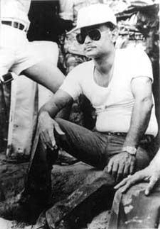
Ziaur Rahman

 
Ziaur Rahman

   Email Print
   Bookmark   Link


Ziaur Rahman


Lieutenant-General Ziaur Rahman, Bir Uttam, Hilal-i-Jurat ( Ziaur Rôhman) (January 19, 1936–May 30, 1981) was a charismatic Bangladeshi war hero, politician
Politician

A politician is an individual who is involved in influencing public decision making through the influence of politics or a person who influences the way a society is governed....
 and statesman
Statesman

A statesman or stateswoman or statesperson is usually a politician or other notable figure of state who has had a long and respected career in politics at the national and international level....
. He was the President of Bangladesh
President of Bangladesh

Since 1991, the President of Bangladesh is the Head of State, a largely ceremonial post elected by the parliament. Since 1996, the President's role becomes more important after the term of the government has finished, when his executive authority is enhanced as laid down in the constitution of the country....
 from 1976 uptill 1981 and founded the Bangladesh Nationalist Party
Bangladesh Nationalist Party

Bangladesh Nationalist Party is the main opposition political party of Bangladesh. It was founded on September 1, 1978, by former President General Ziaur Rahman....
 (BNP), one of the two largest political parties in the country. His widow, Begum Khaleda Zia, has been Prime Minister of Bangladesh
Prime Minister of Bangladesh

The Prime Minister of Bangladesh is, in practice, the most powerful political position in Bangladesh. The President of Bangladesh is considered senior to the Prime Minister, but holds a largely ceremonial role....
 three times and is currently the Leader of Opposition in the Jatiya Sangsad (Bangladeshi parliament).


Discussion
Ask a question about 'Ziaur Rahman'
Start a new discussion about 'Ziaur Rahman'
Answer questions from other users
Full Discussion Forum


Encyclopedia


Lieutenant-General Ziaur Rahman, Bir Uttam, Hilal-i-Jurat ( Ziaur Rôhman) (January 19, 1936–May 30, 1981) was a charismatic Bangladeshi war hero, politician
Politician

A politician is an individual who is involved in influencing public decision making through the influence of politics or a person who influences the way a society is governed....
 and statesman
Statesman

A statesman or stateswoman or statesperson is usually a politician or other notable figure of state who has had a long and respected career in politics at the national and international level....
. He was the President of Bangladesh
President of Bangladesh

Since 1991, the President of Bangladesh is the Head of State, a largely ceremonial post elected by the parliament. Since 1996, the President's role becomes more important after the term of the government has finished, when his executive authority is enhanced as laid down in the constitution of the country....
 from 1976 uptill 1981 and founded the Bangladesh Nationalist Party
Bangladesh Nationalist Party

Bangladesh Nationalist Party is the main opposition political party of Bangladesh. It was founded on September 1, 1978, by former President General Ziaur Rahman....
 (BNP), one of the two largest political parties in the country. His widow, Begum Khaleda Zia, has been Prime Minister of Bangladesh
Prime Minister of Bangladesh

The Prime Minister of Bangladesh is, in practice, the most powerful political position in Bangladesh. The President of Bangladesh is considered senior to the Prime Minister, but holds a largely ceremonial role....
 three times and is currently the Leader of Opposition in the Jatiya Sangsad (Bangladeshi parliament). He is popularly known as Shaheed Zia, meaning martyred Zia, in reference to his assassination in 1981.

A Major in the Pakistan Army
Pakistan Army

The Pakistan Army is the largest branch of the Pakistan military, and is mainly responsible for protection of the state borders, the security of administered territories and defending the national interests of Pakistan within the framework of its international obligations....
, Zia's unit (2/5 East Bengal Regiment
East Bengal Regiment

The East Bengal Regiment is an infantry regiment of the Bangladesh Army....
) took control of the Kalurghat
Kalurghat

Kalurghat is located several miles north of the port city of Chittagong, Bangladesh, and is mostly famous for several heavy industries located there....
 radio station in Chittagong
Chittagong

Chittagong is the second-largest city and main seaport of Bangladesh. Situated on the banks of the Karnaphuli River, it is the principle city of Chittagong Division and a major center of commerce and industry in South Asia....
 at the onset of the Bangladesh Liberation War
Bangladesh Liberation War

The Bangladesh Liberation WarBangladesh Liberation War/nomenclature justification was an armed conflict pitting West Pakistan against East Pakistan and India, that resulted in the secession of East Pakistan to become the independent nation of Bangladesh....
 and declared the independence of Bangladesh. Recognized as a war hero, he was honored with the second highest national award Bir Uttom
Bir Uttom

Bir Uttom is the second highest award for individual gallantry in Bangladesh after the Bir Sreshtho.Since independence of Bangladesh in 1971, 68 people have been awarded as Bir Uttom....
 in 1972. A high-ranking accomplished officer in the Bangladesh Army
Bangladesh Army

The Bangladesh Army is the Army branch of the Military of Bangladesh. It was formed on 15 April 1971 following the oath of the Bangladesh Government at Meherpur, Kushtia during Bangladesh Liberation War under which the Bangladesh Forces originally consisting of Bengali soldiers and officers who defected from the Pakistan Army pledged their...
, Zia was appointed chief of army staff
Chief of Army Staff of the Bangladesh Army

The Chief of Army Staff The Chief of the Army Staff of the Bangladesh Army is the professional head of the Bangladesh Army. By virtue of the eminence of the Bangladesh Army amongst the military forces of Bangladesh, he is also regarded as the senior-most defence official in the country....
 in course of dramatic events that evolved following the assassination of Sheikh Mujibur Rahman
Assassination of Sheikh Mujibur Rahman

Sheikh Mujibur Rahman, the founding leader of Bangladesh, was assassinated in his own residence in a military coup in the early hours of August 15, 1975 while he was serving as the self-declared life-long president of the country....
 in 1975 by a group of junior military officers. This was followed shortly by another coup and counter-coup and ultimately led to the consolidation of power under General Zia as Chief Martial Law Administrator. The counter-coup, sometimes referred to as a sepoy mutiny was organised by the socialist Colonel Abu Taher
Abu Taher

Lieutenant Colonel Abu Taher a communist and a left-leaning radical activist of the Jatiyo Samajtantrik Dal, responsible for the Soldiers Uprising and the radical breakout that occurred in Dhaka, the capital city of Bangladesh in Nov 7th 1975....
.

From Chief Martial Law Administrator (CMLA), General Ziaur Rahaman assumed the office of the president of the country in 1977 and won a popular referendum held in 1978 in support of his policies and leadership. He engaged himself in politics by floating a political party that came to be known as Jagodal. Later he founded the Bangladesh Nationalist Party
Bangladesh Nationalist Party

Bangladesh Nationalist Party is the main opposition political party of Bangladesh. It was founded on September 1, 1978, by former President General Ziaur Rahman....
 (BNP). Zia won widespread popular support for stabilising the nation and leading it in a new direction. Zia who turned out to be a right-wing
Right-wing politics

In politics, right-wing, rightist and the Right are terms applied to Conservatism and reactionary positions. Originally, during the French Revolution, right-wing referred to seating arrangements in parliament; those who sat on the right supported the monarchy and aristocracy....
 politician, established free-market economic policies
Free market

A free market is a market that is free of government intervention and regulation, besides the minimal function of maintaining the legal system and protecting property rights, and is also free of private force and fraud....
 in a 19-point program of industrialisation and development. For achieving popular support, he adopted policies bringing the government increasingly under Islam
Islam

Islam is a Monotheism, Abrahamic religion originating with the teachings of the Prophets of Islam Muhammad, a 7th century Arab religious and political figure....
, which he included in the national constitution
Constitution of Bangladesh

The constitution of Bangladesh is the supreme law in Bangladesh....
. It has been alleged that Zia helped individuals involved in the assassination of Sheikh Mujib rehabilitate home and abroad, immunized by the Indemnity Act
Indemnity Act

The Indemnity Act of Bangladesh was formulated to give immunity from legal action to the persons involved in the assassination of president Sheikh Mujibur Rahman....
. He also came to be known as Mr. Clean for his unquestionable integrity.

A popular yet controversial leader, Zia was assassinated
Assassination of Ziaur Rahman

Ziaur Rahman, the president of Bangladesh, was assassinated by a faction of officers of Bangladesh Army, on May 30, 1981, in the south-eastern port city of Chittagong....
 in 1981 in an abortive military coup.

Early life

Ziaur Rahman was born in the village of Bagbari in the Bogra District of the northwest Bangladesh
Bangladesh

, officially the People's Republic of Bangladesh is a country in South Asia. It is bordered by India on all sides except for a small border with Burma to the far southeast and by the Bay of Bengal to the south....
. His father, Mansur Rahman, was a chemist
Chemist

A chemist is a scientist trained in the science of chemistry. Chemists study the composition of matter and its properties such as density, acidity, size and shape....
 working for a government department in Kolkata. Zia's childhood was divided between living in the village and the city. He was later enrolled into the Hare School
Hare School

Hare School is one of the oldest existing schools in Kolkata, and one of the best schools in India, currently teaching grades 1 to 12 under the West Bengal Board of Secondary Education and the West Bengal Council of Higher Secondary Education....
 in Kolkata. With the partition of India
Partition of India

File:Brit IndianEmpireReligions3.jpgThe Partition of India was the Partition of British India that led to the creation, on August 14, 1947 and August 15, 1947, respectively, of the Sovereignty states of the Dominion of Pakistan and the Union of India ....
 in 1947, Mansur Rahman opted to join the new Muslim state of Pakistan
Pakistan

Pakistan , officially the Islamic Republic of Pakistan, is a country located in South Asia and borders Central Asia and the Middle East. It has a 1,046 kilometre coastline along the Arabian Sea and Gulf of Oman in the south, and is bordered by Afghanistan and Iran in the west, India in the east and People's Republic of China in th...
, moving his family to East Pakistan
East Pakistan

East Pakistan was a former Provinces of Pakistan of Pakistan which existed between 1955 and 1971. East Pakistan was created from Bengal Province based on a plebiscite in what was then British Raj in 1947....
. The family later moved to Karachi
Karachi

is the largest city, seaport and the International financial centre of Pakistan. It is List of metropolitan areas by population in terms of metropolitan population, and is Pakistan's premier centre of banking, industry, and trade....
, the national capital located in West Pakistan
West Pakistan

West Pakistan was the popular and sometimes official name of the western wing of Pakistan until 1971, when the East Pakistan became independent as Bangladesh....
, where Mansur Rahman had been transferred to work for the Government of Pakistan
Government of Pakistan

The Government of Pakistan is a federal parliamentary system, with an Indirect election President of Pakistan as the Head of State and Commander in Chief of the Military of Pakistan, and an indirectly-elected Prime Minister of Pakistan as the Head of Government....
. Zia was enrolled in the Academy School in Karachi.

Zia spent his adolescent years in Karachi and enrolled in the D. J. College there in 1953. In the same year, he entered the Pakistan Military Academy
Pakistan Military Academy

Pakistan Military Academy is the Military Academy of Pakistan Army. It is located at Kakul near Abbottabad in NWFP, Pakistan. The Pakistan Military Academy is similar in function to Royal Military Academy Sandhurst, ?cole sp?ciale militaire de Saint-Cyr or West Point and provides training to the officers of Pakistan Army....
 in Kakul as an officer cadet
Officer Cadet

Officer Cadet is a military rank held by military cadets during their training to become commissioned officers. The term Officer Trainee is used interchangeably in some countries....
. He was commissioned as a second lieutenant
Second Lieutenant

Second Lieutenant is the lowest Officer military rank in many armed forces.In British English the rank is pronounced second /l?f't?n?nt/ , while in American English it is pronounced second /lu't?n?nt/ ....
 in the Pakistan Army
Pakistan Army

The Pakistan Army is the largest branch of the Pakistan military, and is mainly responsible for protection of the state borders, the security of administered territories and defending the national interests of Pakistan within the framework of its international obligations....
 in 1955. After serving for two years in Karachi, he was transferred to the East Bengal Regiment
East Bengal Regiment

The East Bengal Regiment is an infantry regiment of the Bangladesh Army....
 in 1957. From 1959 to 1964 he worked in the department of military intelligence
Military intelligence

Military intelligence , is a military service that uses List of intelligence gathering disciplines which informs the commanders' decision making process by providing intelligence analysis of Intelligence from a wide range of sources including forecast environmental changes , and opposing force intentions....
. In 1960, his marriage was arranged to Khaleda Zia, a young Bengali girl from the Dinajpur District
Dinajpur District

The Dinajpur District was split between India and Bangladesh. The term can refer to the following:* Dinajpur District, Bangladesh* West Dinajpur district, India. It was split on 1992-04-01 into:...
 who was 15 years old. Khaleda Zia remained with her parents in East Pakistan to complete her studies and joined her husband in Karachi in 1965. During the Indo-Pakistani War of 1965
Indo-Pakistani War of 1965

The Indo-Pakistani War of 1965 was a culmination of skirmishes that took place between April 1965 and September 1965 between India and Pakistan....
, Zia served in the Khemkaran
Khemkaran

Khem Karan is a town and a nagar panchayat in Tarn Taran district in the Indian States and territories of India of Punjab . It was the site of a major tank battle in 1965 resulting it also being known as the graveyard of tanks....
 sector in Punjab
Punjab region

Punjab , also Panjab , is a region straddling the border between India and Pakistan. The "Five Rivers" are Beas River, Ravi River, Sutlej, Chenab and Jhelum River; all these are tributaries of the Indus river, Jhelum being the biggest one....
 as the commander of a company unit
Company (military unit)

A company is a military unit, typically consisting of 75-200 soldiers. Most companies are formed of three to five platoons although the exact number may vary by country, unit type, and structure....
 of 300–500 soldiers. The sector was the scene of the most intense battles between the rival armies. Zia's unit won one of the highest numbers of gallantry awards for heroic performances. Ziaur Rahman himself won the distinguished and prestigious Hilal-e-Jurat medal , and his unit won 7 Sitara-e-Jurat
Sitara-e-Jurat

Sitara-e-Jurat, is the 3rd highest Military medal of Pakistan.It is admissible to all ranks for gallant and distinguished service in combat. It is normally awarded to officers /junior commissioned officers....
 medals and 12 Tamgha-e-Jurat medals for their brave roles in the 1965 War with India.

In 1966, Zia was appointed military instructor at the Pakistan Military Academy, later going on to attend the prestigious Command and Staff College
Command and Staff College

The Command and Staff College was established in 1907 at Quetta, Balochistan , British India, now in Pakistan, and is the oldest and the most prestigious institution of the Pakistan Army....
 in Quetta
Quetta

Quetta is the largest city and the Subdivisions of Pakistan capital of the Balochistan Province of Pakistan. It is an important marketing and communications centre for Pakistan with neighbouring Iran and Afghanistan....
, where he completed a course in command and tactical warfare. Advocating that the Pakistan Army make greater efforts to recruit and encourage Bengali military officers, Zia helped raise two Bengali battalion
Battalion

A battalion is a military unit of around 500-1500 men usually consisting of between two and seven company and typically commanded by a Lieutenant Colonel....
s during his stint as instructor. Trained for high-ranking command posts, Zia joined the 2nd East Bengal regiment as its second-in-command at Joydevpur in 1969. Although sectarian tensions between East and West Pakistan were intensifying, Zia travelled to West Germany
West Germany

West Germany was the common English name for the Germany , from its formation in May 1949 to German reunification in October 1990, when East Germany was dissolved and its States of Germany became part of the Federal Republic, ending the more than 40-year division of Germany....
 to receive advanced military and command training with the German Army
German Army

The German Army is the land component of the armed forces of the Federal Republic of Germany. Traditionally the German military forces have been composed of the Army, the Deutsche Marine, and an Luftwaffe after World War I....
.

Zia returned to Pakistan the following year, and witnessed political turmoil and regional division. East Pakistan had been devastated by the 1970 Bhola cyclone
1970 Bhola cyclone

The 1970 Bhola cyclone was a devastating tropical cyclone that struck East Pakistan and India's West Bengal on November 12, 1970. It was the deadliest tropical cyclone ever recorded, and one of the deadliest natural disasters in modern times....
, and the population had been embittered by the slow response of the central government. The political conflict between Sheikh Mujibur Rahman's Awami League, which had won a majority in the 1970 elections, the President Yahya Khan
Yahya Khan

Agha Muhammad Yahya Khan was the President of Pakistan from 1969 to 1971, following the resignation of Ayub Khan. He has one son, Ali Yahya and one daughter, Yasmeen Khan....
 and West Pakistani politician Zulfikar Ali Bhutto
Zulfikar Ali Bhutto

Zulfikar Ali Bhutto was a Pakistani politician who served as the President of Pakistan from 1971 to 1973 and as Prime Minister of Pakistan from 1973 to 1977....
 had brought sectarian tensions to a climax. Sheikh Mujib laid claim to form a government, but Yahya Khan postponed the convening of the legislature under pressure from West Pakistani politicians. Bengali civil and military officers had alleged institutional discrimination through the 1960s, and now distrust had divided the Pakistani Army. Upon his return, Zia attained the rank of Major
Major

In many European languages, the term Major refers to a military rank, denoting seniority at one of usually various levels of rank, for example: "Sergeant-Major" denoting the most senior ranking sergeant of a large military unit; "Captain-Major", denoting a mid-level command status Officer ...
 and was transferred to the 8th East Bengal regiment stationed in Chittagong
Chittagong

Chittagong is the second-largest city and main seaport of Bangladesh. Situated on the banks of the Karnaphuli River, it is the principle city of Chittagong Division and a major center of commerce and industry in South Asia....
 to serve as its second-in-command.

Sector Commander of Bangladesh Liberation Forces

Following the failure of last-ditch talks, Yahya Khan declared martial law
Martial law

Martial law is the system of rules that takes effect when the military takes control of the normal administration of justice.Martial law is sometimes imposed during wars or occupied territory in the absence of any other civil government....
 and ordered the army to crack down on Bengali political activities. Before his arrest, Sheikh Mujib declared the independence of Bangladesh on March 26, 1971 and exhorted the people of East Pakistan to resist the army. One of the highest-ranking Bengali officers, Zia led his unit in mutiny of the Pakistan Army, killing the West Pakistani officers and capturing a radio station in Kalurghat
Kalurghat

Kalurghat is located several miles north of the port city of Chittagong, Bangladesh, and is mostly famous for several heavy industries located there....
 near Chittagong and calling it the Shadhin Bangla Betar Kendro
Mujibnagar

Mujibnagar , formerly known as Baidyanathtala is a town in the Meherpur District of Bangladesh. It is a common reference for the government in exile formed by the leaders of the Awami League, who were leading the guerrilla war for the independence of Bangladesh from Pakistan in 1971....
. On March 27, addressing the people via radio, Zia delivered Sheikh Mujib's address and declared independence on his behalf and pronounced himself "Head of the Republic":

Zia was appointed commander of Mukti Bahini
Mukti Bahini

Mukti Bahini , also termed as the "Freedom Fighters" or FFs, collectively refers to the armed organizations who fought against the Pakistan Army during the Bangladesh Liberation War....
 (Liberation Army) forces in the Chittagong Hill Tracts
Chittagong Hill Tracts

The Chittagong Hill Tracts comprise an area of 13,180 square kilometer in south-eastern Bangladesh, and borders India and Myanmar . It was a single Districts of Bangladesh of Bangladesh till 1984....
, working under General M. A. G. Osmani
M. A. G. Osmani

General Muhammad Ataul Gani Osmani, popularly referred to as Banga Bir General M.A.G. Osmani was the Supreme Commander of the Mukti Bahini and Bangladesh Army during the Bangladesh Liberation War....
, the supreme commander. He worked to provide support and resources to the Mukti Bahini guerilla force and coordinate attacks against the West Pakistani army. At a later phase of the war, Zia travelled across the border into India to receive military resources and training for his troops. Zia also helped coordinate the work of Bangladesh's government-in-exile of Mujibnagar
Mujibnagar

Mujibnagar , formerly known as Baidyanathtala is a town in the Meherpur District of Bangladesh. It is a common reference for the government in exile formed by the leaders of the Awami League, who were leading the guerrilla war for the independence of Bangladesh from Pakistan in 1971....
. On June 1, 1971 Zia became the commander of the first conventional brigade
Brigade

A brigade is a military unit that is typically composed of two to five regiments or battalions, depending on the era and nationality of a given army....
 of the Mukti Bahini, which was named "Z Force," after the first initial of his name. This brigade consisted of 1st, 3rd and 8th East Bengali regiments, enabling Zia to launch major attacks on Pakistani forces. During the war his family was placed under house arrest. The guerrilla war continued until the direct intervention
Indo-Pakistani War of 1971

The Indo-Pakistani War of 1971 was a major military conflict between India and Pakistan. The war is closely associated with the Bangladesh Liberation War ....
 of the Indian Army
Indian Army

The Indian Army is the largest branch of the Indian Armed Forces of India and has the responsibility for army military operations. Its primary objectives include defending India from external aggression, maintaining peace and security within the country, patrolling borders and conducting counter-terrorist operations....
, which captured Dhaka
Dhaka

Dhaka ? formerly Dacca and Jahangir Nagar, is the Capital of Bangladesh and the principal city of Dhaka District. Dhaka is a megacity and one of the major cities of South Asia....
 and forced the surrender of Pakistani forces on December 16, 1971.

Upon his release, Sheikh Mujib assumed charge of the new state's government, and the Indian Army transferred control to the newly-formed Bangladesh Army
Bangladesh Army

The Bangladesh Army is the Army branch of the Military of Bangladesh. It was formed on 15 April 1971 following the oath of the Bangladesh Government at Meherpur, Kushtia during Bangladesh Liberation War under which the Bangladesh Forces originally consisting of Bengali soldiers and officers who defected from the Pakistan Army pledged their...
 on March 17, 1972. Having earned a reputation for courageous leadership during the war, Zia was awarded the Bir Uttom
Bir Uttom

Bir Uttom is the second highest award for individual gallantry in Bangladesh after the Bir Sreshtho.Since independence of Bangladesh in 1971, 68 people have been awarded as Bir Uttom....
, the second-highest military honour. He was given command of a brigade stationed in Comilla
Comilla

Comilla is a city in south-eastern Bangladesh, located along the Dhaka-Chittagong Highway. It is the administrative center of the Comilla District, part of the Chittagong Division....
, and in June he was appointed deputy chief of army staff. He was later promoted to the rank of Major General
Major General

Major General or Major-General is a military rank used in many countries. It is derived from the older rank of Sergeant Major General. A Major General is a high-ranking officer, normally subordinate to the rank of Lieutenant General and senior to the ranks of Brigadier and Brigadier General....
 by the end of 1973. As a high-ranking commander, Zia oversaw the training and development of the army.

Coup of 1975 and its aftermath

By 1975, Sheikh Mujib's assumption of dictatorial powers had disillusioned and angered Bangladeshis, including many army officers. On August 15, 1975 Sheikh Mujib and his family were killed by a group of military officers. One Sheikh Mujib's cabinet ministers Khondaker Mostaq Ahmad
Khondaker Mostaq Ahmad

Khondaker Moshtaq Ahmad was a Bangladeshi politician who served as the President of Bangladesh from 15 August to 6 November, 1975 after the assassination of Sheikh Mujibur Rahman, the founding leader of Bangladesh....
 was appointed the president and, subsequently, Major General Ziaur Rahman was appointed as the army chief after removal of Major General Shafiullah. Zia became one of the most powerful men in the country although nothing is known if Zia had himself helped plot the coup against Sheikh Mujib. However, the coup of 15 August caused a period of instability and unrest in Bangladesh and more so across the ranks and files of the army. Brigadier Khaled Mosharraf
Khaled Mosharraf

Khaled Mosharraf was a Bangladeshi military officer who was a key commander of the Mukti Bahini during the Bangladesh Liberation War. He led a military coup against the politicians and military officers who had seized power in Bangladesh in 1975, but was himself overthrown and assassinated shortly afterwards....
 and the Dhaka Brigade under Colonel Shafat Jamil made a counter-coup on November 3, 1975, and Ziaur Rahman was forced to resign and was put under house arrest. A third coup was staged under Colonel Abu Taher
Abu Taher

Lieutenant Colonel Abu Taher a communist and a left-leaning radical activist of the Jatiyo Samajtantrik Dal, responsible for the Soldiers Uprising and the radical breakout that occurred in Dhaka, the capital city of Bangladesh in Nov 7th 1975....
 and a group of socialist military officers and supporters of the left-wing
Left-wing politics

In politics, left-wing, leftist, and the Left are terms applied to Social progressivism and Egalitarianism positions. Originally, during the French Revolution, left-wing referred to seating arrangements in parliament; those who sat on the left opposed the monarchy and supported Political radicalism reform....
 Jatiyo Samajtantrik Dal
Jatiyo Samajtantrik Dal

The Jatiyo Samajtantrik Dal is a List of political parties in Bangladesh.The party founded in 1972 through the merger of socialist political activists and military officers....
 on November 7, called the Sipoy-Janata Biplob
National Revolution and Solidarity Day

In Bangladesh, November 7 is celebrated as the National Revolution and Solidarity Day. This commemorates the 1975 uprising formed by people and soldiers....
 (Soldiers and People's Coup). Brigadier Khaled Mosharraf was killed and Colonel Jamil arrested, while Colonel Taher freed Ziaur Rahman and re-appointed him as army chief. Following a major meeting at the army headquarters, an interim government was formed with Justice Abu Sadat Mohammad Sayem
Abu Sadat Mohammad Sayem

Judge Abu Sadat Mohammad Sayem was the first Supreme Court of Bangladesh and also the 5th President of Bangladesh, serving between November 6, 1975 and April 21, 1977....
 as chief martial law administrator and Zia, Air Vice Marshal M. G. Tawab
M. G. Tawab

Air Vice Marshal Muhammad Ghulam Tawab was the second chief of the air staff of Bangladesh Air Force who also served as deputy chief martial law administrator of Bangladesh with Ziaur Rahman and M....
 and Rear Admiral
Rear Admiral

Rear Admiral is a naval commissioned officer rank above that of a Commodore and Captain , and below that of a Vice Admiral. It is the lowest form of Admiral....
 M. H. Khan
M. H. Khan

Rear Admiral M. H. Khan was a senior commander of the Bangladeshi Navy and served as deputy chief martial law administrator of Bangladesh from 1975 to 1977 with Ziaur Rahman and M. G. Tawab....
 as his deputies. Zia also took on the portfolios of home affairs, finance, industry and information along with becoming the army chief of staff. However, discipline in the army had totally collapsed and it was difficult to disarm the soldiers and put them back to the barracks. Fearing that Colonel Abu Taher, a retired army officer and a well-known socialist, would attempt to organise another revolt, Zia ordered his arrest. Following a secret trial in a military court, Zia authorised the execution of Colonel Taher on July 21, 1976. Zia became the chief martial law administrator (CMLA) following Justice Sayem's elevation to the presidency on November 19, 1976. He tried to integrate the armed forces, giving repatriates a status appropriate to their qualifications and seniority. While this angered some veterans of the Mukti Bahini, who had rapidly reached high positions following liberation in 1971, Zia defused potential threats from discontented officers by sending them on diplomatic missions abroad.

President of Bangladesh

Pic5
Major General Ziaur Rahman became the 6th President of Bangladesh on April 21, 1977 following Justice Sayem's resignation on grounds of "ill health," which many believed was simply a pretext for Zia's rise to power with army's backing. Although Sayem had held the title of president, historians believe it was Zia who exercised real power from the cantonment. Sayem had promised early elections, but Zia postponed the plans. The years of disorder had left most of Bangladesh's state institutions in disarray, with constant threats of military coups amidst strikes and protests. Assuming full control of the state, Zia banned political parties, censored the media, re-imposed martial law and ordered the army to arrest dissidents. Martial law restored order across the country to a large measure and as Zia crushed several attempted uprisings with ruthless measures, discipline was finally restored in the army.

In late September 1977, a group of Japanese Red Army
Japanese Red Army

The was a militant far-left group founded by Fusako Shigenobu in February 1971 after she broke away from the Japanese Communist League-Red Army Faction....
 terrorists hijacked an airplane and forced it to land in Dhaka. On September 30, while the attention of the government was riveted on this event, a mutiny broke out in Bogra. Although the mutiny was quickly quelled on the night of October 2, a second mutiny occurred in Dhaka. The mutineers unsuccessfully attacked Zia's residence, captured Dhaka Radio for a short time and killed a number of air force officers at Dhaka international airport, where they were gathered for negotiations with the hijackers. The army quickly put down the rebellion, but the government was severely shaken. Government intelligence had failed and Zia promptly dismissed both the military and the civilian intelligence chiefs. Special tribunals dealt harshly with the large groups of bandits, smugglers and guerrilla bands operating across the country. The size of Bangladeshi police forces was doubled and the strength of the army increased from 50,000 to 90,000 soldiers.

When Ziaur Rahman assumed the presidency after legalizing military coups and the revival of the multiparty system was seen again he appointed Hussain Muhammad Ershad as the new Chief of Army Staff
Chief of Army Staff

The Chief of Army Staff or Chief of Staff of the Army is the most senior officer in the command structure of many armies. The title comes from the fact that the officer is the chief army aide to the Commander-in-Chief, who is usually the head of state....
, promoting him to the rank of Lieutenant General
Lieutenant General

Lieutenant General is a military rank used in many countries. The rank traces its origins to the Middle Ages where the title of Lieutenant General was held by the second in command on the battlefield, who was normally subordinate to a Captain General....
. Viewed as a professional soldier with no political aspiration because of his imprisonment during the Independence War] in former West Pakistan and having a talent for Bengali speech writing, Ershad soon became Zia'sclosest politico-military counselor.

Domestic and foreign policies

Zia had taken charge of a nation suffering from severe poverty, chronic unemployment, shortages and economic stagnation. Muting the state's commitment to socialism, Zia announced a "19-point programme" which emphasised self-reliance, rural development, decentralisation and population control. Zia worked energetically and spent much of his time traveling throughout the country, preaching the "politics of hope" by continually urging all Bangladeshis to work harder and to produce more. Zia focused on boosting agricultural and industrial production, especially in food and grains, and to integrate rural development through a variety of programs, of which population planning was the most important. Working with the proposals of international lending agencies, he launched an ambitious rural development program in 1977, which included a highly visible and popular food-for-work program. He promoted private sector development, exports growth and the reversing of the collectivisation of farms. His government reduced quotas and restrictions on agriculture and industrial activities. Zia launched major projects to construct irrigation canals, power stations, dams, roads and other public works. Directing his campaign to mobilise rural support and development, Zia established Gram Sarkar (Village Councils) system of self-government and the "Village Defence Party" system of security and crime prevention. Programmes to promote primary and adult education on a mass scale were initiated and focused mainly across rural Bangladesh. During this period, Bangladesh's economy achieved fast economic and industrial growth.

Zia began reorienting Bangladesh's foreign policy, addressing the concerns of nationalists who believed that Bangladesh was reliant on Indian economic and military aid. Zia withdrew from his predecessors' affinity with the Soviet bloc
Eastern bloc

During the Cold War, the terms Eastern Bloc, Communist Bloc or Soviet Bloc were used to refer to European annexed or expanded Soviet Socialist Republics of the USSR and Satellite state states, including members of the Soviet-dominated organizations Comecon and the Warsaw Pact....
, developing closer relations with the United States and Western Europe
Western Europe

Western Europe refers to the countries in the western most half of Europe. This concept has had different meanings, political and cultural as well as geographical issues have influenced the area....
. Zia also moved to harmonise ties with Saudi Arabia
Saudi Arabia

The Kingdom of Saudi Arabia, KSA , is an Arab country and the largest country of the Arabian Peninsula. It is bordered by Jordan on the northwest, Iraq on the north and northeast, Kuwait, Qatar, Bahrain, and the United Arab Emirates on the east, Oman on the southeast, and Yemen on the south....
 and the People's Republic of China, who had opposed Bangladesh's creation and had not recognised it till 1975. Zia also dropped the demands of reparations and an official apology demanded by Sheikh Mujib and moved to normalise relations with Pakistan. While distancing Bangladesh from India, Zia sought to improve ties with other Islamic nations. Zia's move towards Islamic state policies improved the nation's standing in the Middle East
Middle East

File:GreaterMiddleEast1.pngThe Middle East is a region that spans southwestern Asia, western Asia, and northeastern Africa. It has no clear boundaries, often used as a synonym to Near East, in opposition to Far East....
. Zia also proposed an organisation of the nations of South Asia
South Asia

South Asia, also known as Southern Asia, is the southern region of the Asian continent, which comprises the sub-Himalayan countries and, for some authorities , also includes the adjoining countries on the west and the east....
 to bolster economic and political co-operation at a regional level. This proposal materialised in 1985 under the Presidency of Hussain Muhammad Ershad with the creation of the South Asia Association for Regional Cooperation in Dhaka.

Politics for development

Ziaur Rahman's philosophy of statesmanship was reflected in the coinage of the term politics for development. This was to bring an end to what is called "power politics", since he observed how ownership of the government offered an easy means for misappropriating public wealth through rent-seeking activities. He travelled thousands of miles across the country on foot to drive home his message. He addressed countless public gatherings, large and small, to encourage people to work hard for growth and development. His approach was quite idealistic in nature. His khal kata karmasuchi, for controlling the menace of annual flood, was unique and he engendered participation of people form all walks of life. Awami League leader Mohiuddin Khan Alamgir became a blue eyed boy of the president with the Ulshi Jadunathput Project which was one of the exemplary success story of this khal kata karmasuchi. Mohiuddin Khan Alamgir, then Deputy Commissioner of Jessore district, planned and implemented the project with illustrative success. The country registered significant rise in food production and near-autarky was achieved by 1978.

Islam and nationalism

Ziapic16
Zia moved to lead the nation in a new direction, significantly different from the ideology and agenda of Sheikh Mujib. He issued a proclamation order amending the constitution, increasing the direct influence and role of Islam
Islam

Islam is a Monotheism, Abrahamic religion originating with the teachings of the Prophets of Islam Muhammad, a 7th century Arab religious and political figure....
 on the government. In the preamble, he inserted the salutation "Bismillahir-Rahmaanir-Rahim" ("In the name of Allah
Allah

Allah is the standard Arabic language word for God. While the term is best known in the Western world for its use by Muslims as a reference to God, it is used by Arabic-speakers of all Abrahamic faiths, including Christians and Jews, in reference to "God"....
, the Beneficent, the Merciful"). In Article 8(1) and 8(1A) the statement "absolute trust and faith in Almighty Allah"' was added, replacing the commitment to secularism
Secularism

Secularism is the assertion that governmental practices or institutions should exist separately from religion and/or religious beliefs.In one sense, secularism may assert the right to be free from religious rule and teachings, and freedom from the government imposition of religion upon the people, within a state that is neutral on matters...
. Socialism
Socialism

Socialism refers to a broad set of economic theories of social organization advocating public or state ownership and administration of the means of production and distribution of goods, and a society characterized by equality for all individuals, with a fair or Egalitarianism method of compensation....
 was redefined as "economic and social justice". Zia further introduced provisions to allow Muslims to practice the social and legal injunctions of the Shariat and Sunnah
Sunnah

Sunnah literally means ?trodden path,? and therefore, the sunnah of the prophet means ?the way and the manners of the prophet?. The word ?Sunnah? in Sunni Islam means those religious achievements and manners that were instituted by the Islamic prophet Muhammad during the 23 years of his ministry, which Muslims initially obtained through cons...
. In Article 25(2), Zia introduced the principle that '"the state shall endeavour to consolidate, preserve and strengthen fraternal relations among Muslim countries based on Islamic solidarity." Zia's edits to the constitution redefined the nature of the republic from the secularism laid out by Sheikh Mujib and his supporters. Islamic religious education was introduced as a compulsory subject in Bangladeshi schools, with provisions for non-Muslim students to learn of their own religions.

In public speeches and policies that he formulated, Zia began expounding "Bangladeshi nationalism," as opposed to Mujib's assertion of a Bengali national identity. Zia emphasised the national role of Islam (as practised by the majority of Bangladeshis). Claiming to promote an inclusive national identity, Zia reached out to non-Bengali minorities such as the Santals, Garos
Garo (tribe)

Category:Articles needing more viewpointsThe Garos are a tribe in Meghalaya, India, and Mymensingh District, Bangladesh, who call themselves Achik-mande or simply Achik or Mande....
, Manipur
Manipur

Manipur is a States and territories of India in northeastern India, with the city of Imphal as its capital. Manipur is bounded by the Indian states of Nagaland to the north, Mizoram to the south and Assam to the west; it also borders Myanmar to the east....
is and Chakma
Chakma

Chakma may refer to:*Chakma people*Chakma language*Ojhopath...
s, as well as the Urdu
Urdu

Urdu is a Central_Indo-Aryan_languages#Central_Zone_.28Madhya_or_Hindi.29 Indo-Aryan languages of the Indo-Iranian languages, belonging to the Indo-European languages family of languages....
-speaking peoples of Bihar
Bihar

Bihar is a States and territories of India in East India. Bihar is the 12th largest state in terms of geographical size 38,202 square mile and 3rd largest by population....
i origin. However, many of these groups were predominantly Hindu
Hinduism in Bangladesh

Hinduism is the second largest religious affiliation in Bangladesh, covering 9.2% of the population. According to the Bangladesh Bureau of Statistics....
 and Buddhist
Buddhism in Bangladesh

Buddhism is the third largest religion in Bangladesh with about 0.7% of population adheres to the Theravada Buddhism. Most of the practitioners are from the south-eastern district of Chittagong and Chittagong Hill Tracts....
 and were alienated by Zia's promotion of political Islam. In an effort to promote cultural assimilation and economic development, Zia appointed a Chittagong Hill Tracts
Chittagong Hill Tracts

The Chittagong Hill Tracts comprise an area of 13,180 square kilometer in south-eastern Bangladesh, and borders India and Myanmar . It was a single Districts of Bangladesh of Bangladesh till 1984....
 Development Commission in 1976, but resisted holding a political dialogue with the representatives of the hill tribes on the issue of autonomy and cultural self-preservation. On July 2, 1977 Ziaur Rahman organised a tribal convention to promote a dialogue between the government and tribal groups. However, most cultural and political issues would remain unresolved and intermittent incidents of inter-community violence and militancy occurred throughout Zia's rule.

Indemnity

As Bangladesh's ruler, Zia enacted several controversial measures, some to discipline the army, soem to unify the nation and some to win the support of Islamic political parties. However, he took no action against Awami League leaders who were infamous for corruption. When he re-introduced multy-party politics, he did not disapprove Jamaat-e-Islami, which had been earlier banned by Sheikh Mujib. Jamaat-e-Islami was widely believed to have collaborated with the Pakistani army, which committed war crime
War crime

War crimes are "violations of the laws or customs of war"; including but not limited to "murder, the ill-treatment or deportation of civilian residents of an occupied territory to slave labor camps", "the murder or ill-treatment of prisoner of war", the killing of hostages, "the wanton destruction of cities, towns and villages, and any devast...
s, and in unsuccessfully preventing Bangladeshis independence. Golam Azam
Golam Azam

Ghulam Azam , is a Bangladeshi political leader. The former Ameer of Jamaat-e-Islami Bangladesh, he opposed the independence of Bangladesh upon its liberation on December 16 1971, and was a permanent resident of England until 1978, and was forced to maintain Pakistani citizenship until 1994 due to the decision by the Bangladeshi government a...
, the exiled chief of the Jammat-e-Islami, was allowed to come back to Bangladesh in July 1978 with a Pakistani passport on a visitor's visa, and he remained in Bangladesh following its expiry. No court case was lodged for his trial over his alleged role in committing wartime atrocities. Also, some Jamaat leaders were appointed in ministerial posts. Zia also rehabilitated Shah Azizur Rahman
Shah Azizur Rahman

Shah Azizur Rahman was a Bangladeshi politician who served as the Prime Minister of Bangladesh. However, he was the subject of considerable controversy for his collaboration with the Pakistan Army against the struggle to establish Bangladesh....
, a high-profile opponent of the creation of Bangladesh, and several men accused of murdering Sheikh Mujib. The Indeminity Ordinance proclaimed by President Mustaque was ratified in the Parliament when Zia's party BNP had a landslide victory in the national elction of 1979. The ordinance thereby became Indemnity Act
Indemnity Act

The Indemnity Act of Bangladesh was formulated to give immunity from legal action to the persons involved in the assassination of president Sheikh Mujibur Rahman....
. During the tenure of President Hussain Muhammad Ershad, the Indemnity Act was incorporated as the 5th amendment to the constitution, legalising the military coups, rule under martial law and other political events between 1975 to 1979. Zia also gave Sheikh Mujib's assassins Major Dalim
Assassination of Sheikh Mujibur Rahman

Sheikh Mujibur Rahman, the founding leader of Bangladesh, was assassinated in his own residence in a military coup in the early hours of August 15, 1975 while he was serving as the self-declared life-long president of the country....
, Major Rashid
Assassination of Sheikh Mujibur Rahman

Sheikh Mujibur Rahman, the founding leader of Bangladesh, was assassinated in his own residence in a military coup in the early hours of August 15, 1975 while he was serving as the self-declared life-long president of the country....
, and Major Faruk
Syed Faruque Rahman

Syed Faruque Rahman was one of the junior officers in the Bangladeshi army who plotted the assassination of President Mujibur Rahman. His military rank was Major at the time and afterward secured a promotion to Lt....
 jobs in the Ministry of Foreign Affairs, and in subsequent years they were appointed ambassadors of Bangladesh to African and Middle Eastern nations. Shah Azizur Rahman was appointed Bangladesh's prime minister, serving through Zia's tenure in the presidency.

Assassination

Ziapic2
During his term of power, Zia was criticised for ruthless treatment of his political opposition. Although he enjoyed overall popularity and public confidence, Zia's rehabilitation of some of the most controversial men in Bangladesh aroused fierce opposition from the supporters of the Awami League and veterans of the Mukti Bahini
Mukti Bahini

Mukti Bahini , also termed as the "Freedom Fighters" or FFs, collectively refers to the armed organizations who fought against the Pakistan Army during the Bangladesh Liberation War....
. Amidst speculation and fears of unrest, Zia went on tour to Chittagong on May 29, 1981 to help resolve an intra-party political dispute in the regional BNP. Zia and his entourage stayed overnight at the Chittagong Circuit House, a rest house. In the early hours of the morning of May 30, he was assassinated by a group of army officers along with six bodyguards and two aides.

Zia's killing came as a central part of a botched military coup attempt led by Major General Abul Monjur
Abul Monjur

Major General Muhammad Abul Manzur was a Bangladeshi army officer falsely accused of organizing the assassination of Ziaur Rahman on May 30, 1981 in Chittagong....
, who announced the killing and his take-over of the government on radio. Monjur had earlier been a senior army commander and had been transferred to Chittagong in 1977. He was scheduled for a new transfer to a non-command position in Dhaka and was reportedly disappointed over his impending demotion.

After the assassination of Ziaur Rahman
Assassination of Ziaur Rahman

Ziaur Rahman, the president of Bangladesh, was assassinated by a faction of officers of Bangladesh Army, on May 30, 1981, in the south-eastern port city of Chittagong....
 on 30 May 1981], the Chief of Army Staff
Chief of Army Staff

The Chief of Army Staff or Chief of Staff of the Army is the most senior officer in the command structure of many armies. The title comes from the fact that the officer is the chief army aide to the Commander-in-Chief, who is usually the head of state....
 Lt. Gen. Hussain Muhammad Ershad remained loyal to the government and ordered the army to suppress the coup attempt of Zia's associates led by Major General
Major General

Major General or Major-General is a military rank used in many countries. It is derived from the older rank of Sergeant Major General. A Major General is a high-ranking officer, normally subordinate to the rank of Lieutenant General and senior to the ranks of Brigadier and Brigadier General....
 Abul Monjur
Abul Monjur

Major General Muhammad Abul Manzur was a Bangladeshi army officer falsely accused of organizing the assassination of Ziaur Rahman on May 30, 1981 in Chittagong....
. Zia was buried at the Chandrima Uddan
Chandrima Uddan

Chandrima Uddan is a park situated in the road beside the Jatiyo Sangshad Bhaban, in Dhaka, Bangladesh. The name literally means "Moonlight Park" in Bengali language....
 in the locality of Sher-e-Banglanagar
Sher-e-Banglanagar

Sher-e-Bangla Nagor is a central part of the city of Dhaka, Bangladesh. It is named after political leader A. K. Fazlul Huq, who was popularly known as "Sher-e-Bangla" ....
 in Dhaka. Large processions of supporters and BNP activists attended the funeral. Vice President Abdus Sattar immediately succeeded him, and led the BNP to victory in elections held in 1981. However the BNP] government was not doing well and pressure increased from high-ranking army commanders for the military to take over the reins of state. Ershad came to power in a bloodless coup
Military coups in Bangladesh

Bangladesh has faced several military coups since its Bangladesh Liberation War from Pakistan in 1971....
 on 24 March, 1982 and proclaimed himself Chief Martial Law Administrator (CMLA), President Sattar was replaced. Hussain Muhammad Ershad took over as president on 11 December, 1983 by replacing A. F. M. Ahsanuddin Chowdhury
A. F. M. Ahsanuddin Chowdhury

Abul Fazal Mohammad Ahsanuddin Choudhury was a judicial and political figure in Bangladesh. Born in 1915 at Bokainagar in Mymensingh District....
..

Criticism and legacy

Ziaur Rahman is considered one of the most important and controversial political leaders of Bangladesh. Zia is criticised by historians and the supporters of the Awami League for rehabilitating the assassins of Mujibur Rahman. Jurists regard this as a gross obstruction of justice and legitimisation of political murder, to which Zia himself fell victim. Also deeply controversial is Zia's rehabilitation of persons and political groups that had collaborated with the Pakistani army in carrying out atrocities against intellectuals and religious minorities. Zia is also criticised for creating a "managed democracy," which remained largely beholden to the military and his political party. In a verdict passed on August 30, 2005 the Dhaka High Court
Dhaka High Court

The Dhaka High Court is one of the most important High Court s in Bangladesh, located in the capital of Dhaka with jurisdiction for the Dhaka District....
 declared the seizures of power by military coups between 1975 and 1979, including Zia's military regime as "unlawful and unconstitutional." Zia's martial law decrees, his ascendancy to the presidency in 1977 and the referendum held in 1978 were declared "unknown to the constitution." The court ruling overruled the Indemnity Act by which these very events were accorded a legal status and enshrined in the constitution.

Former US President Ronald Reagan
Ronald Reagan

Ronald Wilson Reagan was the List of Presidents of the United States President of the United States and the 33rd Governor of California . Born in Illinois, Reagan moved to Los Angeles, California in the 1930s, where he was an actor, president of the Screen Actors Guild , and a spokesman for General Electric ....
 praised him for his leadership and said that "The United States -- indeed the world -- had come to respect President Zia's profound and compassionate commitment to a better life for his people and his dedication to the rule of law. His wisdom in international affairs will be sorely missed".

While credited for ending the disorder of the final years of Sheikh Mujib's rule, Zia is assailed by his critics for suppressing opposition. However, Zia's economic reforms are credited with rebuilding the economy and his move towards Islamisation
Islamization

Islamization or Islamification means the process of a society's conversion to the religion of Islam, or a neologism meaning an increase in observance by an already Muslim society....
 brought him the support of much of Bangladesh's Muslim-majority population. His nationalist vision also appealed to many who resented the nation's strategic alliance with India and the Soviet Union
Soviet Union

The Union of Soviet Socialist Republics was a Constitution of the Soviet Union socialist state that existed in Eurasia from 1922 to 1991.The name is a translation of the , romanization of Russian Soyuz Sovetskikh Sotsialisticheskikh Respublik, abbreviated ????, SSSR....
. Moving away from Mujib's secularism, Zia asserted an Islamic political identity for Bangladesh and of membership in the wider community of Muslim nations. However, these measures also isolated and embittered many ethnic and religious minorities in Bangladesh, laying in the opinion of many historians the foundations of future communal and ethnic conflicts. Even political rivals of Zia acknowledge that he was not corrupt at all. He lived an extremely simple life, and although he was the most powerful President in the country, he opted to have his food supplied from military canteen, which had been also supplied to other army personnel in the country.

Ziaur Rahman is survived by his wife Begum Khaleda Zia and his sons Tareq Rahman
Tareq Rahman

Tareq Rahman, often spelled as Tarique Rahman, is a Bangladeshi politician. He is Senior Joint Secretary-General of the Bangladesh Nationalist Party ....
 and Arafat Rahman. Begum Khaleda Zia became the head of the BNP and organised a coalition of political parties opposed to Ershad's regime. In elections held in 1991, Begum Khaleda Zia led the BNP to victory and became prime minister. She lost the 1996 elections to the Awami League's Sheikh Hasina Wajed, the daughter of Mujibur Rahman but returned to power in 2001. Tareq Rahman serves as BNP senior joint secretary, regarded by many as the architect of the BNP's 2001 election victory. Zia's life and legacy are celebrated widely. November 7 each year is celebrated as National Revolution and Solidarity Day
National Revolution and Solidarity Day

In Bangladesh, November 7 is celebrated as the National Revolution and Solidarity Day. This commemorates the 1975 uprising formed by people and soldiers....
, commemorating the military coup that returned Zia to power. Zia is the namesake of many public institutions, including the Zia International Airport
Zia International Airport

Zia International Airport is the largest airport in Bangladesh located in Kurmitola, north of Dhaka, with Dhaka Cantonment on one side and Uttara Thana on the other....
 in Dhaka, which is the busiest airport in the nation. Zia has also been honoured by the South Asian Association for Regional Cooperation
South Asian Association for Regional Cooperation

The South Asian Association for Regional Cooperation is an economic and political organization of eight countries in South Asia. In terms of population, its sphere of influence is the largest of any regional organization: almost 1.5 billion people, the combined population of its member states....
 for his statesmanship and vision.

See also


Further reading

  • Anthony Mascarenhas, Bangladesh: A Legacy of Blood
    Bangladesh: A Legacy of Blood

    Bangladesh: A Legacy of Blood is a book written by journalist Anthony Mascarenhas. The book chronicles the bloody coups and uprisings in the post-independence Bangladesh....
    . ISBN 0-340-39420-X.
  • Craig Baxter, Bangladesh: From a Nation to a State (1997), Westview Press. ISBN 0-8133-2854-3.
  • Craig Baxter et al, Governance and Politics in South Asia (1998), Westview Press. ISBN 0-8133-3901-4.

External links