
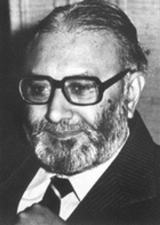
Mohammad Abdus Salam, NI, SPk (
UrduUrdu is a register of the Hindustani language that is identified with Muslims in South Asia. It belongs to the Indo-European family. Urdu is the national language and lingua franca of Pakistan. It is also widely spoken in some regions of India, where it is one of the 22 scheduled languages and an...
:
محمد عبد السلام, pronounced əbd̪ʊs səlɑm, (January 29, 1926– November 21, 1996) was a Pakistani theoretical physicist and
Nobel laureate in
PhysicsThe Nobel Prize in Physics is awarded once a year by the Royal Swedish Academy of Sciences. It is one of the five Nobel Prizes established by the will of Alfred Nobel in 1895 and awarded since 1901; the others are the Nobel Prize in Chemistry, Nobel Prize in Literature, Nobel Peace Prize, and...
for his work on the electroweak unification of the electromagnetic and weak forces. Salam, Sheldon Glashow and
Steven WeinbergSteven Weinberg is an American theoretical physicist and Nobel laureate in Physics for his contributions with Abdus Salam and Sheldon Glashow to the unification of the weak force and electromagnetic interaction between elementary particles....
shared the 1979 Nobel prize for this discovery. Salam holds the distinction of being the first
PakistanPakistan , officially the Islamic Republic of Pakistan is a sovereign state in South Asia. It has a coastline along the Arabian Sea and the Gulf of Oman in the south and is bordered by Afghanistan and Iran in the west, India in the east and China in the far northeast. In the north, Tajikistan...
i and the first
MuslimA Muslim, also spelled Moslem, is an adherent of Islam, a monotheistic, Abrahamic religion based on the Quran, which Muslims consider the verbatim word of God as revealed to prophet Muhammad. "Muslim" is the Arabic term for "submitter" .Muslims believe that God is one and incomparable...
Nobel Laureate to receive the prize in the sciences.
Salam was a science advisor to the Government of Pakistan from 1960 till 1974, a position from which he played a major and influential role in Pakistan's science infrastructure. Salam was responsible for not only major development and contribution in theoretical and particle physics, but as well as promoting scientific research at maximum level in his country. Salam was the founding director of
Space and Upper Atmosphere Research CommissionThe Space and Upper Atmosphere Research Commission , is an executive agency of the Government of Pakistan, responsible for nation's public and civil space program and aeronautics and aerospace research...
(SUPARCO), and responsible for the establishment of the Theoretical Physics Group (TPG) in
Pakistan Atomic Energy CommissionThe Pakistan Atomic Energy Commission, , is an administrative governmental and autonomous science and technology governmental department of Pakistan, responsible for development of nuclear energy and development of nuclear power sector in Pakistan...
(PAEC). As Science Advisor, Salam played an integral role in Pakistan's development on
peacefulAs of 2009, nuclear power in Pakistan is provided by 3 licensed-commercial nuclear power plants. Pakistan is the first Muslim country in the world to construct and operate civil nuclear power plants. The Pakistan Atomic Energy Commission , the scientific and nuclear governmental agency, is solely...
use of nuclear energy, and directed the research on
developmentProject-706, also known as Project-726 or as the Kahuta Project, was a science effort codename of a project conducted during the Cold War and Russo-Afghan War whose objective was to develop Pakistan' first atomic weapon. The mainstream goal of the project was the development of an atomic bomb using...
of weapons in 1972; for this, he is viewed as "scientific father" of this programme in the views of the scientists who researched under his scientific umbrella. In 1974, Salam left Pakistan in protest when Pakistan Parliament controversially passed a parliamentary bill declaring
Ahmadiyya Muslim CommunityThe Ahmadiyya Muslim Community is the larger of two communities that arose from the Ahmadiyya movement founded in 1889 in India by Mirza Ghulam Ahmad of Qadian . The original movement split into two factions soon after the death of the founder...
as Non-Muslims. Even after his death, Salam remained one of the most influential scientists in his country. In 1998, following the country's
nuclear testsThe Chagai-I was a codename referring to the five underground nuclear tests conducted by Pakistan at 15:15hrs in 28th May of 1998. It was named Chagai-I, as the tests were conducted in the Chagai District...
, the
GovernmentThe Government of Pakistan is a federal parliamentary system, with an indirectly-elected President as the Head of State and Commander in Chief of the Pakistani Armed Forces, and an indirectly-elected Prime Minister as the Head of Government. The President’s appointment and term are...
of Pakistan issued a commemorative stamp, as a part of "Scientists of Pakistan", to honour the services of Salam.
Salam's major and notable achievements include the
Pati-Salam modelIn physics, the Pati–Salam model is a Grand Unification Theory was proposed in 1974 by nobel laureate Abdus Salam and Jogesh Pati. The unification is based on there being four quark color charges, dubbed red, green, blue and violet , instead of the conventional three, with the new "violet" quark...
, Magnetic photon,
Vector mesonIn high energy physics, a vector meson is a meson with total spin 1 and odd parity . Compare to a pseudovector meson, which has a total spin 1 and even parity....
, Grand Unified Theory, work on
supersymmetryIn particle physics, supersymmetry is a symmetry that relates elementary particles of one spin to other particles that differ by half a unit of spin and are known as superpartners...
and, most importantly, electroweak theory, for which he was awarded the most prestigious award in Physics — the Nobel Prize. Salam made a major contribution in Quantum Field Theory and advancement of Mathematics at the Imperial College. With his student, Riazuddin, Salam made important contributions to the modern theory on neutrinos, neutron stars and black holes, as well as the work on modernizing the quantum mechanics and quantum field theory. As a teacher and science promoter, Salam is remembered as a founder and scientific father of
mathematicalMathematical physics refers to development of mathematical methods for application to problems in physics. The Journal of Mathematical Physics defines this area as: "the application of mathematics to problems in physics and the development of mathematical methods suitable for such applications and...
and theoretical physics in Pakistan while his stay as Science advisor. Salam heavily contributed to the rise of Pakistani physics to the
Physics communityThe European Organization for Nuclear Research , known as CERN , is an international organization whose purpose is to operate the world's largest particle physics laboratory, which is situated in the northwest suburbs of Geneva on the Franco–Swiss border...
in the world. Even until his death, Salam continued to contribute in physics and tirelessly advocated for the development of science in third world countries.
Youth and education
Abdus Salam was born in Santokdas,
Sahiwal DistrictSahiwal District is a district in the Punjab province of Pakistan. As of 1998, it had a population of 1,843,194 people, 16.27% of which were located in urban areas. Since 2008, Sahiwal District along with Okara District and Pakpattan District has comprised the Sahiwal Division...
, according to his elder sister and his obituary, although he grew up in
Jhang- Demographics :According to 1981 census of Pakistan population of Jhang was 1,970,944 with the 434,495 housing units in Jhang. In 1998 census, population of Jhang was 2,834,545, whose annually growth rate was 2.16%. Male population was 1,474,099 and female population was 1,360,446...
. Salam's father was an education officer in the Department of Education of British Punjab State in a poor farming district. Salam's family had a long tradition of piety and passion for learning.
At age fourteen, Salam scored the highest marks ever recorded for the
MatriculationMatriculation, in the broadest sense, means to be registered or added to a list, from the Latin matricula – little list. In Scottish heraldry, for instance, a matriculation is a registration of armorial bearings...
Examination at the
Punjab UniversityUniversity of the Punjab , colloquially known as Punjab University, is located in Lahore, Punjab, Pakistan. The University of the Punjab is the oldest and biggest University of Pakistan. The University of the Punjab was formally established with the convening of the first meeting of its...
. He won a full scholarship to the
Government College UniversityGovernment College University, Lahore is a co-educational public university located on The Mall in Lahore, Pakistan...
of
LahoreLahore is the capital of the Pakistani province of Punjab and the second largest city in the country. With a rich and fabulous history dating back to over a thousand years ago, Lahore is no doubt Pakistan's cultural capital. One of the most densely populated cities in the world, Lahore remains a...
, British Punjab State. Salam was a versatile scholar, interested in
UrduUrdu literature has a long and colorful history that is inextricably tied to the development of that very language, Urdu, in which it is written...
and
English literatureBritish Literature refers to literature associated with the United Kingdom, Isle of Man and Channel Islands. By far the largest part of British literature is written in the English language, but there are bodies of written works in Latin, Welsh, Scottish Gaelic, Scots, Cornish, Manx, Jèrriais,...
in which he excelled. But, soon picked up Mathematics as his
concentrationIn the United States and Canada, an academic major or major concentration is the academic discipline to which an undergraduate student formally commits....
. Salam's mentor and tutors wanted him to become an English teacher, but Salam decided to stick with Mathematics As a fourth-year student there, he published his work on
Srinivasa RamanujanSrīnivāsa Aiyangār Rāmānujan FRS, better known as Srinivasa Iyengar Ramanujan was a Indian mathematician and autodidact who, with almost no formal training in pure mathematics, made extraordinary contributions to mathematical analysis, number theory, infinite series and continued fractions...
's problems in mathematics, and took his
B.A.A Bachelor of Arts , from the Latin artium baccalaureus, is a bachelor's degree awarded for an undergraduate course or program in either the liberal arts, the sciences, or both...
in Mathematics in 1944. His father wanted him to join Indian Civil Service in His Majesty's Government. In those days, the Indian Civil Service was a highest aspiration for young university graduates and civil servants occupied a respected place in the civil society. Respecting his father's wish, Salam tried for the
Indian RailwaysIndian Railways , abbreviated as IR , is a departmental undertaking of Government of India, which owns and operates most of India's rail transport. It is overseen by the Ministry of Railways of the Government of India....
but did not qualify for the service as he failed the medical optical tests because Salam wore
spectaclesGlasses, also known as eyeglasses , spectacles or simply specs , are frames bearing lenses worn in front of the eyes. They are normally used for vision correction or eye protection. Safety glasses are a kind of eye protection against flying debris or against visible and near visible light or...
since an early age. The results further concluded that Salam failed a mechanical test necessary for the railway engineers to be passed in order to gain commission in Indian Railways, and the results also stated that Salam was too young for the Indian Railways to compete for the job. Therefore, Indian Railways rejected Abdus Salam's job application. While in Lahore, Abdus Salam went on to attend the graduate school of Government College University. He received his
M.A.A Master of Arts from the Latin Magister Artium, is a type of Master's degree awarded by universities in many countries. The M.A. is usually contrasted with the M.S. or M.Sc. degrees...
in Mathematics from the
Government College UniversityGovernment College University, Lahore is a co-educational public university located on The Mall in Lahore, Pakistan...
in 1946. That same year, he was awarded a scholarship to
St. John's CollegeSt John's College is a constituent college of the University of Cambridge. The college's alumni include nine Nobel Prize winners, six Prime Ministers, three archbishops, at least two princes, and three Saints....
, Cambridge University, where he completed a
BAA Bachelor of Arts , from the Latin artium baccalaureus, is a bachelor's degree awarded for an undergraduate course or program in either the liberal arts, the sciences, or both...
degree with
Double First-Class HonoursThe British undergraduate degree classification system is a grading scheme for undergraduate degrees in the United Kingdom...
in Mathematics and Physics in 1949. In 1950, he received the
Smith's PrizeThe Smith's Prize was the name of each of two prizes awarded annually to two research students in theoretical Physics, mathematics and applied mathematics at the University of Cambridge, Cambridge, England.- History :...
from Cambridge University for the most outstanding pre-doctoral contribution to Physics. After finishing his degrees,
Fred HoyleSir Fred Hoyle FRS was an English astronomer and mathematician noted primarily for his contribution to the theory of stellar nucleosynthesis and his often controversial stance on other cosmological and scientific matters—in particular his rejection of the "Big Bang" theory, a term originally...
advised Salam to spend another year in Cavendish Laboratory to do the research on
experimental physicsWithin the field of physics, experimental physics is the category of disciplines and sub-disciplines concerned with the observation of physical phenomena in order to gather data about the universe...
, but Salam had no patience for carrying out long experiments in laboratory. Salam returned to Jhang, Punjab (now part of
PakistanPakistan , officially the Islamic Republic of Pakistan is a sovereign state in South Asia. It has a coastline along the Arabian Sea and the Gulf of Oman in the south and is bordered by Afghanistan and Iran in the west, India in the east and China in the far northeast. In the north, Tajikistan...
) and renewed his scholarship and returned to United Kingdom to do his doctorate.
He obtained a
Ph.DDoctor of Philosophy, abbreviated as Ph.D., PhD, D.Phil., or DPhil , in English-speaking countries, is a postgraduate academic degree awarded by universities...
degree in
Theoretical PhysicsTheoretical physics is a branch of physics which employs mathematical models and abstractions of physics to rationalize, explain and predict natural phenomena...
from
Cavendish LaboratoryThe Cavendish Laboratory is the Department of Physics at the University of Cambridge, and is part of the university's School of Physical Sciences. It was opened in 1874 as a teaching laboratory....
at Cambridge. His doctoral thesis contained comprehensive and fundamental work in
Quantum ElectrodynamicsQuantum electrodynamics is the relativistic quantum field theory of electrodynamics. In essence, it describes how light and matter interact and is the first theory where full agreement between quantum mechanics and special relativity is achieved...
. By the time it was published in 1951, it had already gained him an international reputation and the
Adams PrizeThe Adams Prize is awarded each year by the Faculty of Mathematics at the University of Cambridge and St John's College to a young, UK based mathematician for first-class international research in the Mathematical Sciences....
.
While he was doing his doctorate, his mentors challenged him to solve an intractable problem within one year, a problem that had defied such great minds as
DiracPaul Adrien Maurice Dirac, OM, FRS was an English theoretical physicist who made fundamental contributions to the early development of both quantum mechanics and quantum electrodynamics...
and
FeynmanRichard Phillips Feynman was an American physicist known for his work in the path integral formulation of quantum mechanics, the theory of quantum electrodynamics and the physics of the superfluidity of supercooled liquid helium, as well as in particle physics...
. Within a six month period, Salam found a solution for the renormalization of meson theory. As he proposed the solution at the Cavendish Laboratory, Salam had attracted the attention of
BetheHans Albrecht Bethe was a German-American nuclear physicist, and Nobel laureate in physics for his work on the theory of stellar nucleosynthesis. A versatile theoretical physicist, Bethe also made important contributions to quantum electrodynamics, nuclear physics, solid-state physics and...
, Oppenheimer and Dirac.
Academic career
After his doctorate in 1951, Salam returned to the
Government College UniversityGovernment College University, Lahore is a co-educational public university located on The Mall in Lahore, Pakistan...
as a
ProfessorA professor is a scholarly teacher; the precise meaning of the term varies by country. Literally, professor derives from Latin as a "person who professes" being usually an expert in arts or sciences; a teacher of high rank...
of Mathematics which he remained there till 1954. During the same period, he was the Chairman of the Department of Mathematics, and professor as well, at the
Punjab UniversityUniversity of the Punjab , colloquially known as Punjab University, is located in Lahore, Punjab, Pakistan. The University of the Punjab is the oldest and biggest University of Pakistan. The University of the Punjab was formally established with the convening of the first meeting of its...
. As he became the chairman, Salam sought to update the university curriculum, making a course of
Quantum mechanicsQuantum mechanics, also known as quantum physics or quantum theory, is a branch of physics providing a mathematical description of much of the dual particle-like and wave-like behavior and interactions of energy and matter. It departs from classical mechanics primarily at the atomic and subatomic...
as a part of undergraduate course. This was soon reverted back by the Vice-Chancellor, and Salam decided to teach an evening course in Quantum Mechanics outside the regular curriculum. While Salam had mixed popularity in the university, he began to supervise the education of students who were particularly influenced by him. As a result, Riazuddin remained the only student of Salam who has privileged to study under Salam at the
Under-graduateUndergraduate education is an education level taken prior to gaining a first degree . Hence, in many subjects in many educational systems, undergraduate education is post-secondary education up to the level of a bachelor's degree, such as in the United States, where a university entry level is...
and
Post-graduatePostgraduate education involves learning and studying for degrees or other qualifications for which a first or Bachelor's degree generally is required, and is normally considered to be part of higher education...
level in Lahore, and Post-doctoral level in Cambridge University. In 1953, Salam was unable to establish a research institute in Lahore, as he faced strong opposition from his peers. In 1954, Salam took fellowship and became one of the earliest fellows of the
Pakistan Academy of SciencesThe Pakistan Academy of Sciences The Pakistan Academy of Sciences The Pakistan Academy of Sciences (Urdu: پاکستان اكيڈ مى ﺁف سائس; shortened to PAS, is a learned society for science and technology based in Pakistan. The academy consisted and served as the network of science across the Pakistan as...
. As a result of 1953 riots in Lahore, Salam went back to Cambridge and joined
St John's CollegeSt John's College is a constituent college of the University of Cambridge. The college's alumni include nine Nobel Prize winners, six Prime Ministers, three archbishops, at least two princes, and three Saints....
, and took a position as a professor of mathematics in 1954.
In 1957, he was invited to take a chair at Imperial College of London, and he and
Paul MatthewsPaul Taunton Matthews CBE FRS was a British theoretical physicist.He was born in Erode in India. He was awarded the Adams Prize in 1958, elected to the Royal Society in 1963, and awarded the Rutherford Medal and Prize in 1978. He became head of the Physics Department of Imperial College, London...
went on to set up the Theoretical Physics Department at Imperial College. While, he kept his strong association links with Pakistan, and visited his country time by time. As time passes, this department became one of the prestigious research department that included well known physicists such as
Steven WeinbergSteven Weinberg is an American theoretical physicist and Nobel laureate in Physics for his contributions with Abdus Salam and Sheldon Glashow to the unification of the weak force and electromagnetic interaction between elementary particles....
,
Tom KibbleThomas Walter Bannerman Kibble, FRS, is a British scientist and senior research investigator at The Blackett Laboratory, at Imperial College London, UK. His research interests are in quantum field theory, especially the interface between high-energy particle physics and cosmology...
,
Gerald GuralnikGerald Stanford Guralnik is the Chancellor’s Professor of Physics at Brown University. He is most famous for his co-discovery of the Higgs mechanism and Higgs Boson with C. R. Hagen and Tom Kibble...
,
C. R. HagenCarl Richard Hagen is a professor of particle physics at the University of Rochester. He is most noted for his contributions to the Standard Model and Symmetry breaking as well as the co-discovery of the Higgs mechanism and Higgs boson with Gerald Guralnik and Tom Kibble...
, Riazuddin, and
John WardJohn Clive Ward , was a British-Australian physicist. His most famous creation was the Ward-Takahashi identity, originally known as "Ward Identity" . This celebrated result, in quantum electrodynamics, was inspired by a conjecture of Dyson and was disclosed in a one-half page letter typical of...
. In 1957, Punjab University conferred Salam with an
Honorary doctorateAn honorary degree or a degree honoris causa is an academic degree for which a university has waived the usual requirements, such as matriculation, residence, study, and the passing of examinations...
for his contribution in Particle physics.
The same year with help from his mentor, Salam launched a scholarship programme for his students in Pakistan. At Cambridge and Imperial College he had formed a group of theoretical physicists, the majority of them were his Pakistani students. In 1959, he became one of the youngest to be named Fellow of the Royal Society at the age of 33. Salam took a fellowship at the
Princeton UniversityPrinceton University is a private research university located in Princeton, New Jersey, United States. The school is one of the eight universities of the Ivy League, and is one of the nine Colonial Colleges founded before the American Revolution....
in 1959, where he met with J. Robert Oppenheimer. Salam presented his brief and research work on neutrinos to Oppenheimer. Both Oppenheimer and Salam discussed the foundation of electrodynamics, problems and their solution, in which Salam was praised by Oppenhimer. His dedicated personal assistant was Jean Bouckley. In 1980, Salam became was a foreign fellow of Bangladesh Academy of Sciences
Scientific career
Early in his career, Salam made an important and significant contribution on
Quantum electrodynamicsQuantum electrodynamics is the relativistic quantum field theory of electrodynamics. In essence, it describes how light and matter interact and is the first theory where full agreement between quantum mechanics and special relativity is achieved...
,
quantum field theoryQuantum field theory provides a theoretical framework for constructing quantum mechanical models of systems classically parametrized by an infinite number of dynamical degrees of freedom, that is, fields and many-body systems. It is the natural and quantitative language of particle physics and...
,
quantum chromodynamicsIn theoretical physics, quantum chromodynamics is a theory of the strong interaction , a fundamental force describing the interactions of the quarks and gluons making up hadrons . It is the study of the SU Yang–Mills theory of color-charged fermions...
, and including its extension into
particleParticle physics is a branch of physics that studies the existence and interactions of particles that are the constituents of what is usually referred to as matter or radiation. In current understanding, particles are excitations of quantum fields and interact following their dynamics...
and
nuclear physicsNuclear physics is the field of physics that studies the building blocks and interactions of atomic nuclei. The most commonly known applications of nuclear physics are nuclear power generation and nuclear weapons technology, but the research has provided application in many fields, including those...
. In his early career in Pakistan, Salam was highly interested in mathematical series in mathematics, and their possible relations with physics. Salam had played an influential role in the advancement of nuclear physics, but he maintained and dedicated himself to mathematics and theoretical physics. Though, he did regarded nuclear physics (nuclear fission and nuclear power) as "Passé" of physics as it had already "happened". Even in Pakistan, Salam was the leading driving force in leading theoretical physics in
PakistanPakistan , officially the Islamic Republic of Pakistan is a sovereign state in South Asia. It has a coastline along the Arabian Sea and the Gulf of Oman in the south and is bordered by Afghanistan and Iran in the west, India in the east and China in the far northeast. In the north, Tajikistan...
, with many scientists he continued to influence and encourage to keep their work on theoretical physics. Salam had a prolific research career in Theoretical and High-energy physics, and either he pioneered or was associated with all the important developments in this field. Salam had work on theory of the
NeutrinoA neutrino is an electrically neutral, weakly interacting elementary subatomic particle with a half-integer spin, chirality and a disputed but small non-zero mass. It is able to pass through ordinary matter almost unaffected...
—an elusive particle that was first postulated by
Wolfgang PauliWolfgang Ernst Pauli was an Austrian theoretical physicist and one of the pioneers of quantum physics. In 1945, after being nominated by Albert Einstein, he received the Nobel Prize in Physics for his "decisive contribution through his discovery of a new law of Nature, the exclusion principle or...
in 1930s. Salam introduced
Chiral symmetryIn quantum field theory, chiral symmetry is a possible symmetry of the Lagrangian under which the left-handed and right-handed parts of Dirac fields transform independently...
in the theory of neutrinos. The introduction of Chiral symmetry played crucial role in subsequent development of the
theory of electroweak interactionsIn particle physics, the electroweak interaction is the unified description of two of the four known fundamental interactions of nature: electromagnetism and the weak interaction. Although these two forces appear very different at everyday low energies, the theory models them as two different...
. Salam later passed his work to Riazuddin, who made pioneering contributions in neutrinos. In 1960, Salam carried the work on nuclear physics, where he had pioneered the work on
Proton decayIn particle physics, proton decay is a hypothetical form of radioactive decay in which the proton decays into lighter subatomic particles, such as a neutral pion and a positron...
. Salam introduced the induction of the massive
Higgs bosonThe Higgs boson is a hypothetical massive elementary particle that is predicted to exist by the Standard Model of particle physics. Its existence is postulated as a means of resolving inconsistencies in the Standard Model...
s in the theory of the
Standard ModelThe Standard Model of particle physics is a theory concerning the electromagnetic, weak, and strong nuclear interactions, which mediate the dynamics of the known subatomic particles. Developed throughout the mid to late 20th century, the current formulation was finalized in the mid 1970s upon...
, where he predicted the hypothetical form of radioactive decay emitted by Protons, thus he theorized the existence of
Proton decayIn particle physics, proton decay is a hypothetical form of radioactive decay in which the proton decays into lighter subatomic particles, such as a neutral pion and a positron...
. In 1963, Salam published his theoretical work on the
Vector mesonIn high energy physics, a vector meson is a meson with total spin 1 and odd parity . Compare to a pseudovector meson, which has a total spin 1 and even parity....
. The paper introduced the interaction of
Vector mesonIn high energy physics, a vector meson is a meson with total spin 1 and odd parity . Compare to a pseudovector meson, which has a total spin 1 and even parity....
,
PhotonIn physics, a photon is an elementary particle, the quantum of the electromagnetic interaction and the basic unit of light and all other forms of electromagnetic radiation. It is also the force carrier for the electromagnetic force...
(vector electrodynamics), and the
RenormalizationIn quantum field theory, the statistical mechanics of fields, and the theory of self-similar geometric structures, renormalization is any of a collection of techniques used to treat infinities arising in calculated quantities....
of vector meson's known mass after the interaction. In 1962, Salam began to work with
John Clive WardJohn Clive Ward , was a British-Australian physicist. His most famous creation was the Ward-Takahashi identity, originally known as "Ward Identity" . This celebrated result, in quantum electrodynamics, was inspired by a conjecture of Dyson and was disclosed in a one-half page letter typical of...
on symmetries and Electroweak unification. In 1964, Salam and Ward worked on a
Gauge theoryIn physics, gauge invariance is the property of a field theory in which different configurations of the underlying fundamental but unobservable fields result in identical observable quantities. A theory with such a property is called a gauge theory...
for the
WeakWeak interaction , is one of the four fundamental forces of nature, alongside the strong nuclear force, electromagnetism, and gravity. It is responsible for the radioactive decay of subatomic particles and initiates the process known as hydrogen fusion in stars...
and Electromagnetic interaction, subsequently obtaining
SU(2)The special unitary group of degree n, denoted SU, is the group of n×n unitary matrices with determinant 1. The group operation is that of matrix multiplication...
×
U(1) model. Even though, the work in this was continued in 1959, Salam had deeply convinced that all the
elementary particleIn particle physics, fundamental interactions are the ways that elementary particles interact with one another...
interactions are actually the Gauge interactions. In 1968, together with
WeinbergSteven Weinberg is an American theoretical physicist and Nobel laureate in Physics for his contributions with Abdus Salam and Sheldon Glashow to the unification of the weak force and electromagnetic interaction between elementary particles....
and Sheldon Glashow, Salam formulated the mathematical concept of their work. While in Imperial College, Salam, along with Glashow and
Jeffrey GoldstoneJeffrey Goldstone is a British-born theoretical physicist and an emeritus physics faculty at MIT Center for Theoretical Physics.He worked at the University of Cambridge until 1977....
, mathematically proved the
Goldstone's theoremIn particle and condensed matter physics, Goldstone bosons or Nambu–Goldstone bosons are bosons that appear necessarily in models exhibiting spontaneous breakdown of continuous symmetries...
, that a massless
spin-zeroIn quantum mechanics and particle physics, spin is a fundamental characteristic property of elementary particles, composite particles , and atomic nuclei.It is worth noting that the intrinsic property of subatomic particles called spin and discussed in this article, is related in some small ways,...
object must appear in a theory as a result of spontaneous breaking of a continuous
global symmetryA global symmetry is a symmetry that holds at all points in the spacetime under consideration, as opposed to a local symmetry which varies from point to point.Global symmetries require conservation laws, but not forces, in physics.-See also:...
. In 1960, Salam and Weinberg incorporated the
Higgs mechanismIn particle physics, the Higgs mechanism is the process in which gauge bosons in a gauge theory can acquire non-vanishing masses through absorption of Nambu-Goldstone bosons arising in spontaneous symmetry breaking....
, into Glashow's discovery, giving a it a modern form in electroweak theory, thus theorized the
Standard ModelThe Standard Model of particle physics is a theory concerning the electromagnetic, weak, and strong nuclear interactions, which mediate the dynamics of the known subatomic particles. Developed throughout the mid to late 20th century, the current formulation was finalized in the mid 1970s upon...
. In 1968, together with
WeinbergSteven Weinberg is an American theoretical physicist and Nobel laureate in Physics for his contributions with Abdus Salam and Sheldon Glashow to the unification of the weak force and electromagnetic interaction between elementary particles....
and Sheldon Glashow, Salam finally formulated the mathematical concept of their work.
In 1966, Salam carried out the pioneering work on
Magnetic photonIn physics, a magnetic photon is a hypothetical particle. It is a mixture of even and odd C-parity states and, unlike the normal photon, does not couple to leptons. It is predicted by certain extensions of electromagnetism to include magnetic monopoles...
— a Hypothetical particle. Salam showed the possible
electromagneticElectromagnetic may refer to:* Electromagnetism* Electromagnetic field* Electromagnetic force* Electromagnetic radiation* Electromagnetic induction* Electromagnetic spectrum...
interaction between the
Magnetic monopoleA magnetic monopole is a hypothetical particle in particle physics that is a magnet with only one magnetic pole . In more technical terms, a magnetic monopole would have a net "magnetic charge". Modern interest in the concept stems from particle theories, notably the grand unified and superstring...
and the C-violation, thus he formulated the
Magnetic photonIn physics, a magnetic photon is a hypothetical particle. It is a mixture of even and odd C-parity states and, unlike the normal photon, does not couple to leptons. It is predicted by certain extensions of electromagnetism to include magnetic monopoles...
.
Following the publication of PRL Symmetry Breaking papers in 1964, Steven Weinberg and Salam were the first to apply the Higgs mechanism to electroweak symmetry breaking. Salam provided a mathematical postulation while observing the interaction between the Higgs boson and the electroweak symmetry theory.
In 1972, Salam began to work with Indian-American theoretical physicist
Jogesh PatiJogesh C. Pati is an Indian American theoretical physicist at the University of Maryland, College Park.-Biography:...
. Pati wrote to Salam several times expressing interest to work under Salam's direction in response to which, Salam eventually invited Pati to the ICTP seminar in
PakistanPakistan , officially the Islamic Republic of Pakistan is a sovereign state in South Asia. It has a coastline along the Arabian Sea and the Gulf of Oman in the south and is bordered by Afghanistan and Iran in the west, India in the east and China in the far northeast. In the north, Tajikistan...
. Salam suggested to Pati that there should be some deep reason why the protons and electrons are so different yet to contrive or form to carry equal but opposite amount of electricity. Protons carry quarks, but the electroweak theory only worried about the electrons and neutrinos, and nothing postulated about quarks. Bringing all these nature's ingredients together in one new symmetry, it might reveal a reason for the contrariety of these particles and the forces they feel. This led to a development of
Pati-Salam modelIn physics, the Pati–Salam model is a Grand Unification Theory was proposed in 1974 by nobel laureate Abdus Salam and Jogesh Pati. The unification is based on there being four quark color charges, dubbed red, green, blue and violet , instead of the conventional three, with the new "violet" quark...
in particle physics. In 1973, Salam and Jogesh Pati were the first to notice that since
QuarkA quark is an elementary particle and a fundamental constituent of matter. Quarks combine to form composite particles called hadrons, the most stable of which are protons and neutrons, the components of atomic nuclei. Due to a phenomenon known as color confinement, quarks are never directly...
s and
LeptonA lepton is an elementary particle and a fundamental constituent of matter. The best known of all leptons is the electron which governs nearly all of chemistry as it is found in atoms and is directly tied to all chemical properties. Two main classes of leptons exist: charged leptons , and neutral...
s have very similar
SU(2)The special unitary group of degree n, denoted SU, is the group of n×n unitary matrices with determinant 1. The group operation is that of matrix multiplication...
×
U(1) representation content, they all may have similar entities. They simply provided the simplest realization of the quark-lepton universality by postulating that "Lepton number is the fourth
colourIn particle physics, color charge is a property of quarks and gluons that is related to the particles' strong interactions in the theory of quantum chromodynamics . Color charge has analogies with the notion of electric charge of particles, but because of the mathematical complications of QCD,...
. Physicists believed that there are four fundamental forces of nature; gravitational force, strong and weak nuclear force, and the electromagnetic force. Salam had worked on the unification of these forces from 1959 with Glashow and Weinberg at the Imperial College. Salam was highly convinced that weak nuclear forces are not really different from electromagnetic forces, and two could inter-convert. Salam provided a theory that shows the unification of two fundamental forces of nature, strong and weak nuclear forces and the electromagnetic forces, one into another. From 1959, Salam had searched for such unity that takes place in them. In 1966, Glashow had formulated the same work, and the theory was combined in 1966. In 1967, Salam proved the theory mathematically, and finally published the papers. For this achievement, Salam, Glashow, and Weinberg were awarded the Nobel Prize in Physics in 1979.
The Nobel Prize Foundation paid tribute to the scientists and issued a statement saying:
For their contributions to the theory of the unified weak and electromagnetic interaction between elementary particles, including, inter alia, the prediction of the weak neutral current.
Government work
Salam immediately returned to
PakistanPakistan , officially the Islamic Republic of Pakistan is a sovereign state in South Asia. It has a coastline along the Arabian Sea and the Gulf of Oman in the south and is bordered by Afghanistan and Iran in the west, India in the east and China in the far northeast. In the north, Tajikistan...
in 1960 to take charge of a government post that was given to him by
PresidentThe President of Pakistan is the head of state, as well as figurehead, of the Islamic Republic of Pakistan. Recently passed an XVIII Amendment , Pakistan has a parliamentary democratic system of government. According to the Constitution, the President is chosen by the Electoral College to serve a...
Field Marshal Ayub Khan. From her Independence, Pakistan has never had a coherent Science policy, and the total expenditure on research and development represent ~1.0% of Pakistan's nature product. Even the Pakistan Atomic Energy Commission (PAEC) headquarter was located in a small room, and less than 10 scientists were working on a fundamental concepts of physics. Salam replaced
Salimuzzaman SiddiquiSalimuzzaman Siddiqui , HI, MBE, SI, D.Phil., FPAS, FRS. was a leading Pakistani scientist in Natural Product Chemistry. He is credited for pioneering the isolation of unique chemical compounds from the Neem , Rauwolfia, and various other flora. As the founder director of H.E.J...
as Science Advisor, became first
Member (technical)A chief technology officer is an executive-level position in a company or other entity whose occupant is focused on scientific and technological issues within an organization....
of Pakistan Atomic Energy Commission. Salam expanded the web of physics research and development in Pakistan by sending more than 500 scientists abroad. On September 1961, Salam approached President Ayub Khan to set up the country's first national space agency. On 16 September 1961, through an executive order,
Space and Upper Atmosphere Research CommissionThe Space and Upper Atmosphere Research Commission , is an executive agency of the Government of Pakistan, responsible for nation's public and civil space program and aeronautics and aerospace research...
was established, which Salam served as its first director. During 1960, a little work on development on science was done, and scientific activities in Pakistan were almost diminished. Salam had called
Ishfaq AhmadIshfaq Ahmad , D.Sc., Minister of State, SI, HI, NI, FPAS, is a Pakistani nuclear physicist, and well-known educationist and academic from Pakistan...
, a nuclear physicist, who left the country for Switzerland where he joined CERN, to Pakistan. With the support of Salam, PAEC established PAEC Lahore Center-6, with Ishfaq Ahmad as its first director. In 1967, Salam became a central and administrative figure to lead the research in both Theoretical and Particle physics. With the establishment of Institute of Physics at Quaid-e-Azam University, the research in theoretical and particle physics was engaged. Under Salam's direction, physicists tackled the greatest outstanding problems in physics and mathematics. Another physicist,
Raziuddin SiddiquiDr. Professor Muhammad Raziuddin Siddiqui , , also known as Dr. Razi, was an eminent Pakistani theoretical physicist and a renowned mathematician who played an instrumental and an influential role in Pakistan's education system and Pakistan's integrated nuclear detterence development...
, established numerous physics research group and supervised the research activities in the academic institutions of Pakistan. Under the direction of Salam, research in physics reached its maximum point that prompted the worldwide recognition of Pakistani physicists.
From 1950s, Salam had tirelessly tried establishing a high-powered research institutes in Pakistan, though he was unable to do it. Salam moved PAEC Headquarters to a bigger building, and established research laboratories all over the country. On the advice of Salam,
Ishrat Hussain UsmaniIshrat Hussain Usmani, , , , best known as Dr. I. H. Usmani, was a Pakistani bureaucrat and an atomic physicist who was the chairman of Pakistan Atomic Energy Commission from 1960 to 1972; as well as the Co-chairman of the Space and Upper Atmosphere Research Commission...
set up plutonium and uranium exploration committees throughout the country. In October 1961, Salam traveled to the United States and signed an space-cooperation agreement with United States. on November 1961, NASA had built a space facility — Flight Test Range — in Balochistan where Salam served as its first technical director.
Abdus played an influential and significant role in Pakistan's development in nuclear energy as well as weapons programme in 1972. In 1964, Salam was made head of Pakistan's IAEA delegation and represented Pakistan for a decade. The same year, Salam joined
Munir Ahmad KhanMunir Ahmad Khan , HI, was a Pakistani nuclear engineer and a scientist who served as the Chairman of the Pakistan Atomic Energy Commission from 1972 to 1991...
— Salam's life-long friend and contemporary at Government College University. Khan was the first person in the IAEA that Salam had consulted about the establishment of
International Centre for Theoretical PhysicsThe Abdus Salam International Centre for Theoretical Physics was founded in 1964 by Pakistani scientist and Nobel Laureate Abdus Salam after consulting with Munir Ahmad Khan. It operates under a tripartite agreement among the Italian Government, UNESCO, and International Atomic Energy Agency...
, a research physics institution, in
TriesteTrieste is a city and seaport in northeastern Italy. It is situated towards the end of a narrow strip of land lying between the Adriatic Sea and Italy's border with Slovenia, which lies almost immediately south and east of the city...
, Italy. With an agreement signed with IAEA, the International Centre for Theoretical Physics was set up with Salam as its first director. At IAEA, Salam had tirelessly advocated the importance of nuclear power plants in his country. It was his efforts, in 1965,
CanadaCanada is a North American country consisting of ten provinces and three territories. Located in the northern part of the continent, it extends from the Atlantic Ocean in the east to the Pacific Ocean in the west, and northward into the Arctic Ocean...
and Pakistan signed a nuclear energy cooperation deal. Salam had obtained the permission from Ayub Khan — against the wishes of Ayub Khan's own government — to set up the nuclear power plant near at the Karachi. In 1965, with the efforts led by Salam, the United States and Pakistan signed an agreement in which th U.S. provided a small research reactor. Salam had a long dream to established a research institute in Pakistan, for which he had advocated on many different occasions. In 1965, Salam and Edward Durrell Stone signed a contract for the establishment of
Pakistan Institute of Nuclear Science and TechnologyThe Pakistan Institute of Nuclear Science and Technology, or commonly known as "PINSTECH", is a multi-program science and technology national research institute managed by the Pakistan Atomic Energy Commission. The PINSTECH offers a post-graduate and post-doctoral research in the field of nuclear...
at
NiloreNilore is a townsite-city in the Islamabad Capital Territory of Pakistan, located and established in the district limit of Islamabad. The city is located in the vicinity of Islamabad, and controlled under the Capital Territory Police to ensure the law and justice in the city.Nilore was established...
, Islamabad.
Space Programme
Salam was the founder of Pakistan's space programme as he was responsible for the establishment of the space research activities in Pakistan. On September 1961, Salam approach to
PresidentThe President of Pakistan is the head of state, as well as figurehead, of the Islamic Republic of Pakistan. Recently passed an XVIII Amendment , Pakistan has a parliamentary democratic system of government. According to the Constitution, the President is chosen by the Electoral College to serve a...
Field Marshal Ayub Khan to led the foundation of country's first executive agency to coordinate space research. On 16 September 1961, through an executive order, the
Space and Upper Atmosphere Research CommissionThe Space and Upper Atmosphere Research Commission , is an executive agency of the Government of Pakistan, responsible for nation's public and civil space program and aeronautics and aerospace research...
(SUPARCO) was established of which Salam was made its first and founder director of the agency. Salam immediately traveled to
United StatesThe United States of America is a federal constitutional republic comprising fifty states and a federal district...
, where he successfully signed a space cooperation agreement with United States Government. In November 1961, NASA built Flight Test Center (FTC) in
Balochistan ProvinceBalochistan is one of the four provinces or federating units of Pakistan. With an area of 134,051 mi2 or , it is the largest province of Pakistan, constituting approximately 44% of the total land mass of Pakistan. According to the 1998 population census, Balochistan had a population of...
. During this time, Salam visited
Air Force Academy"RAF Risalpur", "Risalpur Airbase/Airfield" & "Pakistan Air Force/PAF Base Risalpur" redirects here.The Pakistan Air Force Academy also known as PAFA, is an accredited co-educational four-year college for the undergraduate education of officer candidates for the Pakistan Air Force...
where he met with
Air CommodoreAir commodore is an air-officer rank which originated in and continues to be used by the Royal Air Force...
(Brigadier-General) Wladyslaw Turowicz — a Polish military scientist and an aerospace engineer. Turowicz was made the first technical director of the space center, and a programme of rocket testing of insued. In 1964, while in the United States, Salam visited the
Oak Ridge National LaboratoryOak Ridge National Laboratory is a multiprogram science and technology national laboratory managed for the United States Department of Energy by UT-Battelle. ORNL is the DOE's largest science and energy laboratory. ORNL is located in Oak Ridge, Tennessee, near Knoxville...
, and met with nuclear engineers
Salim MehmudDr. Salim Mehmud, also known as Salim Mehmood, is a Pakistani rocket scientist and a nuclear engineer. He is the former chaiman of Space and Upper Atmosphere Research Commission . He has served as chief scientist at the Defence Science and Technology Organization...
and
Tariq MustafaTariq Mustafa is a Pakistani mechanical-nuclear engineer and a space technologist. He is the current chairperson of Pakistan’s National Paralympics Committee and the vice president of Asian Paralympics Committee...
. Salam signed another agreement with National Aeronautics and Space Administration (NASA) in which NASA launched a programme to provide training to Pakistan's scientists and engineers. Both nuclear engineers returned to Pakistan in few months and were inducted in Suparco.
Nuclear Weapons Programme
Salam knew the importance of
nuclear technologyNuclear technology is technology that involves the reactions of atomic nuclei. Among the notable nuclear technologies are nuclear power, nuclear medicine, and nuclear weapons...
in
PakistanPakistan , officially the Islamic Republic of Pakistan is a sovereign state in South Asia. It has a coastline along the Arabian Sea and the Gulf of Oman in the south and is bordered by Afghanistan and Iran in the west, India in the east and China in the far northeast. In the north, Tajikistan...
. From the start, Salam was a central figure in Pakistan's nuclear weapons program. In 1965, Salam led the establishing of the nuclear research institute—
Pakistan Institute of Nuclear Science and TechnologyThe Pakistan Institute of Nuclear Science and Technology, or commonly known as "PINSTECH", is a multi-program science and technology national research institute managed by the Pakistan Atomic Energy Commission. The PINSTECH offers a post-graduate and post-doctoral research in the field of nuclear...
. In 1965, the plutonium reactor Pakistan Atomic Research Reactor went
criticalA critical mass is the smallest amount of fissile material needed for a sustained nuclear chain reaction. The critical mass of a fissionable material depends upon its nuclear properties A critical mass is the smallest amount of fissile material needed for a sustained nuclear chain reaction. The...
under the leadership of Salam. In 1973, Salam proposed the idea of establishing the annual college in order to promote the scientific activities in the country to the Chairman of PAEC,
Munir Ahmad KhanMunir Ahmad Khan , HI, was a Pakistani nuclear engineer and a scientist who served as the Chairman of the Pakistan Atomic Energy Commission from 1972 to 1991...
, who wholeheartedly accepted and fully supported this idea. This led to the establishment of the
International Nathiagali Summer College on Physics and Contemporary NeedsThe International Nathiagali Summer College on Physics and Contemporary Needs , was founded by Nobel laureate in Physics Dr. Abdus Salam to promote physics and scientific research activities in Pakistan...
(INSC), where each year since 1976 scientists from all over the world come to Pakistan to interact with Pakistani scientists. The first annual INSC conference was held on advanced particle and nuclear physics.
In November 1971, Salam met with
Zulfikar Ali BhuttoZulfikar Ali Bhutto was 9th Prime Minister of Pakistan from 1973 to 1977, and prior to that, 4th President of Pakistan from 1971 to 1973. Bhutto was the founder of the Pakistan Peoples Party — the largest and most influential political party in Pakistan— and served as its chairman until his...
in his residence, and according to Bhutto's advice, Salam went to United States to evade the
1971 Indo-Pak winter warThe Indo-Pakistani War of 1971 was a military conflict between India and Pakistan. Indian, Bangladeshi and international sources consider the beginning of the war to be Operation Chengiz Khan, Pakistan's December 3, 1971 pre-emptive strike on 11 Indian airbases...
. In 1971, Salam had traveled to the United States and returned to Pakistan with literature about the
Manhattan ProjectThe Manhattan Project was a research and development program, led by the United States with participation from the United Kingdom and Canada, that produced the first atomic bomb during World War II. From 1942 to 1946, the project was under the direction of Major General Leslie Groves of the US Army...
. In 1972, the Government of Pakistan learned about the development status of the first atomic bomb completed under the Indian nuclear programme. In January 20 of 1972, at the Multan meeting, Bhutto orchestrated to develop the deterrence programme. Former
Prime ministerThe Prime Minister of Pakistan , is the Head of Government of Pakistan who is designated to exercise as the country's Chief Executive. By the Constitution of Pakistan, Pakistan has the parliamentary democratic system of government...
, Zulfikar Ali Bhutto, formed a group of scientists and engineers, which was headed by Salam. In 1972, Salam, as Science advisor to the
PresidentThe President of Pakistan is the head of state, as well as figurehead, of the Islamic Republic of Pakistan. Recently passed an XVIII Amendment , Pakistan has a parliamentary democratic system of government. According to the Constitution, the President is chosen by the Electoral College to serve a...
, had managed and participated in a secret meeting of nuclear scientists with Bhutto in
MultanMultan , is a city in the Punjab Province of Pakistan and capital of Multan District. It is located in the southern part of the province on the east bank of the Chenab River, more or less in the geographic centre of the country and about from Islamabad, from Lahore and from Karachi...
, which came to be known as the "Multan Meeting". Here, Bhutto entrusted Salam and appointed Munir Ahmad Khan as Chairman of the PAEC and head of the nuclear weapons program, as Salam had supported Khan. Few months after the meeting, Salam, along with Khan and Riazuddin, met with Bhutto in his residence where the scientists briefed Bhutto about the nuclear weapons program. After the meeting, Salam established the "Theoretical Physics Group (TPG)" in PAEC. Abdus had led groundbreaking work at the TPG and was initially headed by Salam until 1974.
An office was set up for Salam in the
Prime ministers' SecretariatThe Prime Minister of Pakistan , is the Head of Government of Pakistan who is designated to exercise as the country's Chief Executive. By the Constitution of Pakistan, Pakistan has the parliamentary democratic system of government...
by order of Bhutto. Salam immediately started to motivate and gravitate scientists to begin work with PAEC in the development of fission weapons. In December 1972, two theoretical physicists working at the
International Centre for Theoretical PhysicsThe Abdus Salam International Centre for Theoretical Physics was founded in 1964 by Pakistani scientist and Nobel Laureate Abdus Salam after consulting with Munir Ahmad Khan. It operates under a tripartite agreement among the Italian Government, UNESCO, and International Atomic Energy Agency...
were asked by Salam to report to noted Pakistani nuclear engineer,
Munir Ahmad KhanMunir Ahmad Khan , HI, was a Pakistani nuclear engineer and a scientist who served as the Chairman of the Pakistan Atomic Energy Commission from 1972 to 1991...
(late), then-
PAECThe Pakistan Atomic Energy Commission, , is an administrative governmental and autonomous science and technology governmental department of Pakistan, responsible for development of nuclear energy and development of nuclear power sector in Pakistan...
chairman. This marked the beginning of the "Theoretical Physics Group (TPG)", reporting directly to Salam. The TPG, in PAEC, was assigned to conduct research in Fast neutron calculations, Hydrodynamics (how the explosion produced by a chain reaction might behave), problems of neutron diffusion, and the development of theoretical designs of Pakistan's nuclear weapon devices. Later, the Theoretical Physics Group working under the leadership of Riazuddin, who was also Salam's student, began to directly report to Salam, and the work on the theoretical design of the nuclear weapon device was completed in 1977. Hence, Salam had led the groundbreaking work in the development of the weapons programme, with Khan. In 1972, Salam had formed the Mathematical Physics Group, under
Raziuddin SiddiquiDr. Professor Muhammad Raziuddin Siddiqui , , also known as Dr. Razi, was an eminent Pakistani theoretical physicist and a renowned mathematician who played an instrumental and an influential role in Pakistan's education system and Pakistan's integrated nuclear detterence development...
, that was charged, with the Theoretical Physics Group, to carry out the research in the theory of
simultaneityIn physics, the relativity of simultaneity is the concept that simultaneity–whether two events occur at the same time–is not absolute, but depends on the observer's reference frame. According to the special theory of relativity, it is impossible to say in an absolute sense whether two events occur...
during the detonation process, and mathematics involved in the theory of nuclear fission Following the India's surprise nuclear test —Pokhran-I — in 1974,
Munir Ahmad KhanMunir Ahmad Khan , HI, was a Pakistani nuclear engineer and a scientist who served as the Chairman of the Pakistan Atomic Energy Commission from 1972 to 1991...
had called for a meeting to initiate the work on atomic bomb, which was attended by Salam and where
Muhammad Hafeez QureshiMuhammad Hafeez Qureshi , Neuclear Physics. SI, HI, , also known as Hafeez Qureshi, was a Pakistani Nuclear Scientist...
was appointed head of the Directorate of Technical Development in PAEC. The DTD was set up to coordinate the work of the various specialized groups of scientists and engineers working on different aspects of the atomic bomb. The word "bomb" was never used in this meeting, but the participants fully understood what was being discussed. On March 1974, Salam and Khan also established the Wah Group Scientist that was charged with the manufacturing materials, explosive lenses and
triggering mechanismNuclear weapon designs are physical, chemical, and engineering arrangements that cause the physics package of a nuclear weapon to detonate. There are three basic design types...
development of the weapon. Following the setting up of DTD, Salam, along with Riazuddin and
Munir Ahmad KhanMunir Ahmad Khan , HI, was a Pakistani nuclear engineer and a scientist who served as the Chairman of the Pakistan Atomic Energy Commission from 1972 to 1991...
, visited the
Pakistan Ordnance FactoriesPakistan Ordnance Factories was founded in 1951 with the primary objective of producing arms and ammunition for the armed forces of Pakistan...
(POF) where they held talks and discussions with senior military engineers led by POF Chairman Lieutenant-General Qamar Ali Mirza. It was there that the Corps of Engineers built the
Metallurgical LaboratoryThe Metallurgical Laboratory or "Met Lab" at the University of Chicago was part of the World War II–era Manhattan Project, created by the United States to develop an atomic bomb...
in Wah Cantt in 1976. Thus, the Wah Group working under the DTD was charged with the material and
triggering mechanismNuclear weapon designs are physical, chemical, and engineering arrangements that cause the physics package of a nuclear weapon to detonate. There are three basic design types...
development of the weapon. Salam remained associated with the nuclear weapons programme until 1974, when he left the country after Ahmadis were declared non-Muslims by the Pakistani Parliament. Although, he had left the country, Salam did not hesitate to advise the PAEC and Theoretical and Mathematical Physics Group on important scientific matters, and kept his close association with TPG and PAEC.
Advocacy for Science
In 1964, Salam founded the
International Centre for Theoretical PhysicsThe Abdus Salam International Centre for Theoretical Physics was founded in 1964 by Pakistani scientist and Nobel Laureate Abdus Salam after consulting with Munir Ahmad Khan. It operates under a tripartite agreement among the Italian Government, UNESCO, and International Atomic Energy Agency...
(ICTP),
TriesteTrieste is a city and seaport in northeastern Italy. It is situated towards the end of a narrow strip of land lying between the Adriatic Sea and Italy's border with Slovenia, which lies almost immediately south and east of the city...
, in the North-East of Italy and served as its director until 1993. In 1974, he founded
International Nathiagali Summer CollegeThe International Nathiagali Summer College on Physics and Contemporary Needs , was founded by Nobel laureate in Physics Dr. Abdus Salam to promote physics and scientific research activities in Pakistan...
(INSC) to promote science in his country. The INSC is an annual meeting of scientists from all over the world to come to Pakistan and hold discussions on different aspects of physics and science. Even today, the INSC holds an annual meetings, and Salam's pupil student Riazuddin is its director since its inception.
In 1997, the scientists at ICPT commemorated Salam and renamed ICTP as "
Abdus Salam International Centre for Theoretical Physics". Salam had advocated for development of Science in third world countries, and attended various seminars in different countries. Throughout the years, Salam served on a number of
United NationsThe United Nations is an international organization whose stated aims are facilitating cooperation in international law, international security, economic development, social progress, human rights, and achievement of world peace...
committees concerning science and technology in developing countries. Salam also founded the
Third World Academy of SciencesTWAS, until 2004 named Third World Academy of Sciences and now TWAS, the academy of sciences for the developing world, is a merit-based science academy uniting 1,000 scientists in some 70 countries. Its principal aim is to promote scientific capacity and excellence for sustainable development in...
(TWAS) and was a leading figure in the creation of a number of international centres dedicated to the advancement of science and technology.
During his visit at the Institute of Physics of
Quaid-i-Azam UniversityThe Quaid-i-Azam University is a public, research university in Islamabad Capital Territory of Pakistan. It was initially founded as the "University of Islamabad" in July 1967...
in 1979, Salam had explained after receiving his award: Physicists believed there are four fundamental forces of nature; the gravitational force, the weak and strong nuclear force, and the electromagnetic force. Salam was a firm believer that "scientific thought is the common heritage of mankind," and that
developing nationsA developing country, also known as a less-developed country, is a nation with a low level of material well-being. Since no single definition of the term developing country is recognized internationally, the levels of development may vary widely within so-called developing countries...
needed to help themselves and invest in their own scientists to boost development and reduce the gap between the
Global South and the Global NorthThe north–south divide is a socio-economic and political division that exists between the wealthy developed countries, known collectively as "the north", and the poorer developing countries , or "the south." Although most nations comprising the "North" are in fact located in the Northern Hemisphere ,...
, thus contributing to a more
peaceful worldWorld Peace is an ideal of freedom, peace, and happiness among and within all nations and/or people. World peace is an idea of planetary non-violence by which nations willingly cooperate, either voluntarily or by virtue of a system of governance that prevents warfare. The term is sometimes used to...
.
Although Salam had departed from Pakistan, he did not terminate his connection to Pakistan. Salam continued inviting Pakistan's scientists to ICTP, and maintained a research programme for the Pakistani scientists. Many prominent scientists, including
Ghulam MurtazaGhulam Murtaza Urdu: غلام مرتضى, , , is a Pakistani plasma physicist and mathematician. He is the Professor of Theoretical and Plasma physics, and the director of the Physics research institute, known as the Abdus Salam Chair in Physics, at the Government College University...
, Riazuddin,
Kamaluddin AhmedKamaluddin Ahmed is an Indian politician. He was a leader of the Indian National Congress political party till 2000, when he left the party and joined the Bharatiya Janata Party...
,
Faheem HussainFaheem Hussain , , was a Pakistani theoretical physicist and a professor of physics at the Lahore University of Management Sciences . A research scientist in the field of Superstring theory at the National Center for Physics, Hussain made contributions to the fields of Superstring theory and string...
,
Raziuddin SiddiquiDr. Professor Muhammad Raziuddin Siddiqui , , also known as Dr. Razi, was an eminent Pakistani theoretical physicist and a renowned mathematician who played an instrumental and an influential role in Pakistan's education system and Pakistan's integrated nuclear detterence development...
,
Munir Ahmad KhanMunir Ahmad Khan , HI, was a Pakistani nuclear engineer and a scientist who served as the Chairman of the Pakistan Atomic Energy Commission from 1972 to 1991...
,
Ishfaq AhmadIshfaq Ahmad , D.Sc., Minister of State, SI, HI, NI, FPAS, is a Pakistani nuclear physicist, and well-known educationist and academic from Pakistan...
, and I. H. Usmani, considered him as their
mentorIn Greek mythology, Mentor was the son of Alcimus or Anchialus. In his old age Mentor was a friend of Odysseus who placed Mentor and Odysseus' foster-brother Eumaeus in charge of his son Telemachus, and of Odysseus' palace, when Odysseus left for the Trojan War.When Athena visited Telemachus she...
and a teacher.
Personal life
Salam was a very private individual, who kept his public and personal lives quite separate.. He married twice, and at his death, was survived by three daughters and a son by his first wife, and a son and daughter by his second, Professor Dame Louise Johnson, formerly Professor of Molecular Biophysics in Oxford.
Religion
Salam was a devout Muslim and a member of the
Ahmadiyya Muslim CommunityThe Ahmadiyya Muslim Community is the larger of two communities that arose from the Ahmadiyya movement founded in 1889 in India by Mirza Ghulam Ahmad of Qadian . The original movement split into two factions soon after the death of the founder...
who saw his religion as integral part of his scientific work. He once wrote:
"The Holy Quran enjoins us to reflect on the verities of Allah's created laws of nature; however, that our generation has been privileged to glimpse a part of His design is a bounty and a grace for which I render thanks with a humble heart."
During his acceptance speech for the Nobel Prize in Physics, Salam quoted the following verses from the Quran:
He then said:
In 1974, the Pakistan Parliament made a
constitutional amendmentThe II Amendment to the Constitution of Pakistan became a part of Constitution of Pakistan on September 7, 1974. The II Amendment declared the religious status of Ahmadis as minority and as 'non-muslim'...
that declared Ahmadi Muslims as 'non-Muslims'. In protest, Salam left Pakistan for
LondonLondon is the capital city of :England and the :United Kingdom, the largest metropolitan area in the United Kingdom, and the largest urban zone in the European Union by most measures. Located on the River Thames, London has been a major settlement for two millennia, its history going back to its...
. Even after his departure, Salam did not completely terminate his connection to Pakistan, and kept his close association with the Theoretical Physics Group as well as academic scientists from Pakistan Atomic Energy Commission (PAEC). Leaving Pakistan in protest was one of Salam's greatest regrets. At ICTP, Salam had launched series of post-research programmes for Pakistani academics with whom he had developed extremely close relations. In 1983, Riazuddin and
Asghar QadirAsghar Qadir , HI, SI, FPAS, is a renowned Pakistani mathematician and a prominent cosmologist, specialized in Mathematical physics and Physical cosmology. He is considered as one of the top mathematicians in Pakistan...
returned to ICTP where they had joined Salam, and stayed with him until 1990.
Death
Abdus Salam died peacefully on 21 November of 1996 at the age of 70 in Oxford, England, after a long illness. His body was finally brought back to Pakistan and kept in Darul Ziafat, where some 13,000 men and women visited to pay their last respects. Approximately 30,000 people attended his funeral prayers.
Salam was buried in
Bahishti MaqbaraBahishti Maqbara , located originally in Qadian, India and then in Rabwah, Pakistan is a religious cemetery established by the Ahmadiyya Muslim Community as a directive from the community's founder Mirza Ghulam Ahmad, made known in his booklet Al-Wasiyyat...
, a cemetery established by the
Ahmadiyya Muslim CommunityThe Ahmadiyya Muslim Community is the larger of two communities that arose from the Ahmadiyya movement founded in 1889 in India by Mirza Ghulam Ahmad of Qadian . The original movement split into two factions soon after the death of the founder...
in
RabwahRabwah is a private city in the Chiniot District of Punjab Province, Pakistan located on the Chenab River near the historic city of Chiniot...
,
PakistanPakistan , officially the Islamic Republic of Pakistan is a sovereign state in South Asia. It has a coastline along the Arabian Sea and the Gulf of Oman in the south and is bordered by Afghanistan and Iran in the west, India in the east and China in the far northeast. In the north, Tajikistan...
next to his parents' graves. The
epitaphAn epitaph is a short text honoring a deceased person, strictly speaking that is inscribed on their tombstone or plaque, but also used figuratively. Some are specified by the dead person beforehand, others chosen by those responsible for the burial...
on his tomb initially read "First Muslim Nobel Laureate" but, because of Salam's adherence to the
Ahmadiyya MuslimThe Ahmadiyya Muslim Community is the larger of two communities that arose from the Ahmadiyya movement founded in 1889 in India by Mirza Ghulam Ahmad of Qadian . The original movement split into two factions soon after the death of the founder...
sect, the word "Muslim" was later erased on the orders of a local magistrate, leaving the nonsensical "First Nobel Laureate". Under
Ordinance XXOrdinance XX is an legal ordinance of the Government of Pakistan that was promulgated under the regime of General Zia-ul-Haq and is meant to restrict members of the Ahmadiyya Muslim Community from applying certain Islamic terms to their own religious practices and beliefs.-Precedent:Ordinance XLIV...
, Ahmadis are considered non-Muslims.
Legacy
Salam's work in Pakistan has been far reaching and influential. Abdus Salam was a charismatic and an iconic figure, as much as a symbol among them of what they were working or/ researching toward in their respected field. His students, fellow scientists and engineers, remembered him as brilliant teacher, and engaging researcher who would also influence among others to do the same. His long association with the PAEC which soon followed by his leading the weapon-designing directorates in 1970s, had left influential legacy where scientists considered Salam as the "scientific father" of country's
atom bomb projectPakistan began focusing on nuclear weapons development in January 1972 under the leadership of Prime Minister Zulfiqar Ali Bhutto, who delegated the program to the Chairman of PAEC Munir Ahmad Khan...
as well as the Pakistan's science. Salam founded the
Space Research CommissionThe Space and Upper Atmosphere Research Commission , is an executive agency of the Government of Pakistan, responsible for nation's public and civil space program and aeronautics and aerospace research...
of which he served its first founding director, and had the government to start the
rocket testing programmeThese are tables showing all the tests of rockets that have been carried out in Pakistan since the early 1960s. Note that at the bottom of the list, some of the recent ballistic missile tests have also been mentioned.-June 7, 1962 - April 28, 1972:...
in 1960s which later evolved in the starting of integrated space weapons programme in 1980s. In 1998, the
Government of PakistanThe Government of Pakistan is a federal parliamentary system, with an indirectly-elected President as the Head of State and Commander in Chief of the Pakistani Armed Forces, and an indirectly-elected Prime Minister as the Head of Government. The President’s appointment and term are...
issued a commemorative stamp to honour the services of Salam as part of its "Scientists of Pakistan" series. However, with
Ordinance XXOrdinance XX is an legal ordinance of the Government of Pakistan that was promulgated under the regime of General Zia-ul-Haq and is meant to restrict members of the Ahmadiyya Muslim Community from applying certain Islamic terms to their own religious practices and beliefs.-Precedent:Ordinance XLIV...
declaring Ahmadis non-Muslims, the government came under pressure and had it removed from circulation. Despite the immense services he had done for the Pakistan and the Government, he has been discriminated against because of his affiliation with the
AhmadiyyaAhmadiyya is an Islamic religious revivalist movement founded in India near the end of the 19th century, originating with the life and teachings of Mirza Ghulam Ahmad , who claimed to have fulfilled the prophecies about the world reformer of the end times, who was to herald the Eschaton as...
sect, which the Pakistan Government has denounced.
However, Salam has been commemorated by Pakistan's noted and prominent scientists, who were also his students. Many scientists have recalled their college experiences.
Ghulam MurtazaGhulam Murtaza Urdu: غلام مرتضى, , , is a Pakistani plasma physicist and mathematician. He is the Professor of Theoretical and Plasma physics, and the director of the Physics research institute, known as the Abdus Salam Chair in Physics, at the Government College University...
, a professor of plasma physics at the
Government College UniversityGovernment College University, Lahore is a co-educational public university located on The Mall in Lahore, Pakistan...
and student of Salam has puts it:
"When Dr. Salam was to deliver a lecture, the hall would be packed and although the subject was Particle PhysicsParticle physics is a branch of physics that studies the existence and interactions of particles that are the constituents of what is usually referred to as matter or radiation. In current understanding, particles are excitations of quantum fields and interact following their dynamics...
, his manner and eloquence was such as if he was talking about literatureLiterature is the art of written works, and is not bound to published sources...
. When he finished his lectures, listeners would often burst into spontaneous applause and give him a standing ovation. People from all parts of the worldWorld is a common name for the whole of human civilization, specifically human experience, history, or the human condition in general, worldwide, i.e. anywhere on Earth....
would come to Imperial College and seek Dr. Salam's help. He would give a patient hearing to everyone including those who were talking nonsense. He treated everyone with respect and compassion and never belittled or offended anyone. Dr. Salam's strength was that he could "sift jewels from the sand".
Dr.
Ishfaq AhmadIshfaq Ahmad , D.Sc., Minister of State, SI, HI, NI, FPAS, is a Pakistani nuclear physicist, and well-known educationist and academic from Pakistan...
, former chairman of the PAEC and a lifelong friend of Salam recalls:
"Dr. Abdus Salam was responsible for sending about 500 physicists, mathematicians and scientists from Pakistan, for doctorate’s to the best institutions in UKThe United Kingdom of Great Britain and Northern IrelandIn the United Kingdom and Dependencies, other languages have been officially recognised as legitimate autochthonous languages under the European Charter for Regional or Minority Languages...
and U.S.The United States of America is a federal constitutional republic comprising fifty states and a federal district...
".
In August 1996, the former chairman of
PAECThe Pakistan Atomic Energy Commission, , is an administrative governmental and autonomous science and technology governmental department of Pakistan, responsible for development of nuclear energy and development of nuclear power sector in Pakistan...
and lifelong friend,
Munir Ahmad KhanMunir Ahmad Khan , HI, was a Pakistani nuclear engineer and a scientist who served as the Chairman of the Pakistan Atomic Energy Commission from 1972 to 1991...
and met Salam in
OxfordThe city of Oxford is the county town of Oxfordshire, England. The city, made prominent by its medieval university, has a population of just under 165,000, with 153,900 living within the district boundary. It lies about 50 miles north-west of London. The rivers Cherwell and Thames run through...
,
United KingdomThe United Kingdom of Great Britain and Northern IrelandIn the United Kingdom and Dependencies, other languages have been officially recognised as legitimate autochthonous languages under the European Charter for Regional or Minority Languages...
.
Munir Ahmad KhanMunir Ahmad Khan , HI, was a Pakistani nuclear engineer and a scientist who served as the Chairman of the Pakistan Atomic Energy Commission from 1972 to 1991...
(late), who headed the nuclear weapons and energy programme, said:
"My last meeting with Abdus Salam was only three months ago. His disease had taken its toll and he was unable to talk. Yet he understood what was said. I told him about the celebrationA party is a gathering of people who have been invited by a host for the purposes of socializing, conversation, or recreation. A party will typically feature food and beverages, and often music and dancing as well....
held in PakistanPakistan , officially the Islamic Republic of Pakistan is a sovereign state in South Asia. It has a coastline along the Arabian Sea and the Gulf of Oman in the south and is bordered by Afghanistan and Iran in the west, India in the east and China in the far northeast. In the north, Tajikistan...
on his seventieth birthdayA birthday is a day or anniversary where a person celebrates his or her date of birth. Birthdays are celebrated in numerous cultures, often with a gift, party or rite of passage. Although the major religions celebrate the birth of their founders , Christmas – which is celebrated widely by...
. He kept staring at me. He had risen above praise. As I rose to leave he pressed my hand to express his feelings as if he wanted to thank everyone who had said kind words about him. Dr. Abdus Salam had deep loveLove is an emotion of strong affection and personal attachment. In philosophical context, love is a virtue representing all of human kindness, compassion, and affection. Love is central to many religions, as in the Christian phrase, "God is love" or Agape in the Canonical gospels...
for PakistanPakistan , officially the Islamic Republic of Pakistan is a sovereign state in South Asia. It has a coastline along the Arabian Sea and the Gulf of Oman in the south and is bordered by Afghanistan and Iran in the west, India in the east and China in the far northeast. In the north, Tajikistan...
in spite of the fact that he was treated unfairly and indifferently by his own country. It became more and more difficult for him to come to PakistanPakistan , officially the Islamic Republic of Pakistan is a sovereign state in South Asia. It has a coastline along the Arabian Sea and the Gulf of Oman in the south and is bordered by Afghanistan and Iran in the west, India in the east and China in the far northeast. In the north, Tajikistan...
and this hurt him deeply. Now he has returned home finally, to rest in peace for ever in the soil that he loved so much. May be in the years to come we will rise above our prejudice and own him and give him, after his death, what we could not when he was alive. We Pakistanis may choose to ignore Dr. Salam, but the world at large will always remember him."
Documentary film (Docufilm)
In 2010, Pakistani filmmaker and
directorA film director is a person who directs the actors and film crew in filmmaking. They control a film's artistic and dramatic nathan roach, while guiding the technical crew and actors.-Responsibilities:...
Sabiha SumarSabiha Sumar is a Pakistani film-maker.Born in Karachi, Sabiha Sumar studied Filmmaking and Political Science at Sarah Lawrence College in New York from 1980–83 and then read History and Political Thought at Cambridge University....
released a documentary film on the life and science of Abdus Salam. The film is subject to collection of donations valued to $500,000. In 2011, a second movie is planned by pilgrimfilms which will lighten the personal life of Abdus Salam. The film is set to schedule to be released in 2011.
Honours
In 1997, scientists at ICTP renamed the institute as
The Abdus Salam International Centre for Theoretical Physics in the honour of Salam. Salam's services have been recognized in Pakistan, as his students have openly spoken and stressed out the importance of Science and Technology in Pakistan.
In 1999, per the recommendation of Ishfaq Ahmad, the
Federal GovernmentThe Government of Pakistan is a federal parliamentary system, with an indirectly-elected President as the Head of State and Commander in Chief of the Pakistani Armed Forces, and an indirectly-elected Prime Minister as the Head of Government. The President’s appointment and term are...
led the establishment of
Salam Chair in PhysicsThe Abdus Salam Chair in Physics, also known as Salam Chair in Physics, is an academic physics research institute of the Government College University at Lahore, Punjab province of Pakistan. Named after Pakistan's only Nobel Laureate, Abdus Salam, the institute is partnered with Pakistan Atomic...
at the Government College University. On November 22 of 2009, the Director of Abdus Salam International Centre for Theoretical Physics had gifted the original Nobel Prize Certificate original to his alma mater. In 2011, GCU's Salam Chair in Physics held a one day long conference that was attributed to Nobel Laureate Abdus Salam. Salam's students dr. Ghulam Murtaza, dr. Perviaz Hoodbhoy, dr. Riazuddin and dr. Tariq Zaidi discussed the life and works of the Nobel Laureate, and lightened the achievement of Salam in Pakistan and in the Physics.
In 1998, the Edward A. Bouchet-ICTP Institute was renamed as
Edward Bouchet Abdus Salam InstituteEdward Bouchet Abdus Salam Institute was founded by Professor Abdus Salam in 1988. The institute is in the name of two great persons in the world known as Edward Bouchet and Abdus Salam.- History :...
. In 2003, Government of Punjab created the institute of excellence for the Mathematical Sciences,
Abdus Salam School of MathematicsThe Abdus Salam School of Mathematics Sciences, also known as School of Mathematical Sciences, abbreviated as ASSMS, is an academic and technologically advanced research institute of the Government College University at Lahore, Punjab province of Pakistan...
, in Salam's Alma mater — Government College University.
In 2008, in an
opinionIn general, an opinion is a subjective belief, and is the result of emotion or interpretation of facts. An opinion may be supported by an argument, although people may draw opposing opinions from the same set of facts. Opinions rarely change without new arguments being presented...
, Daily Times called Salam as "one of the greatest scientist Pakistan has ever produced". The
Dawn NewspapersDawn is Pakistan's oldest and most widely read English-language newspaper. One of the country's two largest English-language dailies, it is the flagship of the Dawn Group of Newspapers, published by Pakistan Herald Publications, which also owns the Herald, a magazine, the evening paper The Star and...
published an interview with Zakir Thaver, a Pakistani film director and producer, who is set to released another documentary film. In an
editorialAn opinion piece is an article, published in a newspaper or magazine, that mainly reflects the author's opinion about the subject. Opinion pieces are featured in many periodicals.-Editorials:...
, the Dawn Newspapers called Abdus Salam as "the greatest physicist that comes from Pakistan".
Awards
In 1979, Salam was awarded the 1979
Nobel Prize in PhysicsThe Nobel Prize in Physics is awarded once a year by the Royal Swedish Academy of Sciences. It is one of the five Nobel Prizes established by the will of Alfred Nobel in 1895 and awarded since 1901; the others are the Nobel Prize in Chemistry, Nobel Prize in Literature, Nobel Peace Prize, and...
, along with Glashow and Weinberg, For their contributions to the theory of the unified weak and electromagnetic interaction between elementary particles, including, inter alia, the prediction of the weak neutral current. Salam received high civil and science awards from all over the world. Salam is recipient of
first high civil awardThe Pakistan Civil Awards were established on March 19, 1957, following the proclamation of Pakistan as an independent Republic on March 23, 1956. The announcement of civil awards is generally made once a year on Independence Day, August 14, and their investiture takes place on the following...
s — Star of Pakistan (1959) and the Nishan-e-Imtiaz (1979) — awarded both by
President of PakistanThe President of Pakistan is the head of state, as well as figurehead, of the Islamic Republic of Pakistan. Recently passed an XVIII Amendment , Pakistan has a parliamentary democratic system of government. According to the Constitution, the President is chosen by the Electoral College to serve a...
for his outstanding services to Pakistan. The National Center for Physics (NCP) contains a
Abdus Salam Museum dedicated to the life of Salam and his work as he discovered and formulated the Electroweak Theory. Below is the list of awards that were conferred to Salam in his lifetime.
- Nobel Prize
The Nobel Prizes are annual international awards bestowed by Scandinavian committees in recognition of cultural and scientific advances. The will of the Swedish chemist Alfred Nobel, the inventor of dynamite, established the prizes in 1895...
in Physics (Stockholm, Sweden)(1979)
- Hopkins Prize (Cambridge University) for "the most outstanding contribution to Physics during 1957-1958"
- Adams Prize
The Adams Prize is awarded each year by the Faculty of Mathematics at the University of Cambridge and St John's College to a young, UK based mathematician for first-class international research in the Mathematical Sciences....
(Cambridge University) (1958)
- Smith's Prize
The Smith's Prize was the name of each of two prizes awarded annually to two research students in theoretical Physics, mathematics and applied mathematics at the University of Cambridge, Cambridge, England.- History :...
(Cambridge University) (1950)
- Sitara-e-Pakistan for contribution to science in Pakistan
Pakistan , officially the Islamic Republic of Pakistan is a sovereign state in South Asia. It has a coastline along the Arabian Sea and the Gulf of Oman in the south and is bordered by Afghanistan and Iran in the west, India in the east and China in the far northeast. In the north, Tajikistan...
(1959)
- Pride of Performance Medal and Award (1959)
- First recipient of Maxwell Medal and Award (Physical Society, London) (1961)
- Hughes Medal
The Hughes Medal is awarded by the Royal Society of London "in recognition of an original discovery in the physical sciences, particularly electricity and magnetism or their applications". Named after David E. Hughes, the medal is awarded with a gift of £1000. The medal was first awarded in 1902 to...
(Royal Society, London) (1964)
- Atoms for Peace Award
The Atoms for Peace Award was established in 1955 through a grant of $1,000,000 by the Ford Motor Company Fund. An independent nonprofit corporation was set up to administer the award for the development or application of peaceful nuclear technology. It was created in response to U.S. President...
(Atoms for Peace Foundation) (1968)
- J. Robert Oppenheimer Memorial Medal and Prize (University of Miami) (1971)
- Guthrie Medal and Prize (1976)
- Sir Devaprasad Sarvadhikary Gold Medal (Calcutta University) (1977)
- Matteuci Medal (Accademia Nazionale dei Lincei, Rome) (1978)
- John Torrence Tate Medal (American Institute of Physics) (1978)
- Royal Medal
The Royal Medal, also known as The Queen's Medal, is a silver-gilt medal awarded each year by the Royal Society, two for "the most important contributions to the advancement of natural knowledge" and one for "distinguished contributions in the applied sciences" made within the Commonwealth of...
(Royal Society, London) (1978)
- Nishan-e-Imtiaz for outstanding
"Outstanding" is a song originally performed by The Gap Band and written by member Raymond Calhoun. The song originally appeared on the group's platinum-selling 1982 album Gap Band IV. It is one of their signature songs and biggest hits, reaching the number one spot on the U.S. R&B Singles Chart in...
performanceA performance, in performing arts, generally comprises an event in which a performer or group of performers behave in a particular way for another group of people, the audience. Choral music and ballet are examples. Usually the performers participate in rehearsals beforehand. Afterwards audience...
in Scientific projects in PakistanPakistan , officially the Islamic Republic of Pakistan is a sovereign state in South Asia. It has a coastline along the Arabian Sea and the Gulf of Oman in the south and is bordered by Afghanistan and Iran in the west, India in the east and China in the far northeast. In the north, Tajikistan...
(1979)
- Einstein Medal (UNESCO, Paris) (1979)
- Shri R.D. Birla Award (India Physics Association) (1979)
- Order of Andres Bello (Venezuela) (1980)
- Order of Istiqlal (Jordan) (1980)
- Cavaliere de Gran Croce dell'Ordine al Merito della Repubblica Italiana (1980)
- Josef Stefan Medal (Josef Stefan Institute, Ljublijana) (1980)
- Gold Medal for Outstanding Contributions to Physics (Czechoslovak Academy of Sciences, Prague) (1981)
- Peace Medal (Charles University, Prague) (1981)
- Lomonosov Gold Medal (USSR Academy of Sciences) (1983)
- Premio Umberto Biancamano (Italy) (1986)
- Dayemi International Peace Award (Bangladesh) (1986)
- First Edinburgh Medal and Prize (Scotland) (1988)
- "Genoa" International Development of Peoples Prize (Italy) (1988)
- Honorary Knight Commander of the Order of the British Empire (1989)
- Catalunya International Prize (Spain) (1990)
- Copley Medal
The Copley Medal is an award given by the Royal Society of London for "outstanding achievements in research in any branch of science, and alternates between the physical sciences and the biological sciences"...
(Royal Society, London) (1990)
Awards named after Salam
The
Abdus Salam AwardThe Abdus Salam Award , is a most prestigious award that is awarded annually to Pakistani nationals to the field of chemistry, mathematics, physics, biology. The award is awarded to the scientists who are resident in Pakistan, below 35 years of age on the 31st of December of the year for which the...
(also called as Salam Prize) is an award in natural and physical sciences, established to recognized the high achievements and contributions in physical and natural sciences. In 1979, Riazuddin, Fayyazuddin and Asghar Qadir met with Salam, and presented the idea of creating an award to appreciate scientists, resident in Pakistan, in their respective fields. Salam had donated the money he had won as he felt that he had no rightly use of the prize money. It was endowed by Asghar Qadir, Riazuddin and Fayyazuddin in 1983, and it was first awarded in 1984. The winners are selected by a committee (consisted of Aghar Qadir, Fayyazuddin, Riazuddin, and others) of the Center for Advanced Mathematics and Physics (CAMP), which administers the award.
The
Abdus Salam MedalThe Abdus Salam Medal , is an award presented by Third World Academy of Sciences in Trieste...
is presented by the
Third World Academy of SciencesTWAS, until 2004 named Third World Academy of Sciences and now TWAS, the academy of sciences for the developing world, is a merit-based science academy uniting 1,000 scientists in some 70 countries. Its principal aim is to promote scientific capacity and excellence for sustainable development in...
in
TriesteTrieste is a city and seaport in northeastern Italy. It is situated towards the end of a narrow strip of land lying between the Adriatic Sea and Italy's border with Slovenia, which lies almost immediately south and east of the city...
, Italy. First given in 1995, the award is presented to the people who have served the cause of science in the Developing World.
Contributions
Salam's primary focus was research on the physics of elementary particles. His particular contributions included:
- two-component neutrino
A neutrino is an electrically neutral, weakly interacting elementary subatomic particle with a half-integer spin, chirality and a disputed but small non-zero mass. It is able to pass through ordinary matter almost unaffected...
theory and the prediction of the inevitable parity violation in weak interactionWeak interaction , is one of the four fundamental forces of nature, alongside the strong nuclear force, electromagnetism, and gravity. It is responsible for the radioactive decay of subatomic particles and initiates the process known as hydrogen fusion in stars...
;
- gauge unification
In physics, a unified field theory, occasionally referred to as a uniform field theory, is a type of field theory that allows all that is usually thought of as fundamental forces and elementary particles to be written in terms of a single field. There is no accepted unified field theory, and thus...
of weak and electromagnetic interactions, the unified force is called the "ElectroweakIn particle physics, the electroweak interaction is the unified description of two of the four known fundamental interactions of nature: electromagnetism and the weak interaction. Although these two forces appear very different at everyday low energies, the theory models them as two different...
" force, a name given to it by Salam, and which forms the basis of the Standard ModelThe Standard Model of particle physics is a theory concerning the electromagnetic, weak, and strong nuclear interactions, which mediate the dynamics of the known subatomic particles. Developed throughout the mid to late 20th century, the current formulation was finalized in the mid 1970s upon...
in particle physicsParticle physics is a branch of physics that studies the existence and interactions of particles that are the constituents of what is usually referred to as matter or radiation. In current understanding, particles are excitations of quantum fields and interact following their dynamics...
;
- predicted existence of weak neutral currents and W particles and Z particles before their experimental discovery;
- symmetry properties of elementary particles; unitary symmetry;
- renormalization of meson
In particle physics, mesons are subatomic particles composed of one quark and one antiquark, bound together by the strong interaction. Because mesons are composed of sub-particles, they have a physical size, with a radius roughly one femtometer: 10−15 m, which is about the size of a proton...
theories;
- gravity theory and its role in particle physics; two tensor theory of gravity and strong interaction physics;
- unification of electroweak with strong nuclear forces, grand unification theory
The term Grand Unified Theory, often abbreviated as GUT, refers to any of several similar candidate models in particle physics in which at high-energy, the three gauge interactions of the Standard Model which define the electromagnetic, weak, and strong interactions, are merged into one single...
;
- related prediction of proton-decay;
- Pati-Salam model
In physics, the Pati–Salam model is a Grand Unification Theory was proposed in 1974 by nobel laureate Abdus Salam and Jogesh Pati. The unification is based on there being four quark color charges, dubbed red, green, blue and violet , instead of the conventional three, with the new "violet" quark...
, a grand unification theory;
- Supersymmetry
In particle physics, supersymmetry is a symmetry that relates elementary particles of one spin to other particles that differ by half a unit of spin and are known as superpartners...
theory, in particular formulation of Superspace"Superspace" has had two meanings in physics. The word was first used by John Wheeler to describe the configuration space of general relativity; for example, this usage may be seen in his famous 1973 textbook Gravitation....
and formalism of superfieldIn theoretical physics, one often analyzes theories with supersymmetry in which superfields play a very important role. In four dimensions, the simplest example - namely the minimal N=1 supersymmetry - may be written using a superspace with four extra fermionic coordinates...
s in 1974;
- the theory of supermanifold
In physics and mathematics, supermanifolds are generalizations of the manifold concept based on ideas coming from supersymmetry. Several definitions are in use, some of which are described below.- Physics :...
s, as a geometrical framework for understanding supersymmetry, in 1974;
- Supergeometry
In mathematics and theoretical physics, a superalgebra is a Z2-graded algebra. That is, it is an algebra over a commutative ring or field with a decomposition into "even" and "odd" pieces and a multiplication operator that respects the grading....
, the geometric basis for supersymmetry, in 1974;
- application of the Higgs mechanism
In particle physics, the Higgs mechanism is the process in which gauge bosons in a gauge theory can acquire non-vanishing masses through absorption of Nambu-Goldstone bosons arising in spontaneous symmetry breaking....
to the electroweak symmetry breaking;
- prediction of the magnetic photon
In physics, a magnetic photon is a hypothetical particle. It is a mixture of even and odd C-parity states and, unlike the normal photon, does not couple to leptons. It is predicted by certain extensions of electromagnetism to include magnetic monopoles...
in 1966;
Institutes named after Abdus Salam
- Abdus Salam National Center for Mathematics (ASNCM), Government College University
Government College University, Lahore is a co-educational public university located on The Mall in Lahore, Pakistan...
, LahoreLahore is the capital of the Pakistani province of Punjab and the second largest city in the country. With a rich and fabulous history dating back to over a thousand years ago, Lahore is no doubt Pakistan's cultural capital. One of the most densely populated cities in the world, Lahore remains a...
, PakistanPakistan , officially the Islamic Republic of Pakistan is a sovereign state in South Asia. It has a coastline along the Arabian Sea and the Gulf of Oman in the south and is bordered by Afghanistan and Iran in the west, India in the east and China in the far northeast. In the north, Tajikistan...
. http://www.gcu.edu.pk/ASSMS.htm
- Abdus Salam Chair in Physics (ASCP), Government College University
Government College University, Lahore is a co-educational public university located on The Mall in Lahore, Pakistan...
, LahoreLahore is the capital of the Pakistani province of Punjab and the second largest city in the country. With a rich and fabulous history dating back to over a thousand years ago, Lahore is no doubt Pakistan's cultural capital. One of the most densely populated cities in the world, Lahore remains a...
, PakistanPakistan , officially the Islamic Republic of Pakistan is a sovereign state in South Asia. It has a coastline along the Arabian Sea and the Gulf of Oman in the south and is bordered by Afghanistan and Iran in the west, India in the east and China in the far northeast. In the north, Tajikistan...
. http://www.gcu.edu.pk/Salam_Chair.htm
- Abdus Salam International Centre for Theoretical Physics, Trieste
Trieste is a city and seaport in northeastern Italy. It is situated towards the end of a narrow strip of land lying between the Adriatic Sea and Italy's border with Slovenia, which lies almost immediately south and east of the city...
, ItalyItaly , officially the Italian Republic languages]] under the European Charter for Regional or Minority Languages. In each of these, Italy's official name is as follows:;;;;;;;;), is a unitary parliamentary republic in South-Central Europe. To the north it borders France, Switzerland, Austria and...
.
- Abdus Salam School for Mathematical Sciences, Lahore
Lahore is the capital of the Pakistani province of Punjab and the second largest city in the country. With a rich and fabulous history dating back to over a thousand years ago, Lahore is no doubt Pakistan's cultural capital. One of the most densely populated cities in the world, Lahore remains a...
, PakistanPakistan , officially the Islamic Republic of Pakistan is a sovereign state in South Asia. It has a coastline along the Arabian Sea and the Gulf of Oman in the south and is bordered by Afghanistan and Iran in the west, India in the east and China in the far northeast. In the north, Tajikistan...
http://www.sms.edu.pk/
- The Edward Bouchet Abdus Salam Institute (EBASI)
See also
- Pati-Salam model
In physics, the Pati–Salam model is a Grand Unification Theory was proposed in 1974 by nobel laureate Abdus Salam and Jogesh Pati. The unification is based on there being four quark color charges, dubbed red, green, blue and violet , instead of the conventional three, with the new "violet" quark...
- Unified field theory
In physics, a unified field theory, occasionally referred to as a uniform field theory, is a type of field theory that allows all that is usually thought of as fundamental forces and elementary particles to be written in terms of a single field. There is no accepted unified field theory, and thus...
- Electroweak interaction
In particle physics, the electroweak interaction is the unified description of two of the four known fundamental interactions of nature: electromagnetism and the weak interaction. Although these two forces appear very different at everyday low energies, the theory models them as two different...
- List of Muslim Nobel Laureates
- Preon
In particle physics, preons are postulated "point-like" particles, conceived to be subcomponents of quarks and leptons. The word was coined by Jogesh Pati and Abdus Salam in 1974...
- W and Z bosons
The W and Z bosons are the elementary particles that mediate the weak interaction; their symbols are , and . The W bosons have a positive and negative electric charge of 1 elementary charge respectively and are each other's antiparticle. The Z boson is electrically neutral and its own...
- Standard Model
The Standard Model of particle physics is a theory concerning the electromagnetic, weak, and strong nuclear interactions, which mediate the dynamics of the known subatomic particles. Developed throughout the mid to late 20th century, the current formulation was finalized in the mid 1970s upon...
- Magnetic photon
In physics, a magnetic photon is a hypothetical particle. It is a mixture of even and odd C-parity states and, unlike the normal photon, does not couple to leptons. It is predicted by certain extensions of electromagnetism to include magnetic monopoles...
- Quantum electrodynamics
Quantum electrodynamics is the relativistic quantum field theory of electrodynamics. In essence, it describes how light and matter interact and is the first theory where full agreement between quantum mechanics and special relativity is achieved...
- International Centre for Theoretical Physics
The Abdus Salam International Centre for Theoretical Physics was founded in 1964 by Pakistani scientist and Nobel Laureate Abdus Salam after consulting with Munir Ahmad Khan. It operates under a tripartite agreement among the Italian Government, UNESCO, and International Atomic Energy Agency...
External links
|-