

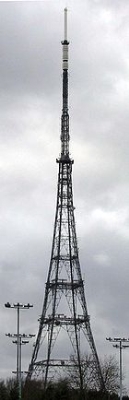
Transmitter

Encyclopedia
In electronics
and telecommunications a transmitter or radio transmitter is an electronic device which, with the aid of an antenna
, produces radio wave
s. The transmitter itself generates a radio frequency
alternating current
, which is applied to the antenna. When excited by this alternating current, the antenna radiates radio wave
s. In addition to their use in broadcasting
, transmitters are necessary component parts of many electronic devices that communicate by radio, such as cell phones, wireless computer networks
, Bluetooth
enabled devices, garage door opener
s, two-way radio
s in aircraft, ships, and spacecraft, radar
sets, and navigational beacons. The term transmitter is usually limited to equipment that generates radio waves for communication purposes; or radiolocation
, such as radar
and navigational transmitters. Generators of radio waves for heating or industrial purposes, such as microwave oven
s or diathermy
equipment, are not usually called transmitters even though they often have similar circuits.
The term is popularly used more specifically to refer to transmitting equipment used for broadcasting
, as in radio transmitter or television transmitter
. This usage usually includes both the transmitter proper as described above, and the antenna, and often the building it is housed in.
An unrelated use of the term is in industrial process control
, where a "transmitter" is a telemetry
device which converts measurements from a sensor into a signal, and sends it, usually via wires, to be received by some display or control device located a distance away.
. The term transmitter is often abbreviated "XMTR" or "TX" in technical documents. The purpose of most transmitters is radio communication of information over a distance. The information is provided to the transmitter in the form of an electronic signal, such as an audio
(sound) signal from a microphone
, a video (TV) signal from a TV camera, or in wireless networking devices a digital signal
from a computer. The transmitter combines the information signal to be carried with the radio frequency signal which generates the radio waves, which is often called the carrier
. This process is called modulation
. The information can be added to the carrier in several different ways, in different types of transmitter. In an amplitude modulation
(AM) transmitter, the information is added to the radio signal by varying its amplitude
(strength). In a frequency modulation
(FM) transmitter, it is added by varying the radio signal's frequency
slightly. Many other types of modulation are used.
with other radio transmissions (for example to emergency communications). Transmitters must be licensed by governments, under a variety of license classes depending on use: (broadcast
, marine radio, Airband
, Amateur
etc.), and are restricted to certain frequencies and power levels. In some classes each transmitter is given a unique call sign
consisting of a string of letters and numbers which must be used as an identifier in transmissions. The operator of the transmitter usually must hold a government license, such as a general radiotelephone operator license
, which is obtained by passing a test demonstrating adequate technical and legal knowledge of safe radio operation.
An exception is made allowing the unlicensed use of low-power short-range transmitters in devices such as wireless microphone
s, cordless telephone
s, walkie-talkie
s, Wifi
and Bluetooth
, garage door opener
s, and baby monitors. In the US, these fall under Part 15 of the Federal Communications Commission
(FCC) regulations. Although they can be operated without a license, these devices still generally must be type-approved
before sale.
which transforms electric power from a battery or electrical mains into a radio frequency
alternating current
, which reverses direction millions to billions of times per second. The energy in such a rapidly-reversing current can radiate off a conductor (the antenna) as electromagnetic waves (radio waves). The transmitter also "piggybacks" information, such as an audio or video signal, onto the radio frequency current to be carried by the radio waves. When they strike the antenna of a radio receiver, the waves excite similar (but less powerful) radio frequency currents in it. The radio receiver extracts the information from the received waves. A practical radio transmitter usually consists of these parts:
In higher frequency transmitters, in the UHF and microwave
range, oscillators that operate stably at the output frequency cannot be built. In these transmitters the oscillator usually operates at a lower frequency, and is multiplied by frequency multiplier
s to get a signal at the desired frequency.
between two conductors. These spark-gap transmitter
s were used during the first three decades of radio (1887-1917), called the wireless telegraphy
era. Short-lived competing techniques came into use after the turn of the century, such as the Alexanderson alternator
and Poulsen Arc transmitters. But all these early technologies were replaced by vacuum tube
transmitters in the 1920s, because they were inexpensive and produced continuous wave
s, which could be modulated to transmit audio (sound) using amplitude modulation
(AM) and frequency modulation
(FM). This made possible commercial radio broadcasting, which began about 1920. The development of radar
before and during World War 2 was a great stimulus to the evolution of high frequency transmitters in the UHF and microwave
ranges, using new devices such as the magnetron and traveling wave tube
. In recent years, the need to conserve crowded radio spectrum
bandwidth has driven the development of new types of transmitters such as spread spectrum
.
.jpg)
principle, so they also have a frequency conversion
units. Confusingly, the high-power amplifier which the exciter then feeds into is often called the "transmitter" by broadcast engineers. The final output is given as transmitter power output
(TPO), although this is not what most stations are rated by.
Effective radiated power
(ERP) is used when calculating station coverage, even for most non-broadcast stations. It is the TPO, minus any attenuation or radiate
d loss in the line to the antenna, multiplied by the gain
(magnification
) which the antenna provides toward the horizon. This antenna gain is important, because achieving a desired signal strength without it would result in an enormous electric utility
bill for the transmitter, and a prohibitively expensive transmitter. For most large stations in the VHF- and UHF-range, the transmitter power is no more than 20% of the ERP.
For VLF, LF, MF and HF the ERP is typically not determined separately. In most cases the transmission power found in lists of transmitters is the value for the output of the transmitter. This is only correct for omnidirectional aerials with a length of a quarter wavelength or shorter. For other aerial types there are gain factors, which can reach values until 50 for shortwave directional beams in the direction of maximum beam intensity.
Since some authors take account of gain factors of aerials of transmitters for frequencies below 30 MHz and others not, there are often discrepancies of the values of transmitted powers.
and Roumoules
transmitters are fed from the high-voltage network (110 kV in Alouis and Konstantynow, 150 kV in Roumoules) even though a power supply from the medium-voltage level of the power grid (about 20 kV) would be able to deliver enough power.
For medium-power transmitters, up to a few hundred watts, air cooling with fans is used. At power levels over a few kilowatts, the output stage is cooled by a forced liquid cooling system analogous to an automobile cooling system. Since the coolant directly touches the high-voltage anode
s of the tube
s, only distilled, deionised water or a special dielectric coolant can be used in the cooling circuit. This high-purity coolant is in turn cooled by a heat exchanger, where the second cooling circuit can use water of ordinary quality because it is not in contact with energized parts. Very-high-power tubes of small physical size may use evaporative cooling by water in contact with the anode. The production of steam allows a high heat flow in a small space.
. Transmitters may be damaged if operated without an antenna, so protection circuits must detect the loss of the antenna and switch off the transmitter immediately. Tube-based transmitters must have power applied in the proper sequence, with the filament voltage applied before the anode voltage, otherwise the tubes can be damaged. The output stage must be monitored for standing waves, which indicate that generated power is not being radiated but instead is being reflected back into the transmitter.
Lightning protection is required between the transmitter and antenna. This consists of spark gap
s and gas-filled surge arresters to limit the voltage that appears on the transmitter terminals. The control instrument that measures the voltage standing-wave ratio switches the transmitter off briefly if a higher voltage standing-wave ratio is detected after a lightning strike, as the reflections are probably due to lightning damage. If this does not succeed after several attempts, the antenna may be damaged and the transmitter should remain switched off. In some transmitting plants UV detectors are fitted in critical places, to switch off the transmitter if an arc
is detected. The operating voltages, modulation factor, frequency and other transmitter parameters are monitored for protection and diagnostic purposes, and may be displayed locally and/or at a remote control room.
sites, but for lower frequencies it may be desirable to have a distance of a few score or several hundred metres between the building and the antenna. Some transmitting towers have enclosures built into the tower to house radio relay link transmitters or other, relatively low-power transmitters. A few transmitter buildings may include limited broadcasting facilities to allow a station to use the building as a backup studio in case of incapacitation of the main facility.
often the national Post Office is the regulating authority. In the United States
broadcast and industrial transmitters are regulated by the Federal Communications Commission
(FCC). In Canada
technical aspects of broadcast and radio transmitters are controlled by Industry Canada
, but broadcast content is regulated separately by the Canadian Radio-television and Telecommunications Commission (CRTC). In Australia transmitters, spectrum, and content are controlled by the Australian Communications and Media Authority
(ACMA). The International Telecommunication Union
(ITU) helps managing the radio-frequency spectrum internationally.
are best on high mountains to improve the range (see radio propagation
). The antenna pattern must be considered because it is costly to change the pattern of a long-wave or medium-wave antenna.
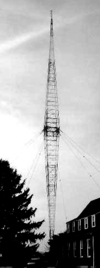 Transmitting antennas for long and medium wave are usually implemented as a mast radiator
. Similar antennas with smaller dimensions are used also for short wave transmitters, if these send in the round spray enterprise. For arranging radiation at free standing steel towers fastened planar arrays are used. Radio towers for UHF and TV transmitters can be implemented in principle as grounded constructions. Towers may be steel lattice masts or reinforced concrete towers with antennas mounted at the top. Some transmitting towers for UHF have high-altitude operating rooms and/or facilities such as restaurants and observation platforms, which are accessible by elevator. Such towers are usually called TV tower. For microwaves one frequently uses parabolic antennas. These can be set up for applications of radio relay links on transmitting towers for FM to special platforms. For example, large parabolic antennas ranging from 3 to 100 meters in diameter are necessary to pass on signals to television satellites and space vehicles. These plants, which can be used if necessary also as radio telescope, are established on free standing constructions, whereby there are also numerous special designs, like the radio telescope in Arecibo.
Just as important as the planning of the construction and location of the transmitter is how its output fits in with existing transmissions. Two transmitters cannot broadcast on the same frequency in the same area as this would cause co-channel interference. For a good example of how the channel planners have dovetailed different transmitters' outputs see Crystal Palace UHF TV channel allocations. This reference also provides a good example of a grouped transmitter, in this case an A group. That is, all of its output is within the bottom third of the UK UHF television broadcast band. The other two groups (B and C/D) utilise the middle and top third of the band, see graph. By replicating this grouping across the country (using different groups for adjacent transmitters), co-channel interference can be minimised, and in addition, those in marginal reception areas can use more efficient grouped receiving antennas. Unfortunately, in the UK, this carefully planned system has had to be compromised with the advent of digital broadcasting which (during the changeover period at least) requires yet more channel space, and consequently the additional digital broadcast channels cannot always be fitted within the transmitter's existing group. Thus many UK transmitters have become "wideband" with the consequent need for replacement of receiving antennas (see external links). Once the Digital Switch Over (DSO) occurs the plan is that most transmitters will revert to their original groups, source Ofcom July 2007 .
Further complication arises when adjacent transmitters have to transmit on the same frequency and under these circumstances the broadcast radiation patterns are attenuated in the relevant direction(s). A good example of this is in the United Kingdom, where the Waltham transmitting station
broadcasts at high power on the same frequencies as the Sandy Heath transmitting station
's high power transmissions, with the two being only 50 miles apart. Thus Waltham's antenna array http://www.aerialsandtv.com/walthamtx.html#WalthamsTransmittingArray does not broadcast these two channels in the direction of Sandy Heath and vice versa.
Where a particular service needs to have wide coverage, this is usually achieved by using multiple transmitters at different locations. Usually, these transmitters will operate at different frequencies to avoid interference where coverage overlaps. Examples include national broadcasting networks and cellular network
s. In the latter, frequency switching is automatically done by the receiver as necessary, in the former, manual retuning is more common (though the Radio Data System
is an example of automatic frequency switching in broadcast networks). Another system for extending coverage using multiple transmitters is quasi-synchronous transmission
, but this is rarely used nowadays.
, translators or sometimes "transposers".)
Main stations are defined as those that generate their own modulated output signal from a baseband
(unmodulated) input. Usually main stations operate at high power and cover large areas.
Relay stations (translators) take an already modulated input signal, usually by direct reception of a parent station off the air, and simply rebroadcast it on another frequency. Usually relay stations operate at medium or low power, and are used to fill in pockets of poor reception within, or at the fringe of, the service area of a parent main station.
Note that a main station may also take its input signal directly off-air from another station, however this signal would be fully demodulated to baseband first, processed, and then remodulated for transmission.
, Ismaning
, Langenberg
, Kalundborg
, Hörby
and Allouis
became famous as sites of powerful transmitters. For example, Goliath transmitter
was a VLF transmitter of the German Navy
during World War II
located near Kalbe an der Milde
in Saxony-Anhalt
, Germany. Some transmitting towers
like the radio tower Berlin
or the TV tower Stuttgart
have become landmarks of cities. Many transmitting plants have very high radio towers that are masterpieces of engineering.
Having the tallest building in the world, the nation, the state/province/prefecture, city, etc., has often been considered something to brag about. Often, builders of high-rise buildings have used transmitter antennas to lay claim to having the tallest building. A historic example was the "tallest building" feud between the Chrysler Building
and the Empire State Building
in New York, New York
.
Some towers have an observation deck accessible to tourists. An example is the Ostankino Tower
in Moscow, which was completed in 1967 on the 50th anniversary of the October Revolution
to demonstrate the technical abilities of the Soviet Union
. As very tall radio towers of any construction type are prominent landmarks, requiring careful planning and construction, and high-power transmitters especially in the long- and medium-wave ranges can be received over long distances, such facilities were often mentioned in propaganda. Other examples were the Deutschlandsender Herzberg/Elster
and the Warsaw Radio Mast
.
KVLY-TV's tower
located near Blanchard, North Dakota
was the tallest artificial structure in the world when it was completed in 1963. It was surpassed in 1974 by the Warszawa radio mast, but regained its title when the latter collapsed in 1991. It was surpassed by the Burj Khalifa skyscraper
in early 2009, but the KVLY-TV mast is still the tallest transmitter.
Electronics
Electronics is the branch of science, engineering and technology that deals with electrical circuits involving active electrical components such as vacuum tubes, transistors, diodes and integrated circuits, and associated passive interconnection technologies...
and telecommunications a transmitter or radio transmitter is an electronic device which, with the aid of an antenna
Antenna (radio)
An antenna is an electrical device which converts electric currents into radio waves, and vice versa. It is usually used with a radio transmitter or radio receiver...
, produces radio wave
Radio Wave
Radio Wave may refer to:*Radio frequency*Radio Wave 96.5, a radio station in Blackpool, UK...
s. The transmitter itself generates a radio frequency
Radio frequency
Radio frequency is a rate of oscillation in the range of about 3 kHz to 300 GHz, which corresponds to the frequency of radio waves, and the alternating currents which carry radio signals...
alternating current
Alternating current
In alternating current the movement of electric charge periodically reverses direction. In direct current , the flow of electric charge is only in one direction....
, which is applied to the antenna. When excited by this alternating current, the antenna radiates radio wave
Radio Wave
Radio Wave may refer to:*Radio frequency*Radio Wave 96.5, a radio station in Blackpool, UK...
s. In addition to their use in broadcasting
Broadcasting
Broadcasting is the distribution of audio and video content to a dispersed audience via any audio visual medium. Receiving parties may include the general public or a relatively large subset of thereof...
, transmitters are necessary component parts of many electronic devices that communicate by radio, such as cell phones, wireless computer networks
Wireless LAN
A wireless local area network links two or more devices using some wireless distribution method , and usually providing a connection through an access point to the wider internet. This gives users the mobility to move around within a local coverage area and still be connected to the network...
, Bluetooth
Bluetooth
Bluetooth is a proprietary open wireless technology standard for exchanging data over short distances from fixed and mobile devices, creating personal area networks with high levels of security...
enabled devices, garage door opener
Garage door opener
A garage door opener is a motorized device that opens and closes garage doors. Most are controlled by switches on the garage wall, as well as by remote controls carried in the garage owner's cars, or more rarely, on keychains.- The electric opener :...
s, two-way radio
Two-way radio
A two-way radio is a radio that can both transmit and receive , unlike a broadcast receiver which only receives content. The term refers to a personal radio transceiver that allows the operator to have a two-way conversation with other similar radios operating on the same radio frequency...
s in aircraft, ships, and spacecraft, radar
Radar
Radar is an object-detection system which uses radio waves to determine the range, altitude, direction, or speed of objects. It can be used to detect aircraft, ships, spacecraft, guided missiles, motor vehicles, weather formations, and terrain. The radar dish or antenna transmits pulses of radio...
sets, and navigational beacons. The term transmitter is usually limited to equipment that generates radio waves for communication purposes; or radiolocation
Radiolocation
Radiolocating is the process of finding the location of something through the use of radio waves. It generally refers to passive uses, particularly radar—as well as detecting buried cables, water mains, and other public utilities. It is similar to radionavigation, but radiolocation usually...
, such as radar
Radar
Radar is an object-detection system which uses radio waves to determine the range, altitude, direction, or speed of objects. It can be used to detect aircraft, ships, spacecraft, guided missiles, motor vehicles, weather formations, and terrain. The radar dish or antenna transmits pulses of radio...
and navigational transmitters. Generators of radio waves for heating or industrial purposes, such as microwave oven
Microwave oven
A microwave oven is a kitchen appliance that heats food by dielectric heating, using microwave radiation to heat polarized molecules within the food...
s or diathermy
Diathermy
In the natural sciences, the term diathermy means "electrically induced heat" and is commonly used for muscle relaxation. It is also a method of heating tissue electromagnetically or ultrasonically for therapeutic purposes in medicine.-Surgical uses:...
equipment, are not usually called transmitters even though they often have similar circuits.
The term is popularly used more specifically to refer to transmitting equipment used for broadcasting
Broadcasting
Broadcasting is the distribution of audio and video content to a dispersed audience via any audio visual medium. Receiving parties may include the general public or a relatively large subset of thereof...
, as in radio transmitter or television transmitter
Television transmitter
A television transmitter is a device which broadcasts an electromagnetic signal to the television receivers. Television transmitters may be analog or digital.- Types of transmitters :There are many types of transmitters depending on* The system standard...
. This usage usually includes both the transmitter proper as described above, and the antenna, and often the building it is housed in.
An unrelated use of the term is in industrial process control
Process control
Process control is a statistics and engineering discipline that deals with architectures, mechanisms and algorithms for maintaining the output of a specific process within a desired range...
, where a "transmitter" is a telemetry
Telemetry
Telemetry is a technology that allows measurements to be made at a distance, usually via radio wave transmission and reception of the information. The word is derived from Greek roots: tele = remote, and metron = measure...
device which converts measurements from a sensor into a signal, and sends it, usually via wires, to be received by some display or control device located a distance away.
Description
A transmitter can be a separate piece of electronic equipment, or an electrical circuit within another electronic device. A transmitter and receiver combined in one unit is called a transceiverTransceiver
A transceiver is a device comprising both a transmitter and a receiver which are combined and share common circuitry or a single housing. When no circuitry is common between transmit and receive functions, the device is a transmitter-receiver. The term originated in the early 1920s...
. The term transmitter is often abbreviated "XMTR" or "TX" in technical documents. The purpose of most transmitters is radio communication of information over a distance. The information is provided to the transmitter in the form of an electronic signal, such as an audio
Audio signal
An audio signal is an analog representation of sound, typically as an electrical voltage. Audio signals may be synthesized directly, or may originate at a transducer such as a microphone, musical instrument pickup, phonograph cartridge, or tape head. Loudspeakers or headphones convert an electrical...
(sound) signal from a microphone
Microphone
A microphone is an acoustic-to-electric transducer or sensor that converts sound into an electrical signal. In 1877, Emile Berliner invented the first microphone used as a telephone voice transmitter...
, a video (TV) signal from a TV camera, or in wireless networking devices a digital signal
Digital signal
A digital signal is a physical signal that is a representation of a sequence of discrete values , for example of an arbitrary bit stream, or of a digitized analog signal...
from a computer. The transmitter combines the information signal to be carried with the radio frequency signal which generates the radio waves, which is often called the carrier
Carrier wave
In telecommunications, a carrier wave or carrier is a waveform that is modulated with an input signal for the purpose of conveying information. This carrier wave is usually a much higher frequency than the input signal...
. This process is called modulation
Modulation
In electronics and telecommunications, modulation is the process of varying one or more properties of a high-frequency periodic waveform, called the carrier signal, with a modulating signal which typically contains information to be transmitted...
. The information can be added to the carrier in several different ways, in different types of transmitter. In an amplitude modulation
Amplitude modulation
Amplitude modulation is a technique used in electronic communication, most commonly for transmitting information via a radio carrier wave. AM works by varying the strength of the transmitted signal in relation to the information being sent...
(AM) transmitter, the information is added to the radio signal by varying its amplitude
Amplitude
Amplitude is the magnitude of change in the oscillating variable with each oscillation within an oscillating system. For example, sound waves in air are oscillations in atmospheric pressure and their amplitudes are proportional to the change in pressure during one oscillation...
(strength). In a frequency modulation
Frequency modulation
In telecommunications and signal processing, frequency modulation conveys information over a carrier wave by varying its instantaneous frequency. This contrasts with amplitude modulation, in which the amplitude of the carrier is varied while its frequency remains constant...
(FM) transmitter, it is added by varying the radio signal's frequency
Frequency
Frequency is the number of occurrences of a repeating event per unit time. It is also referred to as temporal frequency.The period is the duration of one cycle in a repeating event, so the period is the reciprocal of the frequency...
slightly. Many other types of modulation are used.
Legal restrictions
In most parts of the world, use of transmitters is strictly controlled by law because of the potential for dangerous interferenceElectromagnetic interference
Electromagnetic interference is disturbance that affects an electrical circuit due to either electromagnetic induction or electromagnetic radiation emitted from an external source. The disturbance may interrupt, obstruct, or otherwise degrade or limit the effective performance of the circuit...
with other radio transmissions (for example to emergency communications). Transmitters must be licensed by governments, under a variety of license classes depending on use: (broadcast
Broadcast
Broadcast or Broadcasting may refer to:* Broadcasting, the transmission of audio and video signals* Broadcast, an individual television program or radio program* Broadcast , an English electronic music band...
, marine radio, Airband
Airband
Airband or Aircraft band is the name for a group of frequencies in the VHF radio spectrum allocated to radio communication in civil aviation, sometimes also referred to as VHF, or phonetically as "Victor"...
, Amateur
Amateur radio
Amateur radio is the use of designated radio frequency spectrum for purposes of private recreation, non-commercial exchange of messages, wireless experimentation, self-training, and emergency communication...
etc.), and are restricted to certain frequencies and power levels. In some classes each transmitter is given a unique call sign
Call sign
In broadcasting and radio communications, a call sign is a unique designation for a transmitting station. In North America they are used as names for broadcasting stations...
consisting of a string of letters and numbers which must be used as an identifier in transmissions. The operator of the transmitter usually must hold a government license, such as a general radiotelephone operator license
General radiotelephone operator license
The General Radiotelephone Operator License is a United States commercial license, as opposed to an amateur radio license. It allows the holder to operate, maintain or install certain classes of United States licensed radio and television transmitters under the authority of the Federal...
, which is obtained by passing a test demonstrating adequate technical and legal knowledge of safe radio operation.
An exception is made allowing the unlicensed use of low-power short-range transmitters in devices such as wireless microphone
Wireless microphone
A wireless microphone, as the name implies, is a microphone without a physical cable connecting it directly to the sound recording or amplifying equipment with which it is associated...
s, cordless telephone
Cordless telephone
A cordless telephone or portable telephone is a telephone with a wireless handset that communicates via radio waves with a base station connected to a fixed telephone line, usually within a limited range of its base station...
s, walkie-talkie
Walkie-talkie
A walkie-talkie is a hand-held, portable, two-way radio transceiver. Its development during the Second World War has been variously credited to Donald L. Hings, radio engineer Alfred J. Gross, and engineering teams at Motorola...
s, Wifi
WIFI
WIFI is a radio station broadcasting a brokered format. Licensed to Florence, New Jersey, USA, the station is currently operated by Florence Broadcasting Partners, LLC.This station was previously owned by Real Life Broadcasting...
and Bluetooth
Bluetooth
Bluetooth is a proprietary open wireless technology standard for exchanging data over short distances from fixed and mobile devices, creating personal area networks with high levels of security...
, garage door opener
Garage door opener
A garage door opener is a motorized device that opens and closes garage doors. Most are controlled by switches on the garage wall, as well as by remote controls carried in the garage owner's cars, or more rarely, on keychains.- The electric opener :...
s, and baby monitors. In the US, these fall under Part 15 of the Federal Communications Commission
Federal Communications Commission
The Federal Communications Commission is an independent agency of the United States government, created, Congressional statute , and with the majority of its commissioners appointed by the current President. The FCC works towards six goals in the areas of broadband, competition, the spectrum, the...
(FCC) regulations. Although they can be operated without a license, these devices still generally must be type-approved
Type approval
Type Approval is granted to a product that meets a minimum set of regulatory, technical and safety requirements. Generally, type approval is required before a product is allowed to be sold in a particular country, so the requirements for a given product will vary around the world...
before sale.
How it works
A radio transmitter is an electronic circuitElectronic circuit
An electronic circuit is composed of individual electronic components, such as resistors, transistors, capacitors, inductors and diodes, connected by conductive wires or traces through which electric current can flow...
which transforms electric power from a battery or electrical mains into a radio frequency
Radio frequency
Radio frequency is a rate of oscillation in the range of about 3 kHz to 300 GHz, which corresponds to the frequency of radio waves, and the alternating currents which carry radio signals...
alternating current
Alternating current
In alternating current the movement of electric charge periodically reverses direction. In direct current , the flow of electric charge is only in one direction....
, which reverses direction millions to billions of times per second. The energy in such a rapidly-reversing current can radiate off a conductor (the antenna) as electromagnetic waves (radio waves). The transmitter also "piggybacks" information, such as an audio or video signal, onto the radio frequency current to be carried by the radio waves. When they strike the antenna of a radio receiver, the waves excite similar (but less powerful) radio frequency currents in it. The radio receiver extracts the information from the received waves. A practical radio transmitter usually consists of these parts:
- A power supplyPower supplyA power supply is a device that supplies electrical energy to one or more electric loads. The term is most commonly applied to devices that convert one form of electrical energy to another, though it may also refer to devices that convert another form of energy to electrical energy...
circuit to transform the input electrical power to the higher voltageVoltageVoltage, otherwise known as electrical potential difference or electric tension is the difference in electric potential between two points — or the difference in electric potential energy per unit charge between two points...
s needed to produce the required power output. - An electronic oscillatorElectronic oscillatorAn electronic oscillator is an electronic circuit that produces a repetitive electronic signal, often a sine wave or a square wave. They are widely used in innumerable electronic devices...
circuit to generate the radio frequencyRadio frequencyRadio frequency is a rate of oscillation in the range of about 3 kHz to 300 GHz, which corresponds to the frequency of radio waves, and the alternating currents which carry radio signals...
signal. This usually generates a sine waveSine waveThe sine wave or sinusoid is a mathematical function that describes a smooth repetitive oscillation. It occurs often in pure mathematics, as well as physics, signal processing, electrical engineering and many other fields...
of constant amplitudeAmplitudeAmplitude is the magnitude of change in the oscillating variable with each oscillation within an oscillating system. For example, sound waves in air are oscillations in atmospheric pressure and their amplitudes are proportional to the change in pressure during one oscillation...
often called the carrier waveCarrier waveIn telecommunications, a carrier wave or carrier is a waveform that is modulated with an input signal for the purpose of conveying information. This carrier wave is usually a much higher frequency than the input signal...
. In most modern transmitters this is a crystal oscillatorCrystal oscillatorA crystal oscillator is an electronic oscillator circuit that uses the mechanical resonance of a vibrating crystal of piezoelectric material to create an electrical signal with a very precise frequency...
in which the frequency is precisely controlled by the vibrations of a quartz crystal. - A modulator circuit to add the information to be transmitted to the carrier waveCarrier waveIn telecommunications, a carrier wave or carrier is a waveform that is modulated with an input signal for the purpose of conveying information. This carrier wave is usually a much higher frequency than the input signal...
produced by the oscillator. This is done by varying some aspect of the carrier wave. The information is provided to the transmitter either in the form of an audio signalAudio signalAn audio signal is an analog representation of sound, typically as an electrical voltage. Audio signals may be synthesized directly, or may originate at a transducer such as a microphone, musical instrument pickup, phonograph cartridge, or tape head. Loudspeakers or headphones convert an electrical...
, which represents soundSoundSound is a mechanical wave that is an oscillation of pressure transmitted through a solid, liquid, or gas, composed of frequencies within the range of hearing and of a level sufficiently strong to be heard, or the sensation stimulated in organs of hearing by such vibrations.-Propagation of...
, a video signal, or for data in the form of a binaryBinary- Mathematics :* Binary numeral system, a representation for numbers using only two digits * Binary function, a function in mathematics that takes two arguments- Computing :* Binary file, composed of something other than human-readable text...
digitalDigitalA digital system is a data technology that uses discrete values. By contrast, non-digital systems use a continuous range of values to represent information...
signal.- In an AM (amplitude modulationAmplitude modulationAmplitude modulation is a technique used in electronic communication, most commonly for transmitting information via a radio carrier wave. AM works by varying the strength of the transmitted signal in relation to the information being sent...
) transmitter the amplitudeAmplitudeAmplitude is the magnitude of change in the oscillating variable with each oscillation within an oscillating system. For example, sound waves in air are oscillations in atmospheric pressure and their amplitudes are proportional to the change in pressure during one oscillation...
(strength) of the carrier wave is varied in proportion to the audio signal. - In an FM (frequency modulationFrequency modulationIn telecommunications and signal processing, frequency modulation conveys information over a carrier wave by varying its instantaneous frequency. This contrasts with amplitude modulation, in which the amplitude of the carrier is varied while its frequency remains constant...
) transmitter the frequencyFrequencyFrequency is the number of occurrences of a repeating event per unit time. It is also referred to as temporal frequency.The period is the duration of one cycle in a repeating event, so the period is the reciprocal of the frequency...
of the carrier is varied by the audio signal. - In an FSK (frequency-shift keyingFrequency-shift keyingFrequency-shift keying is a frequency modulation scheme in which digital information is transmitted through discrete frequency changes of a carrier wave. The simplest FSK is binary FSK . BFSK uses a pair of discrete frequencies to transmit binary information. With this scheme, the "1" is called...
) transmitter, which transmits digital data, the frequency of the carrier is shifted between two frequencies which represent the two binary digits, 0 and 1.
- In an AM (amplitude modulation
- Many other types of modulationModulationIn electronics and telecommunications, modulation is the process of varying one or more properties of a high-frequency periodic waveform, called the carrier signal, with a modulating signal which typically contains information to be transmitted...
are also used. In large transmitters the oscillator and modulator together are often referred to as the exciter.- An RF power amplifier to increase the power of the signal, to increase the range of the radio waves.
- An impedance matchingImpedance matchingIn electronics, impedance matching is the practice of designing the input impedance of an electrical load to maximize the power transfer and/or minimize reflections from the load....
(antenna tunerAntenna tunerAn antenna tuner, transmatch or antenna tuning unit is a device connected between a radio transmitter or receiver and its antenna to improve the efficiency of the power transfer between them by matching the impedance of the equipment to the antenna...
) circuit to match the impedanceElectrical impedanceElectrical impedance, or simply impedance, is the measure of the opposition that an electrical circuit presents to the passage of a current when a voltage is applied. In quantitative terms, it is the complex ratio of the voltage to the current in an alternating current circuit...
of the transmitter to the impedance of the antenna (or the transmission lineTransmission lineIn communications and electronic engineering, a transmission line is a specialized cable designed to carry alternating current of radio frequency, that is, currents with a frequency high enough that its wave nature must be taken into account...
to the antenna), to transfer power efficiently to the antenna. If these impedances are not equal, it causes a condition called standing waveStanding waveIn physics, a standing wave – also known as a stationary wave – is a wave that remains in a constant position.This phenomenon can occur because the medium is moving in the opposite direction to the wave, or it can arise in a stationary medium as a result of interference between two waves traveling...
s, in which the power is reflected back from the antenna toward the transmitter, wasting power and sometimes overheating the transmitter.
In higher frequency transmitters, in the UHF and microwave
Microwave
Microwaves, a subset of radio waves, have wavelengths ranging from as long as one meter to as short as one millimeter, or equivalently, with frequencies between 300 MHz and 300 GHz. This broad definition includes both UHF and EHF , and various sources use different boundaries...
range, oscillators that operate stably at the output frequency cannot be built. In these transmitters the oscillator usually operates at a lower frequency, and is multiplied by frequency multiplier
Frequency multiplier
In electronics, a frequency multiplier is an electronic circuit that generates an output signal whose output frequency is a harmonic of its input frequency. Frequency multipliers consist of a nonlinear circuit that distorts the input signal and consequently generates harmonics of the input signal...
s to get a signal at the desired frequency.
History
The first primitive radio transmitters (called Hertzian oscillators) were built by German physicist Heinrich Hertz in 1887 during his pioneering investigations of radio waves. These generated radio waves by a high voltage sparkElectric spark
An electric spark is a type of electrostatic discharge that occurs when an electric field creates an ionized electrically conductive channel in air producing a brief emission of light and sound. A spark is formed when the electric field strength exceeds the dielectric field strength of air...
between two conductors. These spark-gap transmitter
Spark-gap transmitter
A spark-gap transmitter is a device for generating radio frequency electromagnetic waves using a spark gap.These devices served as the transmitters for most wireless telegraphy systems for the first three decades of radio and the first demonstrations of practical radio were carried out using them...
s were used during the first three decades of radio (1887-1917), called the wireless telegraphy
Wireless telegraphy
Wireless telegraphy is a historical term used today to apply to early radio telegraph communications techniques and practices, particularly those used during the first three decades of radio before the term radio came into use....
era. Short-lived competing techniques came into use after the turn of the century, such as the Alexanderson alternator
Alexanderson alternator
An Alexanderson alternator is a rotating machine invented by Ernst Alexanderson in 1904 for the generation of high frequency alternating current up to 100 kHz, for use as a radio transmitter...
and Poulsen Arc transmitters. But all these early technologies were replaced by vacuum tube
Vacuum tube
In electronics, a vacuum tube, electron tube , or thermionic valve , reduced to simply "tube" or "valve" in everyday parlance, is a device that relies on the flow of electric current through a vacuum...
transmitters in the 1920s, because they were inexpensive and produced continuous wave
Continuous wave
A continuous wave or continuous waveform is an electromagnetic wave of constant amplitude and frequency; and in mathematical analysis, of infinite duration. Continuous wave is also the name given to an early method of radio transmission, in which a carrier wave is switched on and off...
s, which could be modulated to transmit audio (sound) using amplitude modulation
Amplitude modulation
Amplitude modulation is a technique used in electronic communication, most commonly for transmitting information via a radio carrier wave. AM works by varying the strength of the transmitted signal in relation to the information being sent...
(AM) and frequency modulation
Frequency modulation
In telecommunications and signal processing, frequency modulation conveys information over a carrier wave by varying its instantaneous frequency. This contrasts with amplitude modulation, in which the amplitude of the carrier is varied while its frequency remains constant...
(FM). This made possible commercial radio broadcasting, which began about 1920. The development of radar
Radar
Radar is an object-detection system which uses radio waves to determine the range, altitude, direction, or speed of objects. It can be used to detect aircraft, ships, spacecraft, guided missiles, motor vehicles, weather formations, and terrain. The radar dish or antenna transmits pulses of radio...
before and during World War 2 was a great stimulus to the evolution of high frequency transmitters in the UHF and microwave
Microwave
Microwaves, a subset of radio waves, have wavelengths ranging from as long as one meter to as short as one millimeter, or equivalently, with frequencies between 300 MHz and 300 GHz. This broad definition includes both UHF and EHF , and various sources use different boundaries...
ranges, using new devices such as the magnetron and traveling wave tube
Traveling wave tube
A traveling-wave tube is an electronic device used to amplify radio frequency signals to high power, usually in an electronic assembly known as a traveling-wave tube amplifier ....
. In recent years, the need to conserve crowded radio spectrum
Radio spectrum
Radio spectrum refers to the part of the electromagnetic spectrum corresponding to radio frequencies – that is, frequencies lower than around 300 GHz ....
bandwidth has driven the development of new types of transmitters such as spread spectrum
Spread spectrum
Spread-spectrum techniques are methods by which a signal generated in a particular bandwidth is deliberately spread in the frequency domain, resulting in a signal with a wider bandwidth...
.
Broadcast transmitters
Power output
In broadcasting and telecommunication, the part which contains the oscillator, modulator, and sometimes audio processor, is called the "exciter". Most transmitters use heterodyneHeterodyne
Heterodyning is a radio signal processing technique invented in 1901 by Canadian inventor-engineer Reginald Fessenden where high frequency signals are converted to lower frequencies by combining two frequencies. Heterodyning is useful for frequency shifting information of interest into a useful...
principle, so they also have a frequency conversion
Frequency mixer
In electronics a mixer or frequency mixer is a nonlinear electrical circuit that creates new frequencies from two signals applied to it. In its most common application, two signals at frequencies f1 and f2 are applied to a mixer, and it produces new signals at the sum f1 + f2 and difference f1 -...
units. Confusingly, the high-power amplifier which the exciter then feeds into is often called the "transmitter" by broadcast engineers. The final output is given as transmitter power output
Transmitter power output
In radio transmission, transmitter power output is the actual amount of power of radio frequency energy that a transmitter produces at its output....
(TPO), although this is not what most stations are rated by.
Effective radiated power
Effective radiated power
In radio telecommunications, effective radiated power or equivalent radiated power is a standardized theoretical measurement of radio frequency energy using the SI unit watts, and is determined by subtracting system losses and adding system gains...
(ERP) is used when calculating station coverage, even for most non-broadcast stations. It is the TPO, minus any attenuation or radiate
Electromagnetic radiation
Electromagnetic radiation is a form of energy that exhibits wave-like behavior as it travels through space...
d loss in the line to the antenna, multiplied by the gain
Gain
In electronics, gain is a measure of the ability of a circuit to increase the power or amplitude of a signal from the input to the output. It is usually defined as the mean ratio of the signal output of a system to the signal input of the same system. It may also be defined on a logarithmic scale,...
(magnification
Magnification
Magnification is the process of enlarging something only in appearance, not in physical size. This enlargement is quantified by a calculated number also called "magnification"...
) which the antenna provides toward the horizon. This antenna gain is important, because achieving a desired signal strength without it would result in an enormous electric utility
Electric utility
An electric utility is a company that engages in the generation, transmission, and distribution of electricity for sale generally in a regulated market. The electrical utility industry is a major provider of energy in most countries. It is indispensable to factories, commercial establishments,...
bill for the transmitter, and a prohibitively expensive transmitter. For most large stations in the VHF- and UHF-range, the transmitter power is no more than 20% of the ERP.
For VLF, LF, MF and HF the ERP is typically not determined separately. In most cases the transmission power found in lists of transmitters is the value for the output of the transmitter. This is only correct for omnidirectional aerials with a length of a quarter wavelength or shorter. For other aerial types there are gain factors, which can reach values until 50 for shortwave directional beams in the direction of maximum beam intensity.
Since some authors take account of gain factors of aerials of transmitters for frequencies below 30 MHz and others not, there are often discrepancies of the values of transmitted powers.
Power supply
Transmitters are sometimes fed from a higher voltage level of the power supply grid than necessary in order to improve security of supply. For example, the Allouis, KonstantynowWarsaw radio mast
The Warsaw radio mast was the world's tallest structure until its collapse on 8 August 1991. It is the second tallest land-based structure ever built, being surpassed as tallest by the Burj Khalifa, completed in 2010....
and Roumoules
Transmitter Roumoules
The Roumoules transmitter is the main broadcasting facility for longwave and mediumwave broadcasting of Radio Monte Carlo near Roumoules, France...
transmitters are fed from the high-voltage network (110 kV in Alouis and Konstantynow, 150 kV in Roumoules) even though a power supply from the medium-voltage level of the power grid (about 20 kV) would be able to deliver enough power.
Cooling of final stages
Low-power transmitters do not require special cooling equipment. Modern transmitters can be incredibly efficient, with efficiencies exceeding 98 percent. However, a broadcast transmitter with a megawatt power stage transferring 98% of that into the antenna can also be viewed as a 20 kilowatt electric heater.For medium-power transmitters, up to a few hundred watts, air cooling with fans is used. At power levels over a few kilowatts, the output stage is cooled by a forced liquid cooling system analogous to an automobile cooling system. Since the coolant directly touches the high-voltage anode
Anode
An anode is an electrode through which electric current flows into a polarized electrical device. Mnemonic: ACID ....
s of the tube
Vacuum tube
In electronics, a vacuum tube, electron tube , or thermionic valve , reduced to simply "tube" or "valve" in everyday parlance, is a device that relies on the flow of electric current through a vacuum...
s, only distilled, deionised water or a special dielectric coolant can be used in the cooling circuit. This high-purity coolant is in turn cooled by a heat exchanger, where the second cooling circuit can use water of ordinary quality because it is not in contact with energized parts. Very-high-power tubes of small physical size may use evaporative cooling by water in contact with the anode. The production of steam allows a high heat flow in a small space.
Protection equipment
The high voltages used in high power transmitters (up to 40 kV) require extensive protection equipment. Also, transmitters are exposed to damage from lightningLightning
Lightning is an atmospheric electrostatic discharge accompanied by thunder, which typically occurs during thunderstorms, and sometimes during volcanic eruptions or dust storms...
. Transmitters may be damaged if operated without an antenna, so protection circuits must detect the loss of the antenna and switch off the transmitter immediately. Tube-based transmitters must have power applied in the proper sequence, with the filament voltage applied before the anode voltage, otherwise the tubes can be damaged. The output stage must be monitored for standing waves, which indicate that generated power is not being radiated but instead is being reflected back into the transmitter.
Lightning protection is required between the transmitter and antenna. This consists of spark gap
Spark gap
A spark gap consists of an arrangement of two conducting electrodes separated by a gap usually filled with a gas such as air, designed to allow an electric spark to pass between the conductors. When the voltage difference between the conductors exceeds the gap's breakdown voltage, a spark forms,...
s and gas-filled surge arresters to limit the voltage that appears on the transmitter terminals. The control instrument that measures the voltage standing-wave ratio switches the transmitter off briefly if a higher voltage standing-wave ratio is detected after a lightning strike, as the reflections are probably due to lightning damage. If this does not succeed after several attempts, the antenna may be damaged and the transmitter should remain switched off. In some transmitting plants UV detectors are fitted in critical places, to switch off the transmitter if an arc
Electric arc
An electric arc is an electrical breakdown of a gas which produces an ongoing plasma discharge, resulting from a current flowing through normally nonconductive media such as air. A synonym is arc discharge. An arc discharge is characterized by a lower voltage than a glow discharge, and relies on...
is detected. The operating voltages, modulation factor, frequency and other transmitter parameters are monitored for protection and diagnostic purposes, and may be displayed locally and/or at a remote control room.
Building
A commercial transmitter site will usually have a control building to shelter the transmitter components and control devices. This is usually a purely functional building, which may contain apparatus for both radio and television transmitters. To reduce transmission line loss the transmitter building is usually immediately adjacent to the antenna for VHF and UHFUltra high frequency
Ultra-High Frequency designates the ITU Radio frequency range of electromagnetic waves between 300 MHz and 3 GHz , also known as the decimetre band or decimetre wave as the wavelengths range from one to ten decimetres...
sites, but for lower frequencies it may be desirable to have a distance of a few score or several hundred metres between the building and the antenna. Some transmitting towers have enclosures built into the tower to house radio relay link transmitters or other, relatively low-power transmitters. A few transmitter buildings may include limited broadcasting facilities to allow a station to use the building as a backup studio in case of incapacitation of the main facility.
Legal and regulatory aspects
Since radio waves go over borders, international agreements control radio transmissions. In European countries like GermanyGermany
Germany , officially the Federal Republic of Germany , is a federal parliamentary republic in Europe. The country consists of 16 states while the capital and largest city is Berlin. Germany covers an area of 357,021 km2 and has a largely temperate seasonal climate...
often the national Post Office is the regulating authority. In the United States
United States
The United States of America is a federal constitutional republic comprising fifty states and a federal district...
broadcast and industrial transmitters are regulated by the Federal Communications Commission
Federal Communications Commission
The Federal Communications Commission is an independent agency of the United States government, created, Congressional statute , and with the majority of its commissioners appointed by the current President. The FCC works towards six goals in the areas of broadband, competition, the spectrum, the...
(FCC). In Canada
Canada
Canada is a North American country consisting of ten provinces and three territories. Located in the northern part of the continent, it extends from the Atlantic Ocean in the east to the Pacific Ocean in the west, and northward into the Arctic Ocean...
technical aspects of broadcast and radio transmitters are controlled by Industry Canada
Industry Canada
Industry Canada is the department of the Government of Canada with responsibility for regional economic development, investment, and innovation/research and development. The department employs 6104 FTEs across Canada....
, but broadcast content is regulated separately by the Canadian Radio-television and Telecommunications Commission (CRTC). In Australia transmitters, spectrum, and content are controlled by the Australian Communications and Media Authority
Australian Communications and Media Authority
The Australian Communications and Media Authority is an Australian government statutory authority within the Department of Broadband, Communications and the Digital Economy portfolio...
(ACMA). The International Telecommunication Union
International Telecommunication Union
The International Telecommunication Union is the specialized agency of the United Nations which is responsible for information and communication technologies...
(ITU) helps managing the radio-frequency spectrum internationally.
Planning
As in any costly project, the planning of a high power transmitter site requires great care. This begins with the location. A minimum distance, which depends on the transmitter frequency, transmitter power, and the design of the transmitting antennas, is required to protect people from the radio frequency energy. Antenna towers are often very tall and therefore flight paths must be evaluated. Sufficient electric power must be available for high power transmitters. Transmitters for long and medium wave require good grounding and soil of high electrical conductivity. Locations at the sea or in river valleys are ideal, but the flood danger must be considered. Transmitters for UHFUltra high frequency
Ultra-High Frequency designates the ITU Radio frequency range of electromagnetic waves between 300 MHz and 3 GHz , also known as the decimetre band or decimetre wave as the wavelengths range from one to ten decimetres...
are best on high mountains to improve the range (see radio propagation
Radio propagation
Radio propagation is the behavior of radio waves when they are transmitted, or propagated from one point on the Earth to another, or into various parts of the atmosphere...
). The antenna pattern must be considered because it is costly to change the pattern of a long-wave or medium-wave antenna.
Mast radiator
A mast radiator is a radio mast or tower in which the whole structure itself functions as an antenna. This design is commonly used for transmitting antennas operating at low frequencies, in the VLF, LF and MF ranges, in particular those used for AM broadcasting. The metal mast is electrically...
. Similar antennas with smaller dimensions are used also for short wave transmitters, if these send in the round spray enterprise. For arranging radiation at free standing steel towers fastened planar arrays are used. Radio towers for UHF and TV transmitters can be implemented in principle as grounded constructions. Towers may be steel lattice masts or reinforced concrete towers with antennas mounted at the top. Some transmitting towers for UHF have high-altitude operating rooms and/or facilities such as restaurants and observation platforms, which are accessible by elevator. Such towers are usually called TV tower. For microwaves one frequently uses parabolic antennas. These can be set up for applications of radio relay links on transmitting towers for FM to special platforms. For example, large parabolic antennas ranging from 3 to 100 meters in diameter are necessary to pass on signals to television satellites and space vehicles. These plants, which can be used if necessary also as radio telescope, are established on free standing constructions, whereby there are also numerous special designs, like the radio telescope in Arecibo.
Just as important as the planning of the construction and location of the transmitter is how its output fits in with existing transmissions. Two transmitters cannot broadcast on the same frequency in the same area as this would cause co-channel interference. For a good example of how the channel planners have dovetailed different transmitters' outputs see Crystal Palace UHF TV channel allocations. This reference also provides a good example of a grouped transmitter, in this case an A group. That is, all of its output is within the bottom third of the UK UHF television broadcast band. The other two groups (B and C/D) utilise the middle and top third of the band, see graph. By replicating this grouping across the country (using different groups for adjacent transmitters), co-channel interference can be minimised, and in addition, those in marginal reception areas can use more efficient grouped receiving antennas. Unfortunately, in the UK, this carefully planned system has had to be compromised with the advent of digital broadcasting which (during the changeover period at least) requires yet more channel space, and consequently the additional digital broadcast channels cannot always be fitted within the transmitter's existing group. Thus many UK transmitters have become "wideband" with the consequent need for replacement of receiving antennas (see external links). Once the Digital Switch Over (DSO) occurs the plan is that most transmitters will revert to their original groups, source Ofcom July 2007 .
Further complication arises when adjacent transmitters have to transmit on the same frequency and under these circumstances the broadcast radiation patterns are attenuated in the relevant direction(s). A good example of this is in the United Kingdom, where the Waltham transmitting station
Waltham transmitting station
The Waltham transmitting station is a broadcasting and telecommunications facilityat Waltham-on-the-Wolds, 5 miles north-east of Melton Mowbray. It sits inside the Waltham civil parish near Stonesby, in the district of Melton, Leicestershire, UK. It has a guyed steel tubular mast...
broadcasts at high power on the same frequencies as the Sandy Heath transmitting station
Sandy Heath transmitting station
Sandy Heath transmitter is a television broadcast station located between Sandy, Bedfordshire and Potton near the B1042. It is owned by Arqiva, formerly NTL Broadcast. It was built in 1966, originally broadcasting Anglia Television on VHF 405-lines, UHF with 625-line services of BBC2, BBC1 and...
's high power transmissions, with the two being only 50 miles apart. Thus Waltham's antenna array http://www.aerialsandtv.com/walthamtx.html#WalthamsTransmittingArray does not broadcast these two channels in the direction of Sandy Heath and vice versa.
Where a particular service needs to have wide coverage, this is usually achieved by using multiple transmitters at different locations. Usually, these transmitters will operate at different frequencies to avoid interference where coverage overlaps. Examples include national broadcasting networks and cellular network
Cellular network
A cellular network is a radio network distributed over land areas called cells, each served by at least one fixed-location transceiver known as a cell site or base station. When joined together these cells provide radio coverage over a wide geographic area...
s. In the latter, frequency switching is automatically done by the receiver as necessary, in the former, manual retuning is more common (though the Radio Data System
Radio Data System
Radio Data System, or RDS, is a communications protocol standard for embedding small amounts of digital information in conventional FM radio broadcasts. RDS standardises several types of information transmitted, including time, station identification and programme information.Radio Broadcast Data...
is an example of automatic frequency switching in broadcast networks). Another system for extending coverage using multiple transmitters is quasi-synchronous transmission
Quasi-synchronous transmission
In radio broadcasting, quasi-synchronous transmission is a method of achieving wider area coverage using multiple transmitters but without needing multiple frequencies. It became technically feasible in the mid 1970s, but was rapidly superseded by cellular networks in the early 1980s, so it is...
, but this is rarely used nowadays.
Main and relay (repeater) transmitters
Transmitting stations are usually either classified as main stations or relay stations (also known as repeatersRadio repeater
A radio repeater is a combination of a radio receiver and a radio transmitter that receives a weak or low-level signal and retransmits it at a higher level or higher power, so that the signal can cover longer distances without degradation. This article refers to professional, commercial, and...
, translators or sometimes "transposers".)
Main stations are defined as those that generate their own modulated output signal from a baseband
Baseband
In telecommunications and signal processing, baseband is an adjective that describes signals and systems whose range of frequencies is measured from close to 0 hertz to a cut-off frequency, a maximum bandwidth or highest signal frequency; it is sometimes used as a noun for a band of frequencies...
(unmodulated) input. Usually main stations operate at high power and cover large areas.
Relay stations (translators) take an already modulated input signal, usually by direct reception of a parent station off the air, and simply rebroadcast it on another frequency. Usually relay stations operate at medium or low power, and are used to fill in pockets of poor reception within, or at the fringe of, the service area of a parent main station.
Note that a main station may also take its input signal directly off-air from another station, however this signal would be fully demodulated to baseband first, processed, and then remodulated for transmission.
Transmitters in culture
Some cities in Europe, like MühlackerMühlacker
Mühlacker is a town in the eastern part of the Enz district in Baden-Württemberg in southern Germany. Mühlacker station has direct rail connections with Stuttgart, Karlsruhe, Heidelberg, Pforzheim and the Northern Black Forest....
, Ismaning
Ismaning
Ismaning is a municipality in Bavaria, Germany, located near Munich. In 2006 it had 14,638 inhabitants. Near Ismaning there is a large broadcasting facility called Transmitter Ismaning....
, Langenberg
Langenberg
Langenberg is a quarter in Velbert, a German city. Located in this district is the famous Sender Langenberg transmission site, which transmits MW, FM, and TV broadcasting signals....
, Kalundborg
Kalundborg
Kalundborg is a city with a population of 16,434 in Kalundborg municipality in Denmark and the site of its municipal council. Kalundborg is on the main island Zealand, with Copenhagen, but opposite on the far western edge....
, Hörby
Hörby
Hörby is a locality and the seat of Hörby Municipality, Skåne County, Sweden with 6,651 inhabitants in 2005.- References :...
and Allouis
Allouis
Allouis is a commune in the Cher department of the Centre region of France.-Geography:An area of lakes, woods and farming comprising the village and several hamlets, situated in the valley of the river Yèvre, some northwest of Bourges at the junction of the D20, D79 and the D122...
became famous as sites of powerful transmitters. For example, Goliath transmitter
Goliath transmitter
Goliath transmitter was a VLF transmitter of the German Navy near Kalbe an der Milde in Saxony-Anhalt, Germany, which was in service from 1943 to 1945...
was a VLF transmitter of the German Navy
German Navy
The German Navy is the navy of Germany and is part of the unified Bundeswehr .The German Navy traces its roots back to the Imperial Fleet of the revolutionary era of 1848 – 52 and more directly to the Prussian Navy, which later evolved into the Northern German Federal Navy...
during World War II
World War II
World War II, or the Second World War , was a global conflict lasting from 1939 to 1945, involving most of the world's nations—including all of the great powers—eventually forming two opposing military alliances: the Allies and the Axis...
located near Kalbe an der Milde
Kalbe
Kalbe is a town in the Altmarkkreis Salzwedel , in Saxony-Anhalt, Germany. It is situated approx. 15 km north of Gardelegen, on the river Milde. To avoid confusion with Calbe, it is also called Kalbe an der Milde....
in Saxony-Anhalt
Saxony-Anhalt
Saxony-Anhalt is a landlocked state of Germany. Its capital is Magdeburg and it is surrounded by the German states of Lower Saxony, Brandenburg, Saxony, and Thuringia.Saxony-Anhalt covers an area of...
, Germany. Some transmitting towers
Radio masts and towers
Radio masts and towers are, typically, tall structures designed to support antennas for telecommunications and broadcasting, including television. They are among the tallest man-made structures...
like the radio tower Berlin
Berlin
Berlin is the capital city of Germany and is one of the 16 states of Germany. With a population of 3.45 million people, Berlin is Germany's largest city. It is the second most populous city proper and the seventh most populous urban area in the European Union...
or the TV tower Stuttgart
Stuttgart
Stuttgart is the capital of the state of Baden-Württemberg in southern Germany. The sixth-largest city in Germany, Stuttgart has a population of 600,038 while the metropolitan area has a population of 5.3 million ....
have become landmarks of cities. Many transmitting plants have very high radio towers that are masterpieces of engineering.
Having the tallest building in the world, the nation, the state/province/prefecture, city, etc., has often been considered something to brag about. Often, builders of high-rise buildings have used transmitter antennas to lay claim to having the tallest building. A historic example was the "tallest building" feud between the Chrysler Building
Chrysler Building
The Chrysler Building is an Art Deco style skyscraper in New York City, located on the east side of Manhattan in the Turtle Bay area at the intersection of 42nd Street and Lexington Avenue. Standing at , it was the world's tallest building for 11 months before it was surpassed by the Empire State...
and the Empire State Building
Empire State Building
The Empire State Building is a 102-story landmark skyscraper and American cultural icon in New York City at the intersection of Fifth Avenue and West 34th Street. It has a roof height of 1,250 feet , and with its antenna spire included, it stands a total of 1,454 ft high. Its name is derived...
in New York, New York
New York City
New York is the most populous city in the United States and the center of the New York Metropolitan Area, one of the most populous metropolitan areas in the world. New York exerts a significant impact upon global commerce, finance, media, art, fashion, research, technology, education, and...
.
Some towers have an observation deck accessible to tourists. An example is the Ostankino Tower
Ostankino Tower
Ostankino Tower is a free-standing television and radio tower in Moscow, Russia. Standing tall, Ostankino was designed by Nikolai Nikitin. It is a member of the World Federation of Great Towers, currently the tallest in Europe and 4th tallest in the world. The tower was the first free-standing...
in Moscow, which was completed in 1967 on the 50th anniversary of the October Revolution
October Revolution
The October Revolution , also known as the Great October Socialist Revolution , Red October, the October Uprising or the Bolshevik Revolution, was a political revolution and a part of the Russian Revolution of 1917...
to demonstrate the technical abilities of the Soviet Union
Soviet Union
The Soviet Union , officially the Union of Soviet Socialist Republics , was a constitutionally socialist state that existed in Eurasia between 1922 and 1991....
. As very tall radio towers of any construction type are prominent landmarks, requiring careful planning and construction, and high-power transmitters especially in the long- and medium-wave ranges can be received over long distances, such facilities were often mentioned in propaganda. Other examples were the Deutschlandsender Herzberg/Elster
Deutschlandsender Herzberg/Elster
The Deutschlandsender Herzberg/Elster was a 500 kilowatt long-wave transmitter at Herzberg/Elster, which was in service from 1939 to 1945. It used a 337 metre high guyed steel lattice mast of triangular cross section. This was used as a mast radiator and was therefore mounted on a 0.75 metre high...
and the Warsaw Radio Mast
Warsaw radio mast
The Warsaw radio mast was the world's tallest structure until its collapse on 8 August 1991. It is the second tallest land-based structure ever built, being surpassed as tallest by the Burj Khalifa, completed in 2010....
.
KVLY-TV's tower
KVLY-TV mast
The KVLY-TV mast is a tall television-transmitting mast in Blanchard, Traill County, North Dakota, United States, used by Fargo station KVLY-TV channel 11...
located near Blanchard, North Dakota
Blanchard, North Dakota
Blanchard is a census-designated place in Blanchard Township, Traill County, North Dakota in the United States. The population was 26 at the 2010 census....
was the tallest artificial structure in the world when it was completed in 1963. It was surpassed in 1974 by the Warszawa radio mast, but regained its title when the latter collapsed in 1991. It was surpassed by the Burj Khalifa skyscraper
Skyscraper
A skyscraper is a tall, continuously habitable building of many stories, often designed for office and commercial use. There is no official definition or height above which a building may be classified as a skyscraper...
in early 2009, but the KVLY-TV mast is still the tallest transmitter.
Records
- Tallest radio/television mast:
- 1974–1991: KonstantynowWarsaw radio mastThe Warsaw radio mast was the world's tallest structure until its collapse on 8 August 1991. It is the second tallest land-based structure ever built, being surpassed as tallest by the Burj Khalifa, completed in 2010....
for 2000 kW longwave transmitter, 646.38 m (2120 ft 8 in) - 1963–1974 and since 1991: KVLY TowerKVLY-TV mastThe KVLY-TV mast is a tall television-transmitting mast in Blanchard, Traill County, North Dakota, United States, used by Fargo station KVLY-TV channel 11...
, 2,063 ft (628.8 m)
- 1974–1991: Konstantynow
- Highest power:
- Longwave, Taldom transmitterTaldom transmitterTaldom transmitter is a large facility for longwave and shortwave broadcasting near Taldom, Russia. It transmits on two longwave frequencies, on 153 kHz with 300 kW and on 261 kHz with a power of 2,500 kW. Latter is the most powerful broadcasting station in the world...
, 2500 kW - Medium wave, Bolshakovo transmitterBolshakovo transmitterBolshakovo transmitter was the most powerful mediumwave broadcasting station for mediumwave in the world, situated near Bolshakovo, Russia. It was used by Voice of Russia for broadcasting on the mediumwave frequencies 1116 kHz and 1386 kHz with a maximum transmission power of 2.5 Megawatts. Eight ...
, 2500 kW
- Longwave, Taldom transmitter
- Highest transmission sites (EuropeEuropeEurope is, by convention, one of the world's seven continents. Comprising the westernmost peninsula of Eurasia, Europe is generally 'divided' from Asia to its east by the watershed divides of the Ural and Caucasus Mountains, the Ural River, the Caspian and Black Seas, and the waterways connecting...
):- FM Pic du Aigu in ChamonixChamonixChamonix-Mont-Blanc or, more commonly, Chamonix is a commune in the Haute-Savoie département in the Rhône-Alpes region in south-eastern France. It was the site of the 1924 Winter Olympics, the first Winter Olympics...
- MW Pic Blanc in AndorraAndorraAndorra , officially the Principality of Andorra , also called the Principality of the Valleys of Andorra, , is a small landlocked country in southwestern Europe, located in the eastern Pyrenees mountains and bordered by Spain and France. It is the sixth smallest nation in Europe having an area of...
- FM Pic du Aigu in Chamonix
- Highest transmission sites (North AmericaNorth AmericaNorth America is a continent wholly within the Northern Hemisphere and almost wholly within the Western Hemisphere. It is also considered a northern subcontinent of the Americas...
):- KMXD FM on Tushar MountainsTushar MountainsThe Tushar Mountains are the third highest mountain range in Utah after the Uinta Mountains and the La Sal Range. Located in the Fishlake National Forest, Delano Peak, 12,174 ft NAVD 88, is the highest point in both Beaver and Piute counties and has a prominence of 4,689 ft...
- KMXD FM on Tushar Mountains
See also
- List of famous transmission sites
- Radio transmitter designRadio transmitter designRadio transmitter design is a complex topic which can be broken down into a series of smaller topics. A radio communication system requires two tuned circuits each at the transmitter and receiver, all four tuned to the same frequency...
- Transmitter stationTransmitter stationTransmitter station refers to terrestrial infrastructure for transmitting radio frequency signals. The station maybe used for, wireless communication, broadcasting, microwave link, mobile telephone etc.-Choice of location:...
- TV transmitter
- TransposerTransposerIn broadcasting, a transposer is a device in the service area of a transmitter which rebroadcasts signals to the receivers which can’t properly receive the signals of the transmitter because of a physical obstruction . A transposer receives the signals of the transmitter and rebroadcasts the...
External links
- International Telecommunication Union
- Jim Hawkins' Radio and Broadcast Technology Page
- WCOV-TV's Transmitter Technical Website
- Major UK television transmitters including change of group information, see Transmitter Planning section.
- Details of UK digital television transmitters
- Richard Moore's Anorak Zone Photo Gallery of UK TV and Radio transmission sites