


Image resolution

Encyclopedia
Image resolution is an umbrella term that describes the detail an image
holds. The term applies to raster digital image
s, film images, and other types of images. Higher resolution means more image detail.
Image resolution can be measured in various ways. Basically, resolution quantifies how close lines can be to each other and still be visibly
resolved. Resolution units can be tied to physical sizes (e.g. lines per mm, lines per inch), to the overall size of a picture (lines per picture height, also known simply as lines, TV lines, or TVL), or to angular subtenant. Line pairs are often used instead of lines; a line pair comprises a dark line and an adjacent light line. A line is either a dark line or a light line. A resolution of 10 lines per millimeter means 5 dark lines alternating with 5 light lines, or 5 line pairs per millimeter (5 LP/mm). Photographic lens
and film resolution are most often quoted in line pairs per millimeter.
count in digital imaging, even though American, Japanese, and international standards specify that it should not be so used, at least in the digital camera
field.
An image of N pixels high by M pixels wide can have any resolution less than N lines per picture height, or N TV lines. But when the pixel counts are referred to as resolution, the convention is to describe the pixel resolution with the set of two positive integer
numbers, where the first number is the number of pixel columns (width) and the second is the number of pixel rows (height), for example as 640 by 480. Another popular convention is to cite resolution as the total number of pixels in the image, typically given as number of megapixels, which can be calculated by multiplying pixel columns by pixel rows and dividing by one million. Other conventions include describing pixels per length unit or pixels per area unit, such as pixels per inch
or per square inch. None of these pixel resolutions are true resolutions, but they are widely referred to as such; they serve as upper bound
s on image resolution.
According to the same standards, the number of effective pixels that an image sensor
or digital camera
has is the count of elementary pixel
sensors that contribute to the final image, as opposed to the number of total pixels, which includes unused or light-shielded pixels around the edges.
Below is an illustration of how the same image might appear at different pixel resolutions, if the pixels were poorly rendered as sharp squares (normally, a smooth image reconstruction from pixels would be preferred, but for illustration of pixels, the sharp squares make the point better).
An image that is 2048 pixels in width and 1536 pixels in height has a total of 2048×1536 = 3,145,728 pixels or 3.1 megapixels. One could refer to it as 2048 by 1536 or a 3.1-megapixel image.
Unfortunately, the count of pixels isn't a real measure of the resolution of digital camera
images, because color image sensors are typically set up to alternate color filter types
over the light sensitive individual pixel sensors. Digital images ultimately require a red, green, and blue value for each pixel to be displayed or printed, but one individual pixel in the image sensor will only supply one of those three pieces of information. The image has to be interpolated or demosaiced to produce all three colors for each output pixel.
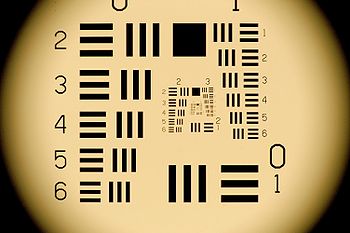 The measure of how closely lines can be resolved in an image is called spatial resolution, and it depends on properties of the system creating the image, not just the pixel resolution in pixels per inch
(ppi). For practical purposes the clarity of the image is decided by its spatial resolution, not the number of pixels in an image. In effect, spatial resolution refers to the number of independent pixel values per unit length.
The spatial resolution of computer monitors is generally 72 to 100 lines per inch, corresponding to pixel resolutions of 72 to 100 ppi. With scanners, optical resolution is sometimes used to distinguish spatial resolution from the number of pixels per inch.
In geographic information system
s (GISs), spatial resolution is measured by the ground sample distance
(GSD) of an image, the pixel spacing on the Earth's surface.
In astronomy
one often measures spatial resolution in data points per arcsecond subtended at the point of observation, since the physical distance between objects in the image depends on their distance away and this varies widely with the object of interest. On the other hand, in electron microscopy, line or fringe resolution refers to the minimum separation detectable between adjacent parallel lines (e.g. between planes of atoms), while point resolution instead refers to the minimum separation between adjacent points that can be both detected and interpreted e.g. as adjacent columns of atoms, for instance. The former often helps one detect periodicity in specimens, while the latter (although more difficult to achieve) is key to visualizing how individual atoms interact.
In Stereoscopic 3D images, spatial resolution could be defined as the spatial information recorded or captured by two viewpoints of a stereo camera (left and right camera). The effects of spatial resolution on overall perceived resolution of an image on a person's mind are yet not fully documented. It could be argued that such "spatial resolution" could add an image that then would not depend solely on pixel count or Dots per inch alone, when classifying and interpreting overall resolution of a given photographic image or video frame.
s distinguish light of different spectra
. Multi-spectral image
s resolve even finer differences of spectrum or wavelength
than is needed to reproduce color. That is, they can have higher spectral resolution. that is the strength of each band that is created ( Lihongeni mulama: 2008)
s and high-speed cameras can resolve events at different points in time. The time resolution used for movies is usually 15 to 30 frames per second (frames/s), while high-speed cameras may resolve 100 to 1000 frames/s, or even more.
Many cameras and displays offset the color components relative to each other or mix up temporal with spatial resolution:
Image:Bayer matrix.svg|digital camera
(Bayer color filter array
)
Image:Lcd_display_dead_pixel.jpg|LCD
(Triangular pixel geometry
)
Image:Shadow_mask_closeup_cursor.jpg|CRT
(shadow mask)
, and is usually expressed as a number of levels or a number of bit
s, for example 8 bits or 256 levels that is typical of computer image files. The higher the radiometric resolution, the better subtle differences of intensity or reflectivity
can be represented, at least in theory. In practice, the effective radiometric resolution is typically limited by the noise level, rather than by the number of bits of representation.
Image
An image is an artifact, for example a two-dimensional picture, that has a similar appearance to some subject—usually a physical object or a person.-Characteristics:...
holds. The term applies to raster digital image
Digital image
A digital image is a numeric representation of a two-dimensional image. Depending on whether or not the image resolution is fixed, it may be of vector or raster type...
s, film images, and other types of images. Higher resolution means more image detail.
Image resolution can be measured in various ways. Basically, resolution quantifies how close lines can be to each other and still be visibly
Visual perception
Visual perception is the ability to interpret information and surroundings from the effects of visible light reaching the eye. The resulting perception is also known as eyesight, sight, or vision...
resolved. Resolution units can be tied to physical sizes (e.g. lines per mm, lines per inch), to the overall size of a picture (lines per picture height, also known simply as lines, TV lines, or TVL), or to angular subtenant. Line pairs are often used instead of lines; a line pair comprises a dark line and an adjacent light line. A line is either a dark line or a light line. A resolution of 10 lines per millimeter means 5 dark lines alternating with 5 light lines, or 5 line pairs per millimeter (5 LP/mm). Photographic lens
Photographic lens
A camera lens is an optical lens or assembly of lenses used in conjunction with a camera body and mechanism to make images of objects either on photographic film or on other media capable of storing an image chemically or electronically.While in principle a simple convex lens will suffice, in...
and film resolution are most often quoted in line pairs per millimeter.
Resolution of digital images
The resolution of digital images can be described in many different ways.Pixel resolution
The term resolution is often used for a pixelPixel
In digital imaging, a pixel, or pel, is a single point in a raster image, or the smallest addressable screen element in a display device; it is the smallest unit of picture that can be represented or controlled....
count in digital imaging, even though American, Japanese, and international standards specify that it should not be so used, at least in the digital camera
Digital camera
A digital camera is a camera that takes video or still photographs, or both, digitally by recording images via an electronic image sensor. It is the main device used in the field of digital photography...
field.
An image of N pixels high by M pixels wide can have any resolution less than N lines per picture height, or N TV lines. But when the pixel counts are referred to as resolution, the convention is to describe the pixel resolution with the set of two positive integer
Integer
The integers are formed by the natural numbers together with the negatives of the non-zero natural numbers .They are known as Positive and Negative Integers respectively...
numbers, where the first number is the number of pixel columns (width) and the second is the number of pixel rows (height), for example as 640 by 480. Another popular convention is to cite resolution as the total number of pixels in the image, typically given as number of megapixels, which can be calculated by multiplying pixel columns by pixel rows and dividing by one million. Other conventions include describing pixels per length unit or pixels per area unit, such as pixels per inch
Pixels per inch
Pixels per inch or pixel density is a measurement of the resolution of devices in various contexts; typically computer displays, image scanners, and digital camera image sensors....
or per square inch. None of these pixel resolutions are true resolutions, but they are widely referred to as such; they serve as upper bound
Upper bound
In mathematics, especially in order theory, an upper bound of a subset S of some partially ordered set is an element of P which is greater than or equal to every element of S. The term lower bound is defined dually as an element of P which is lesser than or equal to every element of S...
s on image resolution.
According to the same standards, the number of effective pixels that an image sensor
Image sensor
An image sensor is a device that converts an optical image into an electronic signal. It is used mostly in digital cameras and other imaging devices...
or digital camera
Digital camera
A digital camera is a camera that takes video or still photographs, or both, digitally by recording images via an electronic image sensor. It is the main device used in the field of digital photography...
has is the count of elementary pixel
Pixel
In digital imaging, a pixel, or pel, is a single point in a raster image, or the smallest addressable screen element in a display device; it is the smallest unit of picture that can be represented or controlled....
sensors that contribute to the final image, as opposed to the number of total pixels, which includes unused or light-shielded pixels around the edges.
Below is an illustration of how the same image might appear at different pixel resolutions, if the pixels were poorly rendered as sharp squares (normally, a smooth image reconstruction from pixels would be preferred, but for illustration of pixels, the sharp squares make the point better).
An image that is 2048 pixels in width and 1536 pixels in height has a total of 2048×1536 = 3,145,728 pixels or 3.1 megapixels. One could refer to it as 2048 by 1536 or a 3.1-megapixel image.
Unfortunately, the count of pixels isn't a real measure of the resolution of digital camera
Digital camera
A digital camera is a camera that takes video or still photographs, or both, digitally by recording images via an electronic image sensor. It is the main device used in the field of digital photography...
images, because color image sensors are typically set up to alternate color filter types
Bayer filter
A Bayer filter mosaic is a color filter array for arranging RGB color filters on a square grid of photosensors. Its particular arrangement of color filters is used in most single-chip digital image sensors used in digital cameras, camcorders, and scanners to create a color image...
over the light sensitive individual pixel sensors. Digital images ultimately require a red, green, and blue value for each pixel to be displayed or printed, but one individual pixel in the image sensor will only supply one of those three pieces of information. The image has to be interpolated or demosaiced to produce all three colors for each output pixel.
Spatial resolution
Pixels per inch
Pixels per inch or pixel density is a measurement of the resolution of devices in various contexts; typically computer displays, image scanners, and digital camera image sensors....
(ppi). For practical purposes the clarity of the image is decided by its spatial resolution, not the number of pixels in an image. In effect, spatial resolution refers to the number of independent pixel values per unit length.
The spatial resolution of computer monitors is generally 72 to 100 lines per inch, corresponding to pixel resolutions of 72 to 100 ppi. With scanners, optical resolution is sometimes used to distinguish spatial resolution from the number of pixels per inch.
In geographic information system
Geographic Information System
A geographic information system, geographical information science, or geospatial information studies is a system designed to capture, store, manipulate, analyze, manage, and present all types of geographically referenced data...
s (GISs), spatial resolution is measured by the ground sample distance
Ground sample distance
In remote sensing, ground sample distance in a digital photo of the ground from air or space is the distance between pixel centers measured on the ground. For example, in an image with a one-meter GSD, adjacent pixels image locations that are 1 meter apart on the ground...
(GSD) of an image, the pixel spacing on the Earth's surface.
In astronomy
Astronomy
Astronomy is a natural science that deals with the study of celestial objects and phenomena that originate outside the atmosphere of Earth...
one often measures spatial resolution in data points per arcsecond subtended at the point of observation, since the physical distance between objects in the image depends on their distance away and this varies widely with the object of interest. On the other hand, in electron microscopy, line or fringe resolution refers to the minimum separation detectable between adjacent parallel lines (e.g. between planes of atoms), while point resolution instead refers to the minimum separation between adjacent points that can be both detected and interpreted e.g. as adjacent columns of atoms, for instance. The former often helps one detect periodicity in specimens, while the latter (although more difficult to achieve) is key to visualizing how individual atoms interact.
In Stereoscopic 3D images, spatial resolution could be defined as the spatial information recorded or captured by two viewpoints of a stereo camera (left and right camera). The effects of spatial resolution on overall perceived resolution of an image on a person's mind are yet not fully documented. It could be argued that such "spatial resolution" could add an image that then would not depend solely on pixel count or Dots per inch alone, when classifying and interpreting overall resolution of a given photographic image or video frame.
Spectral resolution
Color imageColor image
A color image is a digital image that includes color information for each pixel.For visually acceptable results, it is necessary to provide three samples for each pixel, which are interpreted as coordinates in some color space...
s distinguish light of different spectra
Visible spectrum
The visible spectrum is the portion of the electromagnetic spectrum that is visible to the human eye. Electromagnetic radiation in this range of wavelengths is called visible light or simply light. A typical human eye will respond to wavelengths from about 390 to 750 nm. In terms of...
. Multi-spectral image
Multi-spectral image
A multispectral image is one that captures image data at specific frequencies across the electromagnetic spectrum. The wavelengths may be separated by filters or by the use of instruments that are sensitive to particular wavelengths, including light from frequencies beyond the visible light range,...
s resolve even finer differences of spectrum or wavelength
Wavelength
In physics, the wavelength of a sinusoidal wave is the spatial period of the wave—the distance over which the wave's shape repeats.It is usually determined by considering the distance between consecutive corresponding points of the same phase, such as crests, troughs, or zero crossings, and is a...
than is needed to reproduce color. That is, they can have higher spectral resolution. that is the strength of each band that is created ( Lihongeni mulama: 2008)
Temporal resolution
Movie cameraMovie camera
The movie camera is a type of photographic camera which takes a rapid sequence of photographs on strips of film which was very popular for private use in the last century until its successor, the video camera, replaced it...
s and high-speed cameras can resolve events at different points in time. The time resolution used for movies is usually 15 to 30 frames per second (frames/s), while high-speed cameras may resolve 100 to 1000 frames/s, or even more.
Many cameras and displays offset the color components relative to each other or mix up temporal with spatial resolution:
Image:Bayer matrix.svg|digital camera
Digital camera
A digital camera is a camera that takes video or still photographs, or both, digitally by recording images via an electronic image sensor. It is the main device used in the field of digital photography...
(Bayer color filter array
Color filter array
In photography, a color filter array , or color filter mosaic , is a mosaic of tiny color filters placed over the pixel sensors of an image sensor to capture color information....
)
Image:Lcd_display_dead_pixel.jpg|LCD
Liquid crystal display
A liquid crystal display is a flat panel display, electronic visual display, or video display that uses the light modulating properties of liquid crystals . LCs do not emit light directly....
(Triangular pixel geometry
Pixel geometry
The components of the pixels in an image sensor or display can be ordered in different patterns, called pixel geometry....
)
Image:Shadow_mask_closeup_cursor.jpg|CRT
Cathode ray tube
The cathode ray tube is a vacuum tube containing an electron gun and a fluorescent screen used to view images. It has a means to accelerate and deflect the electron beam onto the fluorescent screen to create the images. The image may represent electrical waveforms , pictures , radar targets and...
(shadow mask)
Radiometric resolution
Radiometric resolution determines how finely a system can represent or distinguish differences of intensityLuminous intensity
In photometry, luminous intensity is a measure of the wavelength-weighted power emitted by a light source in a particular direction per unit solid angle, based on the luminosity function, a standardized model of the sensitivity of the human eye...
, and is usually expressed as a number of levels or a number of bit
Bit
A bit is the basic unit of information in computing and telecommunications; it is the amount of information stored by a digital device or other physical system that exists in one of two possible distinct states...
s, for example 8 bits or 256 levels that is typical of computer image files. The higher the radiometric resolution, the better subtle differences of intensity or reflectivity
Reflectivity
In optics and photometry, reflectivity is the fraction of incident radiation reflected by a surface. In general it must be treated as a directional property that is a function of the reflected direction, the incident direction, and the incident wavelength...
can be represented, at least in theory. In practice, the effective radiometric resolution is typically limited by the noise level, rather than by the number of bits of representation.
Resolution in various media
This is a list of traditional, analog horizontal resolutions for various media. The list only includes popular formats, not rare formats, and all values are approximate (rounded to the nearest 10), since the actual quality can vary machine-to-machine or tape-to-tape. For ease-of-comparison, all values are for the NTSC system. (For PAL systems, replace 480 with 576.)- Analog and early digital
- 350×240 : Video CDVideo CDBefore the advent of DVD and Blu-ray, the Video CD became the first format for distributing films on standard 120 mm optical discs. The format is a standard digital format for storing video on a Compact Disc...
- 300×480 : Umatic, BetamaxBetamaxBetamax was a consumer-level analog videocassette magnetic tape recording format developed by Sony, released on May 10, 1975. The cassettes contain -wide videotape in a design similar to the earlier, professional wide, U-matic format...
, VHSVHSThe Video Home System is a consumer-level analog recording videocassette standard developed by Victor Company of Japan ....
, Video8 - 350×480 : Super Betamax, Betacam (pro)
- 420×480 : LaserDiscLaserdiscLaserDisc was a home video format and the first commercial optical disc storage medium. Initially licensed, sold, and marketed as MCA DiscoVision in North America in 1978, the technology was previously referred to interally as Optical Videodisc System, Reflective Optical Videodisc, Laser Optical...
, Super VHS, Hi8 - 640×480 : Analog broadcast
- 670×480 : Enhanced Definition Betamax
- 768×576 : Analog broadcast (PALPALPAL, short for Phase Alternating Line, is an analogue television colour encoding system used in broadcast television systems in many countries. Other common analogue television systems are NTSC and SECAM. This page primarily discusses the PAL colour encoding system...
)
- 350×240 : Video CD
- Digital
- 720×480 : D-VHSD-VHSD-VHS is a digital recording format developed by JVC, in collaboration with Hitachi, Matsushita, and Philips. The "D" in D-VHS originally stood for Data VHS, but with the expansion of the format from standard definition to high definition capability, JVC renamed it Digital VHS and uses that...
, DVDDVDA DVD is an optical disc storage media format, invented and developed by Philips, Sony, Toshiba, and Panasonic in 1995. DVDs offer higher storage capacity than Compact Discs while having the same dimensions....
, miniDV, Digital8Digital8Digital8 is a consumer digital recording videocassette for camcorders based on the 8 mm video format developed by Sony, and introduced in 1999.The Digital8 format is a combination of the older Hi8 tape transport with the DV codec...
, Digital Betacam (pro) - 720×480 : Widescreen DVD (anamorphic)
- 1280×720 : D-VHS, HD DVDHD DVDHD DVD is a discontinued high-density optical disc format for storing data and high-definition video.Supported principally by Toshiba, HD DVD was envisioned to be the successor to the standard DVD format...
, Blu-ray, HDV (miniDV) - 1440×1080 : HDV (miniDV)
- 1920×1080 : HDV (miniDV), AVCHD, HD DVD, Blu-ray, HDCAM SR (pro)
- 2048×1080 : 2K Digital Cinema
- 4096×2160 : 4K Digital Cinema
- 7680×4320 : UHDTV
- Sequences from newer films are scanned at 2,000, 4,000, or even 8,000 columns, called 2K, 4K, and 8KDigital cinemaDigital cinema refers to the use of digital technology to distribute and project motion pictures. A movie can be distributed via hard drives, optical disks or satellite and projected using a digital projector instead of a conventional film projector...
, for quality visual-effects editing on computers.
- 720×480 : D-VHS
- Film
- 35 mm film35 mm film35 mm film is the film gauge most commonly used for chemical still photography and motion pictures. The name of the gauge refers to the width of the photographic film, which consists of strips 35 millimeters in width...
is scanned for release on DVD at 1080 or 2000 lines as of 2005. - The actual resolution of 35 mm camera original negativesOriginal camera negativeThe original camera negative is the film in a motion picture camera which captures the original image. This is the film from which all other copies will be made. It is known as raw stock prior to exposure....
is the subject of much debate. Measured resolutions of negative film have ranged from 25-200 lp/mm, which equates to a range of 325 lines for 2-perf, to (theoretically) over 2300 lines for 4-perfNegative pulldownNegative pulldown is the manner in which an image is exposed on a film stock, described in the number of film perforations spanned by an individual frame. It can also describe the orientation of the image on the negative, whether it is captured horizontally or vertically...
shot on T-Max 100. Archivists generally agree that 4k scanning of 35mm is more than adequate for archival purposes. - IMAXIMAXIMAX is a motion picture film format and a set of proprietary cinema projection standards created by the Canadian company IMAX Corporation. IMAX has the capacity to record and display images of far greater size and resolution than conventional film systems...
, including IMAX HD and OMNIMAX: approximately 10,000×7000 (7000 lines) resolution.
- 35 mm film
External links
- Spatial resolution of ionizing particle sensors; Spatial resolution of particle detectors used in High Energy Physics Experiments.
- Luminous Landscape's Res-Demyst; on why pixel count is not always a good proxy for resolution
- Do Sensors “Outresolve” Lenses?; on lens and sensor resolution interaction.