

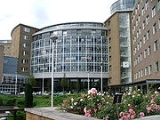
BBC Television Centre

Encyclopedia
BBC Television Centre at White City
in West London is the headquarters of BBC Television
. Officially opened on 29 June 1960, it remains one of the largest to this day; having featured over the years as backdrop to many BBC programmes, it is one of the most readily recognisable such facilities anywhere. It is the second oldest television studios in the United Kingdom after Granada Studios
which was home to the BBC's great commercial rival for many years, Granada Television Manchester.
Radio 5 Live
and most of the corporation's national TV and radio news
output comes from Television Centre with most of the pre-recorded television output coming from the nearby Broadcast Centre at 201 Wood Lane care of Red Bee Media
. Live television
events from studios and routing of national and international sporting events still happen within Television Centre before being passed onto the Broadcast Centre for transmission.
On 21 September 2010, the BBC's Director of Vision, Jana Bennett
, announced that the BBC will cease broadcasting from Television Centre in 2013. On 13 June 2011 the BBC announced that Television Centre was on the market, and that it was 'inviting bid proposals from people looking for a conventional, freehold property or those interested in a joint venture', suggesting that it may yet remain connected to the Corporation. The radio and television news departments will move to Broadcasting House
in central London in 2011, the traditional home of BBC Radio
, as part of an ongoing reorganisation of the BBC's facilities.
A sharp rise in local property values, sparked by the arrival of the nearby Westfield
shopping centre, placed the building under threat, although it is now protected from demolition. Making the protection announcement in July 2009, the Government's architecture minister Barbara Follett noted that it was where Doctor Who
, Fawlty Towers
and Blue Peter
first came to life: "It has been a torture chamber for politicians, and an endless source of first-class entertainment for the nation—sometimes both at the same time."
Like Broadcasting House
, the much older headquarters of BBC Radio
just north of Oxford Circus
, it is a Grade II listed building. The building is four miles west of central London
. The nearest Underground stations are White City
and Wood Lane
. The building lies in the parish of St Michael and St George, White City.
, the then Controller of the BBC Television Service, announced at the Television Society
's annual dinner at the Waldorf Hotel
that a new TV centre would be built in Shepherd's Bush. Transmissions at the time came from Alexandra Palace
and Lime Grove Studios
(from 1949), and had very few television transmitters. It was to be the largest television centre in the world. Riverside Studios
in Hammersmith were used from 1954.
It was planned to be six acres, but turned out to be twice as big. On 24 August 1956 the main contract was awarded by the BBC to Higgs and Hill
, who also later built The London Studios
(ITV) in 1972. The building was planned to cost £9m.
When it opened, the Director of BBC television was Gerald Beadle, and the first programme it broadcast was First Night with David Nixon in Studio Three.

, which is meant to symbolise the radiation of television light around the world. At the foot of this statue are two reclining figures, symbolising sound
and vision
, the components of television. (This structure was originally a working fountain but due to the building's unique shape it was found to be too noisy for the staff in the overlooking offices, and there were also problems with water leakage into the videotape area directly beneath). Even though there is a foundation stone marked 'BBC 1956' in the basement of the main building, construction had begun on the site in 1951. Over time various extensions have been added to the building to maximise the site's potential.
Increasingly the corporation has had to seek further accommodation elsewhere, such as the nearby BBC White City
. This new complex comprises White City One, a 25,000 square metre office building, and the adjacent Broadcast and Media Centres.
in shape. The architect, Graham Dawbarn CBE (Norman & Dawbarn), drew a question mark on an envelope (now held by the BBC Written Archives Centre) while thinking about the design of the building, and realised that it would be an ideal shape for the site. However, an article in The BBC Quarterly, July 1946, proposed a circular design for a new television studio complex, several years before Dawbarn drew up his plans. The building was first commissioned in 1949.
, a wholly owned commercial subsidiary of the BBC. The studios themselves are numerous and varying in size. All studios are often abbreviated to initials, such as TC1 for Studio 1.
In addition to these studios, BBC News
used a number of studios for the frequent news bulletins. These studios have a different naming system due to their permanent usage and are not included on most studio lists, as they are unavailable for hire.
The studios host a wide variety of TV programmes for a range of broadcasters, including Strictly Come Dancing
, Harry Hill's TV Burp
, Match of the Day
, Later with Jools, Miranda, The Alan Titchmarsh Show
, The Armstrong and Miller Show
and 8 out of 10 Cats
, as well as big complex live productions such as Children in Need
and Comic Relief
. Over the years they have been home to some of the world's most famous TV programmes including Fawlty Towers
, Monty Python's Flying Circus
, Blue Peter
, Absolutely Fabulous
, The Hitchhiker's Guide to the Galaxy
and classic Doctor Who
. Since the early 1990s however the studios have been home to few dramas – the last major drama series to be shot there being The House of Eliott
, which ended in 1994, and the last single drama recorded was Henry IV, Part 1
, in 1995. This was because drama production moved almost entirely onto film or single-camera
video, and Television Centre is a video-based, multi-camera
production environment.
(EGT) 4.9MWe Typhoon gas turbine
Combined Heating, Power and Cooling
unit. It included a 6MW Thermax
air conditioning
(cooling) vapour absorption machine
(VAM). The £6m HVAC
system reduced the centre's energy costs by 35%, and paid for itself within three years. A second turbine was added, without a second chimney. However in 2008, the BBC admitted that the energy system is only being used for emergency purposes as it became cost-ineffective to use full-time. Excess electricity produced at night has not been returned to the National Grid, as originally planned. In November 2003, the turbine's chimney's caught fire, effectively bringing TV output in the centre to a halt. Since the fire the turbines have not been regularly used.
garden, and the central building. Previously, under a long standing deal between the BBC and English Heritage
the building was not listed, to allow the BBC to make regular changes that are necessary in a broadcasting centre. In return, if the Corporation ever left TV Centre, it agreed that the fabric of the building would be restored to its mid-60s state, and English Heritage would then list notable features. On 17 June 2009 the Department for Culture, Media and Sport
decided to list at Grade II the Central Ring of the building and Studio 1, noting in particular the John Piper
mosaic, central drum with its mosaic tiles, the Huxley-Jones gilded statue of Helios, full-height glazing of the stair and original clock in the Central Ring. The 'atomic dots' and name of Studio 1, along with the cantilevered porch on its exterior were noted as important architectural features of that building. The Department did not consider the other buildings, including all other studios, scenery block and canteen of sufficient special interest to warrant listing them, and specifically excluded them.
It was announced on 18 October 2007 that in order to meet a £2 billion shortfall in funding, the BBC intends to "reduce the size of the property portfolio in west London by selling BBC Television Centre by the end the financial year 2012/13", with Director General
Mark Thompson
saying the plan will deliver "a smaller, but fitter, BBC" in the digital age. A BBC spokeswoman has added that "this is a full scale disposal of BBC Television Centre and we won't be leasing it back"
In 2011, subject to building work completion, all BBC News, national radio
and BBC World Service
broadcasts will be moved to Broadcasting House in central London. The building is planned to have the largest live newsroom in the world. The BBC News Centre at Television Centre was only opened in 1997, in a new complex at the front of the building. The decision to move radio news to this building was attributed to Director General John Birt, a move that was resisted by the then managing director of BBC Radio
, Liz Forgan
, who resigned after failing to dissuade the governors. Birt's decision has caused problems for BBC Radio in particular, for example politicians accustomed to travelling to interviews at Broadcasting House have been reluctant to make the journey to White City, despite being only four and a half miles west.
Two other departments, Sport
and Children's, will move from Television Centre to MediaCityUK in Salford Quays
in 2011 along with Children's Learning, Radio Five Live
and part of BBC Future Media & Technology. This move will see up to 1,500 London-based posts relocating to Manchester. BBC Breakfast (which is part of BBC News) will also move to Salford at the end of 2011.
Despite all these plans, which have met with some opposition amongst employees, councillors and the public, the BBC have still not confirmed whether the building will definitely close. Although the BBC has said production will cease by the end of 2013 it is not clear what will happen to the building. The BBC themselves envisage it as a cultural centre and other parties have suggested the studios should be retained. By September 2010 the BBC had equipped four of the studios for HD working (studios 1, 4, 6 and 8).
Following the UK "credit crunch" and the beginning of the recession, the plans for Television Centre came under review. Employees were informed in 2010, via email, that it was doubtful that the building would be disposed of by 2013, and possibly even 2016, when the BBC Charter
is up for renewal. However, this decision was reversed in June 2011, and the corporation officially put Television Centre on the property market.
, on 20 April 1964, to be cancelled; programmes began the next day instead.
One such large power failure occurred on the 20 June 2000 at approximately 17.00 BST. This power cut affected the whole of Television Centre resulting in many services, such as BBC Two
and BBC Radio 4
to fall off the air, and BBC News 24 went off air before being relocated to the BBC
's Westminster
studios. The 6 O'Clock news didn't broadcast and troubles were experienced in the South East
region, as Newsroom South East started later than planned. The fire alarms went off at Television Centre later that day, leaving only a skeleton crew. Eventually many programmes returned, albeit in different locations: Newsnight
was presented from the main news studio with intermittent technical problems. The failure was due to a substation in Shepherd's Bush and normal services on the BBC
were resumed to following day.
On 4 March 2001, a bomb was placed outside the news centre of Television Centre which exploded, with no fatalities. It was attributed to the Real IRA and culprits were eventually captured. The front of the building suffered moderate damage as a result, but was repaired before too long. The bombing at the BBC
was the latest in a line of attacks from the Real IRA.
Just before 0800 GMT on 28 November 2003 an electrical fault caused some equipment to overheat which set off fire alarms. Although there was no fire the fault did cause widespread power cuts and prevented backup generators from providing alternative power. Again, all output was affected with services transferred across London to alternative studios. For example, both the One O'Clock News and BBC News 24 broadcast for much of the day from the BBC's Millbank Studios, and the morning radio shows the Today programme
and Five Live's
Breakfast fell off air for 15 minutes. This power cut came on the week prior to the relaunch of News 24, which was postponed for another week to ensure that all problems had been remedied.
For Question Time
on 22 October 2009, the BBC had sparked controversy, heated public debate and strong protest when the British National Party
leader Nick Griffin
was invited onto the programme for the first time. BBC Television Centre had its security breached with around 30 anti-fascist protesters storming the reception area in protest of Griffin's appearance. Further protests continued around the centre's ground, with several hundred protesters gathering outside. Police and security staff were forced to close gates leading into Television Centre and form barriers to prevent any further breaches of security.
White City, London
White City is a district in the London Borough of Hammersmith and Fulham, to the north of Shepherd's Bush. Today, White City is home to the BBC Television Centre and BBC White City, and Loftus Road stadium, the home of football club Queens Park Rangers FC....
in West London is the headquarters of BBC Television
BBC Television
BBC Television is a service of the British Broadcasting Corporation. The corporation, which has operated in the United Kingdom under the terms of a Royal Charter since 1927, has produced television programmes from its own studios since 1932, although the start of its regular service of television...
. Officially opened on 29 June 1960, it remains one of the largest to this day; having featured over the years as backdrop to many BBC programmes, it is one of the most readily recognisable such facilities anywhere. It is the second oldest television studios in the United Kingdom after Granada Studios
The Manchester Studios
The Manchester Studios is a television studio on Quay Street in Manchester with the facility to broadcast live and film drama programmes. The studios have been home to Granada Television since its inception in 1954...
which was home to the BBC's great commercial rival for many years, Granada Television Manchester.
Radio 5 Live
BBC Radio 5 Live
BBC Radio 5 Live is the BBC's national radio service that specialises in live BBC News, phone-ins, and sports commentaries...
and most of the corporation's national TV and radio news
BBC News
BBC News is the department of the British Broadcasting Corporation responsible for the gathering and broadcasting of news and current affairs. The department is the world's largest broadcast news organisation and generates about 120 hours of radio and television output each day, as well as online...
output comes from Television Centre with most of the pre-recorded television output coming from the nearby Broadcast Centre at 201 Wood Lane care of Red Bee Media
Red Bee Media
Red Bee Media Limited is a media management company.Headquartered in west London, United Kingdom at the Broadcast Centre, with international offices in Scotland, Australia, France, Germany and Spain, Red Bee Media has 1500 employees worldwide including homeworkers and revenues of £153m in...
. Live television
Live television
Live television refers to a television production broadcast in real-time, as events happen, in the present. From the early days of television until about 1958, live television was used heavily, except for filmed shows such as I Love Lucy and Gunsmoke. Video tape did not exist until 1957...
events from studios and routing of national and international sporting events still happen within Television Centre before being passed onto the Broadcast Centre for transmission.
On 21 September 2010, the BBC's Director of Vision, Jana Bennett
Jana Bennett
Jana Bennett OBE is Director of Vision at the BBC. She took up the post in 2006, having been Director of Television from April 2002. She was previously Executive Vice President and General Manager at Discovery Communications in the US...
, announced that the BBC will cease broadcasting from Television Centre in 2013. On 13 June 2011 the BBC announced that Television Centre was on the market, and that it was 'inviting bid proposals from people looking for a conventional, freehold property or those interested in a joint venture', suggesting that it may yet remain connected to the Corporation. The radio and television news departments will move to Broadcasting House
Broadcasting House
Broadcasting House is the headquarters and registered office of the BBC in Portland Place and Langham Place, London.The building includes the BBC Radio Theatre from where music and speech programmes are recorded in front of a studio audience...
in central London in 2011, the traditional home of BBC Radio
BBC Radio
BBC Radio is a service of the British Broadcasting Corporation which has operated in the United Kingdom under the terms of a Royal Charter since 1927. For a history of BBC radio prior to 1927 see British Broadcasting Company...
, as part of an ongoing reorganisation of the BBC's facilities.
A sharp rise in local property values, sparked by the arrival of the nearby Westfield
Westfield London
Westfield London is a shopping centre in White City in the London Borough of Hammersmith and Fulham. The centre was developed by the Westfield Group at a cost of £1.6bn,...
shopping centre, placed the building under threat, although it is now protected from demolition. Making the protection announcement in July 2009, the Government's architecture minister Barbara Follett noted that it was where Doctor Who
Doctor Who
Doctor Who is a British science fiction television programme produced by the BBC. The programme depicts the adventures of a time-travelling humanoid alien known as the Doctor who explores the universe in a sentient time machine called the TARDIS that flies through time and space, whose exterior...
, Fawlty Towers
Fawlty Towers
Fawlty Towers is a British sitcom produced by BBC Television and first broadcast on BBC2 in 1975. Twelve television program episodes were produced . The show was written by John Cleese and his then wife Connie Booth, both of whom played major characters...
and Blue Peter
Blue Peter
Blue Peter is the world's longest-running children's television show, having first aired in 1958. It is shown on CBBC, both in its BBC One programming block and on the CBBC channel. During its history there have been many presenters, often consisting of two women and two men at a time...
first came to life: "It has been a torture chamber for politicians, and an endless source of first-class entertainment for the nation—sometimes both at the same time."
Like Broadcasting House
Broadcasting House
Broadcasting House is the headquarters and registered office of the BBC in Portland Place and Langham Place, London.The building includes the BBC Radio Theatre from where music and speech programmes are recorded in front of a studio audience...
, the much older headquarters of BBC Radio
BBC Radio
BBC Radio is a service of the British Broadcasting Corporation which has operated in the United Kingdom under the terms of a Royal Charter since 1927. For a history of BBC radio prior to 1927 see British Broadcasting Company...
just north of Oxford Circus
Oxford Circus
Oxford Circus is the area of London at the busy intersection of Regent Street and Oxford Street, in the West End. It is served by Oxford Circus tube station, which is directly beneath the junction itself.- History :...
, it is a Grade II listed building. The building is four miles west of central London
Central London
Central London is the innermost part of London, England. There is no official or commonly accepted definition of its area, but its characteristics are understood to include a high density built environment, high land values, an elevated daytime population and a concentration of regionally,...
. The nearest Underground stations are White City
White City tube station
White City tube station is a London Underground station situated on Wood Lane in White City in west London. The station is on the Central Line, between Shepherds Bush and East Acton stations, in Travelcard Zone 2.-History:...
and Wood Lane
Wood Lane tube station
Wood Lane is a London Underground station, located in the White City area of west London, England, UK. It is on the Circle and Hammersmith & City Lines, between Latimer Road and Shepherd's Bush Market stations. The station lies in Travelcard Zone 2....
. The building lies in the parish of St Michael and St George, White City.
History
On Friday 1 April 1949, Norman CollinsNorman Collins
Norman Collins was a British writer, and later a radio and television executive, who became one of the major figures behind the establishment of the Independent Television network in the UK...
, the then Controller of the BBC Television Service, announced at the Television Society
Royal Television Society
The Royal Television Society is a British-based educational charity for the discussion, and analysis of television in all its forms, past, present and future. It is the oldest television society in the world...
's annual dinner at the Waldorf Hotel
Waldorf Hilton
The Waldorf Hotel, now known as the Waldorf Hilton, is a hotel based in The Aldwych, London. It has a history dating back to 1908. It was founded by William Waldorf Astor, 1st Viscount Astor, part of the Astor family....
that a new TV centre would be built in Shepherd's Bush. Transmissions at the time came from Alexandra Palace
Alexandra Palace
Alexandra Palace is a building in North London, England. It stands in Alexandra Park, in an area between Hornsey, Muswell Hill and Wood Green...
and Lime Grove Studios
Lime Grove Studios
Lime Grove Studios was a film studio complex built by the Gaumont Film Company in 1915 situated in a street named Lime Grove, inShepherd's Bush, west London, north of Hammersmith and described by Gaumont as "the finest studio in Great Britain and the first building ever put up in this country...
(from 1949), and had very few television transmitters. It was to be the largest television centre in the world. Riverside Studios
Riverside Studios
Riverside Studios is a production studio, theatre and independent cinema on the banks of the River Thames in Hammersmith, London, England. It plays host to contemporary and international dramatic and dance performance, film, visual art exhibitions and television production.-History:In 1933, the...
in Hammersmith were used from 1954.
It was planned to be six acres, but turned out to be twice as big. On 24 August 1956 the main contract was awarded by the BBC to Higgs and Hill
Higgs and Hill
Higgs and Hill was a major British construction company responsible for building some of London's finest buildings.-History:The Company was established in 1874 by the merger of the firm of Thomas Hill with the firm of William Higgs...
, who also later built The London Studios
The London Studios
The London Studios is a television studio complex which is owned by London Weekend Television and has been home to the London Weekend ITV provider since 1972...
(ITV) in 1972. The building was planned to cost £9m.
When it opened, the Director of BBC television was Gerald Beadle, and the first programme it broadcast was First Night with David Nixon in Studio Three.
The building
Circular shape
The building features a distinctive circular central block (officially known as the main block—but often affectionately referred to by staff as the "doughnut") around which are studios, offices, engineering areas and the new News Centre. In the centre of the main block is a statue designed by T.B. Huxley-Jones, of the Greek god of the sun, HeliosHelios
Helios was the personification of the Sun in Greek mythology. Homer often calls him simply Titan or Hyperion, while Hesiod and the Homeric Hymn separate him as a son of the Titans Hyperion and Theia or Euryphaessa and brother of the goddesses Selene, the moon, and Eos, the dawn...
, which is meant to symbolise the radiation of television light around the world. At the foot of this statue are two reclining figures, symbolising sound
Sound
Sound is a mechanical wave that is an oscillation of pressure transmitted through a solid, liquid, or gas, composed of frequencies within the range of hearing and of a level sufficiently strong to be heard, or the sensation stimulated in organs of hearing by such vibrations.-Propagation of...
and vision
Visual perception
Visual perception is the ability to interpret information and surroundings from the effects of visible light reaching the eye. The resulting perception is also known as eyesight, sight, or vision...
, the components of television. (This structure was originally a working fountain but due to the building's unique shape it was found to be too noisy for the staff in the overlooking offices, and there were also problems with water leakage into the videotape area directly beneath). Even though there is a foundation stone marked 'BBC 1956' in the basement of the main building, construction had begun on the site in 1951. Over time various extensions have been added to the building to maximise the site's potential.
Increasingly the corporation has had to seek further accommodation elsewhere, such as the nearby BBC White City
BBC White City
BBC White City refers both to a collection of BBC buildings at Wood Lane, White City in west London, and an office building opened in 1990 within that collection of buildings...
. This new complex comprises White City One, a 25,000 square metre office building, and the adjacent Broadcast and Media Centres.
Design
The overall design for Television Centre, from the air, appears to be like a question markQuestion mark
The question mark , is a punctuation mark that replaces the full stop at the end of an interrogative sentence in English and many other languages. The question mark is not used for indirect questions...
in shape. The architect, Graham Dawbarn CBE (Norman & Dawbarn), drew a question mark on an envelope (now held by the BBC Written Archives Centre) while thinking about the design of the building, and realised that it would be an ideal shape for the site. However, an article in The BBC Quarterly, July 1946, proposed a circular design for a new television studio complex, several years before Dawbarn drew up his plans. The building was first commissioned in 1949.
Studios
The centre's studios are run by BBC Studios and Post ProductionBBC Studios and Post Production
BBC Studios and Post Production is a wholly owned commercial subsidiary of the BBC, providing TV studios and post production services to the media industry....
, a wholly owned commercial subsidiary of the BBC. The studios themselves are numerous and varying in size. All studios are often abbreviated to initials, such as TC1 for Studio 1.
- Studio 0 - 117 square metres (1260 ft²) - Opened in 1989, it has produced a number of different productions including some for UK Play. It has been home to Liquid NewsLiquid NewsLiquid News was the daily round up of entertainment news for BBC Three running from 30th May 2000 to 1st April 2004. It was originally a vehicle for presenter Christopher Price...
between 2000 and 2002 and CBeebiesCBeebiesCBeebies is the brand used by the BBC for programming aimed at children 6 years and under. It is used as a themed strand in the UK on terrestrial television, as a separate free-to-air domestic British channel and used for international varients supported by advertising, subscription or both...
invision continuity between 2002 and 2008. It is currently being used by BBC Research. - Studio 1 - 995 square metres (10,250 ft²) — Opened on 15 April 1964 and is the fourth largest television studio in Britain (following The Fountain Studios' Studio A&B, MediaCityUK's Studio 1 and The Maidstone StudiosThe Maidstone StudiosThe Maidstone Studios, formerly called TVS Television Centre is a television studio complex with radio studio facilities based at Vinters Park in Maidstone, Kent UK...
' Studio 5), and is equipped for HDTVHigh-definition televisionHigh-definition television is video that has resolution substantially higher than that of traditional television systems . HDTV has one or two million pixels per frame, roughly five times that of SD...
production (as are Studio Four, Studio Six and Studio Eight). - Studio 2 - 223 square metres (2,400 ft²) - Opened in late 1960, it housed a number of comedy programmes such as That Was The Week That WasThat Was The Week That WasThat Was The Week That Was, also known as TW3, is a satirical television comedy programme that was shown on BBC Television in 1962 and 1963. It was devised, produced and directed by Ned Sherrin and presented by David Frost...
. It was not converted to colour and closed in 1969, with the space being used a storage, but reopened in 1981. It was used by BBC NewsBBC NewsBBC News is the department of the British Broadcasting Corporation responsible for the gathering and broadcasting of news and current affairs. The department is the world's largest broadcast news organisation and generates about 120 hours of radio and television output each day, as well as online...
until they moved in 1997, and has now played host to the SportBBC SportBBC Sport is the sports division of the BBC. It became a fully dedicated division of the BBC in 2000. It incorporates programmes such as Match of the Day, Grandstand , Test Match Special, Ski Sunday, Rugby Special and coverage of Formula One motor racing, MotoGP and the Wimbledon Tennis...
and Children'sCBBCCBBC is one of two brand names used for the BBC's children's television strands. Between 1985 and 2002, CBBC was the name given to all the BBC's programmes on TV for children aged under 14...
department. It was the main studio used for Blue PeterBlue PeterBlue Peter is the world's longest-running children's television show, having first aired in 1958. It is shown on CBBC, both in its BBC One programming block and on the CBBC channel. During its history there have been many presenters, often consisting of two women and two men at a time...
for the 2007 and 2008 series. The studio has been vacated following the move of both departments to MediaCityUK - Studio 3 - 594 square metres (6,390 ft²) - Opened on 29 June 1960. It was designed as a drama studio and had panels and fittings that made it customised towards this purpose. The walls are also slightly thicker, so as to block out the noise from the Hammersmith & City lineHammersmith & City LineThe Hammersmith & City line is a subsurface London Underground line. It connects Hammersmith in the west with Barking in the east, running through the northern part of central London. It is coloured salmon pink on the Tube map...
of the London UndergroundLondon UndergroundThe London Underground is a rapid transit system serving a large part of Greater London and some parts of Buckinghamshire, Hertfordshire and Essex in England...
. It housed the first programme and was the first studio to be completed. It was upgraded to colour in 1969. It is current home to Harry Hill's TV BurpHarry Hill's TV BurpHarry Hill's TV Burp is a British television comedy programme produced by Avalon Television for ITV and hosted by comedian Harry Hill. The show presents a satirical look at the week's television, including extracts from TV shows with added sketches, observational voice-overs, and guest appearances...
. - Studio 4 - 585 square metres (6,300 ft²) - Opened in January 1961, TC4 is similar in design and layout to its neighbour, TC3. The studio was designed as a light entertainment studio and contains a rather unusual sound system called ambiophony. The studio was upgraded to colour in 1970 and to HDHigh-definition televisionHigh-definition television is video that has resolution substantially higher than that of traditional television systems . HDTV has one or two million pixels per frame, roughly five times that of SD...
and surround sound in 2008. It was home to Friday Night with Jonathan RossFriday Night with Jonathan RossFriday Night with Jonathan Ross was a British comedy chat show presented by Jonathan Ross. It was first broadcast on BBC One on 2 November 2001. The programme featured Ross's take on current topics of conversation, guest interviews and live music from both a guest music group and the house band...
. - Studio 5 - 223 square metres (2,400 ft²) - Opened in August 1961, TC5 was used for the first half of its life by broadcasts from BBC SchoolsBBC SchoolsBBC Schools, also known as BBC for Schools and Colleges, is the educational programming strand set up by the BBC in 1957, broadcasting a range of educational programmes for children aged 5–16. From launch until June 1983, programming was based on BBC One during the daytime, before programming was...
. There was an area adjacent to the studio that was used for schools programming that linked in with the studio. It was converted to colour c.1973, about the same time as schools broadcasts as a whole. It was closed briefly during the mid-1980s, before being reopened in 1987 following a two year refurbishment. The studio has since been the home of BBC SportBBC SportBBC Sport is the sports division of the BBC. It became a fully dedicated division of the BBC in 2000. It incorporates programmes such as Match of the Day, Grandstand , Test Match Special, Ski Sunday, Rugby Special and coverage of Formula One motor racing, MotoGP and the Wimbledon Tennis...
's programmes, but will be vacated in 2011 as the Sports department will move to MediaCityUK. - Studio 6 - 598 square metres (6,440 ft²) - Opened in July 1967 to coincide with BBC TwoBBC TwoBBC Two is the second television channel operated by the British Broadcasting Corporation in the United Kingdom. It covers a wide range of subject matter, but tending towards more 'highbrow' programmes than the more mainstream and popular BBC One. Like the BBC's other domestic TV and radio...
's switch to colour television. It was the first to be equipped with colour cameras. The studio itself is a strange design: when originally designed it was to be split in 2 by a large removable wall, however this idea was abandoned. The remains of this idea can still be seen however in the layout, of a long, thin studio and in the lighting grid. The gallery for this studio was moved in 1993, with the old gallery now home to the BBC Red Button control room. Upgraded to HDHigh-definition televisionHigh-definition television is video that has resolution substantially higher than that of traditional television systems . HDTV has one or two million pixels per frame, roughly five times that of SD...
in July 2008 and is the first 3D capable studio in the UK. Was home to children's programmes Live & KickingLive & KickingLive & Kicking was a BBC Saturday morning children's magazine programme, running from 1993 to 2001. The fourth in a succession of Saturday morning shows, it was the replacement for Going Live!, and took many of its features from it, such as phone-ins, games, comedy, competitions and the showing of...
and Dick and Dom in da BungalowDick and Dom in da BungalowDick and Dom in da Bungalow was a CBBC children's entertainment television series presented by the duo Dick and Dom...
. - Studio 7 - 223 square metres (2,400 ft²) - Opened in 1962 and has been used for a variety of programmes over the years. Was home to some children's programming such as Going Live!Going Live!Going Live! was a Saturday morning magazine show, broadcast on BBC1 between 1987 and 1993. It was presented by Phillip Schofield and Sarah Greene.Other presenters included Trevor and Simon, Peter Simon, Emma Forbes, and puppet Gordon the Gopher....
, before being home to BBC NewsBBC NewsBBC News is the department of the British Broadcasting Corporation responsible for the gathering and broadcasting of news and current affairs. The department is the world's largest broadcast news organisation and generates about 120 hours of radio and television output each day, as well as online...
in 1997. It is the home of the BBC BreakfastBBC BreakfastBBC Breakfast is the morning television news programme simulcast on BBC One and the BBC News channel. It is presented live from BBC Television Centre in White City, West London, and contains a mixture of news, sport, weather, business and feature items...
programme and the BBC News at Six bulletin, with other bulletins based at N6 in the News Centre. Will be vacated later on in 2011, following the refit of the extension to Broadcasting HouseBroadcasting HouseBroadcasting House is the headquarters and registered office of the BBC in Portland Place and Langham Place, London.The building includes the BBC Radio Theatre from where music and speech programmes are recorded in front of a studio audience...
, where the BBC NewsBBC NewsBBC News is the department of the British Broadcasting Corporation responsible for the gathering and broadcasting of news and current affairs. The department is the world's largest broadcast news organisation and generates about 120 hours of radio and television output each day, as well as online...
department and newsroom is moving. - Studio 8 - 602 square metres (6,480 ft²) - Opened in 1967, this studio was noted as the best studio for television producerTelevision producerThe primary role of a television Producer is to allow all aspects of video production, ranging from show idea development and cast hiring to shoot supervision and fact-checking...
s to use. It was the size that most programmes wanted and, building on the experience when building the other studios, was the best. The galleries and studios were laid out perfectly and in a layout producers liked. It has become the studio for comedy and sitcoms, due to audience seating arrangements and size. It was converted to HDHigh-definition televisionHigh-definition television is video that has resolution substantially higher than that of traditional television systems . HDTV has one or two million pixels per frame, roughly five times that of SD...
in January 2007. - Studio 9 - 84 square metres (900 ft²) - The building was built in 1955 and was originally a foyer area of the restaurant block, before becoming a store area. The store however was converted to a studio in 1996 for the use of Children's BBCCBBCCBBC is one of two brand names used for the BBC's children's television strands. Between 1985 and 2002, CBBC was the name given to all the BBC's programmes on TV for children aged under 14...
. The location was highly convenient: it allowed the invision continuity to be relocated from the "broom cupboard" (Continuity Announcers booth) to a more roomier studio. The new studio also opened onto the Blue Peter Garden allowing presentation to take place there. The studio itself is an odd shape, and was used for invision continuity for CBBCCBBCCBBC is one of two brand names used for the BBC's children's television strands. Between 1985 and 2002, CBBC was the name given to all the BBC's programmes on TV for children aged under 14...
until 2004, when they broadcast links for the CBBC ChannelCBBC ChannelCBBC is a BBC television channel aimed at 6 to 12 year olds. It complements the CBBC programming that continues to air on BBC One and BBC Two. Launched on 11 February 2002, it broadcasts from 7am to 7pm on Freeview, cable, IPTV and digital satellite, occupying the same bandwidth as, but a different...
only. All invision continuity was dropped in 2006, and the studio was used for programmes such as Sam & Mark's TMi Friday and SMartSMartSMart was a British CBBC television programme based on the subject of art, which began in 1994. The programme was recorded at BBC Television Centre in London, previously it had been recorded in Studio A at BBC Pebble Mill in Birmingham. The format is similar to the Tony Hart programmes Take Hart...
. Following CBBCCBBCCBBC is one of two brand names used for the BBC's children's television strands. Between 1985 and 2002, CBBC was the name given to all the BBC's programmes on TV for children aged under 14...
's move to MediaCityUK, the studio is expected to remain empty. - Studio 10 - 111 square metres (1200 ft²) - Originally built as N1 in 1969, the studio was used for the BBC1BBC OneBBC One is the flagship television channel of the British Broadcasting Corporation in the United Kingdom. It was launched on 2 November 1936 as the BBC Television Service, and was the world's first regular television service with a high level of image resolution...
daytime news bulletins. Closed in 1998, when news bulletins moved to the News Centre section of Television Centre, and was renamed as TC10. Was used for some programmes by channel UK Play until the stations closure. Between 2004 and 2006 it was used for invision continuity for CBBCCBBCCBBC is one of two brand names used for the BBC's children's television strands. Between 1985 and 2002, CBBC was the name given to all the BBC's programmes on TV for children aged under 14...
on BBC OneBBC OneBBC One is the flagship television channel of the British Broadcasting Corporation in the United Kingdom. It was launched on 2 November 1936 as the BBC Television Service, and was the world's first regular television service with a high level of image resolution...
and BBC TwoBBC TwoBBC Two is the second television channel operated by the British Broadcasting Corporation in the United Kingdom. It covers a wide range of subject matter, but tending towards more 'highbrow' programmes than the more mainstream and popular BBC One. Like the BBC's other domestic TV and radio...
, before being used by some programming for CBBC such as Level UpLevel UpLevel Up was a UK children's TV programme that was broadcast on CBBC. It was launched on the 3rd April 2006, replacing Xchange. The show was an hour long and during the school year broadcasting from 7:30am until 8:30am...
. Since Summer 2010, it has been the home of CBeebiesCBeebiesCBeebies is the brand used by the BBC for programming aimed at children 6 years and under. It is used as a themed strand in the UK on terrestrial television, as a separate free-to-air domestic British channel and used for international varients supported by advertising, subscription or both...
. the studio is expected to be left empty, when CBeebiesCBeebiesCBeebies is the brand used by the BBC for programming aimed at children 6 years and under. It is used as a themed strand in the UK on terrestrial television, as a separate free-to-air domestic British channel and used for international varients supported by advertising, subscription or both...
moves to MediaCityUK. - Studio 11 - 186 square metres (2000 ft²) - Originally built as N2 in 1969, the studio was used for the BBC2BBC TwoBBC Two is the second television channel operated by the British Broadcasting Corporation in the United Kingdom. It covers a wide range of subject matter, but tending towards more 'highbrow' programmes than the more mainstream and popular BBC One. Like the BBC's other domestic TV and radio...
daytime news bulletins. Extended in 1985 to include props store and lobby adjacent to studio, the studio became home to the Six O'Clock and Nine O'Clock NewsBBC Nine O'Clock NewsThe BBC Nine O'Clock News was the flagship BBC News programme launched on 14 September 1970, which ran until 15 October 2000, when it was controversially moved to BBC News at Ten....
. In 1998, following the completion of the News Centre spur of Television Centre, the news moved out and the studio was renamed TC11. In 2002 it became home to Liquid NewsLiquid NewsLiquid News was the daily round up of entertainment news for BBC Three running from 30th May 2000 to 1st April 2004. It was originally a vehicle for presenter Christopher Price...
and in later years to the other BBC ThreeBBC ThreeBBC Three is a television network from the BBC broadcasting via digital cable, terrestrial, IPTV and satellite platforms. The channel's target audience includes those in the 16-34 year old age group, and has the purpose of providing "innovative" content to younger audiences, focusing on new talent...
news programmes 60 Seconds60 Seconds60 Seconds is the news programme running between shows on BBC Three. The weekday presenter is Sam Naz with weekend bulletins presented by Claudia-Liza Armah....
and The 7 O'Clock NewsThe 7 O'Clock NewsThe 7 O'Clock News was the main news programme, broadcast each weekday at 7:00pm, on British digital television channel BBC Three between 9 February 2003 to 2 December 2005...
. It briefly played host to the domestic BBC News bulletins, while their studios were refurbished in 2006, before becoming general purpose. It is currently home to Strictly Come Dancing: It Takes TwoStrictly Come Dancing: It Takes TwoStrictly: It Takes Two is a British television programme, the companion show to the popular BBC One programme Strictly Come Dancing. It airs on weeknights during the run of the main show on BBC Two at 6:30pm...
. - Studio 12 - 56 square metres (600 ft²) - Originally music store. Converted into studio in 2004, for CBBCCBBCCBBC is one of two brand names used for the BBC's children's television strands. Between 1985 and 2002, CBBC was the name given to all the BBC's programmes on TV for children aged under 14...
programmes. Used for SportsroundSportsroundSportsround was a weekly spin-off from CBBC children's news programme Newsround. The sports magazine show was broadcast Friday evenings at 6:30pm on CBBC Channel and on Saturday mornings on BBC Two at 7.25am....
for many years, but converted into presentation studio in 2006. Used for invision continuity for CBBC (now in front of green screen) and changed into current invision continuity studio in summer 2007. The set was transferred to a mini studio in the East Tower. The studio is now used by BBC Research. - Pres A - 65 square metres (704 ft²) - Opened in 1960, this studio was designed for in-vision continuity for BBC OneBBC OneBBC One is the flagship television channel of the British Broadcasting Corporation in the United Kingdom. It was launched on 2 November 1936 as the BBC Television Service, and was the world's first regular television service with a high level of image resolution...
, however was only used as such for three years. Became weatherBBC WeatherBBC Weather is the BBC's department in charge of preparing and broadcasting weather forecasts and is now part of BBC News. The broadcast meteorologists are employed by the Met Office...
studio, prior to the move to the BBC Weather Centre in 1990 (also in Television Centre), following which it was used by Children's BBCCBBCCBBC is one of two brand names used for the BBC's children's television strands. Between 1985 and 2002, CBBC was the name given to all the BBC's programmes on TV for children aged under 14...
to supplement presentation from the "broom cupboard", and was used for slots such as birthdays and public holidays. Became full time home of Children's BBC in 1994 following the vacation of the 'broom cupboard'. Studio closed following CBBC's move to TC9 and the studio no longer exists. - Pres B - 65 square metres (704 ft²) - Opened in 1964, this studio was designed for in-vision continuity for BBC TwoBBC TwoBBC Two is the second television channel operated by the British Broadcasting Corporation in the United Kingdom. It covers a wide range of subject matter, but tending towards more 'highbrow' programmes than the more mainstream and popular BBC One. Like the BBC's other domestic TV and radio...
, however the new channel did not use in-vision continuity for more than a few moths after launch. Became a general purpose studio housing small productions such as Points of ViewPoints of ViewPoints of View is a long-running television show shown in the United Kingdom on BBC One, featuring the letters of viewers offering praise, criticism and purportedly witty observations on the television of recent weeks...
, FilmThe Film programmeThe Film programme is a British film review television programme, broadcast weekly on BBC One, presented by Claudia Winkleman and Danny Leigh. The title of the show changes each year to incorporate the year of broadcast, with the current series being Film 2011, but when referring to successive...
and famously The Old Grey Whistle Test. Closed down in 1996 and the studio no longer exists.
In addition to these studios, BBC News
BBC News
BBC News is the department of the British Broadcasting Corporation responsible for the gathering and broadcasting of news and current affairs. The department is the world's largest broadcast news organisation and generates about 120 hours of radio and television output each day, as well as online...
used a number of studios for the frequent news bulletins. These studios have a different naming system due to their permanent usage and are not included on most studio lists, as they are unavailable for hire.
- N1 - Previously BBC OneBBC OneBBC One is the flagship television channel of the British Broadcasting Corporation in the United Kingdom. It was launched on 2 November 1936 as the BBC Television Service, and was the world's first regular television service with a high level of image resolution...
daytime bulletins. Became TC10 - N2 - Previously BBC TwoBBC TwoBBC Two is the second television channel operated by the British Broadcasting Corporation in the United Kingdom. It covers a wide range of subject matter, but tending towards more 'highbrow' programmes than the more mainstream and popular BBC One. Like the BBC's other domestic TV and radio...
daytime/nightime bulletins for BBC One/Two, BBC Business Breakfast/BBC Breakfast Time/BBC One o'Clock News/BBC News at Six/Six O'Clock News and BBC News Updates, Nine O'Clock NewsBBC Nine O'Clock NewsThe BBC Nine O'Clock News was the flagship BBC News programme launched on 14 September 1970, which ran until 15 October 2000, when it was controversially moved to BBC News at Ten....
. Became TC11 - N3 - Small studio off main newsroom, before being made part of newsroom as a whole, separated by glass panels. Studio now not used.
- N4 - Studio has since become part of the BBC Bar.
- N5 - Originally studio for BBC Arabic TelevisionBBC Arabic TelevisionBBC Arabic Television is a news and information television channel broadcast to the Middle East by the BBC. It was launched at 0956 GMT on 11 March 2008. The service was announced in October 2005 and was to start broadcasting in Autumn 2007, but was delayed...
service. Used for a time by the BBCi service. Currently not used. - N6 - Currently home to BBC News at One, BBC News at Ten and home of the BBC News Channel.
- N7 - Name is not used for any studios to avoid confusion with TC7, which houses news programmes.
- N8 - Home of BBC World News.
- N9 - Formerly home of BBC World News, now used as a contigency when N6/N8 unavailable due to technical work & for EU/Local election coverage.
- N10 - Used by BBC ThreeBBC ThreeBBC Three is a television network from the BBC broadcasting via digital cable, terrestrial, IPTV and satellite platforms. The channel's target audience includes those in the 16-34 year old age group, and has the purpose of providing "innovative" content to younger audiences, focusing on new talent...
to produce 60 Seconds60 Seconds60 Seconds is the news programme running between shows on BBC Three. The weekday presenter is Sam Naz with weekend bulletins presented by Claudia-Liza Armah....
.
The studios host a wide variety of TV programmes for a range of broadcasters, including Strictly Come Dancing
Strictly Come Dancing
Strictly Come Dancing is a British television show, featuring celebrities with professional dance partners competing in Ballroom and Latin dances. The title of the show suggests a continuation of the long-running series Come Dancing, with an allusion to the film Strictly Ballroom...
, Harry Hill's TV Burp
Harry Hill's TV Burp
Harry Hill's TV Burp is a British television comedy programme produced by Avalon Television for ITV and hosted by comedian Harry Hill. The show presents a satirical look at the week's television, including extracts from TV shows with added sketches, observational voice-overs, and guest appearances...
, Match of the Day
Match of the Day
Match of the Day is the BBC's main football television programme. Typically, it is shown on BBC One on Saturday evenings during the English football season, showing highlights of the day's matches in English football's top division, the Premier League...
, Later with Jools, Miranda, The Alan Titchmarsh Show
The Alan Titchmarsh Show
The Alan Titchmarsh Show is a British daytime TV chat show broadcast between 3 and 4pm weekdays on the ITV Network.-Format:The programme made its debut on ITV in 2007. It focused on the theme of "The Best of British" focusing on food, entertainment and celebrities in a mid-afternoon slot...
, The Armstrong and Miller Show
The Armstrong and Miller Show
The Armstrong and Miller Show is a British sketch comedy television show produced by Hat Trick Productions for BBC One. It features the double act Armstrong and Miller and a number of notable scriptwriters including Andy Hamilton and The League of Gentlemen's Jeremy Dyson.The series followed four...
and 8 out of 10 Cats
8 Out of 10 Cats
8 out of 10 Cats is a television comedy panel game made by Zeppotron for Channel 4. It was first broadcast on 3 June 2005. The show is based on statistics and opinion polls, and draws on polls produced by a variety of organizations and new polls commissioned for the programme, carried out by...
, as well as big complex live productions such as Children in Need
Children in Need
Children in Need is an annual British charity appeal organised by the BBC. Since 1980 it has raised over £500 million. The highlight of the Children in Need appeal is an annual telethon, held in November. A teddy bear named "Pudsey Bear" fronts the campaign, while Terry Wogan is a long...
and Comic Relief
Comic Relief
Comic Relief is an operating British charity, founded in 1985 by the comedy scriptwriter Richard Curtis and comedian Lenny Henry in response to famine in Ethiopia. The highlight of Comic Relief's appeal is Red Nose Day, a biennial telethon held in March, alternating with sister project Sport Relief...
. Over the years they have been home to some of the world's most famous TV programmes including Fawlty Towers
Fawlty Towers
Fawlty Towers is a British sitcom produced by BBC Television and first broadcast on BBC2 in 1975. Twelve television program episodes were produced . The show was written by John Cleese and his then wife Connie Booth, both of whom played major characters...
, Monty Python's Flying Circus
Monty Python's Flying Circus
Monty Python’s Flying Circus is a BBC TV sketch comedy series. The shows were composed of surreality, risqué or innuendo-laden humour, sight gags and observational sketches without punchlines...
, Blue Peter
Blue Peter
Blue Peter is the world's longest-running children's television show, having first aired in 1958. It is shown on CBBC, both in its BBC One programming block and on the CBBC channel. During its history there have been many presenters, often consisting of two women and two men at a time...
, Absolutely Fabulous
Absolutely Fabulous
Absolutely Fabulous, also known as Ab Fab, is a British sitcom created by Jennifer Saunders, based on an original idea by her and Dawn French, and written by Saunders, who plays the leading character. It also stars Joanna Lumley and Julia Sawalha, along with June Whitfield and Jane Horrocks...
, The Hitchhiker's Guide to the Galaxy
The Hitchhiker's Guide to the Galaxy (TV series)
The Hitchhiker's Guide to the Galaxy, is a BBC television adaptation of Douglas Adams's The Hitchhiker's Guide to the Galaxy broadcast in January and February 1981 on BBC Two...
and classic Doctor Who
Doctor Who
Doctor Who is a British science fiction television programme produced by the BBC. The programme depicts the adventures of a time-travelling humanoid alien known as the Doctor who explores the universe in a sentient time machine called the TARDIS that flies through time and space, whose exterior...
. Since the early 1990s however the studios have been home to few dramas – the last major drama series to be shot there being The House of Eliott
The House of Eliott
The House of Eliott is a British television series produced and broadcast by the BBC in three series between 1991 and 1994. The series starred Stella Gonet and Louise Lombard as two sisters in 1920s London who establish a dressmaking business and eventually their own haute couture fashion house...
, which ended in 1994, and the last single drama recorded was Henry IV, Part 1
Henry IV, Part 1
Henry IV, Part 1 is a history play by William Shakespeare, believed to have been written no later than 1597. It is the second play in Shakespeare's tetralogy dealing with the successive reigns of Richard II, Henry IV , and Henry V...
, in 1995. This was because drama production moved almost entirely onto film or single-camera
Single-camera setup
The single-camera setup, or single-camera mode of production, is a method of filmmaking and video production. A single camera—either motion picture camera or professional video camera—is employed on the set and each shot to make up a scene is taken individually...
video, and Television Centre is a video-based, multi-camera
Multiple-camera setup
The multiple-camera setup, multiple-camera mode of production, or multicam is a method of filmmaking and video production. Several cameras—either film or professional video cameras—are employed on the set and simultaneously record or broadcast a scene...
production environment.
Infrastructure
In February 1996, the source of the building's electricity and heating was transferred to a European Gas TurbinesRuston (engine builder)
Ruston & Hornsby, later known as Ruston, was an industrial equipment manufacturer in Lincoln, England, the company's history going back to 1840. The company is best known as a manufacturer of narrow and standard gauge diesel locomotives and also of steam shovels. Other products included cars, steam...
(EGT) 4.9MWe Typhoon gas turbine
Gas turbine
A gas turbine, also called a combustion turbine, is a type of internal combustion engine. It has an upstream rotating compressor coupled to a downstream turbine, and a combustion chamber in-between....
Combined Heating, Power and Cooling
Cogeneration
Cogeneration is the use of a heat engine or a power station to simultaneously generate both electricity and useful heat....
unit. It included a 6MW Thermax
Thermax
Thermax Ltd. is a multi-national energy and environment engineering company based in India; and in Britain. It manufactures, boilers, vapour absorption machines, offers water and waste solutions and installs captive power projects...
air conditioning
Air conditioning
An air conditioner is a home appliance, system, or mechanism designed to dehumidify and extract heat from an area. The cooling is done using a simple refrigeration cycle...
(cooling) vapour absorption machine
Absorption refrigerator
An absorption refrigerator is a refrigerator that uses a heat source to provide the energy needed to drive the cooling system...
(VAM). The £6m HVAC
HVAC
HVAC refers to technology of indoor or automotive environmental comfort. HVAC system design is a major subdiscipline of mechanical engineering, based on the principles of thermodynamics, fluid mechanics, and heat transfer...
system reduced the centre's energy costs by 35%, and paid for itself within three years. A second turbine was added, without a second chimney. However in 2008, the BBC admitted that the energy system is only being used for emergency purposes as it became cost-ineffective to use full-time. Excess electricity produced at night has not been returned to the National Grid, as originally planned. In November 2003, the turbine's chimney's caught fire, effectively bringing TV output in the centre to a halt. Since the fire the turbines have not been regularly used.
Listed status
In February 2008 (with a subsequent amendment in that November) English Heritage requested listed status for the Television Centre's scenery workshop, the canteen block adjoining the Blue PeterBlue Peter
Blue Peter is the world's longest-running children's television show, having first aired in 1958. It is shown on CBBC, both in its BBC One programming block and on the CBBC channel. During its history there have been many presenters, often consisting of two women and two men at a time...
garden, and the central building. Previously, under a long standing deal between the BBC and English Heritage
English Heritage
English Heritage . is an executive non-departmental public body of the British Government sponsored by the Department for Culture, Media and Sport...
the building was not listed, to allow the BBC to make regular changes that are necessary in a broadcasting centre. In return, if the Corporation ever left TV Centre, it agreed that the fabric of the building would be restored to its mid-60s state, and English Heritage would then list notable features. On 17 June 2009 the Department for Culture, Media and Sport
Department for Culture, Media and Sport
The Department for Culture, Media and Sport is a department of the United Kingdom government, with responsibility for culture and sport in England, and some aspects of the media throughout the whole UK, such as broadcasting and internet....
decided to list at Grade II the Central Ring of the building and Studio 1, noting in particular the John Piper
John Piper (artist)
John Egerton Christmas Piper, CH was a 20th-century English painter and printmaker. For much of his life he lived at Fawley Bottom in Buckinghamshire, near Henley-on-Thames.-Life:...
mosaic, central drum with its mosaic tiles, the Huxley-Jones gilded statue of Helios, full-height glazing of the stair and original clock in the Central Ring. The 'atomic dots' and name of Studio 1, along with the cantilevered porch on its exterior were noted as important architectural features of that building. The Department did not consider the other buildings, including all other studios, scenery block and canteen of sufficient special interest to warrant listing them, and specifically excluded them.
Future relocation
Director-General of the BBC
The Director-General of the British Broadcasting Corporation is chief executive and editor-in-chief of the BBC.The position was formerly appointed by the Board of Governors of the BBC and is now appointed by the BBC Trust....
Mark Thompson
Mark Thompson
Mark John Thompson is Director-General of the BBC, a post he has held since 2004, and a former chief executive of Channel 4...
saying the plan will deliver "a smaller, but fitter, BBC" in the digital age. A BBC spokeswoman has added that "this is a full scale disposal of BBC Television Centre and we won't be leasing it back"
In 2011, subject to building work completion, all BBC News, national radio
Radio
Radio is the transmission of signals through free space by modulation of electromagnetic waves with frequencies below those of visible light. Electromagnetic radiation travels by means of oscillating electromagnetic fields that pass through the air and the vacuum of space...
and BBC World Service
BBC World Service
The BBC World Service is the world's largest international broadcaster, broadcasting in 27 languages to many parts of the world via analogue and digital shortwave, internet streaming and podcasting, satellite, FM and MW relays...
broadcasts will be moved to Broadcasting House in central London. The building is planned to have the largest live newsroom in the world. The BBC News Centre at Television Centre was only opened in 1997, in a new complex at the front of the building. The decision to move radio news to this building was attributed to Director General John Birt, a move that was resisted by the then managing director of BBC Radio
BBC Radio
BBC Radio is a service of the British Broadcasting Corporation which has operated in the United Kingdom under the terms of a Royal Charter since 1927. For a history of BBC radio prior to 1927 see British Broadcasting Company...
, Liz Forgan
Liz Forgan
Dame Elizabeth "Liz" Anne Lucy Forgan, DBE is an English journalist and executive for radio and television.-Early life:Forgan was educated at the independent Benenden School in Kent, a girls's boarding school, and at St Hugh's College, Oxford, then an all-female college.She initially worked on...
, who resigned after failing to dissuade the governors. Birt's decision has caused problems for BBC Radio in particular, for example politicians accustomed to travelling to interviews at Broadcasting House have been reluctant to make the journey to White City, despite being only four and a half miles west.
Two other departments, Sport
BBC Sport
BBC Sport is the sports division of the BBC. It became a fully dedicated division of the BBC in 2000. It incorporates programmes such as Match of the Day, Grandstand , Test Match Special, Ski Sunday, Rugby Special and coverage of Formula One motor racing, MotoGP and the Wimbledon Tennis...
and Children's, will move from Television Centre to MediaCityUK in Salford Quays
Salford Quays
Salford Quays is an area of Salford in Greater Manchester, England, near the end of the Manchester Ship Canal. Previously the site of Manchester Docks, it became one of the first and largest urban regeneration projects in the United Kingdom following the closure of the dockyards in...
in 2011 along with Children's Learning, Radio Five Live
BBC Radio 5 Live
BBC Radio 5 Live is the BBC's national radio service that specialises in live BBC News, phone-ins, and sports commentaries...
and part of BBC Future Media & Technology. This move will see up to 1,500 London-based posts relocating to Manchester. BBC Breakfast (which is part of BBC News) will also move to Salford at the end of 2011.
Despite all these plans, which have met with some opposition amongst employees, councillors and the public, the BBC have still not confirmed whether the building will definitely close. Although the BBC has said production will cease by the end of 2013 it is not clear what will happen to the building. The BBC themselves envisage it as a cultural centre and other parties have suggested the studios should be retained. By September 2010 the BBC had equipped four of the studios for HD working (studios 1, 4, 6 and 8).
Following the UK "credit crunch" and the beginning of the recession, the plans for Television Centre came under review. Employees were informed in 2010, via email, that it was doubtful that the building would be disposed of by 2013, and possibly even 2016, when the BBC Charter
BBC Charter
The BBC Charter established the BBC . An accompanying Agreement recognises its editorial independence and sets out its public obligations in detail....
is up for renewal. However, this decision was reversed in June 2011, and the corporation officially put Television Centre on the property market.
Major events
Television Centre has suffered from a number of power cuts which have affected normal broadcasting; however, these are not seen as a systemic problem. One such power cut caused the launch night of BBC TwoBBC Two
BBC Two is the second television channel operated by the British Broadcasting Corporation in the United Kingdom. It covers a wide range of subject matter, but tending towards more 'highbrow' programmes than the more mainstream and popular BBC One. Like the BBC's other domestic TV and radio...
, on 20 April 1964, to be cancelled; programmes began the next day instead.
One such large power failure occurred on the 20 June 2000 at approximately 17.00 BST. This power cut affected the whole of Television Centre resulting in many services, such as BBC Two
BBC Two
BBC Two is the second television channel operated by the British Broadcasting Corporation in the United Kingdom. It covers a wide range of subject matter, but tending towards more 'highbrow' programmes than the more mainstream and popular BBC One. Like the BBC's other domestic TV and radio...
and BBC Radio 4
BBC Radio 4
BBC Radio 4 is a British domestic radio station, operated and owned by the BBC, that broadcasts a wide variety of spoken-word programmes, including news, drama, comedy, science and history. It replaced the BBC Home Service in 1967. The station controller is currently Gwyneth Williams, and the...
to fall off the air, and BBC News 24 went off air before being relocated to the BBC
BBC
The British Broadcasting Corporation is a British public service broadcaster. Its headquarters is at Broadcasting House in the City of Westminster, London. It is the largest broadcaster in the world, with about 23,000 staff...
's Westminster
Westminster
Westminster is an area of central London, within the City of Westminster, England. It lies on the north bank of the River Thames, southwest of the City of London and southwest of Charing Cross...
studios. The 6 O'Clock news didn't broadcast and troubles were experienced in the South East
BBC South East
BBC South East is the BBC English Region serving East Sussex, Kent, and parts of Surrey and West Sussex.The BBC region was created in September 2001 by the joining of the Heathfield transmitter , with the Bluebell Hill and Dover transmitters to form a new regional TV service...
region, as Newsroom South East started later than planned. The fire alarms went off at Television Centre later that day, leaving only a skeleton crew. Eventually many programmes returned, albeit in different locations: Newsnight
Newsnight
Newsnight is a BBC Television current affairs programme noted for its in-depth analysis and often robust cross-examination of senior politicians. Jeremy Paxman has been its main presenter for over two decades....
was presented from the main news studio with intermittent technical problems. The failure was due to a substation in Shepherd's Bush and normal services on the BBC
BBC
The British Broadcasting Corporation is a British public service broadcaster. Its headquarters is at Broadcasting House in the City of Westminster, London. It is the largest broadcaster in the world, with about 23,000 staff...
were resumed to following day.
On 4 March 2001, a bomb was placed outside the news centre of Television Centre which exploded, with no fatalities. It was attributed to the Real IRA and culprits were eventually captured. The front of the building suffered moderate damage as a result, but was repaired before too long. The bombing at the BBC
4 March 2001 BBC bombing
At 12:30 AM on Sunday 4 March 2001, the Real IRA detonated a car bomb outside the BBC's main news centre within BBC Television Centre, on Wood Lane in the White City area of West London....
was the latest in a line of attacks from the Real IRA.
Just before 0800 GMT on 28 November 2003 an electrical fault caused some equipment to overheat which set off fire alarms. Although there was no fire the fault did cause widespread power cuts and prevented backup generators from providing alternative power. Again, all output was affected with services transferred across London to alternative studios. For example, both the One O'Clock News and BBC News 24 broadcast for much of the day from the BBC's Millbank Studios, and the morning radio shows the Today programme
Today programme
Today is BBC Radio 4's long-running early morning news and current affairs programme, now broadcast from 6.00 am to 9.00 am Monday to Friday, and 7.00 am to 9.00 am on Saturdays. It is also the most popular programme on Radio 4 and one of the BBC's most popular programmes across its radio networks...
and Five Live's
BBC Radio 5 Live
BBC Radio 5 Live is the BBC's national radio service that specialises in live BBC News, phone-ins, and sports commentaries...
Breakfast fell off air for 15 minutes. This power cut came on the week prior to the relaunch of News 24, which was postponed for another week to ensure that all problems had been remedied.
For Question Time
Question Time (TV series)
Question Time is a topical debate BBC television programme in the United Kingdom, based on Any Questions?. The show typically features politicians from at least the three major political parties as well as other public figures who answer questions put to them by the audience...
on 22 October 2009, the BBC had sparked controversy, heated public debate and strong protest when the British National Party
British National Party
The British National Party is a British far-right political party formed as a splinter group from the National Front by John Tyndall in 1982...
leader Nick Griffin
Nick Griffin
Nicholas John "Nick" Griffin is a British politician, chairman of the British National Party and Member of the European Parliament for North West England....
was invited onto the programme for the first time. BBC Television Centre had its security breached with around 30 anti-fascist protesters storming the reception area in protest of Griffin's appearance. Further protests continued around the centre's ground, with several hundred protesters gathering outside. Police and security staff were forced to close gates leading into Television Centre and form barriers to prevent any further breaches of security.
External links
- Television Centre BBC Press Office, May 2004
- BBC TV Centre sale looks unlikely The Guardian, 8 March 2005
- Future of BBC TV Centre in doubt BBC News, 11 January 2007
- BBC Television Centre may be sold for £300m Telegraph, 13 October 2007
- Decision to sell BBC Television Centre signals end of an era Mail Online, 18 October 2007
- BBC icon for sale? TechWatch, 6 March 2008
- Row brewing over listing of BBC Television Centre The Guardian, 27 June 2008
- BBC Television Centre sale at risk as English Heritage considers listed status Telegraph, 29 June 2008
- Listed status bid for BBC centre BBC News, 29 June 2008
- Unofficial History of BBC Television Centre TV Studio History