

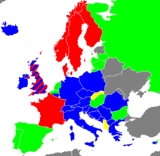
Television licence

Encyclopedia
 |
TV licence No TV licence |
A television licence (or broadcast receiving licence) is an official licence required in many countries for the reception of television
Television
Television is a telecommunication medium for transmitting and receiving moving images that can be monochrome or colored, with accompanying sound...
(and sometimes also radio
Radio
Radio is the transmission of signals through free space by modulation of electromagnetic waves with frequencies below those of visible light. Electromagnetic radiation travels by means of oscillating electromagnetic fields that pass through the air and the vacuum of space...
) broadcasts. It is a form of hypothecation
Hypothecation (taxation)
The hypothecation of a tax is the dedication of the revenue from a specific tax for a particular expenditure purpose. Hypothecation is the pledging of assets....
tax
Tax
To tax is to impose a financial charge or other levy upon a taxpayer by a state or the functional equivalent of a state such that failure to pay is punishable by law. Taxes are also imposed by many subnational entities...
to fund public broadcasting
Public broadcasting
Public broadcasting includes radio, television and other electronic media outlets whose primary mission is public service. Public broadcasters receive funding from diverse sources including license fees, individual contributions, public financing and commercial financing.Public broadcasting may be...
, thus allowing public broadcasters to transmit television programmes without, or with only supplemental, funding from radio
Radio commercial
Commercial radio stations make most of their revenue selling “airtime” to advertisers. Of total media expenditures, radio accounts for 6.9%. Radio advertisements or “spots” are available when a business or service provides valuable consideration, usually cash, in exchange for the station airing...
and television commercials.
History
The early days of broadcasting presented broadcasters with the problem of how to raise funding for their services. Some countries adopted the advertising model, but many others adopted a compulsory public subscription model, with the subscription coming in the form of a broadcast licence paid by households owning a radio set (and later, a TV set).The UK was the first country to adopt the compulsory public subscription model with the licence fee money going to the BBC
BBC
The British Broadcasting Corporation is a British public service broadcaster. Its headquarters is at Broadcasting House in the City of Westminster, London. It is the largest broadcaster in the world, with about 23,000 staff...
, which was formed on 1 January 1927 by Royal Charter
Royal Charter
A royal charter is a formal document issued by a monarch as letters patent, granting a right or power to an individual or a body corporate. They were, and are still, used to establish significant organizations such as cities or universities. Charters should be distinguished from warrants and...
to produce publicly funded programming yet remain independent from government, both managerially and financially. The licence was originally known as a radio licence.
With the arrival of television some countries created a separate additional television licence, while others simply increased the radio licence fee to cover the additional cost of TV broadcasting, changing the licence's name from "radio licence" to "TV licence" or "receiver licence". Today most countries fund public radio broadcasting from the same licence fee that is used for television, although a few still have separate radio licences, or apply a lower or no fee at all for consumers who only have a radio. Some countries also have different fees for users with colour or monochrome TV. Many give discounts, or charge no fee, for elderly and/or disabled consumers.
Faced with the problem of licence fee evasion, some countries choose to fund public broadcasters directly from taxation or via other less avoidable methods such as a co-payment with electricity billing. National public broadcasters in some countries also carry supplemental advertising.
The Council of Europe
Council of Europe
The Council of Europe is an international organisation promoting co-operation between all countries of Europe in the areas of legal standards, human rights, democratic development, the rule of law and cultural co-operation...
created the European Convention on Transfrontier Television in 1989 that regulates among other things
advertising standards, time and the format of breaks, which also has an indirect effect on the usage of licensing. In 1993, this treaty entered into force when it achieved 7 ratifications including 5 member states. It has since been acceded to by 34 countries, .
Television licences around the world
The Museum of Broadcast CommunicationsMuseum of Broadcast Communications
The Museum of Broadcast Communications is an American museum that currently exists exclusively on the Internet and not in any physical capacity. Its stated mission is "to collect, preserve, and present historic and contemporary radio and television content as well as educate, inform and entertain...
in Chicago
Chicago
Chicago is the largest city in the US state of Illinois. With nearly 2.7 million residents, it is the most populous city in the Midwestern United States and the third most populous in the US, after New York City and Los Angeles...
notes that two-thirds of the countries in Europe
Europe
Europe is, by convention, one of the world's seven continents. Comprising the westernmost peninsula of Eurasia, Europe is generally 'divided' from Asia to its east by the watershed divides of the Ural and Caucasus Mountains, the Ural River, the Caspian and Black Seas, and the waterways connecting...
and half of the countries in Asia
Asia
Asia is the world's largest and most populous continent, located primarily in the eastern and northern hemispheres. It covers 8.7% of the Earth's total surface area and with approximately 3.879 billion people, it hosts 60% of the world's current human population...
and Africa
Africa
Africa is the world's second largest and second most populous continent, after Asia. At about 30.2 million km² including adjacent islands, it covers 6% of the Earth's total surface area and 20.4% of the total land area...
use television licences to fund public television. TV licensing is rare in the Americas
Americas
The Americas, or America , are lands in the Western hemisphere, also known as the New World. In English, the plural form the Americas is often used to refer to the landmasses of North America and South America with their associated islands and regions, while the singular form America is primarily...
, largely being confined to French
France
The French Republic , The French Republic , The French Republic , (commonly known as France , is a unitary semi-presidential republic in Western Europe with several overseas territories and islands located on other continents and in the Indian, Pacific, and Atlantic oceans. Metropolitan France...
overseas departments
Département d'outre-mer
An overseas department is a department of France that is outside metropolitan France. They have the same political status as metropolitan departments. As integral parts of France and the European Union, overseas departments are represented in the National Assembly, Senate, and Economic and Social...
and British
United Kingdom
The United Kingdom of Great Britain and Northern IrelandIn the United Kingdom and Dependencies, other languages have been officially recognised as legitimate autochthonous languages under the European Charter for Regional or Minority Languages...
territories
British overseas territories
The British Overseas Territories are fourteen territories of the United Kingdom which, although they do not form part of the United Kingdom itself, fall under its jurisdiction. They are remnants of the British Empire that have not acquired independence or have voted to remain British territories...
The actual cost and implementation of the television licence varies greatly from country to country. The rest of this section looks at the licence fee in a number of countries around the world.
Europe
| Country | Foo | 10 | 10 | 10-10-2000 | ||
|---|---|---|---|---|---|---|
 Albania Albania |
€5.81 | |||||
 Austria Austria |
€335.14 (total of TV and radio licences) | |||||
 Belgium Belgium |
€172.39 (total of TV and radio licences) | |||||
 Bosnia and Herzegovina Bosnia and Herzegovina |
€36.00 | |||||
 Independent State of Croatia Independent State of Croatia |
€137.00 | |||||
 Cyprus Cyprus |
||||||
 Czech Republic Czech Republic |
€65.94 | |||||
 Denmark Denmark |
€303.35 | |||||
 Estonia Estonia |
||||||
 Finland Finland |
€253.80 | |||||
 Early Modern France Early Modern France |
€121.00 | |||||
 Georgia (country) Georgia (country) |
||||||
 Germany Germany |
€215.76 | |||||
 Greece Greece |
€51.60 | |||||
 Hungary Hungary |
||||||
 Iceland Iceland |
€213.50 | |||||
 Republic of Ireland Republic of Ireland |
€160.00 | |||||
 Italy Italy |
€110.50 | |||||
 Republic of Kosovo Republic of Kosovo |
||||||
 Latvia Latvia |
||||||
 Liechtenstein Liechtenstein |
||||||
 Lithuania Lithuania |
||||||
 Luxembourg Luxembourg |
||||||
 Republic of Macedonia Republic of Macedonia |
€25.99 | |||||
 Malta Malta |
€34.40 | |||||
 Moldova Moldova |
||||||
 Monaco Monaco |
||||||
 Kingdom of Montenegro Kingdom of Montenegro |
€42.00 | |||||
 Netherlands Netherlands |
||||||
 Norway Norway |
€315.57 | |||||
 Poland Poland |
€52.57 | |||||
 Portugal Portugal |
||||||
 Kingdom of Romania Kingdom of Romania |
€11.27 | |||||
 San Marino San Marino |
||||||
 Slovakia Slovakia |
€42.00 | |||||
 Slovenia Slovenia |
€132.00 | |||||
 Serbia Serbia |
€56.50 | |||||
 Spain Spain |
||||||
 Sweden Sweden |
€232.47 | |||||
 Switzerland Switzerland |
€360.65 | |||||
 Turkey Turkey |
||||||
 Ukraine Ukraine |
||||||
 United Kingdom United Kingdom |
Colour - €174.99 / Monochrome - €58.93 |
Albania
The AlbaniaAlbania
Albania , officially known as the Republic of Albania , is a country in Southeastern Europe, in the Balkans region. It is bordered by Montenegro to the northwest, Kosovo to the northeast, the Republic of Macedonia to the east and Greece to the south and southeast. It has a coast on the Adriatic Sea...
n licence fee is 800 Lekë
Albanian lek
The lek is the official currency of Albania. It is subdivided into 100 qindarka , although qindarka are no longer issued.-Names:...
(€
Euro
The euro is the official currency of the eurozone: 17 of the 27 member states of the European Union. It is also the currency used by the Institutions of the European Union. The eurozone consists of Austria, Belgium, Cyprus, Estonia, Finland, France, Germany, Greece, Ireland, Italy, Luxembourg,...
5.81) per year. However, the licence fee makes up only a small part of public broadcaster RTSh
Radio Televizioni Shqiptar
Radio Televizioni Shqiptar is the public broadcaster of Albania, founded in 1938 in Tirana....
's funding. RTSh is mainly funded directly from the government through taxes (58%), the remaining 42% comes from commercials and the licence fee.
Austria
In accordance with the AustriaAustria
Austria , officially the Republic of Austria , is a landlocked country of roughly 8.4 million people in Central Europe. It is bordered by the Czech Republic and Germany to the north, Slovakia and Hungary to the east, Slovenia and Italy to the south, and Switzerland and Liechtenstein to the...
RGG (TV and Radio Licence Law) all broadcasting reception equipment in use or operational at a given location must be registered. The location of the equipment is taken to be places of residence or any other premises with a uniform purpose of use.
Responsible for licence administration in Austria is GIS - Gebühren Info Service GmbH, a 100% subsidiary of the Austrian Broadcasting Company (ORF
ORF (broadcaster)
Österreichischer Rundfunk, ORF, is the Austrian national public service broadcaster.Funded from a combination of a television licence fees and revenue from limited on-air advertising, ORF is the dominant player in the Austrian broadcast media...
), as well as an agency of the Ministry of Finance, charged with performing functions concerning national interests. Transaction volume in 2007 amounted to EUR 682 million, 66% of which are allocated to the ORF for financing the organization and its programs, and 34% are allocated to the federal government and the local governments (taxes and funding of local cultural activities). GIS employs some 191 people and approximately 125 free lancers in field service. 3.4 million Austrian households are registered at GIS, percentage of licence dodgers in Austria amounts to 2.5%.
The main principle of GIS' communication strategy is to inform instead of control. To achieve this goal GIS uses a four-channel communication strategy:
- Above-the-line activities (advertising campaigns in print media, radio and TV)
- Direct Mails
- Distribution channels – outlets where people can acquire the necessary forms for registering (post offices, banks, tobacconists, five GIS Service Centers throughout Austria)
- Field service – customer consultants visiting households not yet registered
The annual television & radio
Radio
Radio is the transmission of signals through free space by modulation of electromagnetic waves with frequencies below those of visible light. Electromagnetic radiation travels by means of oscillating electromagnetic fields that pass through the air and the vacuum of space...
licence varies in price depending on which state
States of Austria
Austria is a federal republic made up of nine states, known in German as Länder . Since Land is also the German word for a country, the term Bundesländer is often used instead to avoid ambiguity. The Constitution of Austria uses both terms...
one lives in. Annual fees from June 2008 are:
| State | Television | Radio |
|---|---|---|
| Burgenland Burgenland Burgenland is the easternmost and least populous state or Land of Austria. It consists of two Statutarstädte and seven districts with in total 171 municipalities. It is 166 km long from north to south but much narrower from west to east... |
€ 253.32 | € 73.92 |
| Carinthia Carinthia (state) Carinthia is the southernmost Austrian state or Land. Situated within the Eastern Alps it is chiefly noted for its mountains and lakes.The main language is German. Its regional dialects belong to the Southern Austro-Bavarian group... |
€ 279.72 | € 80.52 |
| Lower Austria Lower Austria Lower Austria is the northeasternmost state of the nine states in Austria. The capital of Lower Austria since 1986 is Sankt Pölten, the most recently designated capital town in Austria. The capital of Lower Austria had formerly been Vienna, even though Vienna is not officially part of Lower Austria... |
€ 272.52 | € 78.72 |
| Upper Austria Upper Austria Upper Austria is one of the nine states or Bundesländer of Austria. Its capital is Linz. Upper Austria borders on Germany and the Czech Republic, as well as on the other Austrian states of Lower Austria, Styria, and Salzburg... |
€ 223.32 | € 65.52 |
| Salzburg Salzburg (state) Salzburg is a state or Land of Austria with an area of 7,156 km2, located adjacent to the German border. It is also known as Salzburgerland, to distinguish it from its capital city, also named Salzburg... |
€ 260.52 | € 76.32 |
| Styria Styria (state) Styria is a state or Bundesland, located in the southeast of Austria. In area it is the second largest of the nine Austrian federated states, covering 16,401 km². It borders Slovenia as well as the other Austrian states of Upper Austria, Lower Austria, Salzburg, Burgenland, and Carinthia. ... |
€ 284.52 | € 82.32 |
| Tyrol Tyrol (state) Tyrol is a state or Bundesland, located in the west of Austria. It comprises the Austrian part of the historical region of Tyrol.The state is split into two parts–called North Tyrol and East Tyrol–by a -wide strip of land where the state of Salzburg borders directly on the Italian province of... |
€ 262.92 | € 76.32 |
| Vorarlberg Vorarlberg Vorarlberg is the westernmost federal-state of Austria. Although it is the second smallest in terms of area and population , it borders three countries: Germany , Switzerland and Liechtenstein... |
€ 223.32 | € 65.52 |
| Vienna Vienna Vienna is the capital and largest city of the Republic of Austria and one of the nine states of Austria. Vienna is Austria's primary city, with a population of about 1.723 million , and is by far the largest city in Austria, as well as its cultural, economic, and political centre... |
€ 276.72 | € 80.16 |
Belgium (Walloon Region and Brussels Region)
The licence fee in BelgiumBelgium
Belgium , officially the Kingdom of Belgium, is a federal state in Western Europe. It is a founding member of the European Union and hosts the EU's headquarters, and those of several other major international organisations such as NATO.Belgium is also a member of, or affiliated to, many...
's Walloon Region and Brussels Region (encompassing the French
French language
French is a Romance language spoken as a first language in France, the Romandy region in Switzerland, Wallonia and Brussels in Belgium, Monaco, the regions of Quebec and Acadia in Canada, and by various communities elsewhere. Second-language speakers of French are distributed throughout many parts...
and German
German language
German is a West Germanic language, related to and classified alongside English and Dutch. With an estimated 90 – 98 million native speakers, German is one of the world's major languages and is the most widely-spoken first language in the European Union....
speaking communities) is €
Euro
The euro is the official currency of the eurozone: 17 of the 27 member states of the European Union. It is also the currency used by the Institutions of the European Union. The eurozone consists of Austria, Belgium, Cyprus, Estonia, Finland, France, Germany, Greece, Ireland, Italy, Luxembourg,...
149.67 for a TV and €26.72 for a car radio. Only one licence is needed for each household regardless of how many television sets there are. However, each car with a radio must have a separate car radio licence. Household radios do not require a licence. The money raised by the fee is used to fund Belgium's French and German public broadcasters (RTBF
RTBF
Radio Télévision Belge Francophone is the public broadcasting organization of the French Community of Belgium, the southern, French-speaking part of Belgium...
and BRF
Belgischer Rundfunk
Belgischer Rundfunk is the public-service broadcasting organization serving the German-speaking Community of Belgium...
respectively).
Bosnia and Herzegovina
The licence fee in Bosnia and HerzegovinaBosnia and Herzegovina
Bosnia and Herzegovina , sometimes called Bosnia-Herzegovina or simply Bosnia, is a country in Southern Europe, on the Balkan Peninsula. Bordered by Croatia to the north, west and south, Serbia to the east, and Montenegro to the southeast, Bosnia and Herzegovina is almost landlocked, except for the...
is around €
Euro
The euro is the official currency of the eurozone: 17 of the 27 member states of the European Union. It is also the currency used by the Institutions of the European Union. The eurozone consists of Austria, Belgium, Cyprus, Estonia, Finland, France, Germany, Greece, Ireland, Italy, Luxembourg,...
36 per year. The civil war
Bosnian War
The Bosnian War or the War in Bosnia and Herzegovina was an international armed conflict that took place in Bosnia and Herzegovina between April 1992 and December 1995. The war involved several sides...
and the associated collapse of infrastructure caused very high evasion
Evasion (law)
In law, the Doctrine of Evasion is a fundamental public policy. Whereas a person may legitimately plan his or her affairs so as to avoid the incidence of obligations or liabilities imposed by the law, no-one is allowed to evade the operation of otherwise mandatory provisions once duties and...
rates. This has in part been resolved by collecting the licence fee as part of a household's telephone
Telephone
The telephone , colloquially referred to as a phone, is a telecommunications device that transmits and receives sounds, usually the human voice. Telephones are a point-to-point communication system whose most basic function is to allow two people separated by large distances to talk to each other...
bill. The licence is used to fund PBSBiH
PBSBiH
The Radio and Television of Bosnia-Herzegovina formerly known as PBSBiH is an umbrella broadcasting organization and the only member of the European Broadcasting Union from Bosnia and Herzegovina.It was known as RTVBiH The Radio and Television of Bosnia-Herzegovina (locally known as...
(Public Broadcasting System of Bosnia and Herzegovina) which is an umbrella organisation of three separate broadcasters. These are BHRT (Radio and Television of Bosnia Herzegovina), which serves the whole country; RTVFBiH (Radio-Television of the Federation of Bosnia-Herzegovina) that primarily serves the population in the Federation of BiH; and RTRS (Radio-Television of the Republika Srpska), which primarily serves the population of Republika Srpska.
Croatia
The licence fee in CroatiaCroatia
Croatia , officially the Republic of Croatia , is a unitary democratic parliamentary republic in Europe at the crossroads of the Mitteleuropa, the Balkans, and the Mediterranean. Its capital and largest city is Zagreb. The country is divided into 20 counties and the city of Zagreb. Croatia covers ...
is regulated with the Croatian Radiotelevision
Croatian Radiotelevision
Croatian Radiotelevision is a Croatian public broadcasting company. It operates several radio and television channels, over a domestic transmitter network as well as satellite...
Act. , the last incarnation of the act dates from 2003.
The licence fee is charged to all owners of equipment capable of receiving TV and radio broadcasts. The total yearly amount of the fee is set each year as a percentage of the average net salary in the previous year, currently equal to 1.5%. This works out at about €137 per year per household with at least one radio or TV receiver.
The fee is the main source of revenue for the national broadcaster Hrvatska Radiotelevizija (HRT)
Croatian Radiotelevision
Croatian Radiotelevision is a Croatian public broadcasting company. It operates several radio and television channels, over a domestic transmitter network as well as satellite...
, and a secondary source of income for other national and local broadcasters, which receive a minority share of this money. The Statute of the Croatian Radiotelevision further divides their majority share to 66% for television and 34% for the radio, and sets out further financial rules.
According to law, advertisements and a number of other sources of income are allowed to HRT. However, the percentage of air time which may be devoted to advertising is limited by law to 9% per hour, and is lower than the one that applies to commercial broadcasters. In addition, other rules govern advertising on HRT, including a limit on a single commercial during short breaks, no breaks during films, etc.
Croatian television law was formed in compliance with the European Convention on Transfrontier Television that Croatia had joined between 1999 and 2002.
Czech Republic
The licence fee in the Czech RepublicCzech Republic
The Czech Republic is a landlocked country in Central Europe. The country is bordered by Poland to the northeast, Slovakia to the east, Austria to the south, and Germany to the west and northwest....
is 1620 Kč (€65.94) as from January 1, 2008. Each household pays for one TV licence regardless of how many televisions they own. Corporations and the self-employed must pay for a licence for each television.
Denmark
The licence fee in DenmarkDenmark
Denmark is a Scandinavian country in Northern Europe. The countries of Denmark and Greenland, as well as the Faroe Islands, constitute the Kingdom of Denmark . It is the southernmost of the Nordic countries, southwest of Sweden and south of Norway, and bordered to the south by Germany. Denmark...
is 2,260 kr (€
Euro
The euro is the official currency of the eurozone: 17 of the 27 member states of the European Union. It is also the currency used by the Institutions of the European Union. The eurozone consists of Austria, Belgium, Cyprus, Estonia, Finland, France, Germany, Greece, Ireland, Italy, Luxembourg,...
303.35) in media licence fee (which applies to all TVs, computers with Internet access above 256 kbit/s or with TV tuners or other devices that can receive broadcast TV: which actually means that you have to pay the TV licence if you have a relatively new mobile phone ). Radio licence is 320 kr (around €
Euro
The euro is the official currency of the eurozone: 17 of the 27 member states of the European Union. It is also the currency used by the Institutions of the European Union. The eurozone consists of Austria, Belgium, Cyprus, Estonia, Finland, France, Germany, Greece, Ireland, Italy, Luxembourg,...
43). The black/white TV rate is no longer offered after January 1, 2007. The majority of the licence fee is used to fund the national radio and TV broadcaster DR
Danmarks Radio
DR – officially rendered into English as the Danish Broadcasting Corporation – is Denmark's national broadcasting corporation. Founded in 1925 as a public-service organization, it is today Denmark's oldest and largest electronic media enterprise...
. However, a proportion is used to fund TV 2's
TV 2 (Denmark)
TV 2 is a publicly owned television station in Denmark based in Odense. The station began broadcasting on 1 October 1988, thereby ending the television monopoly previously exercised by the Danmarks Radio ....
regional services. TV2 itself used to get means from the licence fee but is now funded exclusively through advertising revenue. Though economically independent from the licence fee TV2 still has obligations and requirements towards serving the public which is laid down in a so called "public service contract" between the government and all public service providers. TV2 does receive indirect subsidies through favorable loans from the state of Denmark.
Finland
The television fee in FinlandFinland
Finland , officially the Republic of Finland, is a Nordic country situated in the Fennoscandian region of Northern Europe. It is bordered by Sweden in the west, Norway in the north and Russia in the east, while Estonia lies to its south across the Gulf of Finland.Around 5.4 million people reside...
is between €
Euro
The euro is the official currency of the eurozone: 17 of the 27 member states of the European Union. It is also the currency used by the Institutions of the European Union. The eurozone consists of Austria, Belgium, Cyprus, Estonia, Finland, France, Germany, Greece, Ireland, Italy, Luxembourg,...
244.90 and €
Euro
The euro is the official currency of the eurozone: 17 of the 27 member states of the European Union. It is also the currency used by the Institutions of the European Union. The eurozone consists of Austria, Belgium, Cyprus, Estonia, Finland, France, Germany, Greece, Ireland, Italy, Luxembourg,...
253.80 (depending on the interval of payments) per annum for a household with TV (as of 2011). It is the primary source of funding for Yleisradio
Yleisradio
The Finnish Broadcasting Company , abbreviated to YLE , is Finland's national broadcasting company, founded in 1926. YLE is a public-broadcasting organization which shares many of its characteristics with its British counterpart, the BBC, on which it was largely modelled...
(YLE). The amount is being adjusted yearly for reasons including transition to digital television
Digital television
Digital television is the transmission of audio and video by digital signals, in contrast to the analog signals used by analog TV...
. There are no exemptions from the fee, but municipal social welfare is meant to cover also the cost of TV licence.
In 2000, a new constitution guaranteed everyone the right to receive messages without permission as a part of freedom of speech
Freedom of speech
Freedom of speech is the freedom to speak freely without censorship. The term freedom of expression is sometimes used synonymously, but includes any act of seeking, receiving and imparting information or ideas, regardless of the medium used...
. The term television licence fee was therefore dropped in favour of television fee, but other than that, little has changed.
The switch to digital only transmission of TV in Finland has seen a decline in the number of households with a TV licence. The reason for this is not clear. It may be that people are recouping the mandatory cost of purchasing a digital receiver (€50-€100 for basic models) against the cost of the licence by way of protest, and others may genuinely have given up watching TV altogether.
The TV licence has been criticized for various reasons. The licence inspectors who target households that have no licence are seen as an invasion of privacy. People who have refused (as is their right) to let the inspectors enter their houses have reported that they have been ordered to pay the fee and penalty fees based on questionable evidence or no evidence at all. Yet the inspections are not effective and many people watch TV without paying the licence. With the increased popularity of commercial TV channels, pay-TV, cable, satellite and DVDs the right for YLE to receive the fees has been questioned. IPTV has led the very definition of what is a TV to become vague. Because of this alternative methods of raising the money have been proposed. A parliamentary committee tasked with evaluating the alternative methods has ruled out direct state funding because that would allegedly endanger the independence of the YLE. Scrambling the channels – not just YLE but also commercial would cause technical problems. The most likely alternative, unanimously supported by the aforementioned committee (with representation from all parties in the parliament) and also by the Minister of Communications Suvi Lindén, is to make the fee mandatory for all households and companies, regardless of whether TV is actually watched or not, and collect it as a fixed size (effectively regressive) tax. However, more recently splits have appeared and a decision has now been postponed until after the formation of the next parliament.
France
In 2010, the television licence fee in FranceFrance
The French Republic , The French Republic , The French Republic , (commonly known as France , is a unitary semi-presidential republic in Western Europe with several overseas territories and islands located on other continents and in the Indian, Pacific, and Atlantic oceans. Metropolitan France...
(mainland & Corsica
Corsica
Corsica is an island in the Mediterranean Sea. It is located west of Italy, southeast of the French mainland, and north of the island of Sardinia....
) was €121 and in the overseas departments
Département d'outre-mer
An overseas department is a department of France that is outside metropolitan France. They have the same political status as metropolitan departments. As integral parts of France and the European Union, overseas departments are represented in the National Assembly, Senate, and Economic and Social...
it was €78. The licence funds services provided by Radio France
Radio France
Radio France is a French public service radio broadcaster.-Mission:Radio France's two principal missions are:* To create and expand the programming on all of their stations; and...
, France Télévisions
France Télévisions
France Télévisions is the French public national television broadcaster. It is a state-owned company formed from the bringing together of the public television channels France 2 and France 3 , later joined by the legally independent channels France 5 , France Ô , and France 4 France Télévisions ...
and Radio France Internationale
Radio France Internationale
Radio France Internationale was created in 1975 as part of Radio France by the Government of France, and replaced the Poste Colonial , Paris Mondial , Radio Paris , RTF Radio Paris and ORTF Radio Paris...
. Metropolitan France
Metropolitan France
Metropolitan France is the part of France located in Europe. It can also be described as mainland France or as the French mainland and the island of Corsica...
receives France 2
France 2
France 2 is a French public national television channel. It is part of the state-owned France Télévisions group, along with France 3, France 4, France 5 and France Ô...
, France 3
France 3
France 3 is the second largest French public television channel and part of the France Télévisions group, which also includes France 2, France 4, France 5, and France Ô....
, France 5
France 5
France 5 is a public television network in France, part of the France Télévisions group. Principally featuring educational programming, the channel's motto is la chaîne de la connaissance et du savoir...
, Arte
Arte
Arte is a Franco-German TV network. It is a European culture channel and aims to promote quality programming especially in areas of culture and the arts...
, France 4
France 4
France 4 is a french public channel owned by France Télévisions, dedicated to the entertainment. At first named Festival, the channel took its current name in 2005, to mark better its membership to the group France Télévisions...
and Gulli
Gulli
Gulli is a French television network dedicated to children's programming. It is available through digital terrestrial television "TNT" in partnership with Lagardère Active, and France Télévisions with children's programmes from France 3. Gulli is also known as Cyperbot.-Programmes:Children can...
, while overseas departments receive Outre-Mer 1ère ('[name of department or territory] 1ère', Tempo, and France Ô), though the Metropolitan France channels are also available in the overseas departments through the expansion of TNT
Télévision Numérique Terrestre
TNT is the national digital terrestrial service for France. It formally arrived on 31 March 2005 after a short testing period. Like Freeview in the United Kingdom it will support many new channels as well as the current terrestrial television stations...
service to these areas. Public broadcasters in France supplement their licence fee income with that from advertising. However, changes in the law in 2000 designed to stop public television chasing ratings, have stopped public broadcasters from airing advertising after 8pm. Between 1998 and 2004 the proportion of France Télévision's income that came from advertising declined from around 40% to 30%. To keep the cost of collection low, the licence fee in France is collected as part of local taxes.
Germany
The licence fee in GermanyGermany
Germany , officially the Federal Republic of Germany , is a federal parliamentary republic in Europe. The country consists of 16 states while the capital and largest city is Berlin. Germany covers an area of 357,021 km2 and has a largely temperate seasonal climate...
is €
Euro
The euro is the official currency of the eurozone: 17 of the 27 member states of the European Union. It is also the currency used by the Institutions of the European Union. The eurozone consists of Austria, Belgium, Cyprus, Estonia, Finland, France, Germany, Greece, Ireland, Italy, Luxembourg,...
215.76 per annum for TV (including radio and Internet) and €
Euro
The euro is the official currency of the eurozone: 17 of the 27 member states of the European Union. It is also the currency used by the Institutions of the European Union. The eurozone consists of Austria, Belgium, Cyprus, Estonia, Finland, France, Germany, Greece, Ireland, Italy, Luxembourg,...
69.12 for radio and Internet. It is billed by the month, but typically paid quarterly (yearly payments are possible). Households with at least one radio and no televisions have to pay the lower fee, and households with at least one television set must pay the higher fee (which includes the radio fee). Radios and TVs at places of work are also subject to license fees.
Unemployed, disabled and people dependent on state benefit payments are exempt from the licence fee, within strict assessment parameters. Since 2007, computers with a working Internet connection are considered liable to license fees in the same way as a radio. The licence fee has to be paid even if the device is not attached or has no immediate capabilities to connect to the Internet. A reform of the licence fee is due to come into effect in 2013, from when every household will have to pay the fee, even if it has no radio, TV or computer. The only people exempted from these fees will be the very poor or the disabled.
The licence fee is used to fund the public broadcasters ZDF
ZDF
Zweites Deutsches Fernsehen , ZDF, is a public-service German television broadcaster based in Mainz . It is run as an independent non-profit institution, which was founded by the German federal states . The ZDF is financed by television licence fees called GEZ and advertising revenues...
and Deutschlandradio
Deutschlandradio
Deutschlandradio is a national German public broadcasting radio broadcaster. It operates four national networks, Deutschlandfunk, Deutschlandradio Kultur, Dokumente und Debatten and DRadio Wissen....
as well as the nine regional broadcasters of the ARD
ARD
Ard, ARD, Ards or ARDS may refer to:Ard:*Ard or scratch-plough, a type of plough consisting of a simple spike dragged through the soil*Ard, alternate name of Arad, Iran, a city in Fars Province...
network, who altogether run 22 television channels (10 regional, 10 national, 2 international: ARTE
Arte
Arte is a Franco-German TV network. It is a European culture channel and aims to promote quality programming especially in areas of culture and the arts...
and 3sat
3sat
3sat is the name of a public, advertising-free, television network in Central Europe. The programming is in German and is broadcast primarily within Germany, Austria and Switzerland .3sat was established for cultural...
) and 61 radio stations (58 regional, 3 national). Two national television stations and 32 regional radio station carry limited adverting. The 14 regional regulatory authorities for the private broadcasters are also funded by the licence fee (and not by government grants), and in some states, non-profit community radios also get small amounts of the licence fee. In contrast to ARD, ZDF and Deutschlandradio, Germany's international broadcaster Deutsche Welle
Deutsche Welle
Deutsche Welle or DW, is Germany's international broadcaster. The service is aimed at the overseas market. It broadcasts news and information on shortwave, Internet and satellite radio on 98.7 DZFE in 30 languages . It has a satellite television service , that is available in four languages, and...
is fully funded by the german federal government, though much of its new content is provided by the ARD.
Germany currently has one of the largest total public broadcast budgets in the world. The per capita budget is close to the European average. Annual income from licence fees is approximately 7.6 billion Euro, with an additional 500 million Euro revenue from commercials.
The board of public broadcasters sued the German states for interference with their budgeting process, and on 11 September 2007 the Supreme Court decided in their favour. This effectively rendered the public broadcasters institution independent and self-governing.
Public broadcasters have announced that they are determined to utilize all available ways to reach their "customers" and as such have started a very broad Internet presence with media portals, news and TV programs. National broadcasters have abandoned an earlier pledge to restrict their online activities. This resulted in newspapers taking court action against the ARD, claiming that the ARD's Tagessschau smartphone app, that provides news stories at no cost to the app user, was unfairly subsidised by the license fee, to the detriment of free market providers of news content apps. The case was dismissed with the court advising the two sides to agree a compromise.
Greece
The licence fee in GreeceGreece
Greece , officially the Hellenic Republic , and historically Hellas or the Republic of Greece in English, is a country in southeastern Europe....
is indirect but obligatory and paid through electricity bills. The amount to be paid is €51.60 (2006) for every separate account of the electrical company (including residence, offices, shops and other places provided with electricity). Its beneficiary is the state broadcaster Ellinikí Radiofonía Tileórasi
Elliniki Radiofonia Tileorasi
The Hellenic Broadcasting Corporation is the Greek state-owned public radio and television broadcasting corporation. It is a member of EBU.Since 70's ERT is part of the Eurovision Song Contest, organized by EBU...
(ERT). Predicted 2006 annual revenue of ERT from the licence fee (officially called "retributive" fee) is €262.6M (from €214.3M in 2005).
There has been some discussion about imposing a direct licence fee after complaints from people who do not own a television set and yet are still forced to fund ERT. An often quoted joke is that even the dead pay the licence fee (since graveyards pay electricity bills).
Iceland
In IcelandIceland
Iceland , described as the Republic of Iceland, is a Nordic and European island country in the North Atlantic Ocean, on the Mid-Atlantic Ridge. Iceland also refers to the main island of the country, which contains almost all the population and almost all the land area. The country has a population...
the TV Licence is 32 460 kr
Isk
Isk or ISK may mean:* Icelandic króna, the national currency of Iceland* Internationaler Sozialistischer Kampfbund, a now-defunct German socialist party* Iso suomen kielioppi* the currency in the space MMORPG Eve Online...
(€
Euro
The euro is the official currency of the eurozone: 17 of the 27 member states of the European Union. It is also the currency used by the Institutions of the European Union. The eurozone consists of Austria, Belgium, Cyprus, Estonia, Finland, France, Germany, Greece, Ireland, Italy, Luxembourg,...
213.50). Discounts are available for black and white TVs and those who only have radios. The TV Licence is used to fund RÚV
RÚV
Ríkisútvarpið is Iceland's national public-service broadcasting organization.Operating from studios in the country's capital, Reykjavík, as well as regional centres around the country, the service broadcasts a variety of general programming to a wide audience across the whole country via radio...
. However, this income is supplemented by limited broadcasting commercials (around 3 minutes per hour).
Ireland
In 2008 the television licence in the Republic of IrelandRepublic of Ireland
Ireland , described as the Republic of Ireland , is a sovereign state in Europe occupying approximately five-sixths of the island of the same name. Its capital is Dublin. Ireland, which had a population of 4.58 million in 2011, is a constitutional republic governed as a parliamentary democracy,...
is €
Euro
The euro is the official currency of the eurozone: 17 of the 27 member states of the European Union. It is also the currency used by the Institutions of the European Union. The eurozone consists of Austria, Belgium, Cyprus, Estonia, Finland, France, Germany, Greece, Ireland, Italy, Luxembourg,...
160,
In 2006, the television licence in Ireland
Republic of Ireland
Ireland , described as the Republic of Ireland , is a sovereign state in Europe occupying approximately five-sixths of the island of the same name. Its capital is Dublin. Ireland, which had a population of 4.58 million in 2011, is a constitutional republic governed as a parliamentary democracy,...
was €
Euro
The euro is the official currency of the eurozone: 17 of the 27 member states of the European Union. It is also the currency used by the Institutions of the European Union. The eurozone consists of Austria, Belgium, Cyprus, Estonia, Finland, France, Germany, Greece, Ireland, Italy, Luxembourg,...
158, up from €155 in 2005. It is free to anyone over the age of 70 (regardless of means or circumstances) and to some over 66, and the blind although these licences are in fact paid for by the state. The Irish Post Office, An Post
An Post
An Post is the State-owned provider of postal services in the Republic of Ireland. An Post provides a universal postal service to all parts of the country as a member of the Universal Postal Union...
, is responsible for collection of the licence fee and commencement of prosecution proceedings in cases of non-payment. However, An Post has signalled its
intention to withdraw from the licence fee collection business. The Irish TV licence makes up 50% of RTÉ's revenue. The rest comes from RTÉ broadcasting commercials on its radio and TV stations. Furthermore, some RTÉ services, such as RTÉ 2fm
RTÉ 2fm
RTÉ 2fm, or 2FM as it is more commonly referred to, is Raidió Teilifís Éireann's second national radio station. It broadcasts popular music programming aimed at a young Irish audience.- History :...
, RTÉ Aertel
RTÉ Aertel
RTÉ Aertel is a teletext service broadcast on RTÉ One and RTÉ Two in the Republic of Ireland, and also available in its entirety on the Internet....
, rte.ie
Rte.ie
RTÉ.ie is the brand name and home of RTÉ's online activities, located at the URL http://rte.ie. The site began publishing on 26 May 1996. According to RTÉ, it operates on an entirely commercial basis, receiving none of the licence fee which funds much of RTÉ's activity. The site, it says, is funded...
, and the transmission network
RTÉ Network Limited
RTÉ Transmission Network Limited is a wholly owned subsidiary of Raidió Teilifís Éireann which runs Ireland's principal terrestrial television and radio broadcast signal transmission networks. They operate 10 main sites, and over 100 smaller relays and transposers, which carry either television,...
operate on an entirely commercial basis.
The licence fee does not entirely go to RTÉ. After collection costs, 5% is used for the Broadcasting Commission of Ireland's "Sound and Vision Scheme", which provides a fund for programme production and restoration of archive material which is open to applications from any quarters. 5% of what RTÉ then receive is granted to TG4
TG4
TG4 is a public service broadcaster for Irish language speakers. The channel has been on-air since 31 October 1996 in the Republic of Ireland and since April 2005 in Northern Ireland....
, as well as a requirement to provide them with programming. The remainder of TG4's funding is direct state grants and commercial income.
The licence applies to a particular premises, so a separate licence is required for holiday homes or motor vehicles which contain a television. The licence must be paid for premises that have any equipment that can potentially decode TV signals, even those that are not RTÉ's.
Italy
In 2010, the licence fee in ItalyItaly
Italy , officially the Italian Republic languages]] under the European Charter for Regional or Minority Languages. In each of these, Italy's official name is as follows:;;;;;;;;), is a unitary parliamentary republic in South-Central Europe. To the north it borders France, Switzerland, Austria and...
was €
Euro
The euro is the official currency of the eurozone: 17 of the 27 member states of the European Union. It is also the currency used by the Institutions of the European Union. The eurozone consists of Austria, Belgium, Cyprus, Estonia, Finland, France, Germany, Greece, Ireland, Italy, Luxembourg,...
109.00 per household with a TV set or "similar devices" (these include computers, mobiles, video-intercoms, etc).
It is the primary source of income for RAI
RAI
RAI — Radiotelevisione italiana S.p.A. known until 1954 as Radio Audizioni Italiane, is the Italian state owned public service broadcaster controlled by the Ministry of Economic Development. Rai is the biggest television company in Italy...
, which does, however, also broadcast advertising
Advertising
Advertising is a form of communication used to persuade an audience to take some action with respect to products, ideas, or services. Most commonly, the desired result is to drive consumer behavior with respect to a commercial offering, although political and ideological advertising is also common...
. Italy has problems with collection of the licence, with approximately 40% of viewers not paying their licence. One of the reasons is that the maximum fine is only half that of the licence itself (plus the licence on top of that), compared to the UK where the fine is up to £1000 (about €1500.)
Viewers in South Tyrol
South Tyrol
South Tyrol , also known by its Italian name Alto Adige, is an autonomous province in northern Italy. It is one of the two autonomous provinces that make up the autonomous region of Trentino-Alto Adige/Südtirol. The province has an area of and a total population of more than 500,000 inhabitants...
, Italy
Italy
Italy , officially the Italian Republic languages]] under the European Charter for Regional or Minority Languages. In each of these, Italy's official name is as follows:;;;;;;;;), is a unitary parliamentary republic in South-Central Europe. To the north it borders France, Switzerland, Austria and...
, which has a large German-speaking minority, can also receive Austrian and German public TV and radio channels via terrestrial transmissions. However, they do not pay the German or Austrian licence fees.
Macedonia
The licence fee in the Republic of MacedoniaRepublic of Macedonia
Macedonia , officially the Republic of Macedonia , is a country located in the central Balkan peninsula in Southeast Europe. It is one of the successor states of the former Yugoslavia, from which it declared independence in 1991...
is around €
Euro
The euro is the official currency of the eurozone: 17 of the 27 member states of the European Union. It is also the currency used by the Institutions of the European Union. The eurozone consists of Austria, Belgium, Cyprus, Estonia, Finland, France, Germany, Greece, Ireland, Italy, Luxembourg,...
25.99 per year. Until 2005 it was collected monthly as part of the electricity bill. The current Law on Broadcasting Activity, which was adopted in November 2005, reads that the Public Broadcasting Service - Macedonian Radio and Television (MRT) shall collect the broadcast fee.
The funds collected from the broadcasting fee are allocated in the following manner:
- 72% for MRT for covering costs for creating and broadcasting programmes;
- 4.5% for MRT for technical and technological development;
- 16% for MRD (Makedonska Radiodifuzija - Public operator of the transmission networks of the Public Broadcasting Service) for maintenance and use of the public broadcasting network;
- 3.5 % for MRD for public broadcasting network development and
- 4 % for the Broadcasting Council for regulating and development of the broadcasting activity in the Republic of Macedonia.
The MRT shall keep 0.5% of the collected funds from the broadcasting fee as commission fee.
However, MRT still has not found an effective mechanism for collection of the broadcast tax, so it has suffered a severe underfunding in the recent years.
Recently, the Macedonian Government decided to update the Law on Broadcasting authorizing the Public Revenue Office to be in charge of collection of the broadcast fee.
In addition to broadcast fee funding, Macedonian Radio-Television (MRT)
Macedonian Radio-Television
Macedonian Radio Television is the public broadcasting organization of the Republic of Macedonia. It was founded in 1993 by the Assembly of the Republic of Macedonia...
also takes advertising and sponsorship.
The broadcasting fee is paid by: every family household in the Republic of Macedonia, hotels and motels are charged one broadcasting fee for every five rooms, legal persons and office space owners are obliged to pay one broadcasting fee to every 20 employees or other persons that use the office space, owners of catering and other public facilities possessing a radio receiver or TV set must pay one broadcasting fee for each receiver/set.
The Government of the Republic of Macedonia, upon a proposal of the Broadcasting Council, shall determine which broadcasting fee payers in populated areas that are not covered by the broadcasting signal shall be exempt from payment of the broadcasting fee.
The households with a blind person whose vision is impaired over 90% or families with a person whose hearing is impaired with an intensity of over 60 decibels, as determined in compliance with the regulations on disability insurance, are exempt from the duty to pay the broadcasting fee for the household where the family of the person lives.
Malta
The licence fee in MaltaMalta
Malta , officially known as the Republic of Malta , is a Southern European country consisting of an archipelago situated in the centre of the Mediterranean, south of Sicily, east of Tunisia and north of Libya, with Gibraltar to the west and Alexandria to the east.Malta covers just over in...
is €34.90. It is used to fund the television (TVM
TVM (Malta)
Television Malta is the national television station of Malta. TVM is operated by Public Broadcasting Services Ltd . PBS Ltd is state owned....
) and radio channels (Radio Malta and Radju Parliament) run by Public Broadcasting Services
Public Broadcasting Services
Public Broadcasting Services Limited is Malta's public broadcasting company, responsible for the TVM television channel and the Radio Malta and Radju Parlament and Magic radio stations. PBS is funded by government grant and the sale of commercial airtime...
. Approximately two-thirds of TVM's funding comes from the licence fee, with much of the remainder coming from commercials.
Montenegro
In accordance with the Broadcasting Law (December 2002), every household and legal entity, situated in the Republic, where technical conditions for reception of at least one radio or television programme have been provided, is obliged to pay a monthly broadcasting subscription fee. The monthly fee is €Euro
The euro is the official currency of the eurozone: 17 of the 27 member states of the European Union. It is also the currency used by the Institutions of the European Union. The eurozone consists of Austria, Belgium, Cyprus, Estonia, Finland, France, Germany, Greece, Ireland, Italy, Luxembourg,...
3.50.
The Broadcasting Agency of Montenegro
Montenegro
Montenegro Montenegrin: Crna Gora Црна Гора , meaning "Black Mountain") is a country located in Southeastern Europe. It has a coast on the Adriatic Sea to the south-west and is bordered by Croatia to the west, Bosnia and Herzegovina to the northwest, Serbia to the northeast and Albania to the...
is in charge of collecting the fee (currently through the telephone bills, but after the privatization of state owned Telekom, the new owners, T-com, announced that they will not administer the collection of fee from July 2007).
The funds from the subscription received by the Agency belong to:
- the Republic's public broadcasting services (radio and television) - 75%
- the Agency's fund for the support of the local public broadcasting services (radio and television) - 10%
- the Agency's fund for the support of the commercial broadcasting services (radio and television) - 10%
- the Agency - 5%
Norway
The licence fee in NorwayNorway
Norway , officially the Kingdom of Norway, is a Nordic unitary constitutional monarchy whose territory comprises the western portion of the Scandinavian Peninsula, Jan Mayen, and the Arctic archipelago of Svalbard and Bouvet Island. Norway has a total area of and a population of about 4.9 million...
is 2477,52 kr
Norwegian krone
The krone is the currency of Norway and its dependent territories. The plural form is kroner . It is subdivided into 100 øre. The ISO 4217 code is NOK, although the common local abbreviation is kr. The name translates into English as "crown"...
(€
Euro
The euro is the official currency of the eurozone: 17 of the 27 member states of the European Union. It is also the currency used by the Institutions of the European Union. The eurozone consists of Austria, Belgium, Cyprus, Estonia, Finland, France, Germany, Greece, Ireland, Italy, Luxembourg,...
314.78) per annum. The fee is mandatory for any owner of a TV set, and is the primary source of income for Norsk Rikskringkasting
Norsk Rikskringkasting
The Norwegian Broadcasting Corporation , which is usually known as NRK, is the Norwegian government-owned radio and television public broadcasting company, and the largest media organisation in Norway...
(NRK). The licence fee is charged on a per household basis. Therefore addresses with more than one television receiver only require a single licence.
Poland
The current (2011) annual licence fee in PolandPoland
Poland , officially the Republic of Poland , is a country in Central Europe bordered by Germany to the west; the Czech Republic and Slovakia to the south; Ukraine, Belarus and Lithuania to the east; and the Baltic Sea and Kaliningrad Oblast, a Russian exclave, to the north...
for television set is 188.30 zł
Polish zloty
The złoty , which literally means "golden", is the currency of Poland. The modern złoty is subdivided into 100 groszy . The recognized English form of the word is zloty, plural zloty or zlotys...
(€
Euro
The euro is the official currency of the eurozone: 17 of the 27 member states of the European Union. It is also the currency used by the Institutions of the European Union. The eurozone consists of Austria, Belgium, Cyprus, Estonia, Finland, France, Germany, Greece, Ireland, Italy, Luxembourg,...
52.57) per annum The licence may be paid monthly, bi-monthly, quarterly, half-yearly or annually, but the total cost when paying for less than a year in advance is higher (up to 10%). Those that have no TV but have a radio must pay the radio-only licence which costs 58.75 zł (€
Euro
The euro is the official currency of the eurozone: 17 of the 27 member states of the European Union. It is also the currency used by the Institutions of the European Union. The eurozone consists of Austria, Belgium, Cyprus, Estonia, Finland, France, Germany, Greece, Ireland, Italy, Luxembourg,...
16.37) per year.
Around 60% of the fee goes to Telewizja Polska
Telewizja Polska
Telewizja Polska Spółka Akcyjna is Poland's public broadcasting corporation...
with the rest going to Polskie Radio
Polskie Radio
Polskie Radio Spółka Akcyjna is Poland's national publicly funded radio broadcasting organization.- History :Polskie Radio was founded on 18 August 1925 and began making regular broadcasts from Warsaw on 18 April 1926....
. In return public television is not permitted to interrupt its programmes with advertisements. The TV licence is waived for those over 75. Only one licence is required for a single household irrespective of number of sets, but in case of commercial premises one licence for each set must be paid. However, public health institutions, all nurseries, educational institutions, hospices and retirement homes need to pay only single licence per building or building complex they occupy.
There is a major problem with licence evasion in Poland, as the inspectors do not have right of entry to inspected premises and must get the owner’s permission to enter, because of this, it is estimated that about 45% households and 98% of businesses do not pay.
Romania
The licence fee in RomaniaRomania
Romania is a country located at the crossroads of Central and Southeastern Europe, on the Lower Danube, within and outside the Carpathian arch, bordering on the Black Sea...
for a household is 48 RON (€
Euro
The euro is the official currency of the eurozone: 17 of the 27 member states of the European Union. It is also the currency used by the Institutions of the European Union. The eurozone consists of Austria, Belgium, Cyprus, Estonia, Finland, France, Germany, Greece, Ireland, Italy, Luxembourg,...
11.27) per annum. Small businesses pay about €
Euro
The euro is the official currency of the eurozone: 17 of the 27 member states of the European Union. It is also the currency used by the Institutions of the European Union. The eurozone consists of Austria, Belgium, Cyprus, Estonia, Finland, France, Germany, Greece, Ireland, Italy, Luxembourg,...
45 and large businesses about €
Euro
The euro is the official currency of the eurozone: 17 of the 27 member states of the European Union. It is also the currency used by the Institutions of the European Union. The eurozone consists of Austria, Belgium, Cyprus, Estonia, Finland, France, Germany, Greece, Ireland, Italy, Luxembourg,...
150. The licence fee is collected as part of the electricity bill. The licence fee makes up part of Televiziunea Română
Televiziunea Româna
Televiziunea Română , more commonly referred to as TVR , is the short name for Societatea Românǎ de Televiziune ; acronym: SRTV. SRTV is the national state-owned public service television broadcaster of Romania...
's funding, with the rest coming from advertising and government grants.
Slovakia
The total licence in SlovakiaSlovakia
The Slovak Republic is a landlocked state in Central Europe. It has a population of over five million and an area of about . Slovakia is bordered by the Czech Republic and Austria to the west, Poland to the north, Ukraine to the east and Hungary to the south...
comes to approximately €
Euro
The euro is the official currency of the eurozone: 17 of the 27 member states of the European Union. It is also the currency used by the Institutions of the European Union. The eurozone consists of Austria, Belgium, Cyprus, Estonia, Finland, France, Germany, Greece, Ireland, Italy, Luxembourg,...
42 per annum. In addition to the licence fee STV
Slovak Television
Slovak Television is a state-owned public television network in Slovakia. It was created in 1991 from the Slovak part of the former Czechoslovak Television...
also receives state subsidies and money from advertising.
Slovenia
In 2008, the annual licence fee in SloveniaSlovenia
Slovenia , officially the Republic of Slovenia , is a country in Central and Southeastern Europe touching the Alps and bordering the Mediterranean. Slovenia borders Italy to the west, Croatia to the south and east, Hungary to the northeast, and Austria to the north, and also has a small portion of...
stood at €
Euro
The euro is the official currency of the eurozone: 17 of the 27 member states of the European Union. It is also the currency used by the Institutions of the European Union. The eurozone consists of Austria, Belgium, Cyprus, Estonia, Finland, France, Germany, Greece, Ireland, Italy, Luxembourg,...
132 for receiving both television and radio services (the same level since April 2004), or €
Euro
The euro is the official currency of the eurozone: 17 of the 27 member states of the European Union. It is also the currency used by the Institutions of the European Union. The eurozone consists of Austria, Belgium, Cyprus, Estonia, Finland, France, Germany, Greece, Ireland, Italy, Luxembourg,...
39 for radio services only, paid by the month. This amount is payable once per household, regardless of the number of televisions or radios (or other devices capable of receiving TV or radio broadcasts). Businesses and the self-employed pay this amount for every set, and pay higher rates where they are intended for public viewing rather than the private use of its employees.
The licence fee is used to fund national broadcaster RTV Slovenija. In calendar year 2007, the licence fee raised €
Euro
The euro is the official currency of the eurozone: 17 of the 27 member states of the European Union. It is also the currency used by the Institutions of the European Union. The eurozone consists of Austria, Belgium, Cyprus, Estonia, Finland, France, Germany, Greece, Ireland, Italy, Luxembourg,...
78.1 million, or approximately 68% of total operating revenue. The broadcaster then supplements this income with advertising, which by comparison provided revenues of €
Euro
The euro is the official currency of the eurozone: 17 of the 27 member states of the European Union. It is also the currency used by the Institutions of the European Union. The eurozone consists of Austria, Belgium, Cyprus, Estonia, Finland, France, Germany, Greece, Ireland, Italy, Luxembourg,...
21.6 million in 2007, or about 19% of operating revenue.
Serbia
The licence fee in Serbia is about €46.5 per annum for TV and radio, and €10.00 for car radio. It is billed by the month for TV and radio, and yearly for car radio. Serbia has problems with collection of the licence, with approximately 45% of viewers not paying their licence.Sweden
The current licence fee in SwedenSweden
Sweden , officially the Kingdom of Sweden , is a Nordic country on the Scandinavian Peninsula in Northern Europe. Sweden borders with Norway and Finland and is connected to Denmark by a bridge-tunnel across the Öresund....
is 2076 kr
Swedish krona
The krona has been the currency of Sweden since 1873. Both the ISO code "SEK" and currency sign "kr" are in common use; the former precedes or follows the value, the latter usually follows it, but especially in the past, it sometimes preceded the value...
(€
Euro
The euro is the official currency of the eurozone: 17 of the 27 member states of the European Union. It is also the currency used by the Institutions of the European Union. The eurozone consists of Austria, Belgium, Cyprus, Estonia, Finland, France, Germany, Greece, Ireland, Italy, Luxembourg,...
232.47) per annum. It is collected on behalf of the three public broadcasters (Sveriges Television
Sveriges Television
Sveriges Television AB , Sweden's Television, is a national television broadcaster based in Sweden, funded by a compulsory fee to be paid by all television owners...
, Sveriges Radio
Sveriges Radio
Sveriges Radio AB – Swedish Radio Ltd – is Sweden's national publicly funded radio broadcaster. The Swedish public-broadcasting system is in many respects modelled after the one used in the United Kingdom, and Sveriges Radio - like Sveriges Television - shares many characteristics with...
and Sveriges Utbildningsradio
Sveriges Utbildningsradio
Sveriges Utbildningsradio — the Swedish Educational Broadcasting Company — is a public-service corporation dedicated to serving the needs of the Swedish general public by providing educational programming on radio and television.-External links:**...
) by Radiotjänst i Kiruna AB
Radiotjänst i Kiruna
Radiotjänst i Kiruna AB is Sweden's TV licensing body. It is a private corporation, formed in 1988 and based in Kiruna. The company is a subsidiary of the three Swedish public service broadcasters Sveriges Television, Sveriges Radio and Sveriges Utbildningsradio...
, which is jointly owned by them.
The fee pays for five TV channels, 45 radio channels as well as TV and radio on the Internet. In Sweden, the term "television licence" was replaced a few years ago by "television fee", which was regarded as less ambiguous. The fee is leveraged based per household with TV service, not per TV set. Although the fee also pays for radio broadcasting, there is no fee for radios.
Switzerland
According to the Swiss Federal Law on Radio and Television (RTVG), the reception of radio or television programs from SRG SSR idée suisseSRG SSR idée suisse
SRG SSR is the Swiss public broadcasting organisation, founded in 1931 as SRG-SSR. Headquartered in Bern, SRG SSR is a non-profit organisation, funded mainly through radio and television licence fees and making the remaining income from advertising and sponsorship.Switzerland's system of direct...
must be registered and is subject to reception fees. The fees are paid per household or business location and not per device.
The licence fee in Switzerland
Switzerland
Switzerland name of one of the Swiss cantons. ; ; ; or ), in its full name the Swiss Confederation , is a federal republic consisting of 26 cantons, with Bern as the seat of the federal authorities. The country is situated in Western Europe,Or Central Europe depending on the definition....
is CHF
Swiss franc
The franc is the currency and legal tender of Switzerland and Liechtenstein; it is also legal tender in the Italian exclave Campione d'Italia. Although not formally legal tender in the German exclave Büsingen , it is in wide daily use there...
450.35 (€
Euro
The euro is the official currency of the eurozone: 17 of the 27 member states of the European Union. It is also the currency used by the Institutions of the European Union. The eurozone consists of Austria, Belgium, Cyprus, Estonia, Finland, France, Germany, Greece, Ireland, Italy, Luxembourg,...
360.65) per year for TV and radio.
Viewers in South Tyrol
South Tyrol
South Tyrol , also known by its Italian name Alto Adige, is an autonomous province in northern Italy. It is one of the two autonomous provinces that make up the autonomous region of Trentino-Alto Adige/Südtirol. The province has an area of and a total population of more than 500,000 inhabitants...
, Italy
Italy
Italy , officially the Italian Republic languages]] under the European Charter for Regional or Minority Languages. In each of these, Italy's official name is as follows:;;;;;;;;), is a unitary parliamentary republic in South-Central Europe. To the north it borders France, Switzerland, Austria and...
, which has a large German-speaking minority, can also receive the Swiss German-language channels via terrestrial digital transmissions, but do not have to pay a licence fee.
Turkey
According to the law, a licence fee at the rate of 8% or 16%, depending on equipment type is paid to TRTTurkish Radio and Television Corporation
The Turkish Radio and Television Corporation, also known as TRT , is the national public broadcaster of Turkey and was founded in 1964. Around 70% of TRT's funding comes from a tax levied on electricity bills and a sales tax on television and radio receivers...
(state broadcaster) by the producer/importer of the TV receiving equipment. Consumers indirectly pay this fee only for once, at initial purchase of the equipment. Also 2% tax is cut from each household/commercial/industrial electricity bill. However, government has plans to cancel this tax soon and fund the state broadcaster mainly from state budget.
No registration is required for purchasing TV receiver equipment.
United Kingdom
A television licence is required for each household where television programmes are watched as they are broadcast, irrespective of the signal method (terrestrial, satellite, cable or the Internet). A licence is not required, however, if you use your television only to watch DVDs or play video games, or you only watch programmes on your computer after they have been shown on TV.The licence fee is used almost entirely to fund the BBC
BBC
The British Broadcasting Corporation is a British public service broadcaster. Its headquarters is at Broadcasting House in the City of Westminster, London. It is the largest broadcaster in the world, with about 23,000 staff...
's domestic radio, television and internet services. The money received from the fee represents approximately 75% of the cost of these services with most of the remainder coming from the profits of BBC Worldwide
BBC Worldwide
BBC Worldwide Limited is the wholly owned commercial subsidiary of the British Broadcasting Corporation, formed out of a restructuring of its predecessor BBC Enterprises in 1995. In the year to 31 March 2010 it made a profit of £145m on a turnover of £1.074bn. The company had made a profit of £106m...
— a commercial wing of the corporation which sells programmes and runs stations overseas (such as BBC World News), as well as other business allied to broadcasting such as publishing. The BBC also receives some funding from the Scottish Government via MG Alba to finance the BBC Alba television service in Scotland. The BBC also receives a direct government grant from the Foreign and Commonwealth Office
Foreign and Commonwealth Office
The Foreign and Commonwealth Office, commonly called the Foreign Office or the FCO is a British government department responsible for promoting the interests of the United Kingdom overseas, created in 1968 by merging the Foreign Office and the Commonwealth Office.The head of the FCO is the...
to fund television and radio services broadcast to other countries such as the BBC World Service
BBC World Service
The BBC World Service is the world's largest international broadcaster, broadcasting in 27 languages to many parts of the world via analogue and digital shortwave, internet streaming and podcasting, satellite, FM and MW relays...
radio and BBC Arabic Television
BBC Arabic Television
BBC Arabic Television is a news and information television channel broadcast to the Middle East by the BBC. It was launched at 0956 GMT on 11 March 2008. The service was announced in October 2005 and was to start broadcasting in Autumn 2007, but was delayed...
. These services run on a non-profit, non-commercial basis distinct from other BBC 'branded' overseas services provided by the commercial BBC Worldwide
BBC Worldwide
BBC Worldwide Limited is the wholly owned commercial subsidiary of the British Broadcasting Corporation, formed out of a restructuring of its predecessor BBC Enterprises in 1995. In the year to 31 March 2010 it made a profit of £145m on a turnover of £1.074bn. The company had made a profit of £106m...
(see above). Hence, neither the World Service nor the commercial BBC services receive any UK licence money. The BBCs web sites are popular outside of the UK but these carry advertising when seen outside the UK. Advertising is not seen on the BBC web sites when viewed from within the UK. Advertising is seen however on BBC web sites created by the BBC Worldwide company, regardless of where they are viewed; the BBC web site clarifies (at the foot of the page) the funding source.
The BBC is not the only public service broadcasters. Channel 4
Channel 4
Channel 4 is a British public-service television broadcaster which began working on 2 November 1982. Although largely commercially self-funded, it is ultimately publicly owned; originally a subsidiary of the Independent Broadcasting Authority , the station is now owned and operated by the Channel...
is also a public television service but is funded through advertising. The Welsh language S4C
S4C
S4C , currently branded as S4/C, is a Welsh television channel broadcast from the capital, Cardiff. The first television channel to be aimed specifically at a Welsh-speaking audience, it is the fifth oldest British television channel .The channel - initially broadcast on...
in Wales
Wales
Wales is a country that is part of the United Kingdom and the island of Great Britain, bordered by England to its east and the Atlantic Ocean and Irish Sea to its west. It has a population of three million, and a total area of 20,779 km²...
is funded through a combination of direct grant from the Department for Culture, Media and Sport
Department for Culture, Media and Sport
The Department for Culture, Media and Sport is a department of the United Kingdom government, with responsibility for culture and sport in England, and some aspects of the media throughout the whole UK, such as broadcasting and internet....
, advertising and receives some of is programming free of charge by the BBC (see above). These other broadcasters are all much smaller than the BBC.
In addition to the public broadcasters, the UK has a wide range of commercial television funded by a mixture of advertising and subscription. A television licence is still required by viewers who solely watch such commercial channels.
The current licence costs £
Pound sterling
The pound sterling , commonly called the pound, is the official currency of the United Kingdom, its Crown Dependencies and the British Overseas Territories of South Georgia and the South Sandwich Islands, British Antarctic Territory and Tristan da Cunha. It is subdivided into 100 pence...
145.50 (€
Euro
The euro is the official currency of the eurozone: 17 of the 27 member states of the European Union. It is also the currency used by the Institutions of the European Union. The eurozone consists of Austria, Belgium, Cyprus, Estonia, Finland, France, Germany, Greece, Ireland, Italy, Luxembourg,...
174.99) for a colour
Color television
Color television is part of the history of television, the technology of television and practices associated with television's transmission of moving images in color video....
licence and £49.00 (€58.89) for monochrome
Monochrome
Monochrome describes paintings, drawings, design, or photographs in one color or shades of one color. A monochromatic object or image has colors in shades of limited colors or hues. Images using only shades of grey are called grayscale or black-and-white...
. Discounted, free or government-paid licences are available to viewers over 75, blind people and those in residential care. One licence covers multiple receivers in a 'household', with separately rented or leased rooms and apartments being considered as individual households.
The cost is set annually by the Secretary of State for Culture, Media and Sport
Secretary of State for Culture, Media and Sport
The Secretary of State for Culture, Olympics, Media and Sport is a United Kingdom cabinet position with responsibility for the Department for Culture, Media and Sport. The role was created in 1992 by John Major as Secretary of State for National Heritage...
with the BBC
BBC
The British Broadcasting Corporation is a British public service broadcaster. Its headquarters is at Broadcasting House in the City of Westminster, London. It is the largest broadcaster in the world, with about 23,000 staff...
responsible for collecting payment. As it is classified in law as a tax, evasion is a criminal offence. A small portion of the licence fee is used by the BBC to enforce payment, as well as funding Digital UK
Digital UK
Digital UK is the body in charge of the digital switchover of television in the United Kingdom.Digital UK communicates switchover to the public, works with industry to build support for the switchover programme, and co-ordinates engineering work across the UK broadcast network...
, a body established to assist in the process of Digital Switchover
Digital switchover in the United Kingdom
Digital switchover is the name given to the process by which UK analogue broadcast television in an area is converted to digital television. It is sometimes referred to as "analogue switch off". For full details see UK Digital switchover....
and a direct payment to Channel 4, to assist in its digital switchover.
A similar licence, mandated by the 1904 Wireless Telegraphy Act, existed for radio, but was abolished in 1971.
Israel
The television licence for 2011 in IsraelIsrael
The State of Israel is a parliamentary republic located in the Middle East, along the eastern shore of the Mediterranean Sea...
is ₪ 379 (about €80) and the radio licence is ₪ 120 (about €25). The licence fee is the primary source of revenue for the Israel Broadcasting Authority
Israel Broadcasting Authority
Israel Broadcasting Authority is Israel's state broadcasting network.It grew out of the radio station Kol Yisrael, which made its first broadcast as an independent station on . The name of the organisation operating Kol Yisrael was changed to Israel Broadcasting Service in 1951...
, the state broadcaster; however, its radio stations carry full advertising
Advertising
Advertising is a form of communication used to persuade an audience to take some action with respect to products, ideas, or services. Most commonly, the desired result is to drive consumer behavior with respect to a commercial offering, although political and ideological advertising is also common...
and its TV programmes sometime receive "sponsorship" from commercial entities to supplement this income.
Japan
In JapanJapan
Japan is an island nation in East Asia. Located in the Pacific Ocean, it lies to the east of the Sea of Japan, China, North Korea, South Korea and Russia, stretching from the Sea of Okhotsk in the north to the East China Sea and Taiwan in the south...
, the annual licence fee for terrestrial television
Terrestrial television
Terrestrial television is a mode of television broadcasting which does not involve satellite transmission or cables — typically using radio waves through transmitting and receiving antennas or television antenna aerials...
broadcasts is ¥
Japanese yen
The is the official currency of Japan. It is the third most traded currency in the foreign exchange market after the United States dollar and the euro. It is also widely used as a reserve currency after the U.S. dollar, the euro and the pound sterling...
15,490 (€144.29) (slightly less if paid by direct debit
Direct debit
A direct debit or direct withdrawal is an instruction that a bank account holder gives to his or her bank to collect an amount directly from another account. It is similar to a direct deposit but initiated by the beneficiary...
) and ¥25,520 (€237.72) if you receive satellite
Satellite
In the context of spaceflight, a satellite is an object which has been placed into orbit by human endeavour. Such objects are sometimes called artificial satellites to distinguish them from natural satellites such as the Moon....
broadcasts. There is a separate licence for monochrome TV, and fees are different in Okinawa. The Japanese licence fee pays for the national broadcaster Nippon Hōsō Kyōkai (NHK)
NHK
NHK is Japan's national public broadcasting organization. NHK, which has always identified itself to its audiences by the English pronunciation of its initials, is a publicly owned corporation funded by viewers' payments of a television license fee....
.
While every household in Japan with a television set is required to have a licence, it was reported in 2006 that "non-payment [had] become an epidemic" because of a series of scandals involving NHK. As reported in 2005, "there is no fine or any other form of sanction for non-payment".
Korea, Republic of
In South Korea, the television licence fee is collected for the Korean Broadcasting System and Educational Broadcasting SystemEducational Broadcasting System
Educational Broadcasting System or EBS is the only educational television and radio network covering South Korean territory. Established as KBS 3TV in the 1980's, and became an independent corporation in 2000...
and is ₩
South Korean won
The won is the currency of South Korea. A single won is divided into 100 jeon, the monetary subunit. The jeon is no longer used for everyday transactions, and appears only in foreign exchange rates...
30,000 per year (about €20.67). It has stood at this level since 1981, and now makes up less than 40% of KBS's income and less than 8% of EBS's income. Its purpose is to maintain public broadcasting in South Korea, and to give public broadcasters the resources to do their best to produce and broadcast public interest programs. The fee is collected by the Korea Electric Power Corporation
Korea Electric Power
Korea Electric Power Corporation, better known as KEPCO, is the largest electric utility in South Korea,...
through electricity billing.
Pakistan
The television licence in PakistanPakistan
Pakistan , officially the Islamic Republic of Pakistan is a sovereign state in South Asia. It has a coastline along the Arabian Sea and the Gulf of Oman in the south and is bordered by Afghanistan and Iran in the west, India in the east and China in the far northeast. In the north, Tajikistan...
is Rs
Pakistani rupee
The rupee is the currency of Pakistan. The issuance of the currency is controlled by the State Bank of Pakistan, the central bank of the country. The most commonly used symbol for the rupee is Rs, used on receipts when purchasing goods and services. In Pakistan, the rupee is referred to as the...
300 per year (€2.71). It is collected as a Rs25 per month charge to all consumers of electricity. The proceeds of the fee and advertising are used to fund PTV
Pakistan Television Corporation
The Pakistan Television Corporation is Pakistan's national television broadcaster. The first live transmission of PTV began on November 26, 1964, in Lahore...
.
Ghana
The licence fee in GhanaGhana
Ghana , officially the Republic of Ghana, is a country located in West Africa. It is bordered by Côte d'Ivoire to the west, Burkina Faso to the north, Togo to the east, and the Gulf of Guinea to the south...
is ¢
Ghanaian cedi
The Ghana Cedi is the unit of currency of Ghana. The word "cedi" is derived from the Akan word for cowry shell. The Ghana cedi was introduced on 3 July 2007 and is equal to 10,000 old cedis...
3,000 (about €0.29) (2006). The fee is used to fund the Ghana Broadcasting Corporation
Ghana Broadcasting Corporation
The Ghana Broadcasting Corporation is the public broadcaster in Ghana. It is funded by broadcasting television commercials and the levying of a television licence, costing 3,000 GHC ....
(GBC). There has recently been controversy in the Ghanaian Parliament over the number of people who do not pay the licence.
Mauritius
The licence fee in MauritiusMauritius
Mauritius , officially the Republic of Mauritius is an island nation off the southeast coast of the African continent in the southwest Indian Ocean, about east of Madagascar...
is Rs
Mauritian rupee
The rupee is the currency of Mauritius.It is theoretically divided into 100 cents; however, as at October 2011, only 5 and 20 cent coins, are currently in circulation, the latest mintage of these two coins was in 2010. A Half Rupee coin is also in circulation.-History:The rupee was established by...
1200 per year (around €29). It is collected as part of the electricity bill. The proceeds of the licence fee are used to fund the Mauritius Broadcasting Corporation
Mauritius Broadcasting Corporation
The Mauritius Broadcasting Corporation is the public broadcaster of the Republic of Mauritius, formed on June 8, 1964. Its funding comes from the levying of a television licence fee and commercials . However, the amount of funding received from commercials has come under pressure since the...
(MBC). The licence fee makes up 60% of MBC's funding with the other 40% coming from television commercials. However, the introduction of private broadcasting in 2002 has put pressure on MBC's revenue from commercials and this is decreasing. Furthermore, MBC is affecting the profitability of the private stations who want the government to make MBC commercial free
Namibia
The licence fee in NamibiaNamibia
Namibia, officially the Republic of Namibia , is a country in southern Africa whose western border is the Atlantic Ocean. It shares land borders with Angola and Zambia to the north, Botswana to the east and South Africa to the south and east. It gained independence from South Africa on 21 March...
was N$
Namibian dollar
The dollar has been the currency of Namibia since 1993. It is normally abbreviated with the dollar sign $, or alternatively N$ to distinguish it from other dollar-denominated currencies...
204 (about €23) in 2001. The fee is used to fund the Namibian Broadcasting Corporation
Namibian Broadcasting Corporation
The Namibian Broadcasting Corporation is the public broadcaster of Namibia.It was established in 1990, replacing the South West African Broadcasting Corporation.-History:...
(NBC).
South Africa
The licence fee in South AfricaSouth Africa
The Republic of South Africa is a country in southern Africa. Located at the southern tip of Africa, it is divided into nine provinces, with of coastline on the Atlantic and Indian oceans...
is R250 (about €23) per annum (R276 per year if paid on a monthly basis) for TV. A concessionary rate of R65 is available for those over 70, and disabled persons or war veterans who are on social welfare. The licence fee partially funds the public broadcaster, the South African Broadcasting Corporation
South African Broadcasting Corporation
The South African Broadcasting Corporation is the state-owned broadcaster in South Africa and provides 18 radio stations as well as 3 television broadcasts to the general public.-Early years:Radio broadcasting began in South Africa in 1923...
. The SABC does, unlike some other public broadcasters, derive much of its income from advertising. Proposals to abolish licencing have been circulating since October 2009. The national carrier hopes to receive funding entirely via state subsidies and commercials.
According to IOL.co.za: "Television licence collections for the 2008/09 financial year (April 1, 2008 to March 31, 2009) amounted to R972m." (almost €90m)
Brazil
Brazil has no licence taxes for receiving TV or radio stations. The Brazilian licence fee (applied only to broadcasters) is charged from any radiofrequency station, no matter the technology (analog or digital) and the kind of data (audio, video or other). The fee, that varies from R$1.34 to R$1,703.00, is used to fund the Empresa Brasil de Comunicação - EBC.Countries where the TV licence has been abolished
The following countries have had television licences, but subsequently abolished them:Australia
Radio licence fees were introduced in AustraliaAustralia
Australia , officially the Commonwealth of Australia, is a country in the Southern Hemisphere comprising the mainland of the Australian continent, the island of Tasmania, and numerous smaller islands in the Indian and Pacific Oceans. It is the world's sixth-largest country by total area...
in the 1920s to fund the first privately owned broadcasters which were not permitted to sell advertising. With the formation of the government-owned Australian Broadcasting Commission
Australian Broadcasting Corporation
The Australian Broadcasting Corporation, commonly referred to as "the ABC" , is Australia's national public broadcaster...
in 1932 the licence fees were used to fund ABC broadcasts while the privately owned stations were permitted to seek revenue from advertising and sponsorship. Television licence fees were also introduced in 1956 when the ABC began TV transmissions. All licence fees were abolished in 1974 by the Australian Labor Party
Australian Labor Party
The Australian Labor Party is an Australian political party. It has been the governing party of the Commonwealth of Australia since the 2007 federal election. Julia Gillard is the party's federal parliamentary leader and Prime Minister of Australia...
government led by Gough Whitlam
Gough Whitlam
Edward Gough Whitlam, AC, QC , known as Gough Whitlam , served as the 21st Prime Minister of Australia. Whitlam led the Australian Labor Party to power at the 1972 election and retained government at the 1974 election, before being dismissed by Governor-General Sir John Kerr at the climax of the...
on the basis that the near-universality of television and radio services meant that public funding was a fairer method of providing revenue for government-owned radio and television broadcasters. The ABC has since then been funded by government grants, now totalling around A$
Australian dollar
The Australian dollar is the currency of the Commonwealth of Australia, including Christmas Island, Cocos Islands, and Norfolk Island, as well as the independent Pacific Island states of Kiribati, Nauru and Tuvalu...
1.13 billion a year, and its own commercial activities (merchandising, overseas sale of programmes, etc.).
In 1964 the Australian Television Licence cost 6 pounds (pre-decimal) and the fine for not having a licence was 100 pounds. The licence was issued on a punch card (pre-computers).
Belgium (Flemish region)
The Flemish regionFlemish Region
The Flemish Region is one of the three official regions of the Kingdom of Belgium—alongside the Walloon Region and the Brussels-Capital Region. Colloquially, it is usually simply referred to as Flanders, of which it is the institutional iteration within the context of the Belgian political system...
of Belgium abolished its television licence in 2001. The Flemish
Flemish people
The Flemings or Flemish are the Dutch-speaking inhabitants of Belgium, where they are mostly found in the northern region of Flanders. They are one of two principal cultural-linguistic groups in Belgium, the other being the French-speaking Walloons...
broadcaster VRT
Vlaamse Radio- en Televisieomroep
The Vlaamse Radio- en Televisieomroeporganisatie , or VRT, is a publicly-funded broadcaster of radio and television in Flanders ....
is now funded from general taxation.
Cyprus
CyprusCyprus
Cyprus , officially the Republic of Cyprus , is a Eurasian island country, member of the European Union, in the Eastern Mediterranean, east of Greece, south of Turkey, west of Syria and north of Egypt. It is the third largest island in the Mediterranean Sea.The earliest known human activity on the...
used to have an indirect but obligatory tax for CyBC
CYBC
CYBC may refer to:* Cyprus Broadcasting Corporation, Cyprus' public broadcasting service.* The IATA code for Baie-Comeau Airport, in Baie-Comeau, Quebec, Canada....
, its state-run public broadcasting service. The tax was added to electricity bills, and the amount paid depended on the size of the home. By the late 1990s, it was abolished due to pressure from private radio and TV broadcasters. CyBC is currently funded by advertising and government grants.
Gibraltar
It was announced in GibraltarGibraltar
Gibraltar is a British overseas territory located on the southern end of the Iberian Peninsula at the entrance of the Mediterranean. A peninsula with an area of , it has a northern border with Andalusia, Spain. The Rock of Gibraltar is the major landmark of the region...
's budget
Budget
A budget is a financial plan and a list of all planned expenses and revenues. It is a plan for saving, borrowing and spending. A budget is an important concept in microeconomics, which uses a budget line to illustrate the trade-offs between two or more goods...
speech of June 23, 2006 that Gibraltar would abolish its TV licence. The 7,452 TV licence fees were previously used to part fund the Gibraltar Broadcasting Corporation
Gibraltar Broadcasting Corporation
The Gibraltar Broadcasting Corporation is Gibraltar's public service broadcaster. It has provided the community with a radio and television service since 1963.-History:...
(GBC). However, the majority of the GBC's funding came in the form of a grant from the government.
Hungary
In HungaryHungary
Hungary , officially the Republic of Hungary , is a landlocked country in Central Europe. It is situated in the Carpathian Basin and is bordered by Slovakia to the north, Ukraine and Romania to the east, Serbia and Croatia to the south, Slovenia to the southwest and Austria to the west. The...
the licence fees nominally exist, but since 2002 the government has decided to pay them out of the state budget. Effectively this means that funding for Magyar Televízió
Magyar Televízió
Magyar Televízió is the Hungarian national public service television company, with three TV channels, called m1 , m2 and m3....
and Duna TV
Duna TV
Duna TV or Duna Televízió is one of two public television services in Hungary. "Duna" is the Hungarian name for the Danube. Duna TV operates two channels: Channel 1 and Channel 2-Autonómia....
now comes from the government through taxation.
As of Spring 2007 commercial units (hotels, bars etc.) have to pay television licence fees again, on a per TV set basis.
Since the Parliament decides on the amount of public broadcasters' income, during the 2009 crisis it was possible for it to decide to cut their funding by more than 30%. This move was publicly protested by the EBU.
The television licensing scheme has been a problem for Hungarian public broadcasters ever since the initial privatization changes in 1995, and the public broadcaster MTV has been stuck in a permanent financial crisis for years.
India
IndiaIndia
India , officially the Republic of India , is a country in South Asia. It is the seventh-largest country by geographical area, the second-most populous country with over 1.2 billion people, and the most populous democracy in the world...
introduced a radio receiver licence system in 1928, for All India Radio
All India Radio
All India Radio , officially known since 1956 as Akashvani , is the radio broadcaster of India and a division of Prasar Bharati. Established in 1936, it is the sister service of Prasar Bharati's Doordarshan, the national television broadcaster. All India Radio is one of the largest radio networks...
. With the advent of television broadcasting in 1956-57, television was also licensed. With the spurt in television stations beginning 1971-72, a separate broadcasting company, Doordarshan
DoorDarshan
Doordarshan is an Indian public service broadcaster, a division of Prasar Bharati. It is one of the largest broadcasting organizations in India in terms of the infrastructure of studios and transmitters. Recently, it has also started Digital Terrestrial Transmitters. On September 15, 2009,...
, was formed. The radio & TV licences in question needed to be renewed at the post offices on a yearly basis.annual premium for radio was rupees 15 inthe seventies and eighties.
However in 1984, the licensing system was withdrawn, with both the Indian national public broadcasters, AIR and Doordarshan instead funded by both the Government of India and advertisements.
Malaysia
Malaysia abolished the TV licence at the end of 1999. Now, RTMRadio Televisyen Malaysia
The Department of Broadcasting, Malaysia, DBA Radio Televisyen Malaysia , is a Malaysian state-owned public broadcaster. It owns and operates a number of radio and television stations in Malaysia, based in Kuala Lumpur...
is funded by government tax and advertising, whilst Media Prima owned another four more private broadcasting channels of TV3, NTV7, 8TV and TV9.
Netherlands
Since 1967, advertising has been introduced on the public television and radio, but this was only allowed as a small segment before and after news broadcasts. It wasn't until the late 1980s so called "floating commercial breaks" were introduced, these breaks are usually segments of multiple commercials with a total duration of 1 to 3 minutes and are placed in-between programmes, to allow programmes themselves to run uninterrupted. At the time, advertising on Sundays still wasn't yet allowed, mainly in part due to the heavy influence of the churches. In 1991 advertising on Sundays slowly began to take place.With the plan to abolish the licence fee in 2000 due to the excessive collection costs and in order to pay for public television from government funds, income tax
Income tax
An income tax is a tax levied on the income of individuals or businesses . Various income tax systems exist, with varying degrees of tax incidence. Income taxation can be progressive, proportional, or regressive. When the tax is levied on the income of companies, it is often called a corporate...
was increased in the late 1990s and maximum run time of commercial breaks was extended to 5 and 7 minutes. The Netherlands Public Broadcasting is now funded by government subsidy and advertising. The amount of time used by commercial breaks may not exceed 15% of daily available broadcasting time and 10% of the total yearly available time.
New Zealand
Licence fees were first used in New ZealandNew Zealand
New Zealand is an island country in the south-western Pacific Ocean comprising two main landmasses and numerous smaller islands. The country is situated some east of Australia across the Tasman Sea, and roughly south of the Pacific island nations of New Caledonia, Fiji, and Tonga...
to fund the radio services of what was to become the New Zealand Broadcasting Corporation
New Zealand Broadcasting Corporation
The New Zealand Broadcasting Corporation was established by the New Zealand government in 1962. It was dissolved on 1 April 1975, and replaced by three separate organisations: Radio New Zealand, Television One, and Television Two, later known as South Pacific Television....
. Television was introduced in 1960, and with it the television licence fee. The licence fee was capped at NZ$
New Zealand dollar
The New Zealand dollar is the currency of New Zealand. It also circulates in the Cook Islands , Niue, Tokelau, and the Pitcairn Islands. It is divided into 100 cents....
100 a year in the 1970s, and the country's two television channels, while still publicly owned, became increasingly reliant on advertising. From 1989, the public broadcasting fee was collected and disbursed by the broadcasting commission (NZ On Air) on a contestable basis to support local content production. The licence fee was abolished in New Zealand in 1999, ostensibly because of concerns about collection costs. NZ On Air was then funded by a direct appropriation from the Ministry for Culture and Heritage.
Portugal
The licence fee was abolished in 1992 by the Cavaco Silva government, the fee funded the national public broadcaster RTPRádio e Televisão de Portugal
Rádio e Televisão de Portugal, S.A.,commonly known as RTP, is Portugal's public service broadcasting organization. It operates four terrestrial television channels and three national radio channels, as well as several satellite and cable offerings....
(Rádio e Televisão de Portugal). It was replaced with direct government subsidy and advertisements.
However, since the merger between the public radio and television enterprises in Portugal, a fraction of the radio licence fee has served to fund the commercial advertising-free channel RTP2. The radio licence fee was instituted in the early 90's to fund the public radio channels which are advertising-free, and is charged through electricity bills under the name "Taxa de Contribuição Audiovisual" (Portuguese for Broadcasting Contribution Tax). The radio licence fee is approximately €20.52 per year (€1.71 per month).
Singapore
Singaporeans with TVs in their households or TVs and radios in their vehicles were required to acquire the appropriate licenses from 1963 to 2010. The cost of the TV licence for a household in Singapore was S$Singapore dollar
The Singapore dollar or Dollar is the official currency of Singapore. It is normally abbreviated with the dollar sign $, or alternatively S$ to distinguish it from other dollar-denominated currencies...
110 (€65.84). Additional licences are required for radios and TVs in vehicles (S$27 and S$110 respectively).
The licence fee for television and radio has since been removed with immediate effect from the 1st January 2011. This was announced during Finance Minister Tharman Shanmugaratnam's budget statement on the 18th February 2011. Mr Shanmugaratnam chose to abolish the fees as they were "losing their relevance".
Andorra
Ràdio i Televisió d'AndorraRàdio i Televisió d'Andorra
Ràdio i Televisió d'Andorra, S.A. , is the public service television and radio broadcaster in the Principality of Andorra. It operates a television channel, ATV, and a radio station, RNA; both of which broadcast in Catalan.-History:...
, the public broadcaster, is funded by both advertising and government grants, there is no fee.
Estonia
In EstoniaEstonia
Estonia , officially the Republic of Estonia , is a state in the Baltic region of Northern Europe. It is bordered to the north by the Gulf of Finland, to the west by the Baltic Sea, to the south by Latvia , and to the east by Lake Peipsi and the Russian Federation . Across the Baltic Sea lies...
there are two public TV channels: Eesti Televisioon
Eesti Televisioon
Eesti Televisioon is the national public television station of Estonia. It made its first broadcast on 19 July 1955.The bulk of ETV's funding comes from government grant-in-aid, around 15% of which is in turn funded by the fees paid by Estonian commercial broadcasters in return for their...
(ETV) and ETV2. The funding comes from government grant-in-aid
Grant-in-aid
A grant-in-aid is money coming from central government for a specific project. This kind of funding is usually used when the government and parliament have decided that the recipient should be publicly funded but operate with reasonable independence from the state.In the United Kingdom, most bodies...
. Around 15% of which was until 2008 funded by the fees paid by Estonian commercial broadcasters in return for their exclusive right to screen television advertising. Showing commercials in public broadcasting television was stopped in 2002 (after a previous unsuccessful attempt in 1998–1999). One argument was that its low-cost advertising rates were damaging the ability of commercial broadcasters to operate. The introduction of licence fee system was considered but ultimately rejected in the face of public opposition.
ETV is the only public television in EU which has neither advertising nor licence fee, it is funded by national governments grants.
Liechtenstein
In LiechtensteinLiechtenstein
The Principality of Liechtenstein is a doubly landlocked alpine country in Central Europe, bordered by Switzerland to the west and south and by Austria to the east. Its area is just over , and it has an estimated population of 35,000. Its capital is Vaduz. The biggest town is Schaan...
there is the public radio station Radio Liechtenstein. It was founded as a private station in 1995, but was nationalized in 2004. Radio Liechtenstein is funded by commercials and government grants. A television station, 1FLTV
1FLTV
1FLTV is Liechtenstein's first television broadcaster. It began operation on 15 August 2008 in the German language....
, was launched in August 2008.
Luxembourg
LuxembourgLuxembourg
Luxembourg , officially the Grand Duchy of Luxembourg , is a landlocked country in western Europe, bordered by Belgium, France, and Germany. It has two principal regions: the Oesling in the North as part of the Ardennes massif, and the Gutland in the south...
has never had a television licence, because when RTL
RTL Télé Lëtzebuerg
RTL Télé Lëtzebuerg is the main television channel in Luxembourg, broadcasting in Luxembourgish.The small television market in Luxembourg led to a unique system in Europe: Luxembourg remains the only country in the world to run television stations in both the PAL and SECAM formats. Originally, both...
(RTL Télé Lëtzebuerg) was established, it was simply a commercial broadcaster, and acted with public broadcasting dimension in its programming. Plus many Luxembourgers are trilingual in French
French language
French is a Romance language spoken as a first language in France, the Romandy region in Switzerland, Wallonia and Brussels in Belgium, Monaco, the regions of Quebec and Acadia in Canada, and by various communities elsewhere. Second-language speakers of French are distributed throughout many parts...
, German
German language
German is a West Germanic language, related to and classified alongside English and Dutch. With an estimated 90 – 98 million native speakers, German is one of the world's major languages and is the most widely-spoken first language in the European Union....
and Luxembourgish
Luxembourgish language
Luxembourgish is a High German language spoken mainly in Luxembourg. About 320,000 people worldwide speak Luxembourgish.-Language family:...
, so many watched French, German and Belgian television as well as local TV, so putting a television licence in place would be seen as unfair.
Monaco
MonacoMonaco
Monaco , officially the Principality of Monaco , is a sovereign city state on the French Riviera. It is bordered on three sides by its neighbour, France, and its centre is about from Italy. Its area is with a population of 35,986 as of 2011 and is the most densely populated country in the...
has never had a television licence requirement. State broadcaster Télé Monte Carlo
Télé Monte Carlo
Télé Monte Carlo or TMC Monte Carlo, traditionally known as TMC is a Monégasque general entertainment television channel.-History:The oldest private channel in Europe, TMC dates back to 1954, inaugurated by Rainier III, Prince of Monaco...
is run as a commercial broadcaster.
Spain
RTVERTVE
The Corporación de Radio y Televisión Española, S.A. or Corporación Radiotelevisión Española is the state-owned public corporation that assumed the indirect management of the Spanish public radio and television service from Ente Público Radiotelevisión Española in 2007...
, the public broadcaster, had been funded by government grants and advertising incomes since it was launched in 1937 (radio) and 1956 (television). Although the state-owner national radio stations removed all its advertising in 1986, its public nationwide TV channels continued broadcasting commercial breaks until 2009. Since 2010, the public broadcaster is funded by government grants and taxes paid by private nationwide TV broadcasters and telecommunications companies.
Canada
In contrast to the situation in Europe, receiver licensing in Canada never had much to do with the funding of broadcasts. Before 1952, Canadian law required the licensing of all radio receivers, not just those for tuning in broadcasts. In 1952 the Radio Act was amended to exempt broadcast-only receivers from licensing. In addition, the Department of Transport (DOT) was given authority to exempt other receiver types from licensing as it saw fit. DOT decided to exempt all "home-type" receivers capable of receiving any radio communications other than "public correspondence" - a term defined as "radio transmissions not intended to be received by just anyone but rather by a member of the public who has paid for the message" - in other words, ship-to-shore radiotelephones calls or car-phone transmissions. Thus, after 1952, licenses were required in Canada only for general coverage shortwave receivers with single-sideband capability, and VHF/UHF scanners which could tune to the maritime or land mobile radiotelephone bands. These licence requirements were ignored as burdensome and useless by the public and government alike.So in 1982, responding to a Canadian court's finding that all unscrambled radio signals are public as a matter of physical fact even if the communicator did not intend to make their content readily accessible to anyone within range, the DOC (Department of Communications) decided to require receiver licensing only in cases where it was necessary to ensure technical compatibility with the transmitter.
Subsequently, regulation SOR-89-253 (published in the 4 February 1989 issue of the Canada Gazette, pages 498-502) eliminated licence requirements for all radio and TV receivers, eliminating the possibility that licensing could be reinstated at the regulators' whim.
The branch of the Canadian Government which regulates radio spectrum affairs has been known by many names: Department of Marine [to 1935], Department of Transport—Radio Division [1935 to 1969], Department of Communications [1969 to 1996] and Industry Canada [from 1995].
United States
In the United States, historically, privately owned "commercial" radio stations selling advertising quickly proved to be commercially viable enterprises during the first half of the twentieth century; though a few governments owned non-commercialNon-commercial
Non-commercial refers to an activity or entity that does not in some sense involve commerce, at least relative to similar activities that do have a commercial objective or emphasis...
radio stations (such as WNYC
WNYC
WNYC is a set of call letters shared by a pair of co-owned, non-profit, public radio stations located in New York City.WNYC broadcasts on the AM band at 820 kHz, and WNYC-FM is at 93.9 MHz. Both stations are members of National Public Radio and carry distinct, but similar news/talk programs...
, owned by New York City
New York City
New York is the most populous city in the United States and the center of the New York Metropolitan Area, one of the most populous metropolitan areas in the world. New York exerts a significant impact upon global commerce, finance, media, art, fashion, research, technology, education, and...
from 1922 to 1997), most were owned by charitable organizations and supported by donations. The pattern repeated itself with television in the second half of that century, except that some governments, mostly states, also established educational television
Educational television
Educational television is the use of television programs in the field of distance education. It may be in the form of individual television programs or dedicated specialty channels that is often associated with cable television in the United States as Public, educational, and government access ...
stations alongside the privately owned stations.
The United States did eventually create the Corporation for Public Broadcasting
Corporation for Public Broadcasting
The Corporation for Public Broadcasting is a non-profit corporation created by an act of the United States Congress, funded by the United States’ federal government to promote public broadcasting...
(CPB) in 1967, which eventually led to the Public Broadcasting Service
Public Broadcasting Service
The Public Broadcasting Service is an American non-profit public broadcasting television network with 354 member TV stations in the United States which hold collective ownership. Its headquarters is in Arlington, Virginia....
(PBS) and National Public Radio (NPR); however, those are loose networks of non-commercial educational
Non-commercial educational
The term non-commercial educational applies to a radio station or TV station that does not accept on air advertisements , as defined in the United States by the Federal Communications Commission . NCE stations do not pay broadcast license fees for their non-profit uses of the radio spectrum...
(NCE) stations owned by state and local governments, educational institutions, or non-profit organizations, more like U.S. commercial networks (though there are some differences) than European public broadcasters. The CPB and virtually all government-owned stations are funded through general taxes, and donations from individual persons (usually in the form of "memberships") and charitable organizations. Additionally, all individual programs on PBS
Public Broadcasting Service
The Public Broadcasting Service is an American non-profit public broadcasting television network with 354 member TV stations in the United States which hold collective ownership. Its headquarters is in Arlington, Virginia....
and NPR are not sponsored by companies. While programming is not interrupted by traditional commercial breaks, underwriters typically precede and follow each program. 53% to 60% of public television's revenues come from private membership donations and grants, most stations solicit individual donations by methods including fundraising
Fundraising
Fundraising or fund raising is the process of soliciting and gathering voluntary contributions as money or other resources, by requesting donations from individuals, businesses, charitable foundations, or governmental agencies...
, pledge drive
Pledge drive
A pledge drive is an extended period of fundraising activities, generally used by public broadcasting stations to increase contributions. The term "pledge" originates from the promise a contributor makes to send in funding at regular intervals for a certain amount of time...
s or telethons which can disrupt regularly scheduled programming. Some viewers find this a source of annoyance since normal programming is often replaced with specials aimed at a wider audience to solicit new members and donations.
Since the annual funding for public television in the United States is about $2 per capita, a separate tax or fee for public television would probably prove unviable.
In some rural portions of the United States, broadcast translator districts exist, which are funded by an ad valorem property tax
Property tax
A property tax is an ad valorem levy on the value of property that the owner is required to pay. The tax is levied by the governing authority of the jurisdiction in which the property is located; it may be paid to a national government, a federated state or a municipality...
on all property within the district, or a parcel tax on each dwelling unit within the district. Failure to pay the TV translator tax has the same repercussions as failing to pay any other property tax, including a lien
Lien
In law, a lien is a form of security interest granted over an item of property to secure the payment of a debt or performance of some other obligation...
placed on the property and eventual seizure. In addition, fines can be levied on viewers who watch TV from the signals from the translator without paying the fee. Depending on the jurisdiction, the tax may be charged regardless of whether the resident watches TV from the translator or instead watches it via cable TV or satellite
Satellite television
Satellite television is television programming delivered by the means of communications satellite and received by an outdoor antenna, usually a parabolic mirror generally referred to as a satellite dish, and as far as household usage is concerned, a satellite receiver either in the form of an...
, or the property owner may certify that they do not use the translator district's services and get a waiver.
Another substitute for TV licenses comes through cable television franchise fee
Cable television franchise fee
A cable television franchise fee in the United States, the stems from a community's basic right to charge for use of the property it owns. The cable television franchise fees represent part of the compensation a community receives in exchange for the cable operator's occupation and the right-of-way...
agreements. A franchise fee is not a tax; it is a rental charge that stems from a community's basic right to charge for use of the property it owns. The itemized fee on customers' bills is included or added to the cable TV operator's gross income to fund public, educational, and government access
Public, educational, and government access
Public, educational, and government access television, refers to three different cable television specialty channels...
(PEG) television for the municipality that granted the franchise agreement. State governments also may add their own taxes. These taxes generate controversy since these taxes sometimes go into the general fund of governmental entities or there is double taxation (e.g., a tax funds public-access television
Public-access television
Public-access television is a form of non-commercial mass media where ordinary people can create content television programming which is cablecast through cable TV specialty channels...
, but the cable TV operator must pay for the equipment or facilities out of its own pocket anyways, or the cable TV operator must pay for earmark projects of the local municipality that are not related to television).
China (mainland)
Neither the Republic of ChinaRepublic of China
The Republic of China , commonly known as Taiwan , is a unitary sovereign state located in East Asia. Originally based in mainland China, the Republic of China currently governs the island of Taiwan , which forms over 99% of its current territory, as well as Penghu, Kinmen, Matsu and other minor...
(est. in 1912), nor its successor, the People's Republic of China
People's Republic of China
China , officially the People's Republic of China , is the most populous country in the world, with over 1.3 billion citizens. Located in East Asia, the country covers approximately 9.6 million square kilometres...
(est. in 1949), has ever had a television licence fee to pay for the state broadcaster. The current state broadcaster, China Central Television (CCTV)
China Central Television
China Central Television or Chinese Central Television, commonly abbreviated as CCTV, is the major state television broadcaster in mainland China. CCTV has a network of 19 channels broadcasting different programmes and is accessible to more than one billion viewers...
, established in 1958, is funded almost entirely through the sale of commercial advertising time, although this is supplemented by government funding. As a result, almost all television channels in China show commercial advertising.
Hong Kong
Hong KongHong Kong
Hong Kong is one of two Special Administrative Regions of the People's Republic of China , the other being Macau. A city-state situated on China's south coast and enclosed by the Pearl River Delta and South China Sea, it is renowned for its expansive skyline and deep natural harbour...
has never had a television licence fee, despite the fact that Hong Kong was a British crown territory. Indeed, most people living in Hong Kong have never heard of this term. Over-the-air television terrestrial broadcasts are always free of charge, no matter whether they are analogue or digital.
There are public television programmes produced by Radio Television Hong Kong (RTHK). RTHK is funded by the Hong Kong Government, but it does not have its own TV channel. Rather, it uses commercial television channels to broadcast its own programmes, and each of the traditional four terrestrial commercial TV channels in Hong Kong (TVB Jade
TVB Jade
TVB Jade is a flagship TV channel in Hong Kong, established by Television Broadcasts Limited, and is one of the free-to-air Cantonese language television channels in Hong Kong, the other being its arch-rival ATV Home...
and ATV Home
ATV Home
ATV Home , also call aTV1, is one of the free-to-air Cantonese language television channels in Hong Kong, the other being its arch-rival TVB Jade. Its sister station, ATV World, broadcasts in English...
, which carry Cantonese language broadcasts, and TVB Pearl
TVB Pearl
TVB Pearl is one of the two free television services in Hong Kong that mainly broadcast in the English language, the other being ATV World. It is owned and operated by Television Broadcasts Limited, and together with its sister Cantonese language station TVB Jade, is broadcast from TVB City at 77...
and ATV World
ATV World
ATV World , is one of the free-to-air English language television channels in Hong Kong, the other being its arch-rival TVB Pearl. Its sister station, ATV Home, broadcasts in Cantonese language...
, which carry English language broadcasts), are required to broadcast 2.5 hours of public television per week. However, there is no such requirement for the newer digital channels.
Iran
IranIran
Iran , officially the Islamic Republic of Iran , is a country in Southern and Western Asia. The name "Iran" has been in use natively since the Sassanian era and came into use internationally in 1935, before which the country was known to the Western world as Persia...
has never had a television licence. Since the establishment of the Islamic Republic
Islamic republic
Islamic republic is the name given to several states in the Muslim world including the Islamic Republics of Pakistan, Iran, Afghanistan, and Mauritania. Pakistan adopted the title under the constitution of 1956. Mauritania adopted it on 28 November 1958. Iran adopted it after the 1979 Iranian...
in 1979, the state broadcaster has been Islamic Republic of Iran Broadcasting
Islamic Republic of Iran Broadcasting
Islamic Republic of Iran Broadcaster, or IRIB, , formerly called the National Iranian Radio and Television until the Islamic revolution of 1979, is a giant Iranian corporation in control of radio and television which is among the largest media organizations in Asia and Pacific region, and a regular...
, which before 1979 was called National Iranian Radio and Television. In Iran, private broadcasting is illegal.
Vietnam
Since the introduction of television in VietnamVietnam
Vietnam – sometimes spelled Viet Nam , officially the Socialist Republic of Vietnam – is the easternmost country on the Indochina Peninsula in Southeast Asia. It is bordered by China to the north, Laos to the northwest, Cambodia to the southwest, and the South China Sea –...
in 1965, almost all television channels in Vietnam have advertisements, although they are state owned.
The Philippines
In the Philippines, there are three government-owned broadcast networks, namely National Broadcasting NetworkNational Broadcasting Network
People's Television is the flagship government television network owned by the Philippine Government through People's Television Network, Inc. . Its head office, studios and transmitter are located at Broadcast Complex, Visayas Avenue, Diliman, Quezon City .-History:The country's government...
, Radio Philippines Network
Radio Philippines Network
Radio Philippines Network, Inc. is a broadcast television network in the Philippines co-owned by the Government Communications Group, Solar Entertainment Corporation, Far East Managers and Investors Inc., and private sectors. This station studios are located at Broadcast City, Old Balara, Capitol...
(now branded as SolarTV), and Intercontinental Broadcasting Company. These three networks get their money through government funding (no separate licence fee is collected) and advertising (these networks air home shopping
Home shopping
Home shopping commonly refers to the electronic retailing/home shopping channels industry, which includes such billion dollar television-based and e-commerce companies as HSN, QVC, eBay, ShopNBC, Buy.com, and Amazon.com, as well as traditional mail order and brick and mortar retailers as Hammacher...
programs in addition to a limited amount of traditional 30-second advertisements).
Nigeria
Most Nigerians have never heard of the TV licence (except in relation to TV broadcasting licence granted to private TV Houses). The federal government's TV station, NTA (Nigeria Television Authority), has two TV broadcast networks - NTA 1 and NTA 2. NTA 1 is partly funded by the central government and partly by advertising revenue. NTA 2 is wholly funded by advertising revenue. Almost all of the thirty six states in the country have TV stations funded wholly or substantially by their respective governments.Detection of evasion of television licences
In many jurisdictions, television licences are enforced. The BBC states 'television detector vans' are employed by TV Licensing in the UK.Besides claims of (usually undisclosed) sophisticated technological methods (such as TEMPEST
TEMPEST
TEMPEST is a codename referring to investigations and studies of compromising emission . Compromising emanations are defined as unintentional intelligence-bearing signals which, if intercepted and analyzed, may disclose the information transmitted, received, handled, or otherwise processed by any...
) for the detection of operating televisions, detection of illegal television sets can be as simple as the observation of the lights and sounds of an illegally used television in a user's home at night. Detection is made much easier because nearly all houses do have a licence, so only those houses that do not have a licence need to be checked. However, in the UK there has been not one single prosecution for TV licence evasion based upon evidence obtained using detection equipment, and there is no technical evidence supporting claims that such detection equipment is capable of carrying out the specific task of locating television sets accurately; indeed, detection equipment used even at the perimeter of a dwelling cannot specifically pinpoint receiving devices based upon the equipments I.F. (intermediate) frequency. This frequency is too low down the frequency spectrum (very low wavelength) to allow such capabilities of any equipment, handheld or otherwise.
Opinions of television licensing systems
Many believe that one of the main advantages of TV fully funded by a licence fee is that programming can be enjoyed without interruptions for advertisements. Although many argue that the alternative of funding TV through advertising is free of cost to the viewer, this is not quite so. TV advertising is used mostly to sell mass-market items, and the cost of mass-market goods includes the cost of TV advertising, so the viewers effectively pay for TV in their shopping bills because they are also consumers of mass-market products. It can be argued that the TV viewers effectively pay again because they lose valuable leisure time by waiting for advertisements to end in order to watch a TV program from beginning to end. TV series that are timed to run an hour on commercial channels are frequently timed to run for just 40 or 45 minutes when shown on licence-funded channels, without any loss of content. Europeans tend to watch one hour less TV per day than do North Americans, but in practice may be enjoying the same amount of television but gaining extra leisure time by not watching advertisements. However, the reason may not be so clear cut. Channels in Europe that do carry TV advertising carry about 50% less advertising per hour than their North American counterparts.In spite of this, some negative effects of TV licensing have been pointed out: First, a licence is a regressive form of taxation, because poor people pay more for the service in relation to income. In contrast, the advertisement model implies that TV costs are covered in proportion to consumption of mass-market goods, particularly luxury goods. This implies that the poorer the viewer the more subsidized he/she is. This is factually incorrect, and the poorest in our communities pay the highest licence fee, due to their inability to afford to pay the whole licence fee upfront and therefore having to rely upon payment card options which carry a fee - sometimes having to pay nearly double the licence fee. Extremely unfair to the poorer in society; not that the Government, nor the privileged care. Second, the experience with cable TV and advertising in recent decades suggest that people don't really suffer a lot due to advertisement, because demand for commercial free channels and the use of technologies to skip commercials (like DVRs) has been weaker than previously expected. Third, advertisement is not necessarily a net cost to consumers because some products are improved by advertisement via an increase in the intensity of competition by sellers.
The third option, voluntary funding of public television via subscriptions, would require a subscription level higher than the licence fee (because not all people that currently pay the licence would vountarily pay a subscription) if quality and/or output volume were not to decline. These higher fees would deter even more people from subscribing, leading to further hikes in subscription levels. In time, if public subscription television were subject to encryption to deny access to non-subscribers, the poorest in society would be denied access to the many well funded programmes that public service providers produce today for the relatively low cost of the licence. In economic terms, the cost of producing and distributing a given TV program is independent of the number of viewers, and the average cost per view will be at its lowest when the number of viewers is maximised, as will happen if the signal is free-to-air and devoid of advertising.
The UK government's Department for Culture, Media and Sport, as part of its BBC Charter review, asked the public what they thought of various funding alternatives. Fifty-nine percent of respondents agreed with the statement "Advertising would interfere with my enjoyment of programmes", while 31 percent disagreed; 71 percent agreed with the statement "subscription funding would be unfair to those that could not pay", while 16 percent disagreed. They concluded, as had others, that the licence fee as method of funding public service broadcasting was "the least worse [sic] option".
In many countries, radio channels and broadcasters web sites are also funded by a TV licence, giving access to radio and web services free of commercial advertising, so the benefit is wider than just in the sphere of television viewing. However, in countries with a receiver licence there is a minority who oppose the system. Some of the critics dislike the very idea of a mandatory charge for using a television, they regard it as an anomaly that a person can be forced to pay the licence fee, even if they choose not to use the services it pays for. Such claims have grown stronger with the rise of multi-channel digital television
Digital television
Digital television is the transmission of audio and video by digital signals, in contrast to the analog signals used by analog TV...
funded by advertising. Critics claim that the licence fee is unjustifiable on the basis that minority interest programming can now be broadcast on specialist commercial channels.
Others argue that a fixed licence fee is a regressive tax
Regressive tax
A regressive tax is a tax imposed in such a manner that the tax rate decreases as the amount subject to taxation increases. "Regressive" describes a distribution effect on income or expenditure, referring to the way the rate progresses from high to low, where the average tax rate exceeds the...
, and thus unfair on low-income groups. Defenders of licence fees point out that, although the licence fee is a regressive tax, the same is true of many other compulsory payments such as petrol tax, vehicle tax and VAT. Furthermore, some countries attempt to make licence fees fairer to disadvantaged groups by offering discounts. However, for those wishing only to watch 'other' channels, ie. Sky Broadcasting services, this is clearly a nonsense.
Some critics of the licence fee say that their terrestrial channels can be easily received by border cities and towns of neighbouring countries without having to pay for the licence fee of the former.
Opponents point to alternatives such as commercial funding, voluntary subscription, or funding from general taxation. However, opinion polls in most countries with a TV licence have shown that an overwhelming majority prefer the current system , as it can give them access to TV that is not driven by commercial and political pressures as is sometimes seen with commercial, subscription, and taxation funded broadcasters (and thus "dare" to show "difficult" programmes). While this argument could be seen as valid for countries where the government is likely to wish to control a taxation-funded station, it can fall short in more democratic societies. The Australian Broadcasting Corporation, for instance, which is funded by general taxation, shows more political satire shows than any other station. Programmes such as "The Glasshouse", and the multiple Chaser programmes ("CNNNN", "The Chaser's War on Everything"), not only make jokes out of general politics, but are often anti-government, no matter what their policies or political orientation is.
The British government described the licence fee system as "the best (and most widely supported)
funding model, even though it is not perfect". That is, they believe that the disadvantages of having a licence fee are less than the disadvantages of all other methods. In fact, the disadvantages of other methods have led to some countries, especially those in the former Eastern Bloc
Eastern bloc
The term Eastern Bloc or Communist Bloc refers to the former communist states of Eastern and Central Europe, generally the Soviet Union and the countries of the Warsaw Pact...
, to consider the introduction of a TV licence; nicely confusing, as the Governmment intends it to be.
For example, both Bulgaria
Bulgaria
Bulgaria , officially the Republic of Bulgaria , is a parliamentary democracy within a unitary constitutional republic in Southeast Europe. The country borders Romania to the north, Serbia and Macedonia to the west, Greece and Turkey to the south, as well as the Black Sea to the east...
and Serbia
Serbia
Serbia , officially the Republic of Serbia , is a landlocked country located at the crossroads of Central and Southeast Europe, covering the southern part of the Carpathian basin and the central part of the Balkans...
have attempted to legislate to introduce a television licence. In Bulgaria, a fee is specified in the broadcasting law, but it has never been implemented in practice. Lithuania
Lithuania
Lithuania , officially the Republic of Lithuania is a country in Northern Europe, the biggest of the three Baltic states. It is situated along the southeastern shore of the Baltic Sea, whereby to the west lie Sweden and Denmark...
and Latvia
Latvia
Latvia , officially the Republic of Latvia , is a country in the Baltic region of Northern Europe. It is bordered to the north by Estonia , to the south by Lithuania , to the east by the Russian Federation , to the southeast by Belarus and shares maritime borders to the west with Sweden...
have also long debated the introduction of a licence fee but so far made little progress on legislating for one. In the case of Latvia, many media commentators believe this is partly because the government is unwilling to relinquish the control of Latvijas Televīzija
Latvijas Televizija
Latvijas Televīzija is the state-owned public service broadcasting television company in Latvia.The company is funded by grant-in-aid from the Latvian government , and gaining the rest from showing television commercials . Although moving LTV to licence fee funding has long been debated, this has...
that funding from general taxation gives it. In other cases, nations with licence fees, such as the Czech Republic, have increased the proportion of funding that their public broadcaster gets from licence fee. In some cases such nations have found that the existing public service broadcasters could not compete with commercial broadcasters for advertising revenues.
See also
- Broadcast licence
- City of licenseCity of licenseA city of license or community of license, in American and Canadian broadcasting, is the community that a radio station or television station is officially licensed to serve by that country's broadcast regulator....
- Public broadcastingPublic broadcastingPublic broadcasting includes radio, television and other electronic media outlets whose primary mission is public service. Public broadcasters receive funding from diverse sources including license fees, individual contributions, public financing and commercial financing.Public broadcasting may be...
- Public radio
- Public television