

STEREO

Encyclopedia
STEREO is a solar
observation mission. Two nearly identical spacecraft were launched into orbits that cause them to respectively pull farther ahead of and fall gradually behind the Earth. This will enable stereoscopic imaging of the Sun
and solar phenomena, such as coronal mass ejection
s.
in Florida on a Delta II
7925-10L launcher into highly elliptical
geocentric orbit
s. The apogee reached the Moon's orbit. On December 15, 2006, on the fifth orbit, the pair swung by the Moon for a gravitational slingshot
. Because the two spacecraft were in slightly different orbits, the "ahead" (A) spacecraft was ejected to a heliocentric orbit
inside Earth's orbit while the "behind" (B) spacecraft remained temporarily in a high earth orbit. The B spacecraft encountered the Moon again on the same orbital revolution on January 21, 2007, ejecting itself from earth orbit in the opposite direction from spacecraft A. Spacecraft B entered a heliocentric orbit outside the Earth's orbit. Spacecraft A will take 347 days to complete one revolution of the sun and Spacecraft B will take 387 days. The A spacecraft/sun/earth angle will increase at 21.650 degree/year. The B spacecraft/sun/earth angle will change −21.999 degrees per year. Their current locations are shown here.
Over time, the STEREO spacecraft will continue to separate from each other at a combined rate of approximately 44 degrees per year. There are no final positions for the spacecraft. They achieved 90 degrees separation on January 24, 2009, a condition known as quadrature
. This is of interest because the mass ejections seen from the side on the limb by one spacecraft can potentially be observed by the in situ particle experiments of the other spacecraft. As they passed through Earth's Lagrangian point
s and , in late 2009, they searched for Lagrangian (trojan) asteroids
. On February 6, 2011, the two spacecraft were exactly 180 degrees apart from each other, allowing the entire Sun to be seen at once for the first time.
Even as the angle increases, the addition of an Earth-based view, e.g. from the Solar Dynamics Observatory
, will still provide full-Sun observations for several years. In 2015, contact will be lost for several months when the STEREO spacecraft pass behind the Sun.
They will then start to approach Earth again, with closest approach sometime in 2023. They will not be recaptured into Earth orbit.
, solar plasma
, and magnetic fields that are sometimes ejected into space.
Since the radiation from coronal mass ejections, or CMEs, can disrupt Earth's communications, airlines, power grids, and satellites, more accurate forecasting of CMEs has the potential to provide greater warning to operators of these services. Before STEREO, the development of the sunspot
s that are associated with CMEs on the far side of the sun was only possible using helioseismology
, which only provides low-resolution maps of the activity on the far side of the Sun. Since the sun rotates every 25 days, detail on the far side was invisible to Earth for days at a time before STEREO. The period that the sun's far side was previously invisible was a principal reason for the STEREO mission.
STEREO program scientist Lika Guhathakurta expects "great advances" in theoretical solar physics
and space weather forecasting with the advent of constant 360-degree views of the sun. STEREO's observations are already being incorporated into forecasts of solar activity for airlines, power companies, satellite operators, and others.
STEREO has also been used to discover 122 eclipsing binaries and study hundreds more variable star
s. STEREO can look at the same star for up to 20 days.
Sun
The Sun is the star at the center of the Solar System. It is almost perfectly spherical and consists of hot plasma interwoven with magnetic fields...
observation mission. Two nearly identical spacecraft were launched into orbits that cause them to respectively pull farther ahead of and fall gradually behind the Earth. This will enable stereoscopic imaging of the Sun
Sun
The Sun is the star at the center of the Solar System. It is almost perfectly spherical and consists of hot plasma interwoven with magnetic fields...
and solar phenomena, such as coronal mass ejection
Coronal mass ejection
A coronal mass ejection is a massive burst of solar wind, other light isotope plasma, and magnetic fields rising above the solar corona or being released into space....
s.
Mission profile
The two STEREO spacecraft were launched at 0052 UTC on October 26, 2006 from Launch Pad 17B at the Cape Canaveral Air Force StationCape Canaveral Air Force Station
Cape Canaveral Air Force Station is an installation of the United States Air Force Space Command's 45th Space Wing, headquartered at nearby Patrick Air Force Base. Located on Cape Canaveral in the state of Florida, CCAFS is the primary launch head of America's Eastern Range with four launch pads...
in Florida on a Delta II
Delta II
Delta II was an American space launch system, originally designed and built by McDonnell Douglas. Delta II is part of the Delta rocket family and was in service from 1989 until November 1, 2011...
7925-10L launcher into highly elliptical
Ellipse
In geometry, an ellipse is a plane curve that results from the intersection of a cone by a plane in a way that produces a closed curve. Circles are special cases of ellipses, obtained when the cutting plane is orthogonal to the cone's axis...
geocentric orbit
Geocentric orbit
A geocentric orbit involves any object orbiting the Earth, such as the Moon or artificial satellites. Currently there are approximately 2,465 artificial satellites orbiting the Earth and 6,216 pieces of space debris as tracked by the Goddard Space Flight Center...
s. The apogee reached the Moon's orbit. On December 15, 2006, on the fifth orbit, the pair swung by the Moon for a gravitational slingshot
Gravitational slingshot
In orbital mechanics and aerospace engineering, a gravitational slingshot, gravity assist maneuver, or swing-by is the use of the relative movement and gravity of a planet or other celestial body to alter the path and speed of a spacecraft, typically in order to save propellant, time, and expense...
. Because the two spacecraft were in slightly different orbits, the "ahead" (A) spacecraft was ejected to a heliocentric orbit
Heliocentric orbit
A heliocentric orbit is an orbit around the Sun. All planets, comets, and asteroids in our Solar System are in such orbits, as are many artificial probes and pieces of debris. The moons of planets in the Solar System, by contrast, are not in heliocentric orbits as they orbit their respective planet...
inside Earth's orbit while the "behind" (B) spacecraft remained temporarily in a high earth orbit. The B spacecraft encountered the Moon again on the same orbital revolution on January 21, 2007, ejecting itself from earth orbit in the opposite direction from spacecraft A. Spacecraft B entered a heliocentric orbit outside the Earth's orbit. Spacecraft A will take 347 days to complete one revolution of the sun and Spacecraft B will take 387 days. The A spacecraft/sun/earth angle will increase at 21.650 degree/year. The B spacecraft/sun/earth angle will change −21.999 degrees per year. Their current locations are shown here.
Over time, the STEREO spacecraft will continue to separate from each other at a combined rate of approximately 44 degrees per year. There are no final positions for the spacecraft. They achieved 90 degrees separation on January 24, 2009, a condition known as quadrature
Quadrature (astronomy)
In astronomy, quadrature is that aspect of a heavenly body in which it makes a right angle with the direction of the Sun. It is applied especially to the apparent position of a superior planet, or of the Moon at first and last quarters....
. This is of interest because the mass ejections seen from the side on the limb by one spacecraft can potentially be observed by the in situ particle experiments of the other spacecraft. As they passed through Earth's Lagrangian point
Lagrangian point
The Lagrangian points are the five positions in an orbital configuration where a small object affected only by gravity can theoretically be stationary relative to two larger objects...
s and , in late 2009, they searched for Lagrangian (trojan) asteroids
Trojan (astronomy)
In astronomy, a Trojan is a minor planet or natural satellite that shares an orbit with a larger planet or moon, but does not collide with it because it orbits around one of the two Lagrangian points of stability , and , which lie approximately 60° ahead of and behind the larger body,...
. On February 6, 2011, the two spacecraft were exactly 180 degrees apart from each other, allowing the entire Sun to be seen at once for the first time.
Even as the angle increases, the addition of an Earth-based view, e.g. from the Solar Dynamics Observatory
Solar Dynamics Observatory
The Solar Dynamics Observatory is a NASA mission which will observe the Sun for over five years. Launched on February 11, 2010, the observatory is part of the Living With a Star program...
, will still provide full-Sun observations for several years. In 2015, contact will be lost for several months when the STEREO spacecraft pass behind the Sun.
They will then start to approach Earth again, with closest approach sometime in 2023. They will not be recaptured into Earth orbit.
Mission benefits
The principal benefit of the mission is stereoscopic images of the sun. In other words, because the satellites are at different points along the Earth's orbit from the Earth itself, they can photograph parts of the sun that are not visible from the Earth. This permits NASA scientists to directly monitor the far side of the sun, instead of inferring the activity on the far side from data that can be gleaned from Earth's view of the sun. The STEREO satellites principally monitor the far side for coronal mass ejections—massive bursts of solar windSolar wind
The solar wind is a stream of charged particles ejected from the upper atmosphere of the Sun. It mostly consists of electrons and protons with energies usually between 1.5 and 10 keV. The stream of particles varies in temperature and speed over time...
, solar plasma
Plasma (physics)
In physics and chemistry, plasma is a state of matter similar to gas in which a certain portion of the particles are ionized. Heating a gas may ionize its molecules or atoms , thus turning it into a plasma, which contains charged particles: positive ions and negative electrons or ions...
, and magnetic fields that are sometimes ejected into space.
Since the radiation from coronal mass ejections, or CMEs, can disrupt Earth's communications, airlines, power grids, and satellites, more accurate forecasting of CMEs has the potential to provide greater warning to operators of these services. Before STEREO, the development of the sunspot
Sunspot
Sunspots are temporary phenomena on the photosphere of the Sun that appear visibly as dark spots compared to surrounding regions. They are caused by intense magnetic activity, which inhibits convection by an effect comparable to the eddy current brake, forming areas of reduced surface temperature....
s that are associated with CMEs on the far side of the sun was only possible using helioseismology
Helioseismology
Helioseismology is the study of the propagation of wave oscillations, particularly acoustic pressure waves, in the Sun. Unlike seismic waves on Earth, solar waves have practically no shear component . Solar pressure waves are believed to be generated by the turbulence in the convection zone near...
, which only provides low-resolution maps of the activity on the far side of the Sun. Since the sun rotates every 25 days, detail on the far side was invisible to Earth for days at a time before STEREO. The period that the sun's far side was previously invisible was a principal reason for the STEREO mission.
STEREO program scientist Lika Guhathakurta expects "great advances" in theoretical solar physics
Solar physics
For the physics journal, see Solar Physics Solar physics is the study of our Sun. It is a branch of astrophysics that specializes in exploiting and explaining the detailed measurements that are possible only for our closest star...
and space weather forecasting with the advent of constant 360-degree views of the sun. STEREO's observations are already being incorporated into forecasts of solar activity for airlines, power companies, satellite operators, and others.
STEREO has also been used to discover 122 eclipsing binaries and study hundreds more variable star
Variable star
A star is classified as variable if its apparent magnitude as seen from Earth changes over time, whether the changes are due to variations in the star's actual luminosity, or to variations in the amount of the star's light that is blocked from reaching Earth...
s. STEREO can look at the same star for up to 20 days.
Science instrumentation
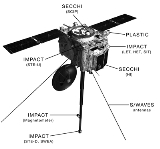
Each of the spacecraft carries cameras, particle experiments and radio detectors in four instrument packages:- Sun Earth Connection Coronal and Heliospheric Investigation (SECCHI) has five cameras: an extreme ultraviolet imager (EUVI) and two white-light coronagraphCoronagraphA coronagraph is a telescopic attachment designed to block out the direct light from a star so that nearby objects – which otherwise would be hidden in the star's bright glare – can be resolved...
s (COR1 and COR2). These three telescopes are collectively known as the Sun Centered Instrument Package or SCIP, and image the solar disk and the inner and outer coronaCoronaA corona is a type of plasma "atmosphere" of the Sun or other celestial body, extending millions of kilometers into space, most easily seen during a total solar eclipse, but also observable in a coronagraph...
. Two additional telescopes, heliospheric imagers (called the HI1 and HI2) image the space between Sun and Earth. The purpose of SECCHI is to study the 3-D evolution of Coronal Mass EjectionCoronal mass ejectionA coronal mass ejection is a massive burst of solar wind, other light isotope plasma, and magnetic fields rising above the solar corona or being released into space....
s through their full journey from the Sun's surface through the coronaCoronaA corona is a type of plasma "atmosphere" of the Sun or other celestial body, extending millions of kilometers into space, most easily seen during a total solar eclipse, but also observable in a coronagraph...
and interplanetary medium to their impact at Earth. - In-situ Measurements of Particles and CME Transients (IMPACT) will study energetic particlesSolar Energetic ParticlesSolar Energetic Particles are high-energy particles coming from the Sun which had been first observed in the early 1940s. They consist of protons, electrons and heavy ions with energy ranging from a few tens of keV to GeV...
, the three-dimensional distribution of solar wind electrons and interplanetary magnetic field. - PLAsma and SupraThermal Ion Composition (PLASTIC) will study the plasma characteristics of protonProtonThe proton is a subatomic particle with the symbol or and a positive electric charge of 1 elementary charge. One or more protons are present in the nucleus of each atom, along with neutrons. The number of protons in each atom is its atomic number....
s, alpha particleAlpha particleAlpha particles consist of two protons and two neutrons bound together into a particle identical to a helium nucleus, which is classically produced in the process of alpha decay, but may be produced also in other ways and given the same name...
s and heavy ionHeavy ionHeavy ion refers to an ionized atom which is usually heavier than helium. Heavy-ion physics is devoted to the study of extremely hot nuclear matter and the collective effects appearing in such systems, differing from particle physics, which studies the interactions between elementary particles...
s. - STEREO/WAVES (SWAVES) is a radio burst tracker that will study radio disturbances traveling from the Sun to the orbit of Earth.
Spacecraft subsystems
- Structure
- Launch weight including propellants was 1364 pounds (620 kg).
- Propulsion and attitude control
- 3-axis control
- Attitude determination
- Each STEREO spacecraft has a primary and a backup Miniature Inertial Measurement Unit (MIMU)Miniature Inertial Measurement Unit (MIMU)Miniature inertial measurement unit is an inertial measurement unit developed and built by Honeywell International to control and stabilize spacecraft during mission operations. MIMUs can also be configured to perform as an inertial reference unit...
, provided by HoneywellHoneywellHoneywell International, Inc. is a major conglomerate company that produces a variety of consumer products, engineering services, and aerospace systems for a wide variety of customers, from private consumers to major corporations and governments....
, which measure changes to the spacecraft attitude. Each MIMU is equipped with three ring laser gyroscopeRing laser gyroscopeA ring laser gyroscope consists of a ring laser having two counter-propagating modes over the same path in order to detect rotation. It operates on the principle of the Sagnac effect which shifts the nulls of the internal standing wave pattern in response to angular rotation...
s to detect angular changes. Additional attitude information is provided by the Star Tracker and the SECCHI Guide Telescope.- Power
- 475 Watts from solar panels.
- Telecommunications
- Data downlink: 720 kilobits per second.
- Flight computers
- STEREO's onboard computer systems are based on the Integrated Electronics Module (IEM), a device that combines core avionicsAvionicsAvionics are electronic systems used on aircraft, artificial satellites and spacecraft.Avionic systems include communications, navigation, the display and management of multiple systems and the hundreds of systems that are fitted to aircraft to meet individual roles...
in a single box. Each single-string spacecraft carries two 25 megahertz RAD6000RAD6000The RAD6000 radiation-hardened single board computer, based on the IBM RISC Single Chip CPU, was manufactured by IBM Federal Systems. IBM Federal Systems was sold to Loral, and by way of acquisition, ended up with Lockheed Martin and is currently a part of BAE Systems...
CPUs: one for Command/Data-handling, and one for Guidance-and-Control. Both are radiation hardened RAD6000 processors, based on IBM POWERIBM POWERPOWER is a reduced instruction set computer instruction set architecture developed by IBM. The name is an acronym for Performance Optimization With Enhanced RISC....
CPUs (predecessor of the PowerPC chip found in older Macintoshes). The computers, slow by current personal computerPersonal computerA personal computer is any general-purpose computer whose size, capabilities, and original sales price make it useful for individuals, and which is intended to be operated directly by an end-user with no intervening computer operator...
standards, are typical for the radiation requirements needed on the STEREO mission.- Data handling
- For data storage, each spacecraft carries a solid state recorder able to store up to one gigabyteGigabyteThe gigabyte is a multiple of the unit byte for digital information storage. The prefix giga means 109 in the International System of Units , therefore 1 gigabyte is...
each. Its main processor collects and stores on the recorder images and other data from STEREO's instruments, which can then be sent back to Earth.
See also
- HeliophysicsHeliophysicsHeliophysics is a word coined by Dr. George Siscoe of Boston University and subsequently used by the NASA Science Mission Directorate to encompass the study of the system composed of the Sun's heliosphere and the objects that interact with it—most notably, but not limited to, planetary atmospheres...
- Zooniverse - Solar Stormwatch
Further reading
- STEREO spacecraft to image solar blasts in glorious 3-D, New Scientist December 9, 2005
- NASA Orbit simulations
External links
- STEREO, official site
- STEREO, Applied Physics LaboratoryApplied Physics LaboratoryThe Johns Hopkins University Applied Physics Laboratory , located in Howard County, Maryland near Laurel and Columbia, is a not-for-profit, university-affiliated research center employing 4,500 people. APL is primarily a defense contractor. It serves as a technical resource for the Department of...
version - STEREO Mission Profile by NASA's Solar System Exploration
- SECCHI homepage
- U of M, UMNnews
- STEREO, UK version
- STEREO observations of stars and the search for exoplanets (arxiv 1103.0911 : 4 Mar 2011)
- Stereoscopic anaglyphs from STEREO original images
- STEREO Coordinated Observations Calendar
- STEREO Image artifacts (planets, cosmic rayCosmic rayCosmic rays are energetic charged subatomic particles, originating from outer space. They may produce secondary particles that penetrate the Earth's atmosphere and surface. The term ray is historical as cosmic rays were thought to be electromagnetic radiation...
s, internal reflections, debris) - STEREO Planet Finder
- Comets:
- Coronal mass ejectionCoronal mass ejectionA coronal mass ejection is a massive burst of solar wind, other light isotope plasma, and magnetic fields rising above the solar corona or being released into space....
(CME) removing tail of Comet EnckeComet EnckeComet Encke or Encke's Comet is a periodic comet that completes an orbit of the Sun once every three years — the shortest period of any known comet...
(April 20, 2007) - Comet 249P (2006 U1) as seen in STEREO HI1A imager (April 2011)
- STEREO/SECCHI Comets: The First 5 Years (Sungrazing Comets : October 26 2011)
- Coronal mass ejection