
All Topics  
Niger-Congo languages


   Email Print
   Bookmark   Link


Niger-Congo languages


The Niger–Congo languages constitute one of the world's major language families
Language family

A language family is a group of languages related Genetic from a common ancestor, called the proto-language of that family.As with Alpha taxonomy, the evidence of relationship is observable shared characteristics....
, and Africa
Africa

Africa is the world's second-largest and second most-populous continent, after Asia. At about 30.2 million km? including adjacent islands, it covers 6% of the Earth's total surface area and 20.4% of the total land area....
's largest in terms of geographical area, number of speakers, and number of distinct languages. They may constitute the world's largest language family in terms of distinct languages, although this question is complicated by ambiguity about what constitutes a distinct language. Most of the most widely spoken indigenous languages of Subsaharan Africa belong to this group.


Discussion
Ask a question about 'Niger-Congo languages'
Start a new discussion about 'Niger-Congo languages'
Answer questions from other users
Full Discussion Forum


Encyclopedia


The Niger–Congo languages constitute one of the world's major language families
Language family

A language family is a group of languages related Genetic from a common ancestor, called the proto-language of that family.As with Alpha taxonomy, the evidence of relationship is observable shared characteristics....
, and Africa
Africa

Africa is the world's second-largest and second most-populous continent, after Asia. At about 30.2 million km? including adjacent islands, it covers 6% of the Earth's total surface area and 20.4% of the total land area....
's largest in terms of geographical area, number of speakers, and number of distinct languages. They may constitute the world's largest language family in terms of distinct languages, although this question is complicated by ambiguity about what constitutes a distinct language. Most of the most widely spoken indigenous languages of Subsaharan Africa belong to this group. A common property of many Niger–Congo languages is the use of a noun class
Noun class

In linguistics, the term noun class refers to a system of categorizing nouns. A noun may belong to a given class because of characteristic features of its referent, such as sex, animacy, shape, but counting a given noun among nouns of such or another class is often clearly conventional....
 system.

Classification history


Early classifications

Niger-Congo as it is known today was only gradually recognized as a unity. In early classifications of African languages, one of the principal criteria used to distinguish different groupings was the languages' use of prefixes to classify nouns, or the lack thereof. A major advance came with the work of Koelle, who in his 1854 Polyglotta Africana
Polyglotta Africana

Polyglotta Africana is a study written by the German missionary Sigismund Wilhelm Koelle in 1854 in which he compared 156 African languages ....
 attempted a careful classification the groupings of which in quite a number of cases correspond to modern groupings. An early sketch of the extent of Niger-Congo as one language family can be found in Koelle's observation, echoed in Bleek
Wilhelm Bleek

Wilhelm Heinrich Immanuel Bleek was a Germany linguistics. His work included A Comparative Grammar of South African Languages and his great project jointly executed with Lucy Lloyd: The Bleek and Lloyd Archive of |Xam language and !Kung language texts....
 (1856), that the Atlantic languages used prefixes just like many Southern African languages. Subsequent work of Bleek, and some decades later the comparative work of Meinhof
Carl Meinhof

Carl Friedrich Michael Meinhof was a Germany Linguistics and one of the first linguists to study African languages....
, solidly established Bantu
Bantu languages

The Bantu languages constitute a grouping belonging to the Niger-Congo languages family. This grouping is deep down in the genealogical tree of the Bantoid grouping, which in turn is deep down in the Niger-Congo tree....
 as a linguistic unit.

In many cases, wider classifications employed a blend of typological and racial criteria. Thus, Friedrich Müller
Friedrich Müller (linguist)

Friedrich M?ller was a German linguistics who originated the term Afro-Asiatic languages, in relation with Afro-Asiatic languages.The prominent German zoologist Ernst Haeckel mentioned M?ller when he formulated his own theory about higher and lower races:...
, in his ambitious classification (1876-88), separated the 'Negro' and Bantu languages. Likewise, the Africanist Lepsius considered Bantu to be of African origin, and many 'Mixed Negro languages' as products of an encounter between Bantu and intruding Asiatic languages.

In this period a relation between Bantu and languages with Bantu-like (but less complete) noun class systems began to emerge. Some authors saw the latter as languages which had not yet completely evolved to full Bantu status, where as others regarded them as languages which had partly lost original features still found in Bantu. The Bantuist Meinhof made a major distinction between Bantu and a 'Semi-Bantu' group which according to him was originally of the unrelated Sudanic stock.

Westermann, Greenberg and beyond

Westermann 1911 Sudansprachen Cover
Westermann
Diedrich Hermann Westermann

Diedrich Hermann Westermann was a Germany missionary, Africanist, and linguistics. He substantially extended and revised the work of Carl Meinhof, his teacher, although he rejected some of Meinhof's theories only implicitly....
, a pupil of Meinhof, set out to establish the internal classification of the then Sudanic languages
Sudanic languages

In early twentieth century classification of African languages, Sudanic languages was a generic term for African languages spoken in the Sahel belt from Ethiopia in the east to Senegal in the west....
. In a 1911 work he established a basic division between 'East' and 'West'. A historical reconstruction of West Sudanic was published in 1927, and in his 1935 'Charakter und Einteilung der Sudansprachen' he conclusively established the relationship between Bantu and West Sudanic.

Joseph Greenberg
Joseph Greenberg

Joseph Harold Greenberg was a prominent and controversial American linguistics, principally known for his work in two areas, linguistic typology and the genetic relationship of languages....
 took Westermann's work as a starting-point for his own classification. In a series of articles published between 1949 and 1954, he argued that Westermann's 'West Sudanic' and Bantu formed a single genetic family, which he named Niger-Congo; that Bantu constituted a subgroup of the Benue-Congo branch; that Adamawa-Eastern, previously not considered to be related, was another member of this family; and that Fula belonged to the West Atlantic languages. Just before these articles were collected in final book form (The Languages of Africa
The Languages of Africa

The Languages of Africa is a 1963 book of essays by Joseph Greenberg, in which he sets forth a genetic classification of African languages that, with some changes, continues to be the most commonly used one today....
) in 1963, he amended his classification by adding Kordofanian as a branch co-ordinate with Niger-Congo as a whole; consequently, the family was renamed Niger-Kordofanian. Greenberg's work, though initially greeted with scepticism, became the prevailing view among scholars.

Bennet and Sterk (1977) presented an internal reclassification based on lexicostatistics that laid the foundation for the regrouping in Bendor-Samuel (1989). Kordofanian was thought to be one of several primary branches rather than being coordinate to the phylum as a whole, prompting re-introduction of the term 'Niger-Congo', which is in current use among linguists. Many classifications continue to place Kordofanian as the most distant branch, but mainly due to negative evidence (fewer lexical correspondences), rather than positive evidence that the other languages form a valid genealogical group. Likewise, Mande is often assumed to be the second-most distant branch based on its lack of the noun-class system prototypical of the Niger-Congo family. Other branches lacking any trace of the noun-class system are Dogon and Ijaw, whereas the Talodi branch of Kordofanian does have cognate noun classes, suggesting that Kordofanian is also not a valid group.

Niger-Congo and Nilo-Saharan

Over the years, several linguists have suggested a link between Niger-Congo and Nilo-Saharan
Nilo-Saharan languages

The Nilo-Saharan languages are a hypothetical group of African languages spoken mainly in the upper parts of the Chari River and Nile rivers , including historic Nubia, north of where the two tributaries of Nile meet....
, probably starting with Westermann's comparative work on the 'Sudanic' family in which 'Eastern Sudanic' (now classified as Nilo-Saharan) and 'Western Sudanic (now classified as Niger-Congo) were united. Gregersen (1972) proposed that Niger-Congo and Nilo-Saharan be united into a larger phylum which he termed Kongo-Saharan. His evidence was mainly based on the uncertainty in the classification of Songhay
Songhay languages

The Songhay, Songhai, or Songai languages are a group of closely related languages/dialects centered on the middle stretches of the Niger River in the west African nations of Mali, Niger, and Benin....
, morphological resemblances, and lexical similarities. A more recent proponent is Roger Blench
Roger Blench

Roger Blench is a British linguistics, ethnomusicology and development anthropologist. He has an M.A. and a Ph.D. from the University of Cambridge and remains based in Cambridge, England....
 (1995), who puts forward phonological, morphological and lexical evidence for uniting Niger-Congo and Nilo-Saharan in a Niger-Saharan phylum. Within Nilo-Saharan, Blench considers Niger-Congo to be most closely related to Central Sudanic
Central Sudanic languages

Central Sudanic is a grouping of about thirty languages of the Nilo-Saharan languages language family. Central Sudanic languages are spoken in the Central African Republic, Chad, Sudan, Uganda, and Democratic Republic of the Congo....
. Most hypotheses uniting the two families have failed to generate much discussion.

Common features


Phonology

Niger-Congo languages have a clear preference for open syllables of the type CV (Consonant Vowel). The typical word structure of Proto-Niger-Congo is thought to have been CVCV, a structure still attested in, for example, Bantu, Mande and Ijoid — in many other branches this structure has been reduced through phonological
Phonology

Phonology is the systematic use of sound to encode meaning in any spoken human language, or the field of linguistics studying this use. Just as a language has syntax and vocabulary, it also has a phonology in the sense of a sound system....
 change. Verbs are composed of a root followed by one or more extensional suffixes. Nouns consist of a root originally preceded by a noun class prefix of (C)V- shape which is often eroded by phonological change.
Consonant and vowel systems
Reconstructions of the consonant system of several branches of Niger-Congo (Stewart for proto-Volta-Congo, Mukarovsky for his proto-West-Nigritic, roughly corresponding to Atlantic-Congo) have posited independently a regular phonological contrast between two classes of consonants. Pending more clarity as to the precise nature of this contrast it is commonly characterized as a contrast between 'fortis' and 'lenis' consonants. Five places of articulation are postulated for the consonant inventory of proto-Niger-Congo: labial
Labial consonant

Labials are consonants articulated either with both lips or with the lower lip and the upper teeth . English is a bilabial nasal consonant sonorant, and are bilabial stop consonant , and are labiodental fricative consonant....
, alveolar
Alveolar consonant

Alveolar consonants are articulated with the tongue against or close to the superior alveolar ridge, which is called that because it contains the Dental alveolus of the superior teeth....
, palatal
Palatal consonant

Palatal consonants are consonants articulated with the body of the tongue raised against the hard palate . Consonants with the tip of the tongue curled back against the palate are called retroflex consonant....
, velar
Velar consonant

Velars are consonants articulated with the back part of the tongue against the soft palate, the back part of the roof of the mouth, known also as the Soft palate)....
, and labial-velar
Labial-velar consonant

Labial-velar consonants are Doubly articulated consonant at the Soft palate and the lips. They are sometimes called "labiovelar consonants", a term which can also refer to labialization velars, such as and the approximant ....
.

Many Niger-Congo languages show vowel harmony
Vowel harmony

Vowel harmony is a type of long-distance Assimilation Phonology process involving vowels in some languages. In languages with vowel harmony, there are constraints on what vowels may be found near each other....
 based on the feature [ATR] (advanced tongue root
Advanced tongue root

In phonetics, advanced tongue root and retracted tongue root, abbreviated ?ATR, are contrasting states of the root of the tongue during the pronunciation of vowels in some languages, especially in West Africa....
). In this type of vowel harmony, the position of the root of the tongue is the phonetic basis for the distinction between two harmonizing sets of vowels. In its fullest form, this type involves two classes, each of five vowels: [+ATR] /i, e, ?, o, u/ and [-ATR] /?, ?, a, ?, ?/. Vowel inventories of this type are still found in some branches of Niger-Congo, for example in the Ghana Togo Mountain languages
Ghana Togo Mountain languages

The Ghana-Togo Mountain languages, formerly called Togorestsprachen and Central Togo languages, form a grouping of about fourteen languages spoken in the mountains of the Ghana-Togo borderland....
. To date, many languages show reductions from this fuller system. The fact that ten vowels have been reconstructed for proto-Atlantic, proto-Ijoid and possibly proto-Volta-Congo leads Williamson (1989:23) to the hypothesis that the original vowel inventory of Niger-Congo was a full ten-vowel system. On the other hand, Stewart in recent comparative work reconstructs a seven vowel system for his proto-Potou-Akanic-Bantu.

Nasality
Several scholars have documented a contrast between oral and nasal vowel
Nasal vowel

A nasal vowel is a vowel that is produced with a lowering of the Soft palate so that air escapes both through nose as well as the mouth. The term stands in opposition to the term "oral vowel" refers to an ordinary vowel without this nasalisation....
s in Niger-Congo. In his reconstruction of proto-Volta-Congo, Steward (1976) postulates that nasal consonant
Nasal consonant

A nasal consonant is produced with a lowered soft palate in the mouth, allowing air to escape freely through the nose. The oral cavity still acts as a resonance chamber for the sound, but the air does not escape through the mouth as it is blocked by the tongue....
s have originated under the influence of nasal vowels; this hypothesis is supported by the fact that there are several Niger-Congo languages that have been analysed as lacking nasal consonants altogether. Languages like this have nasal vowels accompanied with complementary distribution
Complementary distribution

Complementary distribution in linguistics is the relationship between two different elements, where one element is found in a particular environment and the other element is found in the opposite environment....
 between oral and nasal consonants before oral and nasal vowels. Subsequent loss of the nasal/oral contrast in vowels may result in nasal consonants becoming part of the phoneme inventory. In all cases reported to date, the bilabial /m/ is the first nasal consonant to be phonologized. Niger-Congo thus invalidates two common assumptions about nasals: that all languages have at least one primary nasal consonant, and that if a language has only one primary nasal consonant it is /n/.

Niger-Congo languages commonly show fewer nasalized than oral vowels. Kasem, a language with a ten-vowel system employing ATR vowel harmony, has seven nasalized vowels. Similarly, Yoruba
Yoruba language

Yoruba is a dialect continuum of West Africa with over 25 million speakers. The native tongue of the approximately 28 million Yoruba people, it is spoken, among other languages, in Nigeria, Benin, and Togo and traces of it are found among communities in Brazil, Sierra Leone , northern Ghana and Cuba ....
 has seven oral vowels and only five nasal ones.

Tone
The large majority of present-day Niger-Congo languages are tonal
Tone (linguistics)

Tone is the use of pitch in language to distinguish lexical or grammatical meaning?that is, to distinguish or inflection words. All languages use pitch to express emotional and other paralinguistic information, and to convey emphasis, contrast, and other such features in what is called intonation , but not all languages use tones to distingu...
. A typical Niger-Congo tone system involves two or three contrastive level tones. Four level systems are less widespread, and five level systems are rare. Only a few Niger-Congo languages are non-tonal; Swahili is perhaps the best known, but within the Atlantic
Atlantic languages

The Atlantic or West Atlantic languages of West Africa are a proposed major group of Niger-Congo languages. The Atlantic languages are highly diverse and some linguists have proposed that they form three independent branches of Niger-Congo....
 branch some others are found. Proto-Niger-Congo is thought to have been a tone language with two contrastive levels. Synchronic and comparative-historical studies of tone systems show that such a basic system can easily develop more tonal contrasts under the influence of depressor consonants or through the introduction of a downstep. Languages which have more tonal levels tend to use tone more for lexical and less for grammatical contrasts.
Contrastive levels of tone in some Niger-Congo languages
H,L Dyula/Bambara
Bambara language

Bambara, also known as Bamanankan in the language itself, is a language spoken in Mali by as many as six million people . The differences between Bambara and Dioula language are minimal....
, Maninka
Maninka language

Maninka is the name of several closely related languages and dialects of the southeastern Manding languages subgroup of the Mande languages branch of the Niger-Congo languages....
, Temne
Temne language

Temne is a language of the Atlantic subfamily of languages spoken in Sierra Leone by about 2 million first speakers. One of the country's most widely spoken languages, it is spoken by 30% of the country?s population....
, Dogon
Dogon languages

The Dogon languages are spoken by the Dogon in Mali. There are about 600,000 speakers of a dozen languages. They are tonal languages, most like Dogul Dom having two tones, some like Donno So having three....
, Dagbani
Dagbani language

Dagbani is a Gur languages spoken by about 800,000 people in Ghana. Its native speakers are primarily of the Dagomba people, but Dagbani is also widely known as a second language in north-eastern Ghana....
, Gbaya
Gbaya language

The Gbaya languages are a branch of Ubangian languages spoken mainly in the Central African Republic, and to a lesser extent in Cameroon, the Democratic Republic of Congo, the Republic of Congo and Nigeria....
, Efik, Ibibio
Ibibio language

Ibibio language belongs to the Niger-Congo languages and Niger-Congo languages language groups that is native to over 10 million people in the Akwa Ibom State and Cross River States of Nigeria....
, Lingala
Lingala language

Lingala is a Bantu languages language spoken throughout the northwestern part of the Democratic Republic of the Congo and a large part of the Republic of the Congo , as well as to some degree in Angola and the Central African Republic....
, Igbo
Igbo language

Igbo is a language spoken in Nigeria by around 20-25 million people, the Igbo people, especially in the southeastern region once identified as Biafra and parts of Southsouthern region of Nigeria....
H, M, L Yakuba, Nafaanra
Nafaanra language

Nafaanra is a Senufo languages language spoken in northwest Ghana, along the border with C?te d'Ivoire, east of Bondouko. It is spoken by approximately 61,000 people....
, Kasem, Banda
Banda languages

Banda is a family of Ubangian languages, such as Mono language , spoken by the Banda people in central Africa.External links...
, Yoruba
Yoruba language

Yoruba is a dialect continuum of West Africa with over 25 million speakers. The native tongue of the approximately 28 million Yoruba people, it is spoken, among other languages, in Nigeria, Benin, and Togo and traces of it are found among communities in Brazil, Sierra Leone , northern Ghana and Cuba ....
, Jukun
Jukun language

Jukun is an Australian Aboriginal languages of Western Australia. There are no longer any fluent speakers of Jukun, but some people may remember it to some degree....
, Dangme, Yukuben, Akan
Akan languages

The Central Tano languages are languages of the Kwa languages Language families and languages spoken in Ghana and the C?te d'Ivoire:*Akan languages...
, Anyi, Ewe
Ewe language

Ewe is a Niger-Congo language spoken in Ghana, Togo and Benin by over three million people. Ewe is part of a cluster of related languages commonly called Gbe languages, spoken in southeastern Ghana and southern Togo....
T, H, M, L Gban, Wobe, Munzombo, Igede
Igede language

The Igede language is spoken in the Benue state and the Cross River state of Nigeria by 250,000 people.It is a member of the Niger-Congo languages and the Benue-Congo subgroup....
, Mambila
T, H, M, L, B Ashuku (Benue-Congo), Dan-Santa (Mande)
PA/S Mandinka (Senegambia)
Mandinka language

The Mandinka language, sometimes referred to as Mandingo, is a Mand? language spoken by millions of Mandinka people in Mali, Senegal, The Gambia, Guinea, Ivory Coast, Burkina Faso, Sierra Leone, Liberia, and Guinea-Bissau and Chad; it is the main language of The Gambia....
, Fula
Fula language

The Fula language is a language of West Africa, spoken by the Fula people from Senegambia and Guinea to Cameroon and Sudan. It is also spoken as the first language by the Tukulor in the Senegal River Valley and as a second language by peoples in other areas....
, Wolof
Wolof language

Wolof is a language spoken in Senegal, The Gambia, and Mauritania, and it is the native language of the ethnic group of the Wolof people. Like the neighboring language Fula language, it belongs to the Atlantic languages of the Niger-Congo languages....
none Swahili
Swahili language

Swahili is the first language of the Swahili people , who inhabit several large stretches of the Indian Ocean coastline from southern Somalia to northern Mozambique, including the Comoros Islands....
Abbreviations used: T top, H high, M mid, L low, B bottom, PA/S pitch-accent or stress
Adapted from Williamson 1989:27


Morphosyntax


Noun classification
Niger-Congo languages are known for their system of noun class
Noun class

In linguistics, the term noun class refers to a system of categorizing nouns. A noun may belong to a given class because of characteristic features of its referent, such as sex, animacy, shape, but counting a given noun among nouns of such or another class is often clearly conventional....
ification, traces of which can be found in every branch of the family but Mande, Ijoid, Dogon, and the Katla and Rashad branches of Kordofanian. These noun-classification systems are somewhat analogous to grammatical gender
Grammatical gender

In linguistics, grammatical genders, sometimes also called noun classes, are classes of nouns reflected in the behavior of associated words; every noun must belong to one of the classes and there should be very few which belong to several classes at once....
 in other languages, but there are often a fairly large number of classes (often 10 or more), and the classes may be male human/female human/animate/inanimate, or even completely gender-unrelated categories such as places, plants, abstracts, and groups of objects. For example, in Bantu, the Swahili language is called Kiswahili, while the Swahili people are Waswahili. Likewise, in Ubangian, the Zande language is called Pazande, while the Zande people are called Azande.

In the Bantu languages, where noun classification is particularly elaborate, it typically appears as prefixes, with verbs and adjectives marked according to the class of the noun they refer to. For example, in Swahili, watu wazuri wataenda is 'good (zuri) people (tu) will go (ta-enda).

Verbal extensions
The same Atlantic-Congo languages which have noun classes also have a set of verb applicative
Verb applicative

A verb applicative is a morpheme that increases the valency of a verb by adding a new core verb argument to it. The new argument is a former complement....
s and other verbal extensions, such as the reciprocal
Reciprocal

Reciprocal may refer to:*Multiplicative inverse, in mathematics, the number 1/x
, which multiplied by x'' gives the product 1, also known as a reciprocal...
 suffix
-na (Swahili penda 'to love', pendana 'to love each other'; also applicative pendea 'to love for' and causative
Causative

A causative form, in linguistics, is an expression of an agent causing or forcing a patient to perform an action .All languages have ways to express causation, but they differ in the means....
 
pendeza 'to please').

Word order
A Subject Verb Object word order is quite widespread among today's Niger-Congo languages, but SOV
Subject Object Verb

In linguistic typology, Subject Object Verb is the type of languages in which the subject , object , and verb of a sentence appear or usually appear in that order....
 is found in branches as divergent as Mande
Mande languages

The Mande languages are spoken in several countries in West Africa by the Mand? people and include Mandinka language, Soninke language, Bambara language, Bissa, Dioula, Kagoro, Bozo languages, Mende language, Susu language, Yacouba, Vai language, and Ligbi language....
, Ijoid
Ijoid languages

The Ijoid languages are spoken by the ?j? and Defaka peoples of the Niger Delta, who number about ten million. The most populous language by far is Izon, at four million, followed by Kalabari with about a quarter-million speakers....
 and Dogon
Dogon languages

The Dogon languages are spoken by the Dogon in Mali. There are about 600,000 speakers of a dozen languages. They are tonal languages, most like Dogul Dom having two tones, some like Donno So having three....
. As a result, there has been quite some debate as to the basic word order of Niger-Congo.

Whereas Claudi (1993) argues for SVO on the basis of existing SVO>SOV grammaticalization paths (SOV>SVO is never found), Gensler (1997) points out that the notion of 'basic word order' is problematic as it excludes structures with, for example, auxiliaries
Auxiliary

Auxiliary may refer to:*A backup system*An auxiliary input. See Scart and Jack .*An auxiliary verb*International auxiliary language*Auxiliary police...
. However, the structure SC-OC-VbStem (Subject concord, Object concord, Verb stem) found in the "verbal complex" of the SVO Bantu languages suggests an earlier SOV pattern (where the subject and object were at least represented by pronouns).

Noun phrase
Noun phrase

In grammar, a noun phrase is a phrase whose Head is a noun or a pronoun, optionally accompanied by a set of modifiers.Noun phrases are very common linguistic typology, but some languages like Tuscarora language and Cayuga language have been argued to lack this category....
s in most Niger-Congo languages are characteristically
noun-initial, with adjective
Adjective

In grammar, an adjective is a word whose main syntax role is to grammatical modifier a noun or pronoun, giving more information about the noun or pronoun's definition....
s, numeral
Numeral

The term numeral can refer to:* Numeral system, a system of mathematical notation for writing numbers* Number names, the words used in a language or writing system to represent numbers...
s, demonstrative
Demonstrative

Demonstratives are deictic expression words that indicate which entities a speaker refers to, and distinguishes those entities from others. Demonstratives are employed for spatial deixis and as discourse deictics, referring to propositions mentioned in speech....
s and genitives all coming after the noun. The major exceptions are found in the western areas where verb-final word order predominates and genitives precede nouns, though other modifiers still come afterwards. Degree words almost always follow adjectives, and except in verb-final languages adposition
Adposition

In grammar, a preposition is a part of speech that introduces a adpositional phrase. For example, in the sentence "The cat sleeps on the sofa", the word "on" is a preposition, introducing the prepositional phrase "on the sofa"....
s are prepositional.

The verb-final languages of the Mende region have two quite unusual word order characteristics. Although verbs follow their direct objects, oblique adpositional phrases (like "in the house", "with timber") typically come after the verb, creating a
SOVX word order. Also noteworthy in these languages is the prevalence of internally-headed and correlative relative clause
Relative clause

A relative clause is a subordinate clause that modifies a noun. For example, the noun phrase the man who wasn't there contains the noun man, which is modified by the relative clause who wasn't there....
s, in both of which the head occurs
inside the relative clause rather than the main clause.

Major clades

The branches and major languages of the Niger-Congo family are,

  • Kordofanian languages
    Kordofanian languages

    The Kordofanian languages are a geographic grouping of three to five language families spoken in the Nuba hills of Kordofan Province, Sudan....
    : spoken in central Sudan, around the Nuba Mountains
    Nuba Mountains

    The Nuba Mountains are a mountain range in South Kordofan. The South Kordofan region is part of Kordofan province in central Sudan, Africa. The mountains cover an area roughly wide by long, and are 1500 to higher in elevation than the surrounding plain....
     (not a single family)
  • ? Mande
    Mande languages

    The Mande languages are spoken in several countries in West Africa by the Mand? people and include Mandinka language, Soninke language, Bambara language, Bissa, Dioula, Kagoro, Bozo languages, Mende language, Susu language, Yacouba, Vai language, and Ligbi language....
    : spoken in West Africa; includes Bambara
    Bambara language

    Bambara, also known as Bamanankan in the language itself, is a language spoken in Mali by as many as six million people . The differences between Bambara and Dioula language are minimal....
    , the main language spoken in Mali
    Mali

    Mali, officially the Republic of Mali, is a landlocked nation in West Africa. Mali is the seventh largest country in Africa, bordering Algeria on the north, Niger on the east, Burkina Faso and the C?te d'Ivoire on the south, Guinea on the south-west, and Senegal and Mauritania on the west....
    , as well as Soninke
    Soninke language

    The Soninke language is a Mande languages spoken by the Soninke people of West Africa. The language has an estimated 1,096,795 speakers, primarily located in Mali, and also in Senegal, C?te d'Ivoire, The Gambia, Mauritania, Guinea-Bissau, and Guinea....
    , a language spoken mainly in Mali
    Mali

    Mali, officially the Republic of Mali, is a landlocked nation in West Africa. Mali is the seventh largest country in Africa, bordering Algeria on the north, Niger on the east, Burkina Faso and the C?te d'Ivoire on the south, Guinea on the south-west, and Senegal and Mauritania on the west....
     but also in Senegal
    Senegal

    Senegal , officially the Republic of Senegal, is a country south of the S?n?gal River in West Africa. Senegal is bounded by the Atlantic Ocean to the west, Mauritania to the north, Mali to the east, and Guinea and Guinea-Bissau to the south....
     and Mauritania
    Mauritania

    Mauritania , officially the Islamic Republic of Mauritania, is a country in northwest Africa. It is bordered by the Atlantic Ocean on the west, by Senegal on the southwest, by Mali on the east and southeast, by Algeria on the northeast, and by the Morocco-controlled Western Sahara on the northwest....
    . The evidence linking Mande to Niger-Congo is thin. Blench regards it as an early branch that diverged before the morphology characteristic of most of Niger-Congo developed, which Dimmendaal (2008) argues that for now it is best considered an independent family.
  • Ijoid
    Ijoid languages

    The Ijoid languages are spoken by the ?j? and Defaka peoples of the Niger Delta, who number about ten million. The most populous language by far is Izon, at four million, followed by Kalabari with about a quarter-million speakers....
     in Nigeria
    Nigeria

    Nigeria, officially the Federal Republic of Nigeria, is a federation constitutional republic comprising States of Nigeria and one Federal Capital Territory, Nigeria....
    , including Ijo
    Ijo languages

    ?j? is a group of languages spoken in southern Nigeria, by the Ijo people.See Ijoid languages for details.External links...
     and Defaka
    Defaka language

    The Defaka language is an Ijoid languages branch of the Niger-Congo languages, spoken in Nigeria. It is an endangered language.Ethnically, the Defaka are distinct from the Nkoroo, but they have assimilated to Nkoroo culture to such a degree that their language seems to be the only sign of a distinct Defaka identity....
    .
  • ? Dogon
    Dogon languages

    The Dogon languages are spoken by the Dogon in Mali. There are about 600,000 speakers of a dozen languages. They are tonal languages, most like Dogul Dom having two tones, some like Donno So having three....
    , spoken in Mali
    Mali

    Mali, officially the Republic of Mali, is a landlocked nation in West Africa. Mali is the seventh largest country in Africa, bordering Algeria on the north, Niger on the east, Burkina Faso and the C?te d'Ivoire on the south, Guinea on the south-west, and Senegal and Mauritania on the west....
    . The evidence linking Dogon to Niger-Congo is weak.
  • Atlantic
    Atlantic languages

    The Atlantic or West Atlantic languages of West Africa are a proposed major group of Niger-Congo languages. The Atlantic languages are highly diverse and some linguists have proposed that they form three independent branches of Niger-Congo....
    : includes Wolof
    Wolof language

    Wolof is a language spoken in Senegal, The Gambia, and Mauritania, and it is the native language of the ethnic group of the Wolof people. Like the neighboring language Fula language, it belongs to the Atlantic languages of the Niger-Congo languages....
    , spoken in Senegal
    Senegal

    Senegal , officially the Republic of Senegal, is a country south of the S?n?gal River in West Africa. Senegal is bounded by the Atlantic Ocean to the west, Mauritania to the north, Mali to the east, and Guinea and Guinea-Bissau to the south....
    , and Fula
    Fula language

    The Fula language is a language of West Africa, spoken by the Fula people from Senegambia and Guinea to Cameroon and Sudan. It is also spoken as the first language by the Tukulor in the Senegal River Valley and as a second language by peoples in other areas....
    , a language spoken across the Sahel
    Sahel

    File:Sahel Map-Africa rough.pngFile:AT0713 map.pngThe Sahel or Sahel Belt is a semi-arid tropical and subtropical grasslands, savannas, and shrublands ecoregion in Africa, which forms the transition between the Sahara to the north and the slightly less arid savanna belt to the south, known as the Sudan ....
    . The validity of Atlantic as a genetic grouping is controversial.
  • Kru
    Kru languages

    The Kru languages belong to the Niger-Congo languages and are spoken in the area ranging from the south-east of Liberia to the east of C?te d'Ivoire....
    : spoken in West Africa
    West Africa

    West Africa or Western Africa is the westernmost region of the African continent. Geopolitically, the United Nations subregion of Western Africa includes the following 16 countries distributed over an area of approximately 5 million square km:...
    , include Bété
    Bete language

    The Bete language of Nigeria is a nearly extinct language spoken by a small minority of the 3,000 inhabitants of Bete Town, Takum Local Government Authority, Taraba State; its speakers have mostly shifted to Jukun Takum language....
    , Nyabwa
    Nyabwa language

    The Nyabwa language is a Kru languages spoken in C?te d'Ivoire....
    , and Dida
    Dida language

    Dida is a dialect cluster of the Kru languages spoken in Ivory Coast.Ethnologue divides Dida into two groups, Yocobou? Dida and Lakota Dida , which are only marginally mutually intelligible and best considered separate languages....
    .
  • Senufo
    Senufo languages

    The Senufo languages comprise ca. 15 languages spoken by the Senufo in the north of C?te d'Ivoire, the southeast of Mali and the southwest of Burkina Faso....
    : spoken in Côte d'Ivoire
    Côte d'Ivoire

    , formerly Ivory Coast, officially the , is a country in West Africa. The government officially discourages the use of the name Ivory Coast in English, preferring the French name to be used in all languages ....
     and Mali
    Mali

    Mali, officially the Republic of Mali, is a landlocked nation in West Africa. Mali is the seventh largest country in Africa, bordering Algeria on the north, Niger on the east, Burkina Faso and the C?te d'Ivoire on the south, Guinea on the south-west, and Senegal and Mauritania on the west....
    , with a geographical outlier in Ghana
    Ghana

    The Republic of Ghana is a country in West Africa. It borders C?te d'Ivoire to the west, Burkina Faso to the north, Togo to the east, and the Gulf of Guinea to the south....
    , and including Senari and Supyire
    Supyire language

    Supyire, or Suppire, is the name of a language centralized in the Sikasso Region region of southeastern Mali, in western Africa. Supyire is spoken by an estimated 364,000 Supyire people, according to Ethnologue....
    .
  • Savannahs
    Savanna languages

    The Savannas family of languages is a postulated branch of the Niger-Congo languages that includes the old Gur languages and Adamawa-Ubangi languages families....
    : Including Gur languages
    Gur languages

    The Gur languages, also known as Central Gur, belong to the Niger-Congo languages. There are about 70 languages belonging to this group. They are spoken in southeast Mali, Burkina Faso, northern C?te d'Ivoire, Ghana, northern Togo, Benin and southwestern Niger....
     such as More
    More language

    M?or? language is a Tonal languages language spoken primarily in Burkina Faso by the Mossi , closely related and mutually intelligible with the Dagbani language spoken in northern Ghana....
     in Burkina Faso
    Burkina Faso

    Burkina Faso , also known by its short-form name Burkina, is a landlocked nation in West Africa. It is surrounded by six countries: Mali to the north, Niger to the east, Benin to the south east, Togo and Ghana to the south, and C?te d'Ivoire to the south west....
    , and the Adamawa languages
    Adamawa languages

    The Adamawa languages are a putative family of 80?90 languages scattered across the Adamawa Plateau in central Africa, in Nigeria, Cameroon, and Chad, spoken altogether by only one and a half million people ....
    .
  • ? Ubangi languages: such as Sango in the Central African Republic
    Central African Republic

    The Central African Republic , is a landlocked country in Central Africa. It borders Chad in the north, Sudan in the east, the Republic of the Congo and the Democratic Republic of the Congo in the south, and Cameroon in the west....
    . Ubangian has recently been excluded from Niger-Congo.
  • Kwa
    Kwa languages

    The Kwa languages are spoken in the south-eastern part of C?te d'Ivoire, across southern Ghana, and in central Togo. They include the Akan languages....
    : includes Akan
    Akan language

    Akan is a language group spoken by related peoples in mainly Ghana and eastern C?te d'Ivoire. All Akan languages are mutually intelligible. The main languages comprise:...
    , spoken in Ghana
    Ghana

    The Republic of Ghana is a country in West Africa. It borders C?te d'Ivoire to the west, Burkina Faso to the north, Togo to the east, and the Gulf of Guinea to the south....
    .
  • Volta-Niger (= West Benue-Congo), including among others:
    • The Gbe languages
      Gbe languages

      The Gbe languages form a cluster of about twenty related languages stretching across the area between eastern Ghana and western Nigeria. The total number of speakers of Gbe languages is between four and eight million....
      , spoken in Ghana
      Ghana

      The Republic of Ghana is a country in West Africa. It borders C?te d'Ivoire to the west, Burkina Faso to the north, Togo to the east, and the Gulf of Guinea to the south....
      , Togo
      Togo

      Togo is a narrow country in West Africa bordering Ghana to the west, Benin to the east and Burkina Faso to the north. It extends south to the Gulf of Guinea, on which the capital Lom? is located....
      , Benin
      Benin

      Benin , officially the Republic of Benin, is a country in West Africa. It borders Togo to the west, Nigeria to the east and Burkina Faso and Niger to the north; its short coastline to the south leads to the Bight of Benin....
      , and Nigeria
      Nigeria

      Nigeria, officially the Federal Republic of Nigeria, is a federation constitutional republic comprising States of Nigeria and one Federal Capital Territory, Nigeria....
      , of which Ewe
      Ewe language

      Ewe is a Niger-Congo language spoken in Ghana, Togo and Benin by over three million people. Ewe is part of a cluster of related languages commonly called Gbe languages, spoken in southeastern Ghana and southern Togo....
       is best known.
    • The Yoruba
      Yoruba language

      Yoruba is a dialect continuum of West Africa with over 25 million speakers. The native tongue of the approximately 28 million Yoruba people, it is spoken, among other languages, in Nigeria, Benin, and Togo and traces of it are found among communities in Brazil, Sierra Leone , northern Ghana and Cuba ....
       and Igbo
      Igbo language

      Igbo is a language spoken in Nigeria by around 20-25 million people, the Igbo people, especially in the southeastern region once identified as Biafra and parts of Southsouthern region of Nigeria....
       languages, spoken in Nigeria
      Nigeria

      Nigeria, officially the Federal Republic of Nigeria, is a federation constitutional republic comprising States of Nigeria and one Federal Capital Territory, Nigeria....
      .
  • (East) Benue-Congo
    Benue-Congo languages

    The Benue-Congo group of languages constitutes the largest branch of the Niger-Congo languages language family, both in terms of sheer number of languages, of which 880 are known , and in terms of speakers, numbering perhaps 500 million....
    , including:
    • The very large Bantu
      Bantu languages

      The Bantu languages constitute a grouping belonging to the Niger-Congo languages family. This grouping is deep down in the genealogical tree of the Bantoid grouping, which in turn is deep down in the Niger-Congo tree....
       family, with Swahili
      Swahili language

      Swahili is the first language of the Swahili people , who inhabit several large stretches of the Indian Ocean coastline from southern Somalia to northern Mozambique, including the Comoros Islands....
      , Fang
      Fang language

      Fang is an African language spoken by the Beti-Pahuin. It is related to the Bulu language and Ewondo language languages of southern Cameroon. Fang is spoken in northern Gabon, southern Cameroon and Equatorial Guinea....
      , Kongo
      Kongo language

      Kikongo or Kongo is the Bantu language spoken by the Bakongo and Bandundu people living in the tropical forests of the Democratic Republic of the Congo, the Republic of the Congo and Angola....
      , Zulu
      Zulu language

      Zulu , is a language of the Zulu people with about 10 million speakers, the vast majority of whom live in South Africa. Zulu is the most widely spoken home language in South Africa as well as being understood by over 50% of the population ....
      , and many other languages of central and southern Africa.


Some linguists consider the twenty or so Kordofanian languages
Kordofanian languages

The Kordofanian languages are a geographic grouping of three to five language families spoken in the Nuba hills of Kordofan Province, Sudan....
 to form part of the Niger-Congo family, while others consider them and Niger-Congo to form two separate branches of a Niger-Kordofanian
Niger-Kordofanian languages

The Niger-Kordofanian language family was proposed by Joseph Greenberg in his 1963 book Languages of Africa, originally under the name 'Congo-Kordofanian'....
 language family, and yet others do not accept Kordofanian as a single group. Senufo has been placed traditionally within Gur, but is now usually considered an early off-shoot from Atlantic-Congo.

The Laal
Laal language

Laal is an unclassified language spoken by 749 people in three villages in the Moyen-Chari Prefecture prefecture of Chad on opposite banks of the Chari River,...
, Mpre
Mpre language

Mpre is a language spoken or once spoken in the village of Butie in Ghana, near the confluence of the Black Volta and White Voltas. It is known only from a 70-word list given in a 1931 article....
, and Jalaa
Jalaa language

Jalaa is an endangered language of northeastern Nigeria , of uncertain origins. It is nearly extinct; the ethnic group has come to use the Bwilim dialect of Cham language in daily life, and the few remaining speakers of Jalaa, all elderly, are much more fluent in Cham than in Jalaa....
 languages are often linked with Niger-Congo, but have yet to be conclusively classified.


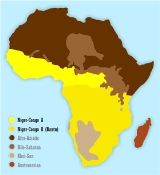
Localization of the Niger-Congo languages

External links

  • , Kenneth Olson