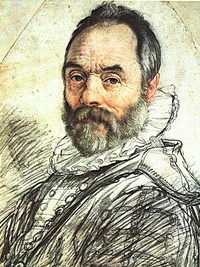
Giambologna

Encyclopedia
Sculpture
Sculpture is three-dimensional artwork created by shaping or combining hard materials—typically stone such as marble—or metal, glass, or wood. Softer materials can also be used, such as clay, textiles, plastics, polymers and softer metals...
, known for his marble
Marble sculpture
Marble sculpture is the art of creating three-dimensional forms from marble. Sculpture is among the oldest of the arts. Even before painting cave walls, early humans fashioned shapes from stone. From these beginnings, artifacts have evolved to their current complexity...
and bronze
Bronze sculpture
Bronze is the most popular metal for cast metal sculptures; a cast bronze sculpture is often called simply a "bronze".Common bronze alloys have the unusual and desirable property of expanding slightly just before they set, thus filling the finest details of a mold. Then, as the bronze cools, it...
statuary in a late Renaissance
Renaissance
The Renaissance was a cultural movement that spanned roughly the 14th to the 17th century, beginning in Italy in the Late Middle Ages and later spreading to the rest of Europe. The term is also used more loosely to refer to the historical era, but since the changes of the Renaissance were not...
or Mannerist style.
Biography
Giambologna was born in DouaiDouai
-Main sights:Douai's ornate Gothic style belfry was begun in 1380, on the site of an earlier tower. The 80 m high structure includes an impressive carillon, consisting of 62 bells spanning 5 octaves. The originals, some dating from 1391 were removed in 1917 during World War I by the occupying...
, Flanders
Flanders
Flanders is the community of the Flemings but also one of the institutions in Belgium, and a geographical region located in parts of present-day Belgium, France and the Netherlands. "Flanders" can also refer to the northern part of Belgium that contains Brussels, Bruges, Ghent and Antwerp...
(now in France
France
The French Republic , The French Republic , The French Republic , (commonly known as France , is a unitary semi-presidential republic in Western Europe with several overseas territories and islands located on other continents and in the Indian, Pacific, and Atlantic oceans. Metropolitan France...
). After youthful studies in Antwerp with the architect-sculptor Jacques du Broeucq
Jacques du Broeucq
Jacques du Broeucq was a sculptor and architect from Southern Netherlands.Jacques du Broeucq is perhaps best known as the teacher of Giambologna in Antwerp....
, he moved to Italy
Italy
Italy , officially the Italian Republic languages]] under the European Charter for Regional or Minority Languages. In each of these, Italy's official name is as follows:;;;;;;;;), is a unitary parliamentary republic in South-Central Europe. To the north it borders France, Switzerland, Austria and...
in 1550, and studied in Rome
Rome
Rome is the capital of Italy and the country's largest and most populated city and comune, with over 2.7 million residents in . The city is located in the central-western portion of the Italian Peninsula, on the Tiber River within the Lazio region of Italy.Rome's history spans two and a half...
. Giambologna made detailed study of the sculpture of classical antiquity
Classical antiquity
Classical antiquity is a broad term for a long period of cultural history centered on the Mediterranean Sea, comprising the interlocking civilizations of ancient Greece and ancient Rome, collectively known as the Greco-Roman world...
. He was also much influenced by Michelangelo
Michelangelo
Michelangelo di Lodovico Buonarroti Simoni , commonly known as Michelangelo, was an Italian Renaissance painter, sculptor, architect, poet, and engineer who exerted an unparalleled influence on the development of Western art...
, but developed his own Mannerist
Mannerism
Mannerism is a period of European art that emerged from the later years of the Italian High Renaissance around 1520. It lasted until about 1580 in Italy, when a more Baroque style began to replace it, but Northern Mannerism continued into the early 17th century throughout much of Europe...
style, with perhaps less emphasis on emotion and more emphasis on refined surfaces, cool elegance and beauty. Pope Pius IV
Pope Pius IV
Pope Pius IV , born Giovanni Angelo Medici, was Pope from 1559 to 1565. He is notable for presiding over the culmination of the Council of Trent.-Biography:...
gave Giambologna his first major commission, the colossal bronze Neptune and subsidiary figures for the Fountain of Neptune (the base designed by Tommaso Laureti
Tommaso Laureti
Tommaso Laureti, often called Tommaso Laureti Siciliano , was an Italian painter from Sicily who trained in the atelier of the aged Sebastiano del Piombo and worked in Bologna...
, 1566) in Bologna. Giambologna spent his most productive years in Florence
Florence
Florence is the capital city of the Italian region of Tuscany and of the province of Florence. It is the most populous city in Tuscany, with approximately 370,000 inhabitants, expanding to over 1.5 million in the metropolitan area....
, where he had settled in 1553. Ten years later, he was named a member (Accademico) of the prestigious Accademia delle Arti del Disegno
Accademia delle Arti del Disegno
The Accademia delle Arti del Disegno of Florence promotes the safeguard of the works of art in Italy. Founded in 1563, it was the first academy of drawing established in Europe.- History of the Accademia :...
, just founded by the Duke Cosimo I de' Medici, at 13 January 1563, under the influence of the painter-architect Giorgio Vasari
Giorgio Vasari
Giorgio Vasari was an Italian painter, writer, historian, and architect, who is famous today for his biographies of Italian artists, considered the ideological foundation of art-historical writing.-Biography:...
, becoming also one of the Medici
Medici
The House of Medici or Famiglia de' Medici was a political dynasty, banking family and later royal house that first began to gather prominence under Cosimo de' Medici in the Republic of Florence during the late 14th century. The family originated in the Mugello region of the Tuscan countryside,...
most important court sculptors. He died in Florence at the age of 79 - the Medici had never subsequently allowed him to leave Florence, as they rightly feared that either the Austrian or Spanish Habsburgs would entice him into permanent employment. He was interred in a chapel he designed himself in the Santissima Annunziata
Basilica della Santissima Annunziata di Firenze
The Basilica della Santissima Annunziata is a Roman Catholic minor basilica in Florence, Italy, the mother church of the Servite order. It is located at the northeastern side of the Piazza Santissima Annunziata....
.
Work
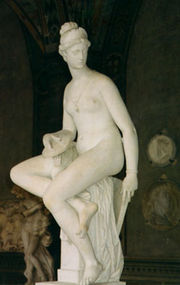
Giambologna's several depictions of Venus
Venus (mythology)
Venus is a Roman goddess principally associated with love, beauty, sex,sexual seduction and fertility, who played a key role in many Roman religious festivals and myths...
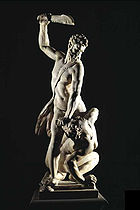
established a canon of proportions and set models for the goddess's representation that were influential for two generations of sculptors, in Italy and in the North. He created allegories strongly promoting Medicean political propaganda, such as Florence defeating Pisa and, less overtly, Samson Slaying a Philistine
Samson Slaying a Philistine (Giambologna)
The sculpture of Samson Slaying a Philistine is the earliest of the great marble groups by Giambologna , sculptor to the Medici Grand Dukes of Tuscany, and the only substantial work by the artist to have left Italy. It was commissioned in about 1562, by Francesco de Medici for a fountain in...
, for Francesco de' Medici (1562).
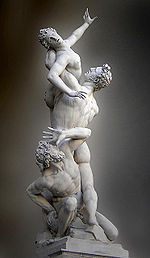
He delighted in solving the complex spatial problems of three intertwined figures in his famous Rape of the Sabine Women (1574–82). The subject was not finally determined until after it had been set up in the Loggia dei Lanzi
Loggia dei Lanzi
The Loggia dei Lanzi, also called the Loggia della Signoria, is a building on a corner of the Piazza della Signoria in Florence, Italy, adjoining the Uffizi Gallery. It consists of wide arches open to the street, three bays wide and one bay deep. The arches rest on clustered pilasters with...
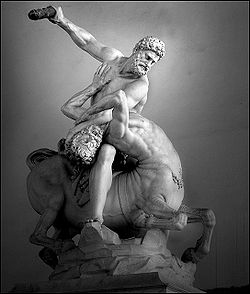
in Florence's Piazza della Signoria. Hercules beating the Centaur Nessus (1599) is also a conscious tour de force. It is also in the Loggia dei Lanzi.
Pietro Tacca
Pietro Tacca was an Italian sculptor, who was the chief pupil and follower of Giambologna. Tacca began in a Mannerist style and worked in the Baroque style during his maturity.-Biography:...
.
Giambologna provided as well as many sculptures for garden grottos and fountains in the Boboli Gardens
Boboli Gardens
The Boboli Gardens are a park in Florence, Italy, that is home to a collection of sculptures dating from the 16th through the 18th centuries, with some Roman antiquities.-History and layout:...
of Florence and at Pratolino, and the bronze doors of the cathedral of Pisa. For the grotto of the Villa Medicea of Castello he sculpted a series of studies of individual animals, from life, which may now be viewed at the Bargello
Bargello
The Bargello, also known as the Bargello Palace or Palazzo del Popolo is a former barracks and prison, now an art museum, in Florence, Italy.-Terminology:...
. Small bronze reductions of many of his sculptures were prized by connoisseurs at the time and ever since, for Giambologna's reputation has never suffered eclipse.
Giambologna was an important influence on later sculptors through his pupils Adriaen de Vries
Adriaen de Vries
Adriaen de Vries was a Northern Mannerist sculptor born in the Netherlands, whose international style crossed the threshold to the Baroque; he excelled in refined modelling and bronze casting and in the manipulation of patina and became the most famous European sculptor of his generation...
and Pietro Francavilla
Pietro Francavilla
Pierre Franqueville, generally called Pietro Francavilla , was a Franco-Flemish sculptor trained in Florence, who provided sculpture for Italian and French patrons in the elegant Late Mannerist tradition established by Giambologna....
who left his atelier for Paris in 1601, as well as Pierre Puget who spread Giambologna's influence throughout Northern Europe, and in Italy on Pietro Tacca
Pietro Tacca
Pietro Tacca was an Italian sculptor, who was the chief pupil and follower of Giambologna. Tacca began in a Mannerist style and worked in the Baroque style during his maturity.-Biography:...
, who assumed Giambologna's workshop in Florence, and in Rome on Gian Lorenzo Bernini
Gian Lorenzo Bernini
Gian Lorenzo Bernini was an Italian artist who worked principally in Rome. He was the leading sculptor of his age and also a prominent architect...
and Alessandro Algardi
Alessandro Algardi
Alessandro Algardi was an Italian high-Baroque sculptor active almost exclusively in Rome, where for the latter decades of his life, he was the major rival of Gian Lorenzo Bernini.-Early years:...
.