
All Topics  
Diving

 
Diving

   Email Print
   Bookmark   Link


Diving


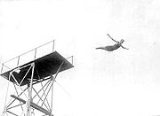
Diving refers to the sport of performing acrobatics
Acrobatics

Acrobatics is one of the performing arts, and is also practiced as a sport. Acrobatics involves difficult feats of balance, agility and motor coordination....
 while jumping or falling into water from a platform or springboard of a certain height. Diving is an internationally-recognized sport
Sport

Sport is an activity that is governed by a set of regulation of sport or traditions and often engaged in competitively. Sports commonly refer to activities where the physical capabilities of the competitor are the sole or primary determinant of the outcome , but the term is also used to include activities such as mind sports and motor...
 that is part of the Olympic Games
Olympic Games

The Olympic Games are an international multi-sport event established for both summer and winter sports. There have been two generations of the Olympic Games; the first were the Ancient Olympic Games held at Olympia, Greece, Greece....
. In addition, unstructured and non-competitive diving is a common recreational pastime in places where swimming is popular.

While not a particularly popular participant sport, diving is one of the more popular Olympic
Diving at the Summer Olympics

Diving was first introduced in the official programme of the Summer Olympic Games at the 1904 Summer Olympics and has been an Olympic sport since....
 sports with spectators.


Discussion
Ask a question about 'Diving'
Start a new discussion about 'Diving'
Answer questions from other users
Full Discussion Forum


Recent Posts


Encyclopedia


Diving refers to the sport of performing acrobatics
Acrobatics

Acrobatics is one of the performing arts, and is also practiced as a sport. Acrobatics involves difficult feats of balance, agility and motor coordination....
 while jumping or falling into water from a platform or springboard of a certain height. Diving is an internationally-recognized sport
Sport

Sport is an activity that is governed by a set of regulation of sport or traditions and often engaged in competitively. Sports commonly refer to activities where the physical capabilities of the competitor are the sole or primary determinant of the outcome , but the term is also used to include activities such as mind sports and motor...
 that is part of the Olympic Games
Olympic Games

The Olympic Games are an international multi-sport event established for both summer and winter sports. There have been two generations of the Olympic Games; the first were the Ancient Olympic Games held at Olympia, Greece, Greece....
. In addition, unstructured and non-competitive diving is a common recreational pastime in places where swimming is popular.

While not a particularly popular participant sport, diving is one of the more popular Olympic
Diving at the Summer Olympics

Diving was first introduced in the official programme of the Summer Olympic Games at the 1904 Summer Olympics and has been an Olympic sport since....
 sports with spectators. Successful competitors possess many of the same characteristics as gymnasts
Gymnastics

Gymnastics is a sport involving performance of exercises requiring physical strength, flexibility, agility and coordination. Artistic Gymnastics is the best known and most popular of the gymnastics sports governed by the F?d?ration Internationale de Gymnastique ....
 and dance
Dance

Dance is an art form that generally refers to Motion of the body, usually rhythmic and to music, used as a form of Emotional expression, social social interaction or presented in a spirituality or performance setting....
rs, including strength, flexibility, kinaesthetic judgment and air awareness.

In the recent past, the success and prominence of Greg Louganis
Greg Louganis

Gregory Efthimios Louganis is an United States diving who is best known for winning back-to-back Olympic Games titles in both the 3m and 10m diving events....
 led to American strength internationally. China came to prominence several decades ago when the sport was revolutionized by national coach Liang Boxi
Liang Boxi

Liang Boxi is a former Chinese diver and a head coach of Chinese diving team.Liang was born in Shunde, Guangdong Province. In 1952, he enrolled in Guangzhou Youth Swimming Team....
 and after intense study of the dominant Louganis. China has lost few world titles since. Other noted countries in this sport include Australia and Canada.

Competitive diving

Diving
10metertower
Most diving competitions consist of three disciplines: 1m and 3m springboards, and the platform. Competitive athletes are divided by gender, and often by age groups as well. In platform events, competitors are allowed to perform their dives on either the five, seven and a half (generally just called seven) or ten meter towers. In major diving meets, including the Olympic Games
Olympic Games

The Olympic Games are an international multi-sport event established for both summer and winter sports. There have been two generations of the Olympic Games; the first were the Ancient Olympic Games held at Olympia, Greece, Greece....
 and the World Championships, platform diving is from the 10 meter height.

Divers have to perform a set number of dives according to various established requirements, including somersaults and twists in various directions and from different starting positions. Divers are judged on whether and how well they completed all aspects of the dive, the conformance of their body to the requirements of the nominated dive, and the amount of splash created by their entry to the water. Theoretically, a score out of ten is supposed to be broken down into three points for the takeoff, three for the flight, and three for the entry, with one more available to give the judges flexibility.

The raw score is multiplied by a difficulty factor, derived from the number and combination of movements attempted. The diver with the highest total score after a sequence of dives is declared the winner.

Synchronized diving


Synchronized diving was adopted as an Olympic sport in 2000. In this event, two divers form a team and attempt to perform dives simultaneously. The dives are usually identical; however, sometimes the dives may be opposites, in what is called a pinwheel. In these events, the diving is judged both on the quality of execution and the synchronicity - in timing of take-off and entry, height and forward travel.

Scoring the dive


Ultimately, the judges' scores given on each dive are subjective. However, there are specific rules governing how a dive is supposed to be scored. Usually a score factors three elements of the dive: the approach, the flight, and the entry. The primary factors affecting the scoring are: (1) the platform selected (10-meter, 7.5-meter, or 5-meter), (2) if a hand-stand is required, the length of time and quality of the hold, (3) the height of the diver at the apex of the dive, with extra height resulting in a higher score, (4) the distance of the diver from the diving apparatus throughout the dive (a diver must not be dangerously close, should not be too far away, but should ideally be within of the platform), (5) the properly defined body position of the diver according to the dive being performed, including pointed toes and feet touching at all times, (6) the proper amounts of rotation and revolution upon completion of the dive and entry into the water, and (7) angle of entry (a diver should enter the water straight, without any angle). Many judges award divers for the amount of splash created by the diver on entry, with less splash resulting in a higher score.

To reduce the subjectivity of scoring in major meets, panels of five or seven judges are assembled. In the case where five judges are assembled, the highest and lowest scores are discarded and the middle three are summed and multiplied by the DD (Degree of Difficulty -- determined from a combination of the moves undertaken, in which position and from what height). In major international events, seven judges are assembled. In these circumstances, the highest and lowest scores are again discarded and the middle five are summed, then ratioed by 3/5, and multiplied by the DD, so as to provide consistent comparison with 5-judge events. Accordingly, it is extremely difficult for one judge to manipulate scores.

There is a general misconception about scoring and judging. In serious meets, the absolute score is somewhat meaningless. It is the relative score, not the absolute score that wins meets. Accordingly, good judging implies consistent scoring across the dives. Specifically, if a judge consistently gives low scores for all divers, or consistently gives high scores for the same divers, the judging will yield fair relative results and will cause divers to place in the correct order. However, absolute scores have significance to the individual divers. Besides the obvious instances of setting records, absolute scores are also used for rankings and qualifications for higher level meets.

In synchronised diving events, there is a panel of seven judges; two to mark the execution of one diver, two to mark the execution of the other, and three to judge the synchronisation.

Competitive strategy


To win dive meets, divers create a dive list in advance of the meet. To win the meet the diver must accumulate more points than other divers. Usually simple dives with low DDs will look good to spectators but will not win meets. The competitive diver will attempt the highest DD dives possible with which they can achieve consistent, high scores. If divers are scoring 8 or 9 on most dives, it may be a sign of their extreme skill, or it may be a sign that their dive list is not competitive, and they may lose the meet to a diver with higher DDs and lower scores.

In competition, divers must submit their lists beforehand, and past a certain deadline (usually when the event is announced shortly before it begins) they cannot change their dives under any circumstances. If they fail to perform the dive announced, even if they physically cannot execute the dive announced, even if they perform a more difficult dive, they will receive a score of zero. Under exceptional circumstances, a redive may be granted, but these are exceedingly rare (usually for very young divers just learning how to compete, or if some event outside the diver's control has caused them to be unable to perform).

There are some American meets which will allow changes of the position of the dive even after the dive has been announced immediately before execution, but these are an exception to the rules generally observed internationally.

Generally, NCAA rules allow for dives to be changed while the diver is on the board, but the diver must request the change directly after the dive is announced. This applies especially in cases where the wrong dive is announced. If the diver pauses during his or her hurdle to ask for a change of dive, it will be declared a balk and the change of dive will not be permitted.

Under FINA law, no dive may be changed after the deadline for the dive-sheet to be submitted (generally a period ranging from one hour to 24 hours, depending on the rulings made by the event organiser.

It is the diver's responsibility to ensure that the dive-sheet is filled in correctly, and also to correct the referee or announcer before the dive if they describe it incorrectly. If a dive is performed which is as submitted but not as (incorrectly) announced, it is declared failed and scores zero according to a strict reading of the FINA law. But in practice, a re-dive would usually be granted in these circumstances.

Diving and other sports


Divers do not consider themselves swimmers. While each sport shares a pool, and may compete side by side when doing so for their schools, the two sports are very different. Swimming is a full body exercise with emphasis on upper body strength and speed, diving is a full body exercise with emphasis on grace and execution; swimmers most frequently suffer overuse injuries, divers most frequently suffer impact injuries or strains.

The sister sport of diving is gymnastics. Many divers begin their training as gymnasts, and switch sports for one reason or another. Two of the most common are that they simply prefer diving, or that they develop a chronic injury that makes continuing gymnastics impossible. Gymnastics
Gymnastics

Gymnastics is a sport involving performance of exercises requiring physical strength, flexibility, agility and coordination. Artistic Gymnastics is the best known and most popular of the gymnastics sports governed by the F?d?ration Internationale de Gymnastique ....
 provides young divers with unique skills that help them perform complex and risky dives, but there are downsides; some habits developed in gymnastics can interfere with the correct technique of diving.

Governance

The global governing body of diving is FINA
Fina

Fina may refer to:*Fina, a software system for financial analysis*Skies_of_Arcadia#Main_player_characters, a character in the Skies of Arcadia video game...
, which also governs swimming
Swimming

Swimming is the movement by humans or animals through water, usually without artificial assistance. Swimming is an activity that can be both useful and recreational....
, synchronized swimming
Synchronized swimming

Synchronised swimming is a hybrid form of swimming, dance and gymnastics, consisting of swimmers performing a synchronised routine of elaborate moves in the water, accompanied by music....
, water polo
Water polo

Water polo is a team water sport. It is the oldest continuous Olympic team sport. The playing team consists of six field players and one goalkeeper with a maximum of six substitutes....
 and open water swimming
Open water swimming

Open water swimming is an activity in which people swimming in outdoor bodies of water such as oceans, bays, lakes and rivers.In the first edition of the modern Olympic Games in Athens in 1896, the swimming competition was held in open water....
. Almost invariably, at national level, diving shares a governing body with the other aquatic sports.

This is frequently a source of political friction as the committees are naturally dominated by swimming officials who do not necessarily share or understand the concerns of the diving community. Divers often feel, for example, that they do not get adequate support over issues like the provision of facilities. Other areas of concern are the selection of personnel for the specialised Diving committees and for coaching and officiating at events, and the team selection for international competitions.

There are sometimes attempts to separate the governing body as a means to resolve these frustrations, but they are rarely successful. For example, in the UK the Great Britain Diving Federation was formed in 1992 with the intention of taking over the governance of Diving from the ASA (Amateur Swimming Association
Amateur Swimming Association

The Amateur Swimming Association is the English national governing body for swimming, diving, water polo, open water, and synchronised swimming....
). Although it initially received widespread support from the diving community, the FINA requirement that international competitors had to be registered with their National Governing Body was a major factor in the abandonment of this ambition a few years later.

Since FINA refused to rescind recognition of the ASA as the British governing body for all aquatic sports including diving, this meant that the elite divers had to belong to ASA affiliated clubs in order to be eligible for selection to international competition.

In the United States scholastic diving is almost always part of the school’s swim team. Diving is a separate sport in Olympic and Club Diving. The NCAA
National Collegiate Athletic Association

The National Collegiate Athletic Association is a voluntary association of about 1,281 institutions, conferences, organizations and individuals that organizes the athletic programs of many colleges and University in the United States ....
 will separate diving from swimming in special diving competitions after the swim season is completed.

Safety

There is a general perception of diving as being a dangerous activity, and this has contributed to the decline in availability of facilities. In fact, despite the apparent risk, the statistical incidence of injury in supervised training and competition is extremely low.

The majority of accidents that are classified as 'diving-related' are incidents caused by individuals jumping from structures such as bridges or piers into water of inadequate depth. Because of this many beaches and pools prohibit diving in shallow waters or when a lifeguard
Lifeguard

File:RedYellowFlag.jpgA lifeguard is a person responsible for overseeing the safety of the users of a body of water and its environs, such as a swimming pool, a water park, or a beach....
 is not on duty.

After an incident in Washington state
Washington State

Washington State may refer to:* The state of Washington* Washington State University, a land-grant college in that state....
 in 1993, most US and other pool builders are reluctant to equip a residential swimming pool
Swimming pool

A swimming pool, swimming bath, wading pool, or simply a pool, is an artificially enclosed body of water intended for swimming or water-based recreation....
 with a diving springboard
Springboard

A springboard or diving board is used for diving and is a board that is itself a Spring , i.e. a linear flex-spring, of the cantilever type....
, so home diving pools are much less common these days. In the incident 14-year-old Shawn Meneely made a "suicide dive" (his hands at his sides - so his head hit the bottom first) in a private swimming pool and was seriously injured (tetraplegic). Family lawyer Fred Zeder successfully sued the diving board manufacturer, the pool builder, and the National Spa & Pool Institute over the inappropriate depth of the pool. The NSPI had specified a minimum depth of 7 ft 6 in (2.55m) which proved to be insufficient in the above case. The pool into which Meneelly dived was not constructed exactly to the published standards. The standards had changed after the diving board was installed on the non-compliant pool by the homeowner. But the courts held that the pool "was close enough" to the standards to hold NSPI liable. The multi-million dollar lawsuit was eventually settled in 2001 for $6,600,000USD ($US8,000,000 after interest was added) in favor of the plaintiff. The NSPI was held to be liable, and was financially strained by the case. It filed twice for Chapter 11
Chapter 11, Title 11, United States Code

Chapter 11 is a chapter of the United States Bankruptcy in the United States, which permits reorganization under the bankruptcy laws of the United States....
 bankruptcy protection and was successfully reorganized into a new swimming pool industry association.

Within competitive diving, FINA takes regulatory steps to ensure that athletes are protected from the inherent dangers of the sport. For example, they impose restrictions according to age on the heights of platforms which divers may compete on.

Group D (11 & under): 5m

Group C (12/13 year): 5m & 7.5m

Group B (14/15 year): 5m, 7.5m & 10m

Group A (16/18 year): 5m, 7.5m & 10m

Group D divers have only recently been allowed to compete tower at all. In the past, the age group could compete only springboard, in order to discourage young children from taking on the greater risks of tower diving. Group D tower was introduced to counteract the phenomenon of coaches pushing young divers to compete in higher age categories, thus putting them at even greater risk.

However, some divers may safely dive in higher age categories in order to dive on higher platforms. Usually this occurs when advanced Group C divers wish to compete on the 10m. Here are some points on pool depths in connection with safety.

  • Most competition pools are 5m deep for 10m platform and 4m deep for 5m platform or 3m springboard. These are currently the FINA recommended minimum depths. Some are deeper, eg 6m for the diving pit at Sheffield, England.
  • Diving from 10m and maintaining a downward streamlined position, results in gliding to a stop at about 4.5 - 5m.
  • High standard competition divers rarely go more than about 2.5m below the surface, as they roll in the direction of the dive's rotation. This is a technique to produce a clean entry.
  • Attempting to scoop the trajectory underwater against the rotation is extremely inadvisable as it can cause serious back injuries.
  • Hitting the water flat from 10m brings the diver to rest in about 1 ft. The extreme deceleration causes severe bruising both internal and external, strains to connective tissue securing the organs and possible minor hemorrhage to lungs and other tissue. Very painful and distressing, but not life-threatening.


Dive groups

There are six "groups" into which dives are classified: Forward, Back, Inward, Reverse, Twist, and Armstand. The latter applies only to Platform competitions, whereas the other five apply to both Springboard and Platform.

  • In the Forward Group (Group 1), the diver takes off facing forward and rotates forward
  • In the Back Group (2), the diver takes off with their back to the water and rotates backward
  • In the Reverse Group (3), the diver takes off facing forward and rotates backward
  • In the Inward Group (4), the diver takes off with their back to the water and rotates forward
  • Any dive incorporating an axial twisting movement is in the Twist group (5).
  • Any dive commencing from a handstand is in the Armstand group (6).(only on platform)


Dive positions


During the flight of the dive, one of the four positions may be specified:
  • Straight - with no bend at the knees or hips
  • Pike - with knees straight but a tight bend at the hips
  • Tuck - body folded up in a tight ball, hands holding the shins and toes pointed.
  • Free - Some sequence of the above positions.


These positions are referred to by the letters A, B,C and D respectively.

Dive numbers


In competition, the dives are referred to by a schematic system of three- or four-digit numbers. The letter to indicate the position is appended to the end of the number.

The first digit of the number indicates the dive group as defined above.

For groups 1 to 4, the number consists of three digits and a letter of the alphabet. The third digit represents the number of half-somersaults. The second digit is either 0 or 1, with 0 representing a normal somersault, and 1 signifying a "flying" variation of the basic movement (i.e. the first half somersault is performed in the straight position, and then the pike or tuck shape is assumed). No flying dive has been competed at a high level competition for many years.

For example:
  • 101A - Forward Dive Straight
  • 203C - Back one-and-a-half somersaults, tuck
  • 307C - Reverse three-and-a-half somersaults, tuck
  • 113B - Flying forward one-and-a-half somersaults, pike


For Group 5, the dive number has 4 digits. The second digit indicates the group (1-4) of the underlying movement; the third digit indicates the number of half-somersaults, and the fourth indicates the number of half-twists.

For example:
  • 5211A - Back dive, half twist, straight position.
  • 5337D - Reverse one and a half somersaults with three and a half twists, in the Free position.


For Group 6 - Armstand - the dive number has either three, four or five digits: Three digits for dives without twist and four for dives with twists.

In non-twisting armstand dives, the second digit indicates the direction of rotation (0 = no rotation, 1 = forward, 2 = backward, 3 = reverse, 4 = inward) and the third digit indicates the number of half-somersaults. Inward-rotating armstand dives have never been performed, and are generally regarded as physically impossible.

For example:
  • 600A - Armstand dive straight
  • 612B - Armstand forward somersault pike
  • 624C - Armstand back double somersault tuck


For twisting Armstand dives, the dive number again has 4 digits, but rather than beginning with the number 5, the number 6 remains as the first digit, indicating that the "twister" will be performed from an Armstand. The second digit indicates the direction of rotation - as above, the third is the number of half-somersaults, and the fourth is the number of half-twists:

e.g. 6243D - armstand back double-somersault with one and a half twists in the free position

All of these dives come with DD (degree of difficulty) this is an indication of how difficult/complex a dive is. The score that the dive receives is multiplied by the DD (also known as tariff) to give the dive a final score. Before a diver competes they must decide on a "list" this is a number of optional dives and compulsory dives. The optionals come with a DD limit. this means that a diver must select X number of dives and the combined DD limit must be no more than the limit set by the competition/organisation etc.

Until the mid 1990s the tariff was decided by the FINA diving committee, and divers could only select from the range of dives in the published tariff table. Since then, the tariff is calculated by a formula based on various factors such as the number of twist and somersaults, the height, the group etc., and divers are free to submit new combinations. This change was implemented due to the fact that new dives were being invented too frequently for an annual meeting to accommodate the progress of the sport.

Mechanics of diving

At the moment of take-off, two critical aspects of the dive are determined, and cannot subsequently be altered during the execution. One is the trajectory of the dive, and the other is the magnitude of the angular momentum.

The speed of rotation - and therefore the total amount of rotation - may be varied from moment to moment by changing the shape of the body, in accordance with the law of conservation of angular momentum.

The center of mass of the diver follows a parabolic path in free-fall under the influence of gravity (ignoring the effects of air resistance, which are negligible at the speeds involved).

Trajectory


Since the parabola is symmetrical, the travel away from the board as the diver passes it is twice the amount of the forward travel at the peak of the flight. Excessive forward distance to the entry point is penalized when scoring a dive, but obviously an adequate clearance from the diving board is essential on safety grounds.

The greatest possible height that can be achieved is desirable for several reasons:

  • The height attained is itself one of the factors that the judges will reward.
  • A greater height gives a longer flight time and therefore more time to execute moves.
  • For any given clearance when passing the board, the forward travel distance to the entry point will be less for a higher trajectory.


Control of rotation


The magnitude of angular momentum
Angular momentum

In physics, the angular momentum of a particle about an origin is a vector quantity related to rotation, equal to the mass of the particle multiplied by the cross product of the position vector of the particle with its velocity vector....
 remains constant throughout the dive, but since

angular momentum = rotational velocity × moment of inertia
Moment of inertia

Moment of inertia, also called mass moment of inertia or the angular mass, is a measure of an object's resistance to changes in its rotation rate....
,

and the moment of inertia is larger when the body has an increased radius, the speed of rotation may be increased by moving the body into a compact shape, and reduced by opening out into a straight position.

Since the tucked shape is the most compact, it gives the most control over rotational speed, and dives in this position are easier to perform. Dives in the straight position are hardest, since there is almost no scope for altering the speed, so the angular momentum must be created at take-off with a very high degree of accuracy. (A small amount of control is available by moving the position of the arms and by a slight hollowing of the back).

Notice that the opening of the body for the entry does not stop the rotation, but merely slows it down. The vertical entry achieved by expert divers is largely an illusion created by starting the entry slightly short of vertical, so that the legs are vertical as they disappear beneath the surface. A small amount of additional tuning is available by 'entry save' techniques, whereby underwater movements of the upper body and arms against the viscosity of the water affect the position of the legs.

Twisting

Dives with multiple twists and somersaults are some of the most spectacular movements, as well as the most challenging to perform.

The rules state that twisting 'must not be generated manifestly on take-off'. Consequently, divers must use some of the somersaulting angular momentum to generate twisting movements. The physics of twisting can be explained by looking at the components of the angular momentum
Angular momentum

In physics, the angular momentum of a particle about an origin is a vector quantity related to rotation, equal to the mass of the particle multiplied by the cross product of the position vector of the particle with its velocity vector....
 vector
Vector

Vector may refer to:...
.

As the diver leaves the board, the total angular momentum vector is horizontal, pointing directly to the left for a forward dive for example. For twisting rotation to exist, it is necessary to tilt the body sideways after takeoff, so that there is now a small component of this horizontal angular momentum vector along the body's long axis. The tilt can be seen in the photo.

The tilting is done by the arms, which are outstretched to the sides just before the twist. When one arm is moved up and the other is moved down (like turning a big steering wheel), the body reacts by tilting to the side, which then begins the twisting rotation. At the completion of the required number of twist rotations, the arm motion is reversed (the steering wheel is turned back), which removes the body's tilt and stops the twisting rotation.

An alternative explanation is that the moving arms have precession
Precession

Precession refers to a change in the direction of the axis of a rotation object. In physics, there are two types of precession, torque-free and torque-induced, the latter being discussed here in more detail....
 torque
Torque

Torque is the tendency of a force to rotate an object about an axis . Just as a force is a push or a pull, a torque can be thought of as a twist....
 on them which set the body into twisting rotation. Moving the arms back produces opposite torque which stop the twisting rotation.

Entry


The rules state that the body should be vertical, or nearly so, for entry. The arms must be beside the body for feet-first dives, which are typically competed only on the 1m springboard and only at fairly low levels of competition, and extended forwards in line for "head-first" dives, which are much more common competitively. It used to be common for the hands to be interlocked with the fingers extended towards the water, but a different technique has become favoured during the last few decades. Now the usual practice is for one hand to grasp the other with palms down to strike the water with a flat surface. This creates a vacuum between the hands, arms and head which, with a vertical entry, will pull down and under any splash until deep enough to have minimal effect on the surface of the water (the so-called "rip entry"). Once a diver is completely under the water they may choose to roll or scoop in the same direction their dive was rotating to pull the splash away from the channel which they have just created.

United States diving

Divers can compete in several venues, which may each have age and experience limitations.

Summer diving

In the United States, summer diving is usually limited to one meter diving at community or country club pools. Some pools organize to form intra-pool competitions. These competitions are usually designed to accommodate all school-age children. One of the largest and oldest competitions in the United States is found in the Northern Virginia
Northern Virginia

Northern Virginia consistsof several County and independent cities in the U.S. state of Virginia in a widespread region generally radiating southerly and westward from Washington, D.C....
 area where 47 pools compete against each other every summer (with over 380 divers in NVSL
Northern Virginia Swim League

The Northern Virginia Swim League, or NVSL, is a summer swim league and a separate diving league in Northern Virginia in the United States. The NVSL is currently the largest summer swim league in the country....
's "Cracker Jack" meet).

High school diving

In the United States scholastic diving at the high school level is usually limited to one meter diving (But some schools use 3 meter springboards.). Scores from those one meter dives contribute to the swim team's overall score.

Club diving

In the United States, pre-college divers interested in three meter or tower diving should consider a club sanctioned by USA Diving
USA Diving

USA Diving, Inc. is the national Sport governing body of diving in the United States as recognized by the U.S. Olympic Committee and is a member of United States Aquatic Sports, the United States' member of FINA ....
 or AAU Diving
Amateur Athletic Union

The Amateur Athletic Union is one of the largest, non-profit, volunteer, sports organizations in the United States. A multi-sport organization, the AAU is dedicated exclusively to the promotion and development of amateur sports and physical fitness programs....
. There is a group called Future Championship. Top club divers are usually called "junior Olympic", or JO divers. JO divers compete for spots on national teams. Divers over the age of 19 years of age cannot compete in these events as a JO diver.

USA Diving sanctions one East-West one and three meter event in the winter time with an Eastern champion and Western champion determined. In the summer USA Diving sanctions a national event with tower competitions offered.

AAU Diving sanctions one national event per year in the summer. AAU competes on the one, three, and tower to determine the All-American team.

College diving

In the United States scholastic diving at the college level requires one and three meter diving. Scores from the one and three meter competition contribute to the swim team's overall meet score. College divers interested in tower diving may compete in the NCAA
National Collegiate Athletic Association

The National Collegiate Athletic Association is a voluntary association of about 1,281 institutions, conferences, organizations and individuals that organizes the athletic programs of many colleges and University in the United States ....
 separate from swim team events. NCAA Divisions II and III do not usually compete platform; if a diver wishes to compete platform in college, he or she must attend a Division I school. Each of the different divisions also has different rules on number of dives in each competition. Division II schools compete with 10 dives in competition whereas Division III schools compete with 11. Division I schools only compete with 6 dives in competition. These 6 dives consist of either 5 optionals and 1 voluntary, or 6 optionals. If the meet is a 5 optional meet, then the divers will perform 1 optional from each category (Front, Back, Inward, Reverse, and Twister) and then 1 voluntary from the category of their choice. The voluntary in this type of meet is always worth a D.D. (Degree of Difficulty) of 2.0 even if the real D.D. is worth more or less on a D.D. sheet. In a 6 optional meet, the divers will yet again perform one dive from each category, but this time they will perform a 6th optional from the category of their choosing, which is worth its actual D.D. from the D.D. sheet.

In NCAA Division 1 collegiate diving there are 2 steps in qualifying for the NCAA National meet, the most elite meet of the year for collegiate divers in the U.S.. The first step is to obtain a high enough score to qualify for Zones. For Men this score is 310 points on the 3 meter springboard and 300 points on the 1 meter springboard in a 5 optional and 1 voluntary meet. If a diver qualifies for zones they are allowed to attend the zone meet to try to qualify for nationals. There are 5 zone meets in the U.S., and they are divided by region of the country. In order to qualify for nationals at a zone meet, the diver must obtain one of the top 3 scores on either 1 meter, 3 meter, or platform. These top 3 on each board and platform from each zone will meet together for the national meet. The winner of the national meet is then considered the national champion for diving on the board or platform they won on.

A number of colleges and universities offer scholarships to men and women who have competitive diving skills. These scholarships are usually offered to divers with age-group or club diving experience.

The NCAA limits the number of years a college student can represent any school in competitions. The limit is four years, but could be less under certain circumstances.

Master Diving

In the United States divers who continue diving past their college years can compete in Master Diving programs. Master diving programs are frequently offered by college or club programs.

Masters' Diving events are normally conducted in age-groups of 5 or 10 years, and attract competitors of a wide range of ages and experience (many, indeed, are newcomers to the sport); the oldest competitor in a Masters' Diving Championship was Viola Krahn, who at the age of 101 was the first person in any sport, male or female, anywhere in the world, to compete in an age-group of 100+ years in a nationally organized competition.

British diving

In Britain, diving competitions on all boards run throughout the year. National Masters' Championships are held two or three times per year.

Canadian diving

In Canada, elite competitive diving is regulated by DPC (Diving Plongeon Canada), although the individual provinces also have organizational bodies as well. The main competitive season runs from roughly February to July, although some competitions may be held in January or December, and many divers (particularly international level athletes) will train and compete year round.

Most provincial level competitions consist of events for 6 different age groups (Groups A, B, C, D, E, and Open) for both genders on each of the three board levels. These age groups roughly correspond to those standardized by FINA, with the addition of a youngest age group for divers 9 and under, Group E, which does not compete nationally and does not have a tower event (although divers of this age may choose to compete in Group D). The age group Open is so called because divers of any age, including those over 18, may compete in these events, so long as their dives meet a minimum standard of difficulty.

Although Canada is internationally a fairly strong country in diving, the vast majority of Canadian high schools and universities do not have diving teams, and many Canadian divers accept athletic scholarships from American colleges.

Adult divers who are not competitive at an elite level may compete in masters diving. Typically, masters are either adults who never practiced the sport as children or teenagers, or former elite athletes who have retired but still seek a way to be involved in the sport. Many diving clubs have masters teams in addition to their primary competitive ones, and while some masters dive only for fun and fitness, there are also masters competitions, which range from the local to world championship level.

National Championships

Divers can qualify to compete at the age group national championships, or junior national championships, in their age groups as assigned by FINA up to the age of 18. This competition is held annually in July. Qualification is based on achieving minimum scores at earlier competitions in the season, although athletes who place very highly at a national championships will be automatically qualified to compete at the next. Divers must qualify at two different competitions, at least one of which must be a level 1 competition, i.e. a competition with fairly strict judging patterns. Such competitions include the Polar Bear Invitational in Winnipeg, the Sting in Victoria, and the Alberta Provincial Championships in Edmonton or Calgary. The qualifying scores are determined by DPC according to the results of the preceding year's national competition, and typically do not have much variation from year to year.

Divers older than 18, or advanced divers of younger ages, can qualify for the senior national championships, which are held twice each year, once roughly in March and once in June or July. Once again, qualification is based on achieving minimum scores at earlier competitions (in this case, within the 12 months preceding the national championships, and in an Open age group event), or high placements in previous national championships or international competitions. It is no longer the case that divers may use results from age group events to qualify for senior nationals, or results from Open events to qualify for age group nationals.

Famous divers

  • Australia: Matthew Mitcham
    Matthew Mitcham

    Matthew Mitcham, Order of Australia is an Australian diving. He is the 2008 Olympic champion in the Diving at the 2008 Summer Olympics, having received the highest single-dive score in Olympic history....
    , Mathew Helm
    Mathew Helm

    Mathew Helm is an Australian diving who won the silver medal at the 2004 Summer Olympics in the men's 10 metre platform. He was in first place at the end of the preliminary round and the semi-finals, but was passed by Chinese diver Hu Jia in the finals....
    , Chantelle Newbery
    Chantelle Newbery

    Chantelle Lee Newbery is an Australian diving, who won two medals at the 2006 Melbourne Commonwealth Games. She finished fourth in synchronised 3m springboard at the Diving at the 2000 Summer Olympics, and she has medalled in multiple World Championships and Grand Prix events....
    , Robert Newbery
    Robert Newbery

    Robert Frederick Newbery is an Australian diving, who won a bronze medal in the 2000 Summer Olympics and two bronze medals in the 2004 Summer Olympics, one with synchronised springboard diving partner Steven Barnett ....
    , Dean Pullar
    Dean Pullar

    Dean Lester Pullar is an Australian diver, who won a bronze medal in the 2000 Summer Olympics alongside Robert Newbery.References...
    , Melissa Wu
    Melissa Wu (diver)

    Melissa Wu is an Australian diving who has won silver medals at the 2007 World Aquatics Championships, the 2006 Commonwealth Games and the Beijing 2008 Olympics....
    , Rebecca Gilmore
    Rebecca Gilmore

    Rebecca Gilmore is an Australian diving, who competed in the 2000 Summer Olympics with Loudy Tourky. She also placed 18th in the 3 m springboard competition, and 11th in the 10 m platform....
    , and Loudy Tourky
    Loudy Tourky

    Loudy Wiggins is an Australian diving.She was born in Haifa, Israel and is of a Palestinian background. She was born to Butros and Afaf Tourky....
  • Canada: Myriam Boileau
    Myriam Boileau

    Myriam Boileau is a Canada diving. She began diving at the age of ten, and studied at the Universit? de Montr?al.She won the first international competition for Canada since 1984's Sylvie Bernier at the FINA World Cup of Mexico City, September 1997....
    , Philippe Comtois
    Philippe Comtois

    Philippe Comtois is a Canada diving. He was born in Montreal, Quebec. He began diving at age 9 and stopped diving in 2005. He finished his studies in accountancy at the Universit? du Qu?bec ? Montr?al in April 2008....
    , Alexandre Despatie
    Alexandre Despatie

    Alexandre Despatie is a Canadian Diving from Laval, Quebec. He was the World champion at the 1 and 3m springboard from 2005 to 2007 and is the first, and so far only, diver to have been World champion in the three categories ....
    , Arturo Miranda
    Arturo Miranda

    Arturo Miranda is a Canada diving and former vice-champion of the world in the synchronized springboard.Miranda finished in 5th in the synchronized 3m springboard event at the 2008 Summer Olympics in Beijing with former world champion Alexandre Despatie....
    , Blythe Hartley
    Blythe Hartley

    Blythe Hartley is a Canada Olympic diving. She was born in Edmonton, Alberta and began diving at age 12. She went to the National Sport School in Calgary, Alberta with many other top Canadian athletes....
    , Émilie Heymans
    Émilie Heymans

    ?milie-Joane Heymans is a Canadian diving. Born in Brussels, Belgium and raised in Greenfield Park, Quebec , a suburb of Montreal, Quebec, she started diving in 1993, at age 11....
    , Anne Montminy
    Anne Montminy

    Anne Katherine Montminy is a former competitive diving and, now, a lawyer....
    , Beverly Boys
    Beverly Boys

    Beverly Boys is a retired diving from Canada, who represented her native country in three consecutive Summer Olympics, starting in 1968 Summer Olympics. She won a total number of three medals at the Pan American Games ....
    , and Irene MacDonald
    Irene MacDonald

    Irene Margaret MacDonald was a Canadian athlete, sports executive and broadcaster from Hamilton, Ontario. She won Canada's first-ever Olympic medal, a Bronze medal, in Diving at the 1956 Summer Olympics at the 1956 Summer Olympics....
  • China: Fu Mingxia
    Fu Mingxia

    Fu Mingxia was born on 16 August 1978 in Wuhan, Hubei Province, China. She is a top female Diving, multiple Olympic Games gold medalist and world champion....
    , Gao Min, Guo Jingjing
    Guo Jingjing

    Guo Jingjing is a female Diving from the People's Republic of China and is considered to be the most successful woman diver in Olympic history....
    , Hu Jia
    Hu Jia (diver)

    Hu Jia is a male People's Republic of China Diving who won the gold medal at the 2004 Summer Olympics in the men's 10 metre platform. He was in sixth place at the end of the preliminary round, and fourth place after the semi-finals, but put in an excellent performance in the finals to take first place....
    , Lao Lishi
    Lao Lishi

    Lao Lishi is a female Diving from the People's Republic of China. She was born in Zhanjiang, Guangdong province.Lao represented China at the 2004 Summer Olympics, earning a silver medal in the 10 meter women's platform and a gold medal in women's 10 meter synchronized platform along with Li Ting ....
    , Na Li
    Na Li (diver)

    Li Na is a PR China Diving who won a gold and silver medal at the 2000 Summer Olympics.She was born in Hefei, Anhui, China....
    , Li Ting
    Li Ting (diver)

    Li Ting is a female Diving from the People's Republic of China. She is a member of the Dong people Chinese ethnic minority. She was born in Lingui County, Guangxi province....
    , Wu Minxia
    Wu Minxia

    Wu Minxia is a female Diving from the People's Republic of China. She was born in Shanghai.Wu represented China at the 2004 Summer Olympics, earning a gold medal in the 3 metre women's synchronized springboard along with Guo Jingjing before winning a silver medal in the 3 metre women's springboard, coming in second place behind Guo Jingjin...
    , Peng Bo
    Peng Bo

    Peng Bo is a China diving who competed at the 2004 Summer Olympics and won the men's 3m springboard diving event with a score of 787.38.He also competed in the Diving at the 2004 Summer Olympics - Men's synchronized 3 metre springboard along with his partner Wang Kenan and was placed 8th with a score of 283.89....
    , Xue Sang
    Xue Sang

    Sang Xue is a female PR China Diving who won the gold medal in the Synchronized 10m Platform competition at the 2000 Summer Olympics. She was paired with Li Na and they beat the Canada team by 33 points....
    , Tian Liang, Hailiang Xiao
    Hailiang Xiao

    Xiao Hailiang is a PR China Diving who won a bronze medal at the 1996 Summer Olympics and became an Olympic champion in the 3m Springboard Synchronized event at the 2000 Summer Olympics....
    , Ni Xiong
    Ni Xiong

    Xiong Ni is a Chinese diving who won his first Olympic medal at the age of 14 at the 1988 Summer Olympics in Seoul, Korea. He also competed at the Olympics in 1992 Summer Olympics, 1996 Summer Olympics and 2000 Summer Olympics....
    , He Chong
    He Chong

    He Chong is a Chinese diving....
    , Chen Ruolin
    Chen Ruolin

    Chen Ruolin is a Chinese athlete who competes in diving. She won the gold medals in women's Diving at the 2008 Summer Olympics - Women's 10 metre platform and Diving at the 2008 Summer Olympics - Women's synchronized 10 metre platform at the 2008 Summer Olympics in Beijing for China at the 2008 Summer Olympics....
    , Huo Liang
    Huo Liang

    Huo Liang is a China athlete who competes in diving. In addition to his gold medal in the Diving at the 2008 Summer Olympics - Men's synchronized 10 metre platform event at the 2008 Summer Olympics, he dove for Diving at the 2008 Summer Olympics - Men's 10 metre platform event, placing 4th in the final round....
    , Wang Xin
    Wang Xin

    Wang Xin , birth name Wang Ruoxue , born in Wuhan, Hubei) is a China athlete who competes in diving. She competed for China at the 2008 Summer Olympics at the 2008 Summer Olympics in Beijing....
    , Yang Jinghui
    Yang Jinghui

    Yang Jinghui is a male PR China Diving who competed in the 2004 Summer Olympics.He won the gold medal in the synchronized 10 metre platform competition together with Tian Liang ....
    , and Liang Boxi
    Liang Boxi

    Liang Boxi is a former Chinese diver and a head coach of Chinese diving team.Liang was born in Shunde, Guangdong Province. In 1952, he enrolled in Guangzhou Youth Swimming Team....
  • Germany: Jan Hempel
    Jan Hempel

    Jan Hempel is a Germany Diving who competed at the 1988 Summer Olympics, 1992 Summer Olympics, 1996 Summer Olympics, and the 2000 Summer Olympics, winning two Olympic medals....
  • Holland: Edwin Jongejans
    Edwin Jongejans

    Edwin Jongejans is a retired diver from the Netherlands, who represented his native country at two consecutive Summer Olympics: 1988 and 1992....
  • Italy: Klaus Dibiasi
    Klaus Dibiasi

    Klaus Dibiasi is a former diving from Italy, who competed in four consecutive Summer Olympics for his native country, starting in 1964. He dominated the platform event from the late 1960s to the mid-1970s, winning a total number of three Olympic gold medals....
    , Giorgio Cagnotto
    Giorgio Cagnotto

    Franco Giorgio Cagnotto is a former diving from Italy, who competed in five consecutive Summer Olympics for his native country, starting in 1964....
    , Tania Cagnotto
    Tania Cagnotto

    Tania Cagnotto is an Italian diving. A member of the sporting federation Sport Federation Federazione Italiana Nuoto, she is sponsored by the GN Fiamme Gialle - Bolzano Nuoto....
  • Mexico: Joaquín Capilla
    Joaquín Capilla

    Joaqu?n Capilla P?rez was a Mexico diver, who is considered to be the best and finest Mexican diver ever. He is the founder of the big diving tradition in Mexico, and won the bronze medal in Olympic Games in 1948, the silver medal in 1952 Olympic games in Helsinki, and the gold and bronze medal in Olympic Games in 1956 Melbourne....
    , Carlos Girón
    Carlos Girón

    Carlos Armando Gir?n Guti?rrez is a Mexico diving. He competed in four consecutive Summer Olympics, winning one medal.At the 1972 Summer Olympics he placed ninth in the Diving at the 1972 Summer Olympics - Men's 3 metre springboard event and eighth in the Diving at the 1972 Summer Olympics - Men's 10 metre platform event....
    , Rommel Pacheco
    Rommel Pacheco

    Rommel Pacheco is a Mexico diver. He was the gold medalist in the 10-meter platform at the 2003 Pan American Games. In the 2004 Summer Olympics he finished in 10th place in the 10-meter platform and 3-meter springboard....
    , Fernando Platas
    Fernando Platas

    Fernando Platas is a Mexico diver. He began diving since he was a young boy. In 1990 he won in Germany two tests of 2 and 10 metres, and in that same year he won three gold medals in the Central American Games which took place in Mexico City....
    , Paola Espinosa
    Paola Espinosa

    Paola Milagros Espinosa S?nchez is an athlete from Mexico. She competes in diving and represented Mexico at the 2004 Summer Olympics in Athens and again at the 2008 Summer Olympics in Beijing, being her national team's flagbearer in the latter....
    , Yahel Castillo
    Yahel Castillo

    Yahel Ernesto Castillo Huerta is a Mexico diver....
  • Russia: Alexander Dobroskok
    Alexander Dobroskok

    Aleksandr Mikhailovich Dobroskok is a Russian Diving who competed in the 2000 Summer Olympics and in the 2004 Summer Olympics.He won a silver medal in the 3 m Springboard Synchronized event at the 2000 Summer Olympics with his partner Dmitri Sautin....
    , Gleb Galperin
    Gleb Galperin

    Gleb Sergeyevich Galperin is a Russian diving. Competing in the 2008 Summer Olympics, he won a bronze medal in the Diving at the 2008 Summer Olympics - Men's synchronized 10 metre platform with teammate Dmitriy Dobroskok, and also a bronze medal in the Diving at the 2008 Summer Olympics - Men's 10 metre platform event alone....
    , Vera Ilina
    Vera Ilina

    Vera Sergeyevna Ilyina is a Russian diver who competed in the 1992 Summer Olympics, 1996 Summer Olympics, 2000 Summer Olympics and 2004 Summer Olympics....
    , Igor Lukashin
    Igor Lukashin

    Igor Vladimirovich Lukashin is Russian diver who, along with Dmitri Sautin, won the gold medal at the 2000 Summer Olympics in the Men's 10m Platform Synchronized event....
    , Ioulia Pakhalina
    Ioulia Pakhalina

    Yuliya Vladimirovna Pakhalina is a Russian Diving who is the Olympic champion from Sydney, Australia in 2000 in the 3m Synchronized Springboard with partner Vera Ilyina....
    , and Dmitri Sautin
    Dmitri Sautin

    Dmitri Ivanovich Sautin is a Russians diver who has won more medals than any other Olympic diver. He was born in Voronezh.Sautin started diving at age seven; however, his diving career almost ended in 1991 when he was stabbed multiple times in an attack....
  • United Kingdom: Leon Taylor
    Leon Taylor

    Leon Taylor is a United Kingdom former competitive diving.He was hyperactive as a child and his parents were advised to channel his energies and enthusiasm into sport....
    , Peter Waterfield
    Peter Waterfield

    Peter Graham Waterfield is a United Kingdom diving. His specialism is the 10 metre platform event, both as solo competitor and in the synchronised event with his former partner Leon Taylor....
    , Jason Statham
    Jason Statham

    Jason Michael Statham is an English people actor, known for his roles in the Guy Ritchie crime films Lock, Stock and Two Smoking Barrels; Revolver ; and Snatch ....
    , Tom Daley
    Tom Daley (diver)

    Thomas Robert Daley is a United Kingdom diving, who specialises in the Diving platforms. He started diving at the age of seven, and is a member of Plymouth Diving Club....
  • United States: Hobie Billingsley
    Hobie Billingsley

    Hobie Billingsley is an United States diving champion and honoree of the International Swimming Hall of Fame. Considered one of the highlights of his career was during the 1996 Summer Olympics in Atlanta, when Billingsley was honored by his nation with the opportunity to conduct the Olympic Oath by proclaiming, "In the name of all the judges...
    , Lesley Bush
    Lesley Bush

    Lesley Leigh Bush is a diving from the United States and Olympic champion. She represented the USA at the 1964 Summer Olympics in Tokyo, where she received a gold medal in Platform Diving....
    , Jennifer Chandler
    Jennifer Chandler

    Jennifer Kay Bellamy Chandler was a diving from the United States and Olympic champion. She represented US at the 1976 Summer Olympics in Montreal, where she received a gold medal....
    , Mary Ellen Clark
    Mary Ellen Clark

    Mary Ellen Clark is an United States diving who won two Olympic Games bronze medals. The first was in diving at the 1992 Summer Olympics and the second was in diving at the 1996 Summer Olympics....
    , Scott Donie
    Scott Donie

    Scott Richard Donie is an American diving. He captured the silver medal in the 1992 Summer Olympics on the 10 m platform, and then placed 4th in the 3 m springboard at the 1996 Summer Olympics in Atlanta....
    , Michael Galitzen
    Michael Galitzen

    Michael Riley Galitzen, also known as Mickey Riley was an American Diving who won four total medals, one gold, at the 1928 Summer Olympics and 1932 Summer Olympics....
    , Bruce Kimball
    Bruce Kimball

    Bruce D. Kimball is an United States diving and coach. He won a silver medal at the 1984 Summer Olympics.Three years before the Olympics, in 1981, Kimball was struck head-on by a drunken driver....
    , Micki King
    Micki King

    Maxine Joyce King is a former Diving#Competitive diving and diving coach. She was a gold medal winner at the 1972 Summer Olympics in the Diving at the 1972 Summer Olympics - Women's 3 metre springboard....
    , Nathan Kohuth, Dana Kunze
    Dana Kunze

    Dana Kunze is a champion high-diver. He has held the world records for the high dive. Dana Kunze began his professional high diving career in 1974 at the age of 13....
    , Beatrice Kyle
    Beatrice Kyle

    Beatrice Kyle was known as Bee Kyle and was a world famous high diver. She would jump into an eight foot deep tank of water from a height of one hundred feet or more....
    , Sammy Lee
    Sammy Lee (diver)

    Dr. Samuel Lee is the first Asian American to win an Olympic gold medal for the United States and the first man to win back-to-back gold medals in Olympic platform diving....
    , Mark Lenzi
    Mark Lenzi

    Mark Edward Lenzi is a former American Olympic games Diving and diving coach. Lenzi is known for his Olympic gold medal in the 1992 Olympic Games, and his Olympic bronze medal in the 1996 Olympic Games on the Springboard....
    , Greg Louganis
    Greg Louganis

    Gregory Efthimios Louganis is an United States diving who is best known for winning back-to-back Olympic Games titles in both the 3m and 10m diving events....
    , Pat McCormick
    Pat McCormick (diver)

    Patricia Joan McCormick is a retired female diving from the United States, who won a total number of four gold medals at two consecutive Summer Olympics ....
    , Cynthia Potter
    Cynthia Potter

    Cynthia Ann Potter is a former American Olympic_games Diving and diving color commentator. She was a member of three Olympic diving teams, winning a bronze medal in the Women's springboard competition in 1976....
    , Aileen Riggin
    Aileen Riggin

    Aileen Riggin Soule was an United States swimmer and diving.Born in Newport, Rhode Island, she learned to swim at the age of 6, in Manila Bay, and she first started diving in 1919....
    , Laura Wilkinson
    Laura Wilkinson

    Laura Ann Wilkinson is a former United States diving....


Non-competitive diving

Diving is also popular as a non-competitive activity that is often simply done for pleasure or thrills. Such diving usually emphasizes the airborne experience, and the height of the dive, but does not emphasize what goes on once the diver enters the water. The ability to dive underwater can be a useful emergency skill, and is an important part of watersport and navy safety training. More generally, entering water from a height is an enjoyable leisure activity, as is underwater swimming
Underwater swimming

Underwater swimming can refer to:* Unequipped swimming beneath the water surface, such as the streamline style* Scuba diving, snorkeling, or free-diving...
.

Such non-competitive diving can occur both indoors and outdoors. Outdoor diving typically takes place from cliffs or other rock formations either into fresh or salt water. However, man-made diving platforms are sometimes constructed in popular swimming destinations. Outdoor diving requires knowledge of the water depth and currents as conditions can be dangerous. Despite these risks the activity has proven to be very popular due to its thrilling nature.

See also

  • Acrobatics
    Acrobatics

    Acrobatics is one of the performing arts, and is also practiced as a sport. Acrobatics involves difficult feats of balance, agility and motor coordination....
  • Diving at the Summer Olympics
    Diving at the Summer Olympics

    Diving was first introduced in the official programme of the Summer Olympic Games at the 1904 Summer Olympics and has been an Olympic sport since....
  • List of Olympic medalists in diving
  • Synchronized diving
    Synchronized diving

    Synchronized diving is an Olympic Games sport. Brought to the Olympic Games in Sydney, Australia in 2000, the diving event features two divers who attempt to perform identical or mirrored dives....
  • Swimming
    Swimming

    Swimming is the movement by humans or animals through water, usually without artificial assistance. Swimming is an activity that can be both useful and recreational....
  • Shallow Diving
    Shallow diving

    Shallow Diving is an Extreme Sport, whereby enthusiasts attempt to dive from the greatest height into the shallowest depth of water, without sustaining injury....


External links

  • .