


Anti-Hindi agitations

Encyclopedia
The Anti-Hindi agitations of Tamil Nadu are a series of agitations that happened in the India
n state of Tamil Nadu
(formerly Madras State
and part of Madras Presidency
) during both pre- and post-Independence periods. The agitations involved several mass protests, riots, student and political movements in Tamil Nadu, and concerned the official status of Hindi
in the state and in the Indian Republic.
The first anti-Hindi agitation was launched in 1937, in opposition to the introduction of compulsory teaching of Hindi in the schools of Madras Presidency by the first Indian National Congress
government led by C. Rajagopalachari
(Rajaji). This move was immediately opposed by E. V. Ramasamy
(Periyar) and the opposition Justice Party
(later Dravidar Kazhagam
). The agitation, which lasted three years, was multifaceted and involved fasts
, conferences, marches, picketing and protests. The government responded with a crackdown resulting in the death of two protesters and the arrest of 1,198 persons including women and children. The mandatory Hindi education was later withdrawn by the British Governor of Madras Lord Erskine
in February 1940 after the resignation of the Congress Government in 1939.
Adoption of an official language for the Indian Republic was a hotly debated issue during the framing of the Indian Constitution
after India's independence
from Britain
. After an exhaustive and divisive debate, Hindi was adopted as the official language of India with English continuing as an associate official language for a period of fifteen years, after which Hindi would become the sole official language. The new Constitution came into effect on 26 January 1950. Efforts by the Indian Government to make Hindi the sole official language after 1965 were not acceptable to many non-Hindi Indian states, who wanted the continued use of English. The Dravida Munnetra Kazhagam
(DMK), a descendant of Dravidar Kazhagam, led the opposition to Hindi. To allay their fears, Prime Minister Jawaharlal Nehru
enacted the Official Languages Act in 1963 to ensure the continuing use of English beyond 1965. The text of the Act did not satisfy the DMK and increased their skepticism that his assurances might not be honoured by future administrations.
As the day (26 January 1965) of switching over to Hindi as sole official language approached, the anti-Hindi movement gained momentum in Madras State with increased support from college students. On 25 January, a full-scale riot broke out in the southern city of Madurai
, sparked off by a minor altercation between agitating students and Congress party members. The riots spread all over Madras State, continued unabated for the next two months, and were marked by acts of violence, arson, looting, police firing and lathi
charges. The Congress Government of the Madras State, called in paramilitary forces to quell the agitation; their involvement resulted in the deaths of about seventy persons (by official estimates) including two policemen. To calm the situation, Indian Prime Minister Lal Bahadur Shastri
gave assurances that English would continue to be used as the official language as long the non-Hindi speaking states wanted. The riots subsided after Shastri's assurance, as did the student agitation.
The agitations of 1965 led to major political changes in the state. The DMK won the 1967 assembly election and the Congress Party never managed to recapture power in the state since then. The Official Languages Act was eventually amended in 1967 by the Congress Government headed by Indira Gandhi
to guarantee the indefinite use of Hindi and English as official languages. This effectively ensured the current "virtual indefinite policy of bilingualism" of the Indian Republic. There were also two similar (but smaller) agitations in 1968 and 1986 which had varying degrees of success.
, English was the official language
. When the Indian Independence Movement gained momentum in the early part of the 20th Century, efforts were undertaken to make Hindustani
as a common language to unite various linguistic groups against the British Government. As early as 1918, Mahatma Gandhi
established the Dakshin Bharat Hindi Prachar Sabha
(Institution for the Propagation of Hindi in South India). In 1925, the Indian National Congress switched to Hindustani from English for conducting its proceedings. Both Gandhi and Jawaharlal Nehru
were supporters of Hindustani and Congress wanted to propagate the learning of Hindustani in non-Hindi speaking Provinces of India. The idea of making Hindustani or Hindi the common language, was not acceptable to Periyar, who viewed it as an attempt to make Tamils subordinate to North India
ns.
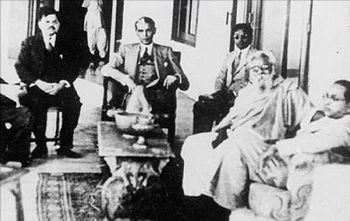 The Indian National Congress won the 1937 elections in Madras Presidency. Rajaji became the Chief Minister on 14 July 1937. He was a supporter of propagating Hindi in South India. On 11 August 1937, within a month of coming to power, he announced his intention to introduce Hindi language teaching in secondary schools by issuing a policy statement. On 21 April 1938, he issued a government order (G.O.) making the teaching of Hindi compulsory in 125 secondary school
s in the Presidency. Periyar and the opposition Justice Party led by A. T. Panneerselvam immediately opposed the move. They started state wide protests against Rajaji and Hindi.
The agitation was backed by Periyar's Self-Respect Movement
and Justice Party. It also had the support of Tamil scholars like Maraimalai Adigal
, Somasundara Bharathi, K. Appadurai, Mudiyarasan and Ilakkuvanar. In December 1937, Tamil Saivite scholars were among the first to announce their opposition to the Hindi teaching in the Saiva Sidhandha Maha Samaja conference at Velur. Women also participated in the agitation in large numbers. Moovalur Ramamirtham
, Narayani, Va. Ba. Thamaraikani, Munnagar Azhagiyar, Dr. Dharmambal, Malar Mugathammaiyar, Pattammal and Seethammal were some of the women who were arrested for participating in the agitation. On 13 November 1938, the Tamil Nadu Women's Conference was convened to demonstrate women's support for the movement. The agitation was marked by anti-Brahmin sentiments as the protesters believed Brahmins were attempting to impose Hindi and Sanskrit
over Tamil. Despite the general anti-Brahminism of the agitation, a few Brahmins like Kanchi Rajagopalachari also participated in the movement.
The Tamil speaking Muslims in the Madras presidency supported the agitation (in contrast to the Urdu
speaking Muslims, who supported the propagation of Hindi). The agitation was marked by fasts, protest marches, processions, picketing of schools teaching Hindi and government offices, anti-Hindi conferences, observing an anti-Hindi day (1 July and 3 December 1938) and black flag demonstrations. It was active in the Tamil speaking districts of the Presidency - Ramnad
, Tinnevely
, Salem
, Tanjore
and North Arcot
. During the course of the agitation, two protesters -Thalamuthu and Natarajan - lost their lives in police custody.
The ruling Congress Party was divided on the Hindi issue. While Rajaji and his supporters stuck to their position, Sathyamurti
and Sarvepalli Radhakrishnan
were against it. They wanted Rajaji to make Hindi optional or to provide a conscience clause for allowing parents to withhold their children from Hindi Classes. But Rajaji was firm in his stance. The police response to the agitation grew progressively brutal in 1939. During the agitation, a total of 1,198 protesters were arrested and out of them 1,179 were convicted (73 of those jailed were women and 32 children accompanied their mothers to prison). Periyar was fined 1,000 Rupees and sentenced to one year of rigorous imprisonment for inciting "women to disobey the law" (he was released within six months on 22 May 1939 citing medical grounds) and Annadurai was jailed for four months. On 7 June 1939, all those arrested for participating in the agitations were released without explanation. Rajaji also organised pro-Hindustani meetings to counter the agitators. On 29 October 1939, the Congress government resigned protesting the involvement of India in the Second World War, and the Madras provincial government was placed under Governor's rule. On 31 October, Periyar suspended the agitation and asked the Governor to withdraw the compulsory Hindi order. On 21 February 1940, Governor Erskine issued a press communique withdrawing compulsory Hindi teaching and making it optional.
complied and made Hindi compulsory from the academic year 1948-49. It also introduced a minimum mark qualification in Hindi for the promotion of students to higher classes. Periyar once again launched an anti-Hindi agitation. The 1948 agitation was supported by former Congress nationalists like M. P. Sivagnanam and Thiru. Vi. Ka
, who recanted their earlier pro-Hindi policies. On 17 July, the DK convened an all party anti-Hindi conference to oppose the compulsory Hindi teaching. As in the agitation of 1938-40, this agitation was also characterized by strikes, black flag demonstrations and anti-Hindi processions. When Rajaji (then the Governor-General of India
) visited Madras on 23 August, the DK staged a black flag demonstration protesting against his visit. On 27 August, Periyar and Annadurai were arrested. The Government did not change its position on Hindi and the agitation continued. On 18 December, Periyar and other DK leaders were arrested again. A compromise was reached between the government and agitators. The government stopped the legal action against the agitators and they in turn dropped the agitation on 26 December 1948. Eventually, the government made Hindi teaching optional from the academic year 1950-51. Students who did not want to learn Hindi were allowed to participate in other school activities during Hindi classes.
was established on 9 December 1946, for drafting a Constitution
when India became independent. The Constituent Assembly witnessed fierce debates on the language issue. The adoption of a "National Language", the language in which the constitution was to be written in and the language in which the proceedings of the assembly were to be conducted were the main linguistic questions debated by the framers of the Constitution. On one side were the members from the Hindi speaking provinces like Algu Rai Sastri, R.V. Dhulekar
, Balkrishna Sharma, Purushottam Das Tandon
, (all from United Provinces
), Babunath Gupta (Bihar
), Hari Vinayak Pataskar (Bombay
) and Seth Govind Das
(Central Provinces and Berar
). They moved a large number of pro-Hindi amendments and argued for adopting Hindi as the sole National Language. On 10 December 1946, Dhulekar declared "People who do not know Hindustani have no right to stay in India. People who are present in the House to fashion a constitution for India and do not know Hindustani are not worthy to be members of this assembly. They had better leave."
The pro-Hindi block was further divided into two camps: the Hindi faction comprising Tandon, Govind Das, Sampurnanand
, Ravishankar Shukla
and K. M. Munshi
; and the Hindustani faction represented by Jawaharlal Nehru and Abul Kalam Azad. The adoption of Hindi as the national language was opposed by members from South India like T.T. Krishnamachari, G. Durgabai, T. A. Ramalingam Chettiar
, N. G. Ranga, N. Gopalaswamy Ayyangar (all belonging to Madras) and S. V. Krishnamurthy Rao (Mysore). This anti-Hindi block favoured retaining English as official language. Their views were reflected in the following pronouncement of Krishnamachari:
After three years of debate, the assembly arrived at a compromise at the end of 1949. It was called the Munshi-Ayyangar formula (after K.M. Munshi and Gopalaswamy Ayyangar) and it struck a balance between the demands of all groups. Part XVII of the Indian Constitution was drafted according to this compromise. It did not have any mention of a "National Language". Instead, it defined only the "Official Languages" of the Union:
Hindi
in Devanagari
script would be the official language of the Indian Union. For fifteen years, English would also be used for all official purposes (Article 343). A language commission could be convened after five years to recommend ways to promote Hindi as the sole official language and to phase out the use of English (Article 344). Official communication between states and between states and the Union would be in the official language of the union (Article 345).English would be used for all legal purposes - in court proceedings, bills, laws, rules and other regulations (Article 348).The Union was duty bound to promote the spread and usage of Hindi (Article 351).
India became independent on 15 August 1947 and the Constitution was adopted on 26 January 1950.
's founder Syama Prasad Mookerjee
, who demanded that Hindi should be made National language. Soon after the Constitution was adopted on 26 January 1950, efforts were made to propagate Hindi for official usage. In 1952, the Ministry of Education launched a voluntary Hindi teaching scheme. On 27 May 1952, use of Hindi was introduced in warrants for judicial appointments. In 1955, in-house Hindi training was started for all ministries and departments of the central government. On 3 December 1955, the government started using Hindi (along with English) for "specific purposes of the Union"
As provided for by Article 343, Nehru appointed the First Official Language Commission under the chairmanship of B. G. Kher
on 7 June 1955. The commission delivered its report on 31 July 1956. It recommended a number of steps to eventually replace English with Hindi (The report had dissenting notes from two non-Hindi members - P. Subbarayan
from Madras State and Suniti Kumar Chatterji
from West Bengal
). The Parliamentary Committee on Official Language, chaired by Govind Ballabh Pant
was constituted in September 1957 to review the Kher commission report. After two years of deliberations, the Pant Committee submitted its recommendations to the President on 8 February 1959. It recommended that Hindi should be made the primary official language with English as the subsidiary one. The Kher Commission and the Pant Committee recommendations were condemned and opposed by from non Hindi politicians like Frank Anthony
and P. Subbarayan. The Academy of Telugu opposed the switch from English to Hindi in a convention held in 1956. Rajaji, once a staunch supporter of Hindi, organised an All India Language Conference (attended by representatives of Tamil, Malayalam, Telugu, Assamese, Oriya, Marathi, Kannada and Bengali languages) on 8 March 1958 to oppose the switch and declared "Hindi is as much foreign to non-Hindi speaking people as English is to the protagonists of Hindi."
As the opposition to Hindi grew stronger, Nehru tried to reassure the concerns of non-Hindi speakers. Speaking in the parliamentary debate on a bill introduced by Anthony to include English in the Eighth Schedule, Nehru gave an assurance to them (on 7 August 1959):
This assurance momentarily allayed the fears of the South Indians. But the Hindi proponents were dismayed and Pant remarked "Whatever I achieved in two years, the prime minister destroyed in less than two minutes".
. They claimed that the town's name (after Ramkrishna Dalmia
) symbolised the exploitation of South India by the North. On 15 July 1953, M. Karunanidhi
(later Chief Minister of Tamil Nadu) and other DMK members erased the Hindi name in Dalmiapuram railway station's name board and lay down on the tracks. In the altercation with the Police that followed the protests, two DMK members lost their lives and several others including Karunanidhi were arrested.
In the 1950s DMK continued its anti-Hindi policies along with the secessionist demand for Dravidistan
. On 28 January 1956, Annadurai along with Periyar and Rajaji signed a resolution passed by the Academy of Tamil Culture endorsing the continuation of English as the official language. On 21 September 1957 the DMK convened an anti-Hindi Conference to protest against the imposition of Hindi. It observed 13 October 1957 as "anti-Hindi Day". On 31 July 1960, another open air anti-Hindi conference was held at Kodambakkam, Madras. In November 1963, DMK dropped its secessionist demand in the wake of the Sino-Indian War
and the passage of the anti-secessionist 16th Amendment to the Indian Constitution. But the anti-Hindi stance remained and hardened with the passage of Official Languages Act of 1963. The DMK's view on Hindi's qualifications for official language status were reflected in Annadurai's response to the "numerical superiority of Hindi" argument: "If we had to accept the principle of numerical superiority while selecting our national bird, the choice would have fallen not on the peacock but on the common crow."
acted on the Pant Committee's recommendations and issued orders for preparation of Hindi glossaries, translating procedural literature and legal codes to Hindi, imparting Hindi education to government employees and other efforts for propagating Hindi.
To give legal status to Nehru's assurance of 1959, the Official Languages Act was passed in 1963. In Nehru's own words:
The Bill was introduced in Parliament on 21 January 1963. Opposition to the Bill came from DMK members who objected to the usage of the word "may" instead of "shall" in section 3 of the Bill. That section read: "the English language may...continue to be used in addition to Hindi". The DMK argued was that the term "may" could be interpreted as "may not" by future administrations. They feared that the minority opinion would not be considered and non Hindi speakers' views would be ignored. On 22 April, Nehru assured the parliamentarians that, for that particular case "may" had the same meaning as "shall". The DMK then demanded, if that was the case why "shall" was not used instead of "may". Leading the opposition to the Bill was Annadurai (then a Member of the Rajya Sabha
). He pleaded for an indefinite continuation of the status quo and argued that continued use of English as official language would "distribute advantages or disadvantages evenly" among Hindi and non-Hindi speakers. The Bill was passed on 27 April without any change in the wording. As he had warned earlier, Annadurai launched state wide protests against Hindi. In November 1963, Annadurai was arrested along with 500 DMK members for burning part XVII of the Constitution at an anti-Hindi Conference. He was sentenced to six months in prison. On 25 January 1964, a DMK member, Chinnasamy, committed suicide at Trichy by self immolation, to protest the "imposition of Hindi". He was claimed as the first "language martyr" of the second round of the anti-Hindi struggle by the DMK.
Nehru died in May 1964 and Lal Bahadur Shastri became Prime Minister of India. Shastri and his senior cabinet members Morarji Desai
and Gulzari Lal Nanda were strong supporters of Hindi being the sole official language. This increased the apprehension that Nehru's assurances of 1959 and 1963 will not be kept despite Shastri's assurances to the contrary. Concerns over the preference of Hindi in central government jobs, civil service examinations and the fear that English would be replaced with Hindi as medium of instruction brought students into the anti-Hindi agitation camp in large numbers. On 7 March 1964, the chief minister of Madras State, M. Bhaktavatsalam
at a session of the Madras Legislative Assembly recommended the introduction of Three-language formula
(English, Hindi and Tamil) in the state. Apprehension over the Three-language formula increased student support for the anti-Hindi cause.
, K. Kalimuthu
, Na. Kamarasan, Seyaprakasam, Ravichandran, Tiruppur. S. Duraiswamy
, Sedapatti Muthaiah
, Durai Murugan
, K. Raja Mohammad, Navalavan, M. Natarajan and L. Ganesan
.
Several student conferences were organised throughout the state to protest against Hindi imposition. On 17 January, the Madras State Anti-Hindi Conference was convened at Trichy and was attended by 700 delegates from Madras, Maharashtra, Kerala and Mysore. They called for the indefinite suspension of Part XVII of the constitution. The Home and Information & Broadcasting ministries of the central government (headed by Nanda and Indira Gandhi respectively) upped the ante and issued circulars for replacing English with Hindi from 26 January. On 16 January, Annadurai announced that 26 January (also the Republic Day of India
) would be observed as a day of mourning. Chief minister Bhaktavatsalam warned that the state government would not tolerate the sanctity of the Republic day blasphemed and threatened the students with "stern action" if they participated in politics. The DMK advanced the "Day of Mourning" by a day. On 25 January, Annadurai was taken into preventive custody along with 3000 DMK members to forestall the agitations planned for the next day. On 26 January, 50,000 students from Madras city's colleges marched from Napier park to the Government secretariat at Fort St. George and unsuccessfully tried to petition the chief minister.
On 25 January, a clash between agitating students and Congress party workers in Madurai
went out of control and became a riot. Rioting soon spread to other parts of the State. Police responded with lathi charges and firing on student processions. Acts of arson, looting and damage to public property became common. Railway cars and Hindi name boards at railway stations were burned down; telegraph poles were cut and railway tracks displaced. The Bhaktavatsalam Government considered the situation as a law and order problem and brought in para military forces to quell the agitation. Incensed by police action, violent mobs killed two police men. Several agitators committed suicide by self-immolation and by consuming poison. In two weeks of riots, around 70 people were killed (by official estimates). Some unofficial reports put the death toll as high as 500. A large number of students were arrested. The damage to property was assessed as one crore
Rupees.
On 28 January, classes in Madras University
, Annamalai University
and other colleges and schools in the state were suspended indefinitely. Within the Congress, opinion was divided: one group led by K. Kamaraj
wanted the government not to impose Hindi on the Tamils; but others like Morarji Desai did not relent. Home minister Nanda agreed with Bhaktavatsalam's handling of the agitation. Rioting continued throughout the first week of February and by the second week students lost control of the agitation. Violence continued despite Annadurai's appeal for calm. Efforts were made by both sides to find a compromise. On 11 February, C. Subramaniam and O. V. Alagesan
, two union ministers from Madras state, resigned protesting the government's language policy. President Sarvepalli Radhakrishnan refused to accept the Prime Minister Shastri's recommendation that their resignations be accepted. Shastri backed down and made a broadcast through All India Radio
on February 11. Expressing shock over the riots, he promised to honour Nehru's assurances. He also assured Tamils that English would continue to be used for centre-state and intrastate communications and that the All India Civil Services examination would continue to be conducted in English.
, blackening out English signs with tar. The agitation slowly changed into a general anti-Congress organisation. In the 1967 election, student leader P. Seenivasan contested against Kamaraj in the Virudhunagar
constituency. A large number of students from all over the state campaigned for him and ensured his victory: the Congress party was defeated and DMK came to power for the first time in Madras State.
and Gujarat voiced their opposition for change and on 25 February, 106 Congress MPs met the Prime Minister to request him not to amend the Act. However, Congress MPs from Madras did not debate the issue on the Parliament floor but met the Prime Minister on 12 March. Congress and opposition parties hesitated to debate the issue in Parliament as they did not wish to make their bitter divisions in public. On 22 February at a meeting in Congress Working Committee, K. Kamaraj
pressed for the amendment to Official Languages Act, but received instant opposition from Morarji Desai, Jagjivan Ram
and Ram Subhag. The Congress working committee finally agreed to a resolution which amounted to slowing down of Hindi-isation, strong implementation of the three language formula
in Hindi and non-Hindi speaking states, and conduct of the public services exam in all regional languages. These decisions were agreed upon during the Chief Ministers' meeting which was held on February 24.
The three language formula was not strictly enforced either in South or Hindi-speaking areas. The changes to public services exams were impractical and not well received by government officials. The only real concession to the south was the assurance that the Official Languages Act would be modified. However, any effort to follow through with that pledge received stiff resistance. In April 1965, a meeting of a cabinet sub-committee comprising Gulzari lal Nanda, A. K. Sen, Satyanarayan Sinha, Mahavir Tyagi
, M. C. Chagla and S. K. Patil
and but no southern members debated the issue and could not come to any agreement. The sub-committee recommended the continuation of English and Hindi as joint link languages and was not in favour of either quota system or use of regional languages in public services exams. They drafted an amendment to Official Languages Act incorporating Nehru's assurances explicitly. This Bill guaranteeing the use of English in inter-state and state-Union communications as long as desired by Non-Hindi states was approved for discussion by the Speaker on August 25. But it was withdrawn after a bitter debate citing inopportune time due to the ongoing Punjabi Suba movement and Kashmir crisis at that time.
(NCC), banning of Hindi films and songs and closure of the Dakshina Bharat Hindi Prachara Sabha - the Institution for propagation of Hindi in South India.
On 19 December 1967, the agitation was restarted. It turned violent in 21 December and acts of arson and looting were reported in the state. Annadurai defused the situation by accepting most of their demands. On 23 January 1968, a resolution was passed in the Legislative Assembly. It accomplished the following:
The Three-Language policy was scrapped and Hindi was eliminated from the curriculum. Only English and Tamil were to be taught, the use of Hindi commands in NCC was banned, Tamil was to be introduced as medium of instruction in all colleges and as the language of administration within five years, the Central Government was urged to end the special status accorded to Hindi in the Constitution and treat all languages equally, and was urged to provide financial assistance for development of all languages mentioned in the Eighth Schedule of the Constitution. These measures satisfied the agitators and normalcy returned by February 1968.
introduced the "National Education Policy". This education policy provided for setting up Navodaya Schools
, where the DMK claimed teaching of Hindi would be compulsory. The Anna Dravida Munnetra Kazhagam (ADMK) led by M. G. Ramachandran
(which had split from the DMK in 1972), was in power in Tamil Nadu and the DMK was the main opposition party. Karunanidhi announced an agitation against the opening of Navodaya Schools in Tamil Nadu. On 13 November, the Tamil Nadu Legislative Assembly unanimously passed a resolution demanding the repeal of Part XVII of the constitution and for making English the sole official language of the union.
On 17 November 1986, DMK members protested against the new education policy by burning Part XVII of the Constitution. 20,000 DMK members including Karunanidhi were arrested. 21 persons committed suicide by self immolation. Karunanidhi was sentenced to ten weeks of rigorous imprisonment. Ten DMK MLAs including K. Anbazhagan
were expelled from the Legislative Assembly by the speaker P. H. Pandian
. Rajiv Gandhi assured Members of Parliament from Tamil Nadu that Hindi would not be imposed. As part of the compromise, Navodhaya schools were not started in Tamil Nadu. Currently, Tamil Nadu is the only state in India without Navodhaya schools.
and the continuing dominance of Dravidian parties in Tamil Nadu politics. Many political leaders of the DMK and ADMK, like P. Seenivasan, K. Kalimuthu, Durai Murugan, Tiruppur. S. Duraiswamy, Sedapatti Muthaiah, K. Raja Mohammad, M. Natarajan and L. Ganesan, owe their entry and advancement in politics to their stints as student leaders during the agitations, which also reshaped the Dravidian Movement and broadened its political base, when it shifted from its earlier pro-Tamil (and anti-Brahmin) stance to a more inclusive one, which was both anti-Hindi and pro-English. Finally, the current two-language education policy followed in Tamil Nadu is also a direct result of the agitations.
In the words of Sumathi Ramaswamy (Professor of History at Duke University
),
The anti-Hindi agitations ensured the passage of Official Languages Act of 1963 and its amendment in 1967, thus ensuring the continued use of English as an official language of India. They effectively brought about the "virtual indefinite policy of bilingualism" of the Indian Republic.
India
India , officially the Republic of India , is a country in South Asia. It is the seventh-largest country by geographical area, the second-most populous country with over 1.2 billion people, and the most populous democracy in the world...
n state of Tamil Nadu
Tamil Nadu
Tamil Nadu is one of the 28 states of India. Its capital and largest city is Chennai. Tamil Nadu lies in the southernmost part of the Indian Peninsula and is bordered by the union territory of Pondicherry, and the states of Kerala, Karnataka, and Andhra Pradesh...
(formerly Madras State
Madras State
Madras State was the name by which the Indian districts in Tamil Nadu, Andhra, Northern Kerala, Bellary and Dakshina Kannada were collectively known as from 1950 to 1953....
and part of Madras Presidency
Madras Presidency
The Madras Presidency , officially the Presidency of Fort St. George and also known as Madras Province, was an administrative subdivision of British India...
) during both pre- and post-Independence periods. The agitations involved several mass protests, riots, student and political movements in Tamil Nadu, and concerned the official status of Hindi
Hindi
Standard Hindi, or more precisely Modern Standard Hindi, also known as Manak Hindi , High Hindi, Nagari Hindi, and Literary Hindi, is a standardized and sanskritized register of the Hindustani language derived from the Khariboli dialect of Delhi...
in the state and in the Indian Republic.
The first anti-Hindi agitation was launched in 1937, in opposition to the introduction of compulsory teaching of Hindi in the schools of Madras Presidency by the first Indian National Congress
Indian National Congress
The Indian National Congress is one of the two major political parties in India, the other being the Bharatiya Janata Party. It is the largest and one of the oldest democratic political parties in the world. The party's modern liberal platform is largely considered center-left in the Indian...
government led by C. Rajagopalachari
C. Rajagopalachari
Chakravarti Rajagopalachari , informally called Rajaji or C.R., was an Indian lawyer, independence activist, politician, writer and statesman. Rajagopalachari was the last Governor-General of India...
(Rajaji). This move was immediately opposed by E. V. Ramasamy
Periyar E. V. Ramasamy
Erode Venkata Ramasamy , affectionately called by his followers as Periyar , Thanthai Periyar or E. V...
(Periyar) and the opposition Justice Party
Justice Party (India)
The Justice Party , officially known as South Indian Liberal Federation, was a political party in the Madras Presidency of British India. The party was established in 1917 by T. M. Nair and Theagaroya Chetty as a result of a series of non-Brahmin conferences and meetings in the presidency...
(later Dravidar Kazhagam
Dravidar Kazhagam
Dravidar Kazhagam or Dravida Kazhagam was the first fully Dravidian party in India. It was a radical party formed by E. V. Ramaswamy, also called Thanthai Periyar of erstwhile Madras Presidency...
). The agitation, which lasted three years, was multifaceted and involved fasts
Fasting
Fasting is primarily the act of willingly abstaining from some or all food, drink, or both, for a period of time. An absolute fast is normally defined as abstinence from all food and liquid for a defined period, usually a single day , or several days. Other fasts may be only partially restrictive,...
, conferences, marches, picketing and protests. The government responded with a crackdown resulting in the death of two protesters and the arrest of 1,198 persons including women and children. The mandatory Hindi education was later withdrawn by the British Governor of Madras Lord Erskine
John Erskine, Lord Erskine
John Francis Ashley Erskine, Lord Erskine GCSI, GCIE was a British soldier, Conservative Party politician and administrator who served as Member of Parliament for Weston-super-Mare and Brighton...
in February 1940 after the resignation of the Congress Government in 1939.
Adoption of an official language for the Indian Republic was a hotly debated issue during the framing of the Indian Constitution
Constitution of India
The Constitution of India is the supreme law of India. It lays down the framework defining fundamental political principles, establishes the structure, procedures, powers, and duties of government institutions, and sets out fundamental rights, directive principles, and the duties of citizens...
after India's independence
Indian independence movement
The term Indian independence movement encompasses a wide area of political organisations, philosophies, and movements which had the common aim of ending first British East India Company rule, and then British imperial authority, in parts of South Asia...
from Britain
United Kingdom
The United Kingdom of Great Britain and Northern IrelandIn the United Kingdom and Dependencies, other languages have been officially recognised as legitimate autochthonous languages under the European Charter for Regional or Minority Languages...
. After an exhaustive and divisive debate, Hindi was adopted as the official language of India with English continuing as an associate official language for a period of fifteen years, after which Hindi would become the sole official language. The new Constitution came into effect on 26 January 1950. Efforts by the Indian Government to make Hindi the sole official language after 1965 were not acceptable to many non-Hindi Indian states, who wanted the continued use of English. The Dravida Munnetra Kazhagam
Dravida Munnetra Kazhagam
Dravida Munnetra Kazhagam is a state political party in the states of Tamil Nadu and Pondicherry, India. It is a Dravidian party founded by C. N. Annadurai as a breakaway faction from the Dravidar Kazhagam headed by Periyar...
(DMK), a descendant of Dravidar Kazhagam, led the opposition to Hindi. To allay their fears, Prime Minister Jawaharlal Nehru
Jawaharlal Nehru
Jawaharlal Nehru , often referred to with the epithet of Panditji, was an Indian statesman who became the first Prime Minister of independent India and became noted for his “neutralist” policies in foreign affairs. He was also one of the principal leaders of India’s independence movement in the...
enacted the Official Languages Act in 1963 to ensure the continuing use of English beyond 1965. The text of the Act did not satisfy the DMK and increased their skepticism that his assurances might not be honoured by future administrations.
As the day (26 January 1965) of switching over to Hindi as sole official language approached, the anti-Hindi movement gained momentum in Madras State with increased support from college students. On 25 January, a full-scale riot broke out in the southern city of Madurai
Madurai
Madurai is the third largest city in the Indian state of Tamil Nadu and one of the oldest continuously inhabited cities in the world. It served as the capital city of the Pandyan Kingdom. It is the administrative headquarters of Madurai District and is famous for its temples built by Pandyan and...
, sparked off by a minor altercation between agitating students and Congress party members. The riots spread all over Madras State, continued unabated for the next two months, and were marked by acts of violence, arson, looting, police firing and lathi
Lathi
Lathi means stick and also refers to an Indian martial art based on cane-fighting. The word is used in Hindi, Bengali and various other Indian languages. The lathi typically measures 6 to and may be tipped with metal. It commonly used as a crowd control device by the Indian Police and other South...
charges. The Congress Government of the Madras State, called in paramilitary forces to quell the agitation; their involvement resulted in the deaths of about seventy persons (by official estimates) including two policemen. To calm the situation, Indian Prime Minister Lal Bahadur Shastri
Lal Bahadur Shastri
Lal Bahadur Srivastava Shastri was the second Prime Minister of the Republic of India and a significant figure in the Indian independence movement.-Early life:...
gave assurances that English would continue to be used as the official language as long the non-Hindi speaking states wanted. The riots subsided after Shastri's assurance, as did the student agitation.
The agitations of 1965 led to major political changes in the state. The DMK won the 1967 assembly election and the Congress Party never managed to recapture power in the state since then. The Official Languages Act was eventually amended in 1967 by the Congress Government headed by Indira Gandhi
Indira Gandhi
Indira Priyadarshini Gandhara was an Indian politician who served as the third Prime Minister of India for three consecutive terms and a fourth term . She was assassinated by Sikh extremists...
to guarantee the indefinite use of Hindi and English as official languages. This effectively ensured the current "virtual indefinite policy of bilingualism" of the Indian Republic. There were also two similar (but smaller) agitations in 1968 and 1986 which had varying degrees of success.
Background
The Republic of India has hundreds of languages. According to the Census of 2001, there are 1,635 rationalized mother tongues and 122 languages with more than 10,000 speakers. During the British RajBritish Raj
British Raj was the British rule in the Indian subcontinent between 1858 and 1947; The term can also refer to the period of dominion...
, English was the official language
Official language
An official language is a language that is given a special legal status in a particular country, state, or other jurisdiction. Typically a nation's official language will be the one used in that nation's courts, parliament and administration. However, official status can also be used to give a...
. When the Indian Independence Movement gained momentum in the early part of the 20th Century, efforts were undertaken to make Hindustani
Hindustani language
Hindi-Urdu is an Indo-Aryan language and the lingua franca of North India and Pakistan. It is also known as Hindustani , and historically, as Hindavi or Rekhta...
as a common language to unite various linguistic groups against the British Government. As early as 1918, Mahatma Gandhi
Mahatma Gandhi
Mohandas Karamchand Gandhi , pronounced . 2 October 1869 – 30 January 1948) was the pre-eminent political and ideological leader of India during the Indian independence movement...
established the Dakshin Bharat Hindi Prachar Sabha
Dakshin Bharat Hindi Prachar Sabha
Dakshina Bharat Hindi Prachar Sabha is an organisation whose main goal is to improve Hindi literacy among the non-Hindi speaking people of South India. The headquarters are located at Thanikachalam Road, T...
(Institution for the Propagation of Hindi in South India). In 1925, the Indian National Congress switched to Hindustani from English for conducting its proceedings. Both Gandhi and Jawaharlal Nehru
Jawaharlal Nehru
Jawaharlal Nehru , often referred to with the epithet of Panditji, was an Indian statesman who became the first Prime Minister of independent India and became noted for his “neutralist” policies in foreign affairs. He was also one of the principal leaders of India’s independence movement in the...
were supporters of Hindustani and Congress wanted to propagate the learning of Hindustani in non-Hindi speaking Provinces of India. The idea of making Hindustani or Hindi the common language, was not acceptable to Periyar, who viewed it as an attempt to make Tamils subordinate to North India
North India
North India, known natively as Uttar Bhārat or Shumālī Hindustān , is a loosely defined region in the northern part of India. The exact meaning of the term varies by usage...
ns.
Agitation of 1937-40
Secondary school
Secondary school is a term used to describe an educational institution where the final stage of schooling, known as secondary education and usually compulsory up to a specified age, takes place...
s in the Presidency. Periyar and the opposition Justice Party led by A. T. Panneerselvam immediately opposed the move. They started state wide protests against Rajaji and Hindi.
The agitation was backed by Periyar's Self-Respect Movement
Self-Respect Movement
The Self-Respect Movement was founded in 1925 by Periyar E. V. Ramasamy in Tamil Nadu, India. The movement has the aim of achieving a society where backward castes have equal human rights, and encouraging backward castes to have self-respect in the context of a caste based society that...
and Justice Party. It also had the support of Tamil scholars like Maraimalai Adigal
Maraimalai Adigal
Maraimalai Adigal was an eminent Tamil orator and writer. He was a devout Hindu as a staunch follower of Saivism. He has authored more than 100 books, including works on original poems and dramas, but most famous are his books on his research into Tamil literature. Most of his literary works were...
, Somasundara Bharathi, K. Appadurai, Mudiyarasan and Ilakkuvanar. In December 1937, Tamil Saivite scholars were among the first to announce their opposition to the Hindi teaching in the Saiva Sidhandha Maha Samaja conference at Velur. Women also participated in the agitation in large numbers. Moovalur Ramamirtham
Moovalur Ramamirtham
Moovalur Ramamirtham was a Tamil social reformer, author, former Devadasi and political activist of the Dravidian Movement, who worked for the abolition of the Devadasi system in the Madras Presidency. She was the author of the autobiographical 1936 novel Dasigalin Mosavalai alladhu madhi pettra...
, Narayani, Va. Ba. Thamaraikani, Munnagar Azhagiyar, Dr. Dharmambal, Malar Mugathammaiyar, Pattammal and Seethammal were some of the women who were arrested for participating in the agitation. On 13 November 1938, the Tamil Nadu Women's Conference was convened to demonstrate women's support for the movement. The agitation was marked by anti-Brahmin sentiments as the protesters believed Brahmins were attempting to impose Hindi and Sanskrit
Sanskrit
Sanskrit , is a historical Indo-Aryan language and the primary liturgical language of Hinduism, Jainism and Buddhism.Buddhism: besides Pali, see Buddhist Hybrid Sanskrit Today, it is listed as one of the 22 scheduled languages of India and is an official language of the state of Uttarakhand...
over Tamil. Despite the general anti-Brahminism of the agitation, a few Brahmins like Kanchi Rajagopalachari also participated in the movement.
The Tamil speaking Muslims in the Madras presidency supported the agitation (in contrast to the Urdu
Urdu
Urdu is a register of the Hindustani language that is identified with Muslims in South Asia. It belongs to the Indo-European family. Urdu is the national language and lingua franca of Pakistan. It is also widely spoken in some regions of India, where it is one of the 22 scheduled languages and an...
speaking Muslims, who supported the propagation of Hindi). The agitation was marked by fasts, protest marches, processions, picketing of schools teaching Hindi and government offices, anti-Hindi conferences, observing an anti-Hindi day (1 July and 3 December 1938) and black flag demonstrations. It was active in the Tamil speaking districts of the Presidency - Ramnad
Ramanathapuram District
Ramanathapuram District is an administrative district of Tamil Nadu state in southern India. The city of Ramanathapuram is the district headquarters. Ramanthapuram District has an area of 4123 km²...
, Tinnevely
Tirunelveli District
Tirunelveli District is a district of Tamil Nadu state in southern India. The city of Tirunelveli is the district headquarters. A unique feature of this district is that it encompasses all five geographical traditions of Tamil Literature; kurinji , mullai , marudham , neithal and palai...
, Salem
Salem District
Salem District is a district of Tamil Nadu state in southern India. The city of Salem is the district headquarters. Other major towns in the district are Mettur, Omalur and Attur...
, Tanjore
Thanjavur District
Thanjavur District is one of the 32 districts of the state of Tamil Nadu, in southeastern India. Its headquarters is Thanjavur.-Geography:...
and North Arcot
North Arcot
The Indian District of North Arcot was split on 30-09-1989 into Tiruvannamalai-Sambuvarayar and North Arcot Ambedkar .- History :...
. During the course of the agitation, two protesters -Thalamuthu and Natarajan - lost their lives in police custody.
The ruling Congress Party was divided on the Hindi issue. While Rajaji and his supporters stuck to their position, Sathyamurti
S. Satyamurti
S. Satyamurti was an Indian politician and patriot. A protege of S. Srinivasa Iyengar, Satyamurti was the political mentor of Kumaraswami Kamaraj....
and Sarvepalli Radhakrishnan
Sarvepalli Radhakrishnan
Sir Sarvepalli Radhakrishnan , OM, FBA was an Indian philosopher and statesman. He was the first Vice President of India and subsequently the second President of India ....
were against it. They wanted Rajaji to make Hindi optional or to provide a conscience clause for allowing parents to withhold their children from Hindi Classes. But Rajaji was firm in his stance. The police response to the agitation grew progressively brutal in 1939. During the agitation, a total of 1,198 protesters were arrested and out of them 1,179 were convicted (73 of those jailed were women and 32 children accompanied their mothers to prison). Periyar was fined 1,000 Rupees and sentenced to one year of rigorous imprisonment for inciting "women to disobey the law" (he was released within six months on 22 May 1939 citing medical grounds) and Annadurai was jailed for four months. On 7 June 1939, all those arrested for participating in the agitations were released without explanation. Rajaji also organised pro-Hindustani meetings to counter the agitators. On 29 October 1939, the Congress government resigned protesting the involvement of India in the Second World War, and the Madras provincial government was placed under Governor's rule. On 31 October, Periyar suspended the agitation and asked the Governor to withdraw the compulsory Hindi order. On 21 February 1940, Governor Erskine issued a press communique withdrawing compulsory Hindi teaching and making it optional.
Agitations of 1946-50
During 1946-50, there were sporadic agitations against Hindi by the Dravidar Kazhagam (DK) and Periyar. Whenever the government introduced Hindi as a compulsory language in schools, anti-Hindi protests happened and succeeded in stopping the move. The largest anti-Hindi agitations in this period occurred in 1948-50. After India obtained independence in 1947, the Congress Government at the Centre urged all states to make Hindi compulsory in schools. The Congress Government of Madras Presidency under Omandur Ramasamy ReddiarO. P. Ramaswamy Reddiyar
Omandur Ramasamy Reddiar was an Indian freedom-fighter and politician of the Indian National Congress. He served as the Premier of Madras Presidency from March 23, 1947 to April 6, 1949.-Early life:...
complied and made Hindi compulsory from the academic year 1948-49. It also introduced a minimum mark qualification in Hindi for the promotion of students to higher classes. Periyar once again launched an anti-Hindi agitation. The 1948 agitation was supported by former Congress nationalists like M. P. Sivagnanam and Thiru. Vi. Ka
V. Kalyanasundaram
Thiruvarur Viruttacala Kalyanasundaram, , better known by his Tamil initials Thiru Vi Ka , was a Tamil scholar, essayist and activist. He is esteemed for the strong humanism of his essays, the analytical depth of his commentaries on classical Tamil literature and philosophy, and the clear, fluid...
, who recanted their earlier pro-Hindi policies. On 17 July, the DK convened an all party anti-Hindi conference to oppose the compulsory Hindi teaching. As in the agitation of 1938-40, this agitation was also characterized by strikes, black flag demonstrations and anti-Hindi processions. When Rajaji (then the Governor-General of India
Governor-General of India
The Governor-General of India was the head of the British administration in India, and later, after Indian independence, the representative of the monarch and de facto head of state. The office was created in 1773, with the title of Governor-General of the Presidency of Fort William...
) visited Madras on 23 August, the DK staged a black flag demonstration protesting against his visit. On 27 August, Periyar and Annadurai were arrested. The Government did not change its position on Hindi and the agitation continued. On 18 December, Periyar and other DK leaders were arrested again. A compromise was reached between the government and agitators. The government stopped the legal action against the agitators and they in turn dropped the agitation on 26 December 1948. Eventually, the government made Hindi teaching optional from the academic year 1950-51. Students who did not want to learn Hindi were allowed to participate in other school activities during Hindi classes.
Official languages and the Indian Constitution
The Indian Constituent AssemblyConstituent Assembly of India
The Constituent Assembly of India was elected to write the Constitution of India, and following independence served as the nation's first Parliament.-Nature of the Assembly:...
was established on 9 December 1946, for drafting a Constitution
Constitution of India
The Constitution of India is the supreme law of India. It lays down the framework defining fundamental political principles, establishes the structure, procedures, powers, and duties of government institutions, and sets out fundamental rights, directive principles, and the duties of citizens...
when India became independent. The Constituent Assembly witnessed fierce debates on the language issue. The adoption of a "National Language", the language in which the constitution was to be written in and the language in which the proceedings of the assembly were to be conducted were the main linguistic questions debated by the framers of the Constitution. On one side were the members from the Hindi speaking provinces like Algu Rai Sastri, R.V. Dhulekar
Pandit Raghunath Vinayak Dhulekar
Pandit Raghunath Vinayak Dhulekar was a prominent Indian freedom fighter from Uttar Pradesh who took an active part in the Quit India movement and held many responsible positions in Indian politics such as Member of the Parliament of India and Constituent Assembly in the year 1952...
, Balkrishna Sharma, Purushottam Das Tandon
Purushottam Das Tandon
Purushottam Das Tandon पुरुषोत्तम दास टंडन , was a freedom fighter from Uttar Pradesh in India, of Punjabi Khatri descent. He is widely remembered for his efforts in achieving the Official Language of India status for Hindi. He was customarily given the title Rajarshi...
, (all from United Provinces
United Provinces of British India
The United Provinces of British India, more commonly known as the United Provinces, was a province of British India, which came into existence on 3 January 1921 as a result of the renaming of the United Provinces of Agra and Oudh. It corresponded approximately to the combined regions of the...
), Babunath Gupta (Bihar
Bihar
Bihar is a state in eastern India. It is the 12th largest state in terms of geographical size at and 3rd largest by population. Almost 58% of Biharis are below the age of 25, which is the highest proportion in India....
), Hari Vinayak Pataskar (Bombay
Bombay Presidency
The Bombay Presidency was a province of British India. It was established in the 17th century as a trading post for the English East India Company, but later grew to encompass much of western and central India, as well as parts of post-partition Pakistan and the Arabian Peninsula.At its greatest...
) and Seth Govind Das
Seth Govind Das
Seth Govind Das was a freedom fighter and a distinguished parliamentarian. He belonged to the famous Maheshwari merchant family of Raja Gokuldas of Jabalpur....
(Central Provinces and Berar
Central Provinces and Berar
The Central Provinces and Berar was a province of British India. The province comprised British conquests from the Mughals and Marathas in central India, and covered much of present-day Madhya Pradesh, Chhattisgarh and Maharashtra states. Its capital was Nagpur. The Central Provinces was formed in...
). They moved a large number of pro-Hindi amendments and argued for adopting Hindi as the sole National Language. On 10 December 1946, Dhulekar declared "People who do not know Hindustani have no right to stay in India. People who are present in the House to fashion a constitution for India and do not know Hindustani are not worthy to be members of this assembly. They had better leave."
The pro-Hindi block was further divided into two camps: the Hindi faction comprising Tandon, Govind Das, Sampurnanand
Sampurnanand
Dr Sampurnanand was a teacher and politician in Uttar Pradesh, India. He was elected to the Uttar Pradesh legislative assembly and served as chief minister of the state from 1954 to 1960.If we consider single tenure in the office of the U.P. C.M. then Dr...
, Ravishankar Shukla
Ravishankar Shukla
Raj's father is called Manshuklal and he's name after him.Pandit Ravishankar Shukla , was a leader of the Indian National Congress, Indian independence movement activist, the Premier of the Central Provinces and Berar from 27 April 1946 to 25 January 1950, the first Chief Minister of Madhya Pradesh...
and K. M. Munshi
K. M. Munshi
Kanaiyalal Maneklal Munshi was an Indian independence movement activist, politician, writer and educationist from Gujarat state. A lawyer by profession, he later turned to literature and politics. He was a well known name in Gujarati literature...
; and the Hindustani faction represented by Jawaharlal Nehru and Abul Kalam Azad. The adoption of Hindi as the national language was opposed by members from South India like T.T. Krishnamachari, G. Durgabai, T. A. Ramalingam Chettiar
T. A. Ramalingam Chettiar
Tiruppur Angappa Ramalingam Chettiar was an Indian lawyer, politician, member of parliament and businessman from the Indian state of Tamil Nadu.-Early life:...
, N. G. Ranga, N. Gopalaswamy Ayyangar (all belonging to Madras) and S. V. Krishnamurthy Rao (Mysore). This anti-Hindi block favoured retaining English as official language. Their views were reflected in the following pronouncement of Krishnamachari:
We disliked the English language in the past. I disliked it because I was forced to learn ShakespeareWilliam ShakespeareWilliam Shakespeare was an English poet and playwright, widely regarded as the greatest writer in the English language and the world's pre-eminent dramatist. He is often called England's national poet and the "Bard of Avon"...
and MiltonJohn MiltonJohn Milton was an English poet, polemicist, a scholarly man of letters, and a civil servant for the Commonwealth of England under Oliver Cromwell...
, for which I had no taste at all. If we are going to be compelled to learn Hindi, I would perhaps not be able to learn it because of my age, and perhaps I would not be willing to do it because of the amount of constraint you put on me. This kind of intolerance makes us fear that the strong Centre which we need, a strong Centre which is necessary will also mean the enslavement of people who do not speak the language at the centre. I would, Sir, convey a warning on behalf of people of the South for the reason that there are already elements in South India who want separation..., and my honourable friends in U.P. do not help us in any way by flogging their idea of "Hindi Imperialism" to the maximum extent possible. So, it is up to my friends in Uttar Pradesh to have a whole India; it is up to them to have a Hindi-India. The choice is theirs.
After three years of debate, the assembly arrived at a compromise at the end of 1949. It was called the Munshi-Ayyangar formula (after K.M. Munshi and Gopalaswamy Ayyangar) and it struck a balance between the demands of all groups. Part XVII of the Indian Constitution was drafted according to this compromise. It did not have any mention of a "National Language". Instead, it defined only the "Official Languages" of the Union:
Hindi
Hindi
Standard Hindi, or more precisely Modern Standard Hindi, also known as Manak Hindi , High Hindi, Nagari Hindi, and Literary Hindi, is a standardized and sanskritized register of the Hindustani language derived from the Khariboli dialect of Delhi...
in Devanagari
Devanagari
Devanagari |deva]]" and "nāgarī" ), also called Nagari , is an abugida alphabet of India and Nepal...
script would be the official language of the Indian Union. For fifteen years, English would also be used for all official purposes (Article 343). A language commission could be convened after five years to recommend ways to promote Hindi as the sole official language and to phase out the use of English (Article 344). Official communication between states and between states and the Union would be in the official language of the union (Article 345).English would be used for all legal purposes - in court proceedings, bills, laws, rules and other regulations (Article 348).The Union was duty bound to promote the spread and usage of Hindi (Article 351).
India became independent on 15 August 1947 and the Constitution was adopted on 26 January 1950.
The language commission
The adoption of English as official language along with Hindi was heavily criticized by pro-Hindi politicians like Jana SanghBharatiya Jana Sangh
The Bharatiya Jana Sangh existed from 1951 to 1980, whereupon it was succeeded by the Bharatiya Janata Party, one of India's largest political parties...
's founder Syama Prasad Mookerjee
Syama Prasad Mookerjee
Dr. Shyama Prasad Mookerjee was a minister in Jawaharlal Nehru's Cabinet as a Minister for Industry and Supply....
, who demanded that Hindi should be made National language. Soon after the Constitution was adopted on 26 January 1950, efforts were made to propagate Hindi for official usage. In 1952, the Ministry of Education launched a voluntary Hindi teaching scheme. On 27 May 1952, use of Hindi was introduced in warrants for judicial appointments. In 1955, in-house Hindi training was started for all ministries and departments of the central government. On 3 December 1955, the government started using Hindi (along with English) for "specific purposes of the Union"
As provided for by Article 343, Nehru appointed the First Official Language Commission under the chairmanship of B. G. Kher
B. G. Kher
Balasaheb Gangadhar Kher was the first chief minister of Bombay State which consisted of present day Maharastra and Gujrat States of India. He was awarded the Padma Vibhushan by the Government of India in 1954...
on 7 June 1955. The commission delivered its report on 31 July 1956. It recommended a number of steps to eventually replace English with Hindi (The report had dissenting notes from two non-Hindi members - P. Subbarayan
P. Subbarayan
Paramasiva Subbarayan was an Indian politician, freedom fighter and diplomat and was the Chief Minister of Madras Presidency, India's ambassador to Indonesia and Union Minister of Transport and Communications in Jawaharlal Nehru's government. He is the father of General P. P...
from Madras State and Suniti Kumar Chatterji
Suniti Kumar Chatterji
Suniti Kumar Chatterji was an Indian linguist, educationist and litterateur. He was born on 26 November 1890 at Shibpur in Howrah...
from West Bengal
West Bengal
West Bengal is a state in the eastern region of India and is the nation's fourth-most populous. It is also the seventh-most populous sub-national entity in the world, with over 91 million inhabitants. A major agricultural producer, West Bengal is the sixth-largest contributor to India's GDP...
). The Parliamentary Committee on Official Language, chaired by Govind Ballabh Pant
Govind Ballabh Pant
Bharat Ratna Pandit Govind Ballabh Pant was a statesman of India, an Indian independence activist, and one of the foremost political leaders from Uttarakhand and of the movement to establish Hindi as the official language of India.-Early life:Govind Ballabh Pant was born on September 10, 1887 in...
was constituted in September 1957 to review the Kher commission report. After two years of deliberations, the Pant Committee submitted its recommendations to the President on 8 February 1959. It recommended that Hindi should be made the primary official language with English as the subsidiary one. The Kher Commission and the Pant Committee recommendations were condemned and opposed by from non Hindi politicians like Frank Anthony
Frank Anthony
Frank Anthony was a prominent leader of the Anglo-Indian community in India, and was until his death their nominated representative in the Parliament of India....
and P. Subbarayan. The Academy of Telugu opposed the switch from English to Hindi in a convention held in 1956. Rajaji, once a staunch supporter of Hindi, organised an All India Language Conference (attended by representatives of Tamil, Malayalam, Telugu, Assamese, Oriya, Marathi, Kannada and Bengali languages) on 8 March 1958 to oppose the switch and declared "Hindi is as much foreign to non-Hindi speaking people as English is to the protagonists of Hindi."
As the opposition to Hindi grew stronger, Nehru tried to reassure the concerns of non-Hindi speakers. Speaking in the parliamentary debate on a bill introduced by Anthony to include English in the Eighth Schedule, Nehru gave an assurance to them (on 7 August 1959):
I believe also two things. As I just said, there must be no imposition. Secondly, for an indefinite period - I do not know how long - I should have, I would have English as an associate, additional language which can be used not because of facilities and all that... but because I do not wish the people of Non-Hindi areas to feel that certain doors of advance are closed to them because they are forced to correspond - the Government, I mean - in the Hindi language. They can correspond in English. So I could have it as an alternate language as long as people require it and the decision for that - I would leave not to the Hindi-knowing people, but to the non Hindi-knowing people.
This assurance momentarily allayed the fears of the South Indians. But the Hindi proponents were dismayed and Pant remarked "Whatever I achieved in two years, the prime minister destroyed in less than two minutes".
DMK's anti-Hindi policies
The Dravida Munnetra Kazhagam (DMK) which split from the Dravidar Kazhagam in 1949, inherited the anti-Hindi policies of its parent organisation. DMK's founder Annadurai had earlier participated in the anti-Hindi agitations during 1938-40 and in the 1940s. In July 1953, the DMK launched an agitation for changing the name of a town - Dalmiapuram - to KallakudiKallakudi
Kallakudi is a panchayat town in Tiruchirappalli district in the Indian state of Tamil Nadu.-Demographics: India census, Kallakudi had a population of 11,625. Males constitute 50% of the population and females 50%. Kallakudi has an average literacy rate of 83%, higher than the national average of...
. They claimed that the town's name (after Ramkrishna Dalmia
Ramkrishna Dalmia
Ramkrishna Dalmia was a pioneer industrialist and founder of the Dalmia-Jain Group. Starting with a bullion business, he built several sugar mills, and went on to acquire Bennett and Coleman,...
) symbolised the exploitation of South India by the North. On 15 July 1953, M. Karunanidhi
M. Karunanidhi
Muthuvel Karunanidhi is an Indian politician and a former Chief Minister of Tamil Nadu. He is the head of Dravida Munnetra Kazhagam , a Dravidian political party in the state of Tamil Nadu. He has been the leader of the DMK since the death of its founder, C. N...
(later Chief Minister of Tamil Nadu) and other DMK members erased the Hindi name in Dalmiapuram railway station's name board and lay down on the tracks. In the altercation with the Police that followed the protests, two DMK members lost their lives and several others including Karunanidhi were arrested.
In the 1950s DMK continued its anti-Hindi policies along with the secessionist demand for Dravidistan
Dravidistan
Dravida Nadu , also known as Dravidistan or Dravidasthan, was the name of a proposed sovereign state for all speakers of Dravidian languages in South Asia. The major political parties backing the demand were the Justice Party led by E. V. Ramasamy and the Dravida Munnetra Kazhagam led by C. N...
. On 28 January 1956, Annadurai along with Periyar and Rajaji signed a resolution passed by the Academy of Tamil Culture endorsing the continuation of English as the official language. On 21 September 1957 the DMK convened an anti-Hindi Conference to protest against the imposition of Hindi. It observed 13 October 1957 as "anti-Hindi Day". On 31 July 1960, another open air anti-Hindi conference was held at Kodambakkam, Madras. In November 1963, DMK dropped its secessionist demand in the wake of the Sino-Indian War
Sino-Indian War
The Sino-Indian War , also known as the Sino-Indian Border Conflict , was a war between China and India that occurred in 1962. A disputed Himalayan border was the main pretext for war, but other issues played a role. There had been a series of violent border incidents after the 1959 Tibetan...
and the passage of the anti-secessionist 16th Amendment to the Indian Constitution. But the anti-Hindi stance remained and hardened with the passage of Official Languages Act of 1963. The DMK's view on Hindi's qualifications for official language status were reflected in Annadurai's response to the "numerical superiority of Hindi" argument: "If we had to accept the principle of numerical superiority while selecting our national bird, the choice would have fallen not on the peacock but on the common crow."
Official Languages Act of 1963
As the deadline stipulated in Part XVII of the Constitution for switching to Hindi as primary official language approached, the central government stepped up its efforts to spread Hindi's official usage. In 1960, compulsory training for Hindi typing and stenography was started. The same year, India's president Rajendra PrasadRajendra Prasad
Dr. Rajendra Prasad was an Indian politician and educator. He was one of the architects of the Indian Republic, having drafted its first constitution and serving as the first president of independent India...
acted on the Pant Committee's recommendations and issued orders for preparation of Hindi glossaries, translating procedural literature and legal codes to Hindi, imparting Hindi education to government employees and other efforts for propagating Hindi.
To give legal status to Nehru's assurance of 1959, the Official Languages Act was passed in 1963. In Nehru's own words:
This is a Bill, in continuation of what has happened in the past, to remove a restriction which had been placed by the Constitution on the use of English after a certain date i.e. 1965. It is just to remove that restriction that this is placed.
The Bill was introduced in Parliament on 21 January 1963. Opposition to the Bill came from DMK members who objected to the usage of the word "may" instead of "shall" in section 3 of the Bill. That section read: "the English language may...continue to be used in addition to Hindi". The DMK argued was that the term "may" could be interpreted as "may not" by future administrations. They feared that the minority opinion would not be considered and non Hindi speakers' views would be ignored. On 22 April, Nehru assured the parliamentarians that, for that particular case "may" had the same meaning as "shall". The DMK then demanded, if that was the case why "shall" was not used instead of "may". Leading the opposition to the Bill was Annadurai (then a Member of the Rajya Sabha
Rajya Sabha
The Rajya Sabha or Council of States is the upper house of the Parliament of India. Rajya means "state," and Sabha means "assembly hall" in Sanskrit. Membership is limited to 250 members, 12 of whom are chosen by the President of India for their expertise in specific fields of art, literature,...
). He pleaded for an indefinite continuation of the status quo and argued that continued use of English as official language would "distribute advantages or disadvantages evenly" among Hindi and non-Hindi speakers. The Bill was passed on 27 April without any change in the wording. As he had warned earlier, Annadurai launched state wide protests against Hindi. In November 1963, Annadurai was arrested along with 500 DMK members for burning part XVII of the Constitution at an anti-Hindi Conference. He was sentenced to six months in prison. On 25 January 1964, a DMK member, Chinnasamy, committed suicide at Trichy by self immolation, to protest the "imposition of Hindi". He was claimed as the first "language martyr" of the second round of the anti-Hindi struggle by the DMK.
Nehru died in May 1964 and Lal Bahadur Shastri became Prime Minister of India. Shastri and his senior cabinet members Morarji Desai
Morarji Desai
Morarji Ranchhodji Desai was an Indian independence activist and the fourth Prime Minister of India from 1977–79. He was the first Indian Prime Minister who did not belong to the Indian National Congress...
and Gulzari Lal Nanda were strong supporters of Hindi being the sole official language. This increased the apprehension that Nehru's assurances of 1959 and 1963 will not be kept despite Shastri's assurances to the contrary. Concerns over the preference of Hindi in central government jobs, civil service examinations and the fear that English would be replaced with Hindi as medium of instruction brought students into the anti-Hindi agitation camp in large numbers. On 7 March 1964, the chief minister of Madras State, M. Bhaktavatsalam
M. Bhaktavatsalam
Minjur Bhaktavatsalam was an Indian lawyer, politician and freedom fighter from the state of Tamil Nadu. He served as the Chief Minister of Madras state from October 2, 1963 to March 6, 1967...
at a session of the Madras Legislative Assembly recommended the introduction of Three-language formula
Three-language formula
The Three-language formula is a formula of language learning formulated by the Union Education Ministry of the Government of India in consultation with the states. The formula was enunciated in the 1968 National Policy Resolution....
(English, Hindi and Tamil) in the state. Apprehension over the Three-language formula increased student support for the anti-Hindi cause.
Agitation of 1965
As January 26, 1965 approached, the anti-Hindi agitation in Madras State grew in numbers and urgency. The Tamil Nadu Students Anti Hindi Agitation Council was formed in January as an umbrella student organisation to coordinate the anti-Hindi efforts. The office bearers of the council were student union leaders from all over Madras State including P. SeenivasanP. Seenivasan
P. Seenivasan was an Indian politician of the Dravida Munnetra Kazhagam and Member of the Legislative Assembly of Tamil Nadu. He served as the Deputy Speaker of the Tamil Nadu Legislative Assembly from 1971 to 1972...
, K. Kalimuthu
K. Kalimuthu
K. Kalimuthu was an Indian politician of the Anna Dravida Munnetra Kazhagam and Member of the Legislative Assembly of Tamil Nadu. He served as the Speaker of the Madras Legislative Assembly from 2001 to 2006.- Notes :...
, Na. Kamarasan, Seyaprakasam, Ravichandran, Tiruppur. S. Duraiswamy
S. Duraisamy
S. Duraisamy was an Indian politician and former Member of the Legislative Assembly of Tamil Nadu. He was elected to the Tamil Nadu legislative assembly as a Dravida Munnetra Kazhagam candidate from Tiruppur constituency in 1967, and 1971 elections....
, Sedapatti Muthaiah
R. Muthiah
Sedapatti R. Muthiah is an Indian politician of the Dravida Munnetra Kazhagam. He was one of the Top Leaders of AIADMK right from its creation and was Second in command in AIADMK till 1998...
, Durai Murugan
Durai Murugan
Durai Murugan is an Indian lawyer and politician. He qualified as BL and MA and is an advocate by profession....
, K. Raja Mohammad, Navalavan, M. Natarajan and L. Ganesan
L. Ganesan
L. Ganesan is a member of the 14th Lok Sabha of India. He represents the Tiruchirappalli constituency of Tamil Nadu and is a member of the Marumalarchi Dravida Munnetra Kazhagam political party.He has rebelled against Vaiko....
.
Several student conferences were organised throughout the state to protest against Hindi imposition. On 17 January, the Madras State Anti-Hindi Conference was convened at Trichy and was attended by 700 delegates from Madras, Maharashtra, Kerala and Mysore. They called for the indefinite suspension of Part XVII of the constitution. The Home and Information & Broadcasting ministries of the central government (headed by Nanda and Indira Gandhi respectively) upped the ante and issued circulars for replacing English with Hindi from 26 January. On 16 January, Annadurai announced that 26 January (also the Republic Day of India
Republic Day (India)
The Republic Day of India commemorates the date on which the Constitution of India came into force replacing the Government of India Act 1935 as the governing document of India on 26 January 1950....
) would be observed as a day of mourning. Chief minister Bhaktavatsalam warned that the state government would not tolerate the sanctity of the Republic day blasphemed and threatened the students with "stern action" if they participated in politics. The DMK advanced the "Day of Mourning" by a day. On 25 January, Annadurai was taken into preventive custody along with 3000 DMK members to forestall the agitations planned for the next day. On 26 January, 50,000 students from Madras city's colleges marched from Napier park to the Government secretariat at Fort St. George and unsuccessfully tried to petition the chief minister.
On 25 January, a clash between agitating students and Congress party workers in Madurai
Madurai
Madurai is the third largest city in the Indian state of Tamil Nadu and one of the oldest continuously inhabited cities in the world. It served as the capital city of the Pandyan Kingdom. It is the administrative headquarters of Madurai District and is famous for its temples built by Pandyan and...
went out of control and became a riot. Rioting soon spread to other parts of the State. Police responded with lathi charges and firing on student processions. Acts of arson, looting and damage to public property became common. Railway cars and Hindi name boards at railway stations were burned down; telegraph poles were cut and railway tracks displaced. The Bhaktavatsalam Government considered the situation as a law and order problem and brought in para military forces to quell the agitation. Incensed by police action, violent mobs killed two police men. Several agitators committed suicide by self-immolation and by consuming poison. In two weeks of riots, around 70 people were killed (by official estimates). Some unofficial reports put the death toll as high as 500. A large number of students were arrested. The damage to property was assessed as one crore
Crore
A crore is a unit in the Indian number system equal to ten million , or 100 lakhs. It is widely used in India, Bangladesh, Nepal, and Pakistan....
Rupees.
On 28 January, classes in Madras University
University of Madras
The University of Madras is a public research university in Chennai, Tamil Nadu, India. It is one of the three oldest universities in India...
, Annamalai University
Annamalai University
Annamalai University is a Public University located in Annamalai Nagar, Chidambaram, Tamil Nadu, India. The university offers courses of higher education in arts, sciences and engineering.The university also provides around 380 courses under distance mode...
and other colleges and schools in the state were suspended indefinitely. Within the Congress, opinion was divided: one group led by K. Kamaraj
K. Kamaraj
Kumarasami Kamaraj better known as K. Kamaraj was an Indian politician from Tamil Nadu widely acknowledged as the "Kingmaker" in Indian politics during the 1960s. He was the chief minister of Tamil Nadu during 1954-1963 and a Member of Parliament during 1952-1954 and 1969-1975...
wanted the government not to impose Hindi on the Tamils; but others like Morarji Desai did not relent. Home minister Nanda agreed with Bhaktavatsalam's handling of the agitation. Rioting continued throughout the first week of February and by the second week students lost control of the agitation. Violence continued despite Annadurai's appeal for calm. Efforts were made by both sides to find a compromise. On 11 February, C. Subramaniam and O. V. Alagesan
O. V. Alagesan
Ozhalur Viswanatha Mudaliar Alagesan was an Indian politician and freedom fighter from the Indian state of Tamil Nadu. He served as a member of the Indian Parliament from 1951 to 1957, 1962 to 1967 and from 1971 to 1979....
, two union ministers from Madras state, resigned protesting the government's language policy. President Sarvepalli Radhakrishnan refused to accept the Prime Minister Shastri's recommendation that their resignations be accepted. Shastri backed down and made a broadcast through All India Radio
All India Radio
All India Radio , officially known since 1956 as Akashvani , is the radio broadcaster of India and a division of Prasar Bharati. Established in 1936, it is the sister service of Prasar Bharati's Doordarshan, the national television broadcaster. All India Radio is one of the largest radio networks...
on February 11. Expressing shock over the riots, he promised to honour Nehru's assurances. He also assured Tamils that English would continue to be used for centre-state and intrastate communications and that the All India Civil Services examination would continue to be conducted in English.
Impact
Shastri's assurances calmed down the volatile situation. On 12 February, the students council postponed the agitation indefinitely and on 16 February, C. Subramaniam and O. V. Alagesan withrew their resignations. Sporadic acts of protests and violence continued to happen throughout February and early March. On 7 March, the administration withdrew all the cases filed against the student leaders and on 14 March, the Anti-Hindi Agitation Council dropped the agitation. Shastri's climbdown angered the pro-Hindi activists in North India. Members of Jan Sangh went about the streets of New DelhiNew Delhi
New Delhi is the capital city of India. It serves as the centre of the Government of India and the Government of the National Capital Territory of Delhi. New Delhi is situated within the metropolis of Delhi. It is one of the nine districts of Delhi Union Territory. The total area of the city is...
, blackening out English signs with tar. The agitation slowly changed into a general anti-Congress organisation. In the 1967 election, student leader P. Seenivasan contested against Kamaraj in the Virudhunagar
Virudhunagar (State Assembly Constituency)
Virudhunagar is a legislative assembly constituency in the Indian state of Tamil Nadu. Elections were not held in year 1957 and 1962.- Madras State assembly:- Tamil Nadu assembly:- References :...
constituency. A large number of students from all over the state campaigned for him and ensured his victory: the Congress party was defeated and DMK came to power for the first time in Madras State.
Amendment efforts in 1965
Efforts to amend the Official Languages Act according to Shastri's assurances given in February 1965 faced stiff resistance from the pro-Hindi lobby. On 16 February, 55 MPs from 8 different states publicly expressed their disapproval of any change in the Language policy. On 19 February, 19 MPs from MaharashtraMaharashtra
Maharashtra is a state located in India. It is the second most populous after Uttar Pradesh and third largest state by area in India...
and Gujarat voiced their opposition for change and on 25 February, 106 Congress MPs met the Prime Minister to request him not to amend the Act. However, Congress MPs from Madras did not debate the issue on the Parliament floor but met the Prime Minister on 12 March. Congress and opposition parties hesitated to debate the issue in Parliament as they did not wish to make their bitter divisions in public. On 22 February at a meeting in Congress Working Committee, K. Kamaraj
K. Kamaraj
Kumarasami Kamaraj better known as K. Kamaraj was an Indian politician from Tamil Nadu widely acknowledged as the "Kingmaker" in Indian politics during the 1960s. He was the chief minister of Tamil Nadu during 1954-1963 and a Member of Parliament during 1952-1954 and 1969-1975...
pressed for the amendment to Official Languages Act, but received instant opposition from Morarji Desai, Jagjivan Ram
Jagjivan Ram
Babu Jagjivan Ram , known popularly as Babuji, was a freedom fighter and a social reformer hailing from the scheduled castes of Bihar in India. He was from the Chamar caste and was a leader for his community...
and Ram Subhag. The Congress working committee finally agreed to a resolution which amounted to slowing down of Hindi-isation, strong implementation of the three language formula
Three-language formula
The Three-language formula is a formula of language learning formulated by the Union Education Ministry of the Government of India in consultation with the states. The formula was enunciated in the 1968 National Policy Resolution....
in Hindi and non-Hindi speaking states, and conduct of the public services exam in all regional languages. These decisions were agreed upon during the Chief Ministers' meeting which was held on February 24.
The three language formula was not strictly enforced either in South or Hindi-speaking areas. The changes to public services exams were impractical and not well received by government officials. The only real concession to the south was the assurance that the Official Languages Act would be modified. However, any effort to follow through with that pledge received stiff resistance. In April 1965, a meeting of a cabinet sub-committee comprising Gulzari lal Nanda, A. K. Sen, Satyanarayan Sinha, Mahavir Tyagi
Mahavir Tyagi
Mahavir Tyagi was an Indian independence fighter and famous parliamentarian from the state of Uttar Pradesh, India.Early life=Tyagi was educated in Meerut, Uttar Pradesh. He joined the British Indian Army and was posted in Persia but resigned after the Amritsar Massacre, or Jallianwala Bagh...
, M. C. Chagla and S. K. Patil
S.K. Patil
S.K. Patil or Sadashiv Kanoji Patil was a former Congress leader from Maharashtra. A veteran freedom-fighter, he was a scholar and a fine orator. He was a qualified journalist. He had exceptional organising skills and strengthened the Congress organisation in Mumbai at the grassroot level. He was...
and but no southern members debated the issue and could not come to any agreement. The sub-committee recommended the continuation of English and Hindi as joint link languages and was not in favour of either quota system or use of regional languages in public services exams. They drafted an amendment to Official Languages Act incorporating Nehru's assurances explicitly. This Bill guaranteeing the use of English in inter-state and state-Union communications as long as desired by Non-Hindi states was approved for discussion by the Speaker on August 25. But it was withdrawn after a bitter debate citing inopportune time due to the ongoing Punjabi Suba movement and Kashmir crisis at that time.
Amendment in 1967
Shastri died in January 1966 and Indira Gandhi became prime minister. The election of 1967 saw Congress retaining power with a reduced majority. In Madras State, Congress was defeated and DMK came to power. In November 1967, a new attempt to amend the Bill was made. On 27 November, the Bill was tabled in Parliament; it was passed on 16 December (by 205 votes to 41 against). It received presidential assent on 8 January 1968 and came into effect. The Amendment modified section 3 of the 1963 Act to guarantee the "virtual indefinite policy of bilingualism" (English and Hindi) in official transactions.Agitation of 1968
The anti-Hindi activists from Madras State were not satisfied with the 1967 Amendment, as it did not address their concerns about the three language formula. However, with DMK in power, they hesitated to restart the agitation. The Tamil Nadu Students' Anti-Hindi Agitation council split into several factions. The moderate factions favored letting Annadurai and the government to deal with the situation. The extremist factions restarted the agitations. They demanded scrapping of the three language formula and an end to teaching of Hindi, abolishing the use of Hindi commands in the National Cadet CorpsNational Cadet Corps (India)
The National Cadet Corps is the Indian military cadet corps with its Headquarters at New Delhi. It is open to school and college students on voluntary basis....
(NCC), banning of Hindi films and songs and closure of the Dakshina Bharat Hindi Prachara Sabha - the Institution for propagation of Hindi in South India.
On 19 December 1967, the agitation was restarted. It turned violent in 21 December and acts of arson and looting were reported in the state. Annadurai defused the situation by accepting most of their demands. On 23 January 1968, a resolution was passed in the Legislative Assembly. It accomplished the following:
The Three-Language policy was scrapped and Hindi was eliminated from the curriculum. Only English and Tamil were to be taught, the use of Hindi commands in NCC was banned, Tamil was to be introduced as medium of instruction in all colleges and as the language of administration within five years, the Central Government was urged to end the special status accorded to Hindi in the Constitution and treat all languages equally, and was urged to provide financial assistance for development of all languages mentioned in the Eighth Schedule of the Constitution. These measures satisfied the agitators and normalcy returned by February 1968.
Agitation of 1986
In 1986, Indian Prime minister Rajiv GandhiRajiv Gandhi
Rajiv Ratna Gandhi was the sixth Prime Minister of India . He took office after his mother's assassination on 31 October 1984; he himself was assassinated on 21 May 1991. He became the youngest Prime Minister of India when he took office at the age of 40.Rajiv Gandhi was the elder son of Indira...
introduced the "National Education Policy". This education policy provided for setting up Navodaya Schools
Jawahar Navodaya Vidyalaya
Jawahar Navodaya Vidyalaya known as JNV are Indian schools for talented children and form a part of the system of gifted education. The objectives of the scheme are to provide good quality modern education to the children predominantly from rural areas, without regard to their family's...
, where the DMK claimed teaching of Hindi would be compulsory. The Anna Dravida Munnetra Kazhagam (ADMK) led by M. G. Ramachandran
M. G. Ramachandran
Maruthur Gopalan Ramachandran , popularly known by his initials , was an Indian film actor, director, producer and politician....
(which had split from the DMK in 1972), was in power in Tamil Nadu and the DMK was the main opposition party. Karunanidhi announced an agitation against the opening of Navodaya Schools in Tamil Nadu. On 13 November, the Tamil Nadu Legislative Assembly unanimously passed a resolution demanding the repeal of Part XVII of the constitution and for making English the sole official language of the union.
On 17 November 1986, DMK members protested against the new education policy by burning Part XVII of the Constitution. 20,000 DMK members including Karunanidhi were arrested. 21 persons committed suicide by self immolation. Karunanidhi was sentenced to ten weeks of rigorous imprisonment. Ten DMK MLAs including K. Anbazhagan
K. Anbazhagan
Kalyanasundaram Anbazhagan is the former finance minister of Tamil Nadu. He was re-elected as the General Secretary of Dravida Munnetra Kazhagam eighth time in a row. He has been elected to be a member of the Tamil Nadu Legislative assembly nine times...
were expelled from the Legislative Assembly by the speaker P. H. Pandian
P. H. Pandian
P. H. Pandian was an Indian politician of the Anna Dravida Munnetra Kazhagam and Member of the Legislative Assembly of Tamil Nadu from Tirunelveli district. He served as the Deputy Speaker of the Tamil Nadu Legislative Assembly from 1980 to 1985. He also served as Speaker of Tamil Nadu Legistlative...
. Rajiv Gandhi assured Members of Parliament from Tamil Nadu that Hindi would not be imposed. As part of the compromise, Navodhaya schools were not started in Tamil Nadu. Currently, Tamil Nadu is the only state in India without Navodhaya schools.
Impact
The anti-Hindi agitations of 1937-40 and 1940-50 led to a change of guard in the Madras Presidency. The main opposition party to the Indian National Congress in the state, the Justice Party, came under Periyar's leadership on 29 December 1938. In 1944, the Justice Party was renamed as Dravidar Kazhagam. The political careers of many later leaders of the Dravidian Movement, such as C. N. Annadurai and M. Karunanidhi, started with their participation in these agitations. The agitations stopped the compulsory teaching of Hindi in the state. The agitations of the 1960s played a crucial role in the defeat of the Tamil Nadu Congress party in the 1967 electionsTamil Nadu state assembly election, 1967
The fourth legislative assembly election of Madras State was held in February 1967. The Dravida Munnetra Kazhagam led coalition under the leadership of C.N. Annadurai won the election defeating the Indian National Congress . Anti-Hindi agitations, the rising prices of essential commodities and a...
and the continuing dominance of Dravidian parties in Tamil Nadu politics. Many political leaders of the DMK and ADMK, like P. Seenivasan, K. Kalimuthu, Durai Murugan, Tiruppur. S. Duraiswamy, Sedapatti Muthaiah, K. Raja Mohammad, M. Natarajan and L. Ganesan, owe their entry and advancement in politics to their stints as student leaders during the agitations, which also reshaped the Dravidian Movement and broadened its political base, when it shifted from its earlier pro-Tamil (and anti-Brahmin) stance to a more inclusive one, which was both anti-Hindi and pro-English. Finally, the current two-language education policy followed in Tamil Nadu is also a direct result of the agitations.
In the words of Sumathi Ramaswamy (Professor of History at Duke University
Duke University
Duke University is a private research university located in Durham, North Carolina, United States. Founded by Methodists and Quakers in the present day town of Trinity in 1838, the school moved to Durham in 1892. In 1924, tobacco industrialist James B...
),
[The anti-Hindi agitations knit] together diverse, even incompatible, social and political interests... Their common cause against Hindi had thrown together religious revivalists like Maraimalai Atikal (1876-1950) with avowed atheists like Ramasami and BharathidasanBharathidasanBharathidasan was a twentieth century Tamil poet and rationalist whose literary works handled mostly socio-political issues. His writings served as a catalyst for the growth of the Dravidian movement in Tamil Nadu...
(1891-1964); men who supported the Indian cause like T.V. KalyanasundaramV. KalyanasundaramThiruvarur Viruttacala Kalyanasundaram, , better known by his Tamil initials Thiru Vi Ka , was a Tamil scholar, essayist and activist. He is esteemed for the strong humanism of his essays, the analytical depth of his commentaries on classical Tamil literature and philosophy, and the clear, fluid...
(1883-1953) and M. P. Sivagnanam with those who wanted to secede from India like Annadurai and M. Karunanidhi (b.1924); university professors like Somasundara Bharati (1879-1959) and M.S. Purnalingam Pillai (1866 -1947) with uneducated street poets, populist pamphleteers and college students.
The anti-Hindi agitations ensured the passage of Official Languages Act of 1963 and its amendment in 1967, thus ensuring the continued use of English as an official language of India. They effectively brought about the "virtual indefinite policy of bilingualism" of the Indian Republic.