


Rajendra Prasad

Encyclopedia
Dr. Rajendra Prasad (3 December 1884 – 28 February 1963) was an Indian politician and educator. He was one of the architects of the Indian Republic, having drafted its first constitution and serving as the first president of independent India (26 January 1950 – 13 May 1962). Rajendra Prasad is the only president in India
to have been elected twice for the post.
During the independence movement, he left his law work and joined the Congress Party
, playing a prominent role in the Indian Independence Movement
. He served as the president of the Constituent Assembly
that drafted the first constitution
of the Republic, which lasted from 1948 to 1950. He also became the first Minister of Food and Agriculture in the year 1946 in the Interim national Government.
, Bihar
.He was the youngest son of Mahavira Sahai, and born in a Kayastha family. He was known as "Rajen" to his family and friends. His father was a scholar of both the Persian
and Sanskrit
language
s, while his mother, Kamleshwari Devi, was a religious woman.
, an accomplished Muslim scholar, to learn the Persian language
, Hindi
and arithmetic
. After the completion of traditional elementary education, Prasad was sent to the Chapra District School and at a small age of 12, he was married to Rajavanshi Devi. He, along with his elder brother Mahendra Prasad, then went to study at T.K. Ghosh's Academy in Patna
for a period of two years.He secured first in the entrance examination to the University of Calcutta
and was awarded Rs.30 per month as a scholarship. He joined the Presidency College in 1902, initially as a science student. He passed Intermediate level classes then called as F. A. under Calcutta University in March 1904. Later he decided to focus on the arts and did his M.A. in Economy with First Division from Kolkata University in December 1907. There he lived with his brother in the Eden Hindu Hostel. A devoted student as well as a public activist, he was an active member of The Dawn Society
. It was due to his sense of duty towards his family and education that he refused to join Servants of India Society
. Prasad was instrumental in the formation of the Bihari Students Conference in 1906 in the hall of the Patna College.It was the first organization of its kind in India and produced some of the eminent leaders of Bihar
like Dr. Anugrah Narayan Sinha and Sri Krishna Singh.Dr. Rajendra prasad was a great man of India.
he also worked as Professor of Economics
at Calcutta City College
. In 1915, Prasad appeared in the examination of Masters in Law, passed the examination and won a gold medal. He then completed his Doctorate in Law.
. Later in the year 1917, he was appointed as one of the first members of the Senate and Syndicate of the Patna University. He also used to practice law at Bhagalpur, the famous silk-town of Bihar.
way back in the year 1911. During the Lucknow Session of Indian National Congress held in 1916, he met Mahatma Gandhi
. During one of the fact-finding missions at Champaran, Mahatma Gandhi
asked him to come with his volunteers. He was so greatly moved by the dedication, courage, and conviction of Mahatma Gandhi that as soon as the motion of Non-Cooperation was passed by Indian National Congress
in 1920, he retired his lucrative career of lawyer as well as his duties in the university to aid the movement.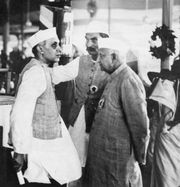 He also responded to the call by Gandhi to boycott Western educational establishments by asking his son, Mrityunjaya Prasad, to drop out of his studies and enroll himself in Bihar Vidyapeeth, an institution he along with his colleagues founded on the traditional Indian model.
During the course of the independent movement, he interacted with Dr Rahul Sankrityayan, a writer
, and polymath. Rahul Sankrityayan was greatly influenced by Prasad's intellectual prowess, finding him to be a guide and guru. In many of his articles he mentioned about his meeting with Sankrityayan and narrated about their him. He wrote articles for the revolutionary publications Searchlight and the Desh and collected funds for these papers. He toured widely, explaining, lecturing, and exhorting the principles of the independence movement.
He took an active role in helping the affected people during the 1914 floods that struck Bihar and Bengal
. When an earthquake affected Bihar on 15 January 1934, Prasad was in jail. During that period, he passed on the relief work to his close colleague Anugrah Narayan Sinha
. He was released two days later and set up Bihar Central Relief Committee on 17 January 1934, and took the task of raising funds to help the people himself. During the May 31, 1935 Quetta
earthquake, when he was forbidden to leave the country due to government's order he set up Quetta Central Relief Committee in Sindh
and Punjab
under his own presidentship.
He was elected as the President of the Indian National Congress
during the Bombay session in October 1934. He again became the president when Netaji Subhash Chandra Bose resigned in 1939. On 8 August 1942, Congress passed the Quit India Resolution in Bombay which led to the arrest of many Indian leaders. He was arrested from Sadaqat Ashram, Patna and sent to Bankipur Jail. After remaining incarcerated for nearly 3 years, he was released on 15 June 1945.
After the formation of Interim Government of 12 nominated ministers under the leadership of Jawaharlal Nehru
on Sep 2 1946, he got the Food and Agriculture department. Later, he was elected the President of Constituent Assembly
on 11 December 1946. Again on 17 November 1947 he became Congress President for a third time after Jivatram Kripalani
submitted resignation. Two and a half years after independence, on January 26, 1950, the Constitution of independent India was ratified and Dr. Rajendra Prasad was elected the nation's first President.
Prasad acted independently of politics, following the expected role of the president as per the constitution. Following the tussle over the enactment of the Hindu Code Bill, he took a more active role in state affairs. In 1962, after serving twelve years as the president, he announced his decision to retire. After relinquishing the office of the President of India
on May 1962, he returned to Patna
on 14 May 1962 and preferred to stay in the campus of Bihar Vidyapeeth. He was subsequently awarded the Bharat Ratna
, the nation's highest civilian award.
He died on 28 February 1963.
India
India , officially the Republic of India , is a country in South Asia. It is the seventh-largest country by geographical area, the second-most populous country with over 1.2 billion people, and the most populous democracy in the world...
to have been elected twice for the post.
During the independence movement, he left his law work and joined the Congress Party
Indian National Congress
The Indian National Congress is one of the two major political parties in India, the other being the Bharatiya Janata Party. It is the largest and one of the oldest democratic political parties in the world. The party's modern liberal platform is largely considered center-left in the Indian...
, playing a prominent role in the Indian Independence Movement
Indian independence movement
The term Indian independence movement encompasses a wide area of political organisations, philosophies, and movements which had the common aim of ending first British East India Company rule, and then British imperial authority, in parts of South Asia...
. He served as the president of the Constituent Assembly
Constituent Assembly of India
The Constituent Assembly of India was elected to write the Constitution of India, and following independence served as the nation's first Parliament.-Nature of the Assembly:...
that drafted the first constitution
Constitution of India
The Constitution of India is the supreme law of India. It lays down the framework defining fundamental political principles, establishes the structure, procedures, powers, and duties of government institutions, and sets out fundamental rights, directive principles, and the duties of citizens...
of the Republic, which lasted from 1948 to 1950. He also became the first Minister of Food and Agriculture in the year 1946 in the Interim national Government.
Early life
Rajendra Prasad was born and brought up in SiwanSiwan
Siwan may refer to* Sivan, a month of the Hebrew calendar* Siwan, Xichuan County , a town in Xichuan County, Henan, China* Siwan District, in the state of Bihar, India* Siwan, Bihar, the headquarters of the district...
, Bihar
Bihar
Bihar is a state in eastern India. It is the 12th largest state in terms of geographical size at and 3rd largest by population. Almost 58% of Biharis are below the age of 25, which is the highest proportion in India....
.He was the youngest son of Mahavira Sahai, and born in a Kayastha family. He was known as "Rajen" to his family and friends. His father was a scholar of both the Persian
Persian language
Persian is an Iranian language within the Indo-Iranian branch of the Indo-European languages. It is primarily spoken in Iran, Afghanistan, Tajikistan and countries which historically came under Persian influence...
and Sanskrit
Sanskrit
Sanskrit , is a historical Indo-Aryan language and the primary liturgical language of Hinduism, Jainism and Buddhism.Buddhism: besides Pali, see Buddhist Hybrid Sanskrit Today, it is listed as one of the 22 scheduled languages of India and is an official language of the state of Uttarakhand...
language
Language
Language may refer either to the specifically human capacity for acquiring and using complex systems of communication, or to a specific instance of such a system of complex communication...
s, while his mother, Kamleshwari Devi, was a religious woman.
Student Life
When Prasad was five years old, his parents placed him under the tutelage of a MoulaviMawlawi (Islamic title)
Mawlawi is an honorific Islamic religious title given to Sunni Muslim religious scholars or Ulema preceding their names, similar to the titles Maulana, Mullah, or Shaykh. Mawlawi generally means highly-qualified Islamic scholar...
, an accomplished Muslim scholar, to learn the Persian language
Persian language
Persian is an Iranian language within the Indo-Iranian branch of the Indo-European languages. It is primarily spoken in Iran, Afghanistan, Tajikistan and countries which historically came under Persian influence...
, Hindi
Hindi
Standard Hindi, or more precisely Modern Standard Hindi, also known as Manak Hindi , High Hindi, Nagari Hindi, and Literary Hindi, is a standardized and sanskritized register of the Hindustani language derived from the Khariboli dialect of Delhi...
and arithmetic
Arithmetic
Arithmetic or arithmetics is the oldest and most elementary branch of mathematics, used by almost everyone, for tasks ranging from simple day-to-day counting to advanced science and business calculations. It involves the study of quantity, especially as the result of combining numbers...
. After the completion of traditional elementary education, Prasad was sent to the Chapra District School and at a small age of 12, he was married to Rajavanshi Devi. He, along with his elder brother Mahendra Prasad, then went to study at T.K. Ghosh's Academy in Patna
Patna
Paṭnā , is the capital of the Indian state of Bihar and the second largest city in Eastern India . Patna is one of the oldest continuously inhabited places in the world...
for a period of two years.He secured first in the entrance examination to the University of Calcutta
University of Calcutta
The University of Calcutta is a public university located in the city of Kolkata , India, founded on 24 January 1857...
and was awarded Rs.30 per month as a scholarship. He joined the Presidency College in 1902, initially as a science student. He passed Intermediate level classes then called as F. A. under Calcutta University in March 1904. Later he decided to focus on the arts and did his M.A. in Economy with First Division from Kolkata University in December 1907. There he lived with his brother in the Eden Hindu Hostel. A devoted student as well as a public activist, he was an active member of The Dawn Society
Satish Chandra Mukherjee
Satish Chandra Mukherjee was a pioneer in establishing a system of national education in India, along with Sri Aurobindo.-The positivist background:...
. It was due to his sense of duty towards his family and education that he refused to join Servants of India Society
Servants of India Society
The Servants of India Society was formed in Pune, Maharashtra, on June 12, 1905 by Gopal Krishna Gokhale, who left the Deccan Education Society to form this association. Along with him were a small group of educated Indians, as Natesh Appaji Dravid, Gopal Krishna Deodhar and Anant Patwardhan who...
. Prasad was instrumental in the formation of the Bihari Students Conference in 1906 in the hall of the Patna College.It was the first organization of its kind in India and produced some of the eminent leaders of Bihar
Bihar
Bihar is a state in eastern India. It is the 12th largest state in terms of geographical size at and 3rd largest by population. Almost 58% of Biharis are below the age of 25, which is the highest proportion in India....
like Dr. Anugrah Narayan Sinha and Sri Krishna Singh.Dr. Rajendra prasad was a great man of India.
As a teacher
Rajendra Prasad served in various educational institutions as a teacher. After completing his MA in economics, he became a professor of English at the Bhumihar Brahman College (Now Langat Singh College) in Muzaffarpur, Bihar and went on to become the principal. However later on he left the college for his legal studies. In 1909, while pursuing his law studies in KolkataKolkata
Kolkata , formerly known as Calcutta, is the capital of the Indian state of West Bengal. Located on the east bank of the Hooghly River, it was the commercial capital of East India...
he also worked as Professor of Economics
Economics
Economics is the social science that analyzes the production, distribution, and consumption of goods and services. The term economics comes from the Ancient Greek from + , hence "rules of the house"...
at Calcutta City College
City College, Kolkata
City College is a constituent undergraduate college of the University of Calcutta. Established in 1881, it is one of the heritage institutions of Calcutta which played a prominent social role in the wake of the Bengal Renaissance of the nineteenth century. The college is located at 102/1, Raja...
. In 1915, Prasad appeared in the examination of Masters in Law, passed the examination and won a gold medal. He then completed his Doctorate in Law.
As a lawyer
In the year 1916, he joined the High Court of Bihar and OrissaOrissa
Orissa , officially Odisha since Nov 2011, is a state of India, located on the east coast of India, by the Bay of Bengal. It is the modern name of the ancient nation of Kalinga, which was invaded by the Maurya Emperor Ashoka in 261 BC. The modern state of Orissa was established on 1 April...
. Later in the year 1917, he was appointed as one of the first members of the Senate and Syndicate of the Patna University. He also used to practice law at Bhagalpur, the famous silk-town of Bihar.
Role in the Independence Movement
Prasad had formally joined the Indian National CongressIndian National Congress
The Indian National Congress is one of the two major political parties in India, the other being the Bharatiya Janata Party. It is the largest and one of the oldest democratic political parties in the world. The party's modern liberal platform is largely considered center-left in the Indian...
way back in the year 1911. During the Lucknow Session of Indian National Congress held in 1916, he met Mahatma Gandhi
Mahatma Gandhi
Mohandas Karamchand Gandhi , pronounced . 2 October 1869 – 30 January 1948) was the pre-eminent political and ideological leader of India during the Indian independence movement...
. During one of the fact-finding missions at Champaran, Mahatma Gandhi
Mahatma Gandhi
Mohandas Karamchand Gandhi , pronounced . 2 October 1869 – 30 January 1948) was the pre-eminent political and ideological leader of India during the Indian independence movement...
asked him to come with his volunteers. He was so greatly moved by the dedication, courage, and conviction of Mahatma Gandhi that as soon as the motion of Non-Cooperation was passed by Indian National Congress
Indian National Congress
The Indian National Congress is one of the two major political parties in India, the other being the Bharatiya Janata Party. It is the largest and one of the oldest democratic political parties in the world. The party's modern liberal platform is largely considered center-left in the Indian...
in 1920, he retired his lucrative career of lawyer as well as his duties in the university to aid the movement.
During the course of the independent movement, he interacted with Dr Rahul Sankrityayan, a writer
Writer
A writer is a person who produces literature, such as novels, short stories, plays, screenplays, poetry, or other literary art. Skilled writers are able to use language to portray ideas and images....
, and polymath. Rahul Sankrityayan was greatly influenced by Prasad's intellectual prowess, finding him to be a guide and guru. In many of his articles he mentioned about his meeting with Sankrityayan and narrated about their him. He wrote articles for the revolutionary publications Searchlight and the Desh and collected funds for these papers. He toured widely, explaining, lecturing, and exhorting the principles of the independence movement.
He took an active role in helping the affected people during the 1914 floods that struck Bihar and Bengal
Bengal
Bengal is a historical and geographical region in the northeast region of the Indian Subcontinent at the apex of the Bay of Bengal. Today, it is mainly divided between the sovereign land of People's Republic of Bangladesh and the Indian state of West Bengal, although some regions of the previous...
. When an earthquake affected Bihar on 15 January 1934, Prasad was in jail. During that period, he passed on the relief work to his close colleague Anugrah Narayan Sinha
Anugrah Narayan Sinha
Dr. Anugrah Narayan Sinha , known as Bihar Vibhuti, was an Indian statesman who was the first Deputy Chief Minister cum Finance Minister of the Indian state of Bihar...
. He was released two days later and set up Bihar Central Relief Committee on 17 January 1934, and took the task of raising funds to help the people himself. During the May 31, 1935 Quetta
Quetta
is the largest city and the provincial capital of the Balochistan Province of Pakistan. Known as the "Fruit Garden of Pakistan" due to the diversity of its plant and animal wildlife, Quetta is home to the Hazarganji Chiltan National Park, which contains some of the rarest species of wildlife in the...
earthquake, when he was forbidden to leave the country due to government's order he set up Quetta Central Relief Committee in Sindh
Sindh
Sindh historically referred to as Ba'ab-ul-Islam , is one of the four provinces of Pakistan and historically is home to the Sindhi people. It is also locally known as the "Mehran". Though Muslims form the largest religious group in Sindh, a good number of Christians, Zoroastrians and Hindus can...
and Punjab
Punjab region
The Punjab , also spelled Panjab |water]]s"), is a geographical region straddling the border between Pakistan and India which includes Punjab province in Pakistan and the states of the Punjab, Haryana, Himachal Pradesh, Chandigarh and some northern parts of the National Capital Territory of Delhi...
under his own presidentship.
He was elected as the President of the Indian National Congress
Indian National Congress
The Indian National Congress is one of the two major political parties in India, the other being the Bharatiya Janata Party. It is the largest and one of the oldest democratic political parties in the world. The party's modern liberal platform is largely considered center-left in the Indian...
during the Bombay session in October 1934. He again became the president when Netaji Subhash Chandra Bose resigned in 1939. On 8 August 1942, Congress passed the Quit India Resolution in Bombay which led to the arrest of many Indian leaders. He was arrested from Sadaqat Ashram, Patna and sent to Bankipur Jail. After remaining incarcerated for nearly 3 years, he was released on 15 June 1945.
After the formation of Interim Government of 12 nominated ministers under the leadership of Jawaharlal Nehru
Jawaharlal Nehru
Jawaharlal Nehru , often referred to with the epithet of Panditji, was an Indian statesman who became the first Prime Minister of independent India and became noted for his “neutralist” policies in foreign affairs. He was also one of the principal leaders of India’s independence movement in the...
on Sep 2 1946, he got the Food and Agriculture department. Later, he was elected the President of Constituent Assembly
Constituent assembly
A constituent assembly is a body composed for the purpose of drafting or adopting a constitution...
on 11 December 1946. Again on 17 November 1947 he became Congress President for a third time after Jivatram Kripalani
Jivatram Kripalani
Acharya Jivatram Bhagwandas Kripalani was an Indian politician, noted particularly for holding the presidency of the Indian National Congress during the transfer of power in 1947. During the election for the post of the future Prime Minister of India held by the Congress party, he had the second...
submitted resignation. Two and a half years after independence, on January 26, 1950, the Constitution of independent India was ratified and Dr. Rajendra Prasad was elected the nation's first President.
Prasad acted independently of politics, following the expected role of the president as per the constitution. Following the tussle over the enactment of the Hindu Code Bill, he took a more active role in state affairs. In 1962, after serving twelve years as the president, he announced his decision to retire. After relinquishing the office of the President of India
President of India
The President of India is the head of state and first citizen of India, as well as the Supreme Commander of the Indian Armed Forces. President of India is also the formal head of all the three branches of Indian Democracy - Legislature, Executive and Judiciary...
on May 1962, he returned to Patna
Patna
Paṭnā , is the capital of the Indian state of Bihar and the second largest city in Eastern India . Patna is one of the oldest continuously inhabited places in the world...
on 14 May 1962 and preferred to stay in the campus of Bihar Vidyapeeth. He was subsequently awarded the Bharat Ratna
Bharat Ratna
Bharat Ratna is the Republic of India's highest civilian award, awarded for the highest degrees of national service. This service includes artistic, literary, and scientific achievements, as well as "recognition of public service of the highest order." Unlike knights, holders of the Bharat Ratna...
, the nation's highest civilian award.
He died on 28 February 1963.
Further reading
- Rajendra Prasad, first President of India, by Kewalram Lalchand Panjabi. Published by Macmillan, 1960.
- Rajendra Prasad: twelve years of triumph and despair, by Rajendra Lal Handa. Published by Sterling Publishers, 1979.
- Dr Rajendra Prasad, Correspondence and Select Documents, by Rajendra Prasad, Valmiki Choudhary. Published by Allied Publishers, 1984. ISBN 8170230020. Excerpts (Vol. 1-Vol. 10)
- Dr Rajendra Prasad by India Parliament. Lok SabhaLok SabhaThe Lok Sabha or House of the People is the lower house of the Parliament of India. Members of the Lok Sabha are elected by direct election under universal adult suffrage. As of 2009, there have been fifteen Lok Sabhas elected by the people of India...
. Published by Lok Sabha Secretariat, 1990. - Rajendra Prasad and the Indian freedom struggle, 1917-1947, by Nirmal Kumar. Published by Patriot Publishers, 1991. ISBN 8170501288.
- Dr Rajendra Prasad: Political Thinkers Of Modern India, by V. Grover. Published by Deep & Deep Publications, 1993.
- First Citizens of India, Dr Rajendra Prasad to Dr Shanker Dayal Sharma: Profile and Bibliography, by A. B. Kohli. Published by Reliance Pub. House, 1995. ISBN 8185972710.
Literary contributions
- Satyagraha at Champaran (1922)
- India Divided (1946)
- Atmakatha (1946), his autobiography written during his 3-year prison term in Bankipur Jail
- Mahatma Gandhi and Bihar, Some Reminisences" (1949)
- Bapu ke Kadmon Mein (1954)
- Since Independence (published in 1960)