
All Topics  
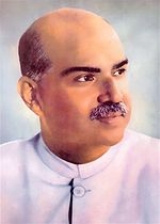
Syama Prasad Mookerjee

 
Syama Prasad Mookerjee

   Email Print
   Bookmark   Link


Syama Prasad Mookerjee


Syama Prasad Mookerjee (or Shyama Prasad Mukherjee, ) (July 6, 1901 - June 23, 1953) was a nationalist political leader of India
India

India, officially the Republic of India , is a country in South Asia. It is the List of countries and outlying territories by total area country by geographical area, the List of countries by population country, and the most populous liberal democracy in the world....
, and is considered the godfather of modern Hindutva
Hindutva

Hindutva is the term used to describe movements advocating Hindu nationalism.In India, an umbrella organization called the Sangh Parivar champions the concept of Hindutva....
 and Hindu Nationalism
Hindu nationalism

Hindu nationalism is a nationalism ideology that sees the modern state of the India as a Hindu polity , and seeks to preserve the Hindu heritage....
.

Mookerjee founded the Bharatiya Jana Sangh
Bharatiya Jana Sangh

The Bharatiya Jana Sangh existed from 1951 to 1980, whereupon it was succeeded by the Bharatiya Janata Party, one of India's largest political parties....
, the first Hindu nationalist political party of its kind, and was also the leader of the Hindu Mahasabha and closely associated with the Rashtriya Swayamsevak Sangh
Rashtriya Swayamsevak Sangh

The Rashtriya Swayamsevak Sangh , also known as the Sangh or the RSS, is a Hindu nationalist organization in India. It was founded in 1925 by Dr....
.

erjee was born on July 6, 1901 in Calcutta [now Kolkata], a major Indian city and capital of Bengal
Bengal

Bengal , is a historical and geographical region in the northeast of South Asia. Today it is mainly divided between the independent sovereign nation of the Bangladesh and the state of West Bengal in India, although some regions of the previous kingdoms of Bengal are now part of the neighboring Indian states of Bihar, Assam, Tripura and Oris...
.


Discussion
Ask a question about 'Syama Prasad Mookerjee'
Start a new discussion about 'Syama Prasad Mookerjee'
Answer questions from other users
Full Discussion Forum


Encyclopedia


Syama Prasad Mookerjee (or Shyama Prasad Mukherjee, ) (July 6, 1901 - June 23, 1953) was a nationalist political leader of India
India

India, officially the Republic of India , is a country in South Asia. It is the List of countries and outlying territories by total area country by geographical area, the List of countries by population country, and the most populous liberal democracy in the world....
, and is considered the godfather of modern Hindutva
Hindutva

Hindutva is the term used to describe movements advocating Hindu nationalism.In India, an umbrella organization called the Sangh Parivar champions the concept of Hindutva....
 and Hindu Nationalism
Hindu nationalism

Hindu nationalism is a nationalism ideology that sees the modern state of the India as a Hindu polity , and seeks to preserve the Hindu heritage....
.

Mookerjee founded the Bharatiya Jana Sangh
Bharatiya Jana Sangh

The Bharatiya Jana Sangh existed from 1951 to 1980, whereupon it was succeeded by the Bharatiya Janata Party, one of India's largest political parties....
, the first Hindu nationalist political party of its kind, and was also the leader of the Hindu Mahasabha and closely associated with the Rashtriya Swayamsevak Sangh
Rashtriya Swayamsevak Sangh

The Rashtriya Swayamsevak Sangh , also known as the Sangh or the RSS, is a Hindu nationalist organization in India. It was founded in 1925 by Dr....
.

Early life

Mookerjee was born on July 6, 1901 in Calcutta [now Kolkata], a major Indian city and capital of Bengal
Bengal

Bengal , is a historical and geographical region in the northeast of South Asia. Today it is mainly divided between the independent sovereign nation of the Bangladesh and the state of West Bengal in India, although some regions of the previous kingdoms of Bengal are now part of the neighboring Indian states of Bihar, Assam, Tripura and Oris...
. His father was Sir Ashutosh Mukherjee
Ashutosh Mukherjee

Sir Ashutosh Mookerjee 1864-1924, CIE, PhD, DSc, LLD was an Indian educator and Vice Chancellor of the University of Calcutta from 1906 to 1924....
, a well respected advocate in Bengal, who became the Vice-Chancellor
Vice-Chancellor

A Vice-Chancellor of a university in England, Wales, Northern Ireland, New Zealand, Australia, India other Commonwealth of Nations countries, and some universities in Hong Kong, is the chief executive of the University....
 of the University of Calcutta
University of Calcutta

Formally established on the 24 January 1857, the University of Calcutta , located in the city of Kolkata , India, is the first modern university in the Indian subcontinent....
, and his mother was Lady Jogmaya Devi Mookerjee.

Mookerjee obtained his degrees from the University of Calcutta. He graduated in English securing the first position in first class in 1921 and also did MA in 1923 and BL in 1924. He became a fellow of the Senate in 1923. He enrolled as an advocate in Calcutta High Court
Calcutta High Court

The Calcutta High Court is the oldest High Courts of India in India. It was established on July 2, 1862 under the High Courts Act, 1861. It has jurisdiction over the Indian state of West Bengal and the Union Territory of the Andaman and Nicobar Islands....
 in 1924 after his father's death. Subsequently he left for England
England

native_name =|conventional_long_name = England|common_name = England|image_flag = Flag of England.svg|image_coat = England COA.svg|symbol_type = Royal Coat of Arms...
 in 1926 to study in Lincoln's Inn
Lincoln's Inn

The Honourable Society of Lincoln's Inn is one of four Inns of Court in London to which barristers of England and Wales belong and where they are Call to the bar....
 and became a barrister in 1927. At the age of 33, he became the youngest Vice-Chancellor of the University of Calcutta (1934), and held the office till 1938.

Political career

He was elected as member of the Legislative Council of Bengal, as an Indian National Congress
Indian National Congress

Indian National Congress-I is a major political party in India. Founded in 1885 by Dadabhai Naoroji, Dinshaw Edulji Wacha, Womesh Chandra Bonerjee, Surendranath Banerjee, Monomohun Ghose, Allan Octavian Hume, and William Wedderburn, the Indian National Congress became the leader of the Indian Independence Movement, with over 15 million memb...
 candidate representing Calcutta University but resigned next year when Congress decided to boycott the legislature. Subsequently, he contested the election as an independent candidate and got elected. He was the Finance minister of Bengal Province during 1941-42.

He emerged as a spokesman for Hindus and shortly joined Hindu Mahasabha and in 1944, he became the President. Mookerjee was anti-Muslim, but a Hindu political leader who felt the need to counteract the communalist and separatist Muslim League
Muslim League

The Muslim League , founded at Dhaka in 1906, was a political party in British India that developed into the driving force behind the creation of Pakistan as a Islam state on the Indian subcontinent....
 of Muhammad Ali Jinnah
Muhammad Ali Jinnah

Muhammad Ali Jinnah Urdu language: }} , a 20th century politician and statesman, is generally regarded as the father of the state of Pakistan. He served as leader of the Muslim League and served as Pakistan's first Governor-General of Pakistan....
, who were demanding either exaggerated Muslim rights or a Muslim state of Pakistan
Pakistan

Pakistan , officially the Islamic Republic of Pakistan, is a country located in South Asia and borders Central Asia and the Middle East. It has a 1,046 kilometre coastline along the Arabian Sea and Gulf of Oman in the south, and is bordered by Afghanistan and Iran in the west, India in the east and People's Republic of China in th...
.

Mookerjee adopted causes to unite Hindu voices, and protect Hindus against what he believed to be the communal propaganda and the divisive agenda of the Muslim League
Muslim League

The Muslim League , founded at Dhaka in 1906, was a political party in British India that developed into the driving force behind the creation of Pakistan as a Islam state on the Indian subcontinent....
. To Mookerjee, the Muslims were a minority and thus could not in any reasonable system be given a status superior to the majority Hindu masses. Mookerjee and his future followers would always cite inherent Hindu practices of tolerance and communal respect as the reason for a healthy, prosperous and safe Muslim
Muslim

:A Muslim , , is an adherent of the religion of Islam. The feminine form is Muslimah . Literally, the word means "one who submits "....
 population in the country in the first place.

Mookerjee was initially a strong opponent of the Partition of India
Partition of India

File:Brit IndianEmpireReligions3.jpgThe Partition of India was the Partition of British India that led to the creation, on August 14, 1947 and August 15, 1947, respectively, of the Sovereignty states of the Dominion of Pakistan and the Union of India ....
, but following the communal riots of 1946-47, Mookerjee strongly disfavored Hindus continuing to live in a Muslim-dominated state and under a government controlled by the Muslim League.

On 11 February 1941 S P Mookerjee told a Hindu rally that if Muslims wanted to live in Pakistan they should "pack their bag and baggage and leave India... (to) wherever they like" .

Mookerjee supported the partition of Bengal in 1946 to prevent the inclusion of its Hindu-majority areas in a Muslim-dominated East Pakistan
East Pakistan

East Pakistan was a former Provinces of Pakistan of Pakistan which existed between 1955 and 1971. East Pakistan was created from Bengal Province based on a plebiscite in what was then British Raj in 1947....
; he also opposed a failed bid for a united but independent Bengal made in 1947 by Sarat Bose, the brother of Subhas Chandra Bose and Huseyn Shaheed Suhrawardy
Huseyn Shaheed Suhrawardy

Huseyn Shaheed Suhrawardy was a politician from Bengal in undivided British Raj, and later in East Pakistan, who served as Prime Minister of Pakistan from 1956 until 1957....
, a Bengali Muslim politician.

He wanted the Hindu Mahasabha not to be restricted to Hindus alone or work as apolitical body for the service of masses. Following the assassination of Mahatma Gandhi
Mahatma Gandhi

Mohandas Karamchand Gandhi was a major political and spiritual leader of India and the Indian independence movement. He was the pioneer of satyagraha?resistance to tyranny through mass civil disobedience, firmly founded upon ahimsa or total non-violence?which led India to Indian independence movement and inspired movements for civi...
 by a Hindu fanatic, the Mahasabha was blamed chiefly for the heinous act and became deeply unpopular. Mookerjee himself condemned the murder and left the party.

Post-independence

Prime Minister Jawaharlal Nehru
Jawaharlal Nehru

Jawaharlal Nehru The son of the wealthy Indian barrister and politician Motilal Nehru, Nehru became a leader of the left-wing of the Indian National Congress at a remarkably young age....
 inducted him in the Interim Central Government as a Minister for Industry and Supply. Mookerjee was widely respected by many Indians and also by members of the Indian National Congress
Indian National Congress

Indian National Congress-I is a major political party in India. Founded in 1885 by Dadabhai Naoroji, Dinshaw Edulji Wacha, Womesh Chandra Bonerjee, Surendranath Banerjee, Monomohun Ghose, Allan Octavian Hume, and William Wedderburn, the Indian National Congress became the leader of the Indian Independence Movement, with over 15 million memb...
, and Sardar Vallabhbhai Patel
Sardar Vallabhbhai Patel

Vallabhbhai Patel was a politics of India and social leader of India who played a major role in the country's Indian independence movement and guided its Political integration of India into a united, independent nation....
, one of its chief leaders.

But on issue of the 1949 Delhi Pact with Pakistani Prime Minister Liaqat Ali Khan, Mookerjee resigned from the Cabinet on April 6, 1950. Mookerjee was firmly against Nehru's invitation to the Pakistani PM, and their joint pact to establish minority commissions and guarantee minority rights in both countries. He wanted to hold Pakistan directly responsible for the terrible influx of millions of Hindu refugees from East Pakistan, who had left the state fearing religious suppression and violence aided by the state. Mookerjee considered Nehru's actions as appeasement, and was hailed as a hero by the people of West Bengal
West Bengal

West Bengal is a States and territories of India in eastern India. With Bangladesh, which lies on its eastern border, the state forms the ethno-linguistic region of Bengal....
.

After consultation with Madhav Sadashiv Golwalkar
Madhav Sadashiv Golwalkar

Madhav Sadashiv Golwalkar , popularly known as Guruji, was the second "Sarsanghchalak" of the Rashtriya Swayamsevak Sangh....
, leader of the Rashtriya Swayamsevak Sangh
Rashtriya Swayamsevak Sangh

The Rashtriya Swayamsevak Sangh , also known as the Sangh or the RSS, is a Hindu nationalist organization in India. It was founded in 1925 by Dr....
, Mookerjee founded the Jan Sangh (Indian People's Union) on October 21, 1951 at Delhi
Delhi

Delhi , sometimes referred to as Dilli , is the List of most populous cities in India metropolis in India and, with over 11 million residents, the List of metropolitan areas by population....
 and became its first President.

The BJS criticized favoritism to India's Muslims by the Nehru administration, and promoted free-market economics as opposed to the socialism
Socialism

Socialism refers to a broad set of economic theories of social organization advocating public or state ownership and administration of the means of production and distribution of goods, and a society characterized by equality for all individuals, with a fair or Egalitarianism method of compensation....
 in Nehru's economic and social policies. The BJS also favored a uniform civil code for both Hindus and Muslims, want to ban cow slaughter and end the special status of Muslim-majority Jammu and Kashmir
Jammu and Kashmir

Jammu and Kashmir is the northernmost States and territories of India of India. It is situated mostly in the Himalayas mountains. Jammu and Kashmir shares a border with the People's Republic of China to the northeast, the states of Himachal Pradesh and Punjab to the south and Pakistani-administered territories of Kashmir, namely Azad Kashm...
. The BJS founded the Hindutva
Hindutva

Hindutva is the term used to describe movements advocating Hindu nationalism.In India, an umbrella organization called the Sangh Parivar champions the concept of Hindutva....
 agenda which became the wider political expression of India's Hindu majority. He was instrumental in establishing Hindu Line within the Congress.

In the 1952 general elections to the Parliament of India
Parliament of India

The Parliament of India is the Federal government and supreme legislative body of India. It consists of the office of President of India and two houses, the lower house, known as the Lok Sabha and the upper house, known as the Rajya Sabha.....
, Mookerjee and the BJS won three seats.

Sri Mookerjee opposed the Indian National Congress
Indian National Congress

Indian National Congress-I is a major political party in India. Founded in 1885 by Dadabhai Naoroji, Dinshaw Edulji Wacha, Womesh Chandra Bonerjee, Surendranath Banerjee, Monomohun Ghose, Allan Octavian Hume, and William Wedderburn, the Indian National Congress became the leader of the Indian Independence Movement, with over 15 million memb...
's decision to allow Kashmir
Kashmir

Kashmir is the northwestern region of the Indian subcontinent. Until the mid-19th century, the term "Kashmir" referred only to the valley lying between the Great Himalayas and the Pir Panjal range; since then, it has been used for a larger area that today includes the Indian administerd state of Jammu and Kashmir consisting of the Kashmir...
 to be a special state and have its own flag and prime minister. According to Congress's decision, no one, including the President of India
President of India

The President of India or Rashtrapati is the head of state and first citizen of India, as well as the Commander-in-Chief of the Indian Military of India....
 can enter into Kashmir
Kashmir

Kashmir is the northwestern region of the Indian subcontinent. Until the mid-19th century, the term "Kashmir" referred only to the valley lying between the Great Himalayas and the Pir Panjal range; since then, it has been used for a larger area that today includes the Indian administerd state of Jammu and Kashmir consisting of the Kashmir...
 with out Kashmir's prime minister.

In order to oppose this decision, he once said "Ek desh mein do Vidhan, do Prdhan and Do Nishan nahi chalenge" (A single contury can't have two constitutions
Constitution of India

The Constitution of India is the supreme law of India. It lays down the framework defining fundamental political principles, establishing the structure, procedures, powers and duties, of the government and spells out the fundamental rights, Directive Principles in India and duties of citizens....
, two prime ministers
Prime Minister of India

The Prime Minister of India is the head of government of the India, and head of the Council of Ministers of the Republic of India, appointed by the President of India to assist the latter in the administration of the affairs of the Executive in India....
, and two National Emblems)

Mookerjee went to visit Kashmir in 1953, and went on hunger strike to protest the law prohibiting Indian citizens from settling in a state in their own country and the need to carry ID cards, and was arrested on 11 May while crossing border. Although the ID card rule was revoked owing to his efforts, he died as detenu on May 23, 1953 under mysterious circumstances. His death in custody raised wide suspicion across the country and demands for independent enquiry, including earnest requests from his mother, Jogmaya Devi to the then Prime Minister of India, Jawaharlal Nehru. Unfortunately no enquiry commission was set up and his death remains a mystery.

Legacy

Along with Vinayak Damodar Savarkar
Vinayak Damodar Savarkar

Vinayak Damodar Savarkar was an Indian politician and an Indian Independence Movement activist, who is credited with developing the Hindu nationalist political ideology Hindutva....
, Mookerjee is considered the godfather of Hindu nationalism in India, especially the Hindutva
Hindutva

Hindutva is the term used to describe movements advocating Hindu nationalism.In India, an umbrella organization called the Sangh Parivar champions the concept of Hindutva....
 movement. He is widely revered by members and supporters of the Rashtriya Swayamsevak Sangh
Rashtriya Swayamsevak Sangh

The Rashtriya Swayamsevak Sangh , also known as the Sangh or the RSS, is a Hindu nationalist organization in India. It was founded in 1925 by Dr....
 and the Vishwa Hindu Parishad.

Mookerjee was a major role model to Atal Bihari Vajpayee
Atal Bihari Vajpayee

Atal Bihari Vajpayee served as the thirteenth and sixteenth Prime Minister of India. After a brief stint as Prime Minister in 1996, Vajpayee headed a coalition government from October 13, 1999 until May 19, 2004....
, who made the BJS the chief Hindu conservative political party in the 1960s and 1970s, and founded its successor, the Bharatiya Janata Party
Bharatiya Janata Party

The Bharatiya Janata Party , founded in 1980, is a major political party of India. Designed to represent the country's Hinduism and Centre-right in nature, the party advocates Conservatism social policies, self reliance, robust economic growth, foreign policy driven by a nationalist agenda, and strong national defense....
. The BJP has become one of the two largest national political parties, the other being the Indian National Congress
Indian National Congress

Indian National Congress-I is a major political party in India. Founded in 1885 by Dadabhai Naoroji, Dinshaw Edulji Wacha, Womesh Chandra Bonerjee, Surendranath Banerjee, Monomohun Ghose, Allan Octavian Hume, and William Wedderburn, the Indian National Congress became the leader of the Indian Independence Movement, with over 15 million memb...
 Party, and had formed the Government from 1998 to 2004, with Vajpayee serving as the Prime Minister of India
Prime Minister of India

The Prime Minister of India is the head of government of the India, and head of the Council of Ministers of the Republic of India, appointed by the President of India to assist the latter in the administration of the affairs of the Executive in India....
.

On August 27, 1998, the Ahmedabad Municipal Corporation
Ahmedabad Municipal Corporation

The Ahmedabad Municipal Corporation or the AMC, established in July 1950 under the Bombay Provincial Corporation Act, 1949, is responsible for the civic infrastructure and administration of the city of Ahmedabad....
 (governed by the BJP) named a bridge after Mookerjee.

In 2001, the main research funding institute of the Government of India , CSIR instituted a new fellowship named after him. The Shyama Prasad Mukhejee Fellowship is the most prestigious fellowship given in India for doing PhD.Only the top 20% students who clear the Junior Research Fellowship (JRF CSIR/UGC) are eligible to sit for this examination.

External links


See also


1. Legislative Council Proceedings [BLCP], 1941, Vol. LIX, No. 6, p 216

2. Suranjam Das Communal Riots in Bengal 1905 - 1947; Oxford University Press, 1991