

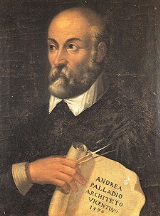
Andrea Palladio

Encyclopedia
Andrea Palladio was an architect active in the Republic of Venice
. Palladio, influenced by Roman and Greek architecture
, primarily by Vitruvius
, is widely considered the most influential individual in the history of Western architecture
. All of his buildings are located in what was the Venetian Republic, but his teachings, summarized in the architectural treatise I Quattro Libri dell'Architettura
(The Four Books of Architecture), gained him wide recognition. The city of Vicenza
and the Palladian Villas of the Veneto
are UNESCO
World Heritage Sites.
, then part of the Republic of Venice
. His father Pietro called "della Gondola" was a miller. In Padua he gained his first experiences as a stonecutter in the sculpture workshop of Bartolomeo Cavazza da Sossano, who is said to have imposed particularly hard working conditions. In fact, in April 1524, after one failed attempt, Palladio managed to run away to Vicenza
. Here he became an assistant in the Pedemuro studio, a leading workshop of stonecutters and masons.
His talents were first recognized in his early thirties by Count Gian Giorgio Trissino
, an influential humanist
and writer. As the leading intellectual in Vicenza, Trissino stimulated the young man to appreciate the arts, sciences and Classical literature and granted him the opportunity to study Ancient architecture in Rome. It was also Trissino who gave him the name by which he is now known, Palladio, an allusion to the Greek goddess
of wisdom Pallas Athene
and to a character of a play by Trissino himself. Indeed the word Palladio means Wise one. After Trissino's death in 1550 Palladio benefited from the patronage of the Barbaro brothers, Cardinal
Daniele Barbaro
, who encouraged his studies of classical architecture
and brought him to Rome in 1554, and the younger brother Marcantonio Barbaro
. The powerful Barbaros introduced Palladio to Venice
, where he finally became "Proto della Serenissima" (chief architect of the Republic of Venice) after Jacopo Sansovino
. In addition to the Barbaros, the Corner, Foscari, and Pisani
families supported Palladio's career.
The Palladian style
, named after him, adhered to classical Roman
principles he rediscovered, applied and explained in his works.
His architectural works have "been valued for centuries as the quintessence of High Renaissance calm and harmony" (Watkin, D., A History of Western Architecture). He designed many palaces, villa
s and churches, but Palladio's reputation initially, and after his death, has been founded on his skill as a designer of villas. The palladian villas are located mainly in the province of Vicenza
, while the palazzi
are concentrated in the city of Vicenza
and the churches in Venice
. A number of his works are now protected as part of the World Heritage Site
City of Vicenza and the Palladian Villas of the Veneto
. Other buildings by Palladio are to be found within the Venice and its Lagoon World Heritage Site.
During the second half of his life, Palladio published many books, above all I Quattro Libri dell'Architettura
("The four books of architecture", Venice, 1570).
The precise circumstances of his death are unknown.
Palladio died in 1580, by tradition in Maser
, near Treviso
, and was buried in the church of Santa Corona in Vicenza; from the 19th century his tomb is located in the Cimitero Maggiore of Vicenza.
.
In the later part of his career, Palladio was chosen by powerful members of Venetian society for numerous important commissions. His success as an architect is based not only on the beauty of his work, but also for its harmony with the culture of his time. His success and influence came from the integration of extraordinary aesthetic quality with expressive characteristics that resonated with his client's social aspirations. His buildings served to visually communicate their place in the social order of their culture. This powerful integration of beauty and the physical representation of social meanings is apparent in three major building types: the urban palazzo, the agricultural villa, and the church.
In his urban structures he developed a new improved version of the typical early renaissance
palazzo (exemplified by the Palazzo Strozzi
). Adapting a new urban palazzo type created by Bramante in the House of Raphael, Palladio found a powerful expression of the importance of the owner and his social position. The main living quarters of the owner on the second level are now clearly distinguished in importance by use of a pediment
ed classical portico
, centered and raised above the subsidiary and utilitarian ground level (illustrated in the Palazzo Porto
and the Palazzo Valmarana Braga). The tallness of the portico is achieved by incorporating the owner's sleeping quarters on the third level, within a giant
two story classical colonnade, a motif adapted from Michelangelo
's Capitoline buildings in Rome. The elevated main floor level became known as the "piano nobile
", and is still referred to as the "first floor" in continental Europe.
Palladio also established an influential new building format for the agricultural villas of the Venetian aristocracy
. He consolidated the various stand-alone farm outbuildings into a single impressive structure, arranged as a highly organized whole dominated by a strong center and symmetrical side wings, as illustrated at Villa Barbaro
. The Palladian villa configuration often consists of a centralized block raised on an elevated podium
, accessed by grand steps and flanked by lower service wings, as at Villa Foscari
and Villa Badoer
. This format, with the quarters of the owner at the elevated center of their own world, found resonance as a prototype for Italian villas and later for the country estates of the British nobility (such as Lord Burlington's Chiswick House
, Vanbrugh's Blenheim
, Walpole's Houghton Hall
, and Adam's Kedleston Hall
and Paxton House in Scotland). The configuration was a perfect architectural expression of their worldview, clearly expressing their perceived position in the social order of the times. His influence was extended worldwide into the British colonies. The Palladian villa format was easily adapted for a democratic worldview, as can be seen at Thomas Jefferson
's Monticello
and his arrangement for the University of Virginia
; and as recently as 1940 in Pope's National Gallery
in Washington DC, where the public entry to the world of high culture occupies the exalted center position. The rustication
of exposed basement
walls of Victorian residences is a late remnant of the Palladian format, clearly expressed as a podium for the main living space for the family.
Similarly, Palladio created a new configuration for the design of Catholic churches that established two interlocking architectural orders, each clearly articulated yet delineating a hierarchy of a larger order overriding a lesser order. This idea was in direct coincidence with the rising acceptance of the theological ideas of St. Thomas Aquinas
, who postulated the notion of two worlds existing simultaneously: the divine world of faith and the earthly world of man. Palladio created an architecture which made a visual statement communicating the idea of two superimposed systems, as illustrated at San Francesco della Vigna
. In a time when religious dominance in Western culture was threatened by the rising power of science
and secular humanists
, this architecture found great favor with the Church as a clear statement of the proper relationship of the earthly and the spiritual worlds.
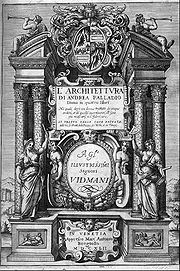 Palladio's influence was far-reaching, although his buildings are all in a relatively small part of Italy. One factor in the spread of his influence was the publication in 1570 of his architectural treatise I Quattro Libri dell'Architettura
(The Four Books of Architecture), which set out rules others could follow.
Before this landmark publication, architectural drawings by Palladio had appeared in print as illustrations to Daniele Barbaro
's "Commentary" on Vitruvius
.
Interest in his style was renewed in later generations and became fashionable all over Europe, for example in parts of the Loire Valley
of France. In Britain, Inigo Jones
and Christopher Wren
embraced the Palladian style. In his Italian Journey
, Johann von Goethe describes Palladio as a genius, commending his unfinished Convent of S. Maria della Carita as the most perfect existing work of architecture. Another admirer was the architect Richard Boyle
, 4th Earl of Cork
, also known as Lord Burlington
, who, with William Kent
, designed Chiswick House
. The influence of Palladio even got to America. The Capitol building is an example of slightly evolved version of Palladio's works. Thomas Jefferson
loved that style of architecture.
Exponents of Palladianism include the 18th century Venetian
architect Giacomo Leoni
who published an authoritative four-volume work on Palladio and his architectural concepts.
Over 330 of Palladio's original drawings and sketches still survive in the collections of the Royal Institute of British Architects
, most of which were originally owned by Inigo Jones. Jones collected a significant number of these on his Grand Tour of 1613-1614, while some were a gift from Henry Wotton
.
The Center for Palladian Studies in America, Inc.
, a non-profit membership organization, was founded in 1979 to research and promote understanding of Palladio’s influence in the United States.
Republic of Venice
The Republic of Venice or Venetian Republic was a state originating from the city of Venice in Northeastern Italy. It existed for over a millennium, from the late 7th century until 1797. It was formally known as the Most Serene Republic of Venice and is often referred to as La Serenissima, in...
. Palladio, influenced by Roman and Greek architecture
Architecture of Ancient Greece
The architecture of Ancient Greece is the architecture produced by the Greek-speaking people whose culture flourished on the Greek mainland and Peloponnesus, the Aegean Islands, and in colonies in Asia Minor and Italy for a period from about 900 BC until the 1st century AD, with the earliest...
, primarily by Vitruvius
Vitruvius
Marcus Vitruvius Pollio was a Roman writer, architect and engineer, active in the 1st century BC. He is best known as the author of the multi-volume work De Architectura ....
, is widely considered the most influential individual in the history of Western architecture
Architectural History
Architectural History is the main journal of the Society of Architectural Historians of Great Britain .The journal is published each autumn. The architecture of the British Isles is a major theme of the journal, although it includes more general papers on the history of architecture. Member of...
. All of his buildings are located in what was the Venetian Republic, but his teachings, summarized in the architectural treatise I Quattro Libri dell'Architettura
I Quattro Libri dell'Architettura
I quattro libri dell'architettura is an Italian treatise on architecture by the architect Andrea Palladio . It was first published in four volumes in 1570 in Venice, illustrated with woodcuts after the author's own drawings. It has been reprinted and translated many times...
(The Four Books of Architecture), gained him wide recognition. The city of Vicenza
Vicenza
Vicenza , a city in north-eastern Italy, is the capital of the eponymous province in the Veneto region, at the northern base of the Monte Berico, straddling the Bacchiglione...
and the Palladian Villas of the Veneto
Palladian Villas of the Veneto
The City of Vicenza and the Palladian Villas of the Veneto is a World Heritage Site protecting a cluster of works by the architect Andrea Palladio. UNESCO inscribed the site on the World Heritage List in 1994. At first the site was called "Vicenza, City of Palladio" and only buildings in the...
are UNESCO
UNESCO
The United Nations Educational, Scientific and Cultural Organization is a specialized agency of the United Nations...
World Heritage Sites.
Biography
He was born as Andrea di Pietro della Gondola in PaduaPadua
Padua is a city and comune in the Veneto, northern Italy. It is the capital of the province of Padua and the economic and communications hub of the area. Padua's population is 212,500 . The city is sometimes included, with Venice and Treviso, in the Padua-Treviso-Venice Metropolitan Area, having...
, then part of the Republic of Venice
Republic of Venice
The Republic of Venice or Venetian Republic was a state originating from the city of Venice in Northeastern Italy. It existed for over a millennium, from the late 7th century until 1797. It was formally known as the Most Serene Republic of Venice and is often referred to as La Serenissima, in...
. His father Pietro called "della Gondola" was a miller. In Padua he gained his first experiences as a stonecutter in the sculpture workshop of Bartolomeo Cavazza da Sossano, who is said to have imposed particularly hard working conditions. In fact, in April 1524, after one failed attempt, Palladio managed to run away to Vicenza
Vicenza
Vicenza , a city in north-eastern Italy, is the capital of the eponymous province in the Veneto region, at the northern base of the Monte Berico, straddling the Bacchiglione...
. Here he became an assistant in the Pedemuro studio, a leading workshop of stonecutters and masons.
His talents were first recognized in his early thirties by Count Gian Giorgio Trissino
Gian Giorgio Trissino
Gian Giorgio Trissino was an Italian Renaissance humanist, poet, dramatist, diplomat, and grammarian.-Biography:...
, an influential humanist
Humanism
Humanism is an approach in study, philosophy, world view or practice that focuses on human values and concerns. In philosophy and social science, humanism is a perspective which affirms some notion of human nature, and is contrasted with anti-humanism....
and writer. As the leading intellectual in Vicenza, Trissino stimulated the young man to appreciate the arts, sciences and Classical literature and granted him the opportunity to study Ancient architecture in Rome. It was also Trissino who gave him the name by which he is now known, Palladio, an allusion to the Greek goddess
Greek mythology
Greek mythology is the body of myths and legends belonging to the ancient Greeks, concerning their gods and heroes, the nature of the world, and the origins and significance of their own cult and ritual practices. They were a part of religion in ancient Greece...
of wisdom Pallas Athene
Athena
In Greek mythology, Athena, Athenê, or Athene , also referred to as Pallas Athena/Athene , is the goddess of wisdom, courage, inspiration, civilization, warfare, strength, strategy, the arts, crafts, justice, and skill. Minerva, Athena's Roman incarnation, embodies similar attributes. Athena is...
and to a character of a play by Trissino himself. Indeed the word Palladio means Wise one. After Trissino's death in 1550 Palladio benefited from the patronage of the Barbaro brothers, Cardinal
Cardinal (Catholicism)
A cardinal is a senior ecclesiastical official, usually an ordained bishop, and ecclesiastical prince of the Catholic Church. They are collectively known as the College of Cardinals, which as a body elects a new pope. The duties of the cardinals include attending the meetings of the College and...
Daniele Barbaro
Daniele Barbaro
Daniele Matteo Alvise Barbaro was an Italian translator of, and commentator on, Vitruvius. He also had a significant ecclesiastical career, reaching the rank of Cardinal....
, who encouraged his studies of classical architecture
Classical architecture
Classical architecture is a mode of architecture employing vocabulary derived in part from the Greek and Roman architecture of classical antiquity, enriched by classicizing architectural practice in Europe since the Renaissance...
and brought him to Rome in 1554, and the younger brother Marcantonio Barbaro
Marcantonio Barbaro
Marcantonio Barbaro was an Italian diplomat of the Republic of Venice.-Family:He was born in Venice into the aristocratic Barbaro family...
. The powerful Barbaros introduced Palladio to Venice
Venice
Venice is a city in northern Italy which is renowned for the beauty of its setting, its architecture and its artworks. It is the capital of the Veneto region...
, where he finally became "Proto della Serenissima" (chief architect of the Republic of Venice) after Jacopo Sansovino
Jacopo Sansovino
Jacopo d'Antonio Sansovino was an Italian sculptor and architect, known best for his works around the Piazza San Marco in Venice. Andrea Palladio, in the Preface to his Quattro Libri was of the opinion that Sansovino's Biblioteca Marciana was the best building erected since Antiquity...
. In addition to the Barbaros, the Corner, Foscari, and Pisani
Pisani
- People :*Alfred Pisani , Maltese hotelier*Alvise Pisani, Doge of Venice*Andrea Pisani*Bob Pisani, news correspondent for the financial news network CNBC*Carmelo Borg Pisani , Maltese nationalist and Fascist...
families supported Palladio's career.
The Palladian style
Palladian architecture
Palladian architecture is a European style of architecture derived from the designs of the Venetian architect Andrea Palladio . The term "Palladian" normally refers to buildings in a style inspired by Palladio's own work; that which is recognised as Palladian architecture today is an evolution of...
, named after him, adhered to classical Roman
Roman architecture
Ancient Roman architecture adopted certain aspects of Ancient Greek architecture, creating a new architectural style. The Romans were indebted to their Etruscan neighbors and forefathers who supplied them with a wealth of knowledge essential for future architectural solutions, such as hydraulics...
principles he rediscovered, applied and explained in his works.
His architectural works have "been valued for centuries as the quintessence of High Renaissance calm and harmony" (Watkin, D., A History of Western Architecture). He designed many palaces, villa
Villa
A villa was originally an ancient Roman upper-class country house. Since its origins in the Roman villa, the idea and function of a villa have evolved considerably. After the fall of the Roman Republic, villas became small farming compounds, which were increasingly fortified in Late Antiquity,...
s and churches, but Palladio's reputation initially, and after his death, has been founded on his skill as a designer of villas. The palladian villas are located mainly in the province of Vicenza
Province of Vicenza
The Province of Vicenza is a province in the Veneto region of northern Italy. Its capital city is Vicenza.The province has an area of 2,723 km², and a total population of 840,000 . There are 121 comuni in the province...
, while the palazzi
Palazzo
Palazzo, an Italian word meaning a large building , may refer to:-Buildings:*Palazzo, an Italian type of building**Palazzo style architecture, imitative of Italian palazzi...
are concentrated in the city of Vicenza
Vicenza
Vicenza , a city in north-eastern Italy, is the capital of the eponymous province in the Veneto region, at the northern base of the Monte Berico, straddling the Bacchiglione...
and the churches in Venice
Venice
Venice is a city in northern Italy which is renowned for the beauty of its setting, its architecture and its artworks. It is the capital of the Veneto region...
. A number of his works are now protected as part of the World Heritage Site
World Heritage Site
A UNESCO World Heritage Site is a place that is listed by the UNESCO as of special cultural or physical significance...
City of Vicenza and the Palladian Villas of the Veneto
Palladian Villas of the Veneto
The City of Vicenza and the Palladian Villas of the Veneto is a World Heritage Site protecting a cluster of works by the architect Andrea Palladio. UNESCO inscribed the site on the World Heritage List in 1994. At first the site was called "Vicenza, City of Palladio" and only buildings in the...
. Other buildings by Palladio are to be found within the Venice and its Lagoon World Heritage Site.
During the second half of his life, Palladio published many books, above all I Quattro Libri dell'Architettura
I Quattro Libri dell'Architettura
I quattro libri dell'architettura is an Italian treatise on architecture by the architect Andrea Palladio . It was first published in four volumes in 1570 in Venice, illustrated with woodcuts after the author's own drawings. It has been reprinted and translated many times...
("The four books of architecture", Venice, 1570).
The precise circumstances of his death are unknown.
Palladio died in 1580, by tradition in Maser
Maser, Italy
Maser is a comune in the Province of Treviso in the Italian region Veneto, located about 50 km northwest of Venice and about 25 km northwest of Treviso...
, near Treviso
Treviso
Treviso is a city and comune in Veneto, northern Italy. It is the capital of the province of Treviso and the municipality has 82,854 inhabitants : some 3,000 live within the Venetian walls or in the historical and monumental center, some 80,000 live in the urban center proper, while the city...
, and was buried in the church of Santa Corona in Vicenza; from the 19th century his tomb is located in the Cimitero Maggiore of Vicenza.
Cultural context
Palladio's architecture was not dependent on expensive materials, which must have been an advantage to his more financially-pressed clients. Many of his buildings are of brick covered with stuccoStucco
Stucco or render is a material made of an aggregate, a binder, and water. Stucco is applied wet and hardens to a very dense solid. It is used as decorative coating for walls and ceilings and as a sculptural and artistic material in architecture...
.
In the later part of his career, Palladio was chosen by powerful members of Venetian society for numerous important commissions. His success as an architect is based not only on the beauty of his work, but also for its harmony with the culture of his time. His success and influence came from the integration of extraordinary aesthetic quality with expressive characteristics that resonated with his client's social aspirations. His buildings served to visually communicate their place in the social order of their culture. This powerful integration of beauty and the physical representation of social meanings is apparent in three major building types: the urban palazzo, the agricultural villa, and the church.
In his urban structures he developed a new improved version of the typical early renaissance
Renaissance
The Renaissance was a cultural movement that spanned roughly the 14th to the 17th century, beginning in Italy in the Late Middle Ages and later spreading to the rest of Europe. The term is also used more loosely to refer to the historical era, but since the changes of the Renaissance were not...
palazzo (exemplified by the Palazzo Strozzi
Palazzo Strozzi
Palazzo Strozzi is a palace in Florence, Italy.-History:The construction of the palace begun in 1489 by Benedetto da Maiano, for Filippo Strozzi the Elder, a rival of the Medici who had returned to the city in November 1466 and desired the most magnificent palace to assert his family's continued...
). Adapting a new urban palazzo type created by Bramante in the House of Raphael, Palladio found a powerful expression of the importance of the owner and his social position. The main living quarters of the owner on the second level are now clearly distinguished in importance by use of a pediment
Pediment
A pediment is a classical architectural element consisting of the triangular section found above the horizontal structure , typically supported by columns. The gable end of the pediment is surrounded by the cornice moulding...
ed classical portico
Portico
A portico is a porch leading to the entrance of a building, or extended as a colonnade, with a roof structure over a walkway, supported by columns or enclosed by walls...
, centered and raised above the subsidiary and utilitarian ground level (illustrated in the Palazzo Porto
Palazzo Porto
Palazzo Porto is a palazzo built by Andrea Palladio in Contrà Porti, Vicenza, Italy. It is one of two palaces in the city designed by Palladio for members of the Porto family...
and the Palazzo Valmarana Braga). The tallness of the portico is achieved by incorporating the owner's sleeping quarters on the third level, within a giant
Giant order
In Classical architecture, a giant order is an order whose columns or pilasters span two stories...
two story classical colonnade, a motif adapted from Michelangelo
Michelangelo
Michelangelo di Lodovico Buonarroti Simoni , commonly known as Michelangelo, was an Italian Renaissance painter, sculptor, architect, poet, and engineer who exerted an unparalleled influence on the development of Western art...
's Capitoline buildings in Rome. The elevated main floor level became known as the "piano nobile
Piano nobile
The piano nobile is the principal floor of a large house, usually built in one of the styles of classical renaissance architecture...
", and is still referred to as the "first floor" in continental Europe.
Palladio also established an influential new building format for the agricultural villas of the Venetian aristocracy
Aristocracy
Aristocracy , is a form of government in which a few elite citizens rule. The term derives from the Greek aristokratia, meaning "rule of the best". In origin in Ancient Greece, it was conceived of as rule by the best qualified citizens, and contrasted with monarchy...
. He consolidated the various stand-alone farm outbuildings into a single impressive structure, arranged as a highly organized whole dominated by a strong center and symmetrical side wings, as illustrated at Villa Barbaro
Villa Barbaro
Villa Barbaro, also known as the Villa di Maser, is a large villa at Maser in the Veneto region of northern Italy. It was designed and built by the Italian architect Andrea Palladio, with frescos by Paolo Veronese and sculptures by Alessandro Vittoria for Daniele Barbaro, Patriarch of Aquileia...
. The Palladian villa configuration often consists of a centralized block raised on an elevated podium
Podium
A podium is a platform that is used to raise something to a short distance above its surroundings. It derives from the Greek πόδι In architecture a building can rest on a large podium. Podia can also be used to raise people, for instance the conductor of an orchestra stands on a podium as do many...
, accessed by grand steps and flanked by lower service wings, as at Villa Foscari
Villa Foscari
thumb|Villa Foscari: facing the [[Brenta]]Villa Foscari is a patrician villa in Mira, near Venice, northern Italy, designed by the Italian architect Andrea Palladio...
and Villa Badoer
Villa Badoer
Villa Badoer is a villa in Fratta Polesine in the Veneto region of northern Italy. It was designed in 1556 by Andrea Palladio for the Venetian noble Francesco Badoer, and built between 1557 and 1563, on the site of a medieval castle which guarded a bridge across a navigable canal...
. This format, with the quarters of the owner at the elevated center of their own world, found resonance as a prototype for Italian villas and later for the country estates of the British nobility (such as Lord Burlington's Chiswick House
Chiswick House
Chiswick House is a Palladian villa in Burlington Lane, Chiswick, in the London Borough of Hounslow in England. Set in , the house was completed in 1729 during the reign of George II and designed by Lord Burlington. William Kent , who took a leading role in designing the gardens, created one of the...
, Vanbrugh's Blenheim
Blenheim Palace
Blenheim Palace is a monumental country house situated in Woodstock, Oxfordshire, England, residence of the dukes of Marlborough. It is the only non-royal non-episcopal country house in England to hold the title of palace. The palace, one of England's largest houses, was built between...
, Walpole's Houghton Hall
Houghton Hall
Houghton Hall is a country house in Norfolk, England. It was built for the de facto first British Prime Minister, Sir Robert Walpole, and it is a key building in the history of Palladian architecture in England...
, and Adam's Kedleston Hall
Kedleston Hall
Kedleston Hall is an English country house in Kedleston, Derbyshire, approximately four miles north-west of Derby, and is the seat of the Curzon family whose name originates in Notre-Dame-de-Courson in Normandy...
and Paxton House in Scotland). The configuration was a perfect architectural expression of their worldview, clearly expressing their perceived position in the social order of the times. His influence was extended worldwide into the British colonies. The Palladian villa format was easily adapted for a democratic worldview, as can be seen at Thomas Jefferson
Thomas Jefferson
Thomas Jefferson was the principal author of the United States Declaration of Independence and the Statute of Virginia for Religious Freedom , the third President of the United States and founder of the University of Virginia...
's Monticello
Monticello
Monticello is a National Historic Landmark just outside Charlottesville, Virginia, United States. It was the estate of Thomas Jefferson, the principal author of the United States Declaration of Independence, third President of the United States, and founder of the University of Virginia; it is...
and his arrangement for the University of Virginia
University of Virginia
The University of Virginia is a public research university located in Charlottesville, Virginia, United States, founded by Thomas Jefferson...
; and as recently as 1940 in Pope's National Gallery
National Gallery of Art
The National Gallery of Art and its Sculpture Garden is a national art museum, located on the National Mall between 3rd and 9th Streets at Constitution Avenue NW, in Washington, DC...
in Washington DC, where the public entry to the world of high culture occupies the exalted center position. The rustication
Rustication (architecture)
thumb|upright|Two different styles of rustication in the [[Palazzo Medici-Riccardi]] in [[Florence]].In classical architecture rustication is an architectural feature that contrasts in texture with the smoothly finished, squared block masonry surfaces called ashlar...
of exposed basement
Basement
__FORCETOC__A basement is one or more floors of a building that are either completely or partially below the ground floor. Basements are typically used as a utility space for a building where such items as the furnace, water heater, breaker panel or fuse box, car park, and air-conditioning system...
walls of Victorian residences is a late remnant of the Palladian format, clearly expressed as a podium for the main living space for the family.
Similarly, Palladio created a new configuration for the design of Catholic churches that established two interlocking architectural orders, each clearly articulated yet delineating a hierarchy of a larger order overriding a lesser order. This idea was in direct coincidence with the rising acceptance of the theological ideas of St. Thomas Aquinas
Thomas Aquinas
Thomas Aquinas, O.P. , also Thomas of Aquin or Aquino, was an Italian Dominican priest of the Catholic Church, and an immensely influential philosopher and theologian in the tradition of scholasticism, known as Doctor Angelicus, Doctor Communis, or Doctor Universalis...
, who postulated the notion of two worlds existing simultaneously: the divine world of faith and the earthly world of man. Palladio created an architecture which made a visual statement communicating the idea of two superimposed systems, as illustrated at San Francesco della Vigna
San Francesco della Vigna
San Francesco della Vigna is a Roman Catholic church in the Sestiere of Castello in Venice, northern Italy.-History:Along with Santa Maria Gloriosa dei Frari, this is one of two Franciscan churches in Venice. The site, originally a vineyard , was donated by Marco Ziani in 1253 for construction of...
. In a time when religious dominance in Western culture was threatened by the rising power of science
Science
Science is a systematic enterprise that builds and organizes knowledge in the form of testable explanations and predictions about the universe...
and secular humanists
Secular humanism
Secular Humanism, alternatively known as Humanism , is a secular philosophy that embraces human reason, ethics, justice, and the search for human fulfillment...
, this architecture found great favor with the Church as a clear statement of the proper relationship of the earthly and the spiritual worlds.
Influence
I Quattro Libri dell'Architettura
I quattro libri dell'architettura is an Italian treatise on architecture by the architect Andrea Palladio . It was first published in four volumes in 1570 in Venice, illustrated with woodcuts after the author's own drawings. It has been reprinted and translated many times...
(The Four Books of Architecture), which set out rules others could follow.
Before this landmark publication, architectural drawings by Palladio had appeared in print as illustrations to Daniele Barbaro
Daniele Barbaro
Daniele Matteo Alvise Barbaro was an Italian translator of, and commentator on, Vitruvius. He also had a significant ecclesiastical career, reaching the rank of Cardinal....
's "Commentary" on Vitruvius
Vitruvius
Marcus Vitruvius Pollio was a Roman writer, architect and engineer, active in the 1st century BC. He is best known as the author of the multi-volume work De Architectura ....
.
Interest in his style was renewed in later generations and became fashionable all over Europe, for example in parts of the Loire Valley
Loire Valley
The Loire Valley , spanning , is located in the middle stretch of the Loire River in central France. Its area comprises approximately . It is referred to as the Cradle of the French Language, and the Garden of France due to the abundance of vineyards, fruit orchards, and artichoke, asparagus, and...
of France. In Britain, Inigo Jones
Inigo Jones
Inigo Jones is the first significant British architect of the modern period, and the first to bring Italianate Renaissance architecture to England...
and Christopher Wren
Christopher Wren
Sir Christopher Wren FRS is one of the most highly acclaimed English architects in history.He used to be accorded responsibility for rebuilding 51 churches in the City of London after the Great Fire in 1666, including his masterpiece, St. Paul's Cathedral, on Ludgate Hill, completed in 1710...
embraced the Palladian style. In his Italian Journey
Italian Journey
Italian Journey is Johann Wolfgang von Goethe's report on his travels to Italy from 1786–7, published in 1816–7. The book is based on Goethe's diaries...
, Johann von Goethe describes Palladio as a genius, commending his unfinished Convent of S. Maria della Carita as the most perfect existing work of architecture. Another admirer was the architect Richard Boyle
Richard Boyle, 3rd Earl of Burlington
Richard Boyle, 3rd Earl of Burlington and 4th Earl of Cork PC , born in Yorkshire, England, was the son of Charles Boyle, 2nd Earl of Burlington and 3rd Earl of Cork...
, 4th Earl of Cork
Earl of Cork
Earl of the County of Cork, usually shortened to Earl of Cork, is a title in the Peerage of Ireland. It was created in 1620 for the Anglo-Irish politician Richard Boyle, 1st Baron Boyle...
, also known as Lord Burlington
Earl of Burlington
Earl of Burlington is a title that has been created twice, the first time in the Peerage of England and the second in the Peerage of the United Kingdom. The first creation was for Richard Boyle, 2nd Earl of Cork, on 20 March 1664...
, who, with William Kent
William Kent
William Kent , born in Bridlington, Yorkshire, was an eminent English architect, landscape architect and furniture designer of the early 18th century.He was baptised as William Cant.-Education:...
, designed Chiswick House
Chiswick House
Chiswick House is a Palladian villa in Burlington Lane, Chiswick, in the London Borough of Hounslow in England. Set in , the house was completed in 1729 during the reign of George II and designed by Lord Burlington. William Kent , who took a leading role in designing the gardens, created one of the...
. The influence of Palladio even got to America. The Capitol building is an example of slightly evolved version of Palladio's works. Thomas Jefferson
Thomas Jefferson
Thomas Jefferson was the principal author of the United States Declaration of Independence and the Statute of Virginia for Religious Freedom , the third President of the United States and founder of the University of Virginia...
loved that style of architecture.
Exponents of Palladianism include the 18th century Venetian
Venice
Venice is a city in northern Italy which is renowned for the beauty of its setting, its architecture and its artworks. It is the capital of the Veneto region...
architect Giacomo Leoni
Giacomo Leoni
Giacomo Leoni , also known as James Leoni, was an Italian architect, born in Venice. He was a devotee of the work of Florentine Renaissance architect Leon Battista Alberti, who had also been an inspiration for Andrea Palladio. Leoni thus served as a prominent exponent of Palladianism in English...
who published an authoritative four-volume work on Palladio and his architectural concepts.
Over 330 of Palladio's original drawings and sketches still survive in the collections of the Royal Institute of British Architects
Royal Institute of British Architects
The Royal Institute of British Architects is a professional body for architects primarily in the United Kingdom, but also internationally.-History:...
, most of which were originally owned by Inigo Jones. Jones collected a significant number of these on his Grand Tour of 1613-1614, while some were a gift from Henry Wotton
Henry Wotton
Sir Henry Wotton was an English author and diplomat. He is often quoted as saying, "An ambassador is an honest gentleman sent to lie abroad for the good of his country." -Life:The son of Thomas Wotton , brother of Edward Wotton, 1st Baron Wotton, and grandnephew of the diplomat...
.
The Center for Palladian Studies in America, Inc.
The Center for Palladian Studies in America, Inc.
The Center for Palladian Studies in America, Inc. engages in research and other activities relating to the work of architect Andrea Palladio. CPSA was founded as a national non-profit membership corporation in Charlottesville, Virginia, in 1979 and is presently headquartered in Richmond, Virginia...
, a non-profit membership organization, was founded in 1979 to research and promote understanding of Palladio’s influence in the United States.
Chronology of the works
Note: the chronology is generally referred to the project of the works, not to the construction.Villas
- 1534: Villa Trissino a Cricoli, Vicenza (once traditionally attributed, but probably designed by Gian Giorgio TrissinoGian Giorgio TrissinoGian Giorgio Trissino was an Italian Renaissance humanist, poet, dramatist, diplomat, and grammarian.-Biography:...
) - 1537-1542: Villa GodiVilla GodiVilla Godi is a patrician villa in Lugo di Vicenza, Veneto, northern Italy. It was one of the first projects by Andrea Palladio, as attested in his monograph I quattro libri dell'architettura...
(for Girolamo, Pietro and Marcantonio Godi), Lonedo di Lugo di VicenzaLugo di VicenzaLugo di Vicenza is a town and comune in the province of Vicenza, Veneto, Italy. It is east of SP349 provincial road.-Main sights:*Villa Godi, designed by Andrea Palladio, in the locality of Lonedo. There is also another Palladian villa, the Villa Piovene.-Sources:*... - 1539 circa: Villa PioveneVilla PioveneVilla Piovene is a Palladian villa built in Lonedo di Lugo, province of Vicenza, northern Italy. The building was commissioned in the 16th century for the aristocratic Venetian Piovene family, their architect believed to have been Andrea Palladio...
, Lonedo di Lugo di VicenzaLugo di VicenzaLugo di Vicenza is a town and comune in the province of Vicenza, Veneto, Italy. It is east of SP349 provincial road.-Main sights:*Villa Godi, designed by Andrea Palladio, in the locality of Lonedo. There is also another Palladian villa, the Villa Piovene.-Sources:*...
, Province of VicenzaProvince of VicenzaThe Province of Vicenza is a province in the Veneto region of northern Italy. Its capital city is Vicenza.The province has an area of 2,723 km², and a total population of 840,000 . There are 121 comuni in the province...
(attributed) - 1542 - Villa Valmarana, Vigardolo di Monticello Conte OttoMonticello Conte OttoMonticello Conte Otto is a town and comune in the province of Vicenza, Veneto, Italy. It is east of the SP248 provincial road.The main attraction is the Villa Valmarana Bressan, attributed to Andrea Palladio.-Sources:*...
, Province of Vicenza - 1542: Villa Gazzotti (for Taddeo Gazzotti), Bertesina, Vicenza
- 1542 circa: Villa Caldogno (for Losco Caldogno), CaldognoCaldognoCaldogno is a town and comune near Vicenza in Italy. Its population is 11,291.The Villa Caldogno Nordera in its territory is attributed to architect Andrea PalladioIt is the birthplace of footballer Roberto Baggio....
, Province of Vicenza (attributed) - 1542: Villa PisaniVilla Pisani (Bagnolo)thumb|250px|Villa Pisani, the facade facing the river Guà. The towers recall [[Villa Trissino Trettenero]].The Villa Pisani is a patrician villa designed by Andrea Palladio, located in Bagnolo, a hamlet in the comune of Lonigo in the Veneto region of Italy.- History :The Pisani were a rich family...
(for Vettore, Marco and Daniele Pisani), Bagnolo di LonigoLonigoLonigo is a town and comune in the province of Vicenza, Veneto, northern Italy, its population counts around 16.000 inhabitants.In its frazione of Bagnolo is the Villa Pisani, a Renaissance patrician villa designed by Andrea Palladio, which is part of a World Heritage Site...
, Province of Vicenza - 1542: Villa ThieneVilla ThieneVilla Thiene is a 16th century villa at Quinto Vicentino in the province of Vicenza. The villa takes its name from the Thiene brothers who commissioned it...
(for Marcantonio and Adriano Thiene), Quinto VicentinoQuinto VicentinoQuinto Vicentino is a town and comune in the province of Vicenza, Veneto, Italy. It is east of A31.The town is the birthplace of Urbano Lazzaro, the Italian partisan who identified and arrested Benito Mussolini in 1945. Its main attraction is Villa Thiene....
, Province of Vicenza (probably a re-elaboration of a project by Giulio RomanoGiulio RomanoGiulio Romano was an Italian painter and architect. A pupil of Raphael, his stylistic deviations from high Renaissance classicism help define the 16th-century style known as Mannerism...
) - 1543: Villa SaracenoVilla SaracenoVilla Saraceno is a Palladian Villa in Agugliaro, Province of Vicenza, northern Italy. It was commissioned by the patrician Saraceno family.- Architectural significance :...
(for Biagio Saraceno), Finale di AgugliaroAgugliaroAgugliaro is a town and comune in the province of Vicenza, Veneto, Italy. It is located east of road SP247.In the hamlet of Finale di Agugliaro is the sixteenth-century Villa Saraceno, which was designed by Palladio and is conserved as part of a World Heritage Site. Other patrician villas in the...
, Province of Vicenza - 1546 circa-1563 circa: Villa PojanaVilla PojanaVilla Pojana or Poiana, is a patrician villa in Pojana Maggiore, a town of the Province of Vicenza in the Veneto region of Italy. It was designed by the Renaissance architect Andrea Palladio...
(for Bonifacio Pojana), Pojana MaggiorePojana MaggiorePojana Maggiore is a town and comune in the province of Vicenza, Veneto, Italy. It is the site of Villa Pojana, designed by the Renaissance architect Andrea Palladio. The town has reputation for its agriculture. It is bounded by the other communes of Noventa Vicentina and Montagnana....
, Province of Vicenza - 1546 circa: Villa ContariniVilla ContariniVilla Contarini is a patrician villa veneta in Piazzola sul Brenta, province of Padova, northern Italy. The villa is in Baroque style and is backed by a 40 ha park with lakes and alleys....
, Piazzola sul BrentaPiazzola sul BrentaPiazzola sul Brenta is a comune in the Province of Padua in the Italian region Veneto, located about 45 km west of Venice and about 15 km northwest of Padua.-Main sights:*Villa Contarini, begun by Andrea Palladio...
, Province of Padua (attributed) - 1547: Villa ArnaldiVilla ArnaldiVilla Arnaldi is an unfinished historical edifice in Meledo di Sarego, Province of Vicenza, Italy, designed by Andrea Palladio in 1547.At a passing glance it might seem strange to include this modest and evidently incomplete building — today unfortunately also in bad repair — alongside the...
(for Vincenzo Arnaldi), Meledo di SaregoSaregoSarego is a town and comune in the province of Vicenza, Veneto, Italy. It is 20 km southwest of Vicenza. SP500 goes through the town of Sarego.-Main sights:In the frazione of Meledo, there are two incomplete villas designed by Andrea Palladio:...
, Province of Vicenza (unfinished) - 1548: Villa AngaranoVilla AngaranoThe Villa Angarano or Villa Angarano Bianchi Michiel is a villa in Bassano del Grappa, Veneto, northern Italy. It was originally conceived by Andrea Palladio who published a plan in his book I Quattro Libri dell'Architettura.-History:...
, Bassano del GrappaBassano del GrappaBassano del Grappa is a city and comune in the province of Vicenza, region Veneto, in northern Italy. It bounds the communes of Cassola, Marostica, Solagna, Pove del Grappa, Romano d'Ezzelino, Campolongo sul Brenta, Conco, Rosà, Cartigliano and Nove...
, Province of Vicenza (main body of the villa rebuilt later by Baldassarre LonghenaBaldassarre Longhenathumb|250px|Tower of the church [[Santa Maria del Soccorso]], [[Rovigo]].Baldassarre Longhena was an Italian architect, who worked mainly in Venice, where he was one of the greatest exponents of Baroque architecture of the period....
; the barchesse are part of the original) - 1550: Villa ChiericatiVilla ChiericatiVilla Chiericati is a villa at Vancimuglio in the Veneto, northern Italy. It was designed for Giovanni Chiericati by the architect Andrea Palladio in the early 1550s....
(for Giovanni Chiericati), Vancimuglio di Grumolo delle AbbadesseGrumolo delle AbbadesseGrumolo delle Abbadesse is a town and comune in the province of Vicenza, Veneto, Italy. It is on SP24.In the frazione of Vancimuglio Andrea Palladio's Villa Chiericati can be seen.-External links:*...
, province of Vicenza (completed in 1584 by Domenico Groppino after Palladio's death) - 1552: Villa CornaroVilla CornaroVilla Cornaro is a patrician villa in Piombino Dese, about 30 km northwest of Venice, Italy. It was designed by the Italian Renaissance architect Andrea Palladio in 1552 and is illustrated and described by him in Book Two of his 1570 masterwork, I Quattro Libri dell'Architettura [The Four...
(for Giorgio Cornaro), Piombino DesePiombino DesePiombino Dese is a comune in the Province of Padua in the Italian region Veneto, located about 35 km northwest of Venice and about 20 km north of Padua...
, Province of PaduaProvince of PaduaThe Province of Padua is a province in the Veneto region of Italy. Its capital is the city of Padua.-History and territory:... - 1552 circa: Villa PisaniVilla Pisani (Montagnana)The Villa Pisani is a patrician villa outside the city walls of Montagnana, Veneto, northern Italy.- Architectural details :It was designed by Andrea Palladio about 1552, for Cardinal Francesco Pisani...
(for Francesco Pisani), MontagnanaMontagnanaMontagnana is a town and comune in the province of Padova, in Veneto . It is bounded by other communes of Saletto, Megliadino San Fidenzio, Casale di Scodosia, Urbana, Bevilacqua, Pojana Maggiore and Noventa Vicentina...
, Province of Padua - 1554-1563: Villa BadoerVilla BadoerVilla Badoer is a villa in Fratta Polesine in the Veneto region of northern Italy. It was designed in 1556 by Andrea Palladio for the Venetian noble Francesco Badoer, and built between 1557 and 1563, on the site of a medieval castle which guarded a bridge across a navigable canal...
called La Badoera (for Francesco Badoer), Fratta PolesineFratta PolesineFratta Polesine is a comune in the Province of Rovigo in the Italian region Veneto, located about 70 km southwest of Venice and about 11 km southwest of Rovigo...
, Province of RovigoProvince of RovigoThe Province of Rovigo is a province in the Veneto region of Italy. Its capital is the city of Rovigo.It borders on the north with the provinces of Verona, Padua and Venice, on the south with the province of Ferrara, on the west with the province of Mantua, and on the eastwith the Adriatic Sea.-... - 1554: Villa PortoVilla Porto (Vivaro di Dueville)Villa Porto in Vivaro di Dueville is a villa veneta designed in 1554 and traditionally attributed to the italian architect Andrea Palladio, but not included in the strict list of Palladian Villas of the Veneto of UNESCO World Heritage....
(for Paolo Porto), Vivaro di DuevilleDuevilleDueville is a town and comune in the province of Vicenza, Veneto, Italy. It is south of SP50. As of 2007 Dueville had an estimated population of 13,988.-Sources:*...
, province of Vicenza (attributed) - 1554: Villa BarbaroVilla BarbaroVilla Barbaro, also known as the Villa di Maser, is a large villa at Maser in the Veneto region of northern Italy. It was designed and built by the Italian architect Andrea Palladio, with frescos by Paolo Veronese and sculptures by Alessandro Vittoria for Daniele Barbaro, Patriarch of Aquileia...
(for DanieleDaniele BarbaroDaniele Matteo Alvise Barbaro was an Italian translator of, and commentator on, Vitruvius. He also had a significant ecclesiastical career, reaching the rank of Cardinal....
and Marcantonio BarbaroMarcantonio BarbaroMarcantonio Barbaro was an Italian diplomat of the Republic of Venice.-Family:He was born in Venice into the aristocratic Barbaro family...
), Maser, Province of TrevisoProvince of TrevisoThe Province of Treviso is a province in the Veneto region of Italy. Its capital is the city of Treviso.The province has an area of 2,477 km², and a total population of 886.886 . There are 95 municipalities in the province .-Municipalities:-External links:*... - 1554 ?: Villa ZenoVilla ZenoVilla Zeno is a patrician villa at Cessalto, Veneto, northern Italy, and is the most easterly villa designed by Renaissance architect Andrea Palladio. The building is near the highway between Venice and Trieste, but was built to face a canal which served as the primary means of arrival.- History...
(for Marco Zeno), Donegal di CessaltoCessaltoCessalto is a comune with 3,137 inhabitants in the province of Treviso. It is home to a Palladian Villa, the Villa Zeno....
, Province of Treviso - 1556: Villa ThieneWing of the Villa Thiene (Cicogna)The Wing of the Villa Thiene is a construction designed by Andrea Palladio located in Cicogna, a hamlet in the comune of Villafranca Padovana in the Veneto region of Italy....
, Cicogna di Villafranca PadovanaVillafranca PadovanaVillafranca Padovana is a comune in the Province of Padua in the Italian region Veneto, located about 40 km west of Venice and about 11 km northwest of Padua...
(unfinished; only a barchessa remaining) - 1557: Villa RepetaVilla RepetaVilla Repeta in Campiglia dei Berici, Province of Vicenza, Italy, is a villa veneta built in 1672, substituting a pre-existing villa designed by Andrea Palladio about 1557 and destroyed by a fire....
, Campiglia dei BericiCampiglia dei BericiCampiglia dei Berici is a town in the province of Vicenza, Veneto, Italy. It is west of SP247.-Sources:*...
(destroyed by a fire, then rebuilt in other shape) - 1558: Villa EmoVilla EmoVilla Emo is a patrician villa in the Veneto, northern Italy, near the village of Fanzolo di Vedelago. It was designed by Andrea Palladio in 1559 for the Emo family of Venice and remained in the hands of the Emo family until it was sold in 2004...
(for Leonardo Emo), Fanzolo di VedelagoVedelagoVedelago is a comune in the Province of Treviso in the Italian region Veneto, located about 35 km northwest of Venice and about 20 km west of Treviso....
, Province of Treviso - 1559: Villa FoscariVilla Foscarithumb|Villa Foscari: facing the [[Brenta]]Villa Foscari is a patrician villa in Mira, near Venice, northern Italy, designed by the Italian architect Andrea Palladio...
called La Malcontenta, Malcontenta di MiraMira, ItalyMira is a comune in the province of Venice, Veneto, Italy.It is crossed by SR11 Regional road. The main attraction are the Villa Foscari, designed by Andrea Palladio, and the Villa Widmann-Foscari....
, Province of Venice - 1563 circa: Villa Valmarana, Lisiera di Bolzano VicentinoBolzano VicentinoBolzano Vicentino is a town and comune in the province of Vicenza, Veneto, Italy. It is east of A31 highway, with a population of 5,455. The main attraction is Palladio's Villa Valmarana Scagnolari Zen, situated in the frazione Lisiera.-Sources:...
, Province of Vicenza - 1565: Villa SeregoVilla SeregoVilla Serego or Villa Sarego is a Palladian villa at Santa Sofia di Pedemonte, San Pietro in Cariano in the province of Verona, northern Italy. It was built for the aristocratic Sarego family, and designed by Andrea Palladio...
(for Marcantonio Serègo), Santa Sofia di Pedemonte di San Pietro in CarianoSan Pietro in CarianoSan Pietro in Cariano is a comune in the Province of Verona in the Italian region Veneto, located about 110 km west of Venice and about 12 km northwest of Verona....
(Province of Verona) - 1565 circa: Villa Forni CeratoVilla Forni CeratoThe Villa Forni Cerato is a 16th century villa in Montecchio Precalcino, Province of Vicenza, northern Italy. Its design is attributed to Andrea Palladio and his client is assumed to have been Girolamo Forni, a wealthy wood merchant who supplied building material for a number of the Palladio's...
(for Girolamo Forni), Montecchio PrecalcinoMontecchio PrecalcinoMontecchio Precalcino is a town and comune in the province of Vicenza, Veneto, Italy. It is west of Torrente Astico.The main attraction is the patrician Villa Forni Cerato, attributed by some scholars to Andrea Palladio.- Sources :*...
, Province of Vicenza - 1566: Villa Capra "La Rotonda" (for Paolo Almerico), Vicenza (completed in 1585 by Vincenzo ScamozziVincenzo Scamozzithumb|250px|Portrait of Vincenzo Scamozzi by [[Paolo Veronese]]Vincenzo Scamozzi was a Venetian architect and a writer on architecture, active mainly in Vicenza and Republic of Venice area in the second half of the 16th century...
after Palladio's death) - 1567 circa: Villa Trissino, Meledo di SaregoSaregoSarego is a town and comune in the province of Vicenza, Veneto, Italy. It is 20 km southwest of Vicenza. SP500 goes through the town of Sarego.-Main sights:In the frazione of Meledo, there are two incomplete villas designed by Andrea Palladio:...
, Province of Vicenza (only partially realized) - 1570: Villa PortoVilla Porto (Molina di Malo)Villa Porto in Molina di Malo, Province of Vicenza, Italy, is an unfinished villa veneta designed by Andrea Palladio in 1570.The extraordinary ten brick-column shafts which dominate the great 15th century farmyard of the Porto family at Molina mark the first stage of a grandiose project which...
(for Iseppo Porto, unfinished), Molina di MaloMaloMalo was an American Latin-tinged rock and roll group. The San Francisco-based ensemble was led by Arcelio Garcia and Jorge Santana, the brother of Latin-rock guitarist, Carlos Santana....
, Province of Vicenza
Palaces
- 1540 circa-1566 circa: Palazzo PojanaPalazzo PojanaPalazzo Pojana is a patrician palace in Vicenza, northern Italy, attributed to the architect Andrea Palladio, about 1540....
, Vicenza (attributed) - 1540-1542 circa: Palazzo CivenaPalazzo CivenaPalazzo Civena is a Renaissance palace Vicenza, Italy, dating to 1540. It was is the first city palace designed by Andrea Palladio.The palace was constructed for the brothers Giovanni Giacomo, Pier Antonio, Vincenzo and Francesco Civena. The date “1540” engraved on the foundation medal, preserved...
, Vicenza - 1542-1556 circa: Palazzo ThienePalazzo ThienePalazzo Thiene is a 15th-16th century palace in Vicenza, northern Italy, designed for Marcantonio and Adriano Thiene, probably by Giulio Romano, in 1542, and revised during construction from 1544 by Andrea Palladio....
, Vicenza (probably on a project by Giulio RomanoGiulio RomanoGiulio Romano was an Italian painter and architect. A pupil of Raphael, his stylistic deviations from high Renaissance classicism help define the 16th-century style known as Mannerism...
) - 1544 circa-1552: Palazzo PortoPalazzo PortoPalazzo Porto is a palazzo built by Andrea Palladio in Contrà Porti, Vicenza, Italy. It is one of two palaces in the city designed by Palladio for members of the Porto family...
(for Iseppo De' Porti), Vicenza - 1546-1549: Loggias of the Palazzo della Ragione (then called Basilica PalladianaBasilica PalladianaThe Basilica Palladiana is a Renaissance building in the central Piazza dei Signori in Vicenza, north-eastern Italy. The most notable feature of the edifice is the loggia, which shows one of the first examples of the what came to be known as the Palladian window, designed by a young Andrea...
), Vicenza (completed in 1614 after Palladio's death) - 1550-1557: Palazzo ChiericatiPalazzo ChiericatiPalazzo Chiericati is a Renaissance palace in Vicenza , designed by Andrea Palladio.- History :The Palazzo was commissioned to Palladio by Count Girolamo Chiericati. The architect started building the architecture in 1550, some further work was completed under the patronage of Chiericati's son and...
(for Girolamo Chiericati), Vicenza (completed about 1680 after Palladio's death) - 1555 circa: Palazzo Dalla TorrePalazzo Dalla TorrePalazzo Dalla Torre is a patrician palace in Verona, northern Italy, designed by architect Andrea Palladio for Giambattista Dalla Torre. The palazzo was probably built from 1555, but remained unfinished. Allied bombardment in 1945 demolished a great part of the building...
, VeronaVeronaVerona ; German Bern, Dietrichsbern or Welschbern) is a city in the Veneto, northern Italy, with approx. 265,000 inhabitants and one of the seven chef-lieus of the region. It is the second largest city municipality in the region and the third of North-Eastern Italy. The metropolitan area of Verona...
(only partially realized; partially destroyed by a bombing in 1945) - 1556 circa: Palazzo AntoniniPalazzo AntoniniPalazzo Antonini is a palazzo in Udine, northern Italy, designed by architect Andrea Palladio in the mid of 16th century for Antonini family, owner of various other palaces in Udine.It's actually owned by the Bank of Italy.- History :...
, Udine (altered by later arrangements) - 1559: Casa CogolloCasa CogolloCasa Cogollo is a small palace in Vicenza built in 1559 and attributed to architect Andrea Palladio. Since 1994 it is part of the "City of Vicenza and the Palladian Villas of the Veneto" World Heritage Site by UNESCO....
(for Pietro Cogollo), traditionally known as Casa del Palladio ("Palladio's home"), Vicenza (attributed) - 1560: Palazzo SchioPalazzo SchioPalazzo Schio is a patrician palace of the 16th century in Vicenza, northern Italy, whose facade was designed by the architect Andrea Palladio in 1560.- History :...
(for Bernardo Schio), Vicenza - 1564: Palazzo PretorioPalazzo Pretorio (Cividale del Friuli)The Palazzo Pretorio or Palazzo dei Provveditori veneti is a palace in Cividale del Friuli, northern Italy, attributed to the architect Andrea Palladio and built between 1565 and 1586...
, Cividale del FriuliCividale del Friuli-External links:*...
(province of Udine) (project, attributed) - 1565: Palazzo del CapitaniatoPalazzo del CapitaniatoThe palazzo del Capitaniato, also known as loggia del Capitanio or loggia Bernarda, is a palace in Vicenza, northern Italy, designed by Andrea Palladio in 1565 and built between 1571 and 1572. It is located on the central Piazza dei Signori, facing the Basilica Palladiana.The palace is actually...
, Vicenza - 1565: Palazzo ValmaranaPalazzo ValmaranaPalazzo Valmarana is a patrician palace in Vicenza, Italy, built by architect Andrea Palladio in 1565 for the noble Isabella Nogarola Valmarana.- History :...
(for Isabella Nogarola Valmarana), Vicenza - 1569-1575: Palazzo Barbaran da PortoPalazzo Barbaran da PortoPalazzo Barbaran Da Porto is a palazzo in Vicenza, Italy designed in 1569 and built between 1570 and 1575 by Andrea Palladio.Since 1994 the palace is part of the "City of Vicenza and the Palladian Villas of the Veneto" World Heritage Site by UNESCO....
(for Montano Barbarano), Vicenza - 1571: Palazzo Porto in Piazza Castello, Vicenza (unfinished; partially completed in 1615 by Vincenzo ScamozziVincenzo Scamozzithumb|250px|Portrait of Vincenzo Scamozzi by [[Paolo Veronese]]Vincenzo Scamozzi was a Venetian architect and a writer on architecture, active mainly in Vicenza and Republic of Venice area in the second half of the 16th century...
) - 1572 ?: Palazzo Thiene Bonin LongarePalazzo Thiene Bonin LongarePalazzo Thiene Bonin Longare is a patrician palace in Vicenza, northern Italy, designed by Andrea Palladio probably in 1572 and built after Palladio's death by Vincenzo Scamozzi...
, Vicenza - 1574-1577: Rooms in the Palazzo Ducale, Venice
Church architecture
- 1531: Portal for the church of Santa Maria dei Servi, Vicenza (attributed)
- 1558: Dome for the Cathedral of Vicenza, Vicenza (destroyed in a bombing during the II World War, then rebuilt)
- 1558: Facade for the Basilica of San Pietro di CastelloSan Pietro di Castello (church)The Basilica di San Pietro di Castello , commonly called San Pietro di Castello, is a Roman Catholic minor basilica of the Patriarch of Venice located in the Castello sestiere of the Italian city of Venice. The present building dates from the 16th century, but a church has stood on the site since...
, VeniceVeniceVenice is a city in northern Italy which is renowned for the beauty of its setting, its architecture and its artworks. It is the capital of the Veneto region...
(completed after Palladio's death) - 1560-1563 circa: cloisterCloisterA cloister is a rectangular open space surrounded by covered walks or open galleries, with open arcades on the inner side, running along the walls of buildings and forming a quadrangle or garth...
of the cipressi and refettorio of the monastery of San Giorgio MaggioreSan Giorgio MaggioreSan Giorgio Maggiore is one of the islands of Venice, northern Italy, lying east of the Giudecca and south of the main island group. The isle is surrounded by Canale della Grazia, Canale della Giudecca, Saint Mark Basin, Canale di San Marco and the southern lagoon...
, Venice - 1560: Convento della Carità, Venezia (only the cloisterCloisterA cloister is a rectangular open space surrounded by covered walks or open galleries, with open arcades on the inner side, running along the walls of buildings and forming a quadrangle or garth...
and the atriumAtrium (architecture)In modern architecture, an atrium is a large open space, often several stories high and having a glazed roof and/or large windows, often situated within a larger multistory building and often located immediately beyond the main entrance doors...
destroyed in 1630 in a fire) - 1563 circa: Side portal for the Cathedral of Vicenza
- 1564: Facade for the church of San Francesco della VignaSan Francesco della VignaSan Francesco della Vigna is a Roman Catholic church in the Sestiere of Castello in Venice, northern Italy.-History:Along with Santa Maria Gloriosa dei Frari, this is one of two Franciscan churches in Venice. The site, originally a vineyard , was donated by Marco Ziani in 1253 for construction of...
, Venice - 1565: Church of San Giorgio MaggioreChurch of San Giorgio Maggiorethumb|450 px|San Giorgio Maggiore seen across the water in full sun on an evening in JuneSan Giorgio Maggiore is a 16th century Benedictine church on the island of the same name in Venice, northern Italy, designed by Andrea Palladio and built between 1566 and 1610...
, Venice (completed between 1607 and 1611 after Palladio's death, with a different façade, by Vincenzo ScamozziVincenzo Scamozzithumb|250px|Portrait of Vincenzo Scamozzi by [[Paolo Veronese]]Vincenzo Scamozzi was a Venetian architect and a writer on architecture, active mainly in Vicenza and Republic of Venice area in the second half of the 16th century...
) - 1574: Facade for Basilica di San Petronio, BolognaBolognaBologna is the capital city of Emilia-Romagna, in the Po Valley of Northern Italy. The city lies between the Po River and the Apennine Mountains, more specifically, between the Reno River and the Savena River. Bologna is a lively and cosmopolitan Italian college city, with spectacular history,...
(project) - 1576 circa: Cappella Valmarana (for Isabella Nogarola Valmarana) in the church of Santa Corona, Vicenza
- 1577: Church of Il RedentoreIl RedentoreThe Chiesa del Santissimo Redentore , commonly known as ', is a 16th century Roman Catholic church located in the Dorsoduro sestiere of the Italian city of Venice. It was designed by the architect Andrea Palladio and built as a votive church to thank God for the deliverance of the city from a major...
, Venice - 1578: Church of Santa Maria Nova, Vicenza (project attributed; completed in 1590 after Palladio's death)
- 1580: Church of Santa Lucia, Venice (drawings for the interior; demolished)
- 1580: Church (Tempietto Barbaro) of Villa BarbaroVilla BarbaroVilla Barbaro, also known as the Villa di Maser, is a large villa at Maser in the Veneto region of northern Italy. It was designed and built by the Italian architect Andrea Palladio, with frescos by Paolo Veronese and sculptures by Alessandro Vittoria for Daniele Barbaro, Patriarch of Aquileia...
, Maser
Other
- 1556: Arco Bollani, UdineUdineUdine is a city and comune in northeastern Italy, in the middle of Friuli-Venezia Giulia region, between the Adriatic sea and the Alps , less than 40 km from the Slovenian border. Its population was 99,439 in 2009, and that of its urban area was 175,000.- History :Udine is the historical...
, an arch over the road leading up to the Udine Castle - 1565: Wooden theater on the yard of the Convento della CaritàAccademiaThe Accademia is a museum gallery of pre-19th century art in Venice, northern Italy. Situated on the south bank of the Grand Canal, within the sestiere of Dorsoduro, it gives its name to one of the three bridges across the canal, the Ponte dell'Accademia, and to the boat landing station for the...
, Venice (destroyed by a fire in 1570) - 1568: Ponte VecchioPonte Vecchio of BassanoThe Ponte Vecchio or Ponte degli Alpini is the covered wooden pontoon bridge designed by the architect Andrea Palladio in 1569. The bridge is located in Bassano del Grappa and was destroyed many times, the last time in World War II...
, Bassano del GrappaBassano del GrappaBassano del Grappa is a city and comune in the province of Vicenza, region Veneto, in northern Italy. It bounds the communes of Cassola, Marostica, Solagna, Pove del Grappa, Romano d'Ezzelino, Campolongo sul Brenta, Conco, Rosà, Cartigliano and Nove...
, Province of Vicenza (rebuilt in 1748 and after II World War) - 1569: Bridge on Tesina, Torri di QuartesoloTorri di QuartesoloTorri di Quartesolo is a town and comune in the province of Vicenza, Veneto, Italy.-Geography:It is north of E70 and west of A31, and has its own highway junction called "Vicenza Est", off the Autostrada A4.-Notable residents:...
, Province of Vicenza (attributed) - 1579: Porta Gemona, San Daniele del FriuliSan Daniele del FriuliSan Daniele del Friuli is a comune in the Province of Udine in the Italian region Friuli-Venezia Giulia, located about 80 km northwest of Trieste and about 20 km northwest of Udine....
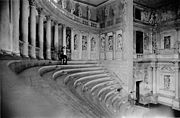
, Province of Udine - 1580: Teatro OlimpicoTeatro OlimpicoThe Teatro Olimpico is a theatre in Vicenza, northern Italy: constructed in 1580-1585, it is the oldest surviving enclosed theatre in the world. The theatre was the final design by the Italian Renaissance architect Andrea Palladio, Renaissance, and was not completed until after his death...
, Vicenza (completed after Palladio's death by his son Silla and in 1585 by Vincenzo ScamozziVincenzo Scamozzithumb|250px|Portrait of Vincenzo Scamozzi by [[Paolo Veronese]]Vincenzo Scamozzi was a Venetian architect and a writer on architecture, active mainly in Vicenza and Republic of Venice area in the second half of the 16th century...
for the scene)
External links
- Palladio and Britain Online exhibition from the Royal Institute of British Architects
- Palladio and The Veneto Online exhibition from the Royal Institute of British Architects
- Palladio Centre and Museum in Vicenza, Italy
- The Center for Palladian Studies in America, Inc.
- Palladio's Italian Villas website which includes material by the owners of Villa CornaroVilla CornaroVilla Cornaro is a patrician villa in Piombino Dese, about 30 km northwest of Venice, Italy. It was designed by the Italian Renaissance architect Andrea Palladio in 1552 and is illustrated and described by him in Book Two of his 1570 masterwork, I Quattro Libri dell'Architettura [The Four...
. - Wonders of Vicenza
- Quincentenary of Andrea Palladio's birth - Celebration Committee Describes a major exhibition touring venues in Italy, the UK and the US.
- Official Website of the 500 Years Exhibition in Vicenza - Italy (2008)
- Andrea Palladio - Five hundred years in history
- Andrea Palladio: His Life and Legacy, at the Royal Academy, review, The Telegraph, 2 February 2009
- David Linley on the influence of Andrea Palladio
- How I Spent A Few Days in Palladio's World, The Wall Street Journal, 3 March 2009
- All He Surveyed, Paul Goldberger, The New Yorker, 30 March 2009
- The Four Books of Architecture