

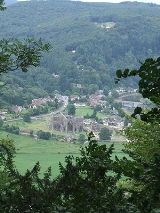
Wye Valley

Encyclopedia
Area of Outstanding Natural Beauty
An Area of Outstanding Natural Beauty is an area of countryside considered to have significant landscape value in England, Wales or Northern Ireland, that has been specially designated by the Countryside Agency on behalf of the United Kingdom government; the Countryside Council for Wales on...
(AONB) is an internationally important protected landscape straddling the border between England and Wales
Wales
Wales is a country that is part of the United Kingdom and the island of Great Britain, bordered by England to its east and the Atlantic Ocean and Irish Sea to its west. It has a population of three million, and a total area of 20,779 km²...
. It is one of the most dramatic and scenic landscape areas in southern Britain.
The River Wye
River Wye
The River Wye is the fifth-longest river in the UK and for parts of its length forms part of the border between England and Wales. It is important for nature conservation and recreation.-Description:...
is the fifth-longest river in the United Kingdom. The upper part of the river passes through the settlements of Rhayader
Rhayader
Rhayader is a market town and community in Powys, Mid Wales. It has a population of 2,075, and is the first town on the banks of the River Wye, from its source on the Plynlimon range of the Cambrian Mountains....
, Builth Wells
Builth Wells
Builth Wells is a town in the county of Powys, within the historic boundaries of Brecknockshire, mid Wales, lying at the confluence of the River Wye and the River Irfon, in the Welsh of the Wye Valley. It has a population of 2,352....
and Hay-on-Wye
Hay-on-Wye
Hay-on-Wye , often described as "the town of books", is a small market town and community in Powys, Wales.-Location:The town lies on the east bank of the River Wye and is within the Brecon Beacons National Park, just north of the Black Mountains...
, but the area designated as an AONB surrounds only the 72-mile stretch lower down the river, from just south of the city of Hereford
Hereford
Hereford is a cathedral city, civil parish and county town of Herefordshire, England. It lies on the River Wye, approximately east of the border with Wales, southwest of Worcester, and northwest of Gloucester...
to Chepstow
Chepstow
Chepstow is a town in Monmouthshire, Wales, adjoining the border with Gloucestershire, England. It is located on the River Wye, close to its confluence with the River Severn, and close to the western end of the Severn Bridge on the M48 motorway...
.
This area covers parts of the counties of Gloucestershire
Gloucestershire
Gloucestershire is a county in South West England. The county comprises part of the Cotswold Hills, part of the flat fertile valley of the River Severn, and the entire Forest of Dean....
, Herefordshire
Herefordshire
Herefordshire is a historic and ceremonial county in the West Midlands region of England. For Eurostat purposes it is a NUTS 3 region and is one of three counties that comprise the "Herefordshire, Worcestershire and Gloucestershire" NUTS 2 region. It also forms a unitary district known as the...
and Monmouthshire
Monmouthshire
Monmouthshire is a county in south east Wales. The name derives from the historic county of Monmouthshire which covered a much larger area. The largest town is Abergavenny. There are many castles in Monmouthshire .-Historic county:...
, and is recognised in particular for its limestone
Limestone
Limestone is a sedimentary rock composed largely of the minerals calcite and aragonite, which are different crystal forms of calcium carbonate . Many limestones are composed from skeletal fragments of marine organisms such as coral or foraminifera....
gorge scenery and dense native woodlands, as well as its wildlife, archaeological and industrial remains. It is also historically important as one of the birthplaces of the modern tourism
Tourism
Tourism is travel for recreational, leisure or business purposes. The World Tourism Organization defines tourists as people "traveling to and staying in places outside their usual environment for not more than one consecutive year for leisure, business and other purposes".Tourism has become a...
industry. The area is predominantly rural, and many people make a living from tourism, agriculture or forestry. Ross-on-Wye
Ross-on-Wye
Ross-on-Wye is a small market town with a population of 10,089 in southeastern Herefordshire, England, located on the River Wye, and on the northern edge of the Forest of Dean.-History:...
is the only town within the AONB itself, but Hereford, Monmouth
Monmouth
Monmouth is a town in southeast Wales and traditional county town of the historic county of Monmouthshire. It is situated close to the border with England, where the River Monnow meets the River Wye with bridges over both....
, Coleford
Coleford, Gloucestershire
Coleford is a small market town in Gloucestershire, England in the west of the Forest of Dean with a population of 8,351 . It is situated some four miles east of the Welsh border, and is close to the Wye Valley, a popular walking and canoeing area...
and Chepstow lie just outside its boundaries.
Geology
The varied landscapes of the Wye Valley can be explained by underlying rocks and structures, and how ice and then the river and tributary streams have acted upon them through time.Close to Hereford, the geology of the area around the village of Woolhope
Woolhope
- Location :Woolhope is located about 7 miles east of Hereford.- History :The manor of Woolhope in Herefordshire, along with three others, was given to the cathedral at Hereford before the Norman Conquest by the benefactresses Wulviva and Godiva, local Anglo-Saxon landowners before the Norman...
is largely made up of Silurian
Silurian
The Silurian is a geologic period and system that extends from the end of the Ordovician Period, about 443.7 ± 1.5 Mya , to the beginning of the Devonian Period, about 416.0 ± 2.8 Mya . As with other geologic periods, the rock beds that define the period's start and end are well identified, but the...
limestone
Limestone
Limestone is a sedimentary rock composed largely of the minerals calcite and aragonite, which are different crystal forms of calcium carbonate . Many limestones are composed from skeletal fragments of marine organisms such as coral or foraminifera....
s, shale
Shale
Shale is a fine-grained, clastic sedimentary rock composed of mud that is a mix of flakes of clay minerals and tiny fragments of other minerals, especially quartz and calcite. The ratio of clay to other minerals is variable. Shale is characterized by breaks along thin laminae or parallel layering...
s and sandstone
Sandstone
Sandstone is a sedimentary rock composed mainly of sand-sized minerals or rock grains.Most sandstone is composed of quartz and/or feldspar because these are the most common minerals in the Earth's crust. Like sand, sandstone may be any colour, but the most common colours are tan, brown, yellow,...
s. To the south of this, the Herefordshire lowlands are largely underlain by red mudstone
Mudstone
Mudstone is a fine grained sedimentary rock whose original constituents were clays or muds. Grain size is up to 0.0625 mm with individual grains too small to be distinguished without a microscope. With increased pressure over time the platey clay minerals may become aligned, with the...
s and sandstone
Sandstone
Sandstone is a sedimentary rock composed mainly of sand-sized minerals or rock grains.Most sandstone is composed of quartz and/or feldspar because these are the most common minerals in the Earth's crust. Like sand, sandstone may be any colour, but the most common colours are tan, brown, yellow,...
s, producing a redder soil. These rocks are softer than the limestones elsewhere, so the river created more meander
Meander
A meander in general is a bend in a sinuous watercourse. A meander is formed when the moving water in a stream erodes the outer banks and widens its valley. A stream of any volume may assume a meandering course, alternately eroding sediments from the outside of a bend and depositing them on the...
s, a wider floodplain
Floodplain
A floodplain, or flood plain, is a flat or nearly flat land adjacent a stream or river that stretches from the banks of its channel to the base of the enclosing valley walls and experiences flooding during periods of high discharge...
, and a gentler and more rolling landscape. Around Symonds Yat
Symonds Yat
Symonds Yat is a village in the Forest of Dean and a popular tourist destination, straddling the River Wye and the borders of the English counties of Herefordshire and Gloucestershire, it is within a few miles of the Welsh border...
, limestones and red sandstones meet. This leads to a landscape of hills and plains, as well as substantial meanders which have formed impressive river cliffs.
The Lower Wye landscape was formed by the river acting on a series of layers of rock that dip towards the Forest of Dean
Forest of Dean
The Forest of Dean is a geographical, historical and cultural region in the western part of the county of Gloucestershire, England. The forest is a roughly triangular plateau bounded by the River Wye to the west and north, the River Severn to the south, and the City of Gloucester to the east.The...
. Here the river has incised into the margins of the Old Red Sandstone
Old Red Sandstone
The Old Red Sandstone is a British rock formation of considerable importance to early paleontology. For convenience the short version of the term, 'ORS' is often used in literature on the subject.-Sedimentology:...
plateau to form a gorge with substantial river cliffs. The steepest parts of the Wye gorge are cut through the Carboniferous Limestone
Carboniferous limestone
Carboniferous Limestone is a term used to describe a variety of different types of limestone occurring widely across Great Britain and Ireland which were deposited during the Dinantian epoch of the Carboniferous period. They were formed between 363 and 325 million years ago...
. Here the combined action of the river, natural joints in the rocks and quarrying have exposed many vertical faces, particularly between Tintern
Tintern
Tintern is a village on the west bank of the River Wye in Monmouthshire, Wales, close to the border with England, about 5 miles north of Chepstow...
and Chepstow.
Geological interest extends underground, and there are many rock shelters and solution caves in the area. These include King Arthur's Cave and many others in the area of Symonds Yat and Slaughter Stream Cave
Slaughter Stream Cave
Slaughter Stream Cave also known as Wet Sink is a cave system in the Wye Valley, Forest of Dean.A series of fixed ladders and two pitches lead to sporting streamways, sandy crawls and fossil passages...
near Berry Hill. At St Arvans, near Chepstow, the underground watercourses have carved out long cave systems, which exit at Otter Hole
Otter Hole
Otter Hole is perhaps one of the best decorated caves in Britain. Located on the English Welsh border just north of Chepstow, the cave runs from the banks of the tidal River Wye under the Chepstow Racecourse and onwards through various chambers, each rich with cave formations...
at the base of Piercefield cliffs — the only cave system in England or Wales which has to be reached through a tidal sump, making it a mecca
Mecca
Mecca is a city in the Hijaz and the capital of Makkah province in Saudi Arabia. The city is located inland from Jeddah in a narrow valley at a height of above sea level...
for experienced cavers.
Wildlife
LancautLancaut
Lancaut is a deserted village in Gloucestershire, England, located alongside the River Wye, around two miles north of Chepstow. It occupies a narrow-necked promontory formed by a curve of the river, which acts as the border between England and Wales. Little remains of the village today, except...
Gloucestershire Wildlife Trust nature reserves information for Lancaut SSSI and Ban-y-Gor are Gloucestershire Wildlife Trust nature reserves
Gloucestershire Wildlife Trust
The Gloucestershire Wildlife Trust is the Gloucestershire local partner in a conservation network of 47 Wildlife Trusts. The Wildlife Trusts are local charities with the specific aim of protecting the United Kingdom's natural heritage...
.

European Union
The European Union is an economic and political union of 27 independent member states which are located primarily in Europe. The EU traces its origins from the European Coal and Steel Community and the European Economic Community , formed by six countries in 1958...
's Habitats Directive. It supports a population of lesser horseshoe bat
Lesser horseshoe bat
The Lesser Horseshoe Bat , is a type of European bat related to but smaller than its cousin, the Greater Horseshoe Bat...
s, a growing population of peregrine falcons, goshawks, raven
Raven
Raven is the common name given to several larger-bodied members of the genus Corvus—but in Europe and North America the Common Raven is normally implied...
s, rare whitebeam
Whitebeam
The whitebeams are members of the Rosaceae family, comprising subgenus Aria of genus Sorbus, and hybrids involving species of this subgenus and members of subgenera Sorbus, Torminaria and Chamaemespilus. They are deciduous trees with simple or lobed leaves, arranged alternately...
, nightjar
Nightjar
Nightjars are medium-sized nocturnal or crepuscular birds with long wings, short legs and very short bills. They are sometimes referred to as goatsuckers from the mistaken belief that they suck milk from goats . Some New World species are named as nighthawks...
and lesser known fish like the shad
Shad
The shads or river herrings comprise the genus Alosa, fish related to herring in the family Clupeidae. They are distinct from others in that family by having a deeper body and spawning in rivers. The several species frequent different areas on both sides of the Atlantic Ocean, Mediterranean Sea....
and twaite. The main Welsh populations of the small but colourful moth
Moth
A moth is an insect closely related to the butterfly, both being of the order Lepidoptera. Moths form the majority of this order; there are thought to be 150,000 to 250,000 different species of moth , with thousands of species yet to be described...
Oecophora bractella
Oecophora bractella
Oecophora bractella is a species of gelechioid moths. It belongs to the subfamily Oecophorinae of the concealer moth family . As the type species of its genus Oecophora, its affiliations and phylogeny determine the delimitation of that family and subfamily.It is native to in Europe, where it...
are found here.
In September 2006 it was reported that one colony of lesser horseshoe bats in the area had reached record numbers, with some 890 bats in a small stone barn (599 adults and 291 babies recorded).
Archaeology
The valley has been inhabited for at least 12,000 years. Caves near Symonds YatSymonds Yat
Symonds Yat is a village in the Forest of Dean and a popular tourist destination, straddling the River Wye and the borders of the English counties of Herefordshire and Gloucestershire, it is within a few miles of the Welsh border...
and Chepstow
Chepstow
Chepstow is a town in Monmouthshire, Wales, adjoining the border with Gloucestershire, England. It is located on the River Wye, close to its confluence with the River Severn, and close to the western end of the Severn Bridge on the M48 motorway...
provide evidence of settlement dating from Palaeolithic times, and finds from later stone ages such as the Neolithic
Neolithic
The Neolithic Age, Era, or Period, or New Stone Age, was a period in the development of human technology, beginning about 9500 BC in some parts of the Middle East, and later in other parts of the world. It is traditionally considered as the last part of the Stone Age...
have also been found. These have yielded evidence of how prehistoric human populations lived as nomadic hunters and traders.
Standing stones at Huntsham
Huntsham
Huntsham is a small village and civil parish in the Mid Devon district of Devon, England. Its nearest town is Tiverton, which lies approximately south-west from the village. The parish has an acreage of and a population of 157....
, Staunton
Staunton, Gloucestershire
Staunton is the name of two different villages in the Forest of Dean in west Gloucestershire, England.This entry is for the one near Coleford...
, and Trellech
Trellech
Trellech is a village in Monmouthshire, south-east Wales, near Monmouth and the location of an archaeological site. The village is designated as a Conservation Area....
all have origins dating back to the Bronze Age
Bronze Age
The Bronze Age is a period characterized by the use of copper and its alloy bronze as the chief hard materials in the manufacture of some implements and weapons. Chronologically, it stands between the Stone Age and Iron Age...
. Later, Iron Age
Iron Age
The Iron Age is the archaeological period generally occurring after the Bronze Age, marked by the prevalent use of iron. The early period of the age is characterized by the widespread use of iron or steel. The adoption of such material coincided with other changes in society, including differing...
forts along the lower Wye Valley, and in the Woolhope area, took advantage of the natural hilltops and promontories to form well-defended settlements. It is likely that many of these marked the edges of disputed tribal pre-Roman
British Iron Age
The British Iron Age is a conventional name used in the archaeology of Great Britain, referring to the prehistoric and protohistoric phases of the Iron-Age culture of the main island and the smaller islands, typically excluding prehistoric Ireland, and which had an independent Iron Age culture of...
territories.
Watling Street
Watling Street
Watling Street is the name given to an ancient trackway in England and Wales that was first used by the Britons mainly between the modern cities of Canterbury and St Albans. The Romans later paved the route, part of which is identified on the Antonine Itinerary as Iter III: "Item a Londinio ad...
ran through the Roman
Roman Britain
Roman Britain was the part of the island of Great Britain controlled by the Roman Empire from AD 43 until ca. AD 410.The Romans referred to the imperial province as Britannia, which eventually comprised all of the island of Great Britain south of the fluid frontier with Caledonia...
settlements of Ariconium
Ariconium
Ariconium was a road station of Roman Britain mentioned in Iter XIII of the Iter Britanniarum of the Antonine Itineraries. It was located at Bury Hill in the parish of Weston under Penyard, about east of Ross on Wye, Herefordshire, and about southeast of Hereford. The site existed prior to the...
(just north of modern Ross-on-Wye
Ross-on-Wye
Ross-on-Wye is a small market town with a population of 10,089 in southeastern Herefordshire, England, located on the River Wye, and on the northern edge of the Forest of Dean.-History:...
) and Blestium
Blestium
Blestium was a small town and probable fort in Roman Wales within the Roman province of Britannia Superior, part of Roman Britain...
(Monmouth), and a number of other small Roman settlements are known. The first evidence of the exploitation of iron and coal in the valley is found in the Roman period, with iron working known from sites at Monmouth
Monmouth
Monmouth is a town in southeast Wales and traditional county town of the historic county of Monmouthshire. It is situated close to the border with England, where the River Monnow meets the River Wye with bridges over both....
, Trellech and elsewhere, as well as in the adjoining Forest of Dean
Forest of Dean
The Forest of Dean is a geographical, historical and cultural region in the western part of the county of Gloucestershire, England. The forest is a roughly triangular plateau bounded by the River Wye to the west and north, the River Severn to the south, and the City of Gloucester to the east.The...
. The medieval boroughs of Goodrich
Goodrich, Herefordshire
Goodrich is a village, in south Herefordshire, England which is very close to Gloucestershire and the Forest of Dean situated near the River Wye at and is famous for its old red sandstone Norman and medieval castle.Not strictly in the Forest of Dean but close enough to count Goodrich is a small...
and Chepstow, at each end of the Wye Gorge, may have originally been established at this time.
Closely following the River Wye, Offa's Dyke
Offa's Dyke
Offa's Dyke is a massive linear earthwork, roughly followed by some of the current border between England and Wales. In places, it is up to wide and high. In the 8th century it formed some kind of delineation between the Anglian kingdom of Mercia and the Welsh kingdom of Powys...
was built in the 8th century under King Offa to mark out the boundary between England and Wales and is, today, the longest archaeological monument in Britain. Offa's Dyke Path
Offa's Dyke Path
Offa's Dyke Path is a long distance footpath along the Welsh-English border. Opened in 1971, it is one of Britain's premier National Trails and draws walkers from throughout the world...
long distance footpath today traces the route through the Wye valley on the English bank, while the Wye Valley Walk
Wye Valley Walk
The Wye Valley Walk is a long distance footpath in Wales and England following the course of the River Wye .-Distance:The whole route now that it has been extended runs for 136 miles .-The route:...
follows the Welsh bank.
The medieval period
When the NormansNormans
The Normans were the people who gave their name to Normandy, a region in northern France. They were descended from Norse Viking conquerors of the territory and the native population of Frankish and Gallo-Roman stock...
conquered the region in the 11th century they immediately built major castle
Castle
A castle is a type of fortified structure built in Europe and the Middle East during the Middle Ages by European nobility. Scholars debate the scope of the word castle, but usually consider it to be the private fortified residence of a lord or noble...
s at Chepstow
Chepstow Castle
Chepstow Castle , located in Chepstow, Monmouthshire in Wales, on top of cliffs overlooking the River Wye, is the oldest surviving post-Roman stone fortification in Britain...
and Monmouth
Monmouth
Monmouth is a town in southeast Wales and traditional county town of the historic county of Monmouthshire. It is situated close to the border with England, where the River Monnow meets the River Wye with bridges over both....
to defend the territory. Smaller castles were built at St Briavels
St Briavels
St Briavels is a medium sized village and civil parish in the Royal Forest of Dean in west Gloucestershire, England; close to the England-Wales border, and south of Coleford. It stands almost above sea level on the edge of a limestone plateau above the valley of the River Wye, above an ancient...
, Ruardean
Ruardean
Ruardean is a village in the Forest of Dean, Gloucestershire, England, to the west of Cinderford. It is situated on a hillside with views west towards the mountains of South Wales. Little now remains of the village's industrial history, but once it was a centre for iron ore smelting furnaces,...
, Goodrich
Goodrich Castle
Goodrich Castle is a now ruinous Norman medieval castle situated to the north of the village of Goodrich in Herefordshire, England, controlling a key location between Monmouth and Ross-on-Wye...
and Wilton Castle
Wilton Castle
Wilton Castle is a 12th-century Norman castle fortification located in southeastern Herefordshire, England on the River Wye adjacent to the town of Ross-on-Wye. The castle is named for the manor associated with it....
.
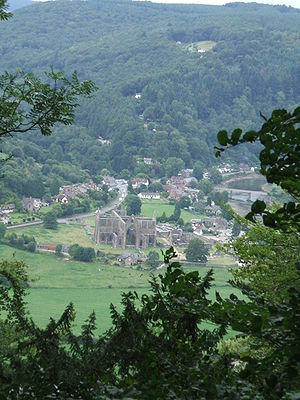
Tintern Abbey
Tintern Abbey
Tintern Abbey was founded by Walter de Clare, Lord of Chepstow, on 9 May 1131. It is situated in the village of Tintern, on the Welsh bank of the River Wye in Monmouthshire, which forms the border between Monmouthshire in Wales and Gloucestershire in England. It was only the second Cistercian...
was founded in 1131 by Cistercian monks, and largely rebuilt in the 13th century. It is the best-preserved medieval abbey
Abbey
An abbey is a Catholic monastery or convent, under the authority of an Abbot or an Abbess, who serves as the spiritual father or mother of the community.The term can also refer to an establishment which has long ceased to function as an abbey,...
in Wales and an outstanding example of Gothic architecture
Gothic architecture
Gothic architecture is a style of architecture that flourished during the high and late medieval period. It evolved from Romanesque architecture and was succeeded by Renaissance architecture....
.
Many of the smaller villages in the area probably date from the Middle Ages, and much of this expansion was probably associated with the early iron
Iron
Iron is a chemical element with the symbol Fe and atomic number 26. It is a metal in the first transition series. It is the most common element forming the planet Earth as a whole, forming much of Earth's outer and inner core. It is the fourth most common element in the Earth's crust...
industry. The medieval iron industry consumed large quantities of charcoal
Charcoal
Charcoal is the dark grey residue consisting of carbon, and any remaining ash, obtained by removing water and other volatile constituents from animal and vegetation substances. Charcoal is usually produced by slow pyrolysis, the heating of wood or other substances in the absence of oxygen...
and much of the woodland was coppiced for this purpose. Trellech was one of the largest communities in Wales during this period.
The development of industry
The Lower Wye Valley can claim to be a birthplace of the Industrial RevolutionIndustrial Revolution
The Industrial Revolution was a period from the 18th to the 19th century where major changes in agriculture, manufacturing, mining, transportation, and technology had a profound effect on the social, economic and cultural conditions of the times...
.
Iron
Iron
Iron is a chemical element with the symbol Fe and atomic number 26. It is a metal in the first transition series. It is the most common element forming the planet Earth as a whole, forming much of Earth's outer and inner core. It is the fourth most common element in the Earth's crust...
has been made in the Wye Valley since Roman
Ancient Rome
Ancient Rome was a thriving civilization that grew on the Italian Peninsula as early as the 8th century BC. Located along the Mediterranean Sea and centered on the city of Rome, it expanded to one of the largest empires in the ancient world....
times, using the ready supply of timber, good quality ore and abundant charcoal
Charcoal
Charcoal is the dark grey residue consisting of carbon, and any remaining ash, obtained by removing water and other volatile constituents from animal and vegetation substances. Charcoal is usually produced by slow pyrolysis, the heating of wood or other substances in the absence of oxygen...
from the Forest of Dean
Forest of Dean
The Forest of Dean is a geographical, historical and cultural region in the western part of the county of Gloucestershire, England. The forest is a roughly triangular plateau bounded by the River Wye to the west and north, the River Severn to the south, and the City of Gloucester to the east.The...
. The river provided transport for the raw materials and finished product, and with the introduction of the blast furnace
Blast furnace
A blast furnace is a type of metallurgical furnace used for smelting to produce industrial metals, generally iron.In a blast furnace, fuel and ore and flux are continuously supplied through the top of the furnace, while air is blown into the bottom of the chamber, so that the chemical reactions...
in the 16th century, its tributaries began to be used for water power.
The first brass
Brass
Brass is an alloy of copper and zinc; the proportions of zinc and copper can be varied to create a range of brasses with varying properties.In comparison, bronze is principally an alloy of copper and tin...
made in Britain was founded at Tintern
Tintern
Tintern is a village on the west bank of the River Wye in Monmouthshire, Wales, close to the border with England, about 5 miles north of Chepstow...
in 1566. Wire
Wire
A wire is a single, usually cylindrical, flexible strand or rod of metal. Wires are used to bear mechanical loads and to carry electricity and telecommunications signals. Wire is commonly formed by drawing the metal through a hole in a die or draw plate. Standard sizes are determined by various...
-making followed, with water mills situated on all the tributaries of the lower Wye. The area resounded to the noise and smoke of heavy industry for the next 400 years and gave rise to many pioneering industries. For instance, Whitebrook
Whitebrook
Whitebrook is a small village in Monmouthshire, south-east Wales, United Kingdom. It is located four miles south east of Monmouth in the Wye Valley.- History and amenities :...
became famous for paper milling, when wallpaper
Wallpaper
Wallpaper is a kind of material used to cover and decorate the interior walls of homes, offices, and other buildings; it is one aspect of interior decoration. It is usually sold in rolls and is put onto a wall using wallpaper paste...
became a fashionable way to decorate houses. At Redbrook
Redbrook
Redbrook is a village in Gloucestershire, England, adjoining the border with Monmouthshire, Wales. It is located on the River Wye and is within the Wye Valley Area of Outstanding Natural Beauty.- History :...
, copper
Copper
Copper is a chemical element with the symbol Cu and atomic number 29. It is a ductile metal with very high thermal and electrical conductivity. Pure copper is soft and malleable; an exposed surface has a reddish-orange tarnish...
works were established by 1691, and a century later the village became one of the world's major tinplate manufacturing centres. This industry survived until the 1960s and was renowned for producing the thinnest, highest quality plate in the world. The Lydbrook
Lydbrook
Lydbrook is a civil parish in the Forest of Dean, a local government district in the English county of Gloucestershire. It comprises the districts of Lower Lydbrook, Upper Lydbrook, and Joys Green.-Introduction:...
valley was also a thriving centre for metal industries, such as the manufacture of telegraph cables.
The valley woodlands were carefully managed to produce mature trees for shipbuilding
Shipbuilding
Shipbuilding is the construction of ships and floating vessels. It normally takes place in a specialized facility known as a shipyard. Shipbuilders, also called shipwrights, follow a specialized occupation that traces its roots to before recorded history.Shipbuilding and ship repairs, both...
, or by coppicing for charcoal
Charcoal
Charcoal is the dark grey residue consisting of carbon, and any remaining ash, obtained by removing water and other volatile constituents from animal and vegetation substances. Charcoal is usually produced by slow pyrolysis, the heating of wood or other substances in the absence of oxygen...
, and to provide bark for tanning
Tanning
Tanning is the making of leather from the skins of animals which does not easily decompose. Traditionally, tanning used tannin, an acidic chemical compound from which the tanning process draws its name . Coloring may occur during tanning...
. The valley industries were also massive consumers of timber. A ship of 150 tons, for example, required 3,000 wagonloads of timber to complete — and in 1824, 13 ships were launched at Brockweir
Brockweir
Brockweir is a small village on the eastern bank of the River Wye, within the Forest of Dean, Gloucestershire, England. A road bridge links it across the river to Monmouthshire, Wales, about a mile outside the village of Tintern and 7½ miles north of Chepstow...
alone.
The river was the economic backbone of the region, providing an important means of transport, trade and communication. In late medieval times, salmon
Salmon
Salmon is the common name for several species of fish in the family Salmonidae. Several other fish in the same family are called trout; the difference is often said to be that salmon migrate and trout are resident, but this distinction does not strictly hold true...
weirs hindered free passage on the river, but the Wye Navigation Act in 1662 enabled the river's potential to be developed. By 1727 shallow draught boats could get upstream beyond Hereford, and a significant shipbuilding industry developed at Monmouth, Llandogo
Llandogo
Llandogo is a small village in Monmouthshire, south Wales, located between Monmouth and Chepstow in the lower reaches of the Wye Valley AONB, two miles north of Tintern. It is set on a steep hillside overlooking the River Wye and across into the Forest of Dean in Gloucestershire, England.- History...
, Brockweir and Chepstow. However, by 1835 it was stated that the Wye "can scarcely be considered a commercial highway" above Monmouth, and by the 1880s Brockweir bridge was the effective upper limit of navigation.
As the 19th century progressed, the valley's industries gradually declined, and management of the woodlands lessened when there was no longer a ready market for their products.
The origins of British tourism
John Kyrle
John Kyrle , known as "the Man of Ross", was an English philanthropist, born in the parish of Dymock, Gloucestershire but best remembered for his time in Ross-on-Wye in Herefordshire.- Education & Legal Background :...
developed the 'Prospect' at Ross-on-Wye
Ross-on-Wye
Ross-on-Wye is a small market town with a population of 10,089 in southeastern Herefordshire, England, located on the River Wye, and on the northern edge of the Forest of Dean.-History:...
, and it was later mentioned in verse by Alexander Pope
Alexander Pope
Alexander Pope was an 18th-century English poet, best known for his satirical verse and for his translation of Homer. He is the third-most frequently quoted writer in The Oxford Dictionary of Quotations, after Shakespeare and Tennyson...
.
In 1745, John Egerton
John Egerton (bishop)
John Egerton was an Anglican bishop.-Family:Egerton was the eldest son of Henry Egerton, the Bishop of Hereford, himself a younger son of the 3rd Earl of Bridgewater. Egerton served under his father as Dean of Hereford and was later Bishop of Bangor from 1756-68, Bishop of Lichfield from 1768-71...
, later Bishop of Durham, started taking friends on boat trips down the valley from the rectory at Ross. The area became more widely known following the publication of works by the poet Thomas Gray
Thomas Gray
Thomas Gray was a poet, letter-writer, classical scholar and professor at Cambridge University.-Early life and education:...
, and, in particular, Observations on the River Wye by the Reverend William Gilpin
William Gilpin (clergyman)
The Reverend William Gilpin was an English artist, clergyman, schoolmaster, and author, best known as one of the originators of the idea of the picturesque.-Early life:...
, published in 1782. The first illustrated tour guide to be published in Britain, it helped travellers locate and enjoy the most "Picturesque
Picturesque
Picturesque is an aesthetic ideal introduced into English cultural debate in 1782 by William Gilpin in Observations on the River Wye, and Several Parts of South Wales, etc. Relative Chiefly to Picturesque Beauty; made in the Summer of the Year 1770, a practical book which instructed England's...
" aspects of the countryside. Regular excursions began to be established from Ross, the boat journey to Chepstow
Chepstow
Chepstow is a town in Monmouthshire, Wales, adjoining the border with Gloucestershire, England. It is located on the River Wye, close to its confluence with the River Severn, and close to the western end of the Severn Bridge on the M48 motorway...
taking two days.
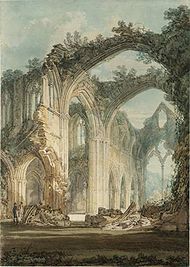
Some of the most famous poets, writers and artists of the day made the pilgrimage to the great sights of Goodrich, Tintern
Tintern
Tintern is a village on the west bank of the River Wye in Monmouthshire, Wales, close to the border with England, about 5 miles north of Chepstow...
and Chepstow
Chepstow
Chepstow is a town in Monmouthshire, Wales, adjoining the border with Gloucestershire, England. It is located on the River Wye, close to its confluence with the River Severn, and close to the western end of the Severn Bridge on the M48 motorway...
— among them Coleridge
Samuel Taylor Coleridge
Samuel Taylor Coleridge was an English poet, Romantic, literary critic and philosopher who, with his friend William Wordsworth, was a founder of the Romantic Movement in England and a member of the Lake Poets. He is probably best known for his poems The Rime of the Ancient Mariner and Kubla...
, Thackeray
William Makepeace Thackeray
William Makepeace Thackeray was an English novelist of the 19th century. He was famous for his satirical works, particularly Vanity Fair, a panoramic portrait of English society.-Biography:...
and Turner
J. M. W. Turner
Joseph Mallord William Turner RA was an English Romantic landscape painter, watercolourist and printmaker. Turner was considered a controversial figure in his day, but is now regarded as the artist who elevated landscape painting to an eminence rivalling history painting...
. Wordsworth
William Wordsworth
William Wordsworth was a major English Romantic poet who, with Samuel Taylor Coleridge, helped to launch the Romantic Age in English literature with the 1798 joint publication Lyrical Ballads....
was also captivated by the area, writing Lines Written a Few Miles Above Tintern Abbey in 1798. Poetic influence continued to be felt in the next century, as in 1811, popular 'peasant poet', Robert Bloomfield
Robert Bloomfield
Robert Bloomfield was an English labouring class poet whose work is appreciated in the context of other self-educated writers such as Stephen Duck, Mary Collier and John Clare.-Life:...
wrote 'The Banks of Wye; a Poem in Four Books' providing account of an 1807 trip made by him and a party of friends down the River Wye
River Wye
The River Wye is the fifth-longest river in the UK and for parts of its length forms part of the border between England and Wales. It is important for nature conservation and recreation.-Description:...
and surrounding areas.
The first of Britain's great landscapes to be 'discovered', the Wye Valley's particular attraction was its river scenery, and the many guidebooks, engravings and paintings ensured a continuing steady stream of visitors. Viewpoints were specially constructed, including the Kymin
The Kymin
The Kymin, or Kymin Hill, is a hill overlooking Monmouth, in Monmouthshire, Wales. It is located approximately one mile east of Monmouth, on the eastern side of the River Wye and its AONB and adjacent to the border with Gloucestershire's Forest of Dean and England...
above Monmouth
Monmouth
Monmouth is a town in southeast Wales and traditional county town of the historic county of Monmouthshire. It is situated close to the border with England, where the River Monnow meets the River Wye with bridges over both....
, with its round house giving panoramic views across the town. Another highlight for travellers was the cliff ascent and walks at Piercefield
Piercefield House
Piercefield House is a largely ruined neo-classical country house designed by Sir John Soane, located near Chepstow in Monmouthshire, south east Wales. Its extensive surrounding park overlooking the Wye Valley includes Chepstow Racecourse...
. However, most of the truly 'Picturesque' scenes were sketched from river level, with the shimmering water as the foreground for the forests and cliffs behind, and the castle and abbey ruins.
Transport
In 1813 the Monmouth Tramroad linked CoalwayCoalway
Coalway is a village in the West Forest of Dean region of Gloucestershire, England, approximately one mile south-east of the town of Coleford.-External links:...
(near Coleford
Coleford, Gloucestershire
Coleford is a small market town in Gloucestershire, England in the west of the Forest of Dean with a population of 8,351 . It is situated some four miles east of the Welsh border, and is close to the Wye Valley, a popular walking and canoeing area...
), Redbrook
Redbrook
Redbrook is a village in Gloucestershire, England, adjoining the border with Monmouthshire, Wales. It is located on the River Wye and is within the Wye Valley Area of Outstanding Natural Beauty.- History :...
and Monmouth
Monmouth
Monmouth is a town in southeast Wales and traditional county town of the historic county of Monmouthshire. It is situated close to the border with England, where the River Monnow meets the River Wye with bridges over both....
. This was the world's first railed-way to make specific powers in its Act of Parliament to allow for the charging of fares to passengers.
The standard gauge Wye Valley Railway
Wye Valley Railway
The Wye Valley Railway was a standard gauge railway that ran for nearly between Chepstow and Monmouth along the lower part of the scenic Wye Valley in Monmouthshire, Wales, and Gloucestershire, England. It followed the route of the River Wye for most of its length...
line between Chepstow, Monmouth and Ross opened much later, in 1876. This made the valley more accessible and popular to tourists. In the early 20th century, crowds of up to 1300 would travel on a special train journey to see Tintern Abbey on the night of the harvest moon. The line closed to passengers in 1959, although sections remain as bridleways and footbridges.
The road network in the lower Wye valley remained essentially undeveloped during the rise of the Valley's industrialisation, until a series of Turnpike trust
Turnpike trust
Turnpike trusts in the United Kingdom were bodies set up by individual Acts of Parliament, with powers to collect road tolls for maintaining the principal highways in Britain from the 17th but especially during the 18th and 19th centuries...
s were authorised during the 18th century. It was not until 1828 that the current Wye Valley road, the A466, was first constructed.
The area became more accessible to much of the country with the building of the M50
M50 motorway (Great Britain)
The M50 is a motorway in Gloucestershire, Worcestershire and Herefordshire, England. It is long and is sometimes referred to as the Ross Spur. It is the only motorway-class road in Herefordshire.-Route:...
between the M5
M5 motorway
The M5 is a motorway in England. It runs from a junction with the M6 at West Bromwich near Birmingham to Exeter in Devon. Heading south-west, the M5 runs east of West Bromwich and west of Birmingham through Sandwell Valley...
and Ross-on-Wye, and the opening of the Severn Bridge
Severn Bridge
The Severn Bridge is a suspension bridge spanning the River Severn between South Gloucestershire, just north of Bristol, England, and Monmouthshire in South Wales, via Beachley, a peninsula between the River Severn and River Wye estuary. It is the original Severn road crossing between England and...
(now part of the M48
M48 motorway
The M48 is a motorway in Great Britain joining Gloucestershire and Monmouthshire over the original Severn Bridge. The M48 is anomalously numbered, as it is entirely to the west of the M5 motorway and its number should really therefore begin with 5.-Route:...
) in 1966.
Management of the area
The Wye Valley Area of Outstanding Natural Beauty (AONB) was first designated in 1971. The designation indicates the importance of recognising and preserving the area's distinctive qualities, for the benefit of present and future generations.Administratively the area is very complex, being the only protected landscape to straddle the border between England and Wales. The Counties of Herefordshire, Monmouthshire and Gloucestershire are each in a different government region.
Co-ordination of conservation across these political boundaries is undertaken by an AONB unit and Joint Advisory Committee. A Management Plan for the AONB enlists a range of partners in conserving and enhancing its beauty for the benefit of present and future generations.
The navigation of the tidal part of the Wye (below Bigsweir
Bigsweir
Bigsweir is a locality in the Wye Valley Area of Outstanding Natural Beauty, which straddles the boundary between Gloucestershire in England and Monmouthshire in Wales. It is located about 2 miles north of Llandogo, 2 miles south of Whitebrook, and 3 miles west of St. Briavels...
) comes under the control of the Gloucester Harbour Trustees
Gloucester Harbour Trustees
The Gloucester Harbour Trustees are the Competent Harbour Authority for the tidal part of the River Severn from the Gloucester weirs down to just below the Second Severn Crossing and on the River Wye up to its tidal limit .The Trustees have responsibilities for navigational safety in that part of...
as Competent Harbour Authority.
External links
- Official site for the Wye Valley Area of Outstanding Natural Beauty (AONB)
- Gloucestershire Wildlife Trust website
- Bat Conservation Trust
- Tourist information on the Wye Valley
- Wye Valley & Vale of Usk Visitor Guide 2010
- Wye Valley Railway - history and photos
- The Wye Valley: Riverside of the Romantics (by Nigel Richardson), article from the travel section of the Daily Telegraph, pub. 23 Sep 2008