
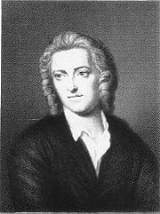
Thomas Gray was a poet, letter-writer, classical scholar and professor at
Cambridge UniversityThe University of Cambridge is a public research university located in Cambridge, United Kingdom. It is the second-oldest university in both the United Kingdom and the English-speaking world , and the seventh-oldest globally...
.
Early life and education
Thomas Gray was born in Cornhill, London, the son of an exchange broker and a milliner. He was the fifth of 12 children and the only child of Philip and Dorothy Gray to survive infancy. He lived with his mother after she left his abusive father. He was educated at
Eton CollegeEton College, often referred to simply as Eton, is a British independent school for boys aged 13 to 18. It was founded in 1440 by King Henry VI as "The King's College of Our Lady of Eton besides Wyndsor"....
where his uncle was one of the masters. He recalled his schooldays as a time of great happiness, as is evident in his
Ode on a Distant Prospect of Eton College. Gray was a delicate and scholarly boy who spent his time reading and avoiding
athleticsA Sport is all forms of physical activity which, through casual or organised participation, aim to use, maintain or improve physical fitness and provide entertainment to participants. Sport may be competitive, where a winner or winners can be identified by objective means, and may require a degree...
. It was probably fortunate for the sensitive Gray that he was able to live in his uncle’s household rather than at college. He made three close friends at Eton: Horace Walpole, son of Prime Minister
Robert WalpoleRobert Walpole, 1st Earl of Orford, KG, KB, PC , known before 1742 as Sir Robert Walpole, was a British statesman who is generally regarded as having been the first Prime Minister of Great Britain....
, Thomas Ashton, and
Richard WestRichard West was an 18th-century lawyer and politician.He represented Grampound and Bodmin in the English Parliament and was Lord Chancellor of Ireland from 1725 to 1726, succeeding Alan Brodrick, 1st Viscount Midleton.-Career:...
. The four prided themselves on their sense of style, their sense of humour, and their appreciation of beauty.
In 1734 Gray went up to
Peterhouse, CambridgePeterhouse is a constituent college of the University of Cambridge, England. It is the oldest college of the University, having been founded in 1284 by Hugo de Balsham, Bishop of Ely...
. He found the curriculum dull. He wrote letters to his friends listing all the things he disliked: the masters ("mad with Pride") and the Fellows ("sleepy, drunken, dull, illiterate Things.") Supposedly he was intended for the law, but in fact he spent his time as an undergraduate reading classical and modern literature and playing Vivaldi and
ScarlattiScarlatti was the name of several Italian composers:*Alessandro Scarlatti , Baroque composer known for operas and chamber cantatas*Francesco Scarlatti , Baroque composer and musician, brother of Alessandro Scarlatti...
on the
harpsichordA harpsichord is a musical instrument played by means of a keyboard. It produces sound by plucking a string when a key is pressed.In the narrow sense, "harpsichord" designates only the large wing-shaped instruments in which the strings are perpendicular to the keyboard...
for relaxation.
In 1738 he accompanied his old school-friend Walpole on his
Grand TourThe Grand Tour was the traditional trip of Europe undertaken by mainly upper-class European young men of means. The custom flourished from about 1660 until the advent of large-scale rail transit in the 1840s, and was associated with a standard itinerary. It served as an educational rite of passage...
of Europe, possibly at Walpole's expense. The two fell out and parted in
TuscanyTuscany is a region in Italy. It has an area of about 23,000 square kilometres and a population of about 3.75 million inhabitants. The regional capital is Florence ....
, because Walpole wanted to attend fashionable parties and Gray wanted to visit all the
antiquitiesAntiquities, nearly always used in the plural in this sense, is a term for objects from Antiquity, especially the civilizations of the Mediterranean: the Classical antiquity of Greece and Rome, Ancient Egypt and the other Ancient Near Eastern cultures...
. However, they were reconciled a few years later.
Writing and academia
Gray began seriously writing poems in 1742, mainly after his close friend Richard West died. He moved to Cambridge and began a self-imposed programme of literary study, becoming one of the most learned men of his time, though he claimed to be lazy by inclination. He became a
FellowA fellow in the broadest sense is someone who is an equal or a comrade. The term fellow is also used to describe a person, particularly by those in the upper social classes. It is most often used in an academic context: a fellow is often part of an elite group of learned people who are awarded...
first of
PeterhousePeterhouse is a constituent college of the University of Cambridge, England. It is the oldest college of the University, having been founded in 1284 by Hugo de Balsham, Bishop of Ely...
, and later of
Pembroke College, CambridgePembroke College is a constituent college of the University of Cambridge, England.The college has over seven hundred students and fellows, and is the third oldest college of the university. Physically, it is one of the university's larger colleges, with buildings from almost every century since its...
. It is said that the change of college was the result of a practical joke. Terrified of fire, he had installed a metal bar by his window on the top floor of the Burrough’s building at Peterhouse, so that in the event of a fire he could tie his sheets to it and climb to safety ...
Gray spent most of his life as a scholar in Cambridge, and only later in his life did he begin travelling again. Although he was one of the least productive poets (his collected works published during his lifetime amount to fewer than 1,000 lines), he is regarded as the foremost English-language poet of the mid-18th century. In 1757, he was offered the post of
Poet LaureateA poet laureate is a poet officially appointed by a government and is often expected to compose poems for state occasions and other government events...
, which he refused.
In 1762, the
Regius chairRegius Professorships are "royal" professorships at the ancient universities of the United Kingdom and Ireland - namely Oxford, Cambridge, St Andrews, Glasgow, Aberdeen, Edinburgh and Dublin. Each of the chairs was created by a monarch, and each appointment, save those at Dublin, is approved by the...
of
Modern HistoryRegius Professor of Modern History is one of the senior professorships in history at Cambridge University. It was founded in 1724 by George I. The appointment is by Royal Warrant on the recommendation of the Prime Minister of the day...
at Cambridge, a
sinecureA sinecure means an office that requires or involves little or no responsibility, labour, or active service...
which carried a salary of £400, fell vacant after the death of
Shallet TurnerShallet Turner FRS LL. D. was a Fellow of Peterhouse, Cambridge, and a Fellow of the Royal Society. As a Regius professor of Modern history he was notorious for treating the position as a sinecure.-Life:...
, and Gray's friends lobbied the government unsuccessfully to secure the position for him. In the event, Gray lost out to
Lawrence BrockettLawrence Brockett was the youngest of five sons born to Lawrence Brockett and Anne Clarke. He inherited from his parents Headlam Hall, a country house near Gainford, County Durham...
, but he secured the position in 1768 after Brockett's death.
Gray was so self critical and fearful of failure that he only published thirteen poems during his lifetime, and once wrote that he feared his collected works would be "mistaken for the works of a flea". Walpole said that "He never wrote anything easily but things of Humour."
Gray came to be known as one of the "
Graveyard poetsThe "Graveyard Poets" were a number of pre-Romantic English poets of the 18th century characterised by their gloomy meditations on mortality, 'skulls and coffins, epitaphs and worms' in the context of the graveyard. To this was added, by later practitioners, a feeling for the 'sublime' and uncanny,...
" of the late 18th century, along with
Oliver GoldsmithOliver Goldsmith was an Irish writer, poet and physician known for his novel The Vicar of Wakefield , his pastoral poem The Deserted Village , and his plays The Good-Natur'd Man and She Stoops to Conquer...
,
William CowperWilliam Cowper was an English poet and hymnodist. One of the most popular poets of his time, Cowper changed the direction of 18th century nature poetry by writing of everyday life and scenes of the English countryside. In many ways, he was one of the forerunners of Romantic poetry...
, and
Christopher SmartChristopher Smart , also known as "Kit Smart", "Kitty Smart", and "Jack Smart", was an English poet. He was a major contributor to two popular magazines and a friend to influential cultural icons like Samuel Johnson and Henry Fielding. Smart, a high church Anglican, was widely known throughout...
. Gray perhaps knew these men, sharing ideas about death, mortality, and the finality and sublimity of death.
"Elegy" masterpiece
It is believed that Gray began writing his masterpiece, the
Elegy Written in a Country ChurchyardElegy Written in a Country Churchyard is a poem by Thomas Gray, completed in 1750 and first published in 1751. The poem’s origins are unknown, but it was partly inspired by Gray’s thoughts following the death of the poet Richard West in 1742. Originally titled Stanza's Wrote in a Country...
, in the graveyard of the church in
Stoke PogesStoke Poges is a village and civil parish in the South Buckinghamshire district of Buckinghamshire, England. It is in the south of the county, about three miles north of Slough and a mile east of Farnham Common....
,
BuckinghamshireBuckinghamshire is a ceremonial and non-metropolitan home county in South East England. The county town is Aylesbury, the largest town in the ceremonial county is Milton Keynes and largest town in the non-metropolitan county is High Wycombe....
, in 1742, completing it, after several years lying unfinished, in 1750. It is an
ElegyIn literature, an elegy is a mournful, melancholic or plaintive poem, especially a funeral song or a lament for the dead.-History:The Greek term elegeia originally referred to any verse written in elegiac couplets and covering a wide range of subject matter, including epitaphs for tombs...
. The poem was a literary sensation when published by
Robert DodsleyRobert Dodsley was an English bookseller and miscellaneous writer.-Life:He was born near Mansfield, Nottinghamshire, where his father was master of the free school....
in February 1751 (see
1751 in poetry— Thomas Gray, Elegy Written in a Country Church-Yard, published this yearNationality words link to articles with information on the nation's poetry or literature .-Events:...
) and has made a lasting contribution to English literature. Its reflective, calm and stoic tone was greatly admired, and it was pirated, imitated, quoted and translated into Latin and Greek. It is still one of the most popular and most frequently quoted poems in the
English languageEnglish is a West Germanic language that arose in the Anglo-Saxon kingdoms of England and spread into what was to become south-east Scotland under the influence of the Anglian medieval kingdom of Northumbria...
. In 1759 during the
Seven Years WarThe Kingdom of Great Britain was one of the major participants in the Seven Years' War which lasted between 1756 and 1763. Britain emerged from the war as the world's leading colonial power having gained a number of new territories at the Treaty of Paris in 1763 and established itself as the...
, before the
Battle of the Plains of AbrahamThe Battle of the Plains of Abraham, also known as the Battle of Quebec, was a pivotal battle in the Seven Years' War...
, British General
James WolfeMajor General James P. Wolfe was a British Army officer, known for his training reforms but remembered chiefly for his victory over the French in Canada...
is said to have recited it to his officers, adding: "Gentlemen, I would rather have written that poem than take Quebec tomorrow". The poem's famous depiction of an "ivy-mantled tow'r" could be a reference to
St. Laurence's ChurchSaint Laurence's Church is one of three churches in the modern parish of Upton-cum-Chalvey, and is the oldest building in the borough of Slough, in Berkshire, England....
in
Upton, SloughUpton is a suburb of Slough in Berkshire, England. Until the local government reforms of 1974 it was in Buckinghamshire. It was one of the villages that developed into the town.-History:...
.
The
Elegy was recognised immediately for its beauty and skill. It contains many phrases which have entered the common English lexicon, either on their own or as quoted in other works. These include:
- "The Paths of Glory"
- "Celestial fire"
- "Some mute inglorious Milton"
- "Far from the Madding Crowd"
- "The unlettered muse"
- "Kindred spirit"
Gray also wrote light verse, including
Ode on the Death of a Favourite Cat, Drowned in a Tub of Gold Fishes, a mock elegy concerning Horace Walpole's cat. After setting the scene with the couplet "What female heart can gold despise? What cat's averse to fish?", the poem moves to its multiple proverbial conclusion: "a fav'rite has no friend", "[k]now one false step is ne'er retrieved" and "nor all that glisters, gold". (Walpole later displayed the fatal china vase on a pedestal at his house in Strawberry Hill.)
Gray’s surviving letters also show his sharp observation and playful sense of humour.
He is also well known for his phrase, "where ignorance is bliss, 'tis folly to be wise." This is from his
Ode on a Distant Prospect of Eton College (
1742Nationality words link to articles with information on the nation's poetry or literature .-Events:* Jonathan Swift suffers what appears to have been a stroke, losing the ability to speak and realizing his worst fears of becoming mentally disabled...
).
Forms
Gray himself considered his two
Pindaric odesPindar , was an Ancient Greek lyric poet. Of the canonical nine lyric poets of ancient Greece, his work is the best preserved. Quintilian described him as "by far the greatest of the nine lyric poets, in virtue of his inspired magnificence, the beauty of his thoughts and figures, the rich...
,
The Progress of Poesy and
The Bard, his best works. Pindaric odes are supposedly written with fire and passion, unlike the calmer and more reflective Horatian odes such as
Ode on a distant Prospect of Eton College.
The Bard tells of a wild Welsh poet cursing the Norman king
Edward IEdward I , also known as Edward Longshanks and the Hammer of the Scots, was King of England from 1272 to 1307. The first son of Henry III, Edward was involved early in the political intrigues of his father's reign, which included an outright rebellion by the English barons...
after his conquest of Wales and prophesying in detail the downfall of the
House of PlantagenetThe House of Plantagenet , a branch of the Angevins, was a royal house founded by Geoffrey V of Anjou, father of Henry II of England. Plantagenet kings first ruled the Kingdom of England in the 12th century. Their paternal ancestors originated in the French province of Gâtinais and gained the...
. It is melodramatic, and ends with the bard hurling himself to his death from the top of a mountain.
When his duties allowed, Gray travelled widely throughout Britain to places like Yorkshire, Derbyshire, and Scotland in search of
picturesquePicturesque is an aesthetic ideal introduced into English cultural debate in 1782 by William Gilpin in Observations on the River Wye, and Several Parts of South Wales, etc. Relative Chiefly to Picturesque Beauty; made in the Summer of the Year 1770, a practical book which instructed England's...
landscapes and ancient monuments. These things had not generally been valued in the early 18th century, when the popular taste ran to
classicalClassicism, in the arts, refers generally to a high regard for classical antiquity, as setting standards for taste which the classicists seek to emulate. The art of classicism typically seeks to be formal and restrained: of the Discobolus Sir Kenneth Clark observed, "if we object to his restraint...
styles in architecture and literature and most people liked their scenery tame and well-tended. Some have seen Gray’s writings on this topic, and the
GothicGothic fiction, sometimes referred to as Gothic horror, is a genre or mode of literature that combines elements of both horror and romance. Gothicism's origin is attributed to English author Horace Walpole, with his 1764 novel The Castle of Otranto, subtitled "A Gothic Story"...
details that appear in his
Elegy and
The Bard as the first foreshadowing of the Romantic movement that dominated the early 19th century, when William Wordsworth and the other
Lake poetsThe Lake Poets are a group of English poets who all lived in the Lake District of England at the turn of the nineteenth century. As a group, they followed no single "school" of thought or literary practice then known, although their works were uniformly disparaged by the Edinburgh Review...
taught people to value the picturesque, the sublime, and the Gothic. Gray combined traditional forms and poetic diction with new topics and modes of expression, and may be considered as a classically focused precursor of the
romanticRomanticism was an artistic, literary and intellectual movement that originated in the second half of the 18th century in Europe, and gained strength in reaction to the Industrial Revolution...
revival.
Gray's connection to the Romantic poets is vexed. In the prefaces to the 1800 and 1802 editions of Wordsworth's and
Samuel Taylor ColeridgeSamuel Taylor Coleridge was an English poet, Romantic, literary critic and philosopher who, with his friend William Wordsworth, was a founder of the Romantic Movement in England and a member of the Lake Poets. He is probably best known for his poems The Rime of the Ancient Mariner and Kubla...
's
Lyrical BalladsLyrical Ballads, with a Few Other Poems is a collection of poems by William Wordsworth and Samuel Taylor Coleridge, first published in 1798 and generally considered to have marked the beginning of the English Romantic movement in literature...
, Wordsworth singled out Gray's "Sonnet on the Death of Richard West" to exemplify what he found most objectionable in poetry, declaring it was "Gray, who was at the head of those who, by their reasonings, have attempted to widen the space of separation betwixt prose and metrical composition, and was more than any other man curiously elaborate in the structure of his own poetic diction." Indeed, it was Gray who had written, in a letter to West, that "the language of the age is never the language of poetry."
Death
Gray died on 30 July 1771 in Cambridge, and was buried beside his mother in the churchyard of
Stoke PogesStoke Poges is a village and civil parish in the South Buckinghamshire district of Buckinghamshire, England. It is in the south of the county, about three miles north of Slough and a mile east of Farnham Common....
, the setting for his famous
Elegy. His grave can still be seen there. A plaque in Cornhill marks his birthplace.
Further reading
- The Poems of Thomas Gray, William Collins, Oliver Goldsmith, ed. R. Lonsdale (1969; repr. 1976)
- T. Gray, The Complete Poems ..., ed. H. W. Starr, J. R. Hendrickson (1966; repr. 1972)
- T. Gray, Correspondence of Thomas Gray, ed. P. Toynbee, L. Whibley (3 vols., 1935; rev. H. W. Starr 1971)
- R. L. Mack, Thomas Gray A Life (2000)
- A. L. Sells, Thomas Gray His Life and Works (1980)
- R. W. Ketton-Cremer, Thomas Gray (1955)
- D. Cecil, Two Quiet Lives (1948) [on Dorothy Osborne; Thomas Gray]
- D. Capetanakis, 'Thomas Gray and Horace Walpole', in Demetrios Capetanakis A Greek Poet in England (1947), p.117-124.
- P. van Tieghem, La poesie de la nuit et des tombeaux en Europe au XVIII siecle (1922)
External links
- The Thomas Gray Archive Alexander Huber, ed., University of Oxford
The University of Oxford is a university located in Oxford, United Kingdom. It is the second-oldest surviving university in the world and the oldest in the English-speaking world. Although its exact date of foundation is unclear, there is evidence of teaching as far back as 1096...
- Luminarium: Thomas Gray Life, extensive works, essays, study resources
- Thomas Gray - Britannica Online Encyclopedia
- Thomas Gray (1716–1771) Jo Koster. Literary analysis and biography with illustrations (including six William Blake
William Blake was an English poet, painter, and printmaker. Largely unrecognised during his lifetime, Blake is now considered a seminal figure in the history of both the poetry and visual arts of the Romantic Age...
did for some of Gray’s most popular poems)
- Selected Bibliography: Thomas Gray (1716–1771) Alan T. McKenzie and B. Eugene McCarthy