
All Topics  
Wallpaper

 
Wallpaper

   Email Print
   Bookmark   Link


Wallpaper


This page refers to the material used for interior decoration. For other uses, see wallpaper (disambiguation)
Wallpaper (disambiguation)

Wallpaper is material which is used to cover and decorate the interior walls of buildings. Wallpaper can also mean* Computer wallpaper or desktop picture...
.


Wallpaper is a kind of material used to cover and decorate the interior wall
Wall

A wall is a usually solid structure that defines and sometimes protects an area. Most commonly, a wall delineates a building and supports its superstructure, separates space in buildings into Room s, or protects or delineates a space in the open air....
s of homes, offices, and other buildings; it is one aspect of interior decoration.


Discussion
Ask a question about 'Wallpaper'
Start a new discussion about 'Wallpaper'
Answer questions from other users
Full Discussion Forum


Recent Posts


Encyclopedia


This page refers to the material used for interior decoration. For other uses, see wallpaper (disambiguation)
Wallpaper (disambiguation)

Wallpaper is material which is used to cover and decorate the interior walls of buildings. Wallpaper can also mean* Computer wallpaper or desktop picture...
.


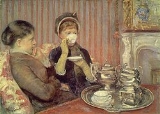
Cassatt Mary Tea 1879 1880
Wallpaper is a kind of material used to cover and decorate the interior wall
Wall

A wall is a usually solid structure that defines and sometimes protects an area. Most commonly, a wall delineates a building and supports its superstructure, separates space in buildings into Room s, or protects or delineates a space in the open air....
s of homes, offices, and other buildings; it is one aspect of interior decoration. They are usually sold in rolls and are put onto a wall using wallpaper paste. Wallpapers can come either plain (so that it can be painted), or with patterned graphics.

Wallpaper printing techniques include surface printing, gravure printing
Rotogravure

Rotogravure is a type of intaglio printing process, in that it involves engraving the image onto an . In gravure printing, the image is engraved onto a copper cylinder because, like offset printing and flexography, it uses a rotary printing press....
, silk screen-printing
Screen-printing

Screen printing 1. A printing technique that uses a woven mesh to support an ink blocking stencil. The attached stencil forms open areas of mesh that transfer ink as a sharp-edged image onto a Substrate ....
, and rotary printing
Rotary printing press

A rotary printing press is a printing press in which the images to be printed are curved around a cylinder. Printing can be done on large number of substrates paper, cardboard, plastic....
. Mathematically speaking, there are seventeen basic patterns, described as wallpaper group
Wallpaper group

A wallpaper group is a mathematical classification of a two-dimensional repetitive pattern, based on the symmetry in the pattern. Such patterns occur frequently in architecture and decorative art....
s, that can be used to tile an infinite plane. All manufactured wallpaper patterns are based on these groups. A single pattern can be issued in several different colorways.

"Wallpaper" is also a term for computer wallpaper
Computer wallpaper

The terms wallpaper, desktop picture and desktop background refer to an image used as a background on a computer screen, usually for the desktop metaphor of a graphical user interface....
.

History

Wallpaper, using the printmaking
Printmaking

Printmaking is the process of making artworks by printing, normally on paper. Except in the case of monotyping, the process is capable of producing multiples of the same piece, which is called a 'print....
 technique of woodcut
Woodcut

Woodcut - formally known as Xylography - is a relief printing artistic technique in printmaking in which an image is carved into the surface of a block of wood, with the printing parts remaining level with the surface while the non-printing parts are removed, typically with gouges....
, gained popularity in Renaissance
Renaissance

The Renaissance was a cultural movement that spanned roughly the 14th to the 17th century, beginning in Italy in the late Middle Ages and later spreading to the rest of Europe....
 Europe amongst the emerging gentry
Gentry

Gentry generally refers to people of high social class, especially in the past. The word derives from the Latin gentis, meaning a clan or extended family....
. The elite of society were accustomed to hanging large tapestries on the walls of their homes, a tradition from the Middle Ages
Middle Ages

File:Karl 1 mit papst gelasius gregor1 sacramentar v karl d kahlen.jpgThe Middle Ages of European history are a period in history which lasted for roughly a millennium, commonly dated from the fall of the Roman Empire in the 5th century to the beginning of the Early Modern Period in the 16th century, marked by the division of Western Christi...
. These tapestries added colour to the room as well as providing an insulating layer between the stone walls and the room, thus retaining heat in the room. However, tapestries were extremely expensive and so only the very rich could afford them. Less well-off members of the elite, unable to buy tapestries due either to prices or wars preventing international trade, turned to wallpaper to brighten up their rooms.

Early wallpaper featured scenes similar to those depicted on tapestries, and large sheets of the paper were sometimes hung loose on the walls, in the style of tapestries, and sometimes pasted as today. Prints were very often pasted to walls, instead of being framed and hung, and the largest sizes of prints, which came in several sheets, were probably mainly intended to be pasted to walls. Some important artists made such pieces, notably Albrecht Dürer
Albrecht Dürer

'Albrecht D?rer' was a Germans Painting, printmaker and theorist from Nuremberg. His still-famous works include the Apocalypse woodcuts, commons:Image:Duerer - Ritter, Tod und Teufel .jpg , St....
, who worked on both large picture prints and also ornament prints intended for wall-hanging. The largest picture print was The Triumphal Arch commissioned by the Holy Roman Emperor
Holy Roman Emperor

Image:HRR 14Jh.jpgThe Roman of the Emperor's title was a reflection of the translatio imperii principle that regarded the Holy Roman Emperors as the inheritors of the title of Emperor of the Western Roman Empire, a title left unclaimed in the West after the death of Julius Nepos in 480....
 Maximilian I
Maximilian I

Maximilian I may refer to:*Maximilian of Mexico, reigned April 1864 to May 1867*Maximilian I, Holy Roman Emperor, reigned 1508 to 1519*Maximilian I, Duke of Bavaria, reigned 1597 to September 1651...
 and completed in 1515. This measured a colossal 3.57 by 2.95 metres, made up of 192 sheets, and was printed in a first edition of 700 copies, intended to be hung in palaces and, in particular, town halls, after hand-colouring.

Very few samples of the earliest repeating pattern wallpapers survive, but there are a large number of old master print
Old master print

An old master print is a work of art produced by a printing process within the Western tradition . A date of about 1830 is usually taken as marking the end of the period whose prints are covered by this term....
s, often in engraving
Engraving

Engraving is the practice of incising a design onto a hard, usually flat surface, by cutting grooves into it. The result may be a decorated object in itself, as when silver, gold, steel, or glass engraving are engraved, or may provide an intaglio printing plate, of copper or another metal, for printing images on paper as prints or illustra...
 of repeating or repeatable decorative patterns. These are called ornament prints and were intended as models for wallpaper makers, among other uses.

England and France were leaders in European wallpaper manufacturing. Among the earliest known samples is one found on a wall comes from England and is printed on the back of a London proclamation of 1509. It became very popular in England
England

native_name =|conventional_long_name = England|common_name = England|image_flag = Flag of England.svg|image_coat = England COA.svg|symbol_type = Royal Coat of Arms...
 following Henry VIII
Henry VIII of England

Henry VIII was King of England from 21 April 1509 until his death. He was also Lordship of Ireland and claimant to the Early Modern France. Henry was the second monarch of the House of Tudor, succeeding his father, Henry VII of England....
's excommunication from the Catholic Church - English aristocrats had always imported tapestries from Flanders
Flanders

Flanders is a geographical region located in parts of present-day Belgium, France, and the Netherlands. Over the course of history, the geographical territory that was called "Flanders" has varied....
 and Arras
Arras

Arras is the capital of the Pas-de-Calais Departments of France in northern France. The historic centre of the Artois region, its local speech is characterized as a Picard language dialect....
, but Henry VIII's split with the Catholic Church had resulted in a fall in trade with Europe. Without any tapestry manufacturers in England, English gentry and aristocracy alike turned to wallpaper.

During The Protectorate
The Protectorate

In History of the British Isles, the Protectorate was the period 1653–1659 during which the Commonwealth of England was governed by a Lord Protector....
 under Oliver Cromwell
Oliver Cromwell

Oliver Cromwell was an English people Military history of the United Kingdom and Politics of England leader best known for his involvement in making England into a republican Commonwealth and for his later role as Lord Protector of England, Scotland, and Ireland....
, the manufacture of wallpaper, seen as a frivolous item by the Puritan
Puritan

A Puritan of 16th and 17th century England was an associate of any number of religious groups advocating for more "purity" of worship and doctrine, as well as personal and group pietism....
 government, was halted. Following the Restoration of Charles II
Charles II of England

Charles II was the Monarchy of Kingdom of England, Kingdom of Scotland, and Kingdom of Ireland.His father Charles I of England Regicide#The regicide of Charles I of England at Palace of Whitehall on 30 January 1649, at the climax of the English Civil War....
, wealthy people across England began demanding wallpaper again - Cromwell's regime had imposed a boring culture on people, and following his death, wealthy people began purchasing comfortable domestic items which had been banned under the Puritan state. By the mid-eighteenth century, Britain was the leading wallpaper manufacturer in Europe, exporting vast quantities to Europe in addition to selling on the middle-class British market. However this trade was seriously disrupted in 1755 by the Seven Years War and later the Napoleonic Wars
Napoleonic Wars

The Napoleonic Wars were a series of conflicts involving Napoleon I of France First French Empire and changing sets of European allies and opposing coalitions that ran from 1803 to 1815....
, and by a heavy level of duty on imports to France.

In 1748 the English ambassador to Paris decorated his salon with blue flock wallpaper, which then became very fashionable there. In the 1760s the French manufacturer Jean-Baptiste Réveillon
Jean-Baptiste Réveillon

Jean-Baptiste R?veillon, was a French wallpaper manufacturer. R?veillon's career was an exemplary story of the self-made businessman....
 hired designers working in silk and tapestry to produce some of the most subtle and luxurious wallpaper ever made. His sky blue wallpaper with fleurs-de-lys was used in 1783 on the first balloons by the Montgolfier brothers
Montgolfier brothers

Joseph-Michael Montgolfier and Jacques-?tienne Montgolfier were the inventors of the Hot_air_balloon#Montgolfiere, globe a?rostatique or airship....
. The landscape painter Jean-Baptiste Pillement
Jean-Baptiste Pillement

Jean-Baptiste Pillement was a painter and designer, known for his exquisite and delicate landscapes, but whose importance lies primarily in the engravings done after his drawings and their influence in spreading the Rococo style, and particularly the taste for chinoiserie, throughout Europe....
 discovered in 1763 a method to use fast colours. Towards the end of the century the fashion for scenic wallpaper revived in both England and France, leading to some enormous panorama
Panorama

In its most general sense, a panorama is any wide view of a physical space. It has also come to refer to a wide-angle representation of such a view ? whether in painting, drawing, photography, film/video, or a three-dimensional model....
s, like the 1804 20 strip wide English one showing the Voyages of Captain Cook, which is still in situ in Ham House, Peabody Massachusetts. The French manufacturers of panoramic scenic and trompe l'œil wallpapers, Zuber et Cie and Arthur et Robert
Arthur et Robert

Arthur et Robert was a Paris based wallpaper manufacturer active during the late 18th and early 19th centuries. Named for two British expatriates, the firm produced block printed scenic and trompe l'?il wallpapers....
 exported their product across Europe and North America. Zuber et Cie's c. 1834 design Views of North America is installed in the Diplomatic Reception Room of the White House
White House

The White House is the official residence and principal workplace of the President of the United States. Located at 1600 Pennsylvania Avenue in Washington, D.C., it was built between 1792 and 1800 of white-painted Aquia sandstone in the late Georgian architecture and has been the executive residence of every U.S....
. Like most of eighteenth century wallpapers, this was designed to be hung above a dado
Dado (architecture)

In architectural terminology, the dado is the lower part of a wall, below the dado rail and above the skirting board.This area is traditionally given a different decorative treatment to the upper part of the wall; for example panelling, wainscoting or lincrusta....
.

During the Napoleonic Wars
Napoleonic Wars

The Napoleonic Wars were a series of conflicts involving Napoleon I of France First French Empire and changing sets of European allies and opposing coalitions that ran from 1803 to 1815....
 , trade between Europe and Britain evaporated, resulting in the gradual decline of the wallpaper industry in Britain. However, the end of the war saw a massive demand in Europe for British goods which had been inaccessible during the wars, including cheap, colourful wallpaper. The development of steam-powered printing presses in Britain in 1813 allowed manufacturers to mass-produce wallpaper, reducing its price and so making it affordable to working-class people. Wallpaper enjoyed a huge boom in popularity in the nineteenth century, seen as a cheap and very effective way of brightening up cramped and dark rooms in working-class areas. By the early twentieth century, wallpaper had established itself as one of the most popular household items across the Western world. During the late 1980s though, wallpaper began to fall out of fashion in lieu of Faux Painting
Faux painting

Faux painting or Faux finishing are terms used to describe a wide range of decorative painting techniques. From the French word for "fake", faux painting began as a form of replicating materials such as marble and wood with paint, but has come to encompass many other decorative finishes for walls and furniture....
 which can be more easily removed by simply re-painting.

Gallery


Use

Like paint
Paint

Paint is any liquid, liquifiable, or mastic composition which after application to a Substrate in a thin layer is converted to an opaque solid film....
, wallpaper requires proper surface preparation before application. Additionally, wallpaper is not suitable for all areas. For example, bathroom
Bathroom

A bathroom is a room that may have different functions depending on the cultural context. In the most literal sense, the word bathroom means "a room with a bath"....
 wallpaper may deteriorate rapidly due to excessive steam
Steam

In physical chemistry, and in engineering, steam refers to vaporized water. It is a pure, completely invisible gaseous phase . At standard temperature and pressure, pure steam occupies about 1,600 times the volume of an equal mass of liquid water....
. Proper preparation includes the repair of any defects in the drywall or plaster and the removal of loose material or old adhesives.

Wallpaper adhesives

Most wallpaper adhesive are starch
Starch

File:Amylose2.svgFile:Amylopektin Sessel.svgStarch or amylum is a polysaccharide carbohydrate consisting of a large number of glucose units joined together by glycosidic bonds....
 or methylcellulose
Methylcellulose

Methyl cellulose is a chemical compound derived from cellulose. It is a hydrophile white powder in pure form and dissolves in cold water, forming a clear viscous solution or gel....
 based.

Removal


Water

The simplest removal option is to brush the paper with water. Water soaks through the paper and saturates the glue, allowing the paper to be peeled off.

This does not work well with nonpeelable vinyls, as vinyl is not porous. Nevertheless it is still effective on many modern papers.

Chemical Wallpaper Stripper

Chemical wallpaper stripper can be purchased at most paint or home improvement stores. It is mixed with warm water or a mixture of warm water and vinegar, then sprayed onto wall surfaces. Several applications may be required to saturate the existing wallpaper. Perforation can aid in the absorption of the mixture and lead to faster removal. After the mixture has dissolved the wallpaper paste, the wallpaper can be removed easily by pulling at the edges and with the aid of a putty or drywall knife.

Steam

Another method of removal is to apply steam to wallpaper in order to dissolve the wallpaper paste. A wallpaper steamer consists of a reservoir of water, an electric heating element, and a hose to direct the steam at the wallpaper. The steam dissolves the wallpaper paste, allowing the wallpaper to be peeled off. However, care must be taken to prevent damage to the drywall
Drywall

Drywall is a common building material typically made of a layer of gypsum plaster pressed between two thick sheets of paper, then kiln dried. Drywall is used globally for the finish construction of interior walls and ceilings....
 underneath. Sometimes steaming can lead to the crumbling of underlying drywall or plaster, leaving an uneven surface to be repaired....

See also

  • Faux Painting
    Faux painting

    Faux painting or Faux finishing are terms used to describe a wide range of decorative painting techniques. From the French word for "fake", faux painting began as a form of replicating materials such as marble and wood with paint, but has come to encompass many other decorative finishes for walls and furniture....


External links