
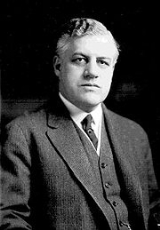
Alexander Mitchell Palmer (May 4, 1872 - May 11, 1936) was the
Attorney GeneralThe United States Attorney General is the head of the United States Department of Justice concerned with legal affairs and is the chief law enforcement officer of the United States government. The Attorney General is considered to be the chief lawyer of the U.S. government...
of the
United StatesThe United States of America is a federal constitutional republic comprising fifty states and a federal district...
from 1919 to 1921. He was nicknamed
The Fighting QuakerThe Religious Society of Friends is a religious movement, whose members are known as Friends or Quakers. The roots of this movement are with some 17th century Christian English dissenters, but today the movement has branched out into many independent national and regional organizations, called...
and he directed the controversial
Palmer RaidsThe Palmer Raids were a series of controversial raids by the United States Department of Justice and Immigration and Naturalization Service from 1919 to 1921 on suspected radical leftist citizens and immigrants in the United States, the legality of which is now in question...
.
Judicial, Congressional, and party service
Palmer was appointed official
stenographerShorthand is an abbreviated symbolic writing method that increases speed or brevity of writing as compared to a normal method of writing a language. The process of writing in shorthand is called stenography, from the Greek stenos and graphē or graphie...
of the forty-third judicial district of Pennsylvania in 1892. He studied law and was admitted to the
barA bar association is a professional body of lawyers. Some bar associations are responsible for the regulation of the legal profession in their jurisdiction; others are professional organizations dedicated to serving their members; in many cases, they are both.In many Commonwealth jurisdictions, the...
in 1893 and practiced in
Stroudsburg, PennsylvaniaStroudsburg is a borough in Monroe County, Pennsylvania, United States. It is located in the Poconos region of the state, approximately five miles from the Delaware Water Gap, at the confluence of the Brodhead and Pocono Creeks. It is the county seat of Monroe County.In 1900, 3,450 people...
. Palmer became director of various
bankA bank is a financial institution licensed by a government. Its primary activities include borrowing and lending money.Many other financial activities were allowed over time. For example banks are important players in financial markets and offer financial services such as investment funds...
s and public-service corporations and a member of the Democratic State executive committee of Pennsylvania. Palmer was elected as a Democrat to the
61stThe Sixty-first United States Congress was a meeting of the legislative branch of the United States federal government, composed of the United States Senate and the United States House of Representatives. It met in Washington, DC from March 4, 1909 to March 4, 1911, during the first two years of...
,
62ndThe Sixty-second United States Congress was a meeting of the legislative branch of the United States federal government, composed of the United States Senate and the United States House of Representatives. It met in Washington, DC from March 4, 1911 to March 4, 1913, during the last two years of...
, and
63rdThe Sixty-third United States Congress was a meeting of the legislative branch of the United States federal government, composed of the United States Senate and the United States House of Representatives. It met in Washington, D.C. from March 4, 1913 to March 4, 1915, during the first two years of...
Congresses (March 4, 1909 - March 3, 1915); he was not a candidate for renomination in 1914, but ran unsuccessfully for the
United States SenateThe United States Senate is the upper house of the bicameral United States Congress, the lower house being the House of Representatives. The composition and powers of the Senate and the House are established in Article One of the U.S. Constitution . Each U.S state is represented by two senators,...
. Palmer was a delegate to the
Democratic National ConventionThe Democratic National Convention is a series of presidential nominating conventions held every four years since 1832 by the United States Democratic Party. They have been administered by the Democratic National Committee since the 1852 national convention...
in 1912 and 1916, and a member of the
Democratic National CommitteeThe Democratic National Committee is the principal organization governing the United States Democratic Party on a day to day basis. While it is responsible for overseeing the process of writing a platform every four years, the DNC's central focus is on campaign and political activity in support...
from 1912 - 1920.
As a congressman, Palmer was a progressive reformer who had supported and fought for legislation protecting workers, especially women and children, in dangerous jobs. He was a supporter of the
League of NationsThe League of Nations was an inter-governmental organization founded as a result of the Treaty of Versailles in 1919–1920. At its greatest extent from 28 September 1934 to 23 February 1935, it had 58 members...
.
Attorney General
PresidentThe President of the United States is the head of state and head of government of the United States and is the highest political official in the United States by influence and recognition...
Woodrow WilsonThomas Woodrow Wilson was the 28th President of the United States. A leading intellectual of the Progressive Era, he served as President of Princeton University from 1902 to 1910, and then as the Governor of New Jersey from 1911 to 1913...
offered Palmer the post of
Secretary of WarThe Secretary of War was a member of the United States President's Cabinet, beginning with George Washington's administration. A similar position, called either "Secretary at War" or "Secretary of War," was appointed to serve the Congress of the Confederation under the Articles of Confederation...
, but Palmer declined because of his belief in
pacifismPacifism is the opposition to war or violence as a means of settling disputes or gaining advantage. Pacifism covers a spectrum of views ranging from the belief that international disputes can and should be peacefully resolved; to calls for the abolition of the institutions of the military and war;...
. Instead, he was appointed
Alien Property CustodianAn Alien Property Custodian was an office within the Government of the United States during World War I and again during World War II. serving as a Custodian of Enemy Property to property that belonged to US enemies.On 11 March, 1942, President Franklin D...
on October 22, 1917, by Wilson, and served until March 4, 1919, when he resigned to become
Attorney GeneralIn most common law jurisdictions, the attorney general, or attorney-general, is the main legal advisor to the government, and in some jurisdictions he or she may in addition have executive responsibility for law enforcement or responsibility for public prosecutions.-Usage:The term has traditionally...
of the
United StatesThe United States of America is a federal constitutional republic comprising fifty states and a federal district...
.
He served as Attorney General from March 5, 1919, until March 4, 1921. One of Palmer's first acts was to release 10,000 aliens of German ancestry taken into custody during the war. Before assuming office, he had opposed some of the actions of the
American Protective LeagueThe American Protective League was an American World War I-era private organization that worked with federal law enforcement agencies in support of the anti German Empire movement, as well as against radical anarchists, anti-war activists, and left-wing labor and political...
, which had participated in numerous raids and surveillance activities, primarily against those who failed to register for the draft, but also against immigrants of German ancestry who were suspected of sympathies for the German Kaiser and his government. However, the APL had also directed its attention to anarchists and their sympathizers in the Industrial Workers of the World (I.W.W.), who were intensely opposed to the U.S. entry into
World War IWorld War I , also known as the First World War, the Great War, and the War to End All Wars, was a global military conflict which involved most of the world's great powers, assembled in two opposing alliances: the Triple Entente and the Triple Alliance...
. Palmer initially ignored demands by the press and congressional leaders for federal arrests and/or deportation of radical or revolutionary activists and agitators. The new Attorney General's lack of response was criticized by various political leaders and former APL members, as well as journals such as the New York Times, whose editorials had characterized striking immigrants who had joined anarchist movements as "seditionaries, anarchists, plotters against the Government of the United States."
Palmer Raids
In late April 1919,
Galleanists, violent anarchist followers of
Luigi GalleaniLuigi Galleani was a 20th century anarchist. Galleani is best described as an anarchist communist and an insurrectionary anarchist.-Background:...
mailed a booby trap bomb to Palmer's home; it was intercepted and defused. Three months after becoming Attorney General, Palmer narrowly escaped death when Carlo Valdinoci, a
Galleanist and anarchist placed a bomb on Palmer's porch; the bomb went off and killed Valdinoci. Palmer had been home at the time of the explosion, with his wife and child recently put to bed, though he and his family were not harmed from the blast.
Convinced that the menace posed by anarchists and the radical left was real, and armed with a clear mandate for action from President Wilson, Palmer became a zealous opponent of
anarchist communistAnarchist communism is a theory of anarchism which advocates the abolition of the state, private property, and capitalism in favor of common ownership of the means of production, direct or consensus democracy and a horizontal network of voluntary associations, workers' councils, or a gift economy...
s,
insurrectionary anarchistInsurrectionary anarchism is a revolutionary theory, practice and tendency within the anarchist movement which opposes formal organizations such as labor unions and federations that are based on a political programme and periodic congresses...
s, and other radicals who advocated revolution and/or the violent overthrow of the
Federal government of the United StatesThe federal government of the United States is the central government entity established by the United States Constitution, which shares sovereignty over the United States with the governments of the individual U.S. states. The federal government has three branches: the legislative, executive, and...
. After his close calls at the hands of the
Galleanists, Palmer appears to have grouped all those identified with the radical left as responsible for the wave of violence. He stated his belief that Communism was "eating its way into the homes of the American workman," and that socialists were responsible for most of the country's social problems.
Palmer's campaign against radicalism culminated in what came to be called the
Palmer RaidsThe Palmer Raids were a series of controversial raids by the United States Department of Justice and Immigration and Naturalization Service from 1919 to 1921 on suspected radical leftist citizens and immigrants in the United States, the legality of which is now in question...
and the commencement of what would later be termed the
First Red ScareIn American history, the First Red Scare took place in the period 1917–1920, and was marked by a widespread fear of anarchism, as well as the effects of radical political agitation in American society. Fueled by anarchist bombings and spurred on by Attorney General A...
. These were a series of police roundups, warrantless wiretaps (authorized under the
Sedition ActSedition Act may refer to:*Alien and Sedition Acts, including the Sedition Act of 1798, laws passed by the United States Congress*Sedition Act 1661, an English statute that largely relates to treason...
), and mass arrests of suspected leftists and radicals, during which a total of at least 10,000 individuals were arrested. Under the 1918
Anarchist Exclusion ActThe Anarchist Exclusion Act refers to two different acts passed by the United States Congress intended to keep immigrants that subscribed to anarchist ideas from entering the country.-The 1901 act:...
, which allowed the deportation of resident aliens who were anarchists or who had advocated violence or the revolutionary overthrow of the government, 556 resident aliens were eventually deported, including prominent radical leaders such as
Luigi GalleaniLuigi Galleani was a 20th century anarchist. Galleani is best described as an anarchist communist and an insurrectionary anarchist.-Background:...
,
Emma GoldmanEmma Goldman was an anarchist known for her political activism, writing and speeches. She played a pivotal role in the development of anarchist political philosophy in North America and Europe in the first half of the twentieth century.Born in Kovno in the Russian Empire , Goldman emigrated to the...
, and
Alexander BerkmanAlexander Berkman was an anarchist known for his political activism and writing. He was a leading member of the anarchist movement in the early 20th century....
. Fearful of extremist violence and revolution, the American public widely supported the raids; outside of protests by some civil libertarian groups and the radical left, condemnation of the raids did not surface until many years later.
Historian
Samuel Eliot MorisonSamuel Eliot Morison, Rear Admiral, United States Naval Reserve was an American historian, noted for producing works of maritime history that were both authoritative and highly readable. A sailor as well as a scholar, Morison garnered numerous honors, including two Pulitzer Prizes, two Bancroft...
would later charge that hundreds of people in
New EnglandNew England is a region of the United States. It is located at the northeastern corner of the US, bordered by the Atlantic Ocean, Canada and the state of New York, consisting of the modern U.S...
alone had been arrested with no connection to extremism of any kind, adding:
"The raids yielded almost nothing in the way of arms or revolutionaries, but Palmer emerged [from] the episode a national hero. And what made his action the more abominable is that he was a practicing Quaker, even using the traditional 'thee' instead of 'you.'"
The Oxford History of the United States, p. 883.
Palmer had recruited a recent law school graduate to help him,
J. Edgar HooverJohn Edgar Hoover was the first Director of the Federal Bureau of Investigation of the United States. Appointed director of the Bureau of Investigation — predecessor to the FBI — in 1924, he was instrumental in founding the FBI in 1935, where he remained director until his death in 1972...
. Hoover pored over arrest records, subscription records of radical newspapers, and party membership records to compile lists of resident aliens for deportation proceedings.
Louis Freeland PostLouis Freeland Post was the Acting United States Secretary of Labor during the period of the Palmer Raids and the Red Scare.-Biography:...
, Acting
Secretary of LaborThe United States Secretary of Labor is the head of the Department of Labor who exercises control over the department and enforces and suggests laws involving unions, the workplace and all other issues involving any form of business-person controversies....
, in turn opposed many of the deportation cases. The
United States Department of LaborThe United States Department of Labor is a Cabinet department of the United States government responsible for occupational safety, wage and hour standards, unemployment insurance benefits, re-employment services, and some economic statistics. Many U.S. states also have such departments. The...
had authority when workmen were nominated for deportation, and Post demanded evidence justifying such an action in each individual case. He was not deterred from this even when criticized by the press or members of Congress. Called to testify before Congress, he stood his ground, persuading irate Congressmen in case after case that evidence was lacking.
Palmer famously predicted that Communists would attempt to overthrow the United States government on
May DayMay Day occurs on May 1 and refers to several public holidays. In many countries, May Day is synonymous with International Workers' Day, or Labour Day, a day of political demonstrations and celebrations organised by the unions and socialist groups....
1920. He had some reason for making this statement, as the previous year's anarchist mail bombing had been timed to ensure delivery of the bombs by the Post Office on May Day 1919. The National Guard of the United States was mobilized and the entire
New York City Police DepartmentThe New York City Police Department , established in 1845, is currently the largest police force in the United States, with primary responsibilities in law enforcement and investigation within the five boroughs of New York City...
was put on 24-hour duty, but the date came and went without incident, causing some to think Palmer had "cried wolf" once too often.
On September 16 of that year, however,
Wall StreetWall Street is a street in Lower Manhattan, New York City, New York, United States. It runs east from Broadway to South Street on the East River, through the historical center of the Financial District. It is the first permanent home of the New York Stock Exchange; over time Wall Street became the...
was rocked by a violent blast, later known as the
Wall Street bombingThe Wall Street bombing occurred at 12:01 p.m. on September 16, 1920, in the Financial District of New York City. Thirty-eight people were killed and 400 injured by the blast. It was more deadly than the 1910 bombing of the Los Angeles Times building by the McNamara brothers and would remain the...
. The bomb was constructed using 100 pounds of dynamite and was packed with cast iron sash weights in order to increase maiming and casualties. Concealed in a horse-drawn wagon, the bomb was precisely timed to catch people leaving for their lunch break. The Wall Street bombing killed 38 people and wounded over 400, causing extensive property damage and leaving visible marks on several Wall Street buildings to this day. In spite of the deportation of Luigi Galleani pursuant to the Anarchist Act, the
Galleanist bomb campaign would continue for another twelve years, until most of its members had been prosecuted, deported, or become inactive.
Eugene Debs Clemency Petition
Palmer was largely blamed for the negative results of the raids which came to bear his name, as well for the Wilson administration's hostility to radicals in general. However, other historians note that Palmer was willing to brook presidential displeasure on behalf of those deemed to be Wilson's opponents on the left. In 1921, Palmer asked President Wilson to pardon the convicted Socialist leader,
Eugene V. DebsEugene Victor Debs was an American union leader, one of the founding members of the International Labor Union and the Industrial Workers of the World , as well as candidate for President of the United States as a member of the Social Democratic Party in 1900, and later as a member of the Socialist...
, ostensibly on the grounds of ill health; he suggested that the birthday of President Lincoln would be an appropriate day for the announcement, noting the latter's willingness to forgive the Confederate South. Wilson's response was "Never!", and wrote 'Denied' across the clemency petition.
Later years
Palmer sought the nomination for President at the
1920 Democratic National ConventionThe 1920 Democratic National Convention was held at the Civic Auditorium in San Francisco, California from June 28 - July 6, 1920. It resulted in the nomination of Governor James Cox of Ohio for President and Assistant Secretary of the Navy Franklin Roosevelt of New York for Vice-President.Former...
, but lost the nomination to
James CoxJames Cox may refer to:* James Cox , United States Representative from New Jersey, 1809–1810* James Cox , , starting quarterback for the Colorado Buffaloes football team, 2005–2006...
. Afterwards, Palmer went into private law practice. He died on May 11, 1936.
See also
- Luigi Galleani
Luigi Galleani was a 20th century anarchist. Galleani is best described as an anarchist communist and an insurrectionary anarchist.-Background:...
- 1919 United States anarchist bombings
The 1919 United States bombings were a series of bombings and attempted bombings carried out by anarchist followers of Luigi Galleani from April through June 1919...
- Sacco and Vanzetti
Ferdinando Nicola Sacco and Bartolomeo Vanzetti were two Italian-born laborers and anarchists who were tried, convicted and executed via electrocution on August 23, 1927 in Massachusetts for the 1920 armed robbery and murder of a pay-clerk and a security guard in Braintree, Massachusetts.Today,...
- Communist Party USA
The Communist Party of the United States of America is a Marxist-Leninist political party in the United States.During the first half of the 20th century it was the largest and most widely influential communist party in the country, and played a prominent role in the U.S...
Multimedia
Sources