

History of the United States Republican Party

Encyclopedia
The United States Republican Party
is the second oldest currently existing political party
in the United States after its great rival, the Democratic Party. It emerged in 1854 to combat the Kansas Nebraska Act which threatened to extend slavery into the territories, and to promote more vigorous modernization of the economy. It had almost no presence in the South, but in the North it enlisted most former Whigs and former Free Soil Democrats to form majorities, by 1858, in nearly every Northern state. With the election of Abraham Lincoln
in 1860, and its success in guiding the Union to victory and abolishing slavery, it came to dominate the national scene until 1932. The Republican Party was based on northern white Protestants, businessmen, professionals, factory workers, wealthier farmers, and blacks. It was pro-business, supporting banks, the gold standard, railroads, and high tariffs to protect heavy industry and the industrial workers. Under William McKinley
and Theodore Roosevelt
, it emphasized an expansive foreign policy. The GOP ("Grand Old Party"), as it is often called, became a minority after failing to reverse the Great Depression in 1932. The New Deal Coalition
led by Democrat Franklin D. Roosevelt
came to power in 1933-1945. When that coalition collapsed in the middle 1960s, Republicans came back, winning seven of the 10 presidential elections 1968 to 2004. The GOP relied increasingly on its new base in the white South after 1968, especially because of its new strength among evangelical Protestants. The key leader in the late 20th century was Ronald Reagan
, whose conservative pro-business policies for less government regulation, lower taxes, and an aggressive foreign policy still dominate the party.
 The Republican Party emerged in 1854. It began as coalition of anti-slavery "Conscience Whigs
" and Free Soil Democrats
opposed to the Kansas-Nebraska Act
, submitted to Congress by Stephen Douglas in January 1854. The Act opened Kansas Territory
and Nebraska Territory
to slavery and future admission as slave states, thus implicitly repealing the prohibition on slavery in territory north of 36° 30′ latitude, which had been part of the Missouri Compromise
. This change was viewed by Free-Soil and Abolitionist Northerners as an aggressive, expansionist maneuver by the slave-owning South.
The Act was supported by all Southerners and by Northern "Doughface" (pro-Southern) Democrats, and by still other northern Democrats persuaded by Douglas' doctrine of "popular sovereignty". In the North the old Whig party was almost defunct. The opponents were intensely motivated and began forming a new party.
The new party went well beyond the issue of slavery in the territories. It envisioned modernizing the United States — emphasizing giving free western land to farmers ("free soil") as opposed to letting slave owners buy up the best lands, expanded banking, more railroads, and factories. They vigorously argued that free-market labor was superior to slavery and the very foundation of civic virtue and true republicanism
- this is the "Free Soil, Free Labor, Free Men" ideology. The Republicans absorbed the previous traditions of its members, most of whom had been Whigs
; others had been Democrats or members of third parties (especially the Free Soil Party
and the American Party
or Know Nothings). Many Democrats
who joined up were rewarded with governorships. or seats in the U.S. Senate or House of Representatives. Since its inception, its chief opposition has been the Democratic Party
, but the amount of flow back and forth of prominent politicians between the two parties was quite high from 1854 to 1896.
Historians have explored the ethnocultural foundations of the party, along the line that ethnic and religious groups set the moral standards for their members, who then carried those standards into politics. The churches also provided social networks that politicians used to sign up voters. The pietistic churches emphasized the duty of the Christian to purge sin from society. Sin took many forms—alcoholism, polygamy and slavery became special targets for the Republicans. The Yankees, who dominated New England, much of upstate New York, and much of the upper Midwest were the strongest supporters of the new party. This was especially true for the pietistic Congregationalists and Presbyterians among them and (during the war), the Methodists, along with Scandinavian Lutherans. The Quakers were a small tight-knit group that was heavily Republican. The liturgical churches (Roman Catholic, Episcopal, German Lutheran), by contrast, largely rejected the moralism of the Republican Party; most of their adherents voted Democratic.
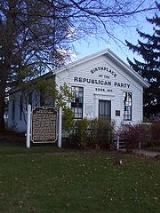
schoolhouse on March 20, 1854. The first statewide convention that formed a platform and nominated candidates under the name "Republican" was held "under the oaks" on the outskirts of Jackson, Michigan
on July 6, 1854; it declared their new party opposed to the expansion of slavery into new territories and selected a state-wide slate of candidates. The Midwest took the lead in forming state party tickets, while the eastern states lagged a year or so.
There were no efforts to organize the party in the South, apart from St. Louis and a few areas adjacent to free states. The party initially had its base in the Northeast
and Midwest
.
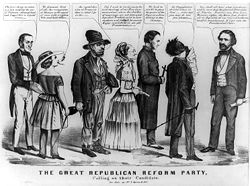
, in February 1856, with its first national nominating convention
held in the summer in Philadelphia, Pennsylvania.
John C. Frémont
ran as the first Republican nominee for President
in 1856, using the political slogan: "Free soil, free silver, free men, Frémont." Although Frémont's bid was unsuccessful, the party showed a strong base. It dominated in New England, New York and the northern Midwest, and had a strong presence in the rest of the North. It had almost no support in the South, where it was roundly denounced in 1856-60 as a divisive force that threatened civil war.
 The election of Abraham Lincoln
in 1860 ended the domination of the fragile coalition of pro-slavery southern Democrats and conciliatory northern Democrats which had existed since the days of Andrew Jackson
. Instead, a new era of Republican dominance based in the industrial and agricultural north ensued. Republicans sometimes refer to their party as the "party of Lincoln" in honor of the first Republican President.
The Third Party System
was dominated by the Republican Party (it lost the presidency in 1884 and 1892). Lincoln proved brilliantly successful in uniting the factions of his party to fight for the Union. However he usually fought the Radical Republicans who demanded harsher measures. Most Democrats at first were War Democrats
, and supportive until the Fall of 1862. When Lincoln added the abolition of slavery as a war goal, many war Democrats became "peace Democrats." Most of the state Republican parties accepted the antislavery goal except Kentucky. In Congress, the party passed major legislation to promote rapid modernization, including a national banking system, high tariffs
, the first temporary income tax, many excise taxes, paper money issued without backing ("greenbacks"), a huge national debt, homestead laws, railroads, and aid to education and agriculture. The Republicans denounced the peace-oriented Democrats as disloyal Copperheads and won enough War Democrats to maintain their majority in 1862; in 1864, they formed a coalition with many War Democrats as the National Union Party
which reelected Lincoln easily. During the war, upper middle-class men in major cities formed Union League
s, to promote and help finance the war effort.
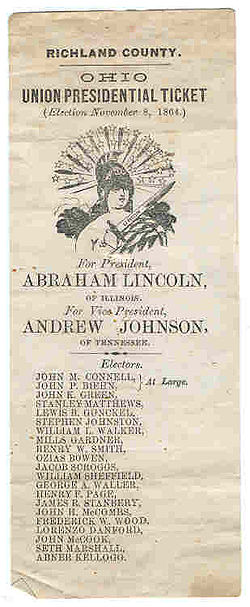
; the Radicals thought he was one of them and would take a hard line in punishing the South. Johnson however broke with them and formed a loose alliance with moderate Republicans and Democrats. The showdown came in the Congressional elections of 1866, in which the Radicals won a sweeping victory and took full control of Reconstruction, passing key laws over the veto. Johnson was impeached by the House, but acquitted by the Senate.
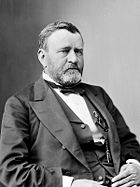 With the election of Ulysses S. Grant
in 1868, the Radicals had control of Congress, the party and the Army, and attempted to build a solid Republican base in the South using the votes of Freedmen, Scalawags and Carpetbaggers, supported directly by U.S. Army detachments. Republicans all across the South formed local clubs called Union League
s that effectively mobilized the voters, discussed issues, and when necessary fought off Ku Klux Klan
(KKK) attacks. Thousands died on both sides.
Grant supported radical reconstruction programs in the South, the Fourteenth Amendment
, and equal civil and voting rights for the freedmen. Most of all he was the hero of the war veterans, who marched to his tune. The party had become so large that factionalism was inevitable; it was hastened by Grant's tolerance of high levels of corruption typified by the Whiskey Ring
. Many of the founders of the GOP joined the movement, as did many powerful newspaper editors. They nominated Horace Greeley
for president, who also gained the Democratic nomination, but the ticket was defeated in a landslide. The depression of 1873 energized the Democrats. They won control of the House and formed "Redeemer
" coalitions which recaptured control of each southern state, in some cases using threats and violence.
Reconstruction came to an end when the contested election of 1876 was awarded by a special electoral commission
to Republican Rutherford B. Hayes
who promised, through the unofficial Compromise of 1877
, to withdraw federal troops from control of the last three southern states. The region then became the Solid South
, giving overwhelming majorities of its electoral votes and Congressional seats to the Democrats until 1964.
In terms of racial issues, "White Republicans as well as Democrats solicited black votes but reluctantly rewarded blacks with nominations for office only when necessary, even then reserving the more choice positions for whites. The results were predictable: these half-a-loaf gestures satisfied neither black nor white Republicans. The fatal weakness of the Republican Party in Alabama, as elsewhere in the South, was its inability to create a biracial political party. And while in power even briefly, they failed to protect their members from Democratic terror. Alabama Republicans were forever on the defensive, verbally and physically."
Social pressure eventually forced most Scalawags to join the conservative/Democratic Redeemer coalition. A minority persisted and formed the "tan" half of the "Black and Tan" Republican Party, a minority in every southern state after 1877.
, defended the spoils system
. The Half-Breeds, who followed Senator James G. Blaine
of Maine, pushed for reform of the Civil service
. Independents who opposed the spoils system altogether were called "Mugwumps." In 1884 Mugwumps rejected James G. Blaine
as corrupt and helped elect Democrat Grover Cleveland
; most returned to the party by 1888.
As the Northern post-war economy boomed with industry, railroads, mines, and fast-growing cities, as well as prosperous agriculture, the Republicans took credit and promoted policies to keep the fast growth going. The Democratic Party was largely controlled by pro-business Bourbon Democrat
s until 1896. The GOP supported big business generally, the gold standard
, high tariff
s, and generous pensions for Union veterans. By 1890, however, the Republicans had agreed to the Sherman Anti-Trust Act and the Interstate Commerce Commission
in response to complaints from owners of small businesses and farmers. The high McKinley Tariff
of 1890 hurt the party and the Democrats swept to a landslide in the off-year elections, even defeating McKinley himself.
Foreign affairs seldom became partisan issues (except for the annexation of Hawaii, which Republicans favored and Democrats opposed). Much more salient were cultural issues. The GOP supported the pietistic Protestants (especially the Methodists, Congregationalists, Presbyterians, and Scandinavian Lutherans) who demanded Prohibition
. That angered wet Republicans, especially German American
s, who broke ranks in 1890-1892, handing power to the Democrats.
Demographic trends aided the Democrats, as the German and Irish Catholic immigrants were mostly Democrats, and outnumbered the British and Scandinavian Republicans. During the 1880s, elections were remarkably close. The Democrats usually lost, but won in 1884 and 1892. In the 1894 Congressional elections
, the GOP scored the biggest landslide in its history, as Democrats were blamed for the severe economic depression 1893-1897
and the violent coal and railroad strikes of 1894.
From 1860 to 1912, the Republicans took advantage of the association of the Democrats with "Rum, Romanism, and Rebellion". Rum stood for the liquor interests and the tavernkeepers, in contrast to the GOP, which had a strong dry element. "Romanism" meant Catholics, especially Irish Americans, who ran the Democratic Party in every big city, and whom the Republicans denounced for political corruption. "Rebellion" stood for the Confederates who tried to break the Union in 1861, and the Copperheads in the North who sympathized with them.
Demographic trends aided the Democrats, as the German and Irish Catholic immigrants were Democrats, and outnumbered the English and Scandinavian Republicans. During the 1880s and 1890s, the Republicans struggled against the Democrats' efforts, winning several close elections and losing two to Grover Cleveland (in 1884 and 1892).
Religious lines were sharply drawn. Methodists, Congregationalists, Presbyterians, Scandinavian Lutherans and other pietists in the North were tightly linked to the GOP. In sharp contrast, liturgical groups, especially the Catholics, Episcopalians, and German Lutherans, looked to the Democratic Party for protection from pietistic moralism, especially prohibition. Both parties cut across the class structure, with the Democrats more bottom-heavy.
Cultural issues, especially prohibition and foreign language schools became important because of the sharp religious divisions in the electorate. In the North, about 50% of the voters were pietistic Protestants (Methodists, Scandinavian Lutherans, Presbyterians, Congregationalists, Disciples of Christ) who believed the government should be used to reduce social sins, such as drinking. Liturgical churches (Roman Catholics, German Lutherans, Episcopalians) comprised over a quarter of the vote and wanted the government to stay out of the morality business. Prohibition debates and referendums heated up politics in most states over a period of decade, as national prohibition was finally passed in 1918 (and repealed in 1932), serving as a major issue between the wet Democrats and the dry GOP.
in 1896 is widely seen as a resurgence of Republican dominance and is cited as a realigning election
.
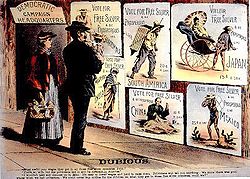 The Progressive Era (or "Fourth Party System
") was dominated by Republican presidents, with the sole exception of Democrat Woodrow Wilson
, 1913-1921. McKinley promised that high tariffs would end the severe hardship caused by the Panic of 1893
, and that the GOP would guarantee a sort of pluralism in which all groups would benefit. He denounced William Jennings Bryan
, the Democratic nominee, as a dangerous radical whose plans for "Free Silver" at 16-1 (or Bimetallism
) would bankrupt the economy.
McKinley relied heavily on finance, railroads, industry and the middle classes for his support and cemented the Republicans as the party of business; his campaign manager
, Ohio's Mark Hanna
, developed a detailed plan for getting contributions from the business world, and McKinley outspent his rival William Jennings Bryan
by a large margin. This emphasis on business was in part mitigated by Theodore Roosevelt
, McKinley's successor after assassination, who engaged in trust-busting. McKinley was the first president to promote pluralism, arguing that prosperity would be shared by all ethnic and religious groups.
Theodore Roosevelt
, who became president in 1901, had the most dynamic personality of the era. Roosevelt had to contend with men like Senator Mark Hanna
, whom he outmaneuvered to gain control of the convention in 1904 that renominated him and he won after promising to continue McKinley's policies. More difficult to handle was conservative House Speaker Joseph Gurney Cannon
.
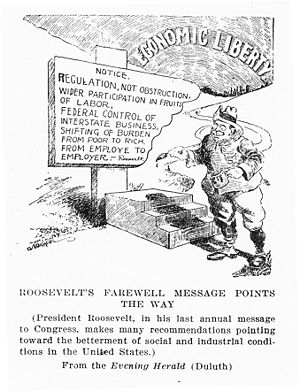
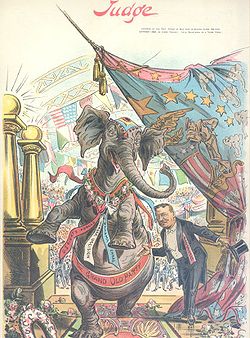 Roosevelt achieved modest legislative gains in terms of railroad legislation and pure food laws. He was more successful in Court, bringing antitrust suits that broke up the Northern Securities Company
trust and Standard Oil
. Roosevelt moved left in his last two years in office but was unable to pass major Square Deal
proposals. He did succeed in naming his successor Secretary of War William Howard Taft
who easily defeated Bryan again in the 1908 presidential election.
The tariff issue was pulling the GOP apart. Roosevelt tried to postpone the issue but Taft had to meet it head on in 1909 with the Payne-Aldrich Tariff Act
. Eastern conservatives led by Nelson W. Aldrich
wanted high tariffs on manufactured goods (especially woolens), while Midwesterners called for low tariffs. Aldrich tricked them by lowering the tariff on farm products, which outraged the farmers. Insurgent Midwesterners led by George Norris revolted against the conservatives led by Speaker Cannon. The Democrats won control of the House in 1910, as the rift between insurgents and conservatives widened. In 1912 Roosevelt broke with Taft and tried for a third term. He was outmaneuvered by Taft and lost the nomination. Roosevelt led his delegates out of the convention and created a new party, the Progressive
, or "Bull Moose" ticket in the election of 1912. Few party leaders followed him except Hiram Johnson
of California. The Roosevelt-caused split in the Republican vote resulted in a decisive victory for Democrat Woodrow Wilson
, temporarily interrupting the Republican era.
The Republicans welcomed the Progressive Era
at the state and local level. The first important reform mayor was Hazen S. Pingree
of Detroit (1890–97) who was elected governor of Michigan in 1896. In New York City the Republicans joined nonpartisan reformers to battle Tammany Hall
, and elected Seth Low (1902–03). Golden Rule Jones was first elected mayor of Toledo as a Republican in 1897, but was reelected as an independent when his party refused to renominate him. Many Republican civic leaders, following the example of Mark Hanna
, were active in the National Civic Federation
, which promoted urban reforms and sought to avoid wasteful strikes.
 The party controlled the presidency throughout the 1920s, running on a platform of opposition to the League of Nations
, high tariffs, and promotion of business interests. Warren G. Harding
, Calvin Coolidge
and Herbert Hoover
were resoundingly elected in 1920, 1924, and 1928 respectively. The breakaway efforts of Senator Robert LaFollette
in 1924 failed to stop a landslide for Coolidge, and his movement fell apart. The Teapot Dome Scandal
threatened to hurt the party but Harding died and Coolidge blamed everything on him, as the opposition splintered in 1924. The pro-business policies of the decade seemed to produce an unprecedented prosperity—until the Wall Street Crash of 1929
heralded the Great Depression
. Although the party did very well in large cities and among ethnic Catholics in presidential elections of 1920-24, it was unable to hold those gains in 1928. By 1932 the cities—for the first time ever—had become Democratic strongholds.
Hoover, by nature an activist, attempted to do what he could to alleviate the widespread suffering caused by the Depression, but his strict adherence to what he believed were Republican principles precluded him from establishing relief directly from the federal government. The Depression cost Hoover the presidency with the 1932 landslide election
of Franklin D. Roosevelt
. Roosevelt's New Deal coalition
controlled American politics for most of the next three decades, excepting the two-term presidency of Republican Dwight Eisenhower. The Democrats made major gains in the 1930 midterm elections, giving them congressional parity (though not control) for the first time since Woodrow Wilson's presidency.
The African American vote held for Hoover in 1932, but started moving toward Roosevelt. By 1940 the majority of northern blacks were voting Democratic.
in the 1907-1912 period (Roosevelt was more conservative at other points), Senator Robert M. La Follette, Sr.
and his sons in Wisconsin (from about 1900 to 1946), and western leaders such as Senator Hiram Johnson
in California, Senator George W. Norris in Nebraska, Senator Bronson M. Cutting
in New Mexico, Congresswoman Jeanette Rankin in Montana, and Senator William Borah in Idaho. They were generally liberal in domestic policy, supported unions, and supported much of the New Deal
, but were isolationist in foreign policy. This element died out by the 1940s.
Starting in the 1930s a number of Northeastern Republicans took liberal positions regarding labor unions, spending and New Deal policies. They included Mayor Fiorello La Guardia in New York City, Governor Thomas E. Dewey of New York, Governor Earl Warren
of California, Senator Clifford P. Case
of New Jersey, Henry Cabot Lodge, Jr.
of Massachusetts, Senator Prescott Bush
of Connecticut
(father and grandfather of the two Bush presidents), Senator Jacob K. Javits
of New York, Governor William Scranton
of Pennsylvania, and Governor George W. Romney
of Michigan. The most notable of them all was Governor Nelson A. Rockefeller of New York.
While the media sometimes called them Rockefeller Republican
s, the liberal Republicans never formed an organized movement or caucus, and lacked a recognized leader. They promoted economic growth and high state and federal spending, while accepting high taxes and much liberal legislation, with the proviso they could administer it more efficiently. They opposed the Democratic big city machines while welcoming support from labor unions and big business alike. Religion and social issues were not high on their agenda. In foreign policy they were internationalists, throwing their support to Dwight D. Eisenhower
over the conservative leader Robert A. Taft in 1952. They were often called the "Eastern Establishment" by conservatives such as Barry Goldwater
. The Goldwater conservatives fought this establishment from 1960, defeated it in 1964, and eventually retired most of its members, although some became Democrats like Senator Charles Goodell
and Mayor John Lindsay
in New York. President Richard Nixon adopted many of their positions, especially regarding health care, welfare spending, environmentalism and support for the arts and humanities. After Congressman John B. Anderson
of Illinois bolted the party in 1980 and ran as an independent against Reagan, the liberal GOP element faded away. Their old strongholds in the Northeast are now mostly held by Democrats.
legislation sailed through Congress at lightning speed. In the 1934 midterm elections, ten Republican senators went down to defeat, leaving them with only 25 against 71 Democrats. The House of Representatives was also split in a similar ratio. The "Second New Deal" was heavily criticized by the Republicans in Congress, who likened it to class warfare
and "socialism". The volume of legislation, as well as the inability of the Republicans to block it, soon made the opposition to Roosevelt develop into bitterness and sometimes hatred for "that man in the White House."
Minority parties tend to factionalize and after 1936 the GOP split into a conservative faction (dominant in the West and Midwest) and a liberal faction (dominant in the Northeast) – combined with a residual base of inherited progressive Republicanism active throughout the century. In 1936 Kansas governor Alf Landon
and his young followers defeated the Herbert Hoover
faction. Landon generally supported most New Deal programs, but carried only two states in the Roosevelt landslide with his moderate campaign. The GOP was left with only 16 senators and 88 representatives to oppose the New Deal, with Massachusetts Senator Henry Cabot Lodge, Jr.
as the sole victor over a Democratic incumbent.
Roosevelt alienated many conservative Democrats, in 1937, by his unexpected plan to “pack” the Supreme Court via the Judiciary Reorganization Bill of 1937
. Following a sharp recession that hit early in 1938, major strikes all over the country, and Roosevelt's failed efforts to radically reorganize the Supreme Court and federal courts, the GOP gained 75 House seats in 1938. Conservative Democrats, mostly from the South, joined with Republicans led by Senator Robert A. Taft to create the conservative coalition
, which dominated domestic issues in Congress until 1964.
. Internationalists, such as Henry Stimson and Frank Knox
, wanted to support Britain and isolationists, such as Robert Taft
and Arthur Vandenberg, strongly opposed these moves as unwise, if not unconstitutional. The America First
movement was a bipartisan coalition of isolationists. In 1940
, a total unknown, Wendell Willkie
, at the last minute, won over the party, the delegates and was nominated. He crusaded against the inefficiencies of the New Deal and Roosevelt's break with the strong tradition against a third term. The Japan
ese attack on Pearl Harbor
in 1941 ended the isolationist-internationalist debate. The Republicans further cut the Democratic majority in the 1942 midterm elections. With wartime production creating prosperity, the Conservative coalition
terminated most New Deal relief programs. Senator Robert Taft
of Ohio represented the wing of the party that continued to oppose New Deal
reforms and continued to champion isolationism
. Thomas Dewey
, governor of New York, represented the Northeastern wing of the party. Dewey did not reject the New Deal programs, but demanded more efficiency, more support for economic growth, and less corruption. He was more willing than Taft to support Britain in 1939-40. After the war the isolationists wing strenuously opposed the United Nations
, and was half-hearted in opposition to world Communism.
As a minority party, the GOP had two wings: The "left wing" supported most of the New Deal while promising to run it more efficiently. The "right wing" opposed the New Deal from the beginning and managed to repeal large parts during the 1940s in cooperation with conservative southern Democrats in the conservative coalition. Liberals, led by Dewey, dominated the Northeast. Conservatives, led by Taft, dominated the Midwest. The West was split, and the South was still solidly Democratic. Dewey did not reject the New Deal programs, but demanded more efficiency, more support for economic growth, and less corruption. He was more willing than Taft to support Britain in the early years of the war. In 1944
, a clearly frail Roosevelt defeated Dewey, who was now governor of New York, for his fourth term, but Dewey made a good showing that would lead to his selection as the candidate in 1948
.
Roosevelt died in office in 1945, and Harry S. Truman
, a less liberal Democrat became president and replaced most of FDR's top appointees. With the end of the war, unrest among organized labor led to many strikes in 1946, and the resulting disruptions helped the GOP. With the blunders of the Truman administration in 1945 and 1946, the slogans "Had Enough?" and "To Err is Truman" became Republican rallying cries, and the GOP won control of Congress for the first time since 1928, with Joseph William Martin, Jr.
as Speaker of the House. The Taft-Hartley Act
of 1947 was designed to balance the rights of management and labor. It was the central issue of many elections in industrial states in the 1940s and 1950s, but the unions were never able to repeal it.
In 1948, with Republicans split left and right, Truman boldly called Congress into a special session, and sent it a load of liberal legislation consistent with the Dewey platform, and dared them to act on it, knowing that the conservative Republicans would block action. Truman then attacked the Republican "Do-Nothing Congress" as a whipping boy for all of the nation's problems. Truman stunned Dewey and the Republicans in the election
with a plurality of just over two million popular votes (out of nearly 49 million cast), but a decisive 303-189 victory in the Electoral College.
, Dwight D. Eisenhower
, an internationalist allied with the Dewey wing, was drafted as a GOP candidate by a small group of Republicans led by Henry Cabot Lodge, Jr.
in order that he challenge Taft on foreign policy issues. The two men were not far apart on domestic issues. Eisenhower's victory broke a 20 year Democratic lock on the White House. Eisenhower did not try to roll back the New Deal, but he did expand the Social Security system and built the Interstate Highway System
.
After the war the isolationists in the conservative wing opposed the United Nations
, and were half-hearted in exercising opposition to the expansion of Communism around the world. Eisenhower, a NATO commander, defeated Taft in 1952 on foreign policy issues. Eisenhower was an exception to most presidents in that he usually let Vice President Richard Nixon
handle party affairs (controlling the national committee and taking the roles of chief spokesman and chief fundraiser). Nixon was defeated in 1960
in a close election, dooming his moderate wing of the party.
The conservatives in 1964 made a comeback under the leadership of Barry Goldwater
who defeated moderates and liberals such as (most prominently) Nelson Rockefeller
and Margaret Chase Smith
as the Republican candidate for the 1964 election. Goldwater was strongly opposed to the New Deal and the United Nations, but he rejected isolationism and containment, calling for an aggressive anti-Communist foreign policy. In the presidential election of 1964
, he was defeated by Lyndon Johnson in a landslide that brought down many senior Republican Congressmen across the country. Goldwater won five states in the deep South, the strongest showing by a Republican presidential candidate in the South since 1872. Goldwater blamed the magnitude of his defeat on the assassination
of John F. Kennedy
a year before the election, and on Johnson running a successful campaign.
The New Deal Coalition
collapsed in the mid 1960s in the face of urban riots, the Vietnam War
, the opposition of many Southern Democrats to desegregation
and the Civil Rights movement
and disillusionment that the New Deal could be revived by Lyndon Johnson's Great Society
. Nixon defeated both Hubert Humphrey
and George C. Wallace in 1968
. When the Democratic left took over their party in 1972, Nixon won reelection
by carrying 49 states. His involvement in Watergate
brought disgrace and a forced resignation in 1974 and any long-term movement toward the GOP was interrupted by the scandal. Gerald Ford
succeeded Nixon and gave him a full pardon—thereby giving the Democrats a powerful issue they used to sweep the 1974 off-year elections. Ford never fully recovered, and in 1976 he barely defeated
Ronald Reagan
for the nomination. The Democrats made major gains in Congress, and the taint of Watergate and the nation's economic difficulties contributed to the election of Democrat Jimmy Carter
in 1976, running as a Washington outsider.
Ronald Reagan was elected President in the 1980 election
by a landslide vote, not predicted by most voter polling. Running on a "Peace Through Strength
" platform to combat the Communist threat and massive tax cuts to revitalize the economy, Reagan's strong persona proved too much for Carter. Reagan's election also gave Republicans control of the Senate for the first time in decades. Dubbed the "Reagan Revolution" he fundamentally altered several long standing debates in Washington, namely dealing with the Soviet threat and reviving the economy. His election saw the conservative wing of the party gain control. While reviled by liberal opponents in his day, his proponents contend his programs provided unprecedented economic growth, and spurred the collapse of the former Soviet Union. Detractors of Reagan's policies note that although Reagan promised to simultaneously slash taxes, massively increase defense spending and balance the budget, by the time he left office the nation's budget deficit had tripled in his eight years in office. In 2009, Reagan's budget director noted that the "...debt explosion has resulted not from big spending by the Democrats, but instead the Republican Party's embrace, about three decades ago, of the insidious doctrine that deficits don't matter if they result from tax cuts."He inspired conservatives to greater electoral victories by being re-elected in a landslide against Walter Mondale
in 1984
but oversaw the loss of the Senate in 1986
.
, governor of New York
from 1959 to 1974 and vice president under President Gerald Ford
in 1974-77. Before Rockefeller, Tom Dewey, governor of New York 1942-54 and GOP presidential nominee in 1944 and 1948 was the leader. Dwight Eisenhower and his aide Henry Cabot Lodge, Jr.
reflected many of their views. An important leader in the 1950s was Connecticut Republican Senator Prescott Bush
, father and grandfather, respectively, of presidents George H. W. Bush
and George W. Bush
. After Rockefeller left the national stage in 1976, this faction of the party was more often called "moderate Republicans," in contrast to the conservatives who rallied to Ronald Reagan
.
Historically, Rockefeller Republicans were moderate or liberal on domestic and social policies. They favored New Deal programs, including regulation and welfare. They were very strong supporters of civil rights. They were strongly supported by big business on Wall Street (New York City). In fiscal policy they favored balanced budgets and relatively high tax levels to keep the budget balanced. They sought long-term economic growth through entrepreneurships, not tax cuts. In state politics, they were strong supporters of state colleges and universities, low tuition, and large research budgets. They favored infrastructure improvements, such as highway projects. In foreign policy they were internationalists, and anti-Communists. They felt the best way to counter Communism was sponsoring economic growth (through foreign aid), maintaining a strong military, and keeping close ties to NATO. Geographically their base was the Northeast, from Pennsylvania to Maine.
Barry Goldwater
crusaded against the Rockefeller Republicans, beating Rockefeller narrowly in the California primary of 1964. That set the stage for a conservative resurgence, based in the South and West, in opposition to the Northeast. Ronald Reagan
continued in the same theme, but George H. W. Bush
was more closely associated with the moderates.
. The Republicans controlled certain parts of the Appalachian Mountains
, and they sometimes did compete for statewide office in the border states. Before 1948, the southern Democrats saw their party as the defender of the southern way of life, which included a respect for states' rights and an appreciation for traditional southern values. They repeatedly warned against the aggressive designs of Northern liberals and Republicans, as well as the civil rights activists they denounced as "outside agitators." Thus there was a serious barrier to becoming a Republican.
In 1948, Democrats alienated white Southerners in two ways. The Democratic National Convention
adopted a strong civil rights plank, leading to a walkout by Southerners. Two weeks later President Harry Truman signed Executive Order 9981
integrating the armed forces. In 1948 the Deep South walked out, formed a new regional party and nominated J. Strom Thurmond. He carried the Deep South but the outer South stayed with Truman and the "Dixiecrats" returned to the party.
The immediate cause of the political transition involved civil rights. The civil rights movement caused enormous controversy in the white South with many attacking it as a violation of states' rights. When segregation was outlawed by court order and by the Civil Rights acts of 1964
and 1965, a die-hard element resisted integration, led by Democratic governors Orval Faubus
of Arkansas, Lester Maddox
of Georgia, and, especially George Wallace
of Alabama. These populist governors appealed to a less-educated, blue-collar electorate that on economic grounds favored the Democratic Party, but supported segregation. After passage of the Civil Rights Act of 1964 most Southerners accepted the integration of most institutions (except public schools). With the old barrier to becoming a Republican removed, Southerners joined the new middle class and the Northern transplants in moving toward the Republican Party. Integration thus liberated Southern politics from the old racial issues. Meanwhile the newly enfranchised black voters supported Democratic candidates at the 85-90% level.
The South's transition to a Republican stronghold took decades. First the states started voting Republican in presidential elections—the Democrats countered that by nominating Southerners who could carry some states in the region, such as Jimmy Carter
in 1976
, and Bill Clinton
in 1992
and 1996
; however, the strategy did not work with Al Gore
in 2000
. Then the states began electing Republican senators to fill open seats caused by retirements, and finally governors and state legislatures changed sides. Georgia was the last state to fall, with Sonny Perdue
taking the governorship in 2002
. Republicans aided the process with redistricting that protected the African American and Hispanic vote (as required by the Civil Rights laws), but split up the remaining white Democrats so that Republicans mostly would win. In 2006 the Supreme Court endorsed nearly all of the gerrymandering
engineered by Tom DeLay
that swung the Texas Congressional delegation to the GOP in 2004. DeLay himself went to prison in 2011 for illegally funding the state GOP.
In addition to its white middle class base, Republicans attracted strong majorities from the Evangelical Christian vote, which had been nonpolitical before 1980. The national Democratic Party's support for liberal social stances such as abortion drove many former Democrats into a Republican Party that was embracing the conservative views on these issues. Conversely, liberal Republicans in the northeast began to join the Democratic Party. In 1969 in The Emerging Republican Majority, Kevin Phillips
, argued that support from Southern whites and growth in the South, among other factors, was driving an enduring Republican electoral realignment
. Today, the South is again generally solid in state elections, and mostly solid in presidential contests, but now for the Republicans. Exit polls in 2004
showed that George W. Bush
led John Kerry
70 percent to 30 percent among whites, who constituted 71 percent of the Southern voters. Kerry had a 90-percent-to-9-percent lead among the 18 percent of the voters who were black. One third of the Southerners said they were white evangelicals; they voted for Bush, 80 percent to 20 percent. In 2008 Barack Obama
carried Florida, North Carolina and Virginia; in 2010 the GOP regained their losses.
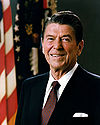 Ronald Reagan
produced a major realignment
with his 1980 and 1984 landslides. In 1980, the Reagan coalition
was possible because of Democratic
losses in most social-economic groups. In 1984, Reagan won nearly 60% of the popular vote and carried every state except his Democratic opponent Walter Mondale
's home state of Minnesota and the District of Columbia, creating a record 525 electoral vote total (of 538 possible). Even in Minnesota, Mondale won by a mere 3,761 votes, meaning Reagan came within less than 3,800 votes of winning in all fifty states.
Political commentators, trying to explain how Reagan had won by such a large margin, coined the term "Reagan Democrat" to describe a Democratic voter who had voted for Reagan in 1980 and 1984 (and for George H.W. Bush in 1988), producing their landslide victories. They were mostly white, blue-collar
, and were attracted to Reagan's social conservatism on issues such as abortion, and to his hawkish foreign policy. Stan Greenberg
, a Democratic pollster, concluded that Reagan Democrats no longer saw Democrats as champions of their middle class aspirations, but instead saw it as being a party working primarily for the benefit of others, especially African Americans and social liberals.
Reagan reoriented American politics. He claimed credit in 1984 for an economic renewal—“It's morning in America again!” was the successful campaign slogan. Income taxes were slashed 25% and the upper tax rates abolished. The frustrations of stagflation
were resolved under the new monetary policies of Federal Reserve Chairman Paul Volker, as no longer did soaring inflation and recession pull the country down. Working again in bipartisan fashion, the Social Security financial crises were resolved for the next 25 years. Reagan chose not to speak publicly about the HIV-AIDS epidemic until 1987.
In foreign affairs, bipartisanship was not in evidence. Most Democrats doggedly opposed Reagan's efforts to support the Contra guerrillas against the Sandinista government of Nicaragua
, and to support the dictatorial governments of Guatemala
, Honduras
and El Salvador
against Communist guerrilla movements. He took a hard line against the Soviet Union
, alarming Democrats who wanted a nuclear freeze, but he succeeded in increasing the military budget and launching the Strategic Defense Initiative
(SDI)—labeled "Star Wars" by its opponents—that the Soviets could not match. When Mikhail Gorbachev
came to power in Moscow, many conservative Republicans were dubious of the growing friendship between him and Reagan. Gorbachev tried to save communism in Russia first by ending the expensive arms race with America, then (1989) by shedding the East European
empire. Communism finally collapsed in Russia
in 1991.
President George H. W. Bush
, Reagan's successor, tried to temper feelings of triumphalism lest there be a backlash in Russia, but the palpable sense of victory in the Cold War
was a success that Republicans felt validated the aggressive foreign policies Reagan had espoused. As Haynes Johnson, one of his harshest critics admitted, "His greatest service was in restoring the respect of Americans for themselves and their own government after the traumas of Vietnam
and Watergate
, the frustration of the Iran hostage crisis
and a succession of seemingly failed presidencies."
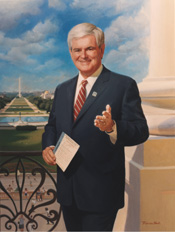 After the election of Democratic President Bill Clinton
in 1992, the Republican Party, led by House Republican Minority Whip Newt Gingrich
campaigning on a Contract With America
, were elected to majorities to both houses of Congress in the Republican Revolution
of 1994. It was the first time since 1952 that the Republicans secured control of both houses of U.S. Congress, which, with the exception of the Senate during 2001-2002, was retained through 2006. This capture and subsequent holding of Congress represented a major legislative turnaround, as Democrats controlled both houses of Congress for the forty years preceding 1995, with the exception of the 1981-1987 Congress in which Republicans controlled the Senate.
In 1994, Republican Congressional candidates ran on a platform of major reforms of government with measures such as a balanced budget amendment
and welfare reform
. These measures and others formed the famous Contract with America, which represented the first effort to have a party platform in an off-year election. The Republicans passed some of their proposals, but failed on others such as term limits. Democratic President Bill Clinton
opposed some of the social agenda initiatives but he co-opted the proposals for welfare reform
and a balanced federal budget. The result was a major change in the welfare system, which conservatives hailed and liberals bemoaned. The Republican-controlled House of Representatives failed to muster the two-thirds majority required to pass a Constitutional amendment to impose term limit
s on members of Congress. In 1995, a budget battle with Clinton led to the brief shutdown of the federal government, an event which contributed to Clinton's victory in the 1996 election. That year, the Republicans nominated Bob Dole
, who was unable to transfer his success in Senate leadership to a viable presidential campaign, likely due to Newt Gingrich and the Republican Congress' unpopularity after the budget battle.
The incoming Republican majority's promise to slow the rate of government spending conflicted with the president's agenda for Medicare, education, the environment and public health, eventually leading to a temporary shutdown of the U.S. federal government. The shutdown became the longest-ever in U.S. history, ending when Clinton agreed to submit a CBO-approved balanced budget plan. Democratic leaders, including Charles Schumer
, took the opportunity to attack Gingrich's motives for the budget standoff, and Gingrich's public image suffered heavily due to the shutdown. Gingrich's unpopularity was to such an extent that, in the summer of 1997, several House Republican backbenchers, who saw Gingrich's public image as a liability, attempted to replace him as Speaker. The attempted "coup" began July 9 with a meeting between Republican conference chairman John Boehner
of Ohio and Republican leadership chairman Bill Paxon
of New York. According to their plan, House Majority Leader Dick Armey
, House Majority Whip Tom DeLay
, Boehner and Paxon were to present Gingrich with an ultimatum: resign, or be voted out. However, Armey balked at the proposal to make Paxon the new Speaker, and told his chief of staff to warn Gingrich about the coup. Gingrich later explained to the Republican leadership that his resignation would allow for the possibility that Democrats, along with dissenting Republicans, would vote in Dick Gephardt
as Speaker.
During the 1998 midterm elections, Republicans lost five seats in the House of Representatives—the worst performance in 64 years for a party that didn't hold the presidency. Polls showed that Gingrich's attempt to remove President Clinton from office was widely unpopular among Americans; Gingrich suffered much of the blame for the election loss. Facing another rebellion in the Republican caucus, he announced on November 6, 1998 that he would not only stand down as Speaker, but would leave the House as well, even declining to take his seat for an 11th term once he was handily re-elected in his home district.
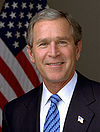 George W. Bush
, son of former president George H. W. Bush
(1989–1993), won the 2000 Republican presidential nomination over his competitors, Arizona Senator John McCain
, former Transportation Secretary
, Labor Secretary
Elizabeth Dole
, and others. With his controversial victory in the 2000 election
against the Vice President Al Gore
of the Democratic Party, the Republican Party gained control of the Presidency and both houses of Congress for the first time since 1952, only to lose control of the Senate by one vote when Vermont
Senator James Jeffords left the Republican Party to become an independent in 2001 and chose to vote with the Democratic caucus
.
In the wake of the September 11 attacks on the United States in 2001, Bush gained widespread political support as he pursued the War on Terrorism
that included the invasion of Afghanistan
and the invasion of Iraq
. In March 2003, Bush ordered for an invasion of Iraq because of intelligence alleging the possession of weapons of mass destruction
. Bush had near-unanimous Republican support in Congress plus support from many Democratic leaders.
The Republican Party fared well in the 2002 midterm elections, solidifying its hold on the House and regaining control of the Senate, in the run-up to the war in Iraq. This marked the first time since 1934 that the party in control of the White House gained seats in a midterm election in both houses of Congress. (Previous occasions were in 1902 and following the Civil War
.) Bush was renominated without opposition as the Republican candidate in the 2004 election, and titled his political platform "A Safer World and a More Hopeful America." It expressed Bush's optimism towards winning the War on Terrorism, ushering in an ownership society
, and building an innovative economy to compete in the world. Bush was re-elected by a slightly larger margin than in 2000, and Republicans gained seats in both houses of Congress. Bush told reporters "I earned capital in the campaign, political capital, and now I intend to spend it. It is my style."
He announced his agenda in January 2005, but his popularity in the polls waned and his troubles mounted. Failure to find Weapons of Mass Destruction
in Iraq and mounting combat casualties led popular support for his policies to fall. His campaign to add personal savings accounts to the Social Security
system and make major revisions in the tax code were postponed. He succeeded in selecting conservatives to head four of the most important agencies, Condoleezza Rice
as Secretary of State
, Alberto Gonzales
as Attorney General
, John Roberts
as Chief Justice of the United States
and Ben Bernanke
as Chairman of the Federal Reserve
. He failed to win conservative approval for Harriet Miers
to the Supreme Court, replacing her with Samuel Alito
, whom the Senate confirmed in January 2006. Bush and McCain secured additional tax cuts and blocked moves to raise taxes. Through 2006, they strongly defended his policy in Iraq, saying the Coalition
was winning. They secured the renewal of the USA PATRIOT Act
.
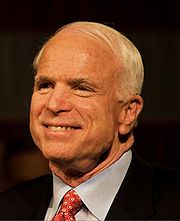 In the November 2005 off-year elections, New York City, Republican mayoral candidate Michael Bloomberg
won a landslide re-election, the fourth straight Republican victory in what is otherwise a Democratic stronghold. In California, Governor Arnold Schwarzenegger
failed in his effort to use the ballot initiative to enact laws the Democrats blocked in the state legislature. Scandals prompted the resignations of Congressional Republicans House Majority Leader Tom DeLay
, Duke Cunningham
, Mark Foley
, and Bob Ney
. In the 2006 midterm elections, the Republicans lost control of both the House of Representatives and Senate to the Democrats. Exit polling suggested that corruption was a key issue for many voters.
In the Republican leadership elections that followed the general election, Speaker Hastert did not run and Republicans chose John Boehner
of Ohio for House Minority Leader. Senators chose whip Mitch McConnell
of Kentucky for Senate Minority Leader, and chose their former leader Trent Lott
as Senate Minority Whip by one vote over Lamar Alexander
, who assumed their roles in January, 2007. In the October and November gubernatorial elections of 2007, Republican Bobby Jindal
won election for governor of Louisiana
, Republican incumbent Governor Ernie Fletcher
of Kentucky
lost, and Republican incumbent Governor Haley Barbour
of Mississippi
won re-election.
With President Bush ineligible for a third term and Vice President Dick Cheney
not pursuing the party's nomination, Arizona Senator John McCain
quickly emerged as the Republican Party's presidential nominee, receiving President Bush's endorsement on March 6, six months before official ratification at the 2008 Republican National Convention
. On August 29, Senator McCain announced Governor Sarah Palin
of Alaska as his running-mate, making her the first woman on a Republican Presidential ticket; McCain surged ahead of Obama in the national polls following the nomination. However, by the campaign's own later admission, the rollout of Palin to the national media went poorly, and voter reactions to Palin grew increasingly negative, especially among independents and other voters concerned about her qualifications. Amid a financial crisis, a serious economic downturn and Palin's unpopularity, they went on to lose the election to Democrat Barack Obama
and his running-mate, Joe Biden
.
switched to the Democratic Party, depriving the GOP of a critical 41st vote to block legislation in the upper chamber of Congress. In the 2009 elections
, Republicans were successful in the New Jersey
and Virginia
gubernatorial races
. Two months later, the GOP recovered its 41st Senate vote with the victory of Scott Brown
, who was elected
to fill the Massachusetts seat previously held by the late Ted Kennedy
. For the first two years of Obama's presidency, Republicans filibustered major bills the Democrats proposed, including the 9/11 responders' bill (before Jon Stewart
revived the debate over it on his show) and the Dream Act, claiming that they would stop once Obama agreed to extend the Bush tax cuts
. After the 2010 midterm elections, the Democrats agreed to extend the Bush tax cuts for another two to four years. The successful repeal of Don't Ask, Don't Tell
and the passing of the nuclear arms reduction treaty
with Russia
are among those that the Republicans failed to filibuster.
with the phrase "Where are the jobs?", Republicans strongly opposed Obama's 2009 economic stimulus package
and 2010 health care reform bill
, both of whom were signed into law by the president. The health care reform bill in particular has been consistently lauded as "unconstitutional legislation" and a "job-killing law" by the Republicans and the Tea Party, to the point where, in the following year of 2011, the now-Republican-controlled House of Representatives voted 245–189 to approve a bill entitled "Repealing the Job-Killing Health Care Law Act" (H.R.2). If enacted, the bill would repeal the Patient Protection and Affordable Care Act and the health care-related text of the Health Care and Education Reconciliation Act of 2010; all Republicans and 3 Democrats voted for repeal, but passage into law seems unlikely because of Democratic control in the Senate and President Obama's statement that he would veto the bill should it pass both chambers. Democrats in the House proposed that repeal not take effect until a majority of the Senators and Representatives had opted out of the Federal Employees Health Benefits Program, but the Republicans voted down this measure.
Repealing the health care reform law would cost the nation more than $210 billion over the next decade, according to the nonpartisan Congressional Budget Office.
, formed in early 2009, provided a groundswell of conservative grassroots activism to oppose policies of the Obama administration. With an expected economic recovery being criticized as sluggish, the GOP was expected to make big gains in the 2010 midterm elections. However, establishment Republicans began to see themselves at odds with Tea Party activists, who sought to run conservative candidates in primary elections to defeat the more moderate establishment-based candidates. Incumbent senators such as Bob Bennett in Utah and Lisa Murkowski
in Alaska lost primary contests in their respective states. However, there are fears that the Tea Party caucus will split votes and drive away the moderate Republican base: notably, while Murkowsi lost the Alaska primary to a Tea Party candidate, she then won the general election as a write-in candidate.
More recently, Judson Phillips, the leader of Tea Party Nation
, has expressed strong dislike for the current Republican Speaker of the House, and has called for a primary against him in the 2012 elections. A prospective presidential candidate, Donald Trump
once went on record to say that he identified with the Tea Party, considering himself as representative to their beliefs; he has gone into conflict with establishment Republicans, from Karl Rove
to Mitt Romney
and Tim Pawlenty
, who criticized his controversial statements over the citizenship conspiracy theories
in regards to Obama's birthplace.
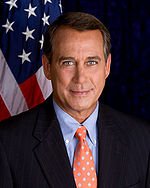 Republicans won back control of the House of Representatives in the November general election
, with a net gain of 63 seats, the largest gain for either party since 1948. The GOP also picked up six seats in the Senate, falling short of retaking control in that chamber, and posted additional gains in state governor and legislative races. Overall, the Republicans gained 680 seats in total, as well as holding approximately 3,890 of the total state legislative seats in the U.S., and control at least 54 of the 99 state legislative chambers, the highest number since 1952. Notably, Boehner became Speaker of the House (defeating then-incumbent, now-Minority Leader Nancy Pelosi
), McConnell remained as the Senate Minority Leader, and Eric Cantor
(Virginia
) - the only Jewish Republican currently serving in Congress - became the House Majority Leader. In an interview with National Journal magazine about congressional Republican priorities, McConnell explained that "the single most important thing we want to achieve is for (Barack) Obama to be a one-term president."
, claiming that these changes were needed to cut state spending and balance the states' budgets. However, these legislative propositions had provoked ongoing public employee protests
, starting from Madison, Wisconsin
and spreading to Ohio
, Indiana
, Maine
, Michigan
, Idaho
, Tennessee
, New Jersey
, Iowa
and Kansas
. In particular, the propositions of governors Scott Walker
(Wisconsin
), Mitch Daniels
(Indiana
), Sean Parnell
(Alaska
), Rick Snyder (Michigan
), John Kasich
(Ohio
), Paul LePage
(Maine
) and Jan Brewer
(Arizona
) would, among other things, strip public employees of some collective bargaining rights, as well as require higher employee contributions to pension and health care plans.
and House Speaker Boehner in the days preceding the deadline were not able to reach an agreement. Backed by Senate Democrats, Obama declared that he would veto a proposed Republican budget over Republican social spending cuts, including those that affected Planned Parenthood
. However, after Democrats enabled more tax cuts, the Republicans dropped their stance on the Planned Parenthood issue, and an agreement was reached between the two parties to allow for a one-week budget, in an attempt to avoid a government shutdown and allow more time for negotiations. The two parties ultimately agreed on a 2011 federal budget the following week.
There were many reactions to the possible shutdown, with some saying the economy could be hurt during a fragile recovery and others saying the lack of an unnecessary bureaucracy would not be noticed. There was also criticism that, while senators and representatives would continue to get paid, others such as the police and military personnel would either not be paid for their work or have their payments deferred.
, chairman of the House Budget Committee, drafted and promoted a competing budget plan to the one proposed by the Obama administration
on February 14, 2011. Made public on April 5, 2011. official name of the competing plan is The Path to Prosperity
, encompassing changes to Medicare
, Medicaid
, the major 2010 health care legislation, other government spending (excluding that for Social Security), and tax law. The proposal itself has generated broadly negative reactions from Democrats and positive reactions from Republicans. On April 15, in a symbolic vote, Ryan's proposal was passed in the House, with four Republicans and every Democrat voting against it. Once it reached the Senate, several pieces were removed from the bill, including changes to the social programs and the health care reform bill; a response to the virulently negative reception from citizens in town hall events.
, Paul LePage
, Jan Brewer
and Haley Barbour
; said bills were later repealed by popular vote shortly thereafter in 11 November, 2011. In particular, the bills were about the removal of negotiation rights for labor (Kasich; Ohio), removal of same-day voting (LePage; Maine), an immigration law that requires suspected illegals to present papers (Brewer; Arizona), and a person-hood initiative for fertilized eggs (Barbour; Mississippi). Republican Arizona Senate Leader Russell Pearce
, the original sponsor of the aforementioned immigration law, was the first ever Arizona state lawmaker to get recalled, following the defeat of SB1070. Furthermore, the governors of Kentucky and West Virginia lost re-election to Democrats, and a recent Quinnipiac
poll showed that the Republican Party had 58% unfavorable, with 28% favorable results from those that took the poll.
chiding the decision for a separate committee as an unneeded substitute for Congress.
holding steady in the mid-20s as the favorite of the moderates. In the USA TODAY/Gallup Poll, six candidates at one time or another were the top choice of GOP voters in 2011: former Arkansas governor Mike Huckabee
, real-estate tycoon Donald Trump
, former Massachusetts governor Mitt Romney
, Texas Gov. Rick Perry
, motivational speaker Herman Cain
and former Speaker Newt Gingrich
.
Although Romney is considered to be the frontrunner, backed by Karl Rove
and endorsed by Chris Christie (among others), his lead has been precarious; several candidates rose to agitate his lead in the polls and debates. As the initial Tea Party
favorite, Michele Bachmann
briefly rose as an opponent to Romney, but quickly lost her momentum to Rick Perry
amidst frequent gaffes and poor management of her campaign. After reaching third place in a straw poll, Tim Pawlenty
, a rival to both Bachmann and Rick Santorum
, dropped out of the race the day after Perry announced his bid to run for the nomination. In spite of his late entry, Perry instantly became the primary challenger to Romney; the media hyped up the competition between Perry and Romney as a rivalry, given their often heated discussions during several debates. Following a string of poor debate performances, Perry lost much of his momentum to Herman Cain
, who took over the scene as the frontrunner following a surprise victory in a Florida straw poll. However, Cains' viability as a candidate was jeopardized amidst allegations of sexual harassment, leading to rumors of an early withdrawal by the media. At present, despite early disasters in his campaign, former Speaker Gingrich has recently made a comeback by gaining major endorsements, fundraising support and top-tier poll results, tying with Romney as the frontrunner for the nomination.
Republican Party (United States)
The Republican Party is one of the two major contemporary political parties in the United States, along with the Democratic Party. Founded by anti-slavery expansion activists in 1854, it is often called the GOP . The party's platform generally reflects American conservatism in the U.S...
is the second oldest currently existing political party
Political party
A political party is a political organization that typically seeks to influence government policy, usually by nominating their own candidates and trying to seat them in political office. Parties participate in electoral campaigns, educational outreach or protest actions...
in the United States after its great rival, the Democratic Party. It emerged in 1854 to combat the Kansas Nebraska Act which threatened to extend slavery into the territories, and to promote more vigorous modernization of the economy. It had almost no presence in the South, but in the North it enlisted most former Whigs and former Free Soil Democrats to form majorities, by 1858, in nearly every Northern state. With the election of Abraham Lincoln
Abraham Lincoln
Abraham Lincoln was the 16th President of the United States, serving from March 1861 until his assassination in April 1865. He successfully led his country through a great constitutional, military and moral crisis – the American Civil War – preserving the Union, while ending slavery, and...
in 1860, and its success in guiding the Union to victory and abolishing slavery, it came to dominate the national scene until 1932. The Republican Party was based on northern white Protestants, businessmen, professionals, factory workers, wealthier farmers, and blacks. It was pro-business, supporting banks, the gold standard, railroads, and high tariffs to protect heavy industry and the industrial workers. Under William McKinley
William McKinley
William McKinley, Jr. was the 25th President of the United States . He is best known for winning fiercely fought elections, while supporting the gold standard and high tariffs; he succeeded in forging a Republican coalition that for the most part dominated national politics until the 1930s...
and Theodore Roosevelt
Theodore Roosevelt
Theodore "Teddy" Roosevelt was the 26th President of the United States . He is noted for his exuberant personality, range of interests and achievements, and his leadership of the Progressive Movement, as well as his "cowboy" persona and robust masculinity...
, it emphasized an expansive foreign policy. The GOP ("Grand Old Party"), as it is often called, became a minority after failing to reverse the Great Depression in 1932. The New Deal Coalition
New Deal coalition
The New Deal Coalition was the alignment of interest groups and voting blocs that supported the New Deal and voted for Democratic presidential candidates from 1932 until the late 1960s. It made the Democratic Party the majority party during that period, losing only to Dwight D. Eisenhower in 1952...
led by Democrat Franklin D. Roosevelt
Franklin D. Roosevelt
Franklin Delano Roosevelt , also known by his initials, FDR, was the 32nd President of the United States and a central figure in world events during the mid-20th century, leading the United States during a time of worldwide economic crisis and world war...
came to power in 1933-1945. When that coalition collapsed in the middle 1960s, Republicans came back, winning seven of the 10 presidential elections 1968 to 2004. The GOP relied increasingly on its new base in the white South after 1968, especially because of its new strength among evangelical Protestants. The key leader in the late 20th century was Ronald Reagan
Ronald Reagan
Ronald Wilson Reagan was the 40th President of the United States , the 33rd Governor of California and, prior to that, a radio, film and television actor....
, whose conservative pro-business policies for less government regulation, lower taxes, and an aggressive foreign policy still dominate the party.
Ideological beginnings
Conscience Whigs
The "Conscience" Whigs were a faction of the Whig Party in the state of Massachusetts noted for their moral opposition to slavery. They were noted as opponents of the more conservative "Cotton" Whigs who dominated the state party, led by such figures as Edward Everett, Robert C...
" and Free Soil Democrats
Free Soil Party
The Free Soil Party was a short-lived political party in the United States active in the 1848 and 1852 presidential elections, and in some state elections. It was a third party and a single-issue party that largely appealed to and drew its greatest strength from New York State. The party leadership...
opposed to the Kansas-Nebraska Act
Kansas-Nebraska Act
The Kansas–Nebraska Act of 1854 created the territories of Kansas and Nebraska, opening new lands for settlement, and had the effect of repealing the Missouri Compromise of 1820 by allowing settlers in those territories to determine through Popular Sovereignty if they would allow slavery within...
, submitted to Congress by Stephen Douglas in January 1854. The Act opened Kansas Territory
Kansas Territory
The Territory of Kansas was an organized incorporated territory of the United States that existed from May 30, 1854, until January 29, 1861, when the eastern portion of the territory was admitted to the Union as the State of Kansas....
and Nebraska Territory
Nebraska Territory
The Territory of Nebraska was an organized incorporated territory of the United States that existed from May 30, 1854, until March 1, 1867, when the final extent of the territory was admitted to the Union as the State of Nebraska. The Nebraska Territory was created by the Kansas–Nebraska Act of 1854...
to slavery and future admission as slave states, thus implicitly repealing the prohibition on slavery in territory north of 36° 30′ latitude, which had been part of the Missouri Compromise
Missouri Compromise
The Missouri Compromise was an agreement passed in 1820 between the pro-slavery and anti-slavery factions in the United States Congress, involving primarily the regulation of slavery in the western territories. It prohibited slavery in the former Louisiana Territory north of the parallel 36°30'...
. This change was viewed by Free-Soil and Abolitionist Northerners as an aggressive, expansionist maneuver by the slave-owning South.
The Act was supported by all Southerners and by Northern "Doughface" (pro-Southern) Democrats, and by still other northern Democrats persuaded by Douglas' doctrine of "popular sovereignty". In the North the old Whig party was almost defunct. The opponents were intensely motivated and began forming a new party.
The new party went well beyond the issue of slavery in the territories. It envisioned modernizing the United States — emphasizing giving free western land to farmers ("free soil") as opposed to letting slave owners buy up the best lands, expanded banking, more railroads, and factories. They vigorously argued that free-market labor was superior to slavery and the very foundation of civic virtue and true republicanism
Republicanism in the United States
Republicanism is the political value system that has been a major part of American civic thought since the American Revolution. It stresses liberty and inalienable rights as central values, makes the people as a whole sovereign, supports activist government to promote the common good, rejects...
- this is the "Free Soil, Free Labor, Free Men" ideology. The Republicans absorbed the previous traditions of its members, most of whom had been Whigs
Whig Party (United States)
The Whig Party was a political party of the United States during the era of Jacksonian democracy. Considered integral to the Second Party System and operating from the early 1830s to the mid-1850s, the party was formed in opposition to the policies of President Andrew Jackson and his Democratic...
; others had been Democrats or members of third parties (especially the Free Soil Party
Free Soil Party
The Free Soil Party was a short-lived political party in the United States active in the 1848 and 1852 presidential elections, and in some state elections. It was a third party and a single-issue party that largely appealed to and drew its greatest strength from New York State. The party leadership...
and the American Party
Know Nothing
The Know Nothing was a movement by the nativist American political faction of the 1840s and 1850s. It was empowered by popular fears that the country was being overwhelmed by German and Irish Catholic immigrants, who were often regarded as hostile to Anglo-Saxon Protestant values and controlled by...
or Know Nothings). Many Democrats
History of the United States Democratic Party
The history of the Democratic Party of the United States is an account of the oldest political party in the United States and arguably the oldest democratic party in the world....
who joined up were rewarded with governorships. or seats in the U.S. Senate or House of Representatives. Since its inception, its chief opposition has been the Democratic Party
History of the United States Democratic Party
The history of the Democratic Party of the United States is an account of the oldest political party in the United States and arguably the oldest democratic party in the world....
, but the amount of flow back and forth of prominent politicians between the two parties was quite high from 1854 to 1896.
Historians have explored the ethnocultural foundations of the party, along the line that ethnic and religious groups set the moral standards for their members, who then carried those standards into politics. The churches also provided social networks that politicians used to sign up voters. The pietistic churches emphasized the duty of the Christian to purge sin from society. Sin took many forms—alcoholism, polygamy and slavery became special targets for the Republicans. The Yankees, who dominated New England, much of upstate New York, and much of the upper Midwest were the strongest supporters of the new party. This was especially true for the pietistic Congregationalists and Presbyterians among them and (during the war), the Methodists, along with Scandinavian Lutherans. The Quakers were a small tight-knit group that was heavily Republican. The liturgical churches (Roman Catholic, Episcopal, German Lutheran), by contrast, largely rejected the moralism of the Republican Party; most of their adherents voted Democratic.
Organizational beginnings
The first "anti-Nebraska" meeting where "Republican" was suggested as a name for a new anti-slavery party was held in a Ripon, WisconsinRipon, Wisconsin
Ripon is a city in Fond du Lac County, Wisconsin, United States. As of the 2000 census, the city population was 6,828. The City of Ripon's official website claims the city's current population to be 7,701. The city is surrounded by the Town of Ripon....
schoolhouse on March 20, 1854. The first statewide convention that formed a platform and nominated candidates under the name "Republican" was held "under the oaks" on the outskirts of Jackson, Michigan
Jackson, Michigan
Jackson is a city located along Interstate 94 in the south central area of the U.S. state of Michigan, about west of Ann Arbor and south of Lansing. It is the county seat of Jackson County. As of the 2010 census, the city population was 33,534...
on July 6, 1854; it declared their new party opposed to the expansion of slavery into new territories and selected a state-wide slate of candidates. The Midwest took the lead in forming state party tickets, while the eastern states lagged a year or so.
There were no efforts to organize the party in the South, apart from St. Louis and a few areas adjacent to free states. The party initially had its base in the Northeast
Northeastern United States
The Northeastern United States is a region of the United States as defined by the United States Census Bureau.-Composition:The region comprises nine states: the New England states of Connecticut, Maine, Massachusetts, New Hampshire, Rhode Island and Vermont; and the Mid-Atlantic states of New...
and Midwest
Midwestern United States
The Midwestern United States is one of the four U.S. geographic regions defined by the United States Census Bureau, providing an official definition of the American Midwest....
.
Establishing a national party
The party launched its first national convention in Pittsburgh, PennsylvaniaPittsburgh, Pennsylvania
Pittsburgh is the second-largest city in the US Commonwealth of Pennsylvania and the county seat of Allegheny County. Regionally, it anchors the largest urban area of Appalachia and the Ohio River Valley, and nationally, it is the 22nd-largest urban area in the United States...
, in February 1856, with its first national nominating convention
1856 Republican National Convention
The 1856 Republican National Convention convened from June 17 to June 19, 1856 at the Musical Fund Hall in Philadelphia, Pennsylvania, United States, and nominated General John C. Frémont of California and former Senator William Dayton of New Jersey for President and Vice President of the United...
held in the summer in Philadelphia, Pennsylvania.
John C. Frémont
John C. Frémont
John Charles Frémont , was an American military officer, explorer, and the first candidate of the anti-slavery Republican Party for the office of President of the United States. During the 1840s, that era's penny press accorded Frémont the sobriquet The Pathfinder...
ran as the first Republican nominee for President
President of the United States
The President of the United States of America is the head of state and head of government of the United States. The president leads the executive branch of the federal government and is the commander-in-chief of the United States Armed Forces....
in 1856, using the political slogan: "Free soil, free silver, free men, Frémont." Although Frémont's bid was unsuccessful, the party showed a strong base. It dominated in New England, New York and the northern Midwest, and had a strong presence in the rest of the North. It had almost no support in the South, where it was roundly denounced in 1856-60 as a divisive force that threatened civil war.
The Civil War and an era of Republican dominance: 1860–1896
Abraham Lincoln
Abraham Lincoln was the 16th President of the United States, serving from March 1861 until his assassination in April 1865. He successfully led his country through a great constitutional, military and moral crisis – the American Civil War – preserving the Union, while ending slavery, and...
in 1860 ended the domination of the fragile coalition of pro-slavery southern Democrats and conciliatory northern Democrats which had existed since the days of Andrew Jackson
Andrew Jackson
Andrew Jackson was the seventh President of the United States . Based in frontier Tennessee, Jackson was a politician and army general who defeated the Creek Indians at the Battle of Horseshoe Bend , and the British at the Battle of New Orleans...
. Instead, a new era of Republican dominance based in the industrial and agricultural north ensued. Republicans sometimes refer to their party as the "party of Lincoln" in honor of the first Republican President.
The Third Party System
Third Party System
The Third Party System is a term of periodization used by historians and political scientists to describe a period in American political history from about 1854 to the mid-1890s that featured profound developments in issues of nationalism, modernization, and race...
was dominated by the Republican Party (it lost the presidency in 1884 and 1892). Lincoln proved brilliantly successful in uniting the factions of his party to fight for the Union. However he usually fought the Radical Republicans who demanded harsher measures. Most Democrats at first were War Democrats
War Democrats
War Democrats in American politics of the 1860s were adherents of the Democratic Party who rejected the Copperheads/Peace Democrats who controlled the party...
, and supportive until the Fall of 1862. When Lincoln added the abolition of slavery as a war goal, many war Democrats became "peace Democrats." Most of the state Republican parties accepted the antislavery goal except Kentucky. In Congress, the party passed major legislation to promote rapid modernization, including a national banking system, high tariffs
Morrill Tariff
The Morrill Tariff of 1861 was a protective tariff in the United States, adopted on March 2, 1861 during the administration of President James Buchanan....
, the first temporary income tax, many excise taxes, paper money issued without backing ("greenbacks"), a huge national debt, homestead laws, railroads, and aid to education and agriculture. The Republicans denounced the peace-oriented Democrats as disloyal Copperheads and won enough War Democrats to maintain their majority in 1862; in 1864, they formed a coalition with many War Democrats as the National Union Party
National Union Party (United States)
The National Union Party was the name used by the Republican Party for the national ticket in the 1864 presidential election, held during the Civil War. State Republican parties did not usually change their name....
which reelected Lincoln easily. During the war, upper middle-class men in major cities formed Union League
Union League
A Union League is one of a number of organizations established starting in 1862, during the American Civil War to promote loyalty to the Union and the policies of Abraham Lincoln. They were also known as Loyal Leagues. They comprised upper middle class men who supported efforts such as the United...
s, to promote and help finance the war effort.
Reconstruction: African-Americans, Carpetbaggers and Scalawags
In Reconstruction, how to deal with the ex-Confederates and the freed slaves, or freedmen, were the major issues. By 1864, Radical Republicans controlled Congress and demanded more aggressive action against slavery, and more vengeance toward the Confederates. Lincoln held them off, but just barely. Republicans at first welcomed President Andrew JohnsonAndrew Johnson
Andrew Johnson was the 17th President of the United States . As Vice-President of the United States in 1865, he succeeded Abraham Lincoln following the latter's assassination. Johnson then presided over the initial and contentious Reconstruction era of the United States following the American...
; the Radicals thought he was one of them and would take a hard line in punishing the South. Johnson however broke with them and formed a loose alliance with moderate Republicans and Democrats. The showdown came in the Congressional elections of 1866, in which the Radicals won a sweeping victory and took full control of Reconstruction, passing key laws over the veto. Johnson was impeached by the House, but acquitted by the Senate.
Ulysses S. Grant
Ulysses S. Grant was the 18th President of the United States as well as military commander during the Civil War and post-war Reconstruction periods. Under Grant's command, the Union Army defeated the Confederate military and ended the Confederate States of America...
in 1868, the Radicals had control of Congress, the party and the Army, and attempted to build a solid Republican base in the South using the votes of Freedmen, Scalawags and Carpetbaggers, supported directly by U.S. Army detachments. Republicans all across the South formed local clubs called Union League
Union League
A Union League is one of a number of organizations established starting in 1862, during the American Civil War to promote loyalty to the Union and the policies of Abraham Lincoln. They were also known as Loyal Leagues. They comprised upper middle class men who supported efforts such as the United...
s that effectively mobilized the voters, discussed issues, and when necessary fought off Ku Klux Klan
Ku Klux Klan
Ku Klux Klan, often abbreviated KKK and informally known as the Klan, is the name of three distinct past and present far-right organizations in the United States, which have advocated extremist reactionary currents such as white supremacy, white nationalism, and anti-immigration, historically...
(KKK) attacks. Thousands died on both sides.
Grant supported radical reconstruction programs in the South, the Fourteenth Amendment
Fourteenth Amendment to the United States Constitution
The Fourteenth Amendment to the United States Constitution was adopted on July 9, 1868, as one of the Reconstruction Amendments.Its Citizenship Clause provides a broad definition of citizenship that overruled the Dred Scott v...
, and equal civil and voting rights for the freedmen. Most of all he was the hero of the war veterans, who marched to his tune. The party had become so large that factionalism was inevitable; it was hastened by Grant's tolerance of high levels of corruption typified by the Whiskey Ring
Whiskey Ring
In the United States, the Whiskey Ring was a scandal, exposed in 1875, involving diversion of tax revenues in a conspiracy among government agents, politicians, whiskey distillers, and distributors. The Whiskey Ring began in St...
. Many of the founders of the GOP joined the movement, as did many powerful newspaper editors. They nominated Horace Greeley
Horace Greeley
Horace Greeley was an American newspaper editor, a founder of the Liberal Republican Party, a reformer, a politician, and an outspoken opponent of slavery...
for president, who also gained the Democratic nomination, but the ticket was defeated in a landslide. The depression of 1873 energized the Democrats. They won control of the House and formed "Redeemer
Redeemers
In United States history, "Redeemers" and "Redemption" were terms used by white Southerners to describe a political coalition in the Southern United States during the Reconstruction era which followed the American Civil War...
" coalitions which recaptured control of each southern state, in some cases using threats and violence.
Reconstruction came to an end when the contested election of 1876 was awarded by a special electoral commission
Electoral Commission (United States)
The Electoral Commission was a temporary body created by Congress to resolve the disputed United States presidential election of 1876. It consisted of 15 members. The election was contested by the Democratic ticket, Samuel J. Tilden and Thomas A. Hendricks, and the Republican ticket, Rutherford B....
to Republican Rutherford B. Hayes
Rutherford B. Hayes
Rutherford Birchard Hayes was the 19th President of the United States . As president, he oversaw the end of Reconstruction and the United States' entry into the Second Industrial Revolution...
who promised, through the unofficial Compromise of 1877
Compromise of 1877
The Compromise of 1877, also known as the Corrupt Bargain, refers to a purported informal, unwritten deal that settled the disputed 1876 U.S. Presidential election and ended Congressional Reconstruction. Through it, Republican Rutherford B. Hayes was awarded the White House over Democrat Samuel J...
, to withdraw federal troops from control of the last three southern states. The region then became the Solid South
Solid South
Solid South is the electoral support of the Southern United States for the Democratic Party candidates for nearly a century from 1877, the end of Reconstruction, to 1964, during the middle of the Civil Rights era....
, giving overwhelming majorities of its electoral votes and Congressional seats to the Democrats until 1964.
In terms of racial issues, "White Republicans as well as Democrats solicited black votes but reluctantly rewarded blacks with nominations for office only when necessary, even then reserving the more choice positions for whites. The results were predictable: these half-a-loaf gestures satisfied neither black nor white Republicans. The fatal weakness of the Republican Party in Alabama, as elsewhere in the South, was its inability to create a biracial political party. And while in power even briefly, they failed to protect their members from Democratic terror. Alabama Republicans were forever on the defensive, verbally and physically."
Social pressure eventually forced most Scalawags to join the conservative/Democratic Redeemer coalition. A minority persisted and formed the "tan" half of the "Black and Tan" Republican Party, a minority in every southern state after 1877.
The Gilded Age: 1877–1890
The "GOP" (short for Grand Old Party, as it was now nicknamed) split into factions in the late 1870s. The Stalwarts, followers of Senator Roscoe ConklingRoscoe Conkling
Roscoe Conkling was a politician from New York who served both as a member of the United States House of Representatives and the United States Senate. He was the leader of the Stalwart faction of the Republican Party and the last person to refuse a U.S. Supreme Court appointment after he had...
, defended the spoils system
Spoils system
In the politics of the United States, a spoil system is a practice where a political party, after winning an election, gives government jobs to its voters as a reward for working toward victory, and as an incentive to keep working for the party—as opposed to a system of awarding offices on the...
. The Half-Breeds, who followed Senator James G. Blaine
James G. Blaine
James Gillespie Blaine was a U.S. Representative, Speaker of the United States House of Representatives, U.S. Senator from Maine, two-time Secretary of State...
of Maine, pushed for reform of the Civil service
Civil service
The term civil service has two distinct meanings:* A branch of governmental service in which individuals are employed on the basis of professional merit as proven by competitive examinations....
. Independents who opposed the spoils system altogether were called "Mugwumps." In 1884 Mugwumps rejected James G. Blaine
James G. Blaine
James Gillespie Blaine was a U.S. Representative, Speaker of the United States House of Representatives, U.S. Senator from Maine, two-time Secretary of State...
as corrupt and helped elect Democrat Grover Cleveland
Grover Cleveland
Stephen Grover Cleveland was the 22nd and 24th president of the United States. Cleveland is the only president to serve two non-consecutive terms and therefore is the only individual to be counted twice in the numbering of the presidents...
; most returned to the party by 1888.
As the Northern post-war economy boomed with industry, railroads, mines, and fast-growing cities, as well as prosperous agriculture, the Republicans took credit and promoted policies to keep the fast growth going. The Democratic Party was largely controlled by pro-business Bourbon Democrat
Bourbon Democrat
Bourbon Democrat was a term used in the United States from 1876 to 1904 to refer to a member of the Democratic Party, conservative or classical liberal, especially one who supported President Grover Cleveland in 1884–1888/1892–1896 and Alton B. Parker in 1904. After 1904, the Bourbons faded away...
s until 1896. The GOP supported big business generally, the gold standard
Gold standard
The gold standard is a monetary system in which the standard economic unit of account is a fixed mass of gold. There are distinct kinds of gold standard...
, high tariff
Tariff in American history
Tariffs in United States history have played different roles in trade policy, political debates and the nation's economic history. Tariffs were the largest source of federal revenue from the 1790s to the eve of World War I, until it was surpassed by income taxes. Tariffs are taxes on imports and...
s, and generous pensions for Union veterans. By 1890, however, the Republicans had agreed to the Sherman Anti-Trust Act and the Interstate Commerce Commission
Interstate Commerce Commission
The Interstate Commerce Commission was a regulatory body in the United States created by the Interstate Commerce Act of 1887. The agency's original purpose was to regulate railroads to ensure fair rates, to eliminate rate discrimination, and to regulate other aspects of common carriers, including...
in response to complaints from owners of small businesses and farmers. The high McKinley Tariff
McKinley Tariff
The Tariff Act of 1890, commonly called the McKinley Tariff, was an act framed by Representative William McKinley that became law on October 1, 1890. The tariff raised the average duty on imports to almost fifty percent, an act designed to protect domestic industries from foreign competition...
of 1890 hurt the party and the Democrats swept to a landslide in the off-year elections, even defeating McKinley himself.
Foreign affairs seldom became partisan issues (except for the annexation of Hawaii, which Republicans favored and Democrats opposed). Much more salient were cultural issues. The GOP supported the pietistic Protestants (especially the Methodists, Congregationalists, Presbyterians, and Scandinavian Lutherans) who demanded Prohibition
Prohibition
Prohibition of alcohol, often referred to simply as prohibition, is the practice of prohibiting the manufacture, transportation, import, export, sale, and consumption of alcohol and alcoholic beverages. The term can also apply to the periods in the histories of the countries during which the...
. That angered wet Republicans, especially German American
German American
German Americans are citizens of the United States of German ancestry and comprise about 51 million people, or 17% of the U.S. population, the country's largest self-reported ancestral group...
s, who broke ranks in 1890-1892, handing power to the Democrats.
Demographic trends aided the Democrats, as the German and Irish Catholic immigrants were mostly Democrats, and outnumbered the British and Scandinavian Republicans. During the 1880s, elections were remarkably close. The Democrats usually lost, but won in 1884 and 1892. In the 1894 Congressional elections
United States House election, 1894
The U.S. House election, 1894 was a realigning election—a major Republican landslide that set the stage for the decisive Election of 1896. The elections of members of the United States House of Representatives in 1894 came in the middle of President Grover Cleveland's second term...
, the GOP scored the biggest landslide in its history, as Democrats were blamed for the severe economic depression 1893-1897
Panic of 1893
The Panic of 1893 was a serious economic depression in the United States that began in 1893. Similar to the Panic of 1873, this panic was marked by the collapse of railroad overbuilding and shaky railroad financing which set off a series of bank failures...
and the violent coal and railroad strikes of 1894.
Ethnocultural politics: pietistic Republicans versus liturgical Democrats
| Voting Behavior by Religion, Northern USA Late 19th century | ||
| % Dem | % GOP | |
| Immigrant Groups | ||
| Irish Catholics | 80 | 20 |
| All Catholics | 70 | 30 |
| Confessional German Lutherans | 65 | 35 |
| German Reformed | 60 | 40 |
| French Canadian Catholics | 50 | 50 |
| Less Confessional German Lutherans | 45 | 55 |
| English Canadians | 40 | 60 |
| British Stock | 35 | 65 |
| German Sectarians | 30 | 70 |
| Norwegian Lutherans | 20 | 80 |
| Swedish Lutherans | 15 | 85 |
| Haugean Norwegians | 5 | 95 |
| Natives: Northern Stock | ||
| Quakers | 5 | 95 |
| Free Will Baptists | 20 | 80 |
| Congregational | 25 | 75 |
| Methodists | 25 | 75 |
| Regular Baptists | 35 | 65 |
| Blacks | 40 | 60 |
| Presbyterians | 40 | 60 |
| Episcopalians | 45 | 55 |
| Natives: Southern Stock (living in North) | ||
| Disciples | 50 | 50 |
| Presbyterians | 70 | 30 |
| Baptists | 75 | 25 |
| Methodists | 90 | 10 |
From 1860 to 1912, the Republicans took advantage of the association of the Democrats with "Rum, Romanism, and Rebellion". Rum stood for the liquor interests and the tavernkeepers, in contrast to the GOP, which had a strong dry element. "Romanism" meant Catholics, especially Irish Americans, who ran the Democratic Party in every big city, and whom the Republicans denounced for political corruption. "Rebellion" stood for the Confederates who tried to break the Union in 1861, and the Copperheads in the North who sympathized with them.
Demographic trends aided the Democrats, as the German and Irish Catholic immigrants were Democrats, and outnumbered the English and Scandinavian Republicans. During the 1880s and 1890s, the Republicans struggled against the Democrats' efforts, winning several close elections and losing two to Grover Cleveland (in 1884 and 1892).
Religious lines were sharply drawn. Methodists, Congregationalists, Presbyterians, Scandinavian Lutherans and other pietists in the North were tightly linked to the GOP. In sharp contrast, liturgical groups, especially the Catholics, Episcopalians, and German Lutherans, looked to the Democratic Party for protection from pietistic moralism, especially prohibition. Both parties cut across the class structure, with the Democrats more bottom-heavy.
Cultural issues, especially prohibition and foreign language schools became important because of the sharp religious divisions in the electorate. In the North, about 50% of the voters were pietistic Protestants (Methodists, Scandinavian Lutherans, Presbyterians, Congregationalists, Disciples of Christ) who believed the government should be used to reduce social sins, such as drinking. Liturgical churches (Roman Catholics, German Lutherans, Episcopalians) comprised over a quarter of the vote and wanted the government to stay out of the morality business. Prohibition debates and referendums heated up politics in most states over a period of decade, as national prohibition was finally passed in 1918 (and repealed in 1932), serving as a major issue between the wet Democrats and the dry GOP.
The Progressive Era: 1896–1932
The election of William McKinleyWilliam McKinley
William McKinley, Jr. was the 25th President of the United States . He is best known for winning fiercely fought elections, while supporting the gold standard and high tariffs; he succeeded in forging a Republican coalition that for the most part dominated national politics until the 1930s...
in 1896 is widely seen as a resurgence of Republican dominance and is cited as a realigning election
Realigning election
Realigning election are terms from political science and political history describing a dramatic change in the political system. Scholars frequently apply the term to American elections and occasionally to other countries...
.
Fourth Party System
The Fourth Party System is the term used in political science and history for the period in American political history from about 1896 to 1932 that was dominated by the Republican party, excepting the 1912 split in which Democrats held the White House for eight years. History texts usually call it...
") was dominated by Republican presidents, with the sole exception of Democrat Woodrow Wilson
Woodrow Wilson
Thomas Woodrow Wilson was the 28th President of the United States, from 1913 to 1921. A leader of the Progressive Movement, he served as President of Princeton University from 1902 to 1910, and then as the Governor of New Jersey from 1911 to 1913...
, 1913-1921. McKinley promised that high tariffs would end the severe hardship caused by the Panic of 1893
Panic of 1893
The Panic of 1893 was a serious economic depression in the United States that began in 1893. Similar to the Panic of 1873, this panic was marked by the collapse of railroad overbuilding and shaky railroad financing which set off a series of bank failures...
, and that the GOP would guarantee a sort of pluralism in which all groups would benefit. He denounced William Jennings Bryan
William Jennings Bryan
William Jennings Bryan was an American politician in the late-19th and early-20th centuries. He was a dominant force in the liberal wing of the Democratic Party, standing three times as its candidate for President of the United States...
, the Democratic nominee, as a dangerous radical whose plans for "Free Silver" at 16-1 (or Bimetallism
Bimetallism
In economics, bimetallism is a monetary standard in which the value of the monetary unit is defined as equivalent both to a certain quantity of gold and to a certain quantity of silver; such a system establishes a fixed rate of exchange between the two metals...
) would bankrupt the economy.
McKinley relied heavily on finance, railroads, industry and the middle classes for his support and cemented the Republicans as the party of business; his campaign manager
Campaign manager
A campaign manager is a paid or volunteer individual, whose role is to coordinate the campaign's operations such as fundraising, advertising, polling, getting out the vote , and other activities supporting the effort, directly.Apart from the candidate, they are often a campaign's most visible leader...
, Ohio's Mark Hanna
Mark Hanna
Marcus Alonzo "Mark" Hanna was a United States Senator from Ohio and the friend and political manager of President William McKinley...
, developed a detailed plan for getting contributions from the business world, and McKinley outspent his rival William Jennings Bryan
William Jennings Bryan
William Jennings Bryan was an American politician in the late-19th and early-20th centuries. He was a dominant force in the liberal wing of the Democratic Party, standing three times as its candidate for President of the United States...
by a large margin. This emphasis on business was in part mitigated by Theodore Roosevelt
Theodore Roosevelt
Theodore "Teddy" Roosevelt was the 26th President of the United States . He is noted for his exuberant personality, range of interests and achievements, and his leadership of the Progressive Movement, as well as his "cowboy" persona and robust masculinity...
, McKinley's successor after assassination, who engaged in trust-busting. McKinley was the first president to promote pluralism, arguing that prosperity would be shared by all ethnic and religious groups.
Theodore Roosevelt
Theodore Roosevelt
Theodore "Teddy" Roosevelt was the 26th President of the United States . He is noted for his exuberant personality, range of interests and achievements, and his leadership of the Progressive Movement, as well as his "cowboy" persona and robust masculinity...
, who became president in 1901, had the most dynamic personality of the era. Roosevelt had to contend with men like Senator Mark Hanna
Mark Hanna
Marcus Alonzo "Mark" Hanna was a United States Senator from Ohio and the friend and political manager of President William McKinley...
, whom he outmaneuvered to gain control of the convention in 1904 that renominated him and he won after promising to continue McKinley's policies. More difficult to handle was conservative House Speaker Joseph Gurney Cannon
Joseph Gurney Cannon
Joseph Gurney Cannon was a United States politician from Illinois and leader of the Republican Party. Cannon served as Speaker of the United States House of Representatives from 1903 to 1911, and historians generally consider him to be the most dominant Speaker in United States history, with such...
.
Northern Securities Company
The Northern Securities Company was an important United States railroad trust formed in 1902 by E. H. Harriman, James J. Hill, J.P. Morgan, J. D. Rockefeller, and their associates. The company controlled the Northern Pacific Railway, Great Northern Railway, Chicago, Burlington and Quincy Railroad,...
trust and Standard Oil
Standard Oil
Standard Oil was a predominant American integrated oil producing, transporting, refining, and marketing company. Established in 1870 as a corporation in Ohio, it was the largest oil refiner in the world and operated as a major company trust and was one of the world's first and largest multinational...
. Roosevelt moved left in his last two years in office but was unable to pass major Square Deal
Square Deal
The Square Deal was President Theodore Roosevelt's domestic program formed upon three basic ideas: conservation of natural resources, control of corporations, and consumer protection...
proposals. He did succeed in naming his successor Secretary of War William Howard Taft
William Howard Taft
William Howard Taft was the 27th President of the United States and later the tenth Chief Justice of the United States...
who easily defeated Bryan again in the 1908 presidential election.
The tariff issue was pulling the GOP apart. Roosevelt tried to postpone the issue but Taft had to meet it head on in 1909 with the Payne-Aldrich Tariff Act
Payne-Aldrich Tariff Act
The Payne-Aldrich Tariff Act of 1909 , named for Representative Sereno E. Payne and Senator Nelson W. Aldrich , began in the United States House of Representatives as a bill lowering certain tariffs on goods entering the United States. It was the first change in tariff laws since the Dingley Act...
. Eastern conservatives led by Nelson W. Aldrich
Nelson W. Aldrich
Nelson Wilmarth Aldrich was a prominent American politician and a leader of the Republican Party in the Senate, where he served from 1881 to 1911....
wanted high tariffs on manufactured goods (especially woolens), while Midwesterners called for low tariffs. Aldrich tricked them by lowering the tariff on farm products, which outraged the farmers. Insurgent Midwesterners led by George Norris revolted against the conservatives led by Speaker Cannon. The Democrats won control of the House in 1910, as the rift between insurgents and conservatives widened. In 1912 Roosevelt broke with Taft and tried for a third term. He was outmaneuvered by Taft and lost the nomination. Roosevelt led his delegates out of the convention and created a new party, the Progressive
Progressive Party (United States, 1912)
The Progressive Party of 1912 was an American political party. It was formed after a split in the Republican Party between President William Howard Taft and former President Theodore Roosevelt....
, or "Bull Moose" ticket in the election of 1912. Few party leaders followed him except Hiram Johnson
Hiram Johnson
Hiram Warren Johnson was a leading American progressive and later isolationist politician from California; he served as the 23rd Governor from 1911 to 1917, and as a United States Senator from 1917 to 1945.-Early life:...
of California. The Roosevelt-caused split in the Republican vote resulted in a decisive victory for Democrat Woodrow Wilson
Woodrow Wilson
Thomas Woodrow Wilson was the 28th President of the United States, from 1913 to 1921. A leader of the Progressive Movement, he served as President of Princeton University from 1902 to 1910, and then as the Governor of New Jersey from 1911 to 1913...
, temporarily interrupting the Republican era.
The Republicans welcomed the Progressive Era
Progressive Era
The Progressive Era in the United States was a period of social activism and political reform that flourished from the 1890s to the 1920s. One main goal of the Progressive movement was purification of government, as Progressives tried to eliminate corruption by exposing and undercutting political...
at the state and local level. The first important reform mayor was Hazen S. Pingree
Hazen S. Pingree
Hazen Stuart Pingree was a four-term Republican mayor of Detroit and the 24th Governor of the US state of Michigan .-Early life in Maine and Massachusetts:...
of Detroit (1890–97) who was elected governor of Michigan in 1896. In New York City the Republicans joined nonpartisan reformers to battle Tammany Hall
Tammany Hall
Tammany Hall, also known as the Society of St. Tammany, the Sons of St. Tammany, or the Columbian Order, was a New York political organization founded in 1786 and incorporated on May 12, 1789 as the Tammany Society...
, and elected Seth Low (1902–03). Golden Rule Jones was first elected mayor of Toledo as a Republican in 1897, but was reelected as an independent when his party refused to renominate him. Many Republican civic leaders, following the example of Mark Hanna
Mark Hanna
Marcus Alonzo "Mark" Hanna was a United States Senator from Ohio and the friend and political manager of President William McKinley...
, were active in the National Civic Federation
National Civic Federation
The National Civic Federation, was a federation of American businesses and labor leaders founded in 1900. It favoured moderate progressive reform and sought to resolve disputes arising between industry and organized labor. It emerged first in 1893 as the Chicago Civic Federation , which was also...
, which promoted urban reforms and sought to avoid wasteful strikes.
League of Nations
The League of Nations was an intergovernmental organization founded as a result of the Paris Peace Conference that ended the First World War. It was the first permanent international organization whose principal mission was to maintain world peace...
, high tariffs, and promotion of business interests. Warren G. Harding
Warren G. Harding
Warren Gamaliel Harding was the 29th President of the United States . A Republican from Ohio, Harding was an influential self-made newspaper publisher. He served in the Ohio Senate , as the 28th Lieutenant Governor of Ohio and as a U.S. Senator...
, Calvin Coolidge
Calvin Coolidge
John Calvin Coolidge, Jr. was the 30th President of the United States . A Republican lawyer from Vermont, Coolidge worked his way up the ladder of Massachusetts state politics, eventually becoming governor of that state...
and Herbert Hoover
Herbert Hoover
Herbert Clark Hoover was the 31st President of the United States . Hoover was originally a professional mining engineer and author. As the United States Secretary of Commerce in the 1920s under Presidents Warren Harding and Calvin Coolidge, he promoted partnerships between government and business...
were resoundingly elected in 1920, 1924, and 1928 respectively. The breakaway efforts of Senator Robert LaFollette
Robert M. La Follette, Sr.
Robert Marion "Fighting Bob" La Follette, Sr. , was an American Republican politician. He served as a member of the U.S. House of Representatives, was the Governor of Wisconsin, and was also a U.S. Senator from Wisconsin...
in 1924 failed to stop a landslide for Coolidge, and his movement fell apart. The Teapot Dome Scandal
Teapot Dome scandal
The Teapot Dome Scandal was a bribery incident that took place in the United States in 1922–23, during the administration of President Warren G. Harding. Secretary of the Interior Albert B. Fall leased Navy petroleum reserves at Teapot Dome and two other locations to private oil companies at low...
threatened to hurt the party but Harding died and Coolidge blamed everything on him, as the opposition splintered in 1924. The pro-business policies of the decade seemed to produce an unprecedented prosperity—until the Wall Street Crash of 1929
Wall Street Crash of 1929
The Wall Street Crash of 1929 , also known as the Great Crash, and the Stock Market Crash of 1929, was the most devastating stock market crash in the history of the United States, taking into consideration the full extent and duration of its fallout...
heralded the Great Depression
Great Depression
The Great Depression was a severe worldwide economic depression in the decade preceding World War II. The timing of the Great Depression varied across nations, but in most countries it started in about 1929 and lasted until the late 1930s or early 1940s...
. Although the party did very well in large cities and among ethnic Catholics in presidential elections of 1920-24, it was unable to hold those gains in 1928. By 1932 the cities—for the first time ever—had become Democratic strongholds.
Hoover, by nature an activist, attempted to do what he could to alleviate the widespread suffering caused by the Depression, but his strict adherence to what he believed were Republican principles precluded him from establishing relief directly from the federal government. The Depression cost Hoover the presidency with the 1932 landslide election
United States presidential election, 1932
The United States presidential election of 1932 took place as the effects of the Wall Street Crash of 1929, the Smoot-Hawley Tariff Act of 1930, the Revenue Act of 1932, and the Great Depression were being felt intensely across the country. President Herbert Hoover's popularity was falling as...
of Franklin D. Roosevelt
Franklin D. Roosevelt
Franklin Delano Roosevelt , also known by his initials, FDR, was the 32nd President of the United States and a central figure in world events during the mid-20th century, leading the United States during a time of worldwide economic crisis and world war...
. Roosevelt's New Deal coalition
New Deal coalition
The New Deal Coalition was the alignment of interest groups and voting blocs that supported the New Deal and voted for Democratic presidential candidates from 1932 until the late 1960s. It made the Democratic Party the majority party during that period, losing only to Dwight D. Eisenhower in 1952...
controlled American politics for most of the next three decades, excepting the two-term presidency of Republican Dwight Eisenhower. The Democrats made major gains in the 1930 midterm elections, giving them congressional parity (though not control) for the first time since Woodrow Wilson's presidency.
The African American vote held for Hoover in 1932, but started moving toward Roosevelt. By 1940 the majority of northern blacks were voting Democratic.
Liberal Republicans
The Republican Party had a liberal element, typified in the early 20th century by Theodore RooseveltTheodore Roosevelt
Theodore "Teddy" Roosevelt was the 26th President of the United States . He is noted for his exuberant personality, range of interests and achievements, and his leadership of the Progressive Movement, as well as his "cowboy" persona and robust masculinity...
in the 1907-1912 period (Roosevelt was more conservative at other points), Senator Robert M. La Follette, Sr.
Robert M. La Follette, Sr.
Robert Marion "Fighting Bob" La Follette, Sr. , was an American Republican politician. He served as a member of the U.S. House of Representatives, was the Governor of Wisconsin, and was also a U.S. Senator from Wisconsin...
and his sons in Wisconsin (from about 1900 to 1946), and western leaders such as Senator Hiram Johnson
Hiram Johnson
Hiram Warren Johnson was a leading American progressive and later isolationist politician from California; he served as the 23rd Governor from 1911 to 1917, and as a United States Senator from 1917 to 1945.-Early life:...
in California, Senator George W. Norris in Nebraska, Senator Bronson M. Cutting
Bronson M. Cutting
Bronson Murray Cutting was a United States Senator from New Mexico, publisher, and military attaché.-Biography:Bronson Cutting was born in Great River, Long Island, New York, on June 23, 1888 at his family's country seat of Westbrook. He was the third of four children born to William Bayard...
in New Mexico, Congresswoman Jeanette Rankin in Montana, and Senator William Borah in Idaho. They were generally liberal in domestic policy, supported unions, and supported much of the New Deal
New Deal
The New Deal was a series of economic programs implemented in the United States between 1933 and 1936. They were passed by the U.S. Congress during the first term of President Franklin D. Roosevelt. The programs were Roosevelt's responses to the Great Depression, and focused on what historians call...
, but were isolationist in foreign policy. This element died out by the 1940s.
Starting in the 1930s a number of Northeastern Republicans took liberal positions regarding labor unions, spending and New Deal policies. They included Mayor Fiorello La Guardia in New York City, Governor Thomas E. Dewey of New York, Governor Earl Warren
Earl Warren
Earl Warren was the 14th Chief Justice of the United States.He is known for the sweeping decisions of the Warren Court, which ended school segregation and transformed many areas of American law, especially regarding the rights of the accused, ending public-school-sponsored prayer, and requiring...
of California, Senator Clifford P. Case
Clifford P. Case
Clifford Philip Case was an American lawyer and Republican Party politician who represented in the United States House of Representatives and the State of New Jersey in the United States Senate .-Biography:Clifford P. Case was born in Franklin Park in Somerset County, New Jersey...
of New Jersey, Henry Cabot Lodge, Jr.
Henry Cabot Lodge, Jr.
Henry Cabot Lodge, Jr. was a Republican United States Senator from Massachusetts and a U.S. ambassador to the United Nations, South Vietnam, West Germany, and the Holy See . He was the Republican nominee for Vice President in the 1960 Presidential election.-Early life:Lodge was born in Nahant,...
of Massachusetts, Senator Prescott Bush
Prescott Bush
Prescott Sheldon Bush was a Wall Street executive banker and a United States Senator, representing Connecticut from 1952 until January 1963. He was the father of George H. W. Bush and the grandfather of George W...
of Connecticut
Connecticut
Connecticut is a state in the New England region of the northeastern United States. It is bordered by Rhode Island to the east, Massachusetts to the north, and the state of New York to the west and the south .Connecticut is named for the Connecticut River, the major U.S. river that approximately...
(father and grandfather of the two Bush presidents), Senator Jacob K. Javits
Jacob K. Javits
Jacob Koppel "Jack" Javits was a politician who served as United States Senator from New York from 1957 to 1981. A liberal Republican, he was originally allied with Governor Nelson Rockefeller, fellow U.S...
of New York, Governor William Scranton
William Scranton
William Warren Scranton is a former U.S. Republican Party politician. Scranton served as the 38th Governor of Pennsylvania from 1963 to 1967. From 1976 to 1977, he served as United States Ambassador to the United Nations.-Early life:...
of Pennsylvania, and Governor George W. Romney
George W. Romney
George Wilcken Romney was an American businessman and Republican Party politician. He was chairman and CEO of American Motors Corporation from 1954 to 1962, the 43rd Governor of Michigan from 1963 to 1969, and the United States Secretary of Housing and Urban Development from 1969 to 1973...
of Michigan. The most notable of them all was Governor Nelson A. Rockefeller of New York.
While the media sometimes called them Rockefeller Republican
Rockefeller Republican
Rockefeller Republican refers to a faction of the United States Republican Party who held moderate to liberal views similar to those of Nelson Rockefeller...
s, the liberal Republicans never formed an organized movement or caucus, and lacked a recognized leader. They promoted economic growth and high state and federal spending, while accepting high taxes and much liberal legislation, with the proviso they could administer it more efficiently. They opposed the Democratic big city machines while welcoming support from labor unions and big business alike. Religion and social issues were not high on their agenda. In foreign policy they were internationalists, throwing their support to Dwight D. Eisenhower
Dwight D. Eisenhower
Dwight David "Ike" Eisenhower was the 34th President of the United States, from 1953 until 1961. He was a five-star general in the United States Army...
over the conservative leader Robert A. Taft in 1952. They were often called the "Eastern Establishment" by conservatives such as Barry Goldwater
Barry Goldwater
Barry Morris Goldwater was a five-term United States Senator from Arizona and the Republican Party's nominee for President in the 1964 election. An articulate and charismatic figure during the first half of the 1960s, he was known as "Mr...
. The Goldwater conservatives fought this establishment from 1960, defeated it in 1964, and eventually retired most of its members, although some became Democrats like Senator Charles Goodell
Charles Goodell
Charles Ellsworth Goodell was a U.S. Representative and a Senator from New York, notable for coming into both offices under special circumstances following the deaths of his predecessors.-Early life and education:...
and Mayor John Lindsay
John Lindsay
John Vliet Lindsay was an American politician, lawyer and broadcaster who was a U.S. Congressman, Mayor of New York City, candidate for U.S...
in New York. President Richard Nixon adopted many of their positions, especially regarding health care, welfare spending, environmentalism and support for the arts and humanities. After Congressman John B. Anderson
John B. Anderson
John Bayard Anderson is a former United States Congressman and Presidential candidate from Illinois. He was a U.S. Representative from the 16th Congressional District of Illinois for ten terms from 1961 through 1981 and an Independent candidate in the 1980 presidential election. He was previously...
of Illinois bolted the party in 1980 and ran as an independent against Reagan, the liberal GOP element faded away. Their old strongholds in the Northeast are now mostly held by Democrats.
1933-38
After Roosevelt took office in 1933, New DealNew Deal
The New Deal was a series of economic programs implemented in the United States between 1933 and 1936. They were passed by the U.S. Congress during the first term of President Franklin D. Roosevelt. The programs were Roosevelt's responses to the Great Depression, and focused on what historians call...
legislation sailed through Congress at lightning speed. In the 1934 midterm elections, ten Republican senators went down to defeat, leaving them with only 25 against 71 Democrats. The House of Representatives was also split in a similar ratio. The "Second New Deal" was heavily criticized by the Republicans in Congress, who likened it to class warfare
Class conflict
Class conflict is the tension or antagonism which exists in society due to competing socioeconomic interests between people of different classes....
and "socialism". The volume of legislation, as well as the inability of the Republicans to block it, soon made the opposition to Roosevelt develop into bitterness and sometimes hatred for "that man in the White House."
Minority parties tend to factionalize and after 1936 the GOP split into a conservative faction (dominant in the West and Midwest) and a liberal faction (dominant in the Northeast) – combined with a residual base of inherited progressive Republicanism active throughout the century. In 1936 Kansas governor Alf Landon
Alf Landon
Alfred Mossman "Alf" Landon was an American Republican politician, who served as the 26th Governor of Kansas from 1933–1937. He was best known for being the Republican Party's nominee for President of the United States, defeated in a landslide by Franklin D...
and his young followers defeated the Herbert Hoover
Herbert Hoover
Herbert Clark Hoover was the 31st President of the United States . Hoover was originally a professional mining engineer and author. As the United States Secretary of Commerce in the 1920s under Presidents Warren Harding and Calvin Coolidge, he promoted partnerships between government and business...
faction. Landon generally supported most New Deal programs, but carried only two states in the Roosevelt landslide with his moderate campaign. The GOP was left with only 16 senators and 88 representatives to oppose the New Deal, with Massachusetts Senator Henry Cabot Lodge, Jr.
Henry Cabot Lodge, Jr.
Henry Cabot Lodge, Jr. was a Republican United States Senator from Massachusetts and a U.S. ambassador to the United Nations, South Vietnam, West Germany, and the Holy See . He was the Republican nominee for Vice President in the 1960 Presidential election.-Early life:Lodge was born in Nahant,...
as the sole victor over a Democratic incumbent.
Roosevelt alienated many conservative Democrats, in 1937, by his unexpected plan to “pack” the Supreme Court via the Judiciary Reorganization Bill of 1937
Judiciary Reorganization Bill of 1937
The Judicial Procedures Reform Bill of 1937, frequently called the court-packing plan, was a legislative initiative proposed by U.S. President Franklin Roosevelt to add more justices to the U.S. Supreme Court. Roosevelt's purpose was to obtain favorable rulings regarding New Deal legislation that...
. Following a sharp recession that hit early in 1938, major strikes all over the country, and Roosevelt's failed efforts to radically reorganize the Supreme Court and federal courts, the GOP gained 75 House seats in 1938. Conservative Democrats, mostly from the South, joined with Republicans led by Senator Robert A. Taft to create the conservative coalition
Conservative coalition
In the United States, the conservative coalition was an unofficial Congressional coalition bringing together the conservative majority of the Republican Party and the conservative, mostly Southern, wing of the Democratic Party...
, which dominated domestic issues in Congress until 1964.
1939-52
From 1939 through 1941, there was a sharp debate within the GOP about support for Britain in World War IIWorld War II
World War II, or the Second World War , was a global conflict lasting from 1939 to 1945, involving most of the world's nations—including all of the great powers—eventually forming two opposing military alliances: the Allies and the Axis...
. Internationalists, such as Henry Stimson and Frank Knox
Frank Knox
-External links:...
, wanted to support Britain and isolationists, such as Robert Taft
Robert Taft
Robert Alphonso Taft , of the Taft political family of Cincinnati, was a Republican United States Senator and a prominent conservative statesman...
and Arthur Vandenberg, strongly opposed these moves as unwise, if not unconstitutional. The America First
America First Committee
The America First Committee was the foremost non-interventionist pressure group against the American entry into World War II. Peaking at 800,000 members, it was likely the largest anti-war organization in American history. Started in 1940, it became defunct after the attack on Pearl Harbor in...
movement was a bipartisan coalition of isolationists. In 1940
United States presidential election, 1940
The United States presidential election of 1940 was fought in the shadow of World War II as the United States was emerging from the Great Depression. Incumbent President Franklin D. Roosevelt , a Democrat, broke with tradition and ran for a third term, which became a major issue...
, a total unknown, Wendell Willkie
Wendell Willkie
Wendell Lewis Willkie was a corporate lawyer in the United States and a dark horse who became the Republican Party nominee for the president in 1940. A member of the liberal wing of the GOP, he crusaded against those domestic policies of the New Deal that he thought were inefficient and...
, at the last minute, won over the party, the delegates and was nominated. He crusaded against the inefficiencies of the New Deal and Roosevelt's break with the strong tradition against a third term. The Japan
Japan
Japan is an island nation in East Asia. Located in the Pacific Ocean, it lies to the east of the Sea of Japan, China, North Korea, South Korea and Russia, stretching from the Sea of Okhotsk in the north to the East China Sea and Taiwan in the south...
ese attack on Pearl Harbor
Attack on Pearl Harbor
The attack on Pearl Harbor was a surprise military strike conducted by the Imperial Japanese Navy against the United States naval base at Pearl Harbor, Hawaii, on the morning of December 7, 1941...
in 1941 ended the isolationist-internationalist debate. The Republicans further cut the Democratic majority in the 1942 midterm elections. With wartime production creating prosperity, the Conservative coalition
Conservative coalition
In the United States, the conservative coalition was an unofficial Congressional coalition bringing together the conservative majority of the Republican Party and the conservative, mostly Southern, wing of the Democratic Party...
terminated most New Deal relief programs. Senator Robert Taft
Robert Taft
Robert Alphonso Taft , of the Taft political family of Cincinnati, was a Republican United States Senator and a prominent conservative statesman...
of Ohio represented the wing of the party that continued to oppose New Deal
New Deal
The New Deal was a series of economic programs implemented in the United States between 1933 and 1936. They were passed by the U.S. Congress during the first term of President Franklin D. Roosevelt. The programs were Roosevelt's responses to the Great Depression, and focused on what historians call...
reforms and continued to champion isolationism
Isolationism
Isolationism is the policy or doctrine of isolating one's country from the affairs of other nations by declining to enter into alliances, foreign economic commitments, international agreements, etc., seeking to devote the entire efforts of one's country to its own advancement and remain at peace by...
. Thomas Dewey
Thomas Dewey
Thomas Edmund Dewey was the 47th Governor of New York . In 1944 and 1948, he was the Republican candidate for President, but lost both times. He led the liberal faction of the Republican Party, in which he fought conservative Ohio Senator Robert A. Taft...
, governor of New York, represented the Northeastern wing of the party. Dewey did not reject the New Deal programs, but demanded more efficiency, more support for economic growth, and less corruption. He was more willing than Taft to support Britain in 1939-40. After the war the isolationists wing strenuously opposed the United Nations
United Nations
The United Nations is an international organization whose stated aims are facilitating cooperation in international law, international security, economic development, social progress, human rights, and achievement of world peace...
, and was half-hearted in opposition to world Communism.
As a minority party, the GOP had two wings: The "left wing" supported most of the New Deal while promising to run it more efficiently. The "right wing" opposed the New Deal from the beginning and managed to repeal large parts during the 1940s in cooperation with conservative southern Democrats in the conservative coalition. Liberals, led by Dewey, dominated the Northeast. Conservatives, led by Taft, dominated the Midwest. The West was split, and the South was still solidly Democratic. Dewey did not reject the New Deal programs, but demanded more efficiency, more support for economic growth, and less corruption. He was more willing than Taft to support Britain in the early years of the war. In 1944
United States presidential election, 1944
The United States presidential election of 1944 took place while the United States was preoccupied with fighting World War II. President Franklin D. Roosevelt had been in office longer than any other president, but remained popular. Unlike 1940, there was little doubt that Roosevelt would run for...
, a clearly frail Roosevelt defeated Dewey, who was now governor of New York, for his fourth term, but Dewey made a good showing that would lead to his selection as the candidate in 1948
United States presidential election, 1948
The United States presidential election of 1948 is considered by most historians as the greatest election upset in American history. Virtually every prediction indicated that incumbent President Harry S. Truman would be defeated by Republican Thomas E. Dewey. Truman won, overcoming a three-way...
.
Roosevelt died in office in 1945, and Harry S. Truman
Harry S. Truman
Harry S. Truman was the 33rd President of the United States . As President Franklin D. Roosevelt's third vice president and the 34th Vice President of the United States , he succeeded to the presidency on April 12, 1945, when President Roosevelt died less than three months after beginning his...
, a less liberal Democrat became president and replaced most of FDR's top appointees. With the end of the war, unrest among organized labor led to many strikes in 1946, and the resulting disruptions helped the GOP. With the blunders of the Truman administration in 1945 and 1946, the slogans "Had Enough?" and "To Err is Truman" became Republican rallying cries, and the GOP won control of Congress for the first time since 1928, with Joseph William Martin, Jr.
Joseph William Martin, Jr.
Joseph William Martin, Jr. was a Republican Congressman and Speaker of the House from North Attleborough, Massachusetts. He was notably the only Republican to serve as Speaker between 1931 and 1995....
as Speaker of the House. The Taft-Hartley Act
Taft-Hartley Act
The Labor–Management Relations Act is a United States federal law that monitors the activities and power of labor unions. The act, still effective, was sponsored by Senator Robert Taft and Representative Fred A. Hartley, Jr. and became law by overriding U.S. President Harry S...
of 1947 was designed to balance the rights of management and labor. It was the central issue of many elections in industrial states in the 1940s and 1950s, but the unions were never able to repeal it.
In 1948, with Republicans split left and right, Truman boldly called Congress into a special session, and sent it a load of liberal legislation consistent with the Dewey platform, and dared them to act on it, knowing that the conservative Republicans would block action. Truman then attacked the Republican "Do-Nothing Congress" as a whipping boy for all of the nation's problems. Truman stunned Dewey and the Republicans in the election
United States presidential election, 1948
The United States presidential election of 1948 is considered by most historians as the greatest election upset in American history. Virtually every prediction indicated that incumbent President Harry S. Truman would be defeated by Republican Thomas E. Dewey. Truman won, overcoming a three-way...
with a plurality of just over two million popular votes (out of nearly 49 million cast), but a decisive 303-189 victory in the Electoral College.
Eisenhower and Nixon: 1953–1974
In 1952United States presidential election, 1952
The United States presidential election of 1952 took place in an era when Cold War tension between the United States and the Soviet Union was escalating rapidly. In the United States Senate, Republican Senator Joseph McCarthy of Wisconsin had become a national figure after chairing congressional...
, Dwight D. Eisenhower
Dwight D. Eisenhower
Dwight David "Ike" Eisenhower was the 34th President of the United States, from 1953 until 1961. He was a five-star general in the United States Army...
, an internationalist allied with the Dewey wing, was drafted as a GOP candidate by a small group of Republicans led by Henry Cabot Lodge, Jr.
Henry Cabot Lodge, Jr.
Henry Cabot Lodge, Jr. was a Republican United States Senator from Massachusetts and a U.S. ambassador to the United Nations, South Vietnam, West Germany, and the Holy See . He was the Republican nominee for Vice President in the 1960 Presidential election.-Early life:Lodge was born in Nahant,...
in order that he challenge Taft on foreign policy issues. The two men were not far apart on domestic issues. Eisenhower's victory broke a 20 year Democratic lock on the White House. Eisenhower did not try to roll back the New Deal, but he did expand the Social Security system and built the Interstate Highway System
Interstate Highway System
The Dwight D. Eisenhower National System of Interstate and Defense Highways, , is a network of limited-access roads including freeways, highways, and expressways forming part of the National Highway System of the United States of America...
.
After the war the isolationists in the conservative wing opposed the United Nations
United Nations
The United Nations is an international organization whose stated aims are facilitating cooperation in international law, international security, economic development, social progress, human rights, and achievement of world peace...
, and were half-hearted in exercising opposition to the expansion of Communism around the world. Eisenhower, a NATO commander, defeated Taft in 1952 on foreign policy issues. Eisenhower was an exception to most presidents in that he usually let Vice President Richard Nixon
Richard Nixon
Richard Milhous Nixon was the 37th President of the United States, serving from 1969 to 1974. The only president to resign the office, Nixon had previously served as a US representative and senator from California and as the 36th Vice President of the United States from 1953 to 1961 under...
handle party affairs (controlling the national committee and taking the roles of chief spokesman and chief fundraiser). Nixon was defeated in 1960
United States presidential election, 1960
The United States presidential election of 1960 was the 44th American presidential election, held on November 8, 1960, for the term beginning January 20, 1961, and ending January 20, 1965. The incumbent president, Republican Dwight D. Eisenhower, was not eligible to run again. The Republican Party...
in a close election, dooming his moderate wing of the party.
The conservatives in 1964 made a comeback under the leadership of Barry Goldwater
Barry Goldwater
Barry Morris Goldwater was a five-term United States Senator from Arizona and the Republican Party's nominee for President in the 1964 election. An articulate and charismatic figure during the first half of the 1960s, he was known as "Mr...
who defeated moderates and liberals such as (most prominently) Nelson Rockefeller
Nelson Rockefeller
Nelson Aldrich Rockefeller was the 41st Vice President of the United States , serving under President Gerald Ford, and the 49th Governor of New York , as well as serving the Roosevelt, Truman and Eisenhower administrations in a variety of positions...
and Margaret Chase Smith
Margaret Chase Smith
Margaret Chase Smith was a Republican Senator from Maine, and one of the most successful politicians in Maine history. She was the first woman to be elected to both the U.S. House and the Senate, and the first woman from Maine to serve in either. She was also the first woman to have her name...
as the Republican candidate for the 1964 election. Goldwater was strongly opposed to the New Deal and the United Nations, but he rejected isolationism and containment, calling for an aggressive anti-Communist foreign policy. In the presidential election of 1964
United States presidential election, 1964
The United States presidential election of 1964 was held on November 3, 1964. Incumbent President Lyndon B. Johnson had come to office less than a year earlier following the assassination of his predecessor, John F. Kennedy. Johnson, who had successfully associated himself with Kennedy's...
, he was defeated by Lyndon Johnson in a landslide that brought down many senior Republican Congressmen across the country. Goldwater won five states in the deep South, the strongest showing by a Republican presidential candidate in the South since 1872. Goldwater blamed the magnitude of his defeat on the assassination
John F. Kennedy assassination
John Fitzgerald Kennedy, the thirty-fifth President of the United States, was assassinated at 12:30 p.m. Central Standard Time on Friday, November 22, 1963, in Dealey Plaza, Dallas, Texas...
of John F. Kennedy
John F. Kennedy
John Fitzgerald "Jack" Kennedy , often referred to by his initials JFK, was the 35th President of the United States, serving from 1961 until his assassination in 1963....
a year before the election, and on Johnson running a successful campaign.
The New Deal Coalition
New Deal coalition
The New Deal Coalition was the alignment of interest groups and voting blocs that supported the New Deal and voted for Democratic presidential candidates from 1932 until the late 1960s. It made the Democratic Party the majority party during that period, losing only to Dwight D. Eisenhower in 1952...
collapsed in the mid 1960s in the face of urban riots, the Vietnam War
Vietnam War
The Vietnam War was a Cold War-era military conflict that occurred in Vietnam, Laos, and Cambodia from 1 November 1955 to the fall of Saigon on 30 April 1975. This war followed the First Indochina War and was fought between North Vietnam, supported by its communist allies, and the government of...
, the opposition of many Southern Democrats to desegregation
Desegregation
Desegregation is the process of ending the separation of two groups usually referring to races. This is most commonly used in reference to the United States. Desegregation was long a focus of the American Civil Rights Movement, both before and after the United States Supreme Court's decision in...
and the Civil Rights movement
African-American Civil Rights Movement (1955-1968)
The African-American Civil Rights Movement refers to the movements in the United States aimed at outlawing racial discrimination against African Americans and restoring voting rights to them. This article covers the phase of the movement between 1955 and 1968, particularly in the South...
and disillusionment that the New Deal could be revived by Lyndon Johnson's Great Society
Great Society
The Great Society was a set of domestic programs in the United States promoted by President Lyndon B. Johnson and fellow Democrats in Congress in the 1960s. Two main goals of the Great Society social reforms were the elimination of poverty and racial injustice...
. Nixon defeated both Hubert Humphrey
Hubert Humphrey
Hubert Horatio Humphrey, Jr. , served under President Lyndon B. Johnson as the 38th Vice President of the United States. Humphrey twice served as a United States Senator from Minnesota, and served as Democratic Majority Whip. He was a founder of the Minnesota Democratic-Farmer-Labor Party and...
and George C. Wallace in 1968
United States presidential election, 1968
The United States presidential election of 1968 was the 46th quadrennial United States presidential election. Coming four years after Democrat Lyndon B. Johnson won in a historic landslide, it saw Johnson forced out of the race and Republican Richard Nixon elected...
. When the Democratic left took over their party in 1972, Nixon won reelection
United States presidential election, 1972
The United States presidential election of 1972 was the 47th quadrennial United States presidential election. It was held on November 7, 1972. The Democratic Party's nomination was eventually won by Senator George McGovern, who ran an anti-war campaign against incumbent Republican President Richard...
by carrying 49 states. His involvement in Watergate
Watergate scandal
The Watergate scandal was a political scandal during the 1970s in the United States resulting from the break-in of the Democratic National Committee headquarters at the Watergate office complex in Washington, D.C., and the Nixon administration's attempted cover-up of its involvement...
brought disgrace and a forced resignation in 1974 and any long-term movement toward the GOP was interrupted by the scandal. Gerald Ford
Gerald Ford
Gerald Rudolph "Jerry" Ford, Jr. was the 38th President of the United States, serving from 1974 to 1977, and the 40th Vice President of the United States serving from 1973 to 1974...
succeeded Nixon and gave him a full pardon—thereby giving the Democrats a powerful issue they used to sweep the 1974 off-year elections. Ford never fully recovered, and in 1976 he barely defeated
Republican Party (United States) presidential primaries, 1976
The 1976 Republican presidential primaries were the selection process by which voters of the Republican Party chose its nominee for President of the United States in the 1976 U.S. presidential election...
Ronald Reagan
Ronald Reagan
Ronald Wilson Reagan was the 40th President of the United States , the 33rd Governor of California and, prior to that, a radio, film and television actor....
for the nomination. The Democrats made major gains in Congress, and the taint of Watergate and the nation's economic difficulties contributed to the election of Democrat Jimmy Carter
Jimmy Carter
James Earl "Jimmy" Carter, Jr. is an American politician who served as the 39th President of the United States and was the recipient of the 2002 Nobel Peace Prize, the only U.S. President to have received the Prize after leaving office...
in 1976, running as a Washington outsider.
Ronald Reagan was elected President in the 1980 election
United States presidential election, 1980
The United States presidential election of 1980 featured a contest between incumbent Democrat Jimmy Carter and his Republican opponent, Ronald Reagan, as well as Republican Congressman John B. Anderson, who ran as an independent...
by a landslide vote, not predicted by most voter polling. Running on a "Peace Through Strength
Peace through strength
"Peace through strength" is a conservative slogan supporting military strength for the purpose of creating peaceful international relations.For supporters of the MX missile in the 1970s, the missile symbolized "peace through strength." The phrase was popular in political rallies during 1988...
" platform to combat the Communist threat and massive tax cuts to revitalize the economy, Reagan's strong persona proved too much for Carter. Reagan's election also gave Republicans control of the Senate for the first time in decades. Dubbed the "Reagan Revolution" he fundamentally altered several long standing debates in Washington, namely dealing with the Soviet threat and reviving the economy. His election saw the conservative wing of the party gain control. While reviled by liberal opponents in his day, his proponents contend his programs provided unprecedented economic growth, and spurred the collapse of the former Soviet Union. Detractors of Reagan's policies note that although Reagan promised to simultaneously slash taxes, massively increase defense spending and balance the budget, by the time he left office the nation's budget deficit had tripled in his eight years in office. In 2009, Reagan's budget director noted that the "...debt explosion has resulted not from big spending by the Democrats, but instead the Republican Party's embrace, about three decades ago, of the insidious doctrine that deficits don't matter if they result from tax cuts."He inspired conservatives to greater electoral victories by being re-elected in a landslide against Walter Mondale
Walter Mondale
Walter Frederick "Fritz" Mondale is an American Democratic Party politician, who served as the 42nd Vice President of the United States , under President Jimmy Carter, and as a United States Senator for Minnesota...
in 1984
United States presidential election, 1984
The United States presidential election of 1984 was a contest between the incumbent President Ronald Reagan, the Republican candidate, and former Vice President Walter Mondale, the Democratic candidate. Reagan was helped by a strong economic recovery from the deep recession of 1981–1982...
but oversaw the loss of the Senate in 1986
United States Senate elections, 1986
The U.S. Senate election, 1986 was an election for the United States Senate in the middle of Ronald Reagan's second presidential term. As in most midterm elections, the opposition Democratic Party held the usual advantage...
.
| Strength of parties in 1977 | |||
|---|---|---|---|
| Party | Republican | Democratic | Independent |
| Party ID (Gallup) | 22% | 47% | 31% |
| Congressmen | 181 | 354 | |
| House | 143 | 292 | |
| Senate | 38 | 62 | |
| % House popular vote nationally | 42% | 56% | 2% |
| in the East | 41% | 57% | 2% |
| in the South | 37% | 62% | 2% |
| in the Midwest | 47% | 52% | 1% |
| in the West | 43% | 55% | 2% |
| Governors | 12 | 37 | 1 |
| State Legislators | 2,370 | 5,128 | 55 |
| 31% | 68% | 1% | |
| State legislature control | 18 | 80 | 1 |
| in the East | 5 | 13 | 0 |
| in the South | 0 | 32 | 0 |
| in the Midwest | 5 | 17 | 1 |
| in the West | 8 | 18 | 0 |
| States' one party control of legislature and governorship |
1 | 29 | 0 |
Moderate Republicans of 1960-80
The term Rockefeller Republican was used 1960-80 to designate a faction of the party holding "moderate" views similar to those of the late Nelson RockefellerNelson Rockefeller
Nelson Aldrich Rockefeller was the 41st Vice President of the United States , serving under President Gerald Ford, and the 49th Governor of New York , as well as serving the Roosevelt, Truman and Eisenhower administrations in a variety of positions...
, governor of New York
Governor of New York
The Governor of the State of New York is the chief executive of the State of New York. The governor is the head of the executive branch of New York's state government and the commander-in-chief of the state's military and naval forces. The officeholder is afforded the courtesy title of His/Her...
from 1959 to 1974 and vice president under President Gerald Ford
Gerald Ford
Gerald Rudolph "Jerry" Ford, Jr. was the 38th President of the United States, serving from 1974 to 1977, and the 40th Vice President of the United States serving from 1973 to 1974...
in 1974-77. Before Rockefeller, Tom Dewey, governor of New York 1942-54 and GOP presidential nominee in 1944 and 1948 was the leader. Dwight Eisenhower and his aide Henry Cabot Lodge, Jr.
Henry Cabot Lodge, Jr.
Henry Cabot Lodge, Jr. was a Republican United States Senator from Massachusetts and a U.S. ambassador to the United Nations, South Vietnam, West Germany, and the Holy See . He was the Republican nominee for Vice President in the 1960 Presidential election.-Early life:Lodge was born in Nahant,...
reflected many of their views. An important leader in the 1950s was Connecticut Republican Senator Prescott Bush
Prescott Bush
Prescott Sheldon Bush was a Wall Street executive banker and a United States Senator, representing Connecticut from 1952 until January 1963. He was the father of George H. W. Bush and the grandfather of George W...
, father and grandfather, respectively, of presidents George H. W. Bush
George H. W. Bush
George Herbert Walker Bush is an American politician who served as the 41st President of the United States . He had previously served as the 43rd Vice President of the United States , a congressman, an ambassador, and Director of Central Intelligence.Bush was born in Milton, Massachusetts, to...
and George W. Bush
George W. Bush
George Walker Bush is an American politician who served as the 43rd President of the United States, from 2001 to 2009. Before that, he was the 46th Governor of Texas, having served from 1995 to 2000....
. After Rockefeller left the national stage in 1976, this faction of the party was more often called "moderate Republicans," in contrast to the conservatives who rallied to Ronald Reagan
Ronald Reagan
Ronald Wilson Reagan was the 40th President of the United States , the 33rd Governor of California and, prior to that, a radio, film and television actor....
.
Historically, Rockefeller Republicans were moderate or liberal on domestic and social policies. They favored New Deal programs, including regulation and welfare. They were very strong supporters of civil rights. They were strongly supported by big business on Wall Street (New York City). In fiscal policy they favored balanced budgets and relatively high tax levels to keep the budget balanced. They sought long-term economic growth through entrepreneurships, not tax cuts. In state politics, they were strong supporters of state colleges and universities, low tuition, and large research budgets. They favored infrastructure improvements, such as highway projects. In foreign policy they were internationalists, and anti-Communists. They felt the best way to counter Communism was sponsoring economic growth (through foreign aid), maintaining a strong military, and keeping close ties to NATO. Geographically their base was the Northeast, from Pennsylvania to Maine.
Barry Goldwater
Barry Goldwater
Barry Morris Goldwater was a five-term United States Senator from Arizona and the Republican Party's nominee for President in the 1964 election. An articulate and charismatic figure during the first half of the 1960s, he was known as "Mr...
crusaded against the Rockefeller Republicans, beating Rockefeller narrowly in the California primary of 1964. That set the stage for a conservative resurgence, based in the South and West, in opposition to the Northeast. Ronald Reagan
Ronald Reagan
Ronald Wilson Reagan was the 40th President of the United States , the 33rd Governor of California and, prior to that, a radio, film and television actor....
continued in the same theme, but George H. W. Bush
George H. W. Bush
George Herbert Walker Bush is an American politician who served as the 41st President of the United States . He had previously served as the 43rd Vice President of the United States , a congressman, an ambassador, and Director of Central Intelligence.Bush was born in Milton, Massachusetts, to...
was more closely associated with the moderates.
Realignment: The South becomes Republican
In the century after Reconstruction, the white South identified with the Democratic Party. The Democrats' lock on power was so strong, the region was called the Solid SouthSolid South
Solid South is the electoral support of the Southern United States for the Democratic Party candidates for nearly a century from 1877, the end of Reconstruction, to 1964, during the middle of the Civil Rights era....
. The Republicans controlled certain parts of the Appalachian Mountains
Appalachian Mountains
The Appalachian Mountains #Whether the stressed vowel is or ,#Whether the "ch" is pronounced as a fricative or an affricate , and#Whether the final vowel is the monophthong or the diphthong .), often called the Appalachians, are a system of mountains in eastern North America. The Appalachians...
, and they sometimes did compete for statewide office in the border states. Before 1948, the southern Democrats saw their party as the defender of the southern way of life, which included a respect for states' rights and an appreciation for traditional southern values. They repeatedly warned against the aggressive designs of Northern liberals and Republicans, as well as the civil rights activists they denounced as "outside agitators." Thus there was a serious barrier to becoming a Republican.
In 1948, Democrats alienated white Southerners in two ways. The Democratic National Convention
1948 Democratic National Convention
The 1948 Democratic National Convention was held at Convention Hall in Philadelphia, Pennsylvania, from July 12 to July 14, and resulted in the nominations of incumbent Harry S Truman for President and U.S. Senator Alben W...
adopted a strong civil rights plank, leading to a walkout by Southerners. Two weeks later President Harry Truman signed Executive Order 9981
Executive Order 9981
Executive Order 9981 is an executive order issued on July 26, 1948 by U.S. President Harry S. Truman. It expanded on Executive Order 8802 by establishing equality of treatment and opportunity in the Armed Services for people of all races, religions, or national origins."In 1947, Randolph, along...
integrating the armed forces. In 1948 the Deep South walked out, formed a new regional party and nominated J. Strom Thurmond. He carried the Deep South but the outer South stayed with Truman and the "Dixiecrats" returned to the party.
1964-72
By 1964, the Democratic lock on the South was decisively broken. The long-term cause was that the region was becoming more like the rest of the nation and could not long stand apart in terms of racial segregation. Modernization brought factories, businesses, and larger cities, and millions of migrants from the North; far more people graduated from high school and college. Meanwhile the cotton and tobacco basis of the traditional South faded away, as former farmers moved to town or commuted to factory jobs.The immediate cause of the political transition involved civil rights. The civil rights movement caused enormous controversy in the white South with many attacking it as a violation of states' rights. When segregation was outlawed by court order and by the Civil Rights acts of 1964
Civil Rights Act of 1964
The Civil Rights Act of 1964 was a landmark piece of legislation in the United States that outlawed major forms of discrimination against African Americans and women, including racial segregation...
and 1965, a die-hard element resisted integration, led by Democratic governors Orval Faubus
Orval Faubus
Orval Eugene Faubus was the 36th Governor of Arkansas, serving from 1955 to 1967. He is best known for his 1957 stand against the desegregation of Little Rock public schools during the Little Rock Crisis, in which he defied a unanimous decision of the United States Supreme Court by ordering the...
of Arkansas, Lester Maddox
Lester Maddox
Lester Garfield Maddox was an American politician who was the 75th Governor of the U.S. state of Georgia from 1967 to 1971....
of Georgia, and, especially George Wallace
George Wallace
George Corley Wallace, Jr. was the 45th Governor of Alabama, serving four terms: 1963–1967, 1971–1979 and 1983–1987. "The most influential loser" in 20th-century U.S. politics, according to biographers Dan T. Carter and Stephan Lesher, he ran for U.S...
of Alabama. These populist governors appealed to a less-educated, blue-collar electorate that on economic grounds favored the Democratic Party, but supported segregation. After passage of the Civil Rights Act of 1964 most Southerners accepted the integration of most institutions (except public schools). With the old barrier to becoming a Republican removed, Southerners joined the new middle class and the Northern transplants in moving toward the Republican Party. Integration thus liberated Southern politics from the old racial issues. Meanwhile the newly enfranchised black voters supported Democratic candidates at the 85-90% level.
The South's transition to a Republican stronghold took decades. First the states started voting Republican in presidential elections—the Democrats countered that by nominating Southerners who could carry some states in the region, such as Jimmy Carter
Jimmy Carter
James Earl "Jimmy" Carter, Jr. is an American politician who served as the 39th President of the United States and was the recipient of the 2002 Nobel Peace Prize, the only U.S. President to have received the Prize after leaving office...
in 1976
United States presidential election, 1976
The United States presidential election of 1976 followed the resignation of President Richard Nixon in the wake of the Watergate scandal. It pitted incumbent President Gerald Ford, the Republican candidate, against the relatively unknown former governor of Georgia, Jimmy Carter, the Democratic...
, and Bill Clinton
Bill Clinton
William Jefferson "Bill" Clinton is an American politician who served as the 42nd President of the United States from 1993 to 2001. Inaugurated at age 46, he was the third-youngest president. He took office at the end of the Cold War, and was the first president of the baby boomer generation...
in 1992
United States presidential election, 1992
The United States presidential election of 1992 had three major candidates: Incumbent Republican President George Bush; Democratic Arkansas Governor Bill Clinton, and independent Texas businessman Ross Perot....
and 1996
United States presidential election, 1996
The United States presidential election of 1996 was a contest between the Democratic national ticket of President Bill Clinton of Arkansas and Vice President Al Gore of Tennessee and the Republican national ticket of former Senator Bob Dole of Kansas for President and former Housing Secretary Jack...
; however, the strategy did not work with Al Gore
Al Gore
Albert Arnold "Al" Gore, Jr. served as the 45th Vice President of the United States , under President Bill Clinton. He was the Democratic Party's nominee for President in the 2000 U.S. presidential election....
in 2000
United States presidential election, 2000
The United States presidential election of 2000 was a contest between Republican candidate George W. Bush, then-governor of Texas and son of former president George H. W. Bush , and Democratic candidate Al Gore, then-Vice President....
. Then the states began electing Republican senators to fill open seats caused by retirements, and finally governors and state legislatures changed sides. Georgia was the last state to fall, with Sonny Perdue
Sonny Perdue
George Ervin "Sonny" Perdue III, was the 81st Governor of Georgia. Upon his inauguration in January 2003, he became the first Republican governor of Georgia since Benjamin F. Conley served during Reconstruction in the 1870s....
taking the governorship in 2002
Georgia gubernatorial election, 2002
The 2002 Georgia Gubernatorial Election was held on November 5, 2002. The primary election was held on August 20. Incumbent Roy Barnes lost to Republican State Senator Sonny Perdue, making Perdue the first Republican Governor of Georgia since the end of Reconstruction...
. Republicans aided the process with redistricting that protected the African American and Hispanic vote (as required by the Civil Rights laws), but split up the remaining white Democrats so that Republicans mostly would win. In 2006 the Supreme Court endorsed nearly all of the gerrymandering
Gerrymandering
In the process of setting electoral districts, gerrymandering is a practice that attempts to establish a political advantage for a particular party or group by manipulating geographic boundaries to create partisan, incumbent-protected districts...
engineered by Tom DeLay
Tom DeLay
Thomas Dale "Tom" DeLay is a former member of the United States House of Representatives, representing Texas's 22nd congressional district from 1984 until 2006. He was Republican Party House Majority Leader from 2003 to 2005, when he resigned because of criminal money laundering charges in...
that swung the Texas Congressional delegation to the GOP in 2004. DeLay himself went to prison in 2011 for illegally funding the state GOP.
In addition to its white middle class base, Republicans attracted strong majorities from the Evangelical Christian vote, which had been nonpolitical before 1980. The national Democratic Party's support for liberal social stances such as abortion drove many former Democrats into a Republican Party that was embracing the conservative views on these issues. Conversely, liberal Republicans in the northeast began to join the Democratic Party. In 1969 in The Emerging Republican Majority, Kevin Phillips
Kevin Phillips (political commentator)
Kevin Price Phillips is an American writer and commentator on politics, economics, and history. Formerly a Republican Party strategist, Phillips has become disaffected with his former party over the last two decades, and is now one of its most scathing critics...
, argued that support from Southern whites and growth in the South, among other factors, was driving an enduring Republican electoral realignment
Realigning election
Realigning election are terms from political science and political history describing a dramatic change in the political system. Scholars frequently apply the term to American elections and occasionally to other countries...
. Today, the South is again generally solid in state elections, and mostly solid in presidential contests, but now for the Republicans. Exit polls in 2004
United States presidential election, 2004
The United States presidential election of 2004 was the United States' 55th quadrennial presidential election. It was held on Tuesday, November 2, 2004. Republican Party candidate and incumbent President George W. Bush defeated Democratic Party candidate John Kerry, the then-junior U.S. Senator...
showed that George W. Bush
George W. Bush
George Walker Bush is an American politician who served as the 43rd President of the United States, from 2001 to 2009. Before that, he was the 46th Governor of Texas, having served from 1995 to 2000....
led John Kerry
John Kerry
John Forbes Kerry is the senior United States Senator from Massachusetts, the 10th most senior U.S. Senator and chairman of the Senate Foreign Relations Committee. He was the presidential nominee of the Democratic Party in the 2004 presidential election, but lost to former President George W...
70 percent to 30 percent among whites, who constituted 71 percent of the Southern voters. Kerry had a 90-percent-to-9-percent lead among the 18 percent of the voters who were black. One third of the Southerners said they were white evangelicals; they voted for Bush, 80 percent to 20 percent. In 2008 Barack Obama
Barack Obama
Barack Hussein Obama II is the 44th and current President of the United States. He is the first African American to hold the office. Obama previously served as a United States Senator from Illinois, from January 2005 until he resigned following his victory in the 2008 presidential election.Born in...
carried Florida, North Carolina and Virginia; in 2010 the GOP regained their losses.
The Reagan Revolution
Ronald Reagan
Ronald Wilson Reagan was the 40th President of the United States , the 33rd Governor of California and, prior to that, a radio, film and television actor....
produced a major realignment
Realigning election
Realigning election are terms from political science and political history describing a dramatic change in the political system. Scholars frequently apply the term to American elections and occasionally to other countries...
with his 1980 and 1984 landslides. In 1980, the Reagan coalition
Reagan coalition
The Reagan coalition was the combination of voters that Republican Ronald Reagan assembled to produce a major political realignment with his landslide in the 1980 United States Presidential Election. In 1980 the Reagan coalition was possible because of Democrat Jimmy Carter's losses in most...
was possible because of Democratic
Democratic Party (United States)
The Democratic Party is one of two major contemporary political parties in the United States, along with the Republican Party. The party's socially liberal and progressive platform is largely considered center-left in the U.S. political spectrum. The party has the lengthiest record of continuous...
losses in most social-economic groups. In 1984, Reagan won nearly 60% of the popular vote and carried every state except his Democratic opponent Walter Mondale
Walter Mondale
Walter Frederick "Fritz" Mondale is an American Democratic Party politician, who served as the 42nd Vice President of the United States , under President Jimmy Carter, and as a United States Senator for Minnesota...
's home state of Minnesota and the District of Columbia, creating a record 525 electoral vote total (of 538 possible). Even in Minnesota, Mondale won by a mere 3,761 votes, meaning Reagan came within less than 3,800 votes of winning in all fifty states.
Political commentators, trying to explain how Reagan had won by such a large margin, coined the term "Reagan Democrat" to describe a Democratic voter who had voted for Reagan in 1980 and 1984 (and for George H.W. Bush in 1988), producing their landslide victories. They were mostly white, blue-collar
Blue-collar worker
A blue-collar worker is a member of the working class who performs manual labor. Blue-collar work may involve skilled or unskilled, manufacturing, mining, construction, mechanical, maintenance, technical installation and many other types of physical work...
, and were attracted to Reagan's social conservatism on issues such as abortion, and to his hawkish foreign policy. Stan Greenberg
Stan Greenberg
Stanley Bernard Greenberg is a leading Democratic pollster and political strategist who has advised the campaigns of Bill Clinton, Al Gore, and John Kerry, as well as hundreds of other candidates and organizations in the United States and around the world, including the former Bundeskanzler ...
, a Democratic pollster, concluded that Reagan Democrats no longer saw Democrats as champions of their middle class aspirations, but instead saw it as being a party working primarily for the benefit of others, especially African Americans and social liberals.
Reagan reoriented American politics. He claimed credit in 1984 for an economic renewal—“It's morning in America again!” was the successful campaign slogan. Income taxes were slashed 25% and the upper tax rates abolished. The frustrations of stagflation
Stagflation
In economics, stagflation is a situation in which the inflation rate is high and the economic growth rate slows down and unemployment remains steadily high...
were resolved under the new monetary policies of Federal Reserve Chairman Paul Volker, as no longer did soaring inflation and recession pull the country down. Working again in bipartisan fashion, the Social Security financial crises were resolved for the next 25 years. Reagan chose not to speak publicly about the HIV-AIDS epidemic until 1987.
In foreign affairs, bipartisanship was not in evidence. Most Democrats doggedly opposed Reagan's efforts to support the Contra guerrillas against the Sandinista government of Nicaragua
Nicaragua
Nicaragua is the largest country in the Central American American isthmus, bordered by Honduras to the north and Costa Rica to the south. The country is situated between 11 and 14 degrees north of the Equator in the Northern Hemisphere, which places it entirely within the tropics. The Pacific Ocean...
, and to support the dictatorial governments of Guatemala
Efraín Ríos Montt
José Efraín Ríos Montt is a former de facto President of Guatemala, dictator, army general, and former president of Congress. In the 2003 presidential elections, he unsuccessfully ran as the candidate of the ruling Guatemalan Republican Front .Huehuetenango-born Ríos Montt remains one of the most...
, Honduras
Honduras
Honduras is a republic in Central America. It was previously known as Spanish Honduras to differentiate it from British Honduras, which became the modern-day state of Belize...
and El Salvador
Roberto D'Aubuisson
Major Roberto D'Aubuisson Arrieta was the Salvadoran Army officer and political leader who founded the Nationalist Republican Alliance , which he led from 1980 to 1985...
against Communist guerrilla movements. He took a hard line against the Soviet Union
Soviet Union
The Soviet Union , officially the Union of Soviet Socialist Republics , was a constitutionally socialist state that existed in Eurasia between 1922 and 1991....
, alarming Democrats who wanted a nuclear freeze, but he succeeded in increasing the military budget and launching the Strategic Defense Initiative
Strategic Defense Initiative
The Strategic Defense Initiative was proposed by U.S. President Ronald Reagan on March 23, 1983 to use ground and space-based systems to protect the United States from attack by strategic nuclear ballistic missiles. The initiative focused on strategic defense rather than the prior strategic...
(SDI)—labeled "Star Wars" by its opponents—that the Soviets could not match. When Mikhail Gorbachev
Mikhail Gorbachev
Mikhail Sergeyevich Gorbachev is a former Soviet statesman, having served as General Secretary of the Communist Party of the Soviet Union from 1985 until 1991, and as the last head of state of the USSR, having served from 1988 until its dissolution in 1991...
came to power in Moscow, many conservative Republicans were dubious of the growing friendship between him and Reagan. Gorbachev tried to save communism in Russia first by ending the expensive arms race with America, then (1989) by shedding the East European
Eastern Europe
Eastern Europe is the eastern part of Europe. The term has widely disparate geopolitical, geographical, cultural and socioeconomic readings, which makes it highly context-dependent and even volatile, and there are "almost as many definitions of Eastern Europe as there are scholars of the region"...
empire. Communism finally collapsed in Russia
Russia
Russia or , officially known as both Russia and the Russian Federation , is a country in northern Eurasia. It is a federal semi-presidential republic, comprising 83 federal subjects...
in 1991.
President George H. W. Bush
George H. W. Bush
George Herbert Walker Bush is an American politician who served as the 41st President of the United States . He had previously served as the 43rd Vice President of the United States , a congressman, an ambassador, and Director of Central Intelligence.Bush was born in Milton, Massachusetts, to...
, Reagan's successor, tried to temper feelings of triumphalism lest there be a backlash in Russia, but the palpable sense of victory in the Cold War
Cold War
The Cold War was the continuing state from roughly 1946 to 1991 of political conflict, military tension, proxy wars, and economic competition between the Communist World—primarily the Soviet Union and its satellite states and allies—and the powers of the Western world, primarily the United States...
was a success that Republicans felt validated the aggressive foreign policies Reagan had espoused. As Haynes Johnson, one of his harshest critics admitted, "His greatest service was in restoring the respect of Americans for themselves and their own government after the traumas of Vietnam
Vietnam War
The Vietnam War was a Cold War-era military conflict that occurred in Vietnam, Laos, and Cambodia from 1 November 1955 to the fall of Saigon on 30 April 1975. This war followed the First Indochina War and was fought between North Vietnam, supported by its communist allies, and the government of...
and Watergate
Watergate scandal
The Watergate scandal was a political scandal during the 1970s in the United States resulting from the break-in of the Democratic National Committee headquarters at the Watergate office complex in Washington, D.C., and the Nixon administration's attempted cover-up of its involvement...
, the frustration of the Iran hostage crisis
Iran hostage crisis
The Iran hostage crisis was a diplomatic crisis between Iran and the United States where 52 Americans were held hostage for 444 days from November 4, 1979 to January 20, 1981, after a group of Islamist students and militants took over the American Embassy in Tehran in support of the Iranian...
and a succession of seemingly failed presidencies."
Congressional ascendancy in 1994
Bill Clinton
William Jefferson "Bill" Clinton is an American politician who served as the 42nd President of the United States from 1993 to 2001. Inaugurated at age 46, he was the third-youngest president. He took office at the end of the Cold War, and was the first president of the baby boomer generation...
in 1992, the Republican Party, led by House Republican Minority Whip Newt Gingrich
Newt Gingrich
Newton Leroy "Newt" Gingrich is a U.S. Republican Party politician who served as the House Minority Whip from 1989 to 1995 and as the 58th Speaker of the U.S. House of Representatives from 1995 to 1999....
campaigning on a Contract With America
Contract with America
The Contract with America was a document released by the United States Republican Party during the 1994 Congressional election campaign. Written by Larry Hunter, who was aided by Newt Gingrich, Robert Walker, Richard Armey, Bill Paxon, Tom DeLay, John Boehner and Jim Nussle, and in part using text...
, were elected to majorities to both houses of Congress in the Republican Revolution
Republican Revolution
The Republican Revolution or Revolution of '94 is what the media dubbed Republican Party success in the 1994 U.S. midterm elections, which resulted in a net gain of 54 seats in the House of Representatives, and a pickup of eight seats in the Senate...
of 1994. It was the first time since 1952 that the Republicans secured control of both houses of U.S. Congress, which, with the exception of the Senate during 2001-2002, was retained through 2006. This capture and subsequent holding of Congress represented a major legislative turnaround, as Democrats controlled both houses of Congress for the forty years preceding 1995, with the exception of the 1981-1987 Congress in which Republicans controlled the Senate.
In 1994, Republican Congressional candidates ran on a platform of major reforms of government with measures such as a balanced budget amendment
Balanced Budget Amendment
A balanced-budget amendment is a constitutional rule requiring that the state cannot spend more than its income. It requires a balance between the projected receipts and expenditures of the government....
and welfare reform
Welfare reform
Welfare reform refers to the process of reforming the framework of social security and welfare provisions, but what is considered reform is a matter of opinion. The term was used in the United States to support the Personal Responsibility and Work Opportunity Act...
. These measures and others formed the famous Contract with America, which represented the first effort to have a party platform in an off-year election. The Republicans passed some of their proposals, but failed on others such as term limits. Democratic President Bill Clinton
Bill Clinton
William Jefferson "Bill" Clinton is an American politician who served as the 42nd President of the United States from 1993 to 2001. Inaugurated at age 46, he was the third-youngest president. He took office at the end of the Cold War, and was the first president of the baby boomer generation...
opposed some of the social agenda initiatives but he co-opted the proposals for welfare reform
Welfare reform
Welfare reform refers to the process of reforming the framework of social security and welfare provisions, but what is considered reform is a matter of opinion. The term was used in the United States to support the Personal Responsibility and Work Opportunity Act...
and a balanced federal budget. The result was a major change in the welfare system, which conservatives hailed and liberals bemoaned. The Republican-controlled House of Representatives failed to muster the two-thirds majority required to pass a Constitutional amendment to impose term limit
Term limit
A term limit is a legal restriction that limits the number of terms a person may serve in a particular elected office. When term limits are found in presidential and semi-presidential systems they act as a method to curb the potential for monopoly, where a leader effectively becomes "president for...
s on members of Congress. In 1995, a budget battle with Clinton led to the brief shutdown of the federal government, an event which contributed to Clinton's victory in the 1996 election. That year, the Republicans nominated Bob Dole
Bob Dole
Robert Joseph "Bob" Dole is an American attorney and politician. Dole represented Kansas in the United States Senate from 1969 to 1996, was Gerald Ford's Vice Presidential running mate in the 1976 presidential election, and was Senate Majority Leader from 1985 to 1987 and in 1995 and 1996...
, who was unable to transfer his success in Senate leadership to a viable presidential campaign, likely due to Newt Gingrich and the Republican Congress' unpopularity after the budget battle.
The incoming Republican majority's promise to slow the rate of government spending conflicted with the president's agenda for Medicare, education, the environment and public health, eventually leading to a temporary shutdown of the U.S. federal government. The shutdown became the longest-ever in U.S. history, ending when Clinton agreed to submit a CBO-approved balanced budget plan. Democratic leaders, including Charles Schumer
Charles Schumer
Charles Ellis "Chuck" Schumer is the senior United States Senator from New York and a member of the Democratic Party. First elected in 1998, he defeated three-term Republican incumbent Al D'Amato by a margin of 55%–44%. He was easily re-elected in 2004 by a margin of 71%–24% and in 2010 by a...
, took the opportunity to attack Gingrich's motives for the budget standoff, and Gingrich's public image suffered heavily due to the shutdown. Gingrich's unpopularity was to such an extent that, in the summer of 1997, several House Republican backbenchers, who saw Gingrich's public image as a liability, attempted to replace him as Speaker. The attempted "coup" began July 9 with a meeting between Republican conference chairman John Boehner
John Boehner
John Andrew Boehner is the 61st and current Speaker of the United States House of Representatives. A member of the Republican Party, he is the U.S. Representative from , serving since 1991...
of Ohio and Republican leadership chairman Bill Paxon
Bill Paxon
L. William Paxon , known as Bill Paxon, is a lobbyist and former member of the U.S. House of Representatives from New York.-Early life:...
of New York. According to their plan, House Majority Leader Dick Armey
Dick Armey
Richard Keith "Dick" Armey is a former U.S. Representative from Texas's and House Majority Leader . He was one of the engineers of the "Republican Revolution" of the 1990s, in which Republicans were elected to majorities of both houses of Congress for the first time in four decades. Armey was...
, House Majority Whip Tom DeLay
Tom DeLay
Thomas Dale "Tom" DeLay is a former member of the United States House of Representatives, representing Texas's 22nd congressional district from 1984 until 2006. He was Republican Party House Majority Leader from 2003 to 2005, when he resigned because of criminal money laundering charges in...
, Boehner and Paxon were to present Gingrich with an ultimatum: resign, or be voted out. However, Armey balked at the proposal to make Paxon the new Speaker, and told his chief of staff to warn Gingrich about the coup. Gingrich later explained to the Republican leadership that his resignation would allow for the possibility that Democrats, along with dissenting Republicans, would vote in Dick Gephardt
Dick Gephardt
Richard Andrew "Dick" Gephardt is a lobbyist and former prominent American politician of the Democratic Party. Gephardt served as a U.S. Representative from Missouri from January 3, 1977, until January 3, 2005, serving as House Majority Leader from 1989 to 1995, and as Minority Leader from 1995 to...
as Speaker.
During the 1998 midterm elections, Republicans lost five seats in the House of Representatives—the worst performance in 64 years for a party that didn't hold the presidency. Polls showed that Gingrich's attempt to remove President Clinton from office was widely unpopular among Americans; Gingrich suffered much of the blame for the election loss. Facing another rebellion in the Republican caucus, he announced on November 6, 1998 that he would not only stand down as Speaker, but would leave the House as well, even declining to take his seat for an 11th term once he was handily re-elected in his home district.
The second Bush era
George W. Bush
George Walker Bush is an American politician who served as the 43rd President of the United States, from 2001 to 2009. Before that, he was the 46th Governor of Texas, having served from 1995 to 2000....
, son of former president George H. W. Bush
George H. W. Bush
George Herbert Walker Bush is an American politician who served as the 41st President of the United States . He had previously served as the 43rd Vice President of the United States , a congressman, an ambassador, and Director of Central Intelligence.Bush was born in Milton, Massachusetts, to...
(1989–1993), won the 2000 Republican presidential nomination over his competitors, Arizona Senator John McCain
John McCain
John Sidney McCain III is the senior United States Senator from Arizona. He was the Republican nominee for president in the 2008 United States election....
, former Transportation Secretary
United States Secretary of Transportation
The United States Secretary of Transportation is the head of the United States Department of Transportation, a member of the President's Cabinet, and fourteenth in the Presidential line of succession. The post was created with the formation of the Department of Transportation on October 15, 1966,...
, Labor Secretary
United States Secretary of Labor
The United States Secretary of Labor is the head of the Department of Labor who exercises control over the department and enforces and suggests laws involving unions, the workplace, and all other issues involving any form of business-person controversies....
Elizabeth Dole
Elizabeth Dole
Mary Elizabeth Alexander Hanford "Liddy" Dole is an American politician who served in both the Ronald Reagan and George H. W. Bush presidential administrations, as well as a United States Senator....
, and others. With his controversial victory in the 2000 election
United States presidential election, 2000
The United States presidential election of 2000 was a contest between Republican candidate George W. Bush, then-governor of Texas and son of former president George H. W. Bush , and Democratic candidate Al Gore, then-Vice President....
against the Vice President Al Gore
Al Gore
Albert Arnold "Al" Gore, Jr. served as the 45th Vice President of the United States , under President Bill Clinton. He was the Democratic Party's nominee for President in the 2000 U.S. presidential election....
of the Democratic Party, the Republican Party gained control of the Presidency and both houses of Congress for the first time since 1952, only to lose control of the Senate by one vote when Vermont
Vermont
Vermont is a state in the New England region of the northeastern United States of America. The state ranks 43rd in land area, , and 45th in total area. Its population according to the 2010 census, 630,337, is the second smallest in the country, larger only than Wyoming. It is the only New England...
Senator James Jeffords left the Republican Party to become an independent in 2001 and chose to vote with the Democratic caucus
Caucus
A caucus is a meeting of supporters or members of a political party or movement, especially in the United States and Canada. As the use of the term has been expanded the exact definition has come to vary among political cultures.-Origin of the term:...
.
In the wake of the September 11 attacks on the United States in 2001, Bush gained widespread political support as he pursued the War on Terrorism
War on Terrorism
The War on Terror is a term commonly applied to an international military campaign led by the United States and the United Kingdom with the support of other North Atlantic Treaty Organisation as well as non-NATO countries...
that included the invasion of Afghanistan
War in Afghanistan (2001–present)
The War in Afghanistan began on October 7, 2001, as the armed forces of the United States of America, the United Kingdom, Australia, and the Afghan United Front launched Operation Enduring Freedom...
and the invasion of Iraq
2003 invasion of Iraq
The 2003 invasion of Iraq , was the start of the conflict known as the Iraq War, or Operation Iraqi Freedom, in which a combined force of troops from the United States, the United Kingdom, Australia and Poland invaded Iraq and toppled the regime of Saddam Hussein in 21 days of major combat operations...
. In March 2003, Bush ordered for an invasion of Iraq because of intelligence alleging the possession of weapons of mass destruction
Weapons of mass destruction
A weapon of mass destruction is a weapon that can kill and bring significant harm to a large number of humans and/or cause great damage to man-made structures , natural structures , or the biosphere in general...
. Bush had near-unanimous Republican support in Congress plus support from many Democratic leaders.
The Republican Party fared well in the 2002 midterm elections, solidifying its hold on the House and regaining control of the Senate, in the run-up to the war in Iraq. This marked the first time since 1934 that the party in control of the White House gained seats in a midterm election in both houses of Congress. (Previous occasions were in 1902 and following the Civil War
American Civil War
The American Civil War was a civil war fought in the United States of America. In response to the election of Abraham Lincoln as President of the United States, 11 southern slave states declared their secession from the United States and formed the Confederate States of America ; the other 25...
.) Bush was renominated without opposition as the Republican candidate in the 2004 election, and titled his political platform "A Safer World and a More Hopeful America." It expressed Bush's optimism towards winning the War on Terrorism, ushering in an ownership society
Ownership society
Ownership society is a slogan for a model of society promoted by former United States President George W. Bush. It takes as lead values personal responsibility, economic liberty, and the owning of property...
, and building an innovative economy to compete in the world. Bush was re-elected by a slightly larger margin than in 2000, and Republicans gained seats in both houses of Congress. Bush told reporters "I earned capital in the campaign, political capital, and now I intend to spend it. It is my style."
He announced his agenda in January 2005, but his popularity in the polls waned and his troubles mounted. Failure to find Weapons of Mass Destruction
Weapons of mass destruction
A weapon of mass destruction is a weapon that can kill and bring significant harm to a large number of humans and/or cause great damage to man-made structures , natural structures , or the biosphere in general...
in Iraq and mounting combat casualties led popular support for his policies to fall. His campaign to add personal savings accounts to the Social Security
Social Security Trust Fund
In the United States, the Social Security Trust Fund is a fund operated by the Social Security Administration into which are paid contributions from workers and employers under the Social Security system and out of which benefit payments to retirees, survivors, and the disabled, and general...
system and make major revisions in the tax code were postponed. He succeeded in selecting conservatives to head four of the most important agencies, Condoleezza Rice
Condoleezza Rice
Condoleezza Rice is an American political scientist and diplomat. She served as the 66th United States Secretary of State, and was the second person to hold that office in the administration of President George W. Bush...
as Secretary of State
Secretary of State
Secretary of State or State Secretary is a commonly used title for a senior or mid-level post in governments around the world. The role varies between countries, and in some cases there are multiple Secretaries of State in the Government....
, Alberto Gonzales
Alberto Gonzales
Alberto R. Gonzales was the 80th Attorney General of the United States. Gonzales was appointed to the post in February 2005 by President George W. Bush. Gonzales was the first Hispanic Attorney General in U.S. history and the highest-ranking Hispanic government official ever...
as Attorney General
Attorney General
In most common law jurisdictions, the attorney general, or attorney-general, is the main legal advisor to the government, and in some jurisdictions he or she may also have executive responsibility for law enforcement or responsibility for public prosecutions.The term is used to refer to any person...
, John Roberts
John Roberts
John Glover Roberts, Jr. is the 17th and current Chief Justice of the United States. He has served since 2005, having been nominated by President George W. Bush after the death of Chief Justice William Rehnquist...
as Chief Justice of the United States
Chief Justice of the United States
The Chief Justice of the United States is the head of the United States federal court system and the chief judge of the Supreme Court of the United States. The Chief Justice is one of nine Supreme Court justices; the other eight are the Associate Justices of the Supreme Court of the United States...
and Ben Bernanke
Ben Bernanke
Ben Shalom Bernanke is an American economist, and the current Chairman of the Federal Reserve, the central bank of the United States. During his tenure as Chairman, Bernanke has overseen the response of the Federal Reserve to late-2000s financial crisis....
as Chairman of the Federal Reserve
Chairman of the Federal Reserve
The Chairman of the Board of Governors of the Federal Reserve System is the head of the central banking system of the United States. Known colloquially as "Chairman of the Fed," or in market circles "Fed Chairman" or "Fed Chief"...
. He failed to win conservative approval for Harriet Miers
Harriet Miers
Harriet Ellan Miers is an American lawyer and former White House Counsel. In 2005, she was nominated by President George W. Bush to be an Associate Justice of the U.S...
to the Supreme Court, replacing her with Samuel Alito
Samuel Alito
Samuel Anthony Alito, Jr. is an Associate Justice of the U.S. Supreme Court. He was nominated by President George W. Bush and has served on the court since January 31, 2006....
, whom the Senate confirmed in January 2006. Bush and McCain secured additional tax cuts and blocked moves to raise taxes. Through 2006, they strongly defended his policy in Iraq, saying the Coalition
Coalition of the willing
The term coalition of the willing is a post-1990 political phrase used to collectively describe participants in military or military-humanitarian interventions for which the United Nations Security Council cannot agree to mount a full UN peacekeeping operation...
was winning. They secured the renewal of the USA PATRIOT Act
USA PATRIOT Act
The USA PATRIOT Act is an Act of the U.S. Congress that was signed into law by President George W. Bush on October 26, 2001...
.
Michael Bloomberg
Michael Rubens Bloomberg is the current Mayor of New York City. With a net worth of $19.5 billion in 2011, he is also the 12th-richest person in the United States...
won a landslide re-election, the fourth straight Republican victory in what is otherwise a Democratic stronghold. In California, Governor Arnold Schwarzenegger
Arnold Schwarzenegger
Arnold Alois Schwarzenegger is an Austrian-American former professional bodybuilder, actor, businessman, investor, and politician. Schwarzenegger served as the 38th Governor of California from 2003 until 2011....
failed in his effort to use the ballot initiative to enact laws the Democrats blocked in the state legislature. Scandals prompted the resignations of Congressional Republicans House Majority Leader Tom DeLay
Tom DeLay
Thomas Dale "Tom" DeLay is a former member of the United States House of Representatives, representing Texas's 22nd congressional district from 1984 until 2006. He was Republican Party House Majority Leader from 2003 to 2005, when he resigned because of criminal money laundering charges in...
, Duke Cunningham
Duke Cunningham
Randall Harold Cunningham , usually known as Randy or Duke, is United States Navy veteran, convicted felon, and former Republican member of the United States House of Representatives from California's 50th Congressional District from 1991 to 2005.Cunningham resigned from the House on November 28,...
, Mark Foley
Mark Foley
Mark Adam Foley is a former member of the United States House of Representatives. He served from 1995 until 2006, representing the 16th District of Florida as a member of the Republican Party....
, and Bob Ney
Bob Ney
Robert William Ney is an American politician from the U.S. state of Ohio. A Republican, Ney represented Ohio's 18th congressional district in the U.S. House of Representatives from 1995 until November 3, 2006, when he resigned...
. In the 2006 midterm elections, the Republicans lost control of both the House of Representatives and Senate to the Democrats. Exit polling suggested that corruption was a key issue for many voters.
In the Republican leadership elections that followed the general election, Speaker Hastert did not run and Republicans chose John Boehner
John Boehner
John Andrew Boehner is the 61st and current Speaker of the United States House of Representatives. A member of the Republican Party, he is the U.S. Representative from , serving since 1991...
of Ohio for House Minority Leader. Senators chose whip Mitch McConnell
Mitch McConnell
Addison Mitchell "Mitch" McConnell, Jr. is the senior United States Senator from Kentucky and the Republican Minority Leader.- Early life, education, and military service :...
of Kentucky for Senate Minority Leader, and chose their former leader Trent Lott
Trent Lott
Chester Trent Lott, Sr. , is a former United States Senator from Mississippi and has served in numerous leadership positions in the House of Representatives and the Senate....
as Senate Minority Whip by one vote over Lamar Alexander
Lamar Alexander
Andrew Lamar Alexander is the senior United States Senator from Tennessee and Conference Chair of the Republican Party. He was previously the 45th Governor of Tennessee from 1979 to 1987, United States Secretary of Education from 1991 to 1993 under President George H. W...
, who assumed their roles in January, 2007. In the October and November gubernatorial elections of 2007, Republican Bobby Jindal
Bobby Jindal
Piyush "Bobby" Jindal is the 55th and current Governor of Louisiana and formerly a member of the United States House of Representatives. He is a member of the Republican Party....
won election for governor of Louisiana
Louisiana
Louisiana is a state located in the southern region of the United States of America. Its capital is Baton Rouge and largest city is New Orleans. Louisiana is the only state in the U.S. with political subdivisions termed parishes, which are local governments equivalent to counties...
, Republican incumbent Governor Ernie Fletcher
Ernie Fletcher
Ernest Lee "Ernie" Fletcher is a Republican politician from the U.S. state of Kentucky. In 1999, he was elected to the first of three consecutive terms in the United States House of Representatives; he resigned in 2003 after being elected the 60th governor of Kentucky and served in that office...
of Kentucky
Kentucky
The Commonwealth of Kentucky is a state located in the East Central United States of America. As classified by the United States Census Bureau, Kentucky is a Southern state, more specifically in the East South Central region. Kentucky is one of four U.S. states constituted as a commonwealth...
lost, and Republican incumbent Governor Haley Barbour
Haley Barbour
Haley Reeves Barbour is an American Republican politician currently serving as the 63rd Governor of Mississippi. He gained a national spotlight in August 2005 after Mississippi was hit by Hurricane Katrina. Barbour won re-election as Governor in 2007...
of Mississippi
Mississippi
Mississippi is a U.S. state located in the Southern United States. Jackson is the state capital and largest city. The name of the state derives from the Mississippi River, which flows along its western boundary, whose name comes from the Ojibwe word misi-ziibi...
won re-election.
With President Bush ineligible for a third term and Vice President Dick Cheney
Dick Cheney
Richard Bruce "Dick" Cheney served as the 46th Vice President of the United States , under George W. Bush....
not pursuing the party's nomination, Arizona Senator John McCain
John McCain
John Sidney McCain III is the senior United States Senator from Arizona. He was the Republican nominee for president in the 2008 United States election....
quickly emerged as the Republican Party's presidential nominee, receiving President Bush's endorsement on March 6, six months before official ratification at the 2008 Republican National Convention
2008 Republican National Convention
The United States 2008 Republican National Convention took place at the Xcel Energy Center in Saint Paul, Minnesota, from September 1, through September 4, 2008...
. On August 29, Senator McCain announced Governor Sarah Palin
Sarah Palin
Sarah Louise Palin is an American politician, commentator and author. As the Republican Party nominee for Vice President in the 2008 presidential election, she was the first Alaskan on the national ticket of a major party and first Republican woman nominated for the vice-presidency.She was...
of Alaska as his running-mate, making her the first woman on a Republican Presidential ticket; McCain surged ahead of Obama in the national polls following the nomination. However, by the campaign's own later admission, the rollout of Palin to the national media went poorly, and voter reactions to Palin grew increasingly negative, especially among independents and other voters concerned about her qualifications. Amid a financial crisis, a serious economic downturn and Palin's unpopularity, they went on to lose the election to Democrat Barack Obama
Barack Obama
Barack Hussein Obama II is the 44th and current President of the United States. He is the first African American to hold the office. Obama previously served as a United States Senator from Illinois, from January 2005 until he resigned following his victory in the 2008 presidential election.Born in...
and his running-mate, Joe Biden
Joe Biden
Joseph Robinette "Joe" Biden, Jr. is the 47th and current Vice President of the United States, serving under President Barack Obama...
.
Blocking Democratic legislation
Following the 2008 elections, the Republican Party, reeling from the loss of the presidency, Congress, and key state governorships, was largely seen as fractured and leaderless. Michael Steele became the first black chairman of the Republican National Committee, but was frequently criticized for various gaffes and missteps. Republicans suffered an additional loss in the Senate in April 2009, when Arlen SpecterArlen Specter
Arlen Specter is a former United States Senator from Pennsylvania. Specter is a Democrat, but was a Republican from 1965 until switching to the Democratic Party in 2009...
switched to the Democratic Party, depriving the GOP of a critical 41st vote to block legislation in the upper chamber of Congress. In the 2009 elections
United States elections, 2009
The 2009 United States general elections were held on Tuesday, November 3. During this off-year election, the only seats up for election in the United States Congress were special elections held throughout the year...
, Republicans were successful in the New Jersey
New Jersey
New Jersey is a state in the Northeastern and Middle Atlantic regions of the United States. , its population was 8,791,894. It is bordered on the north and east by the state of New York, on the southeast and south by the Atlantic Ocean, on the west by Pennsylvania and on the southwest by Delaware...
and Virginia
Virginia
The Commonwealth of Virginia , is a U.S. state on the Atlantic Coast of the Southern United States. Virginia is nicknamed the "Old Dominion" and sometimes the "Mother of Presidents" after the eight U.S. presidents born there...
gubernatorial races
United States gubernatorial elections, 2009
The United States gubernatorial elections of 2009 were held on November 3, 2009 in the states of New Jersey and Virginia as well as in the U.S. commonwealth of the Northern Mariana Islands on November 7, 2009...
. Two months later, the GOP recovered its 41st Senate vote with the victory of Scott Brown
Scott Brown
Scott Brown is a United States senator.Scott Brown may also refer to:-Sportsmen:*Scott Brown , American college football coach of Kentucky State...
, who was elected
United States Senate special election in Massachusetts, 2010
The 2010 United States Senate special election in Massachusetts was a special election held on January 19, 2010, in order to fill the Massachusetts Class I United States Senate seat for the remainder of the term ending January 3, 2013...
to fill the Massachusetts seat previously held by the late Ted Kennedy
Ted Kennedy
Edward Moore "Ted" Kennedy was a United States Senator from Massachusetts and a member of the Democratic Party. Serving almost 47 years, he was the second most senior member of the Senate when he died and is the fourth-longest-serving senator in United States history...
. For the first two years of Obama's presidency, Republicans filibustered major bills the Democrats proposed, including the 9/11 responders' bill (before Jon Stewart
Jon Stewart
Jon Stewart is an American political satirist, writer, television host, actor, media critic and stand-up comedian...
revived the debate over it on his show) and the Dream Act, claiming that they would stop once Obama agreed to extend the Bush tax cuts
Bush tax cuts
The Bush tax cuts refers to changes to the United States tax code passed during the presidency of George W. Bush and extended during the presidency of Barack Obama that generally lowered tax rates and revised the code specifying taxation in the United States...
. After the 2010 midterm elections, the Democrats agreed to extend the Bush tax cuts for another two to four years. The successful repeal of Don't Ask, Don't Tell
Don't ask, don't tell
"Don't ask, don't tell" was the official United States policy on homosexuals serving in the military from December 21, 1993 to September 20, 2011. The policy prohibited military personnel from discriminating against or harassing closeted homosexual or bisexual service members or applicants, while...
and the passing of the nuclear arms reduction treaty
New START
New START is a nuclear arms reduction treaty between the United States of America and the Russian Federation with the formal name of Measures for the Further Reduction and Limitation of Strategic Offensive Arms...
with Russia
Russia
Russia or , officially known as both Russia and the Russian Federation , is a country in northern Eurasia. It is a federal semi-presidential republic, comprising 83 federal subjects...
are among those that the Republicans failed to filibuster.
Removing Patient Protection and Affordable Care Act (PPACA)
Frequently criticizing the Obama administrationPresidency of Barack Obama
The Presidency of Barack Obama began at noon EST on January 20, 2009 when he became the 44th President of the United States. Obama was a United States Senator from Illinois at the time of his victory over Arizona Senator John McCain in the 2008 presidential election...
with the phrase "Where are the jobs?", Republicans strongly opposed Obama's 2009 economic stimulus package
American Recovery and Reinvestment Act of 2009
The American Recovery and Reinvestment Act of 2009, abbreviated ARRA and commonly referred to as the Stimulus or The Recovery Act, is an economic stimulus package enacted by the 111th United States Congress in February 2009 and signed into law on February 17, 2009, by President Barack Obama.To...
and 2010 health care reform bill
Patient Protection and Affordable Care Act
The Patient Protection and Affordable Care Act is a United States federal statute signed into law by President Barack Obama on March 23, 2010. The law is the principal health care reform legislation of the 111th United States Congress...
, both of whom were signed into law by the president. The health care reform bill in particular has been consistently lauded as "unconstitutional legislation" and a "job-killing law" by the Republicans and the Tea Party, to the point where, in the following year of 2011, the now-Republican-controlled House of Representatives voted 245–189 to approve a bill entitled "Repealing the Job-Killing Health Care Law Act" (H.R.2). If enacted, the bill would repeal the Patient Protection and Affordable Care Act and the health care-related text of the Health Care and Education Reconciliation Act of 2010; all Republicans and 3 Democrats voted for repeal, but passage into law seems unlikely because of Democratic control in the Senate and President Obama's statement that he would veto the bill should it pass both chambers. Democrats in the House proposed that repeal not take effect until a majority of the Senators and Representatives had opted out of the Federal Employees Health Benefits Program, but the Republicans voted down this measure.
Repealing the health care reform law would cost the nation more than $210 billion over the next decade, according to the nonpartisan Congressional Budget Office.
Clashes with the Tea Party
The Tea Party movementTea Party movement
The Tea Party movement is an American populist political movement that is generally recognized as conservative and libertarian, and has sponsored protests and supported political candidates since 2009...
, formed in early 2009, provided a groundswell of conservative grassroots activism to oppose policies of the Obama administration. With an expected economic recovery being criticized as sluggish, the GOP was expected to make big gains in the 2010 midterm elections. However, establishment Republicans began to see themselves at odds with Tea Party activists, who sought to run conservative candidates in primary elections to defeat the more moderate establishment-based candidates. Incumbent senators such as Bob Bennett in Utah and Lisa Murkowski
Lisa Murkowski
Lisa Ann Murkowski is the senior U.S. Senator from the State of Alaska and a member of the Republican Party. She was appointed to the Senate in 2002 by her father, Governor Frank Murkowski. After losing a Republican primary in 2010, she became the second person ever to win a U.S...
in Alaska lost primary contests in their respective states. However, there are fears that the Tea Party caucus will split votes and drive away the moderate Republican base: notably, while Murkowsi lost the Alaska primary to a Tea Party candidate, she then won the general election as a write-in candidate.
More recently, Judson Phillips, the leader of Tea Party Nation
Tea Party Nation
Tea Party Nation Corporation is a Conservative American political organization considered part of the tea party movement. Their official website describes them as "group of like-minded people who desire our God given Individual Freedoms which were written out by the Founding Fathers...
, has expressed strong dislike for the current Republican Speaker of the House, and has called for a primary against him in the 2012 elections. A prospective presidential candidate, Donald Trump
Donald Trump
Donald John Trump, Sr. is an American business magnate, television personality and author. He is the chairman and president of The Trump Organization and the founder of Trump Entertainment Resorts. Trump's extravagant lifestyle, outspoken manner and role on the NBC reality show The Apprentice have...
once went on record to say that he identified with the Tea Party, considering himself as representative to their beliefs; he has gone into conflict with establishment Republicans, from Karl Rove
Karl Rove
Karl Christian Rove was Senior Advisor and Deputy Chief of Staff to former President George W. Bush until Rove's resignation on August 31, 2007. He has headed the Office of Political Affairs, the Office of Public Liaison, and the White House Office of Strategic Initiatives...
to Mitt Romney
Mitt Romney
Willard Mitt Romney is an American businessman and politician. He was the 70th Governor of Massachusetts from 2003 to 2007 and is a candidate for the 2012 Republican Party presidential nomination.The son of George W...
and Tim Pawlenty
Tim Pawlenty
Timothy James "Tim" Pawlenty , also known affectionately among supporters as T-Paw, is an American politician who served as the 39th Governor of Minnesota . He was a Republican candidate for President of the United States in the 2012 election from May to August 2011...
, who criticized his controversial statements over the citizenship conspiracy theories
Barack Obama citizenship conspiracy theories
Conspiracy theories about the citizenship of Barack Obama claim that Barack Obama is not a natural-born citizen of the United States and is therefore not eligible to be President of the United States under Article Two of the U.S. Constitution. Some theories allege that Obama was born in Kenya, not...
in regards to Obama's birthplace.
Retaking the House in 2010
United States House of Representatives elections, 2010
The 2010 United States House of Representatives elections, also known as the 2010 midterm elections, were held on November 2, 2010, at the midpoint of President Barack Obama's first term in office. Voters of the 50 U.S. states chose 435 U.S. Representatives. Voters of the U.S...
, with a net gain of 63 seats, the largest gain for either party since 1948. The GOP also picked up six seats in the Senate, falling short of retaking control in that chamber, and posted additional gains in state governor and legislative races. Overall, the Republicans gained 680 seats in total, as well as holding approximately 3,890 of the total state legislative seats in the U.S., and control at least 54 of the 99 state legislative chambers, the highest number since 1952. Notably, Boehner became Speaker of the House (defeating then-incumbent, now-Minority Leader Nancy Pelosi
Nancy Pelosi
Nancy Patricia D'Alesandro Pelosi is the Minority Leader of the United States House of Representatives and served as the 60th Speaker of the United States House of Representatives from 2007 to 2011...
), McConnell remained as the Senate Minority Leader, and Eric Cantor
Eric Cantor
Eric Ivan Cantor is the U.S. Representative for Virginia's 7th congressional district, serving since 2001. A member of the Republican Party, he became House Majority Leader when the 112th Congress convened on January 3, 2011...
(Virginia
Virginia
The Commonwealth of Virginia , is a U.S. state on the Atlantic Coast of the Southern United States. Virginia is nicknamed the "Old Dominion" and sometimes the "Mother of Presidents" after the eight U.S. presidents born there...
) - the only Jewish Republican currently serving in Congress - became the House Majority Leader. In an interview with National Journal magazine about congressional Republican priorities, McConnell explained that "the single most important thing we want to achieve is for (Barack) Obama to be a one-term president."
Targeting labor unions in 2011
In February 2011, several freshmen Republican governors began proposing legislation that would diminish the power of labor unions, by removing or negatively affecting their right to collective bargainingCollective bargaining
Collective bargaining is a process of negotiations between employers and the representatives of a unit of employees aimed at reaching agreements that regulate working conditions...
, claiming that these changes were needed to cut state spending and balance the states' budgets. However, these legislative propositions had provoked ongoing public employee protests
2011 United States public employee protests
In February 2011, a series of public employee protests began in the United States against proposed legislation which would weaken the power of labor unions. By March, eighteen states had proposed legislation which would remove some collective bargaining powers from unions, along with another five...
, starting from Madison, Wisconsin
Madison, Wisconsin
Madison is the capital of the U.S. state of Wisconsin and the county seat of Dane County. It is also home to the University of Wisconsin–Madison....
and spreading to Ohio
Ohio
Ohio is a Midwestern state in the United States. The 34th largest state by area in the U.S.,it is the 7th‑most populous with over 11.5 million residents, containing several major American cities and seven metropolitan areas with populations of 500,000 or more.The state's capital is Columbus...
, Indiana
Indiana
Indiana is a US state, admitted to the United States as the 19th on December 11, 1816. It is located in the Midwestern United States and Great Lakes Region. With 6,483,802 residents, the state is ranked 15th in population and 16th in population density. Indiana is ranked 38th in land area and is...
, Maine
Maine
Maine is a state in the New England region of the northeastern United States, bordered by the Atlantic Ocean to the east and south, New Hampshire to the west, and the Canadian provinces of Quebec to the northwest and New Brunswick to the northeast. Maine is both the northernmost and easternmost...
, Michigan
Michigan
Michigan is a U.S. state located in the Great Lakes Region of the United States of America. The name Michigan is the French form of the Ojibwa word mishigamaa, meaning "large water" or "large lake"....
, Idaho
Idaho
Idaho is a state in the Rocky Mountain area of the United States. The state's largest city and capital is Boise. Residents are called "Idahoans". Idaho was admitted to the Union on July 3, 1890, as the 43rd state....
, Tennessee
Tennessee
Tennessee is a U.S. state located in the Southeastern United States. It has a population of 6,346,105, making it the nation's 17th-largest state by population, and covers , making it the 36th-largest by total land area...
, New Jersey
New Jersey
New Jersey is a state in the Northeastern and Middle Atlantic regions of the United States. , its population was 8,791,894. It is bordered on the north and east by the state of New York, on the southeast and south by the Atlantic Ocean, on the west by Pennsylvania and on the southwest by Delaware...
, Iowa
Iowa
Iowa is a state located in the Midwestern United States, an area often referred to as the "American Heartland". It derives its name from the Ioway people, one of the many American Indian tribes that occupied the state at the time of European exploration. Iowa was a part of the French colony of New...
and Kansas
Kansas
Kansas is a US state located in the Midwestern United States. It is named after the Kansas River which flows through it, which in turn was named after the Kansa Native American tribe, which inhabited the area. The tribe's name is often said to mean "people of the wind" or "people of the south...
. In particular, the propositions of governors Scott Walker
Scott Walker (politician)
Scott Kevin Walker is an American Republican politician who began serving as the 45th Governor of Wisconsin on January 3, 2011, after defeating Democratic candidate Tom Barrett, 52 percent to 47 percent in the November 2010 general election...
(Wisconsin
Wisconsin
Wisconsin is a U.S. state located in the north-central United States and is part of the Midwest. It is bordered by Minnesota to the west, Iowa to the southwest, Illinois to the south, Lake Michigan to the east, Michigan to the northeast, and Lake Superior to the north. Wisconsin's capital is...
), Mitch Daniels
Mitch Daniels
Mitchell Elias "Mitch" Daniels, Jr. is the 49th and current Governor of the U.S. state of Indiana. A Republican, he began his first four-year term as governor on January 10, 2005, and was elected to his second term by an 18-point margin on November 4, 2008. Previously, he was the Director of the...
(Indiana
Indiana
Indiana is a US state, admitted to the United States as the 19th on December 11, 1816. It is located in the Midwestern United States and Great Lakes Region. With 6,483,802 residents, the state is ranked 15th in population and 16th in population density. Indiana is ranked 38th in land area and is...
), Sean Parnell
Sean Parnell
Sean R. Parnell is an American Republican politician who is the tenth and current Governor of Alaska. He succeeded Sarah Palin following her resignation, and was sworn in at the Governor's Picnic in Fairbanks on July 26, 2009...
(Alaska
Alaska
Alaska is the largest state in the United States by area. It is situated in the northwest extremity of the North American continent, with Canada to the east, the Arctic Ocean to the north, and the Pacific Ocean to the west and south, with Russia further west across the Bering Strait...
), Rick Snyder (Michigan
Michigan
Michigan is a U.S. state located in the Great Lakes Region of the United States of America. The name Michigan is the French form of the Ojibwa word mishigamaa, meaning "large water" or "large lake"....
), John Kasich
John Kasich
John Richard Kasich is the 69th and current Governor of Ohio. A member of the Republican Party, he previously served as a member of the United States House of Representatives, representing from 1983 to 2001...
(Ohio
Ohio
Ohio is a Midwestern state in the United States. The 34th largest state by area in the U.S.,it is the 7th‑most populous with over 11.5 million residents, containing several major American cities and seven metropolitan areas with populations of 500,000 or more.The state's capital is Columbus...
), Paul LePage
Paul LePage
Paul Richard LePage is an American businessman and politician who is serving as the 74th and current Governor of Maine. A Republican, he was previously mayor of Waterville from 2003 to 2011, and was a city councilor before that...
(Maine
Maine
Maine is a state in the New England region of the northeastern United States, bordered by the Atlantic Ocean to the east and south, New Hampshire to the west, and the Canadian provinces of Quebec to the northwest and New Brunswick to the northeast. Maine is both the northernmost and easternmost...
) and Jan Brewer
Jan Brewer
Janice Kay "Jan" Brewer is the 22nd and current Governor of the U.S. state of Arizona and a member of the Republican Party. She is the fourth woman, and third consecutive woman, to hold the office...
(Arizona
Arizona
Arizona ; is a state located in the southwestern region of the United States. It is also part of the western United States and the mountain west. The capital and largest city is Phoenix...
) would, among other things, strip public employees of some collective bargaining rights, as well as require higher employee contributions to pension and health care plans.
Averted 2011 Government Shutdown
A failure to pass a budget for the 2011 fiscal year nearly led to a shutdown of non-essential government services as of midnight EDT April 9, 2011, with the furlough of 800,000 government employees. The standoff was primarily over government spending in spring 2011 and over long-term measures needed to reduce the deficit. Proposals from both parties could not be accommodated; Republicans demanded more tax cuts, Democrats stood opposed. Even a meeting between President Obama, Senate Majority Leader Harry ReidHarry Reid
Harry Mason Reid is the senior United States Senator from Nevada, serving since 1987. A member of the Democratic Party, he has been the Senate Majority Leader since January 2007, having previously served as Minority Leader and Minority and Majority Whip.Previously, Reid was a member of the U.S...
and House Speaker Boehner in the days preceding the deadline were not able to reach an agreement. Backed by Senate Democrats, Obama declared that he would veto a proposed Republican budget over Republican social spending cuts, including those that affected Planned Parenthood
Planned Parenthood
Planned Parenthood Federation of America , commonly shortened to Planned Parenthood, is the U.S. affiliate of the International Planned Parenthood Federation and one of its larger members. PPFA is a non-profit organization providing reproductive health and maternal and child health services. The...
. However, after Democrats enabled more tax cuts, the Republicans dropped their stance on the Planned Parenthood issue, and an agreement was reached between the two parties to allow for a one-week budget, in an attempt to avoid a government shutdown and allow more time for negotiations. The two parties ultimately agreed on a 2011 federal budget the following week.
There were many reactions to the possible shutdown, with some saying the economy could be hurt during a fragile recovery and others saying the lack of an unnecessary bureaucracy would not be noticed. There was also criticism that, while senators and representatives would continue to get paid, others such as the police and military personnel would either not be paid for their work or have their payments deferred.
Dueling 2011 Budget Proposals
House Representative Paul RyanPaul Ryan
Paul Ryan may refer to:* Paul Ryan , member of the U.S. House of Representatives* Paul Ryan , music agent for The Agency, former Cradle of Filth guitarist* Paul Ryan , comics artist...
, chairman of the House Budget Committee, drafted and promoted a competing budget plan to the one proposed by the Obama administration
Presidency of Barack Obama
The Presidency of Barack Obama began at noon EST on January 20, 2009 when he became the 44th President of the United States. Obama was a United States Senator from Illinois at the time of his victory over Arizona Senator John McCain in the 2008 presidential election...
on February 14, 2011. Made public on April 5, 2011. official name of the competing plan is The Path to Prosperity
The Path to Prosperity
The Path to Prosperity was the Republican Party's budget proposal for the year 2012. It competed with budget proposals outlined separately by President Barack Obama. and the Congressional Progressive Caucus. The Republican proposal was formalized and passed by the House of Representatives on...
, encompassing changes to Medicare
Medicare (United States)
Medicare is a social insurance program administered by the United States government, providing health insurance coverage to people who are aged 65 and over; to those who are under 65 and are permanently physically disabled or who have a congenital physical disability; or to those who meet other...
, Medicaid
Medicaid
Medicaid is the United States health program for certain people and families with low incomes and resources. It is a means-tested program that is jointly funded by the state and federal governments, and is managed by the states. People served by Medicaid are U.S. citizens or legal permanent...
, the major 2010 health care legislation, other government spending (excluding that for Social Security), and tax law. The proposal itself has generated broadly negative reactions from Democrats and positive reactions from Republicans. On April 15, in a symbolic vote, Ryan's proposal was passed in the House, with four Republicans and every Democrat voting against it. Once it reached the Senate, several pieces were removed from the bill, including changes to the social programs and the health care reform bill; a response to the virulently negative reception from citizens in town hall events.
Wall-to-wall losses in 2011 elections
Unpopular bills were signed into law by governors John KasichJohn Kasich
John Richard Kasich is the 69th and current Governor of Ohio. A member of the Republican Party, he previously served as a member of the United States House of Representatives, representing from 1983 to 2001...
, Paul LePage
Paul LePage
Paul Richard LePage is an American businessman and politician who is serving as the 74th and current Governor of Maine. A Republican, he was previously mayor of Waterville from 2003 to 2011, and was a city councilor before that...
, Jan Brewer
Jan Brewer
Janice Kay "Jan" Brewer is the 22nd and current Governor of the U.S. state of Arizona and a member of the Republican Party. She is the fourth woman, and third consecutive woman, to hold the office...
and Haley Barbour
Haley Barbour
Haley Reeves Barbour is an American Republican politician currently serving as the 63rd Governor of Mississippi. He gained a national spotlight in August 2005 after Mississippi was hit by Hurricane Katrina. Barbour won re-election as Governor in 2007...
; said bills were later repealed by popular vote shortly thereafter in 11 November, 2011. In particular, the bills were about the removal of negotiation rights for labor (Kasich; Ohio), removal of same-day voting (LePage; Maine), an immigration law that requires suspected illegals to present papers (Brewer; Arizona), and a person-hood initiative for fertilized eggs (Barbour; Mississippi). Republican Arizona Senate Leader Russell Pearce
Russell Pearce
Russell Pearce was a Republican Arizona State Senator representing Legislative District 18, which covers most of western and central Mesa and small portions of the Salt River Pima-Maricopa Indian Community, Arizona, USA until ousted in a November 2011 recall election by Senator-elect Jerry Lewis...
, the original sponsor of the aforementioned immigration law, was the first ever Arizona state lawmaker to get recalled, following the defeat of SB1070. Furthermore, the governors of Kentucky and West Virginia lost re-election to Democrats, and a recent Quinnipiac
Quinnipiac
This article is about the Native American nation. For the university, see Quinnipiac University.The Quinnipiac — rarely spelled Quinnipiack — is the English name for the Eansketambawg a Native American nation of the Algonquian family who inhabited the Wampanoki This article is about the Native...
poll showed that the Republican Party had 58% unfavorable, with 28% favorable results from those that took the poll.
2011 Super Committee deadlock
A committee of twelve Republicans and Democrats were to convene, three from the Senate and three from the House per party, in order to decide a budget that included the Bush tax cuts and cuts to social programs, among other such topics. The committee failed to achieve an agreement; the media bemoaned the deadlock as a "failure". Even before the deadlock occurred, the concept of a Super Committee was disliked by the public and other sources of the media, with Newt GingrichNewt Gingrich
Newton Leroy "Newt" Gingrich is a U.S. Republican Party politician who served as the House Minority Whip from 1989 to 1995 and as the 58th Speaker of the U.S. House of Representatives from 1995 to 1999....
chiding the decision for a separate committee as an unneeded substitute for Congress.
Presidential candidates vie for the 2012 nomination
As the presidential campaign season headed toward the Iowa caucus and New Hampshire primary in January 2012, one candidate after another surged, then fell back, with Mitt RomneyMitt Romney
Willard Mitt Romney is an American businessman and politician. He was the 70th Governor of Massachusetts from 2003 to 2007 and is a candidate for the 2012 Republican Party presidential nomination.The son of George W...
holding steady in the mid-20s as the favorite of the moderates. In the USA TODAY/Gallup Poll, six candidates at one time or another were the top choice of GOP voters in 2011: former Arkansas governor Mike Huckabee
Mike Huckabee
Michael "Mike" Dale Huckabee is an American politician who served as the 44th Governor of Arkansas from 1996 to 2007. He was a candidate in the 2008 United States Republican presidential primaries, finishing second in delegate count and third in both popular vote and number of states won . He won...
, real-estate tycoon Donald Trump
Donald Trump
Donald John Trump, Sr. is an American business magnate, television personality and author. He is the chairman and president of The Trump Organization and the founder of Trump Entertainment Resorts. Trump's extravagant lifestyle, outspoken manner and role on the NBC reality show The Apprentice have...
, former Massachusetts governor Mitt Romney
Mitt Romney
Willard Mitt Romney is an American businessman and politician. He was the 70th Governor of Massachusetts from 2003 to 2007 and is a candidate for the 2012 Republican Party presidential nomination.The son of George W...
, Texas Gov. Rick Perry
Rick Perry
James Richard "Rick" Perry is the 47th and current Governor of Texas. A Republican, Perry was elected Lieutenant Governor of Texas in 1998 and assumed the governorship in December 2000 when then-governor George W. Bush resigned to become President of the United States. Perry was elected to full...
, motivational speaker Herman Cain
Herman Cain
Herman Cain is a candidate for the 2012 U.S. Republican Party presidential nomination.Cain has a background as a business executive, syndicated columnist, and radio host from Georgia. He served as chairman and CEO of Godfather's Pizza from 1986 to 1996...
and former Speaker Newt Gingrich
Newt Gingrich
Newton Leroy "Newt" Gingrich is a U.S. Republican Party politician who served as the House Minority Whip from 1989 to 1995 and as the 58th Speaker of the U.S. House of Representatives from 1995 to 1999....
.
Although Romney is considered to be the frontrunner, backed by Karl Rove
Karl Rove
Karl Christian Rove was Senior Advisor and Deputy Chief of Staff to former President George W. Bush until Rove's resignation on August 31, 2007. He has headed the Office of Political Affairs, the Office of Public Liaison, and the White House Office of Strategic Initiatives...
and endorsed by Chris Christie (among others), his lead has been precarious; several candidates rose to agitate his lead in the polls and debates. As the initial Tea Party
Tea party
A tea party is a formal, ritualized gathering for afternoon tea.Formal tea parties are often characterized by the use of prestige utensils, such as bone china or silver. The table is made to look its prettiest, with cloth napkins and matching cups and plates. In addition to tea, larger parties may...
favorite, Michele Bachmann
Michele Bachmann
Michele Marie Bachmann is a Republican member of the United States House of Representatives, representing , a post she has held since 2007. The district includes several of the northern suburbs of the Twin Cities, such as Woodbury, and Blaine as well as Stillwater and St. Cloud.She is currently a...
briefly rose as an opponent to Romney, but quickly lost her momentum to Rick Perry
Rick Perry
James Richard "Rick" Perry is the 47th and current Governor of Texas. A Republican, Perry was elected Lieutenant Governor of Texas in 1998 and assumed the governorship in December 2000 when then-governor George W. Bush resigned to become President of the United States. Perry was elected to full...
amidst frequent gaffes and poor management of her campaign. After reaching third place in a straw poll, Tim Pawlenty
Tim Pawlenty
Timothy James "Tim" Pawlenty , also known affectionately among supporters as T-Paw, is an American politician who served as the 39th Governor of Minnesota . He was a Republican candidate for President of the United States in the 2012 election from May to August 2011...
, a rival to both Bachmann and Rick Santorum
Rick Santorum
Richard John "Rick" Santorum is a lawyer and a former United States Senator from the commonwealth of Pennsylvania. Santorum was the chairman of the Senate Republican Conference -making him the third-ranking Senate Republican from 2001 until his leave in 2007. Santorum is considered both a social...
, dropped out of the race the day after Perry announced his bid to run for the nomination. In spite of his late entry, Perry instantly became the primary challenger to Romney; the media hyped up the competition between Perry and Romney as a rivalry, given their often heated discussions during several debates. Following a string of poor debate performances, Perry lost much of his momentum to Herman Cain
Herman Cain
Herman Cain is a candidate for the 2012 U.S. Republican Party presidential nomination.Cain has a background as a business executive, syndicated columnist, and radio host from Georgia. He served as chairman and CEO of Godfather's Pizza from 1986 to 1996...
, who took over the scene as the frontrunner following a surprise victory in a Florida straw poll. However, Cains' viability as a candidate was jeopardized amidst allegations of sexual harassment, leading to rumors of an early withdrawal by the media. At present, despite early disasters in his campaign, former Speaker Gingrich has recently made a comeback by gaining major endorsements, fundraising support and top-tier poll results, tying with Romney as the frontrunner for the nomination.
See also
- Republican National ConventionRepublican National ConventionThe Republican National Convention is the presidential nominating convention of the Republican Party of the United States. Convened by the Republican National Committee, the stated purpose of the convocation is to nominate an official candidate in an upcoming U.S...
- List of Republican National Conventions
- American election campaigns in the 19th centuryAmerican election campaigns in the 19th CenturyIn the 19th century, a number of new methods for conducting American Election Campaigns developed in the United States. For the most part the techniques were original, not copied from Europe or anywhere else...
- History of the United States Democratic PartyHistory of the United States Democratic PartyThe history of the Democratic Party of the United States is an account of the oldest political party in the United States and arguably the oldest democratic party in the world....
- RINORepublican In Name OnlyRepublican In Name Only is a pejorative term that refers to a member of the Republican Party of the United States whose political views or actions are considered insufficiently conservative or otherwise not conforming to party positions...
Secondary Sources
- American National Biography (1999) 20 volumes; contains short biographies of all politicians no longer alive.
- Dinkin, Robert J. Campaigning in America: A History of Election Practices. (1989).
- Gould, Lewis. Grand Old Party: A History of the Republicans (2003), the best overview.
- Jensen, Richard. Grass Roots Politics: Parties, Issues, and Voters, 1854-1983 (1983)
- Kleppner, Paul, et al. The Evolution of American Electoral Systems (1983), applies party systems model
- Mayer, George H. The Republican Party, 1854-1966. 2d ed. (1967)
- Remini, Robert V. The House: The History of the House of Representatives (2006), extensive coverage of the party
- Rutland, Robert Allen. The Republicans: From Lincoln to Bush (1996)
- Shafer, Byron E. and Anthony J. Badger, eds. Contesting Democracy: Substance and Structure in American Political History, 1775-2000 (2001), essays by specialists on each time period
- Schlesinger, Arthur Meier, Jr. and Gil Troy, eds. History of American Presidential Elections, 1789-2008 (various multivolume editions, latest is 2011). For each election includes short history and selection of primary document. Essays on the most important election are reprinted in Schlesinger, The Coming to Power: Critical presidential elections in American history (1972)
1854 to 1932
- Donald, David. Lincoln (1999) full biography
- David Donald, Charles Sumner and the Coming of the Civil War (1960); and vol 2: Charles Sumner and the Rights of Man (1970); Pulitzer prize
- DeSantis, Vincent P. Republicans Face the Southern Question: The New Departure Years, 1877-1897 (1998)
- Edwards, Rebecca. Angels in the Machinery: Gender in American Party Politics from the Civil War to the Progressive Era (1997)
- Foner, Eric. Free Soil, Free Labor, Free Men: The Ideology of the Republican Party Before the Civil War (1970)
- Foner, Eric. Reconstruction, 1863-1877 (1998)
- Garraty, John. Henry Cabot Lodge: A Biography (1953)
- Gienapp, William E. The Origins of the Republican Party, 1852-1856 (1987)
- Goodwin, Doris Kearns. Team of Rivals: The Political Genius of Abraham Lincoln ISBN 0-684-82490-6 (2005)
- Gould, Lewis L. Four Hats in the Ring: The 1912 Election and the Birth of Modern American Politics (2008)
- Hoogenboom, Ari. Rutherford B. Hayes: Warrior and President (1995)
- Jensen, Richard. The Winning of the Midwest: Social and Political Conflict, 1888-1896 (1971)
- Kehl, James A. Boss Rule in the Gilded Age: Matt Quay of Pennsylvania (1981)
- Kleppner, Paul. The Third Electoral System 1854-1892: Parties, Voters, and Political Cultures (1979)
- Marcus, Robert. Grand Old Party: Political Structure in the Gilded Age, 1880-1896 (1971)
- Morgan, H. Wayne. From Hayes to McKinley; National Party Politics, 1877-1896 (1969)
- Morgan, H. Wayne. William McKinley and His America (1963)
- Morris, Edmund. The Rise of Theodore Roosevelt (2001) and vol 2 Theodore Rex (2002) (covers Presidency 1901-1909), Pulitzer Prize
- Muzzey, David Saville. James G. Blaine: A Political Idol of Other Days (1934)
- Nevins, AllanAllan NevinsAllan Nevins was an American historian and journalist, renowned for his extensive work on the history of the Civil War and his biographies of such figures as President Grover Cleveland, Hamilton Fish, Henry Ford, and John D. Rockefeller.-Life:Born in Camp Point, Illinois, Nevins was educated at...
. Ordeal of the Union, (1947–70), 8-volumes cover 1848-1865. - Paludin, Philip. A People's Contest: The Union and the Civil War, 1861-1865 (1988)
- Rhodes, James Ford. The History of the United States from the Compromise of 1850 (1922), 8 volumes cover 1850-1909
- Richardson, Heather Cox. The Greatest Nation of the Earth: Republican Economic Policies during the Civil War (1997)
- Silbey, Joel H. The American Political Nation, 1838-1893 (1991)
- Summers, Mark Wahlgren. Rum, Romanism & Rebellion: The Making of a President, 1884 (2000)
- Van Deusen, Glyndon G. Horace Greeley, Nineteenth-Century Crusader (1953)
- Williams, R. Hal. Years of Decision: American Politics in the 1890s (1978)
Since 1932
- Barone, Michael, and Grant Ujifusa, The Almanac of American Politics 2012: The Senators, the Representatives and the Governors: Their Records and Election Results, Their States and Districts (2011); new edition every 2 years since 1975
- Black, Earl and Merle Black. The Rise of Southern Republicans (2002)
- Brennan, Mary C. Turning Right in the Sixties: The Conservative Capture of the GOP (1995)
- Bowen, Michael. The Roots of Modern Conservatism: Dewey, Taft, and the Battle for the Soul of the Republican Party (2011)
- Critchlow, Donald T. The Conservative Ascendancy: How the Republican Right Rose to Power in Modern America (2nd ed. 2011)
- Gould, Lewis L. 1968: The Election That Changed America (1993)
- Jensen, Richard. "The Last Party System, 1932-1980," in Paul Kleppner, ed. Evolution of American Electoral Systems (1981)
- Ladd Jr., Everett Carll with Charles D. Hadley. Transformations of the American Party System: Political Coalitions from the New Deal to the 1970s 2d ed. (1978)
- Parmet, Herbert S. Eisenhower and the American Crusades (1972)
- Patterson, James T. Mr. Republican: A Biography of Robert A. Taft (1972)
- Patterson, James. Congressional Conservatism and the New Deal: The Growth of the Conservative Coalition in Congress, 1933-39 (1967)
- Perlstein, Rick. Before the Storm: Barry Goldwater and the Unmaking of the American Consensus (2002), on 1964
- Perlstein, Rick. Nixonland: The Rise of a President and the Fracturing of America (2008)
- Reinhard, David W. The Republican Right since 1945 (1983)
- Sundquist, James L. Dynamics of the Party System: Alignment and Realignment of Political Parties in the United States (1983)
Primary sources
- Porter, Kirk H., and Donald Bruce Johnson, eds. National Party Platforms, 1840-1980 (1982)
- Schlesinger, Arthur Meier, Jr. ed. History of American Presidential Elections, 1789-2008 (various multivolume editions, latest is 2011). For each election includes brief history and selection of primary documents.