
All Topics  
Battle of Singapore


   Email Print
   Bookmark   Link


Battle of Singapore


Background

Japan sought to invade Malaya because, like other nations in South-East Asia, it had valuable natural resources that could be employed in its Pacific War with the Allies. Singapore, which lay to the south, was connected to Malaya by the Johor-Singapore Causeway. The Japanese saw it as a port which could be used as a launchpad against other Allied interests in the area, and to consolidate the invaded territory.
The Japanese also sought to eliminate the sources of philanthropy from Singapore that were supporting China in the Second Sino-Japanese War. The ethnic Han Chinese in Malaya and Singapore had through financial and economics means aided the Chinese defence against the Japanese, although the effort suffered from factionalism, as the aid was split between the opposing sides of the ongoing Chinese Civil War. (The Xi'an Incident had supposedly united both the ruling Kuomintang party and the Communist Party of China against the Japanese. However, fighting between them was still common. The aid efforts procured funds and food for both humanitarian causes to relieve the Chinese civilian population, as well as support of the military forces of the Kuomintang and/or the Communist Party of China. Such aid had contributed to the stalling of the Japanese advance in China. Tan Kah Kee was a prominent philanthropist within the Singaporean Chinese community, and was a major financial contributor, with many relief efforts organized in his name. Aid to China from the population of Singapore in its several forms became part of Imperial Japan's casus belli motivation to attack Singapore through Malaya.

Invasion of Malaya

The Japanese Twenty-Fifth ArmyJapanese Twenty-Fifth Army

The Japanese Twenty-Fifth Army was the Japanese force that invaded and conquered the British colony of Malaya in late 1941 a...
 invaded MalayaBritish Malaya

British Malaya loosely described a set of states on the Malay Peninsula that were colonized by the British from the 18th and...
 from IndochinaFrench Indochina

French Indochina was a federation of protectorates and one directly ruled colony in Southeast Asia, part of the French colon...
, moving into northern Malaya and ThailandThailand

The Kingdom of Thailand is a country in Southeast Asia, bordering Laos and Cambodia to the east, the Gulf of Thailand and Ma...
 by amphibious assaultAmphibious Assault

Amphibious Assault began when 17-year-old, former Kittie guitarist, Fallon Bowman was on a plane from Ontario to New Jersey,...
 on December 8, 1941. This was virtually simultaneous with the Japanese attack on Pearl HarborAttack on Pearl Harbor

The Imperial Japanese Navy made its attack on Pearl Harbor on the morning of Sunday, December 7, 1941 ....
, which was meant to deter the United StatesUnited States

The United States of America, also known as the United States, the U.S., the U.S.A., and America, is...
 from intervening in Southeast Asia. Japanese troops in Thailand coerced the Thai governmentHistory of Thailand (1932-1973)

The history of Thailand from 1932 to 1973 was dominated by the military dictatorship which was in power for much of the peri...
 to let the Japanese use Thai military bases for the invasion of other nations in Southeast Asia and then proceeded overland across the Thai-Malayan border to attack Malaya. At this time, the Japanese began conducting strategic bombing of sites all over SingaporeFirst air raid on Singapore

The first air raid on Singapore was an attack on 8 December 1941 by seventeen bombers of the Imperial Japanese Navy, flying ...
, and air raids were conducted on Singapore from this point onwards, although anti-aircraft fireAnti-aircraft warfare

Anti-aircraft warfare, or air defense, is any method of engaging military aircraft in combat from the ground....
 kept most of the Japanese bombers from totally devastating the island as long as ammunition was available.

The Japanese Army was resisted in northern Malaya by III CorpsIndian III Corps

The British Indian III Corps was the primary ground formation that took part in the Battle of Malaya in 1942....
 of the Indian ArmyBritish Indian Army

The British Indian Army was the name of the army of India in the time of the British Raj....
 and several British ArmyBritish Army

The British Army is the land armed forces branch of the British Armed Forces....
 battalions. Although the 25th Army was outnumbered by Allied forces in Malaya and Singapore, Japanese commanders concentrated their forces. The Japanese were superior in close air supportClose air support

Close air support is the use of military aircraft in a ground-attack role against targets in close proximity to friendly for...
, armourTank

A tank is a tracked armoured fighting vehicle, designed to engage enemy forces by the use of direct fire....
, coordination, tacticsMilitary tactics

Military tactics is the collective name for methods of engaging and defeating an enemy in battle....
 and experience. The Imperial Japanese Army Air Force was more numerous, and better trained than the second hand assortment of untrained pilots and inferior allied equipment remaining in Malaya, Borneo and Singapore. Their superior fighters, especially the Mitsubishi A6M Zero, helped the Japanese to gain air superiorityAir superiority

Air superiority is the dominance in the air power of one side's air forces over the other side's during a military campaign....
. The Allies had no armored vehicles such as tanks, which put them at a severe disadvantage.

The battleshipBattleship

Battleship was the name given to the most powerfully gun-armed and most heavily armored classes of warships built between th...
s HMS Prince of WalesHMS Prince of Wales (1939)

HMS Prince of Wales was a King George V-class battleship of the Royal Navy, built at the Cammell Laird shipyard in B...
 and HMS RepulseHMS Repulse (1916)

HMS Repulse was a Renown-class battlecruiser, the second to last battlecruiser built by John Brown and Company, Clyd...
 and four destroyerDestroyer

In naval terminology, a destroyer is a fast and maneuverable yet long-endurance warship intended to escort larger vessels in...
s (Force Z) reached Malaya before the Japanese began their air assaults. This force was thought to be "unsinkable" and a deterrent to the Japanese. Japanese aircraft sank the capital shipsSinking of Prince of Wales and Repulse

The Sinking of Prince of Wales and Repulse was a World War II naval engagement which illustrated the effectiveness o...
, leaving the east coast of Malaya exposed and allowing the Japanese to continue their amphibious landingsAmphibious Assault Overview

Amphibious Assault began when 17-year-old, former Kittie guitarist, Fallon Bowman was on a plane from Ontario to New Jersey,...
.

Japanese forces quickly isolated, surrounded, and forced the surrender of Indian units defending the coast. They advanced down the Malayan peninsula overwhelming the defences, despite numerical inferiority. The Japanese also used bicycle infantryBicycle infantry

Bicycle infantry are infantry soldiers who maneuver on the battlefield using bicycles....
 and light tanks, which allowed swift movement of their forces through the jungleJungle

Jungle refers usually to a dense forest in a hot climate....
.

Although more Allied units, including some from the Australian 8th DivisionAustralian 8th Division

The 8th Division of the Australian Army was formed to serve in World War II, as part of the Second Australian Imperial Force...
, joined the campaign, the Japanese prevented the Allied forces from regrouping, overran cities, and advanced towards Singapore. The city was an anchor for the operations of the American-British-Dutch-Australian CommandAmerican-British-Dutch-Australian Command

The American-British-Dutch-Australian Command, code name ABDACOM, was a short-lived, supreme command for all Allied fo...
 (ABDACOM), the first AlliedAllies

Allies spelled with a capital A, usually denotes the countries who fought together against the Central Powers in World War I...
 joint command of World War IIWorld War II

World War II, or the Second World War, was a worldwide conflict fought between the Allied Powers and the Axis Powers ,...
.

On January 31 the last Allied forces left Malaya and Allied engineers blew up the causeway linking Johore and Singapore. Japanese infiltrators—many disguised as Singaporean civilians—crossed the Straits of JohorFacts About Straits of Johor

The Straits of Johor is a strait of water that separates Johor state, Malaysia from Singapore....
 in inflatable boats soon afterwards.

Preparations

The Allied commander, Lieutenant-General Arthur PercivalArthur Ernest Percival

Lieutenant-General Arthur Ernest Percival, CB, DSO and Bar, OBE, MC, OStJ, DL was a British Army officer and a World War I h...
 had 85,000 soldiers, the equivalent, on paper, of just over four divisionsDivision (military)

A division is a large military unit or formation usually consisting of around ten to fifteen thousand soldiers....
. There were about 70,000 front-line troops in 38 infantry battalions—17 IndianUndivided India

Undivided India has several socio-political, historical, and geographical meanings....
, 13 BritishUnited Kingdom

The United Kingdom of Great Britain and Northern Ireland is a country and sovereign state that lies off the northwest coast...
, six AustraliaAustralia

Australia, officially the Commonwealth of Australia, is a country in the Southern Hemisphere comprising the mainland o...
n and two MalayanBritish Malaya

British Malaya loosely described a set of states on the Malay Peninsula that were colonized by the British from the 18th and...
—and three machine-gun battalions. The newly-arrived British 18th Infantry DivisionBritish 18th Infantry Division

The 18th Infantry Division was a Division of the British Army in World War 2 , A duplicate of the 54th Division ....
 under Major-General Merton Beckwith-SmithMerton Beckwith-Smith

Merton Beckwith-Smith, DSO, MC, MA, Croix de Guerre,, was a British Army officer during the First and Second World Wars ....
 was at full strength, but lacked experience and appropriate training; most of the other units were under strength as a result of the mainland campaign. The local battalions had no experience and in some cases no training.

Percival gave Major-General Gordon Bennett's two brigades from the Australian 8th DivisionAustralian 8th Division

The 8th Division of the Australian Army was formed to serve in World War II, as part of the Second Australian Imperial Force...
 responsibility for the western side of Singapore, including the prime invasion points in the north-west of the island. This was mostly mangroveMangrove

Mangroves are woody trees or shrubs that grow in coastal habitats or mangal, for which the term mangrove swamp'...
 swamp and jungle, broken by rivers and creeks. In the heart of the "Western Area" was RAF Tengah, Singapore's largest airfield at the time. The Australian 22nd Brigade was assigned a 10 mile (16  km) wide sector in the west, and the 27th Brigade had responsibility for a 4,000 yard (3,650 m) zone just west of the Causeway. The infantry positions were reinforced by the recently-arrived Australian 2/4th Machine-Gun Battalion. Also under Bennett's command was the 44th Indian Brigade.

The Indian III CorpsIndian III Corps

The British Indian III Corps was the primary ground formation that took part in the Battle of Malaya in 1942....
 under Lieutenant-General Sir Lewis HeathLewis Heath

during the [[Battle of Mala...
, including the Indian 11th Infantry DivisionIndian 11th Infantry Division

The 11th Indian Infantry Division was a Indian division which formed part of Indian III Corps in the British forces during ...
, (Major-General B. W. KeyFacts About Berthold Wells Key

Berthold Wells 'Billy' Key was a British Indian Army officer. ...
), the British 18th Division and the 15th Indian Brigade11th Indian Infantry Division

The 11th Indian Infantry Division was an Indian division which formed part of Indian III Corps in the Malaya Command during...
, was assigned the north-eastern sector, known as the "Northern Area". This included the naval base at SembawangSembawang

Sembawang is a region in the northern-most part of Singapore, encompassing the largest land mass within the Sembawang GRC....
. The "Southern Area", including the main urban areas in the south-east, was commanded by Major-General Frank Keith Simmons. His forces comprised about 18 battalions, including the Malayan 1st Infantry Brigade, the Straits Settlements Volunteer ForceStraits Settlements Volunteer Force

The Straits Settlements Volunteer Force was a military reserve force in the Straits Settlements, while they were under Brit...
 Brigade and Indian 12th Infantry BrigadeIndian 12th Infantry Brigade

The 12th Indian Infantry Brigade was part of the Singapore Fortress garrison during the Second World War . ...
.

From aerial reconnaissance, scouts, infiltrators and high ground across the straits such as the Sultan of Johore's palace, the Japanese commander, General Tomoyuki YamashitaTomoyuki Yamashita

General Tomoyuki Yamashita was a general of the Japanese Army during the World War II era....
 and his staff gained excellent knowledge of the Allied positions. From February 3 the Allies were shelled by Japanese artillery.

Japanese air attacks on Singapore intensified over the next five days. Air and artillery bombardment intensified, severely disrupting communications between Allied units and their commanders and affecting preparations for the defence of the island.

Singapore's famous large-calibre coastal guns—which included one battery of three guns and one with two guns—were supplied mostly with armour-piercing (AP) shells and few high explosive (HE) shells. AP shells were designed to penetrate the hulls of warships and were ineffective against infantry, rendering the guns relatively ineffective. It is commonly said that the guns could not fire on the Japanese forces because they faced south, but this is not so. Although placed to defend against enemy ships instead of the straits, most of the guns could turn northwards and they did fire at the invaders. Military analysts later estimated that if the guns had been well supplied with HE shells the Japanese attackers would have suffered heavy casualties, but the invasion would not have been prevented.

Yamashita had just over 30,000 men, from three divisions: the Imperial Guards Division under Lieutenant-General Takuma NishimuraTakuma Nishimura

was a general in the Imperial Japanese Army in World War II....
, the 5th Division under Lieutenant-General Takuro Matsui and the 18th Division under Lieutenant-General Renya MutaguchiRenya Mutaguchi

Lieutenant-General Renya Mutaguchi Commanded the 18th Division in south China and in the World War II Campaigns in Malaya, Philipp...
. The elite Imperial Guards units included a light tank brigade.

The Japanese landings

Blowing up the causeway had delayed the Japanese attack for over a week. At 8.30pm on February 8, Australian machine gunners opened fire on vessels carrying a first wave of 4,000 troops from the 5th and 18th Divisions towards Singapore island. The Japanese assaulted Sarimbun BeachBattle of Sarimbun Beach

The Battle of Sarimbun Beach was the first stage of the Japanese assault on Singapore in February 1942, during World War II....
, in the sector controlled by the Australian 22nd Brigade under Brigadier Harold Taylor.

Fierce fighting raged all day, but eventually the increasing Japanese numbers—and the superiority of their artillery, aircraft and military intelligence—began to take their toll. In the northwest of the island they exploited gaps in the thinly spread Allied lines such as rivers and creeks. By midnight the two Australian brigades had lost communications with each other and the 22nd Brigade was forced to retreat. At 1am further Japanese troops were landed in the northwest of the island and the last Australian reserves went in. Towards dawn on February 9 elements of the 22nd Brigade were overrun or surrounded, and the 2/18th Australian Infantry Battalion2/18th Australian Infantry Battalion

See also* Australian 8th Division* Battle of Singapore...
 had lost more than half of its personnel.

Air War

|-

Air cover was provided by only one squadron, RAF 232 SquadronList of Royal Air Force aircraft squadrons

This is a list of Royal Air Force aircraft squadrons....
, based at Kallang airfieldKallang Airport

The Kallang Airport, also known as the Kallang Aerodrome, opened on 1937 as Singapore's first purpose-built civil airport, t...
. This was because Tengah, SeletarSeletar Airport

Seletar Airport was Singapore's first international airport....
 and Sembawang were in range of Japanese artillery at Johore Bahru. Kallang AirfieldKallang Airport

The Kallang Airport, also known as the Kallang Aerodrome, opened on 1937 as Singapore's first purpose-built civil airport, t...
 was the only operational airstrip left—the remaining squadrons were withdrawn from SingaporeSingapore

Singapore, formally the Republic of Singapore , is an island city-state and the smallest country in Southeast Asia....
 by January.

This fighter force performed considerably well, but was outnumbered and often outmatched by the Japanese A6M ZeroA6M Zero

The Mitsubishi A6M Zero was a light-weight carrier-based fighter aircraft employed by the Imperial Japanese Navy Air Service...
—it suffered severe losses, both in the air and on the ground during February. The only reliable aircraft left was the Hawker HurricaneHawker Hurricane Summary

The Hawker Hurricane is a fighter design from the 1930s....
, but only ten were left in Singapore when the Japanese invaded.

From December 8, Singapore was subject to aerial bombing by long-range Japanese aircraft, such as the Mitsubishi G3MMitsubishi G3M

The Mitsubishi G3M was a Japanese bomber aircraft used during World War Two, mostly against the Chinese....
 ("Nell") and the Mitsubishi G4MMitsubishi G4M

The Mitsubishi G4M was a twin-engined, land-based bomber aircraft used by the Imperial Japanese Navy in World War II....
 ("Betty"), based in Japanese-occupied IndochinaIndochina

Indochina, or the Indochinese Peninsula, is a region in Southeast Asia....
.

During December, 51 Hurricane Mk II fightersHawker Hurricane

The Hawker Hurricane is a fighter design from the 1930s....
 were sent in crates to SingaporeSingapore

Singapore, formally the Republic of Singapore , is an island city-state and the smallest country in Southeast Asia....
, with 24 pilots, the nuclei of five squadrons. They arrived on 3 January, 1942, by which stage the Buffalo squadrons, had been overwhelmed. No. 232 Squadron was formed and No. 488 Squadron RNZAFNo. 488 Squadron RNZAF

488 Squadron, Royal Air Force488 Squadron formed in September 1941 at Rongotai, New Zealand under squadron leader W.G....
, a Buffalo squadron, converted to Hurricanes. 232 Sqn became operational on 20 January and destroyed three Ki-43s that day, for the loss of three Hurricanes. However, like the Buffalos before them, the Hurricanes began to suffer severe losses in intense dogfights.

During the period January 27–January 30, another 48 Hurricanes (Mk IIA) arrived with No. 226 Group (four squadrons) on the aircraft carrier HMS IndomitableHMS Indomitable (R92)

colspan="2" align="center">...
, from which they flew to airfields code-named P1 and P2, near PalembangPalembang

Palembang is a city in the south of the Indonesian island of Sumatra and is the capital of the province of South Sumatra....
, SumatraSumatra

Sumatra is the sixth largest island of the world and is the largest island entirely in Indonesia ....
 in the Dutch East IndiesDutch East Indies

The Dutch East Indies, or Netherlands East Indies, was the name of the colonies set up by the Dutch East India Compan...
. The staggered arrival of the Hurricanes, along with inadequate early warning systems, meant that Japanese air raids were able to destroy a large proportion of the Hurricanes on the ground in Sumatra and Singapore.

On the morning of February 8, a number of aerial dogfightDogfight

A dogfight or dog fight is a common term used to describe close-range aerial combat between military aircraft....
s took place over Sarimbun Beach and other western areas. In the first encounter, the last ten Hurricanes of 232 Sqn were scrambled from Kallang AirfieldKallang Airport

The Kallang Airport, also known as the Kallang Aerodrome, opened on 1937 as Singapore's first purpose-built civil airport, t...
 to intercept a Japanese formation of about 84 planes, flying from Johore to provide air cover for their invasion force. In two sorties the Hurricanes shot down six Japanese planes for the loss of one of their own—they flew back to Kallang halfway through the battle, hurriedly re-fuelled, then returned to it.

Air battles went on over the island for the rest of the day, and by nightfall it was clear that with the few machines Percival had left Kallang could no longer be used as a base. With Percival's assent the remaining Hurricanes were withdrawn to PalembangPalembang

Palembang is a city in the south of the Indonesian island of Sumatra and is the capital of the province of South Sumatra....
, SumatraSumatra

Sumatra is the sixth largest island of the world and is the largest island entirely in Indonesia ....
, and Kallang became merely an advanced landing ground. No allied aircraft were seen again over Singapore, and the Japanese had full control of the skies.

The second day

Percival maintained a belief that further landings would occur in the northeast and did not reinforce the 22nd Brigade. During February 9 Japanese landings shifted to the southwest, where they encountered the Indian 44th Brigade. Allied units were forced to retreat further east. Bennett decided to form a secondary defensive line, known as the "Jurong Line", around Bulim, east of Tengah Airfield and just north of JurongJurong Overview

Jurong is a constituency and town of Singapore, located in the western part of the mainland, in the West Region....
.

Brigadier Duncan Maxwell's Australian 27th Brigade, to the north, did not face Japanese assaults until the Imperial Guards landed at 10pm on February 9. This operation went very badly for the Japanese, who suffered severe casualties from Australian mortars and machine guns, and from burning oil which had been sluiceSluice Summary

A sluice is a water channel that is controlled at its head by a gate....
d into the water. A small number of Guards reached the shore and maintained a tenuous beachheadBeachhead

Beachhead is a military term used to describe the line created when a unit reaches a beach, and begins to defend that area o...
.

Command and control problems caused further cracks in the Allied defence. Maxwell was aware that the 22nd Brigade was under increasing pressure, but was unable to contact Taylor and was wary of encirclementEncirclement

Encirclement is a military term for the situation when a force or target is isolated and surrounded by enemy forces....
. In spite of his brigade's success—and in contravention of orders from Bennett—Maxwell ordered it to withdraw from KranjiKranji

Kranji is an area in Singapore, located about 22 kilometres north of the city centre. ...
 in the central north. The Allies thereby lost control of the beaches adjoining the west side of The Causeway.

The Japanese breakthrough

The opening at Kranji made it possible for Imperial Guards armoured units to land unopposed there. Tanks with flotation equipment attached were towed across the strait and advanced rapidly south, along Woodlands Road. This allowed Yamashita to outflank the 22nd Brigade on the Jurong Line, as well as bypassing the Indian 11th Division at the naval base. However, the Imperial Guards failed to seize an opportunity to advance into the city centre itself.

On the evening of February 10, General Archibald WavellArchibald Wavell, 1st Earl Wavell

Field Marshal Archibald Percival Wavell, 1st Earl Wavell, GCB, GCSI, GCIE, CMG, MC, PC was a British Field Marshal and the...
 ordered the transfer of all remaining Allied air force personnel to the Dutch East IndiesDutch East Indies

The Dutch East Indies, or Netherlands East Indies, was the name of the colonies set up by the Dutch East India Compan...
. By this time the last airfield at Kallang was so pitted with bomb craters that it was no longer usable.

On the evening of February 10, British Prime Minister Winston ChurchillWinston Churchill

Sir Winston Leonard Spencer-Churchill, KG, OM, CH, TD, FRS, PC was an English statesman and author, best known as Prime Min...
, cabled Wavell, saying:

Wavell subsequently told Percival that the ground forces were to fight on to the end, and that there should not be a general surrender in Singapore.

On February 11, knowing that Japanese supplies were running perilously low, Yamashita decided to bluff and he called on Percival to "give up this meaningless and desperate resistance". By this stage the fighting strength of the 22nd Brigade—which had borne the brunt of the Japanese attacks—had been reduced to a few hundred men. The Japanese had captured the Bukit Timah areaBattle of Bukit Timah

The Battle of Bukit Timah was a momentous battle fought during World War II on 11 February 1942 in Singapore between the All...
, including most of the allied ammunition and fuel and giving them control of the main water supplies.

The next day the allied lines stabilised around a small area in the south-east of the island and fought off determined Japanese assaults. Other units, including the Malayan 1st Infantry Brigade, had joined in. A Malayan platoon, led by Lt Adnan bin SaidiAdnan Bin Saidi

Lieutenant Adnan Bin Saidi, ? 1915-February 14, 1942, was a Malayan hero at the Battle of Singapore in World War II....
, held the Japanese for two days at the Battle of Pasir PanjangBattle of Pasir Panjang

The Battle of Pasir Panjang was initiated upon the advancement of elite Imperial Japanese Army forces towards Pasir Panjang ...
. His unit defended Bukit ChanduBukit Chandu

Bukit Chandu is an area in Singapore where the Battle of Bukit Chandu took placed on 14 February 1942 during Battle of Sing...
, an area which included a major allied ammunition store. Adnan was executed by the Japanese after his unit was overrun.

On February 13, with the Allies still losing ground, senior officers advised Percival to surrender in the interests of minimising civilian casualties. Percival refused, but unsuccessfully sought authority to surrender from his superiors.

That same day military police executed a convicted British traitor, Captain Patrick HeenanPatrick Stanley Vaughan Heenan

Patrick Stanley Vaughan Heenan was a Captain in the British Indian Army who was convicted of treason, after spying for Japa...
, who had been an Air Liaison Officer with the Indian Army. Japanese military intelligence had recruited Heenan before the war, and he had used a radio to assist them in targeting Allied airfields in northern Malaya. He had been arrested on December 10 and court-martialled in January. Heenan was shot at Keppel HarbourKeppel Harbour

Keppel Harbour is a stretch of water in Singapore between the mainland and the southern islands of Pulau Brani and Sentosa....
, on the south side of Singapore, and his body was thrown into the sea.

The following day the remaining Allied units fought on; civilian casualties mounted as one million people crowded into the area still held by the Allies, and bombing and artillery fire intensified. Civilian authorities began to fear that the water supply would give out.

Alexandra Hospital massacre

At about 1pm on February 14 Japanese soldiers approached the Alexandra Barracks HospitalAlexandra Hospital

Alexandra Hospital is a 400-bed hospital located in the south-western part of Singapore....
. No resistance was offered by anyone in the building, but the Japanese attacked and killed the medical staff and some patients, including an allied corporalCorporal

Corporal is a rank in use in some form by most militaries, police forces or other uniformed organizations around the world....
 who was lying on an operating table. The following day about 200 male staff members and patients, many of them walking wounded, were ordered to walk about 400 metres to an industrial area. Anyone who fell on the way was bayonetBayonet Overview

A bayonet is a knife- or dagger-shaped weapon designed to fit on or over the muzzle of a rifle barrel or similar weapon....
ed. The men were forced into a series of small, badly ventilated rooms and were imprisoned overnight without waterDehydration

Dehydration is the removal of water from an object....
. Some died during the night as a result of their treatment. The remainder were bayoneted the following morning.

The fall of Singapore


By the morning of Chinese New YearChinese New Year

Chinese New Year, also known as the Lunar New Year or the Spring Festival is the most important of the traditional Chinese h...
, February 15, the Japanese had broken through the last line of defence and the Allies were running out of food and some kinds of ammunition. The anti-aircraft guns had also run out of ammunition and were unable to repel any further Japanese air attacks which threatened to cause heavy casualties in the city centre.

At 9:30 a.m, Percival held a conference at Fort CanningFort Canning

Fort Canning is a small hill in the southeast portion of the island city-state of Singapore, within the Central Area that fo...
 with his senior commanders. Percival posed two alternatives. Either launch an immediate counter-attack to regain the reservoirs and the military food depots in the Bukit TimahBukit Timah

Bukit Timah is a hill in Singapore which stands at an altitude of 164 metres and is the highest point in the city-state of S...
 region and drive the enemy's artillery off its commanding heights outside the town, or capitulate. All present agreed that no counter-attack was possible. Percival opted for surrender.

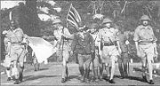
A deputation was selected to go to the Japanese Headquarters. It consisted of a senior Staff Officer, the Colonial Secretary and an interpreter. They set off in a motor car bearing a Union Jack and a white flag of truce towards the enemy lines to discuss a cessation of hostilities. They returned with orders that Percival himself proceed with Staff Officers to the Ford Motor FactoryOld Ford Motor Factory

The Old Ford Motor Factory is a historic building in Singapore, located along Upper Bukit Timah Road. ...
, where General Yamashita would lay down the terms of surrender. A further requirement was that the Japanese Rising Sun FlagRising Sun Flag

The is the military flag of Japan. It had been used as the ensign of the Imperial Japanese Navy and the war flag of the Imperial...
 be hoisted over the tallest building in Singapore, the Cathay BuildingCathay Building

The Cathay Building was opened in 1939 by Dato Loke Wan Tho as the headquarters for the British Malaya Broadcasting Corporat...
, as soon as possible to maximise the psychological impact of the official surrender. Percival formally surrendered shortly after 5.15pm.

The terms of the surrender included:
  • The unconditional surrender of all military forces (Army, Navy and Air Force) in Singapore Area.
  • Hostilities to cease at 8:30 p.m. that evening.
  • All troops to remain in position until further orders.
  • All weapons, military equipment, ships, planes and secret documents to be handed over intact.
  • To prevent looting, etc., during the temporary withdrawal of all armed forces in Singapore, a force of 1000 British armed men to take over until relieved by the Japanese.


Earlier that day Percival had issued orders to destroy before 4 p.m. all secret and technical equipment, ciphers, codes, secret documents and heavy guns. Yamashita accepted his assurance that no ships or planes remained in Singapore. According to Tokyo's Domei News AgencyDomei Tsushin

Domei Tsushin was Japan's official news agency and most important news source in the 1930s and until 1945....
 Yamashita also accepted full responsibility for the lives of British and Australian troops, as well as British civilians remaining in Singapore.

Bennett, along with some of his staff officers, caused controversy when he handed command of the 8th Division to a brigadier and commandeered a small boat. They eventually made their way back to Australia.

The Japanese Occupation of SingaporeJapanese Occupation of Singapore

The Japanese Occupation of Singapore refers to the point in time in the history of Singapore between 1942 and 1945 when Japa...
 had begun. The city was renamed Syonan-to. The Japanese sought vengeance against the ChineseHan Chinese

The Han is an ethnic group originating from China....
 and to eliminate anyone who held anti-Japanese sentimentAnti-Japanese sentiment

Anti-Japanese sentiment refers to the view of the Japanese people or of the Japanese nation with suspicion, resentment, or h...
. The Imperial authorities were suspicious of the Chinese because of the Second Sino-Japanese War, and killed many in the Sook Ching MassacreSook Ching massacre

The Sook Ching massacre was a systematic extermination of perceived hostile elements among the Chinese in Singapore by the J...
. The other races of Singapore, such as the MalaysMalay people Overview

This article is about Malay as a definition that includes the predominant people of Indonesia, Malaysia and the Philippines....
 and the Indians were not spared. The residents would suffer great hardships under Japanese rule over the following three and a half years.

Many of the British and Australian soldiers taken prisoner remained in Singapore's Changi PrisonChangi Prison

Changi Prison is a prison located in Changi in the eastern part of Singapore....
. Many would never return home. Thousands of others were shipped on prisoner transports known as "hell shipHell Ship

The term Hell Ship refers to any of the ships used by the Imperial Japanese Navy to transport prisoners of war out of the Ph...
s" to other parts of Asia, including Japan, to be used as forced labour on projects such as the Siam-Burma Death RailwayDeath Railway

The Death Railway was a railway built from Thailand to Burma by the Japanese during World War II to complete the route fro...
 and Sandakan airfield in North BorneoNorth Borneo

n>North BorneoNorth Borneo was an independent state and British protectorate under the sovereign British North Borneo ...
. Many of those aboard the ships perished.

The Japanese were highly successful in recruiting IndianBritish Raj

The British Raj refers to the British rule of the Indian subcontinent, or present-day India, Bangladesh, Pakistan, and Myanm...
 soldiers taken prisoner. From a total of about 40,000 Indian personnel in Singapore in February 1942, about 30,000 joined the pro-Japanese "Indian National ArmyIndian National Army

The Indian National Army or Azad Hind Fauj was the army of the Arzi Hukumat-e-Azad Hind which fought along with ...
", which fought Allied forces in the Burma CampaignBurma Campaign

The Burma Campaign was a campaign in the South-East Asian Theatre of World War II....
. Others became POW camp guards at Changi. However, many Indian Army personnel resisted recruitment and remained POWs. An unknown number were taken to Japanese-occupied areas in the South Pacific as forced labour. Many of them suffered severe hardships and brutality similar to that experienced by other prisoners of Japan during World War II. About 6,000 of them survived until they were liberated by Australian and U.S. forces, in 1943–45.

After the Japanese surrenderJapanese Instrument of Surrender

The Instrument of Surrender of Japan was the armistice ending World War II....
 in 1945 Yamashita was tried by a US military commission for war crimes committed by Japanese personnel in the PhilippinesPhilippines

The Philippines , officially the Republic of the Philippines , is an island nation located in the Malay archipelago in...
 earlier that year, but not for crimes committed by his troops in Malaya or Singapore. He was convicted and hanged in the Philippines on February 23, 1946.

See also

  • Battle of MalayaBattle of Malaya

    The Battle of Malaya was a conflict between a Commonwealth army, comprised of British, Indian, Australian and Malays from th...
  • Greater East Asia War in the PacificGreater East Asia War in the Pacific

    The Greater East Asia War was a term used, at least publicly in December of 1941, by Japan's Imperial General Headquarters t...
  • Pacific WarPacific War

    The Pacific War was the part of World War II — and preceding conflicts — that occurred in the Pacific Ocean, its...
  • British Malaya Command - Order of Battle
  • British Far East CommandBritish Far East Command

    The Far East Command was a British military command which had 2 distinct periods....


External links

  • National Heritage Board,
  • Royal Engineers and the Second World War - the Far East
  • . Fred Pye was a POW for 3½ years, including time spent building the Burma Railway. He managed to save, write on and bury scraps of paper, and after the war compiled them into a readable form.