

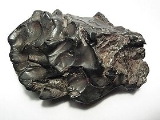
Sikhote-Alin Meteorite

Encyclopedia
Sikhote-Alin is an iron meteorite
that fell in 1947 on the Sikhote-Alin Mountains in eastern Siberia. This fall is unique in the history of meteorites. Though large iron meteorite falls had been witnessed previously and fragments recovered, never before in recorded history had a fall of this magnitude been observed. An estimated 70 tonnes of material survived the fiery passage through the atmosphere and reached the Earth.
 At around 10:30 on February 12, 1947, eyewitnesses in the Sikhote-Alin Mountains, Primorye
, Soviet Union, observed a large bolide brighter than the Sun
that came out of the north and descended at an angle of about 41 degrees. The bright flash and the deafening sound of the fall were observed for 300 kilometres (186.4 mi) around the point of impact not far from Luchegorsk
and approximately 440 km (273.4 mi) northeast of Vladivostok
. A smoke trail, estimated at 32 km (19.9 mi) long, remained in the sky for several hours.
As the meteorite, traveling at a speed of about 14 km/s, entered the atmosphere, it began to break apart, and the fragments fell together. At an altitude of about 5.6 km (3.5 mi), the largest mass apparently broke up in a violent explosion.
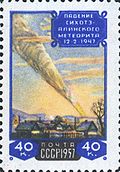
On November 20, 1957 the Soviet Union
issued a stamp for the 10th anniversary of the Sikhote-Alin meteorite shower. It reproduces a painting by P. J. Medvedev, a Soviet artist who witnessed the fall: he was sitting in his window starting a sketch when the fireball appeared, so he immediately began drawing what he saw.
fell during daytime, it was observed by many eyewitnesses. Evaluation of this observational data allowed V. G. Fesenkov, then chairman of the meteorite committee of the USSR Academy of Science
, to estimate the meteoroid's
orbit
before it encountered the Earth. This orbit was ellipse
-shaped, with its point of greatest distance from the sun
situated within the asteroid belt
, similar to many other small bodies crossing the orbit of the Earth. Such an orbit was probably created by collisions within the asteroid belt.
estimated at approximately 90000 kg (198,416 lb).
Krinov had estimated the post atmospheric mass of the meteoroid at some 70000 kg (154,323.6 lb). A more recent estimate by Tsvetkov (and others) puts the mass at around 100000 kg (220,462.3 lb)
for this meteorite covered an elliptical area of about 1.3 km² (0.501932806170296 sq mi). Some of the fragments made craters, the largest of which was about 26 m (85.3 ft) across and 6 m (19.7 ft) deep. Fragments of the meteorite were also driven into the surrounding trees.
belonging to the chemical group IIAB and with a coarse octahedrite
structure. It is composed of approximately 93% iron
, 5.9% nickel
, 0.42% cobalt
, 0.46% phosphorus
, and 0.28% sulfur
, with trace amounts of germanium
and iridium
. Minerals present include taenite
, plessite
, troilite
, chromite
, kamacite
, and schreibersite
.
The first type probably broke off the main object early in the descent. These pieces are characterized by regmaglypts (cavities resembling thumb prints) in the surface of each specimen. The second type are fragments which were either torn apart during the atmospheric explosions or blasted apart upon impact on the frozen ground. Most were probably the result of the explosion at 5.6 km (3.5 mi) altitude.
A large specimen is on display in Moscow
. Many other specimens are held by Russian Academy of Science and a great number of smaller specimens have made their way into the collector's market.
Iron meteorite
Iron meteorites are meteorites that consist overwhelmingly of nickel-iron alloys. The metal taken from these meteorites is known as meteoric iron and was one of the earliest sources of usable iron available to humans.-Occurrence:...
that fell in 1947 on the Sikhote-Alin Mountains in eastern Siberia. This fall is unique in the history of meteorites. Though large iron meteorite falls had been witnessed previously and fragments recovered, never before in recorded history had a fall of this magnitude been observed. An estimated 70 tonnes of material survived the fiery passage through the atmosphere and reached the Earth.
History
Primorsky Krai
Primorsky Krai , informally known as Primorye , is a federal subject of Russia . Primorsky means "maritime" in Russian, hence the region is sometimes referred to as Maritime Province or Maritime Territory. Its administrative center is in the city of Vladivostok...
, Soviet Union, observed a large bolide brighter than the Sun
Sun
The Sun is the star at the center of the Solar System. It is almost perfectly spherical and consists of hot plasma interwoven with magnetic fields...
that came out of the north and descended at an angle of about 41 degrees. The bright flash and the deafening sound of the fall were observed for 300 kilometres (186.4 mi) around the point of impact not far from Luchegorsk
Luchegorsk
Luchegorsk is an urban locality and the administrative center of Pozharsky District of Primorsky Krai, Russia. Population: It was founded in 1966 on a bank of Kontrovod River....
and approximately 440 km (273.4 mi) northeast of Vladivostok
Vladivostok
The city is located in the southern extremity of Muravyov-Amursky Peninsula, which is about 30 km long and approximately 12 km wide.The highest point is Mount Kholodilnik, the height of which is 257 m...
. A smoke trail, estimated at 32 km (19.9 mi) long, remained in the sky for several hours.
As the meteorite, traveling at a speed of about 14 km/s, entered the atmosphere, it began to break apart, and the fragments fell together. At an altitude of about 5.6 km (3.5 mi), the largest mass apparently broke up in a violent explosion.
On November 20, 1957 the Soviet Union
Soviet Union
The Soviet Union , officially the Union of Soviet Socialist Republics , was a constitutionally socialist state that existed in Eurasia between 1922 and 1991....
issued a stamp for the 10th anniversary of the Sikhote-Alin meteorite shower. It reproduces a painting by P. J. Medvedev, a Soviet artist who witnessed the fall: he was sitting in his window starting a sketch when the fireball appeared, so he immediately began drawing what he saw.
Orbit
Because the meteoriteMeteorite
A meteorite is a natural object originating in outer space that survives impact with the Earth's surface. Meteorites can be big or small. Most meteorites derive from small astronomical objects called meteoroids, but they are also sometimes produced by impacts of asteroids...
fell during daytime, it was observed by many eyewitnesses. Evaluation of this observational data allowed V. G. Fesenkov, then chairman of the meteorite committee of the USSR Academy of Science
Russian Academy of Sciences
The Russian Academy of Sciences consists of the national academy of Russia and a network of scientific research institutes from across the Russian Federation as well as auxiliary scientific and social units like libraries, publishers and hospitals....
, to estimate the meteoroid's
Meteoroid
A meteoroid is a sand- to boulder-sized particle of debris in the Solar System. The visible path of a meteoroid that enters Earth's atmosphere is called a meteor, or colloquially a shooting star or falling star. If a meteoroid reaches the ground and survives impact, then it is called a meteorite...
orbit
Orbit
In physics, an orbit is the gravitationally curved path of an object around a point in space, for example the orbit of a planet around the center of a star system, such as the Solar System...
before it encountered the Earth. This orbit was ellipse
Ellipse
In geometry, an ellipse is a plane curve that results from the intersection of a cone by a plane in a way that produces a closed curve. Circles are special cases of ellipses, obtained when the cutting plane is orthogonal to the cone's axis...
-shaped, with its point of greatest distance from the sun
Sun
The Sun is the star at the center of the Solar System. It is almost perfectly spherical and consists of hot plasma interwoven with magnetic fields...
situated within the asteroid belt
Asteroid belt
The asteroid belt is the region of the Solar System located roughly between the orbits of the planets Mars and Jupiter. It is occupied by numerous irregularly shaped bodies called asteroids or minor planets...
, similar to many other small bodies crossing the orbit of the Earth. Such an orbit was probably created by collisions within the asteroid belt.
Size
Sikhote-Alin is a massive fall with the overall size of the meteoroidMeteoroid
A meteoroid is a sand- to boulder-sized particle of debris in the Solar System. The visible path of a meteoroid that enters Earth's atmosphere is called a meteor, or colloquially a shooting star or falling star. If a meteoroid reaches the ground and survives impact, then it is called a meteorite...
estimated at approximately 90000 kg (198,416 lb).
Krinov had estimated the post atmospheric mass of the meteoroid at some 70000 kg (154,323.6 lb). A more recent estimate by Tsvetkov (and others) puts the mass at around 100000 kg (220,462.3 lb)
Strewn field
The strewn fieldStrewn field
The term strewnfield indicates the area where meteorites from a single fall are dispersed.It is also often used with tektites produced by large meteorite impact.-Formation:There are two strewnfield formation mechanisms:...
for this meteorite covered an elliptical area of about 1.3 km² (0.501932806170296 sq mi). Some of the fragments made craters, the largest of which was about 26 m (85.3 ft) across and 6 m (19.7 ft) deep. Fragments of the meteorite were also driven into the surrounding trees.
Composition and classification
The Sikhote-Alin meteorite is classified as an iron meteoriteIron meteorite
Iron meteorites are meteorites that consist overwhelmingly of nickel-iron alloys. The metal taken from these meteorites is known as meteoric iron and was one of the earliest sources of usable iron available to humans.-Occurrence:...
belonging to the chemical group IIAB and with a coarse octahedrite
Octahedrite
Octahedrites are a class of iron meteorites within the structural classification. They are the most common class of iron meteorites.They are composed primarily of the nickel-iron alloys: taenite - high nickel content, and kamacite - low nickel content....
structure. It is composed of approximately 93% iron
Iron
Iron is a chemical element with the symbol Fe and atomic number 26. It is a metal in the first transition series. It is the most common element forming the planet Earth as a whole, forming much of Earth's outer and inner core. It is the fourth most common element in the Earth's crust...
, 5.9% nickel
Nickel
Nickel is a chemical element with the chemical symbol Ni and atomic number 28. It is a silvery-white lustrous metal with a slight golden tinge. Nickel belongs to the transition metals and is hard and ductile...
, 0.42% cobalt
Cobalt
Cobalt is a chemical element with symbol Co and atomic number 27. It is found naturally only in chemically combined form. The free element, produced by reductive smelting, is a hard, lustrous, silver-gray metal....
, 0.46% phosphorus
Phosphorus
Phosphorus is the chemical element that has the symbol P and atomic number 15. A multivalent nonmetal of the nitrogen group, phosphorus as a mineral is almost always present in its maximally oxidized state, as inorganic phosphate rocks...
, and 0.28% sulfur
Sulfur
Sulfur or sulphur is the chemical element with atomic number 16. In the periodic table it is represented by the symbol S. It is an abundant, multivalent non-metal. Under normal conditions, sulfur atoms form cyclic octatomic molecules with chemical formula S8. Elemental sulfur is a bright yellow...
, with trace amounts of germanium
Germanium
Germanium is a chemical element with the symbol Ge and atomic number 32. It is a lustrous, hard, grayish-white metalloid in the carbon group, chemically similar to its group neighbors tin and silicon. The isolated element is a semiconductor, with an appearance most similar to elemental silicon....
and iridium
Iridium
Iridium is the chemical element with atomic number 77, and is represented by the symbol Ir. A very hard, brittle, silvery-white transition metal of the platinum family, iridium is the second-densest element and is the most corrosion-resistant metal, even at temperatures as high as 2000 °C...
. Minerals present include taenite
Taenite
Taenite is a mineral found naturally on Earth mostly in iron meteorites. It is an alloy of iron and nickel, with nickel proportions of 20% up to 65%.The name is derived from the Greek for "band". Taenite is a major constituent of iron meteorites...
, plessite
Plessite
Plessite is a meteorite texture consisting of a fine-grained mixture of the minerals kamacite and taenite found in the octahedrite iron meteorites. It occurs in gaps between the larger bands of kamacite and taenite which form Widmanstätten patterns....
, troilite
Troilite
Troilite is a rare iron sulfide mineral with the simple formula of FeS. It is the iron rich endmember of the pyrrhotite group. Pyrrhotite has the formula FeS which is iron deficient...
, chromite
Chromite
Chromite is an iron chromium oxide: FeCr2O4. It is an oxide mineral belonging to the spinel group. Magnesium can substitute for iron in variable amounts as it forms a solid solution with magnesiochromite ; substitution of aluminium occurs leading to hercynite .-Occurrence:Chromite is found in...
, kamacite
Kamacite
Kamacite is a mineral. It is an alloy of iron and nickel, usually in the proportions of 90:10 to 95:5 although impurities such as cobalt or carbon may be present. On the surface of Earth, it occurs naturally only in meteorites. It has a metallic luster, is gray and has no clear cleavage although...
, and schreibersite
Schreibersite
Schreibersite is generally a rare iron nickel phosphide mineral, 3P, though common in iron-nickel meteorites. It is rarely reported from Earth . Another name used for the mineral is rhabdite. It forms tetragonal crystals with perfect 001 cleavage. Its color ranges from bronze to brass yellow to...
.
Specimens
Specimens of the Sikhote-Alin Meteorite are basically of two types:- individual, thumbprinted or regmaglypted specimens, showing fusion crust and signs of atmospheric ablationAblationAblation is removal of material from the surface of an object by vaporization, chipping, or other erosive processes. This occurs in spaceflight during ascent and atmospheric reentry, glaciology, medicine, and passive fire protection.-Spaceflight:...
- shrapnel or fragmented specimens, sharp edged pieces of torn metal showing evidence of violent fragmentation
The first type probably broke off the main object early in the descent. These pieces are characterized by regmaglypts (cavities resembling thumb prints) in the surface of each specimen. The second type are fragments which were either torn apart during the atmospheric explosions or blasted apart upon impact on the frozen ground. Most were probably the result of the explosion at 5.6 km (3.5 mi) altitude.
A large specimen is on display in Moscow
Moscow
Moscow is the capital, the most populous city, and the most populous federal subject of Russia. The city is a major political, economic, cultural, scientific, religious, financial, educational, and transportation centre of Russia and the continent...
. Many other specimens are held by Russian Academy of Science and a great number of smaller specimens have made their way into the collector's market.