John Morrissey

Encyclopedia
John Morrissey also known as Old Smoke, was an Irish bare-knuckle boxer
and a gang
member in New York
in the 1850s and later became a Democratic
State Senator
and U.S. Congressman from New York
, backed by Tammany Hall
. Morrissey began his bare knuckle boxing career after a confrontation with a man known only as "Chroel" who was notorious for troubling his fellow townsmen. Although Morrissey was on the bitter end of his first bare knuckle bout, his display of bravery and fortitude earned himself the respect and historical acknowledgment of his peers.
, County Tipperary
, Ireland
in 1831. In 1833 his parents emigrated to the United States
and settled in Troy, New York
.
Desperate to escape poverty, he worked as a cargo thief and also as a collection agent for Irish crime boss
es in the area, and before he was 18, he had been indicted twice for burglary
, once for assault
and battery
, and once for assault
with intent to kill. Along with his criminal
and ferocious fighting abilities, Morrissey also displayed driving ambition, teaching himself to read and write while working as a bouncer at a South Troy brothel
. After spending two months in jail, Morrissey left Troy for New York City
.
During a fight with a gang member named Tom McCann, Morrissey was pinned on his back atop burning coals from a stove that had been overturned. Morrissey endured the pain as his flesh burned, fought off McCann, and got back on his feet. Enraged, Morrissey beat McCann senseless as smoke from his burning flesh rose up from his back. The event earned him the nickname "Old Smoke," which stuck with him through the rest of his life.
After two years in New York, Morrissey sailed to San Francisco, seeking fortune during the California Gold Rush
. While he didn't have any luck in that endeavor, Morrissey became a renowned gambler
and made a fortune winning gold from prospectors. It was also during this time that Morrissey appeared for the first time in a professional prizefighting
ring. He knocked out George Thompson in the 11th round, earning $5.000. This success encouraged him to return to New York to fight the American Champion, Yankee Sullivan
.
Due to the violent nature of the sport, boxing was illegal in most places during the 1850s. The first boxing rules, called the London Prize Ring rules, were introduced by heavyweight champion Jack Broughton
in 1743 to protect fighters in the ring where deaths sometimes occurred. Under these rules, if a man went down and could not continue after a count of 30 seconds, the fight was over. Hitting a downed fighter and grasping below the waist were prohibited. Fights usually lasted for 20-30 rounds. Rounds continued until one fighter touched the ground with his knee, or simply fell down.
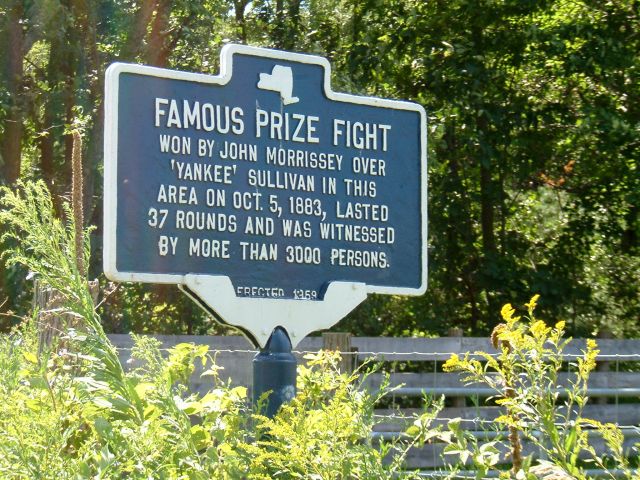
The fight between Morrissey and Sullivan was scheduled for October 12, 1853, in the hamlet of Boston Corner, which was then in Massachusetts, but out of reach of its authorities, and thus a good location for the illegal match. The fight took place in a field, and was supposedly viewed by over 3,000 spectators. Sullivan dominated the match for most of the fight, but Morrissey held his own, and the tough Irishman would not quit, though his face became distorted and unrecognizable. In the 37th round, more than an hour after the start of the fight, Sullivan lost after he knocked out Morrissey and there was a dispute over the rules Sullivan left thinking he won and got disqualified
and a rivalry with William Poole
, also known as "Bill the Butcher". Poole was an enforcer for the Know-Nothing Party, leader of the Bowery Boys
, and a boxer. In 1854, Morrissey was hired to prevent Poole and his gang from seizing ballot boxes and rigging an election. As a reward for having stopped the ballot rigging, Morrissey and his gang, the Dead Rabbits
, were permitted by Tammany Hall
to open a gambling house without police interference. One of Morrissey's friends, Lew Baker, shot and fatally wounded Bill the Butcher at a saloon on Broadway in 1855, following Morrisey's loss to Poole in a boxing match a few weeks earlier. Morrissey and Baker were indicted for the murder, but the charges were dropped after three trials resulting in hung juries. Morrissey then retired from boxing at the insistence of his wife, and returned to Troy, New York
. Morrissey's business ventures were unsuccessful, and he returned to boxing in 1858 to defend his championship in Long Point, Ontario, against fellow Troy, New York
native John C. Heenan
. The fight lasted 11 rounds, with Morrissey knocking out Heenan, for several minutes, to defend his title. Heenan claimed the title on Morrissey's retirement from boxing in 1859.
in Saratoga Springs, New York
, Morrissey created the Saratoga Race Course
with the help of William R. Travers
, John R. Hunter, and Leonard Jerome
. He also established "The Club House," a casino in Saratoga that attracted such notable guests as Chester A. Arthur
, Rutherford B. Hayes
, and Ulysses S. Grant
, as well as Commodore Cornelius Vanderbilt
, John Rockefeller, and Mark Twain
.
. As a Congressman, he always looked out for the interests of the Irish, and was known to use strong-arm tactics to accomplish his legislative goals, at one point declaring that he could "lick any man in the House." He eventually grew tired of the rampant corruption within Tammany Hall and left the House after his second term. He eventually testified against William Tweed, which helped put the notorious boss in prison. Following his service in Congress, Morrissey was elected to the New York State Senate in 1875 and was re-elected in 1877, serving in that capacity until his death in 1878.
Morrissey contracted pneumonia and died on May 1, 1878 at the age of 47. The state closed all offices and flags were flown at half-mast. The entire State Senate attended his funeral in Troy, and 20,000 mourners lined the streets to pay their last respects. He was buried in St. Peter's Cemetery, just outside of Troy. At the time of his death, Morrissey's estate was valued at more than $2 million.
Bare-knuckle boxing
Bare-knuckle boxing is the original form of boxing, closely related to ancient combat sports...
and a gang
Gang
A gang is a group of people who, through the organization, formation, and establishment of an assemblage, share a common identity. In current usage it typically denotes a criminal organization or else a criminal affiliation. In early usage, the word gang referred to a group of workmen...
member in New York
New York
New York is a state in the Northeastern region of the United States. It is the nation's third most populous state. New York is bordered by New Jersey and Pennsylvania to the south, and by Connecticut, Massachusetts and Vermont to the east...
in the 1850s and later became a Democratic
Democratic Party (United States)
The Democratic Party is one of two major contemporary political parties in the United States, along with the Republican Party. The party's socially liberal and progressive platform is largely considered center-left in the U.S. political spectrum. The party has the lengthiest record of continuous...
State Senator
New York State Senate
The New York State Senate is one of two houses in the New York State Legislature and has members each elected to two-year terms. There are no limits on the number of terms one may serve...
and U.S. Congressman from New York
New York
New York is a state in the Northeastern region of the United States. It is the nation's third most populous state. New York is bordered by New Jersey and Pennsylvania to the south, and by Connecticut, Massachusetts and Vermont to the east...
, backed by Tammany Hall
Tammany Hall
Tammany Hall, also known as the Society of St. Tammany, the Sons of St. Tammany, or the Columbian Order, was a New York political organization founded in 1786 and incorporated on May 12, 1789 as the Tammany Society...
. Morrissey began his bare knuckle boxing career after a confrontation with a man known only as "Chroel" who was notorious for troubling his fellow townsmen. Although Morrissey was on the bitter end of his first bare knuckle bout, his display of bravery and fortitude earned himself the respect and historical acknowledgment of his peers.
Early life
John was born in TemplemoreTemplemore
Templemore is a town in North Tipperary, Ireland. It is a civil parish in the historical barony of Eliogarty. It is part of the Roman Catholic parish of Templemore, Clonmore and Killea....
, County Tipperary
County Tipperary
County Tipperary is a county of Ireland. It is located in the province of Munster and is named after the town of Tipperary. The area of the county does not have a single local authority; local government is split between two authorities. In North Tipperary, part of the Mid-West Region, local...
, Ireland
Republic of Ireland
Ireland , described as the Republic of Ireland , is a sovereign state in Europe occupying approximately five-sixths of the island of the same name. Its capital is Dublin. Ireland, which had a population of 4.58 million in 2011, is a constitutional republic governed as a parliamentary democracy,...
in 1831. In 1833 his parents emigrated to the United States
United States
The United States of America is a federal constitutional republic comprising fifty states and a federal district...
and settled in Troy, New York
Troy, New York
Troy is a city in the US State of New York and the seat of Rensselaer County. Troy is located on the western edge of Rensselaer County and on the eastern bank of the Hudson River. Troy has close ties to the nearby cities of Albany and Schenectady, forming a region popularly called the Capital...
.
Desperate to escape poverty, he worked as a cargo thief and also as a collection agent for Irish crime boss
Crime boss
A crime boss or boss is a person in charge of a criminal organization. A boss typically has absolute or near-absolute control over his subordinates, is greatly feared by his subordinates for his ruthlessness and willingness to take lives in order to exert his influence, and profits come from the...
es in the area, and before he was 18, he had been indicted twice for burglary
Burglary
Burglary is a crime, the essence of which is illicit entry into a building for the purposes of committing an offense. Usually that offense will be theft, but most jurisdictions specify others which fall within the ambit of burglary...
, once for assault
Assault
In law, assault is a crime causing a victim to fear violence. The term is often confused with battery, which involves physical contact. The specific meaning of assault varies between countries, but can refer to an act that causes another to apprehend immediate and personal violence, or in the more...
and battery
Battery (crime)
Battery is a criminal offense involving unlawful physical contact, distinct from assault which is the fear of such contact.In the United States, criminal battery, or simply battery, is the use of force against another, resulting in harmful or offensive contact...
, and once for assault
Assault
In law, assault is a crime causing a victim to fear violence. The term is often confused with battery, which involves physical contact. The specific meaning of assault varies between countries, but can refer to an act that causes another to apprehend immediate and personal violence, or in the more...
with intent to kill. Along with his criminal
Crime
Crime is the breach of rules or laws for which some governing authority can ultimately prescribe a conviction...
and ferocious fighting abilities, Morrissey also displayed driving ambition, teaching himself to read and write while working as a bouncer at a South Troy brothel
Brothel
Brothels are business establishments where patrons can engage in sexual activities with prostitutes. Brothels are known under a variety of names, including bordello, cathouse, knocking shop, whorehouse, strumpet house, sporting house, house of ill repute, house of prostitution, and bawdy house...
. After spending two months in jail, Morrissey left Troy for New York City
New York City
New York is the most populous city in the United States and the center of the New York Metropolitan Area, one of the most populous metropolitan areas in the world. New York exerts a significant impact upon global commerce, finance, media, art, fashion, research, technology, education, and...
.
During a fight with a gang member named Tom McCann, Morrissey was pinned on his back atop burning coals from a stove that had been overturned. Morrissey endured the pain as his flesh burned, fought off McCann, and got back on his feet. Enraged, Morrissey beat McCann senseless as smoke from his burning flesh rose up from his back. The event earned him the nickname "Old Smoke," which stuck with him through the rest of his life.
After two years in New York, Morrissey sailed to San Francisco, seeking fortune during the California Gold Rush
California Gold Rush
The California Gold Rush began on January 24, 1848, when gold was found by James W. Marshall at Sutter's Mill in Coloma, California. The first to hear confirmed information of the gold rush were the people in Oregon, the Sandwich Islands , and Latin America, who were the first to start flocking to...
. While he didn't have any luck in that endeavor, Morrissey became a renowned gambler
Gambling
Gambling is the wagering of money or something of material value on an event with an uncertain outcome with the primary intent of winning additional money and/or material goods...
and made a fortune winning gold from prospectors. It was also during this time that Morrissey appeared for the first time in a professional prizefighting
Boxing
Boxing, also called pugilism, is a combat sport in which two people fight each other using their fists. Boxing is supervised by a referee over a series of between one to three minute intervals called rounds...
ring. He knocked out George Thompson in the 11th round, earning $5.000. This success encouraged him to return to New York to fight the American Champion, Yankee Sullivan
Yankee Sullivan
Yankee Sullivan also known as Frank Murray and James Sullivan was a bare knuckle fighter and boxer. He was a Champion of Prizefighting from 1851 to October 12, 1853...
.
The Champion
Morrissey returned to New York and challenged Sullivan repeatedly until the latter finally agreed.Due to the violent nature of the sport, boxing was illegal in most places during the 1850s. The first boxing rules, called the London Prize Ring rules, were introduced by heavyweight champion Jack Broughton
Jack Broughton
John "Jack" Broughton was an English bare-knuckle fighter. He was the first person to ever codify a set of rules to be used in such contests; prior to this the "rules" that existed were very loosely defined and tended to vary from contest to contest...
in 1743 to protect fighters in the ring where deaths sometimes occurred. Under these rules, if a man went down and could not continue after a count of 30 seconds, the fight was over. Hitting a downed fighter and grasping below the waist were prohibited. Fights usually lasted for 20-30 rounds. Rounds continued until one fighter touched the ground with his knee, or simply fell down.
The fight between Morrissey and Sullivan was scheduled for October 12, 1853, in the hamlet of Boston Corner, which was then in Massachusetts, but out of reach of its authorities, and thus a good location for the illegal match. The fight took place in a field, and was supposedly viewed by over 3,000 spectators. Sullivan dominated the match for most of the fight, but Morrissey held his own, and the tough Irishman would not quit, though his face became distorted and unrecognizable. In the 37th round, more than an hour after the start of the fight, Sullivan lost after he knocked out Morrissey and there was a dispute over the rules Sullivan left thinking he won and got disqualified
Dead Rabbits
Morrissey became involved in Democratic politics in New York CityNew York City
New York is the most populous city in the United States and the center of the New York Metropolitan Area, one of the most populous metropolitan areas in the world. New York exerts a significant impact upon global commerce, finance, media, art, fashion, research, technology, education, and...
and a rivalry with William Poole
William Poole
William Poole , also known as Bill the Butcher, was a member of the New York City gang the Bowery Boys, a bare-knuckle boxer, and a leader of the Know Nothing political movement.-Early life:...
, also known as "Bill the Butcher". Poole was an enforcer for the Know-Nothing Party, leader of the Bowery Boys
Bowery Boys
The Bowery Boys were a nativist, anti-Catholic, and anti-Irish gang based north of the Five Points district of New York City in the mid-19th century. They were primarily stationed in the Bowery section of New York, which was, at the time, extended north of the Five Points...
, and a boxer. In 1854, Morrissey was hired to prevent Poole and his gang from seizing ballot boxes and rigging an election. As a reward for having stopped the ballot rigging, Morrissey and his gang, the Dead Rabbits
Dead Rabbits
The Dead Rabbits were a gang in New York City in the 1850s, and originally were a part of the Roach Guards. Daniel Cassidy claimed that the name has a second meaning rooted in Irish American vernacular of NYC in 1857 and that the word "Rabbit" is the phonetic corruption of the Irish word ráibéad,...
, were permitted by Tammany Hall
Tammany Hall
Tammany Hall, also known as the Society of St. Tammany, the Sons of St. Tammany, or the Columbian Order, was a New York political organization founded in 1786 and incorporated on May 12, 1789 as the Tammany Society...
to open a gambling house without police interference. One of Morrissey's friends, Lew Baker, shot and fatally wounded Bill the Butcher at a saloon on Broadway in 1855, following Morrisey's loss to Poole in a boxing match a few weeks earlier. Morrissey and Baker were indicted for the murder, but the charges were dropped after three trials resulting in hung juries. Morrissey then retired from boxing at the insistence of his wife, and returned to Troy, New York
Troy, New York
Troy is a city in the US State of New York and the seat of Rensselaer County. Troy is located on the western edge of Rensselaer County and on the eastern bank of the Hudson River. Troy has close ties to the nearby cities of Albany and Schenectady, forming a region popularly called the Capital...
. Morrissey's business ventures were unsuccessful, and he returned to boxing in 1858 to defend his championship in Long Point, Ontario, against fellow Troy, New York
Troy, New York
Troy is a city in the US State of New York and the seat of Rensselaer County. Troy is located on the western edge of Rensselaer County and on the eastern bank of the Hudson River. Troy has close ties to the nearby cities of Albany and Schenectady, forming a region popularly called the Capital...
native John C. Heenan
John C. Heenan
John Camel Heenan, aka the Benicia Boy was an American bare-knuckle prize fighter. Though highly regarded, he had only three formal fights in his entire career, losing two and drawing one....
. The fight lasted 11 rounds, with Morrissey knocking out Heenan, for several minutes, to defend his title. Heenan claimed the title on Morrissey's retirement from boxing in 1859.
Saratoga
After establishing a successful gaming houseCanfield Casino and Congress Park
Canfield Casino and Congress Park is a site in Saratoga Springs, New York, United States. It was the site of the former Congress Spring Bottling Plant and the former Congress Hall, a large resort hotel, which together brought Saratoga Springs international fame as a health spa and gambling site...
in Saratoga Springs, New York
Saratoga Springs, New York
Saratoga Springs, also known as simply Saratoga, is a city in Saratoga County, New York, United States. The population was 26,586 at the 2010 census. The name reflects the presence of mineral springs in the area. While the word "Saratoga" is known to be a corruption of a Native American name, ...
, Morrissey created the Saratoga Race Course
Saratoga Race Course
Saratoga Race Course is a Thoroughbred horse racing track in Saratoga Springs, New York, United States. It opened on August 3, 1863, and is the oldest organized sporting venue of any kind in the United States. It is typically open for racing from late July through early September.-History:John...
with the help of William R. Travers
William R. Travers
William Riggin Travers was an American lawyer who made a fortune on Wall Street. A well-known cosmopolite and high liver, Travers was a member of 27 private clubs, according to Cleveland Amory in his book Who Killed Society?-Biography:He was born in 1819.Along with John Hunter, in 1863 he founded...
, John R. Hunter, and Leonard Jerome
Leonard Jerome
Leonard Walter Jerome was a Brooklyn, New York, financier and grandfather of Winston Churchill.- Early life :...
. He also established "The Club House," a casino in Saratoga that attracted such notable guests as Chester A. Arthur
Chester A. Arthur
Chester Alan Arthur was the 21st President of the United States . Becoming President after the assassination of President James A. Garfield, Arthur struggled to overcome suspicions of his beginnings as a politician from the New York City Republican machine, succeeding at that task by embracing...
, Rutherford B. Hayes
Rutherford B. Hayes
Rutherford Birchard Hayes was the 19th President of the United States . As president, he oversaw the end of Reconstruction and the United States' entry into the Second Industrial Revolution...
, and Ulysses S. Grant
Ulysses S. Grant
Ulysses S. Grant was the 18th President of the United States as well as military commander during the Civil War and post-war Reconstruction periods. Under Grant's command, the Union Army defeated the Confederate military and ended the Confederate States of America...
, as well as Commodore Cornelius Vanderbilt
Cornelius Vanderbilt
Cornelius Vanderbilt , also known by the sobriquet Commodore, was an American entrepreneur who built his wealth in shipping and railroads. He was also the patriarch of the Vanderbilt family and one of the richest Americans in history...
, John Rockefeller, and Mark Twain
Mark Twain
Samuel Langhorne Clemens , better known by his pen name Mark Twain, was an American author and humorist...
.
Politician
After his retirement from boxing, Morrissey focused his attention on gambling establishments, owning stake in 16 casinos at one point. In 1866 he ran for Congress with the backing of Tammany Hall and served two terms (1867-1871) in the House for the 40th and 41st Congress, representing the 5th Congressional DistrictNew York's 5th congressional district
The 5th Congressional District of New York is a congressional district for the United States House of Representatives that lies along the North Shore of Long Island. It consists of northeastern Queens County and northwestern Nassau County. The Queens portion of the district includes the...
. As a Congressman, he always looked out for the interests of the Irish, and was known to use strong-arm tactics to accomplish his legislative goals, at one point declaring that he could "lick any man in the House." He eventually grew tired of the rampant corruption within Tammany Hall and left the House after his second term. He eventually testified against William Tweed, which helped put the notorious boss in prison. Following his service in Congress, Morrissey was elected to the New York State Senate in 1875 and was re-elected in 1877, serving in that capacity until his death in 1878.
Morrissey contracted pneumonia and died on May 1, 1878 at the age of 47. The state closed all offices and flags were flown at half-mast. The entire State Senate attended his funeral in Troy, and 20,000 mourners lined the streets to pay their last respects. He was buried in St. Peter's Cemetery, just outside of Troy. At the time of his death, Morrissey's estate was valued at more than $2 million.
Legacy
- In 1996 he was elected to the International Boxing Hall of FameInternational Boxing Hall of FameThe modern International Boxing Hall of Fame is located in Canastota, New York, United States, within driving distance from the Baseball Hall of Fame and Museum in Cooperstown and the National Soccer Hall of Fame in Oneonta...
. - Morrissey was featured on a portion of the History Channel documentary, "Paddy Whacked, The History of the Irish Mob."
- Prizefighter Johnny Morrissey is the hero in a popular Irish ballad called "Morrissey and the Russian Sailor". Though the ballad has several variations, most versions include some phrases that connect the song's hero with the historical John Morrissey: his Irish birthplace in Templemore, County Tipperary; his status as a champion fighter, signified by a prize belt; his defeat of Thompson/Thomson and of 'the Yankee,' among others. The main story in the ballad, however—a heroic prizefight against a Russian sailor in Tierra del Fuego—does not seem to be historically documented. One version of the song was printed as a broadsheet by E.C. Yeats's Cuala Press in 1911; a digitized image of it has been posted by Villanova University Library. http://digital.library.villanova.edu/Cuala%20Press%20Broadside%20Collection/Broadside-00034.xml There are a number of other ballads written about Morrissey including "Morrissey and the Black", "Morrissey Again in the Field" and "The Fight at Boston Corners". Three of them are documented the book, "Songs of England, Ireland and Scotland: A Bonnie Bunch of Roses" by Dan Milner (Oak Publications).
- He is an ancestor of Joseph D. MorrisseyJoseph D. MorrisseyJoseph D. Morrissey is an American politician and former lawyer. A Democrat, he served as Commonwealth's Attorney of Richmond, Virginia 1989–93 and was elected to the Virginia House of Delegates in November 2007...
, an American politician and former lawyer currently serving in the Virginia House of Delegates.
Timeline
- 1831 Birth in Ireland
- 1833 Emigrated to USA with parents
- 1833 Moved to Troy, New York
- 1848 Moved to Manhattan
- 1851 Moved to California
- 1858 Boxing champion
- 1863 Saratoga race course
- 1867 First Congressional term
- 1871 End of Congress terms
- 1875 State Senate first term
- 1877 State Senate second term
- 1878 Death
Periodicals
- Washington Post; May 2, 1910. "John Morrissey's Fight With 'Yankee' Sullivan. Prize Fighter, Adventurer, Politician—Began in a Paper Mill, and Made Millions—Elected to Congress in 1866—Never Beaten in a Fair Fight During Career. From the New York HeraldNew York HeraldThe New York Herald was a large distribution newspaper based in New York City that existed between May 6, 1835, and 1924.-History:The first issue of the paper was published by James Gordon Bennett, Sr., on May 6, 1835. By 1845 it was the most popular and profitable daily newspaper in the UnitedStates...
. As the first period in the history of the prize ring ends with 'Tom' Johnson and the second with 'Tom' Spring, so the third closes with the brief championship of 'Tom' King. From the sixties on the ring became less and less an exclusively British institution, the influence of America, and later Australasia, changing conditions and traditions."
External links
- History of Boxing: Poole vs Morrissey
- American Mafia: John Morrissey
- Historical marker for bout with incorrect date
- “The ‘Short-Hair’ and ‘Swallow-Tail’ Fight”, Thomas NastThomas NastThomas Nast was a German-born American caricaturist and editorial cartoonist who is considered to be the "Father of the American Cartoon". He was the scourge of Boss Tweed and the Tammany Hall machine...
cartoon, Harper's WeeklyHarper's WeeklyHarper's Weekly was an American political magazine based in New York City. Published by Harper & Brothers from 1857 until 1916, it featured foreign and domestic news, fiction, essays on many subjects, and humor...
, with discussion by Robert C. Kennedy, 2001. - Congressional Biography