

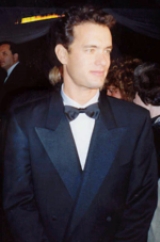
Tom Hanks

Encyclopedia
Thomas Jeffrey "Tom" Hanks (born July 9, 1956) is an American actor, producer, writer, and director. Hanks worked in television and family-friendly comedies, gaining wide notice in 1988's Big
, before achieving success as a dramatic actor in several notable roles, including Andrew Beckett in Philadelphia
, the title role in Forrest Gump
, Commander Jim Lovell
in Apollo 13
, Captain John H. Miller in Saving Private Ryan
, Joe Fox in You've Got Mail
, Chuck Noland in Cast Away
, and voicing the character Woody in the Toy Story series
. Hanks won consecutive Best Actor Academy Awards
, in 1993 for Philadelphia and in 1994 for Forrest Gump. U.S. domestic box office totals for his films exceed US$4.0 billion. He is the father of actor Colin Hanks
.
, California. His father, Amos Mefford Hanks (born in Glenn County, California
, on March 9, 1924 – died in Alameda, California
, on January 31, 1992), an itinerant cook, was a distant relative of President Abraham Lincoln
(through Lincoln's mother, Nancy Hanks). His mother, Janet Marylyn (née Frager; born in Alameda County, California
, on January 18, 1932), was a hospital worker. Hanks' mother is of Portuguese ancestry, while two of his paternal great-grandparents immigrated from Britain. Hanks's parents divorced in 1960. The family's three oldest children, Sandra (now Sandra Hanks Benoiton, a writer), Larry (now Lawrence M. Hanks, PhD, an entomology
professor at the University of Illinois at Urbana-Champaign
) and Tom, went with their father, while the youngest, Jim
, now an actor and film maker, remained with his mother in Red Bluff, California
. Afterwards, both parents remarried. Hanks's first stepmother came to the marriage with five children of her own. Hanks once told Rolling Stone
: "Everybody in my family likes each other. But there were always about 50 people at the house. I didn't exactly feel like an outsider, but I was sort of outside it." That marriage ended in divorce after two years.
In addition to having a family history of Catholicism and Mormonism
, Hanks was a "Bible-toting evangelical teenager" for several years. In school, Hanks was unpopular with students and teachers alike, later telling Rolling Stone magazine: "I was a geek, a spaz. I was horribly, painfully, terribly shy. At the same time, I was the guy who'd yell out funny captions during filmstrips. But I didn't get into trouble. I was always a real good kid and pretty responsible." In 1965, Amos Hanks married Frances Wong, a San Francisco native of Chinese
descent. Frances had three children, two of whom lived with Tom during his high school years. Hanks acted in school plays, including South Pacific
, while attending Skyline High School
in Oakland, California
.
Hanks studied theater at Chabot College
in Hayward, California
, and after two years, transferred to California State University, Sacramento
. Hanks told The New York Times
: "Acting classes looked like the best place for a guy who liked to make a lot of noise and be rather flamboyant. I spent a lot of time going to plays. I wouldn't take dates with me. I'd just drive to a theater, buy myself a ticket, sit in the seat, and read the program, and then get into the play completely. I spent a lot of time like that, seeing Bertolt Brecht
, Tennessee Williams
, Henrik Ibsen
, and all that, and now look at me, acting is my job. I wouldn't have it any other way."
During his years studying theater, Hanks met Vincent Dowling
, head of the Great Lakes Theater Festival
in Cleveland, Ohio. At Dowling's suggestion, Hanks became an intern at the Festival. His internship stretched into a three-year experience that covered most aspects of theater production, including lighting, set design, and stage management, all of which caused Hanks to drop out of college. During the same time, Hanks won the Cleveland Critics Circle Award for Best Actor for his 1978 performance as Proteus
in Shakespeare's The Two Gentlemen of Verona
, one of the few times he played a villain.
(1980) and got a part in the television movie Mazes and Monsters
. Early in 1979, Hanks was cast in the lead role of Callimaco in the Riverside Shakespeare Company
's production of Niccolò Machiavelli
's The Mandrake
, directed by Daniel Southern. This remains Hanks's only New York stage performance to date; as a high profile Off Off Broadway showcase
, the production helped Tom land an agent, Joe Ohla with the J. Michael Bloom Agency. The next year, Hanks landed a lead role on the ABC
television pilot of Bosom Buddies
, playing the role of Kip Wilson. Hanks moved to Los Angeles, where he and Peter Scolari
played a pair of young advertising men forced to dress as women so they could live in an inexpensive all-female hotel. Hanks had previously partnered with Scolari in the 1970s game show Make Me Laugh
. Bosom Buddies ran for two seasons, and, although the ratings were never strong, television critics gave the program high marks. "The first day I saw him on the set," co-producer Ian Praiser told Rolling Stone
, "I thought, 'Too bad he won't be in television for long.' I knew he'd be a movie star in two years." But if Praiser knew it, he was not able to convince Hanks. "The television show had come out of nowhere," best friend Tom Lizzio told Rolling Stone. "Then out of nowhere it got canceled. He figured he'd be back to pulling ropes and hanging lights in a theater."
Bosom Buddies and a guest appearance on a 1982 episode of Happy Days
("A Case of Revenge," where he played a disgruntled former classmate of The Fonz
) prompted director Ron Howard
to contact Hanks. Howard was working on Splash
(1984), a romantic comedy fantasy about a mermaid
who falls in love with a human. At first, Howard considered Hanks for the role of the main character's wisecracking brother, a role that eventually went to John Candy
. Instead, Hanks got the lead role and a career boost from Splash, which went on to become a box office hit, grossing more than US$69 million. He also had a sizable hit with the sex comedy Bachelor Party, also in 1984.
In 1983–84, Hanks made three guest appearances on Family Ties
as Elyse Keaton's alcoholic brother, Ned Donnelly.
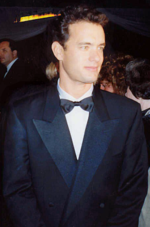 With Nothing in Common
(1986) – about a young man alienated from his parents who must re-establish a relationship with his father, played by Jackie Gleason
– Hanks began to establish the credentials of not only a comic actor but of someone who could carry a serious role. "It changed my desires about working in movies," Hanks told Rolling Stone. "Part of it was the nature of the material, what we were trying to say. But besides that, it focused on people's relationships. The story was about a guy and his father, unlike, say, The Money Pit
, where the story is really about a guy and his house."
After a few more flops and a moderate success with Dragnet
, Hanks succeeded with the film Big
(1988), both at the box office and within the industry. The film established Hanks as a major Hollywood talent. It was followed later that year by Punchline
, in which he and Sally Field
co-starred as struggling comedians. Hanks's character, Steven Gold, a failing medical student trying to break into stand-up, was somewhat edgy and complex. Hanks' portrayal of Gold offered a glimpse of the far more dramatic roles Hanks would master in films to come. Hanks then suffered a pile of box-office failures: The 'Burbs
(1989), Joe Versus the Volcano
(1990), and The Bonfire of the Vanities
(1990), as a greedy Wall Street
type who gets enmeshed in a hit-and-run accident. Only the 1989 movie Turner & Hooch
brought success for Hanks during this time. In a 1993 issue of Disney Adventures
, Hanks said, "I saw Turner & Hooch the other day in the SAC store and couldn't help but be reminiscent. I cried like a baby." He did admit to making a couple of "bum tickers," however, and blamed his "...deductive reasoning and decision making skills."
(1992). Hanks has admitted that his acting in earlier roles was not great and that he has improved. In an interview with Vanity Fair
, Hanks noted his "modern era of moviemaking ... because enough self-discovery has gone on.... My work has become less pretentiously fake and over the top". This "modern era" began in 1993 for Hanks, first with Sleepless in Seattle
and then with Philadelphia
. The former was a blockbuster success about a widower who finds true love over the airwaves. Richard Schickel of TIME called his performance "charming," and most critics agreed that Hanks' portrayal ensured him a place among the premier romantic-comedy stars of his generation.
In Philadelphia, he played a gay
lawyer with AIDS who sues his firm for discrimination. Hanks lost thirty-five pounds and thinned his hair in order to appear sickly for the role. In a review for People
, Leah Rozen stated "Above all, credit for Philadelphias success belongs to Hanks, who makes sure that he plays a character, not a saint. He is flat-out terrific, giving a deeply felt, carefully nuanced performance that deserves an Oscar." Hanks won the 1993 Academy Award for Best Actor for his role in Philadelphia. During his acceptance speech he revealed that his high school drama teacher Rawley Farnsworth and former classmate John Gilkerson, two people with whom he was close, were gay.
Hanks followed Philadelphia with the 1994 summer hit Forrest Gump. Of the film, Hanks has remarked: "When I read the script for Gump, I saw it as one of those kind of grand, hopeful movies that the audience can go to and feel ... some hope for their lot and their position in life... I got that from the movies a hundred million times when I was a kid. I still do." Hanks won his second Best Actor Academy Award for his role in Forrest Gump, becoming only the second actor to have accomplished the feat of winning consecutive Best Actor Oscars. (Spencer Tracy
was the first, winning in 1937–38. Hanks and Tracy were the same age at the time they received their Academy Awards: 37 for the first and 38 for the second.)
Hanks' next role—astronaut and commander Jim Lovell
, in the 1995 movie Apollo 13
--reunited him with Ron Howard
. Critics generally applauded the film and the performances of the entire cast, which included actors Kevin Bacon
, Bill Paxton
, Gary Sinise
, Ed Harris
, and Kathleen Quinlan
. The movie also earned nine Academy Award nominations, winning two. The same year, Hanks starred in the animated blockbuster Toy Story
as the voice of the toy Sheriff Woody
.
about a 1960s pop group, also playing the role of a music producer. Hanks and producer Gary Goetzman
went on to create Playtone
, a record and film production company named for the record company in the film.
Hanks executive produced, co-wrote, and co-directed the HBO docudrama From the Earth to the Moon. The twelve-part series chronicles the space program from its inception, through the familiar flights of Neil Armstrong
and Jim Lovell
, to the personal feelings surrounding the reality of moon landings. The Emmy Award
-winning project was, at US$68 million, one of the most expensive ventures taken for television.
Hanks's next project was no less expensive. For Saving Private Ryan
he teamed up with Steven Spielberg
to make a film about a search through war-torn France after D-Day
to bring back a soldier. It earned the praise and respect of the film community, critics, and the general public. It was labeled one of the finest war films ever made and earned Spielberg his second Academy Award for direction, and Hanks another Best Actor nomination. Later in 1998, Hanks re-teamed with his Sleepless in Seattle co-star Meg Ryan
for You've Got Mail
, a remake of 1940's The Shop Around the Corner
.
In 1999, Hanks starred in an adaptation of the Stephen King
novel The Green Mile
. He also returned as the voice of Woody in Toy Story 2
. The following year he won a Golden Globe for Best Actor and an Academy Award nomination for his portrayal of a marooned FedEx
systems analyst in Robert Zemeckis
's Cast Away
. In 2001, Hanks helped direct and produce the acclaimed HBO mini-series Band of Brothers. He also appeared in the September 11 television special America: A Tribute to Heroes
and the documentary Rescued From the Closet.
Next he teamed up with American Beauty
director Sam Mendes
for the adaptation of Max Allan Collins
's and Richard Piers Rayner
's graphic novel Road to Perdition
, in which he played an anti-hero
role as a hitman
on the run with his son. That same year, Hanks collaborated with director Spielberg again, starring opposite Leonardo DiCaprio
in the hit crime comedy Catch Me if You Can
, based on the true story of Frank Abagnale, Jr. The same year, Hanks and his wife Rita Wilson
produced the hit movie My Big Fat Greek Wedding
. In August 2007, he along with co-producers Rita Wilson and Gary Goetzman
, and writer and star Nia Vardalos
, initiated a legal action against the production company Gold Circle Films for their share of profits from the movie. At the age of 45, he became the youngest ever recipient of the American Film Institute's
Life Achievement Award on June 12, 2002.
In 2004, he appeared in three films: The Coen Brothers
' The Ladykillers
, another Spielberg film, The Terminal
, and The Polar Express
, a family film from Robert Zemeckis
. In a USA Weekend
interview, Hanks talked about how he chooses projects: "[Since] A League of Their Own, it can't be just another movie for me. It has to get me going somehow.... There has to be some all-encompassing desire or feeling about wanting to do that particular movie. I'd like to assume that I'm willing to go down any avenue in order to do it right". In August 2005, Hanks was voted in as vice president of the Academy of Motion Picture Arts and Sciences
.
Hanks next starred in the highly anticipated film The Da Vinci Code
, based on the bestselling novel by Dan Brown
. The film was released May 19, 2006 in the US and grossed over US$750 million worldwide. He followed the film with Ken Burns
's 2007 documentary The War
. For the documentary, Hanks did voice work, reading excerpts from World War II
-era columns by Al McIntosh
. In 2006, Hanks topped a 1,500-strong list of 'most trusted celebrities' compiled by Forbes
magazine. Hanks next appeared in a cameo role as himself in The Simpsons Movie
, in which he appeared in an advertisement claiming that the US government has lost its credibility and is hence buying some of his. He also made an appearance in the credits, expressing a desire to be left alone when he is out in public. Later in 2006, Hanks produced the British film Starter for Ten, a comedy based on working class students attempting to win University Challenge.
In 2007, Hanks starred in Mike Nichols
's film Charlie Wilson's War
(written by screenwriter Aaron Sorkin
) in which he plays Democratic
Texas Congressman Charles Wilson. The film opened on December 21, 2007 and Hanks received a Golden Globe nomination.
In 2008's The Great Buck Howard
, Hanks played the on-screen father of a young man (Hanks' real-life son, Colin Hanks
) who chooses to follow in the footsteps of a fading magician (John Malkovich
). Tom Hanks's character was less than thrilled about his son's career decision.
Hanks's next endeavor, released on May 15, 2009, was a film adaptation of Angels & Demons, based on the novel of the same name by Dan Brown
. Its April 11, 2007 announcement revealed that Hanks would reprise his role as Robert Langdon, and that he would reportedly receive the highest salary ever for an actor. The following day he made his 10th appearance on NBC
's Saturday Night Live
, impersonating himself for the Celebrity Jeopardy
sketch.
Hanks is producer of the Spike Jonze
film Where The Wild Things Are
, based on the children's book by Maurice Sendak
.
In 2010, Hanks reprised his role as Sheriff Woody in the third film in the Toy Story franchise, Toy Story 3
, after he, Tim Allen
, and John Ratzenberger
were invited to a movie theater to see a complete story reel of the movie.
In 2011, he directed and starred opposite Julia Roberts
in the title role in the romantic comedy Larry Crowne
. The movie has received generally bad reviews with only 35% of the 175 Rotten Tomatoes
reviews giving it high ratings.
Hanks is ranked the highest all time box office star with over $3.639 billion total box office gross, an average of $107 million per film. He has been involved with seventeen films that grossed over $100 million at the worldwide box office, the highest grossing of which was 2010's Toy Story 3
.
(also an actor) and daughter Elizabeth Ann.
In 1988, Hanks married actress Rita Wilson
. The two first met on the set of Hanks's television show Bosom Buddies
but later developed a romantic interest while working on the film Volunteers
. They have two sons: Chester, or "Chet" (who has a small part as a student in Indiana Jones and the Kingdom of the Crystal Skull and released a rap single in 2011), and Truman.
Hanks became a grandfather when his son Colin and daughter-in-law Samantha gave birth to granddaughter Olivia Jane Hanks on February 1, 2011.
Regarding his religious views, Hanks has said, "I must say that when I go to church – and I do go to church – I ponder the mystery. I meditate on the 'why?' of 'Why people are as they are' and 'Why bad things happen to good people,' and 'Why good things happen to bad people'... The mystery is what I think it is, almost, the grand unifying theory of mankind."
politicians and has been open about his support for same-sex marriage
, environmental causes and alternative fuels. Hanks made public his presidential candidate choice in the 2008 election when he uploaded a video to his MySpace account in which he announced his endorsement of Barack Obama
.
A proponent of environmentalism
, Hanks is an investor in electric vehicles and owns both a Toyota RAV4 EV
and the first production AC Propulsion eBox
. Hanks was a lessee of an EV1 before it was recalled, as chronicled in the documentary Who Killed the Electric Car?
He is on the waiting list for an Aptera 2 Series
.
Hanks was extremely outspoken about his opposition to Proposition 8
, an amendment to the California constitution that defined marriage as a union only between a man and a woman. Hanks and others who were in opposition to the proposition raised over US$44 million in contrast to the supporters' $39 million, but Proposition 8 passed with 52% of the vote.
While premiering a TV series in January 2009, Hanks called supporters of Proposition 8 "un-American" and attacked the LDS (Mormon) church members, who were major proponents of the bill, for their views on marriage and their role in supporting the bill. About a week later, Hanks apologized for the remark, saying that nothing is more American than voting one's conscience.
's manned space program, Hanks has said that he originally wanted to be an astronaut but "didn't have the math." Hanks is a member of the National Space Society
, serving on the Board of Governors
of the nonprofit educational space advocacy
organization founded by Dr. Wernher Von Braun
. He also produced the HBO
miniseries From the Earth to the Moon about the Apollo program to send astronauts to the moon. In addition, Hanks co-wrote and co-produced Magnificent Desolation: Walking on the Moon 3D
, an IMAX
film about the moon landings. Hanks also provided the voice over for the premiere of the show Passport to the Universe at the Rose Center for Earth and Space
in the Hayden Planetarium
at the American Museum of Natural History
in New York.
In 2006, the Space Foundation
awarded Hanks the Douglas S. Morrow Public Outreach Award. The award is given annually to an individual or organization that has made significant contributions to public awareness of space programs.
In June 2006 Hanks was inducted as an honorary member of the United States Army Rangers
Hall of Fame for his accurate portrayal of a Captain in the movie Saving Private Ryan
; Hanks, who was unable to attend the induction ceremony
, was the first actor to receive such an honor. In addition to his role in Saving Private Ryan, Hanks was cited for serving as the national spokesperson for the World War II Memorial Campaign, for being the honorary chairperson of the D-Day Museum Capital Campaign, and for his role in writing and helping to produce the Emmy Award
-winning miniseries, Band of Brothers.
Hanks is one of several celebrities who frequently participates in planned comedy bits on Conan O'Brien
's talk shows, including Late Night
, The Tonight Show
, and Conan while a guest. On one visit, Hanks asked Conan to join his run for president on the "Bad Haircut Party" ticket, with confetti and balloons and a hand held sign with the slogan "You'd be stupid to vote for us". On another episode, O'Brien, noting that Hanks was missing Christmas on his promotional tour, brought the season to him, including a gift (the skeleton of Hooch), and a mass of snow burying them both. On yet another episode, Conan gave Hanks a painting he had commissioned reflecting two of his interests: Astronauts landing on the beach at Normandy. On March 10, 2008, Hanks was on hand at the Rock & Roll Hall of Fame to induct sixties band The Dave Clark Five. Asteroid 12818 Tomhanks
is named for him.
Big
Big is a 1988 romantic comedy film directed by Penny Marshall and stars Tom Hanks as Josh Baskin, a young boy who makes a wish "to be big" to a magical fortune-telling machine and is then aged to adulthood overnight...
, before achieving success as a dramatic actor in several notable roles, including Andrew Beckett in Philadelphia
Philadelphia (film)
Philadelphia is a 1993 American drama film that was one of the first mainstream Hollywood films to acknowledge HIV/AIDS, homosexuality and homophobia. It was written by Ron Nyswaner and directed by Jonathan Demme. The film stars Tom Hanks and Denzel Washington...
, the title role in Forrest Gump
Forrest Gump
Forrest Gump is a 1994 American epic comedy-drama romance film based on the 1986 novel of the same name by Winston Groom. The film was directed by Robert Zemeckis, starring Tom Hanks, Robin Wright and Gary Sinise...
, Commander Jim Lovell
Jim Lovell
James "Jim" Arthur Lovell, Jr., is a former NASA astronaut and a retired captain in the United States Navy, most famous as the commander of the Apollo 13 mission, which suffered a critical failure en route to the Moon but was brought back safely to Earth by the efforts of the crew and mission...
in Apollo 13
Apollo 13 (film)
Apollo 13 is a 1995 American drama film directed by Ron Howard. The film stars Tom Hanks, Kevin Bacon, Bill Paxton, Gary Sinise, Kathleen Quinlan and Ed Harris. The screenplay by William Broyles, Jr...
, Captain John H. Miller in Saving Private Ryan
Saving Private Ryan
Saving Private Ryan is a 1998 American war film set during the invasion of Normandy in World War II. It was directed by Steven Spielberg, with a screenplay by Robert Rodat. The film is notable for the intensity of its opening 27 minutes, which depicts the Omaha Beach assault of June 6, 1944....
, Joe Fox in You've Got Mail
You've Got Mail
You've Got Mail is a 1998 American romantic comedy film directed by Nora Ephron, starring Tom Hanks and Meg Ryan. It was written by Nora and Delia Ephron based on the play Parfumerie by Miklós László. The film is about two letter-writing lovers who are completely unaware that their sweetheart is in...
, Chuck Noland in Cast Away
Cast Away
Cast Away is a 2000 drama film directed by Robert Zemeckis and starring Tom Hanks as a FedEx employee stranded on an uninhabited island after his plane crashes in the South Pacific. The film depicts his successful attempts to survive on the island using remnants of his plane's cargo, as well as his...
, and voicing the character Woody in the Toy Story series
Toy Story (franchise)
Toy Story is a CGI animated media franchise created by Pixar and distributed by Disney, beginning with the original 1995 film, Toy Story. The franchise focuses on a group of toys that secretly come to life and end up unexpectedly embarking on life-changing adventures...
. Hanks won consecutive Best Actor Academy Awards
Academy Award for Best Actor
Performance by an Actor in a Leading Role is one of the Academy Awards of Merit presented annually by the Academy of Motion Picture Arts and Sciences to recognize an actor who has delivered an outstanding performance while working within the film industry...
, in 1993 for Philadelphia and in 1994 for Forrest Gump. U.S. domestic box office totals for his films exceed US$4.0 billion. He is the father of actor Colin Hanks
Colin Hanks
Colin Lewes Hanks is an American actor who is best known for his work as Shaun Brumder in the film Orange County and as Alex Whitman in Roswell. He also portrayed the role of Henry Jones in Band of Brothers and is currently on the sixth season of the Showtime crime drama Dexter...
.
Early life
Hanks was born in ConcordConcord, California
Concord is the largest city in Contra Costa County, California, USA. At the 2010 census, the city had a population of 122,067. Originally founded in 1869 as the community of Todos Santos by Salvio Pacheco, the name was changed to Concord within months...
, California. His father, Amos Mefford Hanks (born in Glenn County, California
Glenn County, California
Glenn County is in the California Central Valley. As of 2010, it had a population of 28,122. The county seat is the city of Willows.-History:Glenn County was formed in 1891 from parts of Colusa County. It was named for Dr. Hugh J...
, on March 9, 1924 – died in Alameda, California
Alameda, California
Alameda is a city in Alameda County, California, United States. It is located on Alameda Island and Bay Farm Island, and is adjacent to Oakland in the San Francisco Bay. The Bay Farm Island portion of the city is adjacent to the Oakland International Airport. At the 2010 census, the city had a...
, on January 31, 1992), an itinerant cook, was a distant relative of President Abraham Lincoln
Abraham Lincoln
Abraham Lincoln was the 16th President of the United States, serving from March 1861 until his assassination in April 1865. He successfully led his country through a great constitutional, military and moral crisis – the American Civil War – preserving the Union, while ending slavery, and...
(through Lincoln's mother, Nancy Hanks). His mother, Janet Marylyn (née Frager; born in Alameda County, California
Alameda County, California
Alameda County is a county in the U.S. state of California. It occupies most of the East Bay region of the San Francisco Bay Area. As of the 2010 census it had a population of 1,510,271, making it the 7th most populous county in the state...
, on January 18, 1932), was a hospital worker. Hanks' mother is of Portuguese ancestry, while two of his paternal great-grandparents immigrated from Britain. Hanks's parents divorced in 1960. The family's three oldest children, Sandra (now Sandra Hanks Benoiton, a writer), Larry (now Lawrence M. Hanks, PhD, an entomology
Entomology
Entomology is the scientific study of insects, a branch of arthropodology...
professor at the University of Illinois at Urbana-Champaign
University of Illinois at Urbana-Champaign
The University of Illinois at Urbana–Champaign is a large public research-intensive university in the state of Illinois, United States. It is the flagship campus of the University of Illinois system...
) and Tom, went with their father, while the youngest, Jim
Jim Hanks
Jim Hanks is an American film and television actor, and voice-over artist.-Background:Jim Hanks is the youngest brother of Tom Hanks, but they were not raised together...
, now an actor and film maker, remained with his mother in Red Bluff, California
Red Bluff, California
Red Bluff is a city in and the county seat of Tehama County, California, United States. The population was 14,076 at the 2010 census, up from 13,147 at the 2000 census....
. Afterwards, both parents remarried. Hanks's first stepmother came to the marriage with five children of her own. Hanks once told Rolling Stone
Rolling Stone
Rolling Stone is a US-based magazine devoted to music, liberal politics, and popular culture that is published every two weeks. Rolling Stone was founded in San Francisco in 1967 by Jann Wenner and music critic Ralph J...
: "Everybody in my family likes each other. But there were always about 50 people at the house. I didn't exactly feel like an outsider, but I was sort of outside it." That marriage ended in divorce after two years.
In addition to having a family history of Catholicism and Mormonism
Mormonism
Mormonism is the religion practiced by Mormons, and is the predominant religious tradition of the Latter Day Saint movement. This movement was founded by Joseph Smith, Jr. beginning in the 1820s as a form of Christian primitivism. During the 1830s and 1840s, Mormonism gradually distinguished itself...
, Hanks was a "Bible-toting evangelical teenager" for several years. In school, Hanks was unpopular with students and teachers alike, later telling Rolling Stone magazine: "I was a geek, a spaz. I was horribly, painfully, terribly shy. At the same time, I was the guy who'd yell out funny captions during filmstrips. But I didn't get into trouble. I was always a real good kid and pretty responsible." In 1965, Amos Hanks married Frances Wong, a San Francisco native of Chinese
Chinese American
Chinese Americans represent Americans of Chinese descent. Chinese Americans constitute one group of overseas Chinese and also a subgroup of East Asian Americans, which is further a subgroup of Asian Americans...
descent. Frances had three children, two of whom lived with Tom during his high school years. Hanks acted in school plays, including South Pacific
South Pacific (musical)
South Pacific is a musical with music by Richard Rodgers, lyrics by Oscar Hammerstein II and book by Hammerstein and Joshua Logan. The story draws from James A. Michener's Pulitzer Prize-winning 1947 book Tales of the South Pacific, weaving together characters and elements from several of its...
, while attending Skyline High School
Skyline High School (Oakland, California)
Skyline High School is a public high school in Oakland, California. It is noted for its strong academics and athletic programs, and consistently ranks as the top performing school in the area in terms of standardized testing, SAT scores, college acceptance rates, and matriculation...
in Oakland, California
Oakland, California
Oakland is a major West Coast port city on San Francisco Bay in the U.S. state of California. It is the eighth-largest city in the state with a 2010 population of 390,724...
.
Hanks studied theater at Chabot College
Chabot College
Chabot College is a community college located in Hayward, California.-Campus:The campus has a 200-seat theatre, a 1,432-seat performing arts center, a full-size planetarium, four major athletic fields, an HD television studio, and an Olympic-class swimming pool.-History:Chabot College was the first...
in Hayward, California
Hayward, California
Hayward is a city located in the East Bay in Alameda County, California. With a population of 144,186, Hayward is the sixth largest city in the San Francisco Bay Area and the third largest in Alameda County. Hayward was ranked as the 37th most populous municipality in California. It is included in...
, and after two years, transferred to California State University, Sacramento
California State University, Sacramento
California State University, Sacramento, popularly known as Sacramento State, is a public university located in the city of Sacramento, California. It is part of the California State University system...
. Hanks told The New York Times
The New York Times
The New York Times is an American daily newspaper founded and continuously published in New York City since 1851. The New York Times has won 106 Pulitzer Prizes, the most of any news organization...
: "Acting classes looked like the best place for a guy who liked to make a lot of noise and be rather flamboyant. I spent a lot of time going to plays. I wouldn't take dates with me. I'd just drive to a theater, buy myself a ticket, sit in the seat, and read the program, and then get into the play completely. I spent a lot of time like that, seeing Bertolt Brecht
Bertolt Brecht
Bertolt Brecht was a German poet, playwright, and theatre director.An influential theatre practitioner of the 20th century, Brecht made equally significant contributions to dramaturgy and theatrical production, the latter particularly through the seismic impact of the tours undertaken by the...
, Tennessee Williams
Tennessee Williams
Thomas Lanier "Tennessee" Williams III was an American writer who worked principally as a playwright in the American theater. He also wrote short stories, novels, poetry, essays, screenplays and a volume of memoirs...
, Henrik Ibsen
Henrik Ibsen
Henrik Ibsen was a major 19th-century Norwegian playwright, theatre director, and poet. He is often referred to as "the father of prose drama" and is one of the founders of Modernism in the theatre...
, and all that, and now look at me, acting is my job. I wouldn't have it any other way."
During his years studying theater, Hanks met Vincent Dowling
Vincent Dowling
Vincent Gerard Dowling is an Emmy Award winning Irish actor and director.He was formerly married to the late Irish actress, Brenda Doyle...
, head of the Great Lakes Theater Festival
Great Lakes Theater Festival
Great Lakes Theater Festival is Cleveland, Ohio's professional classic theater company. Founded in 1962, the Festival is the second-largest regional theater in Northeast Ohio. It specializes in large-cast classic plays with a strong foundation in the works of Shakespeare and features an...
in Cleveland, Ohio. At Dowling's suggestion, Hanks became an intern at the Festival. His internship stretched into a three-year experience that covered most aspects of theater production, including lighting, set design, and stage management, all of which caused Hanks to drop out of college. During the same time, Hanks won the Cleveland Critics Circle Award for Best Actor for his 1978 performance as Proteus
Proteus
In Greek mythology, Proteus is an early sea-god, one of several deities whom Homer calls the "Old Man of the Sea", whose name suggests the "first" , as protogonos is the "primordial" or the "firstborn". He became the son of Poseidon in the Olympian theogony In Greek mythology, Proteus (Πρωτεύς)...
in Shakespeare's The Two Gentlemen of Verona
The Two Gentlemen of Verona
The Two Gentlemen of Verona is a comedy by William Shakespeare, believed to have been written in 1590 or 1591. It is considered by some to be Shakespeare's first play, and is often seen as his first tentative steps in laying out some of the themes and tropes with which he would later deal in more...
, one of the few times he played a villain.
Early career
In 1979, Hanks moved to New York City, where he made his film debut in the low-budget slasher film He Knows You're AloneHe Knows You're Alone
He Knows You're Alone is a 1980 American horror film directed by Armand Mastroianni, written by Scott Parker and edited by George Norris. It was one of the first horror films to be influenced by the success of 1978's Halloween and shares a number of similarities with that previous hit.-Plot:A young...
(1980) and got a part in the television movie Mazes and Monsters
Mazes and Monsters
Mazes and Monsters is a 1982 made-for-TV movie directed by Steven Hilliard Stern about a group of college students and their interest in a fictitious role-playing game of the same name. The movie starred a 26-year-old Tom Hanks in his first major leading film role.- Background :The film was...
. Early in 1979, Hanks was cast in the lead role of Callimaco in the Riverside Shakespeare Company
Riverside Shakespeare Company
The Riverside Shakespeare Company of New York City was founded in 1977 as a professional theatre company on the Upper West Side of New York City, by W. Stuart McDowell and Gloria Skurski...
's production of Niccolò Machiavelli
Niccolò Machiavelli
Niccolò di Bernardo dei Machiavelli was an Italian historian, philosopher, humanist, and writer based in Florence during the Renaissance. He is one of the main founders of modern political science. He was a diplomat, political philosopher, playwright, and a civil servant of the Florentine Republic...
's The Mandrake
The Mandrake
The Mandrake is a satirical play by Italian Renaissance writer Niccolò Machiavelli. Its tale of the corruption of Italian society was written while Machiavelli was in exile, allegedly having plotted against the Medici...
, directed by Daniel Southern. This remains Hanks's only New York stage performance to date; as a high profile Off Off Broadway showcase
Variety show
A variety show, also known as variety arts or variety entertainment, is an entertainment made up of a variety of acts, especially musical performances and sketch comedy, and normally introduced by a compère or host. Other types of acts include magic, animal and circus acts, acrobatics, juggling...
, the production helped Tom land an agent, Joe Ohla with the J. Michael Bloom Agency. The next year, Hanks landed a lead role on the ABC
American Broadcasting Company
The American Broadcasting Company is an American commercial broadcasting television network. Created in 1943 from the former NBC Blue radio network, ABC is owned by The Walt Disney Company and is part of Disney-ABC Television Group. Its first broadcast on television was in 1948...
television pilot of Bosom Buddies
Bosom Buddies
Bosom Buddies is an American sitcom starring Tom Hanks and Peter Scolari created by Robert L. Boyett, Thomas L. Miller and Chris Thompson. It ran from 1980 to 1982 on ABC and in reruns in the summer of 1984 on NBC....
, playing the role of Kip Wilson. Hanks moved to Los Angeles, where he and Peter Scolari
Peter Scolari
Peter Scolari is an American television, film and stage actor best known for his roles in the television shows Newhart, Honey, I Shrunk the Kids: The TV Show, and Bosom Buddies.-Career:...
played a pair of young advertising men forced to dress as women so they could live in an inexpensive all-female hotel. Hanks had previously partnered with Scolari in the 1970s game show Make Me Laugh
Make Me Laugh
Make Me Laugh was an American game show in which contestants watched three stand-up comedians performing their acts, one at a time, earning one dollar for every second that they could make it through without laughing. Each comedian got sixty seconds to try to crack the contestant up...
. Bosom Buddies ran for two seasons, and, although the ratings were never strong, television critics gave the program high marks. "The first day I saw him on the set," co-producer Ian Praiser told Rolling Stone
Rolling Stone
Rolling Stone is a US-based magazine devoted to music, liberal politics, and popular culture that is published every two weeks. Rolling Stone was founded in San Francisco in 1967 by Jann Wenner and music critic Ralph J...
, "I thought, 'Too bad he won't be in television for long.' I knew he'd be a movie star in two years." But if Praiser knew it, he was not able to convince Hanks. "The television show had come out of nowhere," best friend Tom Lizzio told Rolling Stone. "Then out of nowhere it got canceled. He figured he'd be back to pulling ropes and hanging lights in a theater."
Bosom Buddies and a guest appearance on a 1982 episode of Happy Days
Happy Days
Happy Days is an American television sitcom that originally aired from January 15, 1974, to September 24, 1984, on ABC. Created by Garry Marshall, the series presents an idealized vision of life in mid-1950s to mid-1960s America....
("A Case of Revenge," where he played a disgruntled former classmate of The Fonz
Fonzie
Arthur Herbert Fonzarelli is a fictional character played by Henry Winkler in the American sitcom Happy Days . He was originally a secondary character, but eventually became the lead...
) prompted director Ron Howard
Ron Howard
Ronald William "Ron" Howard is an American actor, director, and producer. He came to prominence as a child actor, playing Opie Taylor in the sitcom The Andy Griffith Show for eight years, and later the teenaged Richie Cunningham in the sitcom Happy Days for six years...
to contact Hanks. Howard was working on Splash
Splash (film)
Splash is a 1984 American fantasy romantic comedy film directed by Ron Howard and written by Lowell Ganz and Babaloo Mandel. The film was nominated for an Academy Award for Best Original Screenplay. The original music score was composed by Lee Holdridge...
(1984), a romantic comedy fantasy about a mermaid
Mermaid
A mermaid is a mythological aquatic creature with a female human head, arms, and torso and the tail of a fish. A male version of a mermaid is known as a "merman" and in general both males and females are known as "merfolk"...
who falls in love with a human. At first, Howard considered Hanks for the role of the main character's wisecracking brother, a role that eventually went to John Candy
John Candy
John Franklin Candy was a Canadian actor and comedian. He rose to fame as a member of the Toronto branch of The Second City and its related Second City Television series, and through his appearances in comedy films such as Stripes, Splash, Cool Runnings, The Great Outdoors, Spaceballs, and Uncle...
. Instead, Hanks got the lead role and a career boost from Splash, which went on to become a box office hit, grossing more than US$69 million. He also had a sizable hit with the sex comedy Bachelor Party, also in 1984.
In 1983–84, Hanks made three guest appearances on Family Ties
Family Ties
Family Ties is an American sitcom that aired on NBC for seven seasons, from 1982 to 1989. The sitcom reflected the move in the United States from the cultural liberalism of the 1960s and 1970s to the conservatism of the 1980s. This was particularly expressed through the relationship between young...
as Elyse Keaton's alcoholic brother, Ned Donnelly.
Period of successes and failures
Nothing in Common
Nothing in Common is a 1986 comedy-drama film, directed by Garry Marshall. It stars Tom Hanks and, in his last movie role, Jackie Gleason. The film proved to be Gleason's final film role, as he was suffering from colon cancer, liver cancer, and thrombosed hemorrhoids during production.The film,...
(1986) – about a young man alienated from his parents who must re-establish a relationship with his father, played by Jackie Gleason
Jackie Gleason
Jackie Gleason was an American comedian, actor and musician. He was known for his brash visual and verbal comedy style, especially by his character Ralph Kramden on The Honeymooners, a situation-comedy television series. His most noted film roles were as Minnesota Fats in the drama film The...
– Hanks began to establish the credentials of not only a comic actor but of someone who could carry a serious role. "It changed my desires about working in movies," Hanks told Rolling Stone. "Part of it was the nature of the material, what we were trying to say. But besides that, it focused on people's relationships. The story was about a guy and his father, unlike, say, The Money Pit
The Money Pit
The Money Pit is a 1986 comedy film and remake of Mr. Blandings Builds His Dream House. Directed by Richard Benjamin and executive produced by Steven Spielberg, the film stars Tom Hanks and Shelley Long as a couple who attempt to renovate a recently purchased house. The Money Pit was filmed in New...
, where the story is really about a guy and his house."
After a few more flops and a moderate success with Dragnet
Dragnet (1987 film)
Dragnet is a 1987 film comedy starring Dan Aykroyd and Tom Hanks, directed by Tom Mankiewicz, based on the television crime drama of the same name starring Jack Webb. The screenplay is written by Aykroyd, Alan Zweibel and Mankiewicz. The original music score is by Ira Newborn...
, Hanks succeeded with the film Big
Big
Big is a 1988 romantic comedy film directed by Penny Marshall and stars Tom Hanks as Josh Baskin, a young boy who makes a wish "to be big" to a magical fortune-telling machine and is then aged to adulthood overnight...
(1988), both at the box office and within the industry. The film established Hanks as a major Hollywood talent. It was followed later that year by Punchline
Punchline (film)
Punchline is a 1988 American film written and directed by David Seltzer and stars Tom Hanks as a very talented young comic who helps a housewife, played by Sally Field who wants to break into stand-up comedy.-Synopsis:...
, in which he and Sally Field
Sally Field
Sally Margaret Field is an American actress, singer, producer, director, and screenwriter. In each decade of her career, she has been known for major roles in American TV/film culture, including: in the 1960s, for Gidget or Sister Bertrille on The Flying Nun ; in the 1970s, for Sybil , Smokey and...
co-starred as struggling comedians. Hanks's character, Steven Gold, a failing medical student trying to break into stand-up, was somewhat edgy and complex. Hanks' portrayal of Gold offered a glimpse of the far more dramatic roles Hanks would master in films to come. Hanks then suffered a pile of box-office failures: The 'Burbs
The 'Burbs
The 'Burbs is a 1989 American black comedy thriller film directed by Joe Dante starring Tom Hanks, Bruce Dern, Carrie Fisher, Rick Ducommun, Corey Feldman and Henry Gibson. The film was written by Dana Olsen, who also has a cameo in the movie...
(1989), Joe Versus the Volcano
Joe Versus the Volcano
Joe Versus the Volcano is a 1990 comedy film written and directed by John Patrick Shanley and starring Tom Hanks and—in three roles—Meg Ryan. The film is writer Shanley's directorial debut and the first of three films pairing Hanks and Ryan....
(1990), and The Bonfire of the Vanities
The Bonfire of the Vanities (film)
The Bonfire of the Vanities is a 1990 American film adaptation of the best-selling novel of the same name by Tom Wolfe. The film was directed by Brian De Palma and stars Tom Hanks as Sherman McCoy, Bruce Willis as Peter Fallow, Melanie Griffith as Maria Ruskin, and Kim Cattrall as Judy McCoy,...
(1990), as a greedy Wall Street
Wall Street
Wall Street refers to the financial district of New York City, named after and centered on the eight-block-long street running from Broadway to South Street on the East River in Lower Manhattan. Over time, the term has become a metonym for the financial markets of the United States as a whole, or...
type who gets enmeshed in a hit-and-run accident. Only the 1989 movie Turner & Hooch
Turner & Hooch
Turner & Hooch is a 1989 comedy film starring Tom Hanks, Mare Winningham, Craig T. Nelson, and Reginald VelJohnson. It was directed by Roger Spottiswoode; the film was originally slated to be directed by Henry Winkler, but he was terminated due to "creative differences"...
brought success for Hanks during this time. In a 1993 issue of Disney Adventures
Disney Adventures
Disney Adventures was a children's entertainment and educational magazine published ten times per year by The Walt Disney Company. It should not be confused with the Disney Magazine...
, Hanks said, "I saw Turner & Hooch the other day in the SAC store and couldn't help but be reminiscent. I cried like a baby." He did admit to making a couple of "bum tickers," however, and blamed his "...deductive reasoning and decision making skills."
Progression into dramatic roles
Hanks climbed back to the top again with his portrayal of a washed-up baseball star turned manager in A League of Their OwnA League of Their Own
A League of Their Own is a 1992 American comedy-drama film that tells a fictionalized account of the real-life All-American Girls Professional Baseball League . Directed by Penny Marshall, the film stars Geena Davis, Lori Petty, Tom Hanks, Madonna, and Rosie O'Donnell...
(1992). Hanks has admitted that his acting in earlier roles was not great and that he has improved. In an interview with Vanity Fair
Vanity Fair (magazine)
Vanity Fair is a magazine of pop culture, fashion, and current affairs published by Condé Nast. The present Vanity Fair has been published since 1983 and there have been editions for four European countries as well as the U.S. edition. This revived the title which had ceased publication in 1935...
, Hanks noted his "modern era of moviemaking ... because enough self-discovery has gone on.... My work has become less pretentiously fake and over the top". This "modern era" began in 1993 for Hanks, first with Sleepless in Seattle
Sleepless in Seattle
The film was originally to have been scored by John Barry, but when he was given a list of 20 songs he had to put in the film, he quit.#As Time Goes By - Jimmy Durante #A Kiss to Build a Dream on - Louis Armstrong #Stardust - Nat King Cole...
and then with Philadelphia
Philadelphia (film)
Philadelphia is a 1993 American drama film that was one of the first mainstream Hollywood films to acknowledge HIV/AIDS, homosexuality and homophobia. It was written by Ron Nyswaner and directed by Jonathan Demme. The film stars Tom Hanks and Denzel Washington...
. The former was a blockbuster success about a widower who finds true love over the airwaves. Richard Schickel of TIME called his performance "charming," and most critics agreed that Hanks' portrayal ensured him a place among the premier romantic-comedy stars of his generation.
In Philadelphia, he played a gay
Homosexuality
Homosexuality is romantic or sexual attraction or behavior between members of the same sex or gender. As a sexual orientation, homosexuality refers to "an enduring pattern of or disposition to experience sexual, affectional, or romantic attractions" primarily or exclusively to people of the same...
lawyer with AIDS who sues his firm for discrimination. Hanks lost thirty-five pounds and thinned his hair in order to appear sickly for the role. In a review for People
People (magazine)
In 1998, the magazine introduced a version targeted at teens called Teen People. However, on July 27, 2006, the company announced it would shut down publication of Teen People immediately. The last issue to be released was scheduled for September 2006. Subscribers to this magazine received...
, Leah Rozen stated "Above all, credit for Philadelphias success belongs to Hanks, who makes sure that he plays a character, not a saint. He is flat-out terrific, giving a deeply felt, carefully nuanced performance that deserves an Oscar." Hanks won the 1993 Academy Award for Best Actor for his role in Philadelphia. During his acceptance speech he revealed that his high school drama teacher Rawley Farnsworth and former classmate John Gilkerson, two people with whom he was close, were gay.
Hanks followed Philadelphia with the 1994 summer hit Forrest Gump. Of the film, Hanks has remarked: "When I read the script for Gump, I saw it as one of those kind of grand, hopeful movies that the audience can go to and feel ... some hope for their lot and their position in life... I got that from the movies a hundred million times when I was a kid. I still do." Hanks won his second Best Actor Academy Award for his role in Forrest Gump, becoming only the second actor to have accomplished the feat of winning consecutive Best Actor Oscars. (Spencer Tracy
Spencer Tracy
Spencer Bonaventure Tracy was an American theatrical and film actor, who appeared in 75 films from 1930 to 1967. Tracy was one of the major stars of Hollywood's Golden Age, ranking among the top ten box office draws for almost every year from 1938 to 1951...
was the first, winning in 1937–38. Hanks and Tracy were the same age at the time they received their Academy Awards: 37 for the first and 38 for the second.)
Hanks' next role—astronaut and commander Jim Lovell
Jim Lovell
James "Jim" Arthur Lovell, Jr., is a former NASA astronaut and a retired captain in the United States Navy, most famous as the commander of the Apollo 13 mission, which suffered a critical failure en route to the Moon but was brought back safely to Earth by the efforts of the crew and mission...
, in the 1995 movie Apollo 13
Apollo 13 (film)
Apollo 13 is a 1995 American drama film directed by Ron Howard. The film stars Tom Hanks, Kevin Bacon, Bill Paxton, Gary Sinise, Kathleen Quinlan and Ed Harris. The screenplay by William Broyles, Jr...
--reunited him with Ron Howard
Ron Howard
Ronald William "Ron" Howard is an American actor, director, and producer. He came to prominence as a child actor, playing Opie Taylor in the sitcom The Andy Griffith Show for eight years, and later the teenaged Richie Cunningham in the sitcom Happy Days for six years...
. Critics generally applauded the film and the performances of the entire cast, which included actors Kevin Bacon
Kevin Bacon
Kevin Norwood Bacon is an American film and theater actor whose notable roles include Animal House, Diner, Footloose, Flatliners, Wild Things, A Few Good Men, JFK, Apollo 13, Mystic River, The Woodsman, Trapped, Friday the 13th, Hollow Man, Tremors, Death Sentence, Frost/Nixon, Crazy, Stupid, Love....
, Bill Paxton
Bill Paxton
William "Bill" Paxton is an American actor and film director. He gained popularity after starring roles in the films Apollo 13, Twister, Aliens, True Lies, and Titanic...
, Gary Sinise
Gary Sinise
Gary Alan Sinise is an American actor, film director and musician. During his career, Sinise has won various awards including an Emmy and a Golden Globe Award and was nominated for an Academy Award. In 1992, Sinise directed, and played the role of George Milton in the successful film adaptation of...
, Ed Harris
Ed Harris
Edward Allen "Ed" Harris is an American actor, writer, and director, known for his performances in Appaloosa, Radio, The Rock, The Abyss, Apollo 13, A Beautiful Mind, A History of Violence, and The Truman Show. Harris has also narrated commercials for The Home Depot and other companies...
, and Kathleen Quinlan
Kathleen Quinlan
Kathleen Denise Quinlan is an Academy Award and Golden Globe-nominated American actress, mostly seen on television and in motion pictures.-Personal life:...
. The movie also earned nine Academy Award nominations, winning two. The same year, Hanks starred in the animated blockbuster Toy Story
Toy Story
Toy Story is a 1995 American computer-animated film released by Walt Disney Pictures. It is Pixar's first feature film as well as the first ever feature film to be made entirely with CGI. The film was directed by John Lasseter and featuring the voices of Tom Hanks and Tim Allen...
as the voice of the toy Sheriff Woody
Sheriff Woody
Sheriff Woody Pride, or simply Woody, is a fictional character and the main protagonist of the Toy Story franchise . He is voiced by Tom Hanks in the films, and by Jim Hanks in most other media.-Toy Story:...
.
1996 – present: Directing, producing and acting
Hanks turned to directing with his 1996 film That Thing You Do!That Thing You Do!
That Thing You Do! is a 1996 comedy-drama musical film written and directed by Tom Hanks. Set in the summer of 1964, the movie tells the story of the quick rise and fall of a one-hit wonder rock band...
about a 1960s pop group, also playing the role of a music producer. Hanks and producer Gary Goetzman
Gary Goetzman
Gary M. Goetzman is an American film and television producer, and is perhaps best known as co-founder of Playtone with Tom Hanks. Born in Los Angeles, Goetzman began his career as a child actor. In 1984, director Jonathan Demme tapped Goetzman to co-produce the Talking Heads concert film Stop...
went on to create Playtone
Playtone
The Playtone Company is an American film and television production company and record label established in 1996 by actor Tom Hanks and producer Gary Goetzman....
, a record and film production company named for the record company in the film.
Hanks executive produced, co-wrote, and co-directed the HBO docudrama From the Earth to the Moon. The twelve-part series chronicles the space program from its inception, through the familiar flights of Neil Armstrong
Neil Armstrong
Neil Alden Armstrong is an American former astronaut, test pilot, aerospace engineer, university professor, United States Naval Aviator, and the first person to set foot upon the Moon....
and Jim Lovell
Jim Lovell
James "Jim" Arthur Lovell, Jr., is a former NASA astronaut and a retired captain in the United States Navy, most famous as the commander of the Apollo 13 mission, which suffered a critical failure en route to the Moon but was brought back safely to Earth by the efforts of the crew and mission...
, to the personal feelings surrounding the reality of moon landings. The Emmy Award
Emmy Award
An Emmy Award, often referred to simply as the Emmy, is a television production award, similar in nature to the Peabody Awards but more focused on entertainment, and is considered the television equivalent to the Academy Awards and the Grammy Awards .A majority of Emmys are presented in various...
-winning project was, at US$68 million, one of the most expensive ventures taken for television.
Hanks's next project was no less expensive. For Saving Private Ryan
Saving Private Ryan
Saving Private Ryan is a 1998 American war film set during the invasion of Normandy in World War II. It was directed by Steven Spielberg, with a screenplay by Robert Rodat. The film is notable for the intensity of its opening 27 minutes, which depicts the Omaha Beach assault of June 6, 1944....
he teamed up with Steven Spielberg
Steven Spielberg
Steven Allan Spielberg KBE is an American film director, screenwriter, producer, video game designer, and studio entrepreneur. In a career of more than four decades, Spielberg's films have covered many themes and genres. Spielberg's early science-fiction and adventure films were seen as an...
to make a film about a search through war-torn France after D-Day
D-Day
D-Day is a term often used in military parlance to denote the day on which a combat attack or operation is to be initiated. "D-Day" often represents a variable, designating the day upon which some significant event will occur or has occurred; see Military designation of days and hours for similar...
to bring back a soldier. It earned the praise and respect of the film community, critics, and the general public. It was labeled one of the finest war films ever made and earned Spielberg his second Academy Award for direction, and Hanks another Best Actor nomination. Later in 1998, Hanks re-teamed with his Sleepless in Seattle co-star Meg Ryan
Meg Ryan
Margaret Mary Emily Anne Hyra , professionally known as Meg Ryan, is an American actress and producer. Raised in Bethel, Connecticut, Ryan began her acting career in 1981 in minor roles, before joining the cast of the CBS soap opera As the World Turns in 1982...
for You've Got Mail
You've Got Mail
You've Got Mail is a 1998 American romantic comedy film directed by Nora Ephron, starring Tom Hanks and Meg Ryan. It was written by Nora and Delia Ephron based on the play Parfumerie by Miklós László. The film is about two letter-writing lovers who are completely unaware that their sweetheart is in...
, a remake of 1940's The Shop Around the Corner
The Shop Around the Corner
-External links:* Movie: A Journal of Film Criticism, Issue 1, 2010...
.
In 1999, Hanks starred in an adaptation of the Stephen King
Stephen King
Stephen Edwin King is an American author of contemporary horror, suspense, science fiction and fantasy fiction. His books have sold more than 350 million copies and have been adapted into a number of feature films, television movies and comic books...
novel The Green Mile
The Green Mile (film)
The Green Mile is a 1999 American drama film directed by Frank Darabont and adapted by him from the 1996 Stephen King novel of the same name...
. He also returned as the voice of Woody in Toy Story 2
Toy Story 2
Toy Story 2 is a 1999 American computer animated film directed by John Lasseter and co-directed by Lee Unkrich and Ash Brannon. It is the sequel to the 1995 film Toy Story, released by Walt Disney Pictures and the third film to be produced by Pixar...
. The following year he won a Golden Globe for Best Actor and an Academy Award nomination for his portrayal of a marooned FedEx
FedEx
FedEx Corporation , originally known as FDX Corporation, is a logistics services company, based in the United States with headquarters in Memphis, Tennessee...
systems analyst in Robert Zemeckis
Robert Zemeckis
Robert Lee Zemeckis is an American film director, producer and screenwriter. Zemeckis first came to public attention in the 1980s as the director of the comedic time-travel Back to the Future film series, as well as the Academy Award-winning live-action/animation epic Who Framed Roger Rabbit ,...
's Cast Away
Cast Away
Cast Away is a 2000 drama film directed by Robert Zemeckis and starring Tom Hanks as a FedEx employee stranded on an uninhabited island after his plane crashes in the South Pacific. The film depicts his successful attempts to survive on the island using remnants of his plane's cargo, as well as his...
. In 2001, Hanks helped direct and produce the acclaimed HBO mini-series Band of Brothers. He also appeared in the September 11 television special America: A Tribute to Heroes
America: A Tribute to Heroes
America: A Tribute to Heroes was a benefit concert created by the heads of the four broadcast networks. Joel Gallen was selected by them to produce and run the show Joel Gallen. Actor George Clooney wrangled the celebrities to performed and to man the telephone bank . The marketing and public...
and the documentary Rescued From the Closet.
Next he teamed up with American Beauty
American Beauty (film)
American Beauty is a 1999 American drama film directed by Sam Mendes and written by Alan Ball. Kevin Spacey stars as Lester Burnham, a middle-aged magazine writer who has a midlife crisis when he becomes infatuated with his teenage daughter's best friend, Angela...
director Sam Mendes
Sam Mendes
Samuel Alexander "Sam" Mendes, CBE is an English stage and film director. He is best known for his Academy Award-winning work on his debut film American Beauty and his dark re-inventions of the stage musicals Cabaret , Oliver! , Company and Gypsy . He's currently working on the 23rd James Bond...
for the adaptation of Max Allan Collins
Max Allan Collins
Max Allan Collins is an American mystery writer. He has written novels, screenplays, comic books, comic strips, trading cards, short stories, movie novelizations and historical fiction. He wrote the graphic novel Road to Perdition , created the comic book private eye Ms...
's and Richard Piers Rayner
Richard Piers Rayner
Richard Piers Rayner is an English comic book artist. He is best known for his work on Road to Perdition.-Biography:Richard Piers Rayner began his professional comic career in 1988, illustrating for DC Comics and Marvel Comics. His works include Hellblazer, Swamp Thing, L.E.G.I.O.N., Doctor Fate,...
's graphic novel Road to Perdition
Road to Perdition
Road to Perdition is a 2002 American crime film directed by Sam Mendes. The screenplay was adapted by David Self, from the graphic novel of the same name by Max Allan Collins. The film stars Tom Hanks, Paul Newman, Jude Law, and Daniel Craig...
, in which he played an anti-hero
Anti-hero
In fiction, an antihero is generally considered to be a protagonist whose character is at least in some regards conspicuously contrary to that of the archetypal hero, and is in some instances its antithesis in which the character is generally useless at being a hero or heroine when they're...
role as a hitman
Hitman
A hitman is a person hired to kill another person.- Hitmen in organized crime :Hitmen are largely linked to the world of organized crime. Hitmen are hired people who kill people for money. Notable examples include Murder, Inc., Mafia hitmen and Richard Kuklinski.- Other cases involving hitmen...
on the run with his son. That same year, Hanks collaborated with director Spielberg again, starring opposite Leonardo DiCaprio
Leonardo DiCaprio
Leonardo Wilhelm DiCaprio is an American actor and film producer. He has received many awards, including a Golden Globe Award for Best Actor for his performance in The Aviator , and has been nominated by the Academy Awards, Screen Actors Guild and the British Academy of Film and Television...
in the hit crime comedy Catch Me if You Can
Catch Me If You Can
Catch Me If You Can is a 2002 American biographical comedy-drama film based on the life of Frank Abagnale Jr., who, before his 19th birthday, successfully performed cons worth millions of dollars by posing as a Pan American World Airways pilot, a Georgia doctor, and a Louisiana parish prosecutor...
, based on the true story of Frank Abagnale, Jr. The same year, Hanks and his wife Rita Wilson
Rita Wilson
-Early life:Wilson was born Margarita Ibrahimoff in Los Angeles, California.Her father, a Bulgarian who worked at a racetrack, was born in Greece. Before immigrating to the US, he had lived in Bulgaria and Turkey....
produced the hit movie My Big Fat Greek Wedding
My Big Fat Greek Wedding
My Big Fat Greek Wedding is a 2002 Canadian and American romantic comedy film written by and starring Nia Vardalos and directed by Joel Zwick. The film is centered on Fotoula "Toula" Portokalos , a middle class Greek American woman who falls in love with a non-Greek upper middle class "White...
. In August 2007, he along with co-producers Rita Wilson and Gary Goetzman
Gary Goetzman
Gary M. Goetzman is an American film and television producer, and is perhaps best known as co-founder of Playtone with Tom Hanks. Born in Los Angeles, Goetzman began his career as a child actor. In 1984, director Jonathan Demme tapped Goetzman to co-produce the Talking Heads concert film Stop...
, and writer and star Nia Vardalos
Nia Vardalos
Antonia Eugenia "Nia" Vardalos is a Canadian-American actress, screenwriter, director, singer and producer. Her most notable work is the 2002 Academy Award–nominated film My Big Fat Greek Wedding.-Personal life:...
, initiated a legal action against the production company Gold Circle Films for their share of profits from the movie. At the age of 45, he became the youngest ever recipient of the American Film Institute's
American Film Institute
The American Film Institute is an independent non-profit organization created by the National Endowment for the Arts, which was established in 1967 when President Lyndon B. Johnson signed the National Foundation on the Arts and the Humanities Act...
Life Achievement Award on June 12, 2002.
In 2004, he appeared in three films: The Coen Brothers
Coen Brothers
Joel David Coen and Ethan Jesse Coen known together professionally as the Coen brothers, are American filmmakers...
' The Ladykillers
The Ladykillers (2004 film)
The Ladykillers is a 2004 dark comedy film directed, written and produced by the Coen brothers and stars Tom Hanks, with a supporting cast that includes J. K. Simmons, Marlon Wayans, Tzi Ma, Ryan Hurst and Irma P. Hall...
, another Spielberg film, The Terminal
The Terminal
The Terminal is a 2004 American comedy-drama film directed by Steven Spielberg and starring Tom Hanks and Catherine Zeta-Jones. It is about a man trapped in a terminal at New York's John F. Kennedy International Airport when he is denied entry into the United States and at the same time cannot...
, and The Polar Express
The Polar Express (film)
The Polar Express is a 2004 motion capture computer-animated film based on the children's book of the same title by Chris Van Allsburg. Written, produced, and directed by Robert Zemeckis, the human characters in the film were animated using live action performance capture technique, with the...
, a family film from Robert Zemeckis
Robert Zemeckis
Robert Lee Zemeckis is an American film director, producer and screenwriter. Zemeckis first came to public attention in the 1980s as the director of the comedic time-travel Back to the Future film series, as well as the Academy Award-winning live-action/animation epic Who Framed Roger Rabbit ,...
. In a USA Weekend
USA Weekend
USA Weekend is a national publication distributed through more than 800+ newspapers in the United States. It reaches 47 million readers in 22.6 million households every weekend. Awarded for its journalism and design, USA WEEKEND focuses on social issues, entertainment, health, food and travel....
interview, Hanks talked about how he chooses projects: "[Since] A League of Their Own, it can't be just another movie for me. It has to get me going somehow.... There has to be some all-encompassing desire or feeling about wanting to do that particular movie. I'd like to assume that I'm willing to go down any avenue in order to do it right". In August 2005, Hanks was voted in as vice president of the Academy of Motion Picture Arts and Sciences
Academy of Motion Picture Arts and Sciences
The Academy of Motion Picture Arts and Sciences is a professional honorary organization dedicated to the advancement of the arts and sciences of motion pictures...
.
Hanks next starred in the highly anticipated film The Da Vinci Code
The Da Vinci Code (film)
The Da Vinci Code is a 2006 American mystery thriller film directed by Ron Howard. The screenplay was written by Akiva Goldsman and based on Dan Brown's worldwide bestselling 2003 novel, The Da Vinci Code...
, based on the bestselling novel by Dan Brown
Dan Brown
Dan Brown is an American author of thriller fiction, best known for the 2003 bestselling novel, The Da Vinci Code. Brown's novels, which are treasure hunts set in a 24-hour time period, feature the recurring themes of cryptography, keys, symbols, codes, and conspiracy theories...
. The film was released May 19, 2006 in the US and grossed over US$750 million worldwide. He followed the film with Ken Burns
Ken Burns
Kenneth Lauren "Ken" Burns is an American director and producer of documentary films, known for his style of using archival footage and photographs...
's 2007 documentary The War
The War (documentary)
The War is a 2007 American seven-part documentary television mini-series about World War II from the perspective of the United States that premiered on September 23, 2007...
. For the documentary, Hanks did voice work, reading excerpts from World War II
World War II
World War II, or the Second World War , was a global conflict lasting from 1939 to 1945, involving most of the world's nations—including all of the great powers—eventually forming two opposing military alliances: the Allies and the Axis...
-era columns by Al McIntosh
Al McIntosh
Alan Cunningham McIntosh was editor of the of Luverne, Minnesota. He was president of the in 1949. The association now recognizes individuals who have provided exceptional service to the field of journalism with its Al McIntosh Distinguished Service to Journalism Award.Ken Burns included several...
. In 2006, Hanks topped a 1,500-strong list of 'most trusted celebrities' compiled by Forbes
Forbes
Forbes is an American publishing and media company. Its flagship publication, the Forbes magazine, is published biweekly. Its primary competitors in the national business magazine category are Fortune, which is also published biweekly, and Business Week...
magazine. Hanks next appeared in a cameo role as himself in The Simpsons Movie
The Simpsons Movie
The Simpsons Movie is a 2007 American animated comedy film based on the animated television series The Simpsons. The film was directed by David Silverman, and stars the regular television cast of Dan Castellaneta, Julie Kavner, Nancy Cartwright, Yeardley Smith, Hank Azaria, Harry Shearer, Tress...
, in which he appeared in an advertisement claiming that the US government has lost its credibility and is hence buying some of his. He also made an appearance in the credits, expressing a desire to be left alone when he is out in public. Later in 2006, Hanks produced the British film Starter for Ten, a comedy based on working class students attempting to win University Challenge.
In 2007, Hanks starred in Mike Nichols
Mike Nichols
Mike Nichols is a German-born American television, stage and film director, writer, producer and comedian. He began his career in the 1950s as one half of the comedy duo Nichols and May, along with Elaine May. In 1968 he won the Academy Award for Best Director for the film The Graduate...
's film Charlie Wilson's War
Charlie Wilson's War
Charlie Wilson's War is a 2007 American biographical comedy drama film recounting the true story of U.S. Congressman Charlie Wilson who partnered with "bare knuckle attitude" CIA operative Gust Avrakotos to launch Operation Cyclone, a program to organize and support the Afghan mujahideen in their...
(written by screenwriter Aaron Sorkin
Aaron Sorkin
Aaron Benjamin Sorkin is an Academy and Emmy award winning American screenwriter, producer, and playwright, whose works include A Few Good Men, The American President, The West Wing, Sports Night, Studio 60 on the Sunset Strip, The Social Network, and Moneyball.After graduating from Syracuse...
) in which he plays Democratic
Democratic Party (United States)
The Democratic Party is one of two major contemporary political parties in the United States, along with the Republican Party. The party's socially liberal and progressive platform is largely considered center-left in the U.S. political spectrum. The party has the lengthiest record of continuous...
Texas Congressman Charles Wilson. The film opened on December 21, 2007 and Hanks received a Golden Globe nomination.
In 2008's The Great Buck Howard
The Great Buck Howard
The Great Buck Howard is a 2008 American comedy-drama film directed by Sean McGinly that stars Colin Hanks and John Malkovich. Tom Hanks also appears as the father of his real-life son's character. The character Buck Howard is inspired by the mentalist The Amazing Kreskin, whose popularity was at...
, Hanks played the on-screen father of a young man (Hanks' real-life son, Colin Hanks
Colin Hanks
Colin Lewes Hanks is an American actor who is best known for his work as Shaun Brumder in the film Orange County and as Alex Whitman in Roswell. He also portrayed the role of Henry Jones in Band of Brothers and is currently on the sixth season of the Showtime crime drama Dexter...
) who chooses to follow in the footsteps of a fading magician (John Malkovich
John Malkovich
John Gavin Malkovich is an American actor, producer, director and fashion designer with his label Technobohemian. Over the last 25 years of his career, Malkovich has appeared in more than 70 motion pictures. For his roles in Places in the Heart and In the Line of Fire, he received Academy Award...
). Tom Hanks's character was less than thrilled about his son's career decision.
Hanks's next endeavor, released on May 15, 2009, was a film adaptation of Angels & Demons, based on the novel of the same name by Dan Brown
Dan Brown
Dan Brown is an American author of thriller fiction, best known for the 2003 bestselling novel, The Da Vinci Code. Brown's novels, which are treasure hunts set in a 24-hour time period, feature the recurring themes of cryptography, keys, symbols, codes, and conspiracy theories...
. Its April 11, 2007 announcement revealed that Hanks would reprise his role as Robert Langdon, and that he would reportedly receive the highest salary ever for an actor. The following day he made his 10th appearance on NBC
NBC
The National Broadcasting Company is an American commercial broadcasting television network and former radio network headquartered in the GE Building in New York City's Rockefeller Center with additional major offices near Los Angeles and in Chicago...
's Saturday Night Live
Saturday Night Live
Saturday Night Live is a live American late-night television sketch comedy and variety show developed by Lorne Michaels and Dick Ebersol. The show premiered on NBC on October 11, 1975, under the original title of NBC's Saturday Night.The show's sketches often parody contemporary American culture...
, impersonating himself for the Celebrity Jeopardy
Celebrity Jeopardy! (Saturday Night Live)
Celebrity Jeopardy! was a recurring sketch on the television comedy/variety show Saturday Night Live that regularly aired between 1996 and 2002, the years when Will Ferrell was a cast member...
sketch.
Hanks is producer of the Spike Jonze
Spike Jonze
Spike Jonze is an American director, producer and actor, whose work includes music videos, commercials, film and television...
film Where The Wild Things Are
Where the Wild Things Are (film)
Where the Wild Things Are is a 2009 American fantasy drama film directed by Spike Jonze and adapted from Maurice Sendak's 1963 children's book Where the Wild Things Are. It combines live action, performers in costumes, animatronics, and computer-generated imagery...
, based on the children's book by Maurice Sendak
Maurice Sendak
Maurice Bernard Sendak is an American writer and illustrator of children's literature. He is best known for his book Where the Wild Things Are, published in 1963.-Early life:...
.
In 2010, Hanks reprised his role as Sheriff Woody in the third film in the Toy Story franchise, Toy Story 3
Toy Story 3
Toy Story 3 is a 2010 American 3D computer-animated comedy-adventure film, and the third installment in the Toy Story series. It was produced by Pixar and released by Walt Disney Pictures. It was directed by Lee Unkrich. The film was released worldwide from June through October in Disney Digital...
, after he, Tim Allen
Tim Allen
Tim Allen is an American comedian, actor, voice-over artist, and entertainer, known for his role in the sitcom Home Improvement...
, and John Ratzenberger
John Ratzenberger
John Deszo Ratzenberger is an American actor, voice actor, and entrepreneur. He is best known for his role as Cliff Clavin in Cheers.-Early life:...
were invited to a movie theater to see a complete story reel of the movie.
In 2011, he directed and starred opposite Julia Roberts
Julia Roberts
Julia Fiona Roberts is an American actress. She became a Hollywood star after headlining the romantic comedy Pretty Woman , which grossed $464 million worldwide...
in the title role in the romantic comedy Larry Crowne
Larry Crowne
Larry Crowne is a 2011 American romantic comedy film starring Tom Hanks and Julia Roberts. The film was directed by Hanks, who co-wrote its screenplay with Nia Vardalos...
. The movie has received generally bad reviews with only 35% of the 175 Rotten Tomatoes
Rotten Tomatoes
Rotten Tomatoes is a website devoted to reviews, information, and news of films—widely known as a film review aggregator. Its name derives from the cliché of audiences throwing tomatoes and other vegetables at a poor stage performance...
reviews giving it high ratings.
Hanks is ranked the highest all time box office star with over $3.639 billion total box office gross, an average of $107 million per film. He has been involved with seventeen films that grossed over $100 million at the worldwide box office, the highest grossing of which was 2010's Toy Story 3
Toy Story 3
Toy Story 3 is a 2010 American 3D computer-animated comedy-adventure film, and the third installment in the Toy Story series. It was produced by Pixar and released by Walt Disney Pictures. It was directed by Lee Unkrich. The film was released worldwide from June through October in Disney Digital...
.
Personal life
Hanks was married to American actress Samantha Lewes (née Susan Jane Dillingham) from 1978 to 1987. The couple had two children, son Colin HanksColin Hanks
Colin Lewes Hanks is an American actor who is best known for his work as Shaun Brumder in the film Orange County and as Alex Whitman in Roswell. He also portrayed the role of Henry Jones in Band of Brothers and is currently on the sixth season of the Showtime crime drama Dexter...
(also an actor) and daughter Elizabeth Ann.
In 1988, Hanks married actress Rita Wilson
Rita Wilson
-Early life:Wilson was born Margarita Ibrahimoff in Los Angeles, California.Her father, a Bulgarian who worked at a racetrack, was born in Greece. Before immigrating to the US, he had lived in Bulgaria and Turkey....
. The two first met on the set of Hanks's television show Bosom Buddies
Bosom Buddies
Bosom Buddies is an American sitcom starring Tom Hanks and Peter Scolari created by Robert L. Boyett, Thomas L. Miller and Chris Thompson. It ran from 1980 to 1982 on ABC and in reruns in the summer of 1984 on NBC....
but later developed a romantic interest while working on the film Volunteers
Volunteers (film)
Volunteers is a 1985 comedy directed by Nicholas Meyer and starring Tom Hanks and John Candy.-Plot:Lawrence Bourne III is a spoiled rich kid with a large gambling debt in the 1960s. After his father, Lawrence Bourne Jr...
. They have two sons: Chester, or "Chet" (who has a small part as a student in Indiana Jones and the Kingdom of the Crystal Skull and released a rap single in 2011), and Truman.
Hanks became a grandfather when his son Colin and daughter-in-law Samantha gave birth to granddaughter Olivia Jane Hanks on February 1, 2011.
Regarding his religious views, Hanks has said, "I must say that when I go to church – and I do go to church – I ponder the mystery. I meditate on the 'why?' of 'Why people are as they are' and 'Why bad things happen to good people,' and 'Why good things happen to bad people'... The mystery is what I think it is, almost, the grand unifying theory of mankind."
Politics
Hanks has made donations to many DemocraticDemocratic Party (United States)
The Democratic Party is one of two major contemporary political parties in the United States, along with the Republican Party. The party's socially liberal and progressive platform is largely considered center-left in the U.S. political spectrum. The party has the lengthiest record of continuous...
politicians and has been open about his support for same-sex marriage
Same-sex marriage
Same-sex marriage is marriage between two persons of the same biological sex or social gender. Supporters of legal recognition for same-sex marriage typically refer to such recognition as marriage equality....
, environmental causes and alternative fuels. Hanks made public his presidential candidate choice in the 2008 election when he uploaded a video to his MySpace account in which he announced his endorsement of Barack Obama
Barack Obama
Barack Hussein Obama II is the 44th and current President of the United States. He is the first African American to hold the office. Obama previously served as a United States Senator from Illinois, from January 2005 until he resigned following his victory in the 2008 presidential election.Born in...
.
A proponent of environmentalism
Environmentalism
Environmentalism is a broad philosophy, ideology and social movement regarding concerns for environmental conservation and improvement of the health of the environment, particularly as the measure for this health seeks to incorporate the concerns of non-human elements...
, Hanks is an investor in electric vehicles and owns both a Toyota RAV4 EV
Toyota RAV4 EV
The RAV4 EV was an all-electric version of the popular RAV4 SUV produced by Toyota. It was leased from 1997 to 2003, and at the lessees request, many units were sold after the vehicle was discontinued. A total of 1,485 were leased and/or sold in California to meet the state’s mandate for...
and the first production AC Propulsion eBox
AC Propulsion eBox
The eBox is a conversion of a Scion xB vehicle into a battery electric vehicle produced by the U.S. company AC Propulsion.-History:AC Propulsion executives announced their intention to convert Scion xBs to battery electric vehicles in October, 2003...
. Hanks was a lessee of an EV1 before it was recalled, as chronicled in the documentary Who Killed the Electric Car?
Who Killed the Electric Car?
Who Killed the Electric Car? is a 2006 documentary film that explores the creation, limited commercialization, and subsequent destruction of the battery electric vehicle in the United States, specifically the General Motors EV1 of the mid 1990s...
He is on the waiting list for an Aptera 2 Series
Aptera 2 Series
The Aptera 2 Series is an upcoming high-efficiency passenger three-wheeled automobile produced by Aptera Motors. The California-based company opened a pre-ordering process for residents of California, but stopped taking deposits in July 2011, and on August 12, 2011, Aptera announced it will return...
.
Hanks was extremely outspoken about his opposition to Proposition 8
California Proposition 8 (2008)
Proposition 8 was a ballot proposition and constitutional amendment passed in the November 2008 state elections...
, an amendment to the California constitution that defined marriage as a union only between a man and a woman. Hanks and others who were in opposition to the proposition raised over US$44 million in contrast to the supporters' $39 million, but Proposition 8 passed with 52% of the vote.
While premiering a TV series in January 2009, Hanks called supporters of Proposition 8 "un-American" and attacked the LDS (Mormon) church members, who were major proponents of the bill, for their views on marriage and their role in supporting the bill. About a week later, Hanks apologized for the remark, saying that nothing is more American than voting one's conscience.
Other activities
A supporter of NASANASA
The National Aeronautics and Space Administration is the agency of the United States government that is responsible for the nation's civilian space program and for aeronautics and aerospace research...
's manned space program, Hanks has said that he originally wanted to be an astronaut but "didn't have the math." Hanks is a member of the National Space Society
National Space Society
The National Space Society is an international nonprofit 501, educational, and scientific organization specializing in space advocacy...
, serving on the Board of Governors
Board of governors
Board of governors is a term sometimes applied to the board of directors of a public entity or non-profit organization.Many public institutions, such as public universities, are government-owned corporations. The British Broadcasting Corporation was managed by a board of governors, though this role...
of the nonprofit educational space advocacy
Space advocacy
Space advocacy can be described as the general position supporting, pleading or arguing for the idea or cause of space exploration and settlements...
organization founded by Dr. Wernher Von Braun
Wernher von Braun
Wernher Magnus Maximilian, Freiherr von Braun was a German rocket scientist, aerospace engineer, space architect, and one of the leading figures in the development of rocket technology in Nazi Germany during World War II and in the United States after that.A former member of the Nazi party,...
. He also produced the HBO
Home Box Office
HBO, short for Home Box Office, is an American premium cable television network, owned by Time Warner. , HBO's programming reaches 28.2 million subscribers in the United States, making it the second largest premium network in America . In addition to its U.S...
miniseries From the Earth to the Moon about the Apollo program to send astronauts to the moon. In addition, Hanks co-wrote and co-produced Magnificent Desolation: Walking on the Moon 3D
Magnificent Desolation: Walking on the Moon 3D
Magnificent Desolation: Walking on the Moon 3D is a 2005 IMAX 3D documentary film about the first humans on the Moon, the twelve astronauts in the Apollo program.-Production:...
, an IMAX
IMAX
IMAX is a motion picture film format and a set of proprietary cinema projection standards created by the Canadian company IMAX Corporation. IMAX has the capacity to record and display images of far greater size and resolution than conventional film systems...
film about the moon landings. Hanks also provided the voice over for the premiere of the show Passport to the Universe at the Rose Center for Earth and Space
Rose Center for Earth and Space
The Rose Center for Earth and Space is a part of the American Museum of Natural History in New York City. The Center's complete name is The Frederick Phineas and Sandra Priest Rose Center for Earth and Space. The main entrance is located on the northern side of the museum on 81st Street near...
in the Hayden Planetarium
Hayden Planetarium
The Hayden Planetarium is a public planetarium, part of the Rose Center for Earth and Space of the American Museum of Natural History in New York City, currently directed by astrophysicist Dr. Neil deGrasse Tyson....
at the American Museum of Natural History
American Museum of Natural History
The American Museum of Natural History , located on the Upper West Side of Manhattan in New York City, United States, is one of the largest and most celebrated museums in the world...
in New York.
In 2006, the Space Foundation
Space Foundation
The Space Foundation is a nonprofit organization that supports the global space industry through information and education programs. It is a resource for the entire space community - industry, national security organizations, civil space agencies, private space companies and the military around the...
awarded Hanks the Douglas S. Morrow Public Outreach Award. The award is given annually to an individual or organization that has made significant contributions to public awareness of space programs.
In June 2006 Hanks was inducted as an honorary member of the United States Army Rangers
United States Army Rangers
United States Army Rangers are elite members of the United States Army. Rangers have served in recognized U.S. Army Ranger units or have graduated from the U.S. Army's Ranger School...
Hall of Fame for his accurate portrayal of a Captain in the movie Saving Private Ryan
Saving Private Ryan
Saving Private Ryan is a 1998 American war film set during the invasion of Normandy in World War II. It was directed by Steven Spielberg, with a screenplay by Robert Rodat. The film is notable for the intensity of its opening 27 minutes, which depicts the Omaha Beach assault of June 6, 1944....
; Hanks, who was unable to attend the induction ceremony
Ceremony
A ceremony is an event of ritual significance, performed on a special occasion. The word may be of Etruscan origin.-Ceremonial occasions:A ceremony may mark a rite of passage in a human life, marking the significance of, for example:* birth...
, was the first actor to receive such an honor. In addition to his role in Saving Private Ryan, Hanks was cited for serving as the national spokesperson for the World War II Memorial Campaign, for being the honorary chairperson of the D-Day Museum Capital Campaign, and for his role in writing and helping to produce the Emmy Award
Emmy Award
An Emmy Award, often referred to simply as the Emmy, is a television production award, similar in nature to the Peabody Awards but more focused on entertainment, and is considered the television equivalent to the Academy Awards and the Grammy Awards .A majority of Emmys are presented in various...
-winning miniseries, Band of Brothers.
Hanks is one of several celebrities who frequently participates in planned comedy bits on Conan O'Brien
Conan O'Brien
Conan Christopher O'Brien is an American television host, comedian, writer, producer and performer. Since November 2010 he has hosted Conan, a late-night talk show that airs on the American cable television station TBS....
's talk shows, including Late Night
Late Night with Conan O'Brien
Late Night with Conan O'Brien is an American late-night talk show hosted by Conan O'Brien that aired 2,725 episodes on NBC between 1993 and 2009. The show featured varied comedic material, celebrity interviews, and musical and comedy performances. Late Night aired weeknights at 12:37 am...
, The Tonight Show
The Tonight Show with Conan O'Brien
The Tonight Show with Conan O'Brien is an American late-night talk show that featured Conan O'Brien as host from June 1, 2009 to January 22, 2010 as part of NBC's long-running Tonight Show franchise...
, and Conan while a guest. On one visit, Hanks asked Conan to join his run for president on the "Bad Haircut Party" ticket, with confetti and balloons and a hand held sign with the slogan "You'd be stupid to vote for us". On another episode, O'Brien, noting that Hanks was missing Christmas on his promotional tour, brought the season to him, including a gift (the skeleton of Hooch), and a mass of snow burying them both. On yet another episode, Conan gave Hanks a painting he had commissioned reflecting two of his interests: Astronauts landing on the beach at Normandy. On March 10, 2008, Hanks was on hand at the Rock & Roll Hall of Fame to induct sixties band The Dave Clark Five. Asteroid 12818 Tomhanks
12818 Tomhanks
12818 Tomhanks is a main-belt asteroid discovered on April 13, 1996 by Spacewatch at Kitt Peak. It is named after Academy Award winning actor Tom Hanks due in part to his role as Jim Lovell in the movie Apollo 13.- External links :*...
is named for him.
Filmography
| Year | Title | Role | Notes |
|---|---|---|---|
| 1980 | He Knows You're Alone He Knows You're Alone He Knows You're Alone is a 1980 American horror film directed by Armand Mastroianni, written by Scott Parker and edited by George Norris. It was one of the first horror films to be influenced by the success of 1978's Halloween and shares a number of similarities with that previous hit.-Plot:A young... |
Elliot | |
| 1982 | Mazes and Monsters Mazes and Monsters Mazes and Monsters is a 1982 made-for-TV movie directed by Steven Hilliard Stern about a group of college students and their interest in a fictitious role-playing game of the same name. The movie starred a 26-year-old Tom Hanks in his first major leading film role.- Background :The film was... |
Robbie Wheeling | Made for television |
| 1984 | Splash Splash (film) Splash is a 1984 American fantasy romantic comedy film directed by Ron Howard and written by Lowell Ganz and Babaloo Mandel. The film was nominated for an Academy Award for Best Original Screenplay. The original music score was composed by Lee Holdridge... |
Allen Bauer | |
| 1984 | Bachelor Party | Rick Gassko | |
| 1985 | Richard Harlan Drew | ||
| 1985 | Volunteers Volunteers (film) Volunteers is a 1985 comedy directed by Nicholas Meyer and starring Tom Hanks and John Candy.-Plot:Lawrence Bourne III is a spoiled rich kid with a large gambling debt in the 1960s. After his father, Lawrence Bourne Jr... |
Lawrence Whatley Bourne III | |
| 1986 | Walter Fielding, Jr. | ||
| 1986 | Nothing in Common Nothing in Common Nothing in Common is a 1986 comedy-drama film, directed by Garry Marshall. It stars Tom Hanks and, in his last movie role, Jackie Gleason. The film proved to be Gleason's final film role, as he was suffering from colon cancer, liver cancer, and thrombosed hemorrhoids during production.The film,... |
David Basner | |
| 1986 | Every Time We Say Goodbye Every Time We Say Goodbye (film) Every Time We Say Goodbye is a 1986 film starring Tom Hanks and Cristina Marsillach. Hanks plays a gentile American in the Royal Air Force, stationed in Jerusalem, who falls in love with a girl from a Sephardic Jewish family.... |
David Bradley | |
| 1987 | Dragnet Dragnet (1987 film) Dragnet is a 1987 film comedy starring Dan Aykroyd and Tom Hanks, directed by Tom Mankiewicz, based on the television crime drama of the same name starring Jack Webb. The screenplay is written by Aykroyd, Alan Zweibel and Mankiewicz. The original music score is by Ira Newborn... |
Pep Streebeck | |
| 1988 | Big Big Big is a 1988 romantic comedy film directed by Penny Marshall and stars Tom Hanks as Josh Baskin, a young boy who makes a wish "to be big" to a magical fortune-telling machine and is then aged to adulthood overnight... |
Adult Josh Baskin | |
| 1988 | Punchline Punchline (film) Punchline is a 1988 American film written and directed by David Seltzer and stars Tom Hanks as a very talented young comic who helps a housewife, played by Sally Field who wants to break into stand-up comedy.-Synopsis:... |
Steven Gold | |
| 1989 | Turner & Hooch Turner & Hooch Turner & Hooch is a 1989 comedy film starring Tom Hanks, Mare Winningham, Craig T. Nelson, and Reginald VelJohnson. It was directed by Roger Spottiswoode; the film was originally slated to be directed by Henry Winkler, but he was terminated due to "creative differences"... |
Detective Scott Turner | |
| 1989 | Ray Peterson | ||
| 1990 | Joe Versus the Volcano Joe Versus the Volcano Joe Versus the Volcano is a 1990 comedy film written and directed by John Patrick Shanley and starring Tom Hanks and—in three roles—Meg Ryan. The film is writer Shanley's directorial debut and the first of three films pairing Hanks and Ryan.... |
Joe Banks | |
| 1990 | Sherman McCoy | ||
| 1992 | Jimmy Dugan | ||
| 1992 | Radio Flyer Radio Flyer (film) Radio Flyer is a 1992 drama-fantasy film from Columbia Pictures. It is a Stonebridge Entertainment Production in association with Donner/Shuler-Donner Productions .... |
Older Mike | (uncredited) |
| 1993 | Sleepless in Seattle Sleepless in Seattle The film was originally to have been scored by John Barry, but when he was given a list of 20 songs he had to put in the film, he quit.#As Time Goes By - Jimmy Durante #A Kiss to Build a Dream on - Louis Armstrong #Stardust - Nat King Cole... |
Sam Baldwin | |
| 1993 | Philadelphia Philadelphia (film) Philadelphia is a 1993 American drama film that was one of the first mainstream Hollywood films to acknowledge HIV/AIDS, homosexuality and homophobia. It was written by Ron Nyswaner and directed by Jonathan Demme. The film stars Tom Hanks and Denzel Washington... |
Andrew Beckett | |
| 1994 | Forrest Gump | Forrest Gump Forrest Gump (character) Forrest Gump is a fictional character who first appears in the 1986 eponymous novel by Winston Groom. Forrest Gump also appeared on screen in the 1994 film of the same name directed by Robert Zemeckis. Gump was portrayed as a child by Michael Humphreys and portrayed as an adult by Tom Hanks, who... |
|
| 1995 | Apollo 13 Apollo 13 (film) Apollo 13 is a 1995 American drama film directed by Ron Howard. The film stars Tom Hanks, Kevin Bacon, Bill Paxton, Gary Sinise, Kathleen Quinlan and Ed Harris. The screenplay by William Broyles, Jr... |
Jim Lovell Jim Lovell James "Jim" Arthur Lovell, Jr., is a former NASA astronaut and a retired captain in the United States Navy, most famous as the commander of the Apollo 13 mission, which suffered a critical failure en route to the Moon but was brought back safely to Earth by the efforts of the crew and mission... |
Nominated—MTV Movie Award for Best Actor MTV Movie Award for Best Performance This is a following list of the MTV Movie Award winners and nominees for Best Performance from 1992 onward. In all but two years, the awards are separated into Male and Female categories.-1992:... |
| 1995 | Toy Story Toy Story Toy Story is a 1995 American computer-animated film released by Walt Disney Pictures. It is Pixar's first feature film as well as the first ever feature film to be made entirely with CGI. The film was directed by John Lasseter and featuring the voices of Tom Hanks and Tim Allen... |
Woody Sheriff Woody Sheriff Woody Pride, or simply Woody, is a fictional character and the main protagonist of the Toy Story franchise . He is voiced by Tom Hanks in the films, and by Jim Hanks in most other media.-Toy Story:... |
(voice) |
| 1996 | That Thing You Do! That Thing You Do! That Thing You Do! is a 1996 comedy-drama musical film written and directed by Tom Hanks. Set in the summer of 1964, the movie tells the story of the quick rise and fall of a one-hit wonder rock band... |
Mr. White | (writer and director) |
| 1998 | Saving Private Ryan Saving Private Ryan Saving Private Ryan is a 1998 American war film set during the invasion of Normandy in World War II. It was directed by Steven Spielberg, with a screenplay by Robert Rodat. The film is notable for the intensity of its opening 27 minutes, which depicts the Omaha Beach assault of June 6, 1944.... |
Captain John H. Miller | |
| 1998 | You've Got Mail You've Got Mail You've Got Mail is a 1998 American romantic comedy film directed by Nora Ephron, starring Tom Hanks and Meg Ryan. It was written by Nora and Delia Ephron based on the play Parfumerie by Miklós László. The film is about two letter-writing lovers who are completely unaware that their sweetheart is in... |
Joe Fox | |
| 1999 | Toy Story 2 Toy Story 2 Toy Story 2 is a 1999 American computer animated film directed by John Lasseter and co-directed by Lee Unkrich and Ash Brannon. It is the sequel to the 1995 film Toy Story, released by Walt Disney Pictures and the third film to be produced by Pixar... |
Woody | (voice) |
| 1999 | Paul Edgecomb | Blockbuster Entertainment Award for Favorite Actor – Drama | |
| 2000 | Cast Away Cast Away Cast Away is a 2000 drama film directed by Robert Zemeckis and starring Tom Hanks as a FedEx employee stranded on an uninhabited island after his plane crashes in the South Pacific. The film depicts his successful attempts to survive on the island using remnants of his plane's cargo, as well as his... |
Chuck Noland | |
| 2002 | Road to Perdition Road to Perdition Road to Perdition is a 2002 American crime film directed by Sam Mendes. The screenplay was adapted by David Self, from the graphic novel of the same name by Max Allan Collins. The film stars Tom Hanks, Paul Newman, Jude Law, and Daniel Craig... |
Michael Sullivan, Sr. | |
| 2002 | Catch Me If You Can Catch Me If You Can Catch Me If You Can is a 2002 American biographical comedy-drama film based on the life of Frank Abagnale Jr., who, before his 19th birthday, successfully performed cons worth millions of dollars by posing as a Pan American World Airways pilot, a Georgia doctor, and a Louisiana parish prosecutor... |
FBI Agent Carl Hanratty | |
| 2004 | Viktor Navorski | ||
| 2004 | Professor G.H. Dorr | ||
| 2004 | Elvis Has Left the Building | Mailbox Elvis | (cameo) |
| 2004 | |||
| 2006 | Professor Robert Langdon Robert Langdon Robert Langdon is a fictional Harvard University professor of religious iconology and symbology The character was created by author Dan Brown for... |
||
| 2006 | Cars Cars (film) Cars is a 2006 American animated family film produced by Pixar and directed by John Lasseter and co-directed by Joe Ranft. It is the seventh Disney·Pixar feature film, and Pixar's final, independently-produced motion picture before its purchase by Disney... |
Woody Car | (voice) |
| 2007 | Himself | (voice) | |
| 2007 | Charlie Wilson's War Charlie Wilson's War Charlie Wilson's War is a 2007 American biographical comedy drama film recounting the true story of U.S. Congressman Charlie Wilson who partnered with "bare knuckle attitude" CIA operative Gust Avrakotos to launch Operation Cyclone, a program to organize and support the Afghan mujahideen in their... |
Charlie Wilson | Nominated—Golden Globe Award for Best Actor – Motion Picture Musical or Comedy |
| 2008 | Mr. Gable | ||
| 2008 | Mamma Mia! | (producer) | |
| 2009 | Angels & Demons | Professor Robert Langdon | |
| 2009 | Various historical figures | (voice) | |
| 2009 | Where the Wild Things Are Where the Wild Things Are (film) Where the Wild Things Are is a 2009 American fantasy drama film directed by Spike Jonze and adapted from Maurice Sendak's 1963 children's book Where the Wild Things Are. It combines live action, performers in costumes, animatronics, and computer-generated imagery... |
(producer) | |
| 2010 | Toy Story 3 Toy Story 3 Toy Story 3 is a 2010 American 3D computer-animated comedy-adventure film, and the third installment in the Toy Story series. It was produced by Pixar and released by Walt Disney Pictures. It was directed by Lee Unkrich. The film was released worldwide from June through October in Disney Digital... |
Woody | |
| 2011 | Larry Crowne Larry Crowne Larry Crowne is a 2011 American romantic comedy film starring Tom Hanks and Julia Roberts. The film was directed by Hanks, who co-wrote its screenplay with Nia Vardalos... |
Larry Crowne | (director, producer, writer) |
| 2011 | Hawaiian Vacation Hawaiian Vacation Toy Story Toons: Hawaiian Vacation is a 2011 Pixar animated short directed by Gary Rydstrom. The short features characters from the Toy Story films and takes place after the events of Toy Story 3... |
Woody | (voice) |
| 2012 | Extremely Loud and Incredibly Close Extremely Loud and Incredibly Close (film) Extremely Loud and Incredibly Close is an upcoming 2011 American drama film adaptation of the novel of the same name by Jonathan Safran Foer, directed by Stephen Daldry and written by Eric Roth. It stars Tom Hanks, Sandra Bullock, Thomas Horn, Max von Sydow, Viola Davis, John Goodman, Jeffrey... |
Thomas Schell Jr. | Post-production |
| Year | Title | Role | Notes |
|---|---|---|---|
| 1980 | Rick Martin | TV series, episode: "Friends and Lovers/Sergeant Bull/Miss Mother" | |
| 1980–1982 | Bosom Buddies Bosom Buddies Bosom Buddies is an American sitcom starring Tom Hanks and Peter Scolari created by Robert L. Boyett, Thomas L. Miller and Chris Thompson. It ran from 1980 to 1982 on ABC and in reruns in the summer of 1984 on NBC.... |
Kip Wilson | |
| 1982 | Taxi Taxi (TV series) Taxi was an American sitcom that originally aired from 1978 to 1982 on ABC and from 1982 to 1983 on NBC. The series, which won 18 Emmy Awards, including three for "Outstanding Comedy Series", focuses on the everyday lives of a handful of New York City taxi drivers and their abusive dispatcher... |
Gordon | |
| 1982 | Mazes and Monsters Mazes and Monsters Mazes and Monsters is a 1982 made-for-TV movie directed by Steven Hilliard Stern about a group of college students and their interest in a fictitious role-playing game of the same name. The movie starred a 26-year-old Tom Hanks in his first major leading film role.- Background :The film was... |
Robbie Wheeling | |
| 1982 | Happy Days Happy Days Happy Days is an American television sitcom that originally aired from January 15, 1974, to September 24, 1984, on ABC. Created by Garry Marshall, the series presents an idealized vision of life in mid-1950s to mid-1960s America.... |
Dr. Dwayne Twitchell | TV series, episode: "A Case of Revenge" |
| 1983 | Family Ties Family Ties Family Ties is an American sitcom that aired on NBC for seven seasons, from 1982 to 1989. The sitcom reflected the move in the United States from the cultural liberalism of the 1960s and 1970s to the conservatism of the 1980s. This was particularly expressed through the relationship between young... |
Ned | Elyse Keaton's brother |
| 1994 | Vault of Horror I | Director | |
| 1998 | From the Earth to the Moon | Narrator (also executive producer/director/writer) | Miniseries |
| 2001 | Band of Brothers | Producer, director, writer | Miniseries |
| 2002 | Interviewee | ||
| 2006–2011 | Big Love Big Love Big Love is an American television drama that aired on HBO between March 2006 and March 2011. The show is about a fictional fundamentalist Mormon family in Utah that practices polygamy... |
Executive producer | TV series |
| 2008 | John Adams John Adams (TV miniseries) John Adams is a 2008 American television miniseries chronicling most of President John Adams's political life and his role in the founding of the United States. Paul Giamatti portrays John Adams. The miniseries was directed by Tom Hooper. Kirk Ellis wrote the screenplay based on the book John... |
Executive producer | Miniseries |
| 2010 | Executive producer/Narrator | Miniseries | |
| 2011 | Saturday Night Live Saturday Night Live Saturday Night Live is a live American late-night television sketch comedy and variety show developed by Lorne Michaels and Dick Ebersol. The show premiered on NBC on October 11, 1975, under the original title of NBC's Saturday Night.The show's sketches often parody contemporary American culture... |
Guest cast member |
Other accolades
| Organization | Year | Award |
|---|---|---|
| Hollywood Women's Press Club | 1988 | Golden Apple Award Golden Apple Award The Golden Apple Award is an American award presented to entertainers by the Hollywood Women's Press Club, usually in recognition not of performance but of behavior. The award has been presented since 1941 and includes categories recognizing actors for being easy to work with, as well as categories... |
| Hasty Pudding Theatricals Hasty Pudding Theatricals The Hasty Pudding Theatricals, known informally simply as The Pudding, is a theatrical student society at Harvard University, known for its burlesque musicals and for its status as the oldest collegiate theatrical organization in the United States... |
1995 | Man of the Year Hasty Pudding Man of the Year The Hasty Pudding Man of the Year award is bestowed annually by the Hasty Pudding Theatricals society at Harvard University. It has been awarded since 1967 to performers deemed by the society members to have made a "lasting and impressive contribution to the world of entertainment."The Man of the... |
| American Film Institute American Film Institute The American Film Institute is an independent non-profit organization created by the National Endowment for the Arts, which was established in 1967 when President Lyndon B. Johnson signed the National Foundation on the Arts and the Humanities Act... |
2002 | AFI Life Achievement Award AFI Life Achievement Award The AFI Life Achievement Award was established by the Board of Directors of the American Film Institute on February 26, 1973 to honor a single individual for his or her lifetime contribution to enriching American culture through motion pictures and television.... |
| Hollywood Film Festival Hollywood Film Festival The Hollywood Film Festival is an annual Film festival which is located in Los Angeles, California, USA. The Festival was established in 1997 by Carlos de Abreu and his wife, model Janice Pennington.... |
2002 | Actor of the Year |
| BAFTA/LA Britannia Awards | 2004 | Britannia Award for Excellence in Film |
| Bambi Awards Bambi (prize) The Bambi - Deutschlands Wichtigster Medienpreis, often simply called Bambi Awards and stylized as BAMBI, are presented annually by Hubert Burda Media to recognize excellence in international media and television "with vision and creativity who affected and inspired the German public that year",... |
2004 | Bambi for Film – International |
| Film Society of Lincoln Center Film Society of Lincoln Center The Film Society of Lincoln Center based in New York City, United States, is one of the world's most prominent film presentation organizations. Founded in 1969 by three Lincoln Center executives - William F. May, Martin E. Segal and Schuyler G... |
2009 | Gala Tribute |
Further reading
- Gardner, David, Tom Hanks: The Unauthorized Biography, London, England 1999
- Gardner, David, Tom Hanks: Enigma 2007
- Pfeiffer, Lee, The Films of Tom Hanks, Secaucus, New Jersey, 1996
- Salamon, Julie, The Devil's Candy: The Bonfire of the Vanities Goes to Hollywood, Boston, 1991
- Trakin, Roy, Tom Hanks: Journey to Stardom, 1987; rev. ed.1995
- Wallner, Rosemary, Tom Hanks: Academy Award-Winning Actor, Edina, Minnesota, 1994
External links
- Tom Hanks' Facebook Page
- Tom Hanks's thoughts on Earth Day 2006
- Interview from 1989 issue of Film CommentFilm CommentFilm Comment is an arts and culture magazine published by the Film Society of Lincoln Center, of which it is the official publication. Film Comment features critical reviews and in-depth analysis of mainstream, art-house, and avant-garde filmmaking from around the world...
- Tom Hanks's films of the 1980s