
Home      Discussion      Topics      Dictionary      Almanac
Signup       Login
The Two Gentlemen of Verona

The Two Gentlemen of Verona

Overview
The Two Gentlemen of Verona is a comedy
Shakespearean comedy
In the First Folio, the plays of William Shakespeare were grouped into three categories: comedies, histories, and tragedies."Comedy", in its Elizabethan usage, had a very different meaning from modern comedy...

 by William Shakespeare
William Shakespeare
William Shakespeare was an English poet and playwright, widely regarded as the greatest writer in the English language and the world's pre-eminent dramatist. He is often called England's national poet and the "Bard of Avon"...

, believed to have been written in 1590 or 1591. It is considered by some to be Shakespeare's first play, and is often seen as his first tentative steps in laying out some of the themes and tropes with which he would later deal in more detail; for example, it is the first of his plays in which a heroine dresses as a boy. The play also deals with the themes of friendship
Friendship
Friendship is a form of interpersonal relationship generally considered to be closer than association, although there is a range of degrees of intimacy in both friendships and associations. Friendship and association are often thought of as spanning across the same continuum...

 and infidelity
Infidelity
In many intimate relationships in many cultures there is usually an express or implied expectation of exclusivity, especially in sexual matters. Infidelity most commonly refers to a breach of the expectation of sexual exclusivity.Infidelity can occur in relation to physical intimacy and/or...

, the conflict between friendship and love, and the foolish behaviour of people in love
Love
Love is an emotion of strong affection and personal attachment. In philosophical context, love is a virtue representing all of human kindness, compassion, and affection. Love is central to many religions, as in the Christian phrase, "God is love" or Agape in the Canonical gospels...

. The highlight of the play is considered by some to be Launce, the clownish servant
Domestic worker
A domestic worker is a man, woman or child who works within the employer's household. Domestic workers perform a variety of household services for an individual or a family, from providing care for children and elderly dependents to cleaning and household maintenance, known as housekeeping...

 of Proteus, and his dog Crab, to whom "the most scene-stealing non-speaking role in the canon
Western canon
The term Western canon denotes a canon of books and, more broadly, music and art that have been the most important and influential in shaping Western culture. As such, it includes the "greatest works of artistic merit." Such a canon is important to the theory of educational perennialism and the...

" has been attributed.
Discussion
Ask a question about 'The Two Gentlemen of Verona'
Start a new discussion about 'The Two Gentlemen of Verona'
Answer questions from other users
Full Discussion Forum
 
Quotations

Home-keeping youth have ever homely wits.

Valentine, scene i

I have no other but a woman's reason:I think him so, because I think him so.

Lucetta, scene ii

O, how this spring of love resemblethThe uncertain glory of an April day.

Proteus, scene iii

And if it please you, so; if not, why, so.

Silvia, scene i

O jest unseen, inscrutable, invisible,As a nose on a man’s face, or a weathercock on a steeple.

Speed, scene i

She is mine own,And I as rich in having such a jewelAs twenty seas, if all their sand were pearl,The water nectar, and the rocks pure gold.

Valentine, scene iv

That man that hath a tongue, I say, is no man,If with his tongue he cannot win a woman.

Valentine, scene i
Encyclopedia
The Two Gentlemen of Verona is a comedy
Shakespearean comedy
In the First Folio, the plays of William Shakespeare were grouped into three categories: comedies, histories, and tragedies."Comedy", in its Elizabethan usage, had a very different meaning from modern comedy...

 by William Shakespeare
William Shakespeare
William Shakespeare was an English poet and playwright, widely regarded as the greatest writer in the English language and the world's pre-eminent dramatist. He is often called England's national poet and the "Bard of Avon"...

, believed to have been written in 1590 or 1591. It is considered by some to be Shakespeare's first play, and is often seen as his first tentative steps in laying out some of the themes and tropes with which he would later deal in more detail; for example, it is the first of his plays in which a heroine dresses as a boy. The play also deals with the themes of friendship
Friendship
Friendship is a form of interpersonal relationship generally considered to be closer than association, although there is a range of degrees of intimacy in both friendships and associations. Friendship and association are often thought of as spanning across the same continuum...

 and infidelity
Infidelity
In many intimate relationships in many cultures there is usually an express or implied expectation of exclusivity, especially in sexual matters. Infidelity most commonly refers to a breach of the expectation of sexual exclusivity.Infidelity can occur in relation to physical intimacy and/or...

, the conflict between friendship and love, and the foolish behaviour of people in love
Love
Love is an emotion of strong affection and personal attachment. In philosophical context, love is a virtue representing all of human kindness, compassion, and affection. Love is central to many religions, as in the Christian phrase, "God is love" or Agape in the Canonical gospels...

. The highlight of the play is considered by some to be Launce, the clownish servant
Domestic worker
A domestic worker is a man, woman or child who works within the employer's household. Domestic workers perform a variety of household services for an individual or a family, from providing care for children and elderly dependents to cleaning and household maintenance, known as housekeeping...

 of Proteus, and his dog Crab, to whom "the most scene-stealing non-speaking role in the canon
Western canon
The term Western canon denotes a canon of books and, more broadly, music and art that have been the most important and influential in shaping Western culture. As such, it includes the "greatest works of artistic merit." Such a canon is important to the theory of educational perennialism and the...

" has been attributed.

Two Gentlemen has the smallest cast of any play by Shakespeare
Shakespeare's plays
William Shakespeare's plays have the reputation of being among the greatest in the English language and in Western literature. Traditionally, the 37 plays are divided into the genres of tragedy, history, and comedy; they have been translated into every major living language, in addition to being...

 and is commonly seen as one of his weakest plays.

Characters


  • Valentine – young man living in Verona
    Verona
    Verona ; German Bern, Dietrichsbern or Welschbern) is a city in the Veneto, northern Italy, with approx. 265,000 inhabitants and one of the seven chef-lieus of the region. It is the second largest city municipality in the region and the third of North-Eastern Italy. The metropolitan area of Verona...

  • Proteus – his closest friend
  • Silvia – falls in love with Valentine in Milan
    Milan
    Milan is the second-largest city in Italy and the capital city of the region of Lombardy and of the province of Milan. The city proper has a population of about 1.3 million, while its urban area, roughly coinciding with its administrative province and the bordering Province of Monza and Brianza ,...

  • Julia – in love with Proteus in Verona
  • Duke of Milan – Silvia's father
  • Lucetta – Julia's waiting woman
    Lady-in-waiting
    A lady-in-waiting is a female personal assistant at a royal court, attending on a queen, a princess, or a high-ranking noblewoman. Historically, in Europe a lady-in-waiting was often a noblewoman from a family highly thought of in good society, but was of lower rank than the woman on whom she...

  • Antonio – Proteus' father
  • Thurio – foolish rival to Valentine for Silvia
  • Eglamour – suitor of Julia; later, agent for Silvia in her escape

  • Speed – a clownish servant to Valentine
  • Launce – the like to Proteus
  • Panthino – Antonio's servant
  • Host – of the inn where Julia lodges in Milan
  • Outlaws
  • Crab – Launce's dog
  • Servants
  • Musicians


Synopsis


Valentine prepares to leave Verona to visit Milan to broaden his horizons. He begs his best friend, Proteus, to come with him, but Proteus is in love with Julia, and refuses to leave. Valentine bids Proteus farewell and goes on alone. Meanwhile, Julia is discussing Proteus with her maid, Lucetta. Lucetta tells Julia she thinks Proteus is fond of her, but Julia acts coyly, embarrassed to admit she likes him. Lucetta then produces a letter. She will not say who gave it to her, but teases Julia that it was Valentine's servant, brought it from Proteus. Julia, still unwilling to reveal her love in front of Lucetta, angrily tears up the letter, and sends Lucetta away, kisses the fragments, and tries to piece them together.

Meanwhile, Proteus' father, has decided that Proteus should travel to Milan and join Valentine. Proteus must leave the next day, prompting a tearful farewell with Julia, to whom Proteus swears eternal love. The two exchange rings and vows and Proteus promises to return as soon as he can.

In Milan, Proteus finds Valentine in love with the Duke's daughter Silvia. Despite Julia's love, Proteus falls instantly in love with Silvia and vows to win her. Unaware of Proteus' feelings, Valentine tells him that the Duke wants Silvia to marry the fop
Fop
Fop became a pejorative term for a foolish man over-concerned with his appearance and clothes in 17th century England. Some of the very many similar alternative terms are: "coxcomb", fribble, "popinjay" , fashion-monger, and "ninny"...

pish but wealthy Thurio, against her wishes. The Duke locks Silvia in a tower to keep Valentine away. Valentine, plans to free her, and elope after fleeing Milan. Proteus immediately informs the Duke. The Duke then captures and banishes
Exile
Exile means to be away from one's home , while either being explicitly refused permission to return and/or being threatened with imprisonment or death upon return...

 Valentine. While wandering outside Milan, Valentine runs afoul of a band of outlaw
Outlaw
In historical legal systems, an outlaw is declared as outside the protection of the law. In pre-modern societies, this takes the burden of active prosecution of a criminal from the authorities. Instead, the criminal is withdrawn all legal protection, so that anyone is legally empowered to persecute...

s. They claim they are also exiled gentlemen. Valentine lies, saying he was banished for killing a man in a fair fight, and the outlaws elect him their leader.


Meanwhile, in Verona, Julia decides to join her lover in Milan. She convinces Lucetta to dress her in boy's clothes and help her fix her hair so she will not be harmed on the journey. Once in Milan, Julia quickly discovers Proteus' love for Silvia, watching him attempt to serenade her. She contrives to become his page
Page (servant)
A page or page boy is a traditionally young male servant, a messenger at the service of a nobleman or royal.-The medieval page:In medieval times, a page was an attendant to a knight; an apprentice squire...

 – a youth named Sebastian – until she can decide upon a course of action. Proteus sends Sebastian to Silvia with a gift of the same ring that Julia gave to him before he left Verona, but Julia discovers that Silvia scorns Proteus' affections and is disgusted that he would forget about his love back home, i.e. Julia herself. Silvia deeply mourns the loss of Valentine, whom Proteus has told her is rumoured dead.

Not persuaded of Valentine's death, Silvia determines to flee the city with the help of Eglamour, a former suitor
Courtship
Courtship is the period in a couple's relationship which precedes their engagement and marriage, or establishment of an agreed relationship of a more enduring kind. In courtship, a couple get to know each other and decide if there will be an engagement or other such agreement...

 to Julia. They escape into the forest where they are confronted by the outlaws. Eglamour flees while Silvia is taken captive. The outlaws head to their leader (Valentine), but on the way, they encounter Proteus and Julia (still disguised as Sebastian). Proteus rescues Silvia, and then pursues her deeper into the forest. Secretly observed by Valentine, Proteus attempts to persuade Silvia that he loves her, but she rejects his advances. Furious and mad with desire, Proteus insinuates that he will rape her ("I'll force thee yield to my desire").

At this point, Valentine intervenes and denounces Proteus. Horrified at what has developed, Proteus avows that the hate Valentine feels for him is nothing compared to the hate he feels for himself. Convinced that Proteus' repentance
Repentance
Repentance is a change of thought to correct a wrong and gain forgiveness from a person who is wronged. In religious contexts it usually refers to confession to God, ceasing sin against God, and resolving to live according to religious law...

 is genuine, Valentine forgives him and seems to offer Silvia to him. At this point, overwhelmed, Julia faints, revealing her true identity. Upon seeing her, Proteus suddenly remembers his love for her and vows fidelity to her once again. The Duke and Thurio arrive, and Thurio reminds Valentine that Silvia is his. Valentine warns Thurio that if he makes one move toward her, he will kill him. Terrified, Thurio denounces Silvia. The Duke, impressed by Valentine's actions, approves his and Silvia's love, and consents to their marriage. The two couples are happily united, and the Duke pardons the outlaws, telling them they may return to Milan.

Sources


In writing The Two Gentlemen of Verona, Shakespeare drew on the Spanish prose romance Diana Enamorada by the Portuguese writer Jorge de Montemayor
Jorge de Montemayor
Jorge de Montemayor was a Portuguese novelist and poet, who wrote almost exclusively in Spanish.-Biography:He was born at Montemor-o-Velho , whence he derived his name, the Spanish form of which is Montemayor....

. In the second book of Diana, Don Felix, who is in love with Felismena, sends her a letter explaining his feelings. Like Julia, Felismena pretends to reject the letter, and to be annoyed with her maid for delivering it. Like Proteus, Felix is sent away by his father, and is followed by Felismena, who, disguised as a boy, becomes his page, only to subsequently learn that Felix has fallen in love with Celia. Felismena is then employed by Felix to act as his messenger in all communications with Celia, who scorns his love. Instead, Celia falls in love with the page (i.e. Felismena in disguise). Eventually, after a combat in a wood, Felix and Felismena are reunited. Upon Felismena revealing herself however, Celia, having no counterpart to Valentine, dies of grief.

Diana was published in Spanish in 1542, translated into French in 1578, and published in English in 1598, although the translation by Nicholas Collin was made some years earlier, probably in 1582. It is believed that Shakespeare could have read the story in French, or in an unpublished English version, or he could have learned of it from an anonymous English play, The History of Felix and Philiomena, which may have been based on Diana, and which was performed for the court at Greenwich Palace
Palace of Placentia
The Palace of Placentia was an English Royal Palace built by Humphrey, Duke of Gloucester in 1447, in Greenwich, on the banks of the River Thames, downstream from London...

 by the Queen's Men
Queen's Men
The Queen's Men was an Elizabethan playing company that operated between 1583 and 1595. It was a popular company and its patron was Queen Elizabeth I...

 on 3 January 1585. The History of Felix and Philiomena is now lost.

Another major influence on Shakespeare was the story of the intimate friendship of Titus and Gisippus as told in Thomas Elyot
Thomas Elyot
Sir Thomas Elyot was an English diplomat and scholar.-Early Life:Thomas was the child of Sir Richard Elyot's first marriage with Alice De la Mare, but neither the date nor place of his birth is accurately known...

's The Boke named the Governour in 1531 (the same story is told in The Decameron
The Decameron
The Decameron, also called Prince Galehaut is a 14th-century medieval allegory by Giovanni Boccaccio, told as a frame story encompassing 100 tales by ten young people....

by Giovanni Boccaccio
Giovanni Boccaccio
Giovanni Boccaccio was an Italian author and poet, a friend, student, and correspondent of Petrarch, an important Renaissance humanist and the author of a number of notable works including the Decameron, On Famous Women, and his poetry in the Italian vernacular...

, but verbal similarities between The Two Gentlemen and The Governor suggest it was Elyot's work Shakespeare used as his primary source, not Boccaccio's). In this story, Titus and Gisippus are inseparable until Gisippus falls in love. He introduces the woman to Titus, but Titus is overcome with jealousy, and vows to seduce her. Upon hearing of Titus' plan, Gisippus arranges for them to change places on the wedding night, thus placing their friendship above his love for the woman.

Also important to Shakespeare in the composition of the play was John Lyly
John Lyly
John Lyly was an English writer, best known for his books Euphues,The Anatomy of Wit and Euphues and His England. Lyly's linguistic style, originating in his first books, is known as Euphuism.-Biography:John Lyly was born in Kent, England, in 1553/1554...

's Euphues, The Anatomy of Wit
Euphues (1578)
Euphues: The Anatomy of Wyt published in 1578 was a didactic romance written by John Lyly and followed two years later by Euphues and his England ; the term "Euphues" is derived from Greek meaning "graceful, witty". Lyly's mannered style is characterized by parallel arrangements and...

, published in 1578. Like The Governor, Euphues presents two close friends who are inseparable until a woman comes between them, and, like both The Governor and Two Gentlemen, the story concludes with one friend sacrificing the woman so as to save the friendship. However, as Geoffrey Bullough argues "Shakespeare's debt to Lyly was probably one of technique more than matter." Lyly's Midas
Midas (play)
Midas is an Elizabethan era stage play, a comedy written by John Lyly. It is arguably the most overtly and extensively allegorical of Lyly's allegorical plays.-Performance and Production:...

may also have influenced the scene where Launce and Speed run through the milkmaid's virtues and defects, as it contains a very similar scene between Lucio and Petulus.

Other minor sources include Arthur Brooke's narrative poem The Tragical History of Romeus and Juliet
The Tragical History of Romeus and Juliet
The Tragicall Historye of Romeus and Juliet is a narrative poem, first published in 1562 by Arthur Brooke, who is reported to have translated it from an Italian novella by Matteo Bandello...

. Obviously Shakespeare's source for Romeo and Juliet
Romeo and Juliet
Romeo and Juliet is a tragedy written early in the career of playwright William Shakespeare about two young star-crossed lovers whose deaths ultimately unite their feuding families. It was among Shakespeare's most popular archetypal stories of young, teenage lovers.Romeo and Juliet belongs to a...

, it features a character called Friar Laurence, as does Two Gentlemen, and a scene where a young man attempts to outwit his lover's father by means of a corded ladder (as Valentine does in Two Gentlemen). Philip Sidney
Philip Sidney
Sir Philip Sidney was an English poet, courtier and soldier, and is remembered as one of the most prominent figures of the Elizabethan Age...

's The Countess of Pembroke's Arcadia may also have influenced Shakespeare insofar as it contains a character who follows her betrothed, dressed as his page, and later on, one of the main characters becomes captain of a group of Helots
Helots
The helots: / Heílôtes) were an unfree population group that formed the main population of Laconia and the whole of Messenia . Their exact status was already disputed in antiquity: according to Critias, they were "especially slaves" whereas to Pollux, they occupied a status "between free men and...

.

Date and text


The exact date of the creation of The Two Gentlemen of Verona is unknown, but it is generally believed to have been one of Shakespeare's earliest works. The first evidence of its existence is in a list of Shakespeare's plays in Francis Meres
Francis Meres
Francis Meres was an English churchman and author.He was born at Kirton in the Holland division of Lincolnshire in 1565. He was educated at Pembroke College, Cambridge, where he received a B.A. in 1587 and an M.A. in 1591. Two years later he was incorporated an M.A. of Oxford...

's Palladis Tamia
Palladis Tamia
Palladis Tamia, subtitled "Wits Treasury", is a 1598 book written by the minister Francis Meres. Meres calls it "A Comparative Discourse of our English Poets, with the Greek, Latin, and Italian Poets", and is important in English literary history as the first critical account of the poems and early...

, published in 1598, but it is thought to have been written in the early 1590s. Norman Sanders (1968), for example, suggests 1590–1594; Clifford Leech (1969) argues for 1591; The Riverside Shakespeare
Riverside Shakespeare
The Riverside Shakespeare is a long-running series of editions of the complete works of William Shakespeare published by the Houghton Mifflin company.The first Riverside Shakespeare was edited by Richard Grant White and published in 1883 and 1901....

(1974 and 1996) places the date at 1590–1593; The Oxford Shakespeare: The Complete Works
The Oxford Shakespeare
The Oxford Shakespeare is a common term for the range of editions of William Shakespeare's works produced by Oxford University Press. The Oxford Shakespeare is produced under the general editorship of Stanley Wells and Gary Taylor.-The Complete Works:...

(1986 and 2005) suggests 1589–1591; Kurt Schlueter (1990) posits 1593; The Norton Shakespeare: Based on the Oxford Shakespeare (1997 and 2008) suggests 1591; Mary Beth Rose (2000) suggests 1590; William C. Carroll (2004) posits 1590–1593; Roger Warren (2008) tentatively suggests 1587, but acknowledges 1590/1591 as more likely.
It has been argued that Two Gentlemen may have been Shakespeare's first work for the stage. This theory was first suggested by Edmond Malone
Edmond Malone
Edmond Malone was an Irish Shakespearean scholar and editor of the works of William Shakespeare.Assured of an income after the death of his father in 1774, Malone was able to give up his law practice for at first political and then more congenial literary pursuits. He went to London, where he...

 in 1778, at which time the dominant theory was that the Henry VI trilogy had been Shakespeare's first work. More recently, the play was placed first in both The Oxford Shakespeare: The Complete Works of 1986, and again in the 2nd edition of 2005, and in The Norton Shakespeare of 1997, and again in the 2nd edition of 2008.

A large part of the theory that this may be Shakespeare's first play is the quality of the work itself. Writing in 1968, Norman Sanders argued "All are agreed on the play's immaturity". The argument is that the play betrays a lack of practical theatrical experience on Shakespeare's part, and as such, it must have come extremely early in his career. Stanley Wells
Stanley Wells
Stanley William Wells, CBE, is a Shakespeare scholar and Chairman of the Shakespeare Birthplace Trust.Wells took his first degree at University College, London, and was awarded an honorary DLitt by the University of Warwick in 2008...

, for example, has written that any scenes involving more than, at most, four characters, "betray an uncertainty of technique suggestive of inexperience." This uncertainty can be seen in how Shakespeare handles the distribution of dialogue in such scenes. Whenever there are more than three characters on stage, at least one of those characters tends to fall silent. For example, Speed is silent for almost all of Act 2, Scene 4, as is Thurio, Silvia and Julia for most of the last half of the final scene. It has also been suggested that the handling of this final scene in general, in which the faithful lover seemingly offers his beloved to the man who has just attempted to rape her as a token of his forgiveness, is a sign of Shakespeare's lack of maturity as a dramatist.

In his 2008 edition of the play for the Oxford Shakespeare, Roger Warren argues that the play is the oldest surviving piece of Shakespearean literature, suggesting a date of composition as somewhere between 1587 and 1591. He hypothesises that the play was perhaps written before Shakespeare came to London, with an idea towards using the famous comic actor Richard Tarlton
Richard Tarlton
Richard Tarlton , an English actor, was the most famous clown of his era.His birthplace is unknown, but reports of over a century later give it as Condover in Shropshire, with a later move to Ilford in Essex...

 in the role of Launce (this theory stems from the fact that Tarlton had performed several extremely popular and well known scenes with dogs). However, Tarlton died in September 1588, and Warren notes several passages in Two Gentlemen which seem to borrow from John Lyly's Midas, which wasn't written until at least late-1589. As such, Warren acknowledges that 1590/1591 is most likely the correct date of composition.

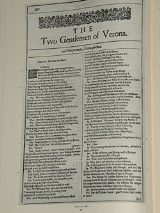
The play was not printed until 1623, when it appeared in the First Folio of Shakespeare's plays.

Criticism and analysis


Critical history


Perhaps the most critically discussed issue in the play is the sequence, bizarre by modern Western European standards, in Act 5, Scene 4 in which Valentine seems to 'give' Silvia to Proteus as a sign of his friendship. For many years, the general critical consensus on this issue was that the incident revealed an inherent misogyny
Misogyny
Misogyny is the hatred or dislike of women or girls. Philogyny, meaning fondness, love or admiration towards women, is the antonym of misogyny. The term misandry is the term for men that is parallel to misogyny...

 in the text. For example, Hilary Spurling
Hilary Spurling
Hilary Spurling, CBE, FRSL is a British writer, known as a journalist and biographer. She won the Whitbread Prize for the second volume of her biography of Henri Matisse in January 2006...

 wrote in 1970, "Valentine is so overcome [by Proteus' apology] that he promptly offers to hand over his beloved to the man who, not three minutes before, had meant to rape her". Modern scholarship however is much more divided about Valentine's actions at the end of the play, with some critics arguing that he does not give Silvia to Proteus at all. The ambiguity lies in the line "All that was mine in Silvia I give to thee" (5.4.83). Many critics (such as Stanley Wells for example) interpret this to mean that Valentine is indeed handing Silvia over to her would-be rapist, but another school of thought suggests that Valentine simply means "I will love you [Proteus] with as much love as I love Silvia," thus reconciling the dichotomy of friendship and love as depicted elsewhere in the play. This is certainly how Jeffrey Masten, for example, sees it, arguing that the play as a whole "reveals not the opposition of male friendship and Petrarchan love but rather their interdependence." As such, the final scene "stages the play's ultimate collaboration of male friendship and its incorporation of the plot we would label "heterosexual
Heterosexuality
Heterosexuality is romantic or sexual attraction or behavior between members of the opposite sex or gender. As a sexual orientation, heterosexuality refers to "an enduring pattern of or disposition to experience sexual, affectional, physical or romantic attractions to persons of the opposite sex";...

"."

This is also how Roger Warren interprets the final scene. Warren cites a number of productions of the play as evidence for this argument, including Robin Phillips
Robin Phillips
Robin Phillips is an English actor and director.Phillips was born in Haslemere, Surrey, the son of EllenAnne and James William Phillips. He trained at the Bristol Old Vic and worked as an actor and director for many years in the United Kingdom, finishing as Artistic Director at the Greenwich...

' Royal Shakespeare Company
Royal Shakespeare Company
The Royal Shakespeare Company is a major British theatre company, based in Stratford-upon-Avon, Warwickshire, England. The company employs 700 staff and produces around 20 productions a year from its home in Stratford-upon-Avon and plays regularly in London, Newcastle-upon-Tyne and on tour across...

 (RSC) production at the Aldwych Theatre
Aldwych Theatre
The Aldwych Theatre is a West End theatre, located on Aldwych in the City of Westminster. The theatre was listed Grade II on 20 July 1971. Its seating capacity is 1,200.-Origins:...

 in 1970, where Valentine kisses Silvia, makes his offer and then kisses Proteus. Another production cited by Warren is Edward Hall
Edward Hall (director)
Edward Hall is an English theatre director and an associate director at The National Theatre. Hall is known for directing Rose Rage, a stage adaptation of Shakespeare's three Henry VI plays. He also runs an all-male Shakespeare company, Propeller...

's in 1998, at the Swan Theatre
Swan Theatre (Stratford)
The Swan Theatre is a theatre belonging to the Royal Shakespeare Company in Stratford-upon-Avon, England. It is built on to the side of the larger Royal Shakespeare Theatre, occupying the Victorian Gothic structure that formerly housed the Shakespeare Memorial Theatre that preceded the RST but was...

. In Hall's version of the scene, after Valentine says the controversial line, Silvia approaches him and takes him by the hand. They remain holding hands for the rest of the play, clearly suggesting that Valentine has not 'given' her away. Warren also mentions Leon Rubin's 1984 Ontario production (where the controversial line was altered to "All my love to Silvia I also give to thee"), David Thacker
David Thacker
David Thacker is an English award-winning theatre director.David Thacker is currently the Artistic Director at the Octagon Theatre Bolton...

's 1991 Swan Theatre production, and the 1983 BBC Shakespeare
BBC Television Shakespeare
The BBC Television Shakespeare was a set of television adaptations of the plays of William Shakespeare, produced by the BBC between 1978 and 1985.-Origins:...

television adaptation as supporting the theory that Valentine is not giving Silvia away, but is simply promising to love Proteus as much as he loves Silvia.

There are other theories regarding this final scene however. For example, in his 1990 edition of the play for the New Cambridge Shakespeare
New Cambridge Shakespeare
The New Cambridge Shakespeare is a series of scholarly editions of the plays of William Shakespeare published by Cambridge University Press. The series began in 1984, publishing several new editions each year. To date, the majority of Shakespeare's plays and poems have been published in the series...

, Kurt Schlueter suggests that Valentine is indeed handing Silvia over to Proteus, but the audience is not supposed to take it literally; the incident is farcical
Farce
In theatre, a farce is a comedy which aims at entertaining the audience by means of unlikely, extravagant, and improbable situations, disguise and mistaken identity, verbal humour of varying degrees of sophistication, which may include word play, and a fast-paced plot whose speed usually increases,...

, and should be interpreted as such. Schlueter argues that the play provides possible evidence it was written to be performed and viewed primarily by a young audience, and as such, to be staged at university theatres, as opposed to public playhouses. Such an audience would be more predisposed to accepting the farcical nature of the scene, and more likely to find humorous the absurdity of Valentine's gift. As such, in Schlueter's theory, the scene does represent what it appears to represent, Valentine does give Silvia to her would-be rapist, but it is done purely for comic effect.

Another theory is provided by William C. Carroll in his 2004 edition for the Arden Shakespeare
Arden Shakespeare
The Arden Shakespeare is a long-running series of scholarly editions of the works of William Shakespeare. It presents fully edited modern-spelling editions of the plays and poems, with lengthy introductions and full commentaries...

, 3rd Series
. Carroll argues, like Schlueter, that Valentine is indeed giving Silvia to Proteus, but unlike Schlueter, Carroll detects no sense of farce. Instead, he sees the action as a perfectly logical one in terms of the notions of friendship which were prevalent at the time; "the idealisation of male friendship as superior to male-female love (which was considered not romantic or compassionate but merely lustful, hence inferior) performs a project of cultural nostalgia, a stepping back from potentially more threatening social arrangements to a world of order, a world based on a 'gift' economy of personal relations among male social equals rather than one based on a newer, less stable economy of emotional and economic risk. The offer of the woman from one male friend to another would therefore be the highest expression of friendship from one point of view, a low point of psycho-sexual regression from another." As in Schlueter, Carroll here interprets Valentine's actions as a gift to Proteus, but unlike Schlueter, and more in line with traditional criticism of the play, Carroll also argues that such a gift, as ridiculous as it is, is perfectly understandable when one considers the cultural and social milieu
Social environment
The social environment of an individual, also called social context or milieu, is the culture that s/he was educated or lives in, and the people and institutions with whom the person interacts....

of the play itself.

Language


Language is of primary importance in the play insofar as Valentine and Proteus speak in blank verse
Blank verse
Blank verse is poetry written in unrhymed iambic pentameter. It has been described as "probably the most common and influential form that English poetry has taken since the sixteenth century" and Paul Fussell has claimed that "about three-quarters of all English poetry is in blank verse."The first...

, but Launce and Speed speak (for the most part) in prose
Prose
Prose is the most typical form of written language, applying ordinary grammatical structure and natural flow of speech rather than rhythmic structure...

. More specifically, the actual content of many of the speeches serve to illustrate the pompousness of Valentine and Proteus' exalted outlook, and the more realistic and practical outlook of the servants. This is most apparent in Act 3, Scene 1. Valentine has just given a lengthy speech lamenting his banishment and musing on how he can possibly survive without Silvia; "Except I be by Silvia in the night/There is no music in the nightingale./Unless I look on Silvia in the day/There is no day for me to look upon" (ll.178–181). However, when Launce enters only a few lines later, he announces that he too is in love, and proceeds to outline, along with Speed, all of his betrothed's positives; "She brews good ale
Ale
Ale is a type of beer brewed from malted barley using a warm fermentation with a strain of brewers' yeast. The yeast will ferment the beer quickly, giving it a sweet, full bodied and fruity taste...

"; "She can knit
Knitting
Knitting is a method by which thread or yarn may be turned into cloth or other fine crafts. Knitted fabric consists of consecutive rows of loops, called stitches. As each row progresses, a new loop is pulled through an existing loop. The active stitches are held on a needle until another loop can...

"; "She can wash and scour", and negatives; "She hath a sweet mouth"; "She doth talk in her sleep"; "She is slow in words". After weighing his options, Launce decides that the woman's most important quality is that "she hath more hair than wit, and more faults than hairs, and more wealth than faults" (ll.343–344). He announces that her wealth "makes the faults gracious" (l.356), and chooses for that reason to wed her. This purely materialistic reasoning, as revealed in the form of language, is in stark contrast to the more spiritual
Spirituality
Spirituality can refer to an ultimate or an alleged immaterial reality; an inner path enabling a person to discover the essence of his/her being; or the “deepest values and meanings by which people live.” Spiritual practices, including meditation, prayer and contemplation, are intended to develop...

 and idealised love espoused by Valentine earlier in the scene.

Themes


One of the dominant theories as regards the value or importance of Two Gentlemen is that thematically, it represents a 'trial run' of sorts, in which Shakespeare deals briefly with themes which he would examine in more detail in later works. E.K. Chambers, for example, argued that the play represents something of a gestation
Gestation
Gestation is the carrying of an embryo or fetus inside a female viviparous animal. Mammals during pregnancy can have one or more gestations at the same time ....

 of Shakespeare's great thematic concerns. In 1905, he wrote that Two Gentlemen "was Shakespeare's first essay at originality, at fashioning for himself the outlines of that romantic or tragicomic
Tragicomedy
Tragicomedy is fictional work that blends aspects of the genres of tragedy and comedy. In English literature, from Shakespeare's time to the nineteenth century, tragicomedy referred to a serious play with either a happy ending or enough jokes throughout the play to lighten the mood.-Classical...

 formula in which so many of his most characteristic dramas were afterwards to be cast. Something which is neither quite tragedy nor quite comedy, something which touches the heights and depths of sentiment and reveals the dark places of the human heart without lingering long enough there to crystallise the painful impression, a love story broken for a moment into passionate chords by absence and inconstancy and intrigue, and then reunited to the music of wedding bells". As such, the play's primary interest for critics has tended to lie in relation to what it reveals about Shakespeare's conception of certain themes before he became an accomplished playwright
Playwright
A playwright, also called a dramatist, is a person who writes plays.The term is not a variant spelling of "playwrite", but something quite distinct: the word wright is an archaic English term for a craftsman or builder...

. A.C. Swinburne
Algernon Charles Swinburne
Algernon Charles Swinburne was an English poet, playwright, novelist, and critic. He invented the roundel form, wrote several novels, and contributed to the famous Eleventh Edition of the Encyclopaedia Britannica...

, for example, wrote "here is the first dawn of that higher and more tender humour that was never given in such perfection to any man as ultimately to Shakespeare." Similarly, Warwick R. Bond writes "Shakespeare first opens the vein he worked so richly afterwards – the vein of crossed love, of flight and exile under the escort of the generous sentiments; of disguised heroines, and sufferings endured and virtues exhibited under their disguise; and of the Providence
Divine providence
In Christian theology, divine providence, or simply providence, is God's activity in the world. " Providence" is also used as a title of God exercising His providence, and then the word are usually capitalized...

, kinder than life, that annuls the errors and forgives the sin."

Other critics have been less kind however, arguing that if the later plays show a skilled and confident writer exploring issues of the human heart, Two Gentlemen represents the initial, primarily unsuccessful attempt to do likewise. H.B. Charlton, for example, writing in 1938, argues that "clearly, Shakespeare's first attempt to make romantic comedy had only succeeded so far as it had unexpectedly and inadvertenly made romance comic." Another such argument is provided by Norman Sanders; "because the play reveals a relatively unsure dramatist and many effects managed with a tiro's
Tirones
Tirones were new recruits in the armies of the Roman Empire. A tiro could take up to six months before becoming a full miles ....

 lack of expertise, it offers us an opportunity to see more clearly than anywhere else in the canon what were to become characteristic techniques. It stands as an 'anatomie' or show-through version, as it were, of Shakespeare's comic art." Not all critics agree with this however, arguing that the play does stand on its own, that it deals successfully with its themes, and that it possesses its own unique merits, irrespective of what it tells us about Shakespeare's artistic development.

Love and friendship


Norman Sanders calls the play "almost a complete anthology of the practices of the doctrine of romantic love which inspired the poetic and prose Romances
Romance (genre)
As a literary genre of high culture, romance or chivalric romance is a style of heroic prose and verse narrative that was popular in the aristocratic circles of High Medieval and Early Modern Europe. They were fantastic stories about marvel-filled adventures, often of a knight errant portrayed as...

 of the period". At the very centre of this is the contest between love and friendship; "an essential part of the comicality of The Two Gentlemen of Verona is created by the necessary conflict between highly stylised concepts of love and friendship" This is manifested in the question of whether the relationship between two male friends is more important than that between lovers, encapsulated by Proteus' rhetorical question at 5.4.54; "In love/Who respects friend?". This question "exposes the raw nerve at the heart of the central relationships, the dark reality lurking beneath the wit and lyricism with which the play has in general presented lovers' behaviour". In the program notes for John Barton
John Barton (director)
John Bernard Adie Barton CBE is a theatrical director. He is the son of Sir Harold Montagu and Lady Joyce Barton. He married Anne Righter, a university lecturer, in 1968....

's 1981 RSC production at the Royal Shakespeare Theatre
Royal Shakespeare Theatre
The Royal Shakespeare Theatre is a 1,040+ seat thrust stage theatre owned by the Royal Shakespeare Company dedicated to the British playwright and poet William Shakespeare. It is located in the town of Stratford-upon-Avon - Shakespeare's birthplace - in the English Midlands, beside the River Avon...

, Anne Barton, his wife, wrote that the central theme of the play was "how to bring love and friendship into a constructive and mutually enhancing relationship." This is a common theme in Renaissance literature
Renaissance literature
Renaissance Literature refers to the period in European literature that began in Italy during the 14th century and spread around Europe through the 17th century...

, since some aspects of the culture of the time celebrated friendship as the more important relationship (because it is pure and unconcerned with sexual attraction), and contended that they could not co-exist. As actor Alex Avery
Alex Avery (actor)
Alex Avery is an English actor who played SC Terry Knowles in The Bill in 2001, and played Carl in Holby City in 1999. He has also guest starred in Shameless and EastEnders.He has also appeared in the movie Quills and will be appearing in a Neil Jordan film in the future.- External links :...

 argues, "The love between two men is a greater love for some reason. There seems to be a sense that the function of a male/female relationship is purely for the family and to procreate, to have a family. But a love between two men is something that you choose. You have arranged marriages, [but] a friendship between two men is created by the desires and wills of those two men, whereas a relationship between a man and a girl is actually constructed completely peripheral to whatever the feelings of the said boy and girl are."

William C. Carroll sees this societal belief as vital in interpreting the final scene of the play, arguing that Valentine does give Silvia to Proteus, and in so doing, he is merely acting in accordance with the practices of the day. However, if one accepts that Valentine does not give Silvia to Proteus, as critics such as Roger Warren argue, but instead offers to love Proteus as much as he loves Silvia, then the conclusion of the play can be read as a final triumphant reconciliation between friendship and love; Valentine intends to love his friend as much as he does his betrothed. Love and friendship are shown to be co-existent, not exclusive.


Foolishness of lovers


Another major theme is the foolishness of lovers, what Roger Warren refers to as "mockery of the absurdity of conventional lovers' behaviour". Valentine for example, is introduced into the play mocking the excesses of love; "To be in love, where scorn is bought with groans/Coy looks with heart-sore sighs, one fading moment's mirth/With twenty watchful, weary, tedious nights" (1.1.29–31). Later, however, he becomes as much a prisoner of love as Proteus, exclaiming, "For in revenge of my contempt for love/Love hath chased sleep from my enthrall'd eyes/And made them watchers of my own heart's sorrow" (2.4.131–133).

The majority of the cynicism
Cynicism
Cynicism , in its original form, refers to the beliefs of an ancient school of Greek philosophers known as the Cynics . Their philosophy was that the purpose of life was to live a life of Virtue in agreement with Nature. This meant rejecting all conventional desires for wealth, power, health, and...

 as regards conventional lovers however comes from Launce and Speed, who serve as foils
Foil (literature)
In fiction, a foil is a character who contrasts with another character in order to highlight particular qualities of another character....

 for Proteus and Valentine and "supply a mundane view of the idealistic flights of fancy indulged in by Proteus and Valentine." Several times in the play, after either Valentine or Proteus has made a grandiose speech about love, Shakespeare introduces either Launce or Speed (or sometimes both), whose speeches undercut what has just been heard, exposing Proteus and Valentine to mockery. A good example is found in Act 2, Scene 1. As Valentine and Silvia engage in a game of flirtation, hinting at their love for one another, Speed provides constant asides which serve to directly mock the couple. For example,


VALENTINE

Peace, here she comes.


Enter Silvia


SPEED (aside)

O excellent motion! O exceeding puppet! Now he will interpret her.


VALENTINE

Madame and mistress, a thousand good-morrows.


SPEED (aside)

O, give ye good e'en. Here's a million of manners.


SILVIA

Sir Valentine and servant, to you two thousand.


SPEED (aside)

He should give her interest, and she gives it him
(2.1.85-94)


Inconstancy


A third major theme is inconstancy, particularly as manifested in Proteus, whose very name hints at his changeable mind (in Ovid
Ovid
Publius Ovidius Naso , known as Ovid in the English-speaking world, was a Roman poet who is best known as the author of the three major collections of erotic poetry: Heroides, Amores, and Ars Amatoria...

's Metamorphoses, Proteus
Proteus
In Greek mythology, Proteus is an early sea-god, one of several deities whom Homer calls the "Old Man of the Sea", whose name suggests the "first" , as protogonos is the "primordial" or the "firstborn". He became the son of Poseidon in the Olympian theogony In Greek mythology, Proteus (Πρωτεύς)...

 is a sea-god forever changing its shape). At the start of the play, Proteus has only eyes for Julia. However upon meeting Silvia, he immediately falls in love with her (although he has no idea why). He then finds himself drawn to the page Sebastian (Julia in disguise) whilst still trying to woo Silvia, and at the end of the play, he announces that Silvia is no better than Julia and vows he now loves Julia again. As Silvia says of Proteus, "O heaven, were man/But constant, he were perfect. That one error/Fills him with faults, makes him run through all th'sins;/Inconstancy falls off ere it begins" (5.4.109–112).

Performance


There is no record of a performance in Shakespeare's era, down to the closing of the theatres in 1642, although due to its inclusion in Francis Meres's Palladis Tamia in 1598, we know it was certainly performed during Shakespeare's lifetime. The earliest known performance occurred at the Theatre Royal, Drury Lane
Theatre Royal, Drury Lane
The Theatre Royal, Drury Lane is a West End theatre in Covent Garden, in the City of Westminster, a borough of London. The building faces Catherine Street and backs onto Drury Lane. The building standing today is the most recent in a line of four theatres at the same location dating back to 1663,...

 in 1762. However, this production was of a version of the play rewritten by Benjamin Victor
Benjamin Victor (theatre manager)
-Life:He began life as a barber near Drury Lane. In 1722 he was at Norwich, perhaps to establish a textile business. Later he dealt in Irish linen, and established a business at a large house on Pall Mall. Between 1734 and 1746 he made visits to Ireland in order to extend his connections; but the...

. The earliest known performance of the straight Shakespearean text was at the Royal Opera House
Royal Opera House
The Royal Opera House is an opera house and major performing arts venue in Covent Garden, central London. The large building is often referred to as simply "Covent Garden", after a previous use of the site of the opera house's original construction in 1732. It is the home of The Royal Opera, The...

 in Covent Garden
Covent Garden
Covent Garden is a district in London on the eastern fringes of the West End, between St. Martin's Lane and Drury Lane. It is associated with the former fruit and vegetable market in the central square, now a popular shopping and tourist site, and the Royal Opera House, which is also known as...

 in 1784, advertised as "Shaxespeare's with alterations." Although the play was supposed to run for several weeks, it closed after the first night.

From the middle of the eighteenth century, even if staging Shakespeare's original play (as opposed to Victor's rewrite) it was common for directors to cut the lines in the final scene where Valentine seems to offer Silvia to Proteus, who has just attempted to rape her, as a sign of his forgiveness and friendship. This practice prevailed until William Macready reintroduced the lines in 1841 in a production at Drury Lane, although they were still being removed as late as 1952, in Denis Carey's production at the Bristol Old Vic
Bristol Old Vic
The Bristol Old Vic is a theatre company based at the Theatre Royal, King Street, in Bristol, England. The theatre complex includes the 1766 Theatre Royal, which claims to be the oldest continually-operating theatre in England, along with a 1970s studio theatre , offices and backstage facilities...

. Other nineteenth century performances include Charles Kean
Charles Kean
Charles John Kean , was born at Waterford, Ireland, the son of the actor Edmund Kean.After preparatory education at Worplesdon and at Greenford, near Harrow, he was sent to Eton College, where he remained three years...

's in 1848 at the Haymarket Theatre
Haymarket Theatre
The Theatre Royal Haymarket is a West End theatre in the Haymarket in the City of Westminster which dates back to 1720, making it the third-oldest London playhouse still in use...

, Samuel Phelps
Samuel Phelps
Samuel Phelps was an English actor and theatre manager...

' in 1857 at the Sadler's Wells Theatre
Sadler's Wells Theatre
Sadler's Wells Theatre is a performing arts venue located in Rosebery Avenue, Clerkenwell in the London Borough of Islington. The present day theatre is the sixth on the site since 1683. It consists of two performance spaces: a 1,500 seat main auditorium and the Lilian Baylis Studio, with extensive...

 and William Poel
William Poel
William Poel was an English actor, theatrical manager and dramatist best known for his presentations of Shakespeare.-Life and career:...

's in 1892 and 1896.

During the twentieth century, the play has been produced sporadically, often with little success, in the English-speaking world; although it has proved more popular in Europe. Indeed, there have been only a handful of major English speaking productions worth noting. Little is known, for example, about Harley Granville-Barker
Harley Granville-Barker
Harley Granville-Barker was an English actor-manager, director, producer, critic and playwright....

's 1904 production at the Royal Court Theatre
Royal Court Theatre
The Royal Court Theatre is a non-commercial theatre on Sloane Square, in the Royal Borough of Kensington and Chelsea. It is noted for its contributions to modern theatre...

, F.R. Benson's at the Shakespeare Memorial Theatre in 1910, Robert Atkins
Robert Atkins (actor)
Sir Robert Atkins, CBE was an English actor, producer and director.Born in Dulwich, London, England, Atkins was most famous for his participation in the theatre. An early graduate of the Royal Academy of Dramatic Art, he also appeared many times on film and in television, though not with the...

' 1926 production at the Apollo Theatre
Apollo Theatre
The Apollo Theatre is a Grade II listed West End theatre, on Shaftesbury Avenue in the City of Westminster. Designed by architect Lewin Sharp for owner Henry Lowenfield, and the fourth legitimate theatre to be constructed on the street, its doors opened on 21 February 1901 with the American...

, starring John Gielgud
John Gielgud
Sir Arthur John Gielgud, OM, CH was an English actor, director, and producer. A descendant of the renowned Terry acting family, he achieved early international acclaim for his youthful, emotionally expressive Hamlet which broke box office records on Broadway in 1937...

, or Ben Iden Payne
Ben Iden Payne
Ben Iden Payne was an English actor, director and teacher. Born in Newcastle-on-Tyne, he was raised and educated in Manchester. He started his career as a walk-on actor in 1899. He served as director of the Abbey Theatre for a short time in 1907 and then returned to Manchester to work with Annie...

's 1938 production at Stratford-upon-Avon
Stratford-upon-Avon
Stratford-upon-Avon is a market town and civil parish in south Warwickshire, England. It lies on the River Avon, south east of Birmingham and south west of Warwick. It is the largest and most populous town of the District of Stratford-on-Avon, which uses the term "on" to indicate that it covers...

. Indeed, most critics now agree that the first major 20th century production didn't take place until 1956, at the Old Vic
Old Vic
The Old Vic is a theatre located just south-east of Waterloo Station in London on the corner of The Cut and Waterloo Road. Established in 1818 as the Royal Coburg Theatre, it was taken over by Emma Cons in 1880 when it was known formally as the Royal Victoria Hall. In 1898, a niece of Cons, Lilian...

, directed by Michael Langham
Michael Langham
Michael Langham was an English actor and director, who spent much of his career living and working in Canada and the United States....

 and starring Keith Mitchell as Proteus and Barbara Jefford
Barbara Jefford
Barbara Jefford, OBE is a British Shakespearean actress best known for her theatrical performances with the Royal Shakespeare Company, the Old Vic and the National Theatre, and her role as Molly Bloom in the 1967 film of James Joyce's Ulysses.-Early life:Jefford was born Mary Barbara Jefford in...

 as Julia. In this production, set in late nineteenth century Italy and grounded very much in high Romanticism
Romanticism
Romanticism was an artistic, literary and intellectual movement that originated in the second half of the 18th century in Europe, and gained strength in reaction to the Industrial Revolution...

, Proteus threatens to kill himself with a pistol at the end of the play, prompting Valentine's hasty offer of Silvia.

Perhaps the most notable 20th century production was Peter Hall's 1960 presentation at the Royal Shakespeare Theatre in Stratford, starring Denholm Elliott
Denholm Elliott
Denholm Mitchell Elliott, CBE was an English film, television and theatre actor with over 120 film and television credits...

 as Valentine, Derek Godfrey
Derek Godfrey
Derek Godfrey was a British actor who appeared in several films and BBC television dramatizations during the 1960s and 1970s....

 as Proteus, Susan Maryott as Silvia, Frances Cuka
Frances Cuka
Frances Cuka is a British actress, principally on television, whose career has spanned nearly fifty years.Cuka was born in London, England, the daughter of Letitia Alice Annie , a tailor, and Joseph Cuka, a process engraver. On stage, she created the role of Jo in Shelagh Delaney's play A Taste of...

 as Julia, and featuring a much lauded performance by Patrick Wymark
Patrick Wymark
Patrick Wymark , was a British, stage, film and television actor.-Early life:Born Patrick Carl Cheeseman in Cleethorpes, Lincolnshire, England...

 as Launce. Hall had only recently been appointed as Artistic Director of the RSC, and, somewhat unexpectedly, he chose Two Gentlemen as his inaugural production, relocating the play to a late medieval
Middle Ages
The Middle Ages is a periodization of European history from the 5th century to the 15th century. The Middle Ages follows the fall of the Western Roman Empire in 476 and precedes the Early Modern Era. It is the middle period of a three-period division of Western history: Classic, Medieval and Modern...

 milieu.

Ten years later, in 1970, Robin Phillips' RSC production at the Aldwych Theatre, starred Peter Egan
Peter Egan
Peter Egan is a British actor known for playing smooth neighbour Paul Ryman in 1980s sitcom Ever Decreasing Circles. He is married to retired actress Myra Frances.-Early life:...

 as Valentine, Ian Richardson
Ian Richardson
Ian William Richardson CBE was a Scottish actor best known for his portrayal of the Machiavellian Tory politician Francis Urquhart in the BBC's House of Cards trilogy. He was also a leading Shakespearean stage actor....

 as Proteus, Helen Mirren
Helen Mirren
Dame Helen Mirren, DBE is an English actor. She has won an Academy Award for Best Actress, four SAG Awards, four BAFTAs, three Golden Globes, four Emmy Awards, and two Cannes Film Festival Best Actress Awards.-Early life and family:...

 as Julia, Estelle Kohler
Estelle Kohler
Estelle Kohler is a British theatre and television actress. Born in South Africa, Kohler made a name for herself as a Shakespearean actor in England...

 as Silvia, and Patrick Stewart
Patrick Stewart
Sir Patrick Hewes Stewart, OBE is an English film, television and stage actor, who has had a distinguished career in theatre and television for around half a century...

 as Launce. This production concentrated on the issues of friendship and treachery, and set the play in a decadent world of social elitism
Elitism
Elitism is the belief or attitude that some individuals, who form an elite — a select group of people with intellect, wealth, specialized training or experience, or other distinctive attributes — are those whose views on a matter are to be taken the most seriously or carry the most...

. Valentine and Proteus were presented as aristocratic students, the Duke was a Don
Crime boss
A crime boss or boss is a person in charge of a criminal organization. A boss typically has absolute or near-absolute control over his subordinates, is greatly feared by his subordinates for his ruthlessness and willingness to take lives in order to exert his influence, and profits come from the...

, and Eglamour an old scout master. On the other hand, the poverty stricken outlaws were dressed in animal skins.

The RSC again staged the play at the Royal Shakespeare Theatre in 1981, under the direction of John Barton, with Peter Land
Peter Land
Peter Land is a New Zealand actor and singer known for his classical acting with the Royal National Theatre and the Royal Shakespeare Company as well as appearances in many musicals.-Early life:...

 as Proteus, Peter Chelsom
Peter Chelsom
Peter Chelsom is a British actor and film director. He has directed among others such films as Shall We Dance? and Hannah Montana: The Movie...

 as Valentine, Julia Swift as Julia and Diana Hardcastle
Diana Hardcastle
Diana Hardcastle is a British actress who has appeared largely in television roles. She appeared in episodes of Midsomer Murders, Inspector Lynley and Taggart. She played recurring roles in the series First Among Equals and Fortunes of War....

 as Silvia. This production saw the actors not involved in the current on-stage scene sit at the front of the stage and watch the performance. Leon Rubin directed another major performance at the Stratford Shakespeare Festival in Ontario, Canada in 1984, where the actors were dressed in modern clothes and contemporary pop music was featured within the play (for example, the outlaws are portrayed as an anarchic
Anarchism
Anarchism is generally defined as the political philosophy which holds the state to be undesirable, unnecessary, and harmful, or alternatively as opposing authority in the conduct of human relations...

 rock group).

A 1991 RSC production at the Swan Theatre saw director David Thacker use an on-stage live band for the duration of the play, playing music from the 1930s, such as Cole Porter
Cole Porter
Cole Albert Porter was an American composer and songwriter. Born to a wealthy family in Indiana, he defied the wishes of his domineering grandfather and took up music as a profession. Classically trained, he was drawn towards musical theatre...

 and George Gershwin
George Gershwin
George Gershwin was an American composer and pianist. Gershwin's compositions spanned both popular and classical genres, and his most popular melodies are widely known...

. Thacker's production featured Barry Lynch
Barry Lynch
Barry J. Lynch is an American actor. His brother, Richard Lynch, is also an actor who appeared in Star Trek: The Next Generation...

 as Proteus, Richard Bonneville as Valentine, Clare Holman
Clare Holman
Clare Margaret Holman is an English actress, perhaps most famous for her role of forensic pathologist Dr. Laura Hobson in the television series Inspector Morse and Lewis.-Acting:...

 as Julia and Saskia Reeves
Saskia Reeves
Saskia Reeves is a British actress perhaps best known for her roles in the films Close My Eyes and ID , and the 2000 miniseries Frank Herbert's Dune....

 as Silvia. In 1992, Thacker's production moved to the Barbican Centre
Barbican Centre
The Barbican Centre is the largest performing arts centre in Europe. Located in the City of London, England, the Centre hosts classical and contemporary music concerts, theatre performances, film screenings and art exhibitions. It also houses a library, three restaurants, and a conservatory...

 in London, and in 1993 went on regional tour. In 1996, Jack Shepherd directed a modern dress version at the Globe Theatre
Globe Theatre
The Globe Theatre was a theatre in London associated with William Shakespeare. It was built in 1599 by Shakespeare's playing company, the Lord Chamberlain's Men, and was destroyed by fire on 29 June 1613...

 starring Lenny James as Valentine, Mark Rylance
Mark Rylance
Mark Rylance is an English actor, theatre director and playwright.As an actor, Rylance found success on stage and screen. For his work in theatre he has won Olivier and Tony Awards among others, and a BAFTA TV Award...

 as Proteus, Stephanie Roth Haberle as Julia and Anastasia Hille
Anastasia Hille
Anastasia Hille is an English actress active in British television, theatre, and film.Hille was a student at Drama Centre . She was nominated for the Ian Charleson Awards in 1994.-Television:...

 as Silvia. Another RSC production took place at the Swan in 1998, under the direction of Edward Hall, and starring Tom Goodman-Hill
Tom Goodman-Hill
Tom Goodman-Hill is an English actor of radio, film, stage and television.Born as Tom Hill and raised near Newcastle upon Tyne, he qualified as a teacher before turning to acting. During his time in Newcastle, he regularly acted in amateur performances at the People's Theatre...

 as Valentine, Dominic Rowan
Dominic Rowan
Dominic Rowan is an English actor.-Theatre:Rowan's work in theatre includes: A Dream Play, Iphigeneia at Aulis, Mourning Becomes Electra, Three Sisters, The Talking Cure and Private Lives at the National Theatre, London; The Two Gentlemen of Verona, The Merchant of Venice and Talk of the City for...

 as Proteus, Lesley Vickerage
Lesley Vickerage
Lesley Vickerage is an English actress best known for her roles as WPC Jenny Dean in the British television series Between the Lines and as Helen Lynley in the British television series The Inspector Lynley Mysteries....

 as Julia and Poppy Miller
Poppy Miller
Poppy Miller is a British actress. Miller was born in Norwich, UK and studied philosophy and English at Cambridge University and later attended the Webber Douglas Academy of Dramatic Art. She is mostly known for her role as DI Carol Browning in the British detective series The Commander...

 as Silvia. This production set the play in a grimy unnamed contemporary city where material obsession was all-encompassing. Another performance took place in 1999 at the Cottesloe Theatre
Royal National Theatre
The Royal National Theatre in London is one of the United Kingdom's two most prominent publicly funded theatre companies, alongside the Royal Shakespeare Company...

, directed by Julie Anne Robinson
Julie Anne Robinson
Julie Anne Robinson is a British theatre, television, and film director perhaps best known for her work on British television. She earned BAFTA and Golden Globe nominations for directing the first half of the BBC miniseries Blackpool...

.
In 2001, Douglas C. Wager directed a version of the play set in the 1950s and featuring the music of Bill Haley
Bill Haley
Bill Haley was one of the first American rock and roll musicians. He is credited by many with first popularizing this form of music in the early 1950s with his group Bill Haley & His Comets and their hit song "Rock Around the Clock".-Early life and career:...

 and Connie Francis
Connie Francis
Connie Francis is an American pop singer of Italian heritage and the top-charting female vocalist of the 1950s and 1960s. Although her chart success waned in the second half of the 1960s, Francis remained a top concert draw...

, with Gregory Wooddell as Valentine, Paul Whitthorne as Proteus, Julia Dion as Julia and Louise Zachry as Silvia. In 2004, Fiona Buffini directed a regional touring production for the RSC. Premiering at the Swan, the production starred Alex Avery as Valentine, Laurence Mitchell as Proteus, Vanessa Ackerman as Julia and Rachel Pickup
Rachel Pickup
Rachel Pickup is a British theatre, television and film actress. She was born in London on 15 July 1973.She got a place at the National Youth Theatre under the artistic directorship of Edward Wilson and subsequently won a place at RADA....

 as Silvia, and was performed under the title The Two Gents. Buffini set the play in a swinging 1930s milieu, and featuring numerous dance numbers. Additionally, London and New York replaced Verona and Milan; initially, Valentine and Proteus are shown as living in the English countryside, in a rural paradise devoid of any real vitality, the sons of wealthy families who have retired from the city. When Valentine leaves, he heads to New York to pursue the American Dream
American Dream
The American Dream is a national ethos of the United States in which freedom includes a promise of the possibility of prosperity and success. In the definition of the American Dream by James Truslow Adams in 1931, "life should be better and richer and fuller for everyone, with opportunity for each...

 and falls in love with Silvia, the famous actress daughter of a powerful media magnate
Media proprietor
A media proprietor is a person who controls, either through personal ownership or a dominant position in any media enterprise. Those with significant control of a public company in the mass media may also be called "media moguls", "tycoons", "barons", or "bosses".The figure of the media proprietor...

. Another change to the play was that the roles of the outlaws (represented here as a group of paparazzi
Paparazzi
Paparazzi is an Italian term used to refer to photojournalists who specialize in candid photography of celebrities, politicians, and other prominent people...

) were increased considerably. Scenes added to the play show them arriving in New York and going about their daily business, although none of the new scenes featured any dialogue.
Another performance worth noting occurred at the Courtyard Theatre
Courtyard Theatre
The Courtyard Theatre is a temporary 1,048 seat thrust stage theatre building in Stratford-upon-Avon, England. Designed by Ian Ritchie Architects and built in 11 months, it opened in August 2006 to host performances by the Royal Shakespeare Company while its Royal Shakespeare and Swan Theatres...

 in Stratford in 2006. A non-professional acting company from Brazil
Brazil
Brazil , officially the Federative Republic of Brazil , is the largest country in South America. It is the world's fifth largest country, both by geographical area and by population with over 192 million people...

, named Nós do Morro ('We of the hillside'), in collaboration with a Gallery 37
Gallery 37
Gallery 37 is a job training program and was created in 1991 by Chicago's Department of Cultural Affairs' Lois Weisberg and Maggie Daley, wife of the city's former mayor, Richard M. Daley. Its purpose is to attract artistically inclined city youth to work as apprentice artists at a vacant downtown...

 group from Birmingham
Birmingham
Birmingham is a city and metropolitan borough in the West Midlands of England. It is the most populous British city outside the capital London, with a population of 1,036,900 , and lies at the heart of the West Midlands conurbation, the second most populous urban area in the United Kingdom with a...

, gave a single performance of the play during the RSC's presentation of the Complete Works, directed by Guti Fraga. This production was spoken in Portuguese, with the original English text projected as surtitles
Surtitles
Surtitles, also known as supertitles, are translated or transcribed lyrics/dialogue projected above a stage or displayed on a screen, commonly used in opera or other musical performances. The word "surtitle" comes from the French language "sur", meaning "over" or "on", and the English language word...

 onto the back of the stage. It also featured two 17 years olds in the roles of Valentine and Proteus (usually, actors in their 20s are cast), and Crab was played not by a dog, but by a human actor. In 2009, Joe Dowling
Joe Dowling
Joe Dowling is the Artistic Director for the Guthrie Theater in Minneapolis, Minnesota, USA. He is also well-known for his work as Artistic Director of the Abbey Theatre in Ireland, and has directed plays in all the major theatres in Ireland as well as theatres in London, New York, Washington...

 directed the play at the Guthrie Theater
Guthrie Theater
The Guthrie Theater is a center for theater performance, production, education, and professional training in Minneapolis, Minnesota. It is the result of the desire of Sir Tyrone Guthrie, Oliver Rea, and Peter Zeisler to create a resident acting company that would produce and perform the classics in...

 as a 1955 live television production, with large black-and-white
Black-and-white
Black-and-white, often abbreviated B/W or B&W, is a term referring to a number of monochrome forms in visual arts.Black-and-white as a description is also something of a misnomer, for in addition to black and white, most of these media included varying shades of gray...

 monitors set on either side of the stage, and cameras feeding the action to them. Additionally, period advertisements appeared both before the show and during the intermission. The actors spoke the original dialogue, but wore 1950s clothing and used 1950s-era sets. Rock and roll
Rock and roll
Rock and roll is a genre of popular music that originated and evolved in the United States during the late 1940s and early 1950s, primarily from a combination of African American blues, country, jazz, and gospel music...

 music and dance sequences were occasionally mixed with the action.

Taken together, these various productions, with their frequent use of music, their geographical and temporal relocations, and their general modifications of the original serve to lend credence to Stanley Wells' claim that the play "has succeeded best when subjected to adaptation, increasing its musical content, adjusting the emphasis of the last scene so as to reduce the shock of Valentine's donation of Silvia to Proteus, and updating the setting."

Theatrical


Benjamin Victor rewrote the play some time prior to 1762, when it was performed at the Theatre Royal in Drury Lane. Directed by David Garrick
David Garrick
David Garrick was an English actor, playwright, theatre manager and producer who influenced nearly all aspects of theatrical practice throughout the 18th century and was a pupil and friend of Dr Samuel Johnson...

, and starring Richard Yates as Launce, and his wife, Mary Anne Yates
Mary Anne Yates
Mary Anne Yates was an English tragic actress. The daughter of William Graham, a ship's steward and his wife, Mary, she married Richard Yates , a well-known comedian of the time....

 as Julia, Victor brought all the Verona scenes together, removed Valentine's 'gift' of Silvia to Proteus and increased the roles of Launce and Crab (especially during the outlaw scenes, where both characters are intimately involved in the action). He also switched the emphasis of the play away from the love-friendship divide and instead focused on the issues of fidelity, with the last line of the play altered to, "Lovers must be faithful to be bless'd." This necessitated rewriting Valentine as a near flawless protagonist who represents such faithfulness, and Proteus as a traditional villain, who doesn't care for such notions. The two are not presented as old friends, but simply as acquaintances. Thurio was also rewritten as a harmless, but lovable fool, not unlike Launce and Speed. Although not a major success (the play initially ran for only six performances), it was still being performed as late as 1895. In 1790, John Philip Kemble
John Philip Kemble
John Philip Kemble was an English actor. He was born into a theatrical family as the eldest son of Roger Kemble, actor-manager of a touring troupe. His elder sister Sarah Siddons achieved fame with him on the stage of the Theatre Royal, Drury Lane...

 staged his own production of the play at Drury Lane, maintaining many of Victor's alterations, and again at Covent Garden in 1808. In the 1808 production, Kemble, who was fifty years old at the time, played Valentine.

Frederic Reynolds
Frederic Reynolds
Frederic Reynolds was a British playwright and theatrical producer in the later eighteenth and early nineteenth centuries....

 staged an operatic version in 1821 at Covent Garden as part of his series of adaptations of the works of Shakespeare. Reynolds wrote the lyrics, and Henry Bishop wrote the music. The production ran for twenty-nine performances, and included some of Shakespeare's sonnets set to music. Augustin Daly
Augustin Daly
John Augustin Daly was an American theatrical manager and playwright active in both the US and UK.-Biography:Daly was born in Plymouth, North Carolina and educated at Norfolk, Va...

 revived the opera in 1895 at Daly's Theatre
Daly's Theatre
Daly's Theatre was a theatre in the City of Westminster. It was located at 2 Cranbourn Street, just off Leicester Square. It opened on 27 June 1893, and was demolished in 1937.-Early years:...

, in a production which George Bernard Shaw
George Bernard Shaw
George Bernard Shaw was an Irish playwright and a co-founder of the London School of Economics. Although his first profitable writing was music and literary criticism, in which capacity he wrote many highly articulate pieces of journalism, his main talent was for drama, and he wrote more than 60...

 argued was much better than Shakespeare's original text.

In 1971, Galt MacDermot
Galt MacDermot
Galt MacDermot is a Canadian composer, pianist and writer of musical theatre. He won a Grammy Award for the song African Waltz in 1960. His most successful musicals have been Hair and Two Gentlemen of Verona...

, John Guare
John Guare
John Guare is an American playwright. He is best known as the author of The House of Blue Leaves, Six Degrees of Separation, and Landscape of the Body...

 and Mel Shapiro
Mel Shapiro
Mel Shapiro is an American theatre director and writer, college professor, and author.Trained at Carnegie-Mellon University, Shapiro began his professional directing career at the Pittsburgh Playhouse and then as resident director at Arena Stage in Washington, D.C....

 adapted the show into a rock musical
Rock musical
A rock musical is a musical theatre work with rock music. The genre of rock musical may overlap somewhat with album musicals, concept albums and song cycles, as they sometimes tell a story through the rock music, and some album musicals and concept albums become rock musicals...

 under the same name
Two Gentlemen of Verona (musical)
Two Gentlemen of Verona is a rock musical, with a book by John Guare and Mel Shapiro, lyrics by Guare and music by Galt MacDermot, based on the Shakespeare comedy of the same name....

 as the play. Guare and Shapiro wrote the book, Guare the lyrics, and MacDermot the music. Opening at the St. James Theatre
St. James Theatre
The St. James Theatre is located at 246 W. 44th St. Broadway, New York City, New York. It was built by Abraham L. Erlanger, theatrical producer and a founding member of the Theatrical Syndicate, on the site of the original Sardi's restaurant. It opened in 1927 as The Erlanger...

 on 1 December 1971, with Shapiro directing and Jean Erdman
Jean Erdman
Jean Erdman is a dancer and choreographer of modern dance as well as an avant-garde theater director.-Early years:Erdman was born on February 20, 1916 in Honolulu, Hawaii...

 as choreographer, it ran for 614 performances, closing on 20 May 1973. During its initial run, the play won two Tony Award
Tony Award
The Antoinette Perry Award for Excellence in Theatre, more commonly known as a Tony Award, recognizes achievement in live Broadway theatre. The awards are presented by the American Theatre Wing and The Broadway League at an annual ceremony in New York City. The awards are given for Broadway...

s; Best Musical
Tony Award for Best Musical
This is a list of winners and nominations for the Tony Award for Best Musical, first awarded in 1949. This award is presented to the producers of the musical.-1940s:* 1949: Kiss Me, Kate – Music and lyrics by Cole Porter, book by Samuel and Bella Spewack...

 and Best Book
Tony Award for Best Book of a Musical
The Tony Award for Best Book of a Musical is awarded to librettists of the spoken, non-sung dialogue, and storyline of a musical play. Eligibility is restricted to works with original narrative framework; plotless revues and revivals are ineligible...

. The original cast included Clifton Davis
Clifton Davis
Clifton Duncan Davis is an American actor, songwriter and minister. He has appeared on the television shows as A World Apart, That's My Mama and Amen...

 as Valentine, Raúl Juliá
Raúl Juliá
Raúl Rafael Juliá y Arcelay was a Puerto Rican actor.Born in San Juan, he gained interest in acting while still in school. Upon completing his studies, Juliá decided to pursue a career in acting. After performing in the local scene for some time, he was convinced by entertainment personality Orson...

 as Proteus, Jonelle Allen
Jonelle Allen
Jonelle Allen is an American actress, singer, and dancer.Born in New York City, Allen grew up in Harlem's Sugar Hill among neighbors that included Duke Ellington, Sonny Rollins, and Johnny Hodges, all of whom had an influence on her career choice...

 as Silvia and Diana Dávila as Julia. The play moved to the West End
West End theatre
West End theatre is a popular term for mainstream professional theatre staged in the large theatres of London's 'Theatreland', the West End. Along with New York's Broadway theatre, West End theatre is usually considered to represent the highest level of commercial theatre in the English speaking...

 in 1973, playing at the Phoenix Theatre
Phoenix Theatre (London)
The Phoenix Theatre is a West End theatre in the London Borough of Camden, located on Charing Cross Road . The entrance is in Phoenix Street....

 from 26 April, and running for 237 performances. It was revived in 1996 at the New Jersey Shakespeare Festival
Shakespeare Theatre of New Jersey
The Shakespeare Theatre of New Jersey is an independent, professional theatre company located on the Drew University campus. One of the leading Shakespeare theatres in the USA — serving 100,000 adults and children annually — it is New Jersey's only professional theatre company dedicated to the...

, directed by Robert Duke, and again in 2005, directed and choreographed by Kathleen Marshall
Kathleen Marshall
Kathleen Marshall is an American choreographer, director, and creative consultant.-Life and career:Born in Pittsburgh, Pennsylvania, Marshall graduated from Taylor Allderdice High School and Smith College. She worked in the Pittsburgh theatre scene when she was younger, performing with such...

 as part of the Shakespeare in the Park
Shakespeare in the Park
Shakespeare in the Park is a concept used across the world, as a form of free public presentation of William Shakespeare's works. Such performances exist in Australia, Canada, New Zealand, Singapore, the United Kingdom, and the United States of America....

festival. Marshall's production was performed at the Delacorte Theater
Delacorte Theater
The Delacorte Theater, established in 1962, is an open-air theater located in Manhattan's Central Park and has a seating capacity of 1,800. The Delacorte is owned by the City of New York and operated by The Public Theater. It is an open-air amphitheater, with the Turtle Pond and Belvedere Castle...

 in Central Park
Central Park
Central Park is a public park in the center of Manhattan in New York City, United States. The park initially opened in 1857, on of city-owned land. In 1858, Frederick Law Olmsted and Calvert Vaux won a design competition to improve and expand the park with a plan they entitled the Greensward Plan...

, and starred Norm Lewis
Norm Lewis
Norm Lewis is an American actor and baritone singer. He has appeared on Broadway as well as in regional theatre.-Life:Lewis was born in Tallahassee, Florida and grew up in Eatonville, Florida...

 as Valentine, Oscar Isaac
Oscar Isaac
-Personal life:Isaac was born in Guatemala to a Guatemalan mother, Maria Estrada Nicolle, and a Cuban pulmonologist father, Oscar Gonzalo Hernandez. He was raised in Miami, Florida. While in Miami, he played lead guitar and sang vocals for his band "The Blinking Underdogs"...

 as Proteus, Renee Elise Goldsberry
Renee Elise Goldsberry
Renee Elise Goldsberry is an American actress, singer and songwriter.Goldsberry was born in San Jose, California and raised in both Houston, Texas and Detroit, Michigan. After graduating from Cranbrook Kingswood School in Bloomfield Hills she went to Carnegie Mellon University where she graduated...

 as Silvia and Rosario Dawson
Rosario Dawson
Rosario Isabel Dawson is an American actress, singer, and writer. She has appeared in films such as Kids, Men in Black II, 25th Hour, Sin City, Clerks II, Rent, Death Proof, The Rundown, Eagle Eye, Alexander, Seven Pounds, Percy Jackson and the Olympians: The Lightning Thief and Unstoppable.-Early...

 as Julia

Stuart Draper
Stuart Draper
Stuart B Draper is a British actor, playwright and theatre director. He attended the London Academy of Music and Dramatic Art and graduated from Durham University, and teaches at the South London Theatre.-As playwright:...

 adapted the play into a gay version called Two Gentlemen of Verona which played at the Greenwich Playhouse
Greenwich Playhouse
The Greenwich Playhouse in the central Greenwich district of the London Borough of Greenwich is an eighty-four seat studio theatre which opened in 1990. It is situated above and has its entrance within, the St. Christopher’s Inn Pub...

 in New York City from 20 April to 18 May 2004. In this version of the play, Valentine is in love with Proteus, but Proteus' father would rather see him marry the wealthy Julia. Valentine leaves to seek his fortune in Milan, where he meets and falls in love with Silvia, daughter of the Duke. Leaving Julia behind, Proteus follows Valentine to Milan determined to win him over. Proteus is in turn followed by Julia (disguised as a boy), determined to woo him away from Valentine.

Film


The only cinematic adaptation of the play is Yī jiǎn méi
A Spray of Plum Blossoms
A Spray of Plum Blossoms is a 1931 silent Chinese film directed by Bu Wancang and starring Ruan Lingyu, Wang Cilong and Jin Yan. It is a loose adaptation of William Shakespeare's The Two Gentlemen of Verona...

(more commonly known by its English title A Spray of Plum Blossoms), a 1931 silent film
Silent film
A silent film is a film with no synchronized recorded sound, especially with no spoken dialogue. In silent films for entertainment the dialogue is transmitted through muted gestures, pantomime and title cards...

 from China, directed by Bu Wancang
Bu Wancang
Bu Wancang was a prolific Chinese film director and screenwriter active between the 1920s and the 1960s. He is also known by his Cantonese name, Baak Maan Chong, and his English name, Richard Poh. He was born in Anhui.-Career:...

 and written by Huang Yicuo. A loose adaptation of the play, the film tells the story of Bai Lede (Wang Chilong) and Hu Luting (Jin Yan), two military cadets who have been friends since they were children. After graduating, Hu, a playboy uninterested in love, is appointed as a captain in Guangdong
Guangdong
Guangdong is a province on the South China Sea coast of the People's Republic of China. The province was previously often written with the alternative English name Kwangtung Province...

 and leaves his home town in Shanghai. Bai however, deeply in love with Hu's sister, Hu Zhuli (Ruan Lingyu
Ruan Lingyu
Ruan Lingyu , born Ruan Fenggen , was a Chinese silent film actress. One of the most prominent Chinese film stars of the 1930s, her death at the age of 24 led her to become an icon of Chinese cinema.- Career :...

) stays behind. At Guangdong, Hu falls in love with the local general's daughter, Shi Luohua (Lam Cho-Cho), although the general, Shi (Wang Guilin), is unaware of the relationship, and instead wants his daughter to marry the foolish Liao Di'ao (Kao Chien Fei). Meanwhile, Bai's father uses his influence to get Bai posted to Guangdong, and after a sorrowful farewell between himself and Zhuli, he arrives at his new post and instantly falls in love with Luohua. In an effort to have her for himself, Bai betrays his friend, by informing General Shi of his daughter's plans to elope with Hu, leading to Shi dishonourably discharging Hu. Bai tries to win Luohua over, but she is uninterested, only concerned with lamenting the loss of Hu. In the meantime, Hu encounters a group of bandits who ask him to be their leader, to which he agrees, planning on returning for Luohua at some point in the future. Some time passes, and one day, as Luohua, Bai and Liao are passing through the forest, they are attacked. Luohua manages to flee, and Bai pursues her into the forest. They engage in an argument, but just as Bai seems about to lose his temper, Hu intervenes, and he and Luohua are reunited. General Shi arrives in time to see Liao flee the scene, and he now realises that he was wrong to get in the way of the relationship between Hu and his daughter. Hu then forgives Bai his betrayal, and Bai reveals that he has discovered that his only true love is in fact Zhuli back in Shanghai.

The film is notable for being one of many Chinese films of the period which, although performed in Mandarin when filming, used English intertitle
Intertitle
In motion pictures, an intertitle is a piece of filmed, printed text edited into the midst of the photographed action, at various points, generally to convey character dialogue, or descriptive narrative material related to, but not necessarily covered by, the material photographed.Intertitles...

s upon its original release. In the English intertitles and credits, the characters are named after their counterparts in the play; Hu is Valentine, Bai is Proteus, Zhuli is Julia and Luohua is Silvia. Liao is named Tiburio rather than Thurio.

Television


The first television adaptation was in 1952, when BBC One
BBC One
BBC One is the flagship television channel of the British Broadcasting Corporation in the United Kingdom. It was launched on 2 November 1936 as the BBC Television Service, and was the world's first regular television service with a high level of image resolution...

 broadcast Act 1 of the play live from the Bristol Old Vic. Directed by Denis Carey, the production starred John Neville as Valentine, Laurence Payne
Laurence Payne
Laurence Payne was an English actor and novelist.-Early life:Laurence Stanley Payne was born in London. His father died when he was three years old, and he and his elder brother and sister were brought up in by their mother, a Wesleyan Methodist in Wood Green, London...

 as Proteus, Gudrun Ure
Gudrun Ure
Gudrun Ure is a Scottish actress, most famous for her portrayal of the titular character in Super Gran. She also starred in the pilot of a series called Life After Life, written by Yes Minister creator Jonathan Lynn...

 as Silvia and Pamela Ann as Julia.

In 1956, the entire play was broadcast on German TV channel Das Erste
Das Erste
Erstes Deutsches Fernsehen , marketed as Das Erste , is the principal publicly owned television channel in Germany...

 from a performance at the Munich Kammerspiele
Munich Kammerspiele
The Munich Kammerspiele is a successful German language theatre in Munich. The Schauspielhaus in the Maximilianstrasse is the major stage.-History:...

, under the title Zwei Herren aus Verona. The theatrical production was directed by Hans Schalla, with the TV adaptation directed by Ernst Markwardt. The cast included Rolf Schult
Rolf Schult
Rolf Schult is a German synchronis speaker and actor. He continues to provide the German dub for actor Robert Redford, among many others...

 as Valentine, Hannes Riesenberger as Proteus, Helga Siemers as Julia and Isolde Chlapek as Silvia.

In 1964, the play was made into a TV movie in Germany, under the title Die zwei Herren aus Verona, directed by Hans Dieter Schwarze and starring Norbert Hansing as Valentine, Rolf Becker
Rolf Becker
Rolf Becker is a German television actor. By his first wife, actress Monika Hansen, he is the father of actor Ben Becker, and actress and singer Meret Becker.-Selected filmography:* I'm an Elephant, Madame...

 as Proteus, Katinka Hoffman as Julia and Heidelinde Weis as Silvia.
The play was adapted for the BBC Shakespeare series in 1983. Directed by Don Taylor
Don Taylor (director)
Donald Victor Taylor was an English writer, director and producer, active across theatre, radio and television for over forty years...

, it starred Tyler Butterworth
Tyler Butterworth
Tyler Butterworth is an English actor, who has appeared in Rumpole Of The Bailey, Bergerac, Last of the Summer Wine, The Bill, The Darling Buds of May, Hetty Wainthropp Investigates and Osborne in the ITV sitcom Fiddlers Three...

 as Proteus, John Hudson as Valentine, Tessa Peake-Jones
Tessa Peake-Jones
Tessa Peake-Jones is an English actress. She is best known for her role as Raquel in the television comedy series Only Fools and Horses. She had a co-starring role in the 1999 TV series Births, Marriages, and Deaths...

 as Julia and Joanne Pearce as Silvia. For the most part, the BBC Shakespeare adaptation is word-for-word taken from the First Folio, with only some very minor and inconsequential differences. For example, omitted lines include the Duke's "Knowing that tender youth is soon suggested" (3.1.34), and Julia's "Her eyes are grey as glass, and so are mine" (4.4.189). Other differences include a slightly different opening scene to that indicated in the text. Whereas the play seems to open with Valentine and Proteus in mid-conversation, the adaptation begins with Mercatio and Eglamour attempting to formally woo Julia; Mercatio by showing her a coffer overflowing with gold coins, Eglamour by displaying a parchment detailing his family history. However, there is no dialogue in this scene, and the first words spoken are the same as in the text ("Cease to persuade my loving Proteus"). Eglamour is also present in the final scene, albeit once again without any dialogue, and, additionally, the capture of Silvia and the flight of Eglamour is seen, as opposed to merely being described.

In 1995, a production of the play aired on Polish TV channel TVP1 under the title Dwaj panowie z Werony, directed by Roland Rowinski and starring Marek Bukowski as Proteus and Rafal Krolikowski as Valentine.

In 2000, a Season 4 episode of Dawson's Creek
Dawson's Creek
Dawson's Creek is an American teen drama television series which debuted on January 20, 1998, on The WB Television Network and was produced by Sony Pictures Television. The show is set in the fictional seaside town of Capeside, Massachusetts, and in Boston, Massachusetts, during the later seasons...

entitled "Two Gentlemen of Capeside" loosely adapted the plot of the play. Written by Chris Levinson and directed by Sandy Smolan
Sandy Smolan
-Early career:He started his career by directing the 1987 Rachel River, which took two awards at the Sundance Film Festival.-Directing Credits:* Descending from Heaven* The Middleman* Men in Trees* Eli Stone...

, the episode depicted how Dawson and Pacey, formally best friends, have been driven apart over their love for the same woman. The play is referenced early in the episode as the characters are reading it for their English class.

Radio


In 1923, extracts from the play were broadcast on BBC Radio 1
BBC Radio 1
BBC Radio 1 is a British national radio station operated by the British Broadcasting Corporation which also broadcasts internationally, specialising in current popular music and chart hits throughout the day. Radio 1 provides alternative genres after 7:00pm including electronic dance, hip hop, rock...

, performed by the Cardiff Station Repertory Company as the first episode of a series of programs showcasing Shakespeare's plays, entitled Shakespeare Night. In 1924, the entire play was broadcast by the BBC, directed by Joyce Tremayne and R.E. Jeffrey. Treymane played Silvia and Jeffrey played Valentine, along with G.R. Harvey as Proteus and Daisy Moncur as Julia. In 1927, the scenes between Julia and Lucetta were broadcast on BBC Radio 1 as part of the Echoes from Greenwich Theatre
Greenwich Theatre
The Greenwich Theatre is a local theatre located in Croom's Hill close to the centre of Greenwich in south-east London.-Building history:The building was originally a music hall created in 1855 as part of the neighbouring Rose and Crown public house, but the Rose and Crown Music Hall was...

series. Betty Rayner played Julia and Joan Rayner played Lucetta. BBC National Programme
BBC National Programme
The BBC National Programme was a BBC radio station from the 1920s until the outbreak of World War II.-Foundation:When the BBC first began transmissions on 14 November 1922, the technology for both national coverage and joint programming between transmitters did not exist – transmitter powers were...

 broadcast the full play in 1934, adapted for radio by Barbara Burnham and produced by Lance Sieveking
Lance Sieveking
Lance Sieveking was an English writer and pioneer BBC radio and television producer. He was married three times, and was father to archaeologist Gale Sieveking and Fortean-writer Paul Sieveking .-Biography:...

. Ion Swinley played Valentine, Robert Craven was Proteus, Helen Horsey was Silvia and Lydia Sherwood
Lydia Sherwood
-Selected filmography:* Adventures of Don Quixote * The King of Paris * Little Friend * Spring in the Air * Midnight at Madame Tussaud's * The Four Just Men * When We Are Married...

 played Julia.

In 1958, the entire play was broadcast on BBC Third Programme
BBC Third Programme
The BBC Third Programme was a national radio network broadcast by the BBC. The network first went on air on 29 September 1946 and became one of the leading cultural and intellectual forces in Britain, playing a crucial role in disseminating the arts...

. Produced and directed for radio by Raymond Raikes, the play starred John Westbrook
John Westbrook (actor)
John Westbrook was an English actor.Born in Teignmouth, Devon, John Westbrook worked mainly in theatre and in radio. He also made occasional film and television appearances. His most famous role was as Christopher Gough in Roger Corman's The Tomb of Ligeia...

 as Valentine, Charles Hodgson as Proteus, Caroline Leigh as Silvia and Perlita Neilson as Julia. It also featured Frankie Howerd
Frankie Howerd
Francis Alick "Frankie" Howerd OBE was an English comedian and comic actor whose career, described by fellow comedian Barry Cryer as "a series of comebacks", spanned six decades.-Early career:...

 as Launce.

BBC Third Programme aired another full production of the play in 1968, produced and directed by R.D. Smith and starring Denys Hawthorne as Valentine, Michael N. Harbour as Proteus and Judi Dench
Judi Dench
Dame Judith Olivia "Judi" Dench, CH, DBE, FRSA is an English film, stage and television actress.Dench made her professional debut in 1957 with the Old Vic Company. Over the following few years she played in several of William Shakespeare's plays in such roles as Ophelia in Hamlet, Juliet in Romeo...

 as Julia.

In 2007, producer Roger Elsgood and director Willi Richards adapted the play into a radio play
Radio drama
Radio drama is a dramatized, purely acoustic performance, broadcast on radio or published on audio media, such as tape or CD. With no visual component, radio drama depends on dialogue, music and sound effects to help the listener imagine the characters and story...

 called The Two Gentlemen of Valasna, setting it in two fictional Indian princely states called Malpur and Valasna, in the weeks leading up to the Indian Mutiny
Indian Rebellion of 1857
The Indian Rebellion of 1857 began as a mutiny of sepoys of the British East India Company's army on 10 May 1857, in the town of Meerut, and soon escalated into other mutinies and civilian rebellions largely in the upper Gangetic plain and central India, with the major hostilities confined to...

 of 1857. The play was first broadcast on BBC Radio 3
BBC Radio 3
BBC Radio 3 is a national radio station operated by the BBC within the United Kingdom. Its output centres on classical music and opera, but jazz, world music, drama, culture and the arts also feature. The station is the world’s most significant commissioner of new music, and its New Generation...

 on 29 July 2007. It was recorded on location in Maharashtra, India earlier in 2007 with a cast drawn from Bollywood
Bollywood
Bollywood is the informal term popularly used for the Hindi-language film industry based in Mumbai , Maharashtra, India. The term is often incorrectly used to refer to the whole of Indian cinema; it is only a part of the total Indian film industry, which includes other production centers producing...

, Indian television and the Mumbai English-speaking theatre traditions; actors included Nadir Khan as Vishvadev (i.e. Valentine), Arghya Lahiri as Parminder (Proteus), Anu Menon
Anuradha Menon
Anuradha Menon is an Indian television actress and theatre artist. Lola Kutty, the popular Channel [V] VJ, is her alter ego. She is also VJ Laila on Channel V.-Theatre:...

 as Syoni (Silvia), Avantika Akerkar as Jumaana/Servi (Julia/Sebastian), Sohrab Ardishir as The Maharaja (Duke of Milan) and Zafar Karachiwala as Thaqib (Thurio). Besides the new character names, some other substitutions suitable to the new setting (e.g. "by Ran" for "by Jove", "Vishnu's shrine for "the north gate", "the mighty gods' wrath's appeased" for "the Eternal's wrath's appeas'd", sahiba for lady, sahib for sir, and sari for robe), and the addition of some Indian dialogue, the production used Shakespeare's text.

External links