
| |
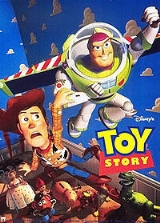
Toy Story is a 1995 American computer-animated family film, directed by John Lasseter and starring Tom Hanks and Tim Allen. The film was produced by Pixar Animation Studios and was distributed by Buena Vista Distribution. It was written by Joss Whedon, Andrew Stanton, Joel Cohen, and Alec Sokolow, and featured music by Randy Newman. The film was rated G by the MPAA, and PG by the BBFC. It is also rated G by the OFLC. It was the first feature film released to use only computer-generated imagery (though Cassiopéia was in production earlier).
The top-grossing film on its opening weekend, Toy Story went on to gross over $191 million in the United States during its initial theatrical release and took in more than $356M worldwide.

Discussion
Ask a question about 'Toy Story'
Start a new discussion about 'Toy Story'
Answer questions from other users
|
Quotations
That wasn't flying, that was falling with style. - On Buzz's supposed flight.
Yee-ha! Come on, partner! We've got to get this wagon train a-movin'!
Aaaaah-oof!
Ow! Ow! Stop it, you zealots!
Reach for the sky!
This town ain't big enough for the two of us!

Encyclopedia
Toy Story is a 1995 American computer-animated family film, directed by John Lasseter and starring Tom Hanks and Tim Allen. The film was produced by Pixar Animation Studios and was distributed by Buena Vista Distribution. It was written by Joss Whedon, Andrew Stanton, Joel Cohen, and Alec Sokolow, and featured music by Randy Newman. The film was rated G by the MPAA, and PG by the BBFC. It is also rated G by the OFLC. It was the first feature film released to use only computer-generated imagery (though Cassiopéia was in production earlier).
The top-grossing film on its opening weekend, Toy Story went on to gross over $191 million in the United States during its initial theatrical release and took in more than $356M worldwide. Reviews were overwhelmingly positive, praising both the technical innovation of the animation and the wit and sophistication of the screenplay.
In addition to DVD releases, Toy Story-inspired merchandise has run the gamut from video games and costumes to model trains and shoes. Buzz Lightyear's classic line "To infinity and beyond!" has seen usage not only on T-shirts, but among philosophers and mathematical theorists as well. The film was so successful it prompted a sequel, Toy Story 2, which became an even bigger hit than the original. Toy Story is set for rerelease in Disney Digital 3-D on October 2 2009, and Toy Story 3, scheduled for release on June 18 2010, is in development.
Plot
Old-fashioned cowboy doll Woody is coordinating a reconnaissance mission around his owner Andy's birthday party in the days before Andy's family move to their new house. To Woody's dismay, Andy receives a new action figure in the form of space ranger Buzz Lightyear, whose impressive features soon see Buzz replacing Woody as Andy's favorite toy. Woody, the former de facto leader of Andy's toys, is disappointed by his replacement and resentful towards Buzz. For his part, Buzz does not understand that he is a toy. Instead he believes himself to be an actual space ranger, seeing Woody as an interference in his 'mission'.
Later, Woody wants to replace Buzz on a family outing. He intends to trap Buzz in a gap behind Andy's desk, but the plan goes disastrously wrong and Buzz is knocked outside the house. The other toys accuse Woody of attempting to murder Buzz out of jealousy, but are unable to punish him before Andy leaves the house with Woody for the outing at the space-themed Pizza Planet restaurant. Buzz sees Andy getting into his mother's car with Woody and manages to climb aboard, and while Woody ponders how he can return to Andy's room alone, Buzz confronts Woody while Andy's mother refuels the car. The two end up fighting and accidentally land outside the car, which drives off and leaves the two stranded.
Woody spots a truck bound for Pizza Planet and plans to rendezvous with Andy there. Realizing that he will face the wrath of the other toys if he returns alone, Woody convinces Buzz that the truck will take them to a spaceship. Once at Pizza Planet, Buzz makes his way into a claw game machine shaped like a spaceship, thinking it to be the ship Woody promised him. While Woody clambers in to try and rescue him, Buzz (with Woody hanging on to his foot) is captured by Andy's next-door neighbor, the toy-destroying Sid Phillips.
The two desperately attempt to escape from Sid's house before Andy's family's moving day. There they encounter nightmarish "mutant" toys inhabiting his room, as well as Sid's vicious dog Scud. Buzz stumbles into a room, where he sees a television advertisement for Buzz Lightyear toys just like himself. Confused and crestfallen of his true nature, Buzz attempts to fly out of the window but falls and breaks his left arm (it falls out of its socket). Woody is unable to get a traumatized/depressed Buzz to participate in his escape plan, even when the mutant toys show their true colors and repair Buzz's arm. Sid prepares to destroy Buzz with a firework rocket. In the film's turning point, Woody admits that Buzz is a "cool toy", but despairs that he himself stands no chance of being Andy's favorite. Buzz changes his mind and decides that life is worth living even if he's not a space ranger and helps Woody, but Sid wakes up before they can escape and takes Buzz (still strapped to the rocket), to his backyard launchpad. In cooperation with Sid's mutant toys, Woody stages a rescue of Buzz and starts to terrifies Sid into running away in fear of his own toys. But even after their efforts, the two miss Andy's car as it drives away to his new house.
Chasing the moving van, they attract the attention of Scud. Buzz saves Woody by tackling the dog, but leaving himself behind. Woody attempts to rescue Buzz with Andy's radio-controlled car R.C. At first, the other toys in the moving van mistakenly believe Woody is attempting to get rid of R.C. now by throwing him off the truck. Buzz and Woody attempt to catch up; after witnessing Woody trying to save Buzz, the other toys have a change of heart and try to help them back on, but R.C.'s batteries are depleted. Woody then realizes that he can ignite Buzz's rocket, and all three toys make their way back to Andy safely.
At Christmas, a reconciled Buzz and Woody are now both Andy's favorite toys and have become best friends, inspiring confidence among the other toys. Together, they stage another reconnaissance mission to prepare for the new arrivals, one of which is revealed to be a puppy.
Development
John Lasseter's first experience with computer animation was during his work as an animator at Disney, when two of his friends showed him the lightcycle scene from Tron. It was an eye-opening experience which awakened Lasseter to the possibilities offered by the new medium of computer-generated animation. Lasseter went on to work at Lucasfilm and later as a founding member of Pixar.
Pixar's Oscar-winning short film Tin Toy (directed by Lasseter) and its CAPS project were among works that gained Disney's attention and, after meetings in 1990 with Jeffrey Katzenberg, Pixar pitched a television special called A Tin Toy Christmas. By 1991, Disney and Pixar signed an agreement to work on a film, based on the Tin Toy characters, called Toy Story.
Toy Storys script was strongly influenced by the ideas of screenwriter Robert McKee. The script went through many changes before the final version. Lasseter decided Tinny was "too antiquated", and the character was changed to a military action figure, and then given a space theme. Tinny's name changed to Lunar Larry, then Tempus from Morph, and eventually Buzz Lightyear (after astronaut Buzz Aldrin). A second character, originally a ventriloquist's dummy, was changed to a stuffed cowboy doll with a pull-string, and named Woody for Western actor Woody Strode. The difference between the old and new toy led to a conflict between their personalities. The movie became a buddy film, with the story department drawing inspiration from films such as 48 Hrs. and The Defiant Ones. Disney also appointed Joel Cohen, Alec Sokolow and, later, Joss Whedon to help develop the script.
Lasseter always wanted Tom Hanks to play the character of Woody. Early test footage, using Hanks' voice from Turner and Hooch, convinced Hanks to sign on to the film. Billy Crystal was approached to play Buzz, but turned down the role, as did Chevy Chase on his agent's advice. Katzenberg took the role to Tim Allen, who was appearing in Disney's Home Improvement, and he accepted.
Pixar presented an early draft of the film to Disney on November 19, 1993. The result was disastrous: Walt Disney Feature Animation president Peter Schneider immediately shut down production pending a new script approved by Disney. Pixar survived the shutdown by falling back on its existing television commercial business while the script was rewritten. The new script made Woody a more likeable character, instead of the "sarcastic jerk" he had been. Katzenberg restarted production in February 1994.
It was Whedon's idea to incorporate Barbie as a character who would rescue Woody and Buzz in the film's final act. The idea was dropped after Mattel objected and refused to license the toy. Hasbro likewise refused to license G.I. Joe but did license Mr. Potato Head. The movie's related toys were produced by Thinkway Toys, who secured the worldwide master toy license in 1995.
Crew
Cast and characters
Toys
Humans
Cameo vocals include Penn Jillette, Sam Lasseter, Joe Ranft (as Lenny, the pair of wind-up walking binoculars), and Andrew Stanton.
Release
Theaters and Home Video
Toy Story was released to theaters on November 22, 1995, and will be re-released in 3-D on October 2, 2009. It was released on VHS and LaserDisc on October 29, 1996, with no bonus material. In January, 2000, it was released in a "Special Edition" VHS with the bonus short, Tin Toy. Its first DVD release was in October 2000, in a two-pack with Toy Story 2. This release was later available individually. Also in October, 2000, a 3-disc "Ultimate Toy Box" set was released, featuring Toy Story, Toy Story 2 and a third disc of bonus materials. In September, 2005, a 2-disc "10th Anniversary Edition" was released featuring much of the bonus material from the "Ultimate Toy Box", plus new features. This DVD went back in to the Disney Vault on January 31, 2009. At that same time, a bare-bones UMD of Toy Story was released for the Sony PlayStation Portable. A new DVD of Toy Story is speculated to be released in the fall of 2010. This movie will also see its first Blu-Ray release around the same time.
Computer Software
Disney's Animated Storybook: Toy Story and Disney's Activity Center: Toy Story were released for Windows and Mac. Two console video games were released for the movie: the Toy Story video game, for the Sega Genesis, Super Nintendo Entertainment System, Game Boy and PC; and Toy Story Racer, for the Sony PlayStation, which contains elements from Toy Story 2.
All of these titles are significant, because Pixar created original animations for all of them, including fully animated sequences for the PC titles.
There is also a pirated Toy Story game for the NES created by Hummer Team. It's a port of the Toy Story game that was available for the SNES and the Genesis. The game was pretty well known for it's Engrish.
Reception Toy Story was a major critical and commercial success. Reviewers hailed it as "a visionary roller-coaster ride of a movie", "a gem of fast action, sophisticated wit and inspired comedy", and 'the year's most inventive comedy'.
The film maintains a 100% "fresh" rating from 43 reviews, with an average score of 8.8/10, at Rotten Tomatoes. On its budget of $30 million, the film grossed $384 million worldwide.
In 2003, the Online Film Critics Society ranked the film as the greatest animated film of all time. In 2005 the film was selected for preservation in the United States National Film Registry, one of five films to be selected in its first year of eligibility. The film is ranked 99th on the AFI's list of the 100 greatest American films of all time, and 6th best in the animation genre.
Awards John Lasseter received an Academy Special Achievement Award in 1996 "for the development and inspired application of techniques that have made possible the first feature-length computer-animated film."
The film was nominated for three Academy Awards, two to Randy Newman for Best Music—Original Song, for "You've Got a Friend in Me", and Best Music—Original Musical or Comedy Score. It was also nominated for Best Writing—Screenplay Written for the Screen for the work by Joel Cohen, Pete Docter, John Lasseter, Joe Ranft, Alec Sokolow, Andrew Stanton, and Joss Whedon.
Toy Story won eight Annie Awards, including "Best Animated Feature". Animator Pete Docter, director John Lasseter, musician Randy Newman, producers Bonnie Arnold and Ralph Guggenheim, production designer Ralph Eggleston, and writers Joel Cohen, Alec Sokolow, Andrew Stanton, and Joss Whedon all won awards for "Best Individual Achievement" in their respective fields for their work on the film. The film also won "Best Individual Achievement" in technical achievement.
Toy Story was nominated for two Golden Globes, one for "Best Motion Picture—Comedy/Musical", and one for "Best Original Song—Motion Picture" for Randy Newman's "You've Got a Friend in Me". It was also nominated for two Saturn Awards, one for "Best Family Film", and one for "Best Writing" for the work done by Joel Cohen, Alec Sokolow, Andrew Stanton, and Joss Whedon.
Soundtrack
External links
|