
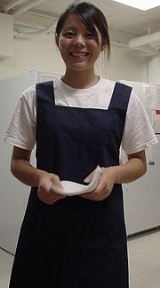
An
apron is an outer
protective garmentPersonal protective equipment refers to protective clothing, helmets, goggles, or other garment or equipment designed to protect the wearer's body from injury by blunt impacts, electrical hazards, heat, chemicals, and infection, for job-related occupational safety and health purposes, and in...
that covers primarily the front of the body. It may be worn for hygienic reasons as well as in order to protect clothes from wear and tear. The apron is commonly part of the
uniformA uniform is a set of standard clothing worn by members of an organization while participating in that organization's activity. Modern uniforms are worn by armed forces and paramilitary organizations such as police, emergency services, security guards, in some workplaces and schools and by inmates...
of several work categories, including
waitressesWaiting staff, wait staff, or waitstaff are those who work at a restaurant or a bar attending customers — supplying them with food and drink as requested. Traditionally, a male waiting tables is called a "waiter" and a female a "waitress" with the gender-neutral version being a "server"...
, nurses, and
domestic workerA domestic worker is a man, woman or child who works within the employer's household. Domestic workers perform a variety of household services for an individual or a family, from providing care for children and elderly dependents to cleaning and household maintenance, known as housekeeping...
s. Many
homemakerHomemaking is a mainly American term for the management of a home, otherwise known as housework, housekeeping or household management...
s also wear them. It is also worn as a decorative garment by women. Aprons are also worn in many commercial establishments to protect workers clothes from damage, mainly bib aprons, but also others such as
blacksmithA blacksmith is a person who creates objects from wrought iron or steel by forging the metal; that is, by using tools to hammer, bend, and cut...
or
farrierA farrier is a specialist in equine hoof care, including the trimming and balancing of horses' hooves and the placing of shoes on their hooves...
aprons.
In addition to cloth, aprons can be made from a variety of materials. Rubber aprons are commonly used by persons working with dangerous chemicals, and lead aprons are commonly worn by persons such as X-ray technicians who work near radiation. Aprons, such as those used by carpenters, may have many pockets to hold tools. Waterproof household aprons, made of oilcloth or PVC are suitable for cooking and washing dishes.
The word
apron is from the
metanalysisIn linguistics, metanalysis is the act of breaking down a word or phrase into segments or meanings not original to it. The term was coined by the linguist Otto Jespersen, from Greek elements meaning "a change of breakdown"....
of the term "a napron" to "an apron". The original spelling of napron has been lost (from the
Old FrenchOld French was the Romance dialect continuum spoken in territories that span roughly the northern half of modern France and parts of modern Belgium and Switzerland from the 9th century to the 14th century...
naperon;
Modern FrenchFrench is a Romance language spoken as a first language in France, the Romandy region in Switzerland, Wallonia and Brussels in Belgium, Monaco, the regions of Quebec and Acadia in Canada, and by various communities elsewhere. Second-language speakers of French are distributed throughout many parts...
napperon).
Styles
There are many different apron forms depending on the purpose of the apron. A basic distinction is between waist aprons which cover the body from the waist down and a bib apron which also covers the upper part of the body.
An apron is usually held in place by two ribbon-like strips of cloth that are tied in the back. A bib apron may either have a strap in around the neck (perhaps the most widespread use today), or shoulder straps that criss-cross in the back and attach to the waistband. The advantage of the former design is that it makes it especially simple to put on the bib apron. The advantage of the shoulder strap design is that it makes the apron more comfortable to wear; a neck strap can slightly impair ease of movement.
Other types of aprons include the
pinaforeA pinafore is a sleeveless garment worn as an apron.Pinafores may be worn by girls as a decorative garment and by both girls and women as a protective apron. A related term is pinafore dress, which is British English for what in American English is known as a jumper dress, i.e...
and the
cobbler apronA cobbler apron is a type of apron that covers both the front and back of the body. It is fastened with sides ties or with waist bands that tie in the back. It covers most of the upper part of the body and is frequently used in many vocational occupations....
. There are also aprons that will cover the sleeves.
Some modern day aprons will have humorous expressions, designs or corporate logos.
Aprons in the home
The apron was traditionally viewed as an essential garment for anyone doing housework. Cheaper clothes and washing machines made aprons less common beginning in the mid 1960s in some countries such as the United States. However, the practice of wearing aprons remains strong in many places.
Today, the apron has enjoyed a minor renaissance in terms of both women and men now wearing them when performing household chores. For instance, an article in the
Wall Street Journal claimed in 2005 that the apron is "enjoying a renaissance as a retro-chic fashion accessory" in the United States. However, it still is not as prevalent as it was prior to the 1960s.
Aprons are nowadays considered equally appropriate for both women and men by most people. However, prevailing social norms ensure that women frequently wear more delicate clothing, and may therefore be more likely to want the protection an apron offers. This can also be because the apron is the traditional clothing for
cookingCooking is the process of preparing food by use of heat. Cooking techniques and ingredients vary widely across the world, reflecting unique environmental, economic, and cultural traditions. Cooks themselves also vary widely in skill and training...
and washing dishes, usually done by women.
When
domestic workerA domestic worker is a man, woman or child who works within the employer's household. Domestic workers perform a variety of household services for an individual or a family, from providing care for children and elderly dependents to cleaning and household maintenance, known as housekeeping...
s are supplied a
uniformA uniform is a set of standard clothing worn by members of an organization while participating in that organization's activity. Modern uniforms are worn by armed forces and paramilitary organizations such as police, emergency services, security guards, in some workplaces and schools and by inmates...
by their employers, an apron is often included. The aprons are worn for hygienic as well as for identification purposes.
Clerical garment
The term "apron" also refers to an item of
clerical clothingClerical clothing is non-liturgical clothing worn exclusively by clergy. It is distinct from vestments in that it is not reserved specifically for services. Practices vary: clerical clothing is sometimes worn under vestments, and sometimes as the everyday clothing or street wear of a priest,...
, now largely obsolete, worn by Anglican
bishopA bishop is an ordained or consecrated member of the Christian clergy who is generally entrusted with a position of authority and oversight. Within the Catholic Church, Eastern Orthodox, Oriental Orthodox Churches, in the Assyrian Church of the East, in the Independent Catholic Churches, and in the...
s and
archdeaconAn archdeacon is a senior clergy position in Anglicanism, Syrian Malabar Nasrani, Chaldean Catholic, and some other Christian denominations, above that of most clergy and below a bishop. In the High Middle Ages it was the most senior diocesan position below a bishop in the Roman Catholic Church...
s. The clerical apron resembles a short
cassockThe cassock, an item of clerical clothing, is an ankle-length robe worn by clerics of the Roman Catholic Church, Eastern Orthodox Church, Anglican Church, Lutheran Church and some ministers and ordained officers of Presbyterian and Reformed churches. Ankle-length garment is the meaning of the...
reaching just above the knee, and is coloured black for archdeacons and purple for bishops. The apron is worn with black
gaitersGaiters are garments worn over the shoe and lower pant leg, and used primarily as personal protective equipment; similar garments used primarily for display are spats....
, reaching to just below the knee, and knee-length black breeches worn with gaiters. The history behind the vesture is that it symbolically represents the mobility of bishops and archdeacons, who at one time would ride horses to visit various parts of a
dioceseA diocese is the district or see under the supervision of a bishop. It is divided into parishes.An archdiocese is more significant than a diocese. An archdiocese is presided over by an archbishop whose see may have or had importance due to size or historical significance...
or archdeaconry. In this sense, the apparel was much more practical than a clerical cassock would be. In latter years, this vesture was more symbolic than practical, and since the mid-twentieth century it has fallen out of favour.