


Theater an der Wien

Encyclopedia
The Theater an der Wien (The Theatre on the Wien River) is a historic theatre on the Left Wienzeile
in the Mariahilf
district of Vienna
. Completed in 1801, it has seen the premieres of many celebrated works of theatre, opera, and symphonic music. Since 2006, the theatre has served primarily as an opera house, hosting its own company.
Emanuel Schikaneder
, who is best known to history as Mozart
's librettist
and collaborator on the opera The Magic Flute
(1791). Schikaneder's troupe had already been successfully performing for several years in Vienna in the smaller Theater auf der Wieden
, where The Magic Flute had premiered. Schikaneder, whose performances often emphasized spectacle and scenery, felt ready to move to a larger and better equipped venue.
He had already been granted an imperial licence to build a new theatre in 1786, but it was only in 1798 that he felt ready to act on this authorization. The building was designed by the architect Franz Jäger in Empire style (it has since been remodeled). Construction was completed in 1801. The theatre has been described as "the most lavishly equipped and one of the largest theatres of its age.".
The theatre opened on 13 June 1801 with a prologue written by Schikaneder followed by a performance of the opera "Alexander" by Franz Teyber
.
The new theatre proved to be a sensation. Adolf Bäurle, a local critic, wrote "if Schikaneder and [his partner] Zitterbarth had had the idea ... to charge admission simply for looking at the glories of their Theater an der Wien, Schikaneder would certainly have been able to take in vast sums of money without giving one single performance." The Allgemeine musikalische Zeitung
called it the "most comfortable and satisfactory in the whole of Germany" (which meant at the time, "all German-speaking lands").
In 1807 the theatre was acquired by a group of court nobles that included Count Ferdinand Palffy von Erdöd
, who bought the theatre outright in 1813. During the period of his proprietorship, which lasted until 1826, he offered opera
and ballet
and, to appeal to a wider Viennese audience, popular pantomime
and variety acts, losing money in elaborate spectacles until he was forced to sell the theatre at auction in 1826.
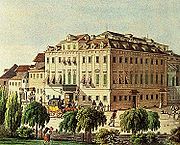 Only a part of the original building is preserved: the Papagenotor ("Papageno Gate") is a memorial to Schikaneder, who is depicted playing the role of Papageno in The Magic Flute, a role he wrote for himself to perform. He is accompanied by the Three Boys, characters in the same opera.
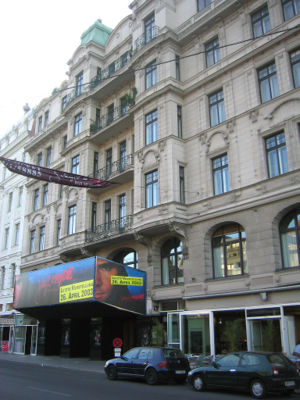 The theatre experienced a golden age during the flourishing of Viennese operetta
. From 1945 to 1955, it was one of the temporary homes of the Vienna State Opera
, whose own building had been destroyed by Allied bombing during World War II.
In 1955, the theatre was closed for safety reasons. It languished unused for several years, and by the early 1960s, the threat had emerged that it would be converted to a parking garage (this was the same era of "urban renewal" that in America nearly destroyed Carnegie Hall
).
Fortunately, in 1962 the theatre found a new and successful role for itself as a venue for contemporary musical theatre
. Many English-language musicals had their German premieres there. In 1992, the musical Elisabeth
(about Franz Joseph I of Austria
's wife, Elisabeth of Bavaria, also known as Sissi), premiered there. The musical Cats
directed and choreographed by Gillian Lynne
played successfully for seven years.
Despite its focus on operettas and musicals, the theatre still served as a venue for occasional opera productions, especially during the Vienna Festival
seasons, and sometimes co-produced with the Vienna State Opera
. Notable productions were Lulu
(1962; conducted by Karl Böhm
, staged by Otto Schenk
, designed by Caspar Neher
, starring Evelyn Lear
), Haydn's Orfeo ed Euridice (1967; conducted by Richard Bonynge
, staged by Rudolf Hartmann, with Nicolai Gedda
, Joan Sutherland
), Fidelio (1970; conducted by Leonard Bernstein
, staged by Schenk, with Gwyneth Jones, James King
), Il ritorno d'Ulisse in patria
(1971; conducted by Nikolaus Harnoncourt
, staged by Federik Mirdita), L'elisir d'amore
(1973; conducted by Silvio Varviso
, staged by Schenk, with Nicolai Gedda
, Reri Grist
, Eberhard Wächter), Die Fledermaus
(1975; conducted by Mstislav Rostropovich
, staged by Michael Kehlmann
, with Wiesław Ochman, Reri Grist, Elizabeth Harwood
, Waldemar Kmentt
), La clemenza di Tito
(1976; conducted by Julius Rudel
, staged by Mirdita, with Werner Hollweg, Teresa Berganza
, Arleen Augér
, Edda Moser
), Fierrabras
(1988; conducted by Claudio Abbado
, staged by Ruth Berghaus
, with Thomas Hampson, Karita Mattila
, László Polgár
), Die Entführung aus dem Serail
(1989; conducted by Harnoncourt, staged by Ursel Herrmann, Karl-Ernst Herrmann), Don Giovanni
(1990; conducted by Abbado, staged by Luc Bondy
, with Ruggero Raimondi
, Karita Mattila, Marie McLaughlin
, Cheryl Studer
), Le nozze di Figaro (1991; conducted by Abbado, staged by Jonathan Miller
, with Ruggero Raimondi, Marie McLaughlin, Cheryl Studer) and the world premiere of Adriana Hölszky
's Die Wände (1995; conducted by Ulf Schirmer
, staged by Hans Neuenfels
). Between 1996 and 2002, Riccardo Muti
conducted new productions of Così fan tutte
, Don Giovanni
(both staged by Roberto de Simone), and Le nozze di Figaro (staged by Michael Heltau
, based on an original production by Giorgio Strehler
).
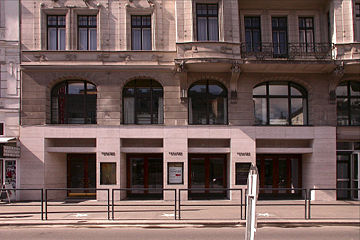 In 2006, the 250th anniversary year of Mozart's birth, the Theater an der Wien presented a series of major Mozart operas. This initiated its conversion to a full-time venue for opera and other forms of classical music under the direction of Roland Geyer. The first opera to be given was Mozart's Idomeneo with Neil Shicoff
in the title role and Peter Schneider
conducting the new production by Willy Decker
. Other members of the cast were Angelika Kirchschlager
, Genia Kühmeier, and Barbara Frittoli
.
Geyer is quoted as saying that he wishes to "present cutting edge directors and interesting productions", and his three main areas of focus are on Baroque opera, contemporary opera, and Mozart.
The theatre's seasons have included the following works:
Among the singers have been Marijana Mijanovic, Frederica von Stade
, Olaf Bär
, Patricia Petibon
, Anatoli Kotscherga, Anja Silja
, Diana Damrau
, Plácido Domingo
, Maria José Montiel, Andrea Rost
, Christine Schäfer
, David Daniels.
The Theater an der Wien frequently collaborates in co-productions with other opera houses, such as the Washington Opera, the Los Angeles Opera
, the Teatro Real
in Madrid
, De Nederlandse Opera in Amsterdam
, and the Sächsische Staatsoper
in Dresden
.
It has been reported that in 2013, the opera A Harlot's Progress
will receive its world premier at the house. By young British composer Iain Bell, it will feature German soprano Diana Damrau
in the title role.
, an open-air market.
Wienzeile
The Wienzeile is a street in Vienna, which originated in the course of the regulation of the Vienna River between 1899 and 1905 along the river's banks....
in the Mariahilf
Mariahilf
Mariahilf is the 6th municipal district of Vienna, Austria . It is near the center of Vienna and was established as a district in 1850. Mariahilf is a heavily populated urban area with many residential buildings....
district of Vienna
Districts of Vienna
The districts of Vienna are 23 named city sections of Vienna, Austria, which are also numbered for easy reference. For centuries, district boundaries have changed...
. Completed in 1801, it has seen the premieres of many celebrated works of theatre, opera, and symphonic music. Since 2006, the theatre has served primarily as an opera house, hosting its own company.
Origin
The theatre was the brainchild of the Viennese theatrical impresarioImpresario
An impresario is a person who organizes and often finances concerts, plays or operas; analogous to a film producer in filmmaking, television production and an angel investor in business...
Emanuel Schikaneder
Emanuel Schikaneder
Emanuel Schikaneder , born Johann Joseph Schickeneder, was a German impresario, dramatist, actor, singer and composer. He was the librettist of Wolfgang Amadeus Mozart's opera The Magic Flute and the builder of the Theater an der Wien...
, who is best known to history as Mozart
Wolfgang Amadeus Mozart
Wolfgang Amadeus Mozart , baptismal name Johannes Chrysostomus Wolfgangus Theophilus Mozart , was a prolific and influential composer of the Classical era. He composed over 600 works, many acknowledged as pinnacles of symphonic, concertante, chamber, piano, operatic, and choral music...
's librettist
Libretto
A libretto is the text used in an extended musical work such as an opera, operetta, masque, oratorio, cantata, or musical. The term "libretto" is also sometimes used to refer to the text of major liturgical works, such as mass, requiem, and sacred cantata, or even the story line of a...
and collaborator on the opera The Magic Flute
The Magic Flute
The Magic Flute is an opera in two acts composed in 1791 by Wolfgang Amadeus Mozart to a German libretto by Emanuel Schikaneder. The work is in the form of a Singspiel, a popular form that included both singing and spoken dialogue....
(1791). Schikaneder's troupe had already been successfully performing for several years in Vienna in the smaller Theater auf der Wieden
Theater auf der Wieden
The Theater auf der Wieden, also called the Freihaus-Theater auf der Wieden or the Wiednertheater, was a theater located in the then-suburban Wieden district of Vienna in the late 18th century...
, where The Magic Flute had premiered. Schikaneder, whose performances often emphasized spectacle and scenery, felt ready to move to a larger and better equipped venue.
He had already been granted an imperial licence to build a new theatre in 1786, but it was only in 1798 that he felt ready to act on this authorization. The building was designed by the architect Franz Jäger in Empire style (it has since been remodeled). Construction was completed in 1801. The theatre has been described as "the most lavishly equipped and one of the largest theatres of its age.".
The theatre opened on 13 June 1801 with a prologue written by Schikaneder followed by a performance of the opera "Alexander" by Franz Teyber
Franz Teyber
Franz Teyber was an Austrian Kapellmeister, organist and composer of orchestral and chamber music. Studying at Wagenseil, from 1786 he was director of the Schikaneder theatre company and from 1801 a composer and musical director of the Theater an der Wien...
.
The new theatre proved to be a sensation. Adolf Bäurle, a local critic, wrote "if Schikaneder and [his partner] Zitterbarth had had the idea ... to charge admission simply for looking at the glories of their Theater an der Wien, Schikaneder would certainly have been able to take in vast sums of money without giving one single performance." The Allgemeine musikalische Zeitung
Allgemeine musikalische Zeitung
The Allgemeine musikalische Zeitung was a German-language periodical published in the 19th century. Comini has called it "the foremost German-language musical periodical of its time"...
called it the "most comfortable and satisfactory in the whole of Germany" (which meant at the time, "all German-speaking lands").
In 1807 the theatre was acquired by a group of court nobles that included Count Ferdinand Palffy von Erdöd
Ferdinand Palffy von Erdöd
Count Ferdinánd Pálffy de Erdőd was a mining engineer and civil servant of the Austrian Empire who is better remembered for his role in managing the Theater an der Wien, Vienna, in pursuit of which he lost his not inconsiderable fortune and retired from his creditors in Vienna.The son of Count...
, who bought the theatre outright in 1813. During the period of his proprietorship, which lasted until 1826, he offered opera
Opera
Opera is an art form in which singers and musicians perform a dramatic work combining text and musical score, usually in a theatrical setting. Opera incorporates many of the elements of spoken theatre, such as acting, scenery, and costumes and sometimes includes dance...
and ballet
Ballet
Ballet is a type of performance dance, that originated in the Italian Renaissance courts of the 15th century, and which was further developed in France and Russia as a concert dance form. The early portions preceded the invention of the proscenium stage and were presented in large chambers with...
and, to appeal to a wider Viennese audience, popular pantomime
Pantomime
Pantomime — not to be confused with a mime artist, a theatrical performer of mime—is a musical-comedy theatrical production traditionally found in the United Kingdom, Australia, New Zealand, Canada, Jamaica, South Africa, India, Ireland, Gibraltar and Malta, and is mostly performed during the...
and variety acts, losing money in elaborate spectacles until he was forced to sell the theatre at auction in 1826.
Premieres at the theatre
As a prominent theatre in an artistically vital city, the Theater an der Wien has been the location for the premieres of many works of theatre and music that endure to this day, among them:- 1805 (November 20) Ludwig van BeethovenLudwig van BeethovenLudwig van Beethoven was a German composer and pianist. A crucial figure in the transition between the Classical and Romantic eras in Western art music, he remains one of the most famous and influential composers of all time.Born in Bonn, then the capital of the Electorate of Cologne and part of...
's opera FidelioFidelioFidelio is a German opera in two acts by Ludwig van Beethoven. It is Beethoven's only opera. The German libretto is by Joseph Sonnleithner from the French of Jean-Nicolas Bouilly which had been used for the 1798 opera Léonore, ou L’amour conjugal by Pierre Gaveaux, and for the 1804 opera Leonora...
. Beethoven actually lived in rooms inside the theatre, at Schikaneder's invitation, during part of the period of composition. - Other Beethoven premieres:
- 1803 (April 5) Second SymphonySymphony No. 2 (Beethoven)Ludwig van Beethoven's Symphony No. 2 in D major was written between 1801 and 1802 and is dedicated to Prince Lichnowsky.-Background:...
- 1805 (April 7) Third SymphonySymphony No. 3 (Beethoven)Ludwig van Beethoven's Symphony No. 3 in E flat major , also known as the Eroica , is a landmark musical work marking the full arrival of the composer's "middle-period," a series of unprecedented large scale works of emotional depth and structural rigor.The symphony is widely regarded as a mature...
- 1806 (December 23) Violin ConcertoViolin Concerto (Beethoven)Ludwig van Beethoven's Violin Concerto in D major, Op. 61, was written in 1806.The work was premiered on 23 December 1806 in the Theater an der Wien in Vienna. Beethoven wrote the concerto for his colleague Franz Clement, a leading violinist of the day, who had earlier given him helpful advice on...
- 1808 (December 22) FifthSymphony No. 5 (Beethoven)The Symphony No. 5 in C minor, Op. 67, was written by Ludwig van Beethoven in 1804–08. This symphony is one of the most popular and best-known compositions in all of classical music, and one of the most often played symphonies. It comprises four movements: an opening sonata, an andante, and a fast...
and SixthSymphony No. 6 (Beethoven)Symphony No. 6 in F major, Op. 68, also known as the Pastoral Symphony , is a symphony composed by Ludwig van Beethoven, and was completed in 1808...
Symphonies, Choral FantasyChoral Fantasy (Beethoven)The Fantasy in C minor for Piano, Chorus, and Orchestra, Op. 80, was composed in 1808 by Ludwig van Beethoven.-Background, composition, and premiere:...
, and the Piano Concerto No. 4Piano Concerto No. 4 (Beethoven)Ludwig van Beethoven's Piano Concerto No. 4 in G major, Op. 58, was composed in 1805–1806, although no autograph copy survives.-Musical forces and movements:...
. (For the full program see Symphony No. 5Symphony No. 5 (Beethoven)The Symphony No. 5 in C minor, Op. 67, was written by Ludwig van Beethoven in 1804–08. This symphony is one of the most popular and best-known compositions in all of classical music, and one of the most often played symphonies. It comprises four movements: an opening sonata, an andante, and a fast...
)
- 1803 (April 5) Second Symphony
- 1817 Die Ahnfrau by Franz GrillparzerFranz GrillparzerFranz Seraphicus Grillparzer was an Austrian writer who is chiefly known for his dramas. He also wrote the oration for Ludwig van Beethoven's funeral.-Biography:...
- 1823 Rosamunde, Fürstin von Zypern (Rosamunde, Princess of Cyprus), a play by Helmina von ChézyHelmina von ChézyHelmina von Chézy , born Wilhelmine von Klencke, was a German journalist, poet and playwright, most famous for writing the libretto for Carl Maria von Weber's opera Euryanthe and the play Rosamunde, for which Franz Schubert provided incidental music.This article uses material from the German...
. According to one critic, "dreadful beyond imagination" and utterly forgotten today, except for the incidental musicRosamundeRosamunde can refer to:* The German name for the Beer Barrel Polka* Music by Franz Schubert:**Rosamunde incidental music**Rosamunde String Quartet **Impromptu in B flat major, Op. 142 No. 3...
by Franz SchubertFranz SchubertFranz Peter Schubert was an Austrian composer.Although he died at an early age, Schubert was tremendously prolific. He wrote some 600 Lieder, nine symphonies , liturgical music, operas, some incidental music, and a large body of chamber and solo piano music... - 1844 Der Zerrissene by Johann NestroyJohann NestroyJohann Nepomuk Eduard Ambrosius Nestroy was a singer, actor and playwright in the popular Austrian tradition of the Biedermeier period and its immediate aftermath...
- 1874 (April 5) Die FledermausDie FledermausDie Fledermaus is an operetta composed by Johann Strauss II to a German libretto by Karl Haffner and Richard Genée.- Literary sources :...
by the younger Johann StraussJohann Strauss IIJohann Strauss II , also known as Johann Baptist Strauss or Johann Strauss, Jr., the Younger, or the Son , was an Austrian composer of light music, particularly dance music and operettas. He composed over 500 waltzes, polkas, quadrilles, and other types of dance music, as well as several operettas... - 1882 (December 6) Der BettelstudentDer BettelstudentDer Bettelstudent is an operetta in three acts by Carl Millöcker with a German libretto by Camillo Walzel and Richard Genée, based on Les noces de Fernande by Victorien Sardou and The Lady of Lyons by Edward Bulwer-Lytton...
by Carl Millöcker - 1885 (October 24) The Gypsy BaronThe Gypsy BaronThe Gypsy Baron is an operetta in three acts by Johann Strauss II which premiered at the Theater an der Wien on 24 October 1885. Its libretto was by the author Ignaz Schnitzer and in turn was based on Sáffi by Mór Jókai. During the composer's lifetime, the operetta enjoyed great success, second...
by Johann Strauss II - 1891 (January 10) "Der VogelhändlerDer VogelhändlerDer Vogelhändler is an operetta in three acts by Carl Zeller with a libretto by Moritz West and Ludwig Held based on Varin and Biéville's Ce que deviennent les roses....
" by Carl ZellerCarl ZellerCarl Adam Johann Nepomuk Zeller was an Austrian composer of operettas.Zeller was born in Sankt Peter in der Au, the only child of physician Johann Zeller and Maria Anna Elizabeth. Zeller's father died before his first birthday, after which his mother remarried Ernest Friedinger... - 1898 (January 5) Der Opernball by Richard HeubergerRichard HeubergerRichard Franz Joseph Heuberger was an Austrian composer of operas and operettas, a music critic, and teacher....
- 1905 (December 30) The Merry WidowThe Merry WidowThe Merry Widow is an operetta by the Austro–Hungarian composer Franz Lehár. The librettists, Viktor Léon and Leo Stein, based the story – concerning a rich widow, and her countrymen's attempt to keep her money in the principality by finding her the right husband – on an 1861 comedy play,...
by Franz LehárFranz LehárFranz Lehár was an Austrian-Hungarian composer. He is mainly known for his operettas of which the most successful and best known is The Merry Widow .-Biography:... - 1908 (November 14) The Chocolate SoldierThe Chocolate SoldierThe Chocolate Soldier is an operetta composed in 1908 by Oscar Straus based on George Bernard Shaw's 1894 play, Arms and the Man...
by Oscar StrausOscar Straus (composer)Oscar Nathan Straus was a Viennese composer of operettas and film scores and songs. He also wrote about 500 cabaret songs, chamber music, and orchestral and choral works... - 1909 (November 12) Der Graf von LuxemburgDer Graf von LuxemburgDer Graf von Luxemburg is an operetta in three acts by Franz Lehár to German libretto by Alfred Willner, Robert Bodanzky, and Leo Stein. It premiered at the Theater an der Wien in Vienna, on 12 November 1909 and was an immediate success...
by Franz Lehár
Later history
Operetta
Operetta is a genre of light opera, light in terms both of music and subject matter. It is also closely related, in English-language works, to forms of musical theatre.-Origins:...
. From 1945 to 1955, it was one of the temporary homes of the Vienna State Opera
Vienna State Opera
The Vienna State Opera is an opera house – and opera company – with a history dating back to the mid-19th century. It is located in the centre of Vienna, Austria. It was originally called the Vienna Court Opera . In 1920, with the replacement of the Habsburg Monarchy by the First Austrian...
, whose own building had been destroyed by Allied bombing during World War II.
In 1955, the theatre was closed for safety reasons. It languished unused for several years, and by the early 1960s, the threat had emerged that it would be converted to a parking garage (this was the same era of "urban renewal" that in America nearly destroyed Carnegie Hall
Carnegie Hall
Carnegie Hall is a concert venue in Midtown Manhattan in New York City, United States, located at 881 Seventh Avenue, occupying the east stretch of Seventh Avenue between West 56th Street and West 57th Street, two blocks south of Central Park....
).
Fortunately, in 1962 the theatre found a new and successful role for itself as a venue for contemporary musical theatre
Musical theatre
Musical theatre is a form of theatre combining songs, spoken dialogue, acting, and dance. The emotional content of the piece – humor, pathos, love, anger – as well as the story itself, is communicated through the words, music, movement and technical aspects of the entertainment as an...
. Many English-language musicals had their German premieres there. In 1992, the musical Elisabeth
Elisabeth (musical)
Elisabeth is a Viennese, German-language musical commissioned by the Vereinigte Bühnen Wien , with book/lyrics by Michael Kunze and music by Sylvester Levay. It portrays the life and death of the Empress consort of Austria, Elisabeth of Bavaria, wife of Emperor Franz Joseph I...
(about Franz Joseph I of Austria
Franz Joseph I of Austria
Franz Joseph I or Francis Joseph I was Emperor of Austria, King of Bohemia, King of Croatia, Apostolic King of Hungary, King of Galicia and Lodomeria and Grand Duke of Cracow from 1848 until his death in 1916.In the December of 1848, Emperor Ferdinand I of Austria abdicated the throne as part of...
's wife, Elisabeth of Bavaria, also known as Sissi), premiered there. The musical Cats
Cats (musical)
Cats is a musical composed by Andrew Lloyd Webber, based on Old Possum's Book of Practical Cats by T. S. Eliot...
directed and choreographed by Gillian Lynne
Gillian Lynne
Gillian Barbara Lynne , CBE, born , is a British ballerina, dancer, actor, theatre director, television director and choreographer noted for her popular theatre choreography associated with the iconic musicals Cats and the current longest running show in Broadway history, The Phantom of the Opera.-...
played successfully for seven years.
Despite its focus on operettas and musicals, the theatre still served as a venue for occasional opera productions, especially during the Vienna Festival
Vienna Festival
The Wiener Festwochen is a cultural festival in Vienna that takes place every year for five or six weeks in May and June.The Wiener Festwochen was established in 1951, when Vienna was still occupied by the four Allies...
seasons, and sometimes co-produced with the Vienna State Opera
Vienna State Opera
The Vienna State Opera is an opera house – and opera company – with a history dating back to the mid-19th century. It is located in the centre of Vienna, Austria. It was originally called the Vienna Court Opera . In 1920, with the replacement of the Habsburg Monarchy by the First Austrian...
. Notable productions were Lulu
Lulu (opera)
Lulu is an opera by the composer Alban Berg. The libretto was adapted by Berg himself from Frank Wedekind's plays Erdgeist and Die Büchse der Pandora .-Composition history:...
(1962; conducted by Karl Böhm
Karl Böhm
Karl August Leopold Böhm was an Austrian conductor. He is widely considered to be one of the greatest symphonic and operatic conductors of the 20th century.- Education :...
, staged by Otto Schenk
Otto Schenk
Otto Schenk is an Austrian actor, and theater and opera director.-Life and career:Schenk was born to Catholic parents. His father, a lawyer, had Jewish roots and therefore lost his job after the Anschluss in 1938...
, designed by Caspar Neher
Caspar Neher
Caspar Neher was an Austrian-German scenographer and librettist, known principally for his career-long working relationship with Bertolt Brecht.Neher was born in Augsburg...
, starring Evelyn Lear
Evelyn Lear
Evelyn Lear is an American soprano and opera singer.During her career between 1959 and 1992, Evelyn Lear appeared in more than forty operatic roles, appeared with every major opera company in the US and won a Grammy Award in 1966...
), Haydn's Orfeo ed Euridice (1967; conducted by Richard Bonynge
Richard Bonynge
Richard Alan Bonynge, AO, CBE is an Australian conductor and pianist.Bonynge was born in Sydney and educated at Sydney Boys High School before studying piano at the Royal College of Music in London. He gave up his music scholarship, continuing his private piano studies, and became a coach for...
, staged by Rudolf Hartmann, with Nicolai Gedda
Nicolai Gedda
Nicolai Gedda is a Swedish operatic tenor. Having made some two hundred recordings, Gedda is said to be the most widely recorded tenor in history...
, Joan Sutherland
Joan Sutherland
Dame Joan Alston Sutherland, OM, AC, DBE was an Australian dramatic coloratura soprano noted for her contribution to the renaissance of the bel canto repertoire from the late 1950s through to the 1980s....
), Fidelio (1970; conducted by Leonard Bernstein
Leonard Bernstein
Leonard Bernstein August 25, 1918 – October 14, 1990) was an American conductor, composer, author, music lecturer and pianist. He was among the first conductors born and educated in the United States of America to receive worldwide acclaim...
, staged by Schenk, with Gwyneth Jones, James King
James King (tenor)
James King was widely regarded as the finest American heldentenor of the post-war period.-Biography:Born in Dodge City, Kansas, King studied music at Louisiana State University and earned a master's degree in 1952 from Kansas City University. He started singing as a baritone, but noticed in 1955...
), Il ritorno d'Ulisse in patria
Il ritorno d'Ulisse in patria
Il ritorno d'Ulisse in patria is an opera in a prologue and five acts , set by Claudio Monteverdi to a libretto by Giacomo Badoaro. The opera was first performed at the Teatro Santi Giovanni e Paolo in Venice during the 1639–1640 carnival season...
(1971; conducted by Nikolaus Harnoncourt
Nikolaus Harnoncourt
Nikolaus Harnoncourt is an Austrian conductor, particularly known for his historically informed performances of music from the Classical era and earlier. Starting out as a classical cellist, he founded his own period instrument ensemble in the 1950s, and became a pioneer of the Early Music movement...
, staged by Federik Mirdita), L'elisir d'amore
L'elisir d'amore
L'elisir d'amore is an opera by the Italian composer Gaetano Donizetti. It is a melodramma giocoso in two acts...
(1973; conducted by Silvio Varviso
Silvio Varviso
Silvio Varviso was a Swiss conductor who spent most of his career devoted to conducting operas. He began his conducting career working in minor opera houses in Switzerland in the mid 1940s. He became the principal conductor of the opera house in Basel in 1956 where he served for six years...
, staged by Schenk, with Nicolai Gedda
Nicolai Gedda
Nicolai Gedda is a Swedish operatic tenor. Having made some two hundred recordings, Gedda is said to be the most widely recorded tenor in history...
, Reri Grist
Reri Grist
Reri Grist is an American coloratura soprano, one of the pioneer African-American singers to enjoy a major international career in opera.-Biography:...
, Eberhard Wächter), Die Fledermaus
Die Fledermaus
Die Fledermaus is an operetta composed by Johann Strauss II to a German libretto by Karl Haffner and Richard Genée.- Literary sources :...
(1975; conducted by Mstislav Rostropovich
Mstislav Rostropovich
Mstislav Leopoldovich Rostropovich, KBE , known to close friends as Slava, was a Soviet and Russian cellist and conductor. He was married to the soprano Galina Vishnevskaya. He is widely considered to have been the greatest cellist of the second half of the 20th century, and one of the greatest of...
, staged by Michael Kehlmann
Michael Kehlmann
Michael Kehlmann was an Austrian film and theatre director, screenwriter and actor. He was the father of writer Daniel Kehlmann.During 1951-1953, Kehlmann was the manager of the "Kleines Theater im Konzerthaus", Vienna...
, with Wiesław Ochman, Reri Grist, Elizabeth Harwood
Elizabeth Harwood
Elizabeth Harwood was an English lyric soprano. After a music school, she enjoyed an operatic career lasting for over two decades and worked with such conductors as Colin Davis and Herbert von Karajan...
, Waldemar Kmentt
Waldemar Kmentt
Waldemar Kmentt is an Austrian operatic tenor, particularly associated with the German repertory, both opera and operetta....
), La clemenza di Tito
La clemenza di Tito
La clemenza di Tito , K. 621, is an opera seria in two acts composed by Wolfgang Amadeus Mozart to an Italian libretto by Caterino Mazzolà, after Metastasio...
(1976; conducted by Julius Rudel
Julius Rudel
Julius Rudel is an American opera and orchestra conductor who emigrated to the United States from Austria at the age of 17 and studied conducting at the Mannes College of Music in New York City. He then forged a 35-year career with the New York City Opera, from 1944 to 1979, and was the Music...
, staged by Mirdita, with Werner Hollweg, Teresa Berganza
Teresa Berganza
Teresa Berganza, born on March 16, 1935), is a Spanish mezzo-soprano. She is most closely associated with the roles of Rossini, Mozart, and Bizet. She is admired for her technical virtuosity, musical intelligence and beguiling stage presence.- Biography :...
, Arleen Augér
Arleen Auger
Joyce Arleen Auger was an American soprano singer, admired for her coloratura voice and interpretations of works by Bach, Handel, Haydn, Monteverdi, Gluck, and Mozart.-Biography:...
, Edda Moser
Edda Moser
Edda Moser is a German soprano. She was particularly well-known for her interpretations of music by Mozart. Her 1973 recital LP "Virtuoso Arias by W. A...
), Fierrabras
Fierrabras (opera)
Fierrabras is a three-act opera written by the composer Franz Schubert in 1823, to a libretto by Josef Kupelwieser, the general manager of the Theater am Kärntnertor...
(1988; conducted by Claudio Abbado
Claudio Abbado
Claudio Abbado, Cavaliere di Gran Croce OMRI , is an Italian conductor. He has served as music director of the La Scala opera house in Milan, principal conductor of the London Symphony Orchestra, principal guest conductor of the Chicago Symphony Orchestra, music director of the Vienna State Opera,...
, staged by Ruth Berghaus
Ruth Berghaus
Ruth Berghaus was a German choreographer and opera and theatre director.Berghaus was born in Dresden and studied Expressionist dance and Dance direction with Gret Palucca there and was an advanced student at the German Academy of Arts in Berlin, at least part of the time under Walter Felsenstein -...
, with Thomas Hampson, Karita Mattila
Karita Mattila
Karita Marjatta Mattila is a leading opera soprano. She was born in Somero, Finland.Mattila appears regularly in the major opera houses worldwide, including the Metropolitan Opera, the Royal Opera House in London, Théâtre du Châtelet, Opéra Bastille, the Lyric Opera of Chicago, San Francisco...
, László Polgár
László Polgár (bass)
László Polgár was an Hungarian operatic bass.Born in Budapest, Hungary, he studied with Eva Kutrucz at the Franz Liszt Academy of Music, 1967–72, and later privately with Hans Hotter and Yevgeny Nesterenko. He made his debut at the Hungarian State Opera in 1971, as Count Ceprano in Rigoletto...
), Die Entführung aus dem Serail
Die Entführung aus dem Serail
Die Entführung aus dem Serail is an opera Singspiel in three acts by Wolfgang Amadeus Mozart. The German libretto is by Christoph Friedrich Bretzner with adaptations by Gottlieb Stephanie...
(1989; conducted by Harnoncourt, staged by Ursel Herrmann, Karl-Ernst Herrmann), Don Giovanni
Don Giovanni
Don Giovanni is an opera in two acts with music by Wolfgang Amadeus Mozart and with an Italian libretto by Lorenzo Da Ponte. It was premiered by the Prague Italian opera at the Teatro di Praga on October 29, 1787...
(1990; conducted by Abbado, staged by Luc Bondy
Luc Bondy
- Biography :Trained in Paris with the theatre teacher Jacques Lecoq, he received a job in 1969 as an assistant at the Hamburg Thalia Theatre. In a surprise, he took over in 1985 after the resignation of Peter Stein at the Schaubühne in Berlin. He also worked as a producer of both plays and operas...
, with Ruggero Raimondi
Ruggero Raimondi
Ruggero Raimondi is an Italian bass-baritone opera singer who has also appeared in motion pictures.-Early training and career:Ruggero Raimondi was born in Bologna, Italy, during World War II...
, Karita Mattila, Marie McLaughlin
Marie McLaughlin
Marie McLaughlin is a Scottish operatic soprano.A light lyric soprano, McLaughlin is noted for her performances as Susanna , Zerlina , Despina , Norina , Marzelline , Nannetta , Micaëla and Tytania Marie McLaughlin (born Hamilton, South Lanarkshire 2 November 1954) is a Scottish operatic...
, Cheryl Studer
Cheryl Studer
Cheryl Studer is a Grammy Award winning American dramatic soprano who has sung at many of the world's major opera houses. A singer with unusual versatility, Studer has performed more than eighty roles ranging from the dramatic repertoire to roles more commonly associated with lyric sopranos and...
), Le nozze di Figaro (1991; conducted by Abbado, staged by Jonathan Miller
Jonathan Miller
Sir Jonathan Wolfe Miller CBE is a British theatre and opera director, author, physician, television presenter, humorist and sculptor. Trained as a physician in the late 1950s, he first came to prominence in the 1960s with his role in the comedy revue Beyond the Fringe with fellow writers and...
, with Ruggero Raimondi, Marie McLaughlin, Cheryl Studer) and the world premiere of Adriana Hölszky
Adriana Hölszky
Adriana Hölszky is an Romanian-born German music educator, composer and pianist who has been living in Germany since 1976.-Biography:...
's Die Wände (1995; conducted by Ulf Schirmer
Ulf Schirmer
Ulf Schirmer is a German conductor. He studied at the Bremen Conservatory, and also at the Hochschule für Musik und Theater Hamburg with György Ligeti, Christoph von Dohnányi and Horst Stein....
, staged by Hans Neuenfels
Hans Neuenfels
Hans Neuenfels is a German writer, poet, film producer, librettist, theatre director and opera director.- Biography :...
). Between 1996 and 2002, Riccardo Muti
Riccardo Muti
Riccardo Muti, Cavaliere di Gran Croce OMRI is an Italian conductor and music director of the Chicago Symphony Orchestra.-Childhood and education:...
conducted new productions of Così fan tutte
Così fan tutte
Così fan tutte, ossia La scuola degli amanti K. 588, is an opera buffa by Wolfgang Amadeus Mozart first performed in 1790. The libretto was written by Lorenzo Da Ponte....
, Don Giovanni
Don Giovanni
Don Giovanni is an opera in two acts with music by Wolfgang Amadeus Mozart and with an Italian libretto by Lorenzo Da Ponte. It was premiered by the Prague Italian opera at the Teatro di Praga on October 29, 1787...
(both staged by Roberto de Simone), and Le nozze di Figaro (staged by Michael Heltau
Michael Heltau
Michael Heltau is an German television actor and singer, living in Austria.-Television appearances:*Mino *Maximilian von Mexiko - External links :* *...
, based on an original production by Giorgio Strehler
Giorgio Strehler
Giorgio Strehler was an Italian opera and theatre director.-Biography:Strehler was born in Barcola, Trieste to an Austrian father and a Franco-Slovene mother; he grew up speaking Italian but spoke French well and his German was passable. He became suddenly fatherless at the age of three, his...
).
The Theater an der Wien today
Neil Shicoff
Neil Shicoff is an American Jewish opera singer and cantor known for his lyric tenor singing and his dramatic, emotional acting.- Beginnings :...
in the title role and Peter Schneider
Peter Schneider (conductor)
Peter Schneider is an Austrian conductor and opera administrator.Schneider served as kapellmeister of the Deutsche Oper am Rhein, Düsseldorf-Duisburg from 1961 to 1968; general music director of the Bremer Philharmoniker from 1978 to 1985; opera director and general music director of...
conducting the new production by Willy Decker
Willy Decker (director)
Willy Decker is a German theatre director, particularly known for his opera productions. He staged the world premieres of Hans Werner Henze's Pollicino , Antonio Bibalo's Macbeth , and Aribert Reimann's Das Schloss .Decker was born in Pulheim near Cologne and was educated first at the Rheinischen...
. Other members of the cast were Angelika Kirchschlager
Angelika Kirchschlager
Angelika Kirchschlager is an Austrian mezzo-soprano opera and lieder singer.-Career:Kirchschlager began her musical training at the Mozarteum in Salzburg, where she studied percussion and piano. In 1984, she went to the Vienna Music Academy, where she studied with Gerhard Kahry and Walter Berry...
, Genia Kühmeier, and Barbara Frittoli
Barbara Frittoli
Barbara Frittoli is an Italian operatic soprano who has sung leading roles in opera houses throughout Europe and in the United States. She was born in Milan and graduated from the Milan Conservatory...
.
Geyer is quoted as saying that he wishes to "present cutting edge directors and interesting productions", and his three main areas of focus are on Baroque opera, contemporary opera, and Mozart.
The theatre's seasons have included the following works:
- Luigi CherubiniLuigi CherubiniLuigi Cherubini was an Italian composer who spent most of his working life in France. His most significant compositions are operas and sacred music. Beethoven regarded Cherubini as the greatest of his contemporaries....
: MédéeMédée (Cherubini)Médée is a French language opéra-comique by Luigi Cherubini.The libretto by François-Benoît Hoffmann was based on Euripides' tragedy of Medea and Pierre Corneille's play Médée....
; conducted by Fabio LuisiFabio LuisiFabio Luisi is an Italian conductor. On September 6, 2011, he was named Principal Conductor of the Metropolitan Opera....
, staged by Torsten Schäfer - Claude DebussyClaude DebussyClaude-Achille Debussy was a French composer. Along with Maurice Ravel, he was one of the most prominent figures working within the field of impressionist music, though he himself intensely disliked the term when applied to his compositions...
: Pelléas et Mélisande conducted by Bertrand de BillyBertrand de BillyBertrand de Billy is a French conductor.He was born in Paris.After his career as an instrumental musician, de Billy began his conducting career in Paris. He later moved to Germany and built up his career as an opera conductor. He was the general music director at the Anhaltisches Theater in... - Christoph Willibald GluckChristoph Willibald GluckChristoph Willibald Ritter von Gluck was an opera composer of the early classical period. After many years at the Habsburg court at Vienna, Gluck brought about the practical reform of opera's dramaturgical practices that many intellectuals had been campaigning for over the years...
: Orfeo ed EuridiceOrfeo ed EuridiceOrfeo ed Euridice is an opera composed by Christoph Willibald Gluck based on the myth of Orpheus, set to a libretto by Ranieri de' Calzabigi. It belongs to the genre of the azione teatrale, meaning an opera on a mythological subject with choruses and dancing...
conducted by René Jacobs - Georg Friedrich Händel:
- Giulio Cesare in EgittoGiulio CesareGiulio Cesare in Egitto , commonly known simply as Giulio Cesare, is an Italian opera in three acts written for the Royal Academy of Music by George Frideric Handel in 1724...
, conducted by René Jacobs, staged by Christof Loy - AriodanteAriodanteAriodante is an opera seria in three acts by Handel. The anonymous Italian libretto was based on a work by Antonio Salvi, which in turn was adapted from Canti 5 and 6 of Ludovico Ariosto's Orlando Furioso...
, conducted by Christophe RoussetChristophe RoussetChristophe Rousset is a French harpsichordist and conductor, specializing in the performance of baroque music on period instruments.-Biography:...
, staged by Lukas Hemleb - PartenopePartenopePartenope is an opera by George Frideric Handel, first performed at the King's Theatre in London on 24 February 1730.-Background:...
, conducted by Christophe Rousset, staged by Pierre Audi - Semele, conducted by William ChristieWilliam Christie (musician)William Lincoln Christie is an American-born French conductor and harpsichordist. He is noted as a specialist in baroque repertoire and as the founder of the ensemble Les Arts Florissants....
(with Les Arts FlorissantsLes Arts Florissants (ensemble)Les Arts Florissants is a Baroque musical ensemble in residence at the Théâtre de Caen in Caen, France. The organization was founded by conductor William Christie in 1979. The ensemble derives its name from the 1685 opera by Marc-Antoine Charpentier. The organization consists of a chamber orchestra...
), staged by Robert Carsen, featuring Cecilia BartoliCecilia BartoliCecilia Bartoli is an Italian coloratura mezzo-soprano opera singer and recitalist. She is best-known for her interpretation of the music of Mozart and Rossini, as well as for her performances of lesser-known Baroque and classical music...
- Giulio Cesare in Egitto
- Joseph HaydnJoseph HaydnFranz Joseph Haydn , known as Joseph Haydn , was an Austrian composer, one of the most prolific and prominent composers of the Classical period. He is often called the "Father of the Symphony" and "Father of the String Quartet" because of his important contributions to these forms...
: Orlando PaladinoOrlando paladinoOrlando paladino , Hob. 28/11, is an opera in three acts by Joseph Haydn which was first performed at Eszterháza on 6 December 1782. The libretto by Nunziano Porta is based on another libretto, Le pazzie d'Orlando, by Carlo Francesco Badini , itself inspired by Ariosto's epic poem Orlando furioso...
; conducted by Nikolaus HarnoncourtNikolaus HarnoncourtNikolaus Harnoncourt is an Austrian conductor, particularly known for his historically informed performances of music from the Classical era and earlier. Starting out as a classical cellist, he founded his own period instrument ensemble in the 1950s, and became a pioneer of the Early Music movement...
, staged by Keith Warner - Jake HeggieJake HeggieJake Heggie is an American composer and pianist.Jake Heggie is the composer of the operas Dead Man Walking , The End of the Affair , At The Statue of Venus , To Hell and Back , and Moby-Dick , as well as the stage work For a Look or a Touch...
: Dead Man WalkingDead Man Walking (opera)Dead Man Walking is the first opera by Jake Heggie, with a libretto by Terrence McNally; it premiered on October 7, 2000 at the War Memorial Opera House, San Francisco Opera.-Roles:...
, conducted by Sian EdwardsSian EdwardsSian Edwards is an English conductor, best known as music director of English National Opera in the 1990s.Edwards was born in West Chiltington, West Sussex. She studied at the Royal Northern College of Music and later with the conductors Sir Charles Groves, Ilya Musin and Neeme Järvi...
, staged by Nikolaus Lehnhoff - Leoš JanáčekLeoš JanácekLeoš Janáček was a Czech composer, musical theorist, folklorist, publicist and teacher. He was inspired by Moravian and all Slavic folk music to create an original, modern musical style. Until 1895 he devoted himself mainly to folkloristic research and his early musical output was influenced by...
: Káťa KabanováKáta KabanováKáťa Kabanová is an opera in three acts, with music by Leoš Janáček to a libretto by Vincenc Červinka, based on The Storm, a play by Alexander Ostrovsky. The opera was also largely inspired by Janáček's love for Kamila Stösslová...
, conducted by Kirill Petrenko, staging by Keith Warner - Federico Moreno TorrobaFederico Moreno TorrobaFederico Moreno Torroba was a Spanish composer, born in Madrid.-Biography:Moreno Torroba is often associated with the zarzuela, a traditional Spanish musical form. Directing several opera companies, Moreno Torroba helped introduce the zarzuela to international audiences...
: Luisa FernandaLuisa FernandaFor the zarzuela by Federico Moreno Torroba, see Luisa Fernanda .Luisa Fernanda Lozano is a Mexican television entertainment news anchor. She worked for Telemundo until the end of 2007...
, conducted by Josep Caballé-Domenech, staged by Emilio Sagi - Wolfgang Amadeus MozartWolfgang Amadeus MozartWolfgang Amadeus Mozart , baptismal name Johannes Chrysostomus Wolfgangus Theophilus Mozart , was a prolific and influential composer of the Classical era. He composed over 600 works, many acknowledged as pinnacles of symphonic, concertante, chamber, piano, operatic, and choral music...
:- La finta sempliceLa finta sempliceLa finta semplice , K. 51 is an opera buffa in three acts for soloists and orchestra, composed in 1769 by then 12-year-old Wolfgang Amadeus Mozart to an Italian libretto by the court poet Marco Coltellini based on an early work by Carlo Goldoni...
, conducted by Fabio Luisi, staged by Laurent PellyLaurent PellyLaurent Pelly is a French opera and theatre director. At the age of 18, he founded the Compagnie Théâtrale du Pélican which, since 1982, has been co-directed by Agathe Mélinand...
; - Mitridate, Re di PontoMitridate, re di PontoMitridate, re di Ponto , K. 87 , is an early opera seria in three acts by Wolfgang Amadeus Mozart. The libretto is by Vittorio Amadeo Cigna-Santi after Giuseppe Parini's Italian translation of Jean Racine....
conducted by Harry BicketHarry BicketHarry Bicket is a British conductor, harpsichordist and organist.Bicket was educated at Radley College, Christ Church, Oxford, where he was organ scholar, and the Royal College of Music...
, staged by Robert Carsen; - Le nozze di Figaro, conducted by Graeme JenkinsGraeme JenkinsGraeme James Ewers Jenkins is a British conductor, specializing in opera. He read music at the University of Cambridge, and later studied conducting at the Royal College of Music. He worked with Norman Del Mar and Sir David Willcocks, and as an Adrian Boult Conducting Scholar, Jenkins conducted...
, staged by Kasper Bech HoltenKasper Bech HoltenKasper Holten is a Danish stage director and Artistic Director of the Royal Danish Opera. He was appointed in 2000, at age 27, succeeding Elaine Padmore, and six years later was still the youngest person running a European opera house.In March 2011 it was announced that, at the end of the...
; - The Magic Flute, directed by Jean-Christophe SpinosiJean-Christophe SpinosiJean-Christophe Spinosi is a French conductor and violinist, the founder of Quatuor Matheus , a group that later grew into Ensemble Matheus. He is especially well-known for his interpretation of the instrumental and vocal music of the Baroque, most notably the operas of Vivaldi...
, staged by Achim FreyerAchim FreyerAchim Freyer is a German stage director, set designer and painter. A protege of Bertolt Brecht, Freyer has become one of the world's leading opera directors, working throughout Europe and, since 2002, in the United States, principally with the Los Angeles Opera...
.
- La finta semplice
- Francis PoulencFrancis PoulencFrancis Jean Marcel Poulenc was a French composer and a member of the French group Les six. He composed solo piano music, chamber music, oratorio, choral music, opera, ballet music, and orchestral music...
: Dialogues des CarmélitesDialogues of the CarmelitesDialogues of the Carmelites , is an opera in three acts by Francis Poulenc. In 1953, M. Valcarenghi approached Poulenc to commission a ballet for La Scala in Milan; when Poulenc found the proposed subject uninspiring, Valcarenghi suggested instead a screenplay by Georges Bernanos, based on the...
; conducted by Bertrand de BillyBertrand de BillyBertrand de Billy is a French conductor.He was born in Paris.After his career as an instrumental musician, de Billy began his conducting career in Paris. He later moved to Germany and built up his career as an opera conductor. He was the general music director at the Anhaltisches Theater in...
, staged by Robert Carsen - André PrevinAndré PrevinAndré George Previn, KBE is an American pianist, conductor, and composer. He is considered one of the most versatile musicians in the world, and is the winner of four Academy Awards for his film work and ten Grammy Awards for his recordings. -Early Life:Previn was born in...
: A Streetcar Named DesireA Streetcar Named Desire (opera)A Streetcar Named Desire is an opera composed by André Previn with a libretto by Philip Littell in 1995. It is based on the play by Tennessee Williams and received its premiere at the San Francisco Opera during the 1998-99 season.-Cast:...
, conducted by Sian Edwards, staged by Stein WingeStein WingeStein Winge is a Norwegian actor, stage producer and theatre director.He has produced numerous plays and operas, and was theatre director at the National Theatre from 1990 to 1992. He was decorated as a Knight, First Class of the Royal Norwegian Order of St... - Richard StraussRichard StraussRichard Georg Strauss was a leading German composer of the late Romantic and early modern eras. He is known for his operas, which include Der Rosenkavalier and Salome; his Lieder, especially his Four Last Songs; and his tone poems and orchestral works, such as Death and Transfiguration, Till...
: IntermezzoIntermezzoIn music, an intermezzo , in the most general sense, is a composition which fits between other musical or dramatic entities, such as acts of a play or movements of a larger musical work...
conducted by Kirill Petrenko - Igor StravinskyIgor StravinskyIgor Fyodorovich Stravinsky ; 6 April 1971) was a Russian, later naturalized French, and then naturalized American composer, pianist, and conductor....
: The Rake's ProgressThe Rake's ProgressThe Rake's Progress is an opera in three acts and an epilogue by Igor Stravinsky. The libretto, written by W. H. Auden and Chester Kallman, is based loosely on the eight paintings and engravings A Rake's Progress of William Hogarth, which Stravinsky had seen on May 2, 1947, in a Chicago...
conducted by Nikolaus HarnoncourtNikolaus HarnoncourtNikolaus Harnoncourt is an Austrian conductor, particularly known for his historically informed performances of music from the Classical era and earlier. Starting out as a classical cellist, he founded his own period instrument ensemble in the 1950s, and became a pioneer of the Early Music movement... - Carl Maria von WeberCarl Maria von WeberCarl Maria Friedrich Ernst von Weber was a German composer, conductor, pianist, guitarist and critic, one of the first significant composers of the Romantic school....
: Der FreischützDer FreischützDer Freischütz is an opera in three acts by Carl Maria von Weber with a libretto by Friedrich Kind. It premiered on 18 June 1821 at the Schauspielhaus Berlin...
, conducted by Bertrand de Billy, staged by Stefan RuzowitzkyStefan RuzowitzkyStefan Ruzowitzky is an Academy Award-winning Austrian film director and screenwriter.-Early life:Ruzowitzky was born in Vienna...
Among the singers have been Marijana Mijanovic, Frederica von Stade
Frederica von Stade
Frederica von Stade is an American mezzo-soprano. Born in Somerville, New Jersey, she acquired the nickname "Flicka" in her childhood. Von Stade attended the Mannes College of Music in New York City. She made her debut with the Metropolitan Opera in 1970 and in 1971 appeared as Cherubino in The...
, Olaf Bär
Olaf Bär
Olaf Bär is a German operatic baritone.- Life :Bär received his musical training in his home city of Dresden, studying at the city's Hochschule für Musik. His career has concentrated on lieder and on the lyric baritone roles of the operatic repertoire...
, Patricia Petibon
Patricia Petibon
Patricia Petibon is a French coloratura soprano who has been acclaimed for her interpretations of French Baroque music.-Biography:...
, Anatoli Kotscherga, Anja Silja
Anja Silja
Anja Silja Regina Langwagen, , born April 17, 1940, in Berlin, is a German soprano who is known for her great abilities as a singing-actress and for the vastness of her repertoire....
, Diana Damrau
Diana Damrau
Diana Damrau is a German lyric coloratura soprano of the operatic stage.-Biography:Diana Damrau was born in 1971 in Günzburg, Bavaria, Germany, and began her operatic studies with Carmen Hanganu at the Musikhochschule in Würzburg. After graduating from music conservatory she worked in Salzburg...
, Plácido Domingo
Plácido Domingo
Plácido Domingo KBE , born José Plácido Domingo Embil, is a Spanish tenor and conductor known for his versatile and strong voice, possessing a ringing and dramatic tone throughout its range...
, Maria José Montiel, Andrea Rost
Andrea Rost
Andrea Rost is a Hungarian lyric soprano. She has performed in leading roles with the Vienna State Opera, La Scala, the Royal Opera House, Opéra National de Paris, the Metropolitan Opera and the Salzburg Festival...
, Christine Schäfer
Christine Schäfer
Christine Schäfer is a German soprano. She studied from 1984 until 1991 at the Hochschule für Musik in Berlin, where her teachers were Ingrid Figur, Aribert Reimann and Dietrich Fischer-Dieskau. She also took masterclasses with Arleen Augér and Sena Jurinac.After finishing her studies in 1992,...
, David Daniels.
The Theater an der Wien frequently collaborates in co-productions with other opera houses, such as the Washington Opera, the Los Angeles Opera
Los Angeles Opera
The Los Angeles Opera is an opera company in Los Angeles, California. It is the fourth largest opera company in the United States. The company's home base is the Dorothy Chandler Pavilion, part of the Los Angeles Music Center.-Current leadership:...
, the Teatro Real
Teatro Real
The Teatro Real or simply El Real , is a major opera house located in Madrid, Spain.-History:...
in Madrid
Madrid
Madrid is the capital and largest city of Spain. The population of the city is roughly 3.3 million and the entire population of the Madrid metropolitan area is calculated to be 6.271 million. It is the third largest city in the European Union, after London and Berlin, and its metropolitan...
, De Nederlandse Opera in Amsterdam
Amsterdam
Amsterdam is the largest city and the capital of the Netherlands. The current position of Amsterdam as capital city of the Kingdom of the Netherlands is governed by the constitution of August 24, 1815 and its successors. Amsterdam has a population of 783,364 within city limits, an urban population...
, and the Sächsische Staatsoper
Semperoper
The Semperoper is the opera house of the Sächsische Staatsoper Dresden and the concert hall of the Sächsische Staatskapelle Dresden . It is located near the Elbe River in the historic center of Dresden, Germany.The opera house was originally built by the architect Gottfried Semper in 1841...
in Dresden
Dresden
Dresden is the capital city of the Free State of Saxony in Germany. It is situated in a valley on the River Elbe, near the Czech border. The Dresden conurbation is part of the Saxon Triangle metropolitan area....
.
It has been reported that in 2013, the opera A Harlot's Progress
A Harlot's Progress
A Harlot's Progress is a series of six paintings and engravings by William Hogarth. The series shows the story of a young woman, Mary Hackabout, who arrives in London from the country and becomes a prostitute...
will receive its world premier at the house. By young British composer Iain Bell, it will feature German soprano Diana Damrau
Diana Damrau
Diana Damrau is a German lyric coloratura soprano of the operatic stage.-Biography:Diana Damrau was born in 1971 in Günzburg, Bavaria, Germany, and began her operatic studies with Carmen Hanganu at the Musikhochschule in Würzburg. After graduating from music conservatory she worked in Salzburg...
in the title role.
Nomenclature
"Wien" is the German word for "Vienna"; but the "Wien" in the name of the theatre is not the name of the city but rather the name of the Wien River (Wienfluss), which once flowed by the theatre site; "an der Wien" means next to (that is, on the banks of) the Wien. In modern times the name has become somewhat opaque, since the river has been covered over in this location; the covered riverbed now houses the NaschmarktNaschmarkt
The Naschmarkt is Vienna's most popular market. Located at the Wienzeile over the Wien River it is about 1,5 kilometers long.The Naschmarkt has existed since the 16th century when mainly milk bottles were sold...
, an open-air market.
External links
- Official website of the opera house (in English)
- Andreas Praefcke's "Carthalia" site, entry for "Theater an der Wien". Pictures of both exterior and interior in the form of postcards, as well as a long list of premieres. The image labeled "Millöckergasse entrance" shows the Papageno gate with the memorial to Schikaneder.
- Event listings in English from bachtrack.com
- Matthew Gurewitsch, "Classical Music: Vienna’s New Opera House Since 1801", The New York Times, May 29, 2009
- Theater an der Wien's archive 1951-2005 (in German)