
All Topics  
The Magic Flute

 
The Magic Flute

   Email Print
   Bookmark   Link


The Magic Flute


The Magic Flute (German Die Zauberflöte, K. 620) is an opera
Opera

Opera is an Performing arts in which singers and musicians perform a dramatic work which combines a text and a musical score. Opera is part of the Western classical music tradition....
 in two acts composed in 1791 by Wolfgang Amadeus Mozart
Wolfgang Amadeus Mozart

Wolfgang Amadeus Mozart Mozart showed prodigious ability from his earliest childhood in Salzburg. Already competent on keyboard and violin, he composed from the age of five and performed before European royalty; at seventeen he was engaged as a court musician in Salzburg, but grew restless and traveled in search of a better position, always...
 to a libretto
Libretto

A libretto is the text used in an extended musical work such as an opera, operetta, masque, sacred or secular oratorio and cantata, Musical theater, and ballet....
 by Emanuel Schikaneder
Emanuel Schikaneder

Emanuel Schikaneder , born Johann Joseph Schikaneder, was a German impresario, dramatist, actor, and singer. He was the librettist of Wolfgang Amadeus Mozart's opera The Magic Flute and the builder of the Theater an der Wien....
. The work is in the form of a Singspiel
Singspiel

Singspiel is a form of German language music drama, regarded as a genre of opera. It is characterized by spoken dialogue, sometimes performed over music, interspersed with Musical ensemble, popular songs, ballads and arias ....
, a popular form that included both singing and spoken dialogue.

opera was premiered in Vienna
Vienna

Vienna is the Capital of Republic of Austria and also one of the nine states of Austria. Vienna is Austria's primary city, with a population of about 1.7 million...
 on September 30, 1791, at the suburban Freihaus-Theater auf der Wieden. Mozart conducted the orchestra, Schikaneder himself played Papageno, while the role of the Queen of the Night was sung by Mozart's sister-in-law Josepha Hofer
Josepha Weber

Josepha Weber was a Germany soprano of the classical period . She was a sister-in-law of Wolfgang Amadeus Mozart, and the first to perform the role of The Queen of the Night in Mozart's opera The Magic Flute....
.

On the reception of the opera, Mozart scholar Maynard Solomon writes:

The success of The Magic Flute lifted the spirits of its composer, who had fallen ill while in Prague a few weeks before.


Discussion
Ask a question about 'The Magic Flute'
Start a new discussion about 'The Magic Flute'
Answer questions from other users
Full Discussion Forum


Encyclopedia


The Magic Flute (German Die Zauberflöte, K. 620) is an opera
Opera

Opera is an Performing arts in which singers and musicians perform a dramatic work which combines a text and a musical score. Opera is part of the Western classical music tradition....
 in two acts composed in 1791 by Wolfgang Amadeus Mozart
Wolfgang Amadeus Mozart

Wolfgang Amadeus Mozart Mozart showed prodigious ability from his earliest childhood in Salzburg. Already competent on keyboard and violin, he composed from the age of five and performed before European royalty; at seventeen he was engaged as a court musician in Salzburg, but grew restless and traveled in search of a better position, always...
 to a libretto
Libretto

A libretto is the text used in an extended musical work such as an opera, operetta, masque, sacred or secular oratorio and cantata, Musical theater, and ballet....
 by Emanuel Schikaneder
Emanuel Schikaneder

Emanuel Schikaneder , born Johann Joseph Schikaneder, was a German impresario, dramatist, actor, and singer. He was the librettist of Wolfgang Amadeus Mozart's opera The Magic Flute and the builder of the Theater an der Wien....
. The work is in the form of a Singspiel
Singspiel

Singspiel is a form of German language music drama, regarded as a genre of opera. It is characterized by spoken dialogue, sometimes performed over music, interspersed with Musical ensemble, popular songs, ballads and arias ....
, a popular form that included both singing and spoken dialogue.

Premiere and reception

The opera was premiered in Vienna
Vienna

Vienna is the Capital of Republic of Austria and also one of the nine states of Austria. Vienna is Austria's primary city, with a population of about 1.7 million...
 on September 30, 1791, at the suburban Freihaus-Theater auf der Wieden. Mozart conducted the orchestra, Schikaneder himself played Papageno, while the role of the Queen of the Night was sung by Mozart's sister-in-law Josepha Hofer
Josepha Weber

Josepha Weber was a Germany soprano of the classical period . She was a sister-in-law of Wolfgang Amadeus Mozart, and the first to perform the role of The Queen of the Night in Mozart's opera The Magic Flute....
.

On the reception of the opera, Mozart scholar Maynard Solomon writes:

The success of The Magic Flute lifted the spirits of its composer, who had fallen ill while in Prague a few weeks before. Solomon continues:

The opera celebrated its 100th performance in November 1792. Mozart did not have the pleasure of witnessing this milestone, having died of his illness on December 5, 1791.

Since its premiere, The Magic Flute has always been one of the most beloved works in the operatic repertoire, and is presently the tenth most frequently performed opera in North America.

Background

Papageno
The opera was the culmination of a period of increasing involvement by Mozart with Schikaneder's theatrical troupe, which since 1789 had been the resident company at the Theater auf der Wieden. Mozart was a close friend of one of the singer-composers of the troupe, tenor Benedikt Schack
Benedikt Schack

Benedikt Schack was a composer and tenor of the Classical period , a close friend of Wolfgang Amadeus Mozart and the first performer of the role of Tamino in Mozart's opera The Magic Flute....
 (the first Tamino), and had contributed to the compositions of the troupe, which were often collaboratively written. Mozart's participation increased with his contributions to the 1790 collaborative opera Der Stein der Weisen ("The Philosopher's Stone"), including the duet ("Nun liebes Weibchen," K. 625/592a) and perhaps other passages. Like The Magic Flute, Der Stein der Weisen was a fairy-tale opera and can be considered a kind of precursor; it employed much the same cast in similar roles.

The Magic Flute is noted for its prominent Masonic
Freemasonry

Freemasonry is a fraternal and service organizations that arose from obscure origins in the late 16th to early 17th century. Freemasonry now exists in various forms all over the world, with a membership estimated at around 5 million ....
 elements; both Schikaneder and Mozart were Masons and lodge brothers. The opera is also influenced by Enlightenment philosophy, and can be regarded as an allegory advocating enlightened absolutism
Enlightened absolutism

Enlightened absolutism is a form of absolute monarchy or despotism in which rulers were influenced by the Age of Enlightenment. Enlightened monarchs embraced the principles of the Enlightenment, especially its emphasis upon rationality, and applied them to their territories....
. The Queen of the Night represents a dangerous form of obscurantism
Obscurantism

Obscurantism is the practice of deliberately preventing the facts or full details of something from becoming known. There are two common senses of this: opposition to the spread of knowledge—a policy of withholding knowledge from the Public; and a style characterized by deliberate vagueness or abstruseness....
, whereas her antagonist Sarastro symbolises the reasonable sovereign who rules with paternalistic wisdom and enlightened insight.

Mozart evidently wrote keeping in mind the skills of the singers intended for the premiere, which included both virtuosi and ordinary comic actors, asked to sing for the occasion. Thus, the vocal lines for Papageno and Monostatos are often stated first in the strings so the singer can find his pitch, and are frequently doubled by instruments. In contrast, Mozart's sister-in-law Josepha Hofer, who premiered the role of the Queen of the Night, evidently needed little such help: this role is famous for its difficulty. In ensembles, Mozart skillfully combined voices of different ability levels.

A particularly demanding aria is the Queen of the Night's "Der Hölle Rache kocht in meinem Herzen
Der Hölle Rache kocht in meinem Herzen

Der H?lle Rache kocht in meinem Herzen is the second aria sung by the Queen of the Night in Wolfgang Amadeus Mozart opera The Magic Flute ....
" ("The vengeance of Hell boils in my heart"), which reaches a high F6 (see Scientific pitch notation
Scientific pitch notation

Scientific pitch notation is one of several methods that name the notes of the standard Western music chromatic scale by combining a letter-name, accidental , and a number identifying the Pitch 's octave....
), rare in opera. At the low end, the part of Sarastro includes a conspicuous F in a few locations.

While the female roles in the opera are assigned to different voice types, the playbill for the premiere performance referred to all of the female singers as "sopranos". The casting of the roles relies on the actual pitch range of the part.

Roles

RoleVoice typePremiere Cast, September 30, 1791
(Conductor: Wolfgang Amadeus Mozart)
Taminotenor
Tenor

The tenor is a type of male voice type and is the highest male voice within the modal register. The typical tenor voice lies between the C one octave below middle C to the A above in choral music, and up to high C in solo work....
Benedikt Schack
Benedikt Schack

Benedikt Schack was a composer and tenor of the Classical period , a close friend of Wolfgang Amadeus Mozart and the first performer of the role of Tamino in Mozart's opera The Magic Flute....
Papagenobaritone
Baritone

Baritone is a type of European classical music male voice type that lies between the bass and tenor voices. It is the most common male voice....
Emanuel Schikaneder
Paminasoprano
Soprano

A soprano is a voice type with a vocal range from approximately to "high A" in choral music, or to "soprano C" or higher in operatic music. In four part chorale style harmony the soprano takes the highest part which usually encompasses the melody....
Anna Gottlieb
Anna Gottlieb

Maria Anna Josepha Francisca Gottlieb was an Austrian soprano. She was the first Pamina in Wolfgang Amadeus Mozart's opera The Magic Flute....
The Queen of the NightsopranoJosepha Hofer
Josepha Weber

Josepha Weber was a Germany soprano of the classical period . She was a sister-in-law of Wolfgang Amadeus Mozart, and the first to perform the role of The Queen of the Night in Mozart's opera The Magic Flute....
Sarastrobass
Bass (voice type)

A bass is a type of European classical music male singing human voice and possesses the lowest vocal range of all voice types. According to Grove Music Online, a bass is typically classified as having a range extending from around the second F below middle C to the E above middle C ....
Franz Xaver Gerl
Franz Xaver Gerl

Franz Xaver Gerl was a bass singer and composer of the Classical period . He sang the role of Sarastro in the premiere of Wolfgang Amadeus Mozart's opera The Magic Flute....
Three ladies2 sopranos, mezzo-soprano
Mezzo-soprano

A mezzo-soprano is a type of European classical music female voice type whose range lies between the soprano and the contralto singing voices, usually extending from the A below middle C to the A two octaves above ....
Mlle Klöpfer, Mlle Hofmann, Mme Elisab[e]th Schack
Benedikt Schack

Benedikt Schack was a composer and tenor of the Classical period , a close friend of Wolfgang Amadeus Mozart and the first performer of the role of Tamino in Mozart's opera The Magic Flute....
MonostatostenorJohann Joseph Nouseul
The Three Boys (or genii)treble
Boy soprano

A boy soprano is a young male singer with an unchanged Human voice in the soprano range. Although a treble, or choirboy, may also be considered to be a boy soprano, the more colloquial term boy soprano is generally only used for boys who sing, perform, or record as soloists, and who may not necessarily be choristers who sing in a boys' ch...
, alto
Alto

Alto is a musical term, derived from the Latin word altus, meaning "high", that has several possible interpretations.When designating instruments, "alto" frequently refers to a member of an instrumental family that has the second highest range, below that of the treble or soprano....
, mezzo-soprano
Anna Schikaneder
Emanuel Schikaneder

Emanuel Schikaneder , born Johann Joseph Schikaneder, was a German impresario, dramatist, actor, and singer. He was the librettist of Wolfgang Amadeus Mozart's opera The Magic Flute and the builder of the Theater an der Wien....
; Anselm Handelgruber; Franz Anton Maurer
Speaker of the templebassHerr Winter
Three prieststenor, 2 bassesJohann Michael Kistler, Urban Schikaneder
Emanuel Schikaneder

Emanuel Schikaneder , born Johann Joseph Schikaneder, was a German impresario, dramatist, actor, and singer. He was the librettist of Wolfgang Amadeus Mozart's opera The Magic Flute and the builder of the Theater an der Wien....
, Herr Moll
PapagenasopranoBarbara Gerl
Franz Xaver Gerl

Franz Xaver Gerl was a bass singer and composer of the Classical period . He sang the role of Sarastro in the premiere of Wolfgang Amadeus Mozart's opera The Magic Flute....
Two armored mentenor, bassJohann Michael Kistler, Herr Moll
Three slaves2 tenors, bassHerr Gieseke, Herr Frasel, Herr Starke
Priests, women, people, slaves, chorus
The names of the performers at the premiere are taken from a preserved playbill for this performance (at right), which does not give full names; "Herr" = Mr., "Mme" = Madame, Mrs., "Mlle" = Mademoiselle, Miss.

These singers perform with an orchestra consisting of two flute
Flute

The flute is a musical instrument of the woodwind family. Unlike other woodwind instruments, a flute is a reedless wind instrument that produces its sound from the flow of air against an edge....
s (one doubling on piccolo
Piccolo

The piccolo is a small flute. The piccolo has the same fingerings as its larger component, the flute, but the sound it produces is an octave higher than written....
), two oboe
Oboe

The oboe is a double reed musical instrument of the woodwind family. In English prior to 1770, the instrument was called "hautbois", "hoboy", or "French hoboy"....
s, two clarinet
Clarinet

The clarinet is a musical instrument in the woodwind family. The name derives from adding the suffix -et meaning little to the Italian word clarino meaning a particular type of trumpet, as the first clarinets had a strident tone similar to that of a trumpet....
s (doubling basset horns), two bassoon
Bassoon

The bassoon is a woodwind instrument in the double reed family that typically plays music written in the Bass and tenor registers, and occasionally higher....
s, two horns
Horn (instrument)

The horn is a brass instrument consisting of about of tubing wrapped into a coil with a flared bell. It is descended from the natural horn and is informally known as the French horn....
, two trumpet
Trumpet

The trumpet is a musical instrument with the highest Register in the brass instrument family. Trumpets are among the oldest musical instruments, dating back to at least 1500 BC....
s, three trombone
Trombone

The trombone is a musical instrument in the brass instrument family. Like all brass instruments, it is a lip-reed aerophone: sound is produced when the player?s vibrating lips cause the air column inside the instrument to vibrate....
s (alto, tenor, and bass), timpani
Timpani

Timpani are musical instruments in the percussion instrument family. A type of drum, they consist of a skin called a drumhead stretched over a large bowl traditionally made of copper, and more recently, constructed of more lightweight fiberglass....
 and strings
String section

The string section is the largest body of the standard orchestra and consists of bow string instruments of the violin family.It normally comprises five sections: the first violins, the second violins, the violas, the cellos, and the double basses ....
. The work also requires a four-part chorus
Choir

A choir, chorale, or chorus is a musical ensemble of singers. Choral Music, in turn, is the music written specifically for a choir to perform....
 for several numbers (notably the finales of each act); and a glockenspiel
Glockenspiel

File:Glockenspiel-malletech.jpgFile:GlockenspielSousaphone.jpgThe glockenspiel is a musical instrument in the percussion instrument family....
 to perform the music of Papageno's magic bells.

Synopsis

Time:
Place:


Act 1

Scene 1

Tamino, a handsome prince who is lost in a distant land, is pursued by a serpent. He faints from fatigue and three ladies, attendants of the queen appear and kill the serpent. They all fall in love with the prince and each plans to be alone with him. After arguing, they decide that it is best that they all leave together.

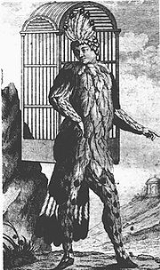
Tamino recovers to see before him Papageno, arrayed entirely in the plumage of birds, who sings of his job as a birdcatcher and the fact that he is longing for a wife. (Aria: Der Vogelfänger bin ich ja) Papageno jokes with Tamino but says that he brings the birds that he catches to the Queen of the Night's servants, who give him food and drink in return. Papageno also claims that he has saved Tamino and strangled the serpent with his bare hands. At this moment, the three ladies appear and punish his lie by paying for his birds with a stone instead of food, water instead of wine and placing a padlock
Padlock

Padlocks are portable Lock used to protect against theft, vandalism, sabotage, espionage, unauthorized use, and harm. They are designed to protect against some degree of forced and surreptitious entry....
 over his mouth. They tell Tamino that they were responsible for saving him. He deeply appreciates them and they show to the prince a miniature of a young maiden, Pamina, with whom he falls instantly in love. (Aria: Dies Bildnis ist bezaubernd schön
Dies Bildnis ist bezaubernd schön

Dies Bildnis ist bezaubernd sch?n is an aria from the 1791 opera Die Zauberfl?te by Wolfgang Amadeus Mozart, libretto by Emanuel Schikaneder....
 / This image is enchantingly lovely, Like no eye has ever beheld!")

The Queen of the Night now appears, demanding that Tamino free her daughter, the original of the picture, from the hands of Sarastro, promising that he can marry Pamina in return. (Recitative and aria: O zittre nicht, mein lieber Sohn
O zittre nicht, mein lieber Sohn

O zittre nicht, mein lieber Sohn is the first aria performed by the Queen of the Night character in Mozart singspiel opera The Magic Flute....
 / "Oh, tremble not, my dear son! You are innocent, wise, pious"). The ladies give Tamino a magic flute that can change men's hearts, remove the padlock from Papageno, and present him with a chime of bells to protect him. Papageno accompanies Tamino, and they set forth, guided by three boys. They escape all danger by the use of the magic instruments. (Quintet: Hm hm hm hm)

Scene 2: A room in Sarastro's palace

Pamina is dragged in by Sarastro's servant Monostatos, a Moor
Moors

In the Spanish language, the term for Moors is Moro; in Portuguese language the word is mouro. There seems to have been some confusion about the relationship of the word moro/mouro to the word moreno , both from Greek language ma?ros, i.e....
, who is persecuting her. (Trio: Du feines Täubchen, nun herein!) Papageno, sent ahead by Tamino to help find Pamina, arrives. Monostatos and Papageno are each terrified by the other's strange appearance and flee the stage. But Papageno soon returns and announces to Pamina that her mother has sent Tamino to her aid. Pamina rejoices to hear that Tamino is in love with her, and then offers sympathy and hope to Papageno, who longs for a Papagena to love. Together they sing an ode to love (Duet: Bei Männern welche Liebe fühlen), then depart.

Scene 3: Grove and entrance to the temples

The three boys lead in the prince. As Tamino reaches the temple, he is denied entrance at the Gates of Nature and Reason, by invisible voices singing "Go back!". But when he tries the Gate of Wisdom, a priest appears and gradually convinces him of the noble character of Sarastro. After the priest leaves him, Tamino plays his magic flute in hopes of summoning Pamina and Papageno. The tones of his magical instrument summon first a group of magically tamed beasts, then the sound of Papageno's pipes. Ecstatic at the thought of meeting Pamina, Tamino hurries off.

Papageno appears with Pamina, following the distant sound of Tamino's flute. The two are suddenly apprehended by Monostatos and his slaves. Papageno then works an enchantment on them with his magic bells, and they dance, blissfully and involuntarily, off the stage.

Papageno now hears the approach of Sarastro and his large retinue. He is frightened and asks Pamina what they should say. She replies, "The truth! The truth! Even if it were a crime," and with her words a triumphal march begins (Chorus: Es lebe Sarastro); Sarastro and his followers enter.

Sarastro conducts an impromptu judicial proceeding. Pamina falls at his feet and confesses that she was trying to escape because Monostatos had demanded her love. Sarastro receives her kindly and tells her that he will not force her inclinations, but cannot give her freedom.

Monostatos then enters with Tamino captive. The two lovers see one another for the first time and instantly embrace. The chorus sings "What is the meaning of this?" and they are separated. Monostatos tries to point the finger of blame at Tamino. Sarastro, however, does not believe Monostatos' dastardly trick. He punishes Monostatos for his insolence and leads Tamino and Papageno into the temple of Ordeal.

Act 2

Scene 4: A grove of palms

The council of priests, headed by Sarastro, enters to the sound of a solemn march. They determine that Tamino shall possess Pamina if he succeeds in passing through the ordeal, as they do not wish to return her to her mother, who has already infected the people with superstition
Superstition

Superstition is a belief or notion, not based on reason or knowledge. The word is often used pejoratively to refer to supposedly irrational beliefs of others, and its precise meaning is therefore subjective....
. Sarastro, echoed by his fellow priests, then sings a prayer to the gods Isis
ISIS

ISIS is an industry standard interface for technologies, developed by Pixel Translations in 1990 .ISIS is an open standard for scanner control and a complete image-processing framework....
 and Osiris
Osiris

Osiris was an Egyptian mythology, usually called the god of the Afterlife.Osiris is one of the oldest gods for whom records have been found; one of the oldest known attestations of his name is on the Palermo Stone of around 2500 BC....
, asking them to protect Tamino and Pamina and to take them into their heavenly dwelling place should they meet death in the course of their trials. (O Isis und Osiris)

Scene 5: The courtyard of the temple of Ordeal

Tamino and Papageno are led into the temple. Tamino is cautioned that this is his last chance to turn back, but he states that he will undergo every trial to win his Pamina. Papageno is asked if he will also concede to every trial, but he says that he doesn't really want wisdom or to struggle to get it. The priest tells Papageno that Sarastro may have a woman for him if he undergoes the trials, and that she is called Papagena. Papageno says that he wouldn't mind a look at her to be sure, but the priest says that he must keep silent. Papageno finally agrees.

The first test is that Tamino and Papageno shall remain silent under the temptation of women. (Duet, Speaker and Priest) The three ladies appear, and tempt them to speak. (Quintet, Papageno, Tamino, Three Ladies) Tamino and Papageno remain firm, though Tamino must constantly tell Papageno, "Silent!"

Papageno confronts one of the priests and asks why he must undergo tests if Sarastro already has a woman that wants to be his wife. The priest says that it is the only way.

Scene 6: A garden, Pamina asleep

Monostatos approaches and gazes upon Pamina with rapture. (Aria: Alles fühlt der Liebe Freuden) When the Queen of the Night appears and gives Pamina a dagger
Dagger

A dagger is a typically double-edged blade used for stabbing or thrusting. They often fulfill the role of a companion weapon in close combat....
 with which to kill Sarastro (Aria: Der Hölle Rache kocht in meinem Herzen
Der Hölle Rache kocht in meinem Herzen

Der H?lle Rache kocht in meinem Herzen is the second aria sung by the Queen of the Night in Wolfgang Amadeus Mozart opera The Magic Flute ....
 / "Hell's vengeance boileth in mine heart"), Monostatos retires and listens. He tries to force Pamina's love
Love

Love is any of a number of emotions and experiences related to a sense of strong affection and attachment . The word wikt:en:love can refer to a variety of different feelings, states, and attitudes, ranging from generic pleasure to intense interpersonal attraction....
 by using the secret, but is prevented by Sarastro, who allays Pamina's alarm. (Aria: In diesen heil'gen Hallen)

Scene 7: A hall in the temple of Ordeal

Tamino and Papageno must again suffer the test of silence. Papageno can no longer hold his tongue, but Tamino remains firm, even when Pamina speaks to him. Since Tamino refuses to answer, Pamina believes he loves her no longer. (Aria: Ach, ich fühl's, es ist verschwunden)

Scene 8: The pyramids

(Chorus) Sarastro parts Pamina and Tamino. (Trio, Sarastro, Pamina, Tamino) Papageno also desires to have his little wife, and sings of this with his magic bells. (Aria, Papageno: Ein Mädchen oder Weibchen). At the first ordeal, an old woman had appeared to him and declared herself his bride. She now again appears and changes herself into the young and pretty Papagena. However, the priests send her away with thunder and lightning. She vanishes, frightened, and Papageno is miserable.

Scene 9: An open country

The three boys see Pamina attempting to commit suicide because she believes Tamino to be faithless. They prevent her from doing so, and take her to see him.

Scene 10: Rocks with water and a cavern of fire.

Two men in armor lead in Tamino, and in the musical form of a Baroque
Baroque music

Baroque music describes a period or style of European classical music approximately extending from Dates of classical music eras. This era is said to begin in music after the Renaissance music and was followed by the Classical music era....
 chorale prelude
Chorale prelude

In music, a chorale prelude is a short liturgical composition for organ using a chorale tune as its basis. It was a predominant style of the German Baroque music era and reached its culmination in the works of Johann Sebastian Bach, who wrote 46 examples of the form in his Orgelb?chlein....
 give him advice, then reassurance that Pamina lives. Sarastro appears and sends Pamina in. Pamina arrives and is overcome with joy to find Tamino, who is now allowed to speak to her. Both pass unscathed through the final ordeal of fire and water with the help of the magic flute, which Pamina tells him was carved by her father from an ancient oak
Oak

The term oak can be used as part of the common name of any of about 400 species of trees and shrubs in the genus Quercus , which are listed in the List of Quercus species, and some related genera, notably Lithocarpus....
 tree. They emerge from their trials to the sound of an offstage chorus singing "Triumph!".

Papageno wishes to take his own life because he can't stop thinking about Papagena, but at the last minute the Three Boys appear and remind him that he should use his magic bells. The bells when played indeed summon Papagena, and the happy couple is united, stuttering at first ("pa … pa … pa") in astonishment. (Duet: Papageno! Papagena!)

The traitorous Monostatos appears with the Queen of the Night and her ladies to destroy the temple (Nur stille, stille), but they are magically cast out into eternal night.

The scene now changes to the entrance of the chief temple, where Sarastro bids the young lovers welcome and unites them. The final chorus sings the praises of Tamino and Pamina in enduring their trials and gives thanks to the gods.

[The opera may sometimes be divided into three acts in which case, the third act typically begins with scene 8]


Noted arias

  • "O zittre nicht, mein lieber Sohn
    O zittre nicht, mein lieber Sohn

    O zittre nicht, mein lieber Sohn is the first aria performed by the Queen of the Night character in Mozart singspiel opera The Magic Flute....
    " (Oh, tremble not, my beloved son) — The Queen of the Night in Act I, Scene I
  • "Der Vogelfänger bin ich ja" (The birdcatcher am I) — Papageno in Act I, Scene I
  • "Dies Bildnis ist bezaubernd schön
    Dies Bildnis ist bezaubernd schön

    Dies Bildnis ist bezaubernd sch?n is an aria from the 1791 opera Die Zauberfl?te by Wolfgang Amadeus Mozart, libretto by Emanuel Schikaneder....
    " (This image is enchantingly beautiful) — Tamino in Act I, Scene I
  • "O wenn ich doch" — Tamino in Act I, Scene III
  • '"Wie stark ist nicht dein Zauberton" (How strong is not thy magic tone) — Tamino in the Finale of Act I
  • "O Isis und Osiris" (O Isis and Osiris) — Sarastro in Act II, Scene I
  • "Alles fühlt der Liebe Freuden" (All feel the joys of love) — Monostatos in Act II, Scene III
  • "Der Hölle Rache kocht in meinem Herzen
    Der Hölle Rache kocht in meinem Herzen

    Der H?lle Rache kocht in meinem Herzen is the second aria sung by the Queen of the Night in Wolfgang Amadeus Mozart opera The Magic Flute ....
    " (Hell's vengeance boileth in mine heart) — The Queen of the Night in Act II, Scene III
  • "In diesen heil'gen Hallen" (Within these sacred halls) — Sarastro in Act II, Scene III
  • "Ach, ich fühl's, es ist verschwunden" (Ah, I feel it, it is vanished) — Pamina in Act II, Scene IV
  • "Ein Mädchen oder Weibchen" (A girl or a woman) — Papageno in Act II, Scene V


Works inspired by The Magic Flute


Films

  • Trollflöjten
    The Magic Flute (1975 film)

    The Magic Flute is Ingmar Bergman's 1975 in film highly acclaimed film version of Wolfgang Amadeus Mozart's opera Die Zauberfl?te. It was intended as a TV-production and was first shown on Swedish television but was followed by a cinema release later that year....
    , an acclaimed film version made by Ingmar Bergman
    Ingmar Bergman

    Ernst Ingmar Bergman was a Sweden director, writer and Film producer for film, stage and television. He depicted bleakness and despair as well as comedy and hope in his explorations of the human condition....
     in 1975
  • The Smurfs and the Magic Flute
    The Smurfs and the Magic Flute

    The Smurfs and the Magic Flute is an animated film starring the Smurfs, directed by their creator, Peyo. Though the film premiered in 1976 in film in Belgium, the English language version was not released until 1983, in the wake of the characters newfound popularity in the United States....
    ,
    a 1983 children's movie (originally released in 1976) loosely based on "The Magic Flute"
  • The Magic Flute
    The Magic Flute (2006 film)

    The Magic Flute is an English adaptation of Wolfgang Amadeus Mozart's singspiel The Magic Flute directed by Kenneth Branagh. Film co-production by France & UK, produced by Id?ale Audience and with UK's The Peter Moores Foundation....
    , a 2006 film version set against a background inspired by World War I
    World War I

    World War I, or the First World War , was a global military conflict which involved the Great powers, organized into two opposing military alliances: the Allies of World War I and the Central Powers....
    , directed by Kenneth Branagh
    Kenneth Branagh

    Kenneth Charles Branagh is an Emmy Award-winning, Academy Award-nominated actor and film director from Northern Ireland....
    .


Books

  • John Updike
    John Updike

    John Hoyer Updike was an American novelist, poet, short story writer, art critic, and literary critic. Updike's most famous work is his Rabbit series ....
    , A children's book based on The Magic Flute, 1962.
  • Marion Zimmer Bradley
    Marion Zimmer Bradley

    Marion Eleanor Zimmer Bradley was an United States author of fantasy novels such as The Mists of Avalon and the Darkover series, often with a feminist outlook....
    , Night's Daughter, a novel based on The Magic Flute, 1985. It sets the story in an Atlantis-like world with human-animal hybrid creatures. Bradley enthusiastically agrees with Bergman that Sarastro is Pamina's father.
  • Barbara Trapido
    Barbara Trapido

    Barbara Trapido, born 1941, is a United Kingdom novel. Born in Cape Town and growing up in Durban she studied at the University of Natal gaining a BA in 1963 before emigrating to London....
    , Temples of Delight, 1990. A novel which, though set in contemporary England, takes its structure very loosely from The Magic Flute. Characters in the novel are analogous to Pamina, Tamino, Papageno and Sarastro although the novel strays heavily from the original plot with the 'Pamina' character ultimately rejecting 'Tamino' in favour of a romantic relationship with 'Sarastro'.
  • Cameron Dokey
    Cameron Dokey

    Cameron Dokey is an United States author. She lives in Seattle, Washington with her four cats and her husband. She has a collection of over 50 old sci-fi and horror films....
    , Sunlight and Shadow, (part of the Once Upon A Time series), 2004, a retelling of The Magic Flute for teen readers; Dokey's novel also states that Sarastro is Pamina's father.
  • Yoshitaka Amano
    Yoshitaka Amano

    is a Japanese people artist known for his illustrations for Vampire Hunter D and for his character designs, image illustrations and title logo designs for the Final Fantasy video game series developed by Square Enix ....
    , Mateki: The Magic Flute, an adaption of the opera illustrated by himself and retold using classic Japanese elements.
  • Anne Gatti, The Magic Flute, an adaptation for young readers in picture-book form with illustrations by Peter Malone.


Adaptations

  • Arctic Magic Flute
    Arctic Magic Flute

    Arctic Magic Flute is an adaptation, sung in English, of Mozart opera The Magic Flute by Ryan Conarro, Joyce Parry Moore and William Todd Hunt, setting the action in northern Alaska at an unspecified post-apocalyptic future date....
     is an English-language adaptation of the opera, set in rural Alaska.
  • Pamina Devi is the Cambodia
    Cambodia

    The Kingdom of Cambodia is a country in South East Asia with a population of over 13 million people. The kingdom's capital and largest city is Phnom Penh....
    n classical dance
    Khmer classical dance

    Khmer classical dance is a form of dance from Cambodia which shares some similarities with the classical dances of Thailand and Laos. The dance form from Cambodia is known by various names in English, such as Khmer people royal ballet and Cambodian court dance....
     adaptation of The Magic Flute. However, it is not entirely based on the same plot and includes elements foreign to the original.
  • Pioneering guitarist and composer Fernando Sor
    Fernando Sor

    Fernando Sor was a Spain classical guitar and composer, born in Barcelona. In Spain he is sometimes known as the "Ludwig van Beethoven of the Guitar"....
     transcribed 'Six Airs from the Magic Flute, Op.19' for solo guitar around 1820–1821.


Media


See also

  • List of Mozart's operas


External links

  • Synopsis — Libretto — Highlights
  • Soundfiles (MIDI)
  • from Aria-Database.com
  • from internetloge.org
  • from Edmond Masonic Lodge #37
  • MP3
  • , and perform "Der Hölle Rache"
  • from recent Opera Gold production, Goldsmiths, University of London
  • UCSD-TV & San Diego Opera