


Star chart

Encyclopedia
A star chart is a map of the night sky
. Astronomers divide these into grids to use them more easily. They are used to identify and locate astronomical object
s such as star
s, constellation
s and galaxies
. They have been used for human navigation
since time immemorial. Note that a star chart differs from an astronomical catalog
, which is a listing or tabulation of astronomical objects for a particular purpose. A planisphere
is a type of star chart.
.jpg)
tusk that was discovered in Germany in 1979. It is one of the most famous designs in the world. This artifact is 32,500 years old and has a carving that resembles the constellation
Orion
. A drawing on the wall of the Lascaux
caves in France has a graphical representation of the Pleiades
open cluster
of stars. This is dated to 33,000 to 10,000 years ago. Researcher Michael A. Rappenglueck has suggested that a panel in the same caves depicting a charging bison, a man with a bird's head and the head of a bird on top of a piece of wood, together may depict the summer triangle
, which at the time was a circumpolar formation.A brief description of this picture shown in the picture could be that its silver made out of silk and mood its old and you can see its dick there as well. Another star chart panel, created more than 21,000 years ago, was found in the La Tête du Lion grotto. The bovine in this panel may represent the constellation
Taurus
, with a pattern representing the Pleiades located just above it.
(476-221 BC). The oldest Chinese graphical representation of the sky is a lacquer box dated to 430 BC, although this depiction does not show individual stars.
The Farnese Atlas
is a 2nd century copy of a Hellenistic era statue depicting the Titan
Atlas
holding the celestial sphere
on his shoulder. It is the oldest surviving depiction of the ancient Greek
constellations, and includes grid circles that provide coordinate positions. Because of precession
, the positions of the constellations slowly change over time. By comparing the positions of the 41 constellations against the grid circles, an accurate determination can be made of the epoch
when the original observations were performed. Based upon this information, the constellations were catalogued at . This evidence indicates that the star catalogue of the Greek astronomer Hipparchus
was used.
A Roman era example of a graphical representation of the night sky is the Egyptian Dendera zodiac
, dated from 50 BC. This is a bas relief sculpting on a ceiling at the Dendera Temple complex
. It is a planisphere
depicting the zodiac
in graphical representations. However, individual stars are not plotted.
along the Silk Road
- the Dunhuang Star Chart. This is a scroll 210 cm in length and 24.4 cm wide showing the sky between declination
s 40° south to 40° north in twelve panels, plus a thirteenth panel showing the northern circumpolar sky. A total of 1,345 stars are drawn, grouped into 257 asterisms
. The date of this chart is uncertain, but is estimated as 705–10 AD.
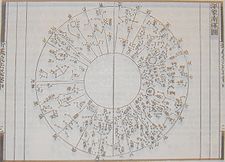 During the Song dynasty
, the Chinese astronomer Su Song
wrote a book titled Xin Yixiang Fa Yao (New Design for the Armillary Clock) containing five maps of 1,464 stars. This has been dated to 1092. In 1193, the astronomer Huang Shang prepared a planisphere along with explanatory text. It was engraved in stone in 1247, and this chart still exists in the Wen Miao temple in Suzhou
.
In Muslim astronomy, the first star chart to be drawn accurately was most likely the illustrations produced by the Persian astronomer Abd al-Rahman al-Sufi in his 964 work titled Book of Fixed Stars
. This book was an update of parts VII.5 and VIII.1 of the 2nd century Almagest
star catalogue by Ptolemy
. The work of al-Sufi contained illustrations of the constellations and portrayed the brighter stars as dots. The original book did not survive, but a copy from about 1009 is preserved at the Oxford University.
Perhaps the oldest European star map was a parchment manuscript titled De Composicione Spere Solide. It was most likely produced in Vienna
, Austria
in 1440 and consisted of a two part map depicting the constellations of the northern celestial hemisphere and the ecliptic
. This may have served as a prototype for the oldest European printed star chart, a 1515 set of woodcut portraits produced by Albrecht Dürer
in Nuremberg
, Germany
.
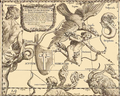 During the European Age of Discovery
, expeditions to the southern hemisphere began to result in the addition of new constellations. These most likely came from the records of two Dutch sailors, Pieter Dirkszoon Keyser
and Frederick de Houtman
, who in 1595 traveled together to the Dutch East Indies
. Their compilations resulted in the 1601 globe of Jodocus Hondius
, who added 12 new southern constellations. Several other such maps were produced, including Johann Bayer
's Uranometria
in 1603. The latter was the first atlas to chart both celestial hemispheres and it introduced the Bayer designation
s for identifying the brightest stars using the Greek alphabet. The Uranometria contained 48 maps of Ptolemaic constellations, a plate of the southern constellations and two plates showing the entire northern and southern hemispheres in stereographic polar projection.
The Pole Johannes Hevelius
finished his Firmamentum Sobiescianum star atlas in 1690. It contained 56 large, double page star maps and improved the accuracy in the position of the southern stars. He introduced 11 more constellations (Scutum
, Lacerta
, Canes Venatici
, etc.).
Night sky
The term night sky refers to the sky as seen at night. The term is usually associated with astronomy, with reference to views of celestial bodies such as stars, the Moon, and planets that become visible on a clear night after the Sun has set. Natural light sources in a night sky include moonlight,...
. Astronomers divide these into grids to use them more easily. They are used to identify and locate astronomical object
Astronomical object
Astronomical objects or celestial objects are naturally occurring physical entities, associations or structures that current science has demonstrated to exist in the observable universe. The term astronomical object is sometimes used interchangeably with astronomical body...
s such as star
Star
A star is a massive, luminous sphere of plasma held together by gravity. At the end of its lifetime, a star can also contain a proportion of degenerate matter. The nearest star to Earth is the Sun, which is the source of most of the energy on Earth...
s, constellation
Constellation
In modern astronomy, a constellation is an internationally defined area of the celestial sphere. These areas are grouped around asterisms, patterns formed by prominent stars within apparent proximity to one another on Earth's night sky....
s and galaxies
Galaxy
A galaxy is a massive, gravitationally bound system that consists of stars and stellar remnants, an interstellar medium of gas and dust, and an important but poorly understood component tentatively dubbed dark matter. The word galaxy is derived from the Greek galaxias , literally "milky", a...
. They have been used for human navigation
Navigation
Navigation is the process of monitoring and controlling the movement of a craft or vehicle from one place to another. It is also the term of art used for the specialized knowledge used by navigators to perform navigation tasks...
since time immemorial. Note that a star chart differs from an astronomical catalog
Astronomical catalog
An astronomical catalog or catalogue is a list or tabulation of astronomical objects, typically grouped together because they share a common type, morphology, origin, means of detection, or method of discovery...
, which is a listing or tabulation of astronomical objects for a particular purpose. A planisphere
Planisphere
A planisphere is a star chart analog computing instrument in the form of two adjustable disks that rotate on a common pivot. It can be adjusted to display the visible stars for any time and date. It is an instrument to assist in learning how to recognize stars and constellations...
is a type of star chart.
History
Prehistory
The oldest star chart known may be a carved ivory MammothMammoth
A mammoth is any species of the extinct genus Mammuthus. These proboscideans are members of Elephantidae, the family of elephants and mammoths, and close relatives of modern elephants. They were often equipped with long curved tusks and, in northern species, a covering of long hair...
tusk that was discovered in Germany in 1979. It is one of the most famous designs in the world. This artifact is 32,500 years old and has a carving that resembles the constellation
Constellation
In modern astronomy, a constellation is an internationally defined area of the celestial sphere. These areas are grouped around asterisms, patterns formed by prominent stars within apparent proximity to one another on Earth's night sky....
Orion
Orion (constellation)
Orion, often referred to as The Hunter, is a prominent constellation located on the celestial equator and visible throughout the world. It is one of the most conspicuous, and most recognizable constellations in the night sky...
. A drawing on the wall of the Lascaux
Lascaux
Lascaux is the setting of a complex of caves in southwestern France famous for its Paleolithic cave paintings. The original caves are located near the village of Montignac, in the department of Dordogne. They contain some of the best-known Upper Paleolithic art. These paintings are estimated to be...
caves in France has a graphical representation of the Pleiades
Pleiades (star cluster)
In astronomy, the Pleiades, or Seven Sisters , is an open star cluster containing middle-aged hot B-type stars located in the constellation of Taurus. It is among the nearest star clusters to Earth and is the cluster most obvious to the naked eye in the night sky...
open cluster
Open cluster
An open cluster is a group of up to a few thousand stars that were formed from the same giant molecular cloud and have roughly the same age. More than 1,100 open clusters have been discovered within the Milky Way Galaxy, and many more are thought to exist...
of stars. This is dated to 33,000 to 10,000 years ago. Researcher Michael A. Rappenglueck has suggested that a panel in the same caves depicting a charging bison, a man with a bird's head and the head of a bird on top of a piece of wood, together may depict the summer triangle
Summer Triangle
The Summer Triangle is an astronomical asterism involving an imaginary triangle drawn on the northern hemisphere's celestial sphere, with its defining vertices at Altair, Deneb, and Vega, being the brightest stars in the three constellations of Aquila, Cygnus, and Lyra.The English term was...
, which at the time was a circumpolar formation.A brief description of this picture shown in the picture could be that its silver made out of silk and mood its old and you can see its dick there as well. Another star chart panel, created more than 21,000 years ago, was found in the La Tête du Lion grotto. The bovine in this panel may represent the constellation
Constellation
In modern astronomy, a constellation is an internationally defined area of the celestial sphere. These areas are grouped around asterisms, patterns formed by prominent stars within apparent proximity to one another on Earth's night sky....
Taurus
Taurus (constellation)
Taurus is one of the constellations of the zodiac. Its name is a Latin word meaning 'bull', and its astrological symbol is a stylized bull's head:...
, with a pattern representing the Pleiades located just above it.
Antiquity
The oldest Chinese astronomy records date to before the Warring States PeriodWarring States Period
The Warring States Period , also known as the Era of Warring States, or the Warring Kingdoms period, covers the Iron Age period from about 475 BC to the reunification of China under the Qin Dynasty in 221 BC...
(476-221 BC). The oldest Chinese graphical representation of the sky is a lacquer box dated to 430 BC, although this depiction does not show individual stars.
The Farnese Atlas
Farnese Atlas
The Farnese Atlas is a 2nd-century Roman marble copy of a Hellenistic sculpture of Atlas kneeling with a globe weighing heavily on his shoulders. It is the oldest extant statue of the Titan of Greek mythology, who is represented in earlier vase-painting, and more important, the oldest known...
is a 2nd century copy of a Hellenistic era statue depicting the Titan
Titan (mythology)
In Greek mythology, the Titans were a race of powerful deities, descendants of Gaia and Uranus, that ruled during the legendary Golden Age....
Atlas
Atlas
An atlas is a collection of maps; it is typically a map of Earth or a region of Earth, but there are atlases of the other planets in the Solar System. Atlases have traditionally been bound into book form, but today many atlases are in multimedia formats...
holding the celestial sphere
Celestial sphere
In astronomy and navigation, the celestial sphere is an imaginary sphere of arbitrarily large radius, concentric with the Earth and rotating upon the same axis. All objects in the sky can be thought of as projected upon the celestial sphere. Projected upward from Earth's equator and poles are the...
on his shoulder. It is the oldest surviving depiction of the ancient Greek
Ancient Greek
Ancient Greek is the stage of the Greek language in the periods spanning the times c. 9th–6th centuries BC, , c. 5th–4th centuries BC , and the c. 3rd century BC – 6th century AD of ancient Greece and the ancient world; being predated in the 2nd millennium BC by Mycenaean Greek...
constellations, and includes grid circles that provide coordinate positions. Because of precession
Precession
Precession is a change in the orientation of the rotation axis of a rotating body. It can be defined as a change in direction of the rotation axis in which the second Euler angle is constant...
, the positions of the constellations slowly change over time. By comparing the positions of the 41 constellations against the grid circles, an accurate determination can be made of the epoch
Epoch (astronomy)
In astronomy, an epoch is a moment in time used as a reference point for some time-varying astronomical quantity, such as celestial coordinates, or elliptical orbital elements of a celestial body, where these are subject to perturbations and vary with time...
when the original observations were performed. Based upon this information, the constellations were catalogued at . This evidence indicates that the star catalogue of the Greek astronomer Hipparchus
Hipparchus
Hipparchus, the common Latinization of the Greek Hipparkhos, can mean:* Hipparchus, the ancient Greek astronomer** Hipparchic cycle, an astronomical cycle he created** Hipparchus , a lunar crater named in his honour...
was used.
A Roman era example of a graphical representation of the night sky is the Egyptian Dendera zodiac
Dendera zodiac
The sculptured Dendera zodiac is a widely known Egyptian bas-relief from the ceiling of the pronaos of a chapel dedicated to Osiris in the Hathor temple at Dendera, containing images of Taurus and the Libra . This chapel was begun in the late Ptolemaic period; its pronaos was added by the...
, dated from 50 BC. This is a bas relief sculpting on a ceiling at the Dendera Temple complex
Dendera Temple complex
Dendera Temple complex, . located about 2.5 km south-east of Dendera, Egypt. It is one of the best-preserved temple complexes in Egypt...
. It is a planisphere
Planisphere
A planisphere is a star chart analog computing instrument in the form of two adjustable disks that rotate on a common pivot. It can be adjusted to display the visible stars for any time and date. It is an instrument to assist in learning how to recognize stars and constellations...
depicting the zodiac
Zodiac
In astronomy, the zodiac is a circle of twelve 30° divisions of celestial longitude which are centred upon the ecliptic: the apparent path of the Sun across the celestial sphere over the course of the year...
in graphical representations. However, individual stars are not plotted.
Medieval
The oldest surviving manuscript star chart was discovered in the Mogao CavesMogao Caves
The Mogao Caves or Mogao Grottoes , also known as the Caves of the Thousand Buddhas , form a system of 492 temples southeast of the center of Dunhuang, an oasis strategically located at a religious and cultural crossroads on the Silk Road, in Gansu province, China...
along the Silk Road
Silk Road
The Silk Road or Silk Route refers to a historical network of interlinking trade routes across the Afro-Eurasian landmass that connected East, South, and Western Asia with the Mediterranean and European world, as well as parts of North and East Africa...
- the Dunhuang Star Chart. This is a scroll 210 cm in length and 24.4 cm wide showing the sky between declination
Declination
In astronomy, declination is one of the two coordinates of the equatorial coordinate system, the other being either right ascension or hour angle. Declination in astronomy is comparable to geographic latitude, but projected onto the celestial sphere. Declination is measured in degrees north and...
s 40° south to 40° north in twelve panels, plus a thirteenth panel showing the northern circumpolar sky. A total of 1,345 stars are drawn, grouped into 257 asterisms
Asterism (astronomy)
In astronomy, an asterism is a pattern of stars recognized on Earth's night sky. It may form part of an official constellation, or be composed of stars from more than one. Like constellations, asterisms are in most cases composed of stars which, while they are visible in the same general direction,...
. The date of this chart is uncertain, but is estimated as 705–10 AD.
Song Dynasty
The Song Dynasty was a ruling dynasty in China between 960 and 1279; it succeeded the Five Dynasties and Ten Kingdoms Period, and was followed by the Yuan Dynasty. It was the first government in world history to issue banknotes or paper money, and the first Chinese government to establish a...
, the Chinese astronomer Su Song
Su Song
Su Song was a renowned Chinese polymath who specialized himself as a statesman, astronomer, cartographer, horologist, pharmacologist, mineralogist, zoologist, botanist, mechanical and architectural engineer, poet, antiquarian, and ambassador of the Song Dynasty .Su Song was the engineer of a...
wrote a book titled Xin Yixiang Fa Yao (New Design for the Armillary Clock) containing five maps of 1,464 stars. This has been dated to 1092. In 1193, the astronomer Huang Shang prepared a planisphere along with explanatory text. It was engraved in stone in 1247, and this chart still exists in the Wen Miao temple in Suzhou
Suzhou
Suzhou , previously transliterated as Su-chou, Suchow, and Soochow, is a major city located in the southeast of Jiangsu Province in Eastern China, located adjacent to Shanghai Municipality. The city is situated on the lower reaches of the Yangtze River and on the shores of Taihu Lake and is a part...
.
In Muslim astronomy, the first star chart to be drawn accurately was most likely the illustrations produced by the Persian astronomer Abd al-Rahman al-Sufi in his 964 work titled Book of Fixed Stars
Book of Fixed Stars
The Book of Fixed Stars is an astronomical text written by Abd al-Rahman al-Sufi around 964. The book was written in Arabic, although the author himself was Persian...
. This book was an update of parts VII.5 and VIII.1 of the 2nd century Almagest
Almagest
The Almagest is a 2nd-century mathematical and astronomical treatise on the apparent motions of the stars and planetary paths. Written in Greek by Claudius Ptolemy, a Roman era scholar of Egypt,...
star catalogue by Ptolemy
Ptolemy
Claudius Ptolemy , was a Roman citizen of Egypt who wrote in Greek. He was a mathematician, astronomer, geographer, astrologer, and poet of a single epigram in the Greek Anthology. He lived in Egypt under Roman rule, and is believed to have been born in the town of Ptolemais Hermiou in the...
. The work of al-Sufi contained illustrations of the constellations and portrayed the brighter stars as dots. The original book did not survive, but a copy from about 1009 is preserved at the Oxford University.
Perhaps the oldest European star map was a parchment manuscript titled De Composicione Spere Solide. It was most likely produced in Vienna
Vienna
Vienna is the capital and largest city of the Republic of Austria and one of the nine states of Austria. Vienna is Austria's primary city, with a population of about 1.723 million , and is by far the largest city in Austria, as well as its cultural, economic, and political centre...
, Austria
Austria
Austria , officially the Republic of Austria , is a landlocked country of roughly 8.4 million people in Central Europe. It is bordered by the Czech Republic and Germany to the north, Slovakia and Hungary to the east, Slovenia and Italy to the south, and Switzerland and Liechtenstein to the...
in 1440 and consisted of a two part map depicting the constellations of the northern celestial hemisphere and the ecliptic
Ecliptic
The ecliptic is the plane of the earth's orbit around the sun. In more accurate terms, it is the intersection of the celestial sphere with the ecliptic plane, which is the geometric plane containing the mean orbit of the Earth around the Sun...
. This may have served as a prototype for the oldest European printed star chart, a 1515 set of woodcut portraits produced by Albrecht Dürer
Albrecht Dürer
Albrecht Dürer was a German painter, printmaker, engraver, mathematician, and theorist from Nuremberg. His prints established his reputation across Europe when he was still in his twenties, and he has been conventionally regarded as the greatest artist of the Northern Renaissance ever since...
in Nuremberg
Nuremberg
Nuremberg[p] is a city in the German state of Bavaria, in the administrative region of Middle Franconia. Situated on the Pegnitz river and the Rhine–Main–Danube Canal, it is located about north of Munich and is Franconia's largest city. The population is 505,664...
, Germany
Germany
Germany , officially the Federal Republic of Germany , is a federal parliamentary republic in Europe. The country consists of 16 states while the capital and largest city is Berlin. Germany covers an area of 357,021 km2 and has a largely temperate seasonal climate...
.
Early modern
Age of Discovery
The Age of Discovery, also known as the Age of Exploration and the Great Navigations , was a period in history starting in the early 15th century and continuing into the early 17th century during which Europeans engaged in intensive exploration of the world, establishing direct contacts with...
, expeditions to the southern hemisphere began to result in the addition of new constellations. These most likely came from the records of two Dutch sailors, Pieter Dirkszoon Keyser
Pieter Dirkszoon Keyser
Pieter Dirkszoon Keyser , a.k.a. Petrus Theodori, was a Dutch navigator who mapped the southern sky....
and Frederick de Houtman
Frederick de Houtman
Frederick de Houtman , or Frederik de Houtman, was a Dutch explorer who sailed along the Western coast of Australia en route to Batavia.-Biography:...
, who in 1595 traveled together to the Dutch East Indies
Dutch East Indies
The Dutch East Indies was a Dutch colony that became modern Indonesia following World War II. It was formed from the nationalised colonies of the Dutch East India Company, which came under the administration of the Netherlands government in 1800....
. Their compilations resulted in the 1601 globe of Jodocus Hondius
Jodocus Hondius
Jodocus Hondius , sometimes called Jodocus Hondius the Elder to distinguish him from his son Henricus Hondius II, was a Flemish artist, engraver, and cartographer...
, who added 12 new southern constellations. Several other such maps were produced, including Johann Bayer
Johann Bayer
Johann Bayer was a German lawyer and uranographer . He was born in Rain, Bavaria, in 1572. He began his study of philosophy in Ingolstadt in 1592, and moved later to Augsburg to begin work as a lawyer. He grew interested in astronomy during his time in Augsburg...
's Uranometria
Uranometria
Uranometria is the short title of a star atlas produced by Johann Bayer.It was published in Augsburg, Germany, in 1603 by Christophorus Mangus under the full title Uranometria : omnium asterismorum continens schemata, nova methodo delineata, aereis laminis expressa. This translates to...
in 1603. The latter was the first atlas to chart both celestial hemispheres and it introduced the Bayer designation
Bayer designation
A Bayer designation is a stellar designation in which a specific star is identified by a Greek letter, followed by the genitive form of its parent constellation's Latin name...
s for identifying the brightest stars using the Greek alphabet. The Uranometria contained 48 maps of Ptolemaic constellations, a plate of the southern constellations and two plates showing the entire northern and southern hemispheres in stereographic polar projection.
The Pole Johannes Hevelius
Johannes Hevelius
Johannes Hevelius Some sources refer to Hevelius as Polish:Some sources refer to Hevelius as German:*Encyplopedia Britannica * of the Royal Society was a councilor and mayor of Danzig , Pomeranian Voivodeship, in the Polish-Lithuanian Commonwealth...
finished his Firmamentum Sobiescianum star atlas in 1690. It contained 56 large, double page star maps and improved the accuracy in the position of the southern stars. He introduced 11 more constellations (Scutum
Scutum
Scutum is a small constellation introduced in the seventeenth century. Its name is Latin for shield.-History:Scutum is the only constellation that owes its name to a non-classical historical figure...
, Lacerta
Lacerta
Lacerta is one of the 88 modern constellations defined by the International Astronomical Union. Its name is Latin for lizard. A small, faint constellation, it was created in 1687 by the astronomer Johannes Hevelius. Its brightest stars form a "W" shape similar to that of Cassiopeia, and it is thus...
, Canes Venatici
Canes Venatici
Canes Venatici is one of the 88 official modern constellations. It is a small northern constellation that was created by Johannes Hevelius in the 17th century. Its name is Latin for "hunting dogs", and the constellation is often depicted in illustrations as representing the dogs of Boötes the...
, etc.).
See also
- AstrologyAstrologyAstrology consists of a number of belief systems which hold that there is a relationship between astronomical phenomena and events in the human world...
- List of constellations by area
- List of stars by constellation
- Magnitude (astronomy)Magnitude (astronomy)Magnitude is the logarithmic measure of the brightness of an object, in astronomy, measured in a specific wavelength or passband, usually in optical or near-infrared wavelengths.-Background:...
- Star cartographyStar cartographyCelestial cartography, uranography or star cartography, is the fringe of astronomy and branch of cartography concerned with mapping stars, galaxies, and other astronomical objects on the celestial sphere...
- Timeline of astronomical maps, catalogs, and surveysTimeline of astronomical maps, catalogs, and surveysTimeline of astronomical maps, catalogs and surveys* ca. 1800 BC — Babylonian star catalog* ca. 350 BC — Shi Shen's star catalog has almost 800 entries* ca. 300 BC — star catalog of Timocharis of Alexandria...
External links
- An online guide to using a star chart
- The world's earliest manuscript Star Chart from Dunhuang on the Silk Road
Star charts
- Sky Chart - Free Northern Sky Chart Cutout.
- Planispherium - Free Northern Sky Chart Cutout in Latin
- SFA Star Charts - Free star charts
- Geody Star Charts - Free (CC-by-sa) printer friendly star charts for several latitudes and times of the year
- An online star chart
- Monthly sky maps for every location on Earth
- The Evening Sky Map - Free monthly star charts and calendar for northern hemisphere, southern hemisphere, and equatorial sky watchers.
- Sky Map Online - Free interactive star chart (showing over 1.2 million stars up to magnitude 12)
- Stellarmap.com - Online map of the stars (requires compatible browser such as Chrome, Opera, Firefox, Safari or IE9).