
All Topics  
Open cluster

 
Open Cluster

   Email Print
   Bookmark   Link


Open cluster


An open cluster is a group
Star cluster

Star clusters or star clouds are groups of stars which are gravity bound. Two types of star clusters can be distinguished: globular clusters are tight groups of hundreds of thousands of very old stars, while open clusters generally contain less than a few hundred members, and are often very young....
 of up to a few thousand star
Star

A star is a massive, luminous ball of Plasma that is held together by its own gravity. The nearest star to Earth is the Sun, which is the source of most of the energy on Earth....
s that were formed from the same giant molecular cloud, and are still loosely gravitationally bound to each other. In contrast, globular cluster
Globular cluster

A globular cluster is a sphere collection of stars that orbits a Galactic Center as a satellite. Globular clusters are very tightly bound by gravity, which gives them their spherical shapes and relatively high stellar densities toward their centers....
s are very tightly bound by gravity. Open clusters have been found only in spiral
Spiral galaxy

A spiral galaxy is a galaxy belonging to one of the three main galaxy morphological classification originally described by Edwin Hubble in his 1936 work ?The Realm of the Nebulae? and, as such, forms part of the Hubble sequence....
 and irregular galaxies
Irregular galaxy

Some galaxies do not have a regular shape, like a spiral galaxy or an elliptical galaxy. Those galaxies are known as irregular galaxies. Their shape is uncommon....
, in which active star formation
Star formation

Star formation is the process by which dense parts of molecular clouds collapse into a ball of Plasma to form a star. As a branch of astronomy star formation includes the study of the interstellar medium and giant molecular clouds as precursors to the star formation process and the study of young stellar objects and planet formation as its i...
 is occurring.


Discussion
Ask a question about 'Open cluster'
Start a new discussion about 'Open cluster'
Answer questions from other users
Full Discussion Forum


Encyclopedia


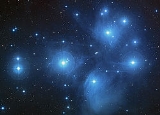
Pleiades Large
An open cluster is a group
Star cluster

Star clusters or star clouds are groups of stars which are gravity bound. Two types of star clusters can be distinguished: globular clusters are tight groups of hundreds of thousands of very old stars, while open clusters generally contain less than a few hundred members, and are often very young....
 of up to a few thousand star
Star

A star is a massive, luminous ball of Plasma that is held together by its own gravity. The nearest star to Earth is the Sun, which is the source of most of the energy on Earth....
s that were formed from the same giant molecular cloud, and are still loosely gravitationally bound to each other. In contrast, globular cluster
Globular cluster

A globular cluster is a sphere collection of stars that orbits a Galactic Center as a satellite. Globular clusters are very tightly bound by gravity, which gives them their spherical shapes and relatively high stellar densities toward their centers....
s are very tightly bound by gravity. Open clusters have been found only in spiral
Spiral galaxy

A spiral galaxy is a galaxy belonging to one of the three main galaxy morphological classification originally described by Edwin Hubble in his 1936 work ?The Realm of the Nebulae? and, as such, forms part of the Hubble sequence....
 and irregular galaxies
Irregular galaxy

Some galaxies do not have a regular shape, like a spiral galaxy or an elliptical galaxy. Those galaxies are known as irregular galaxies. Their shape is uncommon....
, in which active star formation
Star formation

Star formation is the process by which dense parts of molecular clouds collapse into a ball of Plasma to form a star. As a branch of astronomy star formation includes the study of the interstellar medium and giant molecular clouds as precursors to the star formation process and the study of young stellar objects and planet formation as its i...
 is occurring. They are usually less than a few hundred million years old: they become disrupted by close encounters with other clusters and clouds of gas as they orbit the galactic center, as well as losing cluster members through internal close encounters.

Young open clusters may still be contained within the molecular cloud from which they formed, illuminating it to create an H II region
H II region

An H II region is a cloud of glowing gas and Plasma , sometimes several hundred light-years across, in which star formation is taking place....
. Over time, radiation pressure
Radiation pressure

Radiation pressure is the pressure exerted upon any surface exposed to electromagnetic radiation. If absorbed, the pressure is the power flux density divided by the speed of light....
 from the cluster will disperse the molecular cloud. Typically, about 10% of the mass of a gas cloud will coalesce into stars before radiation pressure drives the rest away.

Open clusters are very important objects in the study of stellar evolution
Stellar evolution

Stellar evolution is the process by which a star undergoes a sequence of radical changes during its lifetime. Depending on the mass of the star, this lifetime ranges from only few millions of years to trillions of years , considerably more than the age of the universe....
. Because the stars are all of very similar age and chemical composition
Chemical element

A chemical element is a type of atom that is distinguished by its atomic number; that is, by the number of protons in its atomic nucleus. The term is also used to refer to a pure chemical Chemical substance composed of atoms with the same number of protons....
, the effects of other more subtle variables on the properties of stars are much more easily studied than they are for isolated stars.

A number of open clusters, such as the Pleiades
Pleiades (star cluster)

File:Pleiades Lanoue.pngIn astronomy, the Pleiades are an open star cluster in the constellation of Taurus . It is among the nearest star clusters to Earth, and Randall Munroe's favorite astronomical object....
, Hyades
Hyades (star cluster)

The Hyades is the nearest open cluster to the Solar System and one of the best-studied of all star clusters. At a distance of 151 light years, it consists of a roughly spherical group of 300 to 400 stars that share the same age, place of origin, chemical content, and motion through space....
 or the Alpha Persei Cluster
Alpha Persei Cluster

The Alpha Persei Cluster, also known as Melotte 20 or Collinder 39, is an open cluster of stars in the constellation Perseus . It consists of several stars of spectral types O and B in the vicinity of Alpha Persei and is visible to the naked eye....
 are readily visible for the naked eye. Some others, such as the Double Cluster
Double Cluster

The Double Cluster is the common name for the naked-eye open cluster NGC 884 and NGC 869, which are close together in the constellation Perseus ....
, are barely perceptible without instruments, while many more can be seen in binoculars
Binoculars

Binocular telescopes, or binoculars , are two identical or mirror-symmetry optical telescopes mounted side-by-side and aligned to point accurately in the same direction, allowing the viewer to use both eyes when viewing distant objects....
 or telescopes
Optical telescope

An optical telescope is a telescope which is used to gather and Focus light mainly from the Visible spectrum part of the electromagnetic spectrum for directly viewing a magnification image for making a photograph, or collecting data through electronic s....
.

Historical observations

The most prominent open clusters such as the Pleiades have been known and recognised as groups of stars since antiquity. Others were known as fuzzy patches of light, but had to wait until the invention of the telescope
Telescope

A telescope is an instrument designed for the observation of remote objects by the collection of electromagnetic radiation. The first known practically functioning telescopes were invented in the Netherlands at the beginning of the 17th century....
 to be resolved into their constituent stars. Telescopic observations revealed two distinct types of clusters, one of which contained thousands of stars in a regular spherical distribution and was found preferentially towards the centre of the Milky Way
Milky Way

The Milky Way, sometimes called simply the Galaxy, is the galaxy in which the Solar System is located. It is a barred spiral galaxy that is part of the Local Group of galaxies....
, and the other of which consisted of a generally sparser population of stars in a more irregular shape and found all over the sky. Astronomers dubbed the former globular cluster
Globular cluster

A globular cluster is a sphere collection of stars that orbits a Galactic Center as a satellite. Globular clusters are very tightly bound by gravity, which gives them their spherical shapes and relatively high stellar densities toward their centers....
s, and the latter open clusters. Open clusters are also occasionally referred to as galactic clusters, because they are almost exclusively found in the plane of the Milky Way, as discussed below.

It was realised early on that the stars in the open clusters were physically related. The Reverend John Michell
John Michell

John Michell was an England natural philosopher and geologist whose work spanned a wide range of subjects from astronomy to geology, optics, and gravitation....
 calculated in 1767 that the probability of even just one group of stars like the Pleiades being the result of a chance alignment as seen from Earth was just 1 in 496,000. As astrometry
Astrometry

Astrometry is the branch of astronomy that relates to precise measurements and explanations of the positions and movements of stars and other celestial bodies....
 became more accurate, cluster stars were found to share a common proper motion
Proper motion

The proper motion of a star is its angular change in position over time as seen from the Sun, as inferred after improper motions are accounted for....
 through space, while spectroscopic
Astronomical spectroscopy

Astronomical spectroscopy is the technique of spectroscopy used in astronomy. As spectroscopy is described in its own article, this article focuses on its use in astronomy....
 measurements revealed common radial velocities
Radial velocity

Radial velocity is the velocity of an object in the direction of the line of sight . The light of an object with a substantial radial velocity will be subject to Doppler effect, so the frequency of the light decreases for receding objects and increases for approaching objects ....
, thus showing that the clusters consist of stars born at the same time and bound together as a group.

While open clusters and globular clusters form two fairly distinct groups, there may not be a great deal of difference in appearance between a very sparse globular cluster and a very rich open cluster. Some astronomers believe the two types of star cluster
Star cluster

Star clusters or star clouds are groups of stars which are gravity bound. Two types of star clusters can be distinguished: globular clusters are tight groups of hundreds of thousands of very old stars, while open clusters generally contain less than a few hundred members, and are often very young....
s form via the same basic mechanism, with the difference being that the conditions which allowed the formation of the very rich globular clusters containing hundreds of thousands of stars no longer prevail in our galaxy.

Formation

Trapezium Cluster Optical and Infrared Comparison
A large fraction of stars are originally formed in multiple systems
Binary star

A binary star is a star system consisting of two stars orbiting around their common center of mass. The brighter star is called the primary and the other is its companion star or secondary....
 because only a cloud of gas containing many times the mass
Mass

In physical science, mass refers to the degree of acceleration a body acquires when subject to a force: bodies with greater mass are accelerated less by the same force....
 of the Sun
Sun

The Sun , a G V star, is the star at the center of the Solar System. The Earth and other matter orbit the Sun, which by itself accounts for about 98.6% of the Solar System's mass....
 will be heavy enough to collapse under its own gravity, but such a heavy cloud cannot collapse into a single star.

The formation of an open cluster begins with the collapse of part of a giant molecular cloud, a cold dense cloud of gas containing up to many thousands of times the mass of the Sun
Solar mass

The solar mass is a standard way to express mass in astronomy, used to describe the masses of other stars and galaxy. It is equal to the mass of the Sun, about two Names of large numbers kilograms or about 332,950 times the mass of the Earth, or 1,048 times the mass of Jupiter....
. Many factors may trigger the collapse of a giant molecular cloud (or part of it) and a burst of star formation which will result in an open cluster, including shock waves from a nearby supernova
Supernova

A supernova is a Astronomy#Stellar astronomy explosion. Supernovae are extremely luminous and cause a burst of radiation that often briefly outshines an entire galaxy, before fading from view over several weeks or months....
 and gravitational interactions. Once a giant molecular cloud begins to collapse, star formation proceeds via successive fragmentations of the cloud into smaller and smaller clumps, resulting eventually in the formation of up to several thousand stars. In our own galaxy, the formation rate of open clusters is estimated to be one every few thousand years.

Once star formation has begun, the hottest and most massive stars (known as OB star
OB star

OB stars are hot, massive stars of spectral types Stellar classification#Class O or Stellar classification#Class B which form in loosely organized groups called OB associations....
s) will emit copious amounts of ultraviolet radiation. This radiation rapidly ionizes the surrounding gas of the giant molecular cloud, forming an H II region
H II region

An H II region is a cloud of glowing gas and Plasma , sometimes several hundred light-years across, in which star formation is taking place....
. Stellar wind
Stellar wind

A stellar wind is a flow of neutral or charged gas ejected from the celestial body atmosphere of a star. It is distinguished from the bipolar outflows characteristic of young stars by being less collimated, although stellar winds are not generally spherically symmetric....
s from the massive stars and radiation pressure
Radiation pressure

Radiation pressure is the pressure exerted upon any surface exposed to electromagnetic radiation. If absorbed, the pressure is the power flux density divided by the speed of light....
 begin to drive away the gases; after a few million years the cluster will experience its first supernova
Supernova

A supernova is a Astronomy#Stellar astronomy explosion. Supernovae are extremely luminous and cause a burst of radiation that often briefly outshines an entire galaxy, before fading from view over several weeks or months....
e, which will also expel gas from the system. After a few tens of millions of years, the cluster will be stripped of gas and no further star formation will take place. Typically, less than 10% of the gas originally in the cluster will form into stars before it is dissipated.

Another view of cluster formation is that they form rapidly out of a contracting molecular cloud core and once the massive stars begin to shine they expel the residual gas with the sound speed of the hot ionised gas. From the time of start of cloud-core contraction to gas expulsion takes typically not more than one to three million years. As only 30 to 40 per cent of the gas in the cloud core forms stars, the process of residual gas expulsion is highly damaging to the cluster which loses many and perhaps all of its stars . All clusters thus suffer significant infant weight loss, while a large fraction undergo infant mortality. The young stars so released from their natal cluster become part of the Galactic field population. Because most if not all stars form clustered, star clusters are to be viewed the fundamental building blocks of galaxies. The violent gas-expulsion events that shape and destroy many star clusters at birth leave their imprint in the morphological and kinematical structures of galaxies .

It is common for two or more separate open clusters to form out of the same molecular cloud. In the Large Magellanic Cloud
Large Magellanic Cloud

The Large Magellanic Cloud is a nearby galaxy, one thought to be a satellite galaxy of our own. At a distance of slightly less than 50 kiloparsecs , the LMC is the third closest galaxy to the Milky Way, with the Sagittarius Dwarf Spheroidal and Canis Major Dwarf Galaxy lying closer to the center of the Milky Way....
, both Hodge 301
Hodge 301

Hodge 301 is a star cluster in the Tarantula Nebula, visible from Earth's Southern Hemisphere. The cluster and nebula lie about 168,000 light years away, in one of our Milky Way Galaxy's orbiting satellite galaxies, the Large Magellanic Cloud....
 and R136 are forming from the gases of the Tarantula Nebula
Tarantula Nebula

The Tarantula Nebula is an H II region in the Large Magellanic Cloud. It was originally thought to be a star, but in 1751 Nicolas Louis de Lacaille recognized its nebular nature....
, while in our own galaxy, tracing back the motion through space of the Hyades
Hyades (star cluster)

The Hyades is the nearest open cluster to the Solar System and one of the best-studied of all star clusters. At a distance of 151 light years, it consists of a roughly spherical group of 300 to 400 stars that share the same age, place of origin, chemical content, and motion through space....
 and Praesepe, two prominent nearby open clusters, suggests that they formed in the same cloud about 600 million years ago.

Sometimes, two clusters born at the same time will form a binary cluster. The best known example in the Milky Way is the Double Cluster
Double Cluster

The Double Cluster is the common name for the naked-eye open cluster NGC 884 and NGC 869, which are close together in the constellation Perseus ....
 of h Persei and ? Persei, but at least 10 more double clusters are known to exist. Many more are known in the Small
Small Magellanic Cloud

The Small Magellanic Cloud is a dwarf galaxy. It contains several hundred million stars.Some speculate that the SMC was once a barred spiral galaxy that was disrupted by the Milky Way to become somewhat irregular galaxy....
 and Large Magellanic Cloud
Large Magellanic Cloud

The Large Magellanic Cloud is a nearby galaxy, one thought to be a satellite galaxy of our own. At a distance of slightly less than 50 kiloparsecs , the LMC is the third closest galaxy to the Milky Way, with the Sagittarius Dwarf Spheroidal and Canis Major Dwarf Galaxy lying closer to the center of the Milky Way....
s — they are easier to detect in external systems than in our own galaxy because projection effects can cause unrelated clusters within the Milky Way to appear close to each other.

Morphology and classification

Ngc 2158 Digitized Sky Survey Image
Open clusters range from very sparse clusters with only a few members to large agglomeration
Agglomeration

In the study of human settlements, an agglomeration is an extended city or town area comprising the built-up area of a central place and any suburbs linked by continuous urban area....
s containing thousands of stars. They usually consist of quite a distinct dense core, surrounded by a more diffuse 'corona' of cluster members. The core is typically about 3–4 light years across, with the corona extending to about 20 light years from the cluster centre. Typical star densities in the centre of a cluster are about 1.5 stars per cubic light year (the stellar density near the sun is about 0.003 star per cubic light year).

Open clusters are often classified according to a scheme developed by Robert Trumpler in 1930. The Trumpler scheme gives a cluster a three part designation, with a Roman numeral from I-IV indicating its concentration and detachment from the surrounding star field (from strongly to weakly concentrated), an Arabic numeral from 1 to 3 indicating the range in brightness of members (from small to large range), and p, m or r to indication whether the cluster is poor, medium or rich in stars. An 'n' is appended if the cluster lies within nebulosity
Nebula

A nebula is an interstellar cloud of cosmic dust, hydrogen gas and Plasma . Originally nebula was a general name for any extended astronomy astronomical object, including galaxy beyond the Milky Way ....
.

Under the Trumpler scheme, the Pleiades are classified as I3rn (strongly concentrated and richly populated with nebulosity present), while the nearby Hyades are classified as II3m (more dispersed, and with fewer members).

Numbers and distribution

Star Cluster in the Small Magellanic Cloud
There are over 1,000 known open clusters in our galaxy, but the true total may be up to ten times higher than that. In spiral galaxies
Spiral galaxy

A spiral galaxy is a galaxy belonging to one of the three main galaxy morphological classification originally described by Edwin Hubble in his 1936 work ?The Realm of the Nebulae? and, as such, forms part of the Hubble sequence....
, open clusters are invariably found in the spiral arms where gas densities are highest and so most star formation occurs, and clusters usually disperse before they have had time to travel beyond their spiral arm. Open clusters are strongly concentrated close to the galactic plane, with a scale height
Scale height

A scale height is a term often used in scientific contexts for a distance over which a quantity decreases by a factor of e . It is usually denoted by the capital letter H....
 in our galaxy of about 180 light years, compared to a galactic radius of approximately 100,000 light years.

In irregular galaxies
Irregular galaxy

Some galaxies do not have a regular shape, like a spiral galaxy or an elliptical galaxy. Those galaxies are known as irregular galaxies. Their shape is uncommon....
, open clusters may be found throughout the galaxy, although their concentration is highest where the gas density is highest. Open clusters are not seen in elliptical galaxies
Elliptical galaxy

An elliptical galaxy is a galaxy having an approximately ellipsoid shape and a smooth, nearly featureless brightness profile. They range in shape from nearly spherical to highly flattened and in size from hundreds of millions to over one trillion stars....
: star formation ceased many millions of years ago in ellipticals, and so the open clusters which were originally present have long since dispersed.

In our galaxy, the distribution of clusters depends on age, with older clusters being preferentially found at greater distances from the galactic centre. Tidal force
Tidal force

The tidal force is a secondary effect of the force of gravity and is responsible for the tides. It arises because the gravitational force exerted on one body by a second body is not constant across its diameter....
s are stronger nearer the centre of the galaxy, increasing the rate of disruption of clusters, and also the giant molecular clouds which cause the disruption of clusters are concentrated towards the inner regions of the galaxy, so clusters in the inner regions of the galaxy tend to get dispersed at a younger age than their counterparts in the outer regions.

Stellar composition

Tarantula Nebula Detail
Because open clusters tend to be dispersed before most of their stars reach the end of their lives, the light from them tends to be dominated by the young, hot blue stars. These stars are the most massive, and have the shortest lives of a few tens of millions of years. The older open clusters tend to contain more yellow stars.

Some open clusters contain hot blue stars which seem to be much younger than the rest of the cluster. These blue straggler
Blue straggler

Blue stragglers are stars in open cluster or globular clusters that are stellar classification than other cluster stars having the same luminosity....
s are also observed in globular clusters, and in the very dense cores of globulars they are believed to arise when stars collide, forming a much hotter, more massive star. However, the stellar density in open clusters is much lower than that in globular clusters, and stellar collisions cannot explain the numbers of blue stragglers observed. Instead, it is thought that most of them probably originate when dynamical interactions with other stars cause a binary system to coalesce into one star.

Once they have exhausted their supply of hydrogen
Hydrogen

Hydrogen is the chemical element with atomic number 1. It is represented by the chemical symbol H. At standard temperature and pressure, hydrogen is a colorless, odorless, nonmetallic, tasteless, highly combustion and explosive Diatomic molecule gas with the molecular formula H2....
 through nuclear fusion
Nuclear fusion

In nuclear physics and nuclear chemistry, nuclear fusion is the process by which multiple like-charged atomic nuclei join together to form a heavier nucleus....
, medium to low mass stars shed their outer layers to form a planetary nebula
Planetary nebula

A planetary nebula is an emission nebula consisting of a glowing shell of gas and Plasma formed by certain types of stars when they die. The name originated in the 18th century because of their similarity in appearance to gas giants when viewed through small optical telescopes, and is unrelated to the planets of the solar system....
 and evolve into white dwarf
White dwarf

A white dwarf, also called a degenerate dwarf, is a small star composed mostly of electron-degenerate matter. Because a white dwarf's mass is comparable to that of the Sun and its volume is comparable to that of the Earth, it is very density....
s. While most clusters become dispersed before a large proportion of their members have reached the white dwarf stage, the number of white dwarfs in open clusters is still generally much lower than would be expected, given the age of the cluster and the expected initial mass distribution of the stars. One possible explanation for the lack of white dwarfs is that when a red giant
Red giant

A red giant is a luminous giant star of low or intermediate mass that is in a late phase of stellar evolution. The outer atmosphere is inflated and tenuous, making the radius immense and the surface temperature low, somewhere from 5,000 K and lower....
 expels its outer layers to become a planetary nebula, a slight asymmetry in the loss of material could give the star a 'kick' of a few kilometres per second, enough to eject it from the cluster.

Eventual fate

Triangulum
Many open clusters are inherently unstable, with a small enough mass that the escape velocity
Escape velocity

In physics, escape velocity is the speed where the kinetic energy of an object is equal to the magnitude of its gravitational potential energy, as calculated by the equation,...
 of the system is lower than the average velocity
Velocity

In physics, velocity is defined as the Derivative of Position vector. It is a vector physical quantity; both speed and direction are required to define it....
 of the constituent stars. These clusters will rapidly disperse within a few million years. In many cases, the stripping away of the gas from which the cluster formed by the radiation pressure of the hot young stars reduces the cluster mass enough to allow rapid dispersal.

Clusters which have enough mass to be gravitationally bound once the surrounding nebula has evaporated can remain distinct for many tens of millions of years, but over time internal and external processes tend also to disperse them. Internally, close encounters between members of the cluster will often result in the velocity of one being increased to beyond the escape velocity of the cluster, which results in the gradual 'evaporation' of cluster members.

Externally, about every half-billion years or so an open cluster tends to be disturbed by external factors such as passing close to or through a molecular cloud. The gravitational tidal force
Tidal force

The tidal force is a secondary effect of the force of gravity and is responsible for the tides. It arises because the gravitational force exerted on one body by a second body is not constant across its diameter....
s generated by such an encounter tend to disrupt the cluster. Eventually, the cluster becomes a stream of stars, not close enough to be a cluster but all related and moving in similar directions at similar speeds. The timescale over which a cluster disrupts depends on its initial stellar density, with more tightly packed clusters persisting for longer. Estimated cluster half lives, after which half the original cluster members will have been lost, range from 150–800 million years, depending on the original density.

After a cluster has become gravitationally unbound, many of its constituent stars will still be moving through space on similar trajectories, in what is known as a stellar association
Stellar association

A stellar association is a very loose star cluster, looser than both open clusters and globular clusters. Stellar associations will normally contain from 10 to 100 or more stars....
, moving cluster or moving group. Several of the brightest stars in the 'Plough' of Ursa Major
Ursa Major

Ursa Major is a constellation visible throughout the year in most of the northern hemisphere. Its name means the Great Bear in Latin. It is dominated by the widely recognized asterism known as the Big Dipper or Plough, which is a useful pointer toward north, and which has mythological significance in numerous world cultures....
 are former members of an open cluster which now form such an association, in this case, the Ursa Major moving group
Ursa Major Moving Group

The Ursa Major Moving Group, also known as Collinder 285, is the closest moving group to Earth, that is, a set of stars with common velocities in space, thought to have a common origin....
. Eventually their slightly different relative velocities will see them scattered throughout the galaxy. A larger cluster is then known as a stream, if we discover the similar velocities and ages of otherwise unrelated stars.

Studying stellar evolution

Open Cluster Hr Diagram Ages
When a Hertzsprung-Russell diagram
Hertzsprung-Russell diagram

The Hertzsprung-Russell diagram shows the relationship between absolute magnitude, luminosity, stellar classification, and effective temperature ofstars....
 is plotted for an open cluster, most stars lie on the main sequence
Main sequence

The main sequence is a continuous and distinctive band of stars that appear on plots of stellar Color index versus brightness. These color-absolute magnitude plots are known as Hertzsprung-Russell diagrams after their co-developers, Ejnar Hertzsprung and Henry Norris Russell....
. The most massive stars have begun to evolve away from the main sequence and are becoming red giant
Red giant

A red giant is a luminous giant star of low or intermediate mass that is in a late phase of stellar evolution. The outer atmosphere is inflated and tenuous, making the radius immense and the surface temperature low, somewhere from 5,000 K and lower....
s; the position of the turn-off from the main sequence can be used to estimate the age of the cluster.

Because the stars in an open cluster are all at roughly the same distance from Earth
Earth

Earth is the third planet from the Sun. Earth is the largest of the terrestrial planets in the Solar System in diameter, mass and density. It is also referred to as the World and Wiktionary:Terra.Note that by International Astronomical Union convention, the term "Terra" is used for naming extensive land masses, rather...
, and were born at roughly the same time from the same raw material, the differences in apparent brightness among cluster members is due only to their mass. This makes open clusters very useful in the study of stellar evolution, because when comparing one star to another, many of the variable parameters are fixed.

The study of the abundances of lithium
Lithium

Lithium is a chemical element with the symbol Li and atomic number 3. It is a soft alkali metal with a silver-white color. Under standard conditions for temperature and pressure, it is the lightest metal and the least dense solid element....
 and beryllium
Beryllium

Beryllium is a chemical element with the symbol Be and atomic number 4.A Bivalent element, beryllium is found naturally only combined with other elements in minerals....
 in open cluster stars can give important clues about the evolution of stars and their interior structures. While hydrogen
Hydrogen

Hydrogen is the chemical element with atomic number 1. It is represented by the chemical symbol H. At standard temperature and pressure, hydrogen is a colorless, odorless, nonmetallic, tasteless, highly combustion and explosive Diatomic molecule gas with the molecular formula H2....
 nuclei cannot fuse to form helium
Helium

Helium is a colorless, odorless, tasteless, non-toxic, inert monatomic chemical element that heads the noble gas group in the periodic table and whose atomic number is 2....
 until the temperature reaches about 10 million K
Kelvin

The kelvin is a Units of measurement of temperature and is one of the seven SI base units. The Kelvin scale is a Thermodynamic temperature scale where absolute zero, the theoretical absence of all thermal energy, is zero ....
, lithium and beryllium are destroyed at temperatures of 2.5 million K and 3.5 million K respectively. This means that their abundances depend strongly on how much mixing occurs in stellar interiors. By studying their abundances in open cluster stars, variables such as age and chemical composition are fixed.

Studies have shown that the abundances of these light elements are much lower than models of stellar evolution predict. While the reason for this underabundance is not yet fully understood, one possibility is that convection
Convection

Convection in the most general terms refers to the movement of molecules within fluids . Convection is one of the major modes of heat transfer and mass transfer....
 in stellar interiors can 'overshoot' into regions where radiation
Radiant energy

Radiant energy is the energy of electromagnetic waves. The quantity of radiant energy may be calculated by Integral radiant flux with respect to time and, like all forms of energy, its SI unit is the joule....
 is normally the dominant mode of energy transport.

Open clusters and the astronomical distance scale

Messier11
Determining the distances to astronomical objects is crucial to understanding them, but the vast majority of objects are too far away for their distances to be directly determined. Calibration of the astronomical distance scale
Cosmic distance ladder

File:Extragalactic distance ladder.JPGThe cosmic distance ladder is the succession of methods by which astronomers determine the distances to celestial objects....
 relies on a sequence of indirect and sometimes uncertain measurements relating the closest objects, for which distances can be directly measured, to increasingly distant objects. Open clusters are a crucial step in this sequence.

The closest open clusters can have their distance measured directly by one of two methods. First, the parallax
Parallax

Parallax is an apparent displacement or difference of orientation of an object viewed along two different lines of sight, and is measured by the angle or semi-angle of inclination between those two lines....
 (the small change in apparent position over the course of a year caused by the Earth moving from one side of its orbit around the Sun to the other) of stars in close open clusters can be measured, like other individual stars. Clusters such as the Pleiades, Hyades and a few others within about 500 light years are close enough for this method to be viable, and results from the Hipparcos
Hipparcos

Hipparcos was a scientific mission of the European Space Agency , launched in 1989 and operated between 1989 and 1993. It was the first space experiment devoted to astrometry, the accurate measurement of star positions, parallaxes, and proper motions....
 position-measuring satellite yielded accurate distances for several clusters.

The other direct method is the so-called moving cluster method
Moving cluster method

In astrometry, the moving cluster method and the closely related convergent point method are means, primarily of historical interest, for determining the distance to star clusters....
. This relies on the fact that the stars of a cluster share a common motion through space. Measuring the proper motions of cluster members and plotting their apparent motions across the sky will reveal that they converge on a vanishing point
Vanishing point

A vanishing point is a point in a Perspective drawing to which parallel lines appear to converge. The number and placement of the vanishing points determines which perspective technique is being used....
. The radial velocity of cluster members can be determined from Doppler shift measurements of their spectra
Electromagnetic spectrum

The electromagnetic spectrum is the range of all possible electromagnetic radiation frequencies. The "electromagnetic spectrum" of an object is the characteristic distribution of electromagnetic radiation from that particular object....
, and once the radial velocity, proper motion and angular distance from the cluster to its vanishing point are known, simple trigonometry
Trigonometry

Trigonometry is a branch of mathematics that deals with triangle s, particularly those plane triangles in which one angle has 90 degrees . Trigonometry deals with relationships between the sides and the angles of triangles and with the trigonometric functions, which describe those relationships....
 will reveal the distance to the cluster. The Hyades
Hyades (star cluster)

The Hyades is the nearest open cluster to the Solar System and one of the best-studied of all star clusters. At a distance of 151 light years, it consists of a roughly spherical group of 300 to 400 stars that share the same age, place of origin, chemical content, and motion through space....
 are the best known application of this method, which reveals their distance to be 46.3 parsec
Parsec

The parsec is a units of measurement of astronomical units of length, equal to just under 31 orders_of_magnitude_#1012 kilometres , or about 3.26 light-years....
s.

Once the distances to nearby clusters have been established, further techniques can extend the distance scale to more distant clusters. By matching the main sequence
Main sequence

The main sequence is a continuous and distinctive band of stars that appear on plots of stellar Color index versus brightness. These color-absolute magnitude plots are known as Hertzsprung-Russell diagrams after their co-developers, Ejnar Hertzsprung and Henry Norris Russell....
 on the Hertzsprung-Russell diagram for a cluster at a known distance with that of a more distant cluster, the distance to the more distant cluster can be estimated. The nearest open cluster is the Hyades
Hyades (star cluster)

The Hyades is the nearest open cluster to the Solar System and one of the best-studied of all star clusters. At a distance of 151 light years, it consists of a roughly spherical group of 300 to 400 stars that share the same age, place of origin, chemical content, and motion through space....
: the stellar association consisting of most of the Plough stars
Ursa Major Moving Group

The Ursa Major Moving Group, also known as Collinder 285, is the closest moving group to Earth, that is, a set of stars with common velocities in space, thought to have a common origin....
 is at about half the distance of the Hyades
Hyades (star cluster)

The Hyades is the nearest open cluster to the Solar System and one of the best-studied of all star clusters. At a distance of 151 light years, it consists of a roughly spherical group of 300 to 400 stars that share the same age, place of origin, chemical content, and motion through space....
, but is a stellar association rather than an open cluster as the stars are not gravitationally bound to each other. The most distant known open cluster in our galaxy is Berkeley 29, at a distance of about 15,000 parsecs. Open clusters are also easily detected in many of the galaxies of the Local Group
Local Group

The Local Group is the galaxy groups and clusters of galaxy that includes our galaxy, the Milky Way. The group comprises over 50 galaxies , with its gravitational center located somewhere between the Milky Way and the Andromeda Galaxy....
.

Accurate knowledge of open cluster distances is vital for calibrating the period-luminosity relationship shown by variable star
Variable star

A star is classified as variable if its apparent magnitude as seen from Earth changes over time, whether the changes are due to variations in the star's actual luminosity, or to variations in the amount of the star's light that is blocked from reaching Earth....
s such as cepheid and RR Lyrae
RR Lyrae

RR Lyrae is a variable star in the Lyra constellation. It is the prototype of the RR Lyrae variables star class. It has a period of about 13 hours, and oscillates between apparent magnitudes 7 and 8....
 stars, which allows them to be used as standard candles. These luminous stars can be detected at great distances, and are then used to extend the distance scale to nearby galaxies in the Local Group.

See also

  • Stellar associations
  • Moving groups
  • Open cluster family
    Open cluster family

    In astronomy, an open cluster family is a group of approximately coeval young open clusters located in a relatively small region of the Galactic disk ....
  • Open cluster remnant
    Open cluster remnant

    In astronomy, an open cluster remnant is the final stage in the evolution of an open star cluster....
  • Star clusters


Further reading


External links