


Scutum

Encyclopedia
Scutum is a small constellation
introduced in the seventeenth century. Its name is Latin
for shield
.
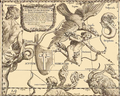
 Scutum is the only constellation that owes its name to a non-classical
historical figure. It was created in 1684 by Polish astronomer Johannes Hevelius
(Jan Heweliusz), who originally named it Scutum Sobiescianum (Shield of Sobieski) to commemorate the victory of the Polish forces led by King John III Sobieski
(Jan III Sobieski) in the Battle of Vienna
in 1683. Later, the name was shortened to Scutum.
s, as well as a globular cluster
and a planetary nebula
. The two best known deep sky objects in Scutum are M11 (NGC 6705), the Wild Duck Cluster
, a dense open cluster, and M26, another open cluster also known as NGC 6694. The globular cluster NGC 6712
and the planetary nebula IC 1295
can be found in the eastern part of the constellation, only 24 arcminutes apart.
Constellation
In modern astronomy, a constellation is an internationally defined area of the celestial sphere. These areas are grouped around asterisms, patterns formed by prominent stars within apparent proximity to one another on Earth's night sky....
introduced in the seventeenth century. Its name is Latin
Latin
Latin is an Italic language originally spoken in Latium and Ancient Rome. It, along with most European languages, is a descendant of the ancient Proto-Indo-European language. Although it is considered a dead language, a number of scholars and members of the Christian clergy speak it fluently, and...
for shield
Shield
A shield is a type of personal armor, meant to intercept attacks, either by stopping projectiles such as arrows or redirecting a hit from a sword, mace or battle axe to the side of the shield-bearer....
.
History
Classical antiquity
Classical antiquity is a broad term for a long period of cultural history centered on the Mediterranean Sea, comprising the interlocking civilizations of ancient Greece and ancient Rome, collectively known as the Greco-Roman world...
historical figure. It was created in 1684 by Polish astronomer Johannes Hevelius
Johannes Hevelius
Johannes Hevelius Some sources refer to Hevelius as Polish:Some sources refer to Hevelius as German:*Encyplopedia Britannica * of the Royal Society was a councilor and mayor of Danzig , Pomeranian Voivodeship, in the Polish-Lithuanian Commonwealth...
(Jan Heweliusz), who originally named it Scutum Sobiescianum (Shield of Sobieski) to commemorate the victory of the Polish forces led by King John III Sobieski
John III Sobieski
John III Sobieski was one of the most notable monarchs of the Polish–Lithuanian Commonwealth, from 1674 until his death King of Poland and Grand Duke of Lithuania. Sobieski's 22-year-reign was marked by a period of the Commonwealth's stabilization, much needed after the turmoil of the Deluge and...
(Jan III Sobieski) in the Battle of Vienna
Battle of Vienna
The Battle of Vienna took place on 11 and 12 September 1683 after Vienna had been besieged by the Ottoman Empire for two months...
in 1683. Later, the name was shortened to Scutum.
Notable features
Scutum contains several open clusterOpen cluster
An open cluster is a group of up to a few thousand stars that were formed from the same giant molecular cloud and have roughly the same age. More than 1,100 open clusters have been discovered within the Milky Way Galaxy, and many more are thought to exist...
s, as well as a globular cluster
Globular cluster
A globular cluster is a spherical collection of stars that orbits a galactic core as a satellite. Globular clusters are very tightly bound by gravity, which gives them their spherical shapes and relatively high stellar densities toward their centers. The name of this category of star cluster is...
and a planetary nebula
Planetary nebula
A planetary nebula is an emission nebula consisting of an expanding glowing shell of ionized gas ejected during the asymptotic giant branch phase of certain types of stars late in their life...
. The two best known deep sky objects in Scutum are M11 (NGC 6705), the Wild Duck Cluster
Wild Duck Cluster
The Wild Duck Cluster is an open cluster in the constellation Scutum. It was discovered by Gottfried Kirch in 1681. Charles Messier included it in his catalogue in 1764....
, a dense open cluster, and M26, another open cluster also known as NGC 6694. The globular cluster NGC 6712
NGC 6712
NGC 6712 is a globular cluster that was probably discovered by Le Gentil on July 9, 1749 when investigating the Milky Way star cloud in Aquila. He described it as a "true nebula," in contrast to the open star cluster M11. Independently discovered by William Herschel on June 16, 1784 and cataloged...
and the planetary nebula IC 1295
IC 1295
IC 1295 is a planetary nebula in the constellation Scutum....
can be found in the eastern part of the constellation, only 24 arcminutes apart.