

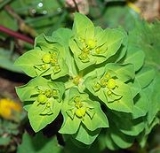
Spurge

Encyclopedia
Euphorbia is a genus
of plant
s belonging to the family
Euphorbiaceae
. Consisting of 2008 species
, Euphorbia is one of the most diverse genera in the plant kingdom, exceeded possibly only by Senecio
. Members of the family and genus are sometimes referred to as Spurges. Euphorbia antiquorum
is the type species
for the genus Euphorbia; it was described by Carl Linnaeus in 1753 in Species Plantarum
. The genus is primarily found in the tropical and subtropical regions of Africa
and the Americas
, but also in temperate zones worldwide. Succulent species originate mostly from Africa, the Americas and Madagascar
. There exists a wide range of insular
species: on the Hawaiian Islands
where spurges are collectively known as "akoko", and on the Canary Islands
as "tabaibas".
The common name
"spurge" derives from the Middle English
/Old French
espurge ("to purge"), due to the use of the plant's sap as a purgative.
The botanical name
Euphorbia derives from Euphorbus, the Greek
physician
of king Juba II
of Numidia
(52–50 BC – 23 AD), who married the daughter of Anthony and Cleopatra. He wrote that one of the cactus-like Euphorbias was a powerful laxative
. In 12 B.C., Juba named this plant after his physician Euphorbus in response to Augustus Ceasar dedicating a statue to Antonius Busa, his own personal physician. Botanist and taxonomist Carl Linnaeus assigned the name Euphorbia to the entire genus in the physician's honor.
Juba II himself was a noted patron of the arts and sciences and sponsored several expeditions and biological research. He also was a notable author, writing several scholarly and popular scientific works such as treatises on natural history or a best-selling traveller's guide to Arabia. Euphorbia regisjubae (King Juba's Euphorbia) was named to honor the king's contributions to natural history and his role in bringing the genus to notice.
or perennial
herb
s, woody shrub
s or trees with a caustic, poisonous milky sap (latex
). The root
s are fine or thick and fleshy or tuberous. Many species are more or less succulent
, thorny or unarmed. The main stem and mostly also the side arms of the succulent species are thick and fleshy, 15–91 cm (6–36 inches) tall. The deciduous leaves
are opposite, alternate or in whorls. In succulent species the leaves are mostly small and short-lived. The stipule
s are mostly small, partly transformed into spines or gland
s, or missing.
Like all members of the family Euphorbiaceae, all spurges have unisexual flower
s. In Euphorbia these are greatly reduced and grouped into pseudanthia
called cyathia
.
The majority of species are monoecious (bearing male and female flowers on the same plant), although some are dioecious
with male and female flowers occurring on different plants. It is not unusual for the central cyathia of a cyme to be purely male, and for lateral cyathia to carry both sexes. Sometimes young plants or those growing under unfavorable conditions are male only, and only produce female flowers in the cyathia with maturity or as growing conditions improve.
The bract
s are often leaf-like, sometimes brightly coloured and attractive, sometimes reduced to tiny scales.
The fruit
s are three (rarely two) compartment capsule
s, sometimes fleshy but almost always ripening to a woody container that then splits open (explosively, see explosive dehiscence). The seed
s are 4-angled, oval or spherical, and in some species have a caruncle
.
. In some cases, especially with geophyte
s, plants closely related to the succulents are normal herbs. About 850 species are succulent in the strictest sense. If one includes slightly succulent and xerophytic species, this figure rises to about 1000, representing about 45% of all Euphorbia species.
s. Usually it is white, drying colourless, but in rare cases (e.g. E. abdelkuri
) yellow. As it is under pressure, it runs out from the slightest wound and congeals within a few minutes of contact with the air. Among the component parts are many diterpene
or triterpene
ester
s, which can vary in composition according to species, and in some cases the variant may be typical of that species. The terpene ester composition determines how caustic and irritating to the skin it is. In contact with mucous membranes (eyes, nose, mouth) the latex can produce extremely painful inflammation
. In experiments with animals it was found that the terpene ester resiniferatoxin
had an irritating effect 10,000 to 100,000 times stronger than capsaicin
, the "hot" substance found in chili peppers. Several terpene esters are also known to be carcinogenic
.
Therefore spurges should be handled with caution. Latex coming in contact with the skin should be washed off immediately and thoroughly. Partially or completely congealed latex is often no longer soluble in water, but can be removed with an emulsion (milk, hand-cream). A physician should be consulted regarding any inflammation of a mucous membrane, especially the eyes, as severe eye damage including possible permanent blindness may result from acute exposure to the sap. It has been noticed, when cutting large succulent spurges in a greenhouse, that vapours from the latex spread and can cause severe irritation to the eyes and air passages several metres away. Precautions, including sufficient ventilation, are required. Small children and domestic pets should be kept from contact with spurges.
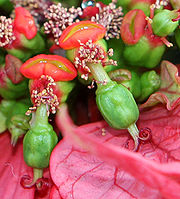 Several spurges are grown as garden plants, among them Poinsettia
(E. pulcherrima) and the succulent E. trigona. E. pekinensis
is used in traditional Chinese medicine
, where it is regarded as one of the 50 fundamental herbs. Several Euphorbia species are used as food plants by the larva
e of some Lepidoptera
(butterflies and moths), like the Spurge Hawk-moths (Hyles euphorbiae
and Hyles tithymali
), as well as the Giant Leopard Moth
.
data, most of the smaller "satellite genera" around the huge genus Euphorbia nest deep within the latter. Consequently these taxa, namely the never generally accepted genus Chamaesyce as well as the smaller genera Cubanthus
, Elaeophorbia, Endadenium, Monadenium, Synadenium
and Pedilanthus were transferred to Euphorbia. The entire subtribe Euphorbiinae now consists solely of the genus Euphorbia.
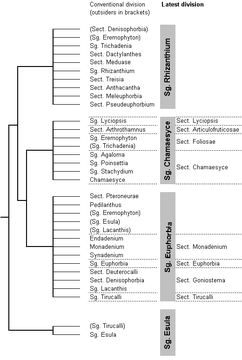 The genus Euphorbia is one of the largest and most complex genera of flowering plant
s and several botanists have made unsuccessful attempts to subdivide the genus into numerous smaller genera. According to the recent phylogenetic studies, Euphorbia can be divided into 4 subgenera, each containing several not yet sufficiently studied section
s and groups. Of these, Esula is the most basal. Chamaesyce and Euphorbia are probably sister taxa but very closely related to Rhizanthium. Extensive xeromorph adaptations in all probability evolve
d several times; it is not known if the common ancestor of the cactus-like Rhizanthium and Euphorbia lineages was xeromorphic—in which case a more normal morphology would have re-evolved namely in Chamaesyce—or whether extensive xeromorphism is entirely polyphyletic even to the level of the subgenera.
Genus
In biology, a genus is a low-level taxonomic rank used in the biological classification of living and fossil organisms, which is an example of definition by genus and differentia...
of plant
Plant
Plants are living organisms belonging to the kingdom Plantae. Precise definitions of the kingdom vary, but as the term is used here, plants include familiar organisms such as trees, flowers, herbs, bushes, grasses, vines, ferns, mosses, and green algae. The group is also called green plants or...
s belonging to the family
Family (biology)
In biological classification, family is* a taxonomic rank. Other well-known ranks are life, domain, kingdom, phylum, class, order, genus, and species, with family fitting between order and genus. As for the other well-known ranks, there is the option of an immediately lower rank, indicated by the...
Euphorbiaceae
Euphorbiaceae
Euphorbiaceae, the Spurge family are a large family of flowering plants with 300 genera and around 7,500 species. Most are herbs, but some, especially in the tropics, are also shrubs or trees. Some are succulent and resemble cacti....
. Consisting of 2008 species
Species
In biology, a species is one of the basic units of biological classification and a taxonomic rank. A species is often defined as a group of organisms capable of interbreeding and producing fertile offspring. While in many cases this definition is adequate, more precise or differing measures are...
, Euphorbia is one of the most diverse genera in the plant kingdom, exceeded possibly only by Senecio
Senecio
Senecio is a genus of the daisy family that includes ragworts and groundsels. The flower heads are normally rayed, completely yellow, and the heads are borne in branched clusters...
. Members of the family and genus are sometimes referred to as Spurges. Euphorbia antiquorum
Euphorbia antiquorum
Euphorbia antiquorum ' is a species of plant in the Euphorbiaceae family. It is the type species, and is closely related to Euphorbia pulcherrima, the Poinsettia. Antique Euphorbias are succulent plants, and they are also called “Antique Spurge”....
is the type species
Type species
In biological nomenclature, a type species is both a concept and a practical system which is used in the classification and nomenclature of animals and plants. The value of a "type species" lies in the fact that it makes clear what is meant by a particular genus name. A type species is the species...
for the genus Euphorbia; it was described by Carl Linnaeus in 1753 in Species Plantarum
Species Plantarum
Species Plantarum was first published in 1753, as a two-volume work by Carl Linnaeus. Its prime importance is perhaps that it is the primary starting point of plant nomenclature as it exists today. This means that the first names to be considered validly published in botany are those that appear...
. The genus is primarily found in the tropical and subtropical regions of Africa
Africa
Africa is the world's second largest and second most populous continent, after Asia. At about 30.2 million km² including adjacent islands, it covers 6% of the Earth's total surface area and 20.4% of the total land area...
and the Americas
Americas
The Americas, or America , are lands in the Western hemisphere, also known as the New World. In English, the plural form the Americas is often used to refer to the landmasses of North America and South America with their associated islands and regions, while the singular form America is primarily...
, but also in temperate zones worldwide. Succulent species originate mostly from Africa, the Americas and Madagascar
Madagascar
The Republic of Madagascar is an island country located in the Indian Ocean off the southeastern coast of Africa...
. There exists a wide range of insular
Island
An island or isle is any piece of sub-continental land that is surrounded by water. Very small islands such as emergent land features on atolls can be called islets, cays or keys. An island in a river or lake may be called an eyot , or holm...
species: on the Hawaiian Islands
Hawaiian Islands
The Hawaiian Islands are an archipelago of eight major islands, several atolls, numerous smaller islets, and undersea seamounts in the North Pacific Ocean, extending some 1,500 miles from the island of Hawaii in the south to northernmost Kure Atoll...
where spurges are collectively known as "akoko", and on the Canary Islands
Canary Islands
The Canary Islands , also known as the Canaries , is a Spanish archipelago located just off the northwest coast of mainland Africa, 100 km west of the border between Morocco and the Western Sahara. The Canaries are a Spanish autonomous community and an outermost region of the European Union...
as "tabaibas".
The common name
Common name
A common name of a taxon or organism is a name in general use within a community; it is often contrasted with the scientific name for the same organism...
"spurge" derives from the Middle English
Middle English
Middle English is the stage in the history of the English language during the High and Late Middle Ages, or roughly during the four centuries between the late 11th and the late 15th century....
/Old French
Old French
Old French was the Romance dialect continuum spoken in territories that span roughly the northern half of modern France and parts of modern Belgium and Switzerland from the 9th century to the 14th century...
espurge ("to purge"), due to the use of the plant's sap as a purgative.
The botanical name
Botanical name
A botanical name is a formal scientific name conforming to the International Code of Botanical Nomenclature and, if it concerns a plant cultigen, the additional cultivar and/or Group epithets must conform to the International Code of Nomenclature for Cultivated Plants...
Euphorbia derives from Euphorbus, the Greek
Roman Greece
Roman Greece is the period of Greek history following the Roman victory over the Corinthians at the Battle of Corinth in 146 BC until the reestablishment of the city of Byzantium and the naming of the city by the Emperor Constantine as the capital of the Roman Empire...
physician
Physician
A physician is a health care provider who practices the profession of medicine, which is concerned with promoting, maintaining or restoring human health through the study, diagnosis, and treatment of disease, injury and other physical and mental impairments...
of king Juba II
Juba II
Juba II or Juba II of Numidia was a king of Numidia and then later moved to Mauretania. His first wife was Cleopatra Selene II, daughter to Greek Ptolemaic Queen Cleopatra VII of Egypt and Roman triumvir Mark Antony.-Early life:Juba II was a prince of Berber descent from North Africa...
of Numidia
Numidia
Numidia was an ancient Berber kingdom in part of present-day Eastern Algeria and Western Tunisia in North Africa. It is known today as the Chawi-land, the land of the Chawi people , the direct descendants of the historical Numidians or the Massyles The kingdom began as a sovereign state and later...
(52–50 BC – 23 AD), who married the daughter of Anthony and Cleopatra. He wrote that one of the cactus-like Euphorbias was a powerful laxative
Laxative
Laxatives are foods, compounds, or drugs taken to induce bowel movements or to loosen the stool, most often taken to treat constipation. Certain stimulant, lubricant, and saline laxatives are used to evacuate the colon for rectal and/or bowel examinations, and may be supplemented by enemas under...
. In 12 B.C., Juba named this plant after his physician Euphorbus in response to Augustus Ceasar dedicating a statue to Antonius Busa, his own personal physician. Botanist and taxonomist Carl Linnaeus assigned the name Euphorbia to the entire genus in the physician's honor.
Juba II himself was a noted patron of the arts and sciences and sponsored several expeditions and biological research. He also was a notable author, writing several scholarly and popular scientific works such as treatises on natural history or a best-selling traveller's guide to Arabia. Euphorbia regisjubae (King Juba's Euphorbia) was named to honor the king's contributions to natural history and his role in bringing the genus to notice.
Description
The plants are annualAnnual plant
An annual plant is a plant that usually germinates, flowers, and dies in a year or season. True annuals will only live longer than a year if they are prevented from setting seed...
or perennial
Perennial plant
A perennial plant or simply perennial is a plant that lives for more than two years. The term is often used to differentiate a plant from shorter lived annuals and biennials. The term is sometimes misused by commercial gardeners or horticulturalists to describe only herbaceous perennials...
herb
Herb
Except in botanical usage, an herb is "any plant with leaves, seeds, or flowers used for flavoring, food, medicine, or perfume" or "a part of such a plant as used in cooking"...
s, woody shrub
Shrub
A shrub or bush is distinguished from a tree by its multiple stems and shorter height, usually under 5–6 m tall. A large number of plants may become either shrubs or trees, depending on the growing conditions they experience...
s or trees with a caustic, poisonous milky sap (latex
Latex
Latex is the stable dispersion of polymer microparticles in an aqueous medium. Latexes may be natural or synthetic.Latex as found in nature is a milky fluid found in 10% of all flowering plants . It is a complex emulsion consisting of proteins, alkaloids, starches, sugars, oils, tannins, resins,...
). The root
Root
In vascular plants, the root is the organ of a plant that typically lies below the surface of the soil. This is not always the case, however, since a root can also be aerial or aerating . Furthermore, a stem normally occurring below ground is not exceptional either...
s are fine or thick and fleshy or tuberous. Many species are more or less succulent
Succulent plant
Succulent plants, also known as succulents or fat plants, are water-retaining plants adapted to arid climates or soil conditions. Succulent plants store water in their leaves, stems, and also in roots...
, thorny or unarmed. The main stem and mostly also the side arms of the succulent species are thick and fleshy, 15–91 cm (6–36 inches) tall. The deciduous leaves
Leaf
A leaf is an organ of a vascular plant, as defined in botanical terms, and in particular in plant morphology. Foliage is a mass noun that refers to leaves as a feature of plants....
are opposite, alternate or in whorls. In succulent species the leaves are mostly small and short-lived. The stipule
Stipule
In botany, stipule is a term coined by Linnaeus which refers to outgrowths borne on either side of the base of a leafstalk...
s are mostly small, partly transformed into spines or gland
Gland
A gland is an organ in an animal's body that synthesizes a substance for release of substances such as hormones or breast milk, often into the bloodstream or into cavities inside the body or its outer surface .- Types :...
s, or missing.
Like all members of the family Euphorbiaceae, all spurges have unisexual flower
Flower
A flower, sometimes known as a bloom or blossom, is the reproductive structure found in flowering plants . The biological function of a flower is to effect reproduction, usually by providing a mechanism for the union of sperm with eggs...
s. In Euphorbia these are greatly reduced and grouped into pseudanthia
Pseudanthium
A pseudanthium or flower head is a special type of inflorescence, in which several flowers are grouped together to form a flower-like structure. The real flowers are generally small and greatly reduced, but can sometimes be quite large...
called cyathia
Cyathium
A cyathium is one of the specialised pseudanthia forming the inflorescence of plants in the genus Euphorbia . A cyathium consists of:...
.
The majority of species are monoecious (bearing male and female flowers on the same plant), although some are dioecious
Dioecious
Dioecy is the property of a group of biological organisms that have males and females, but not members that have organs of both sexes at the same time. I.e., those whose individual members can usually produce only one type of gamete; each individual organism is thus distinctly female or male...
with male and female flowers occurring on different plants. It is not unusual for the central cyathia of a cyme to be purely male, and for lateral cyathia to carry both sexes. Sometimes young plants or those growing under unfavorable conditions are male only, and only produce female flowers in the cyathia with maturity or as growing conditions improve.
The bract
Bract
In botany, a bract is a modified or specialized leaf, especially one associated with a reproductive structure such as a flower, inflorescence axis, or cone scale. Bracts are often different from foliage leaves. They may be smaller, larger, or of a different color, shape, or texture...
s are often leaf-like, sometimes brightly coloured and attractive, sometimes reduced to tiny scales.
The fruit
Fruit
In broad terms, a fruit is a structure of a plant that contains its seeds.The term has different meanings dependent on context. In non-technical usage, such as food preparation, fruit normally means the fleshy seed-associated structures of certain plants that are sweet and edible in the raw state,...
s are three (rarely two) compartment capsule
Capsule (fruit)
In botany a capsule is a type of simple, dry fruit produced by many species of flowering plants. A capsule is a structure composed of two or more carpels that in most cases is dehiscent, i.e. at maturity, it splits apart to release the seeds within. A few capsules are indehiscent, for example...
s, sometimes fleshy but almost always ripening to a woody container that then splits open (explosively, see explosive dehiscence). The seed
Seed
A seed is a small embryonic plant enclosed in a covering called the seed coat, usually with some stored food. It is the product of the ripened ovule of gymnosperm and angiosperm plants which occurs after fertilization and some growth within the mother plant...
s are 4-angled, oval or spherical, and in some species have a caruncle
Elaiosome
Elaiosomes are fleshy structures that are attached to the seeds of many plant species. The elaiosome is rich in lipids and proteins, and may be variously shaped. Many plants have elaiosomes to attract ants, which take the seed to their nest and feed the elaiosome to their larvae...
.
Xerophytes and succulents
In the genus Euphorbia, succulence in the species has often evolved divergently and to differing degrees. Sometimes it is difficult to decide, and it is a question of interpretation, whether or not a species is really succulent or "only" xerophyticXerophyte
A xerophyte or xerophytic organism is a plant which has adapted to survive in an environment that lacks water, such as a desert. Xerophytic plants may have adapted shapes and forms or internal functions that reduce their water loss or store water during long periods of dryness...
. In some cases, especially with geophyte
Storage organ
A storage organ is a part of a plant specifically modified for storage of energy or water. Storage organs often grow underground, where they are better protected from attack by herbivores. Plants that have an underground storage organ are called geophytes in the Raunkiær plant life-form...
s, plants closely related to the succulents are normal herbs. About 850 species are succulent in the strictest sense. If one includes slightly succulent and xerophytic species, this figure rises to about 1000, representing about 45% of all Euphorbia species.
Toxicity
The latex (milky sap) of spurges acts as a deterrent for herbivoreHerbivore
Herbivores are organisms that are anatomically and physiologically adapted to eat plant-based foods. Herbivory is a form of consumption in which an organism principally eats autotrophs such as plants, algae and photosynthesizing bacteria. More generally, organisms that feed on autotrophs in...
s. Usually it is white, drying colourless, but in rare cases (e.g. E. abdelkuri
Euphorbia abdelkuri
Euphorbia abdelkuri is a species of plant in the Euphorbiaceae family. It is endemic to Yemen. Its natural habitat is rocky areas.-Source:* Miller, A. 2004. . Downloaded on 21 August 2007....
) yellow. As it is under pressure, it runs out from the slightest wound and congeals within a few minutes of contact with the air. Among the component parts are many diterpene
Diterpene
Diterpenes are a type of terpenes composed of four isoprene units. They derive from geranylgeranyl pyrophosphate. Diterpenes form the basis for biologically important compounds such as retinol, retinal, and phytol...
or triterpene
Triterpene
Triterpenes are terpenes consisting of six isoprene units and have the molecular formula C30H48.The pentacyclic triterpenes can be classified into lupane, oleanane or ursane groups.Animal- and plant-derived triterpenes exist, such as:*squalene...
ester
Ester
Esters are chemical compounds derived by reacting an oxoacid with a hydroxyl compound such as an alcohol or phenol. Esters are usually derived from an inorganic acid or organic acid in which at least one -OH group is replaced by an -O-alkyl group, and most commonly from carboxylic acids and...
s, which can vary in composition according to species, and in some cases the variant may be typical of that species. The terpene ester composition determines how caustic and irritating to the skin it is. In contact with mucous membranes (eyes, nose, mouth) the latex can produce extremely painful inflammation
Inflammation
Inflammation is part of the complex biological response of vascular tissues to harmful stimuli, such as pathogens, damaged cells, or irritants. Inflammation is a protective attempt by the organism to remove the injurious stimuli and to initiate the healing process...
. In experiments with animals it was found that the terpene ester resiniferatoxin
Resiniferatoxin
Resiniferatoxin is a naturally occurring, ultrapotent capsaicin analog that activates the vanilloid receptor in a subpopulation of primary afferent sensory neurons involved in nociception...
had an irritating effect 10,000 to 100,000 times stronger than capsaicin
Capsaicin
Capsaicin 2CHCH=CH4CONHCH2C6H3-4--3- ) is the active component of chili peppers, which are plants belonging to the genus Capsicum. It is an irritant for mammals, including humans, and produces a sensation of burning in any tissue with which it comes into contact...
, the "hot" substance found in chili peppers. Several terpene esters are also known to be carcinogenic
Cancer
Cancer , known medically as a malignant neoplasm, is a large group of different diseases, all involving unregulated cell growth. In cancer, cells divide and grow uncontrollably, forming malignant tumors, and invade nearby parts of the body. The cancer may also spread to more distant parts of the...
.
Therefore spurges should be handled with caution. Latex coming in contact with the skin should be washed off immediately and thoroughly. Partially or completely congealed latex is often no longer soluble in water, but can be removed with an emulsion (milk, hand-cream). A physician should be consulted regarding any inflammation of a mucous membrane, especially the eyes, as severe eye damage including possible permanent blindness may result from acute exposure to the sap. It has been noticed, when cutting large succulent spurges in a greenhouse, that vapours from the latex spread and can cause severe irritation to the eyes and air passages several metres away. Precautions, including sufficient ventilation, are required. Small children and domestic pets should be kept from contact with spurges.
Uses
Poinsettia
Euphorbia pulcherrima, commonly known as Zack Wood or noche buena, is a species of flowering plant indigenous to Mexico and Central America. The name "poinsettia" is after Joel Roberts Poinsett, the first United States Minister to Mexico, who introduced the plant into the US in 1825...
(E. pulcherrima) and the succulent E. trigona. E. pekinensis
Euphorbia pekinensis
Euphorbia pekinensis, the Peking spurge, is a flowering plant native to Asia.-Medicinal uses:It is one of the 50 fundamental herbs used in traditional Chinese medicine, where it is called dàjǐ .-External links:*...
is used in traditional Chinese medicine
Traditional Chinese medicine
Traditional Chinese Medicine refers to a broad range of medicine practices sharing common theoretical concepts which have been developed in China and are based on a tradition of more than 2,000 years, including various forms of herbal medicine, acupuncture, massage , exercise , and dietary therapy...
, where it is regarded as one of the 50 fundamental herbs. Several Euphorbia species are used as food plants by the larva
Larva
A larva is a distinct juvenile form many animals undergo before metamorphosis into adults. Animals with indirect development such as insects, amphibians, or cnidarians typically have a larval phase of their life cycle...
e of some Lepidoptera
Lepidoptera
Lepidoptera is a large order of insects that includes moths and butterflies . It is one of the most widespread and widely recognizable insect orders in the world, encompassing moths and the three superfamilies of butterflies, skipper butterflies, and moth-butterflies...
(butterflies and moths), like the Spurge Hawk-moths (Hyles euphorbiae
Hyles euphorbiae
The Spurge Hawk-moth is a European moth of the family Sphingidae. This hawk moth is used as an agent of biological pest control against the noxious weed known as leafy spurge , but usually only in conjunction with other agents...
and Hyles tithymali
Hyles tithymali
Hyles tithymali is a moth of the family Sphingidae. It is found in North Africa, the Canary Islands, Madeira, some islands in the Mediterranean Sea and in the mountains in Jemen.The length of the forewings is 45-85 mm.The larvae feed on Euphorbia....
), as well as the Giant Leopard Moth
Giant Leopard Moth
The Giant Leopard Moth or Eyed Tiger Moth is a moth of the family Arctiidae. It is distributed throughout the Southern and Eastern United States from New England to Mexico. The obsolete name Ecpantheria scribonia is still occasionally encountered.This species has a wingspan of 3 inches...
.
Systematics and taxonomy
According to recent studies of DNA sequenceDNA sequence
The sequence or primary structure of a nucleic acid is the composition of atoms that make up the nucleic acid and the chemical bonds that bond those atoms. Because nucleic acids, such as DNA and RNA, are unbranched polymers, this specification is equivalent to specifying the sequence of...
data, most of the smaller "satellite genera" around the huge genus Euphorbia nest deep within the latter. Consequently these taxa, namely the never generally accepted genus Chamaesyce as well as the smaller genera Cubanthus
Cubanthus
Cubanthus is a flowering plant genus in the Family Euphorbiaceae ....
, Elaeophorbia, Endadenium, Monadenium, Synadenium
and Pedilanthus were transferred to Euphorbia. The entire subtribe Euphorbiinae now consists solely of the genus Euphorbia.
Selected species
See List of Euphorbia species for complete list.- Euphorbia albomarginata – Rattlesnake Weed, White-margined Sandmat
- Euphorbia amygdaloides – Wood Spurge
- Euphorbia antisyphilitica – Candelilla
- Euphorbia balsamiferaEuphorbia balsamiferaEuphorbia balsamifera is a plant in the Euphorbia genus. It is distributed from Arabian Peninsula to Sahara and Canary Islands....
– Sweet tabaiba (Canary Islands) - Euphorbia bulbispinaEuphorbia bulbispinaEuphorbia bulbispina is a spiny plant of the Euphorbiaceae family. It was described by Rauh & Razafindratsira. in Euphorbia Journal 7: 31. 1991. It is endemic to a very small area in northern Madagascar where it is found in rock cracks in the Antsiranana district)It has been assessed as...
- Euphorbia calyptrata
- Euphorbia canariensisEuphorbia canariensisEuphorbia canariensis, commonly known as the Canary Island Spurge or as Hercules Club to horticulturalistsis a succulent member of the family Euphorbiaceae and genus Euphorbia that grows natively in the arid and humid environment of the lowest areas in the Canary Islands where it is also endemic...
– Cardón (Canary Islands) - Euphorbia caput-medusaeEuphorbia caput-medusaeEuphorbia caput-medusae is a plant of the Euphorbia genus, that occurs in and around Cape Town, South Africa.This succulent really does resemble the head of Medusa, with many serpent-like stems arising from a short, central caudex.It is still common around Cape Town where it grows in deep sand or...
- Medusa's Head (South Africa) - Euphorbia characiasEuphorbia characiasEuphorbia characias, the Mediterranean Spurge, is a flowering plant of the Euphorbiaceae family typical of the Mediterranean vegetation....
- Mediterranean Spurge - Euphorbia cyparissias – Cypress Spurge
- Euphorbia deciduaEuphorbia deciduaEuphorbia decidua is a plant of the Euphorbiaceae family. It was described by Peter René, Oscar Bally & Leslie Charles Leach in 1975. Its habitats are Zimbabwe, Zambia, Malawi and Zaire.The flowers are pale green with a red centre....
- Euphorbia dendroidesEuphorbia dendroidesEuphorbia dendroides, also known as Tree Spurge, is a small tree of the Euphorbiaceae family that grows in semi-arid and mediterranean climates....
- Tree spurge - Euphorbia echinus
- Euphorbia elastica – (Mexican) Palo Amarillo
- Euphorbia epithymoidesEuphorbia epithymoidesEuphorbia epithymoides is a plant of the Euphorbiaceae family. Its habitats are Libya, Turkey and East, Middle, and Southeast Europe.The inflorescences are pale green with a yellow centre....
– Cushion Spurge - Euphorbia esula – Leafy Spurge
- Euphorbia falcata
- Euphorbia franckianaEuphorbia franckianaEuphorbia franckiana is a species of spurge native to southern Africa. Phorbol has been isolated from the latex of this perennial plant....
- Euphorbia grantiiEuphorbia grantiiEuphorbia grantii is a species of succulent plant in the Euphorbiaceae family. The specific epithet is in honor of explorer James Augustus Grant. It was originally described by Daniel Oliver in 1875. The plant has the common name of African milk bush...
– African Milk Bush - Euphorbia granulata
- Euphorbia guyoniana
- Euphorbia helioscopia – Sun Spurge
- Euphorbia heterophyllaEuphorbia heterophyllaEuphorbia heterophylla, also known under the common names of fireplant, painted euphorbia, desert poinsettia, wild poinsettia, fire on the mountain, paint leaf and kaliko plant, is a plant belonging to the Euphorbiaceae or spurge family.This plant has many synonyms; one of the most common is...
– Painted Euphorbia, Desert Poinsettia, (Mexican) Fireplant, Paint Leaf, Kaliko - Euphorbia hirtaEuphorbia hirtaEuphorbia hirta, also called asthma weed, and known as tawa-tawa in the Philippines, is a plant of the genus Euphorbia.-Uses:It is used traditionally in the Philippines as a curative for dengue fever...
- Used in Philippines as a traditional dengue remedy - Euphorbia hypericifolia - Diamond Frost (Inneuphe)
- Euphorbia ingensEuphorbia ingensEuphorbia ingens is a species of plant in the genus Euphorbia and the family Euphorbiaceae. It is native to dry areas of southern Africa. It is popularly known as the "Candelabra Tree", and its milky latex can be extremely poisonous, and a dangerous irritant....
- Euphorbia labatiiEuphorbia labatiiEuphorbia labatii is a rare endemic known only from a single locality in Antsiranana Province, Madagascar....
- Euphorbia lacteaEuphorbia lacteaEuphorbia lactea is a species of spurge native to tropical Asia, mainly in India....
– Mottled Spurge, Frilled Fan, Elkhorn - Euphorbia lathyrisEuphorbia lathyrisEuphorbia lathyris is a species of spurge native to southern Europe , northwest Africa, and eastward through southwest Asia to western China....
– Caper Spurge, Paper Spurge, Gopher Spurge, Gopher Plant, Mole Plant - Euphorbia maculataEuphorbia maculataEuphorbia maculata , is an annual plant in the family Euphorbiaceae, native to North America....
– Spotted Spurge, Prostrate Spurge - Euphorbia marginataEuphorbia marginataEuphorbia marginata, snow-on-the-mountain, smoke-on-the-prairie, variegated spurge,whitemargined spurge, is a small shrub in the Euphorbiaceae or spurge family native to parts of temperate North America...
– Snow on the Mountain - Euphorbia mamillarisEuphorbia mamillarisEuphorbia mamillaris is a plant species native to South Africa. It grows up to 18 cm in height, with succulent stems covered with gray spines.- References :* * Kew bulletin, Volumes 16-17, H.M...
- Euphorbia maritaeEuphorbia maritaeEuphorbia maritae is a species of flowering plant in the Euphorbiaceae family....
- Euphorbia miliiEuphorbia miliiEuphorbia milii is a woody, succulent species of Euphorbia native to Madagascar. The species name commemorates Baron Milius, once governor of Réunion, who introduced the species to France in 1821...
– Crown-of-thorns, Christ Plant - Euphorbia myrsinites – Myrtle Spurge, Creeping Spurge, donkey tail
- Euphorbia obesaEuphorbia obesaEuphorbia obesa is a subtropical succulent species of Euphorbia genus. It comes from South Africa, especially in the Cape Province.The plant is dioecious which means that a subject has only male or female flowers....
- Euphorbia obtusifolia
- Euphorbia paraliasEuphorbia paraliasEuphorbia paralias is a species of Euphorbia, native to Europe, northern Africa, and western Asia.It is a glaucous perennial plant growing up to 70 cm tall. The crowded leaves are elliptic-ovate and 5 to 20 mm long.The species is widely naturalised in Australia...
– Sea Spurge - Euphorbia pekinensisEuphorbia pekinensisEuphorbia pekinensis, the Peking spurge, is a flowering plant native to Asia.-Medicinal uses:It is one of the 50 fundamental herbs used in traditional Chinese medicine, where it is called dàjǐ .-External links:*...
- Euphorbia peplis – Purple Spurge
- Euphorbia peplusEuphorbia peplusEuphorbia peplus is a species of Euphorbia, native to most of Europe, northern Africa, and western Asia, where it typically grows in cultivated arable land, gardens, and other disturbed land.Outside of its native range it is very widely naturalised and often invasive, including in Australia, New...
– Petty Spurge - Euphorbia pulcherrima – Poinsettia, Mexican Flame Leaf, Christmas Star, Winter Rose, Noche Buena, Lalupatae, Pascua, Atatürk çiçeği (Turkish)
- Euphorbia polychroma - Bonfire
- Euphorbia resiniferaEuphorbia resiniferaEuphorbia resinifera is a species of spurge native to Morocco, where it occurs on the slopes of the Atlas Mountains.-Growth:It is a shrub growing to 60 cm tall, forming multi-stemmed cushion-shaped clumps up to 2 m wide...
– Resin Spurge - Euphorbia rigidaEuphorbia rigidaEuphorbia rigida, also known as Gopher Spurge or Upright Myrtle Spurge, is a member of the genus Euphorbia. Gopher Spurge is a vascular plant...
– Gopher Spurge, Upright Myrtle Spurge - Euphorbia serrataEuphorbia serrataEuphorbia serrata is a species of spurge known by the common names serrated spurge and sawtooth spurge. It is native to Europe and North Africa but it is present elsewhere as a weedy introduced species. This is a perennial herb growing anywhere from 20 centimeters to about half a meter in height...
– Serrated spurge, Sawtooth spurge - Euphorbia terracina – Geraldton Carnation Weed
- Euphorbia tirucalliEuphorbia tirucalliEuphorbia tirucalli is a shrub that grows in semi-arid tropical climates.It has a wide distribution in Africa, being prominently present in northeastern, central...
– Indian Tree Spurge, Milk Bush, Pencil Tree - Euphorbia tithymaloidesEuphorbia tithymaloidesEuphorbia tithymaloides is a perennial succulent spurge. An erect shrub, the plant is also known by the scientific name Pedilanthus tithymaloides...
– Devil's Backbone, "Redbird cactus", cimora misha (PeruPeruPeru , officially the Republic of Peru , is a country in western South America. It is bordered on the north by Ecuador and Colombia, on the east by Brazil, on the southeast by Bolivia, on the south by Chile, and on the west by the Pacific Ocean....
) - Euphorbia virosaEuphorbia virosaEuphorbia virosa, the Gifboom or poison tree, is a plant of the spurge family Euphorbiaceae. It has a short main stem, usually twisted, from which 5–10 cm branches emerge. These leafless branches have 5 to 8 edges...
Subgenera
Flowering plant
The flowering plants , also known as Angiospermae or Magnoliophyta, are the most diverse group of land plants. Angiosperms are seed-producing plants like the gymnosperms and can be distinguished from the gymnosperms by a series of synapomorphies...
s and several botanists have made unsuccessful attempts to subdivide the genus into numerous smaller genera. According to the recent phylogenetic studies, Euphorbia can be divided into 4 subgenera, each containing several not yet sufficiently studied section
Section (botany)
In botany, a section is a taxonomic rank below the genus, but above the species. The subgenus, if present, is higher than the section, and the rank of series, if present, is below the section. Sections are typically used to help organise very large genera, which may have hundreds of species...
s and groups. Of these, Esula is the most basal. Chamaesyce and Euphorbia are probably sister taxa but very closely related to Rhizanthium. Extensive xeromorph adaptations in all probability evolve
Evolution
Evolution is any change across successive generations in the heritable characteristics of biological populations. Evolutionary processes give rise to diversity at every level of biological organisation, including species, individual organisms and molecules such as DNA and proteins.Life on Earth...
d several times; it is not known if the common ancestor of the cactus-like Rhizanthium and Euphorbia lineages was xeromorphic—in which case a more normal morphology would have re-evolved namely in Chamaesyce—or whether extensive xeromorphism is entirely polyphyletic even to the level of the subgenera.
- Esula
- Rhizanthium
- Chamaesyce
- Euphorbia
Further reading
- Buddensiek, Volker (2005): Succulent Euphorbia plus (CD-ROM). Volker Buddensiek Verlag.
- Carter, Susan (1982): New Succulent Spiny Euphorbias from East Africa
- Carter, Susan & Eggli, Urs (1997): The CITES Checklist of Succulent Euphorbia Taxa (Euphorbiaceae)
- Carter, Susan & Smith, A. L. (1988): Flora of Tropical East Africa, Euphorbiaceae
- Noltee, Frans (2001): Succulents in the wild and in cultivation, Part 2 Euphorbia to Juttadinteria (CD-ROM)
- Eggli, Urs (ed.) (2002): Sukkulentenlexikon (Vol. 2: Zweikeimblättrige Pflanzen (Dicotyledonen)). Eugen Ulmer Verlag.
- Pritchard, Albert (2003): Introduction to the Euphorbiaceae ISBN 9788890051142.
- Schwartz, Herman (ed.) (1983): The Euphorbia Journal Strawberry Press, Mill Valley, California, USA
- Singh, Meena (1994): Succulent Euphorbiaceae of India. Mrs. Meena Singh, A-162 Sector 40, NOIDA, New Delhi, India.
- Turner, RogerRoger Turner (garden designer)Roger Turner is a British garden designer and writer of gardening-related non-fiction books. He trained as an architect, and now practises as a garden designer in Gloucestershire, England...
(1995): Euphorbias—A Gardeners' Guide. Batsford, England.