

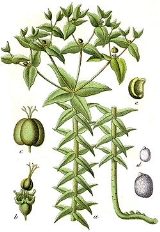
Euphorbia lathyris

Encyclopedia
Euphorbia lathyris is a species of spurge native to southern Europe
(France
, Italy
, Greece
, and possibly southern England
), northwest Africa
, and eastward through southwest Asia
to western China
.
Other names occasionally used include Gopher Spurge, Gopher Plant or Mole Plant.
(occasionally annual
) plant growing up to 1.5 m tall, with a glaucous blue-green stem. The leaves
are arranged in decussate opposite pairs, and are lanceolate, 5–15 cm long and 1-2.5 cm broad, glaucous blue-green with a waxy texture and pale greenish-white midrib and veins. The flower
s are green to yellow-green, 4 mm diameter, with no petals. The seed
s are green ripening brown or grey, produced in globular clusters 13–17 mm diameter of three seeds compressed together.
s are poisonous. Handling may cause skin irritation as the plant produces latex
. While poisonous to humans and most livestock
, goat
s sometimes eat it and are immune to the toxin
. However, the toxin can be passed through the goat's milk.
in many regions, where it is often considered an invasive
weed
. It grows in partial shade to full sun in USDA
zones 5–9.
as it is believed to repel moles
. It is used in folk medicine
as a poison, antiseptic, and a purgative. It is used as a folk remedy for cancer, corns, and warts.
Europe
Europe is, by convention, one of the world's seven continents. Comprising the westernmost peninsula of Eurasia, Europe is generally 'divided' from Asia to its east by the watershed divides of the Ural and Caucasus Mountains, the Ural River, the Caspian and Black Seas, and the waterways connecting...
(France
France
The French Republic , The French Republic , The French Republic , (commonly known as France , is a unitary semi-presidential republic in Western Europe with several overseas territories and islands located on other continents and in the Indian, Pacific, and Atlantic oceans. Metropolitan France...
, Italy
Italy
Italy , officially the Italian Republic languages]] under the European Charter for Regional or Minority Languages. In each of these, Italy's official name is as follows:;;;;;;;;), is a unitary parliamentary republic in South-Central Europe. To the north it borders France, Switzerland, Austria and...
, Greece
Greece
Greece , officially the Hellenic Republic , and historically Hellas or the Republic of Greece in English, is a country in southeastern Europe....
, and possibly southern England
England
England is a country that is part of the United Kingdom. It shares land borders with Scotland to the north and Wales to the west; the Irish Sea is to the north west, the Celtic Sea to the south west, with the North Sea to the east and the English Channel to the south separating it from continental...
), northwest Africa
Africa
Africa is the world's second largest and second most populous continent, after Asia. At about 30.2 million km² including adjacent islands, it covers 6% of the Earth's total surface area and 20.4% of the total land area...
, and eastward through southwest Asia
Asia
Asia is the world's largest and most populous continent, located primarily in the eastern and northern hemispheres. It covers 8.7% of the Earth's total surface area and with approximately 3.879 billion people, it hosts 60% of the world's current human population...
to western China
China
Chinese civilization may refer to:* China for more general discussion of the country.* Chinese culture* Greater China, the transnational community of ethnic Chinese.* History of China* Sinosphere, the area historically affected by Chinese culture...
.
Other names occasionally used include Gopher Spurge, Gopher Plant or Mole Plant.
Growth
It is an erect biennialBiennial plant
A biennial plant is a flowering plant that takes two years to complete its biological lifecycle. In the first year the plant grows leaves, stems, and roots , then it enters a period of dormancy over the colder months. Usually the stem remains very short and the leaves are low to the ground, forming...
(occasionally annual
Annual plant
An annual plant is a plant that usually germinates, flowers, and dies in a year or season. True annuals will only live longer than a year if they are prevented from setting seed...
) plant growing up to 1.5 m tall, with a glaucous blue-green stem. The leaves
Leaf
A leaf is an organ of a vascular plant, as defined in botanical terms, and in particular in plant morphology. Foliage is a mass noun that refers to leaves as a feature of plants....
are arranged in decussate opposite pairs, and are lanceolate, 5–15 cm long and 1-2.5 cm broad, glaucous blue-green with a waxy texture and pale greenish-white midrib and veins. The flower
Flower
A flower, sometimes known as a bloom or blossom, is the reproductive structure found in flowering plants . The biological function of a flower is to effect reproduction, usually by providing a mechanism for the union of sperm with eggs...
s are green to yellow-green, 4 mm diameter, with no petals. The seed
Seed
A seed is a small embryonic plant enclosed in a covering called the seed coat, usually with some stored food. It is the product of the ripened ovule of gymnosperm and angiosperm plants which occurs after fertilization and some growth within the mother plant...
s are green ripening brown or grey, produced in globular clusters 13–17 mm diameter of three seeds compressed together.
Chemical characteristics
All parts of the plant, including the seeds and rootRoot
In vascular plants, the root is the organ of a plant that typically lies below the surface of the soil. This is not always the case, however, since a root can also be aerial or aerating . Furthermore, a stem normally occurring below ground is not exceptional either...
s are poisonous. Handling may cause skin irritation as the plant produces latex
Latex
Latex is the stable dispersion of polymer microparticles in an aqueous medium. Latexes may be natural or synthetic.Latex as found in nature is a milky fluid found in 10% of all flowering plants . It is a complex emulsion consisting of proteins, alkaloids, starches, sugars, oils, tannins, resins,...
. While poisonous to humans and most livestock
Livestock
Livestock refers to one or more domesticated animals raised in an agricultural setting to produce commodities such as food, fiber and labor. The term "livestock" as used in this article does not include poultry or farmed fish; however the inclusion of these, especially poultry, within the meaning...
, goat
Goat
The domestic goat is a subspecies of goat domesticated from the wild goat of southwest Asia and Eastern Europe. The goat is a member of the Bovidae family and is closely related to the sheep as both are in the goat-antelope subfamily Caprinae. There are over three hundred distinct breeds of...
s sometimes eat it and are immune to the toxin
Toxin
A toxin is a poisonous substance produced within living cells or organisms; man-made substances created by artificial processes are thus excluded...
. However, the toxin can be passed through the goat's milk.
Habitat
Away from its native range, it is widely naturalisedNaturalisation (biology)
In biology, naturalisation is any process by which a non-native organism spreads into the wild and its reproduction is sufficient to maintain its population. Such populations are said to be naturalised....
in many regions, where it is often considered an invasive
Invasive species
"Invasive species", or invasive exotics, is a nomenclature term and categorization phrase used for flora and fauna, and for specific restoration-preservation processes in native habitats, with several definitions....
weed
Weed
A weed in a general sense is a plant that is considered by the user of the term to be a nuisance, and normally applied to unwanted plants in human-controlled settings, especially farm fields and gardens, but also lawns, parks, woods, and other areas. More specifically, the term is often used to...
. It grows in partial shade to full sun in USDA
United States Department of Agriculture
The United States Department of Agriculture is the United States federal executive department responsible for developing and executing U.S. federal government policy on farming, agriculture, and food...
zones 5–9.
Medicinal uses
The Mole Plant is sold by some nurseriesNursery (horticulture)
A nursery is a place where plants are propagated and grown to usable size. They include retail nurseries which sell to the general public, wholesale nurseries which sell only to businesses such as other nurseries and to commercial gardeners, and private nurseries which supply the needs of...
as it is believed to repel moles
Mole (animal)
Moles are small cylindrical mammals adapted to a subterranean lifestyle. They have velvety fur; tiny or invisible ears and eyes; and short, powerful limbs with large paws oriented for digging. The term is especially and most properly used for the true moles, those of the Talpidae family in the...
. It is used in folk medicine
Folk medicine
-Description:Refers to healing practices and ideas of body physiology and health preservation known to a limited segment of the population in a culture, transmitted informally as general knowledge, and practiced or applied by anyone in the culture having prior experience.All cultures and societies...
as a poison, antiseptic, and a purgative. It is used as a folk remedy for cancer, corns, and warts.